Author: shivamlohiya

  • Notes of Government Budget and the Economy Class 12 Chapter 5 Economics

    UNIT IX: GOVERNMENT BUDGET AND THE ECONOMY

    KEY CONCEPTS:

    • Meaning of the Budget
    • Objectives of the Budget
    • Components of the Budget
    • Budget Receipts
    • Budget Expenditure
    • Balanced, Surplus and Deficit Budgets
    • Types of Deficits

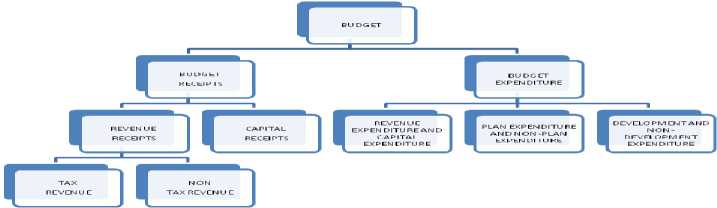
    GOVERNMENT BUDGET – A FLOW CHART
    1 MARK QUESTIONS AND ANSWERS

    1. Define a Budget.

    Ans: It is an annual statement of the estimated Receipts and Expenditures of the Government over the fiscal year which runs from April -I to March 31.

    1. Name the two broad divisions of the Budget.

    Ans: i) Revenue Budget

    1. Capital Budget
    2. What are the two Budget Receipts?

    Ans: i) Revenue Receipts

    1. Capital Receipts
    2. Name the two types of Revenue Receipts.

    Ans: i) Tax Revenue

    ii) Non-tax Revenue

    1. What are the two types of taxes?

    Ans: a) Direct Taxes: i) Income Tax, ii) Interest Tax, iii) Wealth Tax

    1. Indirect Taxes: i) Customs duties, ii) Excise duties, iii) Sales Tax
    2. What are the main items of Capital Receipts?

    Ans: a) Market Loans (loans raised by the government from the public)

    1. Borrowings by the Government
    2. Loans received from foreign governments and International financial Institutions.
    3. Give two examples of Developmental Expenditure.

    Ans: Plan expenditure of Railways and Posts

    1. Give two examples of Non-Developmental expenditures.

    Ans: i) Expenditure on defence ii) Interest payments

    1. Define Surplus Budget.

    Ans: A Surplus Budget is one where the estimated revenues are greater than the Estimated expenditures.

    1. What are the four different concepts of Budget Deficits?

    Ans: a) Budget Deficit

    1. Revenue Deficit
    2. Primary Deficit and
    3. Fiscal Deficit

    3 AND 4 MARK QUESTIONS AND ANSWERS

    1. Explain the objectives of the Government Budget.

    Ans: These below are the main objectives of the Government Budget.

    1. Activities to secure reallocation of resources: – The Government has to reallocate resources with social and economic considerations.
    2. Redistributive Activities: – The Government redistributes income and wealth to reduce inequalities.
    3. Stabilizing Activities: – The Government tries to prevent business fluctuations and maintain economic stability.
    4. Management of Public Enterprises: – Government undertakes commercial activities that are of the nature of natural Monopolies, heavy manufacturing etc., through its public enterprises.
    5. What are the components of the Budget?

    Ans: These below are the main components of the Government Budget. They are—

    1. Budget Receipts
    2. Budget Expenditure

    Budget receipts may be classified as:

    1. Revenue Receipts and
    2. Capital Receipts

    Revenue Receipts may be classified as:

    1. Tax Revenue and
    2. Non-tax Revenue

    Budget Expenditure may be classified as

    1. Revenue Expenditure and Capital Expenditure
    2. Plan Expenditure and Non-Plan Expenditure
    3. Developmental and Non-Developmental Expenditure
    4. Define Direct Taxes and Indirect taxes and give two examples each.
    5. Direct Tax: – These are those taxes levied immediately on the property and Income of persons, and those that are paid directly by the consumers to the state.

    Examples: Income Tax, Wealth Tax, Corporation Tax etc.

    1. Indirect Taxes: These are those taxes that affect the income and property of persons

    through their consumption expenditure. Indirect taxes are those taxes levied on one

    person but paid by another person.

    Examples: Customs duties, excise duties, sales tax, service tax etc.

    1. What are the Non-Tax Revenue receipts?

    Ans: These below are the Non-tax revenue receipts:

    1. Commercial Revenue: Examples-Payments for postage, toll, interest on funds borrowed from government credit corporations, electricity, Railway services.
    2. Interest and dividends
    3. Administrative revenue: Examples: Fees, fines, penalties etc.,
    4. What are the three major ways of Public Expenditure?

    Ans: These below are the three ways of Public Expenditure—

    1. Revenue Expenditure and Capital Expenditure
    2. Plan Expenditure and Non-Plan Expenditure
    3. Development and Non-developmental Expenditure.
    4. What do you mean by Revenue Expenditure and Capital Expenditure?

    Ans: i) Revenue Expenditure:- It is the expenditure incurred for the normal running of government departments and provision of various services like interest charges on debt, subsidies etc.,

    ii)Capital Expenditure:- It consists mainly of expenditure on acquisition of assets like land, building, machinery, equipment etc., and loans and advances granted by the Central Government to States & Union Territories.

    1. Define Balanced, Surplus and Deficit Budgets.

    Ans: a) Balanced Budget – It is one where the estimated revenue EQUALS the estimated expenditure.

    1. Surplus Budget:- It is one where the estimated revenue is GREATER THAN the estimated expenditures.
    2. Deficit Budget:- It is one where the estimated revenue is LESS THAN the estimated expenditure.
    3. Explain the four different concepts of Budget deficit.

    Ans: These are the four different concepts of Budget Deficit.

    1. Budget Deficit:- It is the difference between the total expenditure, current revenue and net internal and external capital receipts of the government.

    Formulae: B.D = BE > B.R (B.D= Budget Deficit, BE. Budget Expenditure B.R= Budget Revenue

    1. Fiscal Deficit:- It is the difference between the total expenditure of the government, the revenue receipts PLUS those capital receipts which finally accrue to the government. Formulae: F.D = B.E – B.R (B.E > B.R. other than borrowings) F.D=Fiscal Deficit,

    B.E= Budget Expenditure, B.R. = Budget Receipts.

    1. Revenue Deficit: – It is the excess of governments revenue expenditures over revenue receipts.

    Formulae: R.D= RE – R.R., When RE > R.R., R.D= Revenue Deficit, R.E= Revenue Expenditure, R.R. = Revenue Receipts.

    1. Primary Deficit: – It is the fiscal deficit MINUS Interest payments.

    Formulae: P.D= F.D – I.P, P.D= Primary Deficit, F.D= Fiscal Deficit, I.P= Interest Payment.

    06 MARK QUESATIONS AND ANSWERS

    1. How is tax revenue different from administrative revenue?

    Ans:

    1. Tax Revenue:-

    i) It is the main source of revenue of the government

    iil It is the revenue that arises on account of taxes levied by the government.

    1. Taxes of two types i.e., Direct and Indirect.
    2. Direct taxes are those taxes levied immediately on the property and income of

    persons. Examples: Income Tax, Corporate Tax, Wealth Tax etc., Incidence and impact falls on same person.

    1. Indirect taxes are those taxes levied on the production and sale of the goods.

    Examples: Sales Tax, Excise Duty etc. Tax paid by one person but burden taken by another person.

    1. Administrative Revenue:-

    i) It is the revenue that arises on account of the administrative function of the Government.

    ii) It includes-

    1. Fees
    2. License fees
    3. Fines and penalties
    4. Forfeitures of surety by courts
    5. Escheat – means claim of the government on the property of a person who dies without having any legal heirs.
    6. What is a balanced government budget? Explain the multiplier effect of a balanced budget. Ans:
    7. Balanced Budget: – It is one where the estimated revenue of the government equals the estimated expenditure.
    8. Effect of Multiplier on the BalancedBudget:-
    9. If only source of revenue is a lump sum tax, a balanced budget will then mean that the

    amount of tax equals the amount of expenditure (T=E)

    1. A balanced budget has an expansionary effect on the economy.
    2. Under balanced budget, the increase in income is equalent to the amount of

    government expenditure financed by tax revenue (i.e., A Y =AG/AT)

    1. The multiplier effect of a balanced budget is ONE (Unitary)
    2. A balanced budget is a good policy to bring the economy, which is under employment

    to a full employment equilibrium.

    HIGHER ORDER THINKING SKILLS (HOTS)

    1. What are the three levels at which the budget impacts the economy?

    Ans: These below are the three levels at which the budget impacts the economy.

    1. Aggregate fiscal discipline:- This means having control over expenditures, given the quantum of revenues. This is necessary for proper macro-economic performance.
    2. Allocation of resources: – The allocation of resources based on social priorities.
    3. Effective and efficient provision of programmes:- Effectiveness measures the extent to which goods and services the government provides its goals.

    NUMERICALS

    1. The following figures are based on budget estimates of Government of India for the year 2001 – 2002. Calculate i) Fiscal Deficit ii) Revenue Deficit and iii) Primary deficit.

    ITEMS

    RS. BILLIONS

    A) Revenue receipts

    2,31,745

    i) Tax Revenue

    1,63,031

    ii) Non-tax Revenue

    68,714

    B) Capital receipts

    1,43,478

    i) Recoveries of loans

    15,164

    ii) Other receipts

    12,000

    iii) Borrowings and other

    1,16,314

    liabilities


    C) Revenue expenditure

    3,10,566

    i) Interest payments

    1,12,300

    ii) Major subsidies

    27,845

    iii) Defence Expenditure

    1,70,421

    D) Capital Expenditure

    64,657

    E) Total Expenditure

    3,75,223

    i) Plan expenditure

    1,00,100

    ii) Non-plan expenditure

    2,75,123

    1. Ans: Fiscal Deficit = Total expenditure – Revenue receipts – Non-debt capital receipts = 3,75,223 – 2,31,745 – 15,164 – 12,000 = Rs. 1,16,314 billion.
    2. Revenue Deficit = Revenue expenditure – Revenue receipts

    = 3, 10,566 – 2, 31,745 = Rs. 78,821 billion.

    1. Primary deficit = Fiscal deficit – Interest payments

    = 1, 16,314 – 1, 12,300 = Rs. 4,014 billion.

    2. From the following data about a government budget find

    a) Revenue Deficit b) Fiscal Deficit and c) Primary Deficit.

    S.No.

    Items

    Rs. (cr.)

    01

    Tax revenue

    47

    02

    Capital receipts

    34

    03

    Non-tax revenue

    10

    04

    Borrowings

    32

    05

    Revenue expenditure

    80

    06

    Interest payments

    20

    Ans: a) Revenue Deficit = Revenue expenditure – (Tax revenue + Non-tax revenue) 80 – (47+10) = 80 – 57 = 23 (cr.)

    Fiscal Deficit = Borrowings = 32 (cr.)

    Primary Deficit = Borrowings – Interest Payments 32 – 20 = 12 (cr.)

    FREQUENTLY ASKED CBSE BOARD QUESTIONS

    1. Define full employment? (1)
    2. What do you mean by Aggregate Demand? (1)
    3. Write any two components of aggregate demand? (1)
    4. Define Aggregate Supply? (1)
    5. When APC is 0.6, what is the value of APS? (1)
    6. If the rate of MPC is 0.75 find the value of multiplier? (1)
    7. Define investment multiplier? (1)
    8. What are the conditions for equilibrium level of income and employment? (1)
    9. What is meant by excess demand? (1)
    10. Define inflationary gap. (1)
    11. Define deficient demand? (1)
    12. Define underemployment equilibrium? (3)
    13. What are the monetary measures to correct excess demand? (3)
    14. State the fiscal measures to correct excess demand? (3)
    15. Explain any two monetary and fiscal measures to correct deficient demand? (4)
    16. Define investment multiplier. What is the relationship between MPC and multiplier? (4)
    17. State the components of AD. Explain any one. (4)
    18. Explain investment multiplier with the help of an example. (4)
    19. Derive saving function from consumption function. (4)
    20. State the Keynesian psychological law of consumption function. (4)


  • Notes of Introduction to Macro Economics Class 12 Chapter 1

    CBSE Class-12 Economics
    Macro Economics
    Chapter 1 – Introduction
    Revision Notes

    1. Macro Economics: It deals with the aggregate economic variables of an economy.

    The word macro comes from a Greek word ‘Makros’ which means large. It is a branch of economics that studies the economic relationships or issues of an economy as a whole like total consumption, saving etc. It investigates the principles, problems and policies relating to achievement of full employment and expansion of productive capacity. It evolved only after the publication of Keynesian’s book, ‘The Theory of Employment, Interest, and Money’. Macroeconomics takes a top-down approach.

    1. Capitalist Country : In a capitalist country production activity are mainly carried out by capitalist enterprises.

    “Doing well is the result of doing good. That’s what capitalism is all about.” – Ralph Waldo Emerson

    Capitalist economy is an economic system governed by capitalist i.e., where the means of production and distribution are privately or corporately owned. It is primarily run by price mechanism, without any interference of government. Government role is to maintain law and order only. This economy’s main motive is to earn profit. This economic structure is also known as free market economy or laissez faire. Examples of capitalist economies are Hong Kong, Singapore, Canada, UAE, Ireland etc.

    Important features of capitalist economy

    • Role of the government.
    • Profit Motive
    • Central Problems
    • Role of Private Sector
    • Laissez Fare
    1. Wage Rate: There is sale and purchase of labour services at a price which is called the v.a. go rate.
    2. Wage Labour: The labour which is sold and purchased against wages is referred to as wage labour.
    3. Great Depression: Great depression of 1929 and the subsequent year saw the output and employment levels in the countries of the world as well.

    The Great Depression was the worst economic downturn in the history of the industrialized world. It began after the stock market crash of October 1929, which sent Wall Street in panic and wiped out millions of investors. In 21 st century, the Great Depression is commonly used as an example of how far an economy can decline. The main cause behind this crisis was the fall in aggregate demand due to under consumption and over investment. Aggregate supply was greater than aggregate demand which resulted into depressing activities. Due to under consumption and over investment the stock of finished goods started piling up, which resulted in low price level and consequently the low profit level. The money in the economy was converted into unsold stock of finished goods that lead to an acute fall in employment and hence income level fell drastically. The demand for goods in the economy was so low that the production was lowered leading to the unemployment. In USA, the rate of unemployment increased from 3% to25%.

    The Great depression has its own implications and importance in economics, as it leads to the failure of the classical approach of economics. Those who believed in the market forces of demand and supply, paved the way for emergence of the Keynesian approach.

    It was this incident that provided the economists with sufficient evidence to recognize macroeconomics as a separate branch of economics.

    The cause and effect relationship of the Great Depression can be summed up in this flow chart

    Low demand —» Overinvestment —» Low level of employment —» Low level of output —» Low income —» Low Demand

    1. Enterpreneurs: People who exercise control over major decisions and bear a large part of the risk associated with the firm / enterprise.
    2. Revenue: The money that is easned is called revenue.
    3. Investment Expenditure: Expensed which raise productive capacity are called inverstment expenditure.

    Four Major Sectors of Economy from Macro Economic Point of View:-

    The four aggregate macroeconomic sectors that form the foundation for macroeconomic analysis are the Household Sector, the Business Sector, the Government Sector and the foreign sector. These four key functions are responsible for four expenditures on Gross Domestic Product (GDP).

    The four major sectors of an economy according to the macroeconomic point of view are:

    1. Households
    2. Firms / Business
    3. Government
    4. External sector / Foreign

    These can be represented in the following flow chart:

    1. Households: Household means a single individual or a group of individuals who independently take decisions regarding their economics activities (i.e., consumption and production). Household sector buy goods and services for consumption and also supply factors of production like land, labour, capital, and entrepreneur. Households

    provide the market for the output of the firms. In short, this sector includes everyone, consumers, people and every member of the society. This sector is responsible for the consumption expenditures role in GDP.

    1. Firms: Firms are economic units that carry out the production. They employ and organize factors of production and undertake production process for the motive of profit making. This includes sole proprietorship, partnerships and corporations. This sector is responsible for investment expenditure role in GDP.
    2. Government: A state/govemment provides law and order, maintains growth and stability and provides administrative services. The main motive of a government is to undertake developmental projects such as dams, roads, heavy industries that usually have long gestation periods by imposing taxes. The government invests in education, health sector and provides these services at nominal price. The motive of a government is to serve and not to make profits. Transportation Dept., Environmental Protection agencies are its examples. This sector is responsible for government purchase role in GDP.

    External sector: This sector is engaged in export and import (external trade) of goods and services. If domestically produced goods and services are sold to the rest of the world, then it is called export. If the goods and services are purchased from the rest of the world, then it is called import. Apart from export and import of goods, there can be inflow of goods (i.e., a country inviting capital from foreign countries) and outflow of foreign capital (i.e., investing in foreign countries). The expenditure on gross domestic product attributable to the foreign sector is net exports.

    Main Objectives of any Macro Economic Policies:-

  • Notes of Determination of Income and Employment Class 12 Chapter 4 Economics

    Key concepts

    • Aggregate demand and its components.
    • Propensity to consume and propensity to save
    • Short run fixed price in product market equilibrium output, investment or output multiplier and the multiplier mechanism.
    • Meaning of full employment and involuntary unemployment.
    • Problems of excess demand and deficient demand.
    • Measures to correct excess demand and deficient demand.
    • Change in government spending.
    • Availability of credit.
    • Autonomous consumption: The consumption which does not depend upon income. (Or) The amount of consumption expenditure when income is zero. C > 0. Even if income is zero consumption cannot be zero. Consumption will take place from past savings for survival.
    • Autonomous Investments: It is Investment which is made irrespective of level of income. It is generally run by the government sector. It is income inelastic. The volume of autonomous investment is same at all level of income.

    Key points

    • Determination of income, output and employment is the core of the subject matter of macroeconomics.
    • AD and AS together determine the level of income, output and employment.
    • Aggregate demand is the total demand of goods and service in the economy.
    • The main components of AD are-
    1. House hold consumption expenditure.
    2. Investment expenditure.
    3. Government consumption expenditure
    4. Net export.
    • Household consumption expenditure is the expenditure incurred by the household on the purchase of goods and services to satisfy their wants.
    • Investment expenditure refers to the expenditure incurred by the private firms and government on the purchase of capital goods such as plant and equipment.
    • Government consumption expenditure refers to the expenditure incurred by the government on the purchase of goods and services.
    • Net export refers to the difference between export and import.
    • AD=C+I+G+(x-m).
    • In a two sector economy AD =C+I.
    • Aggregate supply is the sum total of consumption expenditure and saving.

    AS=C+S

    PROPENSITY TO CONSUME AND PROPENSITY TO SAVE.

    • The relationship between consumption and income is called propensity to consume or consumption function.
    1. C=f(Y).
    • Consumption function may be represented by an equation.

    C=a+b(Y)

    C=consumption, a =consumption at zero level of income b=MPC (slope of the consumption curve) Y=income.

    The consumption equation shows the level of consumption for various level of income.

    • Propensity to consume is of two types
    1. Average propensity to consume (APC)
    2. Marginal propensity to consume (MPC).
    • APC= ratio of total consumption to total income.

    APC=C/Y.

    • MPC=AC/AY.
    • Propensity to save indicates the tendency of the households to save at a given level of income. It shows the relation between saving and income.
    • Propensity to save is also of two types.
    1. Average propensity to save (APC)
    2. Marginal propensity to save.(MPC)
    • Average propensity to save is the ratio of saving to income APC=S/Y.
    • Marginal propensity to save is the ratio of change in saving to change in income MPS=AS/AY.
    • There is relationship between APC and APS.

    APC+APS=1

    APC=1-APS.

    • There is relationship between MPC and MPS.

    MPC+MPS=1

    1-MPC=MPS.

    Meaning of involuntary unemployment and full employment.

    • Involuntary unemployment refers to a situation in which people are ready to work at prevailing wage rate, but do not find work.
    • Full employment refers to a situation in which no one is unemployed i.e… .there is no involuntary unemployment.
    • According to Keynes full employment signifies a level of employment where increase in aggregate demand does not lead to an increase in the level of output and employment.

    Increase in demand beyond full employment causes prices to go up.

    DETERMINATION OF INCOME AND EMPLOYMENT.

    • The determination of income and employment in the Keynesian theory depends on the level of AD and AS.
    • Equilibrium level of income and output is determined where,
    1. AD=AS 2) Planned saving =planned investment.
    • In a two sector economy Ad=C+I, AS=Y, Y=C+I.
    • Suppose that C=40+0.75Y(CONSUMPTION FUNCTION) and I =Rs.60 (investment function)then the equilibrium level of income is obtained as

    Y=C+I

    Y=40+0.75Y=60

    Y-0.75Y=100

    1. 25Y=100

    Y=10000/25

    Y=400crores.

    • Investment multipliers and its working.
    • Investment multiplier explains the relationship between increase in investment and the resultant increase in income.
    • Investment multiplier is the ratio of change in income to change in investment. Multiplier (k) =Ay/AI.
    • The value of multiplier depends on the value of marginal propensity to consume (MPC).
    • There is direct relationship between k and MPC.
    • Multiplier also depends on the marginal propensity to save
    • There is inverse relationship between multiplier and MPS.

    IMPORTANT FORMULAE.

    • AD=C+I (two sector economy).
    • APC=C/Y.
    • APS=S/Y.
    • APC+APS=1
    • MPC=AC/AY
    • MPS=AS/AY
    • MPS+MPC=1 AND 1-MPC=MPS
    • K=AY/AC or K=1/MPS or K=I/I-MPC
    • C= _c+b(Y)
    • S= -a+(1-b)Y

    _c= autonomous consumption -a= negative saving (1-b)=MPS

    SHORT RUN FIXED PRICE ANALYSIS

    Basic Concept

    Assumption 1) Fixed Price :

    In the short period price is fixed (constant) and elasticity of supply is infinite i.e., supply curve is perfectly elastic. It means the suppliers are willing to supply whatever amount of goods, consumer will demand at that price.

    1. Fixed Interest Rate : Interest rate remains constant.
    2. Aggregate supply is perfectly elastic at this price.

    Under these circumstances equilibrium output will be determined by aggregate demand at this price in the economy. At a fixed price the value of ex-ante aggregate demand for final goods is the sum of ex-ante consumption expenditure C and ex-ante investment expenditure I on final goods.

    AD=C+I

    Consumption function C =”c + b(Y)

    “c = Autonomous consumption

    b= marginal propensity to consume due to unit increase in income

    In the short period, price and rate of interest remaining constant i.e., ex-ante Investment expenditure is uniform i.e. same amount every year.

    Hence, I = I

    I = Autonomous Expenditure

    we also assume that Aggregate Supply at this cost price is determined by aggregate demand which is known as Effective demand principle. The level of AD required to achieve full employment equilibrium is called effective demand. (or) AD at the point of equilibrium is called Effective demand.

    AD = C+I (By substituting the value of consumption function)

    AD = C + I + bY

    When final good market is in equilibrium, quantity demanded = quantity supplied AD = AS

    • = C + I + by
    • = A + bY (A = C + I showing total autonomous expenditure

    Y – bY = A

    Y(l – b) = A

    Y = A /l – b

    Y depends upon A (C (or) I) or MPC.

    Effects of an autonomous change on equilibrium in the product market.

    T3

    C

    <T3

    E

    <u

    0

    <T3

    00

    01

    1_

    00

    00

    <


    E2


    F

    / 1

    / 1 / 1 / 1

    / 1

    /1 1


    E1

    L

    G

    A2

    A1

    Y1

    AS=Y

    AD2=A2 + bY AD1=A1 + bY

    Output

    O

    The line AD1 and AD2 correspond to the values of A, via A1 and A2 respectively AS is the 45° line is equal to one

    The 45° line represents point at which AD and output are equal.

    The AD1 line intersects the 45° line at point E1.

    At equilibrium point the equilibrium values of output and aggregate demand are OY1 and AD1.

    When autonomous investment increases the AD1 line shifts upwards and assumes the position AD2.

    The value of aggregate demand at output OY1 is Y1F which is greater than the value of output OY1 = Y1E1 by an amount E1F

    • E1F measures the amount of excess demand that emerges in the economy as a result of the increase in autonomous expenditure: The new AD2 intersects the 45° line at point E2 at the new equilibrium output and AD2 have increased by an amount E2G which is greater than the initial increment in autonomous expenditure E1F.

    1 MARK QUESTIONS

    1. What is the relation between APC and APS?

    Ans. APC+APS=1

    1. What is the relation between MPC and MPS?

    Ans. MPS+MPC=1.

    1. If APC is 0.7 then how much will be APS?

    Ans. 1-0.7=0.3

    1. If MPC =0.75, what will be MPS?

    Ans. MPC+MPS=1 1-0.75=0.25

    1. State the important factor influencing the propensity to consume in an economy?

    Ans. The level of income (Y) Influences the propensity to consume (c) of an economy.

    1. What is meant by investment?

    Ans. Investment means addition to the stock of capital good, in the nature of structures, equipment or inventory.

    1. What is the investment demand function?

    Ans. The relationship between investment demand and the rate of interest is called investment demand function.

    1. What is equilibrium income?

    Ans. The equilibrium income is the level of income where AD=AS i.e….AD=AS and planned saving equals planned investment.

    1. Give the formula of investment multiplier in terms of MPC.

    Ans. K=1/1-MPC

    1. What can be the minimum value of investment multiplier?

    Ans. One.

    1. What is the maximum value of investment multiplier?

    Ans. Infinity.

    1. Give the equation of propensity to consume.

    Ans. C=_a+by.

    1. Write down the equation of saving function?

    Ans. S= -a+ (1-b) y.

    3 AND 4 MARKS QUESTIONS.

    1. Explain the components of equation c= _a + by.

    Ans. ‘a’ is called intercept and it represents the amount of consumption when there is a zero level of income i.e. autonomous consumption. The consumption is positive at zero level of income. The coefficient ‘b’ measures the slope of consumption. The slope gives the increase in consumption per unit increase in income. This is called as MPC. Consumption changes by ‘b’ for every one rupee change in income. Consumption changes in the same direction as income.

    1. Derive the saving function from the consumption function c=_a+by.

    Ans. Saving is equal to income minus consumption (y=c+s).The saving function relates to the level of savings to the level of income. It is derived from the consumption which is as follows:

    Y=C+S

    S=Y-C

    since C=_a+bY. therefore,

    S=Y-(a+bY)

    S= -a+(1-b)Y (SAVING FUNCTION).

    1. Explain the components of S= -a+ (1-b) Y.

    Ans. The saving function is S= -a+ (1-b) Y.-a represents the intercept term and it represents the amount of savings done when there is zero level of income. The saving is negative at zero level of income because at zero level of income consumption (a) is positive. Negative saving is nothing but dissaving, this means that at zero level of income there is dissaving of amount -a.

    The coefficient (1-b) measures the slope of the saving function. The slope of the saving function gives the increase in savings per unit increase in the income. This is known as MPS. Since ‘b’, that is MPC is less than one, it follows that (1-b) i.e. MPS is positive. Saving is an increasing function of income.

    1. Can the value of APS be negative? If yes then when?

    Ans. The value of APS can be negative when the value of consumption exceeds the value of income. At low level of income saving is negative.

    e.g.: if income is Rs 1000 and consumption expenditure is Rs 1200 Y=C+S S=Y-C

    1000-12000=-200

    APS=-200/1000=0.2 APS=S/Y.

    APS=-0.2.

    1. Can the average propensity to consume be greater than one? Give the reason for your answer.

    Ans. APC can be greater than one when the consumption exceeds the income. At that level APS will be negative .when the APS is negative APC will be greater than one.

    e.g.: if the income is 1000 and the consumption is 1200, APC =1200/1000=1.20.

    1. When can the APC be equal to one? Give reason for your answer.

    Ans. APC can be equal to one when APS =0, i.e when consumption = income.

    E.g: y=1000, c=1000.

    APC=C/Y 1000/1000=1

    APC=1

    APC+APS=1

    1-APC=APS

    1-1=0

    1. Explain the meaning of investment multiplier? What can be its minimum value and why?

    Ans. Defined as the ratio of change in the income to the change in the investment.

    K=AY/AI.

    The value of the multiplier is determined by the MPC. It is directly related to MPC.

    K=1/1-mpc = 1/1-0 =1

    K=1

    Minimum value of K is when minimum value of MPC=0, the minimum value of K will be unit one.

    1. Explain the working of a multiplier with an example.

    Ans. Multiplier tells us what will be the final change in the income, as a result of change in investment. Change in investment results in the change in income. Symbolically: AI^AY^AC^AY

    The working of a multiplier can be explained with the help of the following table which is based on the consumption that is, AI=1000 and MPC=4/5.

    PROCESS OF INCOME GENERATION.

    ROUNDS

    AI

    AY

    AC

    1.

    1000

    1000

    4/5xI000=800

    2.

    800

    4/5×800=640

    3.

    640

    4/5×640=512

    4.

    512

    4/5×512=409.6


    TOTAL

    5000

    4000

    As per the table the initial increase in the investment of Rs 1000 there is a total increase in the income by Rs 5000 given MPC=4/5 . Out of this total increase in the income Rs 4000 will be consumed and Rs 5000 be saved.

    The sum of total increase in income is also derived as:

    Ay= 1000+800=640+512+ infinity.

    1000+4/5 x 1000(4/5)2 x 1000+(4/5)3 x 1 ooo+ infinity

    =1000[1 +4/5+ (4/5)2+(4/5)3+ infinity]

    =1000[1/1-4/5] = 1000×5/1=Rs. 5000 cores.

    1. Differentiate between ex ante and ex post investment.

    Ans. Ex ante is the planned investment which the planner intends to invest at different level of income and employment in the economy.

    Ex post investment may differ from ex ante investment when the actual sales differ from the planned sales and the firms thus face unplanned addition or reduction of inventories.

    6 MARKS QUESTIONS WITH ANSWERS

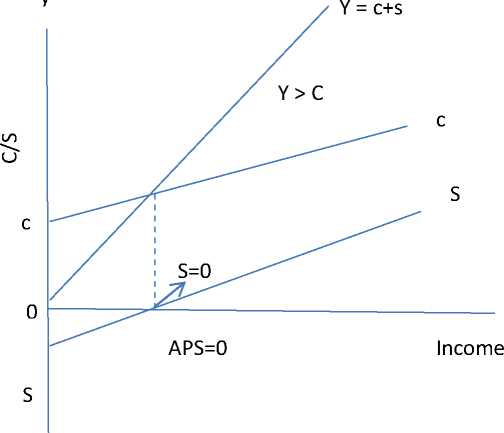
    1. Draw a hypothetical propensity to consume curve from it draw the propensity curve to save curve

    Ans. APC=C/Y APS=S/Y Propensity to save curve Is drawn from propensity to consume curve When Y=C APC=1 Till that point APS is negative at point‘s’

    When y>c there is a positive saving

    X

    1. Explain the determination of income and employment with AD and AS. (Give schedule)

    AD= C+I

    AS=C+S AS=Y (refers to countries national income)

    The equilibrium level of income is determined at a point when AD=AS.

    Equilibrium can be achieved at full employment and even at under employment situation. It may not be always at full employment condition in an economy.

    y

    c

    I

    AD=C+I

    AS=Y


    0

    50

    100

    150

    0

    100

    100

    100

    200

    100

    200

    150

    100

    250

    200

    300

    200

    100

    300

    300

    AD=AS

    400

    250

    100

    350

    400


    500

    300

    100

    400

    500

    The above schedule shows equilibrium level of income is 300 where AD=AS 300=300.

    1. Explain the equilibrium level of income, employment and output with saving and investment approach. What happens when savings exceeds investment?

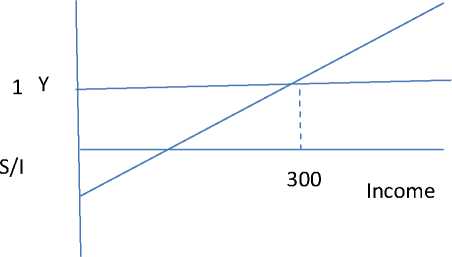
    Ans. Equilibrium is achieved when planned saving is equal to planned investment that is S=I. This can be seen with the help of schedule and a diagram.

    INCOME

    CONSUMPTION

    SAVING

    INVESTMENT


    Y

    C

    (S=Y-C)

    I

    0

    50

    -50

    100

    100

    100

    0

    100

    200

    150

    50

    100

    300

    200

    100

    100

    S=I

    400

    250

    150

    100


    Saving

    The equilibrium level of income is s 300 core and at this point S (100) =i (100) the equilibrium may necessarily not be at the full employment level.

    I

    X

    When saving exceeds planned investment means people are consuming less and spending more as a result AD is less than AS.

    This will lead to accumulation of more goods with producer .this will make the businessmen to reduce production consequently, output, income & employment will be reduced till the equilibrium level of income.

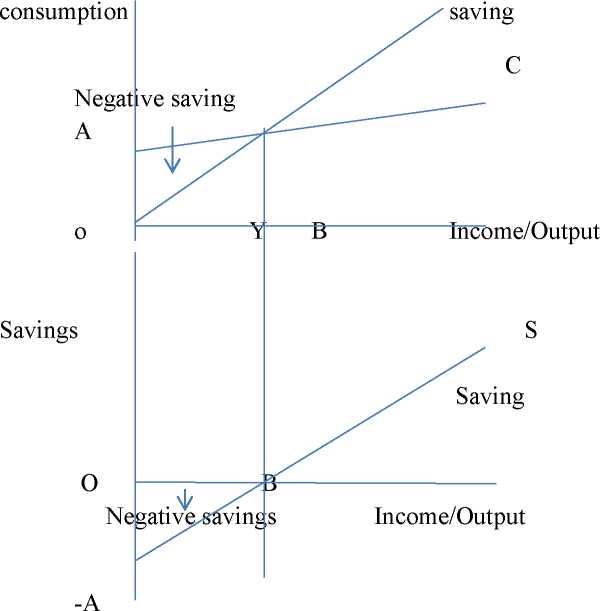
    2. Draw a straight line consumption curve. From it derive a saving curve explaining the process. Show on the diagram.

    1. The level of income at which average propensity to consume equal to one.
    2. A level of income at which average propensity to save is negative.

    Ac is the consumption curve and OA is the consumption expenditure at zero level of income. Income minus consumption is saving.

    When income is 0, the economy’s consumption level is OA. The corresponding level of saving is -0A.

    So -a is the starting point of saving curve. At OB level of income consumption is equal to income, so saving are zero. so B is another point on saving curve .

    Join A and B and extend this line to S, AS is the saving curve.

    1. The level of income at which APC is equal to one is OB.
    2. A level of income at which APS is negative OY.

    NUMERICALS.

    1. If in an economy investment increases by Rs 1000 cores to Rs 1200 cores and as a result total income increases by 800 cores calculate capital MPS.

    Ans.A 1=1200-1000=200 AY=800

    AK=AY/AI=800/200=4

    K=1/MPS=4

    MPS=1/4=0.25

    MPS=0.25

    2. IF in an economy the actual level of income is Rs 500crores whereas the full employment the level of income is RS 800 cores. The MPC=0.75 calculate the increase in investment required to achieve full employment income.

    Actual income=Rs500 cores Full empl Income = Rs 800 cores

    A y = 800 -500 =

    300 cores


    MPC = 0.75 = 75

    = 3


    100

    4


    K = 1

    1

    1

    100

    = 4

    01-MPC

    1 – 0.75

    0.25

    25

    We know that A y = K. A I 300 = 4 x 4 I A I = 75 crores

    3. Calculation of APC and MPC given the level of Income and Consumption

    Income

    consumption

    APC = c/y

    MPC = Ac/Ay

    0

    4

    10

    12

    1.20

    0.80

    20

    20

    1.00

    0.80

    30

    28

    0.93

    0.80

    40

    36

    0.90

    0.80

    4. Calculation of APS and MPS given

    the level of

    Income and consumption

    Income

    consumption

    saving

    APS

    MPS

    (Rs in crores)

    (Rs in crores)


    0

    4

    -4

    10

    12

    -2

    -0.20

    0.20

    20

    20

    0

    0.00

    0.20

    30

    28

    2

    0.07

    0.20

    40

    36

    4

    0.10

    0.20

    Clue: APS = s/y

    MPS = As/Ay

    S=Y – C

       
    1. Suppose the consumption equals c= 40 + 0.75 y, Investment equals I = Rs 60 and Y= C + I. Find i) Equilibrium level of income ii) The level of consumption at equilibrium iii) level of saving at equilibrium

    Ans: i) Y= C + I AS = AD

    Substituting the value of c and I we get

    Y = 40 + 0.75y + 60 Y= C+ I I=60

    (Y-0.75y)= 100

    (1-0.75)Y=100

    0.25Y =100

    Y=100/0.25

    Y=10000/25

    Y=400

    Equilibrium level of income = Rs. 400 cr.

    1. AS =AD

    C= 40 + 0.75y Y = 400

    C= 40 + 0.75(400) = 340 C=340

    1. Y= C + S So S= Y-C

    S= 400 – 340 = 60

    S= 60 crores

    1. In a two sector economy, the saving and investment functions are:

    S= -10 + 0.2Y I = -3 + 0.1Y

    What will be the equilibrium level of income?

    Ans: Equilibrium level of income S= I -10 + 0.2y = -3 + 0.1y 0.2y – 0.1y = -3 + 10 0.1y =7 y = 70

    1. Explain the components of the equation C= 20 + 0.90 y and construct a schedule for consumption where income is Rs 200 , Rs 300 , Rs 350 and Rs 400.

    Components of equation c=20 + 0.90y explained in % mark question number 1

    The schedule for consumption is as follows

    c=20 + 0.90y

    Y (Income)

    200

    250

    300

    200 c= 20 + 0.9 x 200

    245 =20 + 180 = 200

    290 c= 20 + 0.9 x250

    335 = 20 + 225 = 245

    C= 20 + 0.9 x 350 + 335 C= 20 + 0.9 x 400 = 380

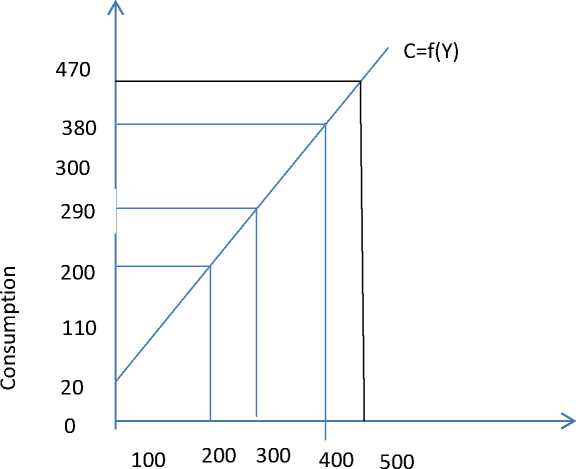
    1. The consumption function is C= 20 + 0.9y. The value of Income is given as 100,200, 300, 400 and 500. Find out the consumption schedule and draw the consumption curve.

    The consumption schedule

    Y (Income)

    C = 20 + 0.9 Y

    0

    C=20

    100

    C=20 + 0.9 (100) = 110

    200

    C=20 + 0.9 (200) = 200

    300

    C=20 + 0.9 (300) = 290

    400

    C=20 + 0.9 (400) = 380

    500

    C=20 + 0.9 (500) = 470

    The consumption curve is shown as

    Income

    1. How is equilibrium output of final goods determined under short run fixed price?

    Under short run fixed price, equilibrium output and equilibrium demand at fixed price and constant rate of interest can be found with the help of following formulas Y= “A

    1 – b

    Y = Value of equilibrium output

    A = Total Autonomous consumption b = MPC

    Thus, value of equilibrium output (y) depends on values of A (i.e, c + I) and b i.e AD = AS

    Y= C + I + by

    • = A + by (A = C + I showing total autonomous expenditure)
    • – by = A
    • (1-b) = “A Y= “A

    1-b

    Application level questions

    Multiplier

    1. In an economy an increase in investment leads to increase in national income which is three times more than the increase in investment (calculate marginal propensity to consume)
    2. In an economy the MPC is 0.95 investment is increased by Rs. 100 crores. Calculate the total increase in income and consumption expenditure.
    3. Explain with numerical example how an increase in investment in an economy affects the level of consumption.
    4. An increase in investment leads to total rise in national income by Rs. 500 crores. If MPC is 0.9 what is the increase in investment? Calculate.
    5. In an economy the MPC is 0.8 Investment is increased by Rs.500 crores.

    Calculate the total increase in income and consumption expenditure.

    1. If in an economy MPC is 0.75 and its investment is increased by Rs.500 crores.

    Calculate the total increase in income and consumption expenditure

    1. Complete the table

    Income MPC Saving APS

    0 – -90 –

    100 0.6 – –

    200 0.6 – –

    300 0.6 – –

    1. In an economy S= -50 +0.5Y is the saving function (where S=saving and Y=national income) and investment expenditure is 7000. Calculate
    2. Equilibrium level of national income
    3. Consumption expenditure at Equilibrium level of N.I
    4. From the following information about an economy calculate
    5. its Equilibrium level of national income and
    6. saving at Equilibrium level of N.I Consumption function = 200 + 0.9Y Investment expenditure I=3000.
    7. Disposable income is Rs. 1000 crores and consumption expenditure is Rs.750 crores. Find out average propensity to save and average represent to consume.

    11 In an economy investment expenditure increased by Rs.700 crores. The marginal propensity to consume is 0.9 calculate total increase income and consumption expenditure

    1. Complete the following table

    Level of income

    Consumption

    Expenditure

    Marginal

    Propensity

    Marginal Propensity to consume

    400

    240


    600

    320


    700

    465

       
    1. In an economy an increase in investment leads to increase in national income which is three times more than the increase in investment calculate marginal propensity to consume.
    2. The disposable income is Rs.2500 crores and saving is Rs.500 crores. Find out average propensity to consume
    3. In an economy MPC is 0.75 if investment expenditure is increased by Rs.500 crores. Calculate the total increase in income and consumption expenditure
    4. As a result of increase investment by 125 crores national income increased by 500 crores. Calculate multiplier, MPC and MPS.
    5. Given consumption function C=100+0.75 Y (where C=consumption expenditure and

    Y=national income) and investment expenditure Rs.2000 .calculate

    1. Equilibrium level of national income
    2. Consumption expenditure at equilibrium level of income
    3. In an economy S= -50+0.5Y is the saving function (where S=saving and Y=national income) and investment expenditure is 9000 calculate
    4. Equilibrium level of national income
    5. Consumption expenditure at equilibrium level of national income
    6. From the following information about an economy calculate (i) Equilibrium level of N.I (ii) saving at Equilibrium level of income consumption function C=200+0.9Y (where C=consumption expenditure and Y=N.I. Investment expenditure I =5000
    7. C=100+0.75 is a consumption function (where C= consumption expenditure and Y= N.I) and investment expenditures =1600 on the basis of this information calculate
    8. Equilibrium level of national income
    9. Saving at Equilibrium level of NI.
    10. Given below is the consumption function in an economy C=100+0.10Y. with the help of a numerical example show that in this economy as income increase APC will decrease.
    11. Given below is the consumption function in an economy C=100 +0.5Y with the help of a numerical example show that in this economy as income increases APS will increase.


  • Notes Of Money and Banking Class 12 Chapter 3 Economics

    UNIT – VII: MONEY AND BANKING

    MEANING OF MONEY: Money is anything which is generally accepted as medium of exchange, measure of value, store of value and as means of standard of deferred payment. FUNCTIONS OF MONEY: Functions of money can be classified into Primary and Secondary

    Primary/Basic functions:-

    1. Medium of Exchange: – It can be used in making payments for all transactions of

    goods and services.

    1. Measure /Unit of value: – It helps in measuring the value of goods and services. The

    value is usually called as price. After knowing the value of goods in single unit (price) exchanges become easy.

    Secondary functions:-

    1. Standard of deferred payments: Deferred payments referred to those payments which

    are to be made in near future.

    Money acts as a standard deferred payment due to the following reasons:

    1. Value of money remains more or less constant compared to other commodities.
    2. Money has the merit of general acceptability.
    3. Money is more durable compare to other commodity.
    4. Store of value: Money can be stored and does not lose value

    Money acts as a store of value due to the following reasons:

    1. It is easy and economical to store.
    2. Money has the merit of general acceptability.
    3. Value of money remains relatively constant

    MONEY HAS OVERCOME THE DRAW BACKS OF BARTER SYSTEM:

    1. Medium of Exchange: Money has removed the major difficulty of the double coincidence of wants.
    2. Measure of value: Money has become measuring rod to measure the value of goods and services and is expressed in terms of price.
    3. Store of value: It is very convenient, easy and economical to store the value and has got general acceptability which was lacking in the barter system.
    4. Standard of deferred payments: Money has simplified the borrowing and lending of operations which were difficult under barter system. It also encourages capital formation.

    MONEY SUPPLY: refers to total volume of money held by public at a particular point of time in an economy.

    M1=currency held by public + Demand deposits + other deposits with Reserve Bank of India. M2=M1+saving deposits with post office saving bank M3=M1+net time deposit with the bank

    M4=M3 + total deposits with post office saving bank excluding national saving certificate HIGH POWERED MONEY:

    Refers to, currency with the public (notes +coins) and cash reserve of banks.

    MONEY CREATION/DEPOSIT CREATION/CREDIT CREATION BY COMMERCIAL BANK

    Let us understand the process of credit creation with the following example.

    Suppose there is an initial deposit of Rs. 1000 and L.R.R. is 20% i.e., the banks have to keep Rs. 200 and lend Rs. 800/-. All the transactions are routed through banks. The borrower withdraws his Rs. 800/- for making payments which are routed through banks in the form of deposits account.

    The Bank receives Rs. 800/- as deposit and keeps 20% of Rs.800/- i.e., Rs.160/- and lends Rs.640/- . Again the borrower uses this for payment which flows back into the banks thereby increasing the flow of deposits.


    Deposits (in Rs.)

    Loans (in Rs.)

    Cash Reserve Ratio (20%)

    Initial deposit

    1000

    800

    200

    First round

    800

    640

    160

    Second round

    640

    512

    128

    Total

    5000

    4000

    1000

    MONEY MULTIPLIER:

    Money Multiplier = 1/LRR. In the above example LRR is 20% i.e., 0.2, so money multiplier is equal to 1/0.2=5.

    Why only a fraction of deposits is kept as Cash Reserve?

    1. All depositors do not withdraw the money at the same time.
    2. There is constant flow of new deposits into the banks.

    CENTRAL BANK

    MEANING: An apex body that controls, operates, regulates and directs the entire banking and monetary structure of the country.

    FUNCTIONS OF CENTRAL BANK:

    1. Currency authority or bank of issue: Central bank is a sole authority to issue currency in the country. Central Bank is obliged to back the currency with assets of equal value (usually gold coins, gold bullions, foreign securities etc.,)

    Advantages of sole authority of note issue:

    1. Uniformity in note circulation
    2. Better supervision and control
    3. It is easy to control credit
    4. Ensures public faith
    5. Stabilization of internal and external value of currency
    6. Banker to the Government: As a banker it carries out all banking business of the Government and maintains current account for keeping cash balances of the government. Accepts receipts and makes payments for the government. It also gives loans and Advances to the government.
    7. Banker’s bank and supervisor: Acts as a banker to other banks in the country—
    8. Custodian of cash reserves:- Commercial banks must keep a certain proportion of cash reserves with the central bank (CRR)
    9. Lender of last resort: – When commercial banks fail to need their financial requirements from other sources, they approach Central Bank which gives loans and advances.
    10. Clearing house: – Since the Central Bank holds the cash reserves of commercial banks it is easier and more convenient to act as clearing house of commercial banks.
    11. Controller of money supply and credit: – Central Bank or RBI plays an important role during the times of economic fluctuations. It influences the money supply through quantitative and qualitative instruments. Former refers to the volume of credit and the latter refers to regulate the direction of credit.
    12. Custodian of foreign exchange reserves.

    Another important function of Central Bank is the custodian of foreign exchange reserves. Central Bank acts as custodian of country’s stock of gold and foreign exchange reserves. It helps in stabilizing the external value of money and maintaining favorable balance of payments in the economy.

    QUANTITATIVE INSTRUMENTS:

    1. Bank Rate policy: – It refers to the rate at which the central bank lends money to

    commercial banks as a lender of the last resort.

    Central Bank increases the bank rate during inflation (excess demand) and reduces the same in times of deflation (deficient demand)

    1. Open Market Operations: It refers to the buying and selling of securities by the

    Central Bank from/ to the public and commercial banks.

    It sells government securities during inflation/excess demand and buys the securities during deflation/deficient demand.

    1. Legal Reserve Ratio: R.B.I. can influence the credit creation power of commercial

    banks by making changes in CRR and SLR

    Cash Reserve Ratio (CRR): It refers to the minimum percentage of net demand and time liabilities to be kept by commercial banks with central bank.

    Reserve Bank increases CRR during inflation and decreases the same during deflation

    Statutory Liquidity Ratio (SLR): It refers to minimum percentage of net demand and time liabilities which commercial banks required to maintain with themselves. SLR is increased during inflation or excess demand and decreased during deflation or deficient demand.

    QUALITATIVE INSTRUMENTS:

    1. Margin Requirements: It is the difference between the amount of loan and market value of the security offered by the borrower against the loan.

    Margin requirements are increased during inflation and decreased during deflation.

    1. Moral suasion: It is a combination of persuasion and pressure that Central Bank applies on other banks in order to get them act in a manner in line with its policy.
    2. Selective credit controls: Central Bank gives direction to other banks to give or not to give credit for certain purposes to particular sectors.

    SHORT AND LONG ANSWER QUESTIONS

    1. Define Central Bank.
    2. Give the meaning of money.
    3. Discuss the functions of money.
    4. Describe how money over comes the problems of barter system?
    5. What are the measures of money supply?
    6. What do you mean by High powered money?
    7. Describe the process of money creation or credit creation by commercial banks.
    8. Why only a fraction of deposits is kept as Cash Reserves?
    9. Discuss the functions of Central Bank.
    10. Bring out the role of Central Bank as the controller of money supply or credit
    11. Explain the various qualitative and quantitative instruments used by the central bank in controlling the money supply during the times of a) excess demand/inflation b) deficient demand/deflation.

    HOTS

    1. Calculate the value money multiplier and the total deposit created if initial deposit is of Rs. 500 crores and LRR is 10%.

    Ans: Money multiplier = 1/LRR which is equal to 1/0.1=10 Initial deposit Rs. 500 crores Total deposit = Initial deposit x money multiplier = 500 x 10 = 5000 crores.

    1. If total deposits created by commercial banks are Rs.12000, LRR is 25% calculate initial deposit.

    Ans: Money multiplier = 1/LRR = 1/.25 = 4

    Initial deposit = Total deposit / money multiplier = 12000/4 = 3000

    1. Calculate LRR, if initial deposit of Rs. 200 cores lead to creation of total deposits of Rs. 1600 cores.

    Ans: Money multiplier = Total deposits/Initial deposits = 1600/200=8 Money multiplier = 1/LRR = 8=1/LRR.

    LRR = 1.25 or 12.5

    FREQUENTLY ASKED CBSE BOARD QUESTIONS

    One Mark Questions (1M)

    1. Define money.
    2. Ml =
    3. What is meant by barter system?
    4. Write two drawbacks of barter exchange.
    5. List out two main functions of money.
    6. Define commercial bank.
    7. Give the meaning of central bank.
    8. What do you mean by credit creation by commercial banks.
    9. Define bank rate.
    10. Define cash reserve ratio.
    11. Give the meaning of statutory liquidity ratio.
    12. What is meant by open market operations (OMO)?
    13. Define money supply.
    14. Write one difference between commercial bank and central bank.
    15. Mention two important functions of central bank.

    Three Marks Questions (3M)

    1. Explain briefly any two main functions of money.
    2. How does the central bank apply bank rate as a measure of credit control?
    3. What are the components of M1?
    4. State any THREE functions of central bank. Explain any one.
    5. Explain the “lender of last resort” function of central bank.
    6. What is money multiplier?
    7. Explain briefly any three drawbacks of barter system
    8. Explain the open market operations method of credit control used by a central bank. Four Marks Questions (4 M)
    9. Distinguish between commercial banks and central bank.
    10. Explain how money solves the drawbacks of barter exchange.
    11. What is money multiplier? How will you determine its value?
    12. Briefly explain any TWO quantitative measures of credit control by the central bank.
    13. Explain briefly the credit creation by commercial banks with the help of an example.


  • Notes of National Income Accounting Class 12 Chapter 2 Economics

    PART B-INTRODUCTORY MACRO ECONOMICS

    Unit VI: NATIONAL INCOME AND RELATED AGGREGATES: KEY CONCEPTS

    • Macro Economics: Its meaning
    • Consumption goods, capital goods, final goods, intermediate goods, stock and flow, gross investment and depreciation.
    • Circular flow of income
    • Methods of calculation of national income
    • Value added method (product method)
    • Expenditure method
    • Income method
    • Concepts and aggregates related to national income
    • Gross national product
    • Net National product
    • Gross and Net domestic product at market price and at factor cost.
    • National disposable income (Gross and net)
    • Private income
    • Personal income
    • Personal disposable income
    • Real and Nominal GDP
    • GDP and welfare

    Macro Economics: – Macroeconomics is the study of aggregate economic variables of an economy.

    Consumption goods:- Are those which are bought by consumers as final or ultimate goods to satisfy their wants.

    Eg: Durable goods car, television, radio etc.

    Non-durable goods and services like fruit, oil, milk, vegetable etc.

    Semi durable goods such as crockery etc.

    Capital goods – capital goods are those final goods, which are used and help in the process of production of other goods and services. E.g.: plant, machinery etc.

    Final goods: Are those goods, which are used either for final consumption or for investment. It includes final consumer goods and final production goods. They are not meant for resale. So, no value is added to these goods. Their value is included in the national income. Intermediate goods intermediate goods are those goods, which are used either for resale or for further production. Example for intermediate good is- milk used by a tea shop for selling tea.

    Stock: – Quantity of an economic variable which is measured at a particular point of time. Stock has no time dimension. Stock is static concept.

    Eg: wealth, water in a tank.

    Flow: Flow is that quantity of an economic variable, which is measured during the period of time.

    Flow has time dimension- like per hr, per day etc.

    Flow is a dynamic concept.

    Eg: Investment, water in a stream.

    Investment: Investment is the net addition made to the existing stock of capital.

    Net Investment = Gross investment – depreciation.

    Depreciation: – depreciation refers to fall in the value of fixed assets due to normal wear and tear, passage of time and expected obsolescence.

    Circular flow in a two sector economy.

    Payment for goods and services (Money Flow)

    Firms

    Supply of goods and services (Real Flow)

    House hold

    Supply of Factors of Production (Real Flow)

    Payment for Factor services (Money Flow)

    Producers (firms) and households are the constituents in a two sectors economy.

    Households give factors of production to firm and firms in turn supply goods and services to households.

    Related aggregates

    Gross Domestic product at market price

    It is the money value of all final goods and services produced during an accounting year with in the domestic territory of a country.

    Gross National product at market price:

    It is a money value of all final goods and services produced by a country during an accounting year including net factor income from abroad.

    Net factor income from abroad:

    Difference between the factor incomes earned by our residents from abroad and factor income earned by non-residents with in our country.

    Components of Net factor income from abroad

    • Net compensation of employees
    • Net income from property and entrepreneurship (other than retained earnings of resident companies of abroad)
    • Net retained earnings of resident companies abroad

    Formulas

    • NNP Mp = GNP mp – depreciation
    • NDP Mp GDPmp – depreciation
    • NDP Fc = NDP mp – Net indirect taxes (indirect tax – subsidies)
    • GDP Fc = NDP fc + depreciation
    • NNP Fc = GDP mp – depreciation + Net factor income from abroad – Net indirect taxes
    • (NNP FC is the sum total of factor income earned by normal residents of a country during the accounting year)
    • NNP fc = NDP fc + Net factor income from abroad.

    Concept of domestic (economic) territory

    Domestic territory is a geographical territory administered by a government within which persons, goods and capital circulate freely. (Areas of operation generating domestic income, freedom of circulation of persons, goods and capital)

    Scope identified as

    *Political frontiers including territorial waters and air space.

    *Embassies, consulates, military bases etc. located abroad but including those locates within the political frontiers.

    *Ships, aircrafts etc., operated by the residents between two or more countries.

    *Fishing vessels, oil and natural gas rigs etc. operated by the residents in the international waters or other areas over which the country enjoys the exclusive rights or jurisdiction.

    Resident (normal resident) :-

    Normal resident is a person or an institution who ordinarily resides in that country and whose center of economic interest lies in that country.

    (The Centre of economic interest implies 🙁 1) the resident lives or is located within the economic territory. (2) The resident carries out the basic economic activities of earnings, spending and accumulation from that location 3. His center of interest lies in that country. Relation between national product and Domestic product.

    Domestic product concept is based on the production units located within domestic (economic) territory, operated both by residents and non-residents.

    National product concept based on resident and includes their contribution to production both within and outside the economic territory.

    National product = Domestic product + Residents contribution to production outside the economic territory (Factor income from abroad) – Non- resident contribution to production inside the economic territory (Factor income to abroad)

    Methods of calculation of national income

    I – PRODUCT METHOD (Value added method):

    • Sales + change in stock = value of output
    • Change in stock = closing stock – opening stock
    • Value of output – Intermediate consumption = Gross value added (GDPMp)
    • NNP Fc (N.I) = GDPMp (-) consumption of fixed capital (depreciation)

    (+) Net factor income from abroad ( -) Net indirect tax.

    Income method:

    1. Compensation of employees.
    2. Operating surplus.

    Dm

    Income from property

    m t

    Rent & Royalty Interest

    Income from^Entrepreneurship
    1

    Profit

    Corporate

    Tax

    Corporate dividend Savings (Net retained earnings)

    3. Mixed income of self-employed.

    • NDP fc = (1) + (2) + (3)
    • NNP fc = NDP fc (+) Net factor income from abroad
    • GNP mp = NDP fc + consumption of fixed capital + Net indirect tax

    (Indirect tax – subsidy)

    Expenditure method:

    1. Government final consumption expenditure.
    2. Private final consumption expenditure.
    3. Net Export.
    4. Gross domestic capital formation.

    Gross Domestic fixed + Change in stock

    Capital formation

    GDPmp = (1) + (2) + (3) + (4)

    NNP fc = GDPmp – consumption of fixed capital + NFIA- Net indirect taxes Note: If capital formation is given as Net domestic capital formation we arrive at NDPmp. Capital formation = Investment

    CALCULATION OF NATIONAL DISPOSABLE INCOME, PRIVATE INCOME, PERSONAL INCOME AND PERSONAL DISPOSABLE INCOME

    Private Income includes factor Personal Income National Disposable income as well as Transfer

    income income (Earned income +

    Unearned income)

    Factor income from net domestic product accruing to private sector includes income from enterprises owned and controlled by the private individual.

    Excludes:-

    It is the income from all the sources (Earned Income as well as transfer payment from abroad) available to resident of a country for consumption expenditure or saving during a year.

    NNPFC + Net Indirect tax + Net current transfer from abroad =Net National

    disposable income. (Gross National

    Disposable Income includes depreciation)

    PI is the income Actually received by the individuals and households from all sources in the form of factor income and current transfers.

    Personal income = Private Income (-) corporation tax. (-) Corporate Savings OR Undistributed profits

    Personal disposable

    income

    Pe rs o n al i n come (-) Direct Personal tax (-) Miscellaneous Receipts of the govt. Administrative department (fees and fines paid by house hold.)

    1. Property and entrepreneurial income of the Gov. departmental enterprise
    2. Savings of the Non-departmental Enterprise.

    Factor Income from NDP Accruing to private

    sector = NDPfc (-) income from properly entrepreneurship accruing to the govt departmental Enterprises (-) savings of Non departmental enterprises.

    Private Income Includes

    * Factor income from net domestic product accruing to private sector.

    + Net factor income from abroad + Interest on National Debt + Current transfer from Govt.

    + Current transfer from rest of the world.

    One Mark questions.

    1. When will the domestic income be greater than the national income?

    Ans: When the net factor income from abroad is negative.

    1. What is national disposable income?

    Ans.It is the income, which is available to the whole economy for spending or disposal NNP Mp + net current transfers from abroad = NDI

    1. What must be added to domestic factor income to obtain national income?

    Ans. Net factor income from abroad.

    1. Explain the meaning of non-market activities

    Ans. Non marketing activities refer to acquiring of many final goods and services not through regular market transactions. E.g. vegetable grown in the backyard of the house.

    1. Define nominal GNP

    Ans. GNP measured in terms of current market prices is called nominal GNP.

    1. Define Real GNP.

    Ans. GNP computed at constant prices (base year price) is called real GNP.

    1. Meaning of real flow.

    Ans. It refers to the flow of goods and services between different sectors of the economy. Eg. Flow of factor services from household to firm and flow of goods and services from firm to household.

    1. Define money flow.

    It refers to the flow of money between different sectors of the economy such as firm, household etc. Eg. Flow of factor income from firm to house hold and consumption expenditure from house hold to firm.

    3- 4 Mark Questions

    1. Distinguish between GDPMp and GNP fc

    Ans. The difference between both arise due to (1) Net factor income from abroad. and 2) Net indirect taxes. In GDPMp Net factor income from abroad is not included but it includes net indirect taxes.

    GNP fc – GDPMp + net factor income from abroad – net indirect taxes

    1. Distinguish between personal income and private income

    Ans. Personal income: -It is the sum total of earned income and transfer incomes received by persons from all sources within and outside the country.

    Personal income – private income – corporate tax -corporate savings (undistributed profit) Private income consists of factor income and transfer income received from all sources by private sectors within and outside the country.

    1. Distinguish between nominal GNP and real GNP

    Ans. Nominal GNP is measured at current prices. Since this aggregate measures the value of goods and services at current year prices, GNP will change when volume of product changes or price changes or when both changes.

    Real GNP is computed at the constant prices. Under real GNP, value is expressed in terms of prices prevailing in the base year. This measure takes only quantity changes. Real GNP is the indicator of real income level in the economy.

    1. Explain the main steps involved in measuring national income through product method

    Ans.

    1. classify the producing units into industrial sectors like primary, secondary and tertiary sectors.
    2. Estimate the net value added at the factor cost.
    3. Estimate value of output by sales + change in stock
    4. Estimate gross value added by value of output – intermediate consumption
    5. Deduct depreciation and net indirect tax from gross value added at market price to arrive at net value added at factor cost – NDP Fc
    6. Add net factor income received from abroad to NDP Fc to obtain NNP FC which is national income
    7. Explain the steps involved in calculation of national income through income method
    8. Classify the producing enterprises into industrial sectors like primary, secondary and tertiary.
    9. Estimate the following factor income paid out by the producing units in each sector i.e.

    Compensation of employees

    *Operating surplus

    *Mixed income of self employed

    1. Take the sum of the factor income by all the industrial sectors to arrive at the NDP Fc (Which is called domestic income)
    2. Add net factor income from abroad to the net domestic product at factor cost to arrive at the net national product at factor cost.
    3. Explain the main steps involved in measuring national income through expenditure method.
    4. Classify the economic units incurring final expenditure into distant groups like households, government, firms etc.
    5. .Estimate the following expenditure on final products by all economic units
    • Private final consumption expenditure
    • Government final consumption expenditure
    • Gross domestic capital formation
    • Net export

    (Sum total of above gives GDPMp)

    1. Deduct depreciation, net indirect taxes to get NDP Fc
    2. Add net factor income from abroad to NDP Fc to arrive at NNP FC.
    3. What are the precautions to be taken while calculating national income through product method (value added method)
    4. Avoid double counting of production, take only value added by each production unit.
    5. The output produced for self-consumption to be included
    6. The sale & purchase of second hand goods should not be included.
    7. Value of intermediate consumption should not be included
    8. The value of services rendered in sales must be included.
    9. Precautions to be taken while calculating national income through income method.
    10. Income from owner occupied house to be included.
    11. Wages & salaries in cash and kind both to be included.
    12. Transfer income should not be included
    13. Interest on loans taken for production only to be included. Interest on loan taken for consumption expenditure is non-factor income and so not included.
    14. Precautions to be taken while calculations N.I under expenditure method.
    15. Avoid double counting of expenditure by not including expenditure on intermediate product
    16. Transfer expenditure not to be included
    17. Expenditure on purchase of second hand goods not to be included.
    18. Write down the limitations of using GDP as an index of welfare of a country
    19. The national income figures give no indications of the population, skill and resources of the country. A country may be having high national income but it may be consumed by the increasing population, so that the level of people’s wellbeing or welfare standard of living remains low.
    20. High N. I may be due to greater area of the country or due to the concentration of some resources in out particular country.
    21. National income does not consider the level of prices of the country. People may be having income but may not be able to enjoy high standard of living due to high prices.
    22. High N. I may be due to the large contribution made by a few industrialists
    23. Level of unemployment is not taken into account.
    24. National income does not care to reduce ecological degradation. Due to excess of economic activity which leads to ecological degradation reduces the welfare of the people. Hence GNP and economic welfare are not positively related. Income in GNP does not bring about increase in economic welfare.
    25. ‘Machine purchased is always a final good’ do you agree? Give reason for your answer

    Whether machine is a final good or it depends on how it is being used (end use). If machine is bought by a household, then it is a final good. If machine is bought by a firm for its own use, then also it is a final good. If the machine is bought by a firm for resale then it is an intermediate good.

    1. What is double counting? How can it be avoided?

    Counting the value of commodities at every stage of production more than one time is called double counting.

    It can be avoided by

    1. taking value added method in the calculation of the national income.
    2. By taking the value of final commodity only while calculating N.I

    6 Mark questions

    1. State whether following is true or false. Give reason for your answer.
    2. Capital formation is a flow

    True, because it is measured over a period of time.

    1. Bread is always a consumer good.

    False, it depends upon the end use of bread. When it is purchased by a household it is a consumer good. When purchased by restaurant for making sandwich, it is an intermediate (producer) good.

    1. Nominal GDP can never be less that real GDP

    False. Nominal GDP can be less than the real GDP when the prices in the base year is more than the current year.

    1. Gross domestic capital formation is always greater than gross fixed capital formation.

    False, gross domestic capital formation can be less than gross fixed capital formation if change in stock is negative.

    1. Why are exports included in the estimation of domestic product by the expenditure method? Can the gross domestic product be greater than the gross national product? Explain

    Expenditure method estimates expenditure on domestic product i.e., expenditure on final goods and services produced within the economic territory of the country. It includes expenditure by residents and non-residents both. Exports though purchased by non residents are produced within the economic territory and therefore a part of domestic product. Domestic product can be greater than national product, if the factor income paid to the rest of the world is greater than the factor income received from the rest of the world i.e, when net factor income received from abroad is negative.

    1. How will you treat the following while estimating domestic product of India?
    2. Rent received by resident Indian from his property in Singapore.

    No, it will not be included in domestic product as this income is earned outside the economic territory of India.

    1. Salaries of Indians working in Japanese Embassy in India

    It will not be included in domestic product of India as embassy of Japan is not a part of economic territory of India.

    1. Profits earned by branch of American bank in India.

    Yes, it is included as part of domestic product since the branch of American bank is located within the economic territory of India.

    1. Salaries paid to Koreans working in the Indian embassy in Korea

    Yes, it will be part of domestic product of India because the income is earned within the economic territory of India. Indian embassy in Korea is a part of economic territory of India.

    1. How are the following treated in estimating national income from expenditure method? Give reason.
    2. Purchase of new car by a household: purchase of car is included in the national income because it is final consumption expenditure, which is part of national income.
    3. Purchase of raw material by purchase unit: purchase of raw material by purchase unit is not included in the national income because raw material is intermediate goods and intermediate goods and service are excluded from the national income. Purchase of raw material, if included in national income will result in double counting.
    4. Expenditure by the government on scholarship to student is not included in the national income because it is a transfer payment and no productive service is rendered by the student in exchange.
    5. Are the following item included in the estimating a country‘s national income? Give reason.
    6. Free cloth given to workers: free cloth given to worker is a part of wages in kind i.e. compensation to employee such compensation to employee is paid for the productive services in the economy, it is included in the national income.
    7. Commission paid to dealer in old car: commission paid to dealer in old car is included in the estimation of national income because it is the income of the dealer for his productive services to various parties.
    8. Growing vegetable in a kitchen garden of the house: growing vegetable in a kitchen garden of the house amount to production, though not for sale for self-consumption. It is included in the national income because it adds to the production of goods.

    NATIONAL INCOME – NUMERICALS

    1. Calculate Value Added at factor cost from the following.


    ITEMS Rs. CRORES


    a.

    Purchase of raw materials

    30

    b.

    Depreciation

    12

    c.

    Sales

    200

    d.

    Excise tax

    20

    e.

    Opening stock

    15

    f.

    Intermediate consumption

    48

    g.

    Closing stock

    10

    Ans:

    Sales + A in stock = value of output 200 + (cl. St – op. st)

    200 +(l0-15)


    = 200 -5=195

    Value of output – intermediate consumption

    = value added at MP 195-48 = 147

    V.A at FC = V.A at MP – Net indirect tax 147 – 20

    127 crores

    1. Calculate (a) Net National Product at MP, and (b) Gross National Disposable Income

    ITEMS

    Rs. crores

    200

    20

    (–)15 (–)10

    50

    15

    30

    5

    10

    Private final Consumption expenditure

    a.

    b.

    c.

    d.

    e.

    f.

    g.

    h.

    i.

    Ans:

    Net indirect taxes

    Change in stocks

    Net current transfers from abroad

    Govt. final consumption expenditure

    Consumption of fixed capital

    Net domestic capital formation

    Net factor income from abroad

    Net imports

    (a) + (e) + (g) + (-i) = NDP mp

    200 + 50+ 30 -10 280 -10 = 270 crores NNP mp = NDP mp + NFIFA 270 + 5 = 275 NNP MP + 275 crores

    GNDI = NNP PC + NFIFA + Net indirect taxes + Net current transfers from abroad + Depreciation (comp of fixed capital)

    NNP MP – net in tax = 275 – 20 =255 crores GNDI = 255 + 20 + 5 + (-10) + 15 = 295 – 10 = 285 crores GNDI = 285 crores

    3. Calculate Gross Domestic Product at Market Price by


    (a) Production Method and (b) Income Method


    ITEMS

    Rs. crores

    a.

    Intermediate consumption by


    i) Primary sector

    500


    ii) Secondary sector

    400


    iii) Tertiary sector

    400

    b.

    Value of output by


    i) Primary sector

    1000


    ii) Secondary sector

    900


    iii) Tertiary sector

    700

    c.

    Rent

    10

    d.

    Compensation of employees

    400

    e.

    Mixed income

    550

    f.

    Operating surplus

    300

    h.

    Net factor income from abroad

    (–)20

    i.

    Interest

    5

    j.

    Consumption of fixed capital

    40

    k.

    Net indirect taxes

    10

    Ans: GDP Mp by production method

    (b) (i) + (ii) + (iii) – a (i) + (ii) + ( iii) = value added

    (1000+ 900 + 700) – (500 -400-400)

    2600 – 1300 = 1300 crores Value added at MP (GDP MP)

    Income method

    Compensation of employees + operating surplus + mixed income = NDP FC = 400 + 300 + 550 = 1250 crores GDP mp = NDP fc + conspn of fixed capital + net In. tax = 1250+ 40 + 10 GDP mp =1300

    4. Calculate Net National Disposable Income from the following data.


    ITEMS

    Rs. crores

    a.

    Gross domestic product at MP

    1000

    b.

    Net factor income from abroad

    (-) 20

    c.

    Net indirect taxes

    120

    d.

    Consumption of fixed capital

    100

    e.

    Net current transfers from abroad

    50

    Ans: NNDI = GDP MP – consumption of fixed capital + Net FIFA + Net current transfer from abroad

    = 1000- 100 + 50 + (-20)

    = 880 + 50 = 930 crores

    5. Calculate Gross National Disposable Income from the following.


    ITEMS

    Rs. crores

    a)

    National Income

    2000

    b)

    Net current transfers from rest of the world

    200

    c)

    Consumption of fixed capital

    100

    d)

    Net factor income from abroad

    (-) 50

    e)

    Net indirect taxes

    25

    Ans:

    GNDI= (a) + (b) +(c) + (e) = 2000 + 200 + 100 + 250


    GNDI

    = 2550 crores

     
    1. ESTIMATE NATIONAL INCOME BY

    (a) EXPENDITURE METHOD (b) INCOME METHOD FROM THE FOLLOWING DATA Rs. in crores

    1. Private final consumption expenditure

    210

    2. Govt: final consumption expenditure

    50

    3. Net domestic capital formation

    40

    4. Net exports

    (-) 5

    5. Wages & Salaries

    170

    6. Employer’s contribution

    10

    7. Profit

    45

    8. Interest

    20

    9. Indirect taxes

    30

    10. Subsidies

    05

    11. Rent

    10

    1. Factor income from abroad 03
    2. Consumption of fixed capital 25
    3. Royalty 15

    Ans: National Income (NNP FC)

    Expenditure Method

    1. + (2) + (3) + (4) = NDP mp

    210 + 50 + 40 + (-5) = 295

    NNP FC = NDP MP + factor Income from abroad – net Indirect tax ( Indirect tax – subsidy) 295 + 3 – (30 -5)

    295 + 3 – 25 = 298 – 25 = 273 NNP FC= 273 crores Income method:

    (5) + (6) + (7) + (8) + (11) + (15)

    170 + 10 + 45 + 20 + 10 + 15 = 270 (NDP FC)

    NDP fc = NDP fc + FIFA = 270 + 3= 273 crores

    1. FROM THE FOLLOWING DATA CALCULATE
     

    (a) NATIONAL INCOME (b) PERSONAL DISPOSIBLE INCOME.

    1.

    Profit

    500

    2.

    Rent

    200

    3.

    Private income

    2000

    4.

    Mixed income of self-employed

    800

    5.

    Compensation of employers

    1000

    6.

    Consumption of fixed capital

    100

    7.

    Net factor income from abroad

    -(50)

    8.

    Net retained earnings of private employees’

    150

    9.

    Interest

    250

    10.

    Net exports

    200

    11.

    Co-operation

    100

    12.

    Net indirect tax

    160

    13.

    Direct taxes paid by houses hold’s

    120

    14.

    Employers contribution to social security scheme.

    60

    Ans: NNP FC (N. I) = (5) + (9) + (4) + (1) + (2) 1000 + 250+ 800 + 500 + 200 NDP FC = 2750 crores NNP FC = NDP FC + (7)

    = 2750 + (-50)

    NNP Fc = 2700 crores PDI = (3) – (8) – (11) – (13)

    2000 – 150 – 100 -120

    PDI = 2000 – 370 = 1630 crores

    1. CALCULATE NATIONAL INCOME AND GROSS NATIONAL DISPOSABLE INCOME FROM THE FOLLOWING DATA.

    Net indirect tax 05

    Net domestic fixed capital formation

    100

    Net exports

    (-) 20

    Gov.: final consumption expenditure

    200

    Net current transfer from abroad

    15

    Private final consumption expenditure

    600

    Change in stock

    10

    Net factor from abroad

    05

    Gross domestic fixed capital formation

    125

    Ans: National Income (NNP FC)

    = (4) + (6) + (2) + (7) + (3) = NDP mp = 200 + 600 + 100 + 10 + (-20)

    = 910 -20 = 890

    NDP MP = 890 crores

    NNP fc = NDP mp + (8) — (1)

    = 890 + 5 -5 NNP fc = 890 Depreciation = (9) – (2)

    125 – 100 = 25 crores

    GNDI = NNP FC + Net Indirect Tax + Net Current transfers from abroad + depreciation = 890 = 05+ 15 + 25 GNDI = 935 crores

    9. CALCULATE NNP AT MARKET PRICE BY PRODUCTION METHOD AND


    INCOME METHOD

    Crores

    1.

    Inter mediate consumption


    (a) primary sector

    500


    (b) Secondary sector

    400


    (c) tertiary sector

    300

    2.

    Value of output of


    (a) primary sector

    1,000


    (b) Secondary sector

    900


    (c) tertiary sector

    700

    3.

    Rent

    10

    4.

    Emoluments of employers

    400

    5.

    Mixed income

    650

    6.

    Operating surplus

    300

    7.

    Net factor income from abroad

    -20

    8.

    Interest

    05

    9.

    Consumptive of fixed capital

    40

    10.

    Net indirect tax

    10

    Ans:

    NNP MP by production method


    (2) Value of output – (1) Intermediate

    conspn = value added at MP

    (2) a + b+ c – (1) a + b + c


    1000 + 900 + 700 – 500 + 400 + 300


    2600

    – 1200


    1400

    = GDP mp


    NNP mp = GDP mp – (9) + (7)

    = 1400 – 40 + (-20)

    NNP mp = 1340 Income Method:

    NNP mp = (4) + (5) + (6) + (10) + (7)

    = 400 + 650 + 300 + 10 + (-20)

    NNP mp = 1350 + 10 – 20

    1. CALCULATE GNP at FACTOR COST BY INCOME METHOD AND

    EXPENDITURE METHOD. Rupees in crores

    1. Private final consumption expenditure 1000
    2. Net domestic capital formation 200
    3. Profit 400
    4. Compensation of employers 800
    5. Rent 250
    6. Gov.: final consumption expenditure 500
    7. Consumption of fixed capital 60
    8. Interest 150
    9. Net current transfer from row (-)80
    10. Net factor income from abroad (-) 10
    11. Net exports (-)20
    12. Net indirect taxes 80

    Ans: GNP FC by Income method

    GNP FC = 4 + 3 + 5 + 8 + 10 + 7

    800 + 400 +250 + 150 + (-10) + 60 GNP FC = 1650 crores GNP FC by Expenditure Method GNP FC = 1 + 2 + 6 + 10 + 11 -12 + 7

    = 1000 + 200 + 500 + (-10) + (-20) -80 + 60 = 1700-110+ 60 GNP FC = 1650 crores

    1. CALCULATE PRIVATE INCOME AND PERSONAL DISPOSABLE INCOME

    FROM THE FOLLOWING DATA

    Rupees in crores

    1. National income
    2. Income from property and entrepreneurship to gov. administrative department
    3. Saving of non-department public enterprises
    4. Corporation tax
    5. Current transfer from govt: administrative depart
    6. Net factor income from abroad
    7. Direct personal tax
    8. Indirect taxes
    9. Current transfer from Raw
    10. Saving of private corporate sector

    5050

    500

    100

    80

    200

    -50

    150

    220

    80

    500

    Ans: Private Income = 1 – 2- 3 + 5 + 9

    5050 – 500 – 100 + 200 + 80 5430 – 500

    Private Income = 4930 crores PDI = Private Income – 4 -10 -7 4930 -80 -500 -150 PDI = 4200 crores

    1. Calculate private income
    2. Income from domestic product accruing to private sector 250
    3. Net current transfer from raw 40

    3Net current transfer from govt: administrative dept 10

    1. National debt interest 20
    2. Net factor income from abroad 05

    Ans: Private Income = 1 + 2+ 3 + 4 + 5

    250 + 40 + 10 + 20 + 5 = 325 crores

    13. CALCULATE NET NATIONAL DISPOSABLE INCOME AND PERSONAL INCOME FROM THE FOLLOWING DATA


    Rs. In crores

    1. Net indirect taxes

    90

    2. Compensation of employers

    400

    3. Personal taxes

    100

    4. Operating surplus

    200

    5. Corporation profit tax

    80

    6. Mixed income of self-employed

    500

    7. National debt interest

    70

    8. Saving of non-departmental enterprises

    40

    9. Current transfer from govt

    60

    1. Income from property and entrepreneurship to govt administrative

    Department 30

    1. Net current transfer from RAW 20
    2. Net factor income from abroad -50
    3. saving of private corporate sector 20

    Ans: NDPfc = (2) + (4) + (6)

    400 + 200 + 500 = 1100 crores NNDI = NDP fc + (12) + (1) + (11)

    =1100 + (-50) + 90 + 20 NNDI = 1210 – 50 = 1160 crores

    Personal Income Ans:

    Private Income = NDP FC -(8) – (10)

    1160 -40 – 30=1090 crores 1090 + 7 + 9 +11 +12 1090 + 70 + 60 + 20 + (-50) = 1190 crores

    Personal income = Private Income – Corporation Profit Tax – Savings of private corporate sectors

    1190 – 80 – 20= 1090 crores

    1. CALCULATE FROM THE FOLLOWING DATA (A) PRIVATE INCOME (B) PERSONAL INCOME (C) PERSONAL DISPOSABLE INCOME.

    RS IN CRORES

    1. Factor income from NDP accruing to private sector 300
    2. Income from entrepreneurship and property
    3. Accruing to govt administrative departmental 70
    4. Savings of non-departmental enterprises 60
    5. Factor income from abroad 20
    6. Consumption of fixed capital 35
    7. Current transfer from rest of the world 15
    8. Corporation taxes 25
    9. Factor income to abroad 30
    10. Current transfer from govt governmental admi depart 40
    11. Direct taxes paid by house hold 20
    12. National dept interest 05
    13. saving of private corporate sector 80
    14. Net national product at factor cost 700

    Ans Private Income = 1 + 5 + 7 -9 + 10 + 12 300 + 20 + 15 -30 + 40 + 05 Private Income = 350 crores Personal Income = Private income – 8 – 13 = 350 – 25 – 80 Personal Income = 245 crores PDI = Personal Income – 11 245 – 20 PDI = 225 crores

    15. From the following data, calculate:

    1. Gross national Disposable Income
    2. Private Income
    3. Personal Disposable Income

    (Rs. In Crores)

    1. Indirect taxes 60
    2. Subsidies 10
    3. Consumption of fixed capital 40
    4. Income from property and entrepreneurship

    Accruing to government administrative departments 50

    1. Current transfers from rest of the world 45
    2. Profits 100
    3. Direct tax paid by households 50
    4. Savings of private corporate sector 60
    5. Saving of non-departmental enterprises 25
    6. Current transfer from govt: administrative departments 70
    7. A factor income abroad 20
    8. Factor income to abroad 30
    9. Corporation tax 35

    Ans GNDI = 1 + 2 -3 + 6 + 4

    700 + 60 – 10 + 45 + 40= 805 -10 + 40 GNDI = 835 crores b) Private Income = 1 – 5 -10 + 6 +11

    (Rs. In Crores)

    1. National income 2000

    700 – 50 -25 + 45 +70 Private Income = 740 crores c) PDI = Private Income – 14 – 9 – 8 740 – 35 – 60 – 50 PDI = 594 crores

    16. Calculate Gross National Disposable Income from the following data:

    1. Net current transfer from rest of the world 200
    2. Consumption of fixed capital 100
    3. Net factor income from abroad (-)50
    4. Net indirect taxes 250

    Ans: GNDI = 1 + 5 + 2 + 3

    2000 + 250 + 200 + 100 GNDI = 2550 crores

    1. Gross national product at factor cost 800

    17. Calculate Net National Disposable Income from the Following Data:

    (Rs. In Crores)

    1. Net current transfer from rest of the world 50
    2. Net indirect taxes 70
    3. Consumption of fixed capital 60
    4. Net factor income from abroad (-)10

    Ans: NNDI = 1 + 2 + 3 -4

    800 + 50 + 70 -60 = 860 crores

    NUMERICALS TO BE CALCULATED BY STUDENTS

    (Rs. In Crores)

    1. Calculate Net National Disposable Income From The Following Data:

    1. Gross domestic product at market price 1,000
    2. Net factor income from abroad (-)20
    3. Net indirect taxes 120
    4. Consumption of fixed capital 100
    5. Net current transfer from rest of the world 70

    2. Calculate Gross National Disposable Income The Following Data:

    (Rs. In Crores)

    1. National income (or NNPfc) 800
    2. Net indirect taxes 100
    3. Net factor income from abroad 30
    4. Net current transfer from rest of the world 50
    5. Consumption of fixed capital 70
    6. Calculate Gross National Disposable Income And net National Disposable Income from the Following Data:

    (Rs. In Crores)

    1. Consumption of fixed capital 30
    2. Net national product at market price 240
    3. Net Indirect taxes 40
    4. Net current transfers from rest of the world (-)20
    5. Net factor income from abroad (-) 10
    6. Find Out GNPmP, NDPfc And Gross National Disposable Income.

    (Rs. In Crores)

    1. National income 520
    2. Net factor income from abroad 10
    3. Indirect taxes 40
    4. Subsidies 10
    5. Consumption of fixed capital 50
    6. Net current transfer received from abroad 20
    7. Calculate NNPfc, net National Disposable Income and Gross National Disposable Income from following data:

    (Rs. In Crores)

    1. GNPmp 1000
    2. Net Indirect taxes 100
    3. Net current transfer received from rest of the world (-)20
    4. Subsidies 25
    5. Consumption of fixed capital 50
    6. Net factor income paid to the rest of the world (-)10
    7. Find Out (a) Personal Income and (b) Personal Disposable Income from following data:

    (Rs. In Crores)

    1.Private income 48,800

    1. Interest on national debit 1,000
    2. Net factor income from abroad 300
    3. Corporate Savings 800
    4. ) Corporation tax 210
    5. Personal income tax 540
    6. From The Following Data Calculate:

    Private Income and (b) Personal disposable income.

    (Rs. In Crores)

    1. Income from Domestic product accruing to the private sector 4,000
    2. Savings of non-departmental public enterprises 200
    3. Current transfer from government administrative departments 150
    4. Savings of private corporate sector 400
    5. Current transfers from rest of the world 50
    6. Net factor income from abroad (-) 4
    7. Corporation tax 60
    8. Direct Personal tax 140
    9. Calculate (a) Personal Income (b) Personal Disposable Income from following data:

    (Rs. In Crores)

    1. Income from property and entrepreneurship accruing to

    Government administrative department 500

    1. Savings of non-departmental public enterprises 100
    2. Corporation tax 80
    3. Income from Domestic product accruing to the private sector 4,500
    4. Current transfer from government administrative departments 200
    5. Net factor income from abroad (-)50
    6. Direct Personal tax 150
    7. Indirect taxes 220
    8. Current transfers from rest of the world 80
    9. Savings of private corporate sector 500

    (Rs. In Crores)

    9.From the following data calculate National Income by (i) Income method and (ii) Expenditure method.

    1. Compensation of employees 1,200
    2. Net factor income from abroad (-)20
    3. Net indirect taxes 120
    4. Profit 800
    5. Private final consumption expenditure 2,000
    6. Net domestic capital formation 770
    7. Consumption of fixed capital 130
    8. Rent 400
    9. Interest 620
    10. Mixed income of self- employed 700
    11. Net exports (-)30
    12. Government final consumption expenditure 1,100
    13. Mixed income of self-employed 400

    10.From the following data, calculate Gross national product at Market Price by (i) Income method. (ii) Expenditure method:

    (Rs. In Crores)

    1. Compensation of employees 500
    2. Private final consumption expenditure 900
    3. Net factor income from abroad (-)20
    4. Net indirect taxes 100
    5. Consumption of fixed capital 120
    6. Net domestic capital formation 280
    7. Net exports (-)30
    8. Profits 350
    9. Rent 100
    10. Interest 150
    11. Government final consumption expenditure 450

    11.Calculate (a) National Income and (b) Gross National Disposable Income from the following data

    (Rs. In Crores)

    1. Net factor income from abroad (-)20
    2. Government final consumption expenditure 200
    3. Subsidies 10
    4. Private final consumption expenditure 800
    5. Net current transfers from the rest of the world 30
    6. Net domestic fixed capital formation 100
    7. Indirect taxes 80
    8. Consumption of fixed capital 40
    9. Change in stock (-)10
    10. Net exports (-)50

    12.From the following data, calculate ‘gross value added at factor cost’

    (Rs. In Crores)

    1. Sales 500
    2. Change in stock 30
    3. Subsidies 40
    4. Consumption of fixed capital 60
    5. Purchases of intermediate products 350
    6. Profit 70

    13.From the following data, calculate:

    (a) National income, and (b) Personal disposable income

    (Rs. In Crores)

    (i) Compensation of employees

    1,200’


    (ii) Rent

    400


    (iii) Profit

    800


    (iv) Consumption of fixed capital

    300


    (v) Mixed income of self- employed

    1,000


    (vi) private income

    3,600


    (vii) net factor income from abroad

    (-)50


    (viii) net trained earnings of private enterprises

    200


    (ix)interest

    250


    (x) net indirect taxes

    350


    (xi) net exports

    (-)60


    (xii) direct taxes paid by households

    150


    (xiii) corporation tax

    100


    14. From the following data calculate national

    income by

    (a) Income method and (b) Expenditure method.


    (Rs. In cores)

    (i) Private final consumption expenditure


    2,000

    (ii) Net capital formation


    400

    (iii) Change in stock


    50

    (iv) Compensation of employees


    1,900

    (v) Rent


    200

    (vi) Interest


    150

    (vii) operating surplus


    720

    (viii) Net indirect tax


    400

    (x) Employers’ contribution to social security schemes

    100

    (xi) Net exports


    20

    (xii) Net factor income from aboard


    (-)20

    (xii) Government final consumption expenditure (xvi) Consumption of fixed capital

    600

    100

    15.

    Find gross national product at market price by

    income method and expenditure

    method.


    ITEMS

    Rs. CRORES

    a.

    Mixed income of the self-employed

    400

    b.

    Compensation of employees

    500

    c.

    Private final consumption expenditure

    900

    d.

    Net factor income from abroad

    (-)20

    e.

    Net indirect taxes

    100

    f.

    Consumption of fixed capital

    20

    g.

    Net domestic capital formation

    280

    h.

    Net exports

    (–) 30

    i.

    Rent

    100

    j.

    Interest

    150

    k.

    Government final consumption expenditure

    450

    FREQUENTLY ASKED CBSE BOARD QUESTIONS

    1.

    Give two examples of macro economics


    (1)

    2.

    Differentiate between micro and macroeconomics


    (3)

    3.

    Distinguish between intermediate goods and final goods.


    (3)

    4.

    Distinguish between domestic product and national product


    (3)

    5.

    What do you understand by net factor income from abroad? Explain

    (3)

    6.

    While estimating national income how will you treat the following?

    Give reasons for


    your answer

    1. Imputed rent of self occupied houses.
    2. Interest received on debentures
    3. Financial help received by flood victims
    4. Capital gains
       

    (4)

    7.

    Distinguish between transfer payments and factor payments.

    Give an example of each.


    (4)
    8.

    From the following data calculate national income

    by income

    method and expenditure


    method


    (6)


    Rs in Crores


    a) Interests

    150


    b) Rent

    250


    c) Govt. final consumption expenditure

    600


    d) Private final consumption expenditure

    1200


    e) Profit

    640


    f) Compensation of employees

    1000


    g) Net factor income from abroad

    30


    h) Net indirect taxes

    60


    i) Net exports

    (-) 40


    j) Depreciation

    50


    k) Net domestic capital formation

    340

       
  • Chapter 2 Polynomials RD Sharam Solution for Class 9th Maths

    Chapter 2: Exponents Of Real Numbers Exercise – 2.1

    Question: 1

    Simplify the following: 

    (i) 3(a4 b3)10 × 5 (a2 b2)3 

    (ii) (2x-2 y3)3 

    Solution:

    (i) 3(a4 b3)10 × 5 (a2 b2)3 

    = 3(a40 b30) × 5(a6 b6)

    = 15 (a46 b36

    (ii) (2x-2 y3)3 

    (23 × -2 × 3 y3 × 3) = 8x-6y9 


    Question: 2

    If a = 3 and b = – 2, find the values of: 

    (i) a+ bb 

    (ii) a+ ba 

    (iii) ab + ba 

    Solution:

    (i) We have,

    aa + bb 

    = 3+ (−2) −2

     = 33 + (−1/2)2 

    = 27 +1/4 

    = 109/4 

    (ii) ab + ba

     = 3−2 + (−2)3

     = (1/3)2 + (−2)3

     = 1/9 – 8

     = −(71/9) 

    (iii) We have, 

    ab + ba 

    = (3 + (−2))3(−2) 

    = (3 − 2))−6

     = 1−6 = 1 


    Question: 3

    Prove that:

    Solution:

    (i) To prove

    Left hand side (LHS) = Right hand side (RHS) Considering LHS,

    Or, Therefore, LHS = RHS Hence proved

    (ii) To prove, 

    Left hand side (LHS) = Right hand side (RHS) Considering LHS,

    Therefore, LHS = RHS Hence proved

    (iii) To prove, 

    Left hand side (LHS) = Right hand side (RHS) Considering LHS,

    = xac−bc × xba−ca × xbc−ab

    = xac − bc + ba − ca + bc − ab

    = x0

    = 1

    Therefore, LHS = RHS

    Hence proved 


    Question: 4

    Prove that: 

    Solution:

    Left hand side (LHS) = Right hand side (RHS) Considering LHS,

    Therefore, LHS = RHS Hence proved

    Left hand side (LHS) = Right hand side (RHS) Considering LHS,

    Therefore, LHS = RHS Hence proved


    Question: 5

    Prove that:

    Solution:

    (i) To prove,

    Left hand side (LHS) = Right hand side (RHS) Considering LHS,

    = abc

    Therefore, LHS = RHS Hence proved

    (ii) To prove,

    Left hand side (LHS) = Right hand side (RHS) Considering LHS,

    Therefore, LHS = RHS

    Hence proved 


    Question: 6

    If abc = 1, show that

    Solution:

    To prove,

    Left hand side (LHS) = Right hand side (RHS) Considering LHS,

    We know abc = 1

    c = 1/ab

    By substituting the value c in equation (1), we get

    Therefore, LHS = RHS Hence proved 


    Question: 7

    Simplify: 

    Solution:


    Question: 8

    Solve the following equations for x: 

    (i) 72x+3 = 1 

    (ii) 2x+1 = 4x−3 

    (iii) 25x+3 = 8x+3 

    (iv) 42x = 1/32 

    (v) 4x−1 × (0.5)3−2x = (1/8)x 

    (vi) 23x−7 = 256 

    Solution:

    (i) We have,

    ⟹ 72x+3 = 1

    ⟹ 72x+3 = 70 

    ⟹ 2x + 3 = 0

    ⟹ 2x = -3

    ⟹ x = −3/2 

    (ii) We have,

    = 2x+1 = 4x−3

    = 2x+1 = 22x−6

    = x + 1 = 2x – 6

    = x = 7

    (iii) We have,

    = 25x+3 = 8x+3

    = 25x+3 = 23x+9

    = 5x + 3 = 3x + 9

    = 2x = 6

    = x = 3

    (iv) We have,

    = 42x = 1/32

    = 24x = 1/25

    = 24x = 2−5

    = 4x = – 5

    x = -5/4

    (v) We have,

    4x−1 × (0.5)3−2x = (1/8)x

    22x−2 × (1/2)3−2x = (1/2)3x

    22x−2 × 22x−3 = (1/2)3x

    22x−2+ 2x−3 = (1/2)3x

    24x−5 = 2−3x

    4x-5 = -3x

    7x = 5

    x = 5/7

    (vi) 23x−7 = 256

    23x−7 = 28

    3x – 7 = 8

    3x = 15

    x = 5


    Question: 9

    Solve the following equations for x: 

    (i) 22x − 2x+3 + 24 = 0 

    (ii) 32x+4 + 1 = 2 × 3x+2 

    Solution:

    (i) We have, ⟹ 22x − 2x+3 + 24 = 0 

    ⟹ 22x + 24 = 2x.23 

    ⟹ Let 2x = y 

    ⟹ y2 + 24 = y × 23 

    ⟹ y2 − 8y + 16 = 0 

    ⟹ y− 4y − 4y + 16 = 0 

    ⟹ y(y – 4) – 4(y – 4) = 0
    ⟹ y = 4

    ⟹ x2 = 22 

    ⟹ x = 2

    (ii) We have,

    32x+4 + 1 = 2 × 3x+2

    (3x+2)+ 1 = 2 × 3x+2

    Let 3x+2 = y

    y2 + 1 = 2y

    y2 − 2y + 1 = 0

    y2 − y − y + 1 = 0

    y(y − 1) − 1(y − 1) = 0

    (y − 1)(y − 1) = 0

    y = 1


    Question: 10

    If 49392 = a4b2c3, find the values of a, b and c, where a, b and c, where a, b, and c are different positive primes. 

    Solution:

    Taking out the LCM, the factors are 24, 32 and 73 a4b2c3 = 24, 32 and 73

    a = 2, b = 3 and c = 7 [Since, a, b and c are primes]


    Question: 11

    If 1176 = 2a × 3b × 7c, Find a, b, and c. 

    Solution:

    Given that 2, 3 and 7 are factors of 1176.

    Taking out the LCM of 1176, we get 23 × 31 × 72 = 2a × 3b × 7c 

    By comparing, we get

    a = 3, b = 1 and c = 2.


    Question: 12

    Given 4725 = 3a × 5b × 7c, find 

    (i) The integral values of a, b and c 

    (ii) The value of 2−a × 3× 7c 

    Solution:

    (i) Taking out the LCM of 4725, we get

    33 × 52 × 71 = 3a × 5b × 7c

    By comparing, we get

    a = 3, b = 2 and c = 1.

    (ii) The value of 2−a × 3× 7c 

    Sol:

    2-a × 3× 7c = 2−3 × 32 × 71

    2−3 × 32 × 71 = 1/8 × 9 × 7

    63/8


    Question: 13

    If a = xyp−1, b = xyq−1 and c = xyr−1, prove that aq−r br−p cp−q = 1 

    Solution:

    Given, a = xyp−1, b = xyq−1 and c = xyr−1 

    To prove, aq−rbr−pcp−q = 1

    Left hand side (LHS) = Right hand side (RHS)

    Considering LHS, = aq−r br−p cp−q …… (i)

    By substituting the value of a, b and c in equation (i), we get

    = (xyp−1)q−r(xyq−1)r−p(xyr−1)p−q 

    = xypq−pr−q+rxyqr−pq−r+pxyrp−rq−p+q 

    = xypq−pr−q+ r+qr−pq−r+p+rp−rq−p+q 

    = xy0 

    = 1

    Chapter 2: Exponents Of Real Numbers Exercise – 2.2

    Question: 1

    Assuming that x, y, z are positive real numbers, simplify each of the following

    Solution:

    = (243x10y5z10)1/5

    = (243)1/5x10/5y5/5z10/5

    = (35)1/5x2yz2

    = 3x2yz2


    Question: 2

    Simplify

    Solution:

    = (4-1)

    = 1/4

    = [(25)−3]1/5

    = (2−15)1/5

    = 2−3

    = 1/23 = 1/8

    = [(343)−2]1/3

    = (343)−2×1/3

    = (73)−2/3

    = (7−2)

    =(1/72)

    = (1/49)

    (iv) (0.001)1/3

    = (1/1000)1/3

    = (1/103)1/3

    = 721-20 × 525/2 – 21/2

    = 71 × 54/2

    = 71 × 52

    = 7 × 25

    = 175


    Question: 3

    Prove that

    (ii) 93/2 − 3 × 50 − (1/81)−1/2

    Solution:

    = ((3 × 5−3)1/2 ÷ (3−1)1/3(5)1/2) × (3 × 56)1/6

    = ((3)1/2(5−3)1/2 ÷ (3−1)1/3(5)1/2) × (3 × 56)1/6

    = ((3)1/2(5)−3/2 ÷ (3)−1/3(5)1/2) × ((3)1/6 × (5)6/6)

    = ((3)1/2 − (−1/3) × (5)−3/2−1/2) × ((3)1/6 × (5))

    = ((3)5/6 × (5)−2) × ((3)1/6 × (5))

    = ((3)5/6+1/6 × (5)−2+1)

    = ((3)6/6 × (5)−1)

    = ((3)1 × (5)−1)

    = ((3) × (5)−1)

    = ((3) × (1/5))

    = (3/5)

    (ii) 93/2 − 3 × 50 − (1/81)−1/2

    = (32)3/2 − 3 − (1/92)−1/2

    = 3− 3 − (9)−2×−1/2

    = 27 − 3 − 9

    = 15

    = 24 − 3 × 23×2/3 + 4/3

    = 16 − 3 × 22 + 4/3

    = 16 − 3 × 4 + 4/3

    = 16 − 12 + 4/3

    = (12 + 4)/3

    = 16/3

    = 2 × 1 × 5

    = 10

    = 1/2 + 1/(0.1)1 − (3)2

    = 1/2 +1/(0.1) −9

    = 1/2 + 10 − 9

    = 1/2 + 1

    = 3/2

    = (5/4)2 + 5/4 + 5/4

    = 25/16 + 10/4

    = 25/16 + 40/16

    = (26 + 40)/16

    = 65/16


    Question: 4

    Show that

    (v) (xa−b)a + b (xb−c)b + c(xc − a)c + a = 1

    Solution:

    Left hand side (LHS) = Right hand side (RHS)

    Considering LHS,

    Therefore, LHS = RHS

    Hence proved

    Left hand side (LHS) = Right hand side (RHS)

    Considering LHS,

    Therefore, LHS = RHS

    Hence proved

    (v) (xa−b)a + b (xb−c)b + c(xc − a)c + a = 1

    (xa−b)a+b(xb−c)b+c(xc−a)c+a


    Question: 5

    If 2x = 3y = 12z, show that 1/z = 1/y + 2/x

    Solution:

    2x = 3y = (2 × 3 × 2)z

    2x = 3y = (22 × 3)z

    2x = 3y = (22z × 3z)

    2x = 3y = 12z = k

    2 = k1/x

    3 = k1/y

    12 = k1/z

    12 = 2 × 3 × 2

    12 = k1/z = k1/y × k1/x × k1/x

    k1/z = k2/x + 1/y

    1/z = 1/y + 2/x


    Question: 6

    If 2x = 3= 6−z, show that 1/x + 1/y + 1/z = 0

    Solution:

     2x = 3y = 6−z

    2x = k

    2 = k1/x

    3y = k

    3 = k1/y

    6−z = k

    k = 1/6z

    6 = k−1/z

    2 × 3 = 6

    k1/x × k1/y = k−1/z

    1/x + 1/y = −1/z [by equating exponents]

    1/x + 1/y + 1/z = 0


    Question: 7

    If ax = by = cz and b2 = ac, then show that

    Solution:

    Let ax = by = cz = k

    a = k1/x, b = k1/y, c = k1/z

    Now,

    b2 = ac

    (k1/y)2 = k1/x × k1/z

    k2/y = k1/x + 1/z

    2/y = 1/x + 1/z


    Question: 8

    If 3x = 5y = (75)z, Show that

    Solution:

    3x = k

    3 = k1/x

    5y = k

    5 = k1/y

    75z = k

    75 = k1/z

    31 × 52 = 751

    k1/x × k2/y = k1/z

    1/x + 2/y = 1/z


    Question: 9

    If (27)= 9/3x, find x

    Solution:

    We have,

    (27)x = 9/3x

    (33)x = 9/3x

    33x = 9/3x

    33x = 32/3x

    33x = 32−x

    3x = 2 − x [On equating exponents]

    3x + x = 2

    4x = 2

    x = 2/4

    x = 1/2

    Here the value of x is ½


    Question: 10

    Find the values of x in each of the following

    (ii) (23)4 = (22)x

    (iii) (3/5)x(5/3)2x = 125/27

    (iv) 5x−2 × 32x−3 = 135

    (v) 2x−7 × 5x−4 = 1250

    (vii) 52x+3 = 1

    Solution:

    We have

    = 4x = 4 [On equating exponent]

    x = 1

    Hence the value of x is 1

    (ii) (23)4 = (22)x

    We have

    (23)4 = (22)x

    = 23×4 = 22×x

    12 = 2x

    2x = 12 [On equating exponents]

    x = 6

    Hence the value of x is 6

    (iii) (3/5)x(5/3)2x = 125/27

    We have

    (3/5)x(5/3)2x = 125/27

    ⇒ 52x−x/32x−x  = 53/33

    ⇒ 5x/3x = 53/33

    ⇒ (5/3)x = (5/3)3

    x = 3 [on equating exponents]

    Hence the value of x is 3

    (iv) 5x−2 × 32x−3 = 135

    We have,

    5x−2 × 32x−3 = 135

    ⇒ 5x−2 × 32x−3 = 5 × 27

    ⇒ 5x−2 × 32x−3 = 51 × 33

    ⇒ x − 2 = 1, 2x − 3 = 3 [On equating exponents]

    ⇒ x = 2 + 1, 2x = 3 + 3

    ⇒ x = 3, 2x = 6

    ⇒ x = 3

    Hence the value of x is 3

    (v) 2x−7 × 5x−4 = 1250

    We have

    2x−7 × 5x−4 = 1250

    ⇒ 2x−7 × 5x−4 = 2 × 625

    ⇒ 2x−7 × 5x−4 = 2 × 54

    ⇒ x − 7 = 1

    ⇒ x = 8, x − 4 = 4

    ⇒ x = 8

    Hence the value of x is 8

    4x + 1 = -15

    4x = -15 – 1

    4x = -16

    x = (-16)/4

    x = – 4

    Hence the value of x is 4

    (vii) 52x+3 = 1

    52x+3 = 1 × 50

    2x + 3 = 0 [By equating exponents]

    2x = −3

    x = −3/2

    Hence the value of x is −3/2

    √x = 2 [By equating exponents]

    (√x)2 = (2)2

    x = 4

    Hence the value of x is 4

    x + 1 = – 6

    x = – 6 – 1

    x = -7

    Hence the value of x is 7


    Question: 11

    If x = 21/3 + 22/3, show that x3 − 6x = 6

    Solution:

    x3 − 6x = 6

    x = 21/3 + 22/3

    Putting cube on both the sides, we get

    x3  = (21/3 + 22/3)3

    As we know, (a + b)3 = a3 + b3 + 3ab(a + b)

    x3 = (21/3)3 + (22/3)3 + 3(21/3)(22/3)(21/3 + 22/3)

    x= (21/3)3 + (22/3)3 + 3(21/3+2/3)(x)

    x3 = (21/3)3 + (22/3)3 + 3(2)(x)

    x3 = 6 + 6x

    x3 – 6x = 6

    Hence proved


    Question: 12

    Determine (8x)x, if 9x+2 = 240 + 9x.

    Solution:

     9x+2 = 240 + 9x

    9x .92 = 240 + 9x

    Let 9x be y

    81y = 240 + y

    81y – y = 240

    80y = 240

    y = 3

    Since, y = 3

    Then,

    9x = 3

    32x = 3

    Therefore, x = ½

    (8x)x = (8 × 1/2)1/2

    = (4)1/2

    = 2

    Therefore (8x)x = 2


    Question: 13

    If 3x+1 = 9x-2, find the value of 21+x

    Solution:

    3x+1 = 9x-2

    3x+1 = 32x-4

    x + 1 = 2x – 4

    x = 5

    Therefore the value of 21+x = 21+5 = 26 = 64


    Question: 14

    If 34x = (81)-1 and (10)1/y = 0.0001, find the value of 2-x+4y.

    Solution:

    34x = (81)-1 and (10)1/y = 0.0001

    34x = (3)-4

    x = -1

    And, (10)1/y = 0.0001

    (10)1/y = (10)−4

    1/y = -4

    y = 1/−4

    To find the value of 2-x+4y, we need to substitute the value of x and y

    2-x+4y = 21+4(1/−4) = 21-1 = 20 = 1


    Question: 15

    If 53x = 125 and 10y = 0.001. Find x and y.

    Solution:

    53x = 125 and 10y = 0.001

    53x = 53

    x = 1

    Now,

    10y = 0.001

    10y = 10-3

    y = -3

    Therefore, the value of x = 1 and the value of y = – 3


    Question: 16

    Solve the following equations

    (i) 3x+1 = 27 × 34

    (iii) 3x−1 × 52y−3 = 225

    (iv) 8x+1 = 16y+2 and (1/2)3+x = (1/4)3y

    Solution:

    (i) 3x+1 = 27 × 34

    3x+1 = 33 × 34

    3x+1 = 33+4

    x + 1 = 3 + 4 [By equating exponents]

    x + 1 = 7

    x = 7 − 1

    x = 6

    4x = 3 (By equating exponents)

    (iii) 3x−1 × 52y−3 = 225

    3x−1 × 52y−3 = 3× 52

    x − 1 = 2 [By equating exponents]

    x = 3

    3x−1 × 52y−3 = 32 × 52

    2y − 3 = 2 [By equating exponents]

    2y = 5

    y = 5/2

    (iv) 8x+1 = 16y+2 and (1/2)3+x = (1/4)3y

    (23)x+1 and (2−1)3+x = (2−2)3y

    3x + 3 = 4y + 8 and − 3 − x = −6y

    3x + 3 = 4y + 8 and 3 + x = 6y

    3x + 3 = 4y + 8 and y = (3+x)/6

    3x + 3 = 4y + 8… eq1

    Substitute eq2 in eq1

    3(3x + 3) = 6 + 2x + 24

    9x + 9 = 30 + 2x

    7x = 21

    x = 21/7

    x = 3

    Putting value of x in eq2

    y = 1

    (v) 4x−1 × (0.5)3−2x = (1/8)x

    22x−2 × (5/10)3−2x = (1/23)x

    22x−2 × (1/2)3−2x = 2−3x

    22x−2 × 2−3+2x = 2−3x

    2x − 2 − 3 + 2x = −3x [By equating exponents]

    4x + 3x = 5

    7x = 5x = 5/7

    (a/b)1/2 = (a/b)−(1−2x)1/2 = −1 + 2x [By equating exponents]

    1/2 + 1 = 2x

    2x = 3/2

    x = ¾


    Question: 17

    If a and b are distinct positive primes such that

    , find x and y
    Solution:

    (a6b−4)1/3 = axb2y

    a6/3b−4/3 = axb2y

    a2b−4/3 = axb2y

    x = 2, 2y = −4/3


    Question: 18

    If a and b are different positive primes such that

    (ii) (a + b)−1(a−1 + b−1) = axby, find x and y
    Solution:

    (a−1−2b2+4)7 ÷ (a3+2b−5−3) = axby

    (a−3b6)7 ÷ (a5b−8) = axby

    (a−21b42) ÷ (a5b−8) = axby

    (a−21−5b42+8) = axby

    (a−26b50) = axby

    x = −26, y = 50

    (ii) (a + b)−1(a−1 + b−1) = axby, find x and y
    (a + b)−1(a−1 + b−1)

    = 1/ab

    = (ab)−1 = a−1b−1

    By equating exponents

    x = −1, y = −1

    Therefore x + y + 2 = −1 − 1 + 2 = 0


    Question: 19

    If 2x × 3y × 5z = 2160, find x, y and z. Hence compute the value of 3x × 2−y × 5−z

    Solution:

    2x × 3y × 5z = 2160

    2x × 3y × 5z = 24 × 33 × 51

    x = 4, y = 3, z = 1

    3x × 2−y × 5−z = 34 × 2−3 × 5−1

    = 81/40


    Question: 20

    If 1176 = 2a × 3b × 7c, find the values of a, b and c.

    Solution:

    Hence compute the value of 2a × 3b × 7−c as a fraction

    1176 = 2a × 3b × 7c

    23 × 31 × 72 = 2a × 3b × 7c

    a = 3, b = 1, c = 2

    We have to find the value of 2a × 3b × 7−c

    2a × 3b × 7−c = 23 × 31 × 7−2

    = 24/49


    Question: 21

    Simplify

    Solution:

    (xa+b−c)a−b(xb+c−a)b−c(xc+a−b)c−a


    Question: 22

    Show that

    Solution:

    Hence, LHS = RHS


    Question: 23

    (i) If a = xm+nyl, b = xn+lym and c = xl+myn, prove that am−nbn−lcl−m = 1

    (ii) If x = am+n, y = an+l and z = al+m, prove that xmynzl = xnylzm

    Solution:

    (i) If a = xm+nyl, b = xn+lym and c = xl+myn, prove that am−nbn−lcl−m = 1

    (xm+nyl)m−n(xn+lym)n−l(xl+myn)l−m

    = (x(m+n)(m−n)yl(m−n))(x(n+l)(n−l)ym(n−l))(x(l+m)(l−m)yn(l−m))

    = x0y0 = 1

    (ii) If x = am+n, y = an+l and z = al+m, prove that xmynzl = xnylzm

    LHS = xmynzl

    (am+n)m(an+l)n(al+m)l

    =a(m+n)na(n+l)la(l+m)m

    = xnylzm

  • Chapter 1 Number Systems RD Sharam Solution for Class 9th Maths

    Chapter 1: Number System Exercise – 1.1

    Question: 1

    Is 0 a rational number? Can you write it in the form P/Q, where P and Q are integers and Q ≠ 0?

    Solution:

    Yes, 0 is a rational number and it can be written in P ÷ Q form provided that Q?

    0 is an integer and it can be written various forms, for example

    0 ÷ 2, 0 ÷ 100, 0 ÷ 95 etc.


    Question: 2

    Find five rational numbers between 1 and 2

    Solution:

    Given that to find out 5 rational numbers between 1 and 2

    Rational number lying between 1 and 2

    = 3/2

    = 1 < 3/2 < 2

    Rational number lying between 1 and 3/2

    = 5/4

    = 1 < 5/4 < 3/2

    Rational number lying between 1 and 5/4

    Rational number lying between 3/2 and 2

    = 9/8

    = 1 < 9/8 < 5/4

    Rational number lying between 3/2 and 2

    = 7/4

    = 3/2 < 7/4 < 2

    Rational number lying between 7/4 and 2

    = 15/8

    = 7/4 < 15/8 < 2

    Therefore, 1 < 9/8 < 5/4 < 3/2 < 7/4 < 15/8 < 2


    Question: 3

    Find out 6 rational numbers between 3 and 4

    Solution:

    Given that to find out 6 rational numbers between 3 and 4

    We have,

    3 × 7/7 = 21/7 and

    4 × 6/6 = 28/7

    We know 21 < 22 <  23 < 24 < 25 < 26 < 27 < 28

    21/7 < 22/7 < 23/7 < 24/7 < 25/7 < 26/7 < 27/7 < 28/7

    3 < 22/7 < 23/7 < 24/7 < 25/7 < 26/7 < 27/7 < 4

    Therefore, 6 rational numbers between 3 and 4 are

    22/7, 23/7, 24/7, 25/7, 26/7, 27/7

    Similarly to find 5 rational numbers between 3 and 4, multiply 3 and 4 respectively with 6/6 and in order to find 8 rational numbers between 3 and 4 multiply 3 and 4 respectively with 8/8 and so on.


    Question: 4

    Find 5 rational numbers between 3/5 and 4/5

    Solution:

    Given to find out the 5 rational numbers between 3/5 and 4/5

    To find 5 rational numbers between 3/5 and 4/5, 3/5 and 4/5 with 6/6

    We have,

    3/5 × 6/6 = 18/30

    4/5 × 6/6 = 24/30

    We know 18 < 19 < 20 < 21 < 22 <  23 < 24

    18/30 < 19/30 < 20/30 < 21/30 < 22/30 < 23/30 < 24/30

    3/5 < 1930 < 20/30 < 21/30 < 22/30 < 23/30 < 4/5

    Therefore, 5 rational numbers between 3/5 and 4/5 are 19/30, 20/30, 21/30, 22/30, 23/30


    Question: 5

    Answer whether the following statements are true or false? Give reasons in support of your answer.

    (i) Every whole number is a rational number

    (ii) Every integer is a rational number

    (iii) Every rational number is an integer

    (iv) Every natural number is a whole number

    (v) Every integer is a whole number

    (vi) Every rational number is a whole number

    Solution:

    (i)  True. As whole numbers include and they can be represented

    For example – 0/10, 1/1, 2/1, 3/1….. And so on.

    (ii) True. As we know 1, 2, 3, 4 and so on, are integers and they can be represented in the form of 1/1, 2/1, 3/1, 4/1.

    (iii) False. Numbers such as 3/2, 1/2, 3/5, 4/5 are rational numbers but they are not integers.

    (iv) True. Whole numbers include all of the natural numbers.

    (v) False. As we know whole numbers are a part of integers.

    (vi) False. Integers include -1, -2, -3 and so on…….which is not whole number

    Chapter 1: Number System Exercise – 1.2

    Question: 1

    Express the following rational numbers as decimals:

    (i) 42/100

    (ii) 327/500

    (iii) 15/4

    Solution:

    (i) By long division method

    Therefore, 42/100 = 0.42

    (ii) By long division method

    Therefore, 327/500 = 0.654

    (iii) By long division method

    Therefore, 15/4 = 3.75


    Question: 2

    Express the following rational numbers as decimals:

    (i)  2/3 

    (ii) – (4/9)

    (iii) – (2/15)

    (iv) – (22/13)

    (v)   437/999 

    Solution:

    (i) By long division method

    Therefore, 2/3 = 0.66

    (ii) By long division method

    Therefore, – 4/9 = – 0.444

    (iii) By long division method

    Therefore, 2/15 = -1.333

    (iv) By long division method

    Therefore, – 22/13 = – 1.69230769

    (v) By long division method

    Therefore, 437/999 = 0.43743


    Question: 3

    Look at several examples of rational numbers in the form of p/q (q ≠ 0), where p and q are integers with no common factor other than 1 and having terminating decimal representations. Can you guess what property q must satisfy?

    Solution:

    A rational number p/q is a terminating decimal

    only, when prime factors of q are q and 5 only. Therefore,

    p/q is a terminating decimal only, when prime

    factorization of q must have only powers of 2 or 5 or both.

    Chapter 1: Number System Exercise – 1.3

    Question: 1

    Express each of the following decimals in the form of rational number.

    (i)  0.39

    (ii) 0.750

    (iii) 2.15

    (iv) 7.010

    (v)  9.90

    (vi) 1.0001

    Solution:

    (i) Given,

    0.39 = 39/100

    (ii) Given,

    0.750 = 750/1000

    (iii) Given,

    2.15 = 215/100 

    (iv) Given, 9.101

    (iv) Given,

    7.010 = 7010/1000

    (v) Given,

    9.90 = 990/100

    (vi) Given,

    1.0001 = 10001/10000


    Question: 2

    Express each of the following decimals in the form of rational number (p/q)

    Solution:

    Multiplying both sides of equation (a) by 10, we get,

    10x = 4.44…. (b)

    Subtracting equation (1) by (2)

    9x = 4

    x = 4/9

    Hence,= x = 4/9 

    Multiplying both sides of equation (a) by 100, we get,

    100 x = 37.37….  (b)

    Subtracting equation (1) by (2)

    99 x = 37

    x = 37/99

    Hence,= x = 37/99

    Chapter 1: Number System Exercise – 1.4

    Question: 1

    Define an irrational number.

    Solution:

    An irrational number is a real number which can be written as a decimal but not as a fraction i.e. it cannot be expressed as a ratio of integers. It cannot be expressed as terminating or repeating decimal.


    Question: 2

    Explain how an irrational number is differing from rational numbers?

    Solution:

    An irrational number is a real number which can be written as a decimal but not as a fraction i.e. it cannot be expressed as a ratio of integers. It cannot be expressed as terminating or repeating decimal.

    For example, 0.10110100 is an irrational number

    A rational number is a real number which can be written as a fraction and as a decimal i.e. it can be expressed as a ratio of integers. . It can be expressed as terminating or repeating decimal.

    For examples,

    0.10 andboth are rational numbers


    Question: 3

    Find, whether the following numbers are rational and irrational

    (i) √7

    (ii)  √4

    (iii) 2 + √3

    (iv) √3 + √2

    (v) √3 + √5

    (vi) (√2 – 2)2

    (vii)  (2 – √2) (2 + √2)

    (viii) (√2 + √3)2

    (ix) √5 – 2

    (x) √23

    (xi) √225

    (xii) 0.3796

    (xiii) 7.478478…

    (xiv) 1.101001000100001…..

    Solution:

    (i) √7 is not a perfect square root so it is an Irrational number.

    (ii) √4 is a perfect square root so it is an rational number.

    We have,

    √4 can be expressed in the form of

    a/b, so it is a rational number. The decimal representation of √9 is 3.0. 3 is a rational number.

    (iii) 2 + √3

    Here, 2 is a rational number and √3 is an irrational number

    So, the sum of a rational and an irrational number is an irrational number.

    (iv) √3 + √2

    √3 is not a perfect square and it is an irrational number and √2 is not a perfect square and is an irrational number. The sum of an irrational number and an irrational number is an irrational number, so √3 + √2 is an irrational number.

    (v) √3 + √5

    √3 is not a perfect square and it is an irrational number and √5 is not a perfect square and is an irrational number. The sum of an irrational number and an irrational number is an irrational number, so √3 + √5 is an irrational number.

    (vi) (√2 – 2)2

    We have, (√2 – 2)2

    = 2 + 4 – 4√2

    = 6 + 4√2

    6 is a rational number but 4√2 is an irrational number.

    The sum of a rational number and an irrational number is an irrational number, so (√2 + √4)2 is an irrational number.

    (vii) (2 -√2) (2 + √2)

    We have,

    (2 – √2) (2 + √2) = (2)2 – (√2)2 [Since, (a + b)(a – b) = a2 – b2]

    4 – 2 = 2/1

    Since, 2 is a rational number.

    (2 – √2)(2 + √2) is a rational number.

    (viii) (√2 +√3)2

    We have,

    (√2 + √3)2 = 2 + 2√6 + 3 = 5+√6   [Since, (a + b)2 = a2 + 2ab + b2

    The sum of a rational number and an irrational number is an irrational number, so (√2 + √3)2 is an irrational number.

    (ix) √5 – 2

    The difference of an irrational number and a rational number is an irrational number. (√5 – 2) is an irrational number.

    (x) √23

    √23 = 4.795831352331….

    As decimal expansion of this number is non-terminating, non-recurring so it is an irrational number.

    (xi) √225

    √225 = 15 = 15/1

    √225 is rational number as it can be represented in p/q form.

    (xii) 0.3796

    0.3796, as decimal expansion of this number is terminating, so it is a rational number.

    (xiii) 7.478478……

    7.478478 = 7.478, as decimal expansion of this number is non-terminating recurring so it is a rational number.

    (xiv) 1.101001000100001……

    1.101001000100001……, as decimal expansion of this number is non-terminating, non-recurring so it is an irrational number


    Question: 4

    Identify the following as irrational numbers. Give the decimal representation of rational numbers:

    (i) √4

    (ii) 3 × √18

    (iii) √1.44

    (iv) √(9/27)

    (v) – √64

     (vi) √100

    Solution:

    (i) We have,

    √4 can be written in the form of

    p/q. So, it is a rational number. Its decimal representation is 2.0

    (ii). We have,

    3 × √18

    = 3 × √2 × 3 × 3

    = 9×√2

    Since, the product of a ratios and an irrational is an irrational number. 9 ×√2 is an irrational.

    3 ×√18 is an irrational number.

    (iii) We have,

    √1.44

    = √(144/100)

    = 12/10

    = 1.2

    Every terminating decimal is a rational number, so 1.2 is a rational number.

    Its decimal representation is 1.2.

    (iv) √(9/27) 

    We have,

    √(9/27)

    =3/√27

    = 1/√3

    Quotient of a rational and an irrational number is irrational numbers so

    1/√3 is an irrational number.

    √(9/27) is an irrational number.

    (v) We have,

    -√64

    = – 8

    = – (8/1)

    = – (8/1) can be expressed in the form of a/b,

    so – √64 is a rational number.

    Its decimal representation is – 8.0.

    (vi) We have,

    √100

    = 10  can be expressed in the form of a/b,

    So √100 is a rational number

    Its decimal representation is 10.0.


    Question: 5

    In the following equations, find which variables x, y and z etc. represent rational or irrational numbers:

    (i) x2 = 5

    (ii) y2 = 9

    (iii) z2 = 0.04

    (iv) u2 = 174

     (v) v2 = 3

    (vi) w2 = 27

    (vii) t2 = 0.4

    Solution:

    (i) We have,

    x2 = 5

    Taking square root on both the sides, we get

    X = √5

    √5 is not a perfect square root, so it is an irrational number.

    (ii) We have,

    = y2 = 9

    = 3

    = 3/1 can be expressed in the form of a/b, so it a rational number.

    (iii) We have,

    z2 = 0.04

    Taking square root on the both sides, we get

    z = 0.2

    2/10 can be expressed in the form of a/b, so it is a rational number.

    (iv) We have,

    u2 = 17/4

    Taking square root on both sides, we get,

    u = √(17/4)

    u = √17/2

    Quotient of an irrational and a rational number is irrational, so u is an Irrational number.

    (v) We have,

    v2 = 3

    Taking square root on both sides, we get,

    v = √3

    √3 is not a perfect square root, so v is irrational number.

    (vi) We have,

    w2 = 27

    Taking square root on both the sides, we get,

    w = 3√3

    Product of a irrational and an irrational is an irrational number. So w is an irrational number.

    (vii) We have,

    t2 = 0.4

    Taking square root on both sides, we get,

    t = √(4/10)

    t = 2/√10

    Since, quotient of a rational and an Irrational number is irrational number. t2 = 0.4 is an irrational number.


    Question: 6

    Give an example of each, of two irrational numbers whose:

    (i) Difference in a rational number.

    (ii) Difference in an irrational number.

    (iii) Sum in a rational number.

    (iv) Sum is an irrational number.

    (v) Product in a rational number.

    (vi) Product in an irrational number.

    (vii) Quotient in a rational number.

    (viii) Quotient in an irrational number.

    Solution:

    (i) √2 is an irrational number.

    Now, √2 -√2 = 0.

    0 is the rational number.

    (ii) Let two irrational numbers are 3√2 and √2.

    3√2 – √2 = 2√2

    5√6 is the rational number.

    (iii) √11 is an irrational number.

    Now, √11 + (-√11) = 0.

    0 is the rational number.

    (iv) Let two irrational numbers are 4√6 and √6

    4√6 + √6

    5√6 is the rational number.

    (iv) Let two Irrational numbers are 7√5 and √5

    Now, 7√5 × √5

    = 7 × 5

    = 35 is the rational number.

    (v) Let two irrational numbers are √8 and √8.

    Now, √8 × √8

    8 is the rational number.

    (vi) Let two irrational numbers are 4√6 and √6

    Now, (4√6)/√6

    = 4 is the rational number

    (vii) Let two irrational numbers are 3√7 and √7

    Now, 3 is the rational number.

    (viii) Let two irrational numbers are √8 and √2

    Now √2 is an rational number.


    Question: 7

    Give two rational numbers lying between 0.232332333233332 and 0.212112111211112.

    Solution:

    Let a = 0.212112111211112

    And, b = 0.232332333233332…

    Clearly, a < b because in the second decimal place a has digit 1 and b has digit 3 If we consider rational numbers in which the second decimal place has the digit 2, then they will lie between a and b.

    Let. x = 0.22

    y = 0.22112211… Then a < x < y < b

    Hence, x, and y are required rational numbers.


    Question: 8

    Give two rational numbers lying between 0.515115111511115 and 0. 5353353335

    Solution:

    Let, a = 0.515115111511115…

    And, b = 0.5353353335..

    We observe that in the second decimal place a has digit 1 and b has digit 3, therefore, a < b.

    So If we consider rational numbers

    x = 0.52

    y = 0.52062062…

    We find that,

    a < x < y < b

    Hence x and y are required rational numbers.


    Question: 9

    Find one irrational number between 0.2101 and 0.2222 … =

    Solution:

    Let, a = 0.2101 and,

    b = 0.2222…

    We observe that in the second decimal place a has digit 1 and b has digit 2, therefore a < b in the third decimal place a has digit 0.

    So, if we consider irrational numbers

    x = 0.211011001100011….

    We find that a < x < b

    Hence x is required irrational number.


    Question: 10

    Find a rational number and also an irrational number lying between the numbers 0.3030030003… and 0.3010010001…

    Solution:

    Let,

    a = 0.3010010001 and,

    b = 0.3030030003…

    We observe that in the third decimal place a has digit 1 and b has digit

    3, therefore a < b in the third decimal place a has digit 1. So, if we

    consider rational and irrational numbers

    x = 0.302

    y = 0.302002000200002…..

    We find that a < x < b and, a < y < b.

    Hence, x and y are required rational and irrational numbers respectively.


    Question: 11

    Find two irrational numbers between 0.5 and 0.55.

    Solution:

    Let a = 0.5 = 0.50 and b = 0.55

    We observe that in the second decimal place a has digit 0 and b has digit

    5, therefore a < 0 so, if we consider irrational numbers

    x = 0.51051005100051…

    y = 0.530535305353530…

    We find that a < x < y < b

    Hence x and y are required irrational numbers.


    Question: 12

    Find two irrational numbers lying between 0.1 and 0.12.

    Solution:

    Let a = 0.1 = 0.10

    And b = 0.12

    We observe that In the second decimal place a has digit 0 and b has digit 2.

    Therefore, a < b.

    So, if we consider irrational numbers

    x = 0.1101101100011… y = 0.111011110111110… We find that a < x < y < 0

    Hence, x and y are required irrational numbers.


    Question: 13

    Prove that √3 + √5 is an irrational number.

    Solution:

    If possible, let √3 + √5 be a rational number equal to x.

    Then,

    Thus, we arrive at a contradiction.

    Hence, √3 + √5 is an irrational number.

  • Class 9th Math R.D. Sharma Solutions

    RD Sharam Solution Class Of class 9th Mathematics Presented By ImperialStudy. With Step By Step Math Solution. If you are Getting Problem In RD Sharam Solution Solution So, Here We Provide Full Solutions Of Class IX Math Students Also We provide RS Aggarwal Solution Of Class 9thNCERT Solution Class 9th Maths &

    RD Sharam Solution for Class 9 – Maths

    • RD Sharam Solution for Class 9th Maths: Chapter 1 Number Systems
    • RD Sharam Solution for Class 9th Maths: Chapter 2 Polynomials
    • RD Sharam Solution for Class 9th Maths: Chapter 3 Coordinate Geometry
    • RD Sharam Solution for Class 9th Maths: Chapter 4 Linear Equations in Two Variables
    • RD Sharam Solution for Class 9th Maths: Chapter 5 Introduction to Euclid’s Geometry
    • RD Sharam Solution for Class 9th Maths: Chapter 6 Lines and Angles
    • RD Sharam Solution for Class 9th Maths: Chapter 7 Triangles
    • RD Sharam Solution for Class 9th Maths: Chapter 8 Quadrilaterals
    • RD Sharam Solution for Class 9th Maths: Chapter 9 Areas of Parallelograms and Triangles
    • RD Sharam Solution for Class 9th Maths: Chapter 10 Circles
    • RD Sharam Solution for Class 9th Maths: Chapter 11 Constructions
    • RD Sharam Solution for Class 9th Maths: Chapter 12 Heron’s Formula
    • RD Sharam Solution for Class 9th Maths: Chapter 13 Surface Areas and Volumes
    • RD Sharam Solution for Class 9th Maths: Chapter 14 Statistics
    • RD Sharam Solution for Class 9th Maths: Chapter 15 Probability
  • Chapter 13 Surface Areas and Volumes RS Aggarwal Solution for Class 9th Maths

    Volume andSurface Area
    Exercise 13A

    Questio3n 1: 3

    1. length =12cm, breadth = 8 cm and height = 4.5 cm

    ∴ Volume o2f cuboid = l x b x h

    = (12 x 28 x 4.5) cm2= 432 cm

    ∴ Lateral surface area of a cuboid = 2(l + b) x h

    = [2(12 + 8) x 4.5] cm 2

    = (2 x 20 x2 4.5) cm = 180 cm

    ∴ T2otal surface area cuboid = 2(lb +b h+ l h)

    2 = 2(12 x 8 + 8 x 4.5 + 12 x 4.5) cm

    = 2(96 +36 +54) cm

    = (2 x186) cm

    = 372 cm

    1. Length 236 m, breadth =14 m and height =6.5 m

    ∴ V3olume of a cuboid = l x b x h

    = (26 x 14 x 6.5) m

    = 2366 m 2

    ∴ Lateral s2urface area of a cuboid =2 (l + b) x h

    = [2(26+14) x 6.5] m

    = (2 x 40 x 6.5) m

    = 520 m2

    ∴ Total surface area = 2(lb+ bh + lh)

    = 2(26 x 14+14 x6.5 +26 x6.5)

    = 2 (364+91+169) m2

    = (2 x 624) m2= 1248 m2.

    1. Length = 15 m, breadth = 6m and height = 5 dm = 0.5 m

    ∴ Volume of a cuboid = l x b x h

    = (15 x 6 x 0.5) m3=45 m3.

    ∴ Lateral surface area = 2(l + b) x h

    = [2(15 + 6) x 0.5] m2

    = (2 x 21×0.5) m2=21 m2

    ∴ Total surface area =2(lb+ bh + lh)

    = 2(15 x 6 +6 x 0.5+ 15 x 0.5) m2

    = 2(90+3+7.5) m2

    = (2 x 100.5) m2

    =201 m2

    1. Length = 24 m, breadth = 25 cm =0.25 m, height = 6m.

    ∴ Volume of cuboid = l x b x h

    = (24 x 0.25 x 6) m3.

    = 36 m3.

    ∴ Lateral surface area = 2(l + b) x h

    = [2(24 +0.25) x 6] m2

    = (2 x 24.25 x 6) m2

    = 291 m2.

    ∴ Total surface area =2(lb+ bh + lh)

    =2(24 x 0.25+0.25x 6 +24 x 6) m2

    = 2(6+1.5+144) m2

    = (2 x151.5) m2

    =303 m2.

    Question 2:

    Length of Cistern = 8 m Breadth of Cistern = 6 m

    And Height (depth) of Cistern =2.5 m

    ∴ Capacity of the Cistern = Volume of cistern

    ∴ Volume of Cistern = (l x b x h)

    = (8 x 6 x2.5) m3

    =120 m3

    Area of the iron sheet required = Total surface area of the cistem.

    ∴ Total surface area = 2(lb +bh +lh)

    = 2(8 x 6 + 6×2.5+ 2.5×8) m2

    = 2(48 + 15 + 20) m2

    = (2 x 83) m2=166 m2

    Question 3:

    Length of a room =9m, Breadth of a room = 8m And height of room = 6.5 m

    ∴ Area of 4 walls = Lateral surface area

    = 2 (l+ b) x h

    = [2 (9+8) x 6.5] m2

    = (2 x 17 x 6.5) m2

    =221 m2

    ∴ Area not be whitewashed = (area of 1 door) + (area of 2 windows)

    = (2 x 1.5) m2 + (2 x 1.5 x 1) m2

    = 3m2 + 3m2 =6m2

    ∴ Area to be whitewashed = (221-6) m2 =215 m2

    ∴ Cost of whitewashing the walls at the rate of Rs.6.40 per Square meter = Rs. (6.40 x 215) = Rs. 1376

    Question 4:

    Question 5:

    Question 6:

    Question 7:

    Question 8:

    Question 9:

    Question 10:

    Question 11:

    Question 12:

    Question 13:

    Question 14:

    Question 15:

    Question 16:

    Question 17:

    Question 18:

    Question 19:

    Question 20:

    Exercise 13B

    Question 1:

    Question 2:

    Question 3:

    Question 4:

    Question 5:

    Question 6:

    Question 7:

    Question 8:

    Question 9:

    Question 10:

    Question 11:

    Question 12:

    Question 13:

    Question 14:

    Question 15:

    Question 16:

    Question 17:

    Question 18:

    Question 1:

    Exercise 13C

    Question 2:

    Question 3:

    Question 5:

    Question 6:

    Question 7:

    Question 8:

    Question 9:

    Question 10:

    Question 11:

    Question 12:

    Question 13:

    Question 14:

    Question 15:

    Question 16:

    Question 17:

    Question 18:

    Exercise 13D

    Question 1:

    Question 2:

    Question 3:

    Question 4:

    Question 5:

    Question 6:

    Question 7:

    Question 8:

    Question 9:

    Question 10:

    Question 11:

    Question 12:

    Question 13:

    Question 14:

    Question 15:

    Question 16:

    Question 17:

    Question 18:

    Question 19:

    Question 20:

    Question 21:

    Question 22:

    Question 23:
  • Chapter 10 Circles RS Aggarwal Solution for Class 9th Maths

    Circle

    Question 1:

    Exercise 11A

    Question 2:


    Question 4:

    Question 5:

    Question 6:


    Question 7:

    Question 8:


    Question 9:


    Question 10:


    Question 11:


    Question 12:


    Question 13:


    Question 14:


    Question 15:

    Question 16:


    Question 17:

    Question 18:


    Question 19:

    Question 20:


    Question 21:

    Question 1:

    Exercise 11B


    Question 2:

    Question 3:


    Question 4:

    Question 5:


    Question 6:

    Question 7:


    Question 8:


    Question 9:

    Question 10:


    Question 11:

    Question 12:


    Question 13:

    Question 14:

    Question 1:

    Exercise 11C

    Question 2:


    Question 3:


    Question 4:

    Question 5:


    Question 6:

    Question 7:


    Question 8:


    Question 9:

    Question 10:


    Question 11:


    Question 12:

    Question 13:


    Question 14:

    Question 15:


    Question 16:


    Question 17:

    Question 18:


    Question 19:


    Question 20:

    Question 21:


    Question 22:


    Question 23:
    Question 24:


    Question 25:


    Question 26:


    Question 27:


    Question 28:


    Question 29: