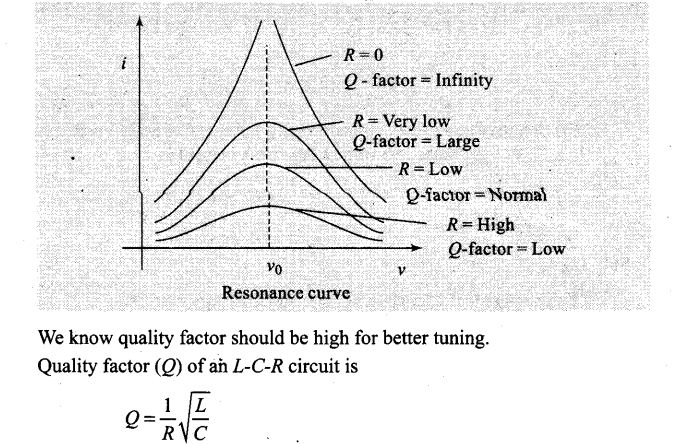
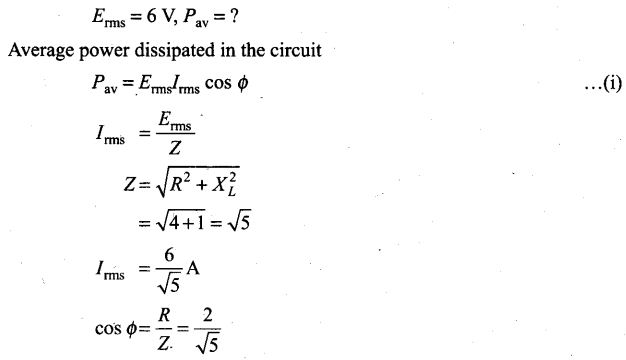
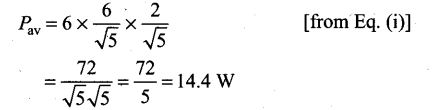
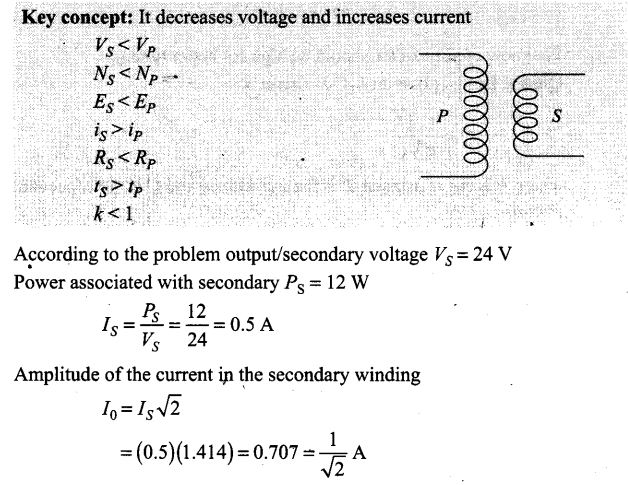
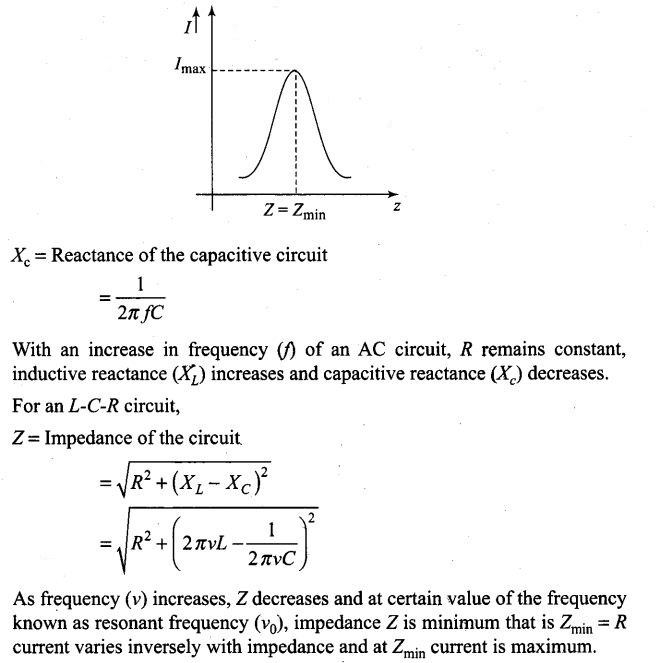
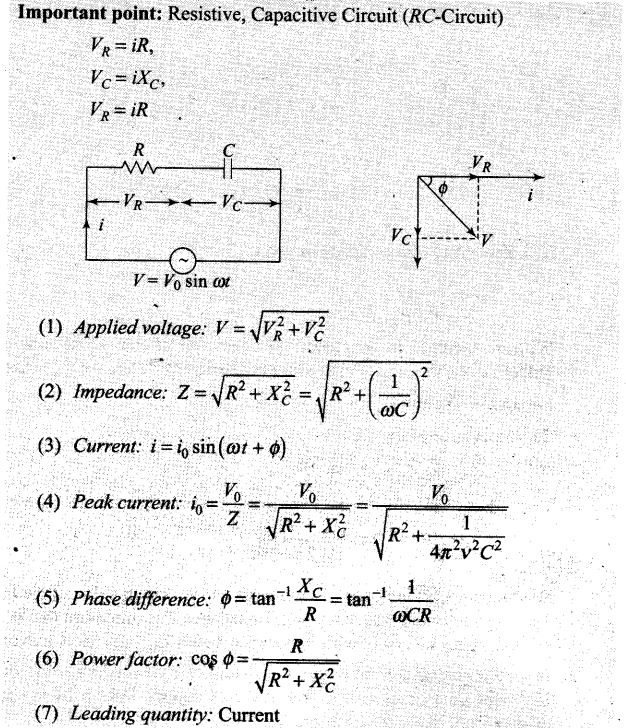
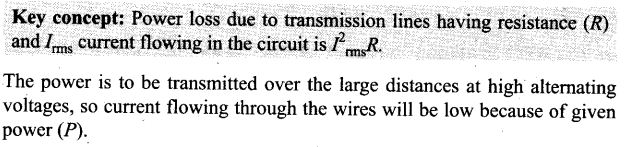
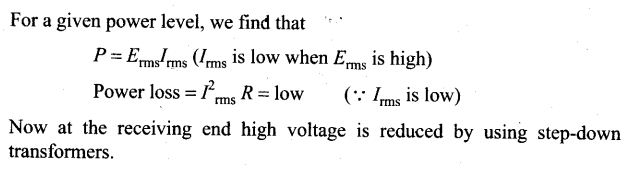
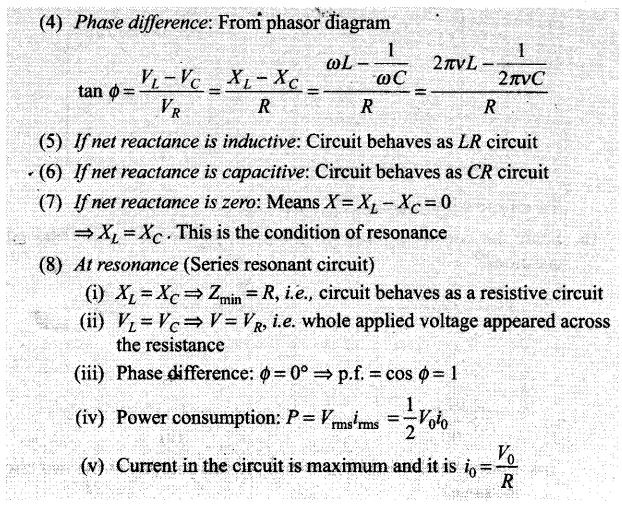
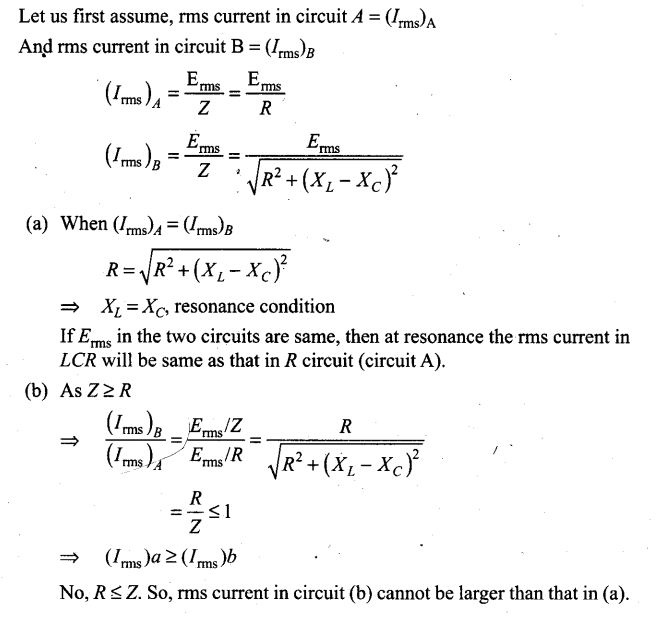
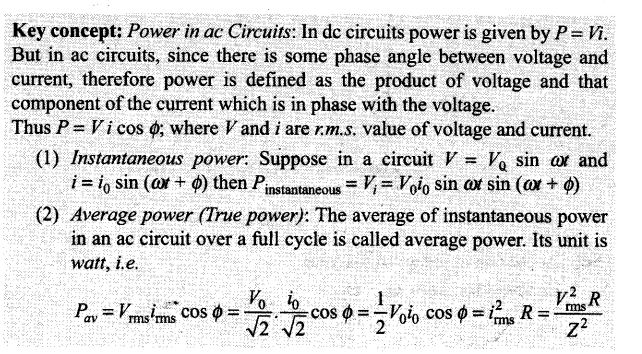
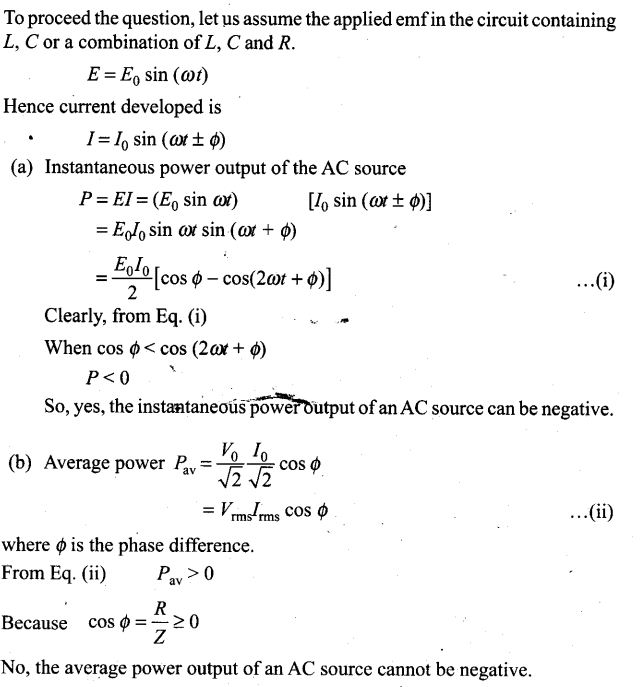
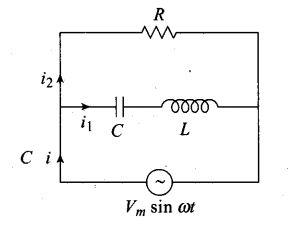
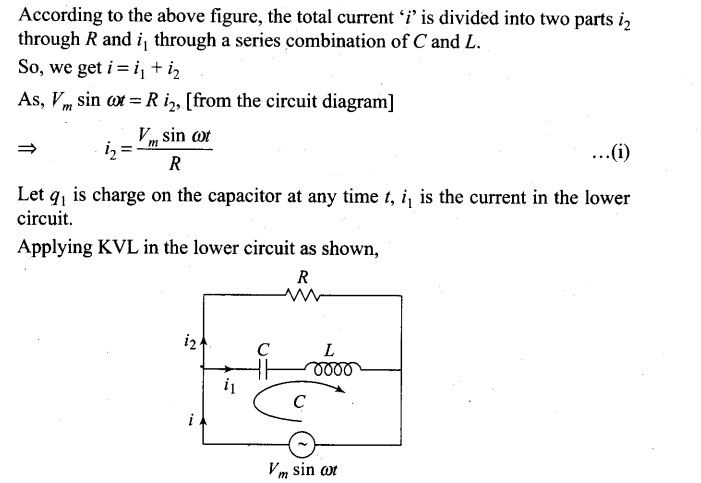
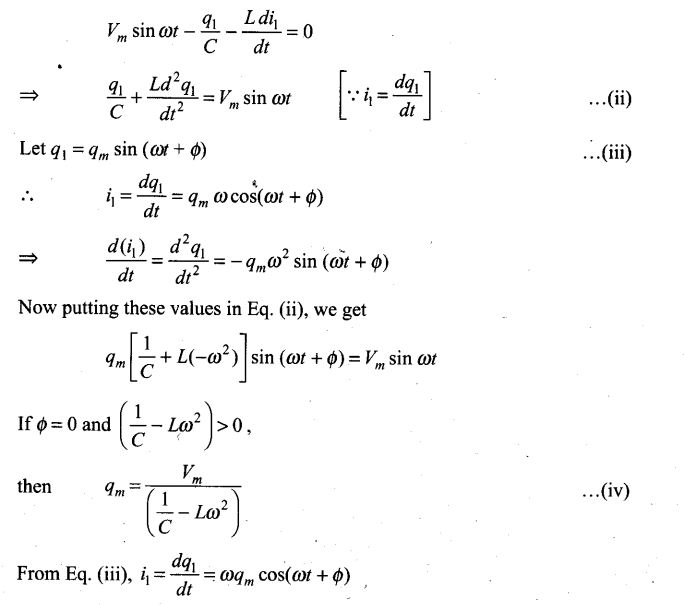
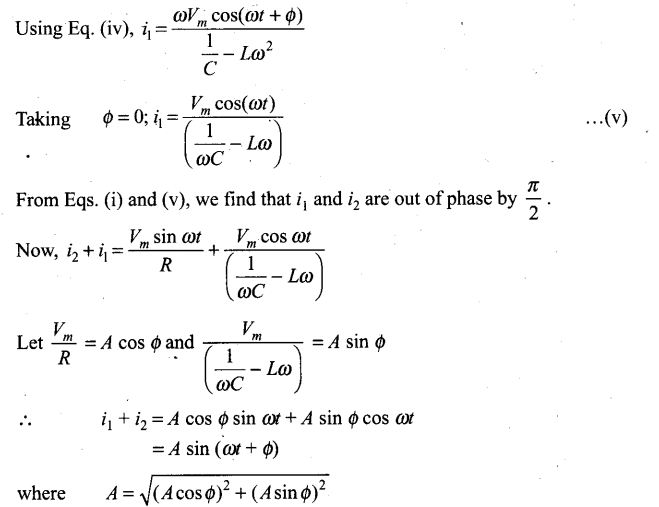
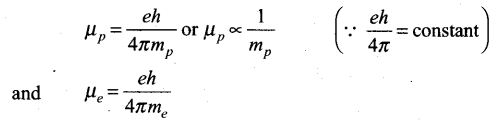
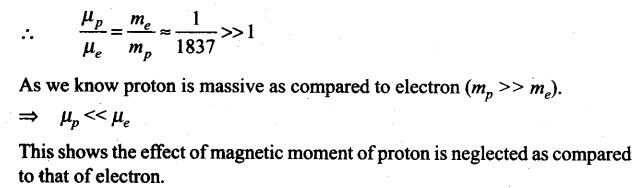
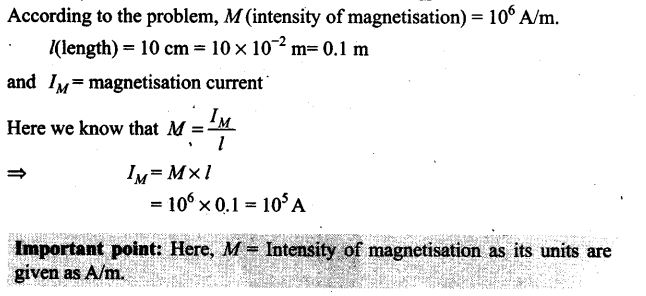
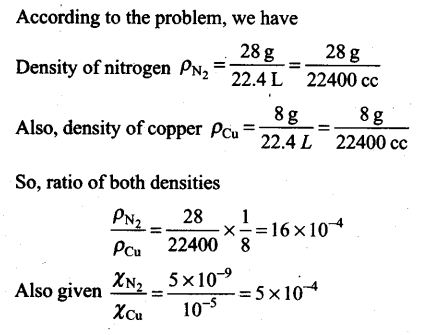
Author: shivamlohiya

  • Dual Nature of Radiation and Matter NCERT Exemplar Problems Solutions Physics

    NCERT Exemplar Problems Class 12 Physics Chapter 11 Dual Nature of Radiation and Matter

    Multiple Choice Questions (MCQs)

    Single Correct Answer Type
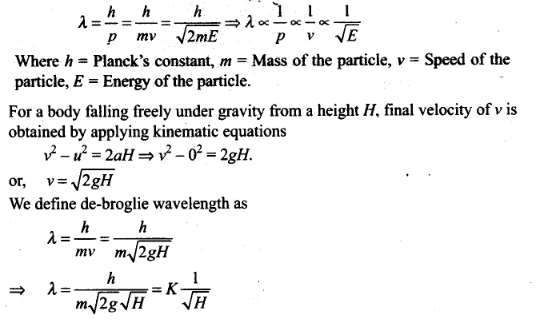
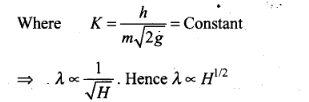
    Question 1. A particle is dropped from a height H. The de-Broglie wavelength of the particle as a function of height is proportional to (a) H (b) H1/2 (c) H0 (d) H-1/2
    Solution: (d)
    Key concept: According to de-Broglie a moving material particle sometimes acts as a wave and sometimes as a particle.
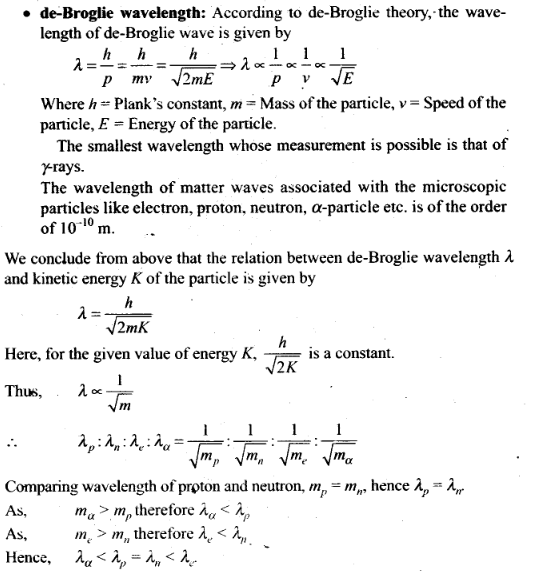
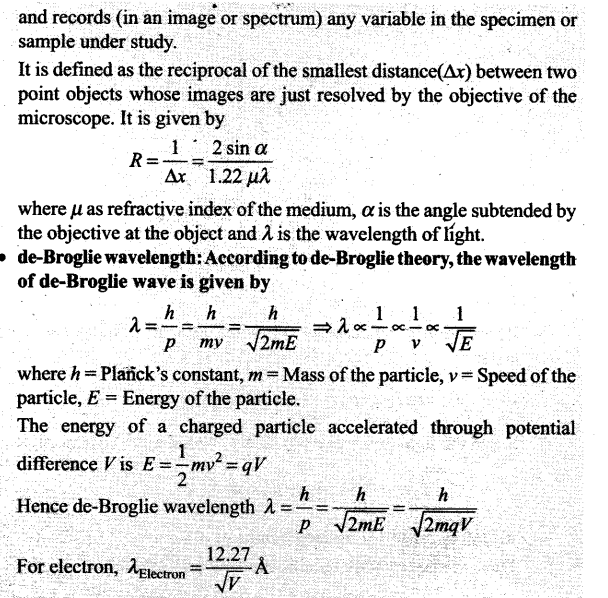
    The wave associated with a moving particle is called matter wave or de-Broglie wave and it propagates in the form of wave packets with group velocity. According to de-Broglie theory, the wavelength of de-Broglie wave is given by
    ncert-exemplar-problems-class-12-physics-dual-nature-of-radiation-and-matter-1
    ncert-exemplar-problems-class-12-physics-dual-nature-of-radiation-and-matter-2

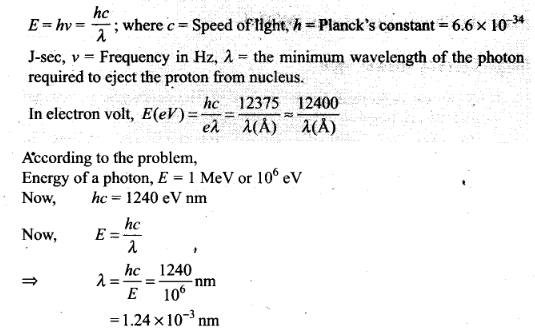
    Question 2. The wavelength of a photon needed to remove a proton from a nucleus which is bound to the nucleus with 1 MeV energy is nearly
    a) 1.2 nm (b) 1.2 x 10⁻³ nm
    (c) 1.2 x 10⁻⁶ nm (d). 1.2 x 10 nm
    Solution: (b)
    Key concept: According to Einstein’s quantum theory light propagates in the bundles (packets or quanta) of energy, each bundle being called a photon and possessing energy.
    Energy of photon is given by
    ncert-exemplar-problems-class-12-physics-dual-nature-of-radiation-and-matter-3

    Question 3. Consider a beam of electrons (each electron with energy E0) incident on a metal surface kept in an evacuated chamber. Then,
    (a) no electrons will be emitted as only photons can emit electrons
    (b) electrons can be emitted but all with an energy, E0
    (c) electrons can be emitted with any energy, with a maximum of E0 – ɸ (ɸ is the work function)
    (d) electron can be omitted with energy ,with a maximum of E0
    Solution: (d) If a beam of electrons of having energy E0 is incident on a metal surface kept in an evacuated chamber.
    ncert-exemplar-problems-class-12-physics-dual-nature-of-radiation-and-matter-4
    The electrons can be emitted with maximum energy E0 (due to elastic collision) and With any energy less than E0, when part of incident energy of electron is used in liberating the electrons from the surface of metal.

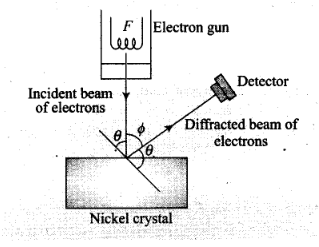
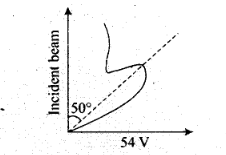
    Question 4. Consider the figure given below. Suppose the voltage applied to A is increased. The diffracted beam will have the maximum at a value of θ that (a) will be larger than the earlier value
    (b) will be the same as the earlier value
    (c) will be less than the earlier value
    (d) will depend on the target
    ncert-exemplar-problems-class-12-physics-dual-nature-of-radiation-and-matter-5
    Solution: (c)
    Key concept: Davision and Germer Experiment:
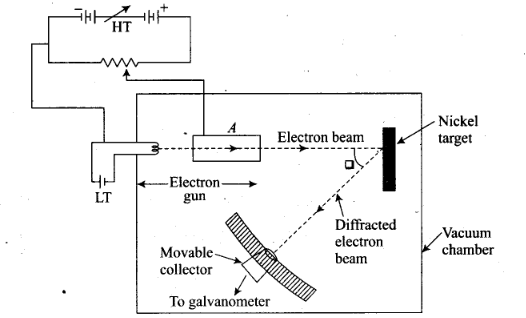
    1. It is used to study the scattering of electron from a solid or to verify the wave nature of electron. A beam of electrons emitted by an . electron gun is made to fall on nickel crystal cut along cubical axis at a particular angle. Ni crystal behaves like a three dimensional diffraction grating and it diffracts the electron beam obtained from electron gun.
    ncert-exemplar-problems-class-12-physics-dual-nature-of-radiation-and-matter-6
    2. The diffracted beam of electrons is received by the detector which can be positioned at any angle by rotating it .about the point of incidence. The energy of the incideni beam of electrons can also be varied by changing the applied voltage to the electron gun.
    According to classical physics, the intensity of scattered beam of electrons at all scattering angle will be same but Davisson and Germer found that the intensity of scattered beam of electrons was not the same but different at different angles of scattering. It is maximum for diffracting angle 50° at 54 volt potential difference.
    3. If the de-Broglie waves exist for electrons then these should be diffracted as X-rays. Using the Bragg’s formula 2d sinθ = nλ, we can determine the wavelength of these waves.
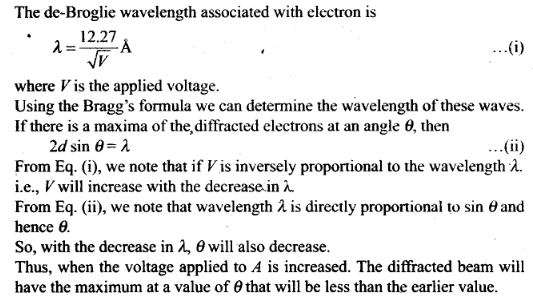
    The de-Broglie wavelength associated with electron is where V is the applied voltage.
    Using the Bragg’s formula we can determine the wavelength of these waves. If there is a maxima of the, diffracted electrons at an angle θ, then
    2d sin θ = A (ii)
    From Eq. (i), we note that if V is inversely proportional to the wavelength λ. i.e., V will increase with the decrease, in λ.
    From Eq. (ii), we note that wavelength λ is directly proportional to sinθ and hence θ.
    So, with the decrease in λ , θ will also decrease.
    Thus, when the voltage applied to A is increased. The diffracted beam will have the maximum at a value of θ that will be less than the earlier value.
    ncert-exemplar-problems-class-12-physics-dual-nature-of-radiation-and-matter-7
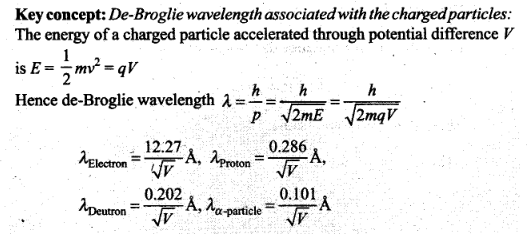
    4. A proton, a neutron, an electron and an a-particle have same energy. Then, their de-Broglie wavelengths compare as
    ncert-exemplar-problems-class-12-physics-dual-nature-of-radiation-and-matter-8

    Question 5. A proton, a neutron, an electron and an a-particle have same energy. Then, their de-Broglie wavelengths compare as (a) λp = λn > λe > λα (b) λα < λp = λn > λe
    (c) λe< λp = λn> λα (d) λe = λp = λn = λα
    Solution: (b)
    Key concept:
    • Matter Waves (de-Broglie Waves)
    According to de-Broglie a moving material particle sometimes acts as a wave and sometimes as a particle.
    ncert-exemplar-problems-class-12-physics-dual-nature-of-radiation-and-matter-9

    Question 6. An electron is moving with an initial velocity v = v0i and is in a magnetic field B = B0j. Then, its de-Broglie wavelength
    (a) remains constant
    (b) increases with time
    (c) decreases with time
    (d) increases and decreases periodically
    Solution: (a)
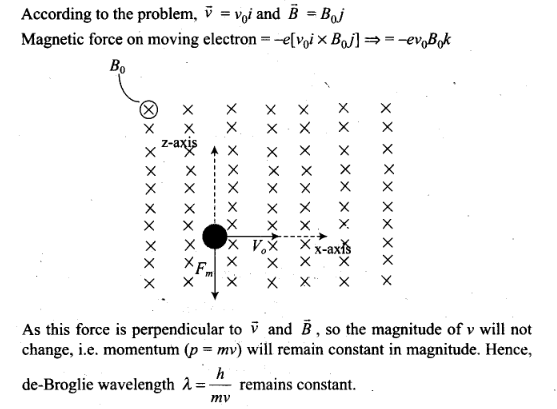
    Key concept: If a particle is carrying a positive charge q and moving with a velocity v enters a magnetic field .5 then it experiences a force F which is given by the expression
    F = q(v x B)=$ F = qvB sin θ. As this force is perpendicular to v and B , so the magnitude of v will not change, i.e. momentum (p = mv) will remain constant in magnitude. Hence,
    ncert-exemplar-problems-class-12-physics-dual-nature-of-radiation-and-matter-10

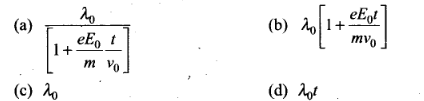
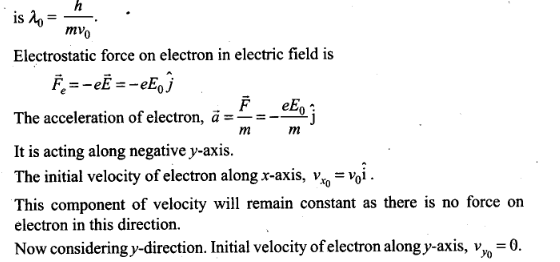
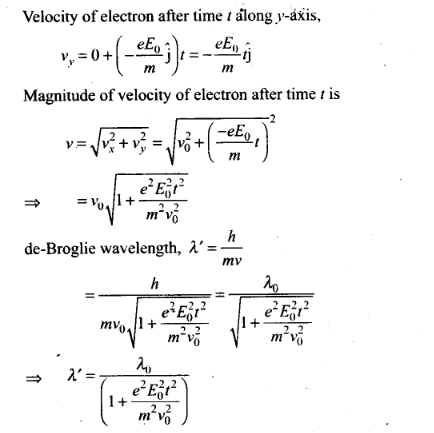
    Question 7. An electron (mass m) with an initial velocity v = v0i(v0 > 0) is in an electric field E =E0î (E0 = constant > 0). Its de-Broglie wavelength at time t is given by
    ncert-exemplar-problems-class-12-physics-dual-nature-of-radiation-and-matter-11
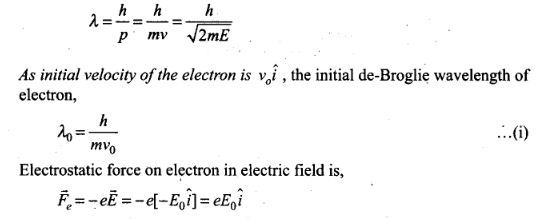
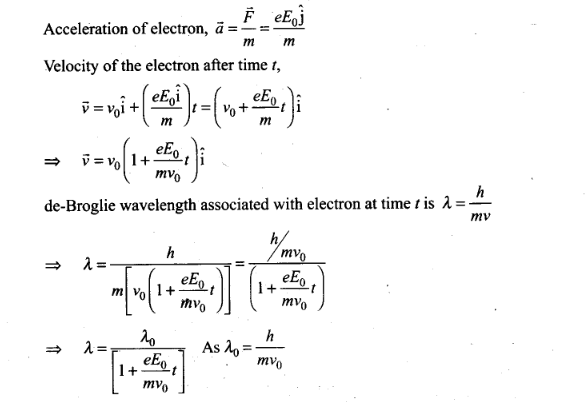
    Solution: (a)
    Key concept: The wave associated with moving particle is called matter wave or de-Broglie wave and it propagates in the form of wave packets with group velocity. According to de-Broglie theory, the wavelength of de- Broglie wave is given by
    ncert-exemplar-problems-class-12-physics-dual-nature-of-radiation-and-matter-12
    ncert-exemplar-problems-class-12-physics-dual-nature-of-radiation-and-matter-13

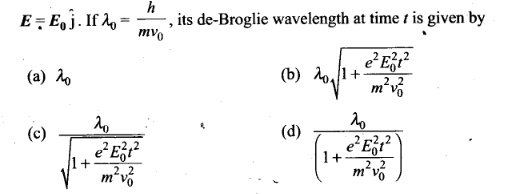
    Question 8. An electron (mass m) with an initial velocity v =v0î is in an electric field
    ncert-exemplar-problems-class-12-physics-dual-nature-of-radiation-and-matter-14
    Solution: (c) According to the problem de-Broglie wavelength of electron at time t=0.
    ncert-exemplar-problems-class-12-physics-dual-nature-of-radiation-and-matter-15
    ncert-exemplar-problems-class-12-physics-dual-nature-of-radiation-and-matter-16

    One or More Than One Correct Answer Type

    Question 9. Relativistic corrections become necessary when the expression for the kinetic
    energy 1/2 mv2 , becomes comparable with mc2. where m is the mass of the
    particle. At what de-Broglie wavelength, will relativistic corrections become important for an electron?
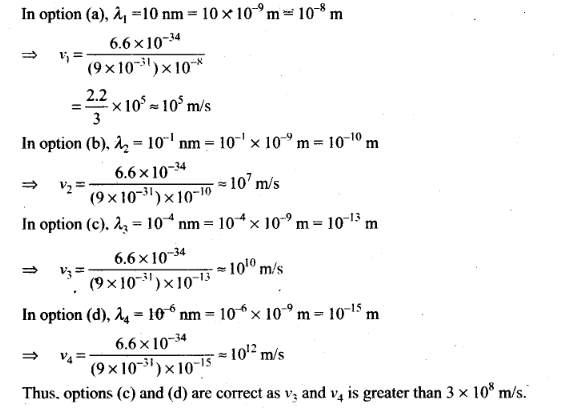
    (a) A=10nm (b) A =10-1 nm (c) A=10-4 nm (d) A=10-6 nm
    Solution: (c, d)
    Key concept: De-Brogile or matter wave is independent of die charge on the material particle. It means, matter wave of de-Broglie wave is associated with every moving particle (whether charged or uncharged).
    The de-Broglie wavelength at which relativistic corrections become important that the phase velocity of the matter waves can be greater than the speed of the light (3 x 10⁸ m/s).
    The wavelength of de-Broglie wave is given by
    λ = h/p = h/mv
    Here, h = 6.6 x 10⁻³⁴ Js
    and for electron, m = 9 x 10-31 kg
    To approach these types of problem we use hit and trial method by picking up each option one by one.
    ncert-exemplar-problems-class-12-physics-dual-nature-of-radiation-and-matter-17

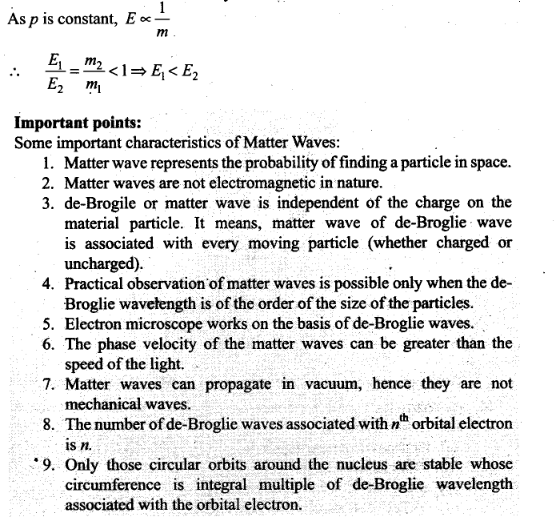
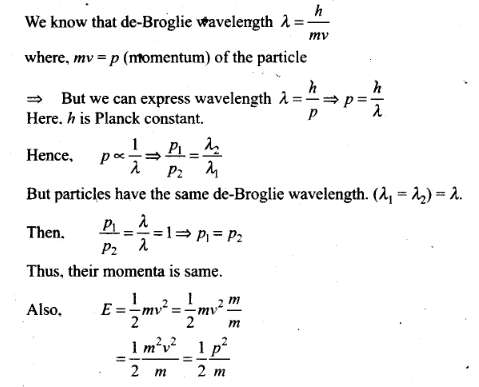
    Question 10. Two particles A1 and A2 of masses m1 , m2 ( m1> m2) have the same de-Broglie
    wavelength. Then,
    (a) their momenta are the same (b) their energies are the same
    (c) energy of A1 is less than the energy of A2
    (d) energy of A1 is more than the energy of A2
    Solution: (a. c)
    ncert-exemplar-problems-class-12-physics-dual-nature-of-radiation-and-matter-18
    ncert-exemplar-problems-class-12-physics-dual-nature-of-radiation-and-matter-19

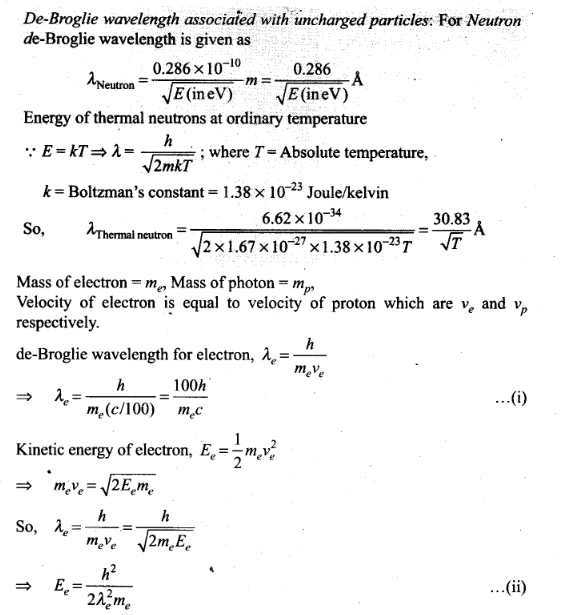
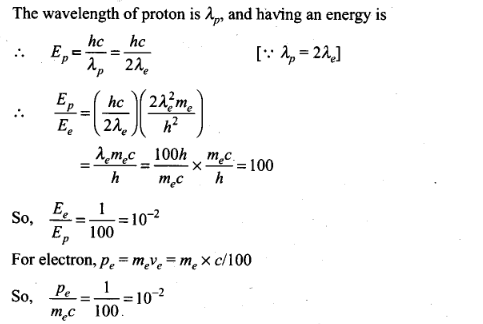
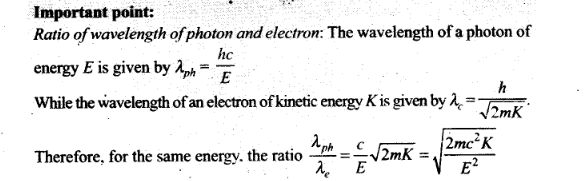
    Question 11. De-Broglie wavelength associated with uncharged particles: For Neutron efe-Broglie wavelength is given as ve=c/100.Then

    ncert-exemplar-problems-class-12-physics-dual-nature-of-radiation-and-matter-20
    Solution:(b,c)
    ncert-exemplar-problems-class-12-physics-dual-nature-of-radiation-and-matter-21
    ncert-exemplar-problems-class-12-physics-dual-nature-of-radiation-and-matter-22
    ncert-exemplar-problems-class-12-physics-dual-nature-of-radiation-and-matter-23
    ncert-exemplar-problems-class-12-physics-dual-nature-of-radiation-and-matter-24

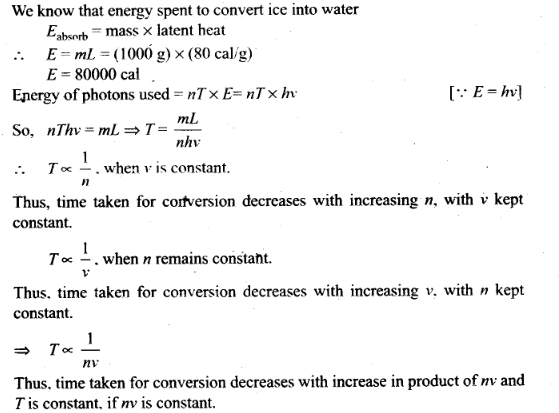
    Question 12. Photons absorbed in a matter are converted to heat. A source emitting v photon/sec of frequency v is used to convert 1 kg of ice at 0°C to water at 0°C. Then, the time T taken for the conversion
    (a) decreases with increasing n. with v fixed
    (b) decreases with n fixed, v increasing
    (c) remains constant with n and v changing such that nv = constant
    (d) increases when the product nv increases
    Solution: (a, b. c).
    ncert-exemplar-problems-class-12-physics-dual-nature-of-radiation-and-matter-25

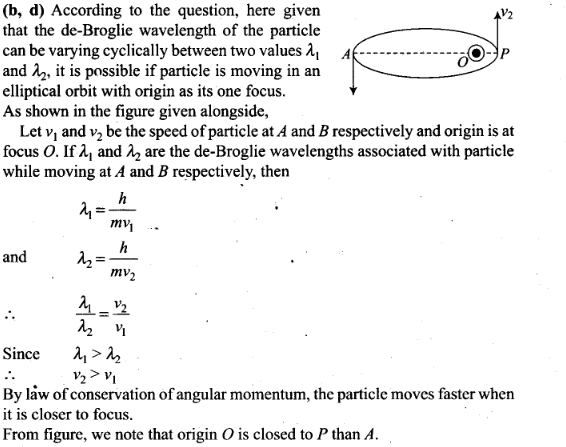
    Question 13. A particle moves in a closed orbit around the origin, due to a force which is directed towards the origin. The de-BrOglie wavelength of the particle varies cyclically between two values λ1, λ2 with λ1> λ2 Which of the following statements are true?
    (a) The particle could be moving in a circular orbit with origin as centre
    (b) The particle could be moving in an elliptic orbit with origin as its focus
    (c) When the de-Broglie wavetength is λ1 the particle is nearer the origin than when its value is λ2
    (d) When the de-Broglie wavelength is λ2 the particle is nearer the origin than when its value is λ1
    Solution:
    ncert-exemplar-problems-class-12-physics-dual-nature-of-radiation-and-matter-26

    Very Short Answer Type Questions

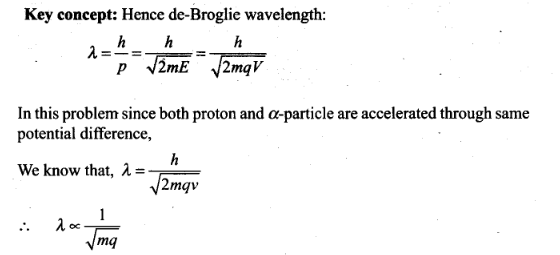
    Question 14. Aproton and an a-particle are accelerated, using the same potential difference. How are the de-Broglie wavelengths λp and λα related to each other?
    Solution:
    ncert-exemplar-problems-class-12-physics-dual-nature-of-radiation-and-matter-27
    ncert-exemplar-problems-class-12-physics-dual-nature-of-radiation-and-matter-28

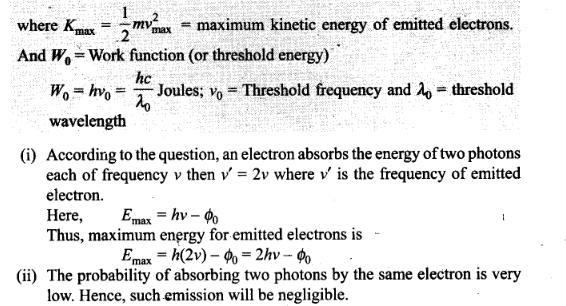
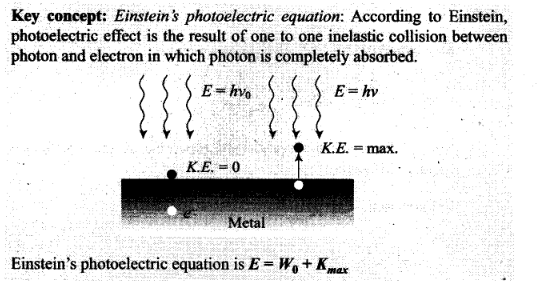
    Question 15. (i) In the explanation of photoeletric effect, we assume one photon of frequency v collides with an electron and transfers its energy. This leads . to the equation for the maximum energy Emax of the emitted electron as Emax = hv – ɸ0
    where ɸ0 is the work function of the metal. If an electron absorbs 2 photons (each of frequency v), what will be the maximum energy for the emitted electron?
    (ii) Why is this fact (two photon absorption) not taken into consideration in our discussion of the stopping potential?
    Solution:
    ncert-exemplar-problems-class-12-physics-dual-nature-of-radiation-and-matter-29
    ncert-exemplar-problems-class-12-physics-dual-nature-of-radiation-and-matter-30

    Question 16. There are materials which absorb photons of shorter wavelength and emit photons of longer wavelength. Can there be stable substances which absorb photons of larger wavelength and emit light of shorter wavelength?
    Solution: In the first case, when the materials which absorb photons of shorter wavelength has the energy of the incident photon on the material is high and the energy of emitted photon is low when it has a longer wavelength or in short we can say that energy given out is less than the energy supplied.
    But in second case, the energy of the incident photon is low for the substances which has to absorb photons of larger wavelength and energy of emitted photon is high to emit light Of shorter wavelength. This means in this statement material has to supply the energy for the emission of photons.
    But this is not possible for a stable substances.

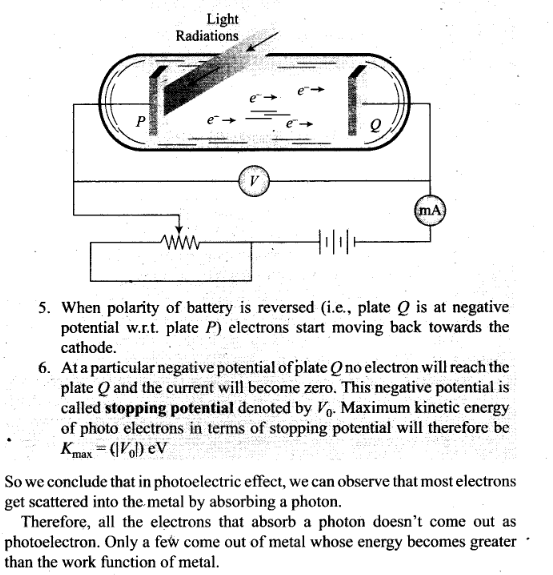
    Question 17. Do all the electrons that absorb a photon come out as photo electrons?
    Solution:
    Key concept: Photo-Electric Effect:
    The photo-electtic effect is the emission of electrons (called photo-electrons when light strikes a surface. To escape from the surface, the electron must absorb enough energy from the incident radiation to overcome the attraction of positive ions in the material of the surface.
    The photoelectric effect is based on the principle of conservation of energy.
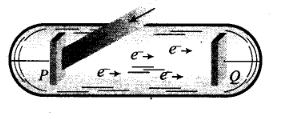
    1. Two conducting electrodes, the anode (Q) and cathode (P) are enclosed in an evacuated glass tube as shown on next page.
    2. The battery or other source of potential difference creates an electric field in the direction from anode to cathode.
    3. Light of certain wavelength or frequency falling on the surface of cathode causes a current in the external circuit called photoelectric current.
    4. As potential difference increases, photoelectric current also increases till saturation is reached.
    ncert-exemplar-problems-class-12-physics-dual-nature-of-radiation-and-matter-31

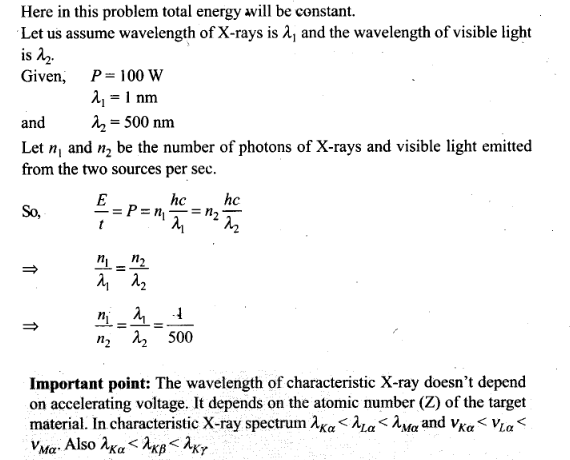
    Question 18. There are two sources of light, each emitting with a power of 100 W. One emits X-rays of wavelength 1 nm and the other visible light at 500 nm. Find the ratio of number of photons of X-rays to the photons of visible light of the given wavelength.
    Solution:
    Key concept: X-Rays:
    1. X-rays were discovered by scientist Roentgen that is why they are also called Roentgen rays.
    2. Roentgen discovered that when pressure inside a discharge tube is kept 10“3 mm of Hg and potential difference is kept 25 kV, then some unknown radiations (X-rays) are emitted by anode.
    3. There are three essential requirements for the production of X-rays.
    (i) A source of electron
    (ii) An arrangement to accelerate the electrons
    (iii) A target of suitable material of high atomic weight and high melting point on which these high speed electrons strike.
    ncert-exemplar-problems-class-12-physics-dual-nature-of-radiation-and-matter-32

    Question 19. Consider a metal exposed to light of wavelength 600 nm. The maximum energy of the electron doubles when light of wavelength 400 nm is used. Find the work function in eV.
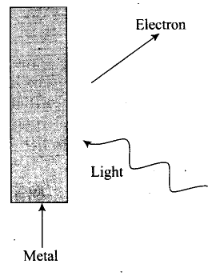
    ncert-exemplar-problems-class-12-physics-dual-nature-of-radiation-and-matter-33
    Solution:The momentum of incident photon is transferred to the metal ,during photo electric emission.
    At microscopic level ,atoms of a metal absorb the photon and its momentum is transferred mainly to the nucleus and electrons.The excited electron is emitted.Therefore,the conservation of momentum is to be considered as the momentum of incident photon transferred to the nucleus and electron.

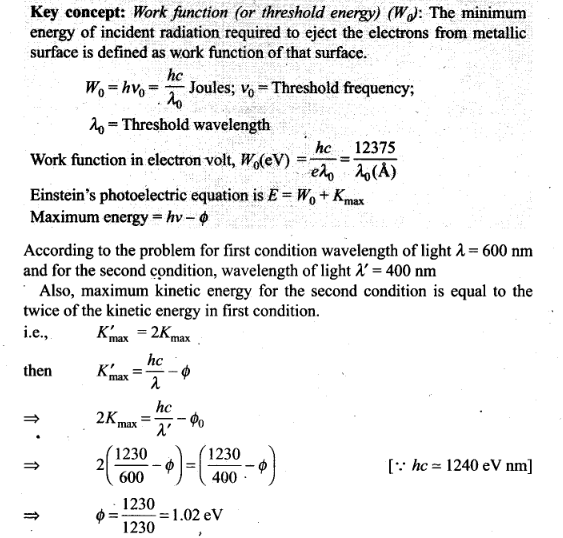
    Question 20.Consider a metal exposed to light the wavelength of 600 nm. The maximum energy of electron doubles when light of wavelength 400 nm is used.Find the work function in eV?
    Solution:
    ncert-exemplar-problems-class-12-physics-dual-nature-of-radiation-and-matter-34

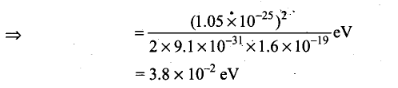
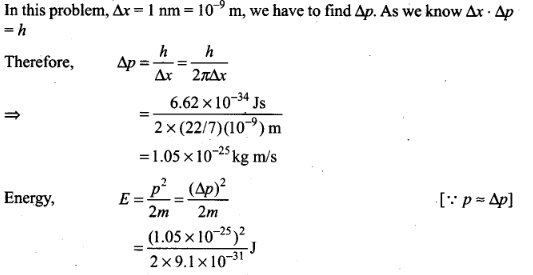
    Question 21. Assuming an electron is confined to a 1 nm wide region, find the uncertainty in momentum using Heisenberg uncertainty principle (∆x x∆p=h). You can assume the uncertainty in position ∆x as 1 nm. Assuming p = ∆p, find the energy of the electron in electron volts.
    Solution:
    ncert-exemplar-problems-class-12-physics-dual-nature-of-radiation-and-matter-35
    ncert-exemplar-problems-class-12-physics-dual-nature-of-radiation-and-matter-36

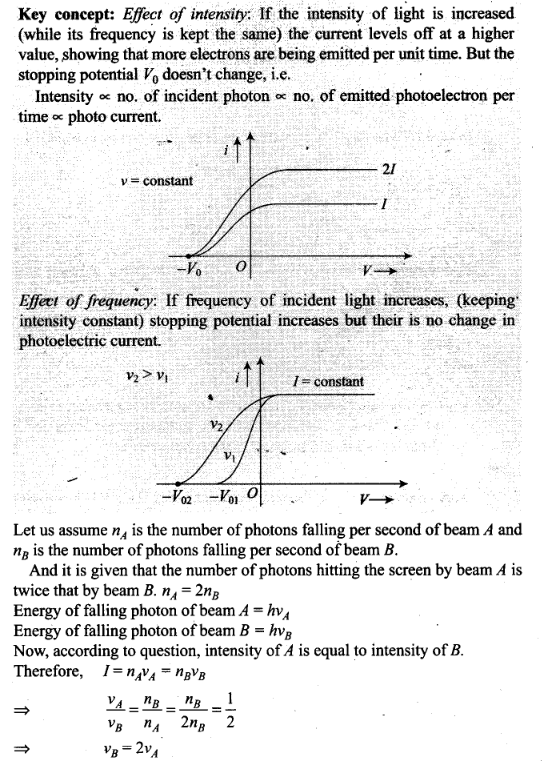
    Question 22. Two monochromatic beams A and B of equal intensity I, hit a screen. The number of photons hitting the screen by beam A is twice that by beam B. Then, what inference can you make about their frequencies?
    Solution:
    ncert-exemplar-problems-class-12-physics-dual-nature-of-radiation-and-matter-37

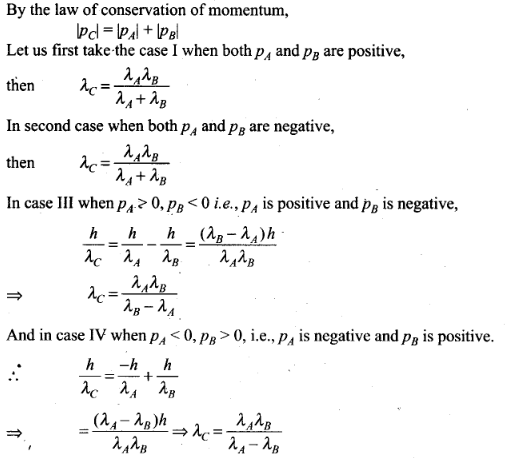
    Question 23. Two particles A and B of de-Broglie wavelengths A, and combine to form a particle C. The process conserves momentum. Find the de-Broglie wavelength of the particle C. (The motion is one-dimensional)
    Solution:
    ncert-exemplar-problems-class-12-physics-dual-nature-of-radiation-and-matter-38

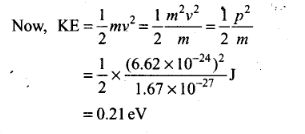
    Question 24. A neutron beam of energy E scatters from atoms on a surface with a spacing d = 0.1 nm. The first maximum intensity in the reflected beam occurs at θ= 30°. What is the kinetic energy E of the beam in eV?
    Solution:
    ncert-exemplar-problems-class-12-physics-dual-nature-of-radiation-and-matter-38
    ncert-exemplar-problems-class-12-physics-dual-nature-of-radiation-and-matter-40

    Long Answer Type Questions

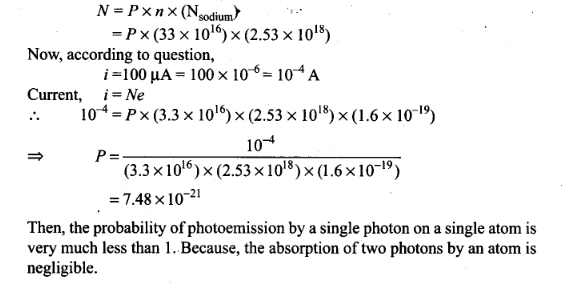
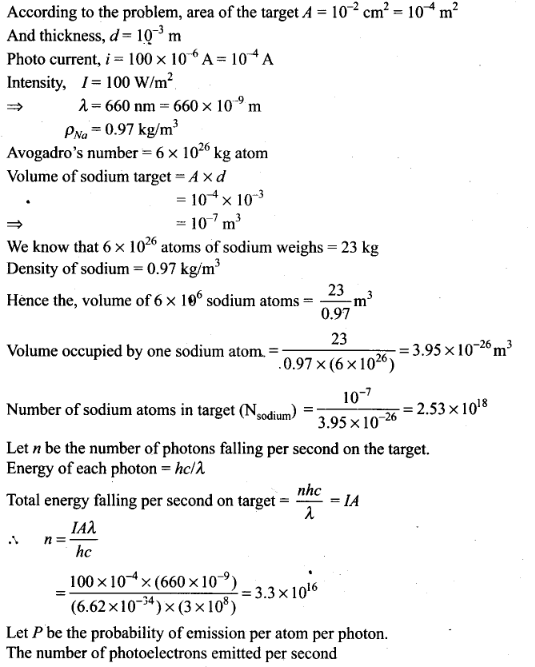
    Question 25. Consider a thin target (10-2 cm square, 10-3 m thickness) of sodium, which produces a photocurrent of 100 µA when a light of intensity 100 W/m2 (λ = 660 nm) falls on it. Find the probability that a photoelectron is produced when a photon strikes a sodium atom. [Take density of Na = 0.97 kg/m3]
    Solution:
    ncert-exemplar-problems-class-12-physics-dual-nature-of-radiation-and-matter-41
    ncert-exemplar-problems-class-12-physics-dual-nature-of-radiation-and-matter-42

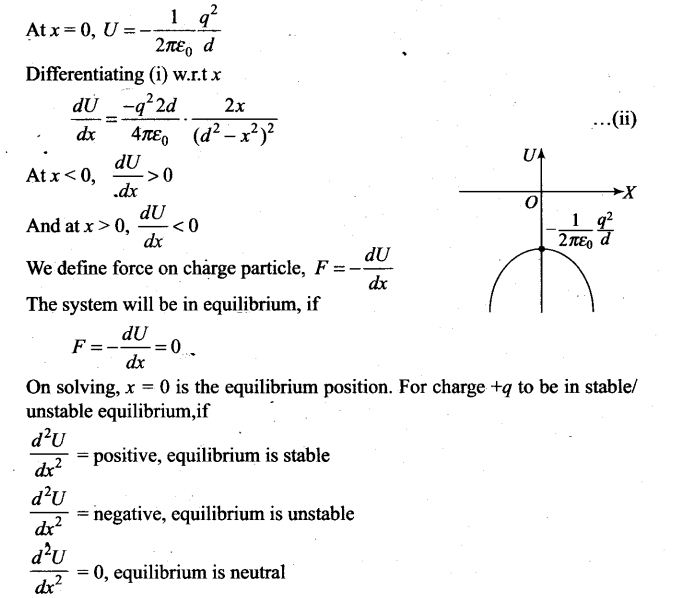
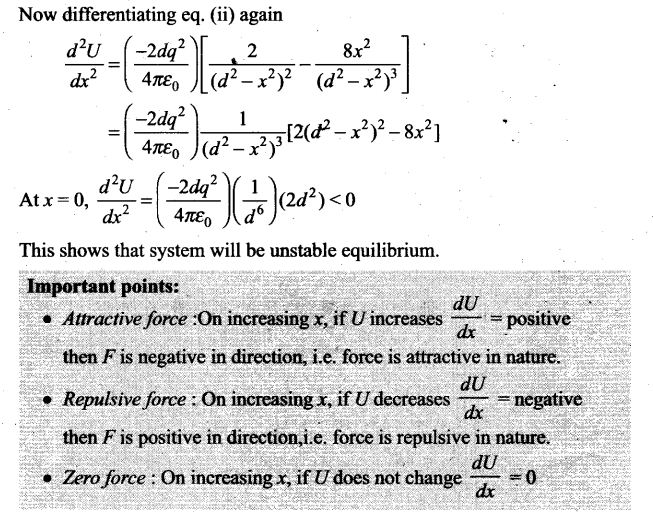
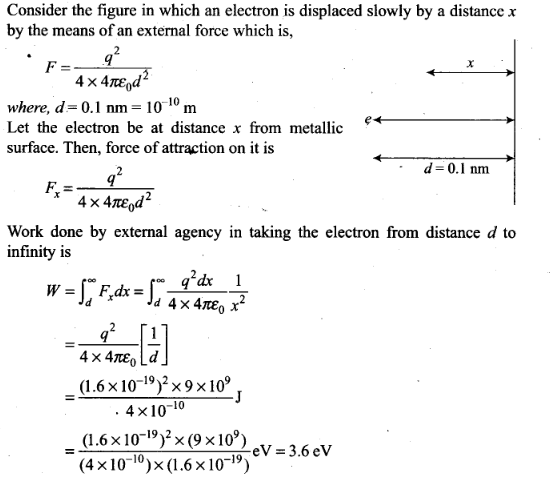
    Question 26. Consider an electron in front of metallic surface of a distance d.Assume the force of attraction by the plate is given as . Calculate work in taking the to an infinite distance from the plate .Taking d=0.1 nm. find the work done in electron volts?
    Solution:
    ncert-exemplar-problems-class-12-physics-dual-nature-of-radiation-and-matter-43

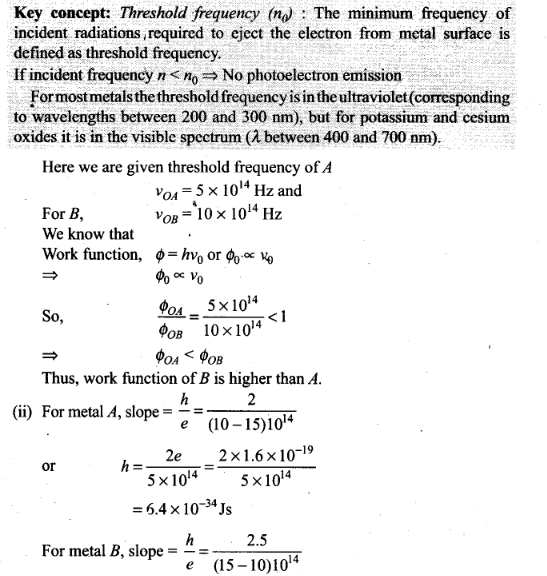
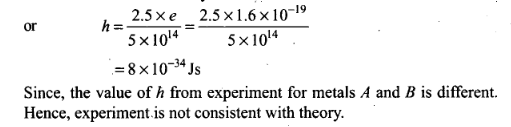
    Question 27. A student performs an experiment on photoelectric effect, using two materials A and B. A plot of Vstop versus v is given in figure.
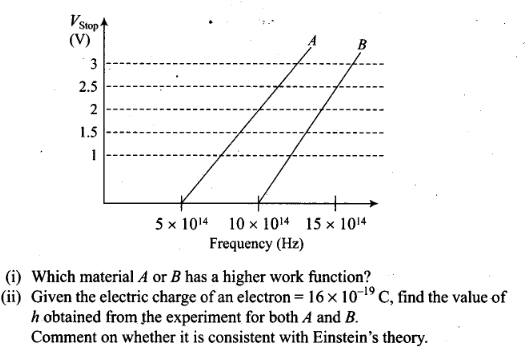
    ncert-exemplar-problems-class-12-physics-dual-nature-of-radiation-and-matter-44
    Solution:
    ncert-exemplar-problems-class-12-physics-dual-nature-of-radiation-and-matter-45
    ncert-exemplar-problems-class-12-physics-dual-nature-of-radiation-and-matter-46

    Question 28. A particle A with a mass mA is moving with a velocity v and hits a particle B (mass mB) at rest (one dimensional motion). Find the change in the de-Broglie wavelength of the particle A. Treat the collision as elastic.
    Solution:
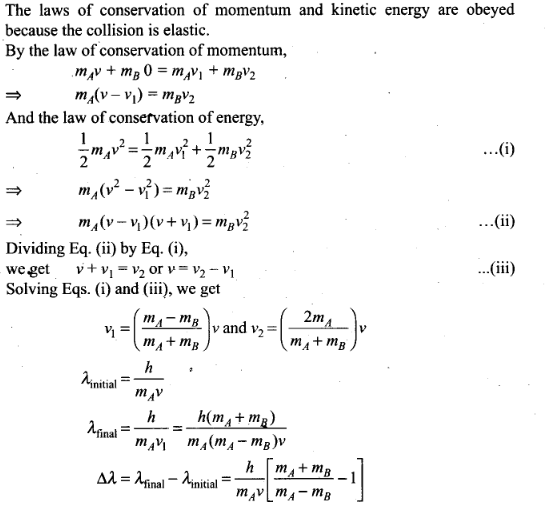
    ncert-exemplar-problems-class-12-physics-dual-nature-of-radiation-and-matter-47

    Question 29. Consider a 20 W bulb emitting light of wavelength 5000 Å and shining on a metal surface kept at a distance 2 m. Assume that the metal surface has work function of 2 eV and that each atom on the metal surface can be treated as a circular disk of radius 1.5 Å.
    (i) Estimate number of photons emitted by the bulb per second. [Assume no other losses]
    (ii) Will there be photoelectric emission?
    (iii) How much time would be required by the atomic disk to receive energy equal to work function (2 eV)?
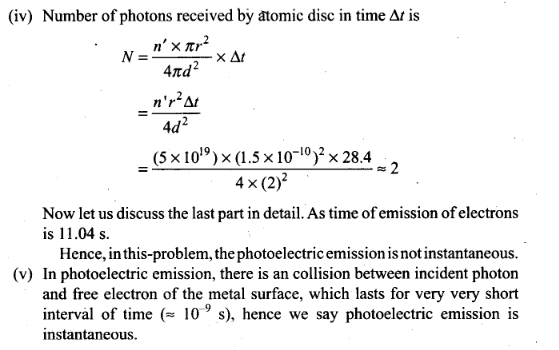
    (iv) How many photons would atomic disk receive within time duration calculated in (iii) above?
    (v) Can you explain how photoelectric effect was observed instantaneously?
    Solution:
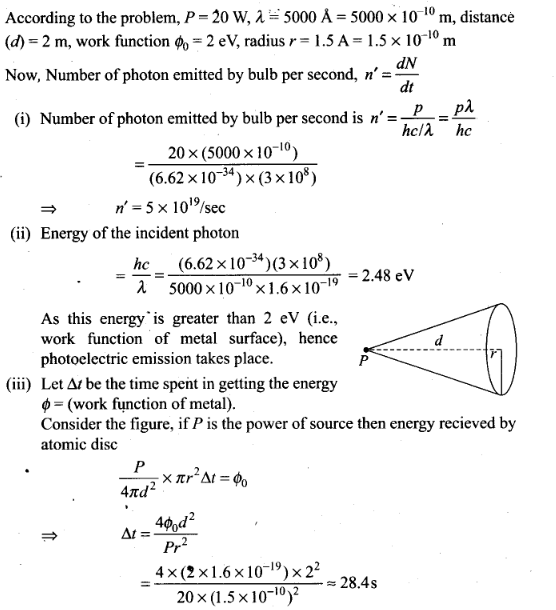
    ncert-exemplar-problems-class-12-physics-dual-nature-of-radiation-and-matter-48
    ncert-exemplar-problems-class-12-physics-dual-nature-of-radiation-and-matter-49

  • Wave Optics NCERT Exemplar Problems Solutions Physics

    NCERT Exemplar Problems Class 12 Physics Chapter 10 Wave Optics

    Multiple Choice Questions (MCQs)

    Single Correct Answer Type
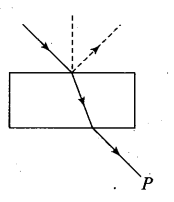
    Question 1. Consider a light beam incident from air to a glass slab at Brewster’s angle as shown in figure.
    ncert-exemplar-problems-class-12-physics-wave-optics-1
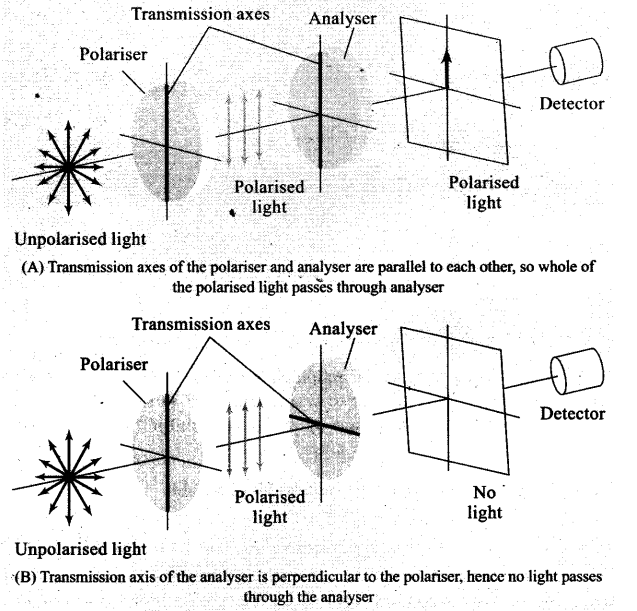
    A Polaroid is placed in the path of the emergent ray at point P and rotated about an axis passing through the centre and perpendicular to the plane of the polaroid.
    (a) For a particular orientation, there shall be darkness as observed through the polaroid.
    (b) The intensity of light as seen through the polaroid shall be independent of the rotation.
    (c) The intensity of light as seen through the polaroid shall go minimum but not zero for two orientations of the polaroid.
    (d) The intensity of light as seen through the polaroid shall go minimum for four orientations of the polaroid.
    Solution: (c)
    Key concept:
    Brewster’s law: Brewster discovered that when a beam of unpolarised light is reflected from a transparent medium (refractive index = µ), the reflected light is completely plane polarised at a certain angle of incidence (called the angle of polarisation θp).
    From figure, it is clear that θp+ θr = 90°
    Also n = tan θp (Brewster’s law)
    (i) For i < θp or i > θp
    Both reflected and refracted rays becomes partially polarised.
    (ii) For glass θp = 51° for water θp = 53°
    ncert-exemplar-problems-class-12-physics-wave-optics-3
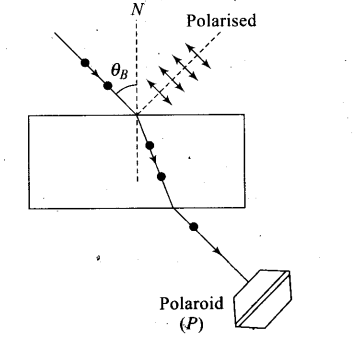
    If a light beam is incident on a glass slab at Brewster’s angle, the transmitted beaiji is unpolarised and reflected beam is polarised.
    In the given figure, the light beam is incident from air to the glass slab at Brewster’s angle (ip). The incident ray is unpolarised and is represented by dot (•). The reflected light is plane polarised represented by arrows.
    As the emergent ray is unpolarised, hence intensity cannot be zero when passes through polaroid.
    ncert-exemplar-problems-class-12-physics-wave-optics-4
    Important points:
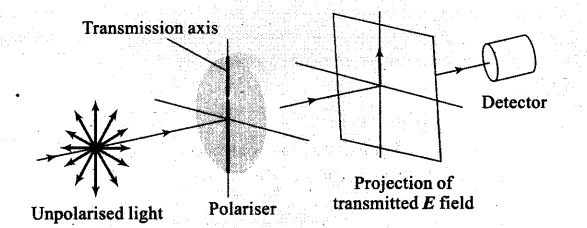
    Polarised light: The phenomenon of limiting the vibrating of electric field vector in one direction in a plane perpendicular to the direction of propagation of light wave is called polarization of light.
    (i) The plane in which oscillation occurs in the polarised light is called plane of oscillation.
    (ii) The plane perpendicular to the plane of oscillation is called plane of polarisation.
    (iii) Light can be polarised by transmitting through certain crystals such as tourmaline or polaroids.
    Polaroids: It is a device used to produce the plane polarised light. It is based on the principle of selective absorption and is more effective than the tourmaline crystal, or it is a thin film of ultramicroscopic crystals of quinine iodosulphate with their optic axis parallel to each other.
    ncert-exemplar-problems-class-12-physics-wave-optics-5

    Question 2. Consider sunlight incident on a slit of width 104 Å. The image seen through the slit shall
    (a) be a fine sharp slit white in colour at the centre
    (b) a bright slit white at the centre diffusing to zero intensities at the edges
    (c) a bright slit white at the centre diffusing to regions of different colours
    (d) only be diffused slit white in colour.
    Solution: (a)
    Key concept: –
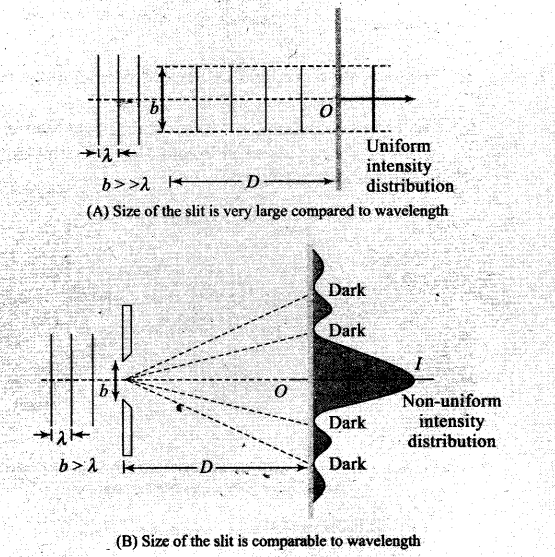
    Diffraction of Light is the phenomenon of bending of light around the comers of an obstacle/aperture of the size of the wavelength of light.
    ncert-exemplar-problems-class-12-physics-wave-optics-6
    In figure (A), no diffraction phenomenon is observed as the size of slit is weary large compared to wavelength. But in figure(B), there will be diffraction of light as size of slit is compared to the wavelength of light incident.
    Here in the question it is given, width of the slit
    b = 104 Å = 104 x 10-10 m = 10-6 m = 1 pm
    Wavelength of (visible) sunlight varies from 4000 Å to 8000 Å.
    Hence the width of slit is comparable to that of wavelength, hence diffraction occurs with maxima at centre. So, at the centre all colours appear, i.e., mixing of colours form white patch at the centre.

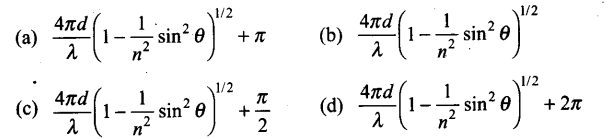
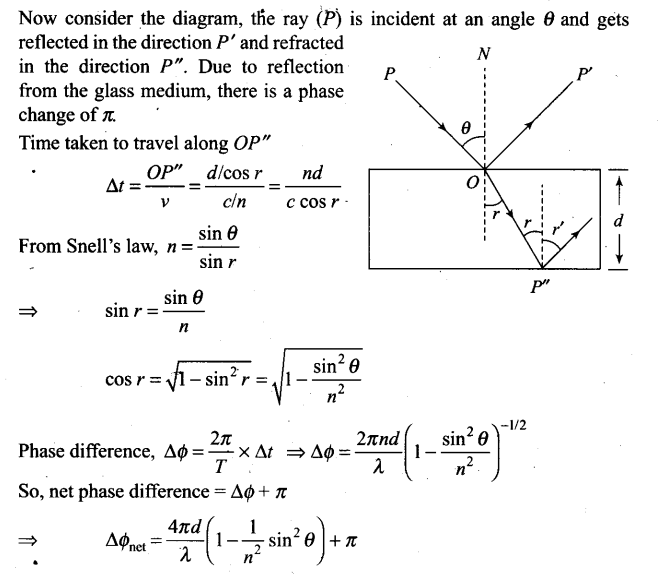
    Question 3. Consider a ray of light incident from air onto a slab of glass (refractive index n) of width d, at an angle θ. The phase difference between the ray reflected by the top surface of the glass and the bottom surface is
    ncert-exemplar-problems-class-12-physics-wave-optics-7
    Solution: (a)
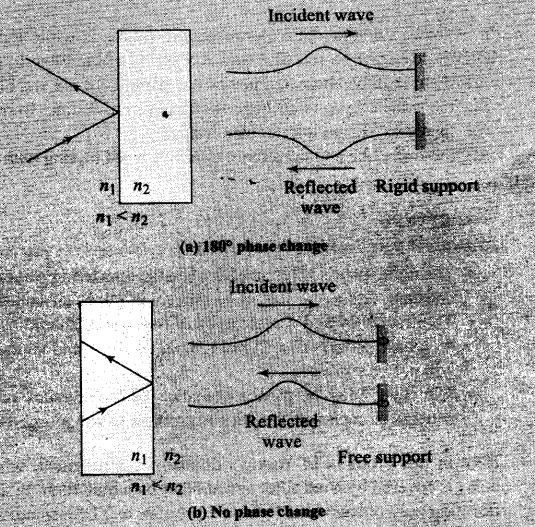
    Key concept: If slab of a glass is placed in air, the wave reflected from the upper surface (from a denser medium) sutlers a sudden phase change of π, while the wave reflected from the lower surface (from a rarer medium) suffers no such phase change.
    It is useful to draw an analogy between reflected light waves and the reflections of a transverse wave on a stretched string when the wave meets a boundary:
    Figure (a) shows that ray reflecting from a medium of higher refractive index undergoes a 180° phase change.
    ncert-exemplar-problems-class-12-physics-wave-optics-8
    ncert-exemplar-problems-class-12-physics-wave-optics-9

    Question 4. In a Young’s double-slit experiment, the source is white light. One of the holes is covered by a red filter and another by a blue filter. In this case,
    (a) there shall be alternate interference patterns of red and blue
    (b) there shall be an interference pattern for red distinct from that for blue
    (c) there shall be no interference fringes
    (d) there shall be an interference pattern for red mixing with one for blue
    Solution: (c)
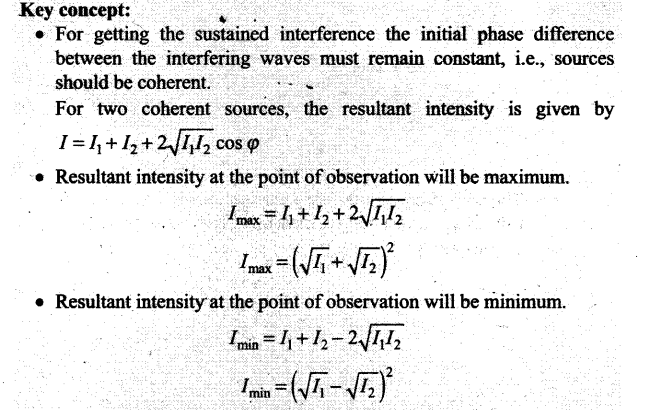
    Key concept:
    Condition for Observing Interference
    The initial phase difference between the interfering waves must remain constant. Otherwise the interference will not be sustained.
    The frequency and wavelengths of two waves should be equal. If not the phase difference will not remain constant and so the interference will not be sustained.
    The light must be monochromatic. This eliminates overlapping of patterns as each wavelength corresponds to one interference pattern.
    Here in this problem of Young’s double-slit experiment, when one of the holes is covered by a red filter and another by a blue filter. In this case due to filtration only red and blue lights are present. In YDSE monochromatic light is used for the formation of fringes on the screen. Hence, in this case there shall be no interference fringes.
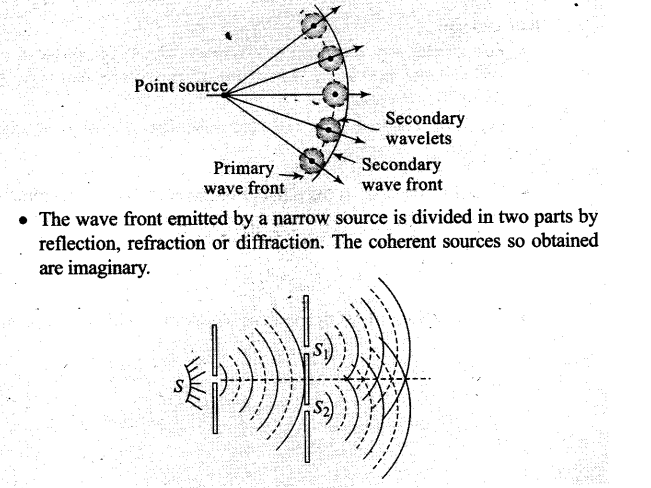
    The wave front emitted by a narrow source is divided in two parts by reflection, refraction or diffraction. The coherent sources so obtained are imaginary.

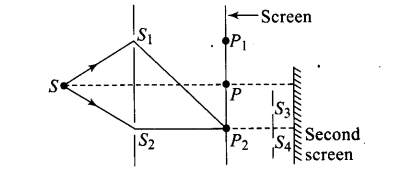
    Question 5. Figure shows a standard two slit arrangement with slits S1, S2, P1, P2 are the two minima points on either side of P (figure).
    ncert-exemplar-problems-class-12-physics-wave-optics-10
    At P2 on the screen, there is a hole and behind P2.is a second 2-slit arrangement with slits S3, S4 and a second screen behind them.
    (a) There would be no interference pattern on the second screen but it would be lighted
    (b) The second screen would be totally dark
    (c) There would be a single bright point on the second screen
    (d) There would be a regular two slit pattern on the second screen
    Solution: (d)
    Key concept:
    Wave front
    Every point on the given wave front acts as a source of new disturbance called secondary wavelets which travel in all directions with the .velocity of light in the medium.
    A surface touching these secondary wavelets tangentially in the forward direction at any instant gives the new wave front at that instant. This is called secondary wave front.In the given question, there is a hole at point which is a maxima point. From Huygen’s principle, wave will propagate from the sources S1 and S2. Each point on the screen will act as secondary sources of wavelets.
    ncert-exemplar-problems-class-12-physics-wave-optics-11

    One or More Than One Correct Answer Type

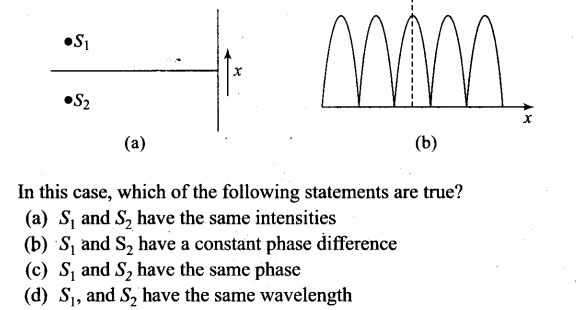
    Question 6. Two sources S1 and S2 of intensity I1 and I2 are placed in front of a screen .
    (a) The pattern of intensity distribution seen in the central portion is given by Fig. (b).
    In this case, which of the following statements are true?
    ncert-exemplar-problems-class-12-physics-wave-optics-12
    Solution: Key concept:
    ncert-exemplar-problems-class-12-physics-wave-optics-13

    Question 7. Consider sunlight incident on a pinhole of width 103 Å. The image of the pinhole seen on a screen shall be
    (a) a sharp white ring
    (b) different from a geometrical image
    (c) a diffused central spot, white in colour
    (d) diffused coloured region around a sharp central white spot
    Solution: (b, d)
    Key concept: Diffraction of Light can be observed only if the size of obstacle/aperture is less than the wavelength of light.
    Given, width of pinhole = 103 Å = 1000 Å
    We know that wavelength of sunlight ranges from 4000 Å to 8000 Å. Clearly, wavelength X < width of the slit.
    Hence, light is diffracted from the hole. Due to diffraction from the slit the image formed on the screen will be different from the geometrical image.

    Question 8. Consider the diffraction pattern for a small pinhole. As the size of the hole is increased
    (a) the size decreases (b) the intensity increases
    (c) the size increases (d) the intensity decreases
    Solution: (a,b)
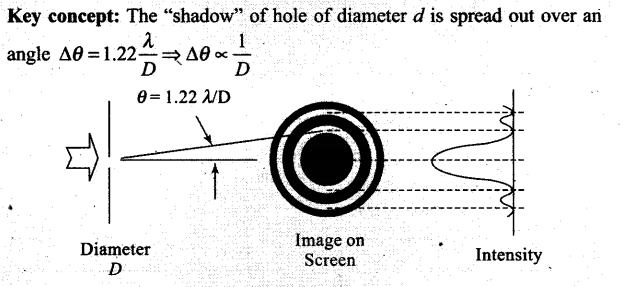
    ncert-exemplar-problems-class-12-physics-wave-optics-14
    The central bright disc is known as Airy’s disc.
    As the size of the hole is increased, AO will decrease and size of Airy’s disc will decrease.
    As the size of the hole is increased, the width of the central maximum of the diffraction pattern of hole decreases. Since the same amount of light is now distributed over a small area, as intensity ∞ 1/area, the area is decreasing so area intensity increases.

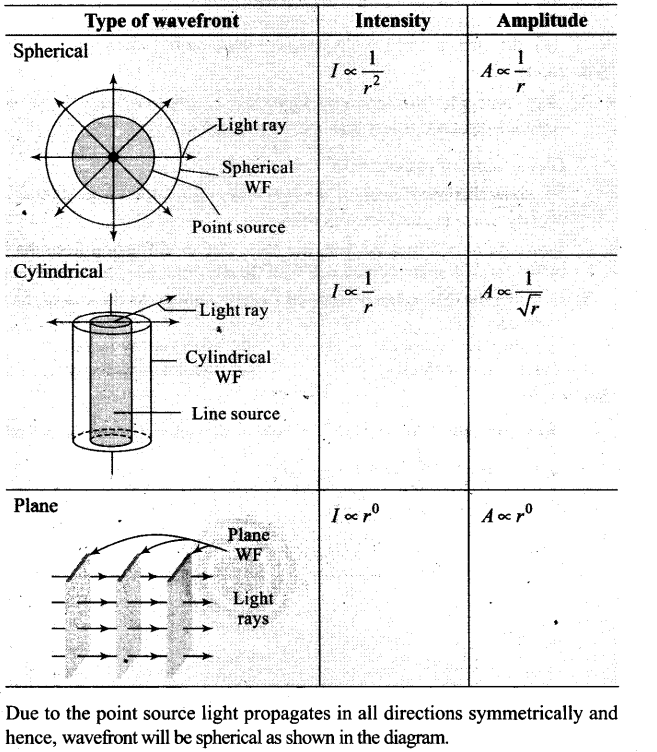
    Question 9. For light diverging from a point source,
    (a) the wavefront is spherical
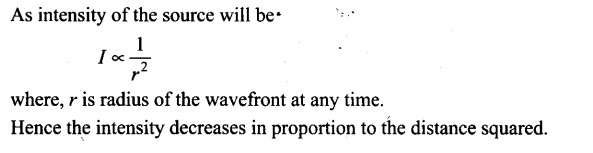
    (b) the intensity decreases in proportion to the distance squared
    (c) the wavefront is parabolic
    (d) the intensity at the wavefront does not depend on the distance
    Solution: (a, b)
    ncert-exemplar-problems-class-12-physics-wave-optics-15
    ncert-exemplar-problems-class-12-physics-wave-optics-16

    Question 10. Is Huygen’s principle valid for longitudinal sound waves?
    Solution: Yes it can. Huygen’s principle basically states that every point wave front can be considered as a secondary source of tiny wavelets that spread out in the forward direction of the wave itself. The disturbance due to the source propagates in spherical symmetry that is in all directions. The formation of wavefront is in accordance with Huygen’s principle.
    So, Huygen’s principle’is valid for longitudinal sound.waves also.

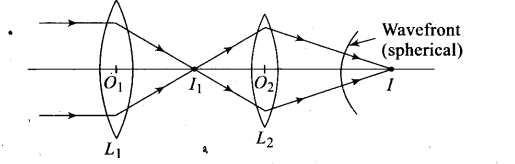
    Question 11. Consider a point at the focal point of a convergent lens. Another convergent lens of short focal length is placed on the other side. What is the nature of the wavefronts emerging from the final image?
    Solution: Orientation of wave front is perpendicular to ray. The ray diagram of the situation is as shown in figure.
    ncert-exemplar-problems-class-12-physics-wave-optics-17
    Parallel rays incident on lens L1 forms the image I2 at the focal point of the lens. This image acts as object for the lens L2 Now, due to the converging lens L2 , let final image formed is I which is point image. Hence the wavefront for this image will be of spherical symmetry.
    ncert-exemplar-problems-class-12-physics-wave-optics-18
    ncert-exemplar-problems-class-12-physics-wave-optics-19
    ncert-exemplar-problems-class-12-physics-wave-optics-20

    Question 12. What is the shape of the wavefront on earth for sunlight?
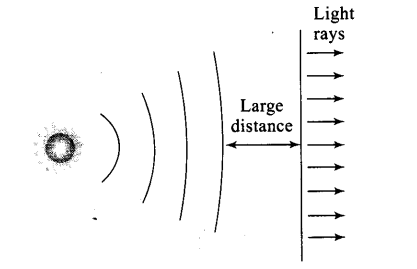
    Solution: The sun is at very large distance from the earth. Assuming sun as spherical, it can be considered as point source situated at infinity. We can treat it like a point object as seen from the surface of earth.
    Because of large distance, the radius of wavefront can be considered as Large (infinity) and hence, wavefront is almost plane.
    ncert-exemplar-problems-class-12-physics-wave-optics-21

    Question 13. Why is the diffraction of Sound waves more evident in daily experience than that of light wave?
    Solution: The frequencies of sound waves lie between 20 Hz to 20 kHz, their wavelength ranges between 15 m to 15 mm. The diffraction occurs if the wavelength of waves is nearly equal to slit width.
    The wavelength of light waves is 7000 x 10-10 m to 4000 x 10-10 m. For observing diffraction of light we need very narrow slit width. In daily life experience we observe the slit width very near to the wavelength of sound waves as compared to light waves. Thus, the diffraction of sound waves is more evident in daily life than that of light waves.

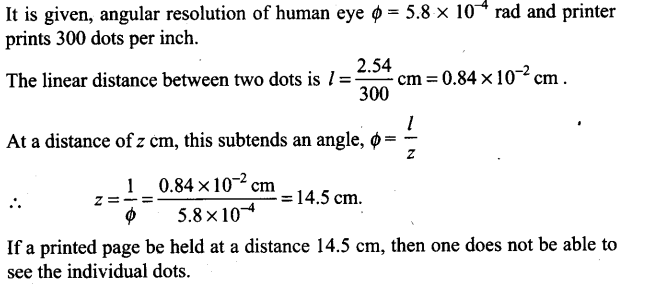
    Question 14. The human eye has an approximate angular resolution of ɸ = 5.8 x 10⁻⁴ rad and a typical photoprinter prints a minimum of 300 dpi (dots per inch, 1 inch = 2.54 cm). At what minimal distance z should a printed page be held so that one does not see the individual dots.
    Solution: It is given, angular resolution of human eye ɸ = 5.8 x 10⁻⁴ rad and printer prints 300 dots per inch.
    ncert-exemplar-problems-class-12-physics-wave-optics-22

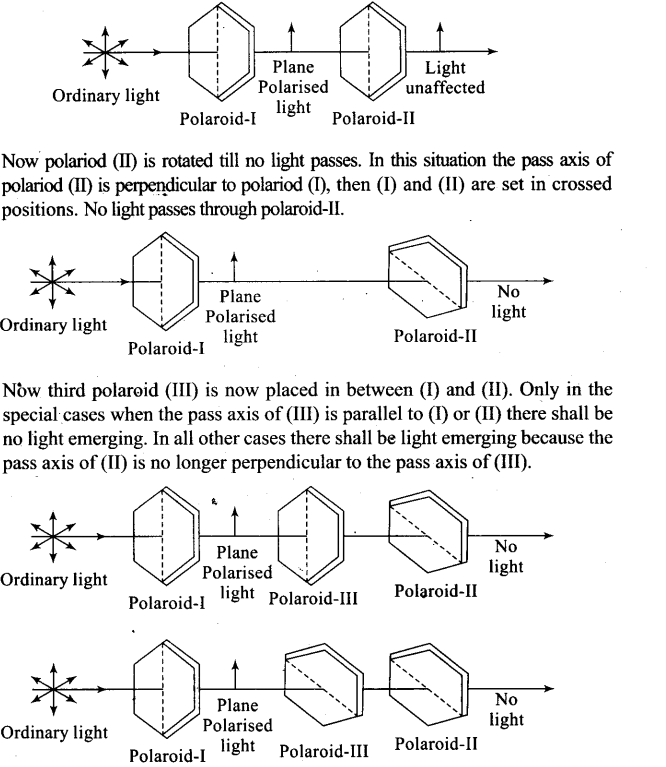
    Question 15. A polaroid (I) is placed in front,of a monochromatic source. Another polariod (II) is placed in front of this polaroid (I) and rotated till no light passes. A third polaroid (III) is now placed in between (I) and (II). In this case, will light emerge from (II). Explain.
    Solution: A polaroid (I) is placed in front of a monochromatic source. Another polariod (II) is placed in front of this polaroid (I) when the pass axis of (II) is parallel to (I), light passes through polaroid-II is unaffected.
    ncert-exemplar-problems-class-12-physics-wave-optics-23
    Now polariod (II) is rotated till no light passes. In this situation the pass axis of polariod (II) is perpendicular to polariod (I), then (I) and (II) are set in crossed positions. No light passes through polaroid-II.
    Now third polaroid (III) is now placed in between (I) and (II). Only in the special cases when the pass axis of (III) is parallel to (I) or (II) there shall be no light emerging. In all other cases there shall be light emerging because the pass axis of (II) is no longer perpendicular to the pass axis of (III).

    Short Answer Type Questions

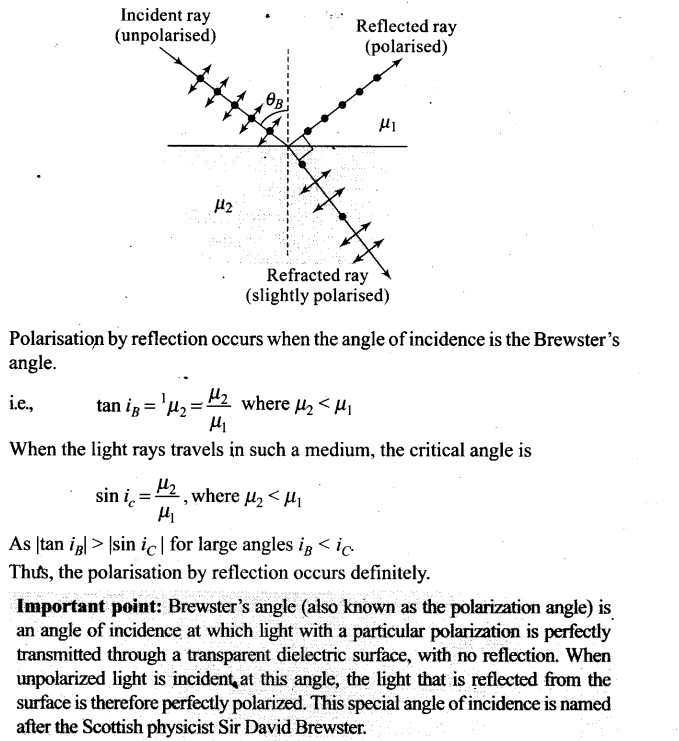
    Question 16. Can reflection result in plane polarised light if the light is incident on the interface from the side with higher refractive index?
    Solution: If angle of incidence is equal to Brewster’s angle, the transmitted light is slightly polarised and reflected light is plane polarised.
    ncert-exemplar-problems-class-12-physics-wave-optics-24

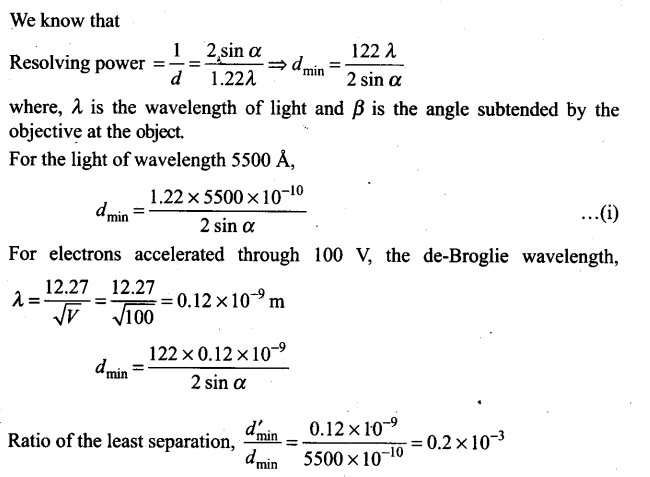
    Question 17. For the same objective, find the ratio of the least separation between two points to be distinguished by a microscope for light of 5000 Å and electrons accelerated through 100 V used as the illuminating substance.
    Solution:
    Key concept:
    • Resolving power is the ability of an imaging device to separate (i.e., to see as distinct) points of an object that are located at a small angular distance or it is the power of an optical instrument to separate far – away objects, that are close together, into individual images. The term resolution or minimum resolvable distance is the minimum distance between distinguishable objects in an image, although the term is loosely used by many users of microscopes and telescopes to describe resolving power. In scientific analysis, in general, the term “resolution” is used to describe the precision with which any instrument measures Ratio of the least separation,
    For electrons accelerated through 100 V, the de-Broglie wavelength, 12.27
    ncert-exemplar-problems-class-12-physics-wave-optics-25
    ncert-exemplar-problems-class-12-physics-wave-optics-26

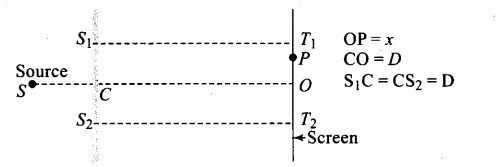
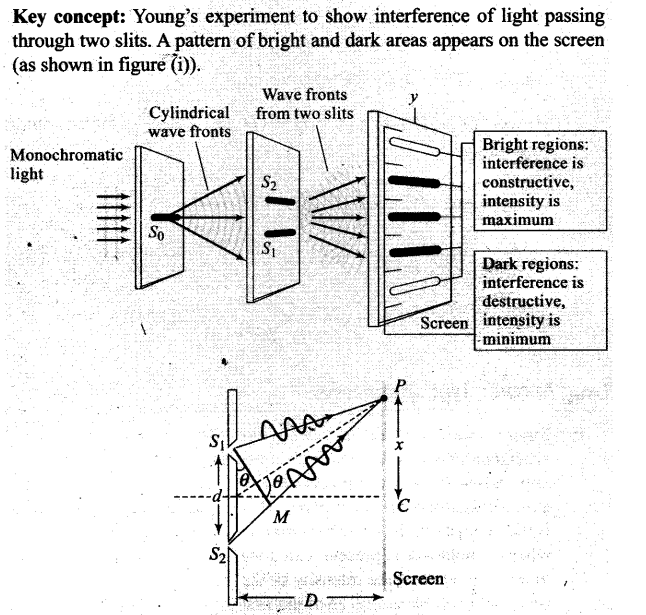
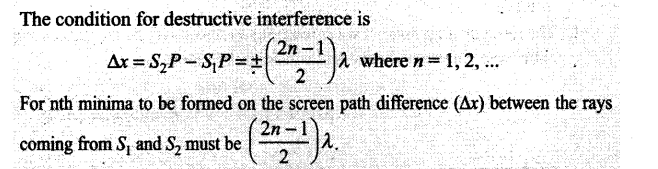
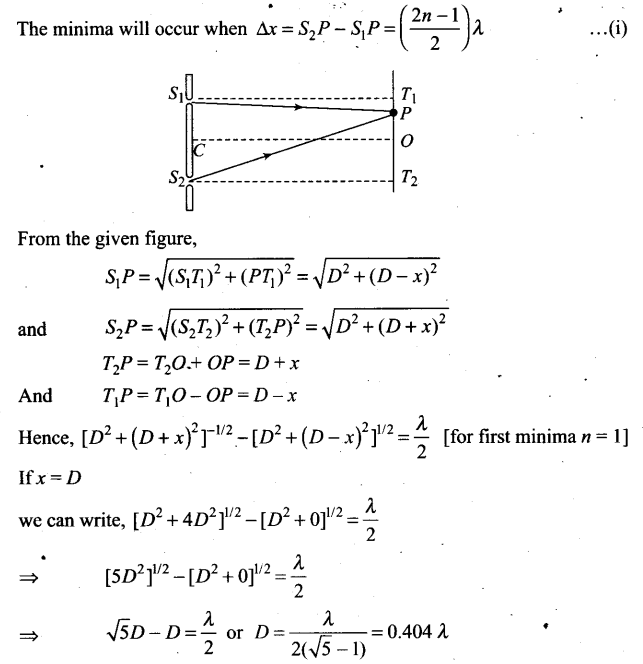
    Question 18. Consider a two slit interference arrangements (figure) such that the distance of the screen from the slits is. half the distance between the slits. Obtain the value of D in terms of X such that the first minima on the screen falls at a distance D from the centre O.
    ncert-exemplar-problems-class-12-physics-wave-optics-27
    Solution:
    ncert-exemplar-problems-class-12-physics-wave-optics-28
    ncert-exemplar-problems-class-12-physics-wave-optics-29
    ncert-exemplar-problems-class-12-physics-wave-optics-30

    Long Answer Type Questions

    Question 19.
    ncert-exemplar-problems-class-12-physics-wave-optics-31
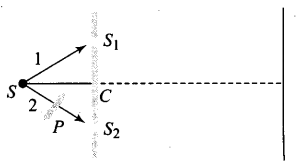
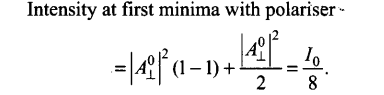
    Figure shown has a two sift arrangement with a source which emits unpolarised light. P is a polariser with axis whose direction is not given. If I0 is the intensity of the principal maxima when no polariser is present, calculate in the present case, the intensity of the principal maxima as well as of the first minima.
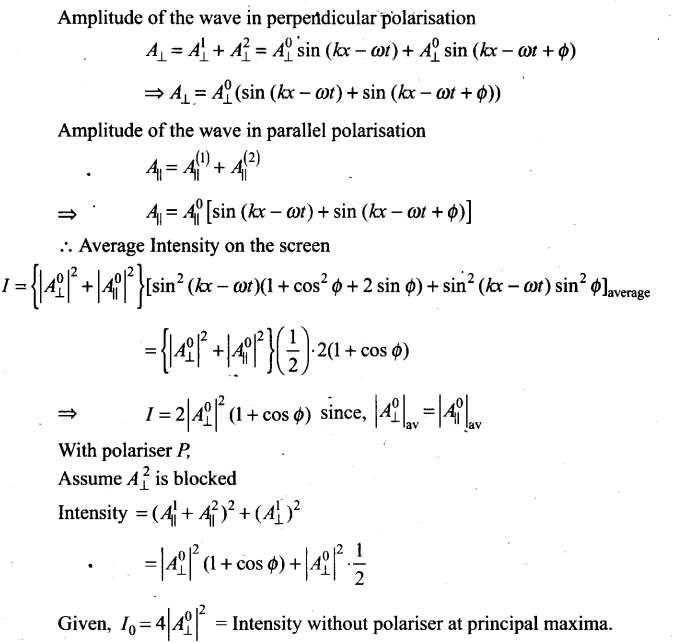
    Solution: The resultant amplitude of wave reaching on screen will be the sum of amplitude of either wave in perpendicular and parallel polarisation.
    ncert-exemplar-problems-class-12-physics-wave-optics-32
    ncert-exemplar-problems-class-12-physics-wave-optics-33

    Question 20.
    ncert-exemplar-problems-class-12-physics-wave-optics-34
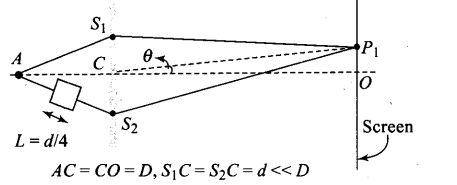
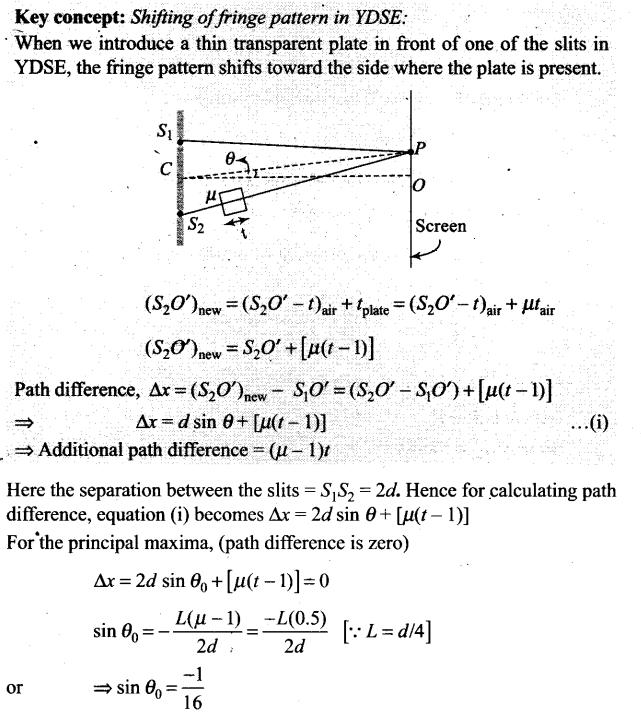
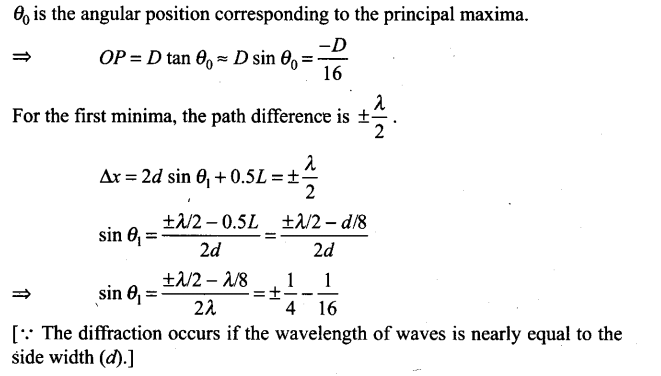
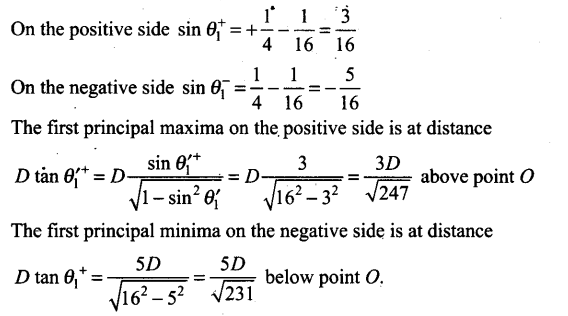
    A small transparent slab containing material of µ = 1.5 is placed along AS2(figure). What will be the distance from O of the principal maxima and of the first minima on either side of the principal maxima obtained in the absence of the glass slab?

    Solution:
    ncert-exemplar-problems-class-12-physics-wave-optics-35
    ncert-exemplar-problems-class-12-physics-wave-optics-36
    ncert-exemplar-problems-class-12-physics-wave-optics-37

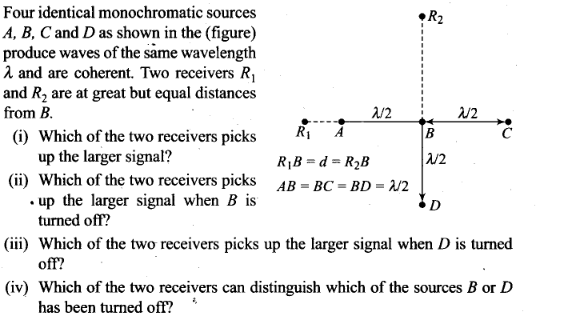
    Question 21.
    ncert-exemplar-problems-class-12-physics-wave-optics-111
    Solution:
    ncert-exemplar-problems-class-12-physics-wave-optics-39
    ncert-exemplar-problems-class-12-physics-wave-optics-40
    ncert-exemplar-problems-class-12-physics-wave-optics-41
    ncert-exemplar-problems-class-12-physics-wave-optics-42

    Question 22.
    ncert-exemplar-problems-class-12-physics-wave-optics-43
    Solution:
    ncert-exemplar-problems-class-12-physics-wave-optics-44
    ncert-exemplar-problems-class-12-physics-wave-optics-45
    ncert-exemplar-problems-class-12-physics-wave-optics-46

  • Ray Optics and Optical Instruments NCERT Exemplar Problems Solutions Physics

    NCERT Exemplar Problems Class 12 Physics Chapter 9 Ray Optics and Optical Instruments

    Multiple Choice Questions (MCQs)

    Single Correct Answer Type
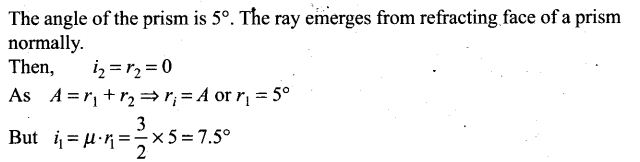
    Question 1. A ray of light incident at an angle d on a refracting face of a prism emerges from the other face normally. If the angle of the prism is 5° and the prism is mad? of a material of refractive index 1.5, the angle of incidence is
    (a) 7.5° (b) 5° (c) 15° (d) 2.5°
    Solution: (a)
    Key concept:
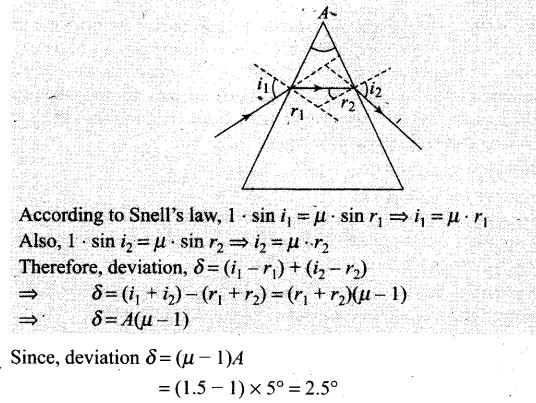
    In thin prisms, the distance between the refracting surfaces is ineligible and the angle of prism (A) is very small. Since A = r1 + r2, therefore if A is small then both r1 , and r2 are also small, and the same is true for i1 and i2.
    ncert-exemplar-problems-class-12-physics-ray-optics-and-optical-instruments-1
    ncert-exemplar-problems-class-12-physics-ray-optics-and-optical-instruments-2

    Question 2. A‘ short pulse of white light is incident from air to a glass slab at normal incidence. After travelling through the slab, the first colour to emerge is
    (a) blue (b) green (c) violet (d) red
    Solution: (d) As velocity of wave is given by the relation v = f λ . When light ray goes from one medium to other medium, the frequency of light remains unchanged. Hence v ∝ λ or greater the wavelength, greater the speed.
    The light of red colour is of highest wavelength and therefore of highest speed. Therefore, after travelling through the slab, the red colour emerges first.

    Question 3. An object approaches a convergent lens from the left of the lens with a uniform speed 5 m/s and stops at the focus. The image
    (a) moves away from the lens with an uniform speed 5 m/s
    (b) moves away from the lens with an uniform acceleration
    (c) moves away from the lens with a non-uniform acceleration
    (d) moves towards the lens with a non-uniform acceleration
    Solution: (c)
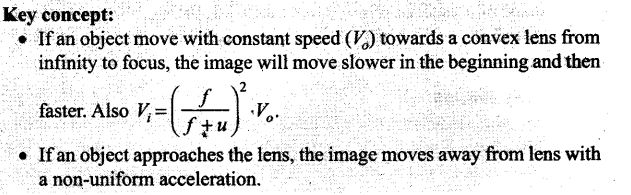
    In our problem the object approaches a convergent lens from the left of the lens with a uniform speed of 5 m/s, hence the image will move away from the lens with a non-uniform acceleration, the image moves slower in the beginning and faster later on will move from F to 2F and when the object moves from 2F to F,the image will move from 2F to infinity. At 2F, the speed of the object and image will be equal.

    Question 4. A passenger in an aeroplane shall
    (a) never see a rainbow
    (b) may see a primary and a secondary rainbow as concentric circles
    (c) may see a primary and a secondary rainbow as concentric arcs
    (d) shall never see a secondary rainbow
    Solution: (b) As aeroplane is at higher altitude, the passenger in an aeroplane may see a primary and a secondary rainbow like concentric circles.
    ncert-exemplar-problems-class-12-physics-ray-optics-and-optical-instruments-3

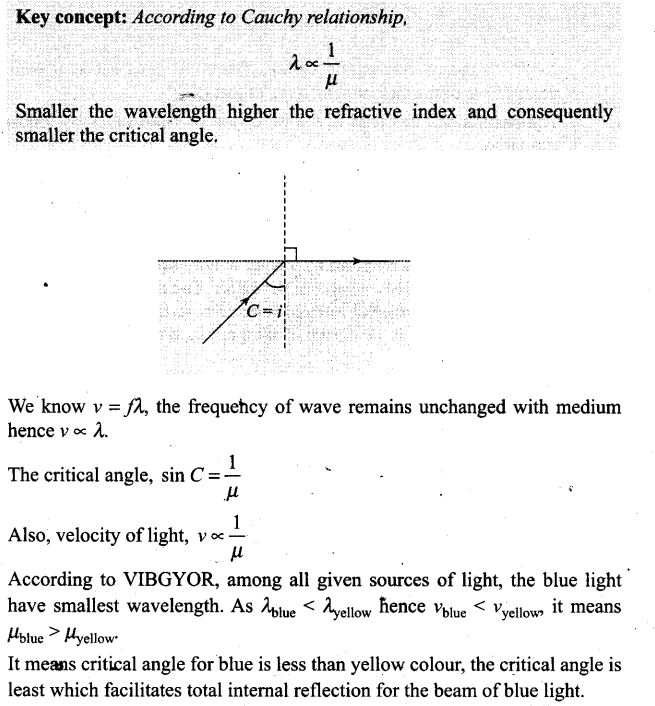
    Question 5. You are given four sources of light each one providing a light of a single colour—red, blue, green and yellow. Suppose the angle of refraction for a beam of yellow light corresponding to a particular angle of incidence at the interface of two media is 90°. Which of the following statements is correct if the source of yellow light is replaced with that of other lights without changing the angle of incidence?
    (a) The beam of red light would undergo total internal reflection.
    (b) The beam of red light would bend towards the normal while it gets refracted through the second medium.
    (c) The beam of blue light would undergo total internal reflection.
    (d) The beam of green light would bend away from the normal as it gets refracted through the second medium.
    Solution: (c)
    ncert-exemplar-problems-class-12-physics-ray-optics-and-optical-instruments-4

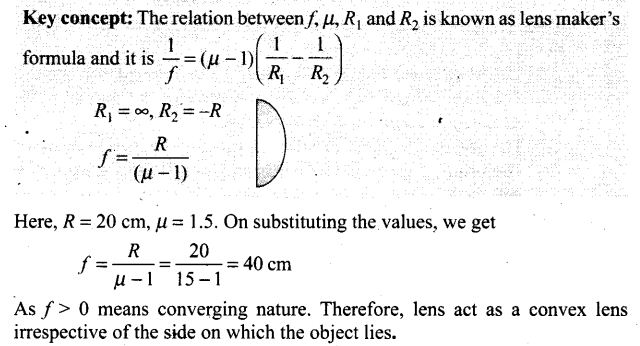
    Question 6. The radius of curvature of the curved surface of a plano-convex lens is 20 cm. If the refractive index of the material of the lens be 1.5, it will
    (a) act as a convex lens only for the objects that lie on its curved side
    (b) act as a concave lens for the objects that lie on its curved side
    (c) act as a convex lens irrespective of the side on which the object lies
    (d) act as a concave lens irrespective of side on which the object lies
    Solution: (c)
    ncert-exemplar-problems-class-12-physics-ray-optics-and-optical-instruments-5

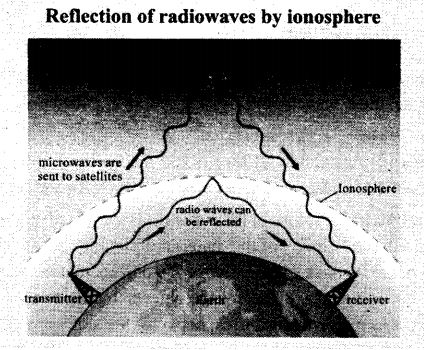
    Question 7. The phenomena involved in the reflection of radio waves by ionosphere is similar to
    (a) reflection of light by a plane mirror
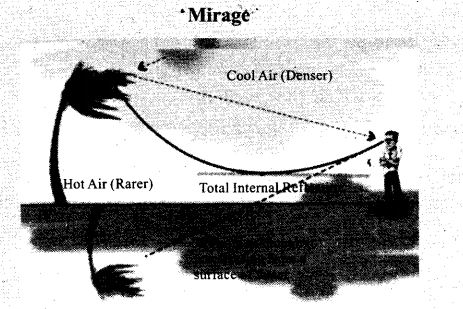
    (b) total internal reflection of light in air during a mirage
    (c) dispersion of light by water molecules during the formation of a rainbow
    (d) scattering of light by the particles of air
    Solution: (b) Radio waves are reflected by a layer of atmosphere called the Ionosphere, so they can reach distant parts of the Earth. The reflection of radio waves by ionosphere is due to total internal reflection. It is the same as total internal reflection of light in air during a mirage, i.e., angle of incidence is greater than critical angle.
    Important point: The ionized part of the Earth’s atmosphere is known as the ionosphere. Ultraviolet light from the sun collides with atoms in this region knocking electrons loose. The creates ions, or atoms with missing electrons. This is what gives the Ionosphere its name- and it is the free electrons that cause the reflection and absorption of ratio waves.
    ncert-exemplar-problems-class-12-physics-ray-optics-and-optical-instruments-6
    ncert-exemplar-problems-class-12-physics-ray-optics-and-optical-instruments-7

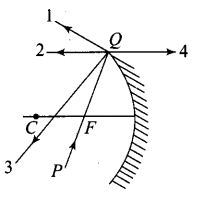
    Question 8. The direction of ray of light incident on a concave mirror is shown by PQ while directions in which the ray would travel after reflection is shown by four rays marked 1, 2, 3 and 4 (figure). Which of the four rays correctly shows the direction of reflected ray?
    ncert-exemplar-problems-class-12-physics-ray-optics-and-optical-instruments-8
    (a) 1 (b) 2
    (c) 3 (d) 4
    Solution: (b) The ray PQ of light passes through focus F and incident on the concave mirror, after reflection, should become parallel to the principal axis and shown by ray 2 in the figure.
    Important points:
    We can locate the image of any extended object graphically by drawing any two of the following four special rays:
    1. A ray initially parallel to the principal axis is reflected through the focus of the mirror (1).
    2. A ray passing through the center of curvature is reflected back along itself (3).
    3. A ray initially passing through the focus is reflected parallel to the principal axis (2).
    4. A ray incident at the pole is reflected symmetrically.

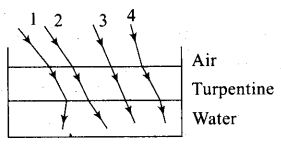
    Question 9. The optical density of turpentine is higher than that of water while its mass density is lower. Figure shows a layer of turpentine floating over water in a container. For which one of the four rays incident on turpentine in figure, the path shown is correct?
    ncert-exemplar-problems-class-12-physics-ray-optics-and-optical-instruments-9
    (a) 1 (b) 2 (c) 3 (d) 4
    Solution: (b)
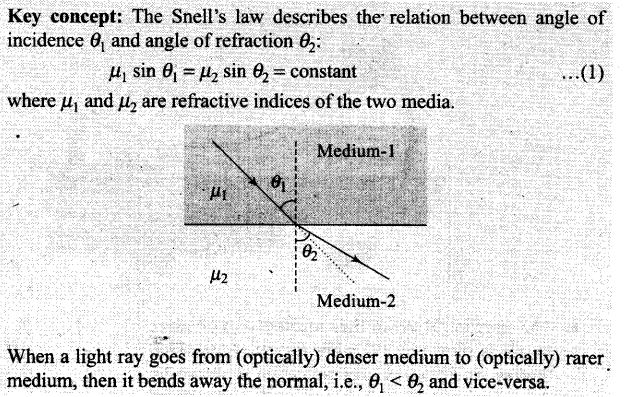
    ncert-exemplar-problems-class-12-physics-ray-optics-and-optical-instruments-10
    Here, light ray goes from (optically) rarer medium air to optically denser medium turpentine, then it bends towards the normal, i.e., θ1 > θ2 whereas when it goes from to optically denser medium turpentine to rarer medium water, then it bends away the normal.

    Question 10. A far is moving with a constant speed of 60 km h-1 on a straight road. Looking at the rear view mirror, the driver finds that the car following him is at a distance of 100 m and is approaching with a speed of 5 km h-1.
    In order to keep track of the car in the rear, the driver begins to glance alternatively at the rear and side mirror of his car after every 2 s till the other car overtakes. If the two cars were maintaining their speeds, which of the following statement (s) is/are correct?
    (a) The speed of the car in the rear is 65 km h-1
    (b) In the side mirror, the car in the-rear would appear to approach with a speed of 5 km h-1 to the driver of the leading car
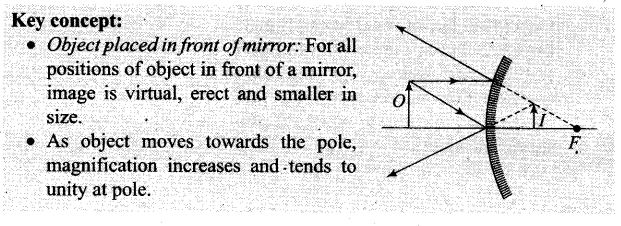
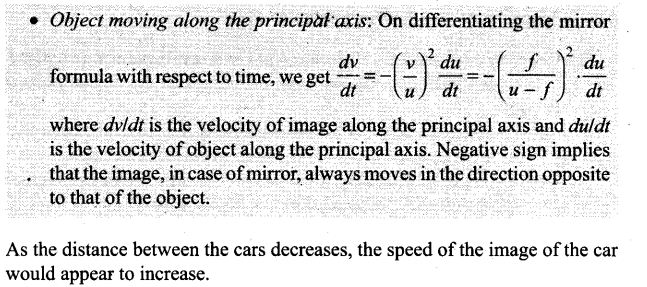
    (c) In the rear view mirror, the speed of the approaching car would appear to decrease as the distance between the cars decreases
    (d) In the side mirror, the speed of the approaching car would appear to increase as the distance between the cars decreases
    Solution: (d)
    ncert-exemplar-problems-class-12-physics-ray-optics-and-optical-instruments-11
    ncert-exemplar-problems-class-12-physics-ray-optics-and-optical-instruments-12

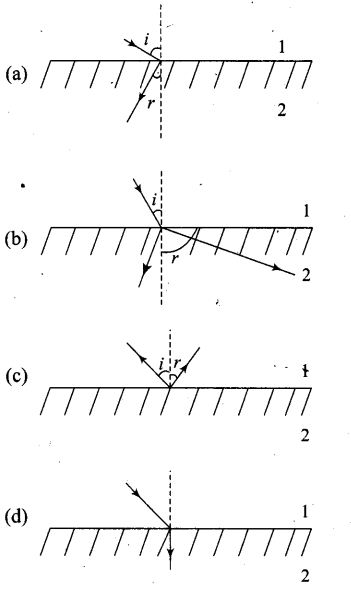
    Question 11. There are certain material developed in laboratories which have a negative refractive index figure. A ray incident from air (Medium 1) into such a medium (Medium 2) shall follow a path given by
    ncert-exemplar-problems-class-12-physics-ray-optics-and-optical-instruments-13
    Solution: (a) The materials with negative refractive index responds to Snell’s law just opposite way. If incident ray from air (Medium 1) incident on those material, the ray refract or bend same side of the normal as in option (a).

    One or More Than One Correct Answer Type

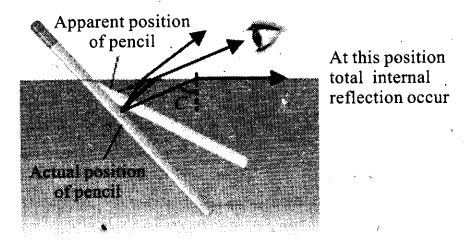
    Question 12. Consider an extended object immersed in water contained in a plane trough. When seen from close to the edge of the trough the object looks distorted because
    (a) the apparent depth of the points close to the edge are nearer the surface of the water compared to the points away from the edge
    (b) the angle subtended by the image of the object at the eye is smaller than the actual angle subtended by the object in air
    (c) some of the points of the object far away from the edge may not be visible because of total internal reflection
    (d) water in a trough acts as a lens and magnifies the object
    Solution: (a, b, c)
    Key concept: The light from the pencil is refracted when it passes from the water into air, bending away from the normal as it moves from high to low refractive index.
    ncert-exemplar-problems-class-12-physics-ray-optics-and-optical-instruments-14
    When light from the submerged object before reaching to the observer gets, refracted from water surface, the rays bend away from normal and the angle subtended by the image of the object at the eye is smaller than the actual angle subtended by the object in air. Also the apparent depth of the .points close to the edge are nearer the surface of the water compared to the points away from the edge.
    As we move towards right, the angle of incident increases and becomes equal to critical angle. Hence some of the points of the object far away from the edge may not be visible because of total internal reflection.

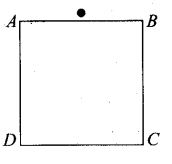
    Question 13. A rectangular block of glass ABCD has a refractive index 1.6. A pin is placed midway on the face AB of figure. When observed from the face AD, the pin shall
    ncert-exemplar-problems-class-12-physics-ray-optics-and-optical-instruments-15
    (a) appear to be near A
    (b) appear to be near D
    (c) appear to be at the centre of AD
    (d) not be seen at all
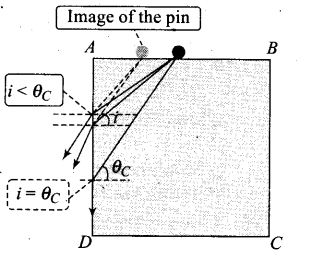
    Solution: (a, d) As long as angle of incidence on AD of the ray emanating from pin is less than the critical angle, the pin shall appear to be near A.
    ncert-exemplar-problems-class-12-physics-ray-optics-and-optical-instruments-16
    When angle of incidence on AD of the ray emanating from pins is greater than the critical angle, the light suffers from total internal reflection and cannot be seen through AD.

    Question 14. Between the primary and secondary rainbow, these is a dark band known as Alexandar’s dark band. This is because
    (a) light scattered into this region interfere destructively
    (b) there is no light scattered into this region
    (c) light is absorbed in this region
    (d)angle made at the eye by the scattered rays with respect to the incident light of the sun lies between approximately 42° and 50°
    Solution: (a, d) The Alexandar’s dark band lies between the primary and secondary rainbows, formed due to light scattered into this region interfere destructively. The primary rainbows subtends an angle nearly 41° to 42° at observer’s eye, whereas secondary rainbows subtends an angle nearly 51° to 54° at observer’s eye w.r.t. incident light ray.
    Hence, the scattered rays with respect to the incident light of the sun lies between approximately 42° and 50°.

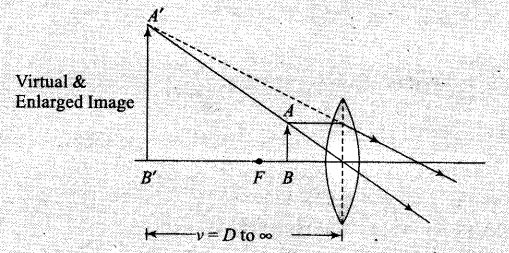
    Question 15. A magnifying glass is used, as the object to be viewed can be brought closer to the eye than the normal near point. This results in
    (a) a larger angle to be subtended by the object at the eye and hence, viewed in greater detail
    (b) the formation of a virtual erect image
    (c) increase in the field of view
    (d) infinite magnification at the near point
    Solution: (a, b)
    Key concept: A magnifying glass is a single convex lens of lesser focal length.
    ncert-exemplar-problems-class-12-physics-ray-optics-and-optical-instruments-17
    ncert-exemplar-problems-class-12-physics-ray-optics-and-optical-instruments-18
    When a magnifying glass is used, the object to be viewed can be brought closer to the eye than the normal near point. This results in a larger angle to be subtended by the object at the eye and hence, viewed in greater detail. Moreover, the formation of a virtual erect and enlarged image takes place.

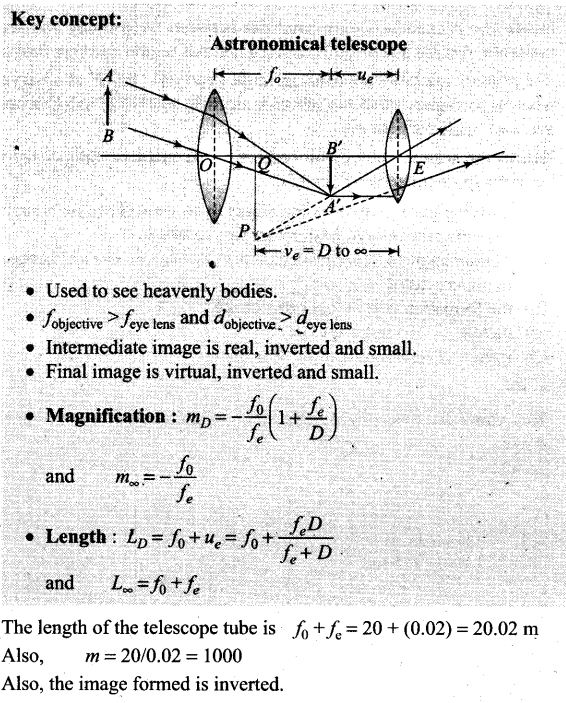
    Question 16. An astronomical refractive telescope has an objective of focal length 20 m and an eyepiece of focal length 2 cm.
    (a) The length of the telescope tube is 20.02 m
    (b) The magnification is 1000
    (c) The image formed is inverted
    (d) An objective of a larger aperture will increase the brightness and reduce chromatic aberration of the image
    Solution: (a, b, c)
    ncert-exemplar-problems-class-12-physics-ray-optics-and-optical-instruments-19

    Very Short Answer Type Questions

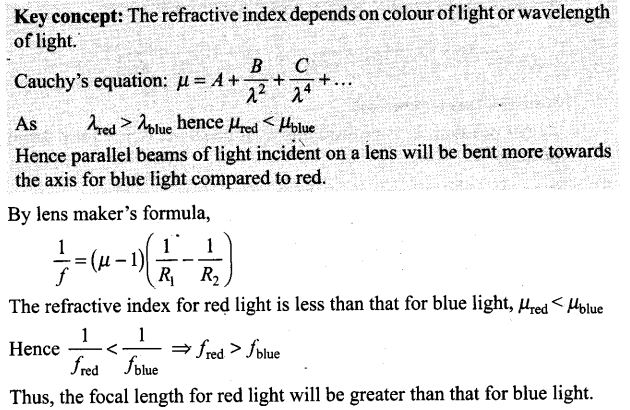
    Question 17. Will the focal length of a lens for red light be more, same or less than that for blue light?
    Solution:
    ncert-exemplar-problems-class-12-physics-ray-optics-and-optical-instruments-20

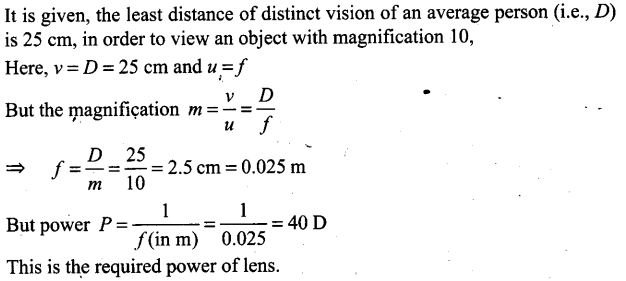
    Question 18. The near vision of an average person is 25 cm. To view an object with an angular magnification of 10, what should be the power of the microscope?
    Solution:
    ncert-exemplar-problems-class-12-physics-ray-optics-and-optical-instruments-21

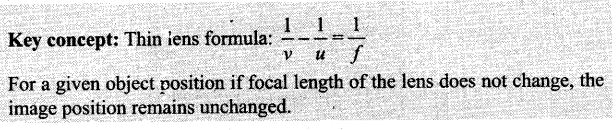
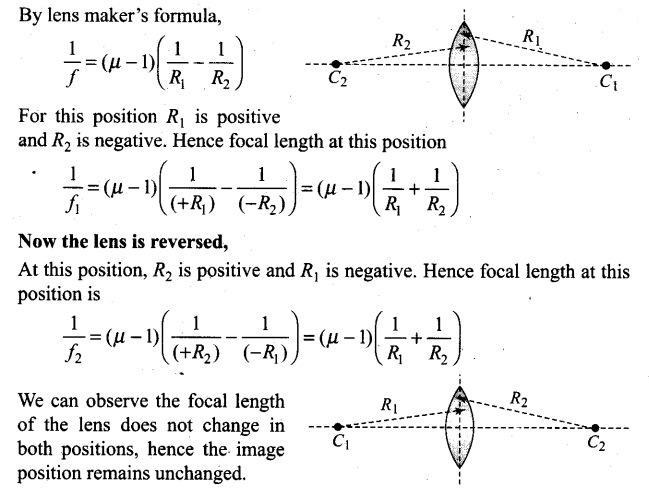
    Question 19. An unsymmetrical double convex thin lens forms the image of a point object on its axis. Will the position of the image change if the lens is reversed?
    Solution:
    ncert-exemplar-problems-class-12-physics-ray-optics-and-optical-instruments-22
    ncert-exemplar-problems-class-12-physics-ray-optics-and-optical-instruments-23

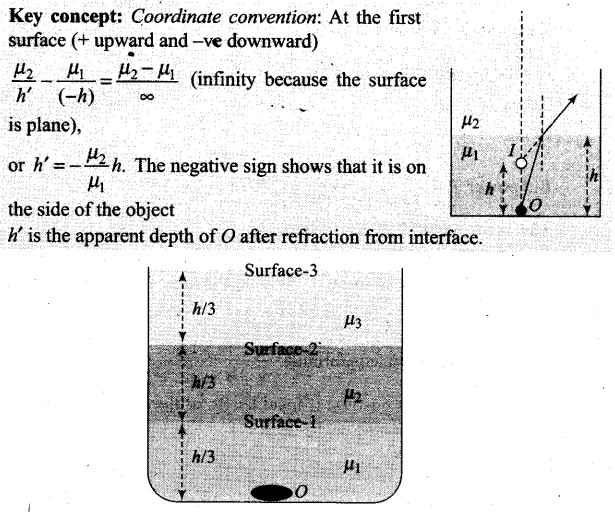
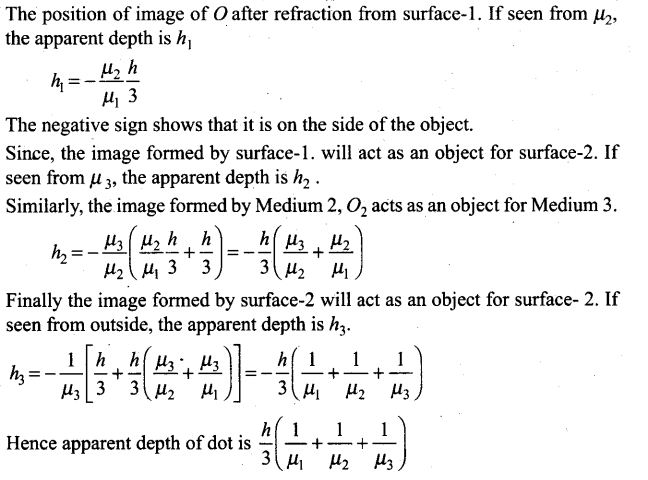
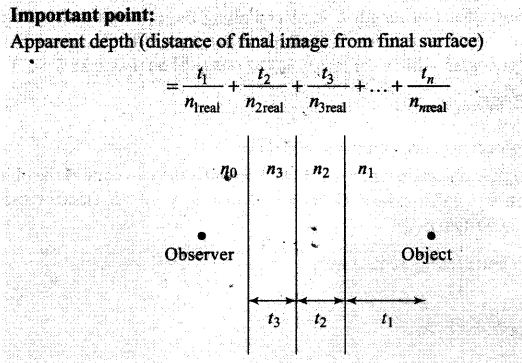
    Question 20. Three immiscible liquids of densities d1> d2> d3 and refractive indices μ1> μ2> μ3 are put in a beaker. The height of each liquid column is h/3. A dot is made at the bottom of the beaker. For near normal vision, find the apparent depth of the dot.
    Solution:
    ncert-exemplar-problems-class-12-physics-ray-optics-and-optical-instruments-24
    ncert-exemplar-problems-class-12-physics-ray-optics-and-optical-instruments-25
    ncert-exemplar-problems-class-12-physics-ray-optics-and-optical-instruments-26

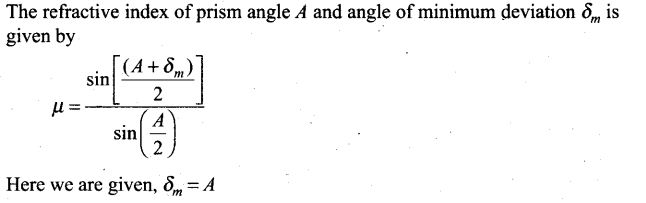
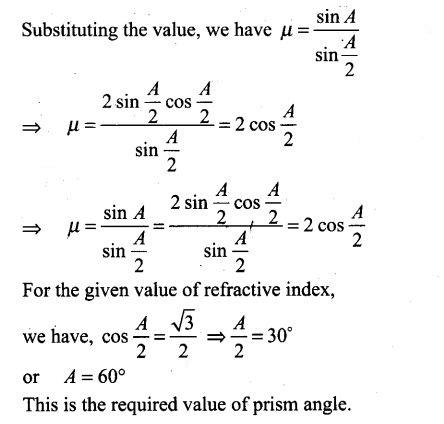
    Question 21. For a glass prism (μ= √3 ), the angle of minimum deviation is equal to the angle of the prism. Find the angle of the prism.
    Solution:
    ncert-exemplar-problems-class-12-physics-ray-optics-and-optical-instruments-27
    ncert-exemplar-problems-class-12-physics-ray-optics-and-optical-instruments-28

    Short Answer Type Questions

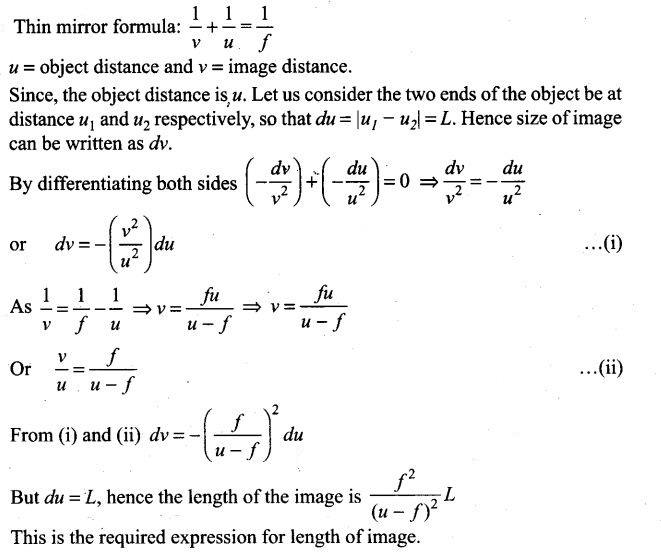
    Question 22. A short object of length L is placed along the principal axis of a concave mirror away from focus. The object distance is u. If the mirror has a focal length f what will be the length of the image? You may take L << |v – f |.
    Solution:
    ncert-exemplar-problems-class-12-physics-ray-optics-and-optical-instruments-29

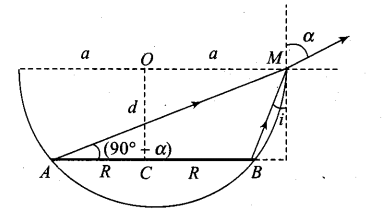
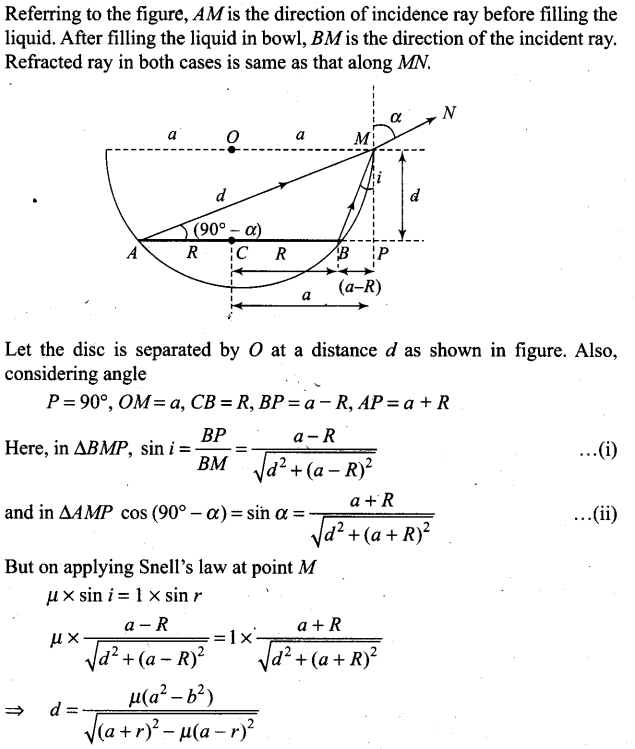
    Question 23. A circular disc of radius R is placed co-axially and horizontally inside an opaque hemispherical bowl of radius a (figure). The far edge of the disc is just visible when viewed from the edge of the bowl. The bowl is filled with transparent liquid of refractive index μ. and the near edge of the disc becomes just visible. How far below the top of the bowl is the disc placed?
    ncert-exemplar-problems-class-12-physics-ray-optics-and-optical-instruments-1
    Solution:
    ncert-exemplar-problems-class-12-physics-ray-optics-and-optical-instruments-2

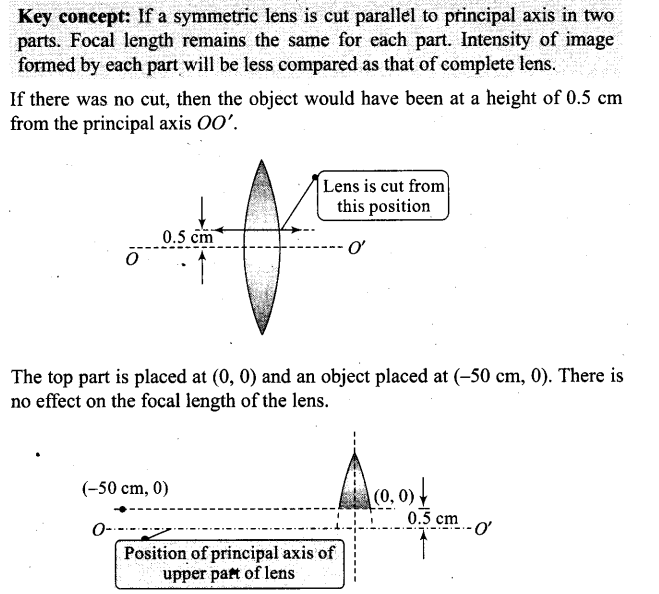
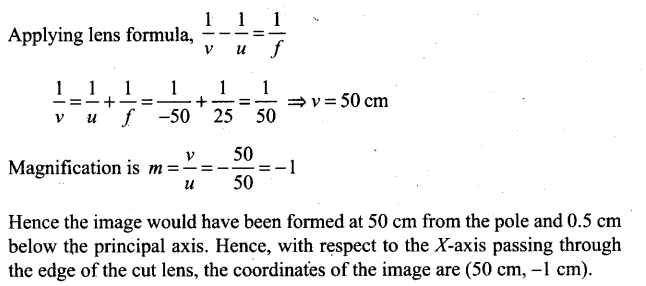
    Question 24. thin convex lens of focal length 25 cm is cut into two pieces 0.5 cm above the principal axis. The top part is placed at (0, 0) and an object is placed at (-50 cm, 0). Find the coordinates of the image.
    Solution:
    ncert-exemplar-problems-class-12-physics-ray-optics-and-optical-instruments-3
    ncert-exemplar-problems-class-12-physics-ray-optics-and-optical-instruments-4

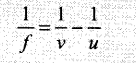
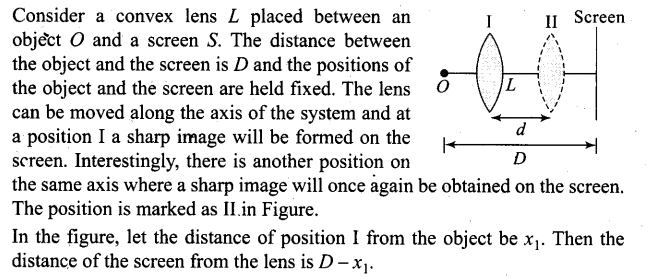
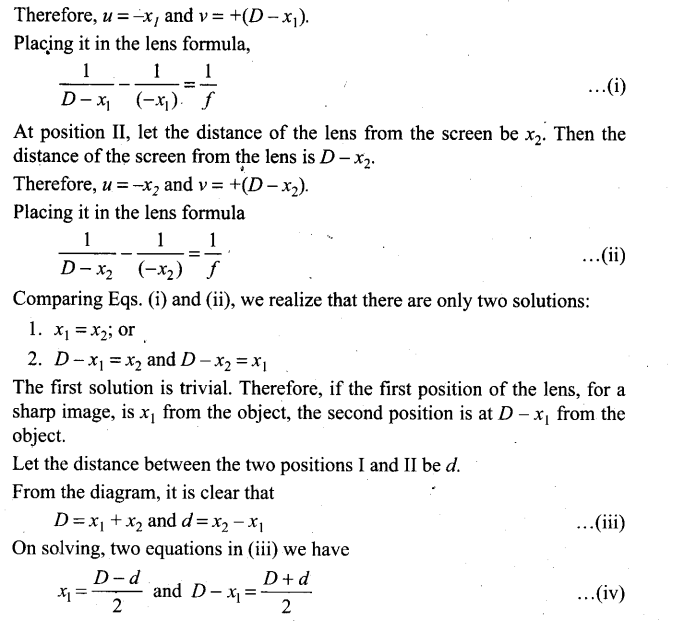
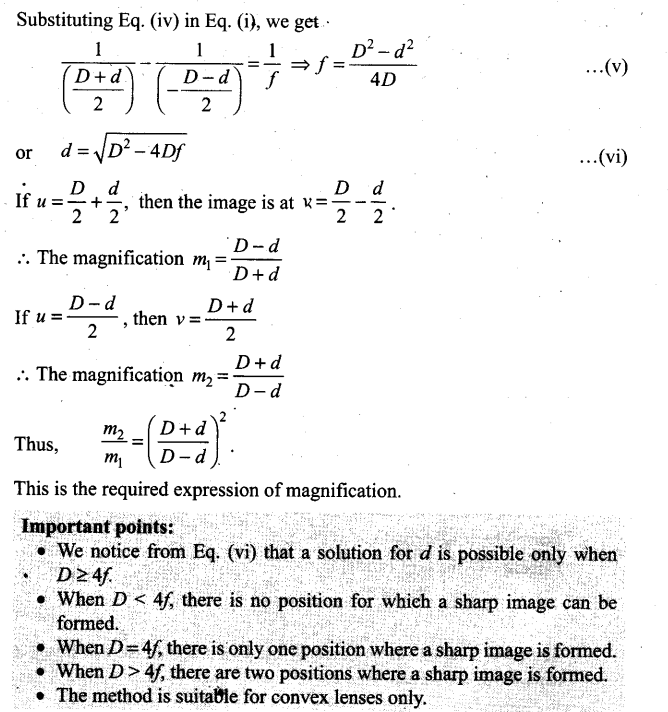
    Question 25. In many experimental set-ups, the source and screen are fixed at a distance say D and the lens is movable. Show that there are two positions for the lens for which an image is formed on the screen. Find the distance between these points and the ratio of the image sizes for these two points.
    Solution:
    Key Concept: This is also one of the methods for finding focal length of the length in laboratory and knows as “Displacement method”.
    ncert-exemplar-problems-class-12-physics-ray-optics-and-optical-instruments-5
    ncert-exemplar-problems-class-12-physics-ray-optics-and-optical-instruments-112
    ncert-exemplar-problems-class-12-physics-ray-optics-and-optical-instruments-7
    ncert-exemplar-problems-class-12-physics-ray-optics-and-optical-instruments-8

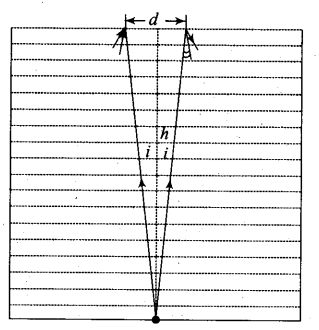
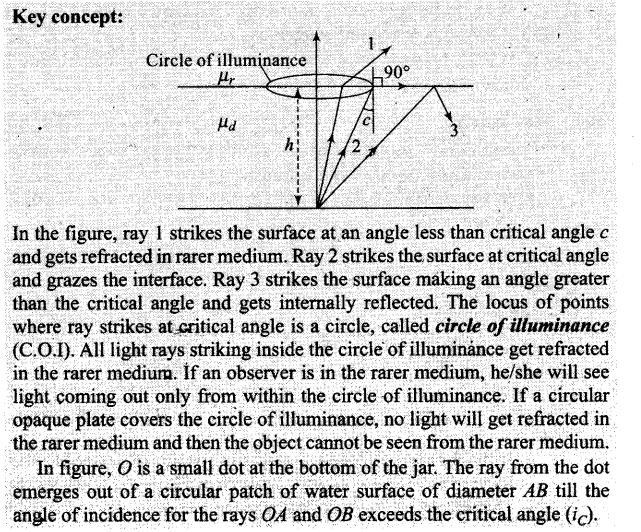
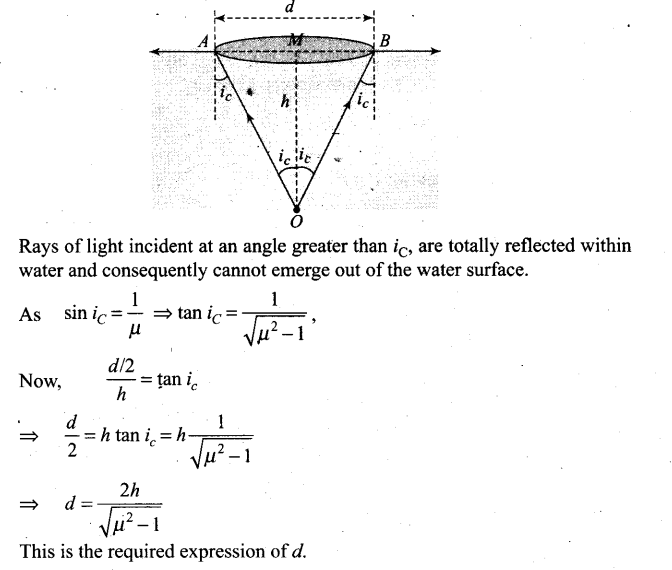
    Question 26. A jar of height h is filled with a transparent liquid of refraction index μ (figure).At the center of the jar on the bottom surface is a dot.Find the minimum diameter of a disc,such that when placed on the top surface symmetrically about the center,the dot is invisible.
    ncert-exemplar-problems-class-12-physics-ray-optics-and-optical-instruments-9
    Solution:
    ncert-exemplar-problems-class-12-physics-ray-optics-and-optical-instruments-10
    ncert-exemplar-problems-class-12-physics-ray-optics-and-optical-instruments-11

    Long Answer Type Questions

    Question 27. A myopic adult has a far point at 0.1 m. His power of accommodation is 4 D.
    (i) What power lenses are required to see distant objects?
    (ii) What is his near point without glasses?
    (iii) What is his near point with glasses? (Take the image distance from the lens of the eye to the retina to be 2 cm.)

    Solution: Key concepts:
    ncert-exemplar-problems-class-12-physics-ray-optics-and-optical-instruments-12

    ncert-exemplar-problems-class-12-physics-ray-optics-and-optical-instruments-13
    ncert-exemplar-problems-class-12-physics-ray-optics-and-optical-instruments-14

    Question 28. Show that for a material with refractive index μ ≥ √2, light incident at angle shall be guided along, a length perpendicular to the incident face.
    Solution: Let the ray incident on face AB at angle i, after refraction, it travels along PQ and then interact with face AC which is perpendicular to the incident face.
    ncert-exemplar-problems-class-12-physics-ray-optics-and-optical-instruments-15
    ncert-exemplar-problems-class-12-physics-ray-optics-and-optical-instruments-16

    Question 29. The mixture of a pure liquid and a solution in a long vertical column (i.e., horizontal dimensions << vertical dimensions) produces diffusion of solute particles and hence a refractive index gradient along the vertical dimension. A ray of light entering the column at right angles to the vertical is deviated from its original path. Find the deviation in travelling a horizontal distance d << h, the height of the column.
    Solution:
    ncert-exemplar-problems-class-12-physics-ray-optics-and-optical-instruments-17
    ncert-exemplar-problems-class-12-physics-ray-optics-and-optical-instruments-18

    Question 30.
    ncert-exemplar-problems-class-12-physics-ray-optics-and-optical-instruments-19
    Solution:
    ncert-exemplar-problems-class-12-physics-ray-optics-and-optical-instruments-20
    ncert-exemplar-problems-class-12-physics-ray-optics-and-optical-instruments-21

    Question 31. An infinitely long cylinder of radius R is made of an unusual exotic material with refractive index -1 (figure). The cylinder is placed between two planes whose normals are along the y-direction. The centre of the cylinder O lies along they-axis.
    ncert-exemplar-problems-class-12-physics-ray-optics-and-optical-instruments-23
    A narrow laser beam is directed along the y-direction from the lower plate.
    The laser source is at a horizontal
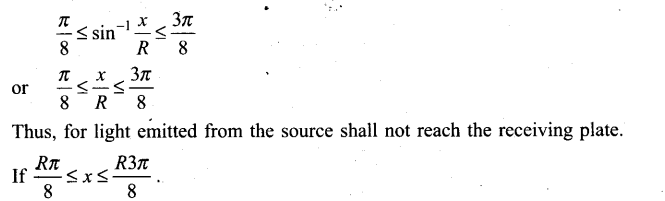
    distance x from the diameter in the y-direction. Find the range of x such that light emitted from the lower plane does not reach the upper plane.
    Solution:
    ncert-exemplar-problems-class-12-physics-ray-optics-and-optical-instruments-24
    ncert-exemplar-problems-class-12-physics-ray-optics-and-optical-instruments-25

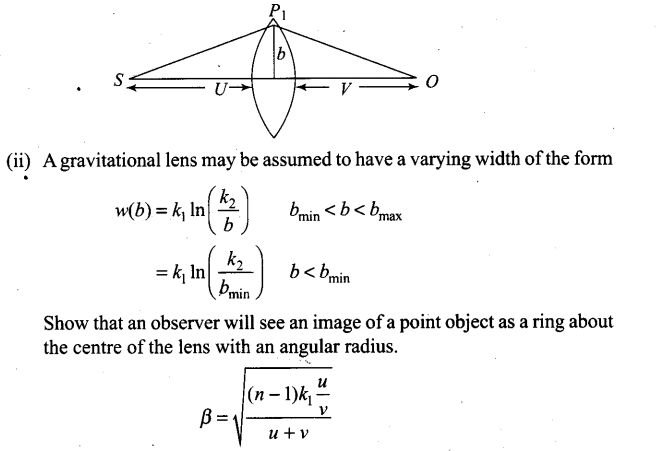
    Question 32. (i) Consider a thin lens placed between a source (S) and an observer (O)
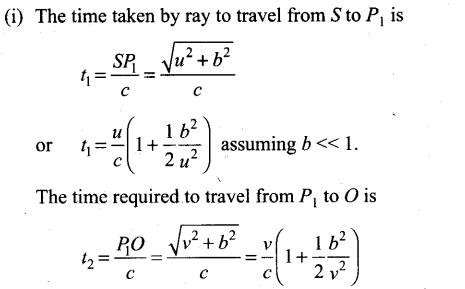
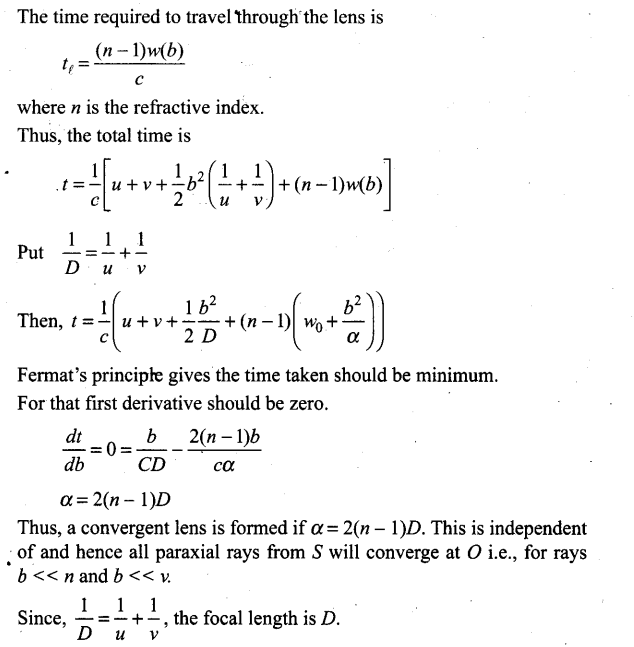
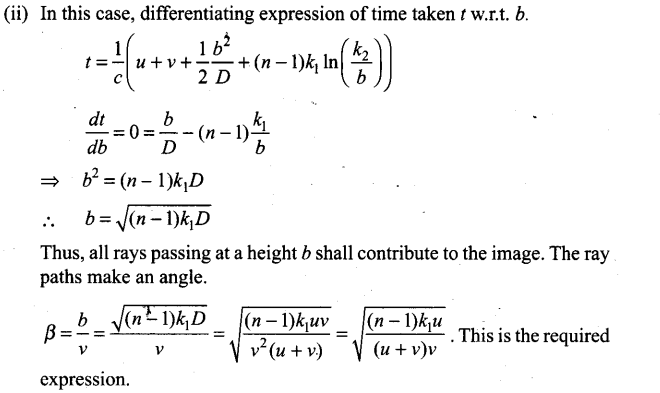
    (Figure). Let the thickness of the lens vary as w(b) =w0– b2/α , where b is the vertical distance from the pole, w0 is a constant. Using Fermat’s principle, i.e., the time of transit fora ray between the source and observer is an extremum find the condition that all paraxial rays starting from the source will converge at a point O on the axis. Find the focal length.
    ncert-exemplar-problems-class-12-physics-ray-optics-and-optical-instruments-26
    Solution:
    ncert-exemplar-problems-class-12-physics-ray-optics-and-optical-instruments-27
    ncert-exemplar-problems-class-12-physics-ray-optics-and-optical-instruments-28
    ncert-exemplar-problems-class-12-physics-ray-optics-and-optical-instruments-29

  • Electromagnetic Waves NCERT Exemplar Problems Solutions Physics

    NCERT Exemplar Problems Class 12 Physics Chapter 8 Electromagnetic Waves

    Multiple Choice Questions (MCQs)
    Single Correct Answer Type
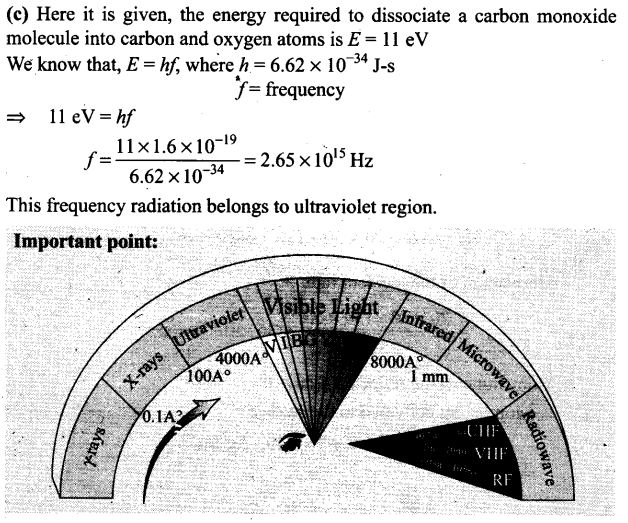
    Question 1. One requires 11 eV of energy to dissociate a carbon monoxide molecule into carbon and oxygen atoms. The minimum frequency of the appropriate electromagnetic radiation to achieve the dissociation lies in
    (a) visible region (b) infrared region
    (c) ultraviolet region (d) microwave region
    Solution:
    ncert-exemplar-problems-class-12-physics-electromagnetic-waves-1

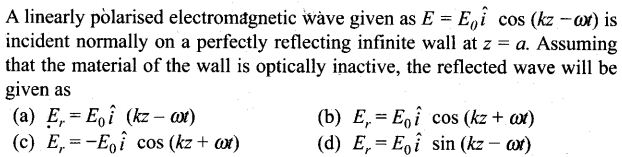
    Question 2.
    ncert-exemplar-problems-class-12-physics-electromagnetic-waves-2
    Solution: (b)
    Key concept: When a wave is reflected from a denser medium or perfectly reflecting wall made with optically inactive material, then the type of wave doesn’t change but only its phase changes by 180° or π radian.

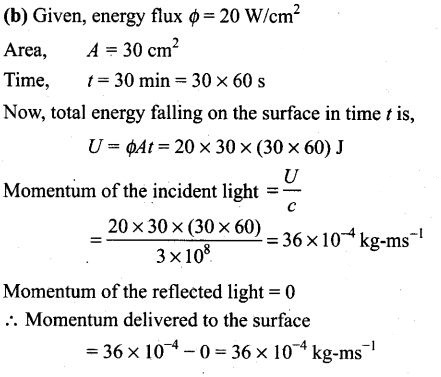
    Question 3. Light with an energy flux of 20 W/cm2 falls on a non-reflecting surface at normal incidence. If the surface has an area of 30 cm2, the total momentum delivered (for complete absorption) during 30 min is
    (a) 36 x 10-5 kg-m/s (b) 36 x 10-4 kg-m/s
    (c) 108 x 104 kg-m/s (d) 1.08 x 10⁷ kg-m/s
    Solution:
    ncert-exemplar-problems-class-12-physics-electromagnetic-waves-3
    ncert-exemplar-problems-class-12-physics-electromagnetic-waves-4

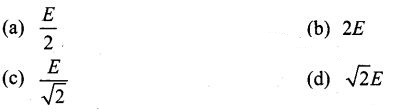
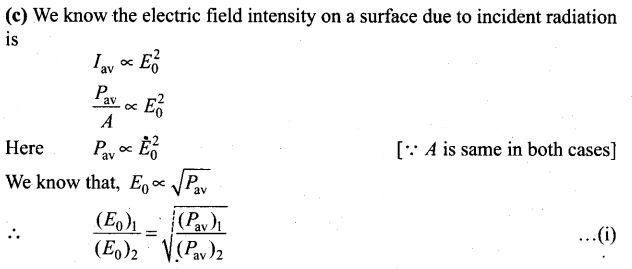
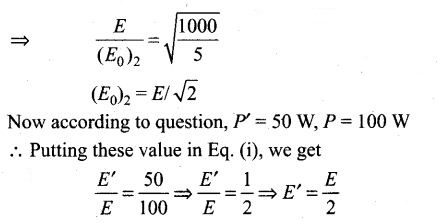
    Question 4. The electric field intensity produced by the radiations coming from a 100 W bulb at a 3 m distance is E. The electric field intensity produced by the radiations coming from 50 W bulb at the same distance is
    ncert-exemplar-problems-class-12-physics-electromagnetic-waves-5
    Solution:
    ncert-exemplar-problems-class-12-physics-electromagnetic-waves-6
    ncert-exemplar-problems-class-12-physics-electromagnetic-waves-9

    Question 5.
    ncert-exemplar-problems-class-12-physics-electromagnetic-waves-10
    Solution: (d)
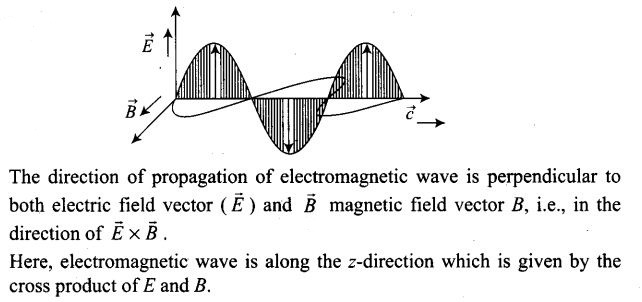
    Key concept: A changing electric field produces a changing magnetic field and vice versa which gives rise to a transverse wave known as electromagnetic wave. The time varying electric and magnetic field are mutually perpendicular to each other and also perpendicular to the direction of propagation of this wave. The electric vector is responsible for the optical effects of an EM wave and is called the light vector.
    ncert-exemplar-problems-class-12-physics-electromagnetic-waves-11

    Question 6. The ratio of contributions made by the electric field and magnetic field components to the intensity of an EM wave is
    ncert-exemplar-problems-class-12-physics-electromagnetic-waves-12
    Solution:
    ncert-exemplar-problems-class-12-physics-electromagnetic-waves-13
    ncert-exemplar-problems-class-12-physics-electromagnetic-waves-14
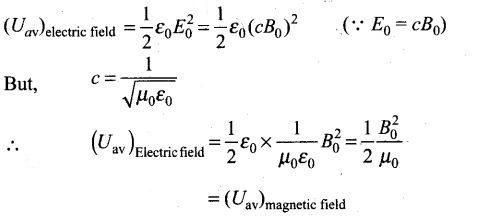
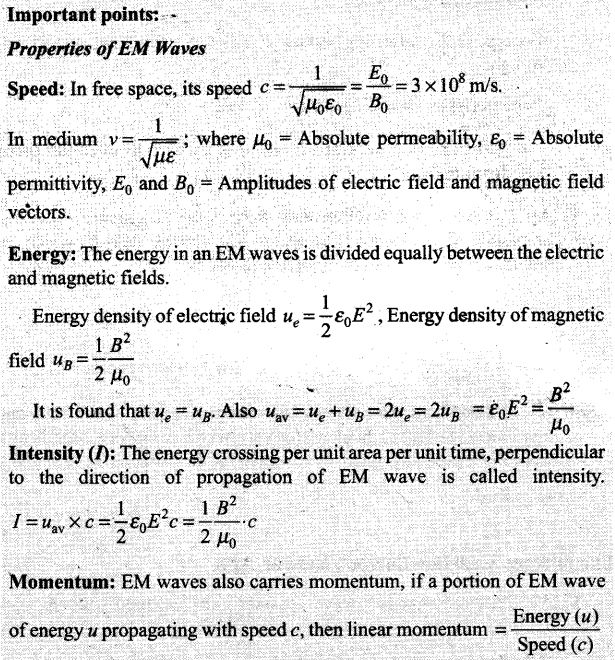
    Hence the energy in electromagnetic wave is divided equally between electric field vector and magnetic field vector.
    It means the ratio of contributions by the electric field and magnetic field components to the intensity of an electromagnetic wave is 1:1.
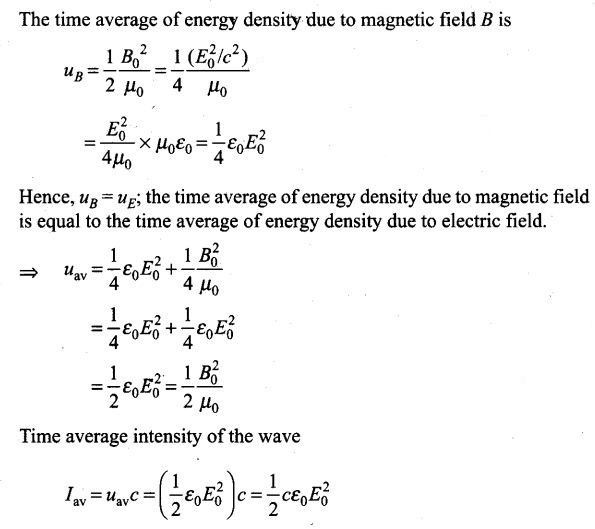
    ncert-exemplar-problems-class-12-physics-electromagnetic-waves-15

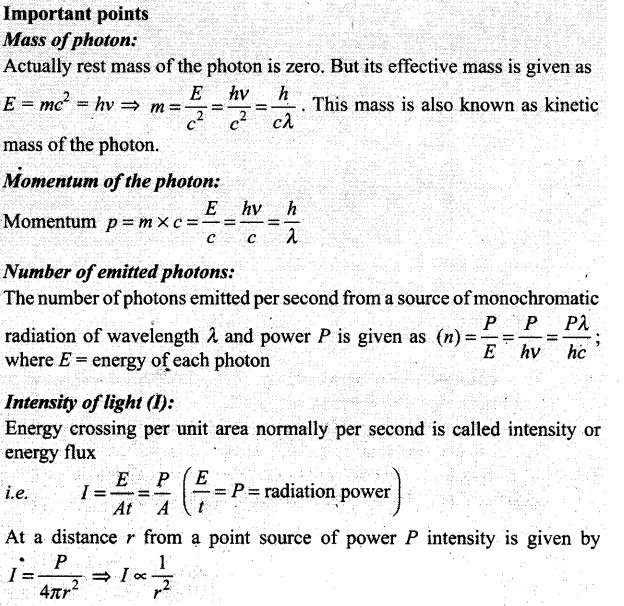
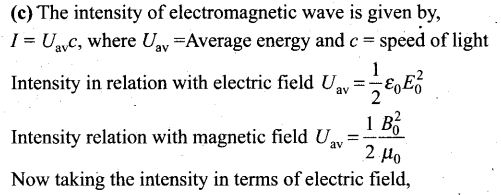
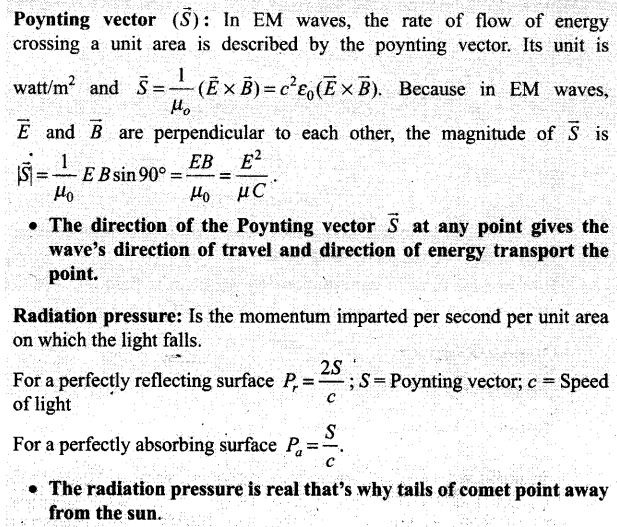
    • When the incident EM wave is completely absorbed by a surface, it delivers energy u and momentum u/c to the surface.
    • When a wave of energy u is totally reflected from the surface, the momentum delivered to surface is 2u/c.

    ncert-exemplar-problems-class-12-physics-electromagnetic-waves-16

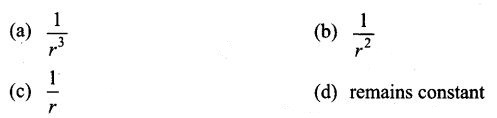
    Question 7. An EM wave radiates outwards from a dipole antenna, with E0 as the amplitude of its electric field vector. The electric field E0 which transports significant energy from the source falls off as
    ncert-exemplar-problems-class-12-physics-electromagnetic-waves-17
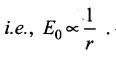
    Solution: (c) A diode antenna radiates the electromagnetic waves outwards. The amplitude of electric field vector (E0) which transports significant energy from the source falls intensity inversely as the distance (r) from the antenna,
    ncert-exemplar-problems-class-12-physics-electromagnetic-waves-18

    One or More Than One Correct Answer Type
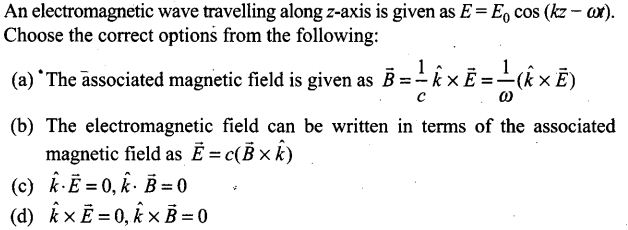
    Question 8.
    ncert-exemplar-problems-class-12-physics-electromagnetic-waves-19
    ncert-exemplar-problems-class-12-physics-electromagnetic-waves-20
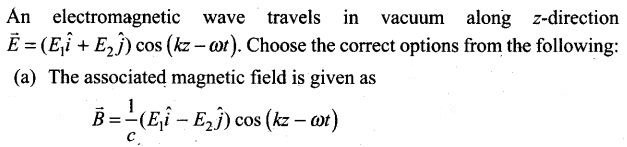
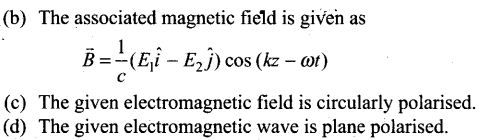
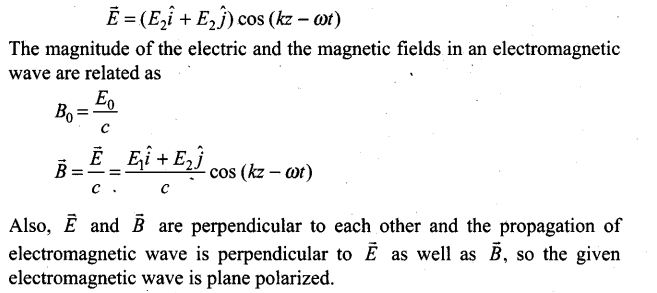
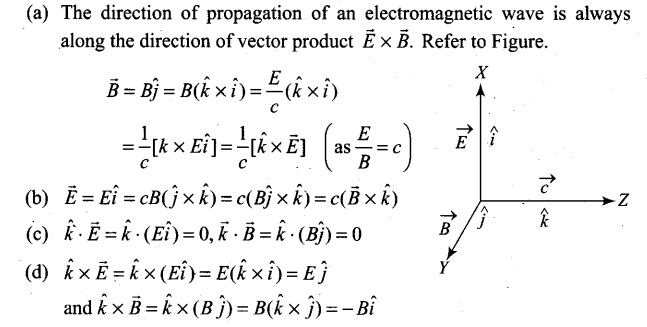
    Solution: (a, d) We are given that the electric field vector of an electromagnetic wave travels in a vacuum along z-direction as,
    ncert-exemplar-problems-class-12-physics-electromagnetic-waves-21

    Question 9.
    ncert-exemplar-problems-class-12-physics-electromagnetic-waves-22
    Solution: (a, b, c)
    ncert-exemplar-problems-class-12-physics-electromagnetic-waves-23

    Question 10. A plane electromagnetic wave propagating along x-direction can have the following pairs of E and B.
    (a) Ex, By (b) Ey, Bz
    (c) Bx,Ey (d) Ez,By
    Solution: (b, d)
    ncert-exemplar-problems-class-12-physics-electromagnetic-waves-24
    Here in the question electromagnetic wave is propagating along x-direction. So, electro and magnetic field vectors should have either y-direction or 2-direction.

    Question 11. A charged particle oscillates about its mean equilibrium position with a frequency of 109 Hz. The electromagnetic waves produced
    (a) will have frequency of 109 Hz
    (b) will have frequency of 2 x 10⁹ Hz
    (c) will have wavelength of 0.3 m
    (d) fall in the region of radio waves
    Solution: (a, c, d)
    Here we are given the frequency by which the charged particles oscillates about its mean equilibrium position, it is equal to 109 Hz. The frequency of electromagnetic waves produced by a charged particle is equal to the frequency by which it oscillates about its mean equilibrium position.
    So, frequency of electromagnetic waves produced by the charged particle is v= 109 Hz.
    ncert-exemplar-problems-class-12-physics-electromagnetic-waves-25

    Question 12. The source of electromagnetic waves can be a charge
    (a) moving with a constant velocity
    (b) moving in a circular orbit
    (c) at rest
    (d) falling in an electric field
    Solution: (b, d)
    Key concept:

    • An electromagnetic wave can be produced by accelerated or oscillating charge.
    • An oscillating charge is accelerating continuously, it will radiate electromagnetic waves continuously.
    • Electromagnetic waves are also produced when fast moving electrons are suddenly stopped by a metal target of high atomic number.

    Here, in option (b) charge is moving in a circular orbit.
    In circular motion, the direction of the motion of charge is changing continuously, thus it is an accelerated motion and this option is correct.
    In option (d), the charge is falling in electric field. If a charged particle is moving in electric field it experiences a force or we can say it accelerates. We know an accelerating charge particle radiates electromagnetic waves. Hence option (d) is also correct.
    Also, we know that a charge starts accelerating when it falls in an electric field.
    Important points:

    • In an atom an electron is circulating around the nucleus in a stable orbit, although accelerating does not emit electromagnetic waves; it does so only when it jumps from a higher energy orbit to a lower energy orbit.
    • A simple LC oscillator and energy source can produce waves of desired frequency

    Question 13. An EM wave of intensity I falls on a surface kept in vacuum and exerts radiation pressure p on it. Which of the following are true?
    (a) Radiation pressure is I/c if the wave is totally absorbed
    (b) Radiation pressure is —I/c if the wave is totally reflected
    (c) Radiation pressure is 2I/c if the wave is totally reflected
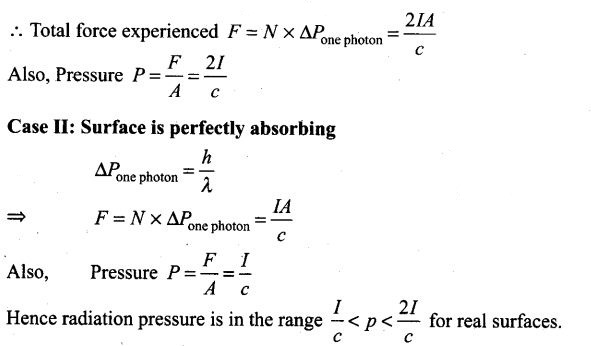
    (d) Radiation pressure is in the range I/c < p < 2I/c for real surfaces
    Solution: (a, c, d)
    Key concept: Radiation pressure (p) is the force exerted by electromagnetic wave on unit area of the surface, i.e., rate of change of momentum per unit area of the surface.
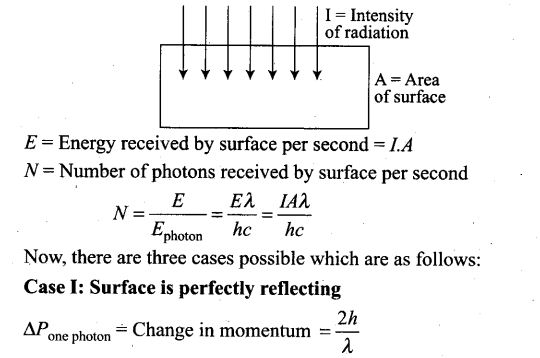
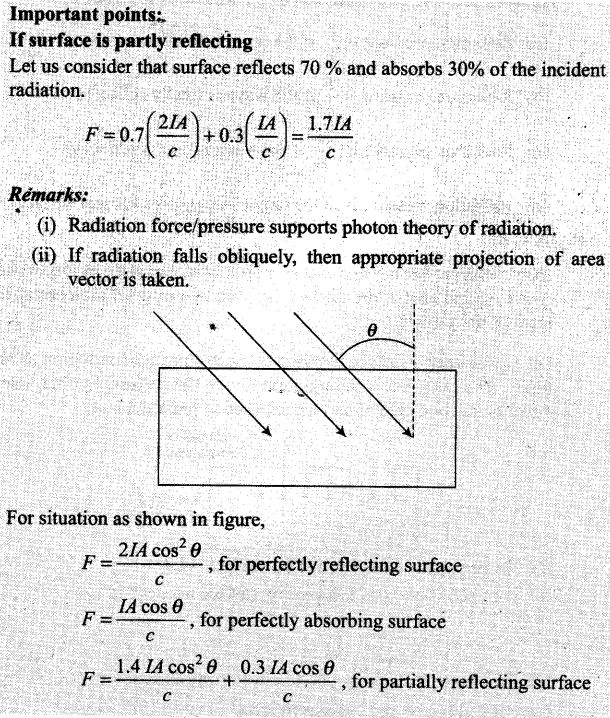
    Let us consider a surface exposed to electromagnetic radiation as shown in figure. The radiation is falling normally on the surface. Further, intensity of radiation is I and area of surface exposed to radiation is A.
    ncert-exemplar-problems-class-12-physics-electromagnetic-waves-26
    ncert-exemplar-problems-class-12-physics-electromagnetic-waves-27
    ncert-exemplar-problems-class-12-physics-electromagnetic-waves-28

    Very Short Answer Type Questions
    Question 14. Why is the orientation of the portable radio with respect to broadcasting station important?
    Solution: The electromagnetic waves are plane polarised, so the receiving antenna should be parallel to the vibration of the electric or magnetic field of the wave. So the receiving antenna should be parallel to electric/magnetic part of the wave. That is why the orientation of the portable radio with respect to broadcasting station is important.

    Question 15. Why does microwave oven heats up a food item containing water molecules most efficiently?
    Solution: The microwave oven heats up the food items containing water molecules most efficiently because the frequency of microwaves matches the resonant frequency of water molecules.
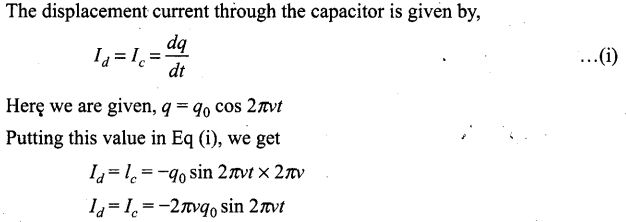
    Question 16. The charge on a parallel plate capacitor varies as q=q0 cos 2πvt. The plates are very large and close together (area = A, separation = d). Neglecting the edge effects, find the displacement current through the capacitor.
    Solution:
    ncert-exemplar-problems-class-12-physics-electromagnetic-waves-29

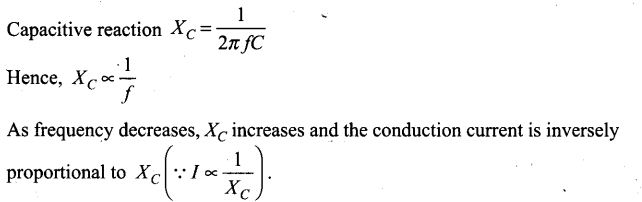
    Question 17. A variable frequency AC source is connected to a capacitor. How will the displacement current change with decrease in frequency?
    Solution:
    ncert-exemplar-problems-class-12-physics-electromagnetic-waves-30
    It means the displacement current decreases as the conduction current is equal to the displacement current.

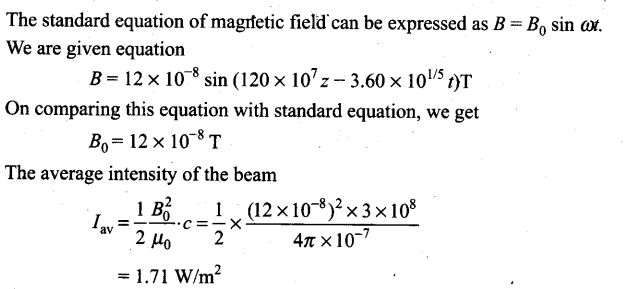
    Question 18. The magnetic field of a beam emerging from a fitter facing a flood light is given by B0= 12 x 10-8 sin (1.20 x 10⁷z- 3.60 x 10¹⁵ t) T What is the average intensity of the beam?
    Solution:
    ncert-exemplar-problems-class-12-physics-electromagnetic-waves-31

    Question 19.
    ncert-exemplar-problems-class-12-physics-electromagnetic-waves-32
    Solution:
    ncert-exemplar-problems-class-12-physics-electromagnetic-waves-33

    Question 20. Professor CV Raman surprised his students by suspending freely a tiny light ball in a transparent vacuum chamber by shining a laser beam on it. Which property of EM waves was he exhibiting? Give one more example of this property.
    Solution: The properties of an electromagnetic wave is same as other waves. Like other wave an electromagnetic wave also carries energy and momentum. Since, it carries momentum, an electromagnetic wave also exerts pressure called radiation pressure. This property of electromagnetic waves helped professor C V Raman surprised his students by suspending freely a tiny light ball in a transparent vacuum chamber by shining a laser beam on it.
    Short Answer Type Questions
    Question 21.
    ncert-exemplar-problems-class-12-physics-electromagnetic-waves-34
    Solution:
    ncert-exemplar-problems-class-12-physics-electromagnetic-waves-35

    Question 22. Electromagnetic waves with wavelength
    (i) λ1, is used in satellite communication.
    (ii) λ2, is used to kill germs in water purifier.
    (iii) λ3, is used to detect leakage of oil in underground pipelines.
    (iv) λ4, is used to improve visibility in runways during fog and mist conditions.
    (a) Identify and name the part of electromagnetic spectrum to which these radiations belong.
    (b) Arrange these wavelengths in ascending order of their magnitude.
    (c) Write one more application of each.
    Solution: (a) (i) In satellite communications, microwave is widely used. Hence λ1, is the wavelength of microwave.
    (ii) In water purifier, ultraviolet rays are used to kill germs. So, λ2 is the wavelength of UV rays.
    (iii) X-rays are used to detect leakage of oil in underground pipelines. So, λ3 is the wavelength of X-rays.
    (iv) Infrared rays are used to improve visibility on runways during fog and mist conditions. So, it is the wavelength of infrared waves.
    (b) Wavelength of X-rays < wavelength of UV < wavelength of infrared < wavelength of microwave.
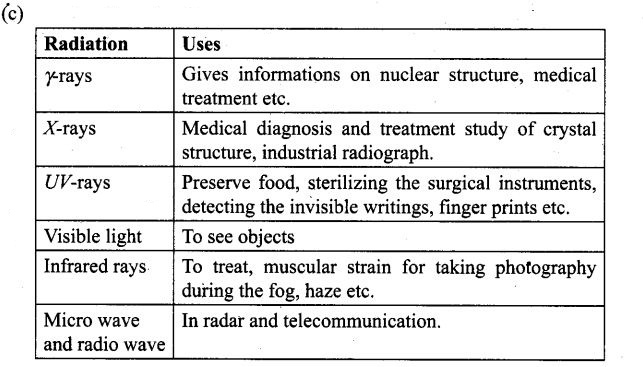
    => λ3241
    ncert-exemplar-problems-class-12-physics-electromagnetic-waves-36

    Question 23.
    ncert-exemplar-problems-class-12-physics-electromagnetic-waves-37
    Solution:
    ncert-exemplar-problems-class-12-physics-electromagnetic-waves-38
    ncert-exemplar-problems-class-12-physics-electromagnetic-waves-39

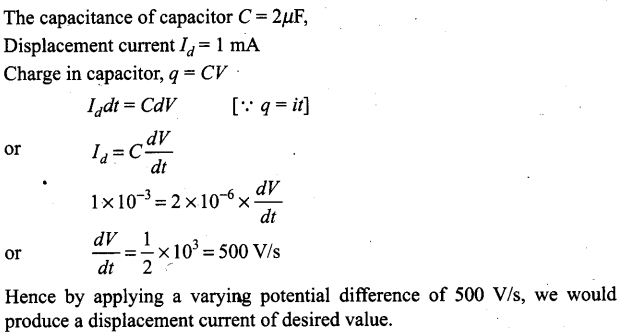
    Question 24. You are given a 2 μF parallel plate capacitor. How would you establish an instantaneous displacement current of 1 mA in the space between its plates?
    Solution:
    ncert-exemplar-problems-class-12-physics-electromagnetic-waves-40

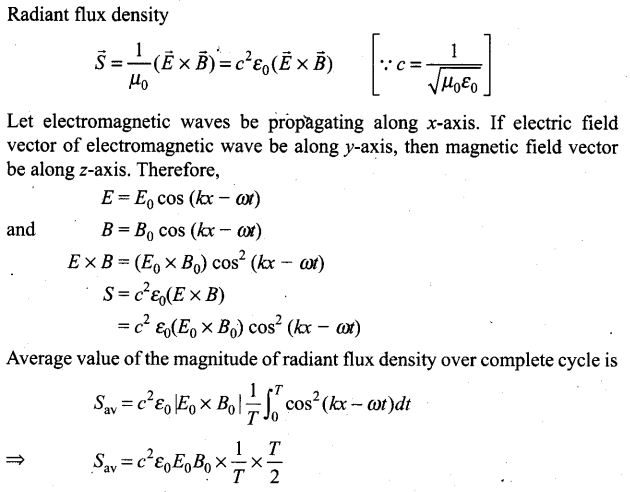
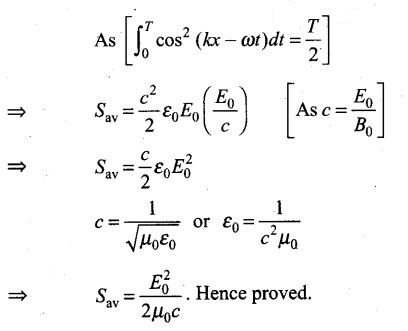
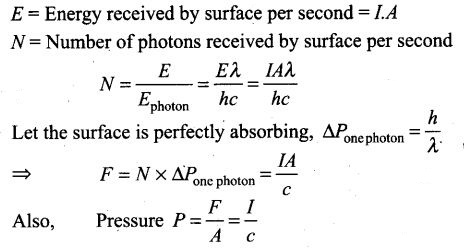
    Question 25. Show that the radiation pressure exerted by an EM wave of intensity I on a surface kept in vacuum is I/C.
    Solution: Let us consider a surface exposed to electromagnetic radiation. The radiation is falling normally on the surface. Further, intensity of radiation is I and area of surface exposed to radiation is A.
    ncert-exemplar-problems-class-12-physics-electromagnetic-waves-41

    Question 26. What happens to the intensity of light from a bulb if the distance from the bulb is doubled? As a laser beam travels across the length of room, its intensity essentially remains constant.
    What geometrical characteristic of LASER beam is responsible for the constant intensity which is missing in the case of light from the bulb?
    Solution: We know intensity of light from a point source I α 1/r2, r is the distance from point source.
    As the distance is doubled, so the intensity becomes one-fourth the initial value. But in case of laser it does not spread, so its intensity remain same.
    Some geometrical characteristics of LASER beam which are responsible for the constant intensity is
    (i) Unidirection (ii) Monochromatic
    (iii) Coherent light (iv) Highly collimated
    These characteristics are missing in the case of normal light from the bulb.

    Question 27. Even though an electric field E exerts a force qE on a charged particle yet electric field of an EM wave does not contribute to the radiation pressure (but transfers energy). Explain.
    Solution: The electric field of an electromagnetic wave is an oscillation field. It exerts electric force on a charged particle, but this electric force averaged over an integral number of cycles is zero, since its direction changes every half cycle. Hence, electric field is not responsible for radiation pressure though it transfer the energy. In fact, radiation pressure appears as a result of the action of the magnetic field of the wave on the electric currents induced by the electric field of the same wave.
    Long Answer Type Questions
    Question 28.
    ncert-exemplar-problems-class-12-physics-electromagnetic-waves-42
    ncert-exemplar-problems-class-12-physics-electromagnetic-waves-43
    Solution:
    ncert-exemplar-problems-class-12-physics-electromagnetic-waves-44
    ncert-exemplar-problems-class-12-physics-electromagnetic-waves-45

    Question 29.
    ncert-exemplar-problems-class-12-physics-electromagnetic-waves-46
    Solution:
    ncert-exemplar-problems-class-12-physics-electromagnetic-waves-47

    Question 30.
    ncert-exemplar-problems-class-12-physics-electromagnetic-waves-48
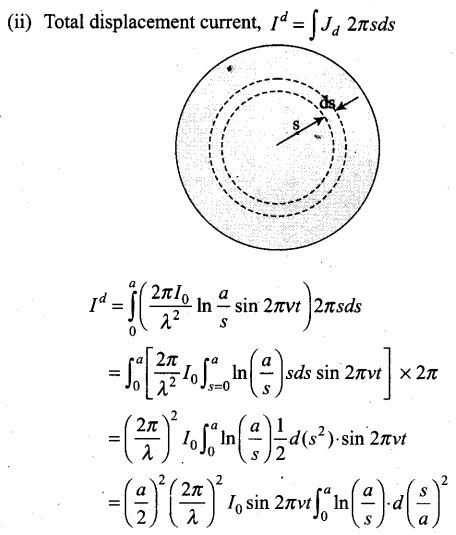
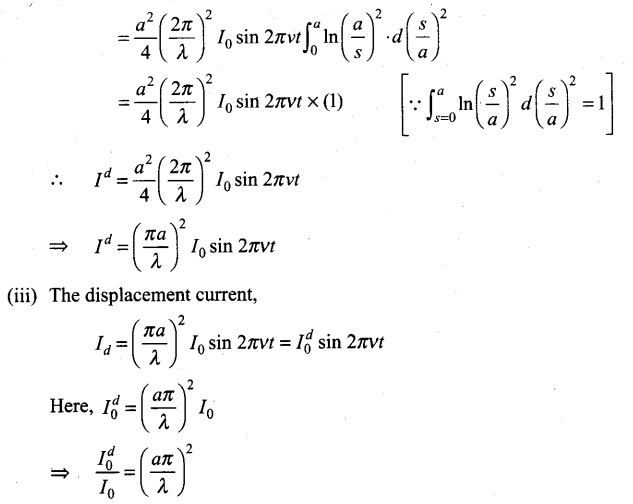
    (i) Calculate the displacement current density inside the cable.
    (ii) Integrate the displacement current density across the cross-section of the cable to find the total displacement current ld.
    (iii) Compare the conduction current I0 with the displacement current I0d.
    Solution:
    ncert-exemplar-problems-class-12-physics-electromagnetic-waves-49
    ncert-exemplar-problems-class-12-physics-electromagnetic-waves-50
    ncert-exemplar-problems-class-12-physics-electromagnetic-waves-51

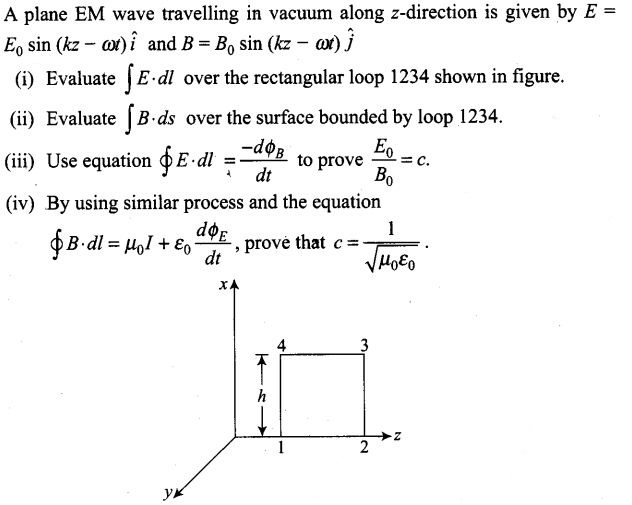
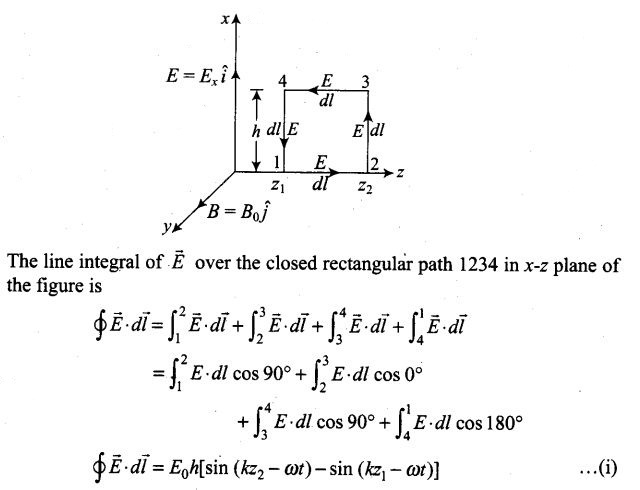
    Question 31.
    ncert-exemplar-problems-class-12-physics-electromagnetic-waves-52
    Solution:
    ncert-exemplar-problems-class-12-physics-electromagnetic-waves-53
    ncert-exemplar-problems-class-12-physics-electromagnetic-waves-54
    ncert-exemplar-problems-class-12-physics-electromagnetic-waves-55
    ncert-exemplar-problems-class-12-physics-electromagnetic-waves-56
    ncert-exemplar-problems-class-12-physics-electromagnetic-waves-57
    ncert-exemplar-problems-class-12-physics-electromagnetic-waves-58

    Question 32.
    ncert-exemplar-problems-class-12-physics-electromagnetic-waves-59
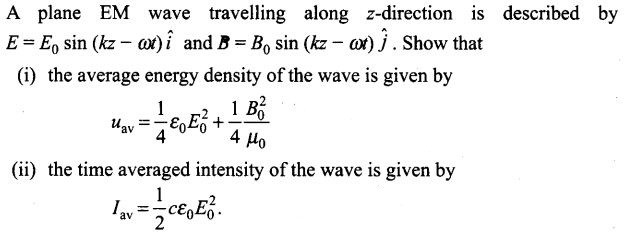
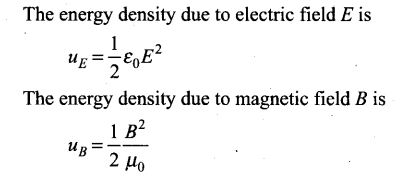
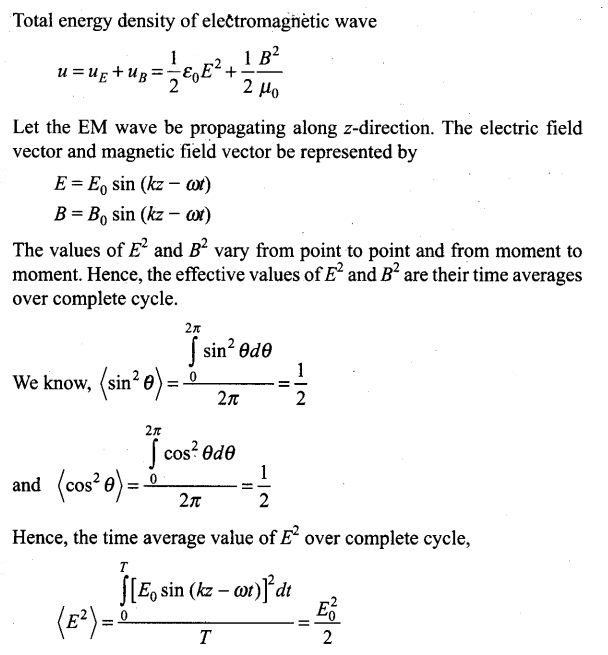
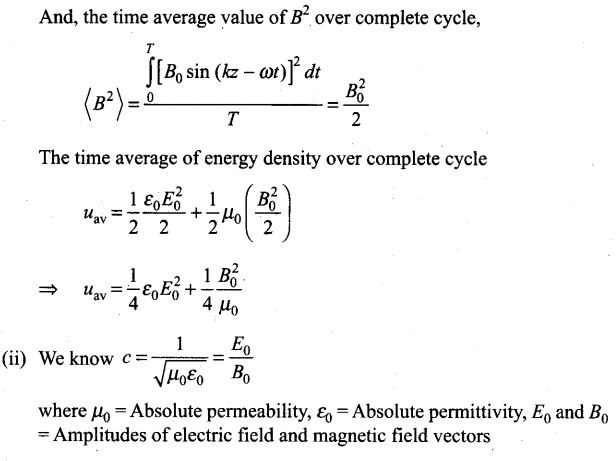
    Solution: (i) Total energy carried by electromagnetic wave is due to electric field vector and magnetic field vector. In electromagnetic wave, E and B vary from point to point and from moment to moment.
    ncert-exemplar-problems-class-12-physics-electromagnetic-waves-60
    ncert-exemplar-problems-class-12-physics-electromagnetic-waves-61
    ncert-exemplar-problems-class-12-physics-electromagnetic-waves-62
    ncert-exemplar-problems-class-12-physics-electromagnetic-waves-63

  • Alternating Current NCERT Exemplar Problems Solutions Physics

    NCERT Exemplar Problems Class 12 Physics Chapter 7 Alternating Current

    Multiple Choice Questions (MCQs)
    Single Correct Answer Type
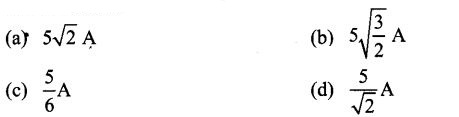
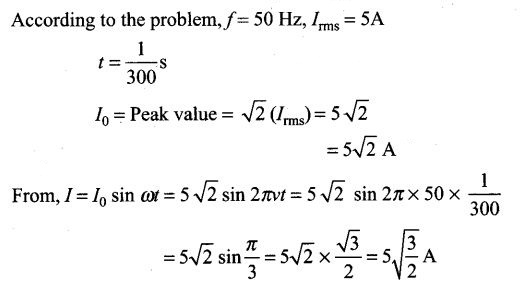
    Question 1. If the rms current in a 50 Hz AC circuit is 5 A, the value of the current 1/300 s after its value becomes zero is
    ncert-exemplar-problems-class-12-physics-alternating-current-1
    Solution: (b)
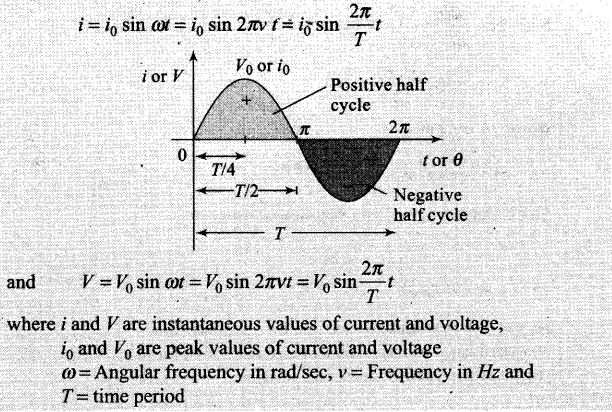
    Key concept: Equation for i and V: Alternating current or voltage varying as sine function can be written as
    ncert-exemplar-problems-class-12-physics-alternating-current-2
    ncert-exemplar-problems-class-12-physics-alternating-current-3

    Question 2. An alternating current generator has an internal resistance Rgand an internal reactance Xg It is used to supply power to a passive load consisting of a resistance Rg and a reactance XL. For maximum power to be delivered from the generator to the load, the value of XL is equal to
    (a) zero (b) Xg
    (c) -Xg (d) Rg
    Solution: (c) For maximum power to be delivered from the generator (or internal reactance Xg) to the load (of reactance, XL),
    => XL + Xg = 0 (the total reactance must vanish)
    =>XL=-Xg

    Question 3.
    ncert-exemplar-problems-class-12-physics-alternating-current-4
    Solution:
    ncert-exemplar-problems-class-12-physics-alternating-current-5

    Question 4. To reduce the resonant frequency in an L-C-R series circuit with a generator,
    (a) the generator frequency should be reduced
    (b) another capacitor should be added in parallel to the first
    (c) the iron core of the inductor should be removed
    (d) dielectric in the capacitor should be removed
    Solution: (b)
    ncert-exemplar-problems-class-12-physics-alternating-current-6
    ncert-exemplar-problems-class-12-physics-alternating-current-7

    Question 5. Which of the following combinations should be selected for better tuning of an L-C-R circuit used for communication?
    (a) R = 20 Ω, L = 1.5 H, C = 35μF
    (b) R = 25 Ω, L = 2.5 H, C = 45 μF
    (c) R=15Ω, L = 3.5H, C = 30 μF
    (d) R = 25 Ω, L = 1.5 H, C = 45 μF
    Solution: (c)
    ncert-exemplar-problems-class-12-physics-alternating-current-8
    ncert-exemplar-problems-class-12-physics-alternating-current-9
    where R is the resistance, L is the inductance and C is the capacitance of the circuit.
    For high Q factor R should be low, L should be high and C should be low. These conditions are best satisfied by the values given in option (c).
    Important point: Be careful while writing formula for quality factor, this formula we used in this case is only for series L-C-R circuit.

    Question 6. An inductor of reactance 1 Ω and a resistor of 2 Ω are connected in series to the terminals of a 6 V (rms) AC source. The power dissipated in the circuit is
    (a) 8 W (b) 12 W
    (c) 14.4 W (d) 18 W
    Solution: (c) According to the problem, XL = 1 Ω , R = 2 Ω ,
    ncert-exemplar-problems-class-12-physics-alternating-current-10
    ncert-exemplar-problems-class-12-physics-alternating-current-11

    Question 7. The output of a step-down transformer is measured to be 24 V when connected to a 12 W light bulb. The value of the peak current is
    ncert-exemplar-problems-class-12-physics-alternating-current-12
    Solution: (a)
    ncert-exemplar-problems-class-12-physics-alternating-current-13

    One or More Than One Correct Answer Type
    Question 8. As the frequency of an AC circuit increases, the current first increases and then decreases. What combination of circuit elements is most likely to comprise the circuit?
    (a) Inductor and capacitor (b) Resistor and inductor
    (c) Resistor and capacitor (d) Resistor, inductor and capacitor
    Solution: (a, d) Compare the given circuit by predicting the variation in their reactances with frequency. So, that then we can decide the elements.
    Reactance of an inductor of inductance L is XL = 2πvL, where v is the frequency of the AC circuit.
    ncert-exemplar-problems-class-12-physics-alternating-current-14

    Question 9. In an alternating current circuit consisting of elements in series, the current increases on increasing the frequency of supply. Which of the following elements are likely to constitute the circuit?
    (a) Only resistor (b) Resistor and an inductor
    (c) Resistor and a capacitor (d) Only a capacitor
    Solution: (c, d) This is the similar problem as we discussed above. In this problem, the current increases on increasing the frequency of supply. Hence, the reactance of the circuit must be decreased as increase in frequency. So, one element that must be connected is capacitor. We can also connect a resistor in series.
    For a capacitive circuit,
    XC = 1/ωC =1/2πfC
    When frequency increases, XC decreases. Hence current in the circuit increases.
    ncert-exemplar-problems-class-12-physics-alternating-current-15

    Question 10. Electrical energy is transmitted over large distances at high alternating voltages. Which of the following statements is (are) correct?
    (a) For a given power level, there is a lower current
    (b) Lower current implies less power loss
    (c) Transmission lines can be made thinner
    (d) It is easy to reduce the voltage at the receiving end using step-down transformers
    Solution: (a, b, d)
    ncert-exemplar-problems-class-12-physics-alternating-current-16
    ncert-exemplar-problems-class-12-physics-alternating-current-17

    Question 11. For an L-C-R circuit, the power transferred from the driving source to the driven oscillator is P = I2 Z cos Ф.
    (a) Here, the power factor cos Ф > 0, P > 0
    (b) The driving force can give no energy to the oscillator (P = 0) in some cases
    (c) The driving force cannot syphon out (P < 0) the energy out of oscillator
    (d) The driving force can take away energy out of the oscillator
    Solution:
    ncert-exemplar-problems-class-12-physics-alternating-current-18

    Question 12. When an AC voltage of 220 V is applied to the capacitor C
    (a) the maximum voltage between plates is 220 V
    (b) the current is in phase with the applied voltage
    (c) the charge on the plates is in phase with the applied voltage
    (d) the power delivered to the capacitor is zero
    Solution: (c, d) If the alternating voltage is applied to the capacitor, the plate connected to the positive terminal of the source will be at higher potential and the plate connected to the negative terminal of source will be at lower potential. So the plates capacitor is charged.
    ncert-exemplar-problems-class-12-physics-alternating-current-19

    Question 13.
    ncert-exemplar-problems-class-12-physics-alternating-current-20
    Solution:
    ncert-exemplar-problems-class-12-physics-alternating-current-21

    Very Short Answer Type Questions
    Question 14. If an L-C circuit is considered analogous to a harmonically oscillating spring- block system, which energy of the L-C circuit would be analogous to potential energy and which one analogous to kinetic energy?
    Solution: When a charged capacitor C having an initial charge q0 is discharged through an inductance L, the charge and current in the circuit start oscillating simple harmonically. If the resistance of the circuit is zero, no energy is dissipated as heat. We also assume an idealized situation in which energy is not radiated away from the circuit. The total energy associated with the circuit is constant.
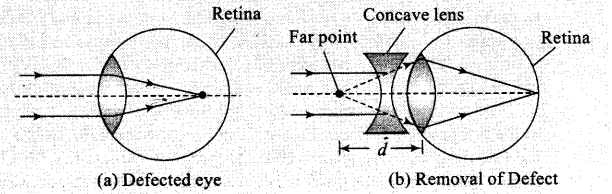
    The oscillation of the LC circuit are an electromagnetic analog to the mechanical oscillation of a block-spring system.
    The total energy of the system remains conserved.
    ncert-exemplar-problems-class-12-physics-alternating-current-22
    ncert-exemplar-problems-class-12-physics-alternating-current-23
    ncert-exemplar-problems-class-12-physics-alternating-current-24
    ncert-exemplar-problems-class-12-physics-alternating-current-25

    Question 15. Draw the effective equivalent circuit of the circuit shown in figure, at very high frequencies and find the effective impedance.
    ncert-exemplar-problems-class-12-physics-alternating-current-26
    Solution:
    Key concept: The element with infinite resistance will be considered as open circuit and the element with zero resistance will be considered as short circuited.
    ncert-exemplar-problems-class-12-physics-alternating-current-27
    ncert-exemplar-problems-class-12-physics-alternating-current-28

    Question 16. Study the circuits (a) and (b) shown in figure and answer the following questions.
    ncert-exemplar-problems-class-12-physics-alternating-current-29
    (a) Under which conditions would the rms currents in the two circuits be the same?
    (b) Can the rms current in circuit (b) be larger than that in (a)?
    Solution:
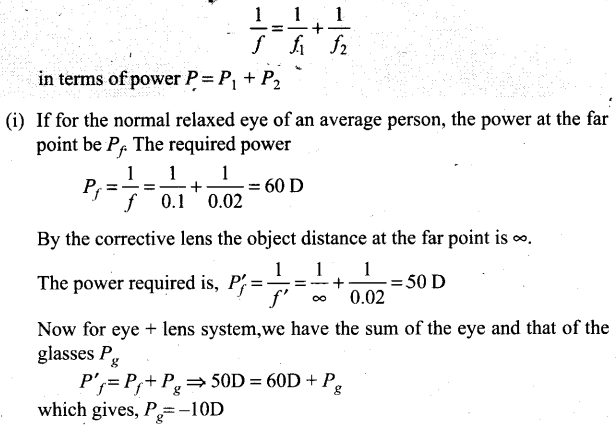
    ncert-exemplar-problems-class-12-physics-alternating-current-30
    ncert-exemplar-problems-class-12-physics-alternating-current-31
    ncert-exemplar-problems-class-12-physics-alternating-current-32

    Question 17. Can the instantaneous power output of an AC source ever be negative? Can the average power output be negative?
    Solution:
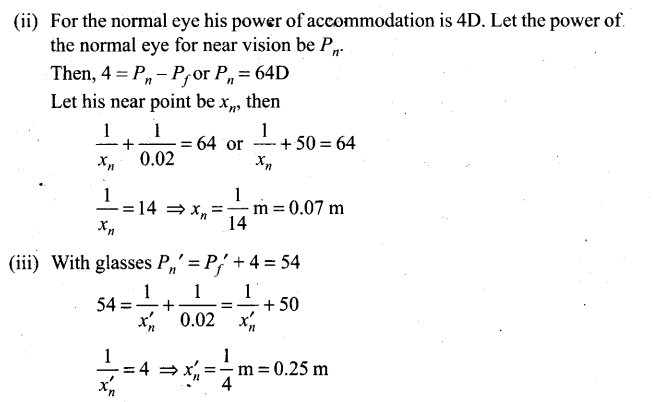
    ncert-exemplar-problems-class-12-physics-alternating-current-33
    ncert-exemplar-problems-class-12-physics-alternating-current-34

    Question 18. In a series LCR circuit, the plot of Imax versus co is shown in figure. Find the bandwidth and mark in the figure.
    ncert-exemplar-problems-class-12-physics-alternating-current-35
    Solution:
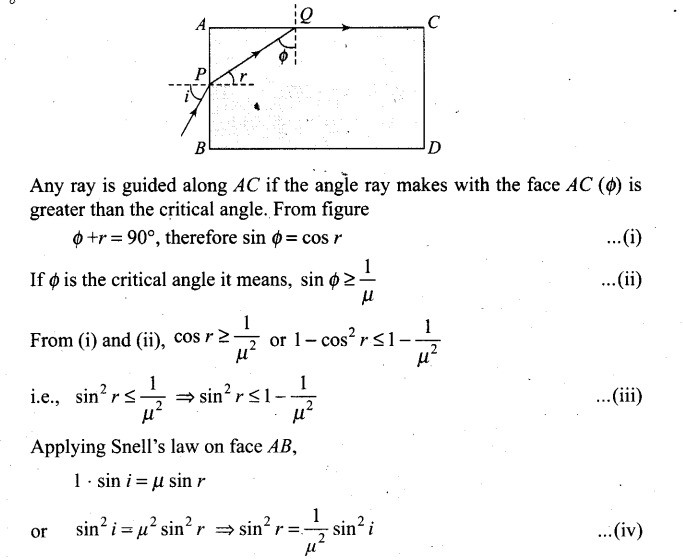
    ncert-exemplar-problems-class-12-physics-alternating-current-36

    Question 19. The alternating current in a circuit is described by the graph shown in figure. Show rms current in this graph.
    ncert-exemplar-problems-class-12-physics-alternating-current-37
    Solution:
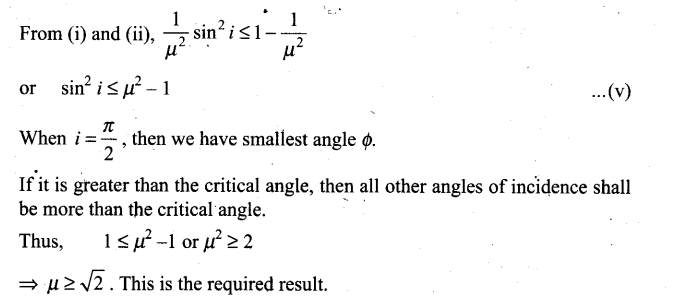
    ncert-exemplar-problems-class-12-physics-alternating-current-38
    ncert-exemplar-problems-class-12-physics-alternating-current-39

    Question 20. How does the sign of the phase angle Ф, by which the supply voltage leads the current in an L-C-R series circuit, change as the supply frequency is gradually increased from very low to very high values?
    Solution:
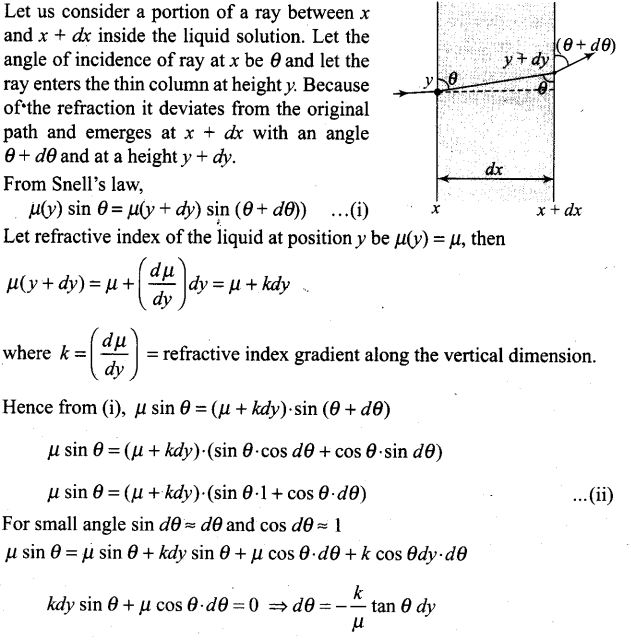
    ncert-exemplar-problems-class-12-physics-alternating-current-40

    Short Answer Type Questions
    Question 21. A device ‘X is connected to an AC source. The variation of voltage, current and power in one complete cycle is shown in figure.
    (a) Which curve shows power consumption over a full cycle?
    (b) What is the average power consumption over a cycle?
    (c) Identify the device X.
    ncert-exemplar-problems-class-12-physics-alternating-current-41
    Solution: (a) Power is the product of voltage and current (Power = P = VI).
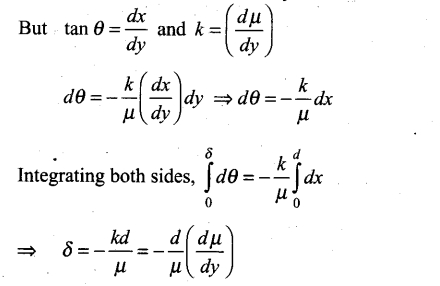
    So, the curve of power will be having maximum amplitude, equals to the product of amplitudes of voltage (V) and current (I) curve. Frequencies , of B and C are-equal, therefore they represent V and I curves. So, the curve A represents power.
    (b) The full cycle of the graph (as shown by shaded area in the diagram) consists of one positive and one negative symmetrical area.
    ncert-exemplar-problems-class-12-physics-alternating-current-42
    Hence, average power consumption over a cycle is zero.
    (c) Here phase difference between V and I is π /2 therefore, the device ‘X’ may be an inductor (L) or capacitor (C) or the series combination of L and C.

    Question 22. Both alternating current and direct current are measured in amperes. But how is the ampere defined for an alternating current?
    Solution: For a Direct Current (DC),
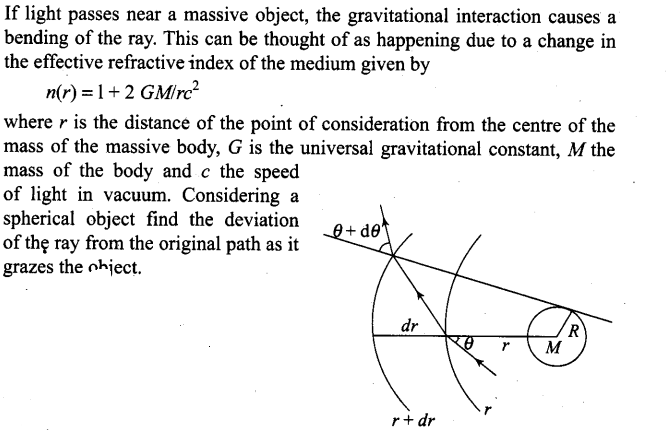
    1 ampere = 1 coulomb/sec
    Direction of AC changes with the frequency of source with the source frequency and the attractive force would average to zero. Thus, the AC ampere must be defined in terms of some property that is independent of the direction of current. Joule’s heating effect is such property and hence it is used to define rms value of AC.
    So, r.m.s. value of AC is equal to that value of DC, which when passed through a resistance for a given time will produce the same amount of heat as produced by the alternating current when passed through the same resistance for same time.

    Question 23. A coil of 0.01 H inductance and 1 ω resistance is connected to 200 V, 50 Hz AC supply. Find the impedance of the circuit and time lag between maximum alternating voltage and current.
    Solution:
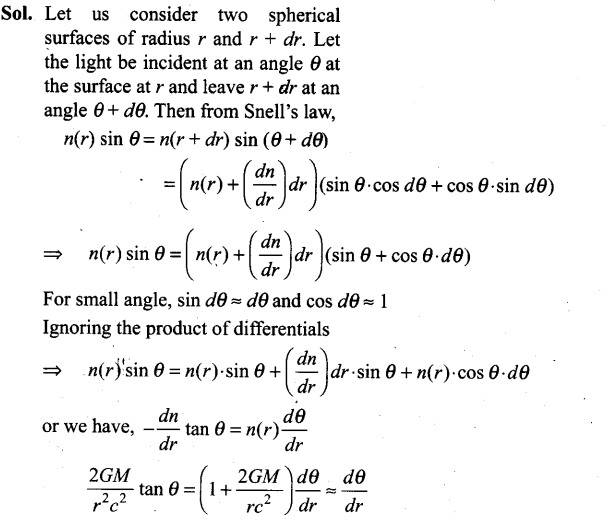
    ncert-exemplar-problems-class-12-physics-alternating-current-43

    Question 24. A 60 W load is connected to the secondary of a transformer whose primary draws line voltage. If a current of 0.54 A flows in the load, what is the current in the primary coil? Comment on the type of transformer being used.
    Solution:
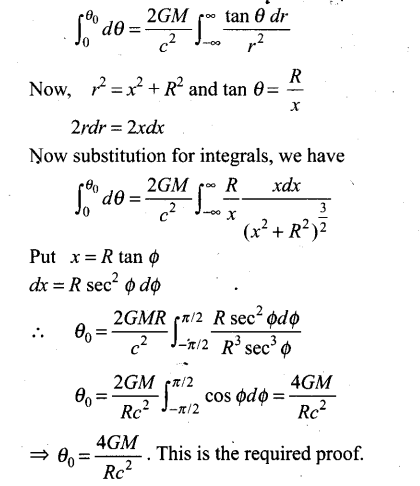
    ncert-exemplar-problems-class-12-physics-alternating-current-44

    Question 25. Explain why the reactance provided by a capacitor to an alternating current decreases with increasing frequency.
    Solution: Capacitor plates get charged and discharged when an AC voltage is applied across the plates. So the current through capacitor is as a result of charging charge. Because the frequency of the capacitive circuit increases, the polarities of the charged plates change more rapidly with time, giving rise to a’larger current. The capacitance reactance (XC) due to a capacitor C varies
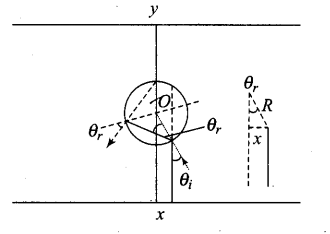
    as the inverse of the frequency (f) (as XC=1/2π fC) and hence approaches zero as v approaches infinity. The current is zero in a DC capacitive circuit, which corresponds to zero proportional and infinite reactance. Also, Since XC is inversely proportional to frequency, capacitors tend to pass high-frequency current and to block low-frequency currents and DC (just the opposite of inductors).

    Question 26. Explain why the reactance offered by an inductor increases with increasing frequency of an alternating voltage.
    Solution: The inductive reactance is given by XL = 2πfL, XL is proportional to the frequency and current is inversely proportional to the reactance. An inductor opposes the flow of current through it by developing a back emf according to Lenz’s law. If the current is decreasing, the polarity of the induced emf will be so as to increase the current and vice-versa.
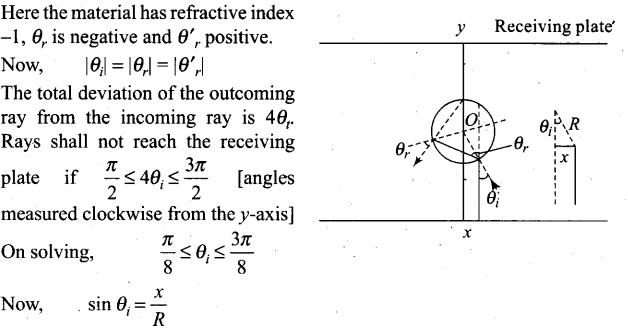
    Since, the induced emf is proportional to the rate of change of current.

    Long Answer Type Questions
    Question 27.
    ncert-exemplar-problems-class-12-physics-alternating-current-45
    Solution:
    ncert-exemplar-problems-class-12-physics-alternating-current-46
    ncert-exemplar-problems-class-12-physics-alternating-current-47
    ncert-exemplar-problems-class-12-physics-alternating-current-48

    Question 28.
    ncert-exemplar-problems-class-12-physics-alternating-current-49
    Solution:
    ncert-exemplar-problems-class-12-physics-alternating-current-50

    Question 29. Consider the L-C-R circuit shown in figure. Find the net current i and the phase of i. Show that i = V/Z. Find the-impedance Z for this circuit.
    ncert-exemplar-problems-class-12-physics-alternating-current-51
    Solution: Key concept: In the circuit given above consists of a capacitor (C) and an inductor (L) connected in series and the combination is connected in parallel with a resistance R. Due to this combination there is an oscillation of electromagnetic energy.
    ncert-exemplar-problems-class-12-physics-alternating-current-52
    ncert-exemplar-problems-class-12-physics-alternating-current-53
    ncert-exemplar-problems-class-12-physics-alternating-current-54
    ncert-exemplar-problems-class-12-physics-alternating-current-55

    Question 30.
    ncert-exemplar-problems-class-12-physics-alternating-current-56
    Solution:
    ncert-exemplar-problems-class-12-physics-alternating-current-57
    ncert-exemplar-problems-class-12-physics-alternating-current-58

    Question 31.
    ncert-exemplar-problems-class-12-physics-alternating-current-59
    Solution:
    ncert-exemplar-problems-class-12-physics-alternating-current-60
    ncert-exemplar-problems-class-12-physics-alternating-current-61
    ncert-exemplar-problems-class-12-physics-alternating-current-62
    ncert-exemplar-problems-class-12-physics-alternating-current-63
    ncert-exemplar-problems-class-12-physics-alternating-current-64

  • Electromagnetic Induction NCERT Exemplar Problems Solutions Physics

    NCERT Exemplar Problems Class 12 Physics Chapter 6 Electromagnetic Induction

    Multiple Choice Questions (MCQs)
    Single Correct Answer Type
    Question 1.
    ncert-exemplar-problems-class-12-physics-electromagnetic-induction-1
    Solution: (c)
    Key concept: Magnetic flux is defined as the total number of magnetic lines of force passing normally through an area placed in a magnetic field and is equal to the magnetic flux linked with that area.
    ncert-exemplar-problems-class-12-physics-electromagnetic-induction-2

    Question 2.
    ncert-exemplar-problems-class-12-physics-electromagnetic-induction-3
    Solution:
    ncert-exemplar-problems-class-12-physics-electromagnetic-induction-4

    Question 3. A cylindrical bar magnet is Rotated about its axis. A wire is connected from the axis and is made to touch the cylindrical surface through a contact. Then,
    (a) a direct current flows in the ammeter A
    (b) no current flows through the ammeter A
    (c) an alternating sinusoidal current flows through the ammeter A with a time period 2π /ω
    (d) a time varying non-sinusoidal current flows through the ammeter A
    Solution: (b)
    Key concept: The phenomenon of electromagnetic induction is used in this problem. Whenever the number of magnetic lines of force (magnetic flux) passing through a circuit changes (or a moving conductor cuts the magnetic flux) an emf is produced in the circuit (or emf induces across the ends of the conductor) is called induced emf. The induced emf persists only as long as there is a change or cutting of flux.
    When cylindrical bar magnet is rotated about its axis, no change in flux linked with the circuit takes place, consequently no emf induces and hence, no current flows through the ammeter A. Hence the ammeter shows no deflection.
    ncert-exemplar-problems-class-12-physics-electromagnetic-induction-5

    Question 4. There are two coils A and B as shown in figure. A current starts flowing in B as shown, when A is moved towards B and stops when A stops moving. The current in A is counter clockwise. B is kept stationary when A moves. We can infer that
    (a) there is a constant current in the clockwise direction in A.
    (b) there is a varying current in A.
    (c) there is no current in A.
    (d) there is a constant current in the counter clockwise direction in A.
    ncert-exemplar-problems-class-12-physics-electromagnetic-induction-6
    Solution: (d)
    Key concept: Due to variation in the flux linked with coil B an emf will be induced in coil B.
    Current in coil B becomes zero when coil A stops moving, it is possible only if the current in coil A is constant. If the current in coil A would be variable, there must be some changing flux and then there must be an induced emf. Hence an induced current will be in coil B even when coil A is not moving.

    Question 5. Same as problem 4 except the coil A is made to rotate about a vertical axis (figure). No current flows in B if A is at rest. The current in coil A, when the current in B (at t = 0) is counter-clockwise and the coil A is as shown at this instant, t = 0, is
    (a) constant current clockwise.
    (b) varying current clockwise.
    (c) varying current counter clockwise.
    (d) constant current counter clockwise.
    ncert-exemplar-problems-class-12-physics-electromagnetic-induction-7
    Solution: (a)
    Key concept: In this problem, the Lenz’s law is applicable so let us introduce Lenz’s law first. .
    Lenz’s law gives the direction of induced emf/induced current. According to this law, the direction of induced emf or current in a circuit is such as to oppose the cause that produces it. This law is based upon law of conservation of energy.
    When the current in coil B (at t= 0) is counter-clockwise and the coil A is considered above it. The counter clockwise flow of the current in coil B is equivalent to north pole of magnet and magnetic field lines are eliminating upward to coil A. When coil A starts rotating at t = 0, the current in A is constant along clockwise direction by Lenz’s rule.

    Question 6. The self inductance L of a solenoid of length l and area of cross-section A, with a fixed number of turns N increases as
    (a) l and A increase (b) l decreases and A increases
    (c) l increases and A decreases (d) both l and A decrease
    Solution: (b)
    Key concept: The self inductance L of a solenoid depends on various factor like geometry and magnetic permeability of the core material.
    L = μr μ0 n2 Al
    where, n = N/l (no. of turns per unit length)
    1. No. of turns: Larger the number of turns in solenoid, larger is its self inductance.
    2. Area of cross section: Larger the area of cross section of the solenoid, larger is its self inductance.
    3. Permeability of the core material. The self inductance of a solenoid increases μr times if it is wound over an iron core of relative permeability μr.
    The long solenoid of cross-sectional area A and length l, having A turns, filled inside of the solenoid with a material of relative permeability (e.g., soft iron, which has a high value of relative permeability) then its self inductance is L = μrμ0 N2 A/l
    So, the self inductance L of a solenoid increases as l decreases and A increases because L is directly proportional to area and inversely proportional to length.
    Important point: The self and mutual inductance of capacitance and resistance depend on the geometry of the devices as well as permittivity/ permeability of the medium.

    One or More Than One Correct Answer Type
    Question 7. A metal plate is getting heated. It can be because
    (a) a direct current is passing through the plate
    (b) it is placed in a time varying magnetic field
    (c) it is placed in a space varying magnetic field, but does not vary with time
    (d) a current (either direct or alternating) is passing through the plate
    Solution: (a, b, c)
    Key concept: Eddy Current: When a changing magnetic flux is applied to a bulk piece of conducting material, then circulating currents called eddy currents are induced in the material. Because the resistance of the bulk conductor is usually low, eddy currents often have large magnitudes and heat up the conductor.
    (1) These are circulating currents like eddies in water.
    (2) Experimental concept is given by Focault, hence also named as “Focault current”.
    (3) The production of eddy currents in a metallic block leads to the loss of electric energy in the form of heat.
    (4) By lamination, slotting processes, the resistance path for circulation of eddy current increases, resulting into weakening them and also reducing losses causes by them.
    ncert-exemplar-problems-class-12-physics-electromagnetic-induction-8
    A metal plate is getting heated when a DC or AC current is passed through the plate, known as heating effect of current. This current (called eddy current) is induced in the plate when a metal plate is subjected to a time varying magnetic field, i.e., the magnetic flux linked with the plate changes and eddy currents comes into existence which make the plate hot.

    Question 8. An emf is produced in a coil, which is not connected to an external voltage source. This can be due to
    (a) the coil being in a time varying magnetic field
    (b) the coil moving in a time varying magnetic field
    (c) the coil moving in a constant magnetic field
    (d) the coil is stationary in external spatially varying magnetic field, which does not change with time
    Solution: (a, b, c)
    Key concept: As we know whenever the number of magnetic lines of force (magnetic flux) passing through a circuit changes, an emf is produced in the circuit called induced emf. The induced emf persists only as long as there is a change or cutting of flux.
    ncert-exemplar-problems-class-12-physics-electromagnetic-induction-9
    In this problem, magnetic flux linked with the isolated coil changes when the coil is placed in the region of a time varying magnetic field, the coil moving in a constant magnetic field or in time varying magnetic field.
    ncert-exemplar-problems-class-12-physics-electromagnetic-induction-10

    Question 9. The mutual inductance M12 of coil 1 with respect to coil 2
    (a) increases when they are brought nearer
    (b) depends on the current passing through the coils
    (c) increases when one of them is rotated about an axis
    (d) is the same as M21 of coil 2 with respect to coil 1
    Solution: (a, d)
    Key concept: Mutual Induction: Whenever the current passing through a coil or circuit changes, the magnetic flux linked with a neighbouring coil or circuit will also change. Hence an emf will be induced in the neighbouring coil or circuit. This phenomenon is called ‘mutual induction’.
    ncert-exemplar-problems-class-12-physics-electromagnetic-induction-11
    ncert-exemplar-problems-class-12-physics-electromagnetic-induction-12

    Question 10. A circular coil expands radially in a region of magnetic field and no electromotive force is produced in the coil. This can be because
    (a) the magnetic field is constant
    (b) the magnetic field is in the same plane as the circular coil and it may or may not vary
    (c) the magnetic field has a perpendicular (to the plane of the coil) component whose magnitude is decreasing suitably
    (d) there is a constant magnetic field in the perpendicular (to the plane of the coil) direction
    Solution: (b, c)
    Key concept: As we know whenever the number of magnetic lines of force (magnetic flux) passing through a circuit changes an emf is produced in the circuit called induced emf. The induced emf persists only as long as there is a change or cutting of flux.
    The induced emf is given by rate of change of magnetic flux linked with the circuit, i.e., e = -dФ/dt
    According to the problem there is no electromotive force produced in the coil. Then the various arrangement are to be thought of in such a way that the magnetic flux linked with the coil does not change even if the coil is placed and expanded in magnetic field.
    When circular coil expands radially in a region of magnetic field such that the magnetic field is in the same plane as the circular coil or we can say that direction of magnetic field is perpendicular to the direction of area (increasing) so that their dot product is always zero and hence change in magnetic flux is also zero.
    ncert-exemplar-problems-class-12-physics-electromagnetic-induction-13
    Or
    The magnetic field has a perpendicular (to the plane of the coil) component whose-magnitude is decreasing suitably in such a way that the dot product of magnetic field and surface area of plane of coil remain constant at every instant.
    ncert-exemplar-problems-class-12-physics-electromagnetic-induction-14

    Very Short Answer Type Questions
    Question 11. Consider a magnet surrounded by a wire, with an on/off switch S (figure). If the switch is thrown from the off position (open circuit) to the on position (closed circuit), will a current flow in the circuit? Explain.
    ncert-exemplar-problems-class-12-physics-electromagnetic-induction-15
    Solution:
    ncert-exemplar-problems-class-12-physics-electromagnetic-induction-16
    Whenever the number of magnetic lines of force (magnetic flux) passing through a circuit changes an emf is produced in the circuit called induced emf. The induced emf persists only as long as there is a change or cutting of flux. The induced emf is given by rate of change of magnetic flux linked with the circuit i.e, e= – dФ/dt . so flux linked will change when either magnetic field, area or the angle between B and A changes.
    If the switch is closed, the circuit will complete. But to induce emf in the circuit, we need:
    (i) a changing magnetic field, but the bar magnet is stationary so it is not possible in this situation.
    (ii) A changing area, which is also not possible because area is also constant as coil is not expanding or compressed.
    (iii) Angle between B bar and A bar changes, which is also not possible in this situation because orientation of bar magnet and coil is fixed.
    Thus, no change in magnetic flux linked with coil occur, hence no electromotive force is induced in the coil and hence no current will flow in the circuit.

    Question 12. A wire in the form of a tightly wound solenoid is connected to a DC source, and carries a current. If the coil is stretched so that there are gaps between successive elements of the spiral coil, will the current increase or decrease? Explain.
    Solution:
    Key concept: Lenz ‘s Law:
    This law gives the direction of induced emf/induced current. According to this law, the direction of induced emf or current in a circuit is such as to oppose the cause that produces it. This law is based upon the law of conservation of energy.
    (1) When AT-pole of a bar magnet moves towards the coil, the flux associated with the loop increases and an emf is induced in it. Since the circuit of loop is closed, induced current also flows in it.
    (2) Cause of this induced current, is approach of north pole and therefore to oppose the cause, i.e., to repel the approaching north pole, the induced current in loop is in such a direction so that the front face of loop behaves as north pole. Therefore induced current as seen by observer O is in anticlockwise direction (figure).
    ncert-exemplar-problems-class-12-physics-electromagnetic-induction-17
    According to the given situation as the coil is stretched so that there are gaps between successive elements of the spiral coil, i.e., the wires are pulled apart which lead to the flux leak through the gaps. According to Lenz’s law, the emf induced in these spirals must oppose this decrease in magnetic flux, which can be done by an increase in current. So, the current will increase.

    Question 13. A solenoid is connected to a battery so that a steady current flows through it. If an iron core is inserted into the solenoid, will the current increase or decrease? Explain.
    Solution: This problem is based on Lenz’s law and according to this law, the direction of induced emf or current in a circuit is such as to oppose the cause that produces it.
    ncert-exemplar-problems-class-12-physics-electromagnetic-induction-18
    When the iron core is inserted in the current carrying solenoid, the magnetic field increases due to the magnetisation of iron core and hence the flux increases.
    So, the emf induced in the coil must oppose this increase in flux, so the current induced in the coil in such a direction that it will oppose the increasing magnetic field which can be done by making decrease in current. So, the current will decrease.

    Question 14. Consider a metal ring kept oft the top of a fixed solenoid (say on a cardboard) (figure). The centre of the ring coincides with the axis of the solenoid. If the current is suddenly switched on, the metal ring jumps up. Explain.
    ncert-exemplar-problems-class-12-physics-electromagnetic-induction-19
    Solution: This problem is based on Lenz’s law and according to this law, the direction of induced emf or current in a circuit is such as to oppose the cause that produces it.
    Initially there is no flux linked with the ring or we can say that initially flux through the ring is zero. When the switch is closed current start flowing in the circuit, magnetic flux is linked through the ring. Thus increase in flux takes place. According to Lenz’s law, this increase will be resisted and this can happen if the ring moves away from the solenoid.
    ncert-exemplar-problems-class-12-physics-electromagnetic-induction-20
    This happen because the flux increases will cause an anticlockwise current (as seen from the top in the ring in figure.), i.e., opposite direction to that in the solenoid.
    This makes the same sense of flow of current in the ring (when viewed from the bottom of the ring) and solenoid forming same magnetic pole in front of each other. Hence, they will repel each other and the ring will move upward.

    Question 15. Consider a metal ring kept (supported by a cardboard) on the top of a fixed solenoid carrying a current I (see figure of Question 14). The centre of the ring coincides with the axis of the solenoid. If the current in the solenoid is switched off, what will happen to the ring?
    Solution: This problem is based on Lenz’s law and according to this law, the direction of induced emf or current in a circuit is such as to oppose the cause that produces it.
    ncert-exemplar-problems-class-12-physics-electromagnetic-induction-21
    When the switch is opened, current in the circuit of solenoid stops flowing. Initially there is some magnetic flux linked with the solenoid and now if current in the circuit stops, the magnetic flux falls to zero or we can say that magnetic flux linked through the ring decreases. According to Lenz’s law, this decrease in flux will be opposed and the ring experiences downward force towards the solenoid.
    This happen because the current i decrease will cause a clockwise current (as seen from the top in the ring in figure) to increase the decreasing flux. This can be done if the direction of induced magnetic field is same as that of solenoid. This makes the opposite sense of flow of current in the ring (when viewed from the bottom of the ring) and solenoid forming opposite magnetic pole in front of each other.
    Hence, they will -attract each other but as ring is placed at the cardboard it could not be able to move downward.

    Question 16. Consider a metallic pipe with ah inner radius of 1 cm. If a cylindrical bar magnet of radius 0.8 cm is dropped through the pipe, it takes more time to come down than it takes for a similar un-magnetised cylindrical iron bar dropped through the metallic pipe. Explain.
    Solution: Key concept: Lem’s Law.
    This law gives the direction of induced emf/induced current. According to this law, the direction of induced emf or current in a circuit is such as to oppose the cause that produces it. This law is based upon the law of conservation of energy.
    Eddy Current. When a changing magnetic flux is applied to a bulk piece of conducting material, then circulating currents called eddy currents are induced in the material. Because the resistance of the bulk conductor is usually low, eddy currents often have large magnitudes and heat up the conductor.
    When a cylindrical bar magnet is dropped through the metallic pipe flux linked with the cylinder changes and consequently eddy currents are produced in the metallic pipe. According to Lenz’s law, these currents will oppose the motion of the magnet, which is the cause of induction.
    ncert-exemplar-problems-class-12-physics-electromagnetic-induction-22
    Therefore, magnet’s downward acceleration will be less than the acceleration due to gravity g. On the other hand, an un-magnetised iron bar will not produce eddy currents and will fall with acceleration due to gravity g.
    Thus, the magnet will take more time to come down than it takes for a similar un-magnetised cylindrical iron bar dropped through the metallic pipe, so, magnetised magnet takes more time.

    Short Answer Type Questions
    Question 17. A magnetic field in a certain region is given by B = B0 cos (ωt) k and a coil of radius a with resistance R is placed in the x-y plane with its centre at the origin in the magnetic field (figure). Find the magnitude and the direction of the current at (a, 0, 0) at
    ncert-exemplar-problems-class-12-physics-electromagnetic-induction-23
    Solution:
    Key concept:
    (1) First law: When ever the number of magnetic lines of force(magnetic flux) passing through a circuit changes, an emf is produced in the circuit called induced emf. The induced emf persists only as long as there is a change or cutting of flux.ncert-exemplar-problems-class-12-physics-electromagnetic-induction-24
    ncert-exemplar-problems-class-12-physics-electromagnetic-induction-25

    Question 18. Consider a closed loop C in a magnetic field (figure). The flux passing through the loop is defined by choosing a surface whose edge coincides with the loop and using the formula Ф = B1dA1, B2dA2 …. Now, if we choose two different surfaces S1 and S2 having C as their edge, would we get the same answer for flux. Justify your answer.
    ncert-exemplar-problems-class-12-physics-electromagnetic-induction-26
    Solution: We would get the same answer for magnetic flux. Let us discuss its reason in detail. The magnetic flux linked with the surface can be considered as the number of magnetic field lines passing through the surface. So, let dФ = B.dA represents magnetic lines in an area A to B.
    Magnetic field cannot end or start in space, this property of magnetic field lines based upon the concept of continuity. Therefore the number of lines passing through surface S1 must be the same as the number of lines passing through the surface S2. Therefore, in both the cases we get the same magnetic flux.
    ncert-exemplar-problems-class-12-physics-electromagnetic-induction-27
    Important point: Magnetic field lines can neither be originated nor be destroyed in space. This property is based on the concept of continuity.

    Question 19. Find the current in the wire for the configuration shown in figure. Wire PQ has negligible resistance. B, the magnetic field is coming out of the paper. θ is a fixed angle made by PQ travelling smoothly over two conducting parallel wires separated by a distance d.
    ncert-exemplar-problems-class-12-physics-electromagnetic-induction-28
    Solution:
    Key concept: This problem is based upon the motional emf.
    Consider a conducting rod of length l moving with a uniform velocity v perpendicular to a uniform magnetic field B bar, directed into the plane of the paper. Let the rod be moving to the right as shown in figure. The conducting electrons also move to the right as they are trapped within the rod.
    ncert-exemplar-problems-class-12-physics-electromagnetic-induction-29
    ncert-exemplar-problems-class-12-physics-electromagnetic-induction-30
    ncert-exemplar-problems-class-12-physics-electromagnetic-induction-31

    Question 20. A (current versus time) graph of the current passing through a solenoid is shown in figure. For which time is the back electromotive force (u) a maximum. If the back emf at t = 3 s is e, find the back emf at t = 7 s, 15 s and 40 s. OA, AB and BC are straight line segments.
    ncert-exemplar-problems-class-12-physics-electromagnetic-induction-32
    Solution:
    Key concept: Whenever the electric current passing through a coil or circuit changes, the magnetic flux linked with it will also change. As a result of this, in accordance with’Faraday’s laws of electromagnetic induction, an emf is induced in the coil or the circuit which opposes the change that causes this induced emf is called back emf, the current so produced in the coil is called induced current. The induced emf is given by
    ncert-exemplar-problems-class-12-physics-electromagnetic-induction-33
    ncert-exemplar-problems-class-12-physics-electromagnetic-induction-34

    Question 21. There are two coils A and B separated by some distance. If a current of 2 A flows through A, a magnetic flux of 10-2 Wb passes through B (no current through B). If no current passes through A and a current of 1A passes through B, what is the flux through A ?
    Solution:
    ncert-exemplar-problems-class-12-physics-electromagnetic-induction-35

    Long Answer Type Questions
    Question 22. A magnetic field B = B0 sin (ωt)k covers a large region where a wire AB slides smoothly over two parallel conductors separated by a distance d (figure). The wires are in the x-y plane. The wire AB (of length d) has resistance R and the parallel wires have negligible resistance. If AB is moving with velocity v, what is the current in the circuit. What is the force needed to keep the wire moving at constant velocity?
    ncert-exemplar-problems-class-12-physics-electromagnetic-induction-36
    Solution: Key concept: In this problem the emf induced across AB is motional emf due to its motion, and emf induced by change in magnetic flux linked with the loop change due to change of magnetic field.
    ncert-exemplar-problems-class-12-physics-electromagnetic-induction-37
    ncert-exemplar-problems-class-12-physics-electromagnetic-induction-38
    ncert-exemplar-problems-class-12-physics-electromagnetic-induction-39
    ncert-exemplar-problems-class-12-physics-electromagnetic-induction-40

    Question 23. A conducting wire XY of mass m and negligible resistance slides smoothly on two parallel conducting wires as shown in figure. The closed circuit has a resistance R due to AC. AB and CD are perfect conductors. There is a magnetic field B = B(t) k
    ncert-exemplar-problems-class-12-physics-electromagnetic-induction-41
    (i) Write down an equation for the acceleration of the wire XY
    (ii) If B is independent of time, obtain v(t), assuming v(0) = u0
    (iii) For (ii), show that the decrease in kinetic energy of XY equals the heat lost in.
    Solution: First we have to analyse the situation as shown in the figure. Let the parallel wires are at y = 0 and y = L and are placed along x-axis. Wire XY is along y-axis.
    At t = 0, wire AB starts from x = 0 and moves with a velocity v. Let at time t, wire is at x(t) = vt.
    (where, x(t) is the displacement as a function of time).
    Let us redraw the diagram as shown below.
    ncert-exemplar-problems-class-12-physics-electromagnetic-induction-42
    ncert-exemplar-problems-class-12-physics-electromagnetic-induction-43
    ncert-exemplar-problems-class-12-physics-electromagnetic-induction-44
    ncert-exemplar-problems-class-12-physics-electromagnetic-induction-45
    ncert-exemplar-problems-class-12-physics-electromagnetic-induction-46

    Question 24. ODBAC is a fixed rectangular conductor of negligible resistance (CO is not connected) and OP is a conductor which rotates clockwise with an angular velocity ω (figure). The entire system is in a uniform magnetic field B whose direction is along the normal to the surface of the rectangular conductor A’BDC. The conductor OP is in electric contact with ABDC. The rotating conductor has a resistance of λ per unit length. Find the current in the rotating conductor, as it rotates by 180°.
    ncert-exemplar-problems-class-12-physics-electromagnetic-induction-47
    Solution:
    ncert-exemplar-problems-class-12-physics-electromagnetic-induction-48
    ncert-exemplar-problems-class-12-physics-electromagnetic-induction-49
    ncert-exemplar-problems-class-12-physics-electromagnetic-induction-50
    ncert-exemplar-problems-class-12-physics-electromagnetic-induction-51

    Question 25. Consider an infinitely long wire carrying a current I(t), with dI/dt=λ =constant. Find the current produced in the rectangular loop of wire ABCD if its resistance is R (figure).
    ncert-exemplar-problems-class-12-physics-electromagnetic-induction-52
    Solution: To approach these types of problems integration is very useful to find the total magnetic flux linked with the loop.
    Let us first consider an elementary strip of length l and width dr at a distance r from an infinite long current carrying wire. The magnetic field at strip due to current carrying wire is given by
    ncert-exemplar-problems-class-12-physics-electromagnetic-induction-53
    ncert-exemplar-problems-class-12-physics-electromagnetic-induction-54

    Question 26. A rectangular loop of wire ABCD is kept close to an infinitely long wire carrying a current I(t) = I0(I – t/T) for 0 ≤ t ≤ T and I(0) = 0 for t >T(figure). Find the total charge passing through a given point in the loop, in time T. The resistance of the loop is R.
    ncert-exemplar-problems-class-12-physics-electromagnetic-induction-55
    Solution: To find the charge that passes through the circuit first we have to find the relation between instantaneous current and instantaneous magnetic flux linked with it. The emf induced can be obtained by differentiating the expression of magnetic flux linked w.r.t. t and then applying Ohm’s law, we get
    ncert-exemplar-problems-class-12-physics-electromagnetic-induction-56
    ncert-exemplar-problems-class-12-physics-electromagnetic-induction-57

    Question 27. A magnetic field B is confined to a region r ≤ a and points out of the paper (the z-axis), r = 0 being the centre of the circular region. A charged ring (charge = Q) of radius b, b> a and mass m lies in the x-y plane with its centre at the origin. The ring is free to rotate and is at rest. The magnetic field is brought to zero in time Δt. Find the angular velocity ω of the ring after the field vanishes.
    Solution:
    Key concept: According to the law of EMI, when magnetic field changes in the circuit, then magnetic flux linked with the circuit also changes and this changing magnetic flux leads to an induced emf in the circuit. Here, magnetic field decreases which causes induced emf and hence, electric field around the ring. The torque experienced by the ring produces change in angular momentum.
    As the magnetic field is brought to zero in time At, the magnetic flux linked with the ring also reduces from maximum to zero. This, in turn, induces an emf in ring as discussed above. The induces emf causes the induced electric field E around the ring.
    ncert-exemplar-problems-class-12-physics-electromagnetic-induction-58
    ncert-exemplar-problems-class-12-physics-electromagnetic-induction-59

    Question 28. A rod of mass m and resistance R slides smoothly over two parallel perfectly conducting wires kept sloping at an angle θ with respect to the horizontal (figure). The circuit is closed through a perfect conductor at the top. There is a constant magnetic field B along the vertical direction. If the rod is initially at rest, find the velocity of the rod as a function of time.
    ncert-exemplar-problems-class-12-physics-electromagnetic-induction-60
    Solution:
    Let us first divide the magnetic field in the components one is along the inclined plane = B sin θ and other component of magnetic field is perpendicular the plane =B cos θ
    Now, the conductor moves with speed v perpendicular to B cos θ, component of magnetic field. This causes motional emf across two ends of rod, which is
    ncert-exemplar-problems-class-12-physics-electromagnetic-induction-61
    ncert-exemplar-problems-class-12-physics-electromagnetic-induction-62

    Question 29. Find the current in the sliding rod AB (resistance = R) for the arrangement shown in figure. B is constant and is out of the paper. Parallel wires have no resistance, v is constant. Switch S is closed at time t = 0.
    ncert-exemplar-problems-class-12-physics-electromagnetic-induction-63
    Solution: This is the similar problem as we discussed above. Here, a conductor of length d moves with speed v, perpendicular to the magnetic field B as shown in figure. Due to this a motional emf is induced across two ends of rod (e = vBd). Since, switch S is closed at time t = 0, capacitor is charged by this potential difference. Let Q(t) be the charge on the capacitor and current flows from A to B.
    Now, the induced current
    ncert-exemplar-problems-class-12-physics-electromagnetic-induction-64

    Question 30. Find the current in the sliding cod AB (resistance = R) for the arrangement shown in figure. B is constant and is out of the paper. Parallel wires have no resistance, v is constant. Switch S is closed at time t = 0.
    ncert-exemplar-problems-class-12-physics-electromagnetic-induction-65
    Solution: This is the similar problem as we discussed above. Here, a conductor of length d moves with speed v, perpendicular to magnetic field B as shown in figure. Due to this an motional emf is induced across two ends of rod (e = vBd). Since, switch S is closed at time t = 0. current start growing in inductor by the potential difference due to motional emf.
    ncert-exemplar-problems-class-12-physics-electromagnetic-induction-66

    Question 31. A metallic ring of mass m and radius l (ring being horizontal) is falling under gravity in a region having a magnetic- field. If z is the vertical direction, the z-component of magnetic field is Bz = B0 (1+ λz). If R is the resistance of the ring and if the ring falls with a velocity v, find the energy lost in the resistance. If the ring has reached a constant velocity, use the conservation of energy to determine v in terms of m, B, λ and acceleration due to gravity g.
    Solution: In this problem a relation is established between induced current, power lost and velocity acquired by freely falling ring.
    The magnetic flux linked with the metallic ring of mass m and radius l ring being horizontal falling under gravity in a region having a magnetic field whose z-component of magnetic field is Bz = B0(1 + λz) is
    ncert-exemplar-problems-class-12-physics-electromagnetic-induction-67
    ncert-exemplar-problems-class-12-physics-electromagnetic-induction-68

    Question 32. A long solenoid S has n turns per metre, with radius a. At the centre of this coil, we place a smaller coil of N turns and radius b (where b < a). If the current in the solenoid increases linearly with time, what is the induced emf appearing in the smaller coil. Plot a graph showing nature of variation in emf, if current varies as a function of mt2 + C.
    Solution:
    Key concept: Magnetic field due to a solenoid is given by, B = μ0ni where signs are as usual.
    In this problem the current is varying with time. Due to this an emf is induced in the coil of radius b.
    ncert-exemplar-problems-class-12-physics-electromagnetic-induction-69

  • Magnetism and Matter NCERT Exemplar Problems Solutions Physics

    NCERT Exemplar Problems Class 12 Physics Chapter 5 Magnetism and Matter

    Multiple Choice Questions (MCQs)
    Single Correct Answer Type
    Question 1. A toroid of n turns, mean radius R and cross-sectional radius a carries current I. It is placed on a horizontal table taken as xy-plane. Its magnetic moment m
    (a) is non-zero and points in the z-direction by symmetry
    (b) points along the axis of the toroid (m = mФ)
    (c) is zero, otherwise there would be a field failing as 1/r3 at large distances outside the toroid
    (d) is pointing radially outwards.
    Solution: (c)
    Key concept: Toroid’. A toroid can be considered as a ring shaped closed solenoid. Hence it is like an endless cylindrical solenoid.
    ncert-exemplar-problems-class-12-physics-magnetism-and-matter-1
    The magnetic field is only confined inside the body of a toroid in the form of concentric magnetic lines of force. For any point inside the empty space surrounded by toroid and outside the toroid, the magnetic field B is zero because the net current enclosed in these spaces is zero. Thus, the magnetic moment of toroid is zero.
    ncert-exemplar-problems-class-12-physics-magnetism-and-matter-2

    Question 2. The magnetic field of the earth’ can be modelled by that of a point dipole placed at the centre of the earth. The dipole axis makes an angle of 11.3° with the axis of the earth. At Mumbai, the declination is nearly zero. Then
    (a) the declination varies between 11,3°W to 11.3°E
    (b) the least declination is 0°
    (c) the plane defined by dipole axis and the earth axis passes through Greenwich
    (d) declination averaged over the earth must be always negative
    Solution: (a) The magnetic field lines of the earth resemble that of a hypothetical magnetic dipole located at the centre of the earth.
    The axis of the dipole does not coincide with the axis of rotation of the earth and it is tilted at some angle (angle of declination). Here in this situation the angle of declination is approximately 11.3° with respect to the later. Here two possibilities arises as shown in the figure below.
    ncert-exemplar-problems-class-12-physics-magnetism-and-matter-3

    Question 3. In a permanent magnet at room temperature,
    (a) magnetic moment of each molecule is zero
    (b) the individual molecules have non-zero magnetic moment which are all perfectly aligned
    (c) domains are partially aligned
    (d) domains are all perfectly aligned
    Solution: (d)
    Key concept: At room temperature permanent magnet behaves as a ferromagnetic substance for a long period of time.
    At room temperature, the permanent magnet retains ferromagnetic property for a long period of time.
    The individual atoms in a ferromagnetic material possess a dipole moment as in a paramagnetic material.
    However, they interact with one another in such a way that they spontaneously align themselves in a common direction over a macroscopic volume called domain. Thus, we can say that in a permanent magnet at room temperature, domains are all perfectly aligned.

    Question 4. Consider the two idealised systems (i) a parallel plate capacitor with large plates and small separation and (ii) a long solenoid of length L>>R, radius of cross-section. In (i) E is ideally treated as a constant between plates and zero outside. In (ii) magnetic field is constant inside the solenoid and zero outside. These idealised assumptions, however, contradict fundamental laws as below:
    ncert-exemplar-problems-class-12-physics-magnetism-and-matter-4
    Solution: (b)
    Key concept: The electrostatic field lines, do not form a continuous closed path (this follows from the conservative nature of electric field) while the magnetic field lines form the closed paths.
    ncert-exemplar-problems-class-12-physics-magnetism-and-matter-5
    Which implies that number of magnetic field lines entering the Gaussian surface is equal to the number of magnetic field lines leaving it. Therefore case (ii) is not possible.

    Question 5. A paramagnetic sample shows a net magnetisation of 8 Am-1 when placed in an external magnetic field of 0.6 T at a temperature of 4 K. When the same sample is placed in an external magnetic field of 0.2 T at a temperature of 16 K, the magnetisation will be
    (a) 32/3 Am-1 (b) 2/3 Am-1
    (c) 6 Am-1 (d) 2.4 Am-1
    Solution: (b)
    ncert-exemplar-problems-class-12-physics-magnetism-and-matter-6
    ncert-exemplar-problems-class-12-physics-magnetism-and-matter-7

    One or More Than One Correct Answer Type
    Question 6. S is the surface of a lump of magnetic material.
    (a) Lines of B are necessarily continuous across S
    (b) Some lines of B must be discontinuous across S
    (c) Lines of H are necessarily continuous across S
    (d) Lines of H cannot all be continuous across S
    Solution: (a, d)
    Key concept: Here we are introducing properties of magnetic field lines (B), for any magnet, it forms continuous closed loops. This is unlike the electric dipole where these field lines begin from a positive charge and end on the negative charge or escape to infinity.
    ncert-exemplar-problems-class-12-physics-magnetism-and-matter-8

    Question 7. The primary origin(s) of magnetism lies in
    (a) atomic currents (b) Pauli exclusion principle
    (c) polar nature of molecules (d) intrinsic spin of electron
    Solution: (a, d) The primary origin of magnetism lies in the fact that the electrons are revolving and spinning about the nucleus of an atom, and we know that an moving charge carries current along with it. We meant this current here as atomic current and which is responsible to produce an orbital magnetic moment. This atomic current gives rise to magnetism. The revolving and spinning about nucleus of an atom is called intrinsic spin of electron, which gives rise to spin magnetic moment. So, total magnetic moment is the sum of orbital magnetic moment and spin magnetic moment.

    Question 8. A long solenoid has 1000 turns per metre and carries a current of 1 A. It has a soft iron core of μr = 1000. The core is heated beyond the Curie temperature, Tc.
    (a) The H field in the solenoid is (nearly) unchanged but the B field decreases drastically
    (b) The H and B fields in the solenoid are nearly unchanged
    (c) The magnetisation in the core reverses direction
    (d) The magnetisation in the core diminishes by a factor of about 108
    Solution: (a, d)
    Key concept: The magnetic field intensity H = nl, where n = number of turns per metre of a solenoid and I = current and B =μ0μrI.
    Also, at normal temperature, a solenoid behaves as a ferromagnetic substance and at the temperature beyond the Curie temperature, it behaves as a paramagnetic substance.
    ncert-exemplar-problems-class-12-physics-magnetism-and-matter-9
    but there is a large decrease in the susceptibility of the core on heating it beyond critical temperature, hence magnetic field will decrease drastically. Now, for magnetisation in the core, when temperature of the iron core of a solenoid is raised beyond Curie temperature, then it behaves as a paramagnetic material, where
    ncert-exemplar-problems-class-12-physics-magnetism-and-matter-10

    Question 9. Essential difference between electrostatic shielding by a conducting shell and magnetostatic shielding is due to
    (a) electrostatic field lines can end on charges and conductors have free charges
    (b) lines of B can also end but conductors cannot end them
    (c) lines of B cannot end on any material and perfect shielding is not possible
    (d) shells of high permeability materials can be used to divert lines of B from the interior region
    Solution: (a, c, d)
    Electrostatic shielding is the phenomenon to block the effects of an electric field. The conducting shell can block the effects of an external field on its internal content or the effect of an internal field on the outside environment. For protecting a sensitive equipment from the external magnetic field it should be placed inside an iron cane (magnetic shielding). Magnetostatic shielding is done by using an enclosure made of a high permeability magnetic material to prevent a static magnetic field outside the enclosure from reaching objects inside it or to confine a magnetic field within the enclosure.

    Question 10. Let the magnetic field on the earth be modelled by that of a point magnetic dipole at the centre of the earth. The angle of dip at a point on the geographical equator (a) is always zero (b) can be zero at specific points (c) can be positive or negative (d) is bounded
    Solution: (b,c,d)
    Key concept: Angle of inclination or dip is the angle between the direction of intensity of total magnetic field of the earth and a horizontal line in the magnetic meridian.
    ncert-exemplar-problems-class-12-physics-magnetism-and-matter-11
    If the total magnetic field of the earth is modelled by a point magnetic dipole at the centre, then it is in the same plane of geographical equator, thus the angle of dip at a point on the geographical equator is bounded in a range from positive to negative value.

    Very Short Answer Type Questions
    Question 11. A proton has spin and magnetic moment just like an electron. Why then its effect is neglected in magnetism of materials?
    Solution:
    Key concept: Spinning of a proton is negligible as compared to that of electron spin because its mass is very larger than the mass of an electron.
    The comparison between the spinning of a proton and an electron can be done by comparing their magnetic dipole moment which can be given by
    ncert-exemplar-problems-class-12-physics-magnetism-and-matter-12
    ncert-exemplar-problems-class-12-physics-magnetism-and-matter-13

    Question 12. A permanent magnet in the shape of a thin cylinder of length 10 cm has M = 106 A/m. Calculate the magnetisation current IM.
    Solution:
    ncert-exemplar-problems-class-12-physics-magnetism-and-matter-14

    Question 13. Explain quantitatively the order of magnitude difference between the diamagnetic susceptibility of N2 (~5 X 10⁻⁹) (at STP) and Cu (~10-5).
    Solution:
    Key concept: Magnetic susceptibility: It is the property of the substance which shows how easily a substance can be magnetised. It can also be defined as the ratio of intensity of magnetisation (I) in a substance to the magnetic intensity (H) applied to the substance, i.e., XM =I/H.
    ncert-exemplar-problems-class-12-physics-magnetism-and-matter-15
    ncert-exemplar-problems-class-12-physics-magnetism-and-matter-16

    Question 14. From molecular view point, discuss the temperature dependence of Susceptibility for diamagnetism, paramagnetism and ferromagnetism.
    Solution: Diamagnetism is due to the orbital motion of electrons in an atom developing magnetic moments opposite to applied field. Thus, the resultant magnetic moment of the diamagnetic material is zero, and hence the susceptibility x of diamagnetic material is not much affected by temperature.
    Paramagnetism and ferromagnetism is due to alignments of atomic magnetic moments in the direction of the applied field. As temperature is raised, the alignment is disturbed, resulting decrease in susceptibility of both with increase in temperature.

    Question 15. A ball of superconducting material is dipped in liquid nitrogen and placed near a bar magnet.
    (i) In which direction will it move?
    (ii) What will be the direction of its magnetic moment?
    Solution:
    Key concept: A superconducting material and nitrogen both are diamagnetic in nature.
    When a diamagnetic material is dipped in liquid nitrogen, it again behaves as a diamagnetic material. Thus, superconducting material will again behave as a diamagnetic material. When this diamagnetic material is placed near a bar magnet, it will be feebly magnetised opposite to the direction of magnetising field.
    ncert-exemplar-problems-class-12-physics-magnetism-and-matter-17
    (i) So it will move away from the magnet.
    (ii) Magnetic moment is from left to right and it is opposite to the direction of magnetic field.

    Short Answer Type Questions
    Question 16. Verify the Gauss’s law for magnetic field of a point dipole of dipole moment m at the origin for the surface which is a sphere of radius R.
    Solution: Let us draw the figure for given situation,
    ncert-exemplar-problems-class-12-physics-magnetism-and-matter-18
    ncert-exemplar-problems-class-12-physics-magnetism-and-matter-19

    Question 17. Three identical bar magnets are rivetted together at centre in the same plane as shown in figure. This system is placed at rest in a slowly varying magnetic field. It is found that the system of magnets does not show any motion. The north-south poles of one magnet is shown in the figure. Determine the poles of the remaining two.
    ncert-exemplar-problems-class-12-physics-magnetism-and-matter-20
    Solution: If the net force on the system is zero and net torque on the system is also zero, then the system will be in stable equilibrium. This is possible only when the poles of the remaining two magnets are as shown as below.
    ncert-exemplar-problems-class-12-physics-magnetism-and-matter-21

    Question 18. Suppose we want to verify the analogy between electrostatic and magnetostatic by an explicit experiment. Consider the motion of (i) electric dipole p in an electrostatic field E and (ii) magnetic dipole M in a magnetic field B. Write down a set of conditions on E, B, p, M so that the two motions are verified to. be identical. (Assume identical initial conditions).
    Solution:
    ncert-exemplar-problems-class-12-physics-magnetism-and-matter-22

    Question 19. A bar magnet of magnetic moment M and moment of inertia 1 (about centre, perpendicular to length) is cut into two equal pieces, perpendicular to length. Let T be the period of oscillations of the original magnet about an axis through the mid-point, perpendicular to length, in a magnetic field B. What would be the similar period T for each piece?
    Solution:
    ncert-exemplar-problems-class-12-physics-magnetism-and-matter-23

    Question 20. Use (i) the Ampere’s law for H and (ii) continuity of lines of B, to conclude that inside a bar magnet, (a) lines of H run from the A-pole to S-pole, while (b) lines of B must run from the S-pole to A-pole.
    Solution: Let us consider a magnetic field line of B through the bar magnet as given in the figure below. It must be a closed loop.
    ncert-exemplar-problems-class-12-physics-magnetism-and-matter-24
    ncert-exemplar-problems-class-12-physics-magnetism-and-matter-25

    Long Answer Type Questions
    Question 21. Verify the Ampere’s law for magnetic field of a point dipole of dipole moment M= Mk. Take C as the closed curve running clockwise along
    (i) the z-axis from z = a > 0 to z = R,
    (ii) along the quarter circle of radius R and centre at the origin in the first quadrant of xz-plane,
    (iii) along the x-axis from x = R to x – a, and
    (iv) along the quarter circle of radius a and centre at the origin in the first quadrant of xz-plane
    Solution: Consider a plane on x-z plane on which there are two loops (of radius R and a)and a point dipole on origin of dipole moment M(as shown in the figure). From P to Q, every point on the z-axis lies at the axial line of magnetic dipole of moment M.
    ncert-exemplar-problems-class-12-physics-magnetism-and-matter-26
    ncert-exemplar-problems-class-12-physics-magnetism-and-matter-27
    ncert-exemplar-problems-class-12-physics-magnetism-and-matter-28
    ncert-exemplar-problems-class-12-physics-magnetism-and-matter-29
    ncert-exemplar-problems-class-12-physics-magnetism-and-matter-30

    Question 22.
    ncert-exemplar-problems-class-12-physics-magnetism-and-matter-43
    Solution:
    ncert-exemplar-problems-class-12-physics-magnetism-and-matter-31
    ncert-exemplar-problems-class-12-physics-magnetism-and-matter-32
    ncert-exemplar-problems-class-12-physics-magnetism-and-matter-33

    Question 23.
    ncert-exemplar-problems-class-12-physics-magnetism-and-matter-34
    Solution:
    ncert-exemplar-problems-class-12-physics-magnetism-and-matter-35
    ncert-exemplar-problems-class-12-physics-magnetism-and-matter-36
    ncert-exemplar-problems-class-12-physics-magnetism-and-matter-38

    Question 24. Consider the plane S formed by the dipole axis and the axis of earth. Let P be a point on the magnetic equator and in S. Let Q be the point of intersection of the geographical and magnetic equators. Obtain the declination and dip angles at P and Q.
    Solution: Let point P is in the plane, S needle is in north, so the declination is zero.
    ncert-exemplar-problems-class-12-physics-magnetism-and-matter-39
    From figure,
    For point P : Since point P lies in plane S formed by the dipole axis and the axis of the Earth, declination is zero,
    For point Q : Since point Q lies on the magnetic equator, angle of dip is zero. Thus the angle of declination is 11.3°

    Question 25. There are two current carrying planar coil made each from identical wires of length L. C1 is circular (radius R) and C2 is square (side a). They are so constructed that they have same frequency of oscillation when they are placed in the same uniform B and carry the same current. Find a in terms of R.
    Solution:
    ncert-exemplar-problems-class-12-physics-magnetism-and-matter-40
    ncert-exemplar-problems-class-12-physics-magnetism-and-matter-41
    ncert-exemplar-problems-class-12-physics-magnetism-and-matter-42

  • Moving Charges and Magnetism NCERT Exemplar Problems Solutions Physics

    NCERT Exemplar Problems Class 12 Physics Chapter 4 Moving Charges and Magnetism

    Multiple Choice Questions

    Single Correct Answer Type
    Question 1. Two charged particles traverse identical helical paths in a completely oppo-site sense in a uniform magnetic field B = B0k
    (a) They have equal z-components of momenta
    (b) They must have equal charges
    (c) They necessarily represent a particle, anti-particle pair
    (d) The charge to mass ratio satisfy
    ncert-exemplar-problems-class-12-physics-moving-charges-and-magnetism-1
    Solution: (d)
    Key concept: In this situation if the particle is thrown in x-y plane (as shown in figure) at some angle θ with velocity v, then we have to resolve the velocity of the particle in rectangular components, such that one component is along the field (v cosθ) and other one is perpendicular to the field (v sinθ). We find that the particle moves with constant velocity v cosθ along the field. The distance covered by the particle along the magnetic field is called pitch.
    ncert-exemplar-problems-class-12-physics-moving-charges-and-magnetism-2
    Here in this case, charged particles traverse identical helical paths in a completely opposite sense in a uniform magnetic field B, LHS for two particles should be same and of opposite sign. Therefore,
    ncert-exemplar-problems-class-12-physics-moving-charges-and-magnetism-3

    Question 2. Biot-Savart law indicates that the moving electrons (velocity v) produce a magnetic field B such that
    (a) B is perpendicular to v.
    (b) B is parallel to v.
    (c) it obeys inverse cube law.
    (d) it is along the line joining the electron and point of observation.
    Solution:
    ncert-exemplar-problems-class-12-physics-moving-charges-and-magnetism-4
    where is a proportionality constant, V’ is the magnitude of position vector from charge to that point at which we have to find the magnetic field and <f) is the angle between v and F .
    Where h is the direction of B which is in the direction of cross product of v and F . Or we can say that B _L to both v and F .

    Question 3. A current carrying circular loop of radius R is placed in the x-y plane with centre at the origin. Half of the loop with x >0 is now bent so that it now lies in the y-z plane.
    (a) The magnitude of magnetic moment now diminishes.
    (b) The magnetic moment does not change.
    (c) The magnitude ofB at (0,0, z), z>>R increases.
    (d) The magnitude ofB at (0,0,z), z>>R is unchanged.
    Solution: (a)
    Key concept: Direction of magnetic moment (M= 14) of circular loop (in figure (a)) is perpendicular to the loop by right hand thumb rule.
    So to compare these magnetic moments, we have to analyse them vectorically.
    Now let us first analyse the situation:
    ncert-exemplar-problems-class-12-physics-moving-charges-and-magnetism-5
    The direction of magnetic moment of circular loop of radius R is placed in the x-y plane is along z-direction and given by M = InR , (as shown in above figure-a). When half of the loop with x > 0 is now bent so that it now lies in the y-z plane as shown in the figure below.
    ncert-exemplar-problems-class-12-physics-moving-charges-and-magnetism-6

    Question 4. An electron is projected with uniform velocity along the axis of a current carrying long solenoid. Which of the following is true?
    (a) The electron will be accelerated along the axis
    (b) The electron path will be circular about the axis
    (c) The electron will experience a force at 45° to the axis and hence execute a helical path
    (d) The electron will continue to move with uniform velocity along the axis of the solenoid
    Solution: (d)
    Key concept: A solenoid consists of a helical winding of wire on a cylinder, usually circular in cross-section. There can be hundreds or thousands of closely spaced turns, each of which can be regarded as a circular loop. There may be several layers of windings.
    Magnetic field due to solenoid B = μ0nl Direction of the field inside the solenoid is parallel to the axis, obtained by right hand thumb rule as shown in figure.
    ncert-exemplar-problems-class-12-physics-moving-charges-and-magnetism-7
    Now, here an electron is moving in magnetic field of solenoid, so the concept of magnetic force comes into existence.
    When an electron is projected with uniform velocity along the axis of a current carrying long solenoid, then the magnetic force due to magnetic field acts on the electron will be F= -evB sin 180° = 0 (either velocity is parallel to magnetic field or anti-parallel or 0= 0°or 180° in both cases F = 0). The electron will continue to move with uniform velocity or will go undeflected along the axis of the solenoid.

    Question 5. In a cyclotron, a charged particle
    (a) undergoes acceleration all the time
    (b) speeds up between the dees because of the magnetic field
    (c) speeds up in a dee
    (d) slows down within a dee and speeds up between dees
    Solution: (a) Cyclotron is a device used to accelerate positively charged particles (like a-particles, deutrons etc.)
    It is based on the fact that the electric field accelerates a charged particle and the perpendicular magnetic field keeps it revolving in circular orbits of constant frequency. Thus a small potential difference would impart enormously large velocities if the particle is made to traverse the potential difference a number of times.
    ncert-exemplar-problems-class-12-physics-moving-charges-and-magnetism-8

    Question 6. A circular current loop of magnetic moment Mis in an arbitrary orientation in an external magnetic field B. The work done to rotate the loop by 30° about an axis perpendicular to its plane is
    ncert-exemplar-problems-class-12-physics-moving-charges-and-magnetism-9
    Solution: (d)
    ncert-exemplar-problems-class-12-physics-moving-charges-and-magnetism-10

    One or More Than One Correct Answer Type

    Question 7. The gyro-magnetic ratio of an electron in an H-atom, according to Bohr model, is .
    (a) independent of which orbit it is in.
    (b) negative
    (c) positive
    (d) increases with the quantum number n.
    Solution: (a, b) .
    ncert-exemplar-problems-class-12-physics-moving-charges-and-magnetism-11

    Question 8. Consider a wire carrying a steady current, I placed in a uniform magnetic field B perpendicular to its length. Consider the charges inside the wire. It is known that magnetic forces do not work. This implies that,
    (a) motion of charges inside the conductor is unaffected by B, since they do not absorb energy.
    (b) some charges inside the wire move to the surface as a result of B.
    (c) if the wire moves under the influence of B, no work is done by the force.
    (d) if the wire moves under die influence of B, no work is done by the magnetic force on the ions, assumed fixed within the wire.
    Solution: (b, d)
    Key concept: If a current carrying straight conductor (length l) is placed in a uniform magnetic field (B) such that it makes an angle θ with the direction of field, then force experienced by it is Fmax= Bil sin θ. Direction of this force is obtained by right hand palm rule.
    Right-hand palm rule: Stretch the fingers and thumb of right hand at right angles to each other. Then if the fingers point in the direction of field B and thumb in the direction of current z, then normal to the palm will point in the direction of force
    ncert-exemplar-problems-class-12-physics-moving-charges-and-magnetism-12

    Question 9. Two identical current carrying coaxial loops, carry current I in an opposite sense. A simple amperian loop passes through both of them once. Calling the loop as C,
    (a) ФBdl =mμ0I
    (b) the value of ФB.dl = ±2μ0I is independent of sense of C
    (c) there may be a point on C where, B and dl are perpendicular
    (d) B vanishes everywhere on C
    Solution: (b, c)
    Key concept: Ampere’s law gives another method to calculate the magnetic field due to a given current distribution.
    ncert-exemplar-problems-class-12-physics-moving-charges-and-magnetism-13

    Question 10. A cubical region of space is filled with some uniform electric and magnetic fields. An electron enters thq cube across one of its faces with velocity v and a positron enters via opposite face with velocity -v. At this instant,
    (a) the electric forces on both the particles cause identical accelerations.
    (b) the magnetic forces on both the particles cause equal accelerations.
    (c) both particles gain or loose energy at the same rate.
    (d) the motion of the Centre of Mass (CM) is determined by B alone.
    Solution: (b, c, d)
    Key concept: This problem is based upon the single moving charge placed with some uniform electric and magnetic fields in space. Then they experiences a force called Lorentz force is given by the relation Fnet =qE + q(v x B).
    (i) The magnetic forces (Fm =q(v x B)), on charge particle is either zero or Fm is perpendicular to v (or component of v) which in turn revolves particles on circular path with uniform speed. In both the cases particles have equal accelerations.
    (ii) Due to same electric force (Fe = qE) which is in opposite direction (because of sign of charge) both the particles gain or loss energy at the same rate.
    (iii) There is no change of the Centre of Mass (CM) of the particles, therefore the motion of the Centre of Mass (CM) is determined by B alone.

    Question 11. A charged particle would continue to move with a constant velocity in a region wherein,
    (a) E = 0,B≠0 (b) E≠0,B≠0
    (c) E≠0,B = 0 (d) E = 0, B = 0
    Solution: (a, b, d)
    Key concept: This problem is based upon the single moving charge placed with some uniform electric and magnetic fields in space. Then they experiences a force called Lorentz force is given by the relation Fnet =qE + q(v x B).
    Force experience by the charged particle due to electric field Fe = qE
    Force experience by the charged particle due to magnetic field, Fm = q(v x B)
    According to the problem, particle is moving with constant velocity means acceleration of particle is zero and also it is not changing its direction of motion.
    This will happen when net force on particle is zero.
    (i) if E = 0, and v || B, thenFnet = 0.
    (ii) if E ≠ 0, B ≠ 0 and E, v and B are mutually perpendicular.
    And (iii) when both E and B are absent.

    Very Short Answer Type Questions

    Question 12. Verify that the cyclotron frequency ω = eB/m has the correct dimensions of [T]-1 .
    Solution: In cyclotron, charge particle describes the circular path where magnetic force acts as centripetal force.
    ncert-exemplar-problems-class-12-physics-moving-charges-and-magnetism-14

    Question 13. Show that a force that does no Work must be a velocity dependent force.
    Solution: To show that a force that does no work must be a velocity dependent force, then we have to assume that work done by force is zero. As shown by the equation below:
    ncert-exemplar-problems-class-12-physics-moving-charges-and-magnetism-15
    So we can say that force F must be velocity dependent, this implies that angle between F and v is 90°. If the direction of velocity changes, then direction of force will also change.

    Question 14. The magnetic force depends on v which depends on the inertial frame of reference. Does then the magnetic force differ from inertial frame to frame? Is it reasonable that-the net acceleration has a different value indifferent frames of reference?
    Solution: As F = q(v x B),velocity depends on frame of reference. Hence The magnetic force is frame dependent. So, yes the magnetic force differ from inertial frame to frame.
    The net acceleration which a rising from this is however, frame independent for inertial frames (non-relativistic physics).

    Question 15. Describe the motion of a charged particle in a cyclotron if the frequency of the radio frequency (rf) field were doubled.
    Solution: The frequency va of the applied voltage (radio frequency) is adjusted so that the polarity of the dees is reversed in the same time that it takes the ions to complete one half of the revolution. The requirement va = vc is called the resonance condition.
    When the frequency of the radio frequency (rf) field were doubled, then the resonance condition are violated and the time period of the radio frequency (rf) field were halved. Therefore, the duration in which particle completes half revolution inside the dees, radio frequency completes the cycle.
    So, particle will accelerate and decelerate alternatively. So, the radius of path in the dees will remain same.

    Question 16. Two long wires carrying current I1, and I2 are arranged as shown in figure. The one carrying current I1 is along the x-axis. The other carrying current I2 is along a line parallel to the y-axis given by x = 0 and z = d. Find the force exerted at O2 because of the wire along the x-axis.
    ncert-exemplar-problems-class-12-physics-moving-charges-and-magnetism-16
    Solution:
    Key concept: In this problem first we have to find the direction of magnetic field due to one wire at the point on other wire, then the magnetic force on that current carrying wire.
    In Biot-Savart law, magnetic field B is parallel to ; dl x r and idl have its direction along the direction of flow of current, or we can find the direction of B with the help of right hand thumb rule.
    ncert-exemplar-problems-class-12-physics-moving-charges-and-magnetism-17

    Short Answer Type Questions

    Question 17. A current carrying loop consists of 3 identical quarter circles of radius R, lying in the positive quadrants of the x-y, y-z and z-x planes with their centres at the origin, joined together. Find the direction and magnitude of B at the origin.
    Solution:
    Key concept: From Biot-Savart law we find the relation of magnetic field
    ncert-exemplar-problems-class-12-physics-moving-charges-and-magnetism-18
    ncert-exemplar-problems-class-12-physics-moving-charges-and-magnetism-19

    Question 18. A charged particle of charge e and mass m is moving in an electric field E and magnetic field B. Construct dimensionless quantities and quantities of dimension [T]-1 .
    Solution: If a charged particle is moving in electric and magnetic field, we cannot construct any dimensionless quantity with these physical quantities.
    For a charged particle moving perpendicular to the magnetic field, the magnetic Lorentz forces provides necessary centripetal force for revolution.
    ncert-exemplar-problems-class-12-physics-moving-charges-and-magnetism-20
    ncert-exemplar-problems-class-12-physics-moving-charges-and-magnetism-21

    Question 19. An electron enters with a velocity v = v0i into a cubical region (face parallel to coordinate planes) in which there are uniform electric and magnetic fields. The orbit of the electron is found to spiral down inside the cube in a plane parallel to the x-y plane. Suggest a configuration to fields E and B that can lead to it.
    Solution:
    Key concept: Due to magnetic force charge particle revolves in uniform circular motion in x-y plane and due to electric field charge particle increases the speed along x-directi on, which in turn increases the radius of circular path and hence, particle traversed on spiral path.
    Let us consider a magnetic field B = B0 present in the region and an electron enters with a velocity into cubical region (faces parallel to coordinate planes). The force on electron, using magnetic Lorentz force, is given by
    ncert-exemplar-problems-class-12-physics-moving-charges-and-magnetism-22
    which revolves the electron in x-y plane.
    The electric force F = eE0j accelerates e along z-axis which in turn increases the radius of circular path and hence particle traversed on spiral path.

    Question 20. Do magnetic forces obey Newton’s third law. Verify for two current elements dl1 = dl i located at the origin and dl2 = dl j located at(0, R, 0). Both carry current I.
    Solution:
    Key concept: In this problem first we have to find the direction of magnetic field due to one wire at the point on other wire, then the magnetic force on that current carrying wire.
    According to Biot-Savart’s law, magnetic field B is parallel to idl x r and idl is the current carrying element having its direction along the direction of flow of current.
    Here, for the direction of magnetic field, at dl2, located at (0, R, 0) due to wire dlx is given by B || idl x r or i xj (because point (0, R, 0) lies ony-axis), but i x j = k.
    So, the direction of magnetic field at dl2 is along z-direction.
    The direction of magnetic force exerted at dl2 due to the magnetic field of first wire is along the x-axis.
    F-i(l X B), i.e., F||(i x k) or along – j direction.
    Therefore, force due to dl[ on dl2 is non-zero.
    Now, for the direction of magnetic field, at dx, located at (0, 0, 0) due to wire d2 is given by B||idl x r or j x – j (because origin lies on y-direction w.r.t. point (0, R, 0), but j x – j = 0.
    So, the magnetic field at dx does not exist.
    Force due to dl2 on dl1, is zero.
    So, magnetic forces do not obey Newton’s third law. But they obey Newton’s third law if current carrying element are placed parallel to each other.

    Question 21.
    ncert-exemplar-problems-class-12-physics-moving-charges-and-magnetism-23
    A multirange voltmeter can be constructed by using a galvanometer circuit as shown in figure. We want to construct a voltmeter that can measure 2 V, 20 V and 200 V using a galvanometer of resistance 10 Ω and that produces maximum deflection for current of 1 mA. Find R1, R2 and R3 that have to be used,
    Solution:
    Key concept: The galvanometer can also be used as a voltmeter to measure the voltage across a given section of the circuit. For this a very high resistance wire is to be connected in series with galvanometer. The relationship is given by Ig (G + R) – V where Ig is the range of galvanometer, G is the resistance of galvanometer and R is the resistance of wire connected in series with galvanometer.
    ncert-exemplar-problems-class-12-physics-moving-charges-and-magnetism-24

    Question 22. A long straight wire carrying current of 25 A rests on a table as shown in figure. Another wire PQ of length 1 m, mass 2.5 g carries the same current but in the opposite direction. The wire PQ is free to slide up and down. To what height will PQ rise?
    ncert-exemplar-problems-class-12-physics-moving-charges-and-magnetism-25
    Solution:
    Key concept: The force applied on PQ by a long straight wire carrying current of 25 A which rests on a table. And the forces which other are repulsive if two straight wires are placed parallel to each other carrying current in opposite direction. Now if the wire PQ is in equilibrium then that repulsive force onPQ must balance its weight.
    ncert-exemplar-problems-class-12-physics-moving-charges-and-magnetism-26

    Long Answer Type Questions

    Question 23.
    ncert-exemplar-problems-class-12-physics-moving-charges-and-magnetism-27
    A 100 turn rectangular coil ABCD (in X-Y plane) is hung from one arm of a balance (shown in figure). A mass 500 g is added to the other arm to balance the weight of the coil. A current 4.9 A passes through the coil and a constant magnetic field of 0.2 T acting inward (in x-z plane) is switched on such that only arm CD of length 1 cm lies in the field. How much additional mass m must be added to regain the balance?
    Solution:
    Key concept: Here we use the concept of magnetic force on straight current carrying conductor placed in the region of external uniform magnetic field. The magnetic force exerted on CD due to external magnetic field must balance its weight.
    And spring balance to be in equilibrium net torque should also be equal to zero.
    ncert-exemplar-problems-class-12-physics-moving-charges-and-magnetism-28

    Question 24. A rectangular conducting loop consists of two wires on two opposite sides of length l joined together by rods of length d. The wires each are of the same material but with cross-sections differing by a factor of 2. The thicker wire has a resistance R and the rods are of low resistance, which in turn are connected to a constant voltage source V0. The loop is placed in a uniform magnetic field B at 45° to its plane. Find T, the torque exerted by the magnetic field on the loop about an axis through the centres of rods.
    Solution: After analyzing the direction of current in both wires, magnetic forces and torques need to be calculated for finding the net torque.
    ncert-exemplar-problems-class-12-physics-moving-charges-and-magnetism-29

    Question 25. An electron and a positron are released from (0, 0, 0) and (0, 0, 1.5R) respectively, in a uniform magnetic field B = B0i, each with an equal momentum of magnitude p = eBR. Under what conditions on the direction of momentum will the orbits be non-intersecting circles?
    Solution: The magnetic field B is along the x-axis, hence for a circular orbit the momenta of the two particles are in the y-z plane. Let p1 and p2 be the momentum of the electron (e ) and positron (e+), respectively. Both traverse a circle of radius R of opposite sense. Let p, make an angle θ with they-axis p2 must make the same angle withy axis.
    The centres of the respective circles must be perpendicular to the momenta and at a distance R. Let the centre of the electron be at Ce and of the positron at Cp.
    The coordinates of Ce is Ce = (0, -R sin θ, R cos θ)
    The coordinates of Cp is Cp = [0, -R sin θ, (1.5R – R cos θ)]
    ncert-exemplar-problems-class-12-physics-moving-charges-and-magnetism-30

    Question 26. A uniform conducting wire of length 12a and resistance R is wound up as a current carrying coil in the shape of (i) an equilateral triangle of side a, (ii) a square of sides a, and (iii) a regular hexagon of sides a. The coil is connected to a voltage source V0. Find the magnetic moment of the coils in each case.
    Solution:
    Key concept: In this problem different shapes form figures of different area and the number of loops in each case is different and hence, there magnetic moments varies.
    Magnetic moment is m = nlA.
    Since, the same wire is used in three cases with same potentials, therefore, same current flows in three cases.
    ncert-exemplar-problems-class-12-physics-moving-charges-and-magnetism-31

    Question 27. Consider a circular current-carrying loop of radius R in the x-y plane with centre at origin. Consider the line integral
    ncert-exemplar-problems-class-12-physics-moving-charges-and-magnetism-32
    Solution: (a) Magnetic field due to a circular current-carrying loop lying in the xy- plane acts along z-axis as shown in figure.
    ncert-exemplar-problems-class-12-physics-moving-charges-and-magnetism-33
    ncert-exemplar-problems-class-12-physics-moving-charges-and-magnetism-34
    ncert-exemplar-problems-class-12-physics-moving-charges-and-magnetism-35

    Question 28. A multirange current meter can be constructed by using a galvanometer circuit as shown in figure. We want a current meter that can measure 10 mA, 100 mA and 1 mA using a galvanometer of resistance 10 Ω and that produces maximum deflection for current of 1 mA. Find S1 ,S2 and S3 that have to be used.
    ncert-exemplar-problems-class-12-physics-moving-charges-and-magnetism-36
    Solution:
    Key concept: A galvanometer can be converted into ammeter by connecting a very low resistance wire (shunt S) connected in parallel with galvanometer. The relationship is given by IgG = (I – Ig) S, whereIg is the range of galvanometer, G is the resistance of galvanometer.
    ncert-exemplar-problems-class-12-physics-moving-charges-and-magnetism-37

    Question 29.
    ncert-exemplar-problems-class-12-physics-moving-charges-and-magnetism-38
    Five long wires A, B, C, D and E, each carrying current I are arranged to form edges of a pentagonal prism as shown in figure. Each carries current out of the plane of paper.
    (a) What will be magnetic induction at a point on the axis 0? Axis is at a distance R from each wire.
    (b) What will be the field if current in one of the wires (say A) is switched off?
    (c) What if current in one of the wire (say A) is reversed?
    Solution: (a)
    Key concept: The wires shown in this problem carrying current outwards to the plane. And we know that direction of magnetic field is perpendicular to both current and position vector r. So, the vector sum of magnetic field produced by each wire at O is equal to 0.
    Suppose the five wires A, B, C, D and E be perpendicular to the plane of paper at locations as shown in figure.
    Thus, magnetic field induction due to five wires will be represented by various sides of closed pentagon in one order, lying in the plane of paper. So, its value is zero.
    ncert-exemplar-problems-class-12-physics-moving-charges-and-magnetism-39
    ncert-exemplar-problems-class-12-physics-moving-charges-and-magnetism-40

  • Current Electricity NCERT Exemplar Problems Solutions Physics

    NCERT Exemplar Problems Class 12 Physics Chapter 3 Current Electricity

    Multiple Choice Questions (MCQs)

    Single Correct Answer Type
    Question 1. Consider a current carrying wire (current 7) in the shape of a circle. Note that as the current progresses along the wire, the direction of j (current density) changes in an exact manner, while the current I remain unaffected. The agent that is essentially responsible for is
    (a) source of emf
    (b) electric field produced by charges accumulated on the surface of wire
    (c) the charges just behind a given segment of wire which push them just the right way by repulsion
    (d) the charges ahead
    Solution: (b)
    ncert-exemplar-problems-class-12-physics-current-electricity-1
    ncert-exemplar-problems-class-12-physics-current-electricity-2

    Question 2.
    ncert-exemplar-problems-class-12-physics-current-electricity-3
    Solution: (a) The equivalent emf of this combination is given by
    ncert-exemplar-problems-class-12-physics-current-electricity-4

    Question 3. A resistance R is to be measured using a meter bridge, a student chooses the standard resistance S to be 100 Ω He finds the null point at l1 = 2.9 cm. He is told to attempt to improve the accuracy. Which of the following is a useful way?
    (a) He should measure l1, more accurately
    (b) He should change S to 1000 Ω and repeat the experiment
    (c) He should change S to 3 Ω and repeat the experiment
    (d) He should have given up hope of a more accurate measurement with a meter bridge
    Solution: (c)
    ncert-exemplar-problems-class-12-physics-current-electricity-5
    Key concept: In this problem, the concept of balanced Wheatstone bridge is to be used.
    Condition of balanced wheatstone bridge: The bridge is said to be balanced if the ratio of the resistances in same branch is equal R/S =l1/(100-l1)
    Wheatstone bridge is an arrangement of four resistances which can be used to measure one unknown resistance of them in terms of rest.
    The percentage error in R can be minimised by adjusting the balance point near the middle of the bridge, i.e., when /, is close to 50 cm. This requires a suitable choice of S.
    Since , R/S =l1/(100-l1)
    Since here, R : S = 2.9 : 97.1
    then the value of S is nearly 33 times to that of R. In order to make this ratio 1:1, it is necessary to reduce the value of S nearly 1/33 times, i.e., nearly 3 Ω.

    Question 4. Two cells of emfs approximately 5 V and 10 V are to be accurately compared using a potentiometer of length 400 cm.
    (a) The battery that runs the potentiometer should have voltage of 8 V.
    (b) The battery of potentiometer can have a voltage of 15 V and R adjusted so that the potential drop across the wire slightly exceeds 10 V.
    (c) The first portion of 50 cm of wire itself should have a potential drop of 10 V.
    (d) Potentiometer is usually used for comparing resistances and not voltages.
    Solution: (b)
    Key concept: The potential drop along the wires of potentiometer should be greater than emfs of cells.
    In a potentiometer experiment, the emf of a cell can be measured if the potential drop along the potentiometer wire is more than the emf of the cell to be determined. Here, values of emfs of two cells are given as 5 V and 10 V, therefore, the potential drop along the potentiometer wire must be more than 10 V.

    Question 5. A metal rod of length 10 cm and a rectangular cross-section of 1 cm x 1/2 cm is connected to a battery across opposite faces. The resistance will be
    (a) maximum when the battery is connected across 1 cm x 1/2 cm faces
    (b) maximum when the battery is connected across 10 cm x 1 cm faces
    (c) maximum when the battery is connected across 10 cm x 1/2 cm faces
    (d) same irrespective of the three faces
    Solution: (a)
    Key concept: The resistance of a wire depends on various parameter, its area, material (resistivity) and length (length of the rod). Here, the metallic rod behaves as a wire.
    Relationship between resistance and various parameter is given by R= ρ l/A.
    ncert-exemplar-problems-class-12-physics-current-electricity-6

    Question 6. Which of the following characteristics of electrons determines the current in a conductor?
    (a) Drift velocity alone
    (b) Thermal velocity alone
    (c) Both drift velocity and thermal velocity
    (d) Neither drift nor thermal velocity
    Solution: (a)
    Key concept: Drift velocity is the average uniform velocity acquired by free electrons inside a metal by the application of an electric field which is responsible for the current through it.
    ncert-exemplar-problems-class-12-physics-current-electricity-7
    ncert-exemplar-problems-class-12-physics-current-electricity-8
    Important point: Remember direction of drift velocity and current is opposite, so we are taking the magnitude of drift velocity or drift speed of free electrons.

    One or More Than One Correct Answer Type
    Question 7. Kirchhoff’s junction rule is a reflection of
    (a) conservation of current density vector.
    (b) conservation of charge.
    (c) the fact that the momentum with which a charged particle approaches a junction is unchanged (as a vector) as the charged particle leaves the junction.
    (d) the fact that there is no accumulation of charges at a junction.
    Solution: (b, d)
    Key concept: Junction rule: At any junction, the sum of the currents entering the junction is equal to the sum of currents leaving the junction.
    ncert-exemplar-problems-class-12-physics-current-electricity-9
    Or
    Algebraic sum of the currents flowing towards any point in an electric network is zero, i.e., charges are conserved in an electric network.
    The proof of this rule follows from the fact that when currents are steady, there is no accumulation of charges at any junction or at any point in a line. Thus, the total current flowing in, (which is the rate at which charge flows into the junction), must equal the total current flowing out.
    Kirchhoffs junction rule is also known as Kirchhoff’s current law.
    So, Kirchhoffs junction rule is the reflection of conservation of charge
    Important point: Sign convention of current from a junction: We are taking outgoing current from a junction as negative. And we are taking incoming current towards a junction as positive.

    Question 8. Consider a simple circuit shown in figure stands for a variable resistance R’. R’ can vary from R0 to infinity, r is internal resistance of the battery (r <<R<<R’).
    (a) Potential drop across AB is nearly constant as R’ is varied.
    (b) Current through R’ is nearly a constant as R’ is varied.
    (c) Current I depends sensitively on R’
    (d) I ≥ V/r + R always;
    ncert-exemplar-problems-class-12-physics-current-electricity-10
    Solution: (a, d)
    ncert-exemplar-problems-class-12-physics-current-electricity-11
    Important point: In parallel combination of resistances, the equivalent resistance is smaller than smallest resistance present in combination.

    Question 9. Temperature dependence of resistivity ρ(T) of semiconductors, insulators and metals is significantly based on the following factors:
    (a) number of charge carriers can change with temperature T.
    (b) time interval between two successive collisions can depend on T.
    (c) length of material can be a function of T.
    (d) mass of carriers is a function of T.
    Solution: (a, b) Resistivity is the intrinsic property of the substance.
    For a metallic conductor, resistivity is given by
    ncert-exemplar-problems-class-12-physics-current-electricity-12

    Question 10. The measurement of an unknown resistance R is to be carried out using Wheatstone bridge as given in the figure. Two students perform an experiment in two ways. The first student takes R2 = 10 Ω and R1 = 5 Ω. The other student takes R2 = 1000 Ω, and R1 = 500 Ω. In the standard arm, both take R3 = 5 Ω.
    Both find R = R2/R1, R3 = 100 Ω within errors.
    (a) The errors of measurement of the two students are the same
    (b) Errors of measurement do depend on the accuracy with which R2 and R1 can be measured
    (c) If the student uses large values of R2 and R1, the currents through the arms will be feeble. This will make determination of null point accurately more difficult.
    (d) Wheatstone bridge is a very accurate instrument and has no errors of measurement
    Solution: (b, c)
    Key concept: Wheatstone bridge:
    Wheatstone bridge is an arrangement of four resistance which can be used to measure one of them in terms of rest. Here arms AB and BC are called ratio arm and arms AC and BD are called conjugate arms.
    ncert-exemplar-problems-class-12-physics-current-electricity-13
    ncert-exemplar-problems-class-12-physics-current-electricity-14
    Now putting all the values in above equation, we get R = 10 Ω for both students. Thus, we can analyse that the Wheatstone bridge is most sensitive and accurate if resistances are of same value.
    Thus, the errors of measurement of the two students depend on the accuracy and sensitivity of the bridge, which in turn depends on the accuracy with which R2 and R1 can be measured.
    The currents through the arms of bridge is very weak, when R2 and R1 are larger.
    This can make the determination of null point accurately more difficult.
    ncert-exemplar-problems-class-12-physics-current-electricity-15

    Question 11. In a meter bridge, the point D is a neutral point (figure).
    (a) The meter bridge can have no other neutral. A point for this set of resistances.
    (b) When the jockey contacts a point on meter wire left of D, current flows to B from the wire
    (c) When the jockey contacts a point on the meter wire to the right of D, current flows from B to the wire through galvanometer
    (d) When R is increased, the neutral point shifts to left
    ncert-exemplar-problems-class-12-physics-current-electricity-16
    Solution: (a, c)
    Key concept: Meter bridge: In case of meter bridge, the resistance wire AC is 100 cm long. Varying the position of tapping point B, bridge is balanced. If in balanced position of bridge AB = l, BC = (100 – l) so that Q/P= (100-l)/l. Also P/Q=R/S=>S=(100-l)/l R
    When there is no deflection in galvanometer there is no current across the galvanometer, then points B and D are at same potential. That point at which galvanometer shows no deflection is called null point, then potential at B and neutral point D are same. When the jockey contacts a point on the meter wire to the right of D, the potential drop across AD is more than potential drop across AB, which brings the potential of point D less than that of B, hence current flows from B to D in the galvanometer wire.

    Very Short Answer Type Questions
    Question 12. Is the motion of a charge across junction momentum conserving? Why or why not?
    Solution: In the circuit when an electron approaches a junction, in addition to the uniform E that faces it normally (which keep the drift velocity fixed), as drift velocity (vd) is directly proportional to Electric field (E). That’s why there are accumulation of charges on the surface of wires at the junction.
    These produce additional electric fields. These fields alter the direction of momentum. Thus, the motion of a charge across junction is not momentum conserving.

    Question 13. The relaxation time T is nearly independent of applied field E whereas it changes significantly with temperature T. First fact is (in part) responsible for Ohm’s law whereas the second fact leads to variation of p with temperature. Elaborate why?
    Solution:
    ncert-exemplar-problems-class-12-physics-current-electricity-17

    Question 14. What are the advantages of the null-point method in a Wheatstone bridge? What additional measurements would be required to calculate R unknown by any other method?
    Solution: In a Wheatstone bridge the main advantage of null point method is that the resistance of galvanometer does not affect the balance point, there is no need to determine current in resistances and the internal resistance of a galvanometer. It is convenient and easy method for observer.
    The R unknown can calculated applying Kirchhoff’s rules to the circuit. We would need additional accurate measurement of all the currents in resistances and galvanometer and internal resistance of the galvanometer.
    Important point: The necessary and sufficient condition for balanced Wheatstone bridge is P/Q = R/S
    where P and Q are ratio arms and R is known resistance and S is unknown resistance.

    Question 15. What is the advantage of using thick metallic strips to join wires in a potentiometer?
    Solution: Metallic strips have negligible resistance and need not to be counted in the length l1, of the null point of potentiometer. That’s why the thick metallic strips are used in potentiometer. It is for the convenience of experimenter as he measures only their lengths along the straight segments each of lengths 1 m.
    This measurements is done with the help of a centimetre scale or metre scale and leads to the accurate measurements.

    Question 16. For wiring in the home, one uses Cu wires or Al wires. What considerations are involved in this?
    Solution: For the selection of metal for wiring in home the main criterion are: the availability, conductivity and the cost of the metal.
    The Cu wires or Al wires are used for wiring in the home. The main considerations are involved in this process are cost of metal and good conductivity of metal.

    Question 17. Why are alloys used for making standard resistance coils?
    Solution: Alloys are used for making standard resistance coil because they have low temperature coefficient of resistance with less temperature sensitivity.
    ncert-exemplar-problems-class-12-physics-current-electricity-18
    This keeps the resistance of the wire almost constant even in small temperature change. The alloys also have high resistivity and hence high resistance, because for given length and cross-section area of conductor (L and A are constant).
    R α p

    Question 18. Power P is to be delivered to a device via transmission cables having resistance Rc. If V is the voltage across R and I the current through it, find the power wasted and how can it be reduced.
    Solution:
    ncert-exemplar-problems-class-12-physics-current-electricity-19

    Question 19. AB is a potentiometer wire (figure). If the value of R is increased, in which direction will the balance point J shift?
    ncert-exemplar-problems-class-12-physics-current-electricity-48
    Solution: If the value of R is increased, the current through the wire will decrease which in turn decreases the potential difference across AB, and hence potential gradient (k) across AB decreases.
    Since, at neutral point, for given emf of cell, l increases as potential gradient (k) across AB has decreased because E’ = kl
    Thus, with the increase of l, which will result in increase in balance length. So, jockey J will shift towards B.

    Question 20. While doing an experiment with potentiometer (figure) it was found that the deflection is one sided and (i) the deflection decreased while moving from one end A of the wire, to the end R; (ii) the deflection increased, while the jockey was moved towards the end D.
    (i) Which terminal positive or negative of the cell E1 is connected at X in case (i) and how is E1 related to E?
    (ii) Which terminal of the cell E1 is connected at X in case (ii)?
    ncert-exemplar-problems-class-12-physics-current-electricity-49
    Solution: (i) If the current in auxiliary circuit (lower circuit containing primary cell) decreases, and potential difference across A and jockey/increases. Then deflection in galvanometer is one sided and the deflection decreased, while moving from one end ‘A ’ of the wire to the end ‘S’.
    And clearly this is possible only when positive terminal of the cell E1 is connected at X and E1>E.
    (ii) If the current in auxiliary circuit increases, and potential difference across A and jockey J increases. Then also deflection in galvanometer is one sided.
    And this is possible only when negative terminal of the cell E1 is connected at X.

    Question 21. A cell of emf E and internal resistance r is connected across an external resistance R. Plot a graph showing the variation of potential difference across R, versus R.
    Solution:
    ncert-exemplar-problems-class-12-physics-current-electricity-20
    ncert-exemplar-problems-class-12-physics-current-electricity-21

    Short Answer Type Questions
    Question 22. First a set of n equal resistors of R each are connected in series to a battery of emf E and internal resistance R. A current / is observed to flow. Then, the n resistors are connected in parallel to the same battery. It is observed that the current is increased 10 times. What is V?
    Solution: Key concept: The equivalent resistance of series combination is in series with the internal resistance R of battery and in parallel combination of resistors, the equivalent resistance of parallel combination is also in series with the internal resistance of battery.
    ncert-exemplar-problems-class-12-physics-current-electricity-22

    Question 23.
    ncert-exemplar-problems-class-12-physics-current-electricity-23
    Solution:
    ncert-exemplar-problems-class-12-physics-current-electricity-24ncert-exemplar-problems-class-12-physics-current-electricity-25
    ncert-exemplar-problems-class-12-physics-current-electricity-26
    ncert-exemplar-problems-class-12-physics-current-electricity-27

    Question 24. The circuit in figure shows two cells connected in opposition to each other. Cell E1 is of emf 6 V and internal resistance 2 Ω; the cell E2 is of emf 4 V and internal resistance 8 Ω. Find the potential difference between the points A and B.
    ncert-exemplar-problems-class-12-physics-current-electricity-28
    Solution: Key concept: In this problem, after finding the electric current flow in the circuit by using Kirchoff’s law or Ohm’s law, the potential difference across AB can be obtained.ncert-exemplar-problems-class-12-physics-current-electricity-29

    Question 25. Two cells of same emf E but internal resistance r1 and r2 are connected in series to an external resistor R (figure). What should be the value of R so that the potential difference across the terminals of the first cell becomes zero?
    ncert-exemplar-problems-class-12-physics-current-electricity-30
    Solution:
    ncert-exemplar-problems-class-12-physics-current-electricity-31
    ncert-exemplar-problems-class-12-physics-current-electricity-32

    Question 26. Two conductors are made of the same material and have the same length. Conductor A is a solid wire of diameter 1 mm. Conductor B is a hollow tube of outer diameter 2 mm and inner diameter 1 mm. Find the ratio of resistance RA to RB.
    Solution:
    ncert-exemplar-problems-class-12-physics-current-electricity-33

    Question 27. Suppose there is a circuit consisting of only resistances and batteries. Suppose one is to double (or increase it to n-times) all voltages and all. resistances. Show that currents are unaltered. Do this for circuit of Examples 3, 7 in the NCERT Text Book for Class XII.
    Solution:
    ncert-exemplar-problems-class-12-physics-current-electricity-34
    ncert-exemplar-problems-class-12-physics-current-electricity-35

    Long Answer Type Questions
    Question 28. Two cells of voltage 10 V and 2 V, and internal resistances 10 Ω and 5 Ω respectively, are connected in parallel with the positive end of 10 V battery connected to negative pole of 2 V battery (figure). Find the effective voltage and effective resistance of the combination.
    ncert-exemplar-problems-class-12-physics-current-electricity-36
    Solution:
    ncert-exemplar-problems-class-12-physics-current-electricity-37
    ncert-exemplar-problems-class-12-physics-current-electricity-38

    Question 29. A room AC runs for 5 a day at a voltage of 220 V. The wiring of the room consists of Cu of 1 mm radius and a length of 10 m. Power consumption per day is 10 commercial units. What fraction of it goes in the joule heating in wires? What would happen if the wiring is made of aluminium of the same dimensions?
    ncert-exemplar-problems-class-12-physics-current-electricity-39
    Solution:
    ncert-exemplar-problems-class-12-physics-current-electricity-40
    ncert-exemplar-problems-class-12-physics-current-electricity-41

    Question 30. In an experiment with a potentiometer, VB = 10 V. R is adjusted to be 50 Ω (figure). A student wanting to measure voltage E1 of a battery (approx. 8 V) finds no null point possible. He then diminishes R to 10 Ω and is able to locate the null point on the-last (4th) segment of the potentiometer. Find the resistance of the potentiometer wire and potential drop per unit length across the wire in the second case.
    ncert-exemplar-problems-class-12-physics-current-electricity-42
    Solution: Key concept: When emf of primary cell is less than the potential difference across the wires of potentiometer, only then the null point is obtained.
    ncert-exemplar-problems-class-12-physics-current-electricity-43
    ncert-exemplar-problems-class-12-physics-current-electricity-44
    ncert-exemplar-problems-class-12-physics-current-electricity-45

    Question 31. (a) Consider circuit in figure. How much energy is absorbed by electrons from the initial state of no current (Ignore thermal motion) to the state of drift velocity?
    (b) Electrons give up energy at the rate of RI2 per second to the thermal energy. What time scale would number associate with energy in problem (a)? n = number
    of electrons/volume = 1029/m3. Length of circuit = 10 cm cross-section . = A = (1 mm)2.
    Solution:
    ncert-exemplar-problems-class-12-physics-current-electricity-46
    ncert-exemplar-problems-class-12-physics-current-electricity-47

  • Electrostatic Potential and Capacitance NCERT Exemplar Problems Solutions Physics

    NCERT Exemplar Problems Class 12 Physics Chapter 2 Electrostatic Potential and Capacitance

    Multiple Choice Questions

    Single Correct Answer Type
    Question 1.
    ncert-exemplar-problems-class-12-physics-electrostatic-potential-and-capacitance-1
    A capacitor of 4 μF is connected as shown in the circuit. The internal resistance of the battery is 0.5 Ω. The amount of charge on the capacitor plates will be
    (a) 0 (b) 4 μC
    (c) 16 μC (d) 8 μC
    Solution: (d)
    Key concept: A capacitor offers zero resistance in a circuit when it is uncharged, i.e., it can be assumed as short circuited and it offers infinite resistance when it is fully charged.
    ncert-exemplar-problems-class-12-physics-electrostatic-potential-and-capacitance-2
    At steady state the capacitor offers infinite resistance in DC circuit and acts as open circuit as shown in figure, therefore no current flows through the capacitor and 10 Ω resistance, leaving zero potential difference across 10 Ω resistance. Hence potential difference across capacitor will be the potential difference across A and B.
    The potential difference across lower and middle branch of circuit is equal to the potential difference across capacitor of upper branch of circuit.
    Current flows through 2 Ω resistance from left to right, is given by I=v/R+r=1A.The potential difference across 2Ω resistance, V=IR= 1 x 2 = 2V Hence potential difference across capacitor is also 2 V.
    The charge on capacitor is q = CV= (2 μF) x 2 V = 8 μC.

    Question 2.  A positively charged particle is released from rest in an uniform electric field. The electric potential energy of the charge
    (a) remains a constant because the electric field is uniform
    (b) increases because the charge moves along the electric field
    (c) decreases because the charge moves along the electric field
    (d) decreases because the charge moves opposite to the electric field
    Solution: (c)
    Key concept: Electric potential decreases in the direction of electric field. The direction of electric field is always perpendicular to one equipotential surface maintained at high electrostatic potential to other equipotential surface maintained at low electrostatic potential.
    The positively charged particle experiences electrostatic force along the direction of electric field, hence moves in the direction of electric field. Thus, positive work is done by the electric field on the charge .We know
    ncert-exemplar-problems-class-12-physics-electrostatic-potential-and-capacitance-3
    Hence electrostatic potential energy of the positive charge decreases.

    Question 3. Figure shows some equipotential lines distributed in space. A charged object is moved from point A to point B.
    (a) The work done in Fig. (i) is the greatest.
    (b) The work done in Fig. (ii) is least.
    (c) The work done is the same in Fig. (i), Fig.(ii) and Fig. (iii).
    (d) The work done in Fig. (iii) is greater than Fig. (ii) but equal to that in
    ncert-exemplar-problems-class-12-physics-electrostatic-potential-and-capacitance-4
    Solution: (c)
    Key concept: For a given charge distribution, locus of all points or regions for which the electric potential has a constant value are called equipotential regions. Such equipotential can be surfaces, volumes or lines. Regarding equipotential surface the following points should be kept in mind:
    • The density of the equipotential lines gives an idea about the magnitude of electric field. Higher the density, larger the field strength.
    • The direction of electric field is perpendicular to the equipotential surfaces or lines.
    ncert-exemplar-problems-class-12-physics-electrostatic-potential-and-capacitance-5
    • The equipotential surfaces produced by a point charge or a spherically charge distribution are a family of concentric spheres.
    • For a uniform electric field, the equipotential surfaces are a family of plane perpendicular to the field lines.
    • A metallic surface ofany shape is an equipotential surface.
    • Equipotential surfaces can never cross each other.
    • The work done in moving a charge along an equipotential surface is always zero.
    As the direction of electric field is always perpendicular to one equipotential surface maintained at high electrostatic potential than other equipotential surface maintained at low electrostatic potential. Hence direction of electric field is from B to A in all three cases.
    The positively charged particle experiences electrostatic force along the direction of electric field, hence moves in the direction opposite to electric field. Thus, the work done by the electric field on the charge will be negative. We know
    ncert-exemplar-problems-class-12-physics-electrostatic-potential-and-capacitance-6
    Here initial and final potentials are same in all three cases and same charge is moved, so work done is same in all three cases.

    Question 4. The electrostatic potentiaLon the surface of a charged conducting sphere is 100 V. Two statements are made in this regard.
    S1 : At any point inside the sphere, electric intensity is zero.
    S2: At any point inside the sphere, the electrostatic potential is 100 V.
    Which of the following is a correct statement?
    (a) S1 is true but S2 is false
    (b) Both S1 and S2 are false
    (c) S1 is true, S2 is also true and 5, is the cause of S2
    (d) S2 is true, S2 is also true but the statements are independent
    Solution: (c) We know, the electric field intensity E and electric potential V are related
    E=dV/dr
    If electric field intensity  E= 0, then  dV/dr = 0.  It means, E = 0 inside the charged conducting sphere causes uniform potential inside the sphere. Hence uniform electrostatic potential 100 V will be at any point inside the sphere.
    Important points:
    • The electric field zero does not necessary imply that electric potential is zero. E.g., the electric field intensity at any point inside the charged spherical shell is zero but there may exist non-zero electric potential.
    • If two charged particles of same magnitude but opposite sign are
    placed, the electric potential at the midpoint will be zero but electric field is not equal to zero. *

    Question 5. Equipotentials at a great distance from a collection of charges whose total sum is not zero are approximately
    (a) spheres (b) planes
    (c) paraboloids (d) ellipsoids
    Solution: (a) The collection of charges, whose total sum is not zero, with regard to great distance can be considered as a single point charge. The equipotential surfaces due to a point charge are spherical.
    Important point:
    The electric potential due to point charge q is given by V=q/4πϵ0r
    It means electric potential due to point charge is same for all equidistant points. The locus of these equidistant points, which are at same potential, form spherical surface.

    Question 6. A parallel plate capacitor is made of two dielectric blocks in series. One of the blocks has thickness d1 and dielectric constant K1 and the other has thickness d2 and dielectric constant K2 as shown in figure. This arrangement can be thought as a dielectric slab of thickness d (= d1 + d2) and effective dielectric constant K. Then K is
    ncert-exemplar-problems-class-12-physics-electrostatic-potential-and-capacitance-7
    Solution: (c) Here the system can be considered as two capacitors C1 and C2 connected in series as shown in figure.
    ncert-exemplar-problems-class-12-physics-electrostatic-potential-and-capacitance-8
    The capacitance of parallel plate capacitor filled with dielectric block has thickness d1 and dielectric constant K2 is given by
    ncert-exemplar-problems-class-12-physics-electrostatic-potential-and-capacitance-9

    One or More Than One Correct Answer Type

    Question 7. Consider a uniform electric field in the z -direction. The potential is a constant
    (a) in all space (b) for any x for a given z
    (c) for any y for a given z (d) on the x-y plane for a given z
    Solution: (b c, d) We know, the electric field intensity E and electric potential V are
    ncert-exemplar-problems-class-12-physics-electrostatic-potential-and-capacitance-10
    Electric potential decreases inf the direction of electric field. The direction of electric field is always perpendicular to one equipotential surface maintained at high electrostatic potential to other equipotential surface maintained at low electrostatic potential.
    The electric field in z-direction suggest that equipotential surfaces are in x-y plane. Therefore the potential is a constant for any x for a given z, for any y for a given z and on the x-y plane for a given z.

    Question 8. Equipotential surfaces
    (a) are closer in regions of large electric fields compared to regions of lower electric fields
    (b) will be more crowded near sharp edges of a conductor
    (c) will be more crowded near regions of large charge densities
    (d) will always be equally spaced
    Solution: (a, b, c)
    Key concept: The density of the equipotential lines gives an idea about the magnitude of electric field. Higher the density, larger the field strength.
    We know, the electric field intensity E and electric potential V are related as
    ncert-exemplar-problems-class-12-physics-electrostatic-potential-and-capacitance-11
    Hence the electric field intensity E is inversely proportional to the separation between equipotential surfaces. So, equipotential surfaces are closer in regions of large electric fields.
    As electric field intensities is large near sharp edges of charged conductor and near regions of large charge densities. Therefore, equipotential surfaces are closer at such places.

    Question 9. The work done to move a charge along an equipotential from A to B
    ncert-exemplar-problems-class-12-physics-electrostatic-potential-and-capacitance-12
    Solution: (b, c)
    Key concept: The work done by the external agent in shifting the test charge along the dashed line from 1 to 2 is
    ncert-exemplar-problems-class-12-physics-electrostatic-potential-and-capacitance-13

    Question 10. In a region of constant potential
    (a) the electric field is uniform
    (b) the electric field is zero
    (c) there can be no charge inside the region
    (d) the electric field shall necessarily change if a charge is placed outside the region
    Solution: (b, c) We know, the electric field intensity E and electric potential V are dV
    related as E =- dV/dr
    or we can write |E|=ΔV/Δr
    The electric field intensity E and electric potential V are related as E = 0 and for V = constant,dV/dr=0 this imply that electric field intensity E = 0.
    If some charge is present inside the region then electric field cannot be zero at that region, for this V = constant is not valid.

    Question 11.
    ncert-exemplar-problems-class-12-physics-electrostatic-potential-and-capacitance-14
    In the circuit shown in figure initially key K1 
    is closed and key K2 is open. Then K1 is opened and K2 is closed (order is important).
    [Take Q’1 and Q’2 as charges on C1 and C2 and V1 and V2 as voltage respectively.]
    Then, E
    (a) charge on C, gets redistributed such that V1 = V2
    (b) charge on C1 gets redistributed such that Q’1 = Q’2
    (c) charge on C1 gets redistributed such that C1V1 + C2V2 = C1E
    (d) charge on C1 gets redistributed such that Q’1 + Q’2=Q
    Solution: (a, d) Initially key K1 is closed and key K2 is open, the capacitor C1 is charged by battery and capacitor C2 is still uncharged. Now K1 is opened and K2 is closed, the capacitors C1 and C2 both are connected in parallel. The charge stored by capacitor C1, gets redistributed between C1 and C2 till their potentials become same, i.e., V2 = V1.
    By law of conservation of charge, the charge stored in capacitor Cx is equal to sum of charges on capacitors C1 and C2 when K1 is opened and K2 is closed, i.e.,
    Q’1+Q’2=Q

    Question 12. If a conductor has a potential V≠0 and there are no charges anywhere else outside, then 
    (a) there must be charges on the surface or inside itself
    (b) there cannot be any charge in the body of the conductor
    (c) there must be charges only on the surface
    (d) there must be charges inside the surface
    Solution: (a, b) The potential of a body is due to charge of the body and due to the charge of surrounding. If tfiere are no charges anywhere else outside, then the potential of the body will be due to its own charge. If there is a cavity inside a conducting body, then charge can be placed inside the body. Hence there must be charges on its surface or inside itself. Hence option (a) is correct. The charge resides on the outer surface of a closed charged conductor. Hence there cannot be any charge in the body of the conductor. Hence option (b) is correct.

    Question 13.
    ncert-exemplar-problems-class-12-physics-electrostatic-potential-and-capacitance-15
    A parallel plate capacitor is connected to a battery as shown in figure. Consider two situations.
    A. Key K is kept closed and plates of capacitors are moved apart using insulating handle.
    B. Key K is opened and plates of capacitors are moved apart using insulating handle.
    Choose the correct option(s).
    (a) In A, Q remains the same but G changes
    (b) In B, V remains the same but C changes
    (c) In A, V remains the same hence Q changes
    (d) In B ,Q remains the same hence V changes
    Solution: (c, d) The battery maintains the potential difference across connected capacitor in every circumstance. However, charge stored by disconnected charged capacitor remains conserved.
    Case A: When key K is kept closed and plates of capacitors are moved apart using insulating handle.
    The battery maintains the potential difference across connected capacitor in every circumstance. The separation between two plates increases which in turn decreases its capacitance (C=ϵ0A/d)and potential difference across
    connected capacitor continue to be the same as capacitor is still connected with battery. Hence, the charge stored decreases as Q = CV.
    Case B: When key K is opened and plates of capacitors are moved apart using insulating handle.
    The charge stored by isolated charged capacitor remains conserved. The separation between two plates is increasing which in turn decreases its capacitance with the decrease of capacitance, potential difference V increases as V=Q/C.

    Very Short Answer Type Questions

    Question 14. Consider two conducting spheres of radii R1 and R2 with R1 > R2. If the two are at the same potential, the larger sphere has more charge than the smaller sphere. State whether the charge density of the smaller sphere is more or less than that of the larger one.
    Solution: Since, the two spheres are at the same potential, therefore
    ncert-exemplar-problems-class-12-physics-electrostatic-potential-and-capacitance-16

    Question 15. Do free electrons travel to region of higher potential or lower potential?
    Solution: The force on a charge particle in electric field F = qE
    The free electrons (negative charge) experience electrostatic force in a direction opposite to the direction of electric field.
    Thedirection of electric field is always from higher potential tolower. Hence direction of travel of electrons is from lower potential to region of higher potential.

    Question 16. Can there be a potential difference between two adjacent conductors carrying the same charge?
    Solution: Yes, if the sizes are different.
    Explanation: We define capacitance of a conductor C = Q/V is the charge
    of conductor and V is the potential of the conductor. For given charge potential V ∝ 1/C. The capacity of conductor depends on its geometry, so two adjacent conductors carrying the same charge of different dimensions may have different potentials.

    Question 17. Can the potential function have a maximum or minimum in free space?
    Solution: No, the potential function does not have a maximum or minimum in free
    space, it is because the absence of atmosphere around conductor prevents the phenomenon of electric discharge or potential leakage.

    Question 18.
    ncert-exemplar-problems-class-12-physics-electrostatic-potential-and-capacitance-17
    A test charge q is made to move in the electric field of a point charge Q along two different closed paths [figure first path has sections along and perpendicular to lines of electric field]. Second path is a rectangular loop of the same area as the first loop. How does the work done compare in the two cases?
    Solution: Work done will be zero in both the cases.
    Explanation: The electrostatic field is conservative, and in this field work done by electric force on the charge in a closed loop is zero. In this question both are closed paths, hence the work done in both the cases will be zero.

    Short Answer Type Questions

    Question 19. Prove that a closed equipptential surface with no charge within itself must enclose an equipotential volume.
    Solution: Let us assume that in a closed equipotential surface with no charge the potential is changing from position to position. Let the potential just inside the surface is different to that of the surface causing in a potential gradient (dV/dr)
    It means E ≠ 0 electric field comes into existence, which is given by as E=-dV/dr
    It means there will be field lines pointing inwards or outwards from the surface. These lines cannot be again on the surface, as the surface is equipotential. It is possible only when the other end of the field lines are originated from the charges inside. This contradicts the original assumption. Hence, the entire volume inside must be equipotential.

    Question 20. A capacitor has some dielectric between its plates and the capacitor is connected to a DC source. The battery is now disconnected and then the dielectric is removed. State whether the capacitance, the energy stored in it, electric field, charge stored and the voltage will increase, decrease or remain constant.
    Solution: The capacitance of the parallel plate capacitor, filled with dielectric medium of dielectric constant K is given by     C=K ϵ0A/d
    The capacitance of the parallel plate capacitor decreases with the removal of dielectric medium as for air or vacuum K = 1 and for dielectric K > 1.
    If we disconnect the battery from capacitor, then the charge stored will remain the same due to conservation of charge.
    The energy stored in an isolated charge capacitor  U =q2/2C  as q is constant, energy stored U ∝ 1/C .As C decreases with the removal of dielectric medium, therefore energy stored increases.
    The potential difference across the plates of the capacitor is given by V =q/C
    Since q is constant and C decreases which in turn increases V and therefore E increases as E = V/d.
    Important point:
    ncert-exemplar-problems-class-12-physics-electrostatic-potential-and-capacitance-18

    Question 21. Prove that, if an insulated, uncharged conductor is placed near a charged conductor and no other conductors are present, the uncharged body must intermediate in potential between that of the charged body and that of infinity. 
    Solution: The electric field E = dV/dr suggests that electric potential decreases along the direction of electric field.
    Let us take any path from the eharged’conductor to the uncharged conductor along the direction of electric field. Therefore, the electric potential decrease along this path.
    Now, another path from the uncharged conductor to infinity will again continually lower the potential further. This ensures that the uncharged body must be intermediate in potential between that of the charged body and that of infinity.

    Question 22. Calculate potential energy of a point charge -q placed along the axis due to a charge +Q uniformly distributed along a ring of radius R. Sketch PE, as a function of axial distance z from the centre of the ring. Looking at graph, can you see what would happen if -q is displaced slightly from the centre of the ring (along the axis)?
    Solution: The potential energy (U) of a point charge q placed at-potential V,U=qV In our case a negative charged particle is placed at the axis of a ring having charge Q. Let the ring has radius a,the electric potential at an axial distance z from the centre of the ring is
    ncert-exemplar-problems-class-12-physics-electrostatic-potential-and-capacitance-19
    The variation of potential energy with z is shown in the figure.
    The charge -q displaced would perform oscillations. Nothing can be concluded just by looking at the graph.

    Question 23. Calculate the potential on the axis of a ring due to charge Q uniformly distributed along the ring of radius R.
    Solution:
    ncert-exemplar-problems-class-12-physics-electrostatic-potential-and-capacitance-20

    Long Answer Type Questions

    Question 24. Find the equation of the equipotentials for an infinite cylinder of radius r0 carrying charge of linear density A.
    Solution: We know the integral relation between electric field gives potential difference between two points.
    The electric field due to line charge need to be obtained in order to find the potential at distance r from the line chaige. For this we need to apply Gauss’ theorem.
    Let the field lines must be radically outward. Draw a cylindrical Gaussian surface of radius r and length l.
    ncert-exemplar-problems-class-12-physics-electrostatic-potential-and-capacitance-21
    >ncert-exemplar-problems-class-12-physics-electrostatic-potential-and-capacitance-22

    Question 25. Two point charges of magnitude +q and -q are placed at (-d/2, 0, 0) and (d/2, 2, 0), respectively. Find the equation of the equipotential surface where the potential is zero.
    Solution: Let the required plane lies at a distance x from the origin as shown in figure.
    ncert-exemplar-problems-class-12-physics-electrostatic-potential-and-capacitance-23

    Question 26. A parallel plate capacitor is filled by a dielectric whose relative permittivity varies with the applied voltage (U) as ε= αU where α = 2V-1. A similar capacitor with no dielectric is charged to U0 = 78 V. It is then connected to the uncharged capacitor with the dielectric. Find the final voltage on the capacitors.
    Solution: Both capacitors will be connected in parallel, hence the potential difference across both capacitors should be same. Assuming the required final voltage. be U. If C is the capacitance of the capacitor without the dielectric, then the charge on the capacitor is given by Q1 = CU.
    As the capacitor with the dielectric has a capacitance εC. Hence, the charge on the capacitor is given by
    ncert-exemplar-problems-class-12-physics-electrostatic-potential-and-capacitance-24

    Question 27. A capacitor is made of two circular plates of radius R each, separated by a , distance d << R. The capacitor is connected to a constant voltage. A thin
    conducting disc of radius r << R and thickness t << r is placed at the centre of the bottom plate. Find the minimum voltage required to lift the disc if the mass of the disc is m.
    Solution: Initially the thin conducting’disc is placed at the centre of the bottom plate, the potential of the disc will be equal to potential of the disc. The disc will be lifted if weight is balanced by electrostatic force.
    The electric field on the disc, when potential difference V is applied across it
    ncert-exemplar-problems-class-12-physics-electrostatic-potential-and-capacitance-25

    Question 28. (a) In a quark model of elementary particles, a neutron is made of one up quarks [charge (2/3)e] and two down quarks [charges (-l/3)e]. Assume that they have a triangle configuration with side length of the order of 10-15 m. Calculate electrostatic potential energy of neutron and compare it with its mass 939 MeV.
    (b) Repeat above exercise for a proton which is made of two up and one down quark.
    Solution: This system is made up of three charges. The potential energy of the system is equal to the algebraic sum of PE of each pair. So,
    ncert-exemplar-problems-class-12-physics-electrostatic-potential-and-capacitance-26

    Question 29. Two metal spheres, one of radius R and the other of radius 2R, both have same surface charge density σ. They are brought in contact and separated. What will be the new surface charge densities on them?
    Solution: The charges on metal spheres before contact, are
    ncert-exemplar-problems-class-12-physics-electrostatic-potential-and-capacitance-27

    Question 30. In the circuit shown in figure, initially K1 is closed and K2 is open. What are the charges on each capacitors?
    Then K1 was opened and K2 was closed (order is important), what will be the charge on each capacitor now? [C = 1 μF]
    ncert-exemplar-problems-class-12-physics-electrostatic-potential-and-capacitance-28
    Solution: In the circuit, when initially K1 is closed and K2 is open, the capacitors C1 and C2 connected in series with battery acquire equal charge.
    ncert-exemplar-problems-class-12-physics-electrostatic-potential-and-capacitance-29
    Hence the charge in capacitors C1 and C2 are
    Henee Q1 = Q2 = 18 μC and Q3 = 0
    Now K1 was opened and K2 was closed, the battery and capacitor C, are disconnected from the circuit .The charge in capacitor C, will remain constant equal to Q1 – Q2 = 18 μC . The charged capacitor C2 now connects in parallel with uncharged capacitor C3, considering common potential of parallel combination as V.
    ncert-exemplar-problems-class-12-physics-electrostatic-potential-and-capacitance-30

    Question 31. Calculate potential on the axis of a disc of radius R due to a charge Q
    uniformly distributed on its surface.
    Solution:
    ncert-exemplar-problems-class-12-physics-electrostatic-potential-and-capacitance-31

    Question 32. Two charges q1 and q2 are placed at (0, 0, d) and (0, 0, -d) respectively. Find
    the locus of points where the potential is zero.
    Solution:
    Key concept: Following the principle of superposition of potentials as
    described in last section, let us find the potential V due to a collection of
    discrete point charges q1, q2, …,qn, at a point P.
    ncert-exemplar-problems-class-12-physics-electrostatic-potential-and-capacitance-32
    ncert-exemplar-problems-class-12-physics-electrostatic-potential-and-capacitance-33

    Question 33.
    ncert-exemplar-problems-class-12-physics-electrostatic-potential-and-capacitance-111
    Solution:
    ncert-exemplar-problems-class-12-physics-electrostatic-potential-and-capacitance-112
    ncert-exemplar-problems-class-12-physics-electrostatic-potential-and-capacitance-34
    ncert-exemplar-problems-class-12-physics-electrostatic-potential-and-capacitance-35
    ncert-exemplar-problems-class-12-physics-electrostatic-potential-and-capacitance-36