Author: shivamlohiya

  • Complex Number Notes Class 11th Maths

    Imaginary Quantity

    The square root of a negative real number is called an imaginary quantity or imaginary number. e.g., √-3, √-7/2

    The quantity √-1 is an imaginary number, denoted by ‘i’, called iota.

    Integral Powers of Iota  (i)

    i=√-1, i2 = -1, i3 = -i, i4=1

    So, i4n+1= i, i4n+2 = -1, i4n+3 = -i, i4n+4 = i4n = 1

    In other words,

    in = (-1)n/2, if n is an even integer
    in = (-1)(n-1)/2.i, if is an odd integer

    Complex Number

    A number of the form z = x + iy, where x, y ∈ R, is called a complex number

    The numbers x and y are called respectively real and imaginary parts of complex number z.

    i.e.,   x = Re (z) and y = Im (z)

    Purely Real and Purely Imaginary Complex Number

    A complex number z is a purely real if its imaginary part is 0.

    i.e., Im (z) = 0. And purely imaginary if its real part is 0 i.e., Re (z)= 0.

    Equality of Complex Numbers

    Two complex numbers z1 = a1 + ib1 and z2 = a2 + ib2 are equal, if a2= a2 and b1 = b2 i.e., Re (z1) = Re (z2) and Im (z1) = Im (z2).

    Algebra of Complex Numbers

    1. Addition of Complex Numbers

    Let z1 = (x1 + iyi) and z2 = (x2 + iy2) be any two complex numbers, then their sum defined as

    z1 + z2 = (x1 + iy1) + (x2 + iy2) = (x1 + x2) + i(y1 + y2)

    Properties of Addition

    (i) Commutative z1 + z2 = z2 + z1

    (ii) Associative (z1 + z2) + z3 = + (z2 + z3)

    (iii) Additive Identity z + 0 = z = 0 + z

    Here, 0 is additive identity.

    2. Subtraction of Complex Numbers

    Let z1 = (x1 + iy1) and z2 = (x2 + iy2) be any two complex numbers, then their difference is defined as

    z1 – z2 = (x1 + iy1) – (x2 + iy2)
    = (x1 – x2) + i(y1 – y2)

    3. Multiplication of Complex Numbers

    Let z1 = (x1 + iyi) and z2 = (x2 + iy2) be any two complex numbers, then their multiplication is defined as

    z1z2 = (x1 + iy1)(x2 + iy2) = (x1x2 – y1y2) + i(x1y2 + x2y1)

    Properties of Multiplication

    (i)  Commutative z1z2 = z2z1

    (ii) Associative (z1 z2) z3 = z1(z2 z3)

    (iii) Multiplicative Identity z • 1 = z = 1 • z

    Here, 1 is multiplicative identity of an element z.

    (iv) Multiplicative Inverse Every non-zero complex number z there exists a complex number z1 such that z.z1    = 1 = z1 • z

    (v)  Distributive Law

    (a)  z1(z2 + z3) = z1z2 + z1z3  (left distribution)

    (b) (z2 + z3)z1 = z2z1 + z3z1 (right distribution)

    4. Division of Complex Numbers

    Let z1 = x1 + iy1 and z2 = x2 + iy2 be any two complex numbers, then their division is defined as
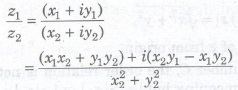
    CBSE Class 11 Maths Notes Complex Number

    where z2 # 0.

    Conjugate of a Complex Number

    If z = x + iy is a complex number, then conjugate of z is denoted by z

    i.e., z = x – iy

    Properties of Conjugate
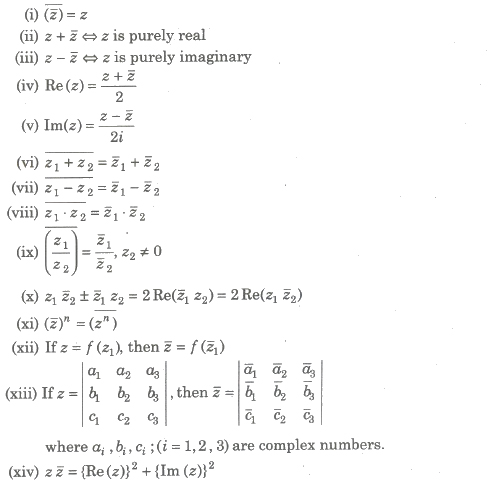
    CBSE Class 11 Maths Notes Complex Number

    Modulus of a Complex Number

    If z = x + iy, , then modulus or magnitude of z is denoted by |z| and is given by

    |z| = x2 + y2.

    It represents a distance of z from origin.

    In the set of complex number C, the order relation is not defined i.e., z1> z2 or zi <z2 has no meaning but |z1|>|z2| or |z1|< | z2 | has got its meaning, since |z| and |z2| are real numbers.

    Properties of Modulus
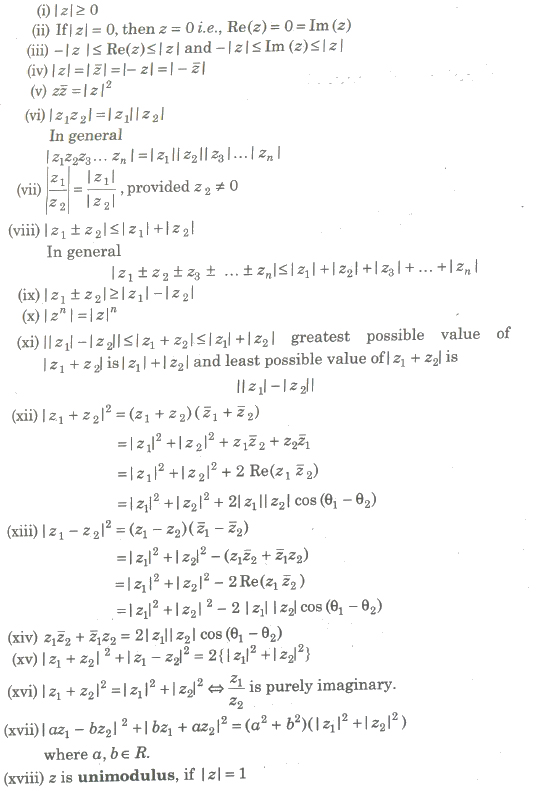
    CBSE Class 11 Maths Notes Complex Number

    Reciprocal/Multiplicative Inverse of a Complex Number

    Let z = x + iy be a non-zero complex number, then
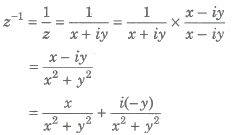
    CBSE Class 11 Maths Notes Complex Number

    Here, z-1 is called multiplicative inverse of z.

    Argument of a Complex Number

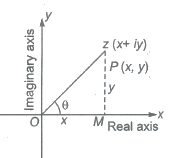
    Any complex number z=x+iy can be represented geometrically by a point (x, y) in a plane, called Argand plane or Gaussian plane. The angle made by the line joining point z to the origin, with the x-axis is called argument of that complex number. It is denoted by the symbol arg (z) or amp (z).
    CBSE Class 11 Maths Notes Complex Number

    Argument (z) = θ = tan-1(y/x)

    Argument of z is not unique, general value of the argument of z is 2nπ + θ. But arg (0) is not defined.

    A purely real number is represented by a point on x-axis.

    A purely imaginary number is represented by a point on y-axis.

    There exists a one-one correspondence between the points of the plane and the members of the set C of all complex numbers.

    The length of the line segment OP is called the modulus of z and is denoted by |z|.

    i.e., length of OP = √x2 + y2.

    Principal Value of Argument

    The value of the argument which lies in the interval (- π, π] is called principal value of argument.

    (i) If x> 0 and y > 0, then arg (z) = 0
    (ii) If x < 0 and y> 0, then arg (z) = π -0
    (iii) If x < 0 and y < 0, then arg (z) = – (π – θ)
    (iv) If x> 0 and y < 0, then arg (z) = -θ

    Properties of Argument
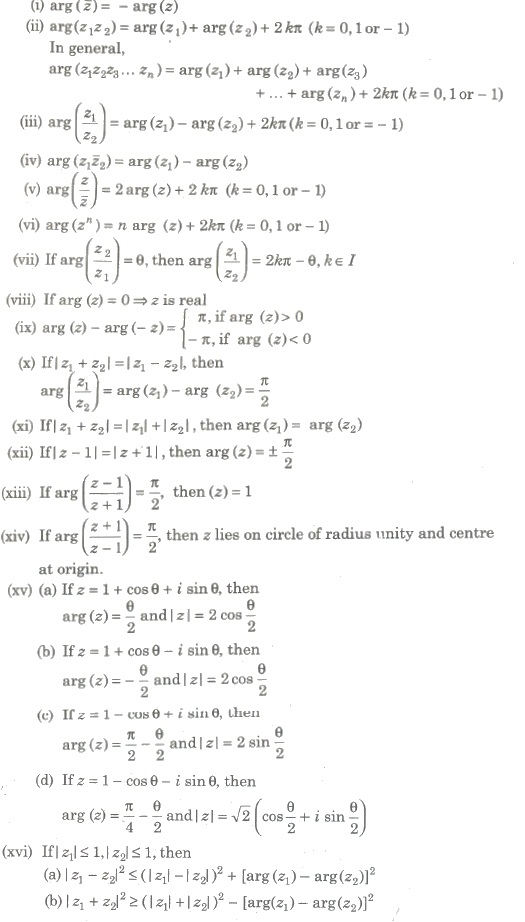
    CBSE Class 11 Maths Notes Complex Number

    Square Root of a Complex Number

    If z = x + iy, then
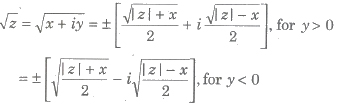
    CBSE Class 11 Maths Notes Complex Number

    Polar Form

    If z = x + iy is a complex number, then z can be written as

    z = |z| (cos θ + i sin θ) where, θ = arg (z)

    this is called polar form.

    If the general value of the argument is 0, then the polar form of z is

    z = |z| [cos (2nπ + θ) + i sin (2nπ + θ)], where n is an integer.

    Eulerian Form of a Complex Number

    If z = x + iy is a complex number, then it can be written as

    z = rei0, where

    r = |z| and θ = arg (z)

    This is called Eulerian form and ei0= cosθ + i sinθ and e-i0 = cosθ — i sinθ.

    De-Moivre’s Theorem

    A simplest formula for calculating powers of complex number known as De-Moivre’s theorem.

    If n ∈ I (set of integers), then (cosθ + i sinθ)n = cos nθ + i sin nθ and if n ∈ Q (set of rational numbers), then cos nθ + i sin nθ is one of the values of (cos θ + i sin θ)n.
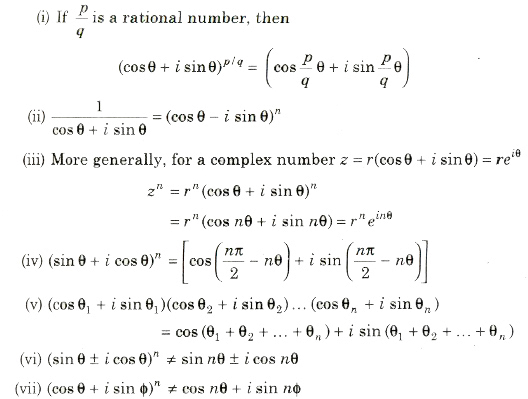
    CBSE Class 11 Maths Notes Complex Number

    The nth Roots of Unity

    The nth roots of unity, it means any complex number z, which satisfies the equation zn = 1 or z = (1)1/n

    or z = cos(2kπ/n) + isin(2kπ/n) , where k = 0, 1, 2, … , (n — 1)

    Properties of nth Roots of Unity

    1. nth roots of unity form a GP with common ratio e(i2π/n) .
    2. Sum of nth roots of unity is always 0.
    3. Sum of nth powers of nth roots of unity is zero, if p is a multiple of n
    4. Sum of pth powers of nth roots of unity is zero, if p is not a multiple of n.
    5. Sum of pth powers of nth roots of unity is n, ifp is a multiple of n.
    6. Product of nth roots of unity is (-1)(n – 1).
    7. The nth roots of unity lie on the unit circle |z| = 1 and divide its circumference into n equal parts.

    The Cube Roots of Unity

    Cube roots of unity are 1, ω, ω2,

    where ω = -1/2 + i√3/2 = e(i2π/3) and ω2 = (-1 – i√3)/2

    ω3r + 1 = ω, ω3r + 2 = ω2

    Properties of Cube Roots of Unity

    (i) 1 + ω + ω2r =
    0, if r is not a multiple of 3.
    3, if r is,a multiple of 3.

    (ii) ω3 = ω3r = 1

    (iii) ω3r + 1 = ω, ω3r + 2 = ω2

    (iv) Cube roots of unity lie on the unit circle |z| = 1 and divide its circumference into 3 equal parts.

    (v) It always forms an equilateral triangle.

    (vi) Cube roots of – 1 are -1, – ω, – ω2.
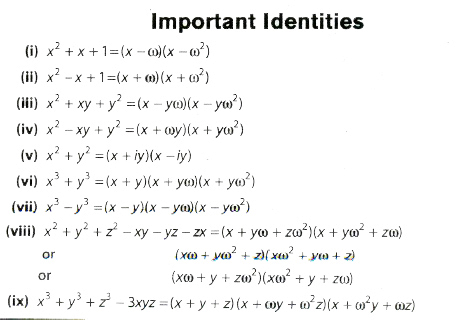
    CBSE Class 11 Maths Notes Complex Number

    Geometrical Representations of Complex Numbers

    1. Geometrical Representation of Addition

    If two points P and Q represent complex numbers z1 and zrespectively, in the Argand plane, then the sum z1 + z2 is represented

    by the extremity R of the diagonal OR of parallelogram OPRQ having OP and OQ as two adjacent sides.
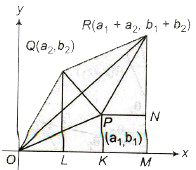
    CBSE Class 11 Maths Notes Complex Number

    2. Geometrical Representation of Subtraction

    Let z1 = a1 + ib1 and z2 = a2 + ia2 be two complex numbers represented by points P (a1, b1) and Q(a2, b2) in the Argand plane. Q’ represents the complex number (—z2). Complete the parallelogram OPRQ’ by taking OP and OQ’ as two adjacent sides.
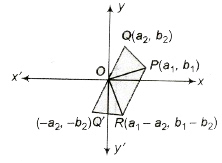
    CBSE Class 11 Maths Notes Complex Number

    The sum of z1 and —z2 is represented by the extremity R of the diagonal OR of parallelogram OPRQ’. R represents the complex number z1 — z2.

    3. Geometrical Representation of Multiplication of Complex Numbers
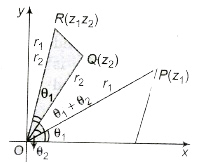
    CBSE Class 11 Maths Notes Complex Number

    R has the polar coordinates (r1r2, θ1 + θ2) and it represents the complex numbers z1z2.

    4. Geometrical Representation of the Division of Complex Numbers
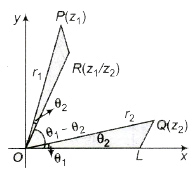
    CBSE Class 11 Maths Notes Complex Number

    R has the polar coordinates  (r1/r2, θ1 – θ2) and it represents the complex number z1/z2.
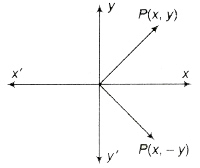
    |z|=|z| and arg (z) = – arg (z). The general value of arg (z) is 2nπ – arg (z).

    If a point P represents a complex number z, then its conjugate i is represented by the image of P in the real axis.
    CBSE Class 11 Maths Notes Complex Number

    Concept of Rotation

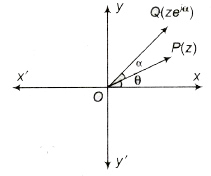
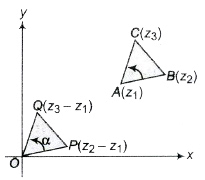
    Let z1, z2 and z3 be the vertices of a ΔABC described in anti-clockwise sense. Draw OP and OQ parallel and equal to AB and AC, respectively. Then, point P is z2 – z1 and Q is z3 – z1. If OP is rotated through angle a in anti-clockwise, sense it coincides with OQ.
    CBSE Class 11 Maths Notes Complex Number

    Important Points to be Remembered

    CBSE Class 11 Maths Notes Complex Number

    (a) ze a is the complex number whose modulus is r and argument θ + α.
    (b) Multiplication by e-iα to z rotates the vector OP in clockwise sense through an angle α.

    (ii) If z1, z2, z3 and z4 are the affixes of the points A, B,C and D, respectively in the Argand plane.

    (a) AB is inclined to CD at the angle arg [(z2 – z1)/(z4 – z3)].

    (b) If CD is inclines at 90° to AB, then arg [(z2 – z1)/(z4 – z3)] = ±(π/2).

    (c) If z1 and z2 are fixed complex numbers, then the locus of a point z satisfying arg [([(z – z1)/(z – z2)] = ±(π/2).

    Logarithm of a Complex Number

    Let z = x + iy be a complex number and in polar form of z is re , then

    log(x + iy) = log (re) = log (r) + iθ

    log(√x2 + y2) + itan-1 (y/x)

    or log(z) = log (|z|)+ iamp (z),

    In general,

    z = rei(θ + 2nπ)

    log z = log|z| + iarg z + 2nπi

    Applications of Complex Numbers in Coordinate Geometry

    Distance between complex Points

    (i) Distance between A(z1) and B(1) is given by

    AB = |z2 — z1| = √(x2 + x1)2 + (y2 + y1)2

    where z1 = x1 + iy1 and z2 = x2 + iy2

    (ii) The point P (z) which divides the join of segment AB in the ratio m : n is given by

    z = (mz2 + nz1)/(m + n)

    If P divides the line externally in the ratio m : n, then

    z = (mz2 – nz1)/(m – n)

    Triangle in Complex Plane

    (i) Let ABC be a triangle with vertices A (z1), B(z2) and C(z3 ) then

    (a) Centroid of the ΔABC is given by

    z = 1/3(z1 + z2 + z3)

    (b) Incentre of the AABC is given by

    z = (az1 + bz2 + cz3)/(a + b + c)

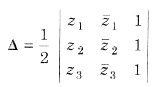
    (ii) Area of the triangle with vertices A(z1), B(z2) and C(z3) is given by
    CBSE Class 11 Maths Notes Complex Number

    For an equilateral triangle,

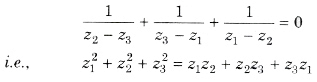
    z12 + z22 + z32 = z2z3 + z3z1 + z1z2

    (iii) The triangle whose vertices are the points represented by complex numbers z1, z2 and z3 is equilateral, if
    CBSE Class 11 Maths Notes Complex Number

    Straight Line in Complex Plane

    (i) The general equation of a straight line is az + az + b = 0, where a is a complex number and b is a real number.

    (ii) The complex and real slopes of the line az + az are -a/a and – i[(a + a)/(a – a)].

    (iii) The equation of straight line through z1 and z2 is z = tz1 + (1 — t)z2, where t is real.

    (iv) If z1 and z2 are two fixed points, then |z — z1| = z — z2| represents perpendicular bisector of the line segment joining z1 and z2.

    (v) Three points z1, z2 and z3 are collinear, if
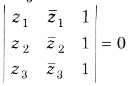
    CBSE Class 11 Maths Notes Complex Number

    This is also, the equation of the line passing through 1, z2 and z3 and slope is defined to be (z1 – z2)/z1 – z2

    (vi) Length of Perpendicular The length of perpendicular from a point z1 to az + az + b = 0 is given by |az1 + az1 + b|/2|a|

    (vii) arg (z – z1)/(z – z2) = β

    Locus is the arc of a circle which the segment joining z1 and z2 as a chord.

    (viii) The equation of a line parallel to the line az + az + b = 0 is az + az + λ = 0, where λ ∈ R.

    (ix) The equation of a line parallel to the line az + az + b = 0 is az + az + iλ = 0, where λ ∈ R.

    (x) If z1 and z2 are two fixed points, then I z — z11 =I z z21 represents perpendicular bisector of the segment joining A(z1) and B(z2).

    (xi) The equation of a line perpendicular to the plane z(z1 – z2) + z(z1 – z2) = |z1|2 – |z2|2.

    (xii) If z1, z2 and z3 are the affixes of the points A, B and C in the Argand plane, then

    (a) ∠BAC = arg[(z3 – z1/z2 – z1)]

    (b) [(z3 – z1)/(z2 – z1)] = |z3 – z1|/|z2 – z1| (cos α + isin α), where α = ∠BAC.

    (xiii) If z is a variable point in the argand plane such that arg (z) = θ, then locus of z is a straight line through the origin inclined at an angle θ with X-axis.

    (xiv) If z is a variable point and z1 is fixed point in the argand plane such that (z — z1)= θ, then locus of z is a straight line passing through the point z1 and inclined at an angle θ with the X-axis.

    (xv) If z is a variable point and z1, z2 are two fixed points in the Argand plane, then

    (a) |z – z1| + |z – z2| = |z1– z2|

    Locus of z is the line segment joining z1 and z2.

    (b) |z – z1| – |z – z2| = |z1– z2|

    Locus of z is a straight line joining z1 and z2 but z does not lie between z1 and z2.

    (c) arg[(z – z1)/(z – z2)] = 0 or &pi;

    Locus z is a straight line passing through z1 and z2.

    (d) |z – z1|2 + |z – z2|2 = |z1 – z2|2

    Locus of z is a circle with z1 and z2 as the extremities of diameter.

    Circle in Complete Plane

    (i) An equation of the circle with centre at z0 and radius r is

    |z – z0| = r

    or zz – z0z – z0z + z0

    • |z — z0| < r, represents interior of the circle.
    • |z — z0| > r, represents exterior of the circle.
    • |z — z0| ≤ r is the set of points lying inside and on the circle |z — z0| = r. Similarly, |z — z0| ≥ r is the set of points lying outside and on the circle |z — z0| = r.
    • General equation of a circle is 

    zz – az – az + b = 0

    where a is a complex number and b is a real number. Centre of the circle = – a

    Radius of the circle = √aa – b or √|a|2 – b

    (a) Four points z1, z2, z3 and z4 are concyclic, if

    [(z4 — z1)(z2 — z3)]/[(z4 – z3)(z2 – z1)] is purely real.

    (ii) |z — z1|/|z – z2| = k ⇒ Circle, if k ≠ 1 or Perpendicular bisector, if k = 1

    (iii) The equation of a circle described on the line segment joining z1 and 1 as diameter is (z – z1) (z – z2) + (z – z2) (z — z1) = 0

    (iv) If z1, and z2 are the fixed complex numbers, then the locus of a point z satisfying arg [(z – z1)/(z – z2)] = ± π / 2 is a circle having z1 and zat the end points of a diameter.

    Conic in Complex plane

    (i) Let z1 and z2 be two fixed points, and k be a positive real number.

    If k >|z1– z2|, then |z – z1| + |z – z2| = k represents an ellipse with foci at A(z1) and B(z2) and length of the major axis is k.

    (ii) Let z1 and z2 be two fixed points and k be a positive real number.

    If k ≠ |z1– z2| , then |z – z1| – |z – z2| = k represents hyperbola with foci at A(z1) and B(z2).

    Important Points to be Remembered

    • √-a x √-b ≠ √ab

    √a x √b = √ab is possible only, if  both a and b are non-negative.

    So, i2 = √-1 x √-1 ≠ √1

    • is neither positive, zero nor negative.
    • Argument of 0 is not defined.
    • Argument of purely imaginary number is π/2
    • Argument of purely real number is 0 or π.
    • If |z + 1/z| = a then the greatest value of |z| = a + √a2 + 4/2 and the least value of |z| = -a + √a2 + 4/2
    • The value of ii = e-π2
    • The complex number do not possess the property of order, i.e., x + iy < (or) > c + id is not defined.
    • The area of the triangle on the Argand plane formed by the complex numbers z, iz and z + iz is 1/2|z|2.
    • (x) If ω1 and ω2 are the complex slope of two lines on the Argand plane, then the lines are

    (a) perpendicular, if ω+ ω2 = 0.
    (b) parallel, if  ω= ω2.

  • Sets, Relations and Binary Operations Notes Class 11th Maths

    Set

    Set is a collection of well-defined objects which are distinct from each other. Sets are usually denoted by capital letters A, B,C,… and elements are usually denoted by small letters a, b,c,… .

    If ‘a’ is an element of a set A, then we write a ∈ A and say ‘a’ belongs to A or ‘a’ is in A or ‘a’ is a member of A. If ‘a’ does not belongs to A, we write a ∉ A.

    Standard Notations

    • N : A set of natural numbers.
    • W : A set of whole numbers.
    • Z : A set of integers.
    • Z+/Z : A set of all positive/negative integers.
    • Q : A set of all rational numbers.
    • Q+/Q : A set of all positive/ negative rational numbers.
    • R : A set of real numbers.
    • R+/R: A set of all positive/negative real numbers.
    • C : A set of all complex numbers.

    Methods for Describing a Set

    (i) Roster/Listing Method/Tabular Form In this method, a set is described by listing element, separated by commas, within braces.
    e.g., A = {a, e, i, o, u}

    (ii) Set Builder/Rule Method In this method, we write down a property or rule which gives us all the elements of the set by that rule.
    e.g.,A = {x : x is a vowel of English alphabets}

    Types of Sets

    1. Finite Set A set containing finite number of elements or no element.
    2. Cardinal Number of a Finite Set The number of elements in a given finite set is called cardinal number of finite set, denoted by n (A).
    3. Infinite Set A set containing infinite number of elements.
    4. Empty/Null/Void Set A set containing no element, it is denoted by (φ) or { }.
    5. Singleton Set A set containing a single element.
    6. Equal Sets Two sets A and B are said to be equal, if every element of A is a member of B and every element of B is a member of A and we write A = B.
    7. Equivalent Sets Two sets are said to be equivalent, if they have same number of elements.
      If n(A) = n(B), then A and B are equivalent sets. But converse is not true.
    8. Subset and Superset Let A and B be two sets. If every element of A is an element of B, then A is called subset of B and B is called superset of A. Written as
      A ⊆ B or B ⊇ A
    9. Proper Subset If A is a subset of B and A ≠ B, then A is called proper subset of B and we write A ⊂ B.
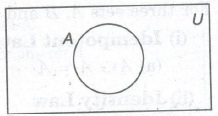
    10. Universal Set (U) A set consisting of all possible elements which occurs under consideration is called a universal set.
    11. Comparable Sets Two sets A and Bare comparable, if A ⊆ B or B ⊆ A.
    12. Non-Comparable Sets For two sets A and B, if neither A ⊆ B nor B ⊆ A, then A and B are called non-comparable sets.
    13. Power Set (P) The set formed by all the subsets of a given set A, is called power set of A, denoted by P(A).
    14. Disjoint Sets Two sets A and B are called disjoint, if, A ∩ B = (φ).

    Venn Diagram

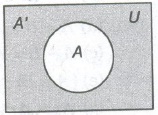
    In a Venn diagram, the universal set is represented by a rectangular region and a set is represented by circle or a closed geometrical figure inside the universal set.

    Sets, Relations and Binary Operations

    Operations on Sets

    1. Union of Sets

    The union of two sets A and B, denoted by A ∪ B is the set of all those elements, each one of which is either in A or in B or both in A and B.

    Sets, Relations and Binary Operations

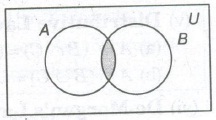
    2. Intersection of Sets

    The intersection of two sets A and B, denoted by A ∩ B, is the set of all those elements which are common to both A and B.

    Sets, Relations and Binary Operations

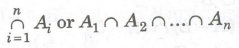
    If A1, A2,… , An is a finite family of sets, then their intersection is denoted by

    Sets, Relations and Binary Operations

    3. Complement of a Set

    If A is a set with U as universal set, then complement of a set, denoted by A’ or Ac is the set U – A .

    Sets, Relations and Binary Operations

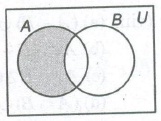
    4. Difference of Sets

    For two sets A and B, the difference A – B is the set of all those elements of A which do not belong to B.

    Sets, Relations and Binary Operations

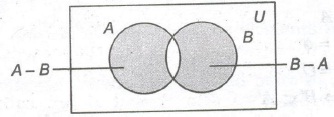
    5. Symmetric Difference

    For two sets A and B, symmetric difference is the set (A – B) ∪ (B – A) denoted by A Δ B.

    Sets, Relations and Binary Operations

    Laws of Algebra of Sets

    For three sets A, B and C

    (i) Commutative Laws

    A ∩ B = B ∩ A
    A ∪ B = B ∪ A

    (ii) Associative Laws

    (A ∩ B) ∩ C = A ∩ (B ∩ C)
    (A ∪ B) ∪ C = A ∪ (B ∪ C)

    (iii) Distributive Laws

    A ∩ (B ∪ C) = (A ∩ B) ∪ (A ∩ C)
    A ∪ (B ∩ C) = (A ∪ B) ∩ (A ∪ C)

    (iv) Idempotent Laws

    A ∩ A = A
    A ∪ A = A

    (v) Identity Laws

    A ∪ Φ = A
    A ∩ U = A

    (vi) De Morgan’s Laws

    (a) (A ∩ B) ′ = A ′ ∪ B ′
    (b) (A ∪ B) ′ = A ′ ∩ B ′
    (c) A – (B ∩ C) = (A – B) ∩ (A- C)
    (d) A – (B ∪ C) = (A – B) ∪ ( A – C)

    (vii) (a) A – B = A ∩ B’
    (b) B – A = B ∩ A’
    (c) A – B = A ⇔A ∩ B= (Φ)
    (d) (A – B) ∪ B= A ∪ B
    (e) (A – B) ∩ B = (Φ)
    (f) A ∩ B ⊆ A and A ∩ B ⊆ B
    (g) A ∪ (A ∩ B)= A
    (h) A ∩ (A ∪ B)= A

    (viii) (a) (A – B) ∪ (B – A) = (A ∪ B) – (A ∩ B)
    (b) A ∩ (B – C) = (A ∩ B) – (A ∩ C)
    (c) A ∩ (B Δ C) = (A ∩ B) A (A ∩ C)
    (d) (A ∩ B) ∪ (A – B) = A
    (e) A ∪ (B – A) = (A ∪ B)

    (ix) (a) U’ = (Φ)
    (b) Φ’ = U
    (c) (A’ )’ = A
    (d) A ∩ A’ = (Φ)
    (e) A ∪ A’ = U
    (f) A ⊆ B ⇔ B’ ⊆ A’

    Important Points to be Remembered

    • Every set is a subset of itself i.e., A ⊆ A, for any set A.
    • Empty set Φ is a subset of every set i.e., Φ ⊂ A, for any set A.
    • For any set A and its universal set U, A ⊆ U
    • If A = Φ, then power set has only one element i.e., n(P(A)) = 1
    • Power set of any set is always a non-empty set.
      Suppose A = {1, 2}, thenP(A) = {{1}, {2}, {1, 2}, Φ}.(a) A ∉ P(A)
      (b) {A} ∈ P(A)
    • (vii) If a set A has n elements, then P(A) or subset of A has 2n elements.
    • (viii) Equal sets are always equivalent but equivalent sets may not be equal.

    The set {Φ} is not a null set. It is a set containing one element Φ.

    Results on Number of Elements in Sets

    • n (A ∪ B) = n(A) + (B)- n(A ∩ B)
    • n(A ∪ B) = n(A)+ n(B), if A and B are disjoint.
    • n(A – B) = n(A) – n(A ∩ B)
    • n(A Δ B) = n(A) + n(B)- 2n(A ∩ B)
    • n(A ∪ B ∪ C)= n(A)+ n(B)+ n(C)- n(A ∩ B) – n(B ∩ C)- n(A ∩ C)+ n(A ∩ B ∩ C)
    • n (number of elements in exactly two of the sets A, B, C) = n(A ∩ B) + n(B ∩ C) + n (C ∩ A)- 3n(A ∩ B ∩ C)
    • n (number of elements in exactly one of the sets A, B, C) = n(A) + n(B) + n(C) – 2n(A ∩ B) – 2n(B ∩ C) – 2n(A ∩ C) + 3n(A ∩ B ∩ C)
    • n(A’ ∪ B’)= n(A ∩ B)’ = n(U) – n(A ∩ B)
    • n(A’ ∩ B’ ) = n(A ∪ B)’ = n(U) – n(A ∪ B)
    • n(B – A) = n(B)- n(A ∩ B)

    Ordered Pair

    An ordered pair consists of two objects or elements in a given fixed order.

    Equality of Ordered Pairs Two ordered pairs (a1, b1) and (a2, b2) are equal iff a1 = a2and b1 = b2.

    Cartesian Product of Sets

    For two sets A and B (non-empty sets), the set of all ordered pairs (a, b) such that a ∈ A and b ∈ B is called Cartesian product of the sets A and’ B, denoted by A x B.

    A x B={(a,b):a ∈ A and b ∈ B}

    If there are three sets A, B, C and a ∈ A, be B and c ∈ C, then we form, an ordered triplet (a, b, c). The set of all ordered triplets (a, b, c) is called the cartesian product of these sets A, B and C.

    i.e., A x B x C = {(a,b,c):a ∈ A,b ∈ B,c ∈ C}

    Properties of Cartesian Product

    For three sets A, B and C

    •  n (A x B)= n(A) n(B)
    • A x B = Φ, if either A or B is an empty set.
    • A x (B ∪ C)= (A x B) ∪ (A x C)
    • A x (B ∩ C) = (A x B) ∩ (A x C)
    • A x (B — C)= (A x B) — (A x C)
    • (A x B) ∩ (C x D)= (A ∩ C) x (B ∩ D)
    • If A ⊆ B and C ⊆ D, then (A x C) ⊂ (B x D)
    • If A ⊆ B, then A x A ⊆ (A x B) ∩ (B x A)
    • A x B = B x A ⇔ A = B
    • If either A or B is an infinite set, then A x B is an infinite set.
    • A x (B’ ∪ C’ )’ = (A x B) ∩ (A x C)
    • A x (B’ ∩ C’ )’ = (A x B) ∪ (A x C)
    • If A and B be any two non-empty sets having n elements in common, then A x B and B x A have n2 elements in common.
    • If ≠ B, then A x B ≠ B x A
    • If A = B, then A x B= B x A
    • If A ⊆ B, then A x C = B x C for any set C.

    Relation

    If A and B are two non-empty sets, then a relation R from A to B is a subset of A x B.

    If R ⊆ A x B and (a, b) ∈ R, then we say that a is related to b by the relation R, written as aRb.

    Domain and Range of a Relation

    Let R be a relation from a set A to set B. Then, set of all first components or coordinates of the ordered pairs belonging to R is called : the domain of R, while the set of all second components or coordinates = of the ordered pairs belonging to R is called the range of R.

    Thus, domain of R = {a : (a , b) ∈ R} and range of R = {b : (a, b) ∈ R}

    Types of Relations

    (i) Void Relation As Φ ⊂ A x A, for any set A, so Φ is a relation on A, called the empty or void relation.

    (ii) Universal Relation Since, A x A ⊆ A x A, so A x A is a relation on A, called the universal relation.

    (iii) Identity Relation The relation IA = {(a, a) : a ∈ A} is called the identity relation on A.

    (iv) Reflexive Relation A relation R is said to be reflexive relation, if every element of A is related to itself.

    Thus, (a, a) ∈ R, ∀ a ∈ A = R is reflexive.

    (v) Symmetric Relation A relation R is said to be symmetric relation, iff

    (a, b) ∈ R (b, a) ∈ R,∀ a, b ∈ A

    i.e., a R b ⇒ b R a,∀ a, b ∈ A

    ⇒ R is symmetric.

    (vi) Anti-Symmetric Relation A relation R is said to be anti-symmetric relation, iff

    (a, b) ∈ R and (b, a) ∈ R ⇒ a = b,∀ a, b ∈ A

    (vii) Transitive Relation A relation R is said to be transitive relation, iff (a, b) ∈ R and (b, c) ∈ R

    ⇒ (a, c) ∈ R, ∀ a, b, c ∈ A

    (viii) Equivalence Relation A relation R is said to be an equivalence relation, if it is simultaneously reflexive, symmetric and transitive on A.

    (ix) Partial Order Relation A relation R is said to be a partial order relation, if it is simultaneously reflexive, symmetric and anti-symmetric on A.

    (x) Total Order Relation A relation R on a set A is said to be a total order relation on A, if R is a partial order relation on A.

    Inverse Relation

    If A and B are two non-empty sets and R be a relation from A to B, such that R = {(a, b) : a ∈ A, b ∈ B}, then the inverse of R, denoted by R-1 , i a relation from B to A and is defined by

    R-1 = {(b, a) : (a, b) ∈ R}

    Equivalence Classes of an Equivalence Relation

    Let R be equivalence relation in A (≠ Φ). Let a ∈ A.

    Then, the equivalence class of a denoted by [a] or {a} is defined as the set of all those points of A which are related to a under the relation R.

    Composition of Relation

    Let R and S be two relations from sets A to B and B to C respectively, then we can define relation SoR from A to C such that (a, c) ∈ So R ⇔ ∃ b ∈ B such that (a, b) ∈ R and (b, c) ∈ S.

    This relation SoR is called the composition of R and S.

    (i) RoS ≠ SoR
    (ii) (SoR)-1 = R-1oS-1

    known as reversal rule.

    Congruence Modulo m

    Let m be an arbitrary but fixed integer. Two integers a and b are said to be congruence modulo m, if a – b is divisible by m and we write a ≡ b (mod m).

    i.e., a ≡ b (mod m) ⇔ a – b is divisible by m.

    Important Results on Relation

    • If R and S are two equivalence relations on a set A, then R ∩ S is also on ‘equivalence relation on A.
    • The union of two equivalence relations on a set is not necessarily an equivalence relation on the set.
    • If R is an equivalence relation on a set A, then R-1 is also an equivalence relation on A.
    • If a set A has n elements, then number of reflexive relations from A to A is 2n2 – 2
    • Let A and B be two non-empty finite sets consisting of m and n elements, respectively. Then, A x B consists of mn ordered pairs. So, total number of relations from A to B is 2nm.

    Binary Operations

    Closure Property

    An operation * on a non-empty set S is said to satisfy the closure ‘ property, if

    a ∈ S, b ∈ S ⇒ a * b ∈ S, ∀ a, b ∈ S

    Also, in this case we say that S is closed for *.

    An operation * on a non-empty set S, satisfying the closure property is known as a binary operation.

    or

    Let S be a non-empty set. A function f from S x S to S is called a binary operation on S i.e., f : S x S → S is a binary operation on set S.

    Properties

    • Generally binary operations are represented by the symbols * , +, … etc., instead of letters figure etc.
    • Addition is a binary operation on each one of the sets N, Z, Q, R and C of natural numbers, integers, rationals, real and complex numbers, respectively. While addition on the set S of all irrationals is not a binary operation.
    • Multiplication is a binary operation on each one of the sets N, Z, Q, R and C of natural numbers, integers, rationals, real and complex numbers, respectively. While multiplication on the set S of all irrationals is not a binary operation.
    • Subtraction is a binary operation on each one of the sets Z, Q, R and C of integers, rationals, real and complex numbers, respectively. While subtraction on the set of natural numbers is not a binary operation.
    • Let S be a non-empty set and P(S) be its power set. Then, the union and intersection on P(S) is a binary operation.
    • Division is not a binary operation on any of the sets N, Z, Q, R and C. However, it is not a binary operation on the sets of all non-zero rational (real or complex) numbers.
    • Exponential operation (a, b) → ab is a binary operation on set N of natural numbers while it is not a binary operation on set Z of integers.

    Types of Binary Operations

    (i) Associative Law A binary operation * on a non-empty set S is said to be associative, if (a * b) * c = a * (b * c), ∀ a, b, c ∈ S.

    Let R be the set of real numbers, then addition and multiplication on R satisfies the associative law.

    (ii) Commutative Law A binary operation * on a non-empty set S is said to be commutative, if

    a * b = b * a, ∀ a, b ∈ S.

    Addition and multiplication are commutative binary operations on Z but subtraction not a commutative binary operation, since

    2 — 3 ≠ 3— 2 .

    Union and intersection are commutative binary operations on the power P(S) of all subsets of set S. But difference of sets is not a commutative binary operation on P(S).

    (iii) Distributive Law Let * and o be two binary operations on a non-empty sets. We say that * is distributed over o., if

    a * (b o c)= (a * b) o (a * c), ∀ a, b, c ∈ S also called (left distribution) and (b o c) * a = (b * a) o (c * a), ∀ a, b, c ∈ S also called (right distribution).

    Let R be the set of all real numbers, then multiplication distributes addition on R.

    Since, a.(b + c) = a.b + a.c,∀ a, b, c ∈ R.

    (iv) Identity Element Let * be a binary operation on a non-empty set S. An element e a S, if it exist such that

    a * e = e * a = a, ∀ a ∈ S.

    is called an identity elements of S, with respect to *.

    For addition on R, zero is the identity elements in R.

    Since, a + 0 = 0 + a = a, ∀ a ∈ R

    For multiplication on R, 1 is the identity element in R.

    Since, a x 1 =1 x a = a,∀ a ∈ R

    Let P (S) be the power set of a non-empty set S. Then, Φ is the identity element for union on P (S) as

    A ∪ Φ =Φ ∪ A = A, ∀ A ∈ P(S)

    Also, S is the identity element for intersection on P(S).

    Since, A ∩ S=A ∩ S=A, ∀ A ∈ P(S).

    For addition on N the identity element does not exist. But for multiplication on N the idenitity element is 1.

    (v) Inverse of an Element Let * be a binary operation on a non-empty set ‘S’ and let ‘e’ be the identity element.

    Let a ∈ S. we say that a-1 is invertible, if there exists an element b ∈ S such that a * b = b * a = e

    Also, in this case, b is called the inverse of a and we write, a-1 = b

    Addition on N has no identity element and accordingly N has no invertible element.

    Multiplication on N has 1 as the identity element and no element other than 1 is invertible.

    Let S be a finite set containing n elements. Then, the total  number of binary operations on S in nn2 

    Let S be a finite set containing n elements. Then, the total number of commutative binary operation on S is n [n(n+1)/2].

  • Notes of Mathematics Textbook Class 11th

    Content’s


    Other Maths Notes

    • Sets Notes Class 11th Maths
    • Relations and Functions Notes Class 11th Maths
    • Trigonometric Functions Notes Class 11th Maths
    • Quadratic Equations Notes Class 11th Maths
    • Binomial Theorem Notes Class 11th Maths
    • Sequences and Series Notes Class 11th Maths

    Number System

    • Natural, Whole, Integers and Rational and Irrational Notes Class 11th Maths
    • Real Numbers and Complex Number Notes Class 11th Maths
    • Intervals (Finite and Infinite) Notes Class 11th Maths
    • Inequalities Notes Class 11th Maths
    • Inequalities using WAVY CURVE METHOD Notes Class 11th Maths
    • Illustrations of Inequalities Using Wavy Curve Method Notes Class 11th Maths
    • General Inequality Problems Notes Class 11th Maths
    • Absolute Value Notes Class 11th Maths
    • Illustration of Ineualities over Modulus Functions Notes Class 11th Maths
    • Logarithmic Function, Graph and Properties Notes Class 11th Maths
    • Illustrations using Logarithmic Functions Notes Class 11th Maths

    Complex Numbers

    • Basic Concepts of Complex Number Notes Class 11th Maths
    • Representation, Argument and Modulus of a Complex Number Notes Class 11th Maths
    • Polar Form of a Complex Number Notes Class 11th Maths
    • Unimodular Complex Number Notes Class 11th Maths
    • Algebraic Operation with Complex Numbers Notes Class 11th Maths
    • Conjugate of a Complex Number and Its Properties Notes Class 11th Maths
    • Complex Number – Properties of Modulus and Properties of Arguments Notes Class 11th Maths
    • DE MOIVER’S Theorem Notes Class 11th Maths
    • Application of DE MOIVER’S Theorem Notes Class 11th Maths
    • Complex Number – Cube Root of Unity Notes Class 11th Maths
    • Complex Number – Concept of Rotation Notes Class 11th Maths
    • Section Formula in Complex Number Notes Class 11th Maths
    • Condition of Collinearity and Equation of Straight Line Notes Class 11th Maths
    • Equation of a Circle Notes Class 11th Maths
    • 5 Must Solve Complex Number Objective Problems Notes Class 11th Maths
    • 5 Different Approach Complex Number Problems Notes Class 11th Maths
  • International Business – II Notes Class 11th Business Studies

    1. Export Procedure The main steps involved in export procedure are

    (i) Receipt of enquiry and sending quotations
    (ii) Receipt of order or indent
    (iii) Assessing importer’s credit guarantee for payment worthiness and securing
    (iv) Obtaining export licence

    According to the customs law, a firm must acquire an export licence before exporting goods

    The pre-requisites of export licences are

    (i) Obtaining IEC Number (Import-Export Code)
    (ii) Obtaining RCMC (Registration Cum Membership Certificate)
    (iii) Registration with ECGC (Export Credit Guarantee Corporation)
    (iv) Obtaining Pre-shipment Finance
    (v) Production and Procurement of goods
    (vi) Pre-shipment inspection

    There are three methods of pre-shipment inspection

    (i) Consignment-wise inspection
    (ii) In-process quality control
    (iii) Self certification
    (iv) Excise clearance
    (v) Obtaining certificate of origin
    (vi) Reservation of shipping space
    (vii) Packing and forwarding
    (viii) Insurance of goods
    (ix) Custom clearance
    (x) Obtaining Mate’s receipts
    (xi) Payment of freight and Insurance of Bill of Landing
    (xii) Preparation of Invoice
    (xiii) Securing Payment

    The importer may accept a bill of exchange of two types

    (i) Documents against right
    (ii) Documents acceptance

    2. Import Procedure Steps involved in import procedure are

    (i) Trade enquiry
    (ii) Procurement of import licence
    (iii) Obtaining foreign exchange
    (iv) Placing order or indent
    (v) Obtaining letter of credit
    (vi) Arranging for finance
    (vii) Receipt of shipment advice
    (viii) Retirements of import documents
    (ix) Arrival of goods
    (x) Custom clearance

    3. Export-Import Documents

    (i) Principal Export Documents

    (a) Commercial invoice
    (b) Packing list
    (c) Bill of lading The bill of lading is considered an important document due to the following reason

    • A receipt of goods
    • A document of Title to goods
    • A contract of affreightment

    (d) Airway bill
    (e) Certification of inspection
    (f) Certificate of origin
    (g) Bill of exchange

    4. Auxiliary Export Documents

    (i) Proforma invoice
    (ii) Intimation of inspection
    (iii) Shipping instruction
    (iv) Insurance declaration
    (v) Shipping order
    (vi) Mate’s receipt
    (vii) Application for certificate of origin
    (viii) Letter to banks for collection of documents

    5. Import Documents The important documents used in import procedure is

    6. Bill of Entry There are three types of bill of entry

    (i) Bill of entry for home consumption
    (ii) Bill of entry
    for warehousing
    (iii) Ex-bond bill of entry

    7. Important Terms Used in External Trade

    (i) Free on Boards (FOB)
    (ii) Cost and Freight (CFR)
    (iii) Cost Insurance and Freight (CIF)

    8. International Trade Institution and Agreements

    (i) World Bank The World Bank was established in 1944, in Buttonwoods. It was setup with a purpose to provide loans to countries whose infrastructure was destroyed by the war.

    (a) Nature of World Bank

    • It was set-up to rebuild post World War -II Europe.
    • It offers loan advice and training to private and public sector of poor countries.

    (ii) United Nation Conferences on Trade and Development (UNCTAD)
    (iii) International Development Association
    (iv) International Finance Corporation (IFC)
    (v) The Multinational Guarantee Agency (MIGA)

    (vi) World Trade Organisation (WTO) The world trade organisation is the only global international organisation which deals with the rules and regulations of trade between different nations.

    (a) Nature of WTO

    • WTO deals with sales of trade between nations at global level.
    • It operates with a purpose liberalising trade and free flow of goods and services in trade policy within agreed limits.
    • WTO settles disputes through some neutral procedures.

    (b) Role of WTO

    • Promotes international peace
    • Settles disputes among member nations
    • Makes international trades very smooth by framing common rules and regulations.
    • Helps in economic growth of developing countries by giving them preferential treatment.

    (c) Agreements of WTO

    • General Agreements on Tariffs and Trade (GATT)
    • Agreement of Textile and Clothing (ATC)
    • Agreement on Agriculture
    • General Agreements in Trade in Services (GATS)
    • Agreements on Trade Related Aspects of Intellectual Property Rights (TRIPS)
  • International Business – I  Notes Class 11th Business Studies

    1. International Business International business refers to buying and selling of goods and services beyond the geographical limits of a country. It is also called trade between two countries.

    International trade is of three types

    (i) Export
    (ii) Import
    (iii) Entrepot (Re-export)

    (i) Nature of International Business

    (a) Involvement of two
    (b) Payment in foreign countries currency
    (c) Legal procedures
    (d) Restrictions
    (e) High risk
    (f) Different languages

    (ii) Reasons for International Business

    (a) The countries can not produce equally well or cheaply all that they need.
    (b) There is a unequal distribution of natural resources among different countries.
    (c) Availability of different factors of production such as land labour, capital and raw material differs among different nations.
    (d) Difference in labour. productivity and production cost due to socio economic geographical and political reasons.
    (e) There is not even a single country which is in a better position to produce better quality products at lower cost.

    2. International Business us Domestic Business The key areas, in respect of which domestic and international business differ from each other

    (i) Nationality of buyers and sellers
    (ii) Nationalities of other stake holders
    (iii) Mobility of factors of production
    (iv) Customer heterogeneity across markets
    (v) Differences in business systems and practices
    (vi) Political system and risk
    (vii) Business regulation and policies
    (viii) Currency used in business transactions

    3. Scope of International Business

    (i) Merchandise exports and imports
    (ii) Service export and import
    (iii) Licensing and franchising
    (iv) Foreign investment

    It is of two types

    (a) Direct investment
    (b) Portfolio investment

    4. Benefits of International Business

    (i) Benefits to Nations

    (a) Earning of foreign exchange
    (b) More efficient use of resources
    (c) Improving growth prospectus and employment potential
    (d) Increases standard of living

    (ii) Benefits to Firms

    (a) Prospects for higher profit
    (b) Increased capacity utilization
    (c) Prospects for growth
    (d) Way out from intense competition in the domestic market
    (e) Improved business vision

    5. Mode of Entering into International Business

    (i) Contract Manufacturing With many business facing high start up cost and limited resources, companies are turning to contract manufacturing. Contract manufacturing allows a company to use the products or services that are manufactured by another external production company.

    (a) Merits

    • There is almost no investment risk involved as there is hardly any investment in the foreign country.
    • Contract manufacturing gives the advantage to international firms to get the goods manufactured at a lower cost.
    • Local manufacturers also get the benefits to be involved with international business and start. exporting.

    (b) Demerits

    • Local firms might not follow and provide the same quality standards. causing problems to international rums.
    • The local manufacturer loses his control as goods are manufactured strictly according to the terms and specifications of international firms.
    • The local manufacturer is not free to sell the goods according to his will.

    (ii) Licensing and Franchising Licensing is an agreement between licensor and licensee where by licensor permits licensee to use the permits/patent rights 01′ trade secret acquired by the licensor.

    Franchising is an agreement between franchisee and franchiser.

    (a) Benefits

    • Established brand
    • Quality product
    • Advertisement
    • Financing
    • Training
    • Technological upgradation
    • Uniform control system
    • Better start
    • Expansion
    • Enhancing the goodwill
    • Direct feedback

    (iii) Joint Venture When two or more firms join together to establish a new enterprise then it is known as a joint venture.

    The two firms contribute capital and participate in management enterprise.

    (a) Merits

    • Reduces competition
    • Reduces risk
    • Protection for small companies
    • Advance technology
    • Reduction in cost
    • Better competence
    • Large capital

    (b) Demerits

    • Problem in sharing capital
    • Legal restrictions
    • Conflicts
    • Mergers and monopolies
    • Lack of co-ordination

    (iv) Setting-up WhOlly Owned Subsidies According to Indian Companies Act a foreign company can set up its subsidiary by acquiring more than 50% voting power (equity share) in a company.

    (a) Advantages

    • The parent company is able to exercise full control over its operation in foreign countries.
    • There is no disclosure of technology or trade secret as the parent company itself looks after the entire operations.

    (b) Limitations

    • The entire loss is for the parent company as the parent company alone invests the 100% investment.
    • This form of business is subject to higher political risks as some countries do not permits 100% wholly owned subsidiaries.

    (v) Exporting and Importing Exporting refers to sending of goods and services from the home country to a foreign country and importing means buying goods and services from a foreign country. The exporting and importing can be done in two ways; direct or indirect.

    (a) Advantages

    • It is easiest way to get entry in a foreign country.
    • Firms have to invest less as compared to joint venture and manufacturing plants.
    • Foreign investment risk is nil or very less as compared to other options.

    (b) Demerits

    • Since goods physically move from one country to another so it involves additional packaging, insurance and transportation cost.
    • Some countries put import restrictions. In such cases, exporting is not a good option for other foreign countries.
    • The exporters are not near the customers so they cannot serves the customer better than a local firm.

    6. India’s Place in World Business

    (i) India’s Export and Import of Goods After the new economic policy of liberalisation and globalisation there is a tremendous increase in India’s foreign trade. The share of foreign trade in the GDP has increased from 14.6% in 1990·91 to 24.1% in 2003 – 2004.

    (ii) India’s Export and Import of Services India’s share of software export has increased from 10.2% in 1995-96 to 49% in 2003-04. Where as share of travel and transportation has declined from 64.3% in 1995 – 96 to 29.6% in 2003-04.

    7. India’s Foreign Investment The inflow as well as out flow of foreign investment has grown after the new economic policy of 1991. India’s investment in foreign countries has also increased from Rs 19 crore in 1990-91 to Rs 83,616 crore in 2003-04.

  • Internal Trade Notes Class 11th Business Studies

    1. Internal Trade When buying and selling of goods and services takes place within the geographical limits of a country. It is known as internal trade.

    The main features of internal trade are

    (i) The buying and selling of goods and services takes place within a country.
    (ii) The payment are made and received in the home country only.
    (iii) There are no or very few formalities to be completed by the traders.

    2. Types of Internal Trade Internal trade can be classified into two categories.

    (i) Wholesale Trade It refers to the trade in which goods are sold in large quantities. The person who carries on wholesale trade is known as wholesaler.

    A wholesaler provides many valuable services to the manufacturer as well as the retailer.

    (a) Services to Manufacturer

    • Facilitating large scale production
    • Bearing risk
    • Financial assistance
    • Expert advice
    • Help in marketing function
    • Facilitate production continuity
    • Storage

    (b) Services to Retailer

    • Availability of goods
    • Marketing support
    • Grant of credit
    • Specialised knowledge
    • Risk sharing

    (ii) Retail Trade Retail trade refers to sale of goods in small lots to the final consumers. A retailer buys goods from a wholesaler and sells them to the consumer.

    (a) Services to Consumers

    • Ready or quick supply
    • Wide variety
    • Guiding consumers
    • Demonstration and after sale services
    • Home delivery
    • Convenient location
    • Credit facility

    (b) Services to Wholesaler and Manufacturer

    •  Ready market
    • Providing information
    • Risk bearing
    • Distribution of goods to distant places

    3. Classification of Retailers

    Retailers can be classified on the following basis

    (i) Size
    (ii) Product mix
    (iii) Pricing
    (iv) Service level
    (v) Form of ownership

    4. Types of Retail Trade Keeping in mind all the above criteria, that is size product mix, pricing and service level, the retail trade can be classified in to the following categories

    (i) Itinerants retailers
    (ii) Fixed shop retailers

    5. Itinerants Itinerants refers to retailers who have no fixed place of sale. They move from one place to another in search of customers.

    6. Types of Itinerants

    (i) Hawkers and Peddlers Hawkers and Pedlars moves from street to street in search of customers.

    The main features of hawkers and pedlars are

    (a) They sell a variety of goods such as fruits, vegetables, toys etc.
    (b) They deal with non-branded and local items.
    (c) They supply the goods at the door step of the customer.

    (ii) Periodic Market Trader These traders sell their goods on fixed days in different market places. Their weekly market are fixed

    The main features of periodic market traders

    (a) They sell their goods in the weekly market.
    (b) They deal in low price and low quality goods.
    (c) These traders also set up shops on the occasion of Diwali, Christmas, etc.

    (iii) Street Traders These retailers display their articles on busy street corners, pavements, bus stands etc.

    The main features of street traders are

    (a) They generally operate near public places such as railway stations.
    (b) They deal in a variety of goods such as towels, things of daily use mirrors etc.

    (iv) Cheap Jacks They display their goods in hired shops or intents for a temporary period in different localities.

    The main features of cheap jacks are

    (a) They hire small shops.
    (b) They shift from locality depending upon the prospectus of business.
    (c) They deal in low price, household articles.

    7. Fixed Retailers The retailer having a fixed place of sale are known as fixed shop retailers.

    Fixed shop retailers can be further classified into t\VO categories

    (i) Small scale fixed retail shops
    (ii) Large scale fixed retail shops

    8. Small Scale Fixed Retailer

    (i) General Stores General stores are small shops located in residential areas.

    The main features of general stores are

    (a) They have a large variety in each line of product.
    (b) They provides free home delivery, credit facility.

    (ii) Single Line Stores Single line stores are small shops which deal with one line of products.

    The main features of single line stores are

    (a) These stores deal with one line of products.
    (b) These stores deal in a variety of goods in that line of product.

    (iii) Speciality Stores These stores deal in a particular type of product under one product line only.

    The main features of speciality stores are

    (a) These stores are specialised in one product only.
    (b) They keep all the brands of that product.

    (iv) Street Shops These shops are situated at street crossings, They are also known as street stalls

    The main features of street shops aTe

    (a) These shops have a limited space.
    (b) These retailers display their goods on tables, stands etc.

    (v) Second Hand Goods Shops These shops deal with second-hand goods or used articles such as books.

    The main features of second- hand good shop

    (a) These shops sell used goods.
    (b) The goods are generally priced low because these are used goods.

    (vi) Seconds Shops There are the shops to sell goods which are not produced according to the required specification.

    The main features of second-hand goods shop

    (a) These shops deal in the products which have some manufacturing defect.

    (b) Goods are sold at a heavily discounted price.

    9. Large Scale Retailers Large scale retailers deal in a large stock of goods and purchase goods in bulk. Features of large scale retailers are.

    (i) They require a huge investment.
    (ii) They have large size show rooms to sell goods.

    The most common forms or types of large scale retailers are

    (a) Departmental stores
    (b) Multiple shops or chain stores
    (c) Mail order retailing
    (d) Consumer co-operative stores
    (e) Super markets
    (f) Franchise

    10. Departmental Stores A departmental store is a large retail showroom having a number of departments under one roof each department specialised in one line of product.

    (i) Advantages

    (a) Convenient shopping
    (b) Central location
    (c) Economies of scale
    (d) Elimination of middleman

    (ii) Limitations

    (3) High operating cost
    (b) Lack of personal attention
    (c) High price
    (d) Not located in residential colonies
    (e) Huge capital

    11. Multiple Shops Multiple shops refer to a number of identical retail shops located in different parts of the city.

    (i) Advantages
    (a) Economies of scale
    (b) Standardised products
    (c) Public confidence
    (d) Division of risk
    (e) No, bad debts

    (ii) Limitations

    (a) Limited variety
    (b) Lack of personal touch
    (c) Inflexibility
    (d) Divided attention
    (e) No facilities

    12. Mail Order Retailing In mail order retailing seller contact the potential buyers through advertisements and mail publicity

    (i) Advantages

    (a) Limited capital
    (b) Convenience
    (c) Wider market
    (d) No, bad debts
    (e) Elimination of middleman

    (ii) Limitations

    (a) No personal contact
    (b) No personal inspection
    (c) Limited variety
    (d) Postal delay
    (e) Heavy advertising cost

    13. Consumer Co-operative Store It can be defined as “A voluntary association of persons based on co-operative principles by buying in common and selling in common”.

    (i) Advantages

    (a) Reasonable prices
    (b) Low operating cost
    (c) Cash sales
    (d) Economies of scale
    (e) Benefits from government

    (ii) Limitations

    (a) Limited capital
    (b) Inefficient management
    (c) Lack of incentives
    (d) Lack of storage facilities

    14. Super Markets Super market are organised by co-operative societies as well as by private traders.

    (i) Advantages

    (a) Wide choice
    (b) Low price
    (c) No, bad debts
    (d) Convenience in shopping

    (ii) Limitations

    (a) No credit
    (b) Lack of personal touch
    (c) High cost
    (d) Mis handling of goods
    (e) Limited scope

    15. Vending Machines A vending machine is a new form of direct retailing. It is a machine operated by coins or tokens. The buyer inserts a coin or token in the machine and receive a specific quantity of product from the machine.

    (i) Advantages

    (a) Buying round the clock is possible.
    (b) The customer gets fresh supply of goods.
    (c) No, requirement of salesman.

    (ii) Limitations

    (a) Initial investment to install the machine is quite high.
    (b) Machine requires regular repair and maintenance.
    (c) Coins of exact shape and size are required to operate the machine.

    16. Role of Commerce and Industry Association is in promotion of internal trade.

    (i) Interstate movement of goods
    (ii) Octroi and other local levies
    (iii) Harmonisation of sales tax structure and value added tax
    (iv) Marketing of agro products and related issues
    (v) Weights and measures and prevention of duplication
    (vi) Excise duty
    (vii) Promoting sound infrastructure
    (viii) Labour legislation

  • Small Business Notes Class 11th Business Studies

    1. Small Business The definition of small business by the Government of India is based on the investment in Plant and Machinery, This approach is justified because we have scarce capital and abundant labour. ‘the small scale industries includes.

    (i) Small scale industries
    (ii) Ancillary industrial undertaking
    (iii) Export-oriented units
    (iv) Tiny units
    (v) Small scale industries owned by women
    (vi) Cottage industries
    (vii) Khadi and village industries
    (viii) Agro based industries

    2. Nature of Small Scale Industries

    (i) The business is organised by individuals in the private sector.
    (ii) The use of family labour and locally available talent is made.
    (iii) Simple equipments are used.
    (iv) Capital investment is small, generally restricted to one crore.
    (v) The use of indigenous technology.

    3. Administrative Setup for the Small Scale

    (i) Agro and Rural Industries

    (a) The government of India created the Ministry of small scale industry and Agro and Rural Industries as the nodal ministry for formulation of policy.

    (b) This ministry was divided into following two separate ministries in September 2001 .

    • Ministry of Small Scale Industries
    • Ministry of Agro and Rural Industries

    (c) A part from the ministries state government also makes various promotional and development projects for SSI and then are executed.

    4. Role of Small Business in India In developing countries like India there is a greater scope for small business enterprise. The following factors help in the scope of small business enterprises

    (i) Limited resources
    (ii) Flexibility of operation
    (iii) Personal attention
    (iv) Individual attitude
    (v) Suppliers of large scale business
    (vi) Social utility

    5. Role of Small Business in Rural India

    Small scale industries provide the following benefits in rural area.

    (i) Employment
    (ii) Improves economic condition
    (iii) Promotion of artistic and creative sense
    (iv) Rural development
    (v) Mobilisation of local resources

    6. Problems of Small Business in India

    (i) Shortage of Fund Small enterprises have a chronic shortage of finance both for fixed and working capital requirement.

    (ii) Shortage of Raw Materials and Power Most of the small factories have shortage of raw materials and other equipments because of limited means to buy in bulk and suppliers hesitate to provide credit policy (facility) to small business.

    (iii) Old Techniques of Production and Lack of Latest Technical Knowledge Most of the small scale enterprise use old techniques of production because they cannot afford new technique.

    (iv) Marketing Problems Small scale industries face many difficulties in marketing their products because of many reasons

    (a) The cost of production is high.
    (b) They cannot afford to have their own marketing organisation.
    (c) Products of many small firms are not having uniform quality.

    (v) Personal Problem Securing the right type of personal is a major problem of small business. A more important problem is the problem of proper training reasonable compensation etc.

    (vi) In perfect Organisational Setup In most of the small enterprise the ownership and management functions are performed by the owner himself. Generally the owners may not have the necessary skill to manage the business also.

    7. Government Assistance and Special Schemes for Industries in Rural Backward and Hilly Areas Some of the support measures and programmes meant for the promotion of small and rural industries are grouped in following two categories.

    (i) Institutional Support

    (a) National Bank for Agriculture and Rural Development (NABARD) The NABARD provides loans and advances to State Government for a period not exceeding 20 years to enable to State Government.

    (b) The Rural Small Business Development Centre (RSBDC) It is set up by the World Association for small and medium enterprises and is sponsored by NABARD. It aims at providing management and technical support to current and prospective micro and small entrepreneurs in rural areas.

    (c) National Small Industries Corporation (NSIC) Its main focus was on

    • To supply indigenous and imported machines in easy instalments.
    • To procure and supply imported raw materials.
    • To export of products of SSI.

    (d) Small Industries Development Bank of India (SIDBl) SlDBI was established in 1989 as a public corporation. Its main object is to promote. Finance and develop the small scale sector in India.

    (e) The National Commission for Enterprises in the Unorganised Sector (NCEDS)The NCEUS was constituted in September 2004, with the following objectives

    • TO improve productivity of small scale enterprises.
    • To generate more employment opportunities.

    (f) Rural and Women Entrepreneurship Development (RWED) This programme encourages rural people and women RWED provides the following

    • Enhancing human and institutional capacities.
    • Providing training for women entrepreneurs.

    (g) World Association for Small and Medium Enterprises (WASME) Common schemes offered by WASMe are

    • Integrated Rural Development Programme
    • Prime Minister Rozgar Yojana
    • Training of Rural Youth for self-employment
    • Jawahar Rozgar Yojana

    (h) Scheme of Fund for Regeneration of Traditional Industries (SFURTl) This fund is used

    • To improve the technology of traditional units.
    • To create sustained employment opportunities.
    • To set up traditional industries in various parts of the country.

    (i) The District Industries Centre (DIC) The DIC Programme was started on 1 May 1978 to provide assistance to small scale industries at the district level.

    These centres provides all the promotional activities such as identification of suitable scheme preparation of feasibility report arranging for credit etc.

    (ii) Incentives Some of the common incentives offered are below

    (a) Land
    (b) Power
    (c) Water
    (d) Sales Tax
    (e) Octroi
    (f) Raw materials
    (g) Finance
    (h) Industrial estates
    (j) Tax holiday

  • Sources of Business Finance Notes Class 11th Business Studies

    1. Business Finance It refers to capital funds and credit funds invested in the business.

    According to BO Wheeler, “Finance is thai business activities which is concerned with acquisition and conservation of capital fund in meeting the financial needs and over all objectives of business enterprise.”

    The financial needs of a business can be classified into two categories.

    (i) Fixed capital requirement
    (ii) Working capital requirement

    2. Classification of Sources of Funds

    (i) Period Basis On the basis of time period, a business finance can be classified in three categories.

    (a) Long Term Finance Funds which are required to be invested In a business for a long period of time, that is more than five years are known as long term finance.

    (b) Medium Term Finance The finance required by business enterprises for more than one year but less than five years is known as medium term finance.

    (c) Short Term Finance The finance required for a short period upto one year is known as short term finance.

    (ii) Ownership Basis On the basis of ownership, the sources can be classified into ‘owner’s fund’ and ‘borrowed fund’,

    (a) Owner Fund It refers to the funds contributed by owners as well as the accumulated profit of the company this fund remains with the company and it has no liability to return this fund. e.g., equity shares, retained earnings.

    (b) Borrowed Fund It refers to the borrowing of the firm. It includes all funds available by way of loans or credit

    (iii) Source of Generation Basis Another basis of categorising the sources of funds can be whether the funds are generated from with in the organisation internal or from external sources.

    3. Sources of Finance Companies can raise finance from the following methods.

    (i) Retained Earning Retained undistributed profits after payment earning refers to of dividend and taxes. It provides the basis of expansion and growth of companies.

    (ii) Features of Retained Earnings

    (a) Cushion of security
    (b) Funds for new and innovative projects
    (c) Medium and long term finance
    (d) Conversion into ownership fund

    4. Trade Credit It refers to an arrangement whereby a manufacturer is granted credit from the supplier of raw materials, inputs spare parts etc. The supplier allow their
    customers to pay their outstanding balance, with in a credit period.

    The availability of trade credit depends upon

    (i) Nature of the firm
    (ii) Size of the firm
    (iii) Status or credit worthiness of the firm

    5. Factoring Factoring is a financial service’under which factor renders the following services

    (i) Discounting of Bills of Exchange When goods are sold on credit then a supplier generally draws bills of exchange upon customers who are required to accept the same.

    (ii) Providing Information Regarding the Creditworthiness of Prospective ClientsFactors collect detailed information regarding the financial history of different companies which can used by the financier who may lend money to these companies.

    6. Lease Financing Leasing is a contract between lessor and lessee. whereby the lessor permits the lessee to use the asset acquired by the lessor in return of a payment called rent.

    Lessor is called the owner of the assets and lessee hires the assets by paying rent. With leasing contract the lessee can use the assets without investing a high amount of fund for buying it.

    7. Public Deposits Public deposits refers to unsecured deposits invited from the public. A company wishing to invite public deposit places an advertisement in newspapers. Any member of the public can fill up the prescribed form and deposit money with the company. Different features of public deposits are

    (i) Unsecured
    (ii) Finance of working capital
    (iii) Time period
    (iv) Simple procedure to raise
    (v) Repayment

    8. Commercial Papers Commercial paper is a source of short finance. The commercial paper was introduced in India for the rust time in 1990. It is an unsecured promissory note issued by public or private sector company with a fixed maturity period, which varies from 3 to 12 months. Since these are unsecured that is why these are generally issued by companies having a good reputation.

    9, Issue of Shares Share is the smallest unit in which owner’s capital of the company is divided. A share may also be defined as a unit of measure of a shareholder’s interest in the company.

    According to Companies Act, a public company can issue two types of shares.

    (i) Equity shares
    (ii) Preference shares

    10. Equity Shares Equity shares is a common security issued under permanent or owner’s fund capital. Equity shares are the most important source of raising long term capital.

    In Companies Act permitting companies to issue two categories of equity shares.

    (i) Equity shares with equal rights.
    (ii) Equity shares with differential rights as to divided.

    11. Preference Shares Preference shares are those shares which get preference over equity shares in respect to

    (i) The payment of dividend.
    (ii) The repayment of investment amount during winding up.
    Different features of preferences shares are
    (i) Fixed rate of dividend
    (ii) No security
    (iii) Voting rights
    (iv) Hybrid security

    12. Debentures Debentures are common securities issued under borrowed fund capital. Debentures are instruments for raising long term debt capital. Debentures are called creditorship securities because debenture holder are called creditors of a company.

    Different features of debentures are

    (i) Borrowed fund
    (ii) Fixed rate of interest
    (iii) Compulsory payment of interest
    (IV) Security
    (v) Redeemable
    (vi) No, voting right
    (vii) Appointment of trustee

    13. Commercial Banks Commercial banks occupy a very important position as they provide funds for different purposes and different periods. Firms of all sizes can approach commercial banks. Generally, commercial banks provide short and medium term loans but now-a-days they have started giving long term loans against security.

    14. Financial Institutions Public financial institutions are referred to as lending institutions. development banks or financial institutions, After independence the Government of India realised that for economic development of a country only commercial banks are not sufficient. There must be financial institutions to provide financial assistance and guidance to industries and business enterprises.

    15. International Source of Finance After the new economic policy of liberalisation or globalisation. the doors of foreign companies and investors were opened to invest In the Indian companies. After 1991. the Indian companies tap international sources of finance for both debt and equity. The main securities used by Indian companies to tap international sources of finance are given below

    (i) Loans from Commercial Bank!’;
    (ii) International Agencies and Development Bank
    (iii) International Capital Market

    (a) GDR
    (b) ADR
    (c) lDR

    The businessman must keep in mind the following factors

    (i) Cost involved
    (ii) Financial capacity of the firm
    (iii) Form of business organisation
    (iv) Time period
    (v) Risk involved
    (vi) Control
    (vii) Flexibility
    (viii) Claim over the assets
    (ix) Tax benefits

  • Formation of a Company Notes Class 11th Business Studies

    1. Business Finance It refers to capital funds and credit funds invested in the business.

    According to BO Wheeler, “Finance is that business activity which is concerned with the acquisition and conservation of capital fund in meeting the financial needs and over all objectives of business enterprise.

    2. Formation of Company There are two stages in the formation of private company, promotion and incorporation. A public company has to under go capital subscription stage and to the get certificate of commencement of business, to begin operation.

    3. Promotion of a Company Promotion is the first stage in the formation of a company. It involves conceiving a business opportunity and taking and initiative to form a company so the particular shape can be given to exploiting the available business opportunity.

    4. Functions of a Promoter

    (i) Identification of Business Opportunity The foremost activity of a promoter is to identify a first and business opportunity.

    (ii) Feasibility Studies The promoters undertake detailed feasibility studies to investigate all aspects of the business they intend to start. There are three types of feasibility

    (a) Technical feasibility
    (b) Financial feasibility
    (c) Economic feasibility

    (iii) Name Approval Having decided to launch a company. the promoters have to select a name for it and submit.

    (iv) Fixing up Signatories to the Memorandum of association Promoters have to decide about the members who will be signing the memorandum of association of the proposed company.

    (v) Appointment of Professionals Certain professionals such as mercantile bankers. auditors etc are appointed by the promoters.

    (vi) Preparation of Necessary Documents The promoter takes up steps to prepare certain legal documents. Which have to be submitted under the law

    5. Documents Required to be Submitted

    (i) Memorandum of Association
    (ii) Articles of Association
    (iii) Consent of Proposed Directors
    (iv) Agreement
    (v) Statutory Declaration
    (vi) Payment of Fee

    6. Position of Promoters Promoters undertake various activities to get a company registered and get it to the position of commencement of business. But they are neither the agents nor the trustee of the company. They can’t be the agents as the company is yet to be incorporated.

    7. Incorporation After completing the afore said formalities, promoters make an application for the incorporation of the company. The app cause is to be filed With the registrar of companies of the state within which they plan to establish the registered office of the company.

    8. Effect of the Certificate of Incorporation A company is legally born on the date printed on the certificate of incorporation. It becomes a legal entity with perceptual succession on such date.

    The certificate of incorporation is a conclusive evidence of the regularity of the incorporation of a company certificate of incorporation has been issued the company has been legal business entity irrespective of any flow in its registration.

    9. Capital Subscription A public company can raise the required funds from the public means of Issue of shares and debentures. For doing the same. It has to issue a prospectus which is an invitation to the public to subscribe to the capital of the company.

    The following steps are required for raising funds from the public

    (i) SEBl approval
    (ii) Filling of prospectus
    (iii) Appointment of bankers brokers underwriters
    (iv) Minimum subscription
    (v) Application to stock exchange
    (vi) Allotment of shares

    10. Conunencement of Business If the amount of minimum subscription is raised through new issue of shares, a public company applies to the registrar of companies for the issue of certificate of commencement of business.

    Commencement of business along with the following documents

    (i) A declaration about meeting minimum subscription requirement
    (ii) A declaration about details in respect of allotment to directors
    (iii) A declaration about no money being payable to applicants
    (iv) A statutory declaration

    A public company raising funds privately has to submit only

    (ii) and (iv) listed above

    The registrar, upon satisfaction issues certificate of commencement of business. This certificate is also a conclusive evidence of completion of formation requirements.

    11. Preliminary Contracts Contracts signed by promoters with third parties before the incorporation of company.

    12. Provisional Contracts Contracts signed after incorporation but before commencement of business.

  • Social Responsibilities of Business Notes Class 11th Business Studies

    1. Social Responsibility

    Social responsibility is the obligation of businessmen towards the society. Businessmen must review the impact of their decisions and actions on the other sections of the society.

    According to Peter F Druker, “Social responsibility requires managers to consider whether their action is likely to promote the public good, to advance the basic beliefs of our society, to contribute to its stability, strength and harmony.”

    2. Need for Social Responsibilities

    A businessman must perform social responsibilities because of the following reason

    (i) Self interest
    (ii) Better environment for business
    (iii) Public image
    (iv) Avoidance of government interference
    (v) Social power
    (vi) Resources used for moral justification
    (vii) Contribution to social problems

    3. The Case Against Social Responsibility

    Some experts criticise the concept of social responsibility, some of the arguments given against social responsibilities are given below

    (i) Motive of earning profit
    (ii) Lack of social skill
    (iii) Social responsibility involves cost
    (iv) Dilution of basic goal of business
    (v) Business are not moral agents
    (vi) Reduction in competitiveness

    4. Reality of Social Responsibility

    After learning the case for and against social responsibilities, we can conclude that business is no longer a mere economic institution but it is also a social institution and businessmen are the trustees of different social groups.

    The main reasons and factors which have forced businessmen to consider their responsibilities towards society

    (i) Threat of public regulation
    (ii) Pressure of labour movements
    (iii) Impact of consumer consciousness
    (iv) Development of social standard for business
    (v) Relationship between social interest and business interest
    (vi) Development of professional managerial Class

    5. Kinds of Social Responsibilities

    (i) Economic Responsibility

    In an economic responsibility, business is expected to produce goods and services that are beneficial for society and society which wants and sell them at a profit.

    (ii) Legal Responsibility

    Every business enterprise is expected to operate within the legal frame work of our society. A law abiding enterprise gets no interference of government and is considered as a socially responsible enterprise.

    (iii) Ethical Responsibilities

    Ethics is much more than law, while behaving ethically businessmen should not be involved in adulteration, black marketing, etc.

    (iv) Discretionary Responsibilities

    This responsibility is purely voluntary. This includes contribution in charity. Participation in social service projects, setting up educational and training institutions etc helping people affected by flood, earthquake etc.

    6. Social Responsibility towards Different Interest Groups

    (i) Responsibilities towards Consumers

    (a) Production of safe items by maintaining quality standards
    (b) Being truthful in advertising
    (c) To follow fair trade practices.

    (ii) Responsibilities towards Employee

    (a) Providing fair compensation and benefits
    (b) Providing good and safe working conditions
    (c) To give them opportunities to participate in decision making

    (iii) Responsibilities towards the Owners / Shareholders / Investors

    (a) To ensure safety of investment
    (b) To ensure fair and regular return on investment
    (c) To ensure appreciation of investment by proper utilisation of resources

    (iv) Responsibilities towards the Government

    (a) To abide by rules, regulations and laws
    (b) To pay taxes and duties on time
    (c) To help in solving social problem

    (v) Responsibilities towards the Community

    (a) To protect the environment from all types of pollution
    (b) To provide more employment opportunities
    (c) To help the weaker section of the society

    (vi) Responsibilities towards Suppliers

    (a) To ensure regular payment to the supplier
    (b) To adopt fair dealing with the suppliers
    (c) To protect and assist small scale suppliers by placing order with them

    7. Business and Environment Protection

    (i) Causes of Environmental Pollution

    Environment pollution arises due to the following causes

    (a) Air pollution
    (b) Water pollution
    (c) Land pollution

    (ii) Need for Pollution Control

    The main reasons to control the pollution are as follows

    (a) To ensure safety
    (b) Economic losses
    (c) To maintain the natural beauty
    (d) To ensure healthy life
    (e) To lead a comfortable life

    8. Role of Business in Environmental Protection

    The businessmen should take following steps to control and check environmental pollution

    (i) Making use of eco-friendly techniques of production
    (ii) Recycling industrial waste
    (iii) Treating the waste through technologies before discharging them into water or dumping in the land
    (iv) Make use of eco-marks by producing eco-friendly products

    9. Business Ethics It refers to the set of moral values or standards or norms which govern the activities of a businessman. Ethics defines what i, right and what IS wrong.

    10. Elements of Business Ethics

    Some of the basic elements of business ethics while running a business enterprises are

    (i) Top management commitment
    (ii) Publication of a ‘code’
    (iii) Establishment of compliance mechanism
    (iv) Involving employees at all levels
    (v) Measuring result