Author: shivamlohiya

  • Solutions Notes for Class 12 Chemistry

    CBSE Class 12 Chemistry
    Quick Revision Notes
    Chapter 2
    Solutions
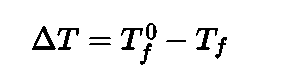
    The difference in boiling points of solution Tb and pure solvent T® is called elevation in boiling point
    • Solutions: Solutions are the homogeneous mixtures of two or more than two components.
    • Binary solution: A solution having two components is called a binary solution.
    • Components of a binary solution.

    It includes solute and solvent.

    1. When the solvent is in solid state, solution is called solid solution.
    2. When the solvent is in liquid state, solution is called liquid solution.
    3. When the solvent is in gaseous state, solution is called gaseous solution.
    • Concentration: It is the amount of solute in given amount of solution.
    • Mass by volume percentage (w/v): Mass of the solute dissolved in 100 mL of solution.
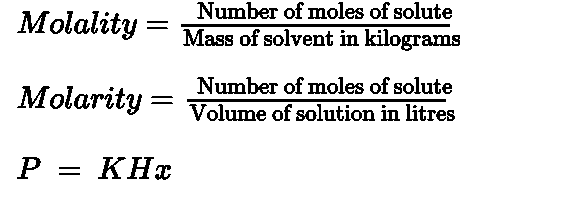
    • Molality (m) is the number of moles of solute present in 1kg of solvent.
    • Molarity (M) is the number of moles of solute present in 1L of solution.
    • Normality is the number of gram equivalent of solute dissolved per litre of solution.
    • Solubility: It is the maximum amount that can be dissolved in a specified amount of solvent at a specified temperature.
    • Saturated solution: It is a solution in which no more solute can be dissolved at the same temperature and pressure.
    • In a nearly saturated solution if dissolution process is an endothermic process, solubility increases with increase in temperature.
    • In a nearly saturated solution if dissolution process is an exothermic process, solubility decreases with increase in temperature.
    • Henry’s Law: It states “at a constant temperature the solubility of gas in a liquid is directly proportional to the pressure of gas”. In other words, “the partial pressure of gas in vapour phase is proportional to the mole fraction of the gas in the solution”.
    • When a non-volatile solute is dissolved in a volatile solvent, the vapour pressure of solution is less than that of pure solvent.
    • Raoult’s law: It states that “for a solution of volatile liquids the partial vapour pressure of each component in the solution is directly proportional to its mole fraction”.
    • Using Dalton’s law of partial pressure the total pressure of solution is calculated.

    • Comparison of Raoult’ law and Henry’s law: It is observed that the partial pressure of volatile component or gas is directly proportional to its mole fraction in solution. In case of Henry’s Law the proportionality constant is KH and it is different from p10 which is partial pressure of pure component. Raoult’s Law becomes a special case of Henry’s Law when KH becomes equal to p10 in Henry’s law.
    • Classification of liquid-liquid solutions: It can be classified into ideal and non-ideal solutions on basis of Raoult’s Law.

    • Ideal solutions:

    1. The solutions that obey Raoult’s Law over the entire range of concentrations are known as ideal solutions.

    3. The intermolecular attractive forces between solute molecules and solvent

    molecules are nearly equal to those present between solute and solvent molecules i.e. A-A and B-B interactions are nearly equal to those between A-B.

    Non-ideal solutions:

    1. When a solution does not obey Raoult’s Law over the entire range of concentration, then it is called non-ideal solution.

    3. The intermolecular attractive forces between solute molecules and solvent

    molecules are not equal to those present between solute and solvent molecules i.e. A-A and B-B interactions are not equal to those between A-B

    • Types of non- ideal solutions:
    1. Non ideal solution showing positive deviation
    2. Non ideal solution showing negative deviation
    • Non ideal solution showing positive deviation
    1. The vapour pressure of a solution is higher than that predicted by Raoult’s Law.
    2. The intermolecular attractive forces between solute-solvent molecules are weaker than those between solute-solute and solvent-solvent molecules i.e., A-B < A-A and B-B interactions.
    • Non ideal solution showing negative deviation
    1. The vapour pressure of a solution is lower than that predicted by Raoult’s Law.
    2. The intermolecular attractive forces between solute-solvent molecules are stronger than those between solute-solute and solvent-solvent molecules i.e. A-B > A-A and B-B interactions.
    • Azeotopes: These are binary mixtures having same composition in liquid and vapour

    phase and boil at constant temperature. Liquids forming azeotrope cannot be

    separated by fractional distillation.

    • Types of azeotropes: There are two types of azeotropes namely,
    1. Minimum boiling azeotrope
    2. Maximum boiling azeotrope

    • The solutions which show a large positive deviation from Raoult’s law form minimum

    boiling azeotrope at a specific composition.

    • The solutions that show large negative deviation from Raoult’s law form maximum

    boiling azeotrope at a specific composition.

    • Colligative properties: The properties of solution which depends on only the number of solute particles but not on the nature of solute are called colligative properties.
    • Types of colligative properties: There are four colligative properties namely,
    1. Relative lowering of vapour pressure
    2. Elevation of boiling point
    3. Depression of freezing point
    4. Osmotic pressure
    • Relative lowering of vapour pressure: The difference in the vapour pressure of pure solvent p\j[1] and solution pi represents lowering in vapour pressure(p® —pi).
    • Relative lowering of vapour pressure: Dividing lowering in vapour pressure by vapour pressure of pure solvent is called relative lowering of vapour pressure
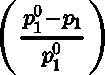
    • Relative lowering of vapour pressure is directly proportional to mole fraction of solute. Hence it is a colligative property.

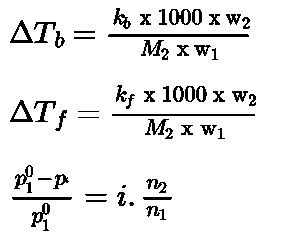
    • For a dilute solution elevation of boiling point is directly proportional to molal concentration of the solute in solution. Hence it is a colligative property.
    • Depression of freezing point: The lowering of vapour pressure ofsolution causes a lowering of freezing point compared to that of pure solvent.The difference in freezing point of the pure solvent T® and solution Tf is called the depression in freezing point.

    passage of solvent into solution through a semipermeable membrane is called osmotic pressure.

    • Osmotic pressure is a colligative property as it depends on the number of solute particles and not on their identity.
    • For a dilute solution, osmotic pressure (7r) is directly proportional to the molarity (C) of the solution i.e. 7r= CRT
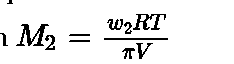
    • Osmotic pressurecan also be used to determine the molar mass of solute using the equatioi
    • Isotonic solution: Two solutions having same osmotic pressure at a given temperature are called isotonic solution.
    • Hypertonic solution: If a solution has more osmotic pressure than other solution it is called hypertonic solution.
    • Hypotonic solution: If a solution has less osmotic pressure than other solution it is called hypotonic solution.
    • Reverse osmosis: The process of movement of solvent through a semipermeable membrane from the solution to the pure solvent by applyingexcess pressure on the solution side is called reverse osmosis.
    • Colligative properties help in calculation of molar mass of solutes.
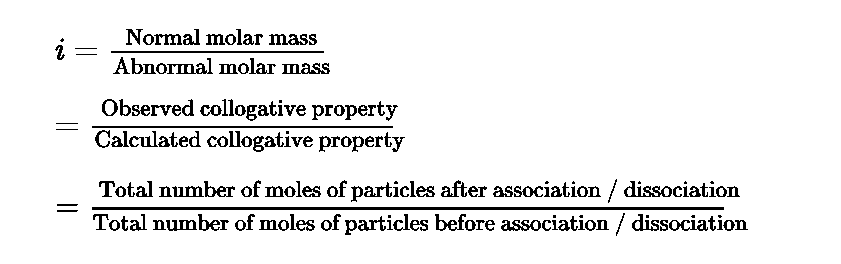
    • Abnormal molar mass: Molar mass that is either lower or higher than expected or normalmolar mass is called as abnormal molar mass.
    • Van’t Hoff factor: Van’t Hoff factor (i)accounts for the extent of dissociation or association.
    • For a dilute solution depression in freezing point is a colligative property because it is

    directly proportional to molal concentration of solute.

    • Osmosis: The phenomenon of flow of solvent molecules through a semi permeable membrane from pure solvent to solution is called osmosis.
    • Osmotic pressure: The excess pressure that must be applied to solution to prevent the
      • Value of i is less than unity in case solute undergo association and the value of i is greater than unity in case solute undergo dissociation.
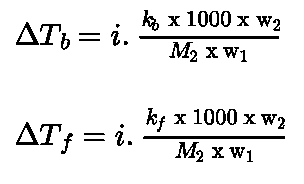
    1. Inclusion of van’t Hoff factor modifies the equations for colligative properties as:

  • The Solid State Notes for Class 12 Chemistry

    CBSE Class 12 Chemistry
    Quick Revision Notes
    Chapter 1
    The Solid State

    Solid: Solid is a state of matter in which the constituting particles are arranged very closely.The constituent particles can be atoms, molecules or ions.

    Properties of solids:

    1. They have definite mass, volume and shape.
    2. They are compressible and rigid.
    3. Intermolecular distances are very short and hence the intermolecular forces are strong.
    4. Their constituent particles have fixed position. sand can only oscillate about their mean positions.

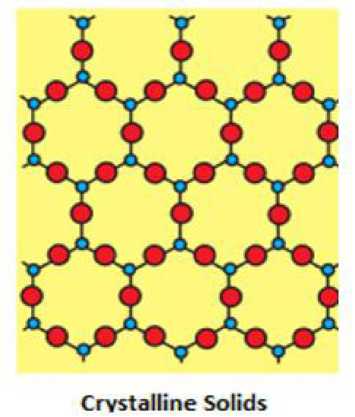
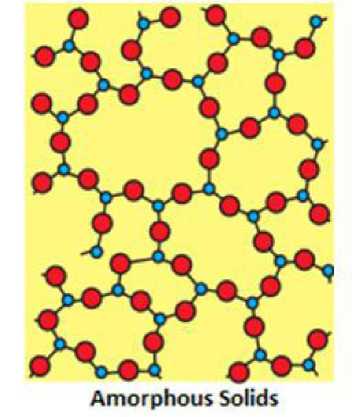
    Classification of on the basis of the arrangement of constituent particles:

    • Properties of crystalline solids:
    • They have a definite geometrical shape.
    • They have a long range order.
    • They have a sharp melting point.
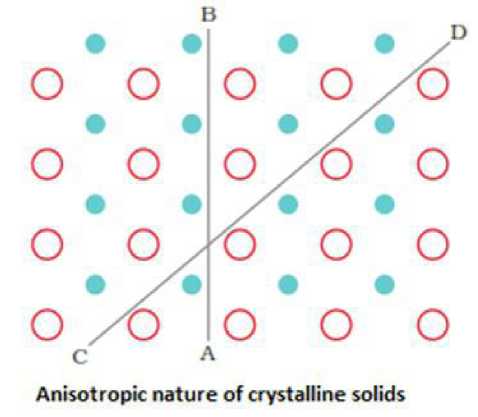
    • They are anisotropic in nature i.e. their physical properties show different values when measured along different directions in the same crystal.
    • They have a definite and characteristic heat of fusion.
    • They are called true solids.
    • When cut with a sharp edged tool , they split into two pieces and the newly generated surfaces are plain and smooth.

    • Polymorphic forms or polymorphs:

    The different crystalline forms of a substance are known as polymorphic forms or polymorphs .For example: graphite and diamond.

    • Characteristics of amorphous solids:
    1. They have an irregular shape.
    2. They have a short range order.
    3. They gradually soften over arrange of temperature.
    4. They are isotropic in nature i.e. their physical properties are the same in all directions.
    5. When cut with a sharp edged tool, they cut into two pieces with irregular surfaces.
    6. They do not have definite heat of fusion.
    7. They are called pseudo solids or super cooled liquids. This is because they have a tendency to flow,though very slowly.
    • Types of crystalline solids:

    A. Molecular Solids

    Constituent Particles: Molecules

    Type of solid

    Constituent

    Particles

    Bonding/

    Attractive

    Forces

    Electrical

    conductivity

    physical

    nature

    Melting

    point

    Examples

    Non

    polar

    solids

    Molecules

    Dispersion or London forces

    Insulator

    Soft

    Very

    low

    Ar,CCl4,H2,I2,C02

    Polar

    solids

    Molecules

    Dipole-

    dipole

    interactions

    Insulator

    Soft

    low

    HCl, solid SO2, solid NH3

    Hydrogen

    bonded

    Molecules

    Hydrogen

    bonding

    Insulator

    Hard

    low

    H20 (ice)

    B. Ionic Solids

    Constituent Particles: Ions

    Bonding/Attractive Forces: Coulombic or Electrostatic

    Electrical Conductivity: Insulators in solid state but conducts in molten state and in

    aqueous solutions

    Physical Nature: Hard but brittle

    Melting Point: High

    Examples: CaF2, ZnS, MgO, NaCl

    C. Metallic Solids

    Constituent Particles: Positive ions in a sea of delocalized electrons Bonding/Attractive Forces: Metallic bonding

    Electrical Conductivity: Conductors in solid state as well as in molten state Physical Nature: Hard but malleable and ductile Melting Point: Fairly high

    Examples: Fe ,Cu, Ag, Mg

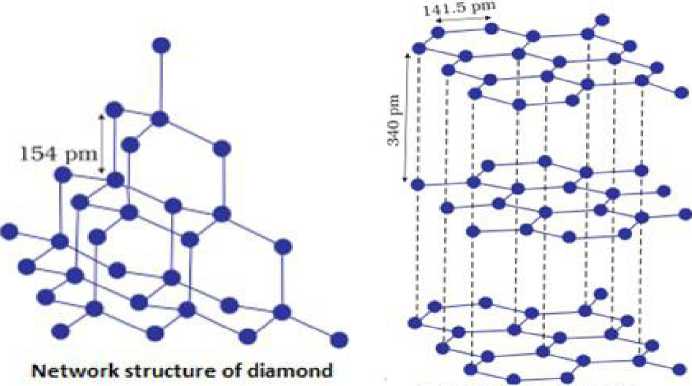
    D. Covalent or NetworkSolids Constituent Particles: Atoms Bonding/Attractive Forces: Covalent bonding

    Electrical Conductivity: Conductors in solid state as well as in molten state Physical Nature: Hard but malleable and ductile Melting Point: Fairly high

    Examples: Si02, (quartz), SiC, C (diamond), C(graphite)

    Network structure of graphite

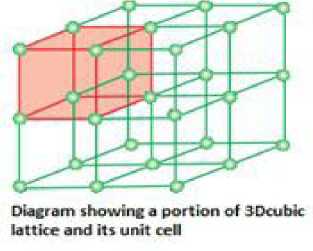
    • Crystal lattice: A regular ordered arrangement of constituent particles in three dimensions is called crystal lattice.

    • Lattice points or lattice sites:the fixed positions on which the constituent particles are presentare called lattice points or lattice sites. A group of lattice points which when repeated over and over againin3dimensions give the complete crystal lattice.
    • Unit cell: It is defined as the smallest repeating unit in space lattice which when repeated over and over again generates the complete crystal lattice. The crystal can consist of an infinite number of unit cells.
    1. Dimensions of the unit cell along the three edges ,a, b and c:these edges may or may not be mutually perpendicular.
    2. Inclination of the edges to each other:this is denoted by the angle between the edges a,fi , andrespectively.cdsthe angle between the edges b and c,/3isthe angle between the edges a and c ,and7is the angle between a and b.
     

    i — 1

    c!

    i


    J0L-A–


    Parameters which characterise a unit cell

    • Seven crystal systems:
    1. Cubic: o:=/3=7=90o ,a=b=c
    2. Tetragonal: a=/3=7=90° ; a=by^c
    3. Orthorhombic: cl={3=j=90°; a^by^c
    4. Monoclinic: o:=7=90°,^:90°; ay^by^c
    5. Hexagonal: o:=/3=90°,7=120°; a=by^c
    6. Rhombohedral or trigonal: a= /3=7y^90°;a=b=c
    7. Triclinic: o:y^/3y^7y^90O;ay^by^c
    • Types of unit cells:
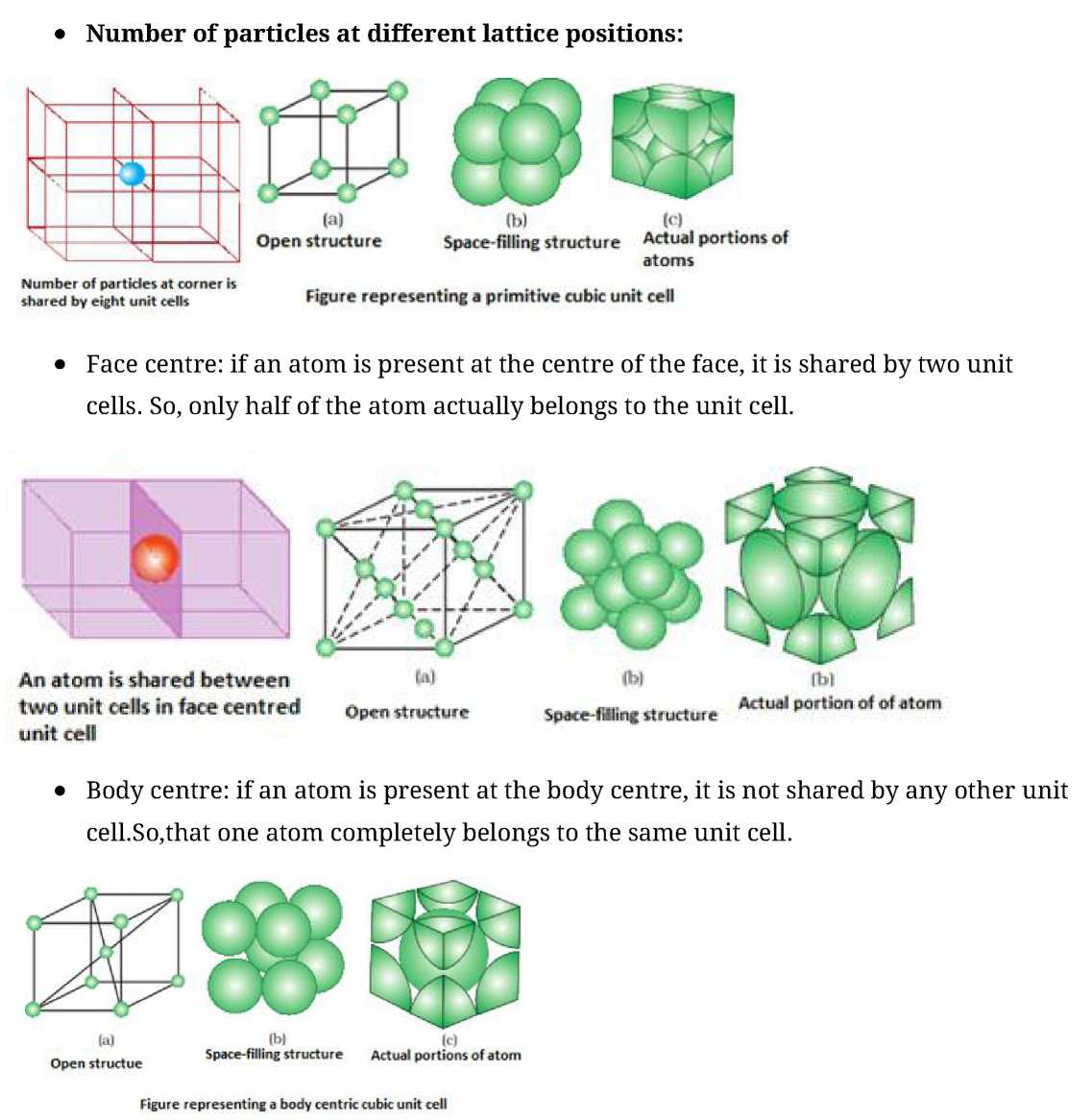
    1. Primitive or simple unit cells have constituent particles only at its corners.
    2. Centered unit cells are those unit cells in which one or more constituent particles are present at positions in addition to those present at the corners.
    • Types of centered unit cells:
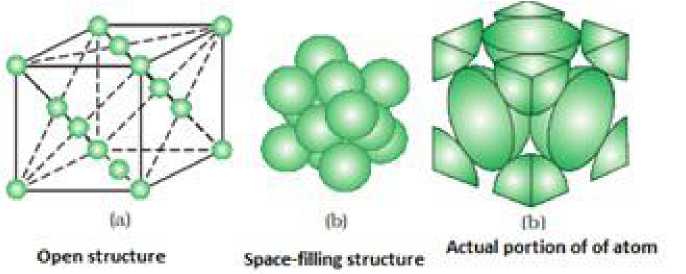
    1. Face centered unit cell: It consists of one constituent particle present at the centre of each face in addition to those present at the corners.
    2. Body centered unit cell: It consists of a one constituent particle is present at its body centre in addition to those present at the corners.
    3. End centered unit cell: It consists of one constituent particle present at the centre of any

    two opposite faces in addition to those present at the corners.

    • End centre: f an atom is present at the edge centre, it is shared by four unit cells. So, only one fourth of an atom belongs to the unit cell.
    • Number of atoms in different unit cells:
    1. Primitive unit cell have latom

    1. Face centered unit cell have 3 atoms
    2. Body centered unit cell have 2atoms
    • Coordination number: Coordination number is the number of nearest neighbours of a particle.
    • Close packed structures:

    ccccccce

    One dimensional close packing of spheres

    • Close packing in two dimensions: It is generated by stacking the rows of close packed spheres in two ways:

    i) Square close packing and ii) Hexagonal close packing.

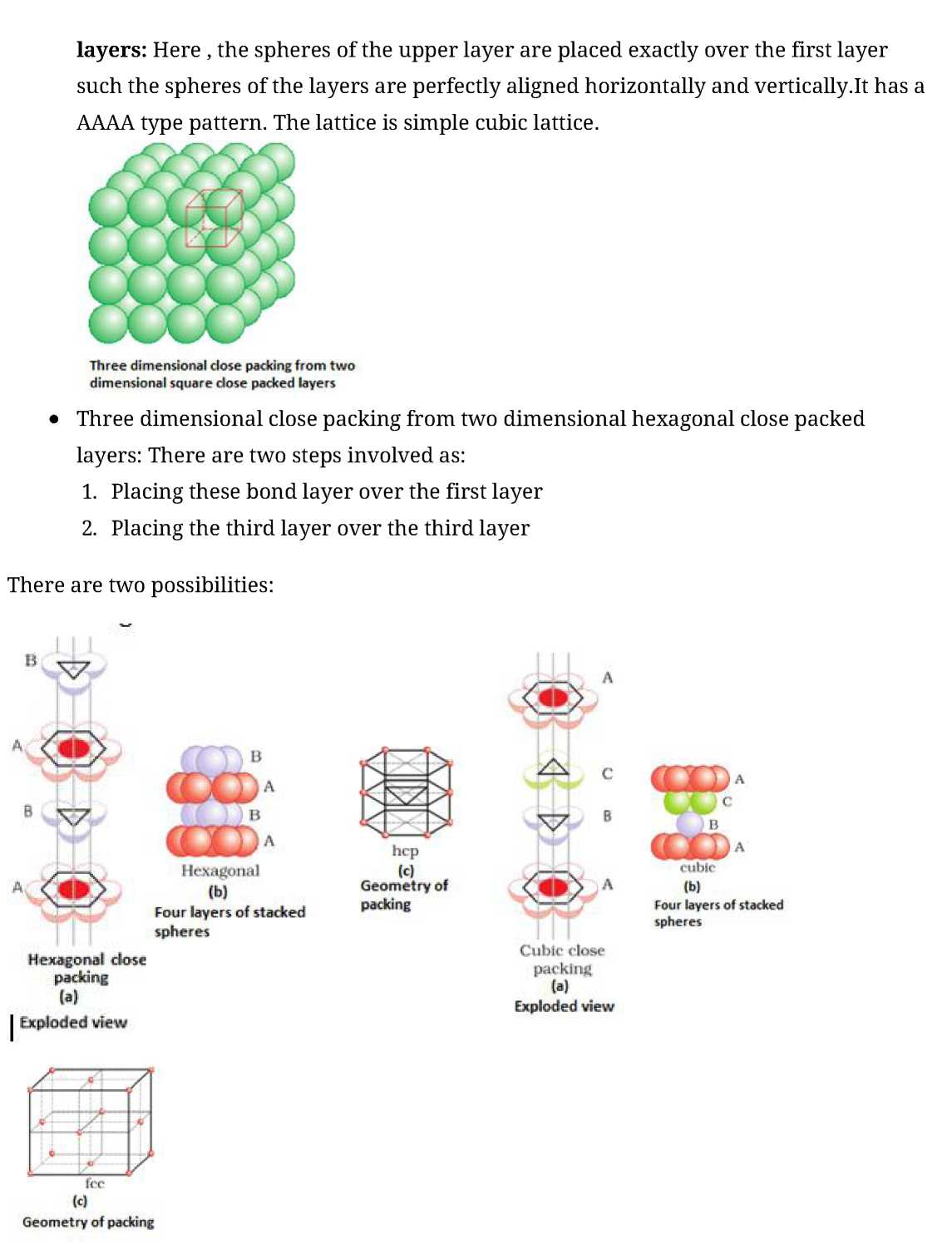
    • Close packing in three dimensions: They can be obtained by stacking the two dimensional layers one above the other. It can be obtained in two ways:

    i) Square close packed layers and ii) Hexagonal close packed layers.

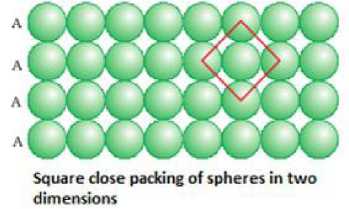
    • Square close packing: Here, the spheres of the second row ware placed exactly above those of the first row. This way the spheres are aligned horizontally as well as vertically. The arrangement is AAA type. The coordination number is 4.

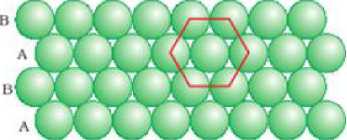
    • Hexagonal close packing: Here, these spheres of these bond row are placed above the first one in as taggered manner in such a way that its spheres fit in the depression of the first row. The arrangement is ABAB type. The coordination number is 6.

    Hexagonal dose packing of spheres in two dimensions

    • Three dimensional close packing from two dimensional square close packed

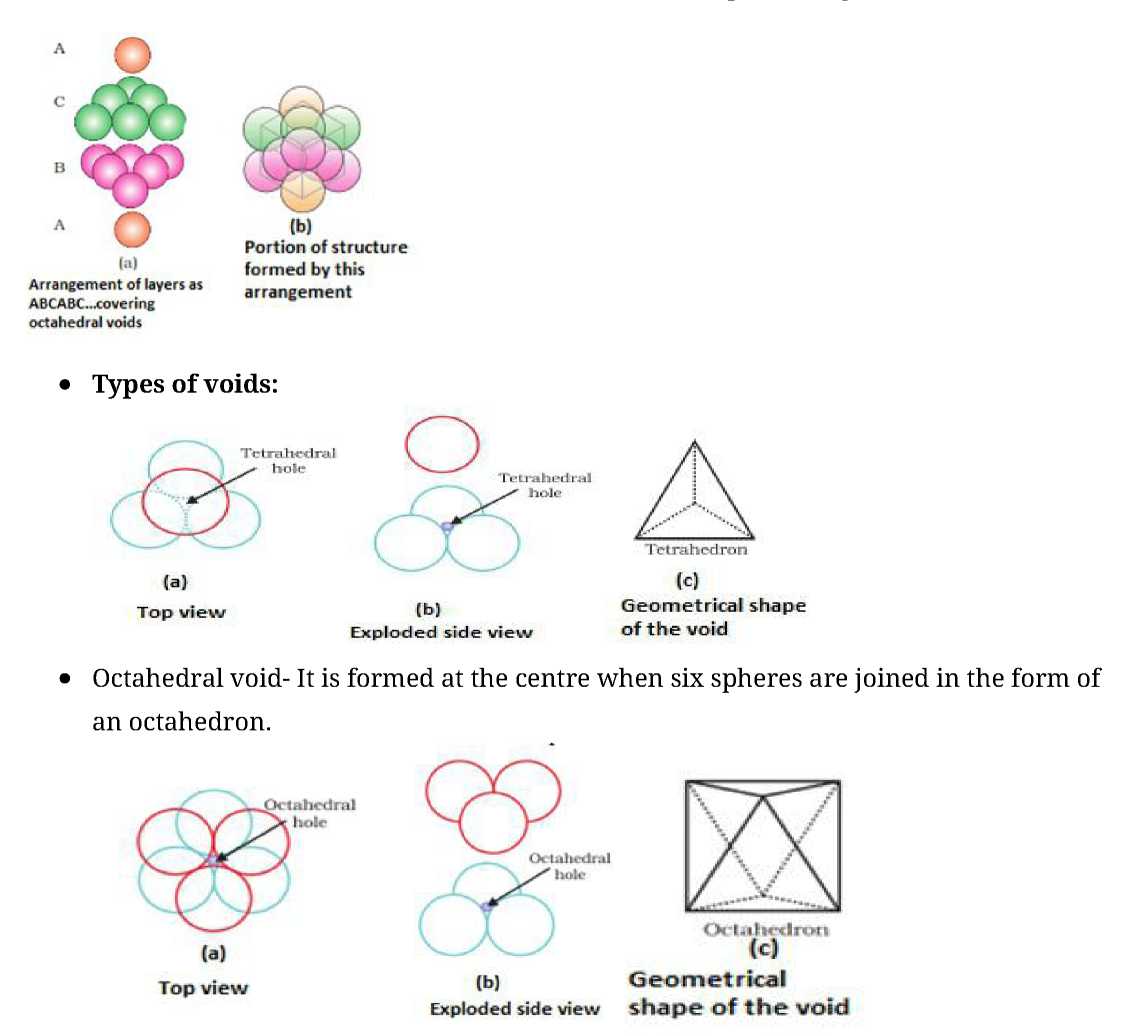
    Covering the octahedral voids: Here, octahedral voids of these bond layer may be covered by the spheres of the third layer. It gives rise to ABCABCABC type pattern. The three dimensional structure is called cubic close packed structure or face centered cubic structure. The coordination number is 12.Example: Cu, Ag.

    • In hexagonal close packing or cubic close packing arrangement, the octa hedral and tetrahedral voids are present. The number of octahedral voids present in a lattice is equal to the number of close packed particles. The number of tetrahedral voids is twice the number of octahedral voids.

    For example:

    If the number of close packed particles = n

    Number of particles present in octahedral voids = n

    Then, the number of particles present in tetrahedral voids = 2n

    • Packing efficiency: It is the percentage of total space occupied by constituent particles (atoms, molecules orions).

    x 100%

    Packing Efficiency =

    Volume occupied by spheres
    Total volume of unit cell

    • Packing efficiency for face centered unit cell =74%
    • Packing efficiency for body centered cubic unit cell =68%
    • Packing efficiency for simple cubic unit cell =52.4%
    • Radius ratio in an octahedral void: For an atom to occupy an octahedral void, its radius must be 0.414 times the radius of the sphere.

    i =o-414

    • Radius ratio for tetrahedral void: For an atom to occupy a tetrahedral void, its radius must be 0.225 times the radius of the sphere.

    i = °-225

    • Density of a unit cell is same as the density of the substance.
    • Relationship between radius of constituent particle(r) and edge length(a):

    Simple cubic unit cell: a=2r Face centered unit cell: a=2y/2r Body centered unit cell: a=

    1.

    2.

    3.

    1.

    2.

    v3

    • Volume of a unit cell=(edge length)3=a3

    Simple cubic unit cell: Volume= (2r)3

    2

    Face centered unit cell: Volume= (2\/2r) Body centered unit cell: Volume=

    • Number of atoms in a unit cell(z):

    1. Simple cubic unit cell: z=1
    2. Face centered unit cell: z=4
    3. Body centered unit cell: z=2
    • Density of unit cell=
    • Crystal defects are basically irregularities in the arrangement of constituent particles.
    • Types of defects:
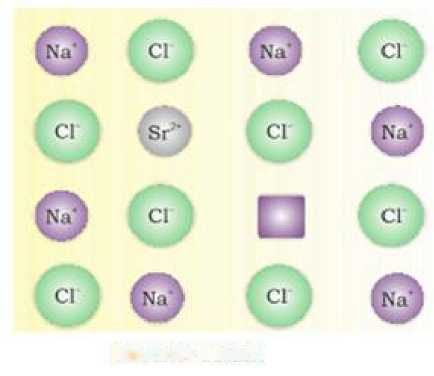
    1. Point defects- Point defects are the irregularities or deviations from ideal arrangement around a point or an atom in a crystalline substance.
    2. Line defects- Line defects are the irregularities or deviations from ideal arrange ment in entire rows of lattice points.

    Impurity defect!

    Different types of point defects:

    Different types of stoichiometric defects for non- ionic solids:

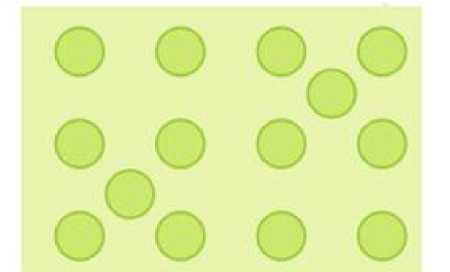
    Vacancy defect

    • Interstitial defect: A crystal is said to have interstitial defect when some constituent particles (atoms or molecules) occupy an interstitial site. This defect results in increase in density of the substance.

    Interstitial defect

    • Different types of stoichiometric defects for ionic solids:

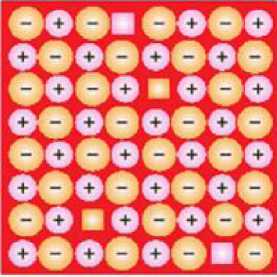
    Schottky defects

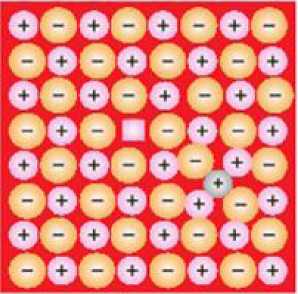
    • Frenkel or dislocation defect: In this defect, the smaller ion (usually cation) is dislocated from its normal site to an interstitial site. It creates a vacancy defect a tits original site and an interstitial defect a tits new location. It does not change the density of the solid. Frenkel defect is shown by ionic substance in which there is a larged difference in the size of ions. It includes ZnS,AgCl,AgBrand Agl.

    Frenkei defects

    • Different types of non-stoichiometric defects:

    • Metal deficiency: This defect arises because of absence of metal ions from its lattice sites. The electrical neutrality is maintained by an adjacention having a higher positive charge.
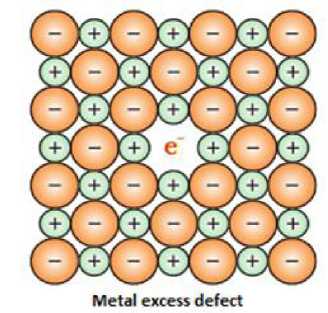
    • Reasons for the cause of metal excess defect:
    1. Anionic vacancies: A compound may have an extra metal ion if the negative ion is absent from its lattice site.This empty lattice site is called a hole.To maintain electrical neutrality this site is occupied by an electron. The hole occupied by an electron is called f-centre or Farbenz enter centre. The F- centre is responsible for the colour of the compound.
    2. Presence of extracations: A compound is said to have extracations if a cation is present in the interstitial site. An electron is present in the interstitial site to maintain the electrical neutrality.
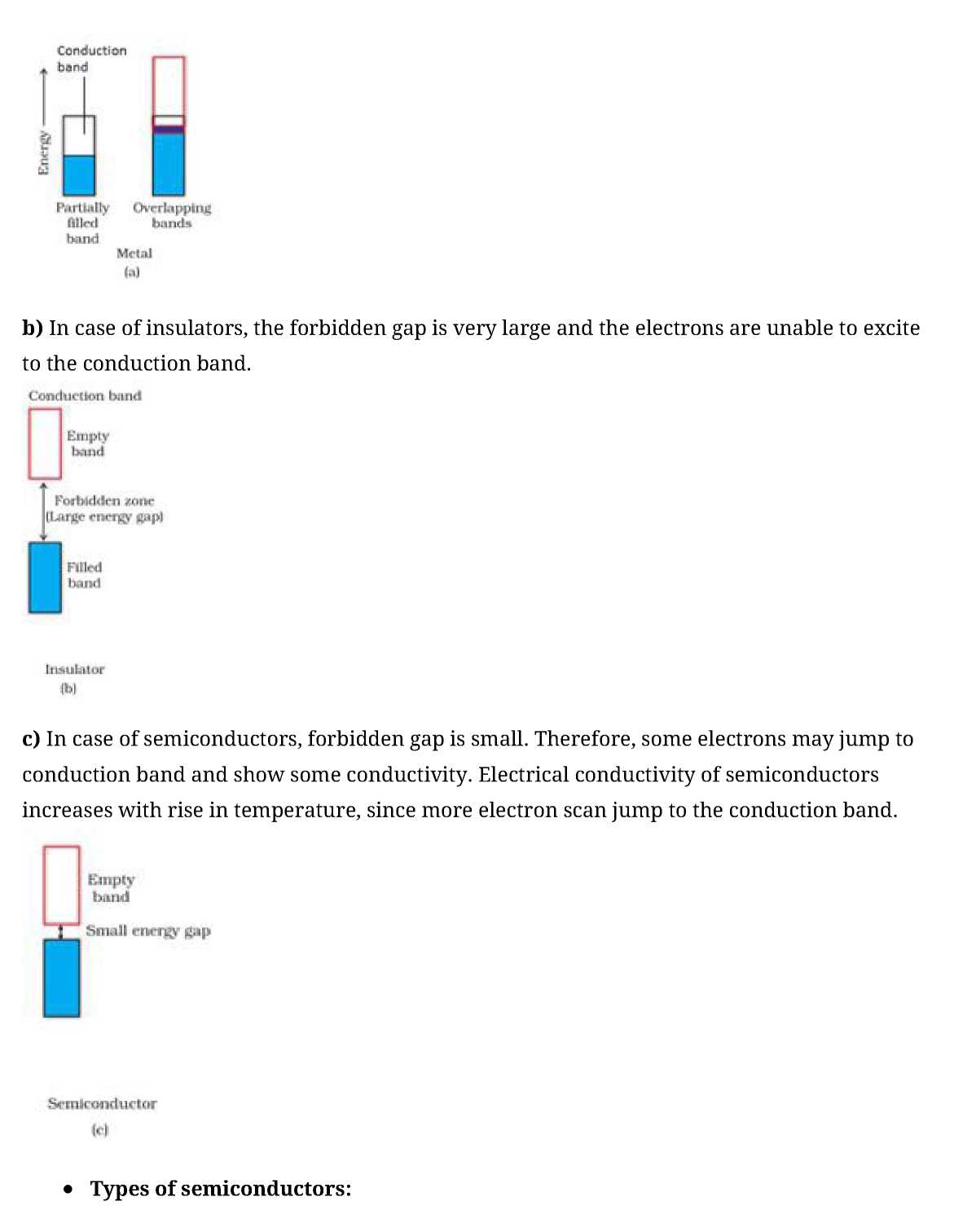
    • Classification of solids based on their electrical conductivities:
    1. Conductors: The solids with conductivities ranging between 104 to 10 7o/im_1m_1 are called conductors.

    nrj

    1. Insulators: These are the solids with very low conductivities ranging between to

    .

    1. Semi- conductors: These are the solids with conductivities in the intermediate range from

    tol04ofom_1m_1.

    1. Intrinsic semiconductors: These are those semiconductors in which the forbidden gap is small. Only some electrons may jump to conduction band and show some conductivity. They have very low electrical conductivity. Example: Silicon, germanium.
    2. Extrinsic semiconductors: When an appropriate impurity is added to an intrinsic semiconductor, it is called extrinsic semi conductors. Their electrical conductivity is high.
    • Doping: The process of adding an appropriate amount of suitable impurity to increase the conductivity of semiconductors is known as doping.
    1. The n-type semiconductors: They are formed when silicon is doped with electron rich impurity like group 15 elements. The increase in conductivity is due to the negatively charged electrons.
    2. The p-type semiconductors: They are formed when silicon is doped with electron deficient impurity like group 13 elements. The increase in conductivity is due to the positively charged holes.
    • Types of extrinsic semiconductors:
    • Diode: It is a combination of n-type and p-type semiconductors and is used as a rectifier.
    • Transistors: They are made by sandwiching a layer of one type of semiconductor between two layers of the other type of semi conductor. The npn and pnp type of transistors are used to detector amplify radio or audio signals.
    • The 12- 16 compounds: These compounds are formed by the combination of group 12 and group 16 compounds.They possess an average valency of 4.Examples – ZnS,CdS,CdSe and HgTe.
    • The 13- 15 compounds: These compounds are formed by the combination of group 13 and group 15 compounds.They possess an average valency of 4.Examples – InSb,AlP and GaAs.
    • Every substance has some magnetic properties associated with it. The origin of these properties lies in the electrons.
    • Each electron in an atom behaves like at in y magnet. Its magnetic moment originates from two types of motions:

    (i) its orbital motion around the nucleus and (ii) its spin around its own axis.

    • Classification of substances based on their magnetic properties:

    1. Paramagnetic substances: These are those substances which are weakly attracted by the magnetic field. It is due to presence of one or more unpaired electrons.
    2. Diamagnetic substances: Diamagnetic substances are weakly repelled by a magnetic field. Diamagnetism is shown by those substances in which all the electrons are paired and there are no unpaired electrons.
    3. Ferromagnetic substances: These are those substances which are attracted every strongly by a magnetic field.
    4. Anti ferromagnetic substances: They have equal number of parallel and anti parallel magnetic dipoles resulting in a zero net dipolemoment.
    5. Ferrimagnetic substances: They have unequal number of parallel and anti parallel magnetic dipoles resulting in an at dipole moment.


  • Environmental Issues Notes Biology Class 12th

    [docxpresso file=”https://www.imperialstudy.com/wp-content/uploads/2019/02/bio_16.odt” comments=”true” SVG=”true”]

  • Biodiversity and Conservation Notes Biology Class 12th

    [docxpresso file=”https://www.imperialstudy.com/wp-content/uploads/2019/02/bio_15.odt” comments=”true” SVG=”true”]

  • Ecosystem Notes Biology Class 12th

    [docxpresso file=”https://www.imperialstudy.com/wp-content/uploads/2019/02/bio_14.odt” comments=”true” SVG=”true”]

  • Organisms and Populations Notes Biology Class 12th

    [docxpresso file=”https://www.imperialstudy.com/wp-content/uploads/2019/02/bio_13.odt” comments=”true” SVG=”true”]

  • Biotechnology and its applications Notes Biology Class 12th

    [docxpresso file=”https://www.imperialstudy.com/wp-content/uploads/2019/02/bio_12.odt” comments=”true” SVG=”true”]

  • Biotechnology: Principles and Processes Notes Biology Class 12th

    [docxpresso file=”https://www.imperialstudy.com/wp-content/uploads/2019/02/bio_11.odt” comments=”true” SVG=”true”]

  • Microbes in Human Welfare Notes Biology Class 12th

    [docxpresso file=”https://www.imperialstudy.com/wp-content/uploads/2019/02/bio_10.odt” comments=”true” SVG=”true”]