Author: shivamlohiya

  • LONG ANSWER TYPE QUESTIONS (4 MARKS) of Food Security in India Class 9th Social Science Economics

    1. LONG ANSWER TYPE QUESTIONS (4 MARKS)

     What is the difference between PDS and TPDS? Ans. Difference between PDS and TPDS   :

    The food procured by the FCI is distributed through fair price shops among the poor.

    This is called public distribution system. There was no discrimination between the poor and  non poor under PDS. Under the TPDS, the government has announced separate issue prices   for people below poverty line (BPL) and for above poverty line (APL) families. In December 2000, two special schemes were launched to make the TPDS more focussed and targeted towards the poor. These were Antyodayo Anna Yojana (AAY) and the Annapurna Scheme (APS). The two schemes were linked with   TPDS.

    Under the AAY, poor families were identified by the respective state rural development boards. Twenty-five kilograms of foodgrains were made available to each eligible family at highly subsidised rate of Rs 2 per kg for wheat and Rs 3 per kg for rice. This quantity has been raised from 25 to 35 kg with effect from April    2002.

     Discuss the role of government in the stabilisation of food grain prices. Ans. Government’s Measures to Stabilise foodgrain    prices.

    Our government has adopted the following measures to stabilise food grain prices.

    • The government has often resorted to

      importof foodgrains whenever it became necessary. For example, it entered into the PL 480 agreement with

      USAin 1956 to import food grain to face food crisis in the

    • It tries to maintain price stability through buffer stocks. It buys foodgrains during crop season when prices fall and

      sellthem when prices tend to rise in times of shortage. Had the government not purchased the food grains, their prices might have fallen due to increased supply in the market. Similarly, in the times of shortage, when these foodgrains are supplied to the consumers at subsidised prices, their prices do not rise

           Explain briefly the measures undertaken by the government to increase the production and supply of  foodgrains.

    Ans. Government’s measures to increase the production and supply of foodgrains

    Main steps undertaken by the government in this regard are as follows :

    • Land Reform Measures : Our government introduced several land reform measures soon after independence to increase domestic production of These measures included (i) abolition of intermediaries to transfer land to the actual tiller (ii) tenancy reforms to regulate rents paid by the tenants to the landlords (iii) imposition of ceiling on landholdings to procure surplus land for distribution among the landless.
    • Provision of Institutional Credit. To provide cheap and adequate agricultural finance many institutional credit agencies were set up. The expansion of institutional credit to farmers were made especially through cooperatives and commercial banks. As a result, the importance of village moneylenders, who used to exploit the farmers by charging high rates of interest, has drastically declined. Initially, only four percent of the total agricultural credit was advanced by cooperatives and commercial banks in 1950-51. Now their percentage share rose to 89 percent in 2004-05.

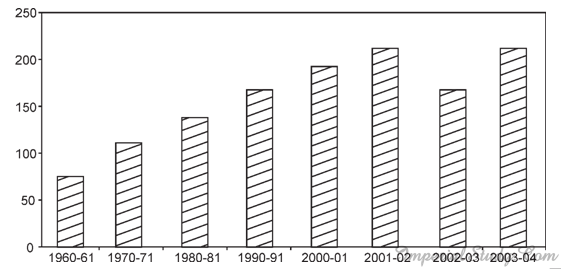
    • New Agricultural New agricultural strategy was introduced which resulted in the Green Revolution, especially in the production of wheat and rice. Total production of foodgrain has increased from 50.8 million tonnes in 1950-51 to 212.0 million tonnes in 2003-04.

    Explain the paradox of excess stocks of food grains and starvation. Ans. Paradox of Excess Stocks and    Starvation.

    India has experienced a paradoxical situation in recent years. While the granaries of the government are overflowing with excess foodgrain stock, we also find people without food. We, in India, find widespread hunger even when we have excess stock of foodgrains. The main reason for this unfortunate situation is that many poor families do not have enough purchasing power (i.e. money income) to buy food. Over one-fifth of the country’s population suffers from chronic hunger. They have to go to their beds with empty stomach. A good food security network, therefore, should not only ensure adequate physical availability of food but also increase the capabilities of the poor to buy food.

    To tackle this unfortunate situation, our government has launched several special poverty alleviation programmes. These programmes aim at increasing income of the poor so as to enable them to buy  food.

    • Point out the major defects of India’s food security system. Ans. Defects of India’s Food Security

      System  :

    The major flaws/drawbacks of food security system in India are as follows :

    • Limited Benefit to the

      Thepoor has not benefited much from the PDS. They have depended to a great extent on the open market for most of the commodities. Ration cards are issued only to those households who have proper residential addresses. Hence, a large number of homeless poor could not be covered under the PDS.

    • Leakages from Another defect of PDS relates to the problem of leakages of goods from PDS to open market. The shopkeepers who are running ration shops sell ration in the open market at higher prices instead of selling to ration card-holders at subsidised prices.
    • Increase in Prices. The PDS has also failed to protect the poor against price rise. There have been frequent increases in procurement and issue prices. Moreover, excessive buffer stocks of foodgrains

      hasreduced its quantity available in the open market. This has also put an upward pressure on the market prices of food

    • Rising Burden of Food Subsidy. PDS is highly subsidised in India. This has put a huge fiscal burden on the government. For example, food subsidy burden has risen from Rs 602 crore in 1980-81 to Rs 25,800 crore in 2003-04.
    • What are the major functions of the Food Corporation of India? [2011 (T-2)] The Food Corporation of India (FCI) has the following major

      functions :-

      • FCI purchases wheat and rice from the farmers in states where there is surplus
      • They announce Minimum Support Price (MSP) on which government buy the surplus from the
      • They keep the record and

        mantainthe buffer

    • Describe four main advantages of the Public Distribution                  [2011 (T-2)] Ans. The main advantages of Public Distribution System

      are :-

      • It is the most effective instrument of government policy over the years in stabilising prices and making food available to consumers at affordable
      • It averts widespread hunger and famine by supplying food from surplus regions of the country to the deficit
      • It revises the prices of food grains in favour of poor
      • The declaration of minimum support price and procurement has contributed to an increase in food grains production and provided income security to farmers in certain
    • How does PDS ensure food security in India?                                    [2011 (T-2)] Ans. PDS or public distribution system distribute the food grains by the help of ration shops among the poorer sections of the society. Presently there

      are4.6 lakh ration shops all over the country. Ration shops

      also knownas fair price shops who keep the stock of foodgrains, sugar and cooking kerosene oil. These items are sold to people at a price lower than the market price.

    Any family with a ration card can buy a stipulated amount of these items (e.g. 35 kg of grains,  5 litres of kerosene, 5 kgs of sugar etc.) every month from the ration shop. PDS keeps on revising the prices in favour of urban    poors.

         What are the problems of the functioning of the ration shops? Describe any four of them.

    [2011 (T-2)]

    Ans. The problems of the functioning of the ration shops are :-

    • Irregular opening of ration shops and selling poor quality grains at ration
    • Massive unsold foodgrains that

      pilesup at ration shops become a big problem for

    • A family even slightly above poverty line gets very little discounts at ration shop. The prices are almost as high as open market
    • The category of ration cards and range of prices do not exist

             Describe in four points your awareness about National Food for Work Programme.

    [2011 (T-2)]

    Ans. (i) National Food for Work Programme was launched on November 14, 2004 in 150 most backward districts of the  country.

    • The programme is open to all rural poor who are in need of wage employment and desire to do manual unskilled
    • It is a 100 percent centrally-sponsored scheme and the food grains are provided to states free of
    • For

      year2004-05, Rs 2020 crores have been allocated for the programme in addition to 20 lakh tonnes of food

             Explain how Green Revolution helped India to be self-sufficient in food grain production.

    [2011 (T-2)]

    Ans. Green Revolution was a policy adopted by Indian policy makers for the growth in production  of wheat and rice. HYV seeds were introduced and there was massive increase in production  of wheat and rice. The increase in foodgrains was, however, disproportionate. The highest rate of growth was achieved in Punjab and Haryana, where foodgrain production jumped from 7.23

    million tonnes in 1964-65 to reach an all-time high of 30.33 million tonnes in 1995-96. Production of rice was recorded to rise significantly in Tamil Nadu and Andhra Pradesh.

    (Production of foodgrains in India) (Source : Economic Survey  2004-05)

             Write a note on the role of cooperatives in providing food and related items.

    [2011 (T-2)]

    Ans. The cooperatives also play an important role in food security in India, especially in southern and western parts of the   country.

    • They set up shops to sell low price goods to poor people. For example, Mother Dairy in Delhi sells milk and vegetables to consumers at controlled rates decided by the Government of
    • Cooperatives like Academy of Development Science (ADS) has facilitated a network of NGOs for setting up grain banks. ADS works in Maharashtra. They also organise training and capacity building programmes on food security for NGOs. The ADS grain bank programme is

      acknolwledgedas a successful and

      innonativefood security
  • SHORT ANSWER TYPE QUESTIONS (3 MARKS) of Food Security in India Class 9th Social Science Economics

    SHORT ANSWER TYPE QUESTIONS (3 MARKS)

    • What are the essentials  of  food  security  system? Ans. Essentials of Food Security System are the following :
      1. Increasing domestic production of food to meet its growing demand
      2. Food should be available in adequate quantity as well as to meet nutritional  requirements
      3. Food should be available at reasonable  prices
      4. Buffer stock of food should be  maintained

    How is food security affected during a natural calamity?

    Ans. In the times of any natural calamity, say a drought, total production of foodgrains declines. It creates a shortage of food, particularly in the affected areas. Due to shortage of food, the prices go up in the market. At high prices, poor people may not afford to buy food. If such a calamity occurs in a large area, it may lead to starvation.

    • Why is there need for self-sufficiency in food grains in India? Ans. Need for self-sufficiency  in foodgrains  arises from  the following :
    • to feed  growing population
    • to fight against any natural  calamity
    • to reduce import of foodgrains
    • to control prices of foodgrains

    The task of attaining self-sufficiency in foodgrains in future seems to be difficult. Give two reasons in support of this    statement.

    Ans.  The task of attaining self-sufficiency in foodgrains in future seems to be difficult in India. It    is  because :

    • There has been a gradual shift from cultivation of food crops to cultivation of fruits, vegetables, oil seeds and crops which act as industrial raw
    • More and more land is being used for construction of factories, residential buildings,

                                                                                                                                                                                             Mention  two  objectives of PDS.                                                                                                                  [Important] Ans. Two  Objectives of  PDS.

    • To provide essential goods at subsidised prices to the
    • To control prices of essential

    Why is procurement of foodgrains done in    India?

    Ans. The government procures foodgrains at pre-announced prices to provide incentives to farmers for raising the production of crops. The food procured by the government is distributed among the poorer section of the society through fair price shops at subsidised prices.

    Mention two reasons behind excessive buffer stocks of foodgrains. Ans. Two  Reasons for Excessive Buffer Stock   :

    • There has been increase in minimum support
    • The offtake of foodgrains under PDS has been

    State two consequences of the excess reserves of food grains in India. Ans. Two  Consequences of Excessive Buffer Stock   :

    • It has raised economic costs i.e. cost incurring for procuring, storing and distribution of foodgrains.
    • It has  adversely affected the food grain

     Mention two measures undertaken by the government to reduce the stock of foodgrains. Ans. Measures to Reduce Buffer   Stock.

    • Open sale at prices much below the economic
    • Increase in BPL allocation from 28 kg to 35 kg per month per

    What is the Public   Distribution System?                                                     [CBSE 2010] Ans. Public Distribution  System

    The Food Corporation of India procures food at pre-announced prices. The state governments distribute foodgrains to poor through ration shops at subsidised prices fixed by the government. This is called the Public Distribution System. There are about 4.6 lakh ration shops all over    the country. Ration shops are also known as fair price shops.

    How cooperatives are helpful in   food security?                                        [CBSE 2010] Ans. Role of cooperatives in providing food security    :

    In many parts of India, the cooperative societies set up their own cooperatives to supply different items at cheaper rates. Following are the examples :

    • In Tamil Nadu 94% of ration shops are run by
    • In Delhi, the Mother Dairy is supplying milk and milk products like butter, ghee etc. to  the people at much subsidised
    • In Gujarat, Amul is doing the same job of supplying milk and milk products to people at much cheaper

    It is being run by cooperatives. It has brought ‘White Revolution’ in India.

    Why is food security essential? How food security is affected during disaster?

    [CBSE 2010]

    Ans. Need of food security : The poorest section of the society might be food-insecure most of the times, while persons above poverty lines might also be food insecure when the country faces national disaster. Due to natural calamity, say drought, total production of foodgrain decreases. It creates a shortage of food in affected areas. Due to shortage of food, the prices go up. At higher prices, some people cannot buy food. So food security is essential.

    State  three dimensions of  food security.                                                     [CBSE 2010] Ans. Three dimensions of food security   :

    • Availability of food : There should be enough stocks of food items in the country through good production, through imports or previous year’s stock stored in government
    • Accessibility of food : Food should be within the reach of
    • Affordability of food : The prices of different food articles should be such that every individual is able to buy them. The foodgrain items should be within the reach of the

             Why has Public Distribution System been criticised? Explain any three reasons.

    [CBSE 2010]

    Ans.   (i)  Market ineffectiveness of PDS : Average  consumption of PDS grain at all India   level   is only 1 kg per person per month. Average consumption figure in the states of Bihar, Orissa and Uttar Pradesh is only 300 gms, while in states like Kerala, Karnataka, Tamil  Nadu this figure is 3-4 kg per person per month. As a result, the poor has to depend on markets rather than ration   shops.

    • With the introduction of three types of cards and three different prices for the same articles to the different people, the whole system of Public Distribution System has become much complicated.
    • PDS dealers malpractices : The ration shop dealers resort to malpractices. They divert the grains to the open market to get a better

    What is the difference between chronic and seasonal hunger? Write any two.

    [CBSE 2010]

    Ans. Chronic Hunger : When diet is inadequate in terms of quantity or quality, it is called chronic hunger. Usually poor people suffer from chronic hunger because of their low income and as      a result their inability to buy food even for their survival. This type of hunger is more or less   of a permanent nature and presents throughout the year.

    Seasonal Hunger : Seasonal hunger persists only during a particular period of the season. It    is linked with the cycles of food growing and harvesting. In rural areas, the seasonal hunger     is prevalent because of the seasonal nature of agricultural activities. The gap between the sowing season and the reaping season is marked by seasonal hunger.

    • Which are the people more prone to food insecurity? [2011 (T-2)] Ans. The people worst affected by food insecurity in India are landless labourers, traditional artisans, providers of traditional services and destitutes including beggars. In the urban    areas,

    the food insecure people are those whose working members are generally employed in ill-paid occuptions and casual labour market. These workers are largely engaged in seasonal activities and are paid very low wages that just ensure bare survival.

             Describe briefly the measures adopted to achieve self-sufficiency in foodgrains since Independence.  [2011 (T-2)]

    Ans. After Independence, Indian policy makers adopted all measures to achieve self-sufficiency in foodgrains. India adopted a new strategy in agriculture which resulted in Green Revolution especially in the production of wheat and    rice.

    What steps have been taken by the Government of India to provide food security to the poor? Explain any three.                                                                                                                [2011 (T-2)]

    Ans. To provide food security to the poor following steps have been taken by the Government of India :

    • PDS :- Public Distribution System (PDS) was established for the distribution of food grains among
    • ICDS :-    Integrated  Child  Development  Services  were  launched  in  1975   to  ensure nutrition among children of backward
    • FFW :- ‘Food for work’ was introduced in 1977-78 to provide employment opportunities for poors to ensure food security for

    Describe Public Distribution System (PDS) is the most important step taken by the Government of India towards ensuring   food security.                                                                   [2011 (T-2)]

    Ans. In the begining, the coverage of PDS was universal with no discrimination between poor and non-poor. Then later on the policy was made more targeted.

    Important Features of  PDS


    Name of scheme Year of introduction Covrage target group Full name
    PDS upto 1992 Universal Public  Distribution System
    RPDS 1992 Backward blocks Revamped  Public Distribution
    System
    TDPS 1997 Poor and non-poor Targeted  Public Distribution
    System
    AAY 2000 Poorest of the  Poor Antyodaya Anna Yojana
    APS 2000 Indigent  senior citizen Annapurna Scheme
    • What is buffer stock? Why is it created by the government? [2011 (T-2)] Buffer stock is the stock of foodgrains, namely wheat and rice procured by the government through Food Corporation of India (FCI). The FCI purchases wheat and rice from the  farmers

    in states where there is surplus production. The farmers are paid a pre-announced price for  their crops. Buffer stock is created to distribute foodgrains in deficit areas and among the poorer strata of society at price lower than the market price. It is also used at a the time of adverse  weather conditions.

             What are famines? Who were the most affected group of devastating famine of Bengal?

    [2011 (T-2)]

    Ans. A famine is characterised by widespread deaths due to starvation and epidemics caused by forced use of contaminated water, of decaying food and loss of body resistance due to weakening from starvation. The agricultural labourers, fishermen, transport workers and other casual labourers were affected the   most.

    • Why is buffer stock created by the government? Give any three [2011 (T-2)] Ans. Buffer stock  is created due to following   reasons:-
    • To distribute food grains in deficit
    • To distribute food grains among the poorer strata of society at prices lower than market
    • To resolve the problem of shortage of food during adverse weather conditions or during the periods of
  • Multiple Choice Questions [Solved] [1 Marks] of Food Security in India Class 9th Social Science Economics

     MULTIPLE CHOICE QUESTIONS (1 MARK)

         The worst affected groups in rural areas facing food insecurity are :

    • landless people (b)  traditional  artisans (c) beggars               (d)  all  the above

    Ans. (d)

         MSP refers  to :

    • Minimum Support Price (b) Maximum Support  Price

    (c)  Marginal  Support Price                             (d)  None of the  above

    Ans. (a)

             Green Revolution in the 1960s was associated with :

    • use of HYV seeds (b)  tree  plantation programme

    (c)  fisheries development                              (d) none of the   above

    Ans. (a)

         Public Distribution System is associated with    :

    • fair price shops (b)  cooperative stores   (c)  super bazars      (d)  none of the above


         Revamped Public Distribution System (RPDS) aimed to provide benefits to :

    • cities (b)  remote and backward  areas

    (c)  self-help groups                                        (d)  cooperative societies

    Ans. (b)

         White Revolution of the country is associated with :

    • sugar (b) milk                       (c) paper                      (d)  none of the above

    Ans. (b)

         Annapurna Scheme (APS) meets the food requirements of :

    • indigent senior citizens (b) children

    (c)  pregnant ladies                                         (d)  young persons

    Ans. (a)

         Antyodaya cards are related  to

    • all poors (b) poorest of the   poor

    (c)  persons  below poverty line                      (d) none of the   above

    Ans. (b)

         Antyodaya Anna Yojana  (AAY)  and Annapurna Scheme (APS) are linked with   :

    • public distribution system (b)  mid-day meal

    (c)  special nutrition programme                     (d) none of the   above

    Ans. (a)

             Under the Targeted Public Distribution System (TPDS) foodgrains given per family per month  is :

    (a)  40 kg                     (b) 35 kg                    (c) 25 kg                     (d)  20 kg

    Ans. (b)

             In which state 94% ration shops are run by cooperatives

    • Andhra Pradesh (b) Tamil Nadu           (c) Orissa                    (d) Bihar

    Ans. (b)

             Average consumption of PDS grains per person per month at all India level is :

    (a)  1 kg                       (b) 4 kg                      (c) 300 gm                  (d)  500 gm

    Ans. (a)

             The society which facilitated setting up of grain banks in different regions is :

    • Amul (Gujarat)
    • Academy of Development Science (Maharashtra)
    • Mother Dairy (Delhi) (d)  None of the  above

    Ans. (b)

             Minimum Support Price (MSP) is announced by the government to provide :

    • incentives to farmers for raising  production
    • incentives to traders to earn maximum profit from  farmers
    • incentives to moneylenders to lend maximum to  farmers
    • none of  the above


             Seasonal hunger occurs in  :

    • urban areas (b) rural areas             (c) metro cities            (d) both (a) and   (b)

    Ans. (b)

             Which crop registered the largest increase in production as a result of Green Revolution?

    • wheat (b) rice                        (c) maize                     (d)  none of the above

    Ans. (a)

             Main purpose of buffer stock scheme is    :

    • to save food grains from  pest attack       (b) to stop price   fluctuations

    (c)  to meet the crisis of    low production       (d) both (b) and   (c)

    Ans. (d)

             Under Antyodaya Anna Yojana  (AAY),  subsidised rate for wheat is    :

    • Rs 3/- per kg (b)  Rs 2/- per kg        (c)  Rs 4/- per kg         (d)  Rs 5/- per kg

    Ans. (b)

             Food  security  means :

    • availability of food (b)  accessibility  of food

    (c)  affordability of food                                (d)  all the above

    Ans. (d)

             Massive starvation takes place due to    :

    • rise in the price of essential commodities  (b) decline in production of foodgrains

    (c)  drought                                                     (d)  both (a) and  (b)

    Ans. (c)

             Chronic  hunger refers  to :

    • low income (b) inadequate quantity of   food

    (c)   inadequate  quality of food                      (d)  all  the above

    Ans. (d)

             The most devastating famine occurred in India in 1943 in :                         [CBSE 2010]

    • Assam (b) Bengal                   (c) Bihar                      (d) Orissa

    Ans. (b)

             In which of the following states do we find the largest number of foodinsecure people?

    [CBSE 2010]

    • Bihar, Jharkhand and Orissa (b) Bihar, Jharkhand and   Gujarat

    (c)  Bihar, Madhya Pradesh  and Tamilnadu   (d)  Bihar, Chhattisgarh and Karnataka

    Ans. (a)

             In which state of India, Amul Dairy    is situated?                                            [CBSE 2010]

    • Rajasthan (b) Gujarat                  (c) Karnataka              (d) Bihar

    Ans. (b)

             Who released a special stamp entitled ‘Wheat Revolution’ in July 1968?      [2011 (T-2)]

    • Mahatma Gandhi (b) Indira Gandhi

    (c)  Jawaharlal Nehru                                      (d)  Motilal Nehru

    Ans. (b)


             The price that is announced before the sowing season is called:                    [2011 (T-2)]

    • Issue price (b)  Fair price

    (c)  Market price                                             (d)  Minimum  support price

    Ans. (d)

             To  whom the yellow card   is issued?                                                                   [2011 (T-2)]

    • To shop keeper (b)  To  land lord’s

    (c)  To  government employee                         (d) People below the poverty   line

    Ans. (d)

             Which are the special target groups    in Antyodaya Anna Yojana?                 [2011 (T-2)]

    • Poorest of the poor                                  (b)  Poor  and non-poor

    (c)  Backward class                                         (d)  None  of these

    Ans. (a)

             Food for Work  Programme  was launched in which  of the  following  years?[2011   (T-2)]

    (a)  2003                      (b) 2001                     (c) 2004                      (d) 2005

    Ans. (c)

             Kalahandi is situated in which of the    following states?                                   [2011 (T-2)]

    • Orissa (b) Punjab                   (c) Rajasthan               (d) Bihar

    Ans. (a)

             The Mother Dairy is an important    cooperative in                        .                   [2011 (T-2)]

    • Gujarat (b) Punjab                   (c) Haryana                 (d) Delhi

    Ans. (d)

             Women and children under the age of five are food insecure population due to :

    [2011 (T-2)]

    • Malnutrition (b)  Healthy diet

    (c)  Fats                                                           (d) None of the   above

    Ans. (a)

             F.C.I. stands for                                                                                                   [2011 (T-2)]

    • Foreign Co-operation with India (b) Food Corporation of  India

    (c)  Fosilse Corporation  of India                    (d)  Food Coming to India

    Ans. (b)

             Which among the following schemes was started in the year 2000 for the indigent senior citizens ?   [2011 (T-2)]

    • PDS (b) NFWP                   (c) SGSY                     (d) APS

    Ans. (d)

             Name the cooperative that provides milk and vegetables controlled rate decided by the Government  of Delhi :                                                                                                                        [2011 (T-2)]

    • Amul (b)  Kendriya  Bhandar  (c) Mother Dairy      (d)  None  of these

    Ans. (c)

             Which among the following schemes was initiated for the poor in all areas? [2011 (T-2)]

    • TPDS (b) RPDS                    (c) AAY                      (d)  All of these

    Ans. (d)


           Buffer stock is the stock of foodgrains procured by the government through

    [2011 (T-2)]

    • IFCI (b) FCI                        (c) IDBI                       (d) FICCI

    Ans. (b)

           In which part of the country, grain banks have been set up by NGO’s?        [2011 (T-2)]

    • Gujarat (b) Haryana                (c) Punjab                   (d) Maharashtra

    Ans. (d)

           When  was  the Antyodaya Anna Yojana scheme launched?                               [2011 (T-2)]

    • In Jan 1999 (b)  In May 2000        (c)  In Dec 2000          (d)  In  October 2005

    Ans. (c)

           Percentage of seasonal as well as chronic hunger in India over the years has

    [2011 (T-2)]

    • increased (b) decreased              (c)  remained constant   (d) None of   these

    Ans. (b)

           The concept of ‘entitlements’ was introduced   by :                                             [2011 (T-2)]

    • Pranab Mukharjee   (b) Amartya Sen       (c) Manmohan Singh  (d)  Sonia Gandhi

    Ans. (b)

           Which institution was set up by Maharashtra Academy of Development Science to facilitate  a  network of NGO’s?                                                                                                             [2011 (T-2)]

    • Gramin banks (b)  Grain banks

    (c)  Co-operative banks                                   (d)  Commercial banks

    Ans. (b)  
    Q.43. Who is the nodal officer at district    level?

    (a)  Commissioner


    (b)  Superintendent  of police

    [2011 (T-2)]
      (c)  District officer (d) Collector  
    Ans. (d)    

             In year 2000 which of the following programmes was launched?                    [2011 (T-2)]

    • APS (b) NREGA                (c) PDS                        (d) PMGY

    Ans. (a)

             In which of the following years was the food grain stock with the FCI the maximum?

    [2011 (T-2)]

    (a)  2001                      (b) 2009                     (c) 2002                      (d) 2000

    Ans. (c)

           Which are the two places in Orissa where starvation deaths are reported? [2011 (T-2)]

    • Kalahandi and Puri (b)  Kashipur  and Bhubaneshwar

    (c)   Kalahandi and Kashipur                          (d)  Puri  and Bhubaneshwar

    Ans. (c)

             Which of the following places of Jharkhand witnessed starvation death recently?

    [2011 (T-2)]

    • Dhanbad (b) Ranchi                  (c) Palamau                 (d) Puri

    Ans. (c)


             In which year was the Integrated Child Development Service (ICDS) introduced?

    [2011 (T-2)]

    (a)  1965                      (b) 1975                     (c) 1985                      (d) 1995

    Ans. (b)

             NREGA provides :                                                                                               [2011 (T-2)]

    • 200-days of assured work (b)  100-days of assured  work

    (c)  No assured work                                      (d) None of the   above

    Ans. (b)

             In which decades was the Rationing System introduced in India?                  [2011 (T-2)]

    (a)  1940s                     (b) 1950s                    (c) 1960s                     (d) 1970s

    Ans. (a)

  • NCERT Textbook Questions Solution’s of Food Security in India Class 9th Social Science Economics

    NCERT TEXTBOOK QUESTIONS

    Questions Within The Lesson

       (a)   Why is agriculture a seasonal   activity?

    • Why is Ramu unemployed for about four months in a year?
    • What does Ramu do when he is  unemployed?
    • Who are supplementing income in Ramu’s  family?
    • Why does Ramu face difficulty when he is unable to get work?
    • When is Ramu food insecure?

    Ans. (a)  Agriculture is a seasonal occupation because farmars remain out of work for 4 to 5 months in  a year.

    • Because Ramu works as a casual labourer in agriculture. Agriculture being a seasonal activity, Ramu gets works only during the times of sowing, transplanting and harvesting. He remains unemployed for about 4 months during the period of plant cultivation and maturing in a
    • He looks for work in other activities such as construction activities, brick laying etc. in the
    • Ramu’s three sons and food grower also work on the field. His wife works as a house cleaner for the livestock, removing and managing cow
    • Ramu is food insecure during 4 months when he remains

         (a)   Does Ahmed have a regular income from   rickshaw-pulling?

    (b) How does the yellow card help Ahmed run his family even with small earnings from rickshaw-pulling?

    Ans.  (a)   No, Ahmed’s earning from rickshaw-pulling fluctuates every   day.

    (b)  With his yellow card, Ahmed gets sufficient quantity of wheat, rice, sugar and kerosene  oil for his daily requirements. He gets these essential items at half of the market price.      In this way, Ahmed is able to manage his family even with small earnings.

           Graph 4.1 : Production of Food grains in India (Million Tonnes)

    NCERT Textbook Questions Solution’s of Food Security in India Class 9th Social Science Economics

    Source : Economic Survey   2004-05.

    Study  the Graph 4.1 and answer the following questions    :

    • In which year did our country cross the 200 million tonnes per year mark in food grain produciton?
    • In which decade did India experience the highest decadal increase in food grain production?
    • Is production increase consistent in India since  2000-01?

    Ans. (a)        In 2001-02 (212.9 million tonnes) in 20.3-04 (213.5 million tonnes)

    (b)  During 1980-81 to  1990-91

    (c)  No.

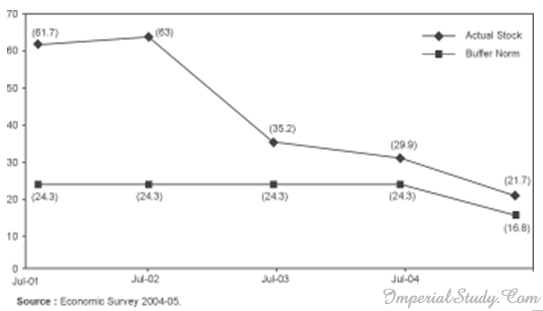
          Graph 4.2 : Central Food grains (Wheat + Rice) Stock and Minimum Buffer Norm (Million Tonnes)

    NCERT Textbook Questions Solution’s of Food Security in India Class 9th Social Science Economics

    Study  the Graph 4.2 and answer the following questions    :

    1. In which recent year food grain stock with the government was maximum?
    2. What is the minimum buffer stock norm for the FCI?
    3. Why were the FCI granaries overflowing with food grains? Ans.    In 2002
    4. 3 million tonnes
    5. Because poor people were not able to buy

    QUESTIONS IN THE EXERCISE

                            When is food security ensured   ?

    Ans. Food security is ensured under the following conditions :

    • When food is available in adequate quantity as well as quality to meet nutritional requirements.
    • When food is within the reach of every
    • When an individual has enough money to buy sufficient, safe and nutritious food to meet one’s dietary

                                                                                                  Which are the people more  prone to   food insecurity?                                                                             [Important] Ans.  People more prone to food insecurity are   :

    • Landless and  small farmers
    • Traditional artisans
    • Providers of  traditional services
    • Petty self-employed persons and
    • Beggars

                            Which states are more foodinsecure in India? Ans. More food insecure states of    India:

    The states of Uttar Pradesh, Bihar, Jharkhand, Orissa, West Bengal, Chhattisgarh, parts of Madhya Pradesh and Maharashtra are more food-insecure in India.

    • Do you believe that Green Revolution has made India self-sufficient in foodgrains? How? After Independence, Indian policy-makers adopted all possible measures to achieve self-sufficiency in food grains. India adopted a new strategy in agriculture which resulted in

    the Green Revolution. Green Revolution took place especially in the production of wheat and rice. The core of this new strategy was the use of HYV seeds along with chemical fertilizer and assured water supplies. As a result, total production of foodgrains increased from 50.8 million tonnes in 1950-51 to 212.0 million tonnes in 2003-04. The largest contribution came from wheat, whose production rose from 6.4 million tonnes to 72.1 million tonnes.

         A section of people in India are still without food. Explain.

    Ans. Despite large increase in foodgrain production we find people without food in India. Poor people suffer from chronic hunger. They find themselves unable to buy food. Over one-fifth    of the country’s population still suffers from chronic    hunger.

         What happens to the supply of food when there is a disaster or a calamity?

    Ans. The supply of food is adversely affected during a natural calamity or disaster. Due to a natural calamity, say drought, the production of food grains is less and hence supply decreases.

    • Differentiate between seasonal  hunger and chronic                             [Important] Ans. Hunger has seasonal and chronic dimensions. Seasonal hunger is a consequence of seasonal nature of work. For example, agriculture in India is seasonal occupation. Farm labourers remain out of work during some months of the year. Hence, during off-season poor people   are

    not able to buy food. On the other hand, chronic hunger exists among people who are not able to buy food because of their very low income. For example land less labourers earn very less   to earn enough for  food.

         What has our government done to provide food security for the poor? Discuss any two schemes launched by the  government.

    Ans. Our government has undertaken a number of measures to provide food security for the poor.

    A brief account of these measures is given below :

    1. Maintenance of Buffer Our government maintains buffer stock of foodgrains through Food Corporation of India. The FCI purchases wheat and rice from the farmers in surplus states and stores in    granaries.
    2. Public Distribution System (PDS). The food procured by the FCI is distributed among the poor through ration shops. Presently, there are about 4.6 lakh ration shops in the country.
    3. Nutritional Programmes. In order to provide nutritional security, our government has launched various schemes. Mid-day meal scheme for schoolchildren, scheme for supply of foodgrains to scheduled castes/scheduled tribes and special nutrition programmes for pregnant/nursing mothers are examples of such

    In 2000, two special schemes were launched. One, Antyodaya Anna Yojana and second, the Annapurna Schemes. The former relate to the poorest of the poor, while the latter targets indigent senior citizens. The functioning of these two schemes was linked with the PDS. Under AAY scheme, thirty-five kilograms of foodgrains are made available to each eligible family at a rate of Rs 2 per kg for wheat and Rs 3 per kg for rice.

    Under APS, 10 kilograms of food grains is made available to eligible persons free of cost.

    • Why is buffer stock created by the government?                                             [Important] Ans. The government creates buffer stock of foodgrains to protect the interest of both farmers as well as Farmers’ interests are protected when they are assured to get a certain

    minimum price for their crops. This price is called ‘minimum support price’.

    The interests of the consumers are protected when the procured food is made available to the consumers at subsidised rates. This task is done through fair price shops.

             Write  notes on :                                                                                                  [Important]

    • Minimum Support Price
    • Issue Price
    • Fair Price Shops

    Ans. (a)   Minimum  Support Price

    With a view to provide incentives to the farmers for raising the production of their crops, the government announces price of some crops before the sowing season. The government remains ready to purchase their crops at these pre-announced prices. This price is called minimum support  price (MSP).

    (b)  Issue Price

    The purchased foodgrains are stored in granaries. This is done to distribute foodgrains among the poorer section of the society. The government makes foodgrains available to  the poor at a price much lower than the market price. This is known as issue price.

    (c)  Fair Price Shops

    The food procured by the government is distributed among the poor. This task is done through government regulated shops which are known as fair price shops.

    • What are the problems of the functioning of ration shops? [Important] Ans. There are various problem of the functioning of ration shops such as ;
    1. Ration cards are issued only to those people who have their proper residential addresses. Hence a large number of homeless poor fail to get ration from these
    2. The owners of these shops sell ration in the open market at higher
    3. Sometimes shopkeepers make bogus entries in the ration

             Write a note on the role of cooperatives in providing food and related items.

    [Important]

    Ans. Role of Cooperatives in providing food and related items is as follows:-

    The cooperatives are playing an important role in food security in India, especially in the southern and western parts of the country. The cooperative societies set up shops to sell goods to the poor people at lower prices. For example, out of all fair price shops operating in Tamil Nadu, nearly 94 percent are being run by the cooperatives. In Delhi, Mother Dairy is providing milk and vegetables to the consumers at controlled prices which are decided by the Delhi Government. Amul is another example in this regard. It has brought about the White Revolution in the country. There are many more cooperatives and NGOs also working intensively towards this  direction.


  • Concept’s of Food Security in India Class 9th Social Science Economics

    CONCEPTS

    • What is food security? Food security means availability, accessibility and affordability of food to all people at all
    • Why food security? The poorest section of the society remains food insecure all the times. People above poverty line might also feel food insecure in times of natural calamity like earthquake, drought, flood, tsunami,
    • Who are food-insecure? In rural areas, the worst affected people are : landless and small farmers, traditional artisans (weavers, potters, blacksmith ) providers  of  services  (e.g. barbers, washermen etc), petty self-employed workers and destitutes. In the urban areas, persons employed in ill-paid occupations and casual labourers are food insecure.

    Large proportion of pregnant and nurshing mothers and children under the age of 5 years constitute an important segment of the food insecure population.

    • Hunger has chronic and seasonal dimensions. Poor people suffer from chronic hunger and are food insecure all the times. Seasonal hunger is caused by the seasonal nature of agricultural activities in rural areas. In urban areas, seasonal hunger occurs because of the casual type of work. Thus, seasonal hunger exists when people are unable to get work for the whole year.
    • Need for self-sufficiency in food grains. Our government since Independence realised the need to attain self-sufficiency in food grains because India experienced acute shortage of food grains after partition of the country in 1947. The need for self-sufficiency arises from the following :
      • to feed rising population (b)  to fight against droughts, floods, cyclone,

    (c)  to  reduce  import  of food grains      (d) to control prices of food    grains.

    • Food Security System in India. Since the advent of the Green Revolution in the 1960s the country has avoided famine, even during adverse weather conditions. India has become self-sufficient in food grains during the last 30 years because of the variety of crops grown all over the Also, we have developed a food security system.
    • Buffer Buffer stock is the stock of food grains (wheat and rice) procured by the government through the Food Corporation of India (FCI). The FCI purchases wheat and rice for the government from the farmers of surplus states at pre-announced prices. This price is called ‘minimum support price’.

    Ÿ Public Distribution System  (PDS)

    PDS refers to a system through which the food procured by the FCI is distributed among the poor through government regulated ration shops. The consumers are issued ration cards.

    Kinds of Ration Cards. There are three kinds of ration cards : (a) Antyodaya cards for the poorest of the poor, (b) BPL cards for those below poverty line and, (c) APL cards for those above poverty line.

    Ÿ Three Important Food Intervention  Programmes.

    In  the  wake  of  high  incidence  of  poverty  levels  in  mid-1970s,  three  important   food

    intervention programmes were introduced   :

    • Public Distribution System (in existence  earlier)
    • Integrated Child Development Services (ICDS) in  1975
    • Food for work in 1977-78.

    In 2000, two special schemes were launched viz. Antyodaya Anna Yojana (AAY) and the Annapurna scheme (APS) with special target groups of the poorest of the poor and indigent senior citizens, respectively.

    • Excessive Food Stocks : In July 2002, the stock of wheat and rice with FCI was 63 million tonnes which was much more than the minimum buffer norms of 24.3 million tonnes. The stock reduced thereafter but always remained higher than the buffer
    • Paradox of Excess Stocks and Starvation. In fact, India has experienced a paradoxical situation in recent years. While the granaries (godowns) of the government are overflowing with excess stocks of food, we also find people without food. The main reason for this unfortunate situation is that many poor families do not have enough money or income to buy food.
  • LONG ANSWER TYPE QUESTIONS (4 MARKS) of Poverty as a Challenge Class 9th Social Science Economics

    LONG ANSWER TYPE QUESTIONS (4 MARKS)


    Q.1. What are the main features of poverty in India?
    Ans. Features of Poverty in India :
    Following are the main features of poverty in India.
    (1)
    Declining Trend : The proportion of people below poverty line in India had variations.
    Poverty ratio increased during the decade of the 1970s. It decreased sharply during the
    decade of the 1980s. During the decade of 1990s, there was first a rise following the
    period of economic reforms and then a fall in the incidence of poverty. Since 1993-94, the
    total number of the poor shows a declining trend.
    (2)
    Inter-State Variations : Poverty is not equally distributed through the country. A recent
    study shows that more than 90 per cent of India’s rural poor live in the states of Andhra
    Pradesh, Orissa, Bihar, Madhya Pradesh, Karnataka, Maharashtra, Rajasthan, Tamil Nadu,
    Uttar Pradesh and West Bengal. Further, 50 per cent of India’s rural poor live in three
    states (namely, Bihar, Madhya Pradesh and Uttar Pradesh). As against this, the poverty ratio
    in the states of Jammu and Kashmir, Gujarat, Kerala, Punjab and Haryana is quite low.
    (3)
    Nature of Poverty : Poverty is visible both in our rural and urban areas. The rural poor
    consist of people of low castes and tribal groups. The major group of the poor include
    landless agricultural labourers, small and marginal farmers, rural artisans, etc.
    In the urban sector, the poor include largely unemployed, underemployed or persons employed
    in low productivity occupations such as rickshawpullers, cobblers, street vendors.
    Q.2. Describe in brief the important poverty alleviation programmes undertaken by the
    Government of India.
    Ans. Poverty Alleviation Programmes of India :
    The important poverty alleviation programmes
    which are in operation in rural and urban areas are :
    (1)
    Prime Minister Rojgar Yojana (PMRY) : PMRY was launched on 2 October 1993. The
    aim of this programme is to create self-employment opportunities for educated youth in
    rural areas and small towns. They are helped in setting up small business and industries.
    (2)
    Swarna Jayanti Gram Swarojgar Yojana (SGSY) : SGSY was launched on 1 April,
    1999. It aims at promoting enterprises at the village level. It helps the rural people to
    organise themselves into self-help groups. The objective of SGSY is to bring the existing
    poor families above the poverty line by providing them income generation assets through
    a mix of bank credit and government subsidy.
    (3)
    Pradhan Mantri Gramodaya Yojana (PMGY) : PMGY was introduced in 2000. Its
    objective is to focus on village level development in five critical areas, that is, primary
    health, primary education, rural shelter, rural drinking water and rural roads. As a result
    of this, the quality of life of rural people will improve.
    (4)
    Sampoorna Grameen Rojgar Yojana (SGRY) : This programme was launched in
    September 2001. The objectives of this scheme are :

    (a) to provide wage employment along with food security in the rural areas.
    (b) to create durable community, social and economic assets.
    The ongoing Employment Assurance Scheme and JGSY would be merged with SGRY.
    (5)
    National Rural Employment Guarantee Act (NREGA) : NREGA was passed in
    September 2005. The Act provides for 100-days assured employment to every rural
    household in 200 districts. Later, the scheme will be extended to 600 districts.
    However, the results of these programmes have not been very effective. One of the major
    reasons for their less effectiveness is the lack of proper implementation and right targeting.
    Also, there has been overlapping of schemes. Therefore, the major emphasis in recent years
    is on their proper monitoring.
    Q.3. What is meant by ‘vulnerability’ to poverty? Which economic categories are more
    vulnerable to poverty in India? [CBSE 2010]
    Ans. Vulnerability to poverty :
    It is a measure which describes the greater probability of certain
    communities or individuals (such as widow or a physically handicapped person) of becoming
    or remaining poor in coming years.
    z Economic categories more vulnerable to poverty in India : Schedule tribes, urban
    casual labourers, rural agriculture labourers, scheduled castes are major economic groups,
    which are more vulnerable to poverty. Among these, scheduled tribes contribute to 51%
    of poverty in India which average Indian poverty ratio is 26.
    Graph 3.1 : Poverty in India 2000 : Most Vulnerable Groups.

    Source : Reports on Employment and Unemployment among Social Groups in India No.
    469,472, NSSO, Ministry of Statistics, Programme Implementation, Govt. of India.

    Q.4. How is the illiteracy responsible for Poverty in India? Explain. [2011 (T-2)]
    Ans. Illiteracy is responsible for poverty in India as it causes the vicious circle of life where a poor
    remains poor. Educated parents teach their children and make them more productive towards
    the economic growth. They are more conscious about the education, health and hygiene of their
    children. On the other hand, illiterate parents are not aware and conscious about providing
    better education, health and hygiene facilities to their children. Thus they do not look for other
    occupational facilities other than traditional one, therefore remain poor.

    Q.5. How can poverty be reduced in future in India? Suggest any four points. [2011 (T-2)]
    Ans.
    Poverty can be reduced in the following ways:-
    (i) Increasing empowerment of women and the economically weaker sections of society.
    (ii) Fostering the economic growth.
    (iii) Increasing the stress on universal free elementary education.
    (iv) Caste and gender discrimination to be avoided.
    (v) Improving health care, education and job security.
    (vi) Removing unequality of wealth among people.
    Q.6. Mention the two planks on which the current anti-poverty strategy of the government is
    based. Why were the poverty alleviation programmes not successful in most parts of
    India? [2011 (T-2)]
    Ans.
    The current anti-poverty strategy of the government is based broadly on two planks:
    (i) Promotion of economic growth.
    (ii) Targeted anti-poverty programmes.
    The results of poverty alleviation programmes have been mixed. The major reasons for less
    effectiveness are :-
    (i) Lack of proper implementation and right targeting.
    (ii) Overlapping of a number of schemes.
    They lack proper monitoring and therefore the benefits of these schemes do not fully reach out
    to the deserving poor.

    Q.7. NREGA 2005 is an important anti-poverty programme. Explain. [2011 (T-2)]
    Ans. NREGA stands for National Rural Employment Guarantee Act, 2005. Following things were
    included in the scheme :
    (i) It aims at providing 100-days assured employment every year to every rural household.
    (ii) It initially started for 200 districts but later on extended to 600 districts.
    (iii) One-third of the proposed jobs were reserved for women.
    (iv) The Central government established National Employment Guarantee Funds and state
    government established State Employment Guarantee Funds for implementation of the
    scheme.
    (v) If an applicant is not provided employment within fifteen days he/she will be entitled to
    a daily unemployment allowance.
    Q.8. Social exclusion can be both a cause as well as consequence of poverty. Explain.

    [2011 (T-2)]
    Ans.
    Social exclusion can be seen in the terms of poors who have to live only in a poor surrounding
    with other poor people. Poor people are excluded from better surroundings with better-off
    people. For example, in India people belonging to certain lower castes (i.e., Scheduled Castes)
    are excluded from equal opportunities. Poor people of certain castes have to live in a separate
    locality and are excluded from mixing with better-off people. Due to such discrimination These
    people are deprived of better employment and growth opportunities. Social exclusion thus lead
    to poverty and can cause more damage than having a very low income.

    Q.9. Who are the most vulnerable as far as poverty is concerned? How have the states of West
    Bengal, Punjab and Tamil Nadu tackled poverty? [2011 (T-2)]
    Ans. The most vulnerable groups to poverty are :
    (i) Scheduled Castes and Scheduled Tribes
    (ii) Rural agricultural labour
    (iii) Urban casual labour

    States tackled poverty in the following ways :-
    1.
    West Bengal :- Land reform measures have helped in reducing poverty.
    2.
    Punjab :- Reduce poverty with high growth rates of agriculture.
    3.
    Tamil Nadu :- Public distribution of foodgrains has reduced the poverty.
     

  • SHORT ANSWER TYPE QUESTIONS (3 MARKS) of Poverty as a Challenge Class 9th Social Science Economics

    SHORT ANSWER TYPE QUESTIONS (3 MARKS)

    Explain how poverty begets more poverty.

    Ans. Poverty begets more poverty. It is both a cause as well as consequence of poverty. A poor country cannot save much out of its national income. As a result, it suffers from capital deficiency which adversely affects the level of production and income in the country.

    Explain the concepts of :

        1. Social exclusion (b) Vulnerability

    Ans. (a) Social Exclusion : According to this concept, poverty must be seen in terms of the poor who have to live only in a poor surroundings with other poor people. Poor people are excluded from better surroundings with better-off people. For example, in India people belonging to certain castes are excluded from equal opportunities.

        1. Vulnerability : There is a greater possibility of remaining poor in case of certain communities (such as members of a backward classes, widows, physically handicapped persons). These groups of people face greater risks at the time of natural disasters (earthquakes, tsunami). Thus vulnerability describes the greater possibility of being adversely affected in comparison of other people in odd times.

    Who are poor in the rural areas?

    Ans. In the rural sector, the poor include farm labourers, small and marginal farmers, rural artisans, backward classes and backward tribes. They lack basic literacy and skills. They are unable to find alternative employment elsewhere. They generally become victims of village moneylenders.

    Who are poor in the urban sector?

    Ans. In the urban sector, the poor consist of rickshaw-pullers, cobblers, street vendors, petty self-

    employed persons, domestic servants and low-paid workers working in factories or in other occupations. They reside in poor localities where the conditions of living are very poor.

    Explain how the low level of education can be held responsible for poverty in India.

    Ans. Low level of education of the poor is a major cause behind their poverty. Poor people are illiterate. Because of their illiteracy, Indian farmers have failed to learn new methods of cultivation. Even the village moneylenders succeed in cheating them quite easily. Moreover, poor parents are not able to send their children to schools. Because of their illiteracy, poor people are employed as unskilled workers and are paid low wages.

    Suggest some measures to reduce regional poverty.

    Ans. Measures to reduce regional poverty : Several states of India like Orissa, Bihar, Madhya Pradesh, Uttar Pradesh, Nagaland, etc., are economically very poor. To remove this regional poverty the following measures may be suggested :

        1. More Central assistance and grants should be given to backward states.
        2. Special concessions may be given for investments in backward areas.
        3. Public sector enterprises should be set up in backward states.

    Discuss any three measures to reduce poverty in India. [CBSE 2010]

    Ans. More Industrialisation : In order to remove poverty and unemployment, especially in cities, more and more industries are to be set up.

    • Improvement in Agriculture : While latest methods should be adopted in improving agriculture, steps should also be taken so that land is provided to the tiller and it is not concentrated in the hands of few rich farmers and landlords.
    • Education : Education is must for removing any evil, including poverty and unemployment. It must be made cheaper so that every person could get it easily.
      1. Discuss any three government programmes for poverty alleviation. [CBSE 2010] Ans. 1. Prime Minister’s Rojgar Yojana (PMRY) : These schemes have been started for the welfare of the educated unemployed in urban areas. Youth belonging to the weaker sections

    of society are given priority.

    1. Employment Assurance Scheme (EAS) : These were launched in 1999 to create wage employment to families below poverty line and to improve the quality of life in the rural areas.
    2. Jawahar Gram Samridhi Yojana (JGSY) : The objective of this programme is to generate gainful employment for the unemployed and underemployed men and women in rural areas, community and social assets are created such as soil conservation work.
      1. Give brief account of inter-state disparities of poverty in India. [CBSE 2010] Ans.  Proportion of poor people is not the same in every state.
    • In 20 states and union territories, the poverty ratio is less than national average.
    • In the states of Orissa, Bihar, Assam, Tripura and Uttar Pradesh poverty percentage is more than 35. So poverty is serious problem in these states. Along with rural poverty, urban poverty is also high in these states.
    • While in the states like Kerala, Jammu and Kashmir, Tamil Nadu, Andhra Pradesh there is significant decline in poverty.
    • States like Punjab and Haryana have succeeded in reducing poverty with the help of high agricultural growth rates.
    • In West Bengal, land reform measures have helped in reducing poverty.

    Mention any three features of the National Rural Employment Guarantee Act, 2005.

    [2011 (T-2)]

    Ans. National Rural Employment Guarantee Act, 2005 was passed in September 2005 with the following features :-

    1. It provides 100-days assured employment every year to every rural household with the reservation for one-third of the proposed jobs for women.
    2. The central government will establish a National Employment Guarantee Fund for Women and state governments will establish State Employment Guarantee Funds for implementation of the scheme.
    3. If an applicant is not provided employment within 15 days, he/she will get daily unemployment allowance.

    How is the regular growth of population one of the major causes of poverty?

    [2011 (T-2)]

    Ans. Problem of high population growth is the major hurdle for economic growth in Indian economy. This results in less job opportunities and low growth rate of incomes. These factors in combination make the growth rate of per capita income very low. The failure on two fronts

    – promotion of economic growth and population control – perpetuates the cycle of poverty. Rapid growth of population increases the number of job seekers and job opportunities are again limited. So population is one of the major causes of poverty in India.

      1. What are the main causes of poverty in India? [2011 (T-2)] Ans. Main causes of poverty in India are :-
    1. Huge income inequalities makes it difficult for the government policies to implement properly for poverty elimination. Therefore income inequality is a major cause of poverty in India.
    2. Exploitation of traditional Indian handicrafts and textile industries by British colonial administration is another major cause of poverty.
    3. In order to fulfil social obligations and observe religious ceremonies, the poor spend a lot of money. Poor people borrow money for different reasons and become the victims of indebtedness.

    How the policies of colonial government were responsible for poverty in India?

    [2011 (T-2)]

    Ans. Policies of colonial government is one of the historical reasons of poverty after and at the time of British colonial administration. The policies of the colonial government ruined traditional handicrafts and discouraged development of industries like textiles. The low rate of growth persisted until the nineteen eighties. This resulted in less job opportunities and low growth rate of incomes. This was accompanied by a high growth rate of population. The two combined to make the growth rate of per capita income very low. The failure at both the fronts – promotion of economic growth and population control – perpetuated the cycle of poverty.

      1. Explain three ways in which poverty can be estimated in India. [2011 (T-2)] Ans. While determining the poverty line in India, a minimum level of food requirement, clothing, footwear, fuel and light, educational and medical requirement etc. are determined for

    subsistence.

    1. The calorie requirement depending upon the age, sex, area and type of work is the way of estimating poverty. Average calorie requirement in India is 2400 per person per day in rural areas and 2100 per person per day in urban areas.
    2. Monetary expenditure per capita needed is also a way of estimating poverty. In the year 2000, poverty line for a person was fixed at Rs 328 per month for the rural areas and Rs 454 for the urban areas.
    3. A uniform standard for poverty line is also used, which is given by international organisations like World Bank. This is equivalent of $ 1 per person per day.

    Explain the principal measures taken in Punjab, Kerala and Andhra Pradesh to reduce poverty. [2011 (T-2)]

    Ans. (i) The principal measures taken in Punjab to reduce poverty is increasing the agricultural growth rates.

    1. Kerala focussed more on human resource development to reduce poverty.
    2. Andhra Pradesh focussed on public distribution of foodgrains to reduce poverty.
      1. ‘‘In poor families all suffer but some suffer more than others.’’ Explain. [2011 (T-2)] Ans. Analysis of poverty on the basis of social exclusion and vulnerability shows that there are people in our economy who suffer more than others. Socially excluded people due to caste discrimination are excluded even from facilities, benefits and opportunities that others enjoy. Vulnerability brings greater risks to the people at the time of natural disasters or terrorism etc.

    Vulnerable groups lack social and economic ability to handle risks.

    What is poverty line? Give the income for poverty line fixed for the rural and urban areas in India according to 2000. [2011 (T-2)]

    Ans. A person is said to be poor if his or her income or consumption level falls below a given ‘‘minimum level’’ necessary to fulfil basic needs. Each country uses an imaginary line that is considered appropriate for its existing level of development and its accepted minimum social norms.

    In the year 2000, a family of five members living in rural areas and earning less than about Rs 1640 per month were below the poverty line, whereas in urban areas earning less than about 2270 per month in similar family were below the poverty line.

    ‘‘There is a strong link between economic growth and poverty reduction.’’ Explain.

    [2011 (T-2)]

    Ans. Economic growth widens the opportunities and provides the resources needed to invest in human development. This also encourages people to send their children, including the girl child, to schools in the hope of getting better economic returns from investing in education.

    Since eighties, India’s economic growth has been one of the fastest in the world. The growth rate jumped from the average of about 3.5% a year in the 1970s to about 6% during the 1980s and 1990s which significantly helped in the reduction of poverty.

    Give one positive and one negative side of poverty conditions in India, and mention the major weaknesses of poverty alleviation programmes. [2011 (T-2)]

    Ans. Positive aspect :-

    (i) India’s economic growth is one of the fastest in the world which helps in reducing poverty.

    Negative aspect :-

    (i) Large number of poors live in villages and dependent upon agriculture where growth is much below expectation.

    Weakness of Poverty alleviation programme :-

    (i) Lack of proper implementation and right targetting with lots of over lapping schemes.