Author: shivamlohiya

  • Non-Multiple Choice Questions of A Dog Name Duke Class 9th.

    NON-MULTIPLE CHOICE QUESTIONS
    Read the extracts and answer the questions that follow.

    1. “About six weeks after the accident, the hospital put him in a wheelchair. ”

    (a) Who does ‘him’ refer to ?

    Ans. ‘Him’ refers to Chuck Hooper who has been admitted in the hospital after he met with an accident.
    (b) How had ‘he’ met with an accident ?

    Ans. One day when Hooper was driving home from office, a car came without warning and collided head on with his car.

    (c) How did the accident affect Hooper ?

    Ans. Hooper had a subdural haemorrhage in the motor

    section of his brain which completely paralyzed his left side.

    2. ‘Finally they decided to bring Duke home.’

    (a) Who is ‘Duke’ ?

    Ans. Duke is their pet dog who had been sent to a kennel after Hooper met with an accident.

    (b) Where had Duke been sent ?

    Ans. Duke had been sent to a kennel after Hooper met with an accident.

    (c) Why was Duke being brought home ?

    Ans. Duke was being brought home to give company to Hooper who was bedridden and was all alone at home after his wife left for work.

    3. “On January 4, Hooper made a big move. ”

    (a) Who was Hooper ?

    Ans. Hooper was working as a Zonal Sales Manager in a chemical company.

    (b) What was the ‘big move’ he made ?

    Ans. After he met with an accident, Hooper’s ‘big

    move’ was his first attempt to have walked 200 metres without the assistance of his dog.

    (c) Who had been instrumental in helping Hooper to make this ‘big move’ ?

    Ans. It was his dog ‘Duke’ who awakened Hooper’s will, which was lying dormant in his mind, to fight back and emerge victorious.

    4. Several people jumped to lift the dog. “No please, ” she said.

    (a) Why did the people want to lift the dog ?

    Ans. The dog had met with an accident. It was

    severally injured and had to be taken to the hospital.

    (b) Why did Marcy say “No please” ?

    Ans. She said so because Marcy had a deep feeling of gratitude for the dog and she herself wanted to do every possible thing for it.

    (c) What had happened to the dog ?

    Ans. The dog had been hit by a vehicle in front of their home and was severally injured.

    Content’s

  • Textbook Question of A Dog Name Duke Class 9th NCERT Solutions

    Page No: 18

    4. (a) With reference to Hooper, the author says, “Every thing was going for him”, What does it imply?
    (i) He had everything that a man aspires for.
    (ii) People admired him.
    (iii) He did what he wanted.
    (iv) He was capable of playing games.

    Answer

    (i) He had everything that a man aspires for.

    (b) Duke never jumped on Chuck again because _____________.
    (i) Duke was paralysed and unable to jump
    (ii) Chuck was angry with Duke for jumping at him
    (iii) Duke realized that Chuck was not well and could not balance himself
    (iv) Marcy did not allow Duke to come near Chuck

    Answer

    (iii) Duke realised that Chuck was not well and could not balance himself.

    (c) The author says that Duke ‘knew his job’. The job was _____________.
    (i) to look after Chuck
    (ii) to get Chuck on his feet
    (iii) to humour Chuck
    (iv) to guard the house

    Answer

    (ii) to get Chuck on his feet

    (d)  “_______ even Duke’s presence didn’t reach Chuck “. Why?
    (i) Duke was locked in his kennel and Chuck couldn’t see him.
    (ii) Duke hid himself behind the bed post.
    (iii) Duke had come to know that Hooper was not well.
    (iv) Hooper was lost in his own grief and pain.

    Answer

    (iv) Hooper was lost in his own grief and pain.

    Page No: 19

    5. (a) In 1953, Hooper was a favoured young man. Explain.

    Answer 

    In 1953, Hooper was a favoured young man. Standing Six-foot-one, he’d played on the university
    football team. He was already a hard-charging zone sales manager for a Chemical company.

    (b) They said that they would create a desk job for Hooper at headquarters.
    (i) Who are ‘they’?
    (ii) Why did they decide to do this?

    Answer

    (i) ‘They’ refer to the seniors of Hooper who were working for the same chemical company Hooper used to work for.

    (ii) Hooper had met with an accident and was critically ill suffering from a subdural haemorrhage. He remained on the critical list for a month. After five weeks when the men from his office came to visit him, they told him that they would create a desk job for him at headquarters because they knew his left side was completely paralyzed and he would not be able to move around.

    (c) Duke was an extraordinary dog. What special qualities did he exhibit to justify this? Discuss.

    Answer 

    Duke was an extraordinary dog with special qualities, when Duke came from the kennel, he jumped on Chuck and he knew instantly that he was never to jump on him again. From that moment, he took up a post beside master’s bed around the clock. Duke encouraged his master to get up by poking his nose under Chuck’s elbow and lifting it up. He also nudged, needled and snorted. Finally, chuck and duke began walking together with Duke pulling at the leash and holding taut so that Chuck could be supported and he could take one step forward. What began as one step at a time culminated in Chuck walking by himself.
    (d) What problems did Chuck present when he returned to the company headquarters?

    Answer

    Chucks moving back to the company’s headquarters presented several tough problems. Looking at the way he had fought to get back to his normal life, no one had the heart to tell him that he would not be able to handle his old job. Yet it was impossible to work as a salesman if you can’t move about and can work for just one hour in a day.

    (e) Why do you think Charles Hooper’s appointment as Assistant National Sales Manager is considered to be a tribute to Duke?

    Answer 

    Charles Hooper’s appointment as assistant national sales manager is considered to be a tribute to Duke because just as Duke helped Chuck to walk again, step by step Chuck’s appointment advanced the objectors of the company step by step.

    1. Following dates were important in Charles Hooper’s life in some way. Complete the table by relating the description with the correct dates.
    January 4, March 1, June 1, October 12
    Date Description
    News spread that Hooper and Duke had made it to an intersection
    Hooper walked independently from the clinic to the branch office
    Hooper planned to start a full day’s work at office
    Duke met with a fatal accident

    Answer

    Date Description
    June 1 News spread that Hooper and Duke had made it to an intersection
    January 4 Hooper walked independently from the clinic to the branch office
    March 1 Hooper planned to start a full day’s work at office
    October 12 Duke met with a fatal accident


    Content’s

  • Word Meanings of A Dog Name Duke Class 9th

    Word-Meaning


    Critical – at a point of danger or crisis

    Slamming – to shut forcefully

    Confinement – a state when one is forced to stay in a closed space or a restricted area

    Quivering – to shake or vibrate slightly

    Slacked – became dull and inactivez Rangy – tall and slim with long limbs

    Stalked – walked in a stiff or angry way

    Nudged – touched to attract attention

    Reproachful – an expression of disappointment

    Yap – to give a sharp, high-pitched bark

    Bash – a band for tying dogs

    Shimmied – moved quickly and smoothly

    Taut – tight

     Jurisdiction – the area over which the legal authority of an institution extends

     Instinctively – do something by impulse.

    Content’s

  • Summary of A Dog Name Duke Class 9th English

    Summary

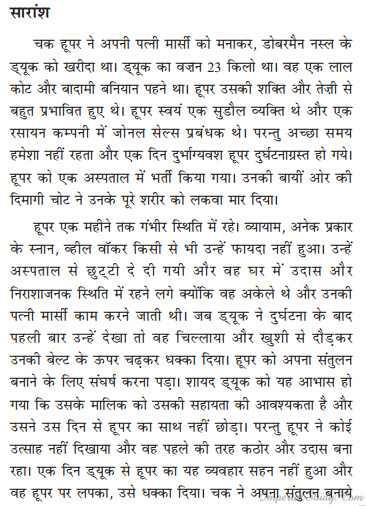
    Duke was a huge Doberman, weighing 23 kilos, with a red coat and a fawn vest. Chuck Hooper prevailed upon his wife, Marcy, and bought him because he was very impressed with the energy and agility of the dog. Hooper himself had an athletic built and professionally also he was fortunate to be the Zonal Sales Manager of a chemical company. But good luck did not last long and one unlucky day, Hooper met with an accident. Hooper had to be admitted to the hospital, due to a hemorrhage in the motor section of his brain, completely paralyzing his left side.
    Hooper remained critical for a month. Exercises, baths, wheeled walker, nothing worked. He was discharged from the hospital and became very depressed since he was lonely at home, with Marcy being away at work. In his first meeting with Duke, after his accident, Duke shouted, charged at Hooper and hit him above the belt, making him struggle to keep his balance. Perhaps the dog sensed his master’s need and from that moment, he never left Hooper’s side. But Hooper remained grim and didn’t reciprocate at all. One fine day, Duke appeared to be in no mood to tolerate his master’s indifference. He nudged, needled, poked and snorted. By chance, Chuck’s right hand hooked onto Duke’s collar to hold him still Duke pranced, Chuck asked Marcy to make him stand, and in a few seconds as he straightened his left foot to drag forward, he had taken a step. Chuck was exhausted but a beginning was made. Next day, Duke walked to the end of the leash and tugged. Chuck managed to take four steps. In two weeks, both of them managed to reach the front porch and by next month, they were along the sidewalk. Seeing this progress, the doctor prescribed a course of physiotherapy with weights, pulleys and whirlpool baths. Soon Duke began walking with Hooper, without pausing and relaxing at each step.
    On January 4, Hooper managed to walk to his district office without Duke. But Hooper was not mentally fit to undertake a full day’s work. There was no time for physiotherapy sessions so Chuck again took Duke’s help who pulled him along the street faster and faster. Chuck regained his stability, endurance and next year, he was promoted to the Regional Manager. Chuck, Marcy, and Duke moved to a new locality. But it was not to be. One day on October 12, 1957, after being run over by a car, Duke succumbed to his injuries in a nearby hospital.
    People who had seen Chuck and Duke walk together sympathized with Chuck, who walked alone now. A few weeks later, the chemical company promoted Charles Hooper to the post of Assistant National Sales Manager. As a special tribute to Duke, they called this promotion as advancing ‘towards our objective, step by step

    Content’s

  • Long Answer Questions of How I Taught My Grandmother To Read.

    1. The granddaughter proves to be a catalyst in the grandmother’s pursuit of knowledge. Discuss.
    Ans. A lot of credit in helping the grandmother in her pursuit of knowledge goes to the granddaughter. She only used to read out the episodes of the story of ‘Kashi Yatre’ every week to her grandmother. She took up the challenge of teaching the Kannada alphabet to her grandmother. The grandmother had kept Dassera festival as a deadline to learn reading. She worked with full devotion – reading, repeating, writing and reciting and the granddaughter gave full support to her. Finally, the grandmother was able to read ‘Kashi Yatre’ by herself.

    2. Why does the grandmother identify with the
    protagonist of the ‘Kashi Yatre’? What does this tell you about her character?
    Ans. ‘Kashi Yatre’ was a story of the struggle of an old lady who had a strong desire to go to Kashi or Varanasi but could not do so because she spent the money she had saved for the purpose, in helping a poor orphan get married.
    There is a belief among most of the Hindus that going to Kashi and worshipping Lord Vishweshwara is the ultimate ‘punya’. The grandmother had never been to Kashi. Like all other Hindus, she also had a desire to visit Kashi, but was anyway happy cooking and feeding her grandchildren.
    That is why she identifies herself, with the protagonist of ‘Kashi Yatre’. This shows that she is a religious lady, who is very loving and affectionate.
    3. The grandmother believes in scriptures and
    Hindu mythology, yet she touches the feet of her granddaughter. Why?
    Ans. According to the Hindu scriptures, touching the feet of elders is considered as a sign of respect. Normally, elders never touch the feet of youngsters. But the grandmother touched the feet of her granddaughter as a mark of respect because she had been her teacher. The grandmother believed that the granddaughter deserved the respect as she had taught her so well and with so much affection that she had made her confident and independent enough to read any novel all by herself.
    4. Give a character-sketch of the grandmother as depicted in the lesson, ‘‘How I Taught My
    Grandmother To Read.’’
    Ans. Grandmother is the central character, the fulcrum around which the entire lesson revolves. She is sixty-two years old, grey-haired, wrinkled and all her life is devoted to the kitchen-chores and well-being of her family. Her lifestyle is mundane, ordinary and routine. Triveni, the famous Kannada writer, acts as the only rainbow to her humdrum life. The novel ‘Kashi Yatre’ stirs in her, yearnings for a visit to Kashi, the ultimate Pooja for Hindus. The sufferings of the protagonist find a ready echo in the grandmother’s heart and she identifies with the suffering of the main character.
    The grandmother is not only religious, but also believes in worshipping Lord Vishweshwara and
    performing rituals. She is a lady of great commitment, courage and indomitable spirit, which is evident in her desire to master Kannada alphabet, even at the age of sixty-two. Determined, fiercely independent, she hates being helpless and desperate. That is why she never asks anyone else to read out the story in the entire village. She diagnoses the weakness that comes in her way and decides to learn the Kannada alphabet immediately. Her desperation over her inability to know the next episode of Kashi Yatre, her rubbing of hand over the pictures and words, is very evocative, it expresses her intense desire for learning. Triveni awakens her dormant desire for literature and education. The grandmother not only proves to be an ideal and diligent student but also preaches by precept that ‘‘One is never too old to learn and a teacher is the most revered one, irrespective of age.’’

    5. As grandmother in the story ‘How I Taught My Grandmother to Read’ write a diary entry on your transformation.
    OR
    You are the grandmother. Write your feelings in your diary when your granddaughter gave you the novel ‘Kashi Yatre’. [CBSE 2010 (TERM 1)]

    Dear Diary 25th August 2011
    I am on Cloud Nine today because I am able to read the episode of ‘Kashi Yatre’ on my own. I remember the day when my granddaughter presented me the magazine in which the novel ‘Kashi Yatre’ was published in a serial.
    Since I was uneducated, she used to read every episode to me. Just like the main protagonist of the novel I also had a strong desire to visit Kashi but could not do so for one reason or the other. I identified myself with the protagonist and became so interested in the novel that I eagerly waited for the magazine so that my granddaughter could read the next episode to me. Once she was away at a wedding, I felt helpess as I couldn’t read the story. There and then I decided to learn Kannada alphabets and it was my granddaughter who did the needful. And see the result Oh!
    I am feeling so light, so independent! I am thankful to my granddaughter. Had she not presented me the magazine, this day would never have come to my life.
    6. Imagine you are the grandmother. In about 150 words, write a letter to share your thoughts, feelings, ambitions and resolutions as a neo-literate.
    [CBSE 2010 (Term 1)]
    Dear Krishna
    How are you? I am writing this letter to give you a thrilling news — I have learned to read Kannada alphabets as you know that we could not go to school because at that time education for girls was not considered essential. Till Sudha presented me the magazine in which ‘Kashi Yatre’ was published even I never felt its important. But afterwards I got so interested in the novel that I used to wait for the next episode so that Sudha was able to read that to me. But once in her absence, I could not read it. It left a void in my life. This fanned my desire to learn. There and then I decided to read and see the result! I am independent now at the age of 62. I suggest you also should try your hand at learning Kannada alphabets. I feel so great to be able to read and write that I have decided to spend some time in teaching the ladies of my neighbourhood. Rest in next letter.
    Your friend
    7. You are Sudha Murthy. Write a letter to your friend telling her how and why you taught your grandmother to read. [CBSE 2010 (Term 1)]
    Dear Mamta
    Hope you are fine. I am writing this letter to you not to tell you about our common friends but about my student. Guess who? She is none other than my grandmother. It so happened that once I came back after attending a wedding she came to me and started crying. I was dumbstruck because I have always known her to be a tough lady who never cried even in most difficult situation.
    You know she cried at her helplessness of not being able to read. This desperation led her to decide upon learning the alphabet even at the age of sixty two. I took up the challenge of teaching Kananada alphabet to my grandmother. She kept Dassera festival as a deadline. She worked with full devotion—reading, repeating writing and reciting and I gave her full support. After she was able to read ‘Kashi Yatre’ by hereself she came and touched my feet. When I protested, she said: ‘‘One is never too old to learn and a teacher is the most revered one, irrespective of age’’. Rest in next letter.
    Sudha

    Content’s

  • Short Answer Questions of How I Taught My Grandmother To Read.

    Short Answer Questions of How I Taught My Grandmother To Read.

    1. Why could the grandmother not be educated? Give reasons.
    Ans.When the grandmother was young, education for
    girls was not considered as essential, so she was never sent to the school. Moreover, she got married at a very young age and had a busy life. Later, when she had the grandchildren, she just felt happy cooking and feeding them.
    So, her education was never thought of by anyone.
    2. For what did the grandmother set Dassara festival as a deadline?
    Ans.In the absence of her granddaughter, the
    grandmother had felt too dependent and helpless as she could not read the next episode of‘Kashi Yatra’. Due to this miserable feeling, she decided to learn the Kannada alphabet for which she kept Dassara as the deadline by then she should be able to read‘Kashi Yatra’ on her own.
    3. Explain the statement, “I knew then that my student had passed with flying colors” in the context of the lesson.
    Ans.When the granddaughter gave the novel to her
    grandmother, she opened it and read immediately the title ‘Kash Yatra’ by Triveni and the publisher’s name. The author knew then that her student had passed with the flying colors, i.e., she had been successful at learning the Kannada alphabet.
    4. The grandmother remained steadfast in her decision despite her granddaughter’s mockery? Why?
    Ans. In spite of her granddaughter’s mockery, the grandmother remained steadfast in her decision to study because she believed that if one is determined for a good cause, one can overcome any obstacle irrespective of the age. She was determined to learn the alphabet, no matter how much hard work she would have to do it.

    5. Describe the grandmother’s desperation when she was not able to read ‘Kashi Yatre’.
    Ans. When the grandmother was not able to read ‘Kashi Yatre’, she felt a vacuum in her life. She was a tough lady and had never cried even in the most difficult situations, but she cried at the helplessness of not being able to read.
    This desperation led her to decide upon learning the alphabet, even though she was sixty-two-years old.
    6. But I know it was not possible. If only I was educated enough….. Describe the circumstances that made the grandmother realize the importance of education.
    When grandmother was young, education for girls was not considered as essential, so she never went to school.
    Once her granddaughter presented her ‘Kashi Yatre’ which had been published as a serial in a magazine. She identified herself with the protagonist. Her granddaughter used to read the story to her. Once her granddaughter was away. She was unable to read ‘Kashi Yatre’, she felt a vacuum in her life. Then she realized the importance of education.
    7. What major Hindu belief did Triveni revolve her story around?
    The story revolves around a belief, prevailing among most of the Hindus, that going to Kashi and worshipping Lord Vishweshawara is the ultimate ‘Nirvana’. ‘Kashi Yatre’ is a story of an old lady’s struggle who had a strong desire to go to Kashi but could not do so because she spent the money she had saved for the purpose of helping a poor girl getting married

    Content’s