[gview file=”https://www.imperialstudy.com/wp-content/uploads/2017/05/NCERT-Class-11-Mathematics.pdf”]
Author: shivamlohiya
-
Class X NCERT Text Book Of Maths | PDF Download
[gview file=”https://www.imperialstudy.com/wp-content/uploads/2017/05/NCERT-Class-10-Mathematics.pdf”]
-
Class IX NCERT Text Book Of Maths | PDF Download
[gview file=”https://www.imperialstudy.com/wp-content/uploads/2017/05/NCERT-Class-9-Mathematics.pdf”]
-
Class VIII NCERT Text Book Of Maths | PDF Download
[gview file=”https://www.imperialstudy.com/wp-content/uploads/2017/05/NCERT-Class-8-Mathematics.pdf”]
-
Class VII NCERT Text Book Of Maths | PDF Download
[gview file=”https://www.imperialstudy.com/wp-content/uploads/2017/05/NCERT-Class-7-Mathematics.pdf”]
-
Class VI Mathematics NCERT Text Book | PDF Download
Note: Please Login To Download This PDF File
[gview file=”https://www.imperialstudy.com/wp-content/uploads/2017/05/NCERT-Class-6-Mathematics.pdf”]
-
Chapter 10 A Strange Wrestling Match NCERT Class VI English
NCERT Class VI English Chapter 10
- Everybody believed that Vijay Singh, the famous wrestler, was unbeatable.
- Vijay Singh was a bit boastful at times.
- Once he took it upon himself to fight a ghost.
THERE was once a wrestler called Vijay Singh. A tall man with massive shoulders and muscular arms, he towered over others like a giant. Vijay Singh, people said, was a born wrestler and could beat all other wrestlers in the world.
This pahalwan had but one shortcoming which often landed him in awkward situations. He was fond of boasting. One day, he was sitting in the market-place surrounded by several young men. After drinking many glasses of milk, he
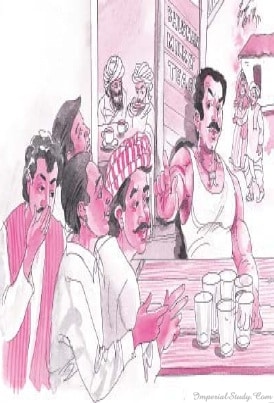
suddenly proclaimed, “Why are people afraid of ghosts? I am not. I wish I met a stout ghost. I’d teach him a lesson.”There were murmurs of applause as well as apprehension among the young men. “If you walk alone at night through the Haunted Desert,” one of them said, “you are sure to meet ghosts. They roam there freely. Strange shrieks and moans can be heard all over the place. Travellers have been looted and killed. Would you really want to go there?” Vijay Singh’s mighty heart missed a beat or two. Why did he have to boast?
“Yes, I have heard of the Haunted Desert,” he said nonchalantly. “I think it’s just a fairy tale.”
“Oh no,” said one of his admirers, “it’s true. This place is ten miles to the west on the road to Jaisalmer. The landmark is an ugly black rock that looks like the head of a camel. Beyond that there is nothing but sand and wilderness and, of course, ghosts.”
- Vijay Singh set out to find a ghost in the Haunted Desert.
- An old woman gave him a small packet containing an egg and a lump of salt.
- Vijay Singh met a ghost who claimed he was his friend, Natwar.
Almost the entire
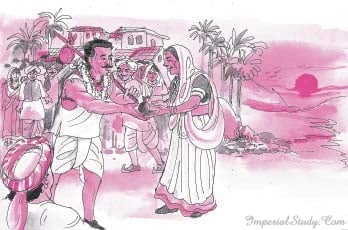 village turned up that evening to bid farewell to Vijay Singh, who was ready to set out west. Just then an old woman came forward and thrust a small packet into his hands, and Vijay Singh started walking into the red sunset of the desert.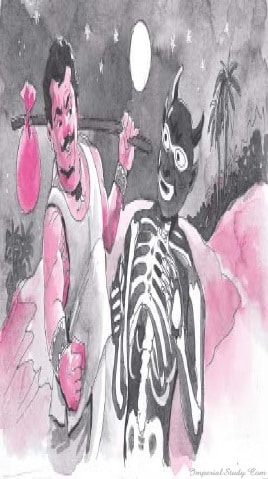
As he walked, the night deepened. The moon was bright and the stars shone clearly in the Rajasthan sky. Still a few miles short of his destination, Vijay Singh remembered the old woman’s packet. He opened it and found nothing but a lump of salt and an egg. The old woman was well-known for her eccentricities.As Vijay Singh stepped into the Haunted Desert, he heard a voice. “Vijay Singh, Vijay Singh! You will get lost in the desert. Come this way. I am your friend, Natwar.” At once Vijay Singh realised it was not his friend but a ghost. Trying to sound brave, he called back, “Where are you, my dear Natwar? It’s dark and I cannot see you. Come here and show me the way.” Like all good wrestlers, Vijay Singh wanted to size up his enemy.
Soon the ghost appeared at his side. Vijay Singh peered into his face and declared, “You are just a plain, lying ghost. Anyway, now I don’t have to walk all night. I was longing to meet you.” Not used to insults, the ghost was taken aback. People generally started back in horror when they met him. They often fainted. But here was this unfeeling creature claiming he wanted to meet a ghost. It didn’t make sense.
“Really, I don’t know why you longed to meet me,” the ghost said.
“That proves,” said Vijay Singh in a bored voice, “that you are a stupid ghost. The least a ghost can do is to read a man’s thoughts. However, a worthless ghost like you is better than no ghost. The fact is, I am tired of wrestling with men. I want to fight a ghost.”
The ghost was speechless. Marshalling his ghostly wits, he made an attempt to look Vijay Singh scornfully in the eye.
“Frankly,” he said, “you don’t appear all that strong to me.”
“Appearances can be deceptive,” Vijay Singh said. “Take your own case. You claim to be Natwar, though actually you are a rascal of a ghost. If you doubt my strength, let me give you a demonstration of it.”
Questions
1. What was Vijay Singh’s weakness? Which awkward situation did it push him into?
2. Was the old woman’s gift to Vijay Singh eccentric? Why?
3. Why did Vijay Singh ask the ghost disguised as Natwar to come closer?
4. What made the ghost speechless? Why?
5. Why did Vijay Singh say “Appearances can be deceptive”?II
- Vijay Singh demonstrated his strength by crushing what the ghost thought was a piece of rock.
- The ghost avoided a wrestling bout with Vijay Singh but decided to conquer him through cheating.
- He invited Vijay Singh to be his guest for the night.
VIJAY Singh picked up a piece of rock from the sand. “Take this,” he offered it to the ghost, “and squeeze it hard. It is filled with fluid. See if I am wrong.” While the ghost tried to squeeze the rock first with one hand, then with both, Vijay Singh stealthily took out the egg from his pocket.
Vijay Singh snatched the rock from the ghost and placed it between both hands and squeezed. At once the yellow yolk oozed from around his
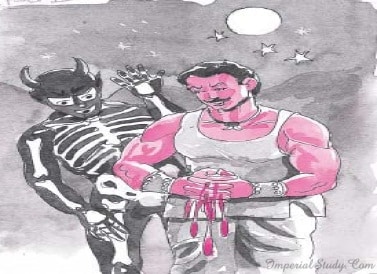 fingers, and the crackling of the egg-shell created the illusion of the stone being crushed. The ghost was so astonished he did not notice Vijay Singh bending to clean his hands with sand and
disposing of the tell-tale shell. Vijay Singh then picked up another piece of rock and gave it to the ghost. Without a word the ghost took it, felt it, and peered at it. Vijay Singh put his hand into his pocket to take out the lump of salt.“This is only a stone,” protested the ghost. “And anyway it is too dark to see.”
“Never heard of a ghost who can’t see in the dark!” remarked Vijay Singh. “That stone which you hold in your hand contains salt. Crumble it and see.” Again the ghost tried to crush the stone, but in vain. He handed over the stone to Vijay Singh. The ghost was now beginning to doubt his ghostly powers.
“I can see that you’re not going to be a worthy opponent.
 What’s the use of wrestling with a weakling whom I can floor in a minute?” So saying, Vijay Singh casually crumbled the lump of salt and let the stone drop in the darkness. He held out his hand and commanded the ghost to taste the powdered stone.
Mesmerised with the pahalwan’s extraordinary strength, the ghost
did as he was told. Alarm shot through him. This man could easily vanquish him in a wrestling bout in the dark. But perhaps, he could be tricked in other ways. Assuming a servile manner, the ghost said, “Friend
Vijay Singh, it is an honour to meet a man like you! I admit to being defeated. But where will you go tonight? Rest in my house. You can leave tomorrow.”Now thoroughly elated, Vijay Singh replied, “I cannot refuse your hospitality but tomorrow you will go with me as my prisoner. I must display the trophy of my victory to my people!” The ghost bowed in agreement, but silently vowed to kill Vijay Singh in the night. He led him to his house in the cave.
- Vijay Singh kept awake at night. He cleverly duped the ghost in his own cave.
- The ghost believed that Vijay Singh was unbeatable.
- He ran away leaving all his property which made Vijay Singh wealthy for life.
The ghost fed him dry fruits and a lot of milk, and later led him to a luxurious bed to sleep on, complete with pillows and bolsters.
But Vijay Singh lay awake listening to the snores of the ghost. In the middle of the night, he slipped off his bed. He placed a bolster in the centre of the bed, throwing over it a
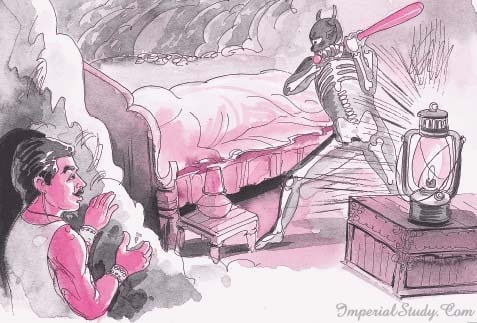
coverlet to make it look exactly like a sleeping man. Having done this he crouched watchfully in a dark corner.Sure enough, just before the break of dawn, the ghost approached the bed armed with a stout club. He brought the club down on what he thought was Vijay Singh’s head. Not hearing even a groan, he smiled, pleased that he had killed his enemy.
However, just to make doubly sure, he struck the bolster six times more. Satisfied with his work, he returned to his couch, and covering his head, settled down to sleep again. Meanwhile, Vijay Singh crept silently back into bed. After a pause, he groaned, as if in disgust, threw back his coverlet, and sat up.
Disturbed by the noise, the ghost peeped from under his bedclothes to see the strong man stretching his arms above his head and yawning. For a moment the ghost turned rigid with shock. “Friend ghost, there are insects in your cave,” said Vijay Singh in a complaining voice. “Here I was, enjoying the sweetest sleep I’ve had in years, and there comes this insect to trouble me. I distinctly counted seven flappings of its wings. Of course, it has not bitten me, but it’s most annoying.” The ghost panicked. Those seven blows would have reduced any other man to pulp. ‘There is no safety near a formidable wrestler like this,’ he thought and fled from the cave leaving behind all his ill-gotten wealth.
It took several camels from the village to remove the property Vijay Singh had acquired. He returned much of it to the rightful owners. He went especially to the old woman, thanked her for her invaluable gift, and asked for her granddaughter’s hand in marriage.
Thenceforth, Vijay Singh was more careful about boasting. It is said that no traveller was ever troubled again in the Haunted Desert.
INDIRA DAVID
[abridged Rajasthani folktale]Questions
1. How did Vijay Singh use the egg? How did he use the lump of salt?
2. Why did Vijay Singh conclude that the ghost would not be a worthy opponent to him? Was he fair in his judgement?
3. Why did Vijay Singh ask the ghost to accompany him to town next day?
4. What made the ghost believe Vijay Singh was dead?
5. Vijay Singh complained of insects in the cave. What was he referring to, and why?
6. Was it really a ghost who Vijay Singh befooled? Who do you think it was?
-
Chapter 9 What Happened to the Reptiles NCERT Class VI English
NCERT Class VI English Chapter 9 What Happened to the Reptiles
- Pambupatti is a peaceful village, inhabited by a variety of people.
- Prem, the narrator of the story, flees his village under unfortunate conditions to reach Pambupatti by chance.
- An old resident of the village looks after him and tells him an interesting story.
YOU may not believe this story. But I can tell you it is true, because I have been to Pambupatti, a village on the edge of the jungle. It is on a cliff, and the vast forest stretches below like a mossy green carpet. There are many kinds of people in the village — dark, fair, tall, short. They speak many languages. Some eat meat, some don’t. Some pray in a small temple at the edge of the forest. Others pray in a mosque some miles away.
My name is Prem and I live many hundred miles away from Pambupatti. I had heard about the village, but I’d never been there. Then last year, something terrible happened. The people of my own village went mad. Far, far away in a place they have never even been to, a temple or mosque had been burnt down, and they went mad. They started fighting with one another. Some had to run away in the middle of the night. And at three in the morning, as I lay in my house, half awake to the sounds of hate and violence, there was a fire. Many houses were burnt down in the fire. One of them was mine.
I managed to grab a few clothes, some coins, my little Ganesh statue, and I ran! I ran for a day and a night, resting whenever my legs would not carry me any further. I jumped on to a train, then on a bus. No tickets. Never mind, everyone
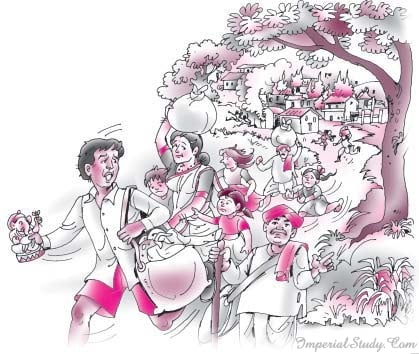
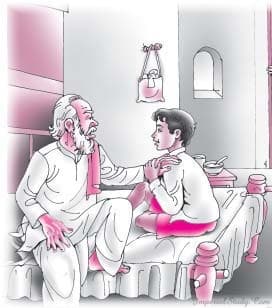
seemed to be running. Finally, I found myself in Pambupatti, and I saw some villagers gathered near a well. I ran to them, and before I could say a thing, I fainted.When I opened my eyes, I saw an old man with white hair, white beard and shining black eyes bending over me. For the next few days, he looked after me, putting food in my mouth and bringing me sweet, cool water from the stream. He rubbed my feet gently and made the pain go away. Neighbours, strangers — everyone came to visit me.
“Tell me, Grandfather,” I said to him one day. “I have never seen people like the villagers here! In my village, people fight with those who pray to another god. But here … this seems a very strange place!”
“Prem,” replied the old man, “I will tell you the story of Pambupatti. You can take this story back to your village. Maybe it will heal some of its wounds, and dry some of its sores.”
“Oh, Grandfather,” I said anxiously, “don’t say that. What I have seen in my village makes me burn with shame. I never, never want to go back there.”
“But that’s exactly why you must go back,” he said, in a soft voice. I kept quiet. I didn’t want to argue with him, and I wanted to hear his story.
- Very, very long ago, there were no animals in Pambupatti, only reptiles.
- They had a meeting every month. Their leader, Makara, would chair the meeting.
- Misusing his power, Makara ordered the tortoises and snakes to leave the forest.
It happened a long, long time ago, he began. So long ago that there were no schools and no teachers.
 Children lived in caves with their parents and helped them to collect fruit and berries from the forest. At that time, there were no tigers or panthers or elephants in Pambupatti forest. There were only reptiles, many kinds of reptiles. Now you know what reptiles are. Snakes, crocodiles, turtles, lizards. And you know that a reptile has scales on its body and it lays eggs. Every month, the reptiles of Pambupatti had a big meeting. Everyone came — the pretty excited snakes, the slow thoughtful tortoises, the clever quick lizards,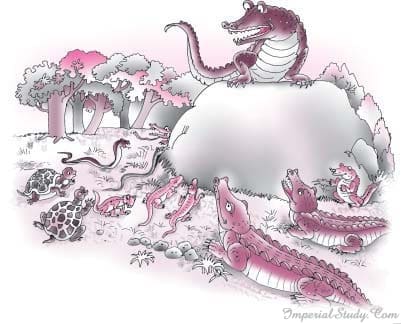
and the moody crocodiles, grumpy because they were out of water. The president of these meetings was Makara, the biggest crocodile of the forest.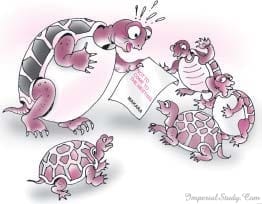 All the animals thought he was very important. When someone is strong and powerful, you know, it is difficult not to go along with what he says or does.
Now, one day, a strange thing happened. It was a week before one of the monthly meetings. Makara sent a letter to the tortoises, asking them not to come to the meeting. Ahistay,
the big old star tortoise with black and yellow pictures on his shell, was very angry.“What does this mean?” he shouted. “How dare they!” But not one of the tortoises had the courage to attend the meeting— they were so few, the others so many!
Before the meeting, the giant Makara polished his teeth with the red flowers of the tree by the river till they sparkled. Everyone was waiting for him at the meeting place.
“Brothers and sisters,” he began. All the reptiles, even the beautiful king cobras, stopped talking. Makara continued his speech. “I have decided that we don’t need the tortoises! I have told them not to come today. Brothers and sisters, can you tell me why we don’t like the tortoises?”
The reptiles looked this way and that. They felt very uncomfortable. The snakes hissed anxiously, the lizards wriggled their tails, the crocodiles opened their jaws even wider.
“But…” said one little lizard.
“No BUTS!” shouted Makara. There was silence.
“I think …” said a baby crocodile.
“No I THINKS!” screamed Makara, so loudly that the fruit in the tree above him rained down. After that, no one had the courage to speak.
Makara cleared his throat and showed a few more teeth. “Well,” he said, “I will tell you why we don’t like the tortoises. They are so slow! So stupid! They even carry their houses on their backs. Whoever heard of such a stupid thing? Now you lizards, you live in trees. Would you ever carry a TREE on your back? Would you?”
Small, frightened voices answered together, “No, we wouldn’t. But…”
“No BUTS! Now, listen. I have told the tortoises that they will have to move out of Pambupatti. When they go, we will have more of everything. More food, more water, more space. I want them out by tomorrow. But because they are such slowcoaches, I have given them one week. By next Tuesday we won’t have a single tortoise left in this jungle!”
And by the following Tuesday, they were all gone. At first the animals were sad, but then they realised that what Makara had said was true. There was more food, more water, and more space for them! But soon, a strange smell began to fill the forest. It was the smell of rot — rotting fruit on the ground, rotting animals in the river. This was what the tortoises used to eat. And even Makara had to go about holding his nose with his big claws.
A month passed by, and then the same thing happened all over again. But this time, it was the snakes. Makara wrote them one of his letters. They were to leave the forest and, since they could move fast, they had to go in a day!
Naga, the head of the snakes, pleaded for more time, but Makara would not give in. At the meeting, he silenced the others — the lizards and crocodiles — with even louder shouts
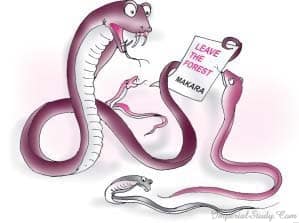 and threats. “Snakes are slimy,” he said, “and they make funny noises. Who wants such weird creatures around?” Again, no one dared to disagree with Makara, and so the snakes left.
For a while, the animals of the forest were happy because they had been a little afraid of the snakes. You never knew when one of them might lose his temper and spit some venom at you! And it took only a little poison to kill you, after all.
- The lizards were also ordered to leave, and the whole forest now belonged to Makara and his group.
- The crocodiles faced unforeseen problems in the absence of their fellow reptiles.
- They soon realised that their happiness lay in their fellow creatures’ happiness and homecoming.
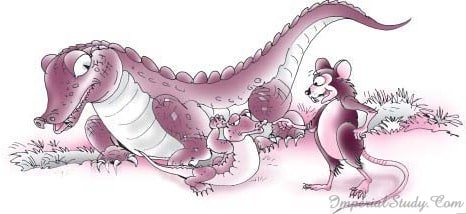
A few weeks passed and the animals of the forest looked tired and fed up. The RATS! Now that there were no snakes to eat them, the rats had taken over the forest. And they were having a wonderful time. They were everywhere, on the trees, in the grass, in the bushes, on the ground. They ate up the eggs of the lizards and crocodiles. There would be no babies that year. Makara’s own nest of eggs had been chewed up.Then Makara had a great idea. He called a meeting of the crocodiles and said, “Wouldn’t it be wonderful if we, the
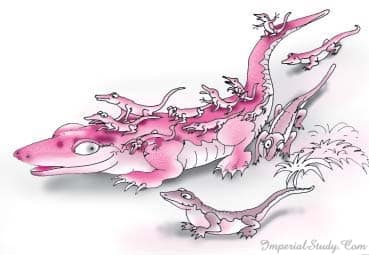
crocodiles, could have the WHOLE jungle for ourselves? No one but us? These lizards, now, just look at them! They have the strangest habits, and some of them even change colour! How can we trust someone who is green one minute, red the next? Let’s get rid of them.”By now, the crocodiles were really scared of Makara. So they clapped and cheered. Makara was pleased. The lizards left the forest, some with their babies on their backs.
But now, when life should have been wonderful for the crocodiles of Pambupatti, all kinds of awful things began to happen. To begin with, the rats grew bolder by the day. They became so fearless that they jumped and turned somersaults on the crocodiles’ backs! And there were too many frogs. They seemed to be growing larger, and there was no one to eat them but the crocodiles. These huge frogs began to eat the baby crocodiles. And the insects! Now that the lizards were gone, there were millions of them, growing bigger and nastier by the day.
It was a terrible time for the crocodiles. They couldn’t understand what had happened to their happy forest home. Then one day, a squeaky little voice piped up at one of their meetings, “We know why the forest has gone crazy, don’t we?”
Suddenly everyone was silent. They looked at Makara fearfully, but to their surprise, he looked nervous. He shook a rat off his tail and asked the small crocodile. “Why, little fellow?”
“It all began with the tort—”
“Okay, okay”, said Makara. “There’s no need to talk so much.” Makara didn’t want to admit he was wrong, but it didn’t matter. All the crocodiles knew now that he was not all that strong or powerful. Or always right. They sent urgent messages all over the place for the tortoises, snakes and lizards to come back to Pambupatti. And what a great day it was when these creatures came back, family after family, with their little ones on their backs or straggling behind, shouting at their parents to wait for them!
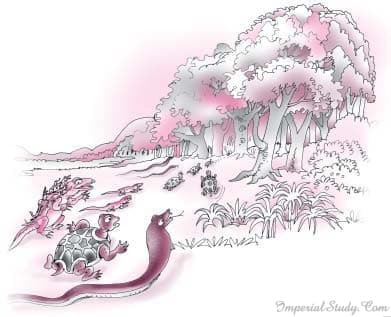
In two months, the forest was back to normal. The rats disappeared, and the insects, and the smell, and the world finally went back to its familiar old self.“Well, Prem,” said the old man, “have you fallen asleep? Did my story send you off to dreamland?”
I shook my head. “No, Grandfather, I was just thinking. Maybe it’s time I went back to my own village, because I have a story to tell them. But what if they don’t listen to me?”
“We can only keep at it, my son — tell these stories again and again, to more and more people. Some of them may laugh at you or say your stories are not true. But they may remember them one day, and understand that each of us has a place in this strange, funny world of ours.”
ZAI WHITAKER
Questions
1. In what way is Pambupatti different from any other village?
2. Why is Prem determined not to return to his village?
3. Why did Makara dislike tortoises, snakes and lizards? Write a line about each.
4. What went wrong when the tortoises, snakes and lizards left the forest?
5. Why do you think Prem wants to tell the story of the reptiles to the people of his village?
6. Do you agree that it is difficult not to go along with someone who is very strong and powerful? Express your views frankly and clearly.
7. If you were a baby crocodile, would you tell Makara that he was wrong? What would you say to convince him? -
Chapter 8 A Pact with the Sun NCERT Class VI English
NCERT Class VI English Chapter 8 A Pact with the Sun
- Saeeda’s mother has not received proper medical treatment for her complaints.
- She is denied healthy food, sunshine and fresh air.
- At last, she consults a good physician who gives her effective medicine and sound advice.
SAEEDA’S mother had been ailing for a long time—fever, cough, body-ache, painful joints and what not. Treated by a variety of physicians for weeks, she often showed signs of improvement but soon relapsed into her old, sick self, one complaint substituted by another. Though weak and colourless, she was forbidden normal food and was under strict orders to remain perpetually confined to her small, dingy room with doors and windows fastened, deprived of sunshine and fresh air.
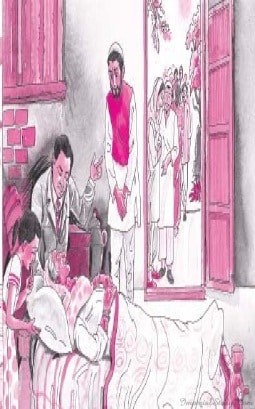
When she became critical, her relatives and neighbours persuaded her to consult a specialist even though his fee was likely to be high. Life is more precious than money, they said. Saeeda’s mother was poor but she heeded their advice and sold a few trinkets to pay the doctor’s fee and the cost of medicine.
The doctor came in a few days and examined her and prescribed effective but costly medicine. To the question as to what she should eat he said, “Anything you wish to eat — chapati, vegetables, milk, fruits, etc. In addition to all this,” he added emphatically, “leave this dark hovel and occupy a bigger room with doors and windows open. Sit in the sun every morning from eight to nine. Sunshine and fresh air,” he concluded, “are more important than medicine.”
The doctor and his advice became a subject of noisy commentary among all present. Some favoured while others opposed it. Exposure to sun and air for someone afflicted with chronic cough was dangerous, an experienced lady declared. A younger neighbour nearly quarrelled with her over this. Too exhausted to participate in the debate, Saeeda’s mother remained quiet but determined to follow the doctor’s advice.
“Forget the consequences,” she said at last. “I’ll carry out his instructions to the letter. Move my bed into the next room and let me sit in the sun on my charpoy for an hour daily.”
- The sky remains overcast with clouds for a few days.
- Saeeda makes a special request to the sunrays to help her mother get well.
- The sunrays keep their word, come down in large numbers and give new life to Saeeda’s mother.
It so happened that the sky remained overcast next morning. The same was the case the following day. Saeeda’s mother was dejected. She muttered, “O Lord of mine, why have you ordered the sun to remain hidden? How will I ever be cured?”
Saeeda was playing with her doll nearby and she heard her mother’s lament but kept calm. Later in the afternoon, when she stumbled on a spot of pale sunshine in the courtyard, she ran to her mother to say the sun was there. “No, no”, said everybody present. “It’s too late and chilly. Your mother can’t sit out there.” Disheartened, Saeeda returned to her doll. There was no sun really except for its last remnant entangled in the top branches of the family mango tree.
Now, children have at their command a secret language, foreign to grown-ups altogether, in which they fluently communicate with trees, flowers, animals, the sun and the moon, perhaps even with the Almighty. Using that special language, Saeeda addressed her remark to the last departing ray of the sun. “Dearest sister, do come tomorrow with lots of warmth and brightness. You see, my mother is ill and needs your help.”
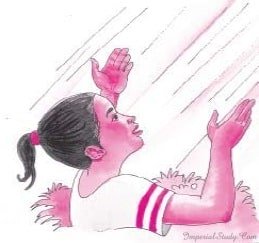 “Surely,” answered the light, “don’t look unhappy. We’ll be here at the fixed hour.”
Next day, early in the morning, when the sprightly sunrays embellished themselves for their journey down to earth, the sun said, “It’s our day off again. We’re staying up here. The road to earth is blocked by an army of thick, mucky clouds.” The little rays so much wanted to go down for a lark but they remained quiet. One of them, though, who had made a pact with little Saeeda said, “Sir, I can’t stay back. I’ve given my word to Saeeda whose mother is ill and needs our help. I’ll pierce through the clouds to reach Saeeda’s courtyard. How else will her mother be cured?” Hearing this, all the rays nearly staged a revolt against their father, the sun. “Fancy staying back again,” they said in a single voice. “What will the people of the earth say about us? That we of the heavens have turned liars?”
The sun relented. “Please yourselves,” he said. “Mind your clothes, though. The clouds are mucky.”
“Never mind our clothes. We can always change. But go we must.” And the rays rushed towards the earth. The clouds stood guard between them and Saeeda’s courtyard. The little rays focussed their heat — and they had enough of it — on a battalion of clouds, which had to flee from its post. The rays got through, shooting past the bewildered clouds. They were already late.

Saeeda saw the whole host of them approaching and her heart leapt with joy. She shouted, “Amma, Amma! The sun is here. Come out.” The old lady’s eyes welled up with tears of gratitude. Her charpoy was placed in the courtyard and she sat on it for an hour reclining against bolsters. It had been months since she had felt the sun on her hands and face and breathed in fresh air. She thought she was in a new world. Though pale, her face glowed and her eyes shone bright. She saw her child too bathed in sunlight and kissed her. The morning air brought in a new fragrance from nearby flowers. The birds chanted a new tune. Saeeda’s mother felt better already.She is fully recovered now, but she still follows the doctor’s advice — an hour of sunlight and lungfuls of fresh air every day.
ZAKIR HUSAIN
[translated from the Urdu and
slightly modified]Questions
1. What did the physicians ask Saeeda’s mother to do to get well? Did their advice help her? If not, why not?
2. What did the specialist prescribe in addition to medicine?
3. What did Saeeda tell the sunrays to do?
4. Why were the sunrays keen to go down to the earth the next day?What is your own formula for keeping good health?
Who would you recommend to a patient in your neighbourhood — the physicians contacted first or the specialist contacted next? Give reasons for your choice. When would you make a pact with the sun? When you are going on a picnic, or when you are playing a cricket match? Think of other occasions.
-
Chapter 7 The Wonder Called Sleep NCERT Class VI English
NCERT Class VI English Chapter 7 The Wonder Called Sleep
- Our body and brain recover from fatigue after a good sleep.
- We dream while sleeping, but we do not always remember our dreams.
- During sleep, our heartbeat becomes slower and our temperature and blood pressure go down.
WE know enough about what sleep is, though we don’t know what exactly causes sleep. Sleep is a state of rest — an unconscious rest. When we sleep, our body recovers from fatigue caused by the day’s activities. After a good sleep and the rest that it gives, we
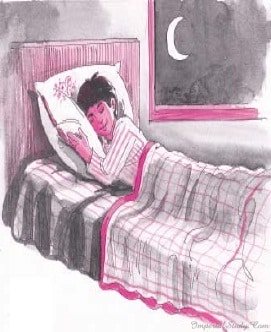 become alert and active again, ready for the normal activities of the day.
When we wake up in the morning, it is not always possible for us to remember what happened when we were asleep. We may remember a dream but the rest of
our sleep was a kind of darkness in which nothing seems to have taken place.Several things happen to our body while we are sleeping. As we sink deeper into sleep, our muscles relax more and more. Our heartbeat becomes slower. Our temperature and blood pressure go down. The ever-active brain also slows down so that we can’t think or act consciously. But we dream.
When we wake up, our temperature and blood pressure rise to normal. Our heartbeat and breathing also become normal and we are fully awake, and have forgotten most, if not all, the dreams that we had while sleeping.
- A dream is an activity of the mind when we are asleep.
- Dreams help us sleep through noise and other disturbances.
- Dreams may reveal something about one’s problems, but they cannot tell the future.
What is a dream? It is an activity of the mind that takes place when we are asleep. Some dreams are probable while others are not. That only means that many of the things that happen in dreams could happen when we are awake. Others could not. Dreams seem to be important for several reasons. One is that a dream can help us to sleep through noise or other disturbances. For example, the alarm clock rings, but our mind causes us to dream that the telephone or doorbell is ringing, and that we are awake and answering it.
Certain doctors have found that one’s dreams often reveal a great deal about one’s problems and that, if understood correctly, they can provide a key to the solution of those problems. But we must remember one thing. Dreams cannot be used as a way to tell the future. They simply can never tell the future.
Sleep is the most common experience, but how many of us really think about the wonder and power of sleep? Many poets have written beautiful poems about sleep. Here is one in which the poet is describing the experience of falling asleep. Read it aloud.
Lights Out
I have come to the borders of sleep,
The unfathomable deep
Forest where all must lose
Their way, however straight,
Or winding, soon or late;
They cannot choose.
There is not any book
Or face of dearest look
That I would not turn from now
To go into the unknown
I must enter and leave alone
I know not how.EDWARD THOMAS
Questions
1. What is the most obvious advantage of sleep?
2. What happens to our body when we sleep?
3. Define a dream in your own words.
4. Why are dreams important? Mention two reasons.
5. Why has sleep been called a wonder?
6. Describe briefly to the class an improbable dream you have had.Grandmothers and mothers sing nice little songs while rocking little ones to sleep. Such a song is called a ‘lullaby’. Do you remember a lullaby in your own language? Tell the class in English what the lullaby says.