Category: Accountancy

  • Depreciation Notes Class 11th Accountancy

    Depreciation

    1. Meaning

    ‘Depreciation’ means decline in the value of a fixed asset due to use, passage of time or obsolescence.

    2. Depreciation and Other Similar Terms

    The term depreciation covers depletion, amortization and obsolescence.

    • Depletion The term depletion is used in respect of natural resources or wasting assets like mines, quarries oil reserves etc. There occurs an erosion in the value of these natural resources due to the extraction of these resources which is called as depletion. The main difference between depletion a depreciation is, depletion is concerned with the exhaustion of economic resources but depreciation relates to usage of an asset.
    • Amortisation term amortization rerefers towriting-off the value of intangible assets like patents, copyrights, trademarks, goodwill etc., which can be utilized only for a specified time period.
    • Obsolescence Decline in the economic value of the assets due to innovation or improve technique or equipment and market decline or to change in taste and fashion, is reffered to the obsolescence.
      In short,
      Depreciation- Fixed assets except for land
      Depletion- Natural resources like mines
      Amortisation- Intangible assets like patent
      Obsolescence- Plants machinery and irwentory

    Causes of Depreciation

    Various causes of depreciation, spelt out as part of the definition of depreciation in AS-6 are as follows:

    1. Physical wear and tear
    2. Passage or efflux of time
    3. Expiry of legal rights
    4. Obsolescence
    5. Abnormal reasons


    Need for Depreciation

    1. Matching of cost and revenue
    2. Consideration of Tax
    3. True and fair financial position
    4. Compliance with the law


    Factors Affecting the Amount of Depreciation

    1. Cost of Assets
    2. Estimated Net Residual Value (NRV)
    3. Estimated useful life

    Methods of Calculating Depreciation

    1. Straight Line Method Under this method, a fixed and equal amount in the form depreciation, according to a fixed percentage on the original cost, is written-off each year over the expected useful life of the asset. It is also known as original cost method or fixed instalment method. It is the earliest and widely used methods of providing depreciation.
      The depreciation under this method is calculated by using the following formula:

    Depreciation=Cost of Assets – Estimated NRV
    ……………………………………………………..
    Estimated Useful Life

    If the annual depreciation amount is given, then we can calculate the rate of depreciation, with the following formula:

    The rate of Depreciation=Annual Depreciation on Amount
    ……………………………………………………….
    Cost of Asset * 100

    2. Written down the method under this method, depreciation is changed over the book value of the asset. It involves charging a fixed rate on the written down value. The amount of depreciation goes on reducing year after year. As the book value keeps on reducing by the amount charge, it is also known as reducing balance method or diminishing balance method.

    Under the written down value method, the rate of depreciation is computed by using the following formula:

    Methods of recording depreciation

    1. Charging depreciation to asset account under this method, depreciation is directly charged to the asset account, i.e. depreciation is deducted from the depreciation cost of the asset (credited to the asset account) and changes (or debited) to profit and loss account.

    Journal Entries

    For Recording Purchase of Asset

    Asset A/c Dr

    To Cash/Bank/Vendor A/c

    (Being the asset purchased)

    For Providing Depreciation

    Depreciation A/c Dr

    To Asset A/c

    (Being the depreciation provided)

    For Closing Depreciation Account

    Profit and Loss A/c Dr

    To Depreciation A/c

    (Being the transfer of depreciation account to profit and loss account)

    Treatment in balance sheet under this method, the fixed asset appear its net book value/ written down value (i.e., cost less depreciation charged till date) on the assets side of balance sheet and not at its original (historical) cost.

    1. Creating Provision for depreciation account/ accumulated depreciation account under this method, a separate account named as ‘provision for depreciation’ ‘of accumulated depreciation’ account is created and the annual depreciation is transferred to this account.

    Journal Entries

    For Recording Purchase of Asset

    Asset A/c Dr

    To Bank/Cash/Vendor A/c

    For Providing Depreciation

    Depreciation A/c Dr

    To Provision for Depreciation A/c

    For Closure of Depreciation Account

    Profit and loss A/c Dr

    To Depreciation A/c

    Treatment in balance sheet in the balance sheet, the fixed asset continues to appear at its original cost on the asset side. The depreciation charged till that date appears in the provision for depreciation account, which is shown either on the ‘liabilities side’ of the balance sheet or by way of deduction from the original cost of the asset concerned on the asset side of the balance sheet.

    1. Disposal of Asset

    Disposal of an asset can take place either (a) at the end of its useful life or (b) during its useful life (due to obsolescence or nay other abnormal factors.)

    If the asset is sold at the end of its useful life, the amount realized on account of the sale of asset as scrap should be credited to the asset account and the balance is transferred to profit and loss account. If the sale proceeds exceed the book value of the asset, there is profit and if the sale proceeds fail short of written down value, loss in incurred.

    Journal Entries

    For Recording Sale of Asset

    Cash/Bank A/c Dr

    To Asset A/c

    (Being the assets sold)

    For Recording Profit/Loss on sale

    1. In case of Profit

    Asset A/c Dr

    To Profit and Loss A/c

    (Being the transfer of profit on sale of asset)

    1. In case of Loss

    Profit and loss A/c Dr

    To Asset A/c

    (Being the transfer of loss on sale of asset)

    1. Asset Disposal Account

    The account created to provide a complete picture of all the transactions involved in sale/disposal of an asset under one account head is ‘asset disposal account’.

    This account is opened when a part of asset is sold and provision for depreciation account exist.

    Dr Asset Disposal Account Cr

    1. Provisions

    The account set aside for the purpose of providing for any known liability or uncertain loss or expense, the amount of which cannot be ascertained with certainity is referred to as provision.

    Examples of provisions are provision for depreciation, provision for repairs ad renewals etc.

    1. Importance of Provision
    2. To meet anticipated losses and liabilities
    3. To meet known losses and liabilities
    4. To present correct financial statements
    5. Accounting Treatment and Disclosure of Provision

    Provision is a charge against the profit and is created by debiting and loss account. In the balance sheet, the amount of provision may be shown either

    1. On the assets side, by way of deduction from the concerned asset.
    2. On the liability side along with the current liabilities.
    3. Reserves

    Reserves are referred to as the amount set aside from profits and retained in the business to provide for certain future needs like growth and expansion or to meet future contingencies. Examples of reserves are general reserve, workmen compensation fund, etc. Reserves are not a charge against profit but are the appropriation of profit.

    1. Types of Reserves

    Reserves are generally classified into

    1. Revenue Reserves The reserve created from revenue profits which arise out of the normal operating activity of the business and are otherwise freely available for distribution as dividend are known as revenue reserves.

    Revenue reserves can be classified into

    1. General Reserve the reserve which is not created for a specified purpose is general reserve. It is also known as free reserve or contingency reserve.
    2. Specific reserve These are the reserves that are created for some specific purpose and can be utilized only for that purpose.

    Examples of specific reserve are given below:

        • Dividend equalization reserve
        • Workmen compensation reserve
        • Investment fluctuation fund
        • Debenture redemption reserve
    1. Capital reservethe reserves which are created out of capital profits and are not available for distribution as dividend are known as capital reserve. Capital reserves can be used for working off capital losses or issue of bonus shares in case of a company.

    Examples of capital profits are premium on issue of shares of debentures, profit on sale of fixed assets etc.

    1. Importance of Reserves
    2. Reserves strength the financial position of an enterprise.
    3. The amount set aside as reserves may be utilized for the purpose of meeting of future contingency.
    4. Creation of reserves help in the expansion of business operations or for bringing uniformity in distribution of dividends.
    5. Creation of certain reserves is also required by law, e.g. investment allowance reserve, debenture redemption, etc.
    6. Accounting Treatment and Disclosure of Reserve

    Reserves are not a change against profit but are the appropriation of profits. Hence, reserves are transferred to the profit and loss appropriation account. Reserves are shown under the head reserves and surplus on the liabilities of the balance sheet.
  • Trial Balance Notes Class 11th Accountancy.

    Trial Balance

    1. Meaning

    Trial balance is a statement prepared with the debit and credit balances of ledger accounts to test the arithmetical accuracy of the books.

    1. Objectives, Needs or Functions of Preparing a Trial Balance
    2. Ascertain the arithmetical accuracy of the ledger accounts
    3. Helps in locating errors
    4. Summary of the ledger accounts
    5. Helps in the preparation of final accounts
    6. Balance Method of Preparing Trial Balance

    Balance method is the most commonly used method of preparing trial balance as it facilities the preparation of final accounts. Under this method, trial balance is prepared by showing the balances of all ledger accounts (including cash and bank accounts) and then totaling up the debit and credit column of the trial balance to assure their correctness. The account balances are used because the balance summaries the net effect of all transactions relating to an account and helps in preparing the financial statements. Trial balance can be prepared under this method, only when all the ledger accounts have been balanced.

    1. Steps to Prepared a Trial Balance

    Step 1 The balances of each account in the ledger are ascertained.

    Step 2 List each account and place its balance in the debit or credit column (if an account has a zero balance, it may be included in the trial balance with zero in the column for its normal balance).

    Step 3 Compute the total of debit balances column.

    Step 4 Compute the total of debit balances column.

    Step 5 Verify that the sum of the debit balances equal the sum of credit balances. If they do not tally, it indicates that there are some errors. So, one must check the correctness of the balances of all accounts.

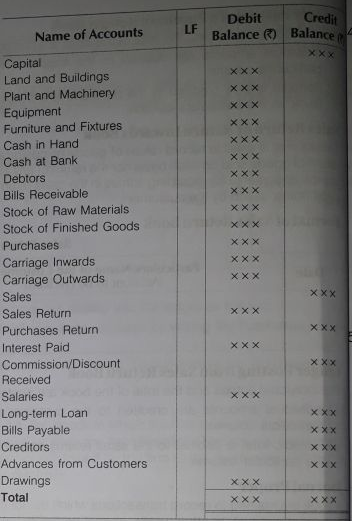
    1. Format of Trial Balance

    An illustrative trial balance indicating list of various accounts with their respective balances (i.e. debit or credit) is shown as below.

    1. Errors not Disclosed by Trial Balance
    2. Errors of complete omission
    3. Errors of principles
    4. Compensating errors
    5. Incorrect amount entered in the journal
    6. Posting to the wrong account.
    7. An entry posted twice in the ledger.

    Bank Reconciliation Statement

    1. Meaning

    Bank reconciliation statement is prepared mainly to reconcile the different between the bank balance as shown by the cash book and bank pass book.

    1. Need and importance of Bank Reconciliation Statement
    2. It helps in locating any error that may have been committed enter in the cash book or in the pass book.
    3. It helps in bringing out the unnecessary delay in the collection of cheques by the bank.
    4. Embezzlements are avoided by regular periodic reconciliation.
    5. The customer is assured of the correctness of bank balance shown by the pass book, by prepared a bank reconciliation statement.
    6. It helps the management to keep a track of cheque which has been sent to the bank for collection.
    7. Bank Pass Book (or Bank Statement)

    Bank pass book id a copy of the customer’s account in books of a bank to customer/account holder so that entries can be complete with entries in cash book and the difference can determined.

    1. Reasons of Different between Cash Book and Pass Book Balances

    The differences between the cash book and the bank pass book is caused by

    1. Differences due to timing on recording any transaction

    The factors affecting time gap includes

        1. Cheques issued by the bank but not yet presented for payment.
        2. Cheques paid/deposited into the bank but not yet collected.
    1. Transactions recorded by the bank
    2. Direct debits made by the bank on behalf of the customer.
    3. Amounts directly deposited in the bank account by the customer.
    4. Interest and dividend collected by the bank.
    5. Direct payments made by the bank on behalf of the customers.
    6. Interest credited by the bank but not recorded in the cash book.
    7. Cheque deposited/bills discounted dishonored.
    8. Differences caused by errors
    9. Errors committed in recording transactions by the firm.
    10. Errors committed in recording transactions by the bank.
    11. Preparation of Bank Reconciliation System without Adjusting Cash Book Balance

    Under this approach, the balance as per cash book or the balance as per pass book is taken as the starting item. The debit balance or favourable balance as per the cash books means the balance of deposits held at the bank. Such a balance will be credit balance or favourable balance as per the pass book.

    On the other hand, the credit balance or unfavourable balance as per the cash book indicates bank overdraft. Such a balance will be a debit balance or unfavourable balance as per the pas book. An overdraft is treated as negative figure on a bank reconciliation statement. When the starting point or the first item in the statement is the overdraft (unfavourable) balance, it is to be shown on the minus side. It is to be noted, all the items in case of overdraft are debit in the same manner, as in the cash of favourable balances (Whether cash/pass book). Unfavourable balance or overdrafts implies credit balance in cash book of debit balance in pass book.

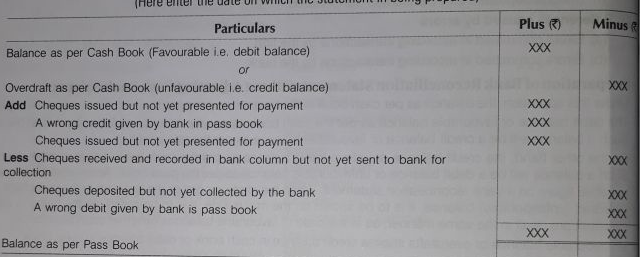
    Format of bank reconciliation statement when the bank balance as per cash book is taken as a starting point.
    Bank Reconciliation Statement

    As on…

    (Here enter the date on which the statement is being prepared)

    • When the balance as per Pass Book is taken as the starting point, the treatment of all items will be reversed, i.e. item that are added, will be deducted and item that are deducted will be added.
    • Either favourable balance or overdraft shall appear.
    • If the total of ‘plus item column’ exceeds the total of ‘minus items column’ the difference between the two is termed as an overdraft.
    1. Preparation of Bank Reconciliation Statement with Adjusted/Amended Cash Book Balance

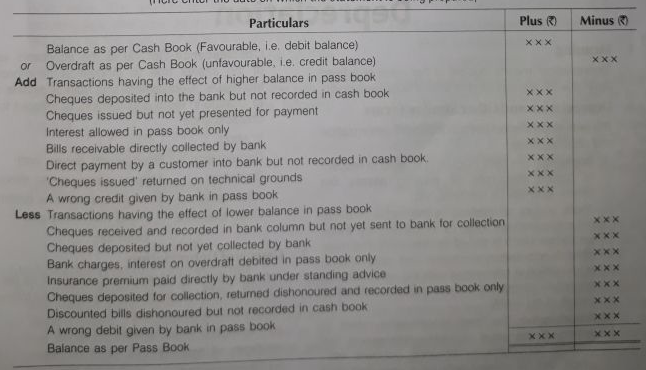
    Another method of preparing bank reconciliation statement is on the basis of the balance of amended cash book. There are a number of items that appears only in the pass book so therefore, it is recommended that the cash book should be prepared to work out the adjustment balance (also known as amended balance) of the cash book and then prepare the bank reconciliation statement.

    Bank Reconciliation Statement

    As on…

    (Here enter the date on which the statement in being prepared)

    • When balance as per pass book is taken as the starting point, the treatment of all items will be reversed i.e. items that are added will be debuted and items to be deducted will be added.
  • Journal and Ledger Notes Class 11th Accountancy

    Journal and Ledger

    1. Rules of Debit and Credit

    Debit (Dr) means to enter an amount of transaction on the left side of an account and credit (Cr) means to enter an amount on the side of an account. Depending on the nature of account, both debit and credit may represent increase or decrease.

    Rules for debit and credit according to traditional classification (i.e. personal, real and nominal)

    Types of Accounts Rules for Debit Rules for Credit
    Personal Accounts Debit the receiver Credit the giver
    Real Accounts Debit what comes in Credit what goes out
    Nominal Accounts Debit all expenses and losses Credit all incomes and gains


    Rules for debit and credit according to modern classification or accounting equation based classification

    Types of Accounts Types of Accounts Rules for Credit
    Assets Accounts Debit the increase Credit the decrease
    Liabilities Accounts Debit the decrease Credit the increase
    Capital Accounts Debit the decrease Credit the increase
    Revenue Accounts Debit the decrease Credit the increase
    Expenses Accounts Debit the increase Credit the decrease
    1. Book of Original Entry (Journal)

    Journal is the book of original entry or prime entry. Journal is a book in which transaction are recorded in the order in which they occur, i.e. in chronological order. The process of recording a transaction in a journal is called journalizing. An entry mode in the journal is called a journal entry.

    1. Format of a Journal

    Journal

    Date

    (1)

    Particulars

    (2)

    LF

    (3)

    Amt (Dr)

    (4)

    Amt (Cr)

    (5)

    1. Simple and Compound Journal Entries

    The journal entry is the basic record of a business transaction. It may be simple or compound.

    1. Simple entry when only two accounts are involved to record a transaction, it is called a simple journal entry. In this one account is debited and another account is credit with an equal amount.
    2. Compound entry when the number of accounts to be debited and credit is more than one, entry made for recording the transaction is called compound journal entry. In other words, it involves multiple accounts.
    3. Recording in Journal

    Entries are recorded in journal on the basis of source documents following the rules of debit and credit.

    A Quick Glance of Some Important Journal Entries

    Transactions Journal Entry
    Cash brought into the business as capital Cash/Bank A/C Dr

    To Capital A/C

    Cash and other assets brought into business Building A/c Dr

    Plant and Machinery/Furniture A/c Dr

    Cash A/c Dr

    To Capital A/c

    Goods purchased on cash Purchases A/c Dr

    To Cash/Bank A/C

    Goods purchased on credit Purchases A/c Dr

    To Supplier’s A/c

    Cash Sales Cash A/c Dr

    To Sales A/c

    Sales of goods on Credit Customer A/c Dr

    To Sales A/c

    Opening a bank account Bank A/c Dr

    To Cash A/c

    Purchase of assets for cash Assets A/c Dr

    To Cash/Bank A/c

    Sale or disposal of any old asset at loss Cash/Bank A/c Dr

    Loss on Sale of Assets A/c

    To Asset A/c

    Sale or disposal of any old asset at profit Cash/Bank A/c Dr

    To Loss on Sale of Assets A/c

    To Asset A/c

    Cash withdrawn for personal use Drawings A/c Dr

    To Cash A/c

    Goods withdrawn for personal use Drawings A/c Dr

    To Purchase A/c

    Goods given as Charity Charity A/c Dr

    To Purchase A/c

    Goods returned by the customer Return Inwards A/c Dr

    To Customer A/c

    Goods returned to the supplier Supplier’s A/c Dr

    To Return Outwards A/c

    Withdrawn of cash from bank Cash A/c (Office Use) Dr

    Drawings A/c (Personal Use) Dr

    To /Bank A/c

    1. Balancing of Single Column Cash Book

    The cash book is balanced in the same way as an account in the ledger. On the left side, all cash transaction relating to cash receipts (debits) and on the right side all transactions relating the cash payments (credits) and entered date wise. When a cash book is maintained, a separate cash account in the ledger is not opened.

    1. Ledger Posting from Single Column Cash Book

    Posting of debit side and credit side of cash book is carried out as follows:

    Debit Side The left side or debit side of the cash book shows the receipts of the cash. The account appears on the debit side of the cash book are credited to their respective ledger accounts by written ‘By Cash’ in the particulars column because cash has been received in respect of them.

    Credit Side The right side or credit side of the cash book shows all the payments made in cash. The accounts appearing on the credit side of the cash book are debited to the ledger accounts by entering ‘To Cash’ in the particulars column as cash/cheque has been paid in respect of them.

    1. Two-Column or Double Column Cash Book (Cash Book with Discount Column)

    Two-Column cash book is a cash book which has two columns on each side of the cash book. One for cash and anotherfor discount (allowed and received).


    Format of Two-Column Cash Book

    Two-Column Cash Book

    Dr Cr

    Date Particulars LF Discount

    (Rs.)

    Cash

    (Rs.)

    Date Particulars Lf Discount

    (Rs.)

    Cash

    (Rs.)

    ↓ ↓

    Receipts Payments

    1. Balancing of Two-Column Cash Book

    Cash Columns are balanced in the same manner as in the case of single column cash book. Discount columns are not balanced but are totaled. Amount in the discount column on the side is the amount allowed as cash discount, it is an expenses for the business and amount in the discount column on the credit side is the amount received as cash discount on the payments made, it is an income for the business.

    1. Ledger Posting from Double Column Cash Book

    Cash Column The process of posting of entries in the cash column is same as in case of single column cash book.

    Discount Column on each side is separately totaled. Total of discount column on debit side, i.e. receipt side is posted to the debit of discount allowed account, as it is an expense for the business and total of discount column on credit side, i.e. payment side is posted to the credit of discount received account as is an income for the business.

    1. Three-column or Triple-column Cash Book (Cash Book with Bank and Discount Column)

    Three-Column cash book is a cash book which has three columns on each side. One for cash, one for bank and one for discount. In other words, it can be said that three-column cash book represents two accounts, i.e. cash account and bank account. Hence, there is no need to open these accounts in the ledger.

    As cash and bank accounts are both asset account therefore cash and bank transactions are recoded in the cash and bank column respectively, following the rule debit the increase in asset and credit the decrease in asset. All the cash receipts, deposits into the bank and discount allowed are recorded on debit side and all cash payments, withdrawals from bank and discount received are recorded on credit side.

    Format of Two-Column Cash Book

    Two-Column Cash Book

    Dr Cr

    Date Particulars LF Discount

    (Rs.)

    Cash

    (Rs.)

    Bank

    (Rs.)

    Date Particulars Lf Discount

    (Rs.)

    Cash

    (Rs.)

    Bank

    (Rs.)

    ↓ ↓

    Receipts Payments

    1. Balancing of Three-column Cash Book

    Cash columns are balanced in the same manner as in case of single column cash book. The process for balancing the bank column is also the same.

    However, it is possible that the bank allows the firm to withdraw more than the balance (the amount deposited), i.e. overdraft.

    1. Ledger Posting of Three-column Cash Book

    Posting of debit side and credit side of cash book is carried out as follows:

    Debit Side the left side or debit side of the cash book shows the receipt of cash. Transactions written in the cash and bank column on debit side are credited to their respective ledger account by written ‘By Cash’ (for cash transactions) and ‘By Bank’ (for bank transactions) in the particulars column. ‘Amount Column’ records the amount of the transaction.

    Discount allowed is individually posted to the credit of related account. Total of discount column is posted to the debit of discount allowed account.

    Credit Side The right side or credit side of the cash book shows all the payments made in cash.

    Transactions written in cash and bank column or credit side are debited to their respective ledger accounts by written ‘To Cash’ (for cash transactions) and ‘To Bank’ (for bank transactions) in the ‘Particulars Column’ records the amount of transaction.

    Discount received individually is posted to the debit of related account. Total of the discount column is posted to the credit of discount received account.

    1. Petty Cash Book

    Petty Cash Book is the book which is used for the purpose of recording the payment of petty cash expenses.

    Petty Cash Book is prepared by petty cashier to record petty expenses (of small amounts). This book is prepared to save valuable time of main (head) cashier from bothering about small and irrelevant cash expenses. For transferring cash to petty cash account, cash account is credited and petty cash account is debited.

    1. Format of Petty Cash Book

    The format of petty cash book may be designed according to the requirements of the business. However, the simplest format is given:

    1. Balancing the Pretty Cash Book

    Petty cash book is balanced in the same manner as a simple cash book. The columns for payments and expenses are totaled and the total equals in the ‘total payment column’. A petty cash book is balanced at the end of the month or a specified period.

    1. Posting the Petty Cash Book
    2. Entries in the petty cash book are posted into the ledger accounts at the end of the specified period, i.e. monthly or quarterly or as the cash may be.
    3. Petty cash book is not posted directly in the ledger. For posting the petty cash book. A petty cash account is opened in the ledger.
    4. When petty cash is advanced to the petty cashier, it is recorded by the chief cashier on the credit side as ‘By petty cash A/c’.
    5. At the end of specified period, a journal entry is first prepared on the basis of the petty cash book, debiting each expenses account individually as per the total shown by respective column and crediting the petty cash account with the total expenditure incurred during the period. Thereafter, posting is made to the debit of each expenses account by written ‘To Petty Cash A/c’.
    6. Purchase Book or Purchase Journal

    Purchase journal records all credit purchases of goods (i.e. goods in which the enterprise deals in). Cash purchases and purchases of goods other than goods in which the firm deals, are not recorded in purchases journal or book.

    The source documents for recording entries in the books are invoices or bills received by the firm from the suppliers of the goods with the amounts net of trade discount/quantity discount. Purchase book is also known as invoice book/bought book.

    1. Format of a Purchases Book

    Purchases Book

    1. Ledger Posting of Purchases Book

    The individual entries and the total of the purchases book are posted into the ledger as follows:

    1. Individual amounts are daily posted to the credit of supplier’s accounts by written ‘By Purchases A/c’ in the particulars column.
    2. Periodic total is posted to the debit of purchases amount by written ‘To sundries as per purchases book’ in the particulars column.
    3. Sales Book for Sales Journal

    Sales book records all credit sale of merchandise (i.e. the goods in which the firm deals in). It does not record the cash sales or merchandise or any other asset other than the merchandise. The source documents recording entries in the sales journal are sales invoice or bill issued by the firm to the customers with the net trade discount/quality discount. It is also known as day book.

    1. Format of a Sales Book

    Sales Book

    1. Ledger posting of the Sales Book

    The individual entries and the total of the sales book are posted into the ledger as follows:

    1. Individual amounts are daily posted to the debit of customer’s accounts by written ‘To Sales A/c’ in the particulars column.
    2. Periodic total is posted to the credit of sales account by writing ‘By Sundries as per Sales Book’ in the particulars column.
    3. Purchase Return or Return Outwards Book

    In this book, purchase returns of goods are recorded. It does not record the returns of goods purchased on cash basis not the returns of purchases other than the goods in which the firm deals in. The entries are usually made the particulars return book on the basis of debit notes issues to the suppliers and credit notes received from the suppliers.

    1. Format of a Purchases Return Book

    Purchase Return Book

    1. Ledger Posting of a Purchase Return Book

    The individual entries and the total of the book are posted into the ledger as follows:

    1. Individual amounts are debited to the supplier’s account by written ‘To Purchase Return A/c’ in the particulars column.
    2. Periodic total is credited to the purchase return account by written ‘By Sundries as per Purchase Return Book’ in the particulars column.
    3. Sales Return or Return Inwards Book

    This journal is used to record return of goods by customers that had been sold on credit. It does not record the return of goods sold on cash basis not the return of any asset other than the goods in which the firm deals in. The source documents for recording entries in the sales return journal are the credit notes issues to the customers or debit notes issued by the customers.

    1. Format of sales Return Book

    Sales Return Book

    1. Ledger Posting from Sales Return Book

    The individual entries and the total of the book are posted into the ledger as follows:

    1. Individual amounts are credited to the customer’s accounts by written ‘By Sales Return A/c’ in the particulars column.
    2. Periodic total is debited to the sales returns accounts by written ‘To Sundries as per Sales Return Book’ in the particulars column.
    3. Journal Proper

    A Book maintained to record transactions which do not find place in special journals, is known as journal proper or journal residual. In other words, journal proper records transactions which cannot be recorded in any other subsidiary book such as cash book, purchase book, sales book, purchase return book, sales return book.


    Following transactions are recorded in journal proper:

    1. Opening Entries
    2. Closing Entries
    3. Adjustment Entries
    4. Rectification Entries
    5. Transfer Entries
    6. Other Entries in addition to the above mentioned entries, recording of the following transactions is also done in the journal proper.
    7. At the time of dishonor of a cheque, the entry for cancellation for discount received or discount allowed earlier.
    8. Purchase/Sale of items on credit other than goods.
    9. Goods withdrawn by the owner for personal use.
    10. Goods distributed as samples for sales promotion.
    11. Endorsement and dishonor of bills of exchange.
    12. Transaction in respect of consignment and joint venture, etc.
    13. Loss of goods by fire/theft/spoilage.
  • Source Documents and Accounting Equation Notes Class 11th Accountancy

    Source Documents and Accounting Equation

    1. Source Documents

    It is a written document which contains details of the transactions prepared at the time, it is entered into. It is also referred to as supporting document it is of prime importance as in the books of accounts. Transactions are recorded on the basis of an evidence. This evidence being the basis of recording entry are known as a source document, e.g. bills of purchases, invoices for sales, debit and credit notes etc.

    1. Cash Memo

    It is prepared by the seller, for goods sold against cash. Cash memo acts as an evidence for both the seller and purchaser of goods. For the purchaser, for goods purchased against cash and for the seller, for sales made for cash. IT contains details of goods sold, quantity, rate, total amount received, date of transactions, etc.


    1. Invoice Bill

    It is prepared by the seller, for goods sold against credit. It contains details such as to whom goods are sold, quantity of goods sold and the total sale amount. One prepares an invoice but receive a bill. These two terms are interchangeable and mean the same thing.

    1. Pay-in-Slip

    It is used for deposition cash or cheque into bank. It is a form which is available from a bank having a counterfoil which is returned to the depositor with cashier’s signature, as receipt. The counterfoil gives details regarding the date and the amount(in cash or cheque) deposited.

    1. Cheque

    A per Negotiable Instrument Act, “A cheque is a bill of exchange drawn on a specified banker and not expressed to be payable, otherwise than on demand and it includes the electronic image of a truncated cheque and a cheque in electronic form”.

    1. Debit Note

    A debit note is made out evidence that a debit was been made to the account of the party named in the debit note. It details the reason for the debit. The effect of a debit note is that the indebtedness to the supplier is reduced or, if the account is already settled, goods can be purchased further without payment.

    1. Credit Note

    A credit note is made out evidencing that credit has been granted to a debtor. The effect of a credit note is that the amount of the customer’s indebtedness is reduced or, if it is already settled, to enable the customer to purchase goods to the value of credit without further payment.


    1. Vouchers

    It is a document evidencing a business transaction. A voucher detailing the accounts that are debited and credited is prepared, on the basis of source documents such as cash memo, invoice or bill, receipt, pay-in-slip, cheque, debit and credit notes, etc.

    1. Types of Vouchers

    Basically, vouchers may be classified into two categories as follows:

    • Supporting vouchers these are also known as source vouchers or source documents. These are the documents which come into existence when a transaction is entered into.
    • Accounting vouchers are the secondary vouchers. These vouchers are a written document prepared on the basis of supporting vouchers for accounting and recording purposes, prepared by an accountant and countersigned by an authorized person. These accounting vouchers are prepared for cash as well as non-cash transactions. Accounting vouchers may be classified into two categories a follows:
    • Cash Vouchers which are prepared at the time of receipt or payment of cash are known as cash vouchers. It includes receipt and payment through cheques.

    Cash vouchers further can be of the following two types:

    • Debit Voucher these are prepared to record the transactions involving cash are known as cash vouchers. It includes receipt and payment through cheques.
    • Credit Voucher these are prepared to record the transactions involving cash payments, i.e. when payment is made.
    • Non-cash vouchers or transfer vouchers the vouchers which are prepared for transactions not involving cash, i.e. non-cash transactions are known as non-cash vouchers or transfer vouchers.
    1. Complex Voucher and Compound Voucher Complex voucher/journal voucher transactions withmultiplecredits are called complex transactions and the accounting vouchers prepared for such transaction is known as complex voucher/journal voucher.

    Compound Voucher which record transactions with multiple debits/credit and one credit/debit are called compound vouchers. Compound vouchers are of two types:

    • Debit Voucher showing transactions that contains multiple debits and one credit is called debit voucher.
    • Credit Voucher showing transactions that contains multiple credits but one debit is called credit voucher.
    1. Preparation of Vouchers

    There is no set format of an accounting voucher. The design of the accounting vouchers depends upon the nature, requirement and convenience of the business.

    To distinguish various vouchers, different colour papers and different fonts of printing are used.

    1. Accounting Equation

    A mathematical expression which shows that the assets and liabilities of a firm are equal is known as accounting equation.

    An accounting equation is based on dual aspect concept which states that every transaction has two aspects debit and credit, for every debit there is an equal amount of credit and vice-versa.

    Accounting equation signifies that the assets of a business are always equal to the total of its liabilities and capital (Owner’s equity).

    Accounting equation may be expressed as Total Assets= Total Equities or

    Assets= Internal Equity + External Equity

    Or

    Assets (A) = Capital(C) + Liabilities (L)

    The above equation can also be presented in the following forms:

    Capital = Assets – Liabilities

    Or

    Liabilities = Assets – Capital

    1. Effects of Transaction on Accounting Equation

    Practical steps involved in developing an accounting equation:

    Step 1 Ascertain thevariables (i.e. assets, liabilities or capital) of an equation affected by a transaction.

    Step 2 Find out the effect (in terms of increase or decrease) of a transaction on the variables of an equation.

    Step 3 Show the effect on the appropriate side of an equation and ensure that the total of right hand side is equal to the total of left hand side.

  • Theory Base of Accounting Notes Class 11th Accountancy

    Theory Base of Accounting Notes

    Theory base of accounting comprises of concepts, conventions, principles, rules, standards and guidelines develop, to provide uniformity and consistency to accounting records and enhance is utility, to various users (i.e. internal and external) of accounting information.

    1. Generally Accepted Accounting Principles(GAAP) It refers to the rules or guidelines adopted, for recording and reporting of business transactions, in order to bring uniformity in the preparation and presentation of financial statements.
    2. Fundamental Accounting Assumptions
    • Going concern concept/assumption According to this concept, it is assumed that the business firm would continue its operations indefinitely, i.e. for a fairly long period of time and would not be liquidated in the foreseeable future. All the transactions are recorded in the books on the assumption that it is a continuing enterprise.
    • Consistency concept/assumption according the consistency concept, accounting practice once chosen and followed should be consistently over the years. It directly helps to financial statement to be more understand and comparable. This concept is particular important when alternative accounting practice are equally acceptable.
    • Accrual concept/assumption according to the concept, a transaction is recorded at the time takes place and not at the time when settlement done. In other words, revenue is recorded which sales are made or services are rendered and irrelevant as to when cash is received against the sales.

    Similarly, expenses are recorded at the time when are incurred and it is irrelevant as to when payable.

    1. Accounting Principles

    The various accounting principles are discussed as below:

    • Business entity or accounting entity (separate entity) principle According to this principle, business is treated as a separate entity distinct from its owners. Recording of accounting information is done, considering this principle.

    A separate account by the name of ‘capital’ is maintained for the money invested by the owner in the business. Business owns money to the owner to the extent of his capital just like it owns money to lenders and creditors who are outside parties to the business.

    (ii) Money measurement principle According to this principle, only those transactions which can be expressed in terms of money are recorded in the books of accounts, e.g. sale of goods or payment of expenses or receipt of income, etc. Another aspect of this principle is that the transactions that can be expressed in terms of money have to be converted in terms of money before being recorded.

    (iii) Accounting Period principle accounting period refers to the span of time at the end of which the financial statements of an enterprise are prepared, to know whether it has earned profits or incurred losses during that period and what exactly is the position of its assets and liabilities at the end of that period. It is also known as periodicity principle or time period principle.

    According to this principle, the life of a business is divided into smaller periods so that its performance can be measured on regular basis or intervals.

    (iv) Full disclosure principle according to this principle, there should be reporting of all the significant information relating to the economic affairs of the business and it should be complete and understandable. The information disclosed should be material and significant which in turn results in better understanding.

    (v) Materiality principle materiality principles states the relative importance of an item or an event with respect to the particular business.

    Information is material, if it has the ability to influence or affect the decision-making of various parties interested in accounting information contained in financial statements.

    It is a matter of judgment to decide whether a particular information is material for a business or not. Also, it depends on the nature and/or amount of that item.

    (vi) Prudence or conservation principle the concept of conservation (also called ‘prudence’) provides guidance for recording transactions in the books of accounts and is based on the policy of playing safe.

    Thisprinciple states that ‘Do not anticipate profits but provide for all possible losses’. In other words, we should make provisions for probable future expenses and ignore any future probable gain until it actually accrues.

    (vii) Cost concept or historical cost principle according to this principle, assets are recorded in the books at the price paid to acquire it. Assets are recorded in the books of accounts at their cost price which includes cost of acquisition, transportation, installation and making the asset ready for use and this cost is the basis for all subsequent accounting of such assets.

    (viii) Matching cost or matching principle according to this principle, expenses incurred in an accounting period should be matched with revenues during that period, i.e. when a revenue is recognized in a period, then the cost related to that revenue also needs to be recognized in that period to enable calculation of correct profits of the business.

    The matching concept thus, states that all revenues earned during an accounting year, whether received during that year or not and all costs incurred whether paid during the year or not should be taken into account while ascertaining profit or loss for that year.

    (ix) Dual aspect or duality principle dual aspect is the foundation or basic principle of accounting.

    According to this principle, every transaction entered by a business has two aspects, i.e. debit and credit. There may be more than one credit. However, the total of all debits and total of all credits will always be equal words, we can say that for every debit, there is always an equal credit.

    (x) Revenue recognition principle (realization principle) the concept of revenue recognition requires that the revenue for a business transaction should be included in the accounting records only when it is realized. Revenue is assumed to be realized when a legal right to receive it arises, i.e. the point of time when goods have been sold or service has been rendered.

    According to this principle, revenue is considered to have been realized at the time when a transaction has been entered and the obligation to receive the amount has been established.

    (xi)Verifiable objective concept/objectivity concept (objective by principle) according to this principle, accounting information should be verifiable and should be free from personal bias. Every transaction should be based on source documents such as evidences should be objective which means that they should state the facts as they are, without any bias towards either side.

    Also Read: TS Grewal Solutions for Basic Accounting Terms Class 11 Accountancy Chapter 2

    1. System of Accounting

    The systems of recording transactions in the books of accounts are generally classified into two types:

    • Double entry system is based on theprinciple of ‘dual aspect’ which states that every transaction has two aspects, i.e. debit and credit. The basic principle followed is that every debit must have a corresponding credit. Thus, one account is debited and the other is credited.
    • Single entry system this system is not a complete system of maintaining records of financial transactions. It does not record two field effect of each and every transaction. Only personal accounts and cash book are maintained under this system instead of maintaining all the accounts. No uniformity is maintained under this system while recording transactions. The single entry system is also known as accounts from incomplete records.
    1. Basis of Accounting
    • Cash basis of accounting under the cash basis of accounting, entries in the books of accounts are made, when cash is received or paid and not when the receipts or payment becomes due. Revenue is recognized at the time when cash is received and not at time of sale or change of ownership of goods. Expenses are recorded only at the time of actual payments. The difference between total revenue (receipts) and expenses (payments) is profit earned or loss suffered.
    • Accrual basis of accounting under accrual basis of accounting, revenue is recognized when sales take place or ownership of goods and services changes whether payment for such sales is received or not, is not relevant. Accrual basis of accounting is based on realization and matching principle.
    1. Meaning of Accounting Standards

    Accounting standards are the written statements consisting of uniform accounting rules and guidelines issued by the accounting body of the country (such as institute of Chartered Accountants of India) that are to be followed in the preparation and presentation of financial statements.

    However, the accounting standards cannot override that provision of applicable laws, customs, usages and business environment in the country.

    1. Utility of Accounting Standards
    • Basis of preparing financial statements
    • Uniformity in accounting methods
    • Sense of confidence to various users
    • Help to auditors
    • Simplifying accounting information
    • Render reliability to financial statements
    1. Meaning of IFRS

    International Financial Reporting Standards (IFRS) and issued by International Accounting System Board (IASB). IASB replacedInternational Accounting Standard Committee (IASC) in 2001. IASC was formed in 1973 develop accounting standards which have global acceptance and make different accounting statement of different countries similar and comparable.

    1. Objective of IASB
    • To issue accounting standards which facilitates transparency and comparability to facilitate rights decisions.
    • To promote use of these standards.
    • To look into the concerns of small and medium enterprise having difficulties in implementation of IFRS.
    • To bring uniformity in national accounting standards and IFRS.
    1. Benefits of IFRS
    • Helpful to global enterprises
    • Helpful to investors
    • Helpful to industry
    • Helpful to accounting professionals
  • Introduction to Accounting Class 11 Notes Accountancy

    Introduction to Accounting Notes

    1. Book-Keeping Accounting and Accountancy Book-Keeping-It is an art of recording in the books of accounts, the monetary aspect of commercial and financial transactions. Book-Keeping is a part of accounting; it is concerned with record keeping or maintenance of books of accounts.

    Accounting is a wider concept than book-keeping; it starts where book-keeping ends. Accounting is an art of recording, classifying and summarizing the financial data and interpreting the results thereof.

    Accounting Accountancy refers to the entire body of the theory and practice of accounting; it is the systematic knowledge of accounting. It tells us why and how to prepare the books of accounts and how to summarize the accounting information and communicate it to the interested parties.

    1. Objectives of Accounting
    • Systematic recording of business transactions
    • Calculation of profit and loss
    • Ascertainment of financial position
    • Providing accounting information to its users for decision-making
    1. Functions of Accounting
    • Maintaining systematic records
    • Communicating the financial results for decision-making
    • Meeting government regulation
    • Protecting business assets
    • Assistance to management
    • Stewardship or trusteeship
    • Control
    1. Accounting Process and Cycle

    Accounting process starts with identifying financial transactions, involves recording, classifying and summarizing and ends with interpreting accounting information and communicating the result to various concerned parties by preparing final accounts.

    The Complete sequence beginning with the recording of the transactions and ending with the preparing of the final accounts, is called accounting cycle.

    1. Is Accounting Science or an Art?

    Accounting is both an art as well as a science. Accounting is an art of recording, classifying and summarizing financial transactions. It helps us in ascertaining the net profit and financial position of the business enterprise.

    Accounting is also a science as it is an organized knowledge based on certain principles.

    1. Branches of Accounting
    • Financial accounting the process of identifying, measuring, recording, classifying, summarizing, analyzing, interpreting and communicating the financial transactions and events is known as financial accounting. The purpose of this branch of accounting is to keep a record of all financial transactions.
    • Cost accounting it is the process of ascertaining and controlling the cost of a product, operation or function. The purpose of cost accounting is to analyse the expenditure, so as to ascertain the cost of various products manufactured by the firm and fix the prices. It also helps in controlling the costs and providing necessary coasting information to management for decision-making.
    • Management Accounting it is the use of accounting techniques for providing to help all levels of management in planning and controlling the activities of business to enable decision-making.

    The purpose of management accounting is to assist the management in taking rational policy decisions and to evaluate the impact of its decisions and actions. Management accounting not only includes cost accounting but also covers other areas such as capital expenditure decision, capital structure decisions, dividend decisions.

    • Social responsibility accounting is the process of identifying, measuring and communicating the social effects of business decision to various users to enable judgments and decision-making by them. It is accounting for social costs and social benefits.
    • Human resource accounting it is the process of identifying, measuring and communicating the value of investment made in human resources of an enterprise.
    1. Advantages of Accounting
    • Financial information about the business
    • Assistance to management
    • Replaces memory
    • Facilities comparative study
    • Facilities settlement of tax liabilities
    • Facilitates raising loans
    • Acts as an evidence in court
    • Helps at the time of insolvency
    • Helps in ascertaining the value of business
    • Helps in ascertaining the net result of operations
    • Helps in ascertaining financial position
    1. Limitations of Accounting
    • Accounting is not fully exact
    • Accounting does not indicate the realizable value
    • Ignores the qualitative elements
    • Ignores price level changes
    • Window dressing
    • Not free from bias
    1. Different Roles of Accounting
    • As a language
    • As a historical record
    • As current economic reality
    • As an information system
    1. Accounting Information

    Accounting is a service activity. Its function is to provide qualitative information, primarily financial in nature, about economic entities that is intended to be useful in making an economic decision.

    1. Qualitative Characteristics of Accounting Information
    • Reliability
    • Relevance
    • Understandability
    • Comparability
    1. Types of Accounting Information
    • Information relating to profit or surplus
    • Information relating to financial position
    • Information about cash flow
    1. Users of Accounting Information

    Users of accounting information may be categorized into internal users and external users.

    • Internal Users
    • Owners
    • Management
    • Employees and workers
    • External Users
    • Investors and potential investors
    • Unions and employee groups
    • Lenders and financial institutions
    • Suppliers and creditors
    • Customers
    • Government and other regulators
    • Social responsibility groups
    • Competitors
    1. Basic Accounting Terms
    • Business transaction it means a transaction or event entered into by various parties and recorded in the books of accounts. It can be a cash transaction or a credit transaction.
    • Account it is a summarized record of transactions relating to a particular head at one place. In an account, not only the amounts of transactions are recorded but their effects and directions are also recorded.
    • Capital is the amount invested by the owner in the business. It may be in the form of cash of kind. In accounting ‘business’ and ‘owner’ and separate and distinct entities. Hence, capital is the liability of the business towards the owners in accounting, such liability is also called internal liability or internal equity or owner’s equity.
    • Drawings It is the amount withdrawn by the owner in cash or assets from the business for personal use. Drawings reduce the capital of the owner in the business.
    • Liabilities It means the amount owed (payable) to the business to outsiders are called external or outside liabilities or simple liabilities. For example, creditors, overdraft etc.

    Liabilities can be classified as

    • Current Liabilities These are the liabilities which are payable within a year. E.g. Creditors, bills payable, short-term loans etc.
    • Non-Current Liabilities Anything not classified as current liability is non-current liability. These are payable after a period of more than one year. E.G. debentures, long-terms etc.
    • Assets are property (movable or immovable) or legal rights owned by an individual or business. These are the economic resources of an enterprise that can be usually expressed in monetary terms. Assets can be classified into
    • Current Assets These are the assets which are purchased to convert them into cash within a short period of time, i.e. one year e.g. debtors, stock.
    • Non-Current Assets Anything not classified as current asset is non-current asset. These are the assets held by the business not with the purpose to resell but are held either as investment or to facilities business operations, e.g. fixed assets such as land, building, machinery, long-term investments, etc.
    • Fixed Assets
    • Tangible assets these are the assets which have a physical existence, e.g. land, buildings, furniture, vehicle etc.
    • Intangible assets these are the assets which do not have physical existence, i.e. they cannot be seen or touched, e.g. trademarks, copyrights, patents, goodwill etc.
    • Receipts The amount received or receivable by selling assets, goods or service is known as receipts. The receipts are categorized into two parts:
    • Capital receipts The amount received or receivable by selling assets is known as capital receipts, e.g. sale building, furniture.
    • Revenue receipts The amount which is received or receivable against the sale of goods or services is known as revenue receipts.
    • Expenditure it is the amount spent or liability incurred for acquiring assets, goods and services. Types of expenditure are
    • Capital Expenditure It is the expenditure incurred to acquire assets or improving the quality of existing assets which will increase the earning capacity of the business. These expenditure give benefit to the business for more than one accounting year. E.g. purchase of machinery.
    • Revenue Expenditure It is the amount spent to purchase goods and services that are consumed during the accounting period. Revenue expenditure does not increase the earning capacity rather maintains the existing earning capacity.
    • Deferred revenue expenditure it is revenue expenditure in nature but provides benefits for more than one accounting period, e.g. heavy advertising expenditure to promote a new product will give benefit for more than one accounting period and hence, is a deferred revenue expenditure.
    • Expenses Cost incurred by a business in the process of earning revenue are known as expenses. It is a value which has expired during the accounting period. It may be
    • Prepaid Expense
    • Outstanding Expense
    • Income it is increase in economic benefits during an accounting period in the form of inflow of assets or decrease of liabilities, that result in increase in internal equity other than those relating to contribution from equity participants.
    • Profit Excess of revenue of a business over its cost is termed as profit. Profits are generally of two types:
    • Gross Profit it means excess of operating revenues over direct/operating expenses.
    • Net Profit it means the excess of revenue over expenses and losses. It increases owner’s equity.
    • Gain it is a profit of irregular or non-recurring nature. It is a profit that arises from events or transactions which are incidental to business such as sale of fixed assets, winning a court case, appreciation in the value of an asset etc.
    • Loss the excess of expenses of a period over its related revenues is termed as loss. It decreases owner’s equity. It also refers to money or money’s worth lost (or cost incurred) without receiving any benefit in return. e.g. cash or goods lost by theft or a fire accident, etc. It also includes loss on sale of fixed assets
    • Goods are the articles or things in which a business deals. It is a term that applies to all the items held for sale. They are thus stock-in-trade of an enterprise which is purchased or manufactured with a purpose of selling. For a furniture dealer, furniture is good, for a vehicle dealer, vehicle is goods.
    • Purchase The term purchase is used for purchases of goods and not fixed assets. Goods are articles purchased for resale or for producing the finished product which are also to be sold.

    The term ‘purchases’ includes both cash and credit purchases of goods. Goods purchases for cash are termed as cash purchases and goods purchased on credit are termed as credit purchases.

    • Purchases return goods purchased may be returned when they are not as per specification, are defective or due to any other reasons. Goods returned are known as purchases or return outwards.
    • Sales it means sale of goods, sales are total revenues from goods or services sold or provide to customers. Sales include both cash and credit sales. When goods for cash, they are termed cash sales and when sold on credit, they are termed credit sales.
    • Sales Return Goods sold when returned by the purchaser are termed as sales return or return inwards.
    • Stock It is the articles which are held by an enterprise for the purpose of sale in the ordinary course of business or for the purpose of using it in the production of goods meant for sale. Stock are of following kinds:
    • Stock of new material it includes stock of raw material used for manufacturing of goods, e.g. stock of cloth to be used for making shirts.
    • Work-in-progress it is a stock that is in the process of being finished, i.e. they are partly finished goods.
    • Trade receivables the term ‘receivable’ includes the outstanding amount due form others. It includes debtors and bills receivables.
      1. Debtors are personsand/or other entities who own to the enterprise an amount for buying goods and services on credit. The total amount standing against such persons and/or entities on the closing date, is shown in the balance sheet as sundry debtors on the asset side.
      2. Bills receivable it means a bill of amount accepted by a debtor, the amount of which be received on the specified date.

    Also Read: Introduction to Accounting Class 11th Accountancy (Commerce) CHAPTER-1

    • Trade Payables The term ‘payables’ includes amounts due to others. Accounts payable include trade creditors as well as bills payable promissory notes.
      1. Creditors are persons and/or entities who have to be paid by the enterprise amount for providing the enterprise goods services on credit. The total amount standard the favour of such persons and/or entities or closing date, is shown in the balance she/he sundry creditors on the liabilities side.
      2. Bills Payable it means a bill of exchange amount of which will be payable on the spate date.
    • Cost the amount of expenditure incurrent attributable to a specified article, product is known as cost.
    • Discount it is any type of reduction in the primary goods sold.

    Discount is generally of two types:

    1. Trade Discount it is offered at a percentage of list price, at the time of separate goods. The objective of allowing trade distribute is to persuade the buyer to buy more goods.
    2. Cash Discount the objective of allowing the discount is to encourage the debtor to paid dues promptly.
    • Voucher it is a documentary evidence in support of a transaction, e.g. cash memo, invoice of receipts, debit/credit notes etc.
  • NCERT Solutions of Theory Base of Accounting Class 11th Accountancy (Commerce) Chapter 2

    Page No: 38

    Questions for Practice

    Short Questions

    1. Why is it necessary for accountants to assume that business entity will remain a going concern?

    Answer

    It is necessary for accountants to assume that business entity will remain a going concern because

    → It helps in recording fixed assets at their original cost and depreciation is charged on these assets without reference to their market value. For example: if a machinery is purchased which would last for next 5 years, the cost of this machinery will be spread over the next 5 years for calculating the net profit or loss of each year. The full cost machinery would not be treated as an expense in the year of its purchase itself.

    → It is also because of this concept that outside parties enter into long-term contracts with the enterprise, give loans and purchase the debentures and shares of enterprise.

    2. When should revenue be recognised? Are there exceptions to the general rule?

    Answer

    Revenue is recognised only when it is realised i.e., when a legal right to receive it arises. Thus credit sales are treated as revenue on the day sales are made and not when cash is received from the buyers. Similarly, rent for the month of March even if received in April month will be treated as revenue of the financial year ending 31st March.
    There are two exceptions to this rule:
    → In case of sales on installment basis, only the amount collected in installments is treated as revenue.
    → In case of long-term construction contracts, proportionate amount of revenue, based on part of the contracted completed by the end of the financial year is treated as realised.

    3. What is the basic accounting equation?

    Answer

    Assets = Liabilities + Capital

    4. The realisation concept determines when goods sent on credit to customers are to be included in the sales figure for the purpose of computing the profit or loss for the accounting period. Which of the following tends to be used in practice to determine when to include a transaction in the sales figure for the period. When the goods have been:
    (a) dispatched
    (b) invoiced
    (c) delivered
    (d) paid for

    Answer

    According to the realisation concept, revenue is recognised when a legal right to receive it arises. Therefore, when the goods are invoiced, it is treated as the transfer of ownership of goods from the seller to the buyer and hence the revenue is recognised.

    5. Complete the following work sheet:

    (i) If a firm believes that some of its debtors may ‘default’, it should act on this by making sure that all possible losses are recorded in the books. This is an example of the ___________ concept.
    ► conservatism

    (ii) The fact that a business is separate and distinguishable from its owner is best exemplified by the ___________ concept.
    ► business entity concept

    (iii) Everything a firm owns, it also owns out to somebody. This co-incidence is explained by the ___________ concept.
    ► dual aspect

    (iv) The ___________ concept states that if straight line method of depreciation is used in one year, then it should also be used in the next year.
    ► consistency

    (v) A firm may hold stock which is heavily in demand. Consequently, the market value of this stock may be increased. Normal accounting procedure is to ignore this because of the ___________.
    ► conservatism

    (vi) If a firm receives an order for goods, it would not be included in the sales figure owing to the ___________.
    ► revenue recognition

    (vii) The management of a firm is remarkably incompetent, but the firms accountants can not take this into account while preparing book of accounts because of ___________ concept.
    ► money measurement

    Long Answers

    1. ‘The accounting concepts and accounting standards are generally referred to as the essence of financial accounting’. Comment.

    Answer

    Financial accounting is concerned with the preparation of the financial statements and provides financial information to various accounting users. It is performed according to the basic accounting concepts like Business Entity, Money Measurement, Consistency, Conservatism, etc. These concepts allow various alternatives to treat the same transaction. For example, there are a number of methods available for calculating stock and depreciation, which can be followed by various firms. This leads to wrong interpretation of financial results by external users due to the problem of inconsistency and incomparability of financial results among different business entities. In order to mitigate inconsistency and incomparability and to bring uniformity in preparation of the financial statements, accounting standards are being issued in India by the Institute of Chartered Accountant of India. Accounting standards help in removing ambiguities and inconsistencies. Hence, accounting standards and accounting concepts are referred as the essence of financial accounting.

    2. Why is it important to adopt a consistent basis for the preparation of financial statements? Explain.

    Answer

    It is important to adopt a consistent basis for the preparation of financial statements because it helps in comparability of financial statements. For Example: if a firm choose straight line method for showing depreciation but in the next accounting period switched over to written down method then the results of this year cannot be compared to that of the previous years. However, it does not mean that firm cannot changes its accounting policies. A better method, if available which will lead to better presentation and better understanding of the financial results, the firm may adopt but it must be stated clearly by way of footnotes to enable the users of the financial statements to be aware of the changes.

    3. Discuss the concept-based on the premise ‘do not anticipate profits but provide for all losses’.

    Answer

    According to the Conservatism Principle, all anticipated loss should be recorded in books of accounts, but all anticipated gains should be ignored until they are recognized. For example, stock is valued at cost or market price, whichever is lower. If the market price is lower than the cost price, loss should be accounted; whereas, if the former is more than the latter, then this profit should not be recorded until unless the stock is sold. There are numerous provisions that are maintained based on the conservatism principle like, provision for discount to debtors, provision for doubtful bad debts, etc. This principle is based on the common sense and depicts pessimism. This also helps the business to deal uncertainty and unforeseen conditions.

    4. What is matching concept? Why should a business concern follow this concept? Discuss?

    Answer

    Matching Concept states that all expenses incurred during the year, whether paid or not, and all revenues earned during the year, whether received or not, should be taken into account while determining the profit of that year. For Example: When some expense such as insurance premium is paid partly for the next year also, the part relating to next year will be shown as expense only next year not this year.
    This concept is very important for correct determination of net profit. It is possible that in the same accounting period, the business may either pay or receive payments that may or may not belong to the same accounting period. This leads to either overcasting or under-casting of the profit or loss, which may not reveal the true efficiency of the business and its activities in the concerned accounting period. Similarly, there may be various expenditures like, purchase of machinery, buildings, etc. These expenditures are capital in nature and their benefits can be availed over a period of time. In such cases, only the depreciation of such assets is treated as an expense and should be taken into account for calculating profit or loss of the concerned year. Thus, it is very necessary for any business entity to follow the matching concept.

    5. What is the money measurement concept? Which one factor can make it difficult to compare the monetary values of one year with the monetary values of another year?

    Answer

    Money Measurement Concept states that only those transactions and events are recorded in accounting which are capable of being expressed in terms of money. An event even though may very important for business, will not be recorded in the books of accounts unless its effect can be measured in terms of money. For Example:  a business have 5 machines then this thing cannot be added up unless expressed in terms of money. In order to record this item, we must have to expressed it in monetary terms say Rs. 1,00,000. Thus, money measurement concept enables consistency in maintaining accounting records.

    But on the other hand, the adherence to the money measurement concept makes it difficult to compare the monetary values of one period with that of another. It is because of the fact that the money measurement concept ignores the changes in the purchasing power of the money, i.e. only the nominal value of money is concerned with and not the real value. What Rs 1 could buy 10 years back cannot buy today; hence, the nominal value of money makes comparison difficult. In fact, the real value of money would be a more appropriate measure as it considers the price level (inflation), which depicts the changes in profits, expenses, incomes, assets and liabilities of the business.
  • Extra Questions of Theory Base of Accounting Class 11th Accountancy (Commerce) Chapter 2

    QUESTIONS

    1. Consider the following data pertaining to Ananya Ltd:

    Particulars Rs.

    Cost of Machinery purchased on 1st April, 2012 5,00,000 Installation charges 50,000

    Market value as on 31st march, 2013 8,00,000

    While preparing the annual accounts, if the company values the machinery at Rs. 8,00,000 which principle is being violated by Ananya Ltd.?

    Ans. Historical cost concept.

    1. Accounting to which concept, all expenses incurred to earn revenue of a particular period should be charged against that revenue to determine the net income?

    Ans. Matching concept

    1. A business purchased goods for Rs. 2,00,000 and sold 75% of such goods during accounting year ended 31st March, 2013. The market value of remaining goods was Rs. 48,000. He valued closing stock at cost. Name the concept being violated in this situation.

    Ans. Prudence or conservatism

    1. Under which concept, Owner of business is treated as creditor to the extent of his capital?

    Ans. Business entity concept

    1. Financial statements of an entity are prepared at regular intervals in accordance with which accounting concept?

    Ans. Accounting period concept

    1. According to which concept, each accounting transaction has at least two effects?

    Ans. Dual aspect concept

    1. According to which convention, depreciation is being charged as per one particular method year after year?

    Ans. Consistency

    1. Which accounting convention takes into account all prospective losses but leaves all prospective Profits?

    Ans. Conservatism/prudence

    1. Name the concept under which the skills or quality of the management team is not disclosed in the financial statements.

    Ans. Money measurement concept

    1. Name the concept under which assets are recorded in books at the cost incurred for acquisition of such assets.

    Ans. Historical cost concept

    1. Name the concept under which advance received from the supplier is not taken as income or Sale.

    Ans. Revenue recognition concept

    1. Under which basis of accounting only cash transactions are recorded in the books?

    Ans. Cash basis of accounting.

  • Notes of Theory Base of Accounting Class 11th Accountancy (Commerce) Chapter 2

    Notes

    THEORY BASE OF ACCOUNTING

    Learning Objectives

    After studying this chapter, students will be able to:

    • Describe the meaning of Accounting Assumptions and Accounting Principles.
    • Explain the Accounting Standard and IFRS along with their objectives.
    • Describe the Bases of Accounting.
    • Distinguish between Cash Basis of Accounting and Accrual Basis of Accounting

    Main objective of accounting is to provide appropriate, useful and reliable information about the financial performance of the business to its various users to enable them in judicious decision-making. This objective can be achieved only when accounting records are maintained on the basis of uniform rules and principles.

    Accounting principles, concepts and conventions are known as Generally Accepted Accounting Principles (GAAP). These principles are the base of Accounting. Generally Accepted Accounting Principles (GAAP) refers to the rules or guidelines adopted for recording and reporting of business transactions, in order to bring uniformity and consistency in the preparation and the presentation of financial statements.

    These principles have evolved over a long period of time on the basis of experiences of the accountants, customs, legal decisions etc., and which are generally accepted by the accounting professionals.

    FUNDAMENTAL ACCOUNTING ASSUMPTIONS

    1. Going Concern Assumption :This concept assumes that an enterprise has an indefinite life or existence. It is assumed that the business has neither intention to liquidate nor to scale down its operations significantly.

    Relevance :

    1. Distinction is made between capital expenditure and revenue expenditure.
    2. Classification of assets and liabilities into current and non-current.
    3. Depreciation is charged on fixed assets and fixed assets appear in the Balance Sheet at book value, without having reference to their market value.
    4. Consistency Assumption : According to this assumption, accounting practices once selected and adopted, should be applied consistently year after year. This will ensure a meaningful study of the performance of the business for a number of years.

    Consistency of assumption does not mean that particular practices, once adopted, cannot be changed. The only requirement is that when a change is desirable, it should be fully disclosed in the financial statements along with its effect on income statement and Balance Sheet.

    Any accounting practice may be changed if the law or Accounting standard requires so, to make the financial information more meaningful and transparent.

    Relevance : It helps the management in decision-making by utilizing the comparable financial information.

    1. Accrual Assumption :Accrual concept applies equally to revenue and expenses. As per this assumption, all revenue and costs are recognized when they are earned or incurred.

    It is immaterial, whether the cash is received or paid at the time of transaction or later date e.g., if a credit sale (Credit for two months) for Rs. 15,000 is made on 15th Feb. 2013, then the revenue earned is to be recorded on 15th Feb. 2013, not on the date of cash realized, i.e., after two months. In case of Expenses, if at the end of the year the two months salary is due but not paid, then the expenses of salary will be recorded in the current year in which salary is due, not in the next year in which it will be paid.

    Relevance : Earning of a revenue and consumption of a resource (expenses) can be accurately matched to a particular accounting period.

    ACCOUNTING PRINCIPLES

    1. Accounting Entity : An entity has a separate existence from its owner. According to this principle, business is treated as an entity, which is separate and distinct from its owner. Therefore transactions are recorded; analyzed and financial statements are prepared from the business point of view and not of the owner.

    The owner is treated as a creditor (Internal liability) for his investment in the business, as if the firm has borrowed from its owner instead of the outside parties. Interest on capital is treated as expense like any other business expense. His private expenses are treated as drawings leadings to reduction in capital.

    1. Money Measurement Principle : According to this principle, only those transactions that are measured in money or can be expressed in term of money are recorded in the books of accounts of the enterprises. Non-monetary events like death of any employee/Manager, strikes, disputes etc., are not recorded at all, even though these also affect the business operations significantly.

    Limitation :

    1. It ignores qualitative aspect e.g., efficient human resources (Assets), satisfied customers (Assets) and dishonest employee (liabilities).
    2. Value of money (currency) is not stable.

    To make accounting records simple, relevant, understandable and homogeneous, facts are expressed in a common unit of measurement- money.

    1. Accounting Period Principle : According to this principle, the whole indefinite life of an enterprise is divided into parts, known as accounting period.

    Accounting period is defined as interval of time, at the end of which the profit and loss account and balance sheet are prepared, so that the performance is measured at regular intervals and decision can be taken at the appropriate time. Accounting period is usually a period of one year and that year may be financial year or calendar year.

    Relevance :

    1. This Assumption requires showing the allocation of expenses between Capital and Revenue.
    2. Portion of Capital Expenditure that is consumed during the current year is charged to Income statement and rest of the portion i.e., Unconsumed portion is shown as an asset in the Balance Sheet.
    3. As per income tax law, tax on income is calculated on annual basis from 1st April to 31st March (Financial Year)
    4. Timely action for corrective measures can be taken by the Management.
    5. Full Disclosure Principle : According to this principle, apart from legal requirements all significant and material information relating to the economic affairs of the entity should be completely disclosed in its financial statements and accompanying notes to accounts.

    The financial statements should act as means of conveying and not concealing the information. Disclosure of information will result in better understanding and the parties may be able to take sound decisions on the basis of the information provided.

      1. ., footnotes such as :
        1. Contingent liabilities in respect to a claim of a very big amount against the business are pending in a Court of Law.
        2. Change in the method of providing depreciation.
        3. Market value of investment.
    1. Materiality Principle : Disclosure of all material facts is compulsory but it does not imply that even those figures which are irrelevant are to be included in financial statements. According to this principle, only those items or information should be disclosed that have material effect and relevant to the users. So, item having an insignificant effect or being irrelevant to user need not be disclosed separately, these may be merged with other item.

    If the knowledge of any information may affect the user’s decision, it is termed as material information.

    It should be noted that an item material for one enterprise may not be material for another enterprise. e.g., an item of expenses Rs. 50,000 is material for an enterprise having turnover of Rs. 100 crore.

    1. Prudence Principle : According to this principle, profit in anticipation should not be recorded but loss in anticipation should immediately be recorded. The objective of this principle is not to overstate the profit of the enterprise in any case. When different equally acceptable alternative methods are available, the method which having least favourable immediate effect on profit should be adopted, e.g.,
      1. Valuation of stock at cost or realizable values, whichever is lower.
      2. Provision for doubtful debts and provision for discount on debtors is made.
    2. Cost Principle : According to this Principle, an asset is recorded in the books of accounts at its original cost comprising cost of acquisition and all expenditure incurred for making the assets ready to use.

    This cost becomes the basis of all subsequent accounting transactions for the asset, since the acquisition cost relates to the past, it is referred to as Historical cost. Example: Machinery purchased for Rs. 1,50,000 in cash and Rs. 20,000 was spent on installation of machine then Rs. 1,70,000 be recorded as cost of machine in the books and depreciation will be charged on this cost. If market value of machine due to inflation has gone upto Rs. 2,00,000 then the increased value will not be recorded. This cost is systematically reduced from year after year by charging depreciation and the assets are shown in the balance sheet at book value (cost-depreciation).

    1. Matching Principle : According to this principle, all expenses incurred by any enterprises during an accounting period are matched with the revenue recognized during the same period.

    The matching principle facilitates to ascertain the amount of profit or loss incurred in a particular period by deducting the related expenses from the revenue recognized that period.

    The following treatment of expenses and revenue are done due to matching principle:

      1. Ascertainment of Prepaid Expenses.
      2. Ascertainment of Income received in advance.
      3. Accounting of closing stock.
      4. Depreciation charged on fixed assets.
    1. Dual Aspect Principle : According to this principle, every business transaction has two aspects–a debit and a credit of equal amount. In other words, for every debit there is a credit of equal amount in one or more accounts and vice-versa.

    The system of recording transaction based on this principles is called as ‘‘Double Entry System’’.

    Due to this principle, the two sides of Balance Sheet are always equal and the following accounting equation will always hold good at any point of time.

    Assets = Liabilities + Capital

    Example : Ram started business with cash Rs. 1,00,000. It increases cash in assets side and capital in liabilities side by Rs. 1,00,000.

    Assets Rs. 1,00,000 = Liabilities + Capital Rs. 1,00,000

    BASES OF ACCOUNTING

    There are two bases of ascertaining profit or loss, namely (1) Cash Basis, and (2) Accrual Basis.

    1. Cash Basis of Accounting : Under this system of accounting transactions are recorded in the books of accounts only on the receipt/ payment of cash. The income is calculated as the excess of actual cash receipts (in respect of sale of goods, service, properties etc.) over actual cash payments (regarding purchase of goods, expenses, rent, electricity, salaries etc.)

    Entry is not recorded when a payment or receipt merely due i.e.,

    outstanding expenses, Accrued income are not treated. This method is contrary to the matching principle.

    1. Accrual Basis of Accounting :Under this system of accounting, revenue and expenses are recorded when they are recognized i.e., Income is recorded as Income when it is accrued (when transaction takes place) irrespective of fact whether cash is received or not. Similarly expenses are recorded when they are incurred or become due and not when the cash is paid for them.

    Under this system, expenses such as outstanding expenses, prepaid expenses, accrued income and received in advance are identified and taken into account.

    Under the companies Act 1956, all companies are required to maintain their accounts according to accrual basis of accounting.

    Difference between accrual basis of accounting and cash basis of accounting

    Basis Accrual Basis of Accounting Cash Basis of Accounting

    1. Recording Both cash and credit trans- Only cash transactions are recorded. of transactions actions are recorded.
    2. Profit or Loss Profit or Loss is ascertained Correct profit/loss is not ascertained

    correctly due to complete because it records only cash record of transactions. transactions

    1. Distinction This method makes a dis- This method does not make a between Capital tinction between capital and distinction between capital and and Revenue and revenue items. revenue nature items.
    2. Legal position This basis is recognized This basis is not recognized under under the companies Act the companies Act. 1956.

    1956

    ACCOUNTING STANDARDS : CONCEPT AND OBJECTIONS

    The accounting principles or GAAP in the form of concepts and conventions have been developed to bring comparability and uniformity in the financial statements. But GAAP also allow a large number of alternative treatments for the same item. Different organizations may adopt different accounting policies for the same transaction or an organization may follow different accounting policies for the same item over different accounting periods. As a result, the financial statements become inconsistence and incomparable.

    So it was felt that certain minimum standards should be universally applicable, so that the accounting statements have the qualitative characteristics of realiability, relevance, understandability and comparability.

    International Accounting Standard Committee (IASC) was set up in 1973. (Now renamed as International financial Reporting Committee IFRC). The Institute of Chartered Accountants of India (ICAI) and the Institute of Cost and Works Accountants of India (ICWAI) are members of this committee. ICAI set up the Accounting Standard Board (ASB) in 1977 to identify the areas in which uniformity in accounting required. ASB prepares and submits a draft accounting standard to the Council of ICAI. The Council of ICAI issues the draft for the comments to the Govt., industry and professionals etc. After due

    consideration on comments received, the Council of ICAI notifies it for its use in financial statements.

    Concept of Accounting Standards

    Accounting standards are written statements, issued from time-to- time by institutions of accounting professionals, specifying uniform rules or practices for drawing the financial statements.

    Objectives of Accounting Standards

      1. Accounting standards are required to bring uniformity in accounting practices and policies by proposing standard treatment in preparation of financial statements.
      2. To improve realiability of the financial statement :Accounts prepared by using accounting standards are reliable for various users, because these standards create a sense of confidence among the users.
      3. To prevent frauds and manipulation by codifying the accounting methods and practices.
      4. To Help Auditors : Accounting standards provide uniformity in accounting practices, so it helps auditors to audit the books of accounts.

    IFRS International Financial Reporting Standards

    This term refers to the financial standard issued by International Accounting standards Board (IASB). It is the process of improving the financial reporting Internationally to help participants in the various capital markets of the world and other users. Numbers of IFRS issued so far is 9.

    IFRS Based financial Statements

    Following financial statements are produced under IFRS:

    1. Statement of financial position: The elements of this statement are
      1. Assets (b) Liability C. Equity
    2. Comprehensive Income statement: The elements of this statement are
      1. Revenue (b) Expense
    3. Statement of changes in Equity
    4. Statement of Cash flow
    5. Notes and significant accounting policies

    Main difference between IFRS and IAS (Indian Accounting Standards)

    1. IFRS are principle based while IAS are rule based.
    2. IFRS are based on Fair Value while IAS are based on Historical Cost.