Category: Accountancy

  • CBSE Accountancy Study Materials Class 11th (Commerce) | Notes, Questions

    Chapter 1 – Introduction to Accounting Class 11th Accountancy (Commerce)
    Chapter 2 – Theory Base of Accounting Class 11th Accountancy (Commerce)
    Chapter 3 – Recording of Transactions – I Class 11th Accountancy (Commerce)
    Chapter 4 – Recording of Transactions – II Class 11th Accountancy (Commerce)
    Chapter 5 – Bank Reconciliation Statement Class 11th Accountancy (Commerce)
    Chapter 6 – Trial Balance and Rectification of Errors Class 11th Accountancy (Commerce)
    Chapter 7 – Depreciation, Provisions and Reserves Class 11th Accountancy (Commerce)
    Chapter 8 – Bills of Exchange Class 11th Accountancy (Commerce)

    Financial Accounting Part II
    Chapter 1- Financial Statements – I Class 11th Accountancy (Commerce)
    Chapter 2- Financial Statements Class 11th Accountancy (Commerce)
    Chapter 3- Accounts from Incomplete Records Class 11th Accountancy (Commerce)
    Chapter 4- Accounting for Not-for-Profit Organisation Class 11th Accountancy (Commerce)
    Chapter 5- Applications of Computers in Accounting Class 11th Accountancy (Commerce)
    Chapter 6- Computerized Accounting System Class 11th Accountancy (Commerce)
    Chapter 7- Structuring Database for Accounting Class 11th Accountancy (Commerce)
    Chapter 8- Accounting System Using Database Management System Class 11th Accountancy (Commerce)

  • NCERT Solution of Introduction to Accounting Class 11th Accountancy (Commerce)

    Page No: 19

    Questions for Practice

    Short Answers

    1. Define Accounting.

    Answer

    Accounting is the art of recording, classifying, summarising and communicating financial information to users for correct decision making.

    2. State what is end product of financial accounting?

    Answer

    The end product of financial accounting are Trading account, Profit and loss account and Balance sheet.

    3. Enumerate main objectives of accounting.

    Answer

    The main objectives of accounting are:
    → To keep a systematic record of all business transactions
    → To determine the profit earned or loss incurred during an accounting period by preparing profit and loss account
    → To ascertain the financial position of the business at the end of each accounting period by preparing balance sheet
    → To assist management for decision making, effective control, forecasting, etc.
    → To assess the progress and growth of business from year to year
    → To detect and prevent errors and frauds
    → To communicate information to various users

    4. List any five users who have indirect interest in accounting.

    Answer

    The five users who have indirect interest in accounting are:
    • Trade associations
    • Labour unions
    • Customers
    • Lenders and Financial Institutions
    • Tax authorities

    5. State the nature of accounting information required by long-term lenders.

    Answer

    Long term lenders are interested in repaying capacity of the business, profitability, liquidity, operational efficiency, potential growth of business.

    6. Who are the external users of information?

    Answer

    External users of information are the individual or the organisations that have direct or indirect interest in the business firm, however, are not a part of management. They do not have direct access to the internal data of the firm and uses published data or reports like profit and loss accounts, balance sheets, annual reports, press releases, etc. Some examples of external users are government, tax authorities, labour unions, etc.

    7. Enumerate informational needs of management.
    Answer
    The informational needs of management:


    → For Planning: Management would like to know whether sales are increasing or decreasing also the speed of increase in the cost of production which helps the management in estimating future sales and expenses.
    → For Decision making: Management needs information to take number of decisions such as what will be the selling price of goods and how much discount they should offer.
    → For Controlling: Management would like to know that cost incurred is manufacturing the product is reasonable and that no department is overspending.
    8. Give any three examples of revenues.

    Answer

    Three examples of revenue are given below.
    • Sales revenue
    • Interest received
    • Dividends

    9. Distinguish between debtors and creditors.

    Answer

    Basis of difference
    Debtors
    Creditors
    Meaning Persons or organisations that are liable to pay money to a firm are called debtors. Persons or organisations to whom the firm is liable to pay money are called creditors.
    Nature They have debit balance to the firm. They have credit balance to the firm.
    Payment Payments are received from them. Payments are made to them.
    Shown They are shown as assets in the Balance sheet under Current Assets. They are shown as liabilities in the Balance Sheet under Current Liabilities.

    10. ‘Accounting information should be comparable’. Do you agree with this statement? Give two reasons.

    Answer

    Yes, accounting information should be comparable because:

    → Comparability is needed to make inter-firm comparisons, i.e., to find out how a firm has performed as compared to the other firms.

    → Comparability is needed to make inter-period comparisons, i.e., to find out how it has performed as compared to the previous years.

    11. If the accounting information is not clearly presented, which of the qualitative characteristic of the accounting information is violated?

    Answer

    If the accounting information is not clearly presented, then it will violate the ‘Reliability and Understandability’ qualitative characteristics of accounting because if accounting information is not clearly presented then it will not be reliable and also cannot be understood easily.

    12. The role of accounting has changed over the period of time”- Do you agree? Explain.

    Answer

    The role of accounting has now shifted from that of a mere recording of business transactions to that of providing information to managers and other various interested parties in order to help them in making appropriate decisions. It now becomes an information system.

    13. Giving examples, explain each of the following accounting terms:
    • Fixed assets
    • Revenue
    • Expenses
    • Short-term liability
    • Capital

    Answer

    • Fixed Assets: Fixed Assets refers to those assets which are held for continued use in the business for the purpose of producing goods and services and not meant for resale. Examples: Plant and Machinery, Land and Building etc.

    • Revenue: Revenues refer to the amount received from day to day activities of the business, likesale proceeds of goods and rendering services to the customers. Example: Commission received, dividend, royalty etc.

    • Expenses: Expense is the cost incurred in producing and selling the goods and services. Example: wages, depreciation, salaries etc.

    • Short-term liability: Those liabilities which are to be paid in near future (normally within one year). Example: Bank Overdraft, Bills payable etc.

    • Capital: It refers to the amount invested by the proprietor in a business enterprise. It is the amount with the help of which goods and assets are purchased in the business.

    14. Define revenues and expenses?

    Answer

    Revenues is the income of a regular nature such as receipts from sale of goods, rent, commission etc.
    Expense is the cost incurred in producing and selling the goods and services.

    15. What is the primary reason for the business students and others to familiarise themselves with the accounting discipline?

    Answer

    Every monetary transaction must be recorded in such a manner that various accounting users must understand and interpret these results in the same manner without any ambiguity. The primary reason to study accounting discipline because it helps in the learning:
    • the various aspects of accounting.
    • how to maintain books of accounts.
    • how to summarise accounting information.
    • how to interpret the accounting information with relative accuracy.

    Long Answers

    1. What is accounting? Define its objectives.

    Answer

    Accounting is the art of recording, classifying , and summarising in a significant manner and in terms of money, transactions and events which are, in part at least, of financial character, and interpreting the results thereof.
    Objectives of Accounting are:

    → To keep systematic record of business transactions: The main objective of accounting is to keep complete record of business transaction according to specified rules. It helps to avoid the possibility of errors and fraud.

    → To calculate Profit and loss: Accounting helps in ascertaining the net profit or loss suffered on account of business transaction during a particular period. For this purpose trading and profit and loss account are prepared. It gives information regarding how much of goods have been purchased and sold, expenses incurred and amount earned during a year.

    → To ascertain the financial position of the business: Ascertaining profit or loss is not sufficient for a businessman. The businessman must also know the financial health of the business. This purpose is served by preparing the balance sheet that facilitates in ascertaining the true financial position of the business.

    → To ascertain the progress of business from year to year: Accounting helps in assessing the progress of business from year to year, as accounting facilitates the comparison both inter-firm as well as intra-firm.

    → To prevent and detects errors and frauds.

    → To Provide informations to various parties: Another main objective accounting is to communicate financial and accounting information to various users including both internal and external users like owners, management, government, labour, tax authorities, etc. The information helps them in taking sound and judicious decisions about the business entity.

    2. Explain the factors, which necessitated systematic accounting.

    Answer
    The factors that necessitated systematic accounting are given below.

    → Recording of financial transactions only: Only those transactions and events are recorded in accounting which are of financial character. There are so many events which are important for business but cannot be expressed in terms of money will not be recorded in accounting such as strike by employees etc.

    → Recording in terms of money only: Each business transactions are recorded in terms of money only. For example, if a business possess 300 chairs and 100 tables, then their monetary values is recorded in the books, i.e. 300 chairs costing Rs 60,000, 100 tables costing Rs 50,000. Thus the total value of assets is Rs 1,10,000.

    → Recording: Accounting is the art of recording business transactions according to some specified rules. In a small business, all transaction are recorded in a book called ‘Journal’ but when the transactions becomes large the journal is further subdivided into various subsidiary books.

    → Classifying: After recording the transaction is Journal and subsidiary books, the transactions are classified and posted under their respective accounts. The books in which various accounts are opened is called ‘Ledger’.

    → Summarising: All business transactions are summarised in the form of Trial Balance, Trading Account, Profit and Loss Account and Balance Sheet that provides necessary information to various users.

    → Interpretation of the results: The results of the business are presented in form of graphs, statements, charts so that interested parties such as proprietors, managers, creditors etc. can have full information about the profitability and the financial position of the business.

    3. Describe the informational needs of external users.

    Answer

    The various external users and their needs are:

    • Investors and potential investors: information on the risks and return on investment;

    • Unions and employee groups: information on the stability, profitability and distribution of wealth within the business;

    • Lenders and financial institutions: information on the creditworthiness of the company and its ability to repay loans and pay interest;

    • Suppliers and creditors-information on whether amounts owed will be repaid when due, and on the continued existence of the business;

    • Customers-information on the continued existence of the business and thus the probability of a continued supply of products, parts and after sales service;

    • Government and other regulators- information on the allocation of resources and the compliance to regulations;

    • Social responsibility groups, such as environmental groups-information on the impact on environment and its protection;

    • Competitors: information on the relative strengths and weaknesses of their competition and for comparative and benchmarking purposes.

    4. What do you mean by an asset and what are different types of assets?

    Answer

    Any valuable thing that has monetary value, owned by a business is called an asset. Example: Building, stock, furniture etc.

    Different types of asset are:

    → Fixed Assets- These are those assets that are held for the continued use in the business for the purpose of producing goods and services. These assets are not meant for sale, For example, land, building machinery, etc.

    → Current Assets- These are those assets which are meant for sale or which the management would want to convert into cash within one year. For example, cash, debtors, stock, etc.

    5. Explain the meaning of gain and profit. Distinguish between these two terms.

    Answer

    Profit is the excess of total revenues over total expenses of a business enterprise for an accounting period whereas Gain is the monetary benefit, profit or advantage resulting from events or transactions which are incidental to business such as sale of fixed assets.

    6. Explain the qualitative characteristics of accounting information.

    Answer

    The qualitative characteristics of accounting information are:

    → Reliability: Accounting information must be reliable, so that business owners can be reasonably assured that accounting information presents an accurate picture of the company. All accounting information is verifiable and can be verified from the source document (voucher), via cash memos, bills, etc. Hence, the available information should be free from any errors and unbiased.

    → Relevance: It means that essential and appropriate information should be easily and timely available and any irrelevant information should be avoided. The users of accounting information need relevant information for decision making, planning and predicting the future conditions.

    → Understandability: Accounting information should be presented in such a way that every user is able to interpret the information without any difficulty in a meaningful and appropriate manner.

    → Comparability: It allows business owners to compare accounting information of a current year with that of the previous years. Comparability enables intra-firm and inter-firm comparison. This assists in assessing the outcomes of various policies and programmes adopted in different time horizons by the same or different businesses. Further, it helps to ascertain the growth and progress of the business over time and in comparison to other businesses.

    7. Describe the role of accounting in the modern world.

    Answer

    The role of accounting has been changing over the period of time. In the modern world, the role of accounting is not only limited to record financial transactions but also to provide a basic framework for various decision making, providing relevant information to various users and assists in both short run and long run planning. The role of accounting in the modern world are given below.

    → Assisting management- Management uses accounting information for short term and long term planning of business activities, to predict the future conditions, prepare budgets and various control measures.

    → Comparative study- In the modern world, accounting information helps us to know the performance of the business by comparing current year’s profit with that of the previous years and also with other firms in the same industry.

    → Substitute of memory- In the modern world, every business incurs large number of transactions and it is beyond human capability to memorise each and every transaction. Hence, it is very necessary to record transactions in the books of accounts.

    → Information to end user- Accounting plays an important role in recording, summarising and providing relevant and reliable information to its users, in form of financial data that helps in decision making.

  • Notes Of Introduction to Accounting Class 11th Accountancy (Commerce)

    Introduction

    Accounting is the essential part of business, as it keeps the proper records of business transactions.

    Learning Objectives

    After studying the chapter, you will be able to:  Explain the Accounting alongwith its objectives.

     Explain the advantages & limitations of accounting.

     Explain the users of accounting information and their needs.

     Explain the basic accounting terms.

    Suggested Teaching Method:

    Discussion Method

    Meaning of Accounting

    Accounting is an information system that provides accounting information to the users for correct decision-making.

    “Accounting is the art of recording, classifying and summarising in a significant manner and in terms of money, transactions and events which are, in part at least, of financial character, and interpreting the results thereof..” Objectives of Accounting

    1. To maintain systematic and complete record of business transactions.

    2. To know profitabilities of business by calculating profit or loss.

    3. To ascertain the Financial position of business.

    4. To provide useful information to various users.

    Interested users/parties of Accountings informations and their Needs There are number of users interested in knowing about the financial soundness and the profitability of the business.

    Users Classification Information the user want Internal

    1. Owner Return on their investment, financial health of their company/business.

    2. Management To evaluate the performance to take various decisions.

    External 1. Investors and Safety and growth of their investments, potential investors future of the business.

    2. Creditors Assessing the financial capability, ability of the business to pay its debts.

    3. Lenders Repaying capacity, credit worthiness.

    4. Tax Authorities Assessment of due taxes, true and fair disclosure of accounting information,

    5. Employees Profitability to claim higher wages and bonus, whether their dues (PF, ESI, etc.) deposited regularly.

    6. Others Customers, Researchers etc., may seek different information for different

    reasons.

    Qualitative Characteristics of Accounting Information Accounting information is useful for interested users only if it posses the following characteristics:

    1. Realiability : Means the information must be based on facts and be verified through source documents by anyone. It must be free from bias.

    2. Relevance : To be relevant, information must be available in time and must influence the decisions of users by helping them form prediction about the outcomes.

    3. Understandability: The information should be presented in such a manner that users can understand it well.

    4. Comparability: The information should be disclosed in such a manner that it can be compared with previous years figures of business itself and other firm’s data.

    Limitations of Accounting

    The accounting information suffers from the following limitations: 1. Based on historical data

    2. Not free from bias

    3. Qualitative information not shown

    4. Ignores price level changes

    5. Window Dressing

    BASIC ACCOUNTING TERMS

    Business Transaction

    An economic activity that affects financial position of the business and can be measured in terms of money e.g., sale of goods, paying for expenses etc.

    Voucher

    The documentary evidence in support of a transaction is known as voucher.

    For example, if we buy goods for cash we get cash memo, if we buy on credit, we get an invoice, when we make a payment, we get a receipt and so on.

    Capital

    Amount invested by the owner in the firm is known as capital. It may be brought in the form of cash or assets by the owner.

    Drawings

    The money or goods or both withdrawn by owner from business for personal use, is known as drawings. Example: Purchase of car for wife by withdrawing money from business.

    Assets

    Assets are valuable and economic resources of an enterprise useful in its operations. Assets can be broadly classified as :

    1. Current Assets : Current Assets are those assets which are held for short period and can be converted into cash within one year. For example: Debtors, stock etc.

    2. Non-Current Assets : Non-Current Assets are those assets which are hold for long period and used for normal business operation. For example: Land, Building, Machinery etc.

    3. Tangible Assets : Tangible Assets are those assets which have physical existence and can be seen and touched. For Example: Furniture, Machinery etc.

    4. Intangible Assets : Intangible Assets are those assets which have no physical existence and can be feel by operation. For example: Goodwill, Patent, Trade mark etc.

    Liabilities :

    Liabilities are obligations or debts that an enterprise has to pay after some time in the future.

    Liabilities can be classified as :

    1. Current Liabilities : Current Liabilities are obligations or debts that are payable within a period of one year. For Example: Creditors, Bill Payable etc.

    2. Non-Current Liabilities : Non-Current Liabilities are those obligations or debts that are payable after a period of one year. Example: Bank Loan, Debentures etc.

    RECEIPTS

    1. Revenue Receipts : Revenue Receipts are those receipts which are occurred by normal operation of business like money received by sale of business products.

    2. Capital Receipts : Capital Receipts are those receipts which are occurred by other than business operations like money received by sale of fixed assets.

    Expenses

    Costs incurred by a business for earning revenue are known as expenses.

    For example: Rent, Wages, Salaries, Interest etc.

    Expenditure

    Spending money or incurring a liability for acquiring assets, goods or services is called expenditure. The expenditure is classified as :

    1. Revenue Expenditure : If the benefit of expenditure is received within a year, it is called revenue expenditure. For Example: Rent, Interest etc.

    2. Capital Expenditure : If benefit of expenditure is received for more than one year, it is called capital expenditure. Example: Purchase of Machinery.

    3. Deferred Revenue Expenditure : There are certain expenditures which are revenue in nature but benefit of which is derived over number of years. For Example: Huge Advertisement Expenditure.

    Profit

    The excess of revenues over its related expenses during an accounting year is profit.

    Profit = Revenue – Expenses

    Gain

    A non-recurring profit from events or transactions incidental to business such as sale of fixed assets, appreciation in the value of an asset etc.

    Loss

    The excess of expenses of a period over its related revenues is termed as loss.

    Loss = Expenses – Revenue

    Goods

    The products in which the business deal in. The items that are purchased for the purpose of resale and not for use in the business are called goods.

    Purchases

    The term purchases is used only for the goods procured by a business for resale. In case of trading concerns it is purchase of final goods and in manufacturing concern it is purchase of raw materials. Purchases may be cash purchases or credit purchases.

    Purchase Return

    When purchased goods are returned to the suppliers, these are known as purchase return.

    Sales

    Sales are total revenues from goods sold or services provided to customers.

    Sales may be cash sales or credit sales.

    Sales Return

    When sold goods are returned from customer due to any reason is known as sales return.

    Debtors

    Debtors are persons and/or other entities to whom business has sold goods and services on credit and amount has not received yet. These are assets of the business.

    Creditors

    If the business buys goods/services on credit and amount is still to be paid to the persons and/or other entities, these are called creditors. These are liabilities for the business.

    Bill Receivable

    Bill Receivable is an accounting term of Bill of Exchange. A Bill of Exchange is Bill Receivable for seller at time of credit sale.

    Bill Payable

    Bill Payable is also an accounting term of Bill of Exchange. A Bill of Exchange is Bill Payable for purchaser at time of credit purchase.

    Discount

    Discount is the rebate given by the seller to the buyer. It can be classified as :

    1. Trade Discount : The purpose of this discount is to persuade the buyer to buy more goods. It is offered at an agreed percentage of list price at the time of selling goods. This discount is not recorded in the accounting books as it is deducted in the invoice/cash memo.

    2. Cash Discount : The objective of providing cash discount is to encourage the debtors to pay the dues promptly. This discount is recorded in the accounting books.

    Account

    Account refers to a summarised record of relevant transactions of particular head at one place.

    Income

    Income is a wider term, which includes profit also. Income means increase in the wealth of the enterprise over a period of time.

    Stock

    The goods available with the business for sale on a particular date is known as stock.

    Cost

    Cost refers to expenditures incurred in acquiring manufacturing and processing goods to make it saleable.

  • Solutions of TS Grewal’s Double Entry Book Keeping Class 11 (Accountancy)

    TS Grewal Accountancy Class 11 Solutions

    Solutions of TS Grewal’s Double Entry Book Keeping Class 11 (Accountancy) Read Online Or PDF Download, Provider By ImperialStudy For Class XI Commerce Students To get TS Grewal Book Solution (Accountancy)

    Chapter 2 – Basic Accounting Terms Solution of TS Grewal’s Class 11
    Chapter 5 – Accounting Equation Solution of TS Grewal’s Class 11
    Chapter 6 – Accounting Procedures – Rules of Debit and Credit Solution of TS Grewal’s Class 11
    Chapter 7 – Origin of Transactions – Source Documents and Preparation of Voucher Solution of TS Grewal’s Class 11
    Chapter 8 – Journal and Ledger Solution of TS Grewal’s Class 11
    Chapter 9 – Special Purpose Books I – Cash Book Solution of TS Grewal’s Class 11
    Chapter 10 – Special Purpose Books II – Other Books Solution of TS Grewal’s Class 11
    Chapter 11 – Bank Reconciliation Statement Solution of TS Grewal’s Class 11
    Chapter 12 – Trial Balance Solution of TS Grewal’s Class 11
    Chapter 13 – Depreciation Solution of TS Grewal’s Class 11
    Chapter 15 – Accounting for Bills of Exchange Solution of TS Grewal’s Class 11
    Chapter 16 – Rectification of Errors Solution of TS Grewal’s Class 11
    Chapter 17 – Financial Statements of Sole Proprietorship Solution of TS Grewal’s Class 11
    Chapter 18 – Adjustments in Preparation of Financial Statements Solution of TS Grewal’s Class 11
    Chapter 19 – Accounts from Incomplete Records – Single Entry System Solution of TS Grewal’s Class 11
    Chapter 20 – Financial Statements of Not-for-Profit Organisations Solution of TS Grewal’s Class 11

    [showhide more_text=”Tags” less_text=”Hide Tags”]

    ts grewal accountancy class 11 solutions, ts grewal accountancy class 11, ts grewal accountancy class 11 pdf, ts grewal solutions class 11, ts grewal accountancy class 11 solutions free download pdf, ts grewal class 11 solutions, ts grewal accountancy class 11 pdf free download, ts grewal accountancy class 11 solutions 2016, double entry bookkeeping ts grewal class 11 pdf free download, ts grewal accountancy class 11 solutions pdf, ts grewal accountancy class 11 solutions 2015, solution of ts grewal class 11, ts grewal accountancy class 11 solutions 2017, class 11 accounts ts grewal solutions, class 11 accountancy ts grewal solutions, accounts book for class 11 ts grewal pdf, class 11 ts grewal solutions, ts grewal accountancy class 11 ebook, solution of ts grewal accountancy class 11, ts grewal class 11 accounts solutions, ts grewal accountancy class 11 solutions accounting equation, ts grewal double entry bookkeeping class 11 solutions, ts grewal accountancy class 11 book free download, accounts book for class 11 ts grewal, class 11 accounts ts grewal, ts grewal class 11 solutions pdf, accountancy class 11 ts grewal solution, ts grewal accountancy class 11 solutions depreciation, solutions of ts grewal class 11, ts grewal accountancy class 11 solutions online, accounts class 11 ts grewal solutions, ts grewal class 11, ts grewal accountancy class 11 journal solutions, ts grewal accountancy class 11 solutions pdf 2015, ts grewal class 11 pdf, ts grewal class 11 solutions 2017, accounts class 11 ts grewal, ts grewal accountancy class 11 free download, ts grewal accountancy class 11 solutions chapter 8, ts grewal class 11 journal and ledger solutions, ts grewal solutions class 11 2017, depreciation class 11 ts grewal, accounts ts grewal class 11 solutions, ts grewal accountancy class 11 solutions meritnation, class 11 ts grewal solutions 2017, class 11 accounts ts grewal solutions 2017, accounts ts grewal class 11, ts grewal accountancy class 11 solutions free download, ts grewal accountancy class 11 solutions chapter 9, rectification of errors class 11 ts grewal, ts grewal accountancy class 11 depreciation solutions pdf, ts grewal solution class 11, accounts solution class 11 ts grewal, class 11 accountancy ts grewal, accountancy class 11 ts grewal solutions, solutions for ts grewal class 11, ts grewal class 11 accounts book solutions, meritnation class 11 ts grewal solutions, ts grewal class 11 accounts book pdf, meritnation class 11 accountancy ts grewal, ts grewal accountancy class 11 solutions chapter 5, ts grewal accounts class 11 solutions, ts grewal accountancy class 11 book, class 11 accounts solutions of ts grewal, ts grewal accountancy class 11 answers, double entry bookkeeping ts grewal class 11 solutions, answers of ts grewal class 11, ts grewal solutions class 11 meritnation, class 11 ts grewal, ts grewal double entry bookkeeping class 11, double entry bookkeeping ts grewal class 11 solutions pdf, ts grewal accountancy class 11 book solutions, accountancy class 11 ts grewal, ts grewal accountancy class 11 book pdf, class 11 ts grewal solutions 2016, ts grewal accountancy class 11 solutions 2017 pdf, ts grewal accountancy class 11 book price, ts grewal double entry bookkeeping class 11 pdf, ts grewal 11 class solutions, ts grewal double entry bookkeeping for class 11 solutions, ts grewal accountancy class 11 solutions 2017 edition, meritnation class 11 ts grewal, solution of accounts ts grewal class 11, class 11 ts grewal solutions 2015, ts grewal accountancy class 11 solutions download, ts grewal accountancy class 11 journal and ledger solutions, accounts ts grewal solutions class 11, ts grewal class 11 accounts book answers, ts grewal solutions class 11 2016, solutions of ts grewal accountancy class 11 meritnation, solutions to ts grewal class 11, ts grewal accountancy class 11 book download, ts grewal solutions class 11 2015, ts grewal accountancy class 11 solutions 2015 edition, accountancy class 11 ts grewal solution meritnation, ts grewal class 11 solutions 2016, double entry bookkeeping class 11 by ts grewal pdf, class 11 ts grewal pdf, ts grewal accountancy class 11 questions, download ts grewal accountancy class 11 pdf, class 11 accountancy book ts grewal, ts grewal accountancy class 11 project work, accounts ts grewal class 11 pdf, class 11 accounts ts grewal solutions 2016, solution of double entry bookkeeping ts grewal class 11, accounts book class 11 ts grewal, ts grewal accountancy class 11 book online, accounts book for class 11 ts grewal download, solutions of ts grewal accountancy class 11, ts grewal accountancy class 11 ebook free download, class 11 ts grewal solution, ts grewal accountancy class 11 pdf download, double entry bookkeeping ts grewal class 11, solutions of class 11 accounts ts grewal, ts grewal class 11 book, meritnation class 11 accounts ts grewal 2017, ts grewal accountancy class 11 solutions pdf 2016, ts grewal accountancy class 11 chapter 5 solutions, ts grewal accountancy class 11 solutions 2014, ts grewal accountancy class 11 solutions 2016 pdf, ts grewal solutions class 11 2017 edition, meritnation class 11 commerce ts grewal, class 11 ts grewal 2016 solutions, ts grewal class 11 solution, ts grewal accountancy class 11 double entry bookkeeping, ts grewal accountancy class 11 cbse pdf, meritnation class 11 accountancy ts grewal 2015, class 11 accounts ts grewal pdf, ts grewal class 11 depreciation solutions, bills of exchange class 11 ts grewal, rectification of errors class 11 ts grewal solutions, class 11 accountancy ts grewal pdf, 11 class accounts book ts grewal solutions, solution of ts grewal class 11 2017, class 11 accounts ts grewal solution, meritnation ts grewal solution class 11, ts grewal accountancy class 11 isc, ts grewal accountancy solution class 11, 11 class ts grewal solutions, ts grewal accountancy class 11 meritnation, accounts solutions class 11 ts grewal, ts grewal pdf class 11, accounts book for class 11 ts grewal solution, meritnation class 11 commerce ts grewal 2017, class 11 ts grewal accounts solution, class 11 accountancy book ts grewal pdf, ts grewal accountancy class 11 rectification of errors, accounting equation class 11 ts grewal, solutions of ts grewal class 11 2016, ts grewal accountancy class 11 solutions chapter 10, class 11 ts grewal book, solution of ts grewal accounts class 11, ts grewal accountancy class 11 solutions 2014 edition, ts grewal class 11 solutions 2015, double entry bookkeeping class 11 by ts grewal, answers of class 11 accounts ts grewal, ts grewal accountancy class 11 book pdf download, solutions of ts grewal class 11 2017, accounts class 11 ts grewal solutions 2017, meritnation class 11 accountancy ts grewal solution, ts grewal accountancy class 11 solutions 2013 edition, ts grewal 2015 class 11, ts grewal accountancy class 11 solutions ch 6, ts grewal class 11 solutions chapter 14, ts grewal accountancy class 11 solutions chapter 13, ts grewal class 11 accountancy solutions, solution of ts grewal class 11 2015, bills of exchange class 11 ts grewal solutions, solutions of ts grewal accountancy class 11 2015, ts grewal accountancy class 11 solutions bills of exchange, ledger questions for class 11 ts grewal, ts grewal accountancy class 11 torrent, ts grewal double entry bookkeeping class 11 2017, class 11 ts grewal accountancy solutions, bank reconciliation statement ts grewal class 11, ts grewal accountancy class 11 model test paper, ts grewal questions class 11, meritnation class 11 ts grewal 2017, solution of ts grewal accountancy class 11 2017, class 11 ts grewal solutions pdf, ts grewal class 11 2017 solutions, ts grewal solutions class 11 pdf, ts grewal solutions for class 11, ts grewal solution of class 11, class 11 accounts ts grewal notes, ncert solutions for class 11 accountancy ts grewal, ts grewal solutions class 11 2016 edition, solutions of bank reconciliation statement of class 11 ts grewal, accounts class 11 ts grewal solutions 2016, ts grewal solution 11 class, download ts grewal class 11, double entry bookkeeping ts grewal class 11 pdf, ts grewal accounts book class 11, ts grewal class 11 questions, meritnation ts grewal class 11 solutions 2016, 11 class account book ts grewal, accounts 11 class ts grewal, ts grewal accountancy class 11 journal and ledger, ts grewal class 11 accounts, download ts grewal accountancy class 11, class 11 accountancy ts grewal solution, class 11 accountancy solutions ts grewal, solution of ts grewal accountancy class 11 2015, ts grewal accounts class 11 pdf, solutions of ts grewal class 11 accountancy, meritnation class 11 accountancy ts grewal 2017, ts grewal accountancy class 11 chapter 8, ts grewal accountancy class 11 chapter depreciation, double entry bookkeeping ts grewal solution class 11, accounting equation questions for class 11 with solutions ts grewal, ts grewal book class 11, ts grewal accountancy class 11 solutions rectification of errors, ts grewal accountancy 2015 class 11, accountancy class 11 ts grewal solution 2014, ts grewal accountancy class 11 book pdf free download, answers of double entry bookkeeping ts grewal class 11, class 11 accountancy ts grewal solutions 2017, solved ts grewal accountancy class 11, accounts class 11 ts grewal pdf, ts grewal accountancy class 11 journal solutions 2017, ts grewal accountancy class 11 hindi, ts grewal accountancy class 11 practical problems solutions, ts grewal accountancy class 11 2015 edition, accountancy class 11 ts grewal pdf, ts grewal accountancy class 11 accounting equation, class 11 accounts ts grewal 2015 solutions, ts grewal 2015 class 11 solutions, ts grewal solutions class 11 download, ts grewal accountancy class 11 new edition, ts grewal class 11 bills of exchange solutions, ts grewal class 11 solutions ch 17, ts grewal accountancy class 11 brs, ts grewal accountancy class 11 pdf in hindi, ts grewal class 11 chapter 18 solution, ts grewal solutions class 11 2015 edition, answers to ts grewal class 11, ts grewal class 11 solutions financial statements, ts grewal class 11 chapter 21 solutions, solutions of ts grewal accountancy class 11 2014 edition, ts grewal accountancy class 11 answers pdf, ts grewal solutions class 11 2014 edition, ts grewal accountancy class 11 2014 edition, ts grewal accountancy book for class 11, ts grewal class 11 accountancy solutions 2017, ts grewal class 11 solutions chapter 12, ts grewal class 11 journal solutions, ts grewal accountancy class 11 chapter 13 solutions, ts grewal class 11 chapter 12 solutions, meritnation class 11 ts grewal 2014, ts grewal accountancy class 11 online book, ts grewal accountancy class 11 solutions online 2015, questions of ts grewal accountancy class 11, ts grewal accountancy class 11 chapter 8 solutions, ts grewal class 11 solutions 2016 meritnation, ts grewal accountancy class 11 2013 edition, ts grewal accountancy class 11 in hindi, ts grewal accountancy class 11 brs solutions, ts grewal class 11 solutions chapter 18, ts grewal class 11 solutions 2013, ts grewal class 11 2017 edition, ts grewal accountancy class 11 2012, ts grewal class 11 book solutions, ts grewal class 11 solution 2017, ts grewal class 11 chapter 16 solutions, ts grewal accountancy class 11 solutions chapter 7, ts grewal class 11 2015, ts grewal accountancy class 11 chapter 20, ts grewal class 11 solutions 2017 meritnation, ts grewal accountancy class 11 solutions free, ts grewal class 11 practical problem solutions, ts grewal accountancy class 11 book in hindi, ts grewal accountancy class 11 solutions chapter 19, ts grewal accountancy class 11 solutions ch 15, ts grewal accountancy class 11 npo, ts grewal class 11 chapter 21, ts grewal class 11 depreciation, ts grewal class 11 chapter 20 solutions, ts grewal class 11 pdf 2017, solution of ts grewal accountancy class 11 chapter 5, solutions of ts grewal accountancy for class 11 2014, ts grewal accountancy class 11 solutions for bills of exchange, ts grewal class 11 chapter 8 solutions, ts grewal accountancy class 11 illustrations, ts grewal accountancy class 11 journal, ts grewal accountancy class 11 download, ts grewal class 11 2017 edition pdf, ts grewal accountancy class 11 solutions 2015 pdf, ts grewal class 11 brs solutions, brs of 11 class ts grewal, ts grewal accountancy class 11 notes, ts grewal class 11 solutions single entry system, ts grewal accountancy class 11 ebook pdf, ts grewal accountancy class 11 textbook, ts grewal class 11 2017 pdf, ts grewal accountancy class 11 solutions chapter 16, solutions of ts grewal accountancy class 11 pdf, ts grewal accountancy class 11 pdf 2015, ts grewal accountancy class 11 solutions chapter 15, ts grewal class 11 chapter 1, ts grewal accountancy class 11 2012 edition, double entry bookkeeping ts grewal class 11 pdf download, ts grewal class 11 solutions ch 16, rectification of errors class 11 solutions ts grewal, depreciation class 11 ts grewal pdf, ts grewal accountancy class 11 solutions chapter 11, ts grewal accountancy class 11 sample papers, solution of ts grewal class 11 npo, ts grewal class 11 solutions 2014, cash book class 11 ts grewal, ts grewal class 11 solutions ch 19, ts grewal accountancy class 11 chapter 18 solutions, ts grewal class 11 solutions 2017 pdf, ts grewal accountancy class 11 flipkart, ts grewal accountancy class 11 npo solutions, price of ts grewal accountancy class 11, ts grewal class 11 book pdf, ts grewal accountancy class 11 2012 edition solutions, ts grewal class 11 chapter 19 solutions, ts grewal accountancy class 11 chapter 5, ts grewal accountancy class 11 chapter 1, ts grewal class 11 ebook, ts grewal accountancy class 11 chapter 18, ts grewal accountancy class 11 solutions 2013, ts grewal class 11 solutions chapter 17, ts grewal class 11 rectification of errors solution, solutions of ts grewal class 11 chapter 18, ts grewal class 11 solutions pdf download, ts grewal class 11 adjustments, ts grewal accountancy class 11 solutions of cash book, ts grewal class 11 cbse tuts, ts grewal class 11 chapter 19, ts grewal class 11 rectification of errors, bills of exchange ts grewal class 11, ts grewal class 11 accountancy pdf, ts grewal class 11 chapter 14, ts grewal accountancy class 11 price, ts grewal accountancy class 11 guide, ts grewal accountancy class 11 solutions chapter 17, ts grewal accountancy class 11 index, ts grewal class 11 solutions 2017 chapter 18, ts grewal class 11 solutions 2017 chapter 20, ts grewal accountancy class 11 solutions in pdf, bill of exchange class 11 ts grewal solutions, ts grewal class 11 cash book solutions, ts grewal accountancy class 11 depreciation, solution of ts grewal accountancy class 11 free download, ts grewal class 11 chapter 18, ts grewal class 11 2017 meritnation, ts grewal accountancy class 11 2013 edition solutions, ts grewal class 11 solutions bills of exchange, ts grewal class 11 financial statements, ts grewal class 11 solutions chapter 19, ts grewal class 11 meritnation, ts grewal accountancy class 11 buy online, [/showhide]

  • TS Grewal Solutions for Financial Statements of Not-for-Profit Organisations Class 11 Accountancy Chapter 20

    TS Grewal Solutions for Class 11 Accountancy Chapter 20 – Financial Statements of Not-for-Profit Organisations

    Question 1.
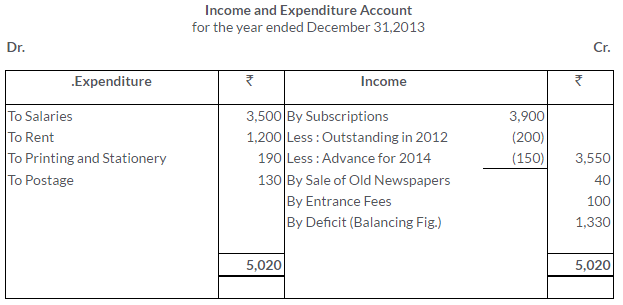
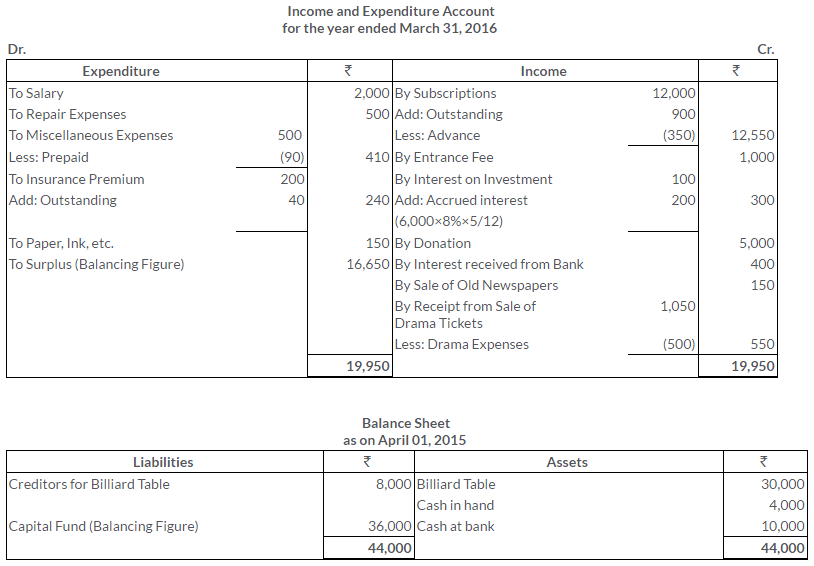
    ts-grewal-solutions-class-11-accountancy-chapter-20-financial-statements-of-not-for-profit-organisations-1-1
    Solution:
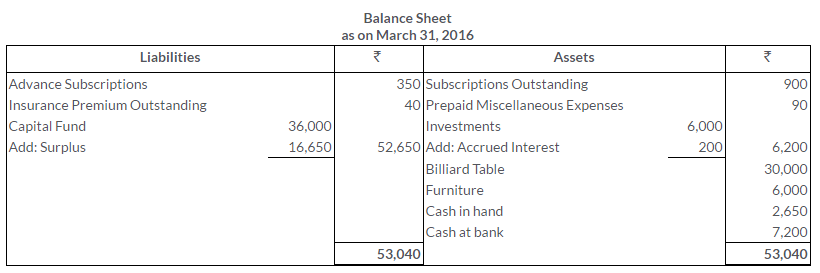
    ts-grewal-solutions-class-11-accountancy-chapter-20-financial-statements-of-not-for-profit-organisations-1-2

    Question 2.
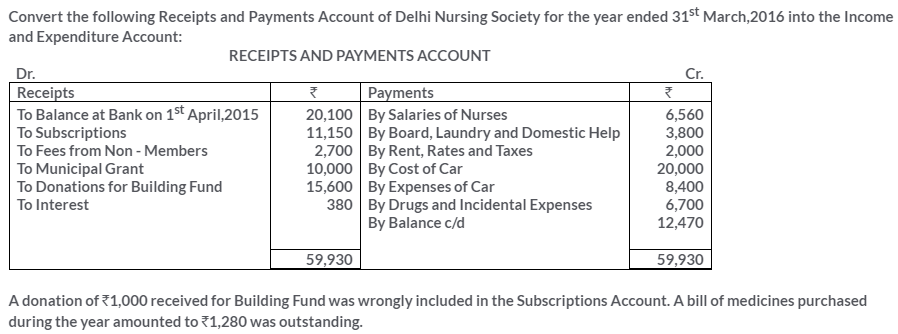
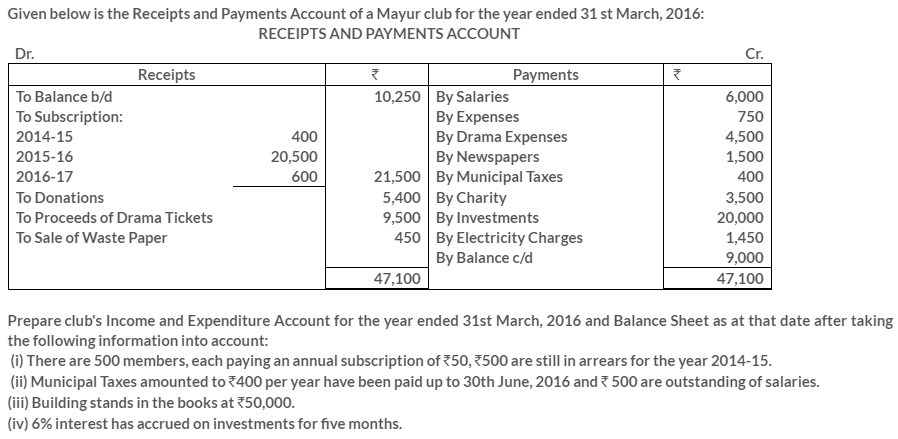
    ts-grewal-solutions-class-11-accountancy-chapter-20-financial-statements-of-not-for-profit-organisations-2-1
    Solution:
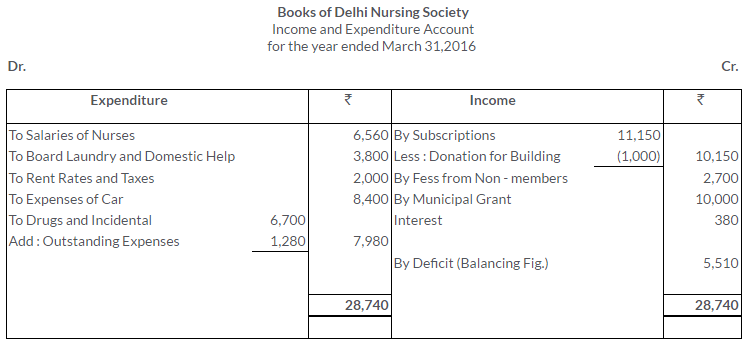
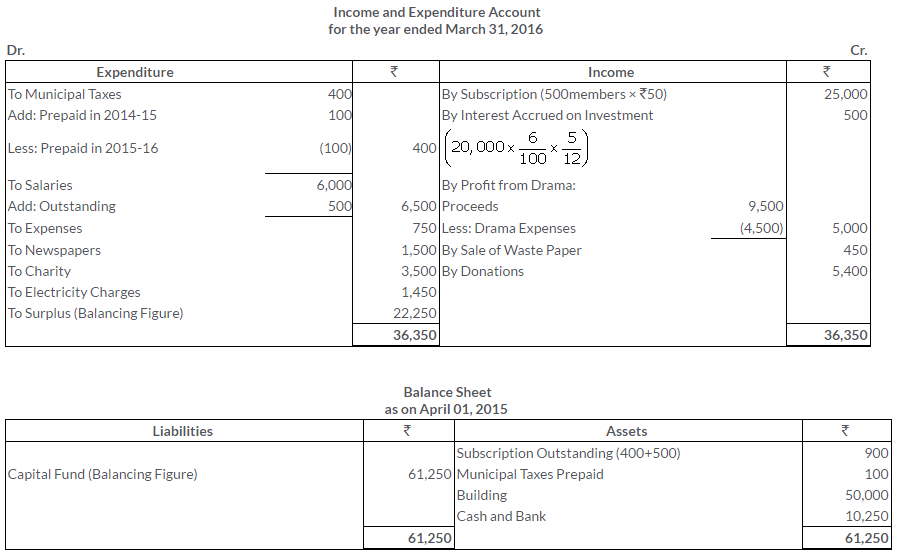
    ts-grewal-solutions-class-11-accountancy-chapter-20-financial-statements-of-not-for-profit-organisations-2-2

    Question 3.
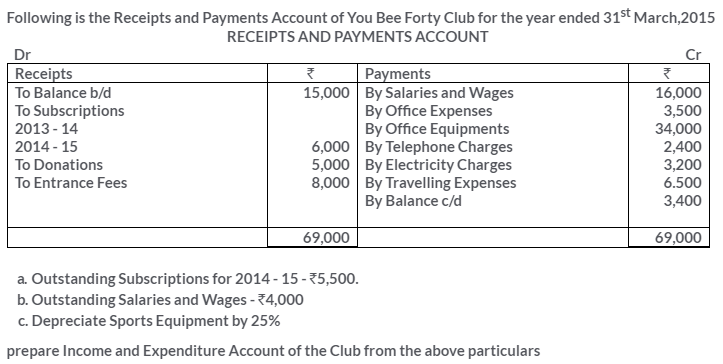
    ts-grewal-solutions-class-11-accountancy-chapter-20-financial-statements-of-not-for-profit-organisations-3-2
    Solution:
    ts-grewal-solutions-class-11-accountancy-chapter-20-financial-statements-of-not-for-profit-organisations-3-1

    Question 4.
    ts-grewal-solutions-class-11-accountancy-chapter-20-financial-statements-of-not-for-profit-organisations-4-1
    Solution:
    ts-grewal-solutions-class-11-accountancy-chapter-20-financial-statements-of-not-for-profit-organisations-4-2

    Question 5.
    ts-grewal-solutions-class-11-accountancy-chapter-20-financial-statements-of-not-for-profit-organisations-5-1
    Solution:
    ts-grewal-solutions-class-11-accountancy-chapter-20-financial-statements-of-not-for-profit-organisations-5-2

    Question 6.
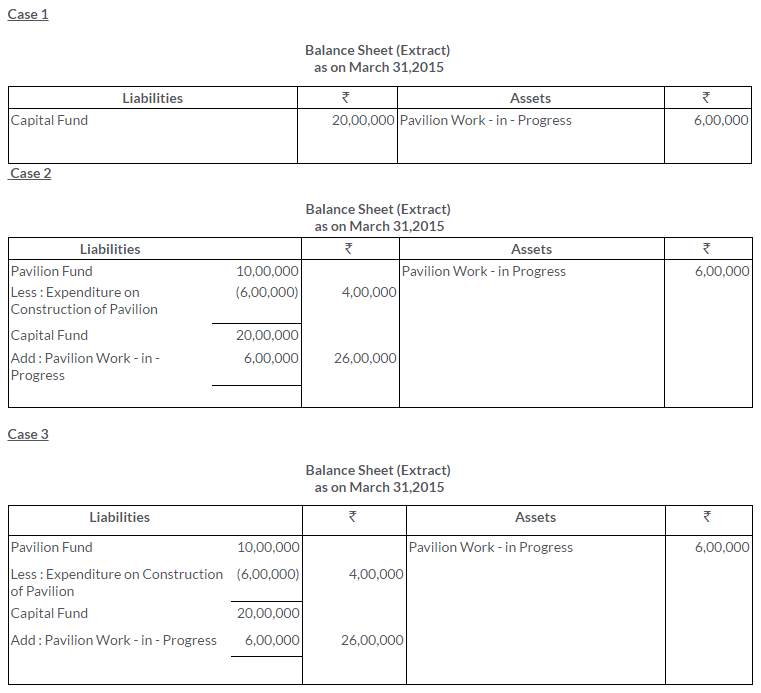
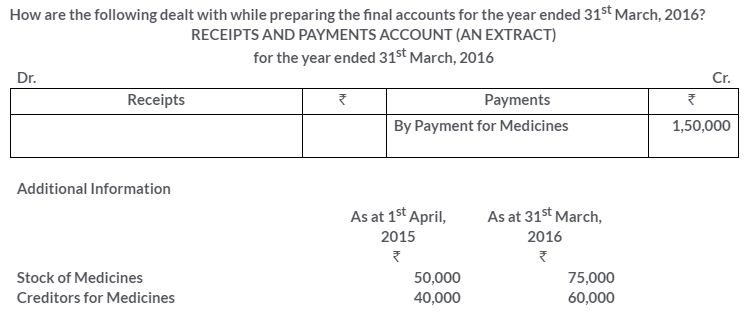
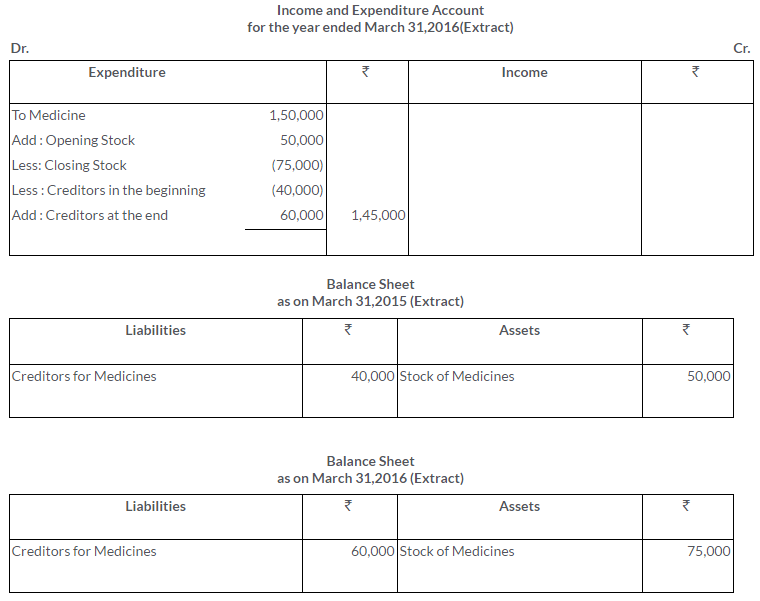
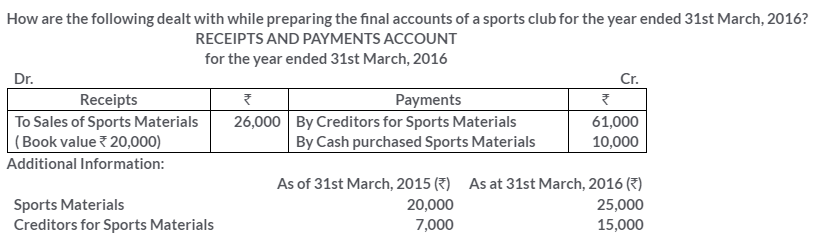
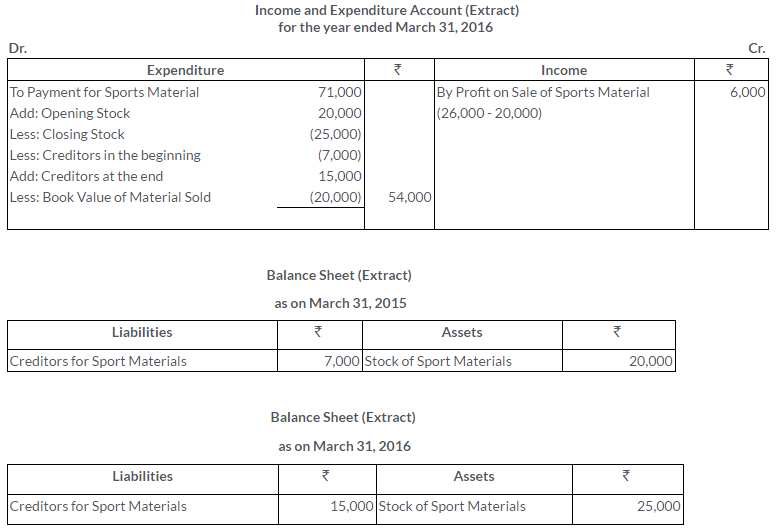
    Show how are the following items dealt with while preparing the final accounts for the year ended 31st March,2016 of a Not – For – Profit Organisation:
    Case 1: Expenditure on construction of Pavilion is Rs.6,00,000. The construction work is in progress and has not yet completed. Capital Fund as at 31st March, 2015 is 20,00,000
    Case 2: Expenditure on construction of Pavilion is Rs.6,00,000. The construction work is in progress and has not yet completed. Pavilion Fund as at 31st March 2015 is Rs.10,00,000 and capital Fund as at 31st March, 2015 is Rs.20,00,000.
    Case 3. Expenditure on construction of Pavilion is Rs.6,00,000. The construction work is in progress and has not yet completed. Pavilion Fund as at 31st March, 2015 is Rs.10,00,000 and Capital Fund as at 31st March, 2015 is Rs.20,00,000. Donation Received for Pavilion on 1st Janurary,2016 is Rs.5,00,000
    Solution:
    ts-grewal-solutions-class-11-accountancy-chapter-20-financial-statements-of-not-for-profit-organisations-6

    Question 7.
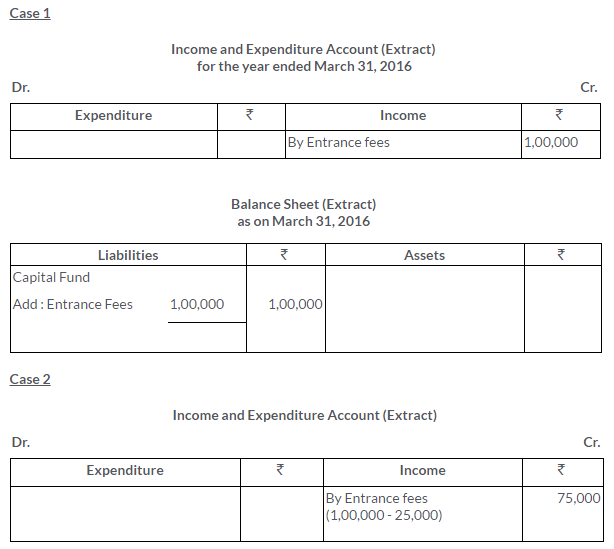
    How is Entrance Fees dealt with while preparing the final accounts for the year ended 31st March, 2016 in each of the following alternatives cases?
    Case 1. During the year 2015-16, Entrance Fees received was Rs.1,00,000.
    Case 2. During the year 2015-16, Entrance Fees received was Rs.1,00,000. Out of this Rs.25,000 pertains to the year 2016 – 17
    Solution:
    ts-grewal-solutions-class-11-accountancy-chapter-20-financial-statements-of-not-for-profit-organisations-7

    Question 8.
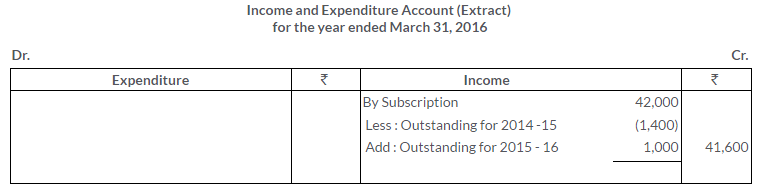
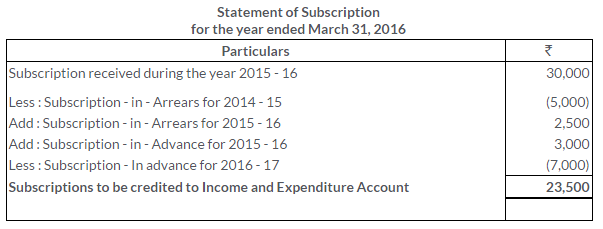
    In 2015 -16, the subscriptions received by the Jaipur Library were Rs.42,000. These subscriptions include Rs.1,400 received for 2014-15. On 31st March, 2016 subscriptions due but not received were Rs.1,000. What amount should be credited to Income and Expenditure Account for the year ended 31st March, 2016 as subscriptions?
    Solution:
    ts-grewal-solutions-class-11-accountancy-chapter-20-financial-statements-of-not-for-profit-organisations-8

    Question 9.
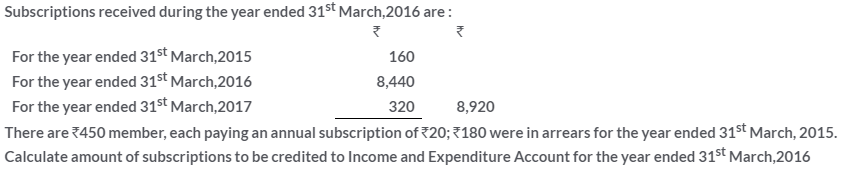
    ts-grewal-solutions-class-11-accountancy-chapter-20-financial-statements-of-not-for-profit-organisations-9-1
    Solution:
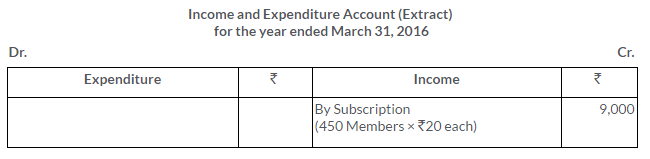
    ts-grewal-solutions-class-11-accountancy-chapter-20-financial-statements-of-not-for-profit-organisations-9-2

    Question 10.
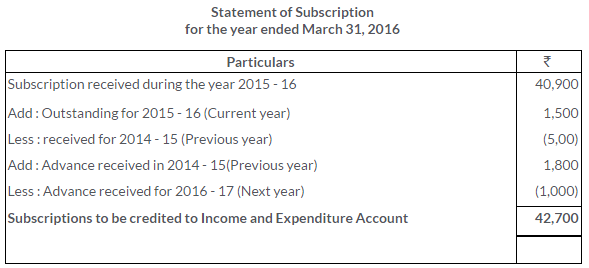
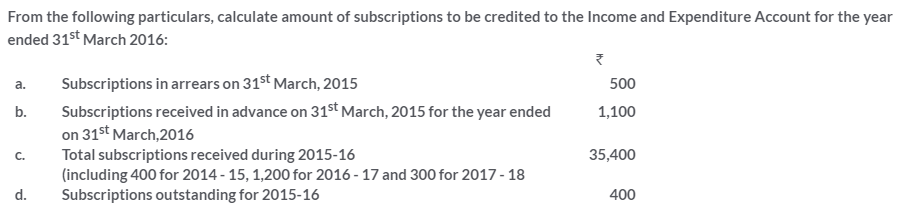
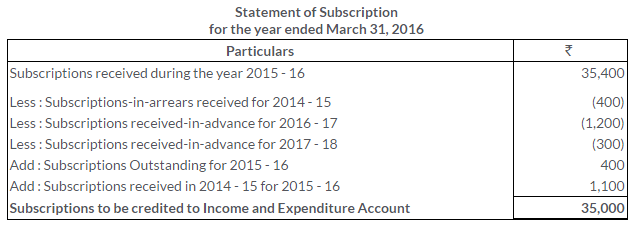
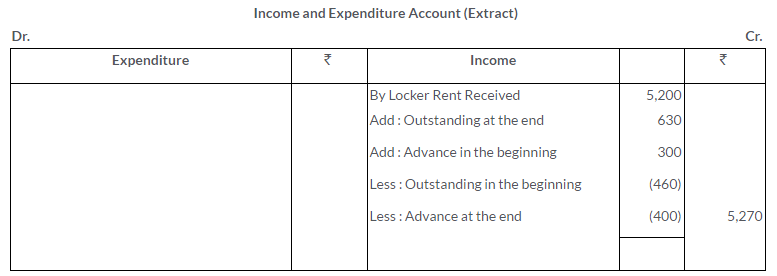
    In 2015-16, subscriptions received by King Club of Delhi were Rs.40,900 including Rs.500 fort 2014-15 and Rs.1,000 for 2016-17. At the end of 2015-16, subscriptions outstanding for 2015-16 were Rs.1,500. The subscriptions due but not received at the end of the previous year, i.e., 31st March, 2015 were Rs.800, while subscriptions received in advance on the same date were Rs.1,800.
    Calculate amount of subscriptions to be credited to Income and Expenditure Account for the- year ended 31st March, 2016.
    Solution:
    ts-grewal-solutions-class-11-accountancy-chapter-20-financial-statements-of-not-for-profit-organisations-10

    Question 11.
    ts-grewal-solutions-class-11-accountancy-chapter-20-financial-statements-of-not-for-profit-organisations-11-1
    Solution:
    ts-grewal-solutions-class-11-accountancy-chapter-20-financial-statements-of-not-for-profit-organisations-11-2

    Question 12.
    ts-grewal-solutions-class-11-accountancy-chapter-20-financial-statements-of-not-for-profit-organisations-12-1
    Solution:
    ts-grewal-solutions-class-11-accountancy-chapter-20-financial-statements-of-not-for-profit-organisations-12-2
    ts-grewal-solutions-class-11-accountancy-chapter-20-financial-statements-of-not-for-profit-organisations-12-3

    Question 13.
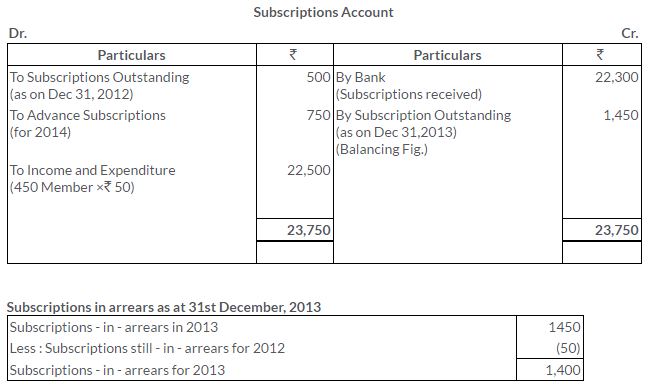
    There were 450 members in a club each paying an annual subscription of Rs.50. Rs.500 were in arrears as at 31st December, 2012. Subscriptions received during 2013 were Rs.22,300 including Rs.450, for 2012 and Rs.750 for the year 2014. Calculate amount of subscriptions in arrears as at 31st December, 2013 by preparing the Subscriptions Account.
    Solution:
    ts-grewal-solutions-class-11-accountancy-chapter-20-financial-statements-of-not-for-profit-organisations-13

    Question 14.
    ts-grewal-solutions-class-11-accountancy-chapter-20-financial-statements-of-not-for-profit-organisations-14-1
    Solution:
    ts-grewal-solutions-class-11-accountancy-chapter-20-financial-statements-of-not-for-profit-organisations-14-2

    Question 15.
    ts-grewal-solutions-class-11-accountancy-chapter-20-financial-statements-of-not-for-profit-organisations-15-1
    Solution:
    ts-grewal-solutions-class-11-accountancy-chapter-20-financial-statements-of-not-for-profit-organisations-15-2

    Question 16.
    ts-grewal-solutions-class-11-accountancy-chapter-20-financial-statements-of-not-for-profit-organisations-16-1
    Solution:
    ts-grewal-solutions-class-11-accountancy-chapter-20-financial-statements-of-not-for-profit-organisations-16-2

    Question 17.
    ts-grewal-solutions-class-11-accountancy-chapter-20-financial-statements-of-not-for-profit-organisations-17-1
    Solution:
    ts-grewal-solutions-class-11-accountancy-chapter-20-financial-statements-of-not-for-profit-organisations-17-2

    Question 18.
    ts-grewal-solutions-class-11-accountancy-chapter-20-financial-statements-of-not-for-profit-organisations-18-1
    Solution:
    ts-grewal-solutions-class-11-accountancy-chapter-20-financial-statements-of-not-for-profit-organisations-18-2

    Question 19.
    ts-grewal-solutions-class-11-accountancy-chapter-20-financial-statements-of-not-for-profit-organisations-19-1
    Solution:
    ts-grewal-solutions-class-11-accountancy-chapter-20-financial-statements-of-not-for-profit-organisations-19-2

    Question 20.
    ts-grewal-solutions-class-11-accountancy-chapter-20-financial-statements-of-not-for-profit-organisations-20-1
    Solution:
    ts-grewal-solutions-class-11-accountancy-chapter-20-financial-statements-of-not-for-profit-organisations-20-2

    Question 21.
    ts-grewal-solutions-class-11-accountancy-chapter-20-financial-statements-of-not-for-profit-organisations-21-1
    Solution:
    ts-grewal-solutions-class-11-accountancy-chapter-20-financial-statements-of-not-for-profit-organisations-21-2
    ts-grewal-solutions-class-11-accountancy-chapter-20-financial-statements-of-not-for-profit-organisations-21-3

    Question 22.
    ts-grewal-solutions-class-11-accountancy-chapter-20-financial-statements-of-not-for-profit-organisations-22-1
    Solution:
    ts-grewal-solutions-class-11-accountancy-chapter-20-financial-statements-of-not-for-profit-organisations-22-2

    Question 23.
    ts-grewal-solutions-class-11-accountancy-chapter-20-financial-statements-of-not-for-profit-organisations-23-1
    Solution:
    ts-grewal-solutions-class-11-accountancy-chapter-20-financial-statements-of-not-for-profit-organisations-23-2

    Question 24.
    ts-grewal-solutions-class-11-accountancy-chapter-20-financial-statements-of-not-for-profit-organisations-24-1
    Solution:
    ts-grewal-solutions-class-11-accountancy-chapter-20-financial-statements-of-not-for-profit-organisations-24-2

    Question 25.
    ts-grewal-solutions-class-11-accountancy-chapter-20-financial-statements-of-not-for-profit-organisations-25-1
    Solution:
    ts-grewal-solutions-class-11-accountancy-chapter-20-financial-statements-of-not-for-profit-organisations-25-2

    Question 26.
    ts-grewal-solutions-class-11-accountancy-chapter-20-financial-statements-of-not-for-profit-organisations-26-1
    Solution:
    ts-grewal-solutions-class-11-accountancy-chapter-20-financial-statements-of-not-for-profit-organisations-26-2
    ts-grewal-solutions-class-11-accountancy-chapter-20-financial-statements-of-not-for-profit-organisations-26-3

    Question 27.
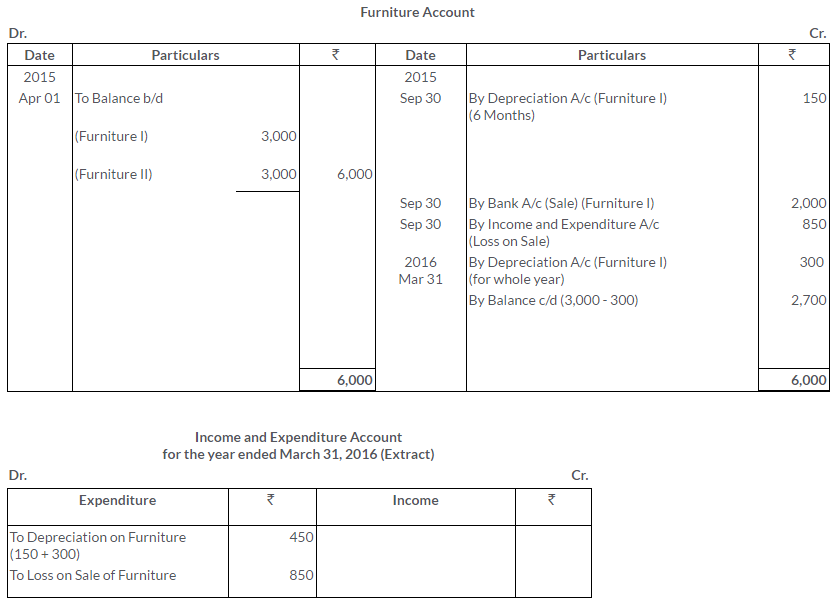
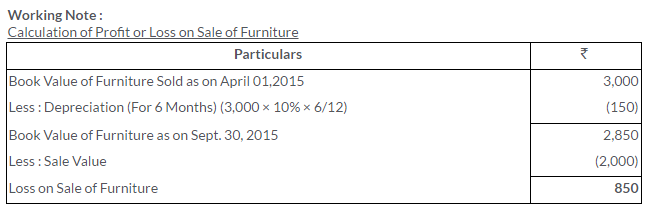
    The book value of furniture on 1st April, 2015 is Rs.6,000. Half of this furniture is sold for Rs.2,000 on 30thSeptember, 2015. Depreciation is to be charged on furniture @ 10% p.a. Calculate loss on sale of furniture. Show how on sale and depreciation on furniture will be shown in the Income and Expenditure Account for the year ended 31st March, 2016.
    Solution:
    ts-grewal-solutions-class-11-accountancy-chapter-20-financial-statements-of-not-for-profit-organisations-27
    ts-grewal-solutions-class-11-accountancy-chapter-20-financial-statements-of-not-for-profit-organisations-27-1

    Question 28.
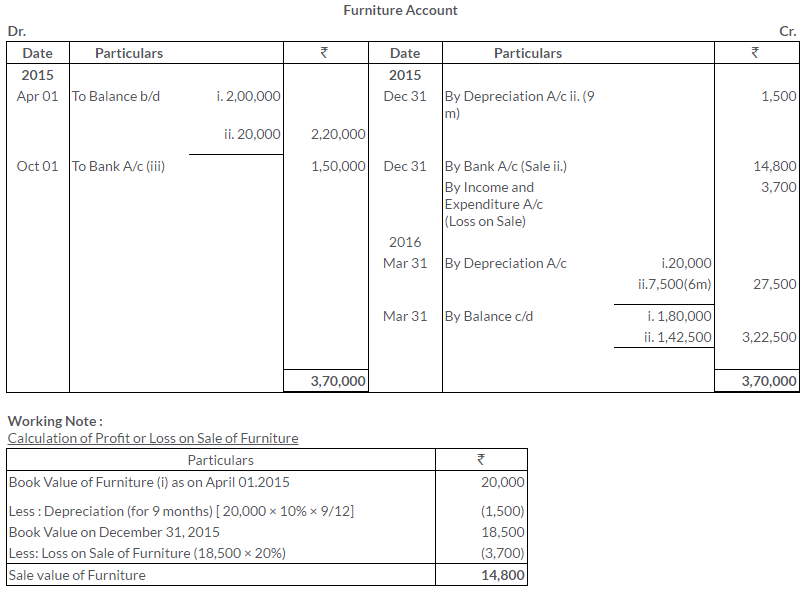
    Delhi Youth Club has furniture at a value of Rs.2,20,000 in its book on 31st March,2015.. It sold old furniture, having book value of Rs.20,000 as at 1st April, 2015 at a loss of @20% on 31st December, 2015. Furniture is to be depreciated @10% p.a. Furniture costing Rs.1,50,000 was also purchased on 1st October, 2015.
    Prepare Furniture Account for the year ended 31st March, 2016
    Solution:
    ts-grewal-solutions-class-11-accountancy-chapter-20-financial-statements-of-not-for-profit-organisations-28

    Question 29.
    ts-grewal-solutions-class-11-accountancy-chapter-20-financial-statements-of-not-for-profit-organisations-29-1
    Solution:
    ts-grewal-solutions-class-11-accountancy-chapter-20-financial-statements-of-not-for-profit-organisations-29-2

    Question 30.
    ts-grewal-solutions-class-11-accountancy-chapter-20-financial-statements-of-not-for-profit-organisations-30-1
    Solution:
    ts-grewal-solutions-class-11-accountancy-chapter-20-financial-statements-of-not-for-profit-organisations-30-2

    Question 31.
    ts-grewal-solutions-class-11-accountancy-chapter-20-financial-statements-of-not-for-profit-organisations-31-1
    Solution:
    ts-grewal-solutions-class-11-accountancy-chapter-20-financial-statements-of-not-for-profit-organisations-31-2

    Question 32.
    ts-grewal-solutions-class-11-accountancy-chapter-20-financial-statements-of-not-for-profit-organisations-32-1
    Solution:
    ts-grewal-solutions-class-11-accountancy-chapter-20-financial-statements-of-not-for-profit-organisations-32-2

    Question 33.
    ts-grewal-solutions-class-11-accountancy-chapter-20-financial-statements-of-not-for-profit-organisations-33-1
    Solution:
    ts-grewal-solutions-class-11-accountancy-chapter-20-financial-statements-of-not-for-profit-organisations-33-2

    Question 34.
    ts-grewal-solutions-class-11-accountancy-chapter-20-financial-statements-of-not-for-profit-organisations-34-1
    Solution:
    ts-grewal-solutions-class-11-accountancy-chapter-20-financial-statements-of-not-for-profit-organisations-34-2

    Question 35.
    ts-grewal-solutions-class-11-accountancy-chapter-20-financial-statements-of-not-for-profit-organisations-35-1
    Solution:
    ts-grewal-solutions-class-11-accountancy-chapter-20-financial-statements-of-not-for-profit-organisations-35-2

    Question 36.
    ts-grewal-solutions-class-11-accountancy-chapter-20-financial-statements-of-not-for-profit-organisations-36-1
    Solution:
    ts-grewal-solutions-class-11-accountancy-chapter-20-financial-statements-of-not-for-profit-organisations-36-2

    Question 37.
    ts-grewal-solutions-class-11-accountancy-chapter-20-financial-statements-of-not-for-profit-organisations-37-1
    Solution:
    ts-grewal-solutions-class-11-accountancy-chapter-20-financial-statements-of-not-for-profit-organisations-37-2

    Question 38.
    ts-grewal-solutions-class-11-accountancy-chapter-20-financial-statements-of-not-for-profit-organisations-38-1
    Solution:
    ts-grewal-solutions-class-11-accountancy-chapter-20-financial-statements-of-not-for-profit-organisations-38-2
    ts-grewal-solutions-class-11-accountancy-chapter-20-financial-statements-of-not-for-profit-organisations-38-3

    Question 39.
    ts-grewal-solutions-class-11-accountancy-chapter-20-financial-statements-of-not-for-profit-organisations-39-1
    Solution:
    ts-grewal-solutions-class-11-accountancy-chapter-20-financial-statements-of-not-for-profit-organisations-39-2
    ts-grewal-solutions-class-11-accountancy-chapter-20-financial-statements-of-not-for-profit-organisations-39-3

    Question 40.
    ts-grewal-solutions-class-11-accountancy-chapter-20-financial-statements-of-not-for-profit-organisations-40-1
    Solution:
    ts-grewal-solutions-class-11-accountancy-chapter-20-financial-statements-of-not-for-profit-organisations-40-2
    ts-grewal-solutions-class-11-accountancy-chapter-20-financial-statements-of-not-for-profit-organisations-40-3

    Question 41.
    ts-grewal-solutions-class-11-accountancy-chapter-20-financial-statements-of-not-for-profit-organisations-41-1
    Solution:
    ts-grewal-solutions-class-11-accountancy-chapter-20-financial-statements-of-not-for-profit-organisations-41-2

    Question 42.
    ts-grewal-solutions-class-11-accountancy-chapter-20-financial-statements-of-not-for-profit-organisations-42-1
    Solution:
    ts-grewal-solutions-class-11-accountancy-chapter-20-financial-statements-of-not-for-profit-organisations-42-2
    ts-grewal-solutions-class-11-accountancy-chapter-20-financial-statements-of-not-for-profit-organisations-42-3

    Question 43.
    ts-grewal-solutions-class-11-accountancy-chapter-20-financial-statements-of-not-for-profit-organisations-43-1
    Solution:
    ts-grewal-solutions-class-11-accountancy-chapter-20-financial-statements-of-not-for-profit-organisations-43-2
    ts-grewal-solutions-class-11-accountancy-chapter-20-financial-statements-of-not-for-profit-organisations-43-3

    Question 44.
    ts-grewal-solutions-class-11-accountancy-chapter-20-financial-statements-of-not-for-profit-organisations-44-1
    Solution:
    ts-grewal-solutions-class-11-accountancy-chapter-20-financial-statements-of-not-for-profit-organisations-44-2
    ts-grewal-solutions-class-11-accountancy-chapter-20-financial-statements-of-not-for-profit-organisations-44-3

    Question 45.
    ts-grewal-solutions-class-11-accountancy-chapter-20-financial-statements-of-not-for-profit-organisations-45-1
    Solution:
    ts-grewal-solutions-class-11-accountancy-chapter-20-financial-statements-of-not-for-profit-organisations-45-2
    ts-grewal-solutions-class-11-accountancy-chapter-20-financial-statements-of-not-for-profit-organisations-45-3

    Question 46.
    ts-grewal-solutions-class-11-accountancy-chapter-20-financial-statements-of-not-for-profit-organisations-46-1
    Solution:
    ts-grewal-solutions-class-11-accountancy-chapter-20-financial-statements-of-not-for-profit-organisations-46-2
    ts-grewal-solutions-class-11-accountancy-chapter-20-financial-statements-of-not-for-profit-organisations-46-3

    Question 47.
    ts-grewal-solutions-class-11-accountancy-chapter-20-financial-statements-of-not-for-profit-organisations-47-1
    Solution:
    ts-grewal-solutions-class-11-accountancy-chapter-20-financial-statements-of-not-for-profit-organisations-47-2
    ts-grewal-solutions-class-11-accountancy-chapter-20-financial-statements-of-not-for-profit-organisations-47-3

    Question 48.
    ts-grewal-solutions-class-11-accountancy-chapter-20-financial-statements-of-not-for-profit-organisations-48-1
    Solution:
    ts-grewal-solutions-class-11-accountancy-chapter-20-financial-statements-of-not-for-profit-organisations-48-2
    ts-grewal-solutions-class-11-accountancy-chapter-20-financial-statements-of-not-for-profit-organisations-48-3

    Question 49.
    ts-grewal-solutions-class-11-accountancy-chapter-20-financial-statements-of-not-for-profit-organisations-49-1
    Solution:
    ts-grewal-solutions-class-11-accountancy-chapter-20-financial-statements-of-not-for-profit-organisations-49-2
    ts-grewal-solutions-class-11-accountancy-chapter-20-financial-statements-of-not-for-profit-organisations-49-3

  • TS Grewal Solutions for Accounts from Incomplete Records – Single Entry System Class 11 Accountancy Chapter 19

    TS Grewal Solutions for Class 11 Accountancy Chapter 19 – Accounts from Incomplete Records – Single Entry System

    Question 1.
    Following information of an accounting year is given:
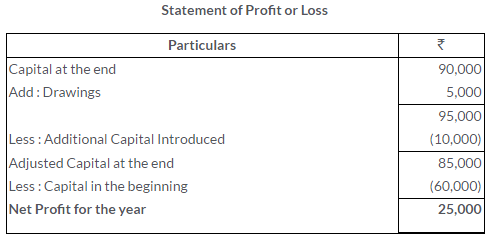
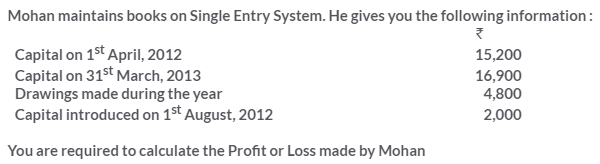
    Opening Capital Rs.60,000;Drawings Rs.5,000; Capital added during the year Rs.10,000 and Closing Capital Rs.90,000. Calculate the Profit or Loss for the year.
    Solution:
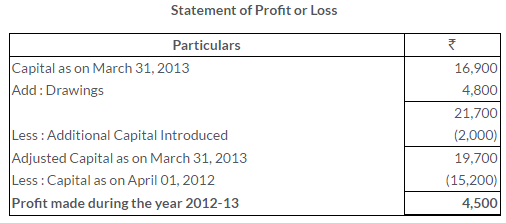
    ts-grewal-solutions-class-11-accountancy-chapter-19-accounts-incomplete-records-single-entry-system-1

    Question 2.
    Mayank does not keep proper records of his business, he gives you the following information:
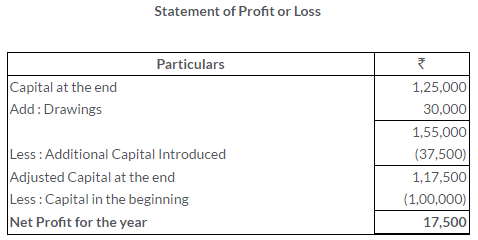
    Opening Capital Rs.1,00,000
    Closing Capital Rs.1,25,000
    Drawings during the year Rs.30,000
    Capital added during the year Rs.37,500
    Calculate the profit or loss for the year.
    Solution:
    ts-grewal-solutions-class-11-accountancy-chapter-19-accounts-incomplete-records-single-entry-system-2

    Question 3.
    Capital of Ganesh Gupta in the beginning of the year was Rs.70,000. During the year his business earned a profit of Rs.20,000. He withdrew Rs.7,000 for his personal use. He sold ornaments of his wife for Rs.20,000 and invested that amount into the business. Find out his Capital at the end of the year.
    Solution:
    Capital at the end of the year
    = Opening Capital + Additional Capital + Profit – Drawings
    = 70,000 + 20,000 + 20,000 – 7,000
    = Rs.1,03,000

    Question 4.
    Vikas maintains his books of account on Single Entry System. He provides following information from his books. Find out additional capital introduced in the business during the year 2012-13.
    Opening Capital – Rs.1,30,000
    Drawing during the year Rs.50,000
    Closing Capital – Rs.2,00,000
    Profit made during the year Rs.1,00,000
    Solution:
    Additional Capital
    = Capital at the End + Drawings – (Capital in the Beginning + Profit)
    = 2,00,000 + 50,000 – (1,30,000 + 1,00,000) = 2,50,000 – 2,30,000
    = Rs.20,000

    Question 5.
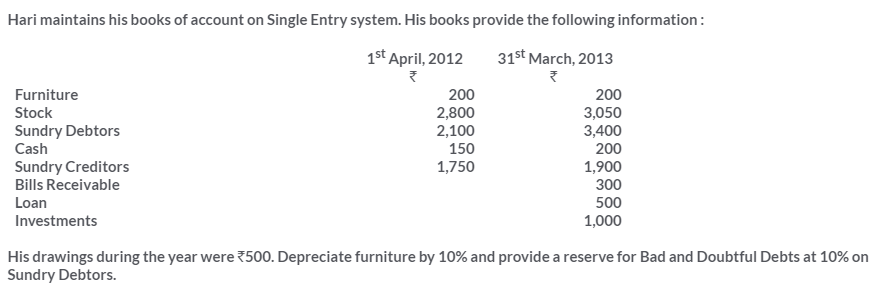
    ts-grewal-solutions-class-11-accountancy-chapter-19-accounts-incomplete-records-single-entry-system-5-1
    Solution:
    ts-grewal-solutions-class-11-accountancy-chapter-19-accounts-incomplete-records-single-entry-system-5-2

    Question 6.
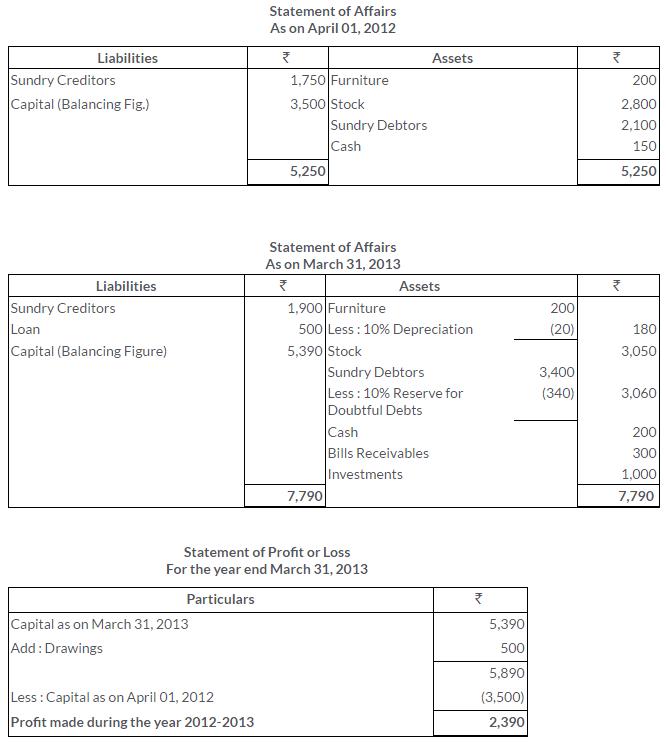
    ts-grewal-solutions-class-11-accountancy-chapter-19-accounts-incomplete-records-single-entry-system-6-1
    Solution:
    ts-grewal-solutions-class-11-accountancy-chapter-19-accounts-incomplete-records-single-entry-system-6-2

    Question 7.
    Ram Prashad keeps his books on Single Entry System and from them and the particulars supplied, the following figures were gathered together on 31st March, 2013:
    Book Debts Rs.10,000;Cash in Hand Rs.510; Stock-in-Trade (estimated) Rs.6,000; Furniture and Fittings Rs.1,200; Trade Creditors Rs.4,000; Bank Overdraft Rs.1,000. Ram Prashad stated that he started business on 1st April with cash Rs.6,000 paid into bank but stocks valued at Rs.4,000. During the year he estimated his drawings to be Rs.2,400. You are required to prepare the statement, showing the profit for the year, after writing off 10% for Depreciation on Furniture and Fittings. What Journal entries will start the books on a Double Entry System with the above figures?
    Solution:
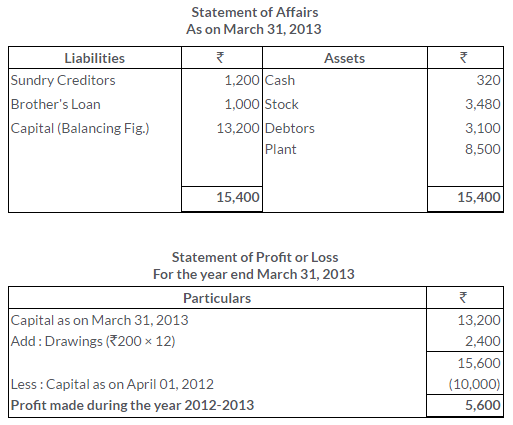
    ts-grewal-solutions-class-11-accountancy-chapter-19-accounts-incomplete-records-single-entry-system-7

    Question 8.
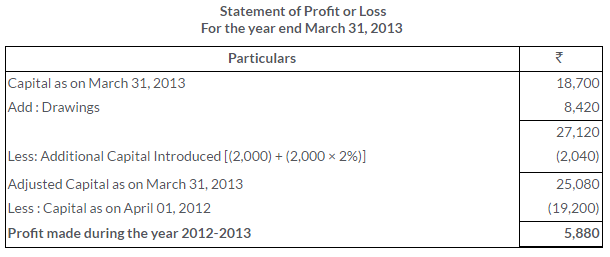
    X, who keeps his books on Single Entry System, tells you that his capital on 31st March, 2013 is Rs.18,700 and his capital on 1st April, 2012 was Rs.19,200. He further informs you that during the year he withdrew for his household purposes Rs.8,420. He once sold his investment of Rs.2,000 at 2% premium and brought that money into the business. You are required to prepare a Statement of Profit or Loss.
    Solution:
    ts-grewal-solutions-class-11-accountancy-chapter-19-accounts-incomplete-records-single-entry-system-8

    Question 9.
    ts-grewal-solutions-class-11-accountancy-chapter-19-accounts-incomplete-records-single-entry-system-9-1
    Solution:
    ts-grewal-solutions-class-11-accountancy-chapter-19-accounts-incomplete-records-single-entry-system-9-2

    Question 10.
    ts-grewal-solutions-class-11-accountancy-chapter-19-accounts-incomplete-records-single-entry-system-10-1
    Solution:
    ts-grewal-solutions-class-11-accountancy-chapter-19-accounts-incomplete-records-single-entry-system-10-2

    Question 11.
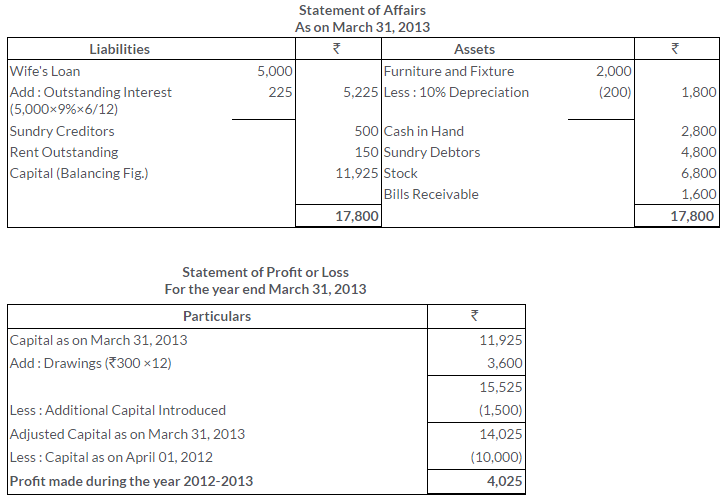
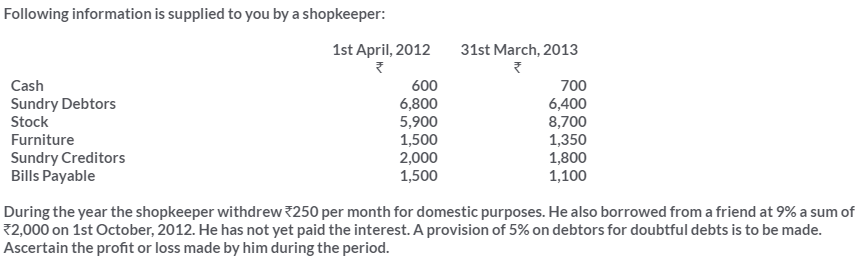
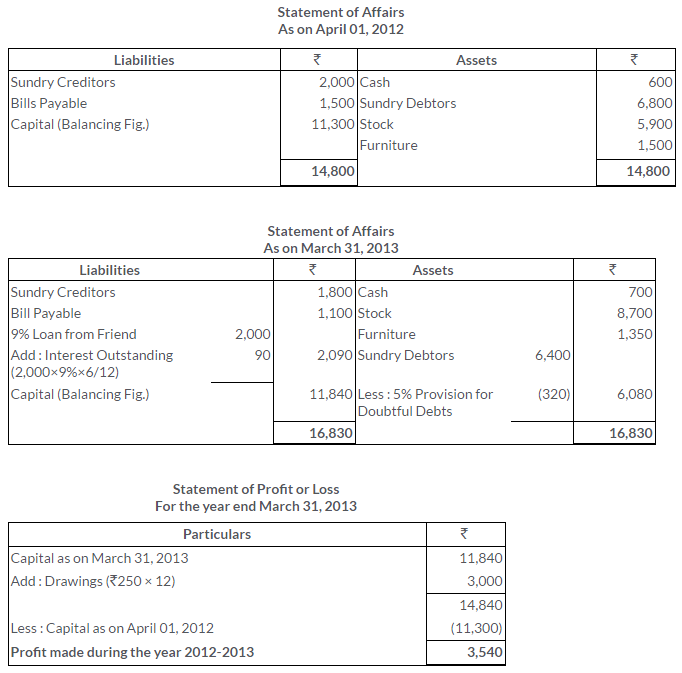
    A commenced business on 1st April, 2012 with a capital of Rs.10,000. He immediately bought Furniture and Fixtures for Rs. 2,000. On 1st October, 2012 he borrowed Rs.5,000 from his wife @ 9% p.a. (interest not yet paid) and introduced a further capital of his own amounting to Rs.1,500. A drew @ Rs.300 per month at the end of each month for household expenses. On 31st March, 2013 his position was as follows :
    Cash in Hand Rs.2,800; Sundry Debtors Rs.4,800; Stock Rs.6,800; Bills Receivable Rs.1,600: Sundry Creditors Rs.500 and owing for Rent Rs.150. Furniture and Fixtures to be depreciated by 10%.
    Ascertain the profit or loss made by A during 2012-2013.
    Solution:
    ts-grewal-solutions-class-11-accountancy-chapter-19-accounts-incomplete-records-single-entry-system-11

    Question 12.
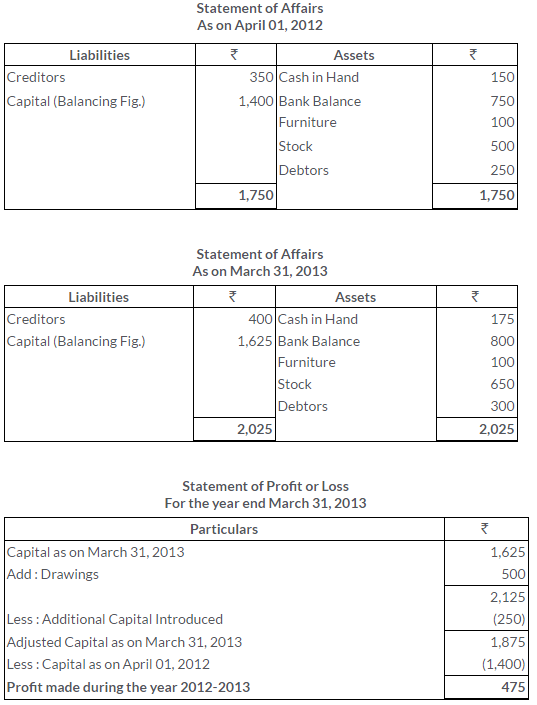
    ts-grewal-solutions-class-11-accountancy-chapter-19-accounts-incomplete-records-single-entry-system-12-1
    Solution:
    ts-grewal-solutions-class-11-accountancy-chapter-19-accounts-incomplete-records-single-entry-system-12-2

    Question 13.
    ts-grewal-solutions-class-11-accountancy-chapter-19-accounts-incomplete-records-single-entry-system-13-1
    Solution:
    ts-grewal-solutions-class-11-accountancy-chapter-19-accounts-incomplete-records-single-entry-system-13-2

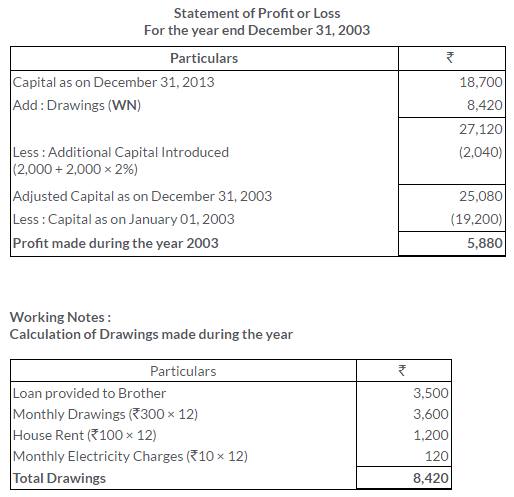
    Question 14.
    Raj tells you that his capital on 31st December, 2003 is Rs.18,700 and his capital on 1st January, 2003 was Rs.19,200. He further informs you that during the year he gave a loan of Rs.3,500 to his brother on private account and withdrew Rs.300 p.m. for personal Purposes. He also used a flat for his personal purpose, the rent of which @ Rs.100 per month and electricity charges at an average rate of Rs.10 per month were paid from the business account. During the year he sold his 7% Government Bonds of Rs.2,000 at 2% Premium and brought that money into the business.
    You are required to prepare a Statement of Profit or Loss for the year ended 31st December, 2003.
    Solution:
    ts-grewal-solutions-class-11-accountancy-chapter-19-accounts-incomplete-records-single-entry-system-14

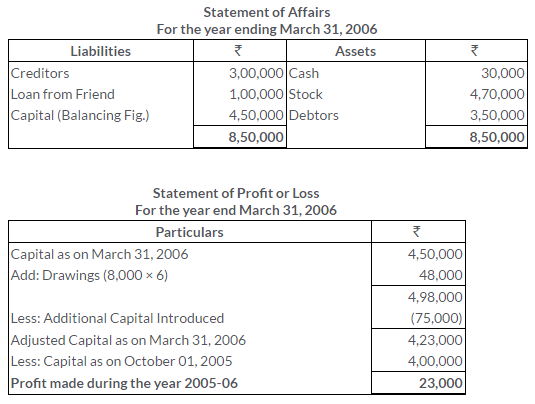
    Question 15.
    Mr. Manu started business with a capital of Rs.4,00,000 on 1st October, 2005. He borrowed from his friend a sum of Rs.1,00,000. He brought further Rs.75,000 as capital on 31st March 2006, his position was:
    Cash: Rs.30,000; Stock: Rs.4,70,000; Debtors: Rs.3,50,000 and Creditors: Rs.3,00,000. He withdrew Rs.8,000 per month during this period. Calculate profit or loss for the period.
    Solution:
    ts-grewal-solutions-class-11-accountancy-chapter-19-accounts-incomplete-records-single-entry-system-15

    Question 16.
    ts-grewal-solutions-class-11-accountancy-chapter-19-accounts-incomplete-records-single-entry-system-16-1
    Solution:
    ts-grewal-solutions-class-11-accountancy-chapter-19-accounts-incomplete-records-single-entry-system-16-2

    Question 17.
    ts-grewal-solutions-class-11-accountancy-chapter-19-accounts-incomplete-records-single-entry-system-17-1
    Solution:
    ts-grewal-solutions-class-11-accountancy-chapter-19-accounts-incomplete-records-single-entry-system-17-2

    Question 18.
    ts-grewal-solutions-class-11-accountancy-chapter-19-accounts-incomplete-records-single-entry-system-18-1
    Solution:
    ts-grewal-solutions-class-11-accountancy-chapter-19-accounts-incomplete-records-single-entry-system-18-2


  • TS Grewal Solutions for Adjustments in Preparation of Financial Statements Class 11 Accountancy Chapter 18

    TS Grewal Solutions for Class 11 Accountancy Chapter 18 – Adjustments in Preparation of Financial Statements

    Question 1.
    ts-grewal-solutions-class-11-accountancy-chapter-18-adjustments-preparation-financial-statements-1-1
    Solution:
    ts-grewal-solutions-class-11-accountancy-chapter-18-adjustments-preparation-financial-statements-1-2
    ts-grewal-solutions-class-11-accountancy-chapter-18-adjustments-preparation-financial-statements-1-3

    Question 2.
    ts-grewal-solutions-class-11-accountancy-chapter-18-adjustments-preparation-financial-statements-2-1
    Solution:
    ts-grewal-solutions-class-11-accountancy-chapter-18-adjustments-preparation-financial-statements-2-2
    ts-grewal-solutions-class-11-accountancy-chapter-18-adjustments-preparation-financial-statements-2-3

    Question 3.
    ts-grewal-solutions-class-11-accountancy-chapter-18-adjustments-preparation-financial-statements-3-1
    Solution:
    ts-grewal-solutions-class-11-accountancy-chapter-18-adjustments-preparation-financial-statements-3-2
    ts-grewal-solutions-class-11-accountancy-chapter-18-adjustments-preparation-financial-statements-3-3
    ts-grewal-solutions-class-11-accountancy-chapter-18-adjustments-preparation-financial-statements-3-4

    Question 4.
    ts-grewal-solutions-class-11-accountancy-chapter-18-adjustments-preparation-financial-statements-4-1
    Solution:
    ts-grewal-solutions-class-11-accountancy-chapter-18-adjustments-preparation-financial-statements-4-2
    ts-grewal-solutions-class-11-accountancy-chapter-18-adjustments-preparation-financial-statements-4-3

    Question 5.
    ts-grewal-solutions-class-11-accountancy-chapter-18-adjustments-preparation-financial-statements-5-1
    Solution:
    ts-grewal-solutions-class-11-accountancy-chapter-18-adjustments-preparation-financial-statements-5-2
    ts-grewal-solutions-class-11-accountancy-chapter-18-adjustments-preparation-financial-statements-5-3
    ts-grewal-solutions-class-11-accountancy-chapter-18-adjustments-preparation-financial-statements-5-4

    Question 6.
    ts-grewal-solutions-class-11-accountancy-chapter-18-adjustments-preparation-financial-statements-6-1
    Solution:
    ts-grewal-solutions-class-11-accountancy-chapter-18-adjustments-preparation-financial-statements-6-2
    ts-grewal-solutions-class-11-accountancy-chapter-18-adjustments-preparation-financial-statements-6-3
    ts-grewal-solutions-class-11-accountancy-chapter-18-adjustments-preparation-financial-statements-6-4

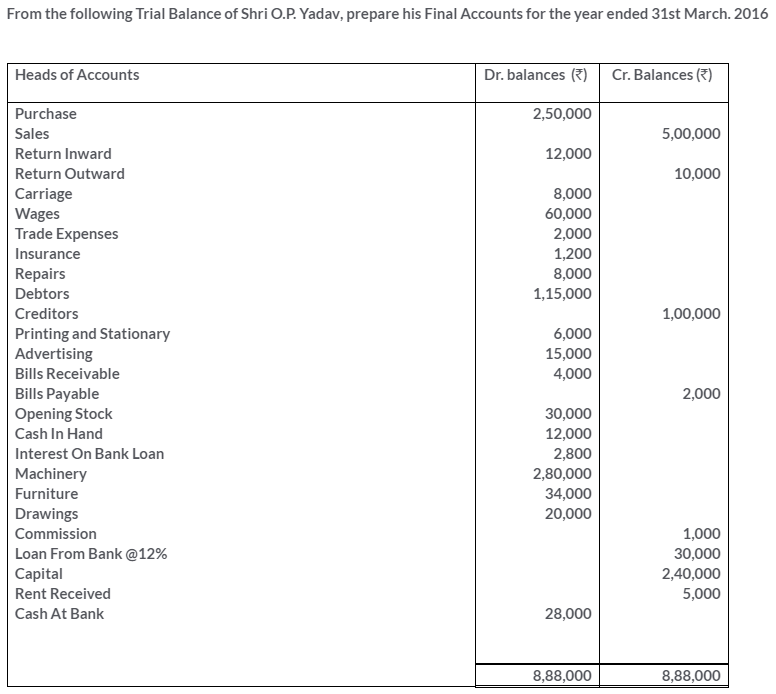
    Question 7.
    ts-grewal-solutions-class-11-accountancy-chapter-18-adjustments-preparation-financial-statements-7-1
    Additional information:
    i. Closing Stock on 31st March, 2016 was Rs.21,000.
    ii. Rent of Rs.1,200 has been received in advance.
    iii. Outstanding liability for trade expenses Rs.12,000.
    iv. Commission earned during the year but not received was Rs.2,100.
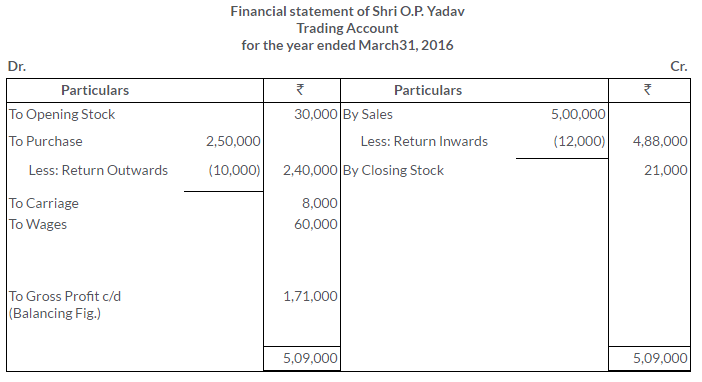
    Solution:
    ts-grewal-solutions-class-11-accountancy-chapter-18-adjustments-preparation-financial-statements-7-2
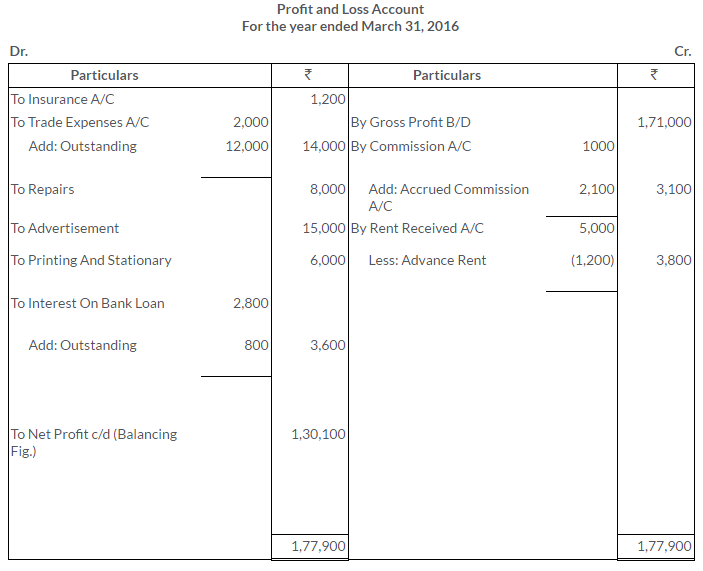
    ts-grewal-solutions-class-11-accountancy-chapter-18-adjustments-preparation-financial-statements-7-3
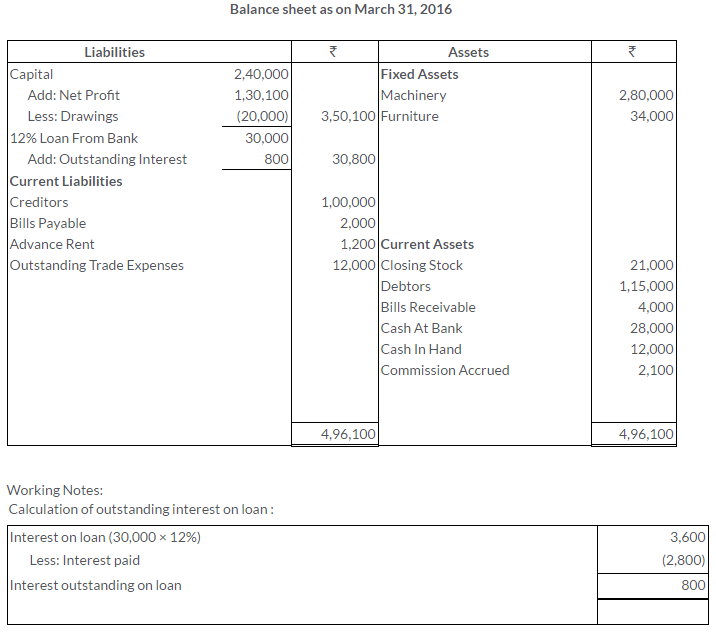
    ts-grewal-solutions-class-11-accountancy-chapter-18-adjustments-preparation-financial-statements-7-4

    Question 8.
    ts-grewal-solutions-class-11-accountancy-chapter-18-adjustments-preparation-financial-statements-8-1
    Solution:
    ts-grewal-solutions-class-11-accountancy-chapter-18-adjustments-preparation-financial-statements-8-2
    ts-grewal-solutions-class-11-accountancy-chapter-18-adjustments-preparation-financial-statements-8-3
    ts-grewal-solutions-class-11-accountancy-chapter-18-adjustments-preparation-financial-statements-8-4

    Question 9.
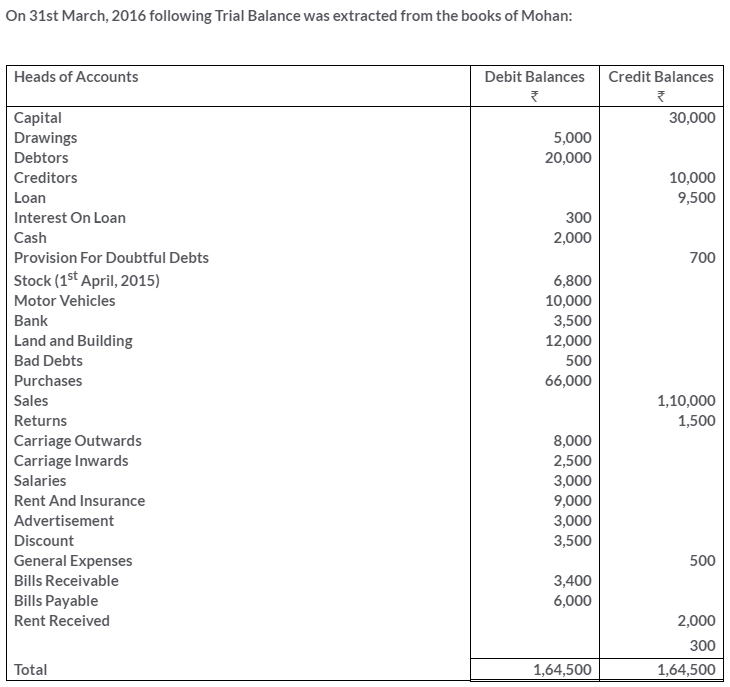
    ts-grewal-solutions-class-11-accountancy-chapter-18-adjustments-preparation-financial-statements-9-1
    Adjustments:
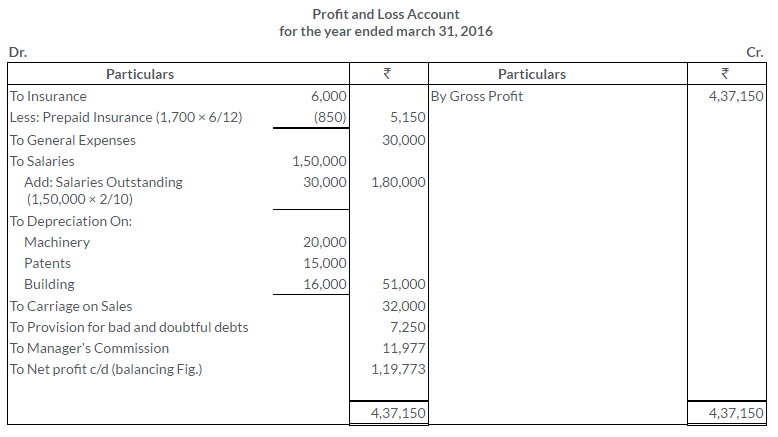
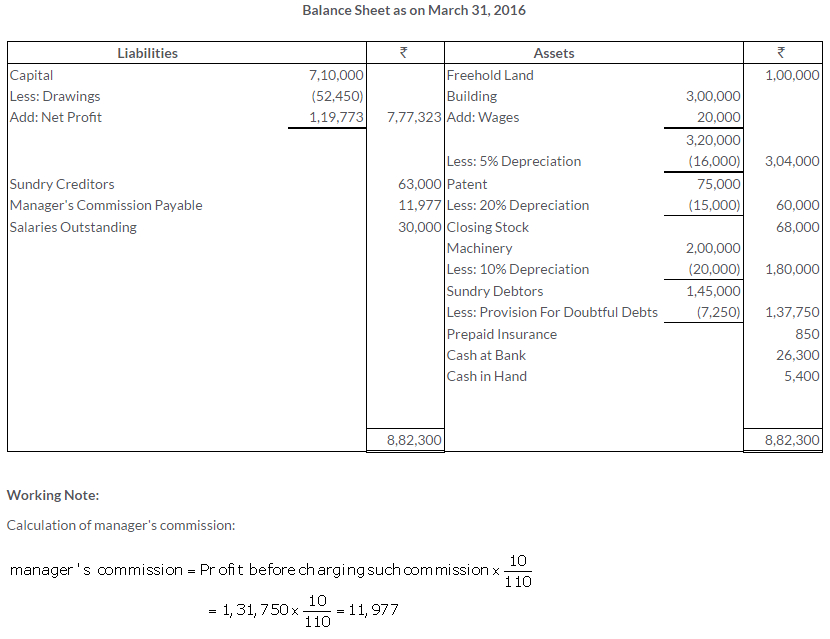
    Prepare Trading and Profit and Loss Account for the year ended 31st March, 2016 and Balance Sheet as at that date after taking into account the following:
    i. Depreciate Land and Building at 2½% and Motor Vehicles at 20%.
    ii. Salaries outstanding Rs.200.
    iii. Prepaid Insurance Rs.200.
    iv. Provision for Doubtful Debts is to be maintained at 5% on Debtors.
    v. Stock on 31st March, 2016 was valued at Rs.7,000.
    Solution:
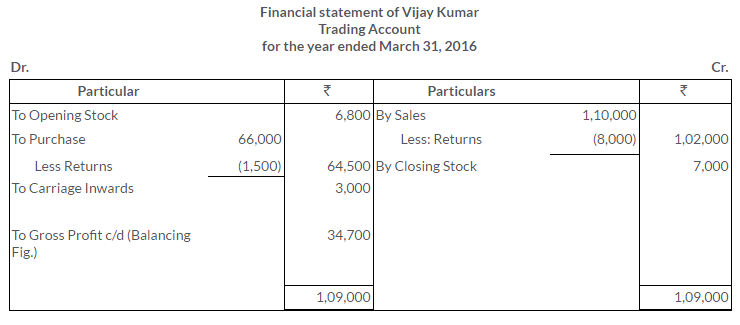
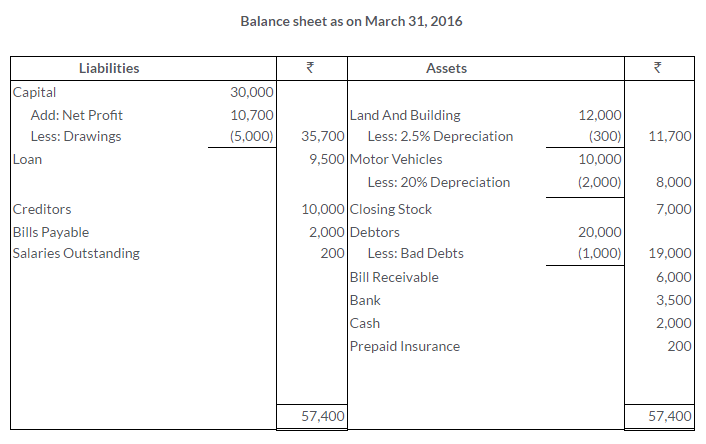
    ts-grewal-solutions-class-11-accountancy-chapter-18-adjustments-preparation-financial-statements-9-2
    ts-grewal-solutions-class-11-accountancy-chapter-18-adjustments-preparation-financial-statements-9-3
    ts-grewal-solutions-class-11-accountancy-chapter-18-adjustments-preparation-financial-statements-9-4

    Question 10.
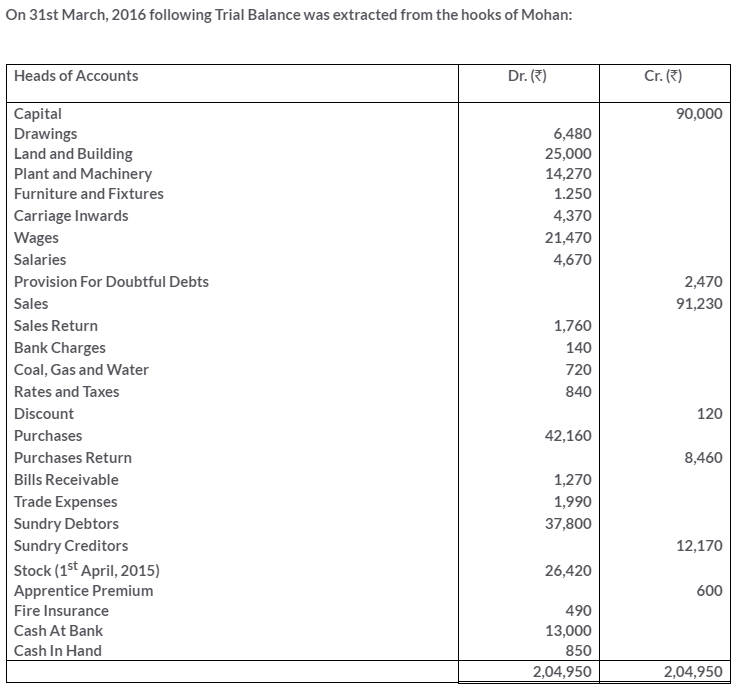
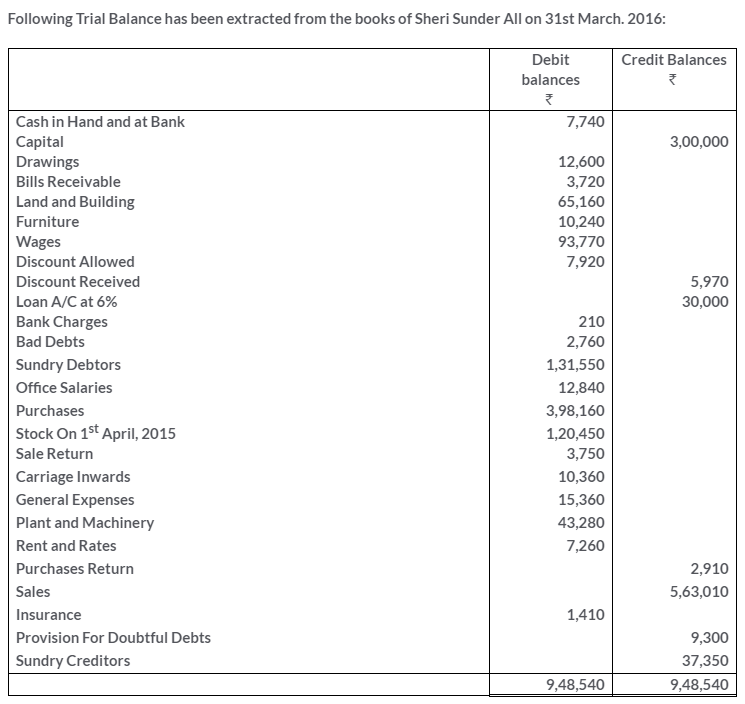
    ts-grewal-solutions-class-11-accountancy-chapter-18-adjustments-preparation-financial-statements-10-1
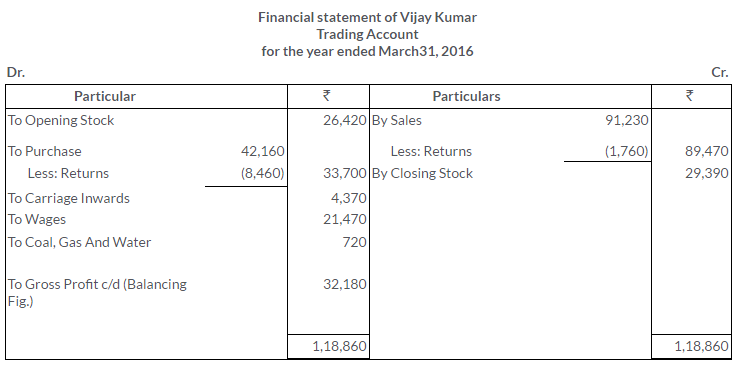
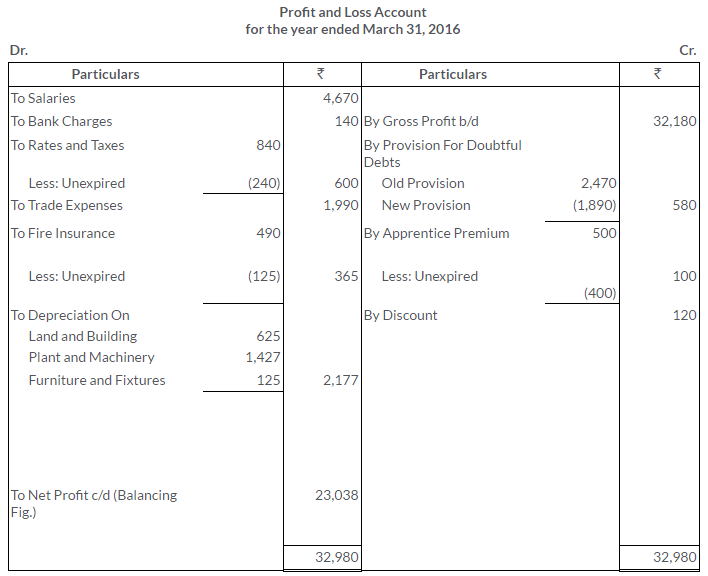
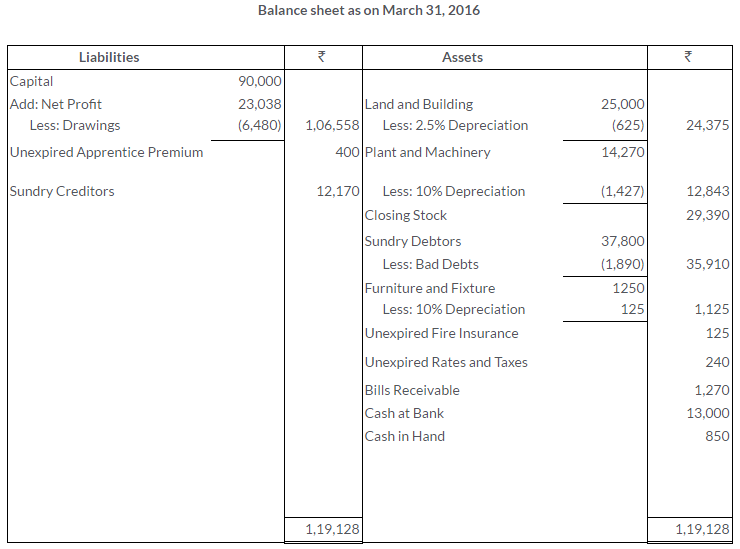
    Adjustments:
    Charge depreciation on Land and Building at 2½%, Plant and Machinery Account at 10% and on furniture and fixture at 10%. Make provision of 5% on debtors for doubtful debts, carry forward the following unexpired amounts:
    i. Fire insurance Rs.125.
    ii. Rates and taxes Rs.240.
    iii. Apprentice premium Rs.400.
    iv. Closing stock Rs.29,390.
    Solution:
    ts-grewal-solutions-class-11-accountancy-chapter-18-adjustments-preparation-financial-statements-10-2
    ts-grewal-solutions-class-11-accountancy-chapter-18-adjustments-preparation-financial-statements-10-3
    ts-grewal-solutions-class-11-accountancy-chapter-18-adjustments-preparation-financial-statements-10-4

    Question 11.
    ts-grewal-solutions-class-11-accountancy-chapter-18-adjustments-preparation-financial-statements-11-1
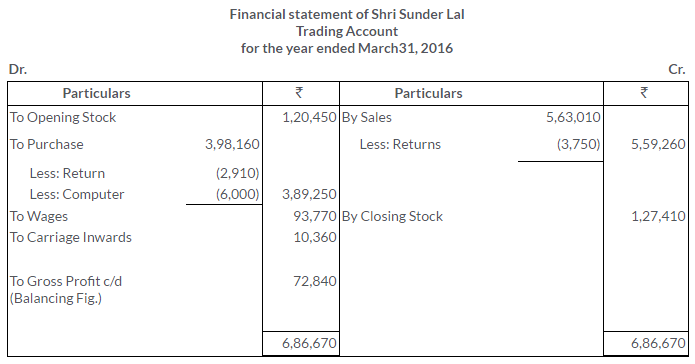
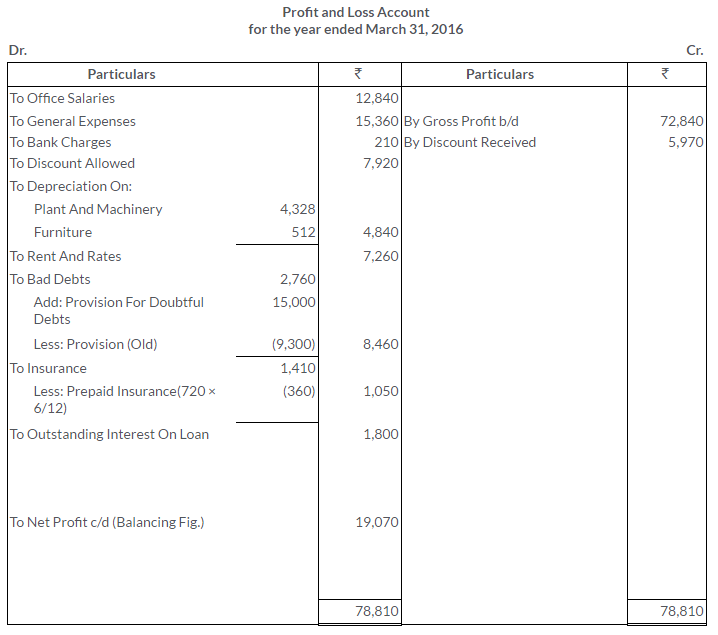
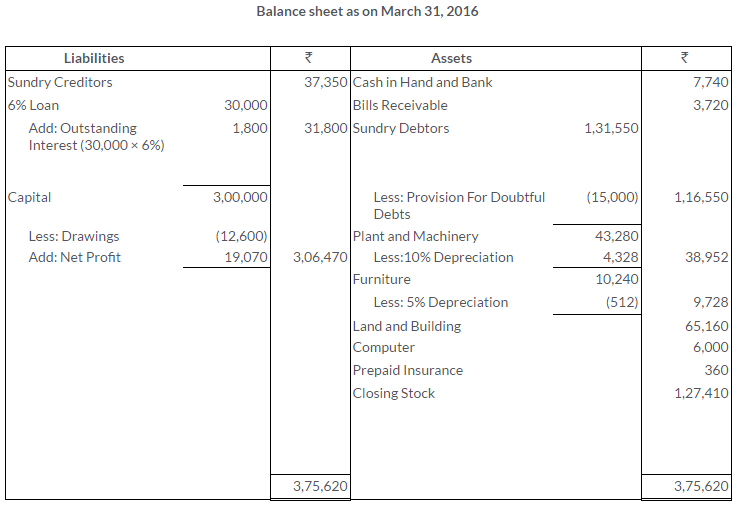
    Closing Stock on 31st March, 2016 was Rs.1,27,410.
    You are required to prepare Trading and Profit and Loss Account for the year ended 31st March, 2016 and Balance Sheet as at that date.
    Adjustments to be made are:
    i. Depreciate Plant and Machinery at 10% and Furniture at 5%.
    ii. Raise the Provision for Doubtful Debts to Rs.15,000.
    iii. Insurance includes annual premium of Rs.720 on a policy which will expire on 30th September, 2016.
    iv. Purchases included a computer costing Rs.6,000.
    Solution:
    ts-grewal-solutions-class-11-accountancy-chapter-18-adjustments-preparation-financial-statements-11-2
    ts-grewal-solutions-class-11-accountancy-chapter-18-adjustments-preparation-financial-statements-11-3
    ts-grewal-solutions-class-11-accountancy-chapter-18-adjustments-preparation-financial-statements-11-4

    Question 12.
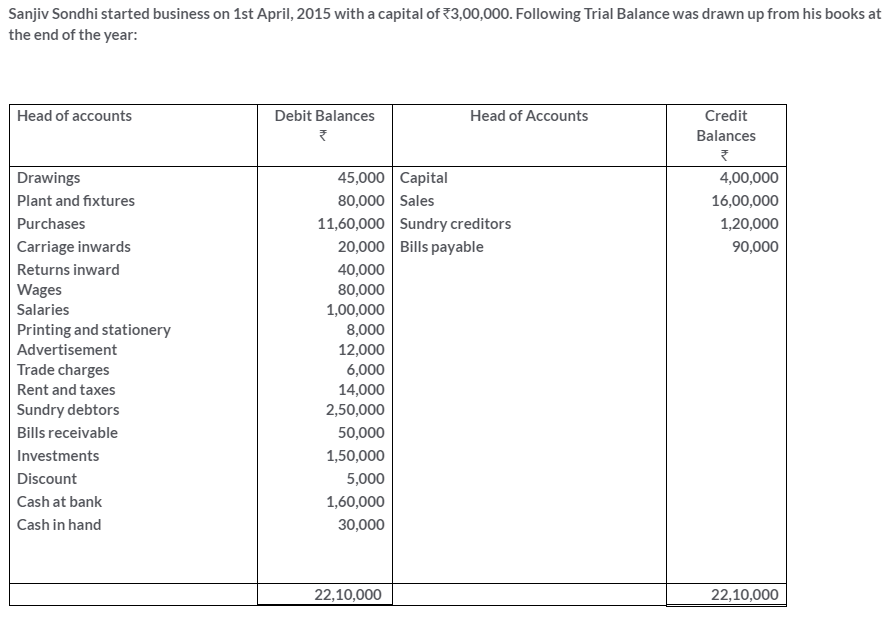
    ts-grewal-solutions-class-11-accountancy-chapter-18-adjustments-preparation-financial-statements-12-1
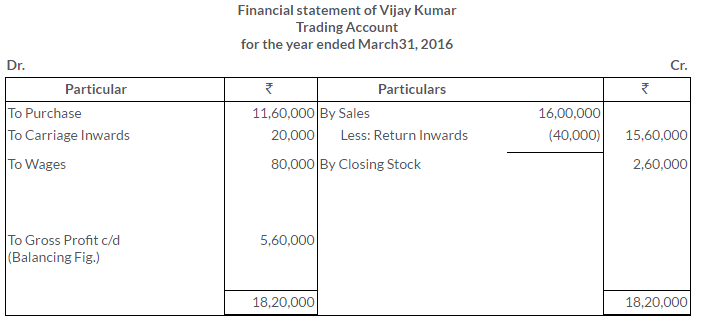
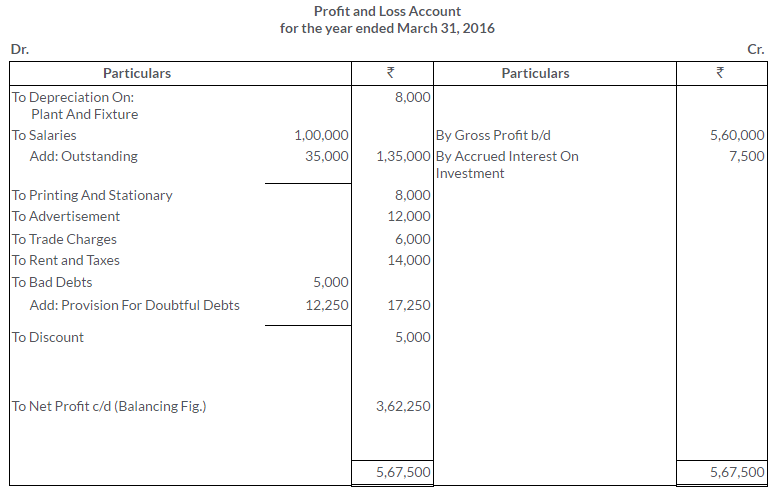
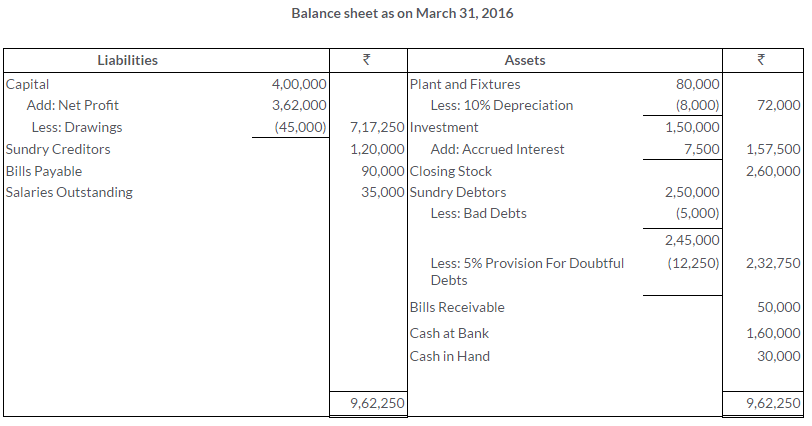
    Value of Stock as on 31st March, 2016 was Rs.2,60,000. You are required to prepare his Trading and Profit and Loss Account for the year ended 31st March, 2016 and Balance Sheet as at that date after taking the following facts into account.
    i. Plant and Fixtures are to be depreciated by 10%.
    ii. Salaries outstanding on 31st March, 2016 amounted to Rs.35,000.
    iii. Accrued interest on investment amounted to Rs.7,500.
    iv. Rs.5,000 are Bad Debts and a Provision for Doubtful Debts is to be created at 5% of balance of debtors
    Solution:
    ts-grewal-solutions-class-11-accountancy-chapter-18-adjustments-preparation-financial-statements-12-2
    ts-grewal-solutions-class-11-accountancy-chapter-18-adjustments-preparation-financial-statements-12-3
    ts-grewal-solutions-class-11-accountancy-chapter-18-adjustments-preparation-financial-statements-12-4

    Question 13.
    ts-grewal-solutions-class-11-accountancy-chapter-18-adjustments-preparation-financial-statements-13-1
    Solution:
    ts-grewal-solutions-class-11-accountancy-chapter-18-adjustments-preparation-financial-statements-13-2
    ts-grewal-solutions-class-11-accountancy-chapter-18-adjustments-preparation-financial-statements-13-3
    ts-grewal-solutions-class-11-accountancy-chapter-18-adjustments-preparation-financial-statements-13-4

    Question 14.
    ts-grewal-solutions-class-11-accountancy-chapter-18-adjustments-preparation-financial-statements-14-1
    Solution:
    ts-grewal-solutions-class-11-accountancy-chapter-18-adjustments-preparation-financial-statements-14-2
    ts-grewal-solutions-class-11-accountancy-chapter-18-adjustments-preparation-financial-statements-14-3
    ts-grewal-solutions-class-11-accountancy-chapter-18-adjustments-preparation-financial-statements-14-4
    ts-grewal-solutions-class-11-accountancy-chapter-18-adjustments-preparation-financial-statements-14-5

    Question 15.
    ts-grewal-solutions-class-11-accountancy-chapter-18-adjustments-preparation-financial-statements-15-1
    Solution:
    ts-grewal-solutions-class-11-accountancy-chapter-18-adjustments-preparation-financial-statements-15-2
    ts-grewal-solutions-class-11-accountancy-chapter-18-adjustments-preparation-financial-statements-15-3
    ts-grewal-solutions-class-11-accountancy-chapter-18-adjustments-preparation-financial-statements-15-4

    Question 16.
    ts-grewal-solutions-class-11-accountancy-chapter-18-adjustments-preparation-financial-statements-16-1
    Solution:
    ts-grewal-solutions-class-11-accountancy-chapter-18-adjustments-preparation-financial-statements-16-2
    ts-grewal-solutions-class-11-accountancy-chapter-18-adjustments-preparation-financial-statements-16-3
    ts-grewal-solutions-class-11-accountancy-chapter-18-adjustments-preparation-financial-statements-16-4

    Question 17.
    ts-grewal-solutions-class-11-accountancy-chapter-18-adjustments-preparation-financial-statements-17-1
    Solution:
    ts-grewal-solutions-class-11-accountancy-chapter-18-adjustments-preparation-financial-statements-17-2
    ts-grewal-solutions-class-11-accountancy-chapter-18-adjustments-preparation-financial-statements-17-3
    ts-grewal-solutions-class-11-accountancy-chapter-18-adjustments-preparation-financial-statements-17-4
    ts-grewal-solutions-class-11-accountancy-chapter-18-adjustments-preparation-financial-statements-17-5

    Question 18.
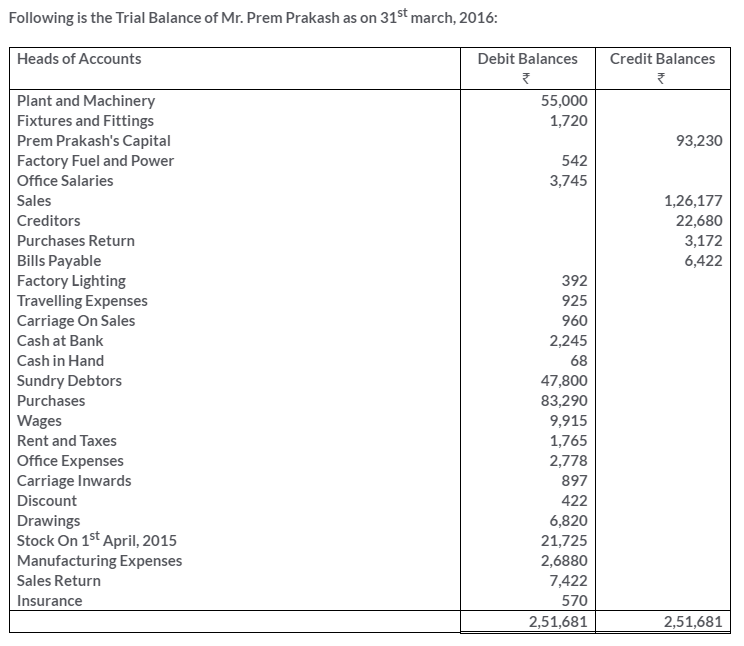
    ts-grewal-solutions-class-11-accountancy-chapter-18-adjustments-preparation-financial-statements-18-1
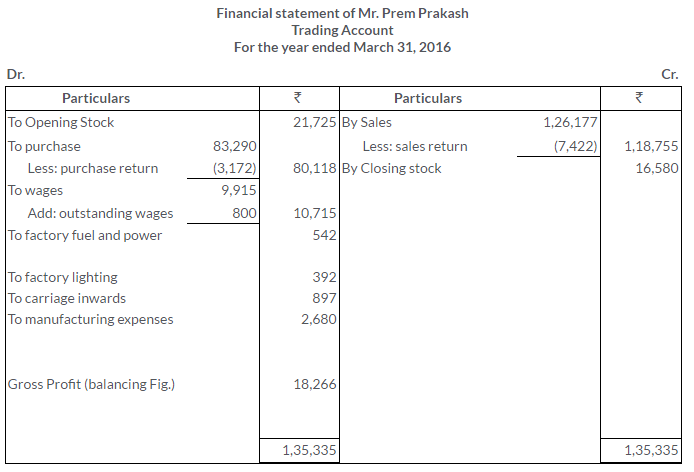
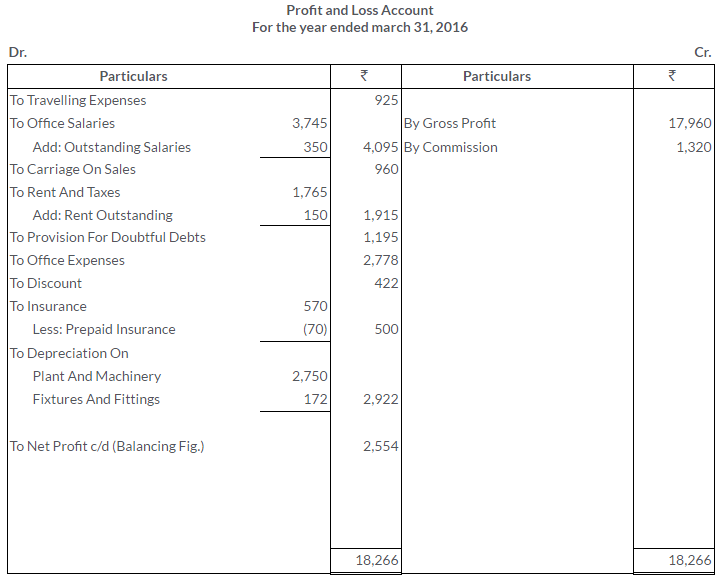
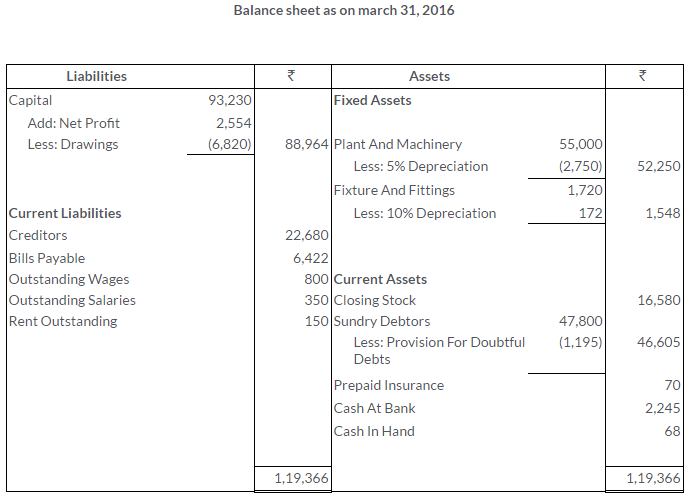
    Taking into account the following adjustments, prepare Trading and Profit and Loss Account and Balance Sheet as at 31st March, 2016:
    a. Depreciation 5% on Plant and Machinery and 10% on Fixtures and Fittings.
    b. Provision for Doubtful Debts 2½ % on Sundry Debtors.
    c. Rent Outstanding for March, 2016 Rs.150.
    d. Insurance unexpired on 31st. March, 2016 Rs.70.
    e. Outstanding Wages and Salaries Rs.800 and Rs.350.
    f. Stock on 31st March, 2016 Rs.16,580.
    Solution:
    ts-grewal-solutions-class-11-accountancy-chapter-18-adjustments-preparation-financial-statements-18-2
    ts-grewal-solutions-class-11-accountancy-chapter-18-adjustments-preparation-financial-statements-18-3
    ts-grewal-solutions-class-11-accountancy-chapter-18-adjustments-preparation-financial-statements-18-4

    Question 19.
    ts-grewal-solutions-class-11-accountancy-chapter-18-adjustments-preparation-financial-statements-19-1
    i. Salaries Rs.100 and Taxes Rs.200 are outstanding but Insurance Rs.50 is prepaid.
    ii. Commission Rs.100 received in advance for the next year.
    iii. Interest Rs.210 is to be received on Deposits and Interest on Bank Overdraft Rs.300 is to be paid.
    iv. Provision for Doubtful Debts to be maintained at Rs.1,000.
    v. Depreciate Furniture by 10%.
    vi. Stock on 31st March, 2016 is Rs.4,500.
    vii. A fire occurred on 1st April, 2016 destroying goods costing Rs.1,000.
    Solution:
    ts-grewal-solutions-class-11-accountancy-chapter-18-adjustments-preparation-financial-statements-19-2
    ts-grewal-solutions-class-11-accountancy-chapter-18-adjustments-preparation-financial-statements-19-3

    Question 20.
    ts-grewal-solutions-class-11-accountancy-chapter-18-adjustments-preparation-financial-statements-20-1
    Solution:
    ts-grewal-solutions-class-11-accountancy-chapter-18-adjustments-preparation-financial-statements-20-2
    ts-grewal-solutions-class-11-accountancy-chapter-18-adjustments-preparation-financial-statements-20-3

    Question 21.
    ts-grewal-solutions-class-11-accountancy-chapter-18-adjustments-preparation-financial-statements-21-1
    Stock on 31st March, 2014 is Rs.20,600.
    You are to make Provisions in respect of the following:
    a. Depredate Machinery at 10% p.a.
    b. Make a Provision @ 5% for Doubtful Debts.
    c. Provide 2½% discount on debtors.
    d. Rent and Rates include rent deposit of Rs.400.
    e. Insurance Prepaid Rs.120.
    Solution:
    ts-grewal-solutions-class-11-accountancy-chapter-18-adjustments-preparation-financial-statements-21-2
    ts-grewal-solutions-class-11-accountancy-chapter-18-adjustments-preparation-financial-statements-21-3
    ts-grewal-solutions-class-11-accountancy-chapter-18-adjustments-preparation-financial-statements-21-4

    Question 22.
    Following is the Trial Balance of Krishan on 31st March. 2016. Prepare Trading and Loss A/c and Balance Sheet after making the following adjustments:
    i. Value of closing stock Rs.29,638.
    ii. Depreciate plant and machinery 10%, furniture 5%, delivery van Rs.4,000.
    iii. Provide 5% for doubtful debts on debtors.
    iv. Prepaid expenses: Insurance Rs.300 and taxes Rs.190.
    v. 3/5 of insurance and taxes, rent and general expenses to be charged to factory balance to the office.
    vi. Commission to Manager at 10% on net profit.
    ts-grewal-solutions-class-11-accountancy-chapter-18-adjustments-preparation-financial-statements-22-1
    Solution:
    ts-grewal-solutions-class-11-accountancy-chapter-18-adjustments-preparation-financial-statements-22-2
    ts-grewal-solutions-class-11-accountancy-chapter-18-adjustments-preparation-financial-statements-22-3
    ts-grewal-solutions-class-11-accountancy-chapter-18-adjustments-preparation-financial-statements-22-4

    Question 23.
    ts-grewal-solutions-class-11-accountancy-chapter-18-adjustments-preparation-financial-statements-23-1
    Following adjustments are to be made:
    i. Stock in Hand on 31st March, 2016 was Rs.3,250.
    ii. Depreciate Building at 5% and Furniture at 10%. Loose Tools are revalued at Rs.5,000 at the end of the year.
    iii. Salaries Rs.300 and taxes Rs.120 are outstanding.
    iv. Insurance amounting Rs.100 is prepaid.
    v. Write off a further Rs.100 as Bad Debts and Provision for Doubtful Debts is to be made equal to 5% on Sundry Debtors.
    vi. Half of the stationery was used by A for his personal purposes.
    Solution:
    ts-grewal-solutions-class-11-accountancy-chapter-18-adjustments-preparation-financial-statements-23-2
    ts-grewal-solutions-class-11-accountancy-chapter-18-adjustments-preparation-financial-statements-23-3
    ts-grewal-solutions-class-11-accountancy-chapter-18-adjustments-preparation-financial-statements-23-4

    Question 24.
    ts-grewal-solutions-class-11-accountancy-chapter-18-adjustments-preparation-financial-statements-24-1
    Solution:
    ts-grewal-solutions-class-11-accountancy-chapter-18-adjustments-preparation-financial-statements-24-2
    ts-grewal-solutions-class-11-accountancy-chapter-18-adjustments-preparation-financial-statements-24-3
    ts-grewal-solutions-class-11-accountancy-chapter-18-adjustments-preparation-financial-statements-24-4

    Question 25.
    ts-grewal-solutions-class-11-accountancy-chapter-18-adjustments-preparation-financial-statements-25-1
    Solution:
    ts-grewal-solutions-class-11-accountancy-chapter-18-adjustments-preparation-financial-statements-25-2
    ts-grewal-solutions-class-11-accountancy-chapter-18-adjustments-preparation-financial-statements-25-3
    ts-grewal-solutions-class-11-accountancy-chapter-18-adjustments-preparation-financial-statements-25-4

    Question 26.
    ts-grewal-solutions-class-11-accountancy-chapter-18-adjustments-preparation-financial-statements-26-1
    Solution:
    ts-grewal-solutions-class-11-accountancy-chapter-18-adjustments-preparation-financial-statements-26-2
    ts-grewal-solutions-class-11-accountancy-chapter-18-adjustments-preparation-financial-statements-26-3
    ts-grewal-solutions-class-11-accountancy-chapter-18-adjustments-preparation-financial-statements-26-4

    Question 27.
    ts-grewal-solutions-class-11-accountancy-chapter-18-adjustments-preparation-financial-statements-27-1
    Solution:
    ts-grewal-solutions-class-11-accountancy-chapter-18-adjustments-preparation-financial-statements-27-2
    ts-grewal-solutions-class-11-accountancy-chapter-18-adjustments-preparation-financial-statements-27-3
    ts-grewal-solutions-class-11-accountancy-chapter-18-adjustments-preparation-financial-statements-27-4

    Question 28.
    ts-grewal-solutions-class-11-accountancy-chapter-18-adjustments-preparation-financial-statements-28-1
    Solution:
    ts-grewal-solutions-class-11-accountancy-chapter-18-adjustments-preparation-financial-statements-28-2
    ts-grewal-solutions-class-11-accountancy-chapter-18-adjustments-preparation-financial-statements-28-3

    Question 29.
    ts-grewal-solutions-class-11-accountancy-chapter-18-adjustments-preparation-financial-statements-29-1
    Adjustments:
    i. Stock on 31st March, 2016 was valued at Rs.5,30,000.
    ii. Salaries have been paid so far for 11months only.
    iii. Unexpired insurance included in the figure of Rs.4,000 appearing in the Trail Balance is Rs.1,000.
    iv. Commission earned but not yet received amounted to Rs.1,220 is to be recorded in the books of account.
    v. Provision for doubtful debts is to be brought up to 3% of sundry debtors.
    vi. Manager is to be allowed a commission of 10% of net profit after charging such commission.
    vii. Furniture is depreciated @10% p.a.
    Prepare Trading and Profit and loss account for the year ended 31st March, 2016 and balance Sheet as at that date.
    Solution:
    ts-grewal-solutions-class-11-accountancy-chapter-18-adjustments-preparation-financial-statements-29-2
    ts-grewal-solutions-class-11-accountancy-chapter-18-adjustments-preparation-financial-statements-29-3
    ts-grewal-solutions-class-11-accountancy-chapter-18-adjustments-preparation-financial-statements-29-4

    Question 30.
    ts-grewal-solutions-class-11-accountancy-chapter-18-adjustments-preparation-financial-statements-30-1
    Additional Information :

    Errors:
    a. Purchases include sales return of Rs.5,000 and sales include purchases return of Rs.4,000.
    b. Goods withdrawn by the proprietor for own consumption Rs.2,000 were included in purchases.
    c. Wages paid for installation of plant and machinery amounted to Rs.2,000 were included in wages account.
    d. Free samples distributed for publicity costing Rs.2,500, but not recorded in the books.
    e. An advance of Rs.5,000 to a supplier was wrongly included in the list of sundry debtors.
    f. A dishonoured bill receivable for Rs.2,000 returned by the bank with whom it had been discounted, had been credited to bank account and debited to bills receivable account.

    Adjustment:
    a. Charge depreciation on plant and machinery at 15% and on furniture at 10%.
    b. Create a Provision for Doubtful Debts @5% and provision for discount on debtors at 2%.
    c. Closing stock is valued at Rs.80,000.
    Solution:
    ts-grewal-solutions-class-11-accountancy-chapter-18-adjustments-preparation-financial-statements-30-2
    ts-grewal-solutions-class-11-accountancy-chapter-18-adjustments-preparation-financial-statements-30-3
    ts-grewal-solutions-class-11-accountancy-chapter-18-adjustments-preparation-financial-statements-30-4

  • TS Grewal Solutions for Financial Statements of Sole Proprietorship Class 11 Accountancy Chapter 17

    TS Grewal Solutions for Class 11 Accountancy Chapter 17 – Financial Statements of Sole Proprietorship

    Question 1.
    ts-grewal-solutions-class-11-accountancy-chapter-17-financial-statements-sole-proprietorship-1-1
    Solution:
    ts-grewal-solutions-class-11-accountancy-chapter-17-financial-statements-sole-proprietorship-1-2

    Question 2.
    ts-grewal-solutions-class-11-accountancy-chapter-17-financial-statements-sole-proprietorship-2-1
    Solution:
    ts-grewal-solutions-class-11-accountancy-chapter-17-financial-statements-sole-proprietorship-2-2

    Question 3.
    ts-grewal-solutions-class-11-accountancy-chapter-17-financial-statements-sole-proprietorship-3-1
    Solution:
    ts-grewal-solutions-class-11-accountancy-chapter-17-financial-statements-sole-proprietorship-3-2

    Question 4.
    ts-grewal-solutions-class-11-accountancy-chapter-17-financial-statements-sole-proprietorship-4-1
    Solution:
    ts-grewal-solutions-class-11-accountancy-chapter-17-financial-statements-sole-proprietorship-4-2

    Question 5.
    ts-grewal-solutions-class-11-accountancy-chapter-17-financial-statements-sole-proprietorship-5-1
    Solution:
    ts-grewal-solutions-class-11-accountancy-chapter-17-financial-statements-sole-proprietorship-5-2

    Question 6.
    From the following information, prepare Trading Account for the year ended 31st March,2014:
    Adjusted Purchases Rs.6,60,000; Sales Rs.7,44,000; Closing Stock Rs.50,400; Freight and Carriage Inwards Rs.3,600; Wages Rs.6,000; Freight and Cartage Outwards Rs.2,000
    Solution:
    ts-grewal-solutions-class-11-accountancy-chapter-17-financial-statements-sole-proprietorship-6

    Question 7.
    ts-grewal-solutions-class-11-accountancy-chapter-17-financial-statements-sole-proprietorship-7-1
    Solution:
    ts-grewal-solutions-class-11-accountancy-chapter-17-financial-statements-sole-proprietorship-7-2

    Question 8.
    ts-grewal-solutions-class-11-accountancy-chapter-17-financial-statements-sole-proprietorship-8-1
    Solution:
    ts-grewal-solutions-class-11-accountancy-chapter-17-financial-statements-sole-proprietorship-8-2

    Question 9.
    ts-grewal-solutions-class-11-accountancy-chapter-17-financial-statements-sole-proprietorship-9-1
    Solution:
    ts-grewal-solutions-class-11-accountancy-chapter-17-financial-statements-sole-proprietorship-9-2

    Question 10.
    ts-grewal-solutions-class-11-accountancy-chapter-17-financial-statements-sole-proprietorship-10-1
    Solution:
    ts-grewal-solutions-class-11-accountancy-chapter-17-financial-statements-sole-proprietorship-10-2
    ts-grewal-solutions-class-11-accountancy-chapter-17-financial-statements-sole-proprietorship-10-3

    Question 11.
    ts-grewal-solutions-class-11-accountancy-chapter-17-financial-statements-sole-proprietorship-11-1
    Solution:
    ts-grewal-solutions-class-11-accountancy-chapter-17-financial-statements-sole-proprietorship-11-2
    ts-grewal-solutions-class-11-accountancy-chapter-17-financial-statements-sole-proprietorship-11-3

    Question 12.
    ts-grewal-solutions-class-11-accountancy-chapter-17-financial-statements-sole-proprietorship-12-1
    Solution:
    ts-grewal-solutions-class-11-accountancy-chapter-17-financial-statements-sole-proprietorship-12-2

    Question 13.
    ts-grewal-solutions-class-11-accountancy-chapter-17-financial-statements-sole-proprietorship-13-1
    Solution:
    ts-grewal-solutions-class-11-accountancy-chapter-17-financial-statements-sole-proprietorship-13-2
    ts-grewal-solutions-class-11-accountancy-chapter-17-financial-statements-sole-proprietorship-13-3

    Question 14.
    ts-grewal-solutions-class-11-accountancy-chapter-17-financial-statements-sole-proprietorship-14-1
    Solution:
    ts-grewal-solutions-class-11-accountancy-chapter-17-financial-statements-sole-proprietorship-14-2
    ts-grewal-solutions-class-11-accountancy-chapter-17-financial-statements-sole-proprietorship-14-3

    Question 15.
    ts-grewal-solutions-class-11-accountancy-chapter-17-financial-statements-sole-proprietorship-15-1
    Solution:
    ts-grewal-solutions-class-11-accountancy-chapter-17-financial-statements-sole-proprietorship-15-2
    ts-grewal-solutions-class-11-accountancy-chapter-17-financial-statements-sole-proprietorship-15-3

    Question 16.
    From The following balances, prepare Final Accounts of M/s Raja and Sons for the year ended 31st March,2014:
    Salary Rs.5,400; Insurance Rs.2,500; Cash Rs.400; Purchases Rs.84,170; Rent Received Rs.3,150; Drawings Rs.2,100; Bills Payable Rs.3,900; Debtors Rs.38,080; Stock (1st April, 2013) Rs.29,500; Bank Overdraft Rs.9,700; Carriage Rs.2,200; Creditors Rs.4,200; Trade Expenses Rs.4,900; Sales Return Rs.4,700; Machinery Rs.12,000; Wages Rs.45,000; Sales Rs.1,47,200; Purchases Return Rs.3,900; Capital Rs.58,900; Closing Stock (31st March, 2014) Rs.36,200.
    Solution:
    ts-grewal-solutions-class-11-accountancy-chapter-17-financial-statements-sole-proprietorship-16
    ts-grewal-solutions-class-11-accountancy-chapter-17-financial-statements-sole-proprietorship-16-1

    Question 17.
    From the following balances, prepare Final Accounts of M/s. Mangal and Sons for the year ended 31st March, 2014:
    Opening Stock Rs.12,500; Bills Receivable Rs.2,000; Sales Rs.70,000; Purchases Rs.37,500; Creditors Rs.20,000; Salaries Rs.3,850; Insurance Rs.200; Debtors Rs.32,500; Carriage Rs.1,450; Commission Rs.750; Interest Rs.900; Printing Rs.250; Bills Payable Rs.3,150: Returns In Rs.1,300; Returns Out Rs.500; Bank Rs.5,250; Rent and Taxes Rs.1,300; Furniture Rs.1,000; Capital Rs.7,100;, Stock on 31st March, 2014 Rs.15,000.
    Solution:
    ts-grewal-solutions-class-11-accountancy-chapter-17-financial-statements-sole-proprietorship-17-1
    ts-grewal-solutions-class-11-accountancy-chapter-17-financial-statements-sole-proprietorship-17

    Question 18.
    ts-grewal-solutions-class-11-accountancy-chapter-17-financial-statements-sole-proprietorship-18-1
    Solution:
    ts-grewal-solutions-class-11-accountancy-chapter-17-financial-statements-sole-proprietorship-18-2

    Question 19.
    ts-grewal-solutions-class-11-accountancy-chapter-17-financial-statements-sole-proprietorship-19-1
    Solution:
    ts-grewal-solutions-class-11-accountancy-chapter-17-financial-statements-sole-proprietorship-19-2
    ts-grewal-solutions-class-11-accountancy-chapter-17-financial-statements-sole-proprietorship-19-3

    Question 20.
    ts-grewal-solutions-class-11-accountancy-chapter-17-financial-statements-sole-proprietorship-20-1
    Solution:
    ts-grewal-solutions-class-11-accountancy-chapter-17-financial-statements-sole-proprietorship-20-2
    ts-grewal-solutions-class-11-accountancy-chapter-17-financial-statements-sole-proprietorship-20-3

    Question 21.
    ts-grewal-solutions-class-11-accountancy-chapter-17-financial-statements-sole-proprietorship-21-1
    Solution:
    ts-grewal-solutions-class-11-accountancy-chapter-17-financial-statements-sole-proprietorship-21-2
    ts-grewal-solutions-class-11-accountancy-chapter-17-financial-statements-sole-proprietorship-21-3

    Question 22.
    ts-grewal-solutions-class-11-accountancy-chapter-17-financial-statements-sole-proprietorship-22-1
    Solution:
    ts-grewal-solutions-class-11-accountancy-chapter-17-financial-statements-sole-proprietorship-22-2
    ts-grewal-solutions-class-11-accountancy-chapter-17-financial-statements-sole-proprietorship-22-3

    Question 23.
    ts-grewal-solutions-class-11-accountancy-chapter-17-financial-statements-sole-proprietorship-23-1
    Solution:
    ts-grewal-solutions-class-11-accountancy-chapter-17-financial-statements-sole-proprietorship-23-2
    ts-grewal-solutions-class-11-accountancy-chapter-17-financial-statements-sole-proprietorship-23-3

    Question 24.
    ts-grewal-solutions-class-11-accountancy-chapter-17-financial-statements-sole-proprietorship-24-1
    Solution:
    ts-grewal-solutions-class-11-accountancy-chapter-17-financial-statements-sole-proprietorship-24-2
    ts-grewal-solutions-class-11-accountancy-chapter-17-financial-statements-sole-proprietorship-24-3

    Question 25.
    ts-grewal-solutions-class-11-accountancy-chapter-17-financial-statements-sole-proprietorship-25-1
    Solution:
    ts-grewal-solutions-class-11-accountancy-chapter-17-financial-statements-sole-proprietorship-25-2
    ts-grewal-solutions-class-11-accountancy-chapter-17-financial-statements-sole-proprietorship-25-3

  • TS Grewal Solutions for Rectification of Errors Class 11 Accountancy Chapter 16

    TS Grewal Solutions for Class 11 Accountancy Chapter 16 – Rectification of Errors

    Question 1.
    How will you rectify the following errors?
    i. Purchases Book is overcast by Rs.10,000.
    ii. Purchases Return Book is overcast by Rs.1,000.
    iii. Purchases Return Book’s balance is carried forward in excess by Rs.100.
    iv. Purchases Book’s balance is carried forward in excess by Rs.1,000.
    Note: The above errors have been detected before the preparation of Trial Balance.
    Solution:
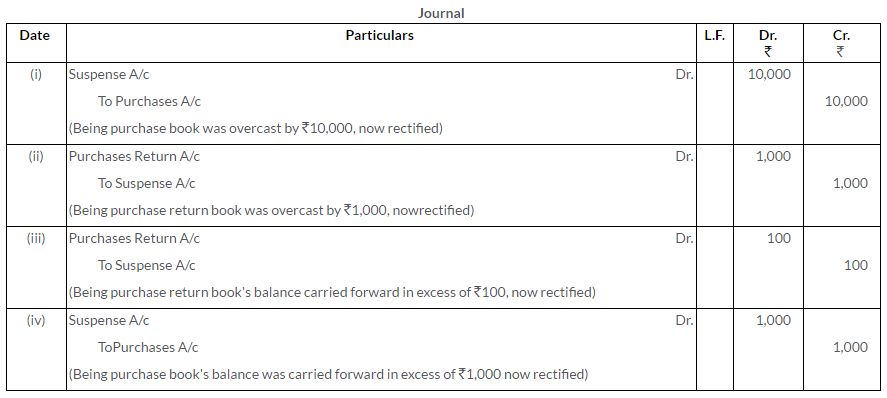
    ts-grewal-solutions-class-11-accountancy-chapter-16-rectification-errors-1

    Question 2.
    How will you rectify the following errors?
    i. Sales Book is short casted by Rs.5,000.
    ii. Sales Return Book is short casted by Rs.500.
    iii. Balance of Sales Book is carried forward short by Rs.1,000.
    iv. Balance of Sales Return Book is carried forward short by Rs.100.
    Solution:
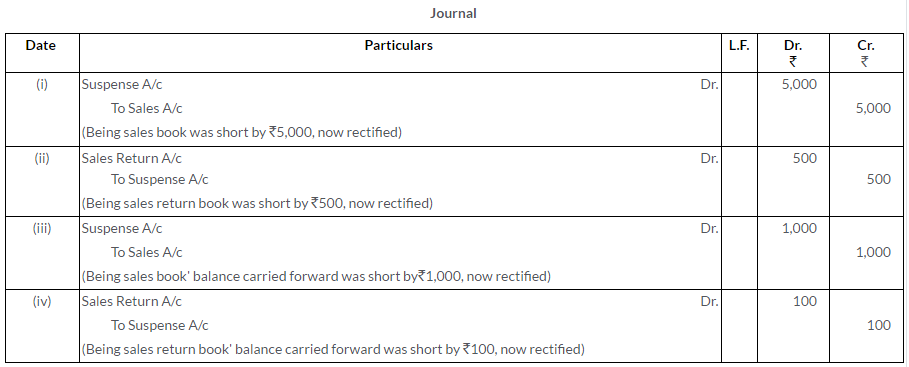
    ts-grewal-solutions-class-11-accountancy-chapter-16-rectification-errors-2

    Question 3.
    How will you rectify the following errors?
    i. Sales Book is overcast by Rs.5,000.
    ii. Sales Return Book is short casted by Rs.500.
    iii. Balance of Sales Book is carried forward in excess by Rs.1,000.
    iv. Balance of Sales Return Book is carried forward in excess by Rs.100.
    Solution:
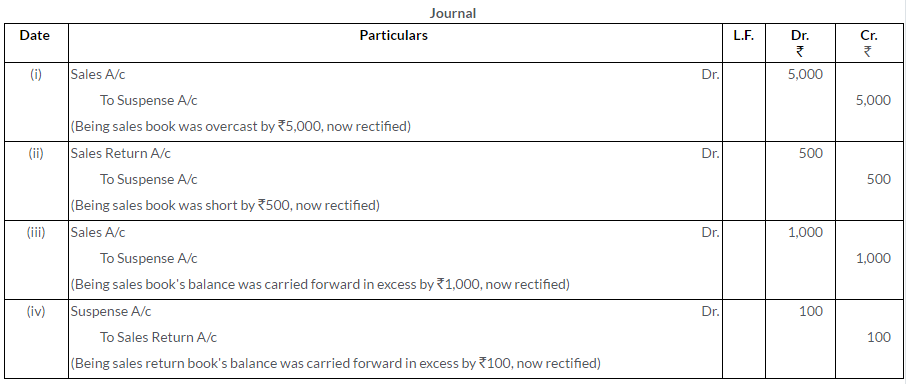
    ts-grewal-solutions-class-11-accountancy-chapter-16-rectification-errors-3

    Question 4.
    Rectify the following errors assuming that there is no Suspense Account:
    i. Salary of Rs.5,000 paid to Rahul was not posted to Salaries Account.
    ii. Sales to Amrish of Rs.1,430 posted to his account as Rs.1,340.
    iii. Sales to Vijay of Rs.2,470 posted to his account as Rs.2,740.
    iv. Purchases from Pal of Rs.1,430 posted to his account as Rs.1,340.
    Solution:
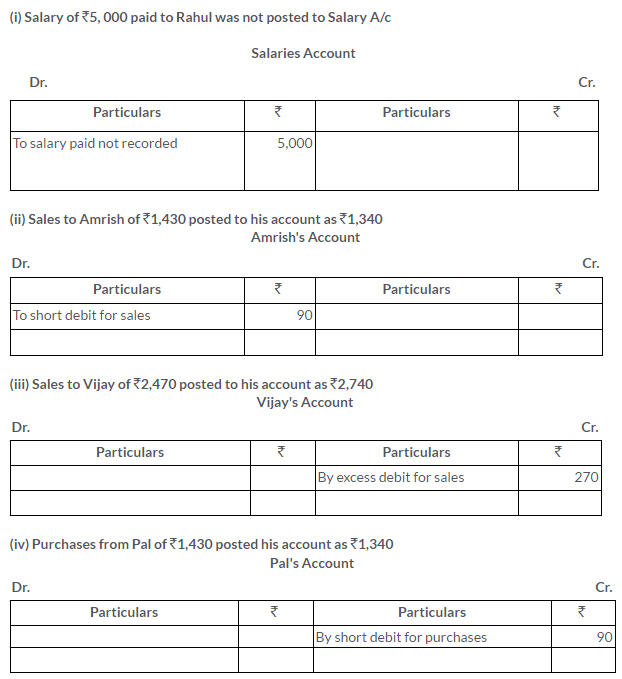
    ts-grewal-solutions-class-11-accountancy-chapter-16-rectification-errors-4

    Question 5.
    Which of the following errors will affect the Trial Balance?
    i. The total of the Sales Book has not been posted to the Sales Account.
    ii. Rs.1,000 paid as installation charges of a new machine has been debited to Repairs Account.
    iii. Goods costing Rs.4,000 taken by the proprietor for personal use have been debited to Debtor’s Account.
    iv. Rs.1,000 paid for repairs to building have been debited to Building Account.
    [The total of the Sales Book has not been posted to Sales Account will affect the Trial Balance.]
    Solution:
    Total of Sales book has not been posted to Sales Account will affect the Trial Balance because due to undercast of Sales Accounts results in undercasting of credit side of the Trial Balance.

    Question 6.
    Rectify the following errors:
    i. The Sales Book of December was added short by Rs.500.
    ii. A periodical total of the Purchases Book was cast short by Rs.5,000.
    iii. The total of Purchases Return Book has been undercast by Rs.1,500.
    iv. The Sales Return Book is added Rs.200 short.
    Solution:
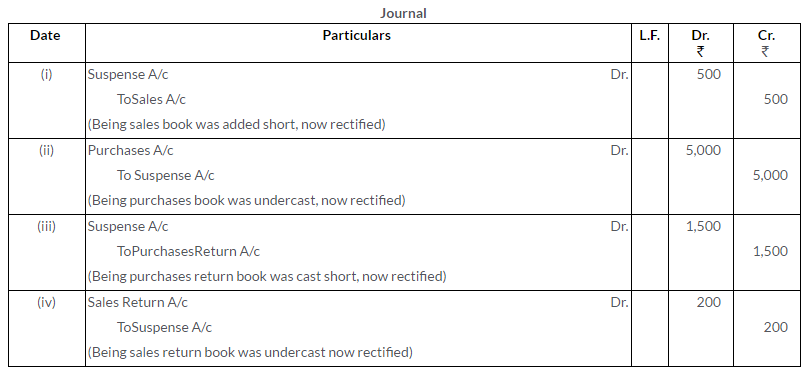
    ts-grewal-solutions-class-11-accountancy-chapter-16-rectification-errors-6

    Question 7.
    Rectify the following errors assuming that there is no Suspense Account:
    i. The Returns Inward Book has been overcast by Rs.200.
    ii. Purchases Book carried forward Rs.75 less.
    iii. Sales Book carried forward Rs.41 less on Page 10 and Rs.43 more on Page 12
    iv. Goods sold to Gautam were posted as Rs.215 instead of Rs.251.
    Solution:
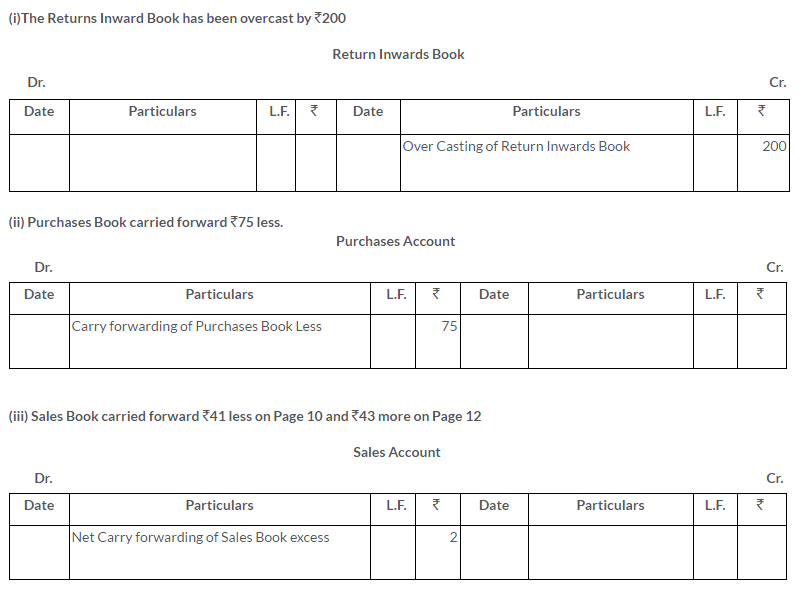
    ts-grewal-solutions-class-11-accountancy-chapter-16-rectification-errors-7
    ts-grewal-solutions-class-11-accountancy-chapter-16-rectification-errors-7-1
    Question 8.
    Following errors are discovered in the books of Sit Ram Lal. Make the necessary entries to rectify them:
    i. Purchases Journal was Rs.2,150.
    ii. Rs.500 received from K. Krishna was debited to his account.
    iii. An amount of Rs.3,000 withdrawn by the proprietor of the firm for his personal use was posted to the Travelling Expense Account.
    iv. An amount of Rs.175 for a credit sale to R. Gopalan correctly entered in the Sale Book, has been debited to his account as Rs.157
    Solution:
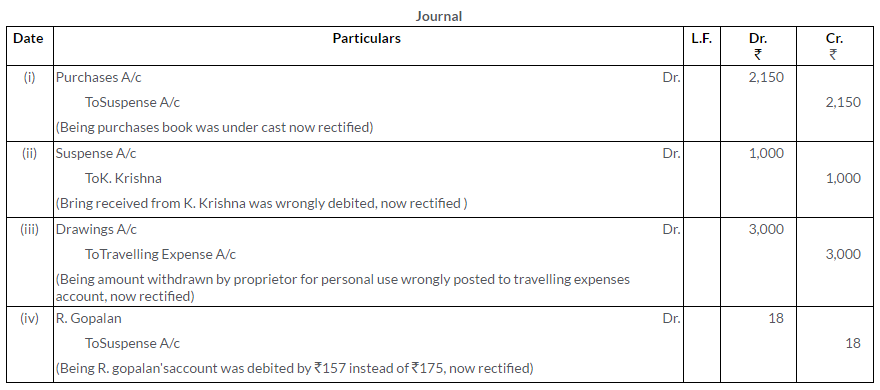
    ts-grewal-solutions-class-11-accountancy-chapter-16-rectification-errors-8

    Question 9.
    Pass the Journal entries rectifying the following errors:
    i. Purchases of Rs.10,000 was omitted to be recorded.
    ii. Purchases of office furniture of Rs.10,000 was recorded in Purchases Book.
    iii. Office Rent of Rs.15,000 was debited to the Personal Account of the landlord.
    iv. Old machine was sold for Rs.5,000 was credited to Sales Account.
    Solution:
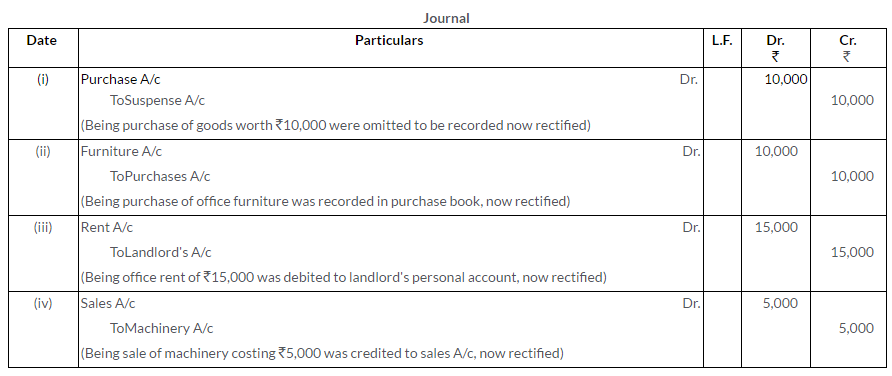
    ts-grewal-solutions-class-11-accountancy-chapter-16-rectification-errors-9

    Question 10.
    Following errors affecting the accounts for the year 2015 were detected in the books of Dasand Co., Meerut:
    i. Sale of old furniture for Rs.5,000 was treated as sales of goods.
    ii. Rent of proprietor’s residence Rs.6,000 was debited to Rent Account.
    iii. Cash received from Rajesh Rs.2,150 was credited to Brajesh.
    Pass the rectifying Journal entries. State the nature of each of these mistakes.
    Solution:
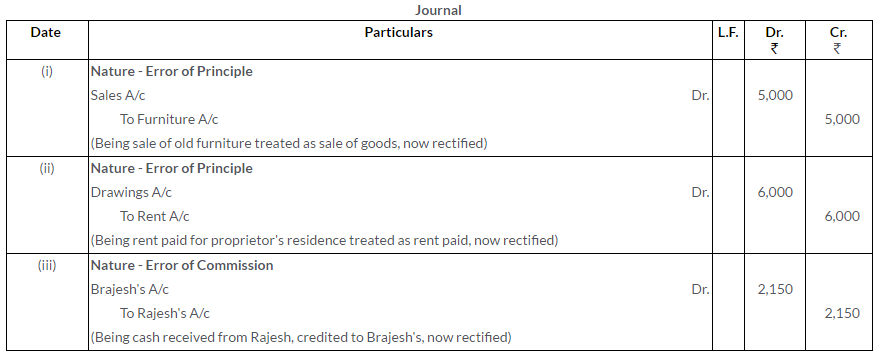
    ts-grewal-solutions-class-11-accountancy-chapter-16-rectification-errors-10

    Question 11.
    Rectify the following errors:
    i. Purchases Book has been undercast by Rs.1,000.
    ii. Credit sale to Anu Prakash Rs.7,000 was recorded in Purchases Book.
    iii. Credit sale to Rahul Rs.7,000 was recorded as Rs.700.
    Solution:
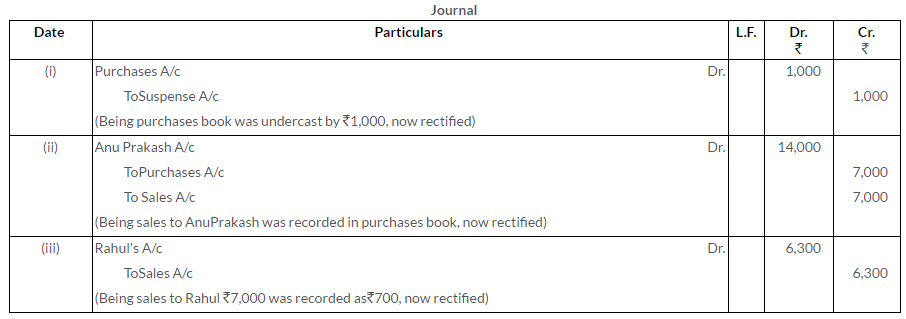
    ts-grewal-solutions-class-11-accountancy-chapter-16-rectification-errors-11

    Question 12.
    Rectify the following errors:
    i. Total of one page of the Sales Book was carried forward to the next page as Rs.2,785 instead of Rs.2,587.
    ii. A cheque of Rs.400 received from Mohan was dishonoured and had been posted to the debit side of the ‘Allowance Account’.
    iii. Return of goods worth Rs.5,000 by a customer was entered in the Purchase Return Book.
    iv. Sum of Rs.200 owed by ‘X’ has been included in the list of Sundry Creditors.
    v. Sale of old furniture worth Rs.430 was credited to the Sales Account as Rs.340.
    (KVS 2005)
    Solution:
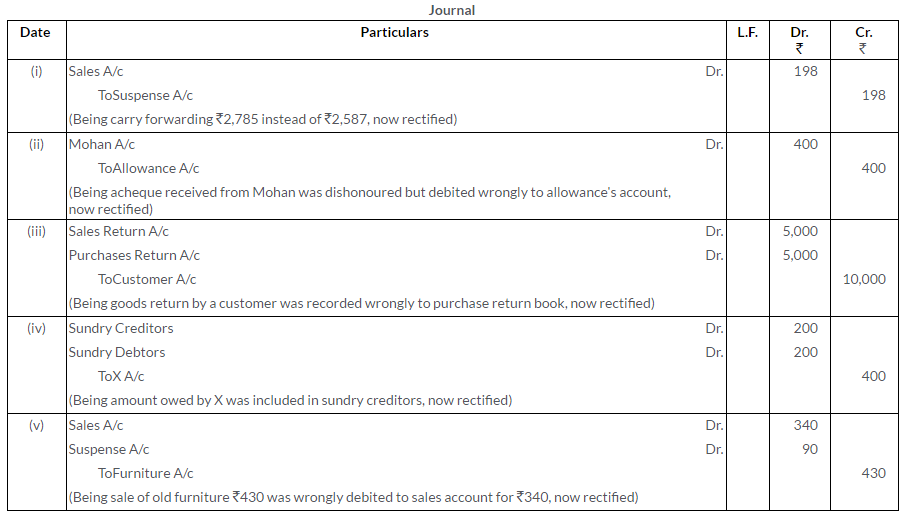
    ts-grewal-solutions-class-11-accountancy-chapter-16-rectification-errors-12

    Question 13.
    Rectify the following errors:
    i. Purchases Book is overcast by Rs.500.
    ii. Salary paid to an employee, Mr. Ajay, is debited to his Personal Account Rs.3,000.
    iii. Goods sold to Shashi on credit Rs.300 have been wrongly passed through the Purchases Book.
    iv. Total of returns inward has been added Rs.9 short.
    v. Purchase of chair from Happy Traders for Rs.35 has been entered in the Purchases Book as Rs.53.
    Solution:
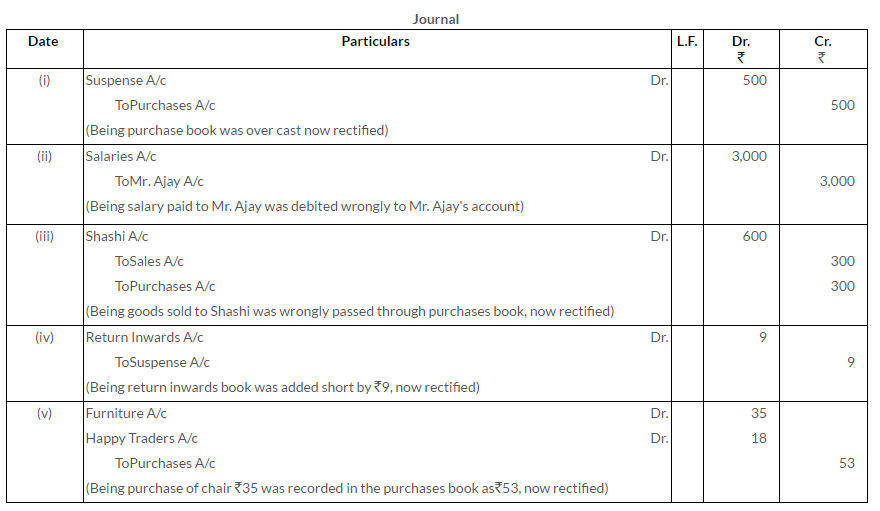
    ts-grewal-solutions-class-11-accountancy-chapter-16-rectification-errors-13

    Question 14.
    Correct the following errors in Mohan Lal’s Book:
    i. A payment of Rs.5,000 for salaries (to Mr. Ram) has been posted twice to the Salaries Account.
    ii. Rs.750 received from Rajesh are entered on the debit side of the Cash Book. No posting was done in Rajesh’s Account.
    iii. Sales Book was overcast by Rs.3,000.
    iv. Goods (Cost Rs.2,000, Sales Price Rs.2,500) distributed as free samples among prospective customers were not recorded anywhere.
    Solution:
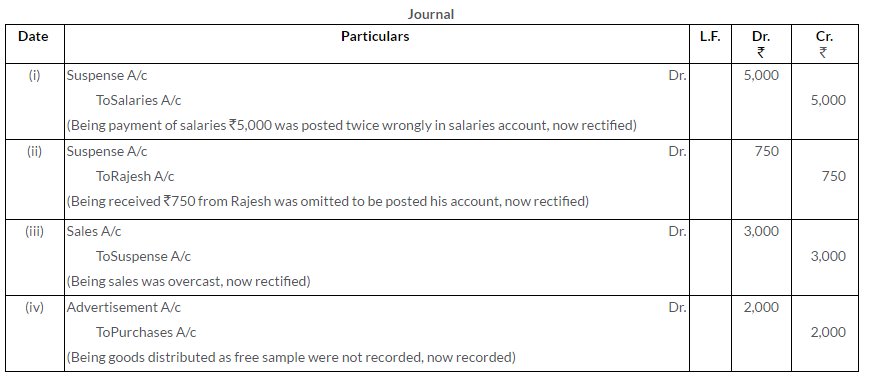
    ts-grewal-solutions-class-11-accountancy-chapter-16-rectification-errors-14

    Question 15.
    Rectify the following errors:
    i. Sales to Vinod of Rs.143 posted to his account as Rs.134.
    ii. Sales to Vinod of Rs.143 debited to his account as Rs.134.
    iii. Sales to Vinod of Rs.143 credited to his account as Rs.134.
    Solution:
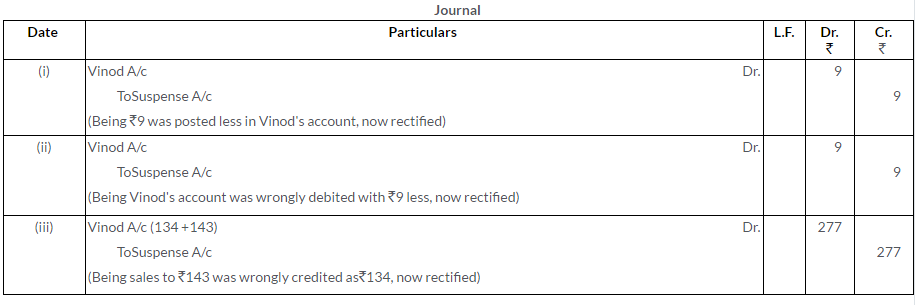
    ts-grewal-solutions-class-11-accountancy-chapter-16-rectification-errors-15

    Question 16.
    Give the rectifying entries of the following:
    i. Sales of Rs.20,000 to Manoj were recorded as Rs.2,000 in the Sales Book.
    ii. An amount of Rs.25,000 spent for the extension of machinery has been debited to the Wages Account.
    iii. Discount received from Ram and Co. Rs.350, has not been entered in the discount column of the Cash Book.
    iv. Goods of Rs.3,000 sold to Mahesh were recorded in the Purchases Book.
    Solution:
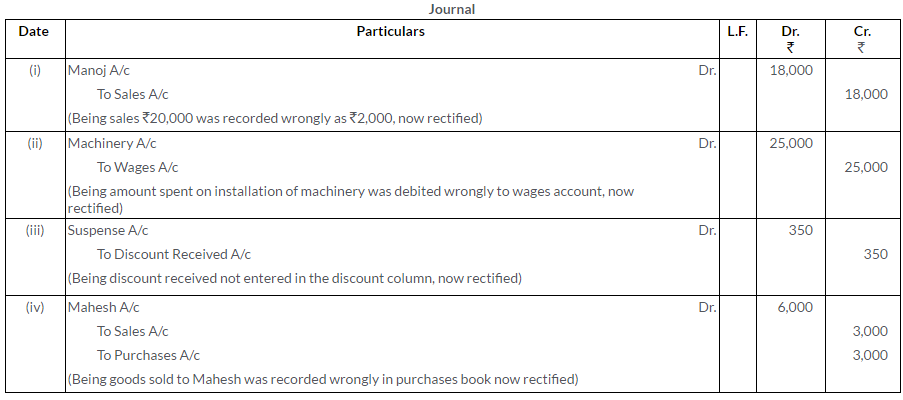
    ts-grewal-solutions-class-11-accountancy-chapter-16-rectification-errors-16

    Question 17.
    Correct the following errors in Mohan Lars Book:
    i. A sum of Rs.1,500 written off as depreciation on furniture has not been debited to the Depreciation Account.
    ii. Returns Outward Journal has been overcast by Rs.85.
    iii. Basudev returned goods worth Rs.500; his account was debited by this amount.
    iv. Purchase from Krishna Mohan of Rs.2,250 has been debited to his account.
    Solution:
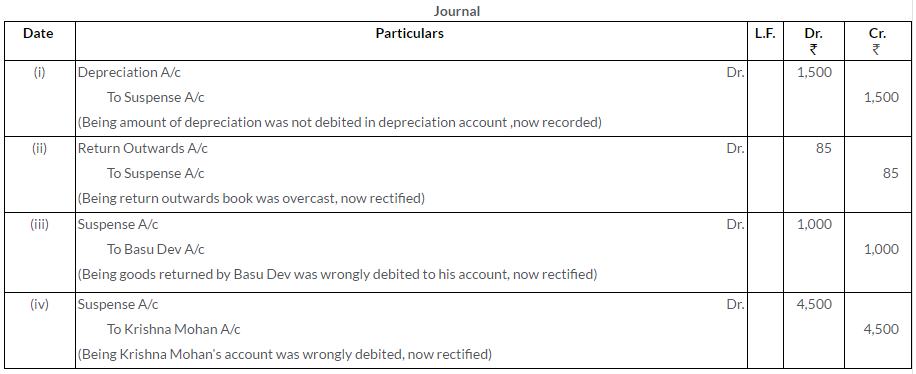
    ts-grewal-solutions-class-11-accountancy-chapter-16-rectification-errors-17

    Question 18.
    Correct the following errors in Hari’s Books:
    i. Credit sale of Rs.132 to R. Krishan correctly entered in Sales Journal but posted to his account as Rs.312.
    ii. The total of the credit side of Ramesh’s Account was overcast by Rs.2,000.
    iii. Total of the Purchases Journal of Rs.5,250 has been posted to Purchases Account as Rs.5,205.
    iv. Printer purchased from R. Ltd. forRs.4,000 on credit was entered in the Purchases Book.
    v. An item of`2,000 entered in the Sales Return Book was posted to the debit of Pandey who had returned the goods.
    Solution:
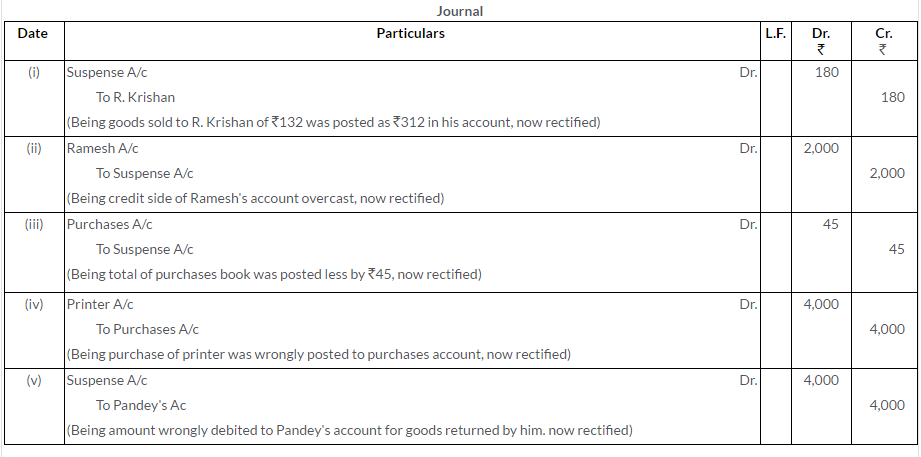
    ts-grewal-solutions-class-11-accountancy-chapter-16-rectification-errors-18

    Question 19.
    Rectify the following errors:
    i. A purchase of Rs.5,000 from Ram was omitted to be entered in the Purchases Book.
    ii. A credit sale of Rs.257 to Messrs. Goodluck and Co. was recorded as Rs.275.
    iii. A purchase of office furniture for Rs.500 from Salwan Furnitures was entered through the Purchases Book.
    iv. Rent paid to Landlord Rs.500 was debited to his Personal Account.
    v. A debit balance of Rs.2000 on the Personal Account of Mr. John (correctly shown in the Ledger) has been omitted when extracting a Trial Balance.
    Solution:
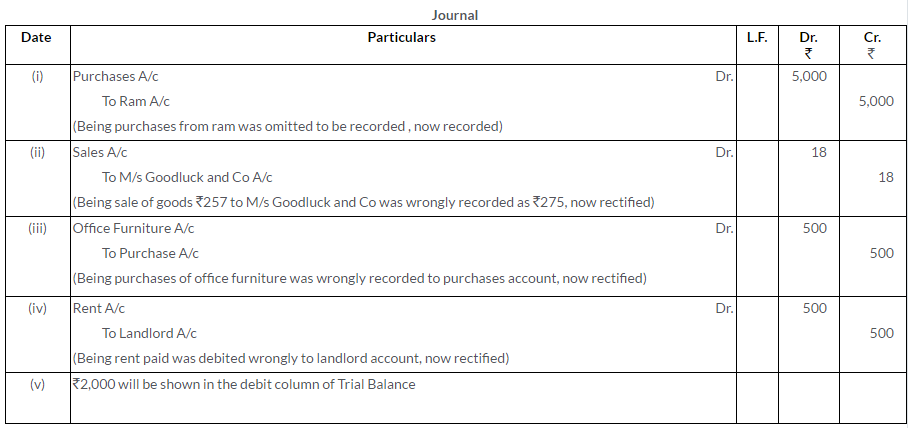
    ts-grewal-solutions-class-11-accountancy-chapter-16-rectification-errors-19

    Question 20.
    Pass the Journal entries to rectify the following errors:
    i. Credit sales to Ram Rs.170 debited to his account as Rs.710.
    ii. Credit purchases from Rs.229 recorded as Rs.292.
    iii. Sales Book was undercast by Rs.200.
    iv. Credit purchase of goods of Rs.2,100 from Sohan posted as Rs.1,200.
    v. An addition in the Returns (Inward) Book had been cast Rs.100 short.
    Solution:
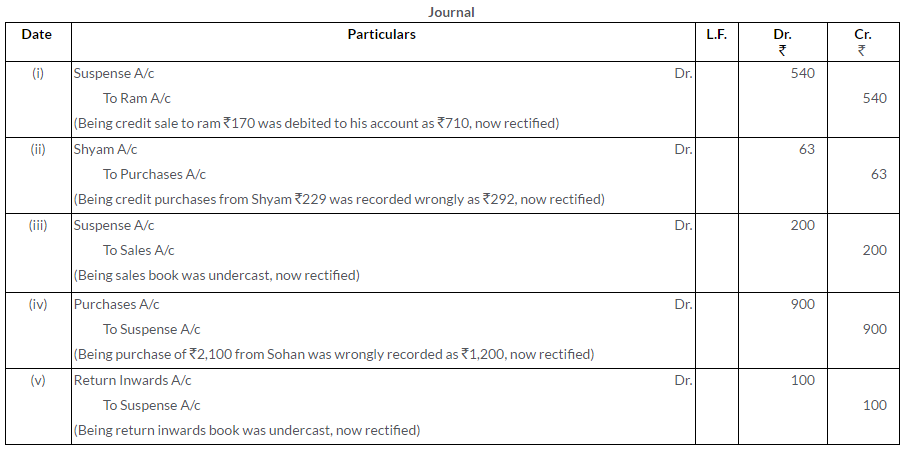
    ts-grewal-solutions-class-11-accountancy-chapter-16-rectification-errors-20

    Question 21.
    Pass the rectifying entries for the following:
    i. Sales of goods Rs.6,000 to Madan were recorded as Rs.600 in the Sales Book.
    ii. Credit purchase of goods from Mohan amounting to Rs.2,000 has been wrongly passed through the Sales Book.
    iii. Return of goods worth Rs.500 by a customer was entered in ‘Purchases Return Book’.
    iv. Cheque of Rs.400 received from Ranjan was dishonoured and debited to the Discount Account.
    v. Bill for Rs.820 received from Ramesh for repair of machinery was entered in the Purchases Book as Rs.720.
    (Delhi 2003)
    Solution:
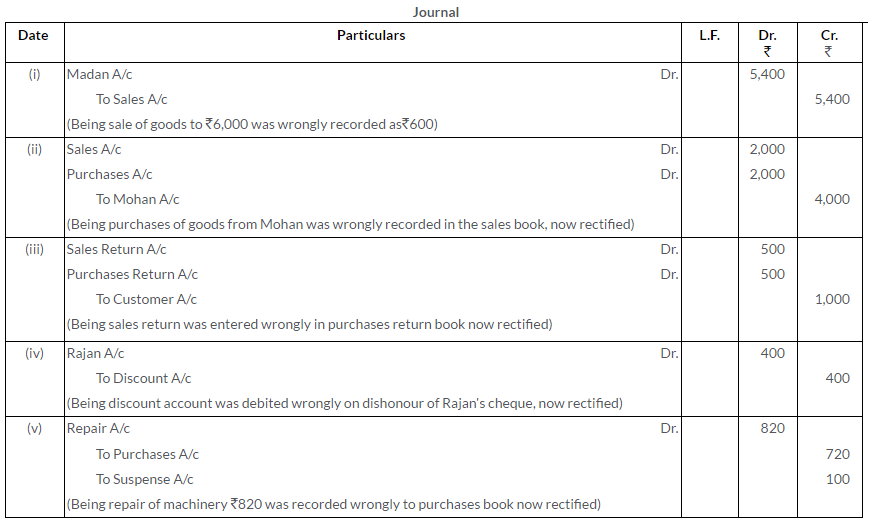
    ts-grewal-solutions-class-11-accountancy-chapter-16-rectification-errors-21

    Question 22.
    Give rectifying Journal entries for the following errors:
    i. Sales of goods to Madan Rs.6,000 were entered in the Sales Book as Rs.600.
    ii. Credit purchase of Rs.1,500 from Ajay has been wrongly passed through the Sales Book.
    iii. Repairs to building Rs.300 were debited to Building Account.
    iv. Rs.2,050 paid to Rohit is posted to the debit of Mohit’s Account as Rs.5,020.
    v. Purchases Return Book is overcast by Rs.400.
    (MSE Chandigarh 2007)
    Solution:
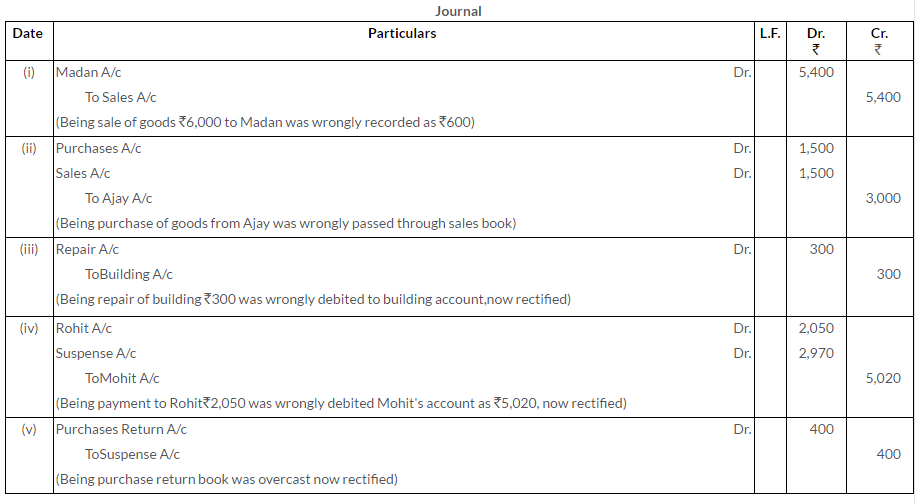
    ts-grewal-solutions-class-11-accountancy-chapter-16-rectification-errors-22

    Question 23.
    Give rectifying entries for the following:
    i. Rs.5,400 received from Mr. A was posted to the debit of his account.
    ii. The total of Sales Return Book overcast by Rs.800.
    iii. Rs.2,740 paid for repairs to motor car was debited to Motor Car Account as Rs.1,740.
    iv. Returned goods to Shyam Rs.1,500 were passed through Returns Inward Book.
    (MSE Chandigarh 2008)
    Solution:
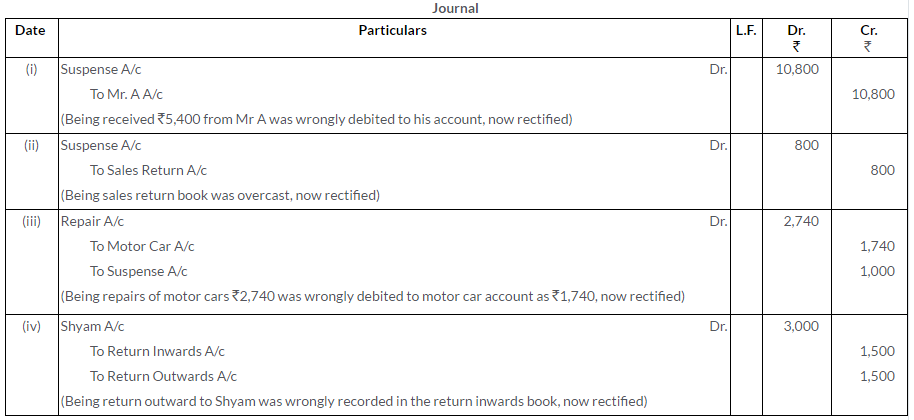
    ts-grewal-solutions-class-11-accountancy-chapter-16-rectification-errors-23

    Question 24.
    Pass Journal entries rectifying the following errors:
    i. A cheque for Rs.10,000 was received from Ranjan on which Rs.200 Cash Discount was allowed. The cheque was not honoured on due date and the amount of discount was credited to Discount Received Account.
    ii. Rs.2,000 paid as wages for machinery installation was debited to Wages Account.
    iii. Rs.5,000 received from Rakesh were credited to his Personal Account. The amount had been written off as bad debt earlier.
    iv. Repair bill of machinery was recorded as Rs.100 against the bill amount of Rs.1,000.
    Solution:
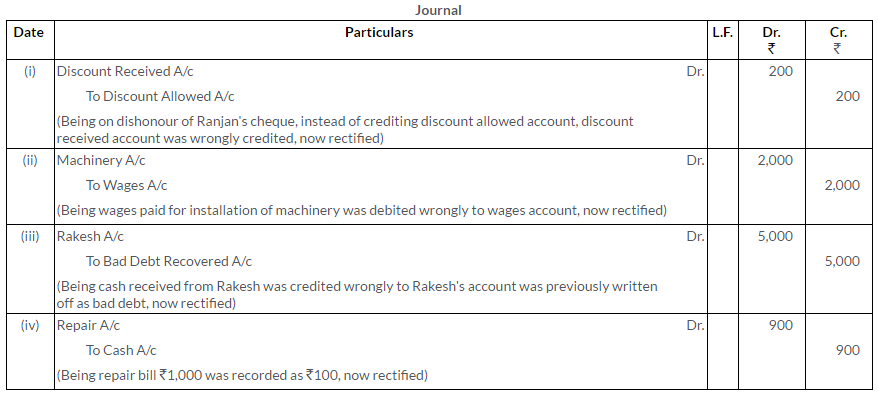
    ts-grewal-solutions-class-11-accountancy-chapter-16-rectification-errors-24

    Question 25.
    Rectify the following errors:
    i. Sales Book has been totaled Rs.1,000 short.
    ii. Goods worth Rs.1,500 returned by Green and Co. have not been recorded anywhere.
    iii. Goods purchased worth Rs.2,500 have been posted to the debit of the supplier, Gupta and Co.
    iv. Furniture purchased from Gulaband Co. worth Rs.10,000 has been entered in Purchases Book.
    v. Cash received from A Rs.2,500 has not been posted in his account.
    (KVS 2008)
    Solution:
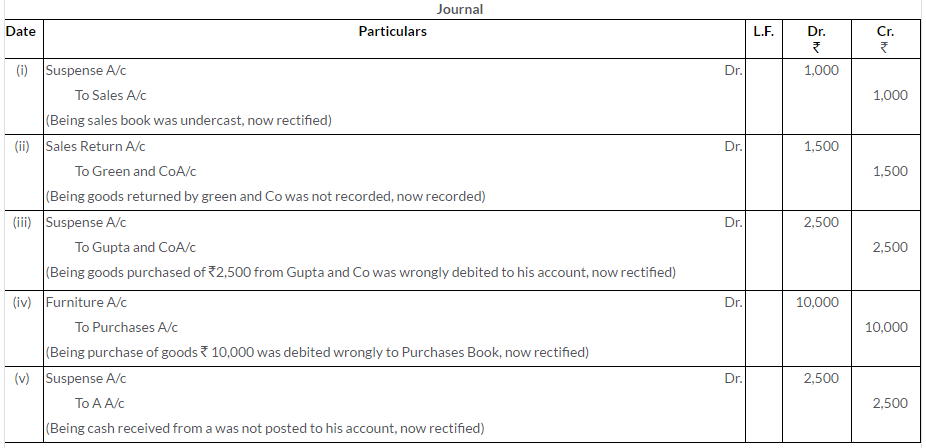
    ts-grewal-solutions-class-11-accountancy-chapter-16-rectification-errors-25

    Question 26.
    How will you rectify the following errors?
    i. Rs.500 spent on building repairs has been debited to the Building Account.
    ii. Furniture worth Rs.5,000 purchased from X on credit omitted from being recorded in the books.
    iii. Total of Returns Inward Book was added by Rs.200 instead of Rs.250.
    iv. Sales Book was overcast by Rs.500.
    v. Sale of old machinery amounting toRs.600 has been credited to the Sales Account.
    Solution:
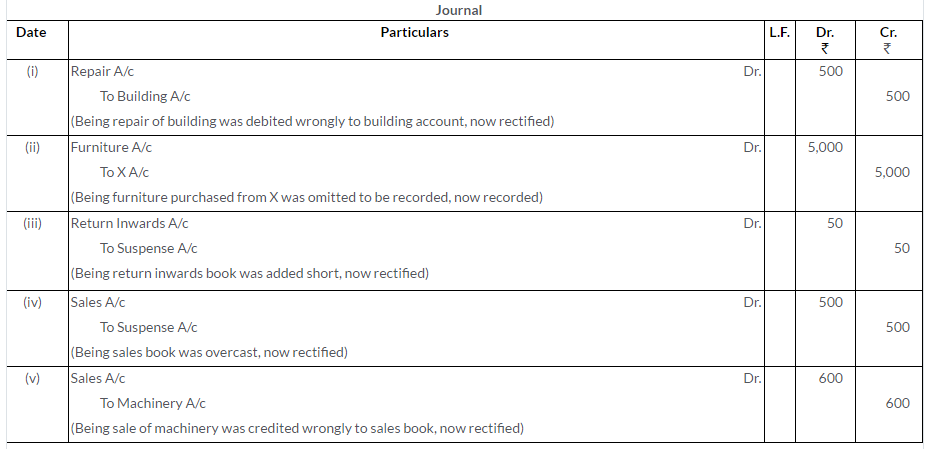
    ts-grewal-solutions-class-11-accountancy-chapter-16-rectification-errors-26

    Question 27.
    Pass Journal entries to rectify the errors in the following cases:
    i. A purchase of goods from David amounting to Rs.150 has been wrongly passed through the Sales Book.
    ii. A credit sale of goods of Rs.120 to Peter has been wrongly passed through the Purchases Book.
    iii. Rs.200, salary paid to Cashier, B. Naidu, stands wrongly debited to his Personal Account.
    iv. Rs.100 received from Shaw and Co. have been wrongly entered as from Shah and Co.
    v. Ramesh’s Account was credited with Rs.840 twice instead of once.
    Solution:
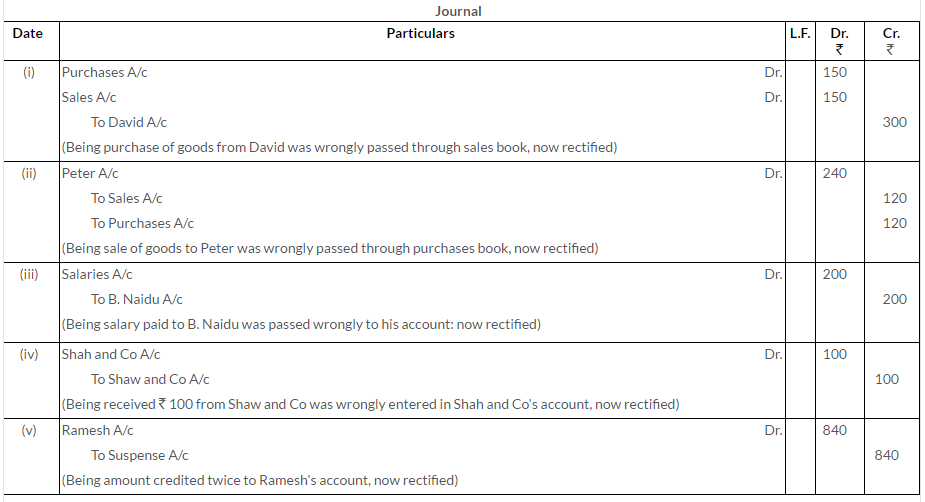
    ts-grewal-solutions-class-11-accountancy-chapter-16-rectification-errors-27

    Question 28.
    A. What are the different causes that make a Trial Balance incorrect?
    B. Pass the rectifying Journal entries:
    i. A credit sale of goods for Rs.2,500 to Krishna has been wrongly passed through the Purchases Book.
    ii. Rs.5,000 paid for freight on machinery purchased was debited to the Freight Account as Rs.500.
    iii. The Returns Inward Book has been wrongly overcast by Rs.100.
    iv. An amount of Rs.500 due from Ramesh which had been written off as bad debt in previous year was recovered and had been posted to the Personal Account of Ramesh.
    v. A sum of Rs.460 owed by Hari had not been included in the list of debtors.
    (MSE Chandigarh 2003)
    Solution:
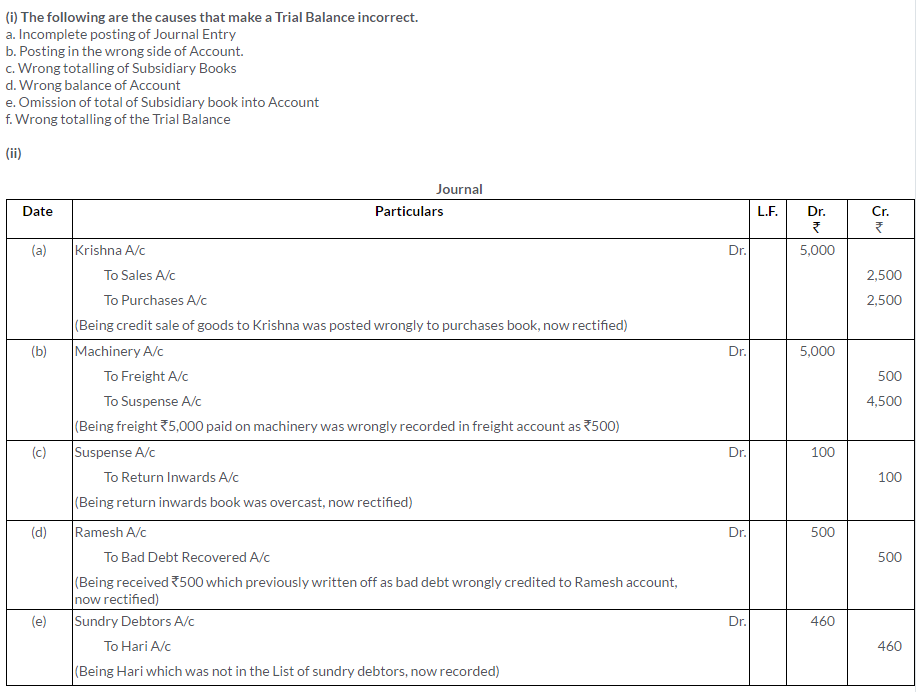
    ts-grewal-solutions-class-11-accountancy-chapter-16-rectification-errors-28

    Question 29.
    Rectify the following errors:
    i. Wages paid for the construction of office debited to the Wages Account, Rs.5,000.
    ii. Machinery purchased for Rs.35,000 was passed through the Purchases Book.
    iii. Old furniture sold for Rs.1,000, passed through the Sales Book.
    iv. Rs.2,000 paid to Mehta Bros. against acceptance were debited to Malhotra Bros Account.
    v. Sales of Rs.204 to Ram debited to his account as Rs.402 and purchases ofRs.1,012 from Shyam credited to his account as Rs.1,210.
    Solution:
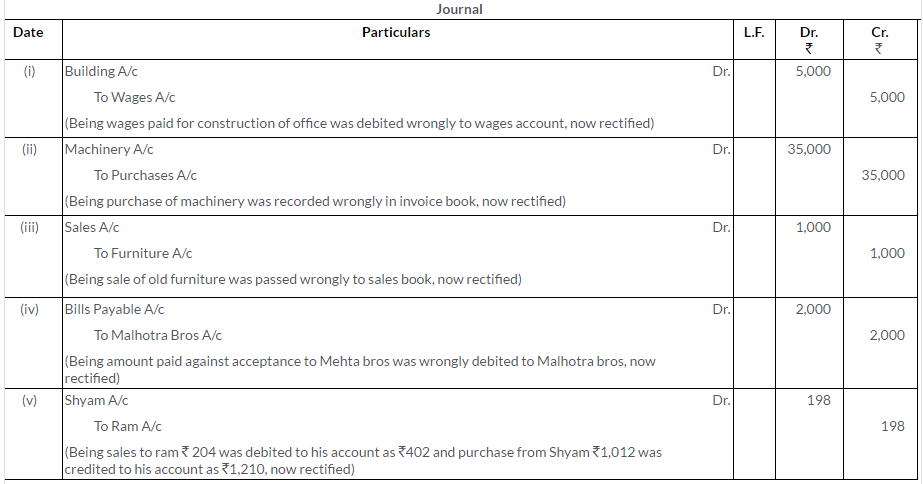
    ts-grewal-solutions-class-11-accountancy-chapter-16-rectification-errors-29

    Question 30.
    There was an error in the Trial Balance of Ram Gopal on 31st March, 2013 and the difference in books was carried to the Suspense Account. On going through the books, you find that:
    i. Rs.540 received from M. Mehta was posted to the debit side of his account.
    ii. Rs.100 being purchases return was posted to the debit of the Purchases Account.
    iii. Discount of Rs.300 received was posted to the debit of the Discount Account.
    iv. Rs.374 paid for motor car repairs was debited to the Motor Car Account as Rs.717
    v. Rs.400 paid to C. Das was debited to the account of G. Dass.
    Pass the Journal entries to rectify the above errors and state what amount was carried to the Suspense Account.
    Solution:
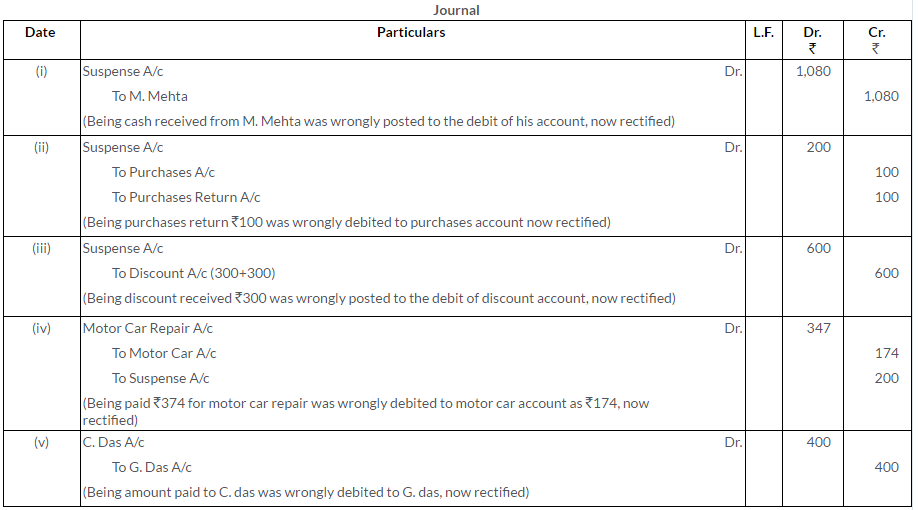
    ts-grewal-solutions-class-11-accountancy-chapter-16-rectification-errors-30
    ts-grewal-solutions-class-11-accountancy-chapter-16-rectification-errors-30-1

    Question 31.
    Trial Balance of a bookkeeper shows an excess of debits over credits by Rs.261. This difference is placed in a Suspense Account to facilitate books closure. Later on the following errors were discovered:
    i. A credit item of Rs.349 has been debited to a Personal Account as Rs.439.
    ii. A sum of Rs.625 written off from fixtures as depreciation has not been posted to Depreciation Account.
    iii. Rs.9,000 paid for furniture bought have been charged to the Purchases Account.
    iv. A discount allowed to a customer has been credited to him as Rs.145 in place of Rs.154.
    v. A sale of Rs.594 was posted as Rs.495 in the Sales Account.
    vi. The total of Returns Inward Book has been added Rs.10 short.
    Pass the Journal entries to correct these errors and prepare the Suspense Account.
    Solution:
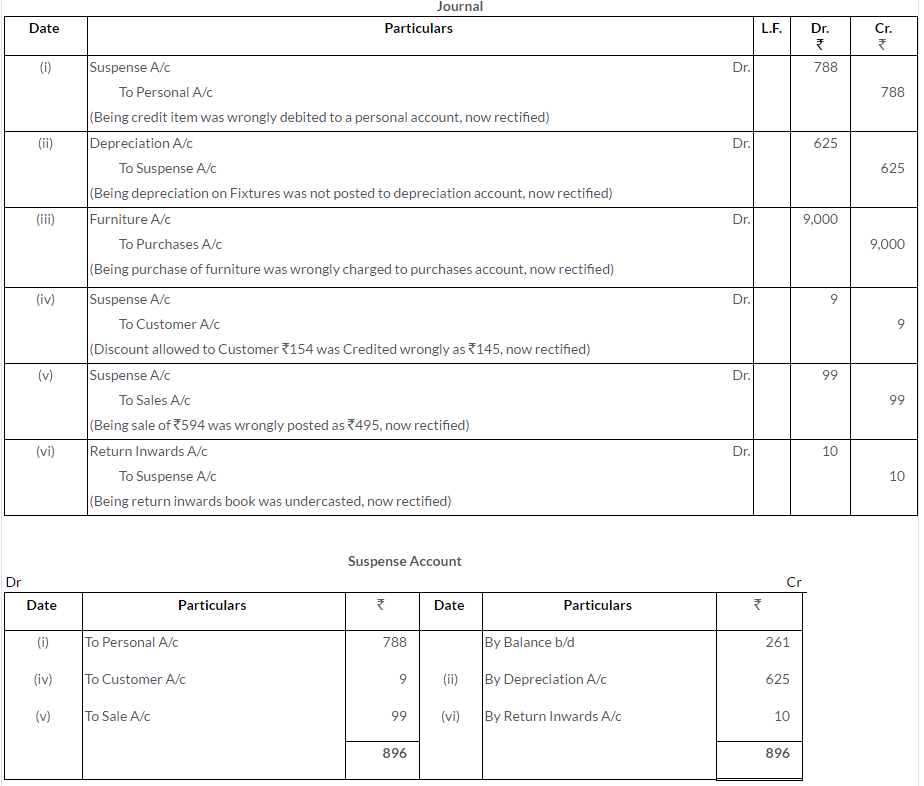
    ts-grewal-solutions-class-11-accountancy-chapter-16-rectification-errors-31

    Question 32.
    The accountant of a firm finds that the Trial Balance as on 31st December, 2015 is out by an excess debit of Rs.283. He placed the amount in the Suspense Account. In the first week of January, 2016, he discovered the following errors. Pass the Journal entries necessary to rectify these errors and show the Suspense Account as it would appear at the end of the week. Have you any comment to make?
    i. Cash paid to Amar Nath, Rs.75, was posted to the credit of Amar Singh’s Account as Rs.57.
    ii. Discount allowed by Brijesh of Rs.5 was not entered in the Cash Book but Brijesh stands debited correctly.
    iii. No entry was made for goods worth Rs.40 taken away by proprietor for personal use.
    iv. Rs.500 received from Jhaveri Bros. for interest on loan advanced to them were recorded in the Cash Book. But the entry was not posted in the Ledger.
    v. The total of Returns Outward Book was short by Rs.100.
    Solution:
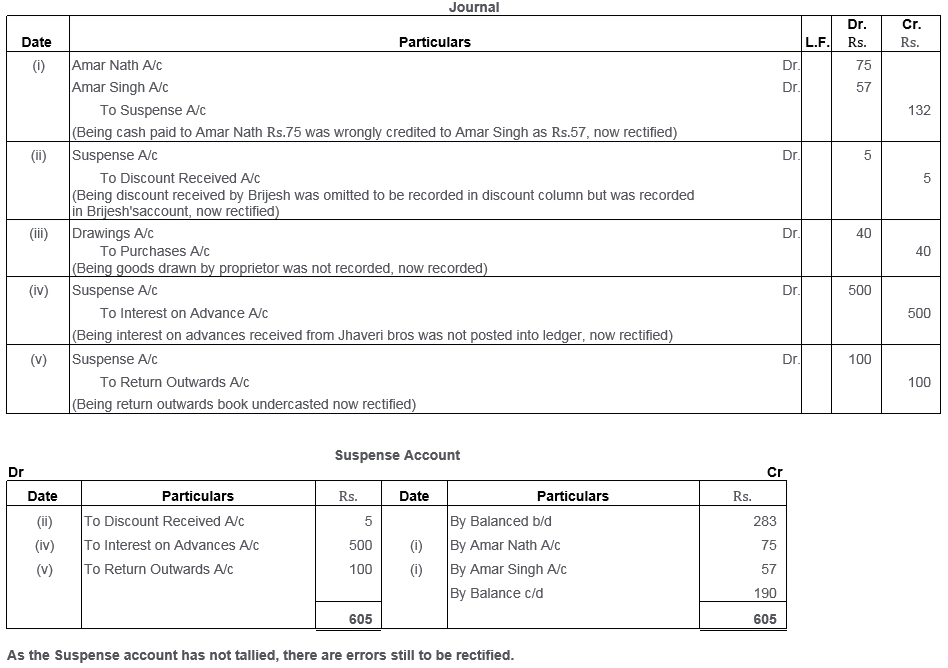
    ts-grewal-solutions-class-11-accountancy-chapter-16-rectification-errors-32

    Question 33.
    You are presented with a Trial Balance showing a difference which has been carried to the Suspense Account and the following errors are revealed:
    i. Rs.1,700 paid in cash for an office equipment was charged to Office Expenses Account.
    ii. A cash sale of Rs.5,000 to Black, correctly entered in the Cash Book, was posted to the credit of Black’s Account in the Ledger.
    iii. Goods amounting to Rs.800, returned by Blue, were entered in the Sales Book and posted there from to the credit of Blue’s Account.
    iv. Furniture purchased for Rs.8,100 was posted to Furniture Account as Rs.810.
    v. Goods amounting to Rs.10,000 sold to Red were correctly entered in Sales Book but posted to Red’s Account for Rs.18,000.
    vi. Sales Return Book was overcast by Rs.100.
    You are required to pass the necessary rectification entries in respect of the above.
    Solution:
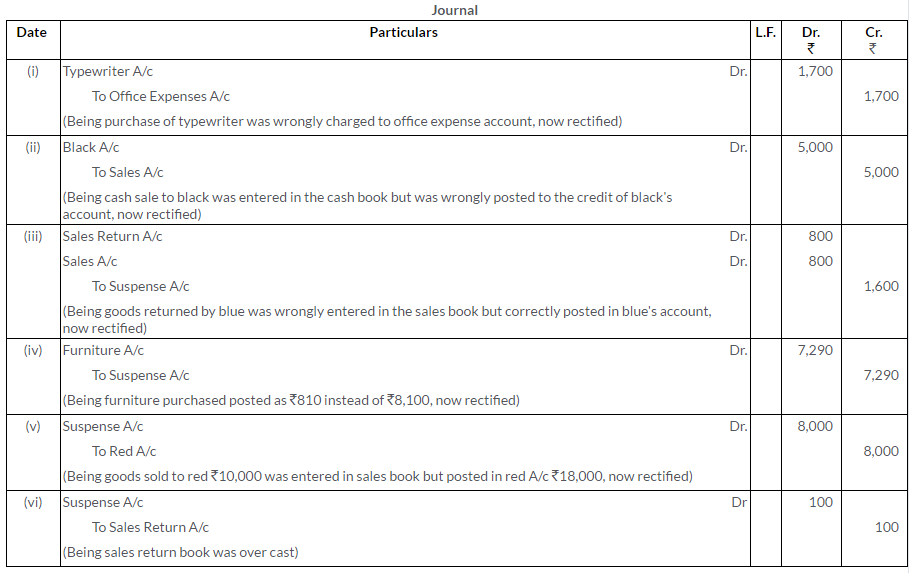
    ts-grewal-solutions-class-11-accountancy-chapter-16-rectification-errors-33

    Question 34.
    The bookkeeper of a firm found that his Trial Balance was out (excess credit) by Rs.742. He I placed the amount in a Suspense Account and subsequently found the following errors:
    i. A discount of Rs.178 was allowed to Ramesh but in his account only Rs.100 is recorded.
    ii. The total of the Purchases Book was Rs.1,000 short.
    iii. A sale of Rs.375 to Kohli was entered in the Sales Book as Rs.735.
    iv. From the Purchases Book, Bose’s Account was debited with Rs.175.
    v. Cash Rs.250 received from Maitra against debt previously written off was credited to his account.
    vi. Purchase of office furniture worth Rs.750 on credit from Delhi Furnitures was entered in the Purchases Book.
    vii. While carrying forward the total of the Sales Book from one page to another the amount of Rs.11,358 was written as Rs.11,538.
    viii. The proprietor took goods of the value of Rs.150 for his domestic consumption. No record of it has been made in the books.
    ix. Repairs bill for the proprietor’s personal car Rs.410, has been paid by the firm and debited to the Repairs Account.
    x. A sale to Kassim of Rs.700 has been entered in the Purchases Book.
    Rectify the errors by means of suitable Journal entries and show the Suspense Account.
    Solution:
    ts-grewal-solutions-class-11-accountancy-chapter-16-rectification-errors-34
    ts-grewal-solutions-class-11-accountancy-chapter-16-rectification-errors-34-1

    Question 35.
    Rectify the following errors found in the books of Mr. B. Trial Balance had Rs.930 excess credit. The difference has been posted to a Suspense Account:
    i. The total of Returns Inward Book has been cast Rs.1,000 short.
    ii. The purchase of an office table costing Rs.3,000 has been passed through the Purchases Book.
    iii. Rs.3,750 paid for wages to workmen for making showcases had been charged to the Wages Account.
    iv. A purchase of Rs.670 had been posted to the Creditors Account as Rs.600.
    v. A cheque for Rs.2,000 received from Mr. P.C. Joshi had been dishonoured and was passed to the debit of the Allowances Account.
    After rectification reflect the transactions in the Suspense Account.
    Solution:
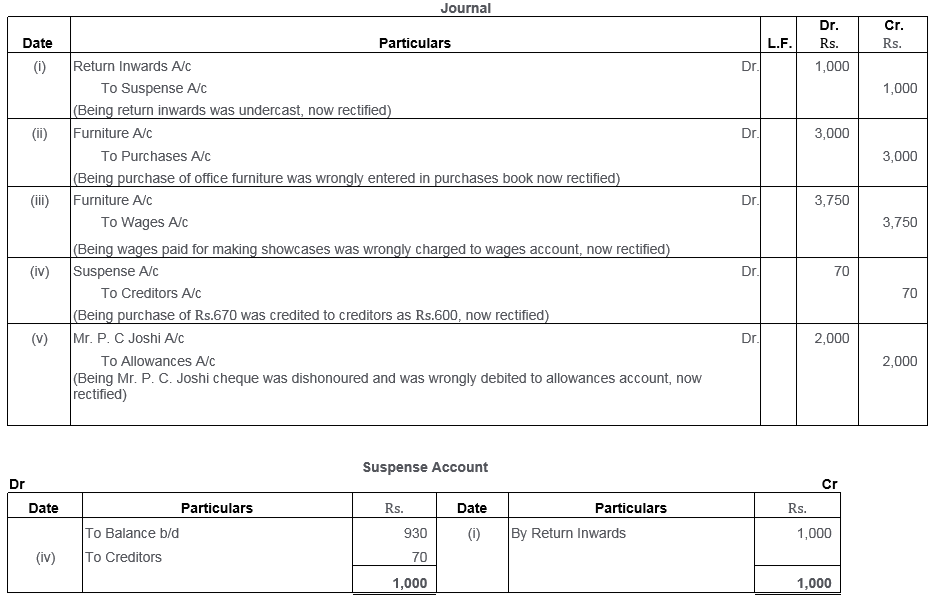
    ts-grewal-solutions-class-11-accountancy-chapter-16-rectification-errors-35

    Question 36.
    Pass the rectification entries for the following transactions:
    i. An amount of Rs.2,000 received from Mohan on 1st April, 2013 had been entered in the Cash Book as having been received on 31st March, 2013.
    ii. The balance in the account of Mr. Rahim Rs.1,000 had been written off as bad but on other account has been debited.
    iii. An addition in the Returns Inward Book had been cast Rs.100 short.
    iv. A cheque for Rs.200 drawn for the Petty Cash Account has been posted in the account of Asif.
    v. A cheque of Rs.150 received from Sharad has been dishonoured and debited in the Discount Account.
    vi. Ramesh’s Account was credited with Rs.840 twice instead of once.
    Solution:
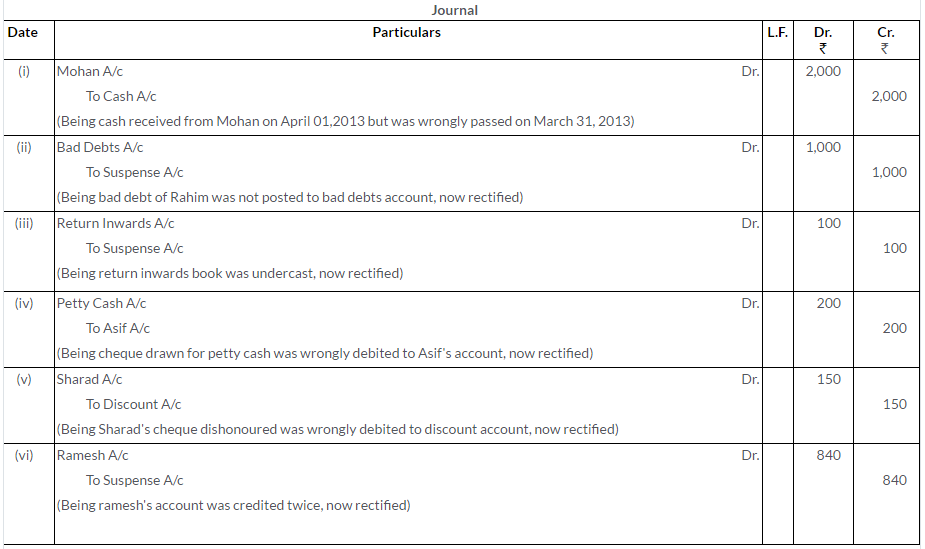
    ts-grewal-solutions-class-11-accountancy-chapter-16-rectification-errors-36

    Question 37.
    The Trial Balance of M/s. Gupta and Sons shows a difference of Rs.52,200. To prepare the Final Account on 31st March, 2009, this difference is placed in a Suspense Account Afterwards the following errors were disclosed. Pass the necessary entries to rectify them and show the Suspense Account.
    i. Purchases Book total had been undercasted by Rs.20,000.
    ii. A cheque received from Vasudev for Rs.7,800 had been debited in the Cash Book but not posted in Vasudev’s Personal Account.
    iii. Returns Outward Book had been overcasted by Rs.10,000.
    iv. Goods returned by Yash Pal worth Rs.15,000 have been entered in Returns Outward Book. However, Yash Pal’s Account is correctly posted.
    (Delhi 2006)
    Solution:
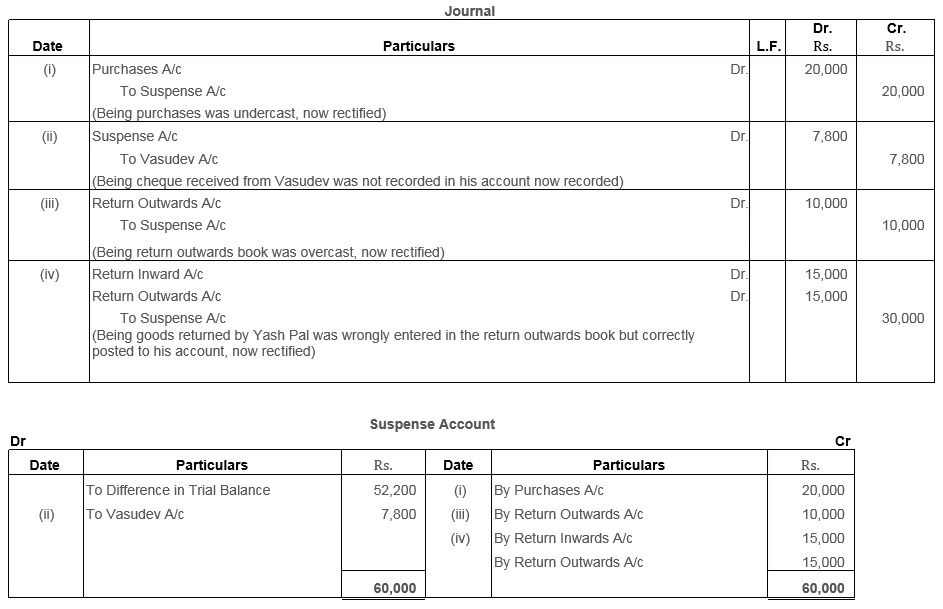
    ts-grewal-solutions-class-11-accountancy-chapter-16-rectification-errors-37

    Question 38.
    A Trial Balance disclosed a difference of Rs.417 placed on the credit side of the Suspense Account. Later on the following errors were located:
    i. Goods worth Rs.200 purchased from Sohan had been posted to his account as Rs.250.
    ii. A purchase of furniture for Rs.500 was recorded in the Purchases Book.
    iii. Instead of crediting Gian’s Account with Rs.512, it was debited with Rs.215.
    iv. Goods worth Rs.130 returned by Gian were entered in the Sales Book and posted therefrom to the credit of Gian’s Personal Account.
    Pass the rectifying entries and prepare a Suspense Account.
    (MSE Chandigarh 2006)
    Solution:
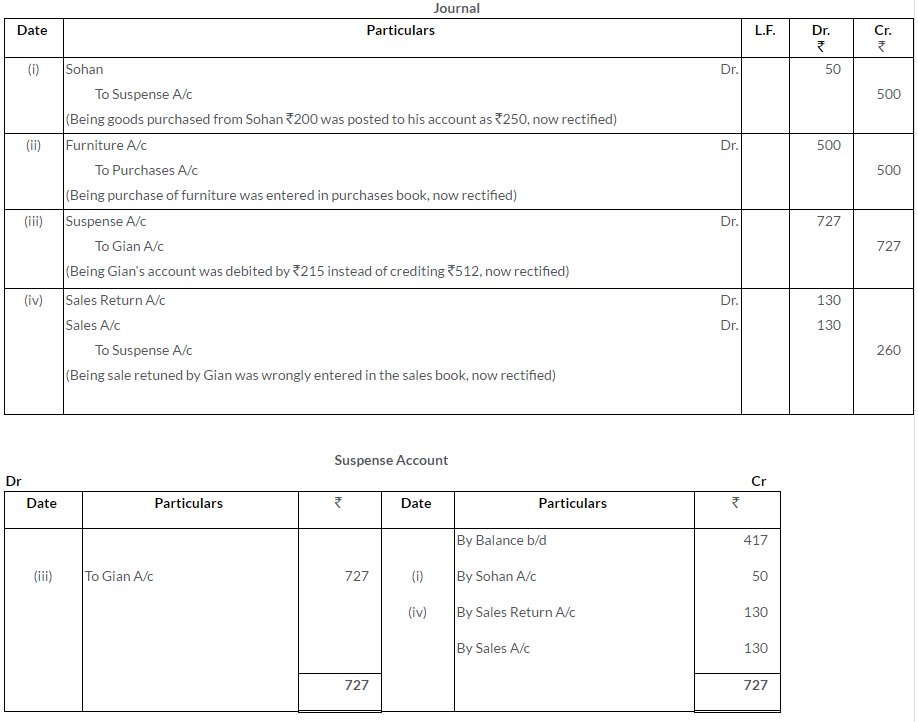
    ts-grewal-solutions-class-11-accountancy-chapter-16-rectification-errors-38

    Question 39.
    There was a difference of Rs.720 in the Trial Balance which has been transferred to the credit side of the Suspense Account. Pass the rectifying entries and prepare a Suspense Account to rectify the following errors:
    i. An amount of Rs.375 now posted on the debit side of the Commission Account instead of Rs.275.
    ii. Credit amount of Rs.260 posted to the debit of the Personal Account as Rs.360.
    iii. Goods sold to Surinder recorded in Purchases Book Rs.300.
    iv. D’s bill for erection of godown at a cost of Rs.1,200 has been charged to the Repairs Account.
    (MSE Chandigarh 2005)
    Solution:
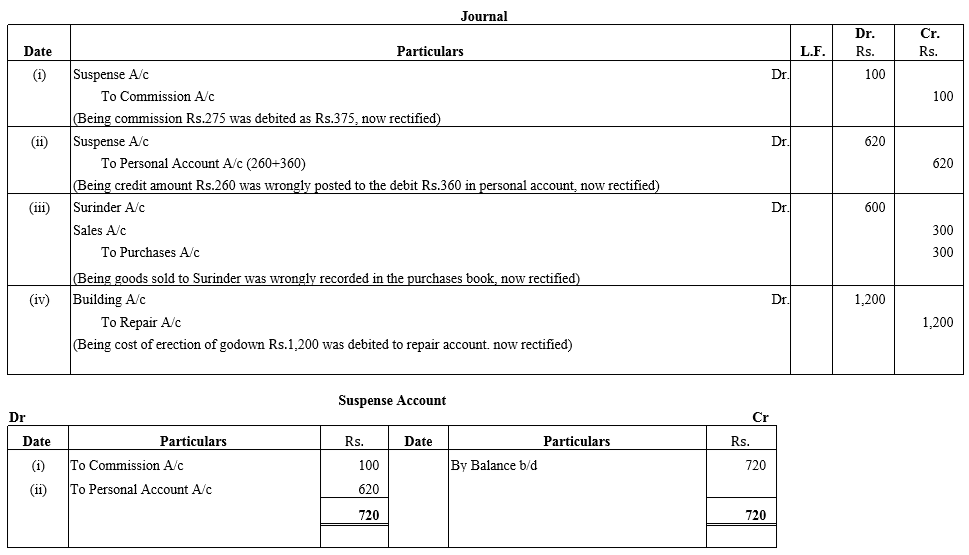
    ts-grewal-solutions-class-11-accountancy-chapter-16-rectification-errors-39

    Question 40.
    Rectify the following errors by means of Journal entries:
    i. A cheque of Rs.5,000 received from Ashish was dishonoured and was debited to Discount Account.
    ii. Purchases of Rs.540 from Ramneek was written in Sales Book but was correctly posted to correct side of Ramneek’s Account.
    iii. Salary paid to Miss Yugakshi Rs.1,000 was debited to her Personal Account as Rs.900.
    iv. Furniture costing Rs.500, purchased from Jyoti, was wrongly entered in Purchases Book as Rs.450.
    (Delhi 2008)
    Solution:
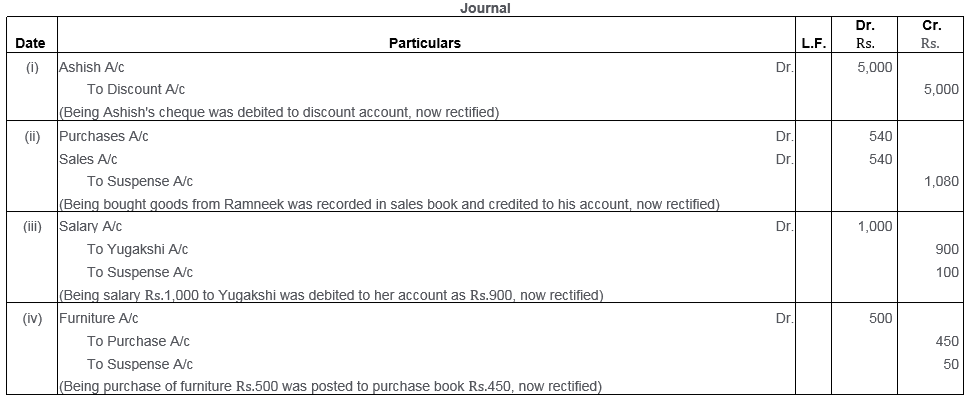
    ts-grewal-solutions-class-11-accountancy-chapter-16-rectification-errors-40

    Question 41.
    The Trial Balance of S. Sen did not agree and the difference in books was carried to a Suspense Account. Pass the entries required to rectify the following errors which accounted for the difference. Also, prepare the Suspense Account:
    i. A Sales Invoice for Rs.1,000 for goods sold on credit to B. Basu was entered in the Purchases Book but in the Ledger, the amount was correctly debited to the account of B. Basu.
    ii. Goods bought on credit from Ram Lal for Rs.1,500 were wrongly debited to his account as Rs.5,100.
    iii. An amount of Rs.275 was posted as Rs.325 to the debit side of the Commission Account.
    iv. The Sales Book for the month of April was undercast by Rs.100.
    v. Rs.460 paid for building repairs was debited to the Building Account as Rs.640.
    [Suspense Account opened with a Credit of Rs.8,930]
    Solution:
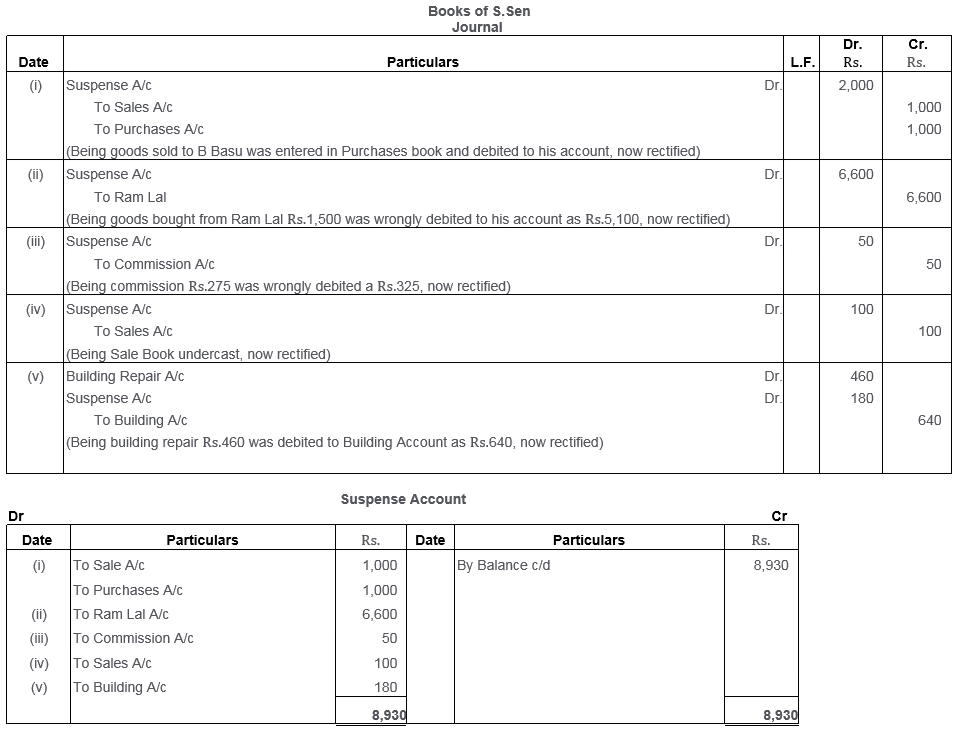
    ts-grewal-solutions-class-11-accountancy-chapter-16-rectification-errors-41

    Question 42.
    Rectify the following errors:
    i. Sale of old furniture worth Rs.3,000 treated as sales of goods.
    ii. Sales Book added Rs.5,000 short.
    iii. Rent of proprietor’s residence, Rs.6,500 debited to Rent Account.
    iv. Goods worth Rs.11,970 returned by Manav posted to his debit as Rs.11,790.
    (Delhi 2010)
    Solution:
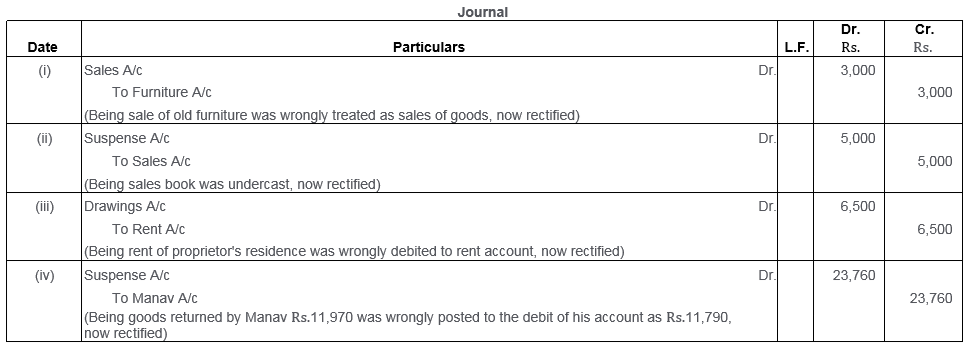
    ts-grewal-solutions-class-11-accountancy-chapter-16-rectification-errors-42

    Question 43.
    There was a difference in the Trial Balance of M/s. Jain and Sons, prepared for the year ended 31st March, 2009. The accountant put the difference in Suspense Account. The following errors were found:
    i. Purchases Return Book total Rs.400 has not been posted to Ledger Account.
    ii. Rs.5,100 spent on legal expense for the newly acquired Building was debited to the Building Account as Rs.1,500.
    iii. A sale of Rs.6,540 to Rajat has been credited to his account.
    Rectify the errors and show the Suspense Account with Nil closing balance.
    (KVS 2010)
    Solution:
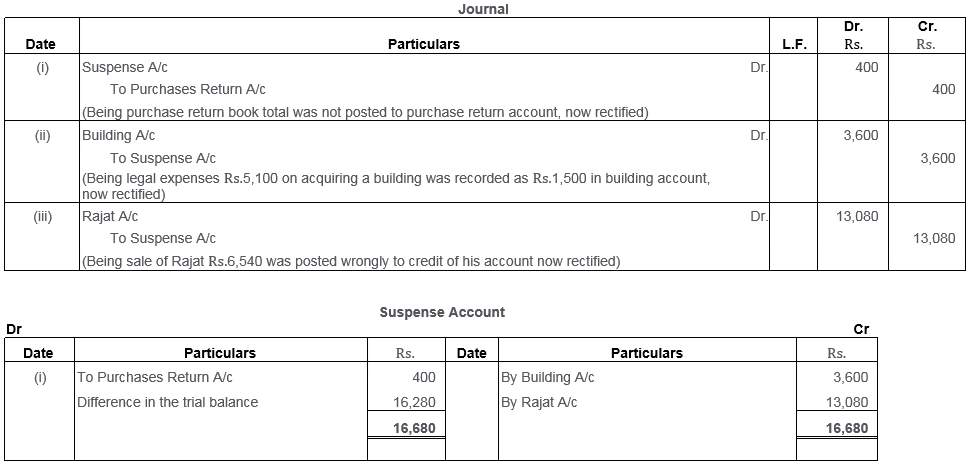
    ts-grewal-solutions-class-11-accountancy-chapter-16-rectification-errors-43

    Question 44.
    Give the Journal entries to rectify the following errors:
    i. Purchases Book was overcast by Rs.1,000.
    ii. Installation charges on new machinery purchased Rs.500 were debited to Sundry Expenses Account as Rs.50.
    iii. Radhey Shyam returned goods worth Rs.500 which was entered in the Purchases Return Book.
    iv. Goods taken by the proprietor for Rs.5,000 have not been entered in the books at all.
    (Delhi 2011)
    Solution:
    ts-grewal-solutions-class-11-accountancy-chapter-16-rectification-errors-44

    Question 45.
    Rectify the following errors:
    i. The total of one page of Sales Book was carried forward as Rs.371 instead of Rs.317.
    ii. Rs.540 received from Yatin was posted to the debit of his Account.
    iii. Purchases Returns Book was overcast by Rs.300.
    iv. An item of Rs.1,062 entered in Sales Return Book had been posted to the debit of customer who returned the goods.
    v. Rs.1,500 paid for furniture purchased had been charged to ordinary Purchase Account.
    (MSE Chandigarh 2011)
    Solution:
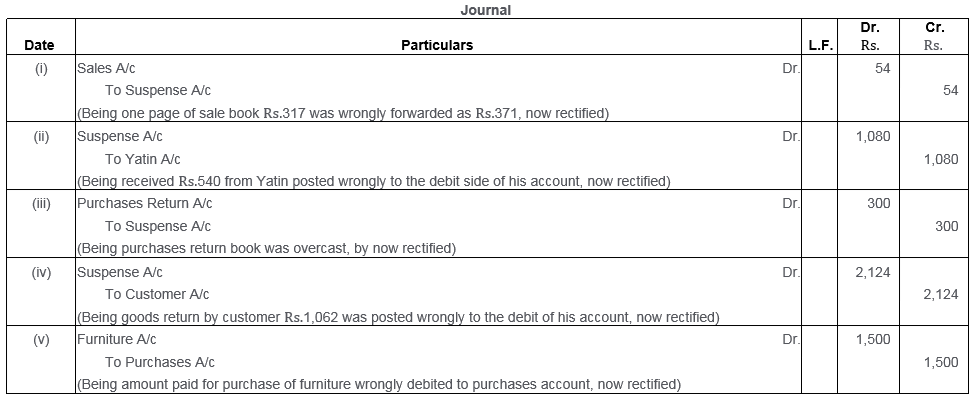
    ts-grewal-solutions-class-11-accountancy-chapter-16-rectification-errors-45

    Question 46.
    Rectify the following errors by passing Journal entries:
    i. Old furniture sold for Rs.500 has been credited to Sales Account.
    ii. Machinery purchased on credit from Raman for Rs.2,000 recorded through PurchaS Book as Rs.16,000.
    iii. Cash received from Rajat Rs.5,000 was posted to the debit of Bhagat as Rs.6,000.
    iv. Depreciation provided on machinery Rs.3,000 was posted to Machinery Account Rs.300.
    (MSE Chandigarh 2013)
    Solution:
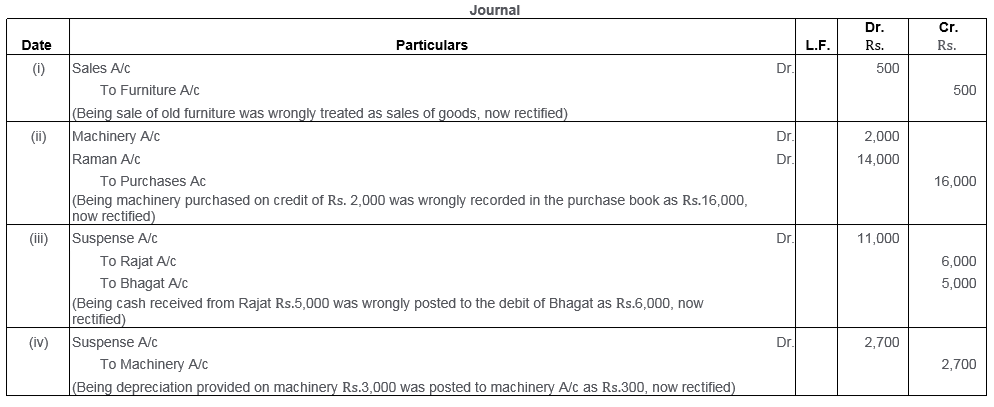
    ts-grewal-solutions-class-11-accountancy-chapter-16-rectification-errors-46

    Question 47.
    Rectify the following errors by passing Journal entries:
    i. A sum of Rs.470 received from Ganga was posted to her debit as Rs.740.
    ii. A debit balance of Rs.550 in the personal account of Mr. John was undercast.
    iii. Bills Receivable from Brown for Rs.3,000 posted to the credit of Bills Payable Account and credited to Brown’s Account.
    iv. Goods returned by Mridul Rs.225 have been entered in the Returns Outward Book.
    (MSE Chandigarh 2015)
    Solution:
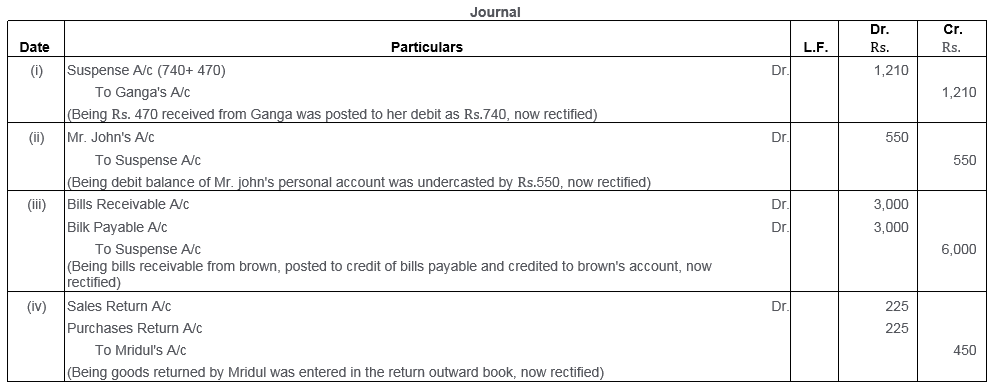
    ts-grewal-solutions-class-11-accountancy-chapter-16-rectification-errors-47

    Question 48.
    Pass the rectification entries for the following transactions:
    i. A builder’s bill for Rs.25,000 for erection of a small shed was debited to Repairs Account.
    ii. Repairs to plant amounting to Rs.2,000 had been charged to Plant and Machinery Account.
    iii. Wages paid to the firm’s workmen for making certain additions to machinery amounting to Rs.1,340 were debited to Wages Account.
    iv. A cheque for Rs.7,500 received from S. Desai was credited to the account of R. Gupta.
    v. Goods to the value of Rs.7,000 returned by X were included in closing stock, but no entry was made in the books.
    vi. Goods costing Rs.5,000 were purchased for various members of the staff and the cost was included in Purchases’. A similar amount was deducted from the salaries of the staff members concerned and the net payments to them debited to Salaries Account.
    vii. Goods sold to Rs.4,750 have been wrongly entered in the Sales Journal as Rs.7,450.
    viii. Debit and Credit totals of discount columns in the Cash Book which come to Rs.400 and Rs.370 respectively have not been posted to Discount Accounts.
    Solution:
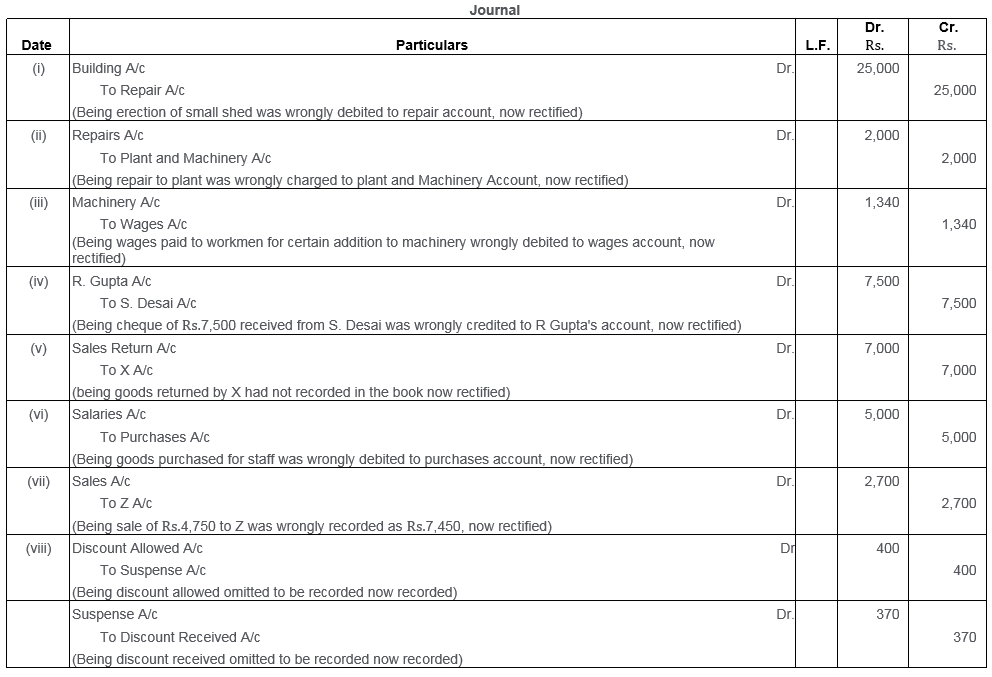
    ts-grewal-solutions-class-11-accountancy-chapter-16-rectification-errors-48

    Question 49.
    While trying to close his books for the year ended 31st March, 2014, Mahesh found that t Trial Balance did not agree. He traced the following errors:
    i. In the Sales Book for the month of January total of Page No. 2 was carried forward to Page No. 3 as Rs.1,000 instead of Rs.1,200 and total of Page No. 6 was carried forward to Page No. 7 as Rs.5,600 instead of Rs.5,000.
    ii. Goods returned to Ram Rs.1,000 were recorded in the Sales Book.
    iii. Bill Receivable for Rs.1,600 from Noor was dishonoured and posted to debit of Allowances Account. Rectify the above errors.
    (KVS 2015)
    Solution:
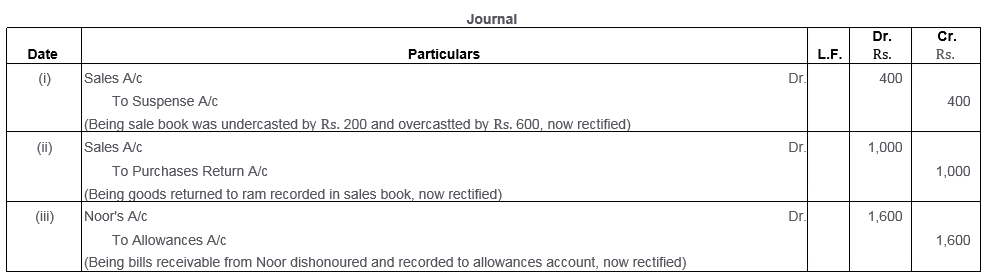
    ts-grewal-solutions-class-11-accountancy-chapter-16-rectification-errors-49