Category: Class 10th

  • Important Terms Of Novels Society And History Class 10, SST (History)

    SECTION A — THE RISE OF THE NOVEL

    1. The Novel : A new form of literature in printed style, very closely related to the development of print culture/technology. Improved communications produced a number of common interests among the readers of the novel, they identified themselves with the lives and stories of the characters.
    2. 17th Century : Novels take firm root in England and France.
    3. 18th Century : Novels really develop from this period.
      Readership expands, includes shopkeepers, clerks, along with aristocratic and gentlemanly classes. (people of high birth and social status)

      Authors : As their earnings increased, they experimented with different literary styles.

      Styles : Henry Fielding, a novelist of the early 18th century, claimed he was ‘the founder of a new province of writing’ where he could make his own laws.
      – Tom Jones.

      Walter Scott wrote historical novels about wars between Scottish clans, collected Scottish ballads, which he used in his novels.

      Samual Richardson wrote Pamela in 18th century in the form of letters.
      The first epistolary novel.

      The publishing market was costly at the beginning. Henry Fielding’s Tom Jones (1749) was sold at three shillings for each of its six volumes – more than a labourer’s earnings in a week.

      In 1836, first novel to be serialised in a magazine – Charles Dickens’ The Pickwick Papers. The suspense and discussion reminds you of the TV serials today.

      Novels become one of the first mass-produced items to be sold.

      The World of the Novel : In the 19th century was about ordinary people, reflected the industrial age of the 19th century, problems created by factories, unemployed poor, homeless people living in workhouses.

      Examples :

      A. Charles Dickens’ novel Hard Times described the terrible conditions of urban life under capitalism.
      Novel Oliver Twist – tale of a poor orphan caught up in a world of petty criminals.

      B. Emile Zola’s Germinal (1885) – Life of French miners, grim life led by them ends on a note of despair.

      Community and Society : Thomas Hardy’s novels e.g., Mayor of Casterbridge (1886) brought the vast majority of urban readers closer to the rural community through his stories.

      Women writers explored the world of women, their emotions, identities, experiences and problems.
      (i) Jane Austen’s (1775–1817) Pride and Prejudice portrays life of women in genteel rural society in the early 19th century England.
      (ii) Charlotte Bronte’s (1816–1855) Jane Eyre portrayed an independent and assertive girl who protests against hypocrisy and cruelty.
      (iii) George Eliot (1819–1880), Mill on the Floss, wrote about freedom given by novels to women to express themselves freely.

      Novels for the young were written by R.L. Stevenson, e.g., Treasure Island (1883) which idealised a new type of man, powerful, assertive, daring and independent, novels full of adventure.

      Rudyard Kipling wrote Jungle Book (1894). Colonisers were portrayed as heroic and honourable, confronting ‘Natives’, adapting themselves to strange places, colonising territories and developing nations.

      G.A. Henty (1832–1902) wrote popular, historical adventure novels for boys during the height of the British Empire – (Under Drake’s Flag).

      Helen Hunt Jackson (Ramona – 1884), Sarah Wolsey (What Katy Did – 1872) wrote love stories for girls.

      Colonialism and after novels appeared in Europe which portrayed colonialists as a superior community. Colonised people were seen as primitive, barbaric and less than human.

      Joseph Conrad (1857–1924) showed the darker side of colonial occupation only in later 20th century.

      Daniel Defoe’s Robinson Crusoe (1719) portrayed an adventurer who treats coloured people as inferior creatures. He rescues a ‘native’ and makes him his slave. Colonial rule was portrayed as necessary to civilise the natives, to make them human.

    SECTION B — THE NOVEL COMES TO INDIA

    Novels in prose unknown to India till the 19th century. Great epics written in verses. Fourth century AD stories written in Sanskrit, e.g., the Panchtantra and Kadambari. Earliest novels in Marathi and Bengali.

    Baba Padmanji’s Yamuna Paryatan (1857), a simple story about the plight of widows.

    Lakshman Moreshwar Halbe’s Muktamala (1861) – an imaginary ‘romance’ with a moral purpose.

    Hari Narayan Apte wrote historical novels (1864-1919). His Ushakala is famous. Naro Sadashiv Rishud wrote Manju Ghosha, a novel full of amazing events. The writer found life dull and uninspiring, so wrote about the marvellous.

    The Novel in South India
    (i) Kerala : Many novels were translations of English novels. Chandu Menon’s translation of Benjamin Disraeli’s Henrietta Temple. Gave up as he realised English culture was difficult for people of Kerala to grasp. Published a delightful novel in Malayalam. Indulekha (1889) – First modern novel in Malayalam.

    (ii) Andhra Pradesh : Kandukuri Viresalingam (1848–1919) began by translating Oliver Goldsmith’s Vicar of Wakefield into Telugu, abandoned it and wrote Rajashekhara Caritamu in 1878 in Telugu.
    The Novel in Hindi : Bharatendu Harishchandra was the pioneer of modern Hindi literature. The first modern novel was written by Srinivas Das of Delhi – Pariksha-Guru (1882). Paariksha-Guru portrayed the inner conflict and outer struggles of the newly emerging middle-class. They had to preserve their own culture and yet adapt to the new colonial society. Novel – a bit too moralising – was not very popular.

    Chandrakanta by Devaki Nandan Khatri made Hindi really popular and attracted hundreds of readers. Writer for “the pleasure of reading,” it also gave insight into the fears and desires of people who read it.

    Premchand wrote in popular Urdu, then shifted to Hindi. His Sevasadan, (1916) written in simple style, was influenced by Gandhiji and his ideas dealt with the position of women, dowry and child marriage.

    Novels in Bengal were love stories based on historical or past events. Domestic novels portrayed the romantic relations between men and women, and social problems.

    Bankim Chandra Chattopadhyaya – His first novel Durgeshnandini (1865) started a new trend, portrayed ordinary people with the strength and weaknesses of ordinary people.

    Sarat Chandra Chattopadhyaya (1876–1938) was the most popular novelist in Bengal.

    The Oriya Novel : First novel, Saudamani by Ramashankar Ray (1877-1918). Incomplete

    Fakir Mohan Senapati (1843–1918) wrote Chha Man Atha Guntha (1902). It means six acres and their two decimals of land. The novel deals with the question of land and its possessions.

    The Novels in Assam
    The first novels in Assam were written by missionaries. Two of them were translations of Bengali including Phulmoni and Karuna. In 1888, Assamese students in Kolkata formed the ‘Asamya Bhasar Unnatisadhan’ that brought out a journal called Jonaki. This journal opened up the opportunities for new authors to develop the novel. Rajanikanta Bardoloi wrote the first major historical novel in Assam called Manomati (1900). It is set in the Burmase invasion, stories of which the author had probably heard from old soldiers who had fought\in the 1819 campaign. It is a tale of two lovers belonging to two hostile families who are separated by the war and finally reunited.

    SECTION C — NOVELS IN THE COLONIAL WORLD

    1. Uses of Novels
      (a) Proved useful to colonial administrators. Vernacular novels, a valuable source of information on native customs and life.
      They could govern a large variety of communities and castes, with their help missionaries translated novels into English.
      (b) The novel was used by Indians to depict and criticise the defects of their society and how to remove them.
      (c) Novels established a link with the past. A sense of national pride was created among readers by glorified accounts of the past.
      (d) A sense of collective belonging created on the basis of one’s language.
      (e) Language of the novel became contemporary. Characters spoke in a manner that revealed their caste, class, region. Readers became familiar with different ways, the same language was spoken in other parts of India.

    The Problem of Being Modern : The novels tried to portray how to be modern in a colonial world without losing dignity, tradition and identity.

    Example : Chandu Menon’s Indulekha.

    The heroine Indulekha is portrayed as highly intelligent, artistic and educated in Sanskrit and English. She is very beautiful too. Madhavan, the hero is equally ideal – member of educated class of Nayars from the University of Madras, first-rate Sanskrit scholar. He dressed in Western clothes but kept a long tuft of hair, according to the Nayar tradition.

    They both represented characters who had taken the best of the colonial West without giving up the traditions of their own culture.
    Pleasures of Reading :
    (i) New form of entertainment.
    (ii) Novels spread silent reading – at home while travelling in trains.
    (iii) In Tamil flood of popular novels, detective mystery novels. ‘Kalki’ wrote popular historical novels.
    (iv) Kathanjali, a Kannada magazine, published short stories regularly. Indirabai, a Kannada
    novel, written by Gulawadi Venkata Rao (1899), told the story of women’s education,
    widow’s plight and problems created by early marriages of girls.


    SECTION D — WOMEN AND THE NOVEL

    1. Everyone did not approve of the novel. It was blamed for having an immoral influence on the readers.
    2. Women and children were specially warned as they could be easily corrupted.
      Effect on Women : They did not remain only readers, started writing novels themselves, novels became a loot of expressing a new woman, they could control their own lives. They wrote about women who influenced world affairs.
      Examples : (a) Rokeya Hossein (1880–1932), a widow who started a girl’s school in Calcutta, wrote two books :
      (i) A fantasy in English – Sultana’s Dream (1905), which shows a world where women take place of men.
      ii) Padmarag – which exhorted women to improve their position by their own actions.

      (b) Hannah Mullens, a Christian missionary wrote Karuna o Phulmonir Bibaran (1852), in secret.
      (c) Sailabala Ghosh Jaya, a 20th century popular writer could write because her husband supported her.

    3. Caste Practices, ‘Lower Castes’ and Minorities
      Novels like Indirabai (Kannada), and Indulekha (Malayalam) were written by members of the upper-castes and had upper-caste characters.
    4. Potheri Kunjambu wrote Saraswativijayam that made a strong attack on the oppression suffered by the lower castes, to which he himself belonged.
    5. In Bengal from 1920, a new trend of novel emerged. It portrayed lives of poor peasants and ‘low castes’.
      Advait Mulla Burman (1914-51) wrote Titash Ekti Nadir Naam (1956) is an epic about a community of fisherfolk – the Mallas, who live by the river.
      Vaikkom Muhammad Basheer (1908-96), a famous Muslim writer in Malayalam, had very little formal education, took part in Salt Satyagraha, travelled all over India, even up to Arabia, working in ship, living with sufis and saniyasis.
      He wrote about poverty, insanity and life in prisons, never written before in Malayalam.


    SECTION E — THE NATION AND ITS HISTORY

    1. History in colonial times depicted Indians a weak, divided and totally dependent on the British.
    2. Historical Novels of Bengal were about Marathas and Rajputs, depicted a nation full of adventure, heroism, romance and sacrifice.
    3. Bhudeb Mukhopadhyay’s (1827-94), Anguriya Binimoy (1857), was the first historical novel written in Bengal.
    4. Bankim Chandra’s Anandamath (1882) is a novel about a Hindu militia that fought Muslims to establish a Hindu kingdom.
    5. The Novel and Nation Making – The novels brought a sense of belongingness by imagining the past. This they achieved by including various classes in the novel. For example : Premchand drew characters from all sections of society. In his novel
    6. Rangbhumi, Surdas – a visually impaired beggar – is the hero. In Godan, Hori and Dhania, a peasant couple, fight the oppression of the landlords, moneylenders, colonial rulers. In short, (i) Novels produce a sense of sharing, (ii) promote understanding of different people (iii) portray different values and communities.
      Rabindranath Tagore (1861–1941) was the great Bengali writer after Bankim Chandra. He started with writing historical novels and later wrote novels about domestic relationships. The  themes of his novels were mainly condition of women and nationalism.
  • NCERT Solutions Of Print Culture And The Morden World Class 10, SST (History)

    Page No: 176

    Write in Brief

    1.Give reasons for the following:
    (a) Woodblock print only came to Europe after 1295.
    (b) Martin Luther was in favour of print and spoke out in praise of it.
    (c) The Roman Catholic Church began keeping an Index of Prohibited books from the mid-sixteenth century.
    (d) Gandhi said the fight for Swaraj is a fight for liberty of speech, liberty of the press, and freedom of association.

    Answer

    (a)Woodblock print was invented around the sixth century in China. It came to Europe, along with Marco Polo, in 1295. Marco Polo returned to Italy after many years of exploration in China, and he brought the knowledge of woodblock print with him on his return.

    (b) Through the publications of his protestant ideas, Martin Luther challenged the orthodox practices and rituals of the Roman Catholic Church. He wrote 95 theses criticizing many of the practices of the Roman Catholic Church. Luther’s writings were immediately reproduced in vast numbers and read widely. This led to a division within the church and to the beginning of the Protestant Reformation. He also translated the New Testament of which 5000 copies were sold within a few days. These were impossible without the printing technology. Deeply grateful to the print, Luther said, “Printing is the ultimate gift of God and the greatest one.”
    This is the reason why Luther was in favour of print and spoke out in praise of it.

    (c) The Roman Catholic Church had to face many dissents from mid-16th century onwards. People had written many books that interpreted the God and the creation in their own ways or as they liked. Therefore, the church banned such books and kept the record of such banned books. It was called the Index of Prohibited Books.

    (d) Gandhi considered that the liberty of speech, liberty of press and freedom of association were three most powerful vehicles of expressing and cultivating public opinion. Therefore, he said the fight for Swaraj was a fight for liberty of speech, press, and freedom for association.

    2. Write short notes to show what you know about:
    (a) The Gutenberg Press
    (b) Erasmus’s idea of the printed book
    (c) The Vernacular Press Act

    Answer

    (a) The Gutenberg Press: The first printing press was developed by Johan Gutenberg in 1430s. It was a developed form of the olive and wine presses. By 1448 Gutenberg perfected this system. The lead moulds were used for casting the metal types for the letters of alphabet. The first book he printed was Bible. He produced 180 copies of Bible in 3 years, which was much faster by standards of the time, at the time.

    (b) Erasmus’s idea of printed book: Erasmus was the Latin scholar and a Catholic reformer. He criticized the printing of books. He thought that most of the books are stupid, ignorant, scandalous, raving, irreligious and seditious. According to him such books devaluate the valuable books.

    (c) The Vernacular Press Act: Modelled on the Irish Press Laws, it was passed in 1878. This law gave the government tyrannical rights to censor reports and editorials in the vernacular press. If a seditious report was published and the newspaper did not heed to an initial warning, then the press was seized and the printing machinery confiscated. This was a complete violation of the freedom of expression.

    3. What did the spread of print culture in nineteenth century India mean to:
    (a) Women
    (b) The poor
    (c) Reformers

    Answer

    (a) The spread of print culture in 19th century India benefitted Indian women through learning and education. The liberal families supported the education of women to study or read as they believed education and reading would make the women corrupt. This led to the counter reaction, as most of the oppressed women began to study and read books and learnt writing in secrecy. Some literate women started to write books and their autobiographies. Rashasundari Devi, a young married girl wrote her autobiography “Amar Jiban” which was published in 1876. Overall, the print culture in 19th century India helped in spread of the feeling of self-reliance among Indian women.

    (b) The poor people benefitted from the spread of print culture because of the availability of books at a low price. The readership among them increased due to the publication of low priced books. Public libraries were also set up from the early 19th century, expanding the access to the books where all people could gain knowledge. Encouraged and inspired by the social reformers, the people like factory workers too set up their libraries and some even wrote books. Kashibaba, a Kanpur mill worker wrote and published ‘Chote aur Bade Ka Sawal’.

    (c) Indian reforms of 19th century utilized print culture as the most potent means of spreading their reformist ideas and highlight the unethical issues. They began publishing various vernacular and English and Hindi newspapers and books through which they could spread their opinions against widow immolation, child marriage, monotheism, Brahmanical priesthood and idolatry to the common people of the country. In this way the spread of print culture in the 19th century provided them a space for attacking religious orthodoxy and to spread modern social and political ideas to the people of different languages across the country.

    Discuss

    1. Why did some people in 18th century Europe think that print culture would bring enlightenment and end despotism?

    Answer

    Many people in the 18th century Europe thought that the print culture has the power in it to bring enlightenment and end despotism. This would help in spreading of literacy and knowledge among all class of people. Social reformers like Louise, Sebastian Mercier, and Martin Luther felt that the print culture is the most powerful engine of progress and public opinion and hence, it would definitely bring enlightenment and an end to despotism.

    2. Why did some people fear the effect of easily available printed books? Choose one example from Europe and one from India.

    Answer

    Some people especially from upper class and powerful class feared the effect of easily available printed books. Their cause of fear was that due to the spread of literacy among the common people they may loose their position or authorities. Some people feared that this may lead to the spread of rebellions and irreligious thoughts. For example –
    → In Europe, the Roman Catholic Church tried to curb the printed books through the Index of Prohibited Books.
    → In India, the Vernacular Press Act imposed restrictions on Indian press and various local newspapers. Also, some religious leaders and some people from upper castes expressed their fear.

    4. What were the effects of the spread of print culture for poor people in nineteenth century India?

    Answer

    The effects of the spread of print culture for poor people in nineteenth century India were:
    → The poor people benefited from the spread of print culture in India on account of the availability of low-price books and public libraries.
    → Enlightening essays were written against caste discrimination and its inherent injustices. These were read by people across the country.
    →  On the encouragement and support of social reformers, over-worked factory workers set up libraries for self-education, and some of them even published their own works, for example, Kashibaba and his “Chhote Aur Bade Ka Sawal”.

    5. Explain how print culture assisted the growth of nationalism in India.

    Answer

    The print culture immensely helped the growth in the growth of nationalism in India in the following ways –
    → Through vernacular press, oppressive methods of colonial rule were reported.
    → The misrule of government and its initiative on curbing the freedom of press spread the nationalist ideas that demanded freedom of press.
    → Nationalist feelings and revolutionary ideas were secretly spread by the dailies like – The Amrit Bazar Patrika, The Indian Mirror, Kesri, The Hindu, Bombay Samachar etc. Through these newspapers national leaders always tried to mobilize public opinion of Indian masses and unite them for the cause of nationalism.
    → The print culture helped in educating the people who then started to be gradually influenced by the reformist and nationalist ideas of the various Indian leaders like Raja Ram Mohun Roy, Tilak, Subhas Bose and Gandhiji etc.

  • Important Terms Of Print Culture And The Morden World Class 10, SST (History)

    SECTION A — THE FIRST PRINTED BOOKS

    1. The print technology was developed in China, Japan and Korea first.
    2. It was a system of hand-printing. From AD 594, books were printed by rubbing paper against the inked surface of wood blocks. Chinese books were folded and stitched at the sides.
    3. Skilled craftsmen duplicated, with remarkable accuracy, the beautiful calligraphy.
    4. China was a major producer of printed material for a long time.
    5. 17th century: Print diversified. Merchants used print in their everyday life. Reading became a popular leisure activity. Rich women, wives of scholar-officials, published their plays and poetry.
    6. By the 19th century : Western powers started exporting new technology to China. Shift from handprinting to mechanical printing. The oldest printed book known is a Japanese Buddhist book, the Diamond Sutra printed in AD 868.
    7. Buddhist missionaries from China introduced handprinting technology in Japan around 768-770 AD.
      In the 18th century : Edo (Tokyo) published illustrated collection of paintings, showing urban culture; hundreds of books published on cooking, famous places, women, musical instruments, tea ceremony. etc. From Japan, this art travelled to Europe and the USA.

    SECTION B — PRINT COMES TO EUROPE

    1. In 1295, Marco Polo, a great Italian explorer, brought the art of wood block printing from China to Italy. From Italy it spread to other European countries.
    2. So far handwritten, expensive books were written on vellum, a parchment made from the skin of animals, for the rich only.
    3. Popularity of books led to book fairs in all parts of Europe but handwritten books were expensive, time-consuming, fragile and awkward to carry.
    4. First Printing Press – invented by Johann Gutenberg of Germany in the 1430s.
    5. Gutenberg, son of a merchant, mastered printing technique by 1448. First book he printed was the Bible. It took him 3 years to print 180 copies.
    6. From 1450-1550 printing presses were set up in most countries of Europe. The second half of the 15th century saw 20 million printed books in Europe, by the 16th century the number was 200 million copies.
    7. William Caxton set up the first printing press in England.
    8. The shift from handprinting to mechanical printing led to the Print Revolution.

    SECTION C — PRINT REVOLUTION AND ITS IMPACT

    1. Print Revolution transformed the lives of the people; changed their relationship to information and knowledge; opened up new ways of looking at things.
    2. A New Reading Public emerged due to low cost of books, multiple production of books quickly, reaching out to an evergrowing eager readership.
    3. Book reading led to a new culture of reading. Common people heard sacred texts in the forms of ballads recited and folk tales narrated, knowledge to them was given orally.
    4. Oral Culture was now replaced by print culture.
    5. Publishers chose themes which were enjoyed listening to, as rate of literacy was still low till the 20th century in most European countries. Books were sung and recited in gatherings in villages and taverns in towns.
    6. Print led to religious debates and fear of print.
    7. People could express their ideas in print and spread them. Fear of books spread.
    8. Rebellious and irreligious thoughts could be spread by new books.
    9. Many writers, artists, religious authorities and monarchs were worried about the loss of valuable literature due to uncontrolled printed works.
    10. Martin Luther wrote Ninety Five Theses in 1517, criticising the Roman Catholic Church for its many rituals. It ultimately led to a division within the Church and the beginning of Reformation and Protestantism in Christianity.
    11. Luther translated the New Testament into German and it sold 5,000 copies in a few weeks. Lather called Printing. “the ultimate gift of God and the greatest one”.
    12. Dissent became a part of print. The clergy became afraid of the new awakening.
    13. Erasmus, a Latin scholar and a Catholic reformer, expressed deep fear of printing, accusing the printers for filling the world with slanderous, irreligious and seditious books.
    14. Catholic Church began inquisition to repress heretical ideas.
    15. They began to maintain an Index of Prohibited Books from 1558.
    16. The 17th and 18th centuries saw the rise of literacy rates in almost all parts of Europe.
    17. This led to the reading mania. People wanted more books.
    18. Ideas of Issac Newton, Thomas Paine, Voltaire and Rousseau reached a larger public and their ideas about science, reason and nation became popular literature.
    19. Result was different types of books being published – Ballads, almanacs, newspapers, magazines, journals.
    20. They gave information about current affairs, prices of various commodities, new discoveries, socio-cultural and political functions.
    21. Booksellers sold books through hawkers, from village to village. Chapbooks (cheap books sold for a penny) were sold by hawkers called chapmen in England, low-priced books called Bibliotheque Bleue sold in France.
    22. By the mid-18th century books were believed to be means of spreading progress and enlightenment. Books would liberate society from the tyranny and despotism. Reason and intellect would reign.
    23. Mercier, a French novelist, proclaimed : ‘Tremble, therefore, tyrants of the world! Tremble before the virtual writer!’
    24. Many historians believe that it was the print culture that created conditions which led to the French Revolution.
    25. 19th century saw children, women and workers becoming new readers.
    26. Books for children, textbooks, folk tales were published.
    27. Women not only became important readers but also writers. Some of the best known novelists of the 19th century were women – Jane Austen, the Bronte sisters, George Eliot.
    28. Lending libraries in England became instruments of education for white-collar workers, artisans and lower middle-class people.
    29. Innovations in Print technology were made throughout the 19th century – (i) Power-driven cylindrical press produced 8000 sheets per hour, (ii) Offset press developed and printed up to six colours at a time (iii) electrically-operated presses accelerated printing operations.
    30. New strategies in selling – (i) Serialised novels (ii) Cheap series called the Shilling Series (iii) The dust cover jacket.
    31. The Great Depression of the 1930s led to cheap paperback editions.
    32. Impact of Print Revolution felt in reading, publishing, growth of ideas, knowledge and new ways of looking at things.
  • Important Terms Of Work, Life, And Leisure Class 10, SST (History)

    SECTION A — CHARACTERISTICS OF A CITY

    1. Cities developed only when an increase in supply of food made it possible to support a wide range of non-food producers.
    2. They were often centres of political powers with administrative network, trade and industry.
    3. In medieval Europe, some towns and cities also emerged in the periphery of religious institutions like the church or important buildings.
    4. Majority of European countries remained rural long after the Industrial Revolution began in Britain.
    5. Migrants from rural areas were attracted to the textile mills of Manchester and Leeds in large numbers after 1850s.
    6. Special features of the city of London in the year 1750 were :
      (i) Colossal city or Metropolis, densely populated, the capital of the region.
      (ii) Population 6,75,000.
      (iii) Rate of growth of population from one million in 1810 to four million in 1880.
    7. According to Gareth Stedman Jones, in the 19th century England, London was “A city of clerks, shopkeepers, small innsters, skilled artisans and a growing number of semi-skilled workers, soldiers, beggars, servants, casual labourers.”
    8. Industries : Shipping and dockyards, clothing and footwear, wood and furniture, metals and engineering, printing and stationery, precision products like surgical instruments, watches, precious metals. During First World War manufacture of motor cars and electrical goods.
    9. Marginal groups : Society transformed in terms of quality of life, morality and distinction between the rich and the poor. Crimes increased as cities expanded. Petty thieves, and poor people were estimated to be 20,000 in number in London during the 1870s.
    10. Remedial measures included high penalties for crimes and work offered to the deserving poor.
    11. Philanthropists concerned about social morality and industrialists watched and investigated the lives of criminals.
    12. Condition of the children and women worsened as industrial employees. Paid less wages, forced to work in mines and factories.
    13. Improvement with the passage of Compulsory Elementary Education Act in 1870 and the Factory Act of 1902, which prevented children from industrial work.
    14. Housing : Housing was a huge problem for urban population. Factory workers lived in tenements run-down and overcrowded houses in the poor section of large cities.
    15. Housing was a threat to public health, fire hazards were expected and there was a fear of rebellion and revolt by the working class (Russian Revolution of 1917 that led to communism in Russia).
    16. Mass housing schemes for workers were planned.
    17. Cleaning London : It was an immediate problem due to the growth of slums. Life expectancy of a worker was at an average 29, as compared to 55 among gentry. Steps taken to clean London were :
      (i) Decongestion of localities by introduction of rent control
      (ii) Increasing green open space by building suburbs or countryside homes for the rich.|
      (iii) Landscaping and building cottages for single families etc.
    18. Transport in the City : To solve the problem of congestion of traffic, the first underground train opened on 10th January, 1863 between Paddington and Farrington Street in London. 10,000 passengers were carried on that day.
    19. Underground trains, though objects of cynicism in the beginning, partially solved housing crisis by carrying large masses to and from the city to the suburbs.
    20. By the 20th century, most large cities like New York, Tokyo, Chicago possessed underground train networks.

    SECTION B — SOCIAL CHANGE IN THE CITY

    1. Family life affected in industrial cities, family ties loosened up due to industrialisation.
    2. Status of women changed and varied among the working class, middle class and upper class.
    3. The upper and middle classes faced higher levels of isolation. But their lives were made easier by the rising number of domestic maids who cooked, cleaned and cared for young children at lower wages.
    4. A quarter of a million domestic servants existed in London, according to an 1861 Census.
    5. Women of lower classes, who worked for wages, had more control of their lives.
    6. Men, Women and Family : Public spaces were male-dominated as women lost their industrial jobs and were forced to withdraw into their homes.
    7. Political movements like the Chartist Movement, demanded voting rights for all male adults and 10-hour movement for limiting the working hours in factories.
    8. Women’s property rights, adult franchise came much later in the 1870s after a lot of struggle.
    9. Wars changed the urban family in the 20th century. Families turned nuclear.
    10. Industrial cities became centres of new market for goods, services as well as ideas.
    11. They provided mass work, demands for rests on Sundays and other common holidays were raised.
    12. Leisure and Consumption : Cultural events increased as a form of leisure. Operas, theatres, classical music performances were patronised by the wealthy Britishers during the London Season.
    13. London Season was a traditional celebration time for the upper class after Christmas and Easter.
    14. The Pubs were meeting places for drinks, news debates on different issues by the working class.
    15. Libraries, Art Galleries, Museums, etc. were established in the 19th century, which increased historic sense and pride in British identity and achievements.
    16. Music Halls and Theatres were popular places of entertainment for the lower classes. Holidays by the sea were encouraged for the working class.
  • Important Terms Of The Age of Industrialisation Class 10, SST (History) 

    SECTION A — BEFORE THE INDUSTRIAL REVOLUTION

    1. Proto-industrialisation was the stage when large scale industrial production took place in the absence of modern factories for international market.
    2. Acquisition of colonies and expansion of trade in the 16th and 17th centuries led to greater demands for goods.
    3. Trade guilds, associations of producers, trained craftsmen and artisans. They restricted the entry of new people into the trade.
    4. A close relationship between town and countryside developed between farmers and merchants.
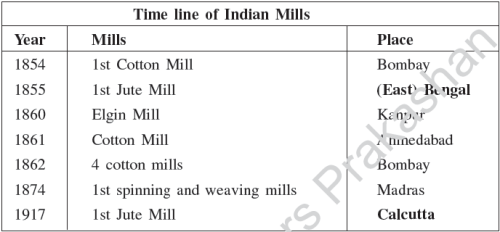
    5. Factories emerged in England in the 1730s. Changes brought about in the production process because of inventions in the 18th centuries, e.g. cotton mill by Richard Arkwright.
    6. Cotton and metal industry (iron and steel) grew rapidly from 2.5 million pounds import of raw cotton in 1760 to 22 million pounds in 1787. By 1873 iron and steel exports rose to 77 million pounds.
    7. Small and ordinary inventions contributed in many mechanised sectors like food processing, building, pottery, glasswork, tanning.
    8. Technological changes were slow and expensive till the late 19th century. Traditional craftsmen played an important role at this stage.


    SECTION B — HANDLOOM AND STEAM POWER

    1. Machines played the following role in the 19th century.

    Machines

    1. They required large capital investment.
    2. The wear and tear of machines made  investors cautious and wary of dependence on them.
    3. Seasonal industries related with gas work, breweries, ship repair, book binders also did not depend on machines.
    4. Machines could produce only limited variety of products like uniforms or products meant for mass production

    Labour

    1. There was no labour shortage. Wages were low.
    2. Human labour was more dependable and cheaper  in those days.
    3. Hand labour could be easily employed seasonally.
    4. Handmade goods were more in demand among the rich and upper classes as a symbol of class and refinement.


    1. Conflict between technology and tradition led to hostility of workers, machines became a target as they caused unemployment, specially among women workers.
    2. Invention of Spinning Jenny by James Mangreaves in 1764 reduced labour demand.
    3. Life improved after 1840s due to massive building activities involving road construction, railways, tunnels, sewers. Number of labour doubled in transport industry.


    SECTION C — INDUSTRIALISATION IN THE COLONIES

    1. India started industrialisation under British rule.
    2. Pre-colonial industrialisation was slow. Silk and cotton textiles were traditional items of export.
    3. Exported as far as Afghanistan, Persia, Central Asia, South-East Asia from Surat in Gujarat, Masaulipatnam on Coromandel coast and Hooghly in Bengal.
    4. Number of merchants and bankers involved in the network of import and export.
    5. Europeans wrested monopoly of trade in the mid-18th century through concessions from rulers, monopoly rights etc.
    6. Old ports like Surat were replaced by new ports in Calcutta, Bombay and Madras.
    7. Textile industry changed dramatically after the conquest of Bengal and Carnatic in the 1760s and 1770s.
    8. Weavers suffered the most. Forced to work for the company, who acted through their agents called Gomasthas.
    9. After 1770s, the English controlled trade, eliminated competition, prevented the weavers from dealing with other buyers. They were severely punished for delays.
    10. There was desertion and migration by farmers of Carnatic and Bengal weavers.
    11. Manchester came to India in the form of cotton textiles produced in English factories.
    12. Imposition of import duties on Indian cotton and sale of British goods in Indian markets at cheaper rates led to decline in Indian exports of cotton piece goods.
    13. Exports fell from 33% in 1811-12 to 3% in 1850-51, whereas imports increased from 31% in 1850-51 to 50% in 1870.
    14. When Indian factories started producing cotton textiles, it spelt doom for Indian weavers. They were already reeling under the price rise in supply of raw cotton due to American War of Independence. Class X, CBSE, NCERT, Questions and Answers, Q and A, Social Studies, Important, History


    SECTION D — FACTORIES COME UP

    1. l Industries were set up by different groups in different places. Most of the entrepreneurs began as investors in trade with China, Burma, Middle East and East Africa.
    2. Prominent entrepreneurs were :
      a. Bengal : Dwarkanath Tagore
      b. Bombay : Dinshaw Petit and Jamshedji Nusserwanjee Tata
      c. Calcutta : Seth Hukam Chand
      d. Father and grandfather of G. D. Birla
      Class X, CBSE, NCERT, Questions and Answers, Q and A, Social Studies, Important, History
    3. Europeans controlled a large section of Indian industries like the Bird Heiglers & Co., Andrew Yule and Jardine Skinner Co.
    4. Factory workers increased from 5,84,000 in 1901 to 24,36,000 in 1946.
    5. Workers came from neighbouring district of Ratnagiri to work in cotton industries. Peasants and artisans from Kanpur district came to work in Kanpur Mills and migrant workers from UP to work in Bombay textile mills or jute mills of Calcutta.
    6. Jobbers became a new group of workers who got villagers to work in cities. They gained importance through commissions and services like housing, rent etc.


    SECTION E — THE PECULIARITIES OF INDUSTRIAL GROWTH

    1. Industrial production in India was dominated by European managing agencies. They produced items of export and not for sale in India—tea, coffee, indigo, jute and mining.
    2. To avoid competition with Manchester products, India produced coarse yarn (thread) in the late 19th century. Swadeshi activists, during national movement, mobilised people against use of foreign goods.
    3. The First World War led Britain to produce materials for war. Indian factories started producing and supplying war goods, such as jute bags, uniforms, leather boots, horse and mule saddles.
    4. After the war, the British lost their economic predominance. New technologies developed in Germany and Japan which took the lead.
      Small-scale industries predominated in India between 1900–1940.
    5. Large industries were located in Calcutta and Bombay. In 1911, 67% of them were in these two cities.


    SECTION F — MARKET FOR GOODS

    1. A significant features of the 19th century Indian economy was the attempt to dominate it by foreign manufacturers.
    2. Indian weavers, craftsmen, traders and industries made collective demand for tariff protection, grants or concessions.
    3. Advertisements became popular as an attempt to increase the sales and win the consumer’s confidence.
    4. Manchester industrialists used their labels on clothes sold in India — “Made in Manchester” was written in bold letters.
    5. Indians used images of Gods and Goddesses, Emperors and Nawabs on calendars to boost the sales.
    6. During the nationalist struggle and Swadeshi movement, Indians used advertisements very effectively on papers, journals and magazines.
  • NCERT Solutions Of Work, Life, And Leisure Class 10th History

    Page No: 150

    Write in Brief

    1. Give two reasons why the population of London expanded from the middle of the eighteenth century.

    Answer

    → The city of London was a magnet for the migrant populations due to the job opportunities provided by its dockyards and industries. By 1750, one out of every nine people of England and Wales lived in London. So, the population of London kept expanding through the eighteenth and nineteenth centuries.
    → During the first world war, London began manufacturing motor cars and electrical goods. This increased the number of large factories, which in turn increased the number of people coming to the city in search of work.

    2. What were the changes in the kind of work available to women in London between the nineteenth and the twentieth century? Explain the factors which led to this change.

    Answer

    Changes in the kind of work available to women in London between the nineteenth and the twentieth century were primarily based on industrial and technological advancements. Consequently, women had to work in households for a living, and this led to an increase in the number of domestic servants. Some women also began to earn by lodging out rooms, tailoring, washing or making matchboxes. With the coming of the First World War though, women once again joined the industrial sector.

    3. How does the existence of a large urban population affect each of the following? Illustrate with historical examples.
    (a) A private landlord
    (b) A Police Superintendent in charge of law and order
    (c) A leader of a political party

    Answer

    (a) A private landlord benefits by increasing the rent and he has more control over the price. The rising population would lead to increasing demand for space, e.g. renting of buildings at high rates were common in London and Bombay.

    (b) Anyone involved with law and order would find it difficult with increasing population in urban areas. He would have to work hard to maintain law and order as crime rates are usually high in cities. For example, London people employed policemen to curb the rising crimes during night.
    (c) Political leaders would have more people voting and hence more responsibilities. In cities, masses of people could be drawn to the political causes as it happened in the Bloody Sunday of November, 1887 in London. The metropolitan character of cities would compel him/her to be more secular and liberal on the one hand. On the other hand, extremism or conservatism might also win them votes as a reactionary phenomenon, e.g. rise of Nazis in Germany or Liberal Democrats in France.

    4. Give explanations for the following:
    (a) Why well-off Londoners supported the need to build housing for the poor in the nineteenth century.
    (b) Why a number of Bombay films were about the lives of migrants.
    (c) What led to the major expansion of Bombay’s population in the mid-nineteenth century.

    Answer

    (a) Well-off Londoners supported the need to build housing for the poor in the nineteenth century on account of three reasons:

    → one-room houses of the poor came to be seen as the breeding ground of diseases, and hence, a threat to public health
    → Fire hazards became a worry in these over-crowded, badly ventilated, unhygienic homes
    → There was a widespread fear of social disorder, especially after the 1917 Russian Revolution. Housing schemes were undertaken to avoid a rebellion by the poor.

    (b) Bombay became an attractive destination for people seeking jobs after the British administration replaced Surat with Bombay as its principal western port. The consequent increase in trade and industries led to a great influx of people. Thus, migrants were (and still are) an important facet of Bombay. Most of the people in the film industry were migrants themselves, and wanted to portray the plight of this class of people through films. Thus, a number of Bombay films were about the lives of migrants.

    (c) In mid-seventeenth century, Bombay became East India Company’s principal western port, replacing Surat. Later, by the end of the nineteenth century, it had become an important administrative as well as industrial centre. All through these years, the prospects for trade and commerce, and employment kept increasing, thereby making Bombay an attractive destination for migrants.

    Discuss

    1. What forms of entertainment came up in nineteenth century England to provide leisure activities for the people.

    Answer

    There were many forms of entertainment came up in nineteenth century England:
    → For the upper classes, an annual “London Season” comprised of opera, the theatre and classical music events was one of the sources of leisure.
    → For the working classes, pubs, discussions and meetings for political action served the same purpose.
    → Libraries, art galleries and museums were new types of entertainment brought about through the utilisation of state money.
    → Music halls and cinema theatres too became immensely popular with the lower classes.
    → Industrial workers were encouraged to undertake seaside vacations to rejuvenate from the banes of working in the polluting environment of factories.

    2. Explain the social changes in London which led to the need for the Underground railway. Why was the development of the Underground criticised?

    Answer

    The development of suburbs as a part of the drive to decongest London led to the extension of the city beyond the range where people could walk to work. Though these suburbs had been built, the people could not be persuaded to leave the city and stay far away from their places of work in the absence of some form of public transport. The Underground railway was constructed to solve this housing problem. It was criticized intially because:
    → A newspaper reported the danger to health and asphyxiation (lack of air) and heat.
    → It was referred to as iron monsters, which added to the mess of the city. Charles Dickens in ‘Dombey and Son’ described its destructive process in construction.
    → About 900 houses were destroyed to make two miles of railways.

    3. Explain what is meant by the Haussmanisation of Paris. To what extent would you support or oppose this form of development? Write a letter to the editor of a newspaper, to either support or oppose this, giving reasons for your view.

    Answer

    Haussmanisation of Paris refers to the forcible reconstruction of cities to enhance their beauty and impose order. The poor were evicted from the centre of Paris to reduce the possibility of political rebellion and to beautify the city.

    4. To what extent does government regulation and new laws solve problems of pollution? Discuss one example each of the success and failure of legislation to change the quality of
    (a) public life
    (b) private life

    Answer

    Government laws play an important role in controlling the rates of pollution in a city. However, simply passing laws is not enough. They need to be properly enforced as well. It is also a fact that people tend to find ways of getting around laws. So, apart from legislations, government also needs to carry out intensive public awareness programmes aimed at educating the public about the need and ways of controlling pollution; and about how they too have a stake in environmental governance.
    Public Life:
    • Failure: The Underground railway enhanced transport, but caused the demolition of many houses, rendering their inhabitants homeless.
    • Success: The British state used public funds to provide for entertainment forms such as museums, art galleries and libraries for the working classes.

    Private Life:
    • Failure: The availability of one-room tenements and no housing facilities for a major part of the industrial revolution time period caused the family to get divided into smaller units. There were even cases where rural people had to leave their families behind and live alone in the urban areas where they worked.
    • Success: British administrative officials built houses in new suburbs for fulfilling the housing needs of the working classes.

  • NCERT Solutions Of The Age of Industrialisation Class 10th History

    Page No: 126

    Write in Brief

    1. Explain the following:
    (a) Women workers in Britain attacked the Spinning Jenny.
    (b) In the seventeenth century merchants from towns in Europe began employing peasants and artisans within the villages.
    (c) The port of Surat declined by the end of the eighteenth century.
    (d) The East India Company appointed gomasthas to supervise weavers in India.

    Answer

    (a) Women workers in Britain attacked the Spinning Jenny because it speeded up the spinning process, and consequently, reduced labour demand. This caused a valid fear of unemployment among women working in the woollen industry. Till date, they had survived on hand spinning, but this was placed in peril by the new machine.

    (b) The trade and commerce guild controlled the market, raw materials, employees, and also production of goods in the towns. This created problems for merchants who wanted to increase production by employing more men. Therefore, they turned to peasants and artisans who lived in villages.

    (c) The port of Surat declined by the end of the eighteenth century on account of the growing power of European companies in trade with India. They secured many concessions from local courts as well as the monopoly rights to trade. This led to a decline of the old ports of Surat and Hoogly from where local merchants had operated. Exports slowed and local banks here went bankrupt.

    (d) The English East India Company appointed Gomasthas for:
    → To eliminate the existence of traders and brokers and establish a direct control over the weavers.
    → To eliminate weavers from dealing with other buyers by means of advances and control. In this manner, weavers who took loans and fees in advance were obligated to the British.

    2. Write True or False against each statement:

    (a) At the end of the nineteenth century, 80 per cent of the total workforce in Europe was employed in the technologically advanced industrial sector.
    ► False

    (b) The international market for fine textiles was dominated by India till the eighteenth century.
    ► True

    (c) The American Civil War resulted in the reduction of cotton exports from India.
    ► Flase

    (d) The introduction of the fly shuttle enabled handloom workers to improve their productivity.
    ► True

    3. Explain what is meant by proto-industrialisation.

    Answer

    Proto-industrialisation is the phase of industrialisation that was not based on the factory system. Before the coming of factories, there was large-scale industrial production for an international market. This part of industrial history is known as proto-industrialisation.

    Discuss
    1. Why did some industrialists in nineteenth-century Europe prefer hand labour over machines?
    Answer
    Some industrialists in nineteenth-century Europe prefer hand labour over machines because:

    → Machines were costly, ineffective, difficult to repair, and needed huge capital investments.
    → Labour was available at low wages at that period of time.
    → In seasonal industries only seasonal labour was required.
    → Market demands of variety of designs and colour and specific type could not be fulfilled by machine made clothes. Intricate designs and colours could be done by human-skills only.
    → In Victorian age, the aristocrats and other upper class people preferred articles made by hand only.

    2. How did the East India Company procure regular supplies of cotton and silk textiles from Indian weavers?

    Answer

    The English East India Company used different means to procure silk and cotton from the weavers:
    → Appointment of paid supervisors called Gomasthas. They also collected supplies and examined cloth quality of the weavers.
    → Prevention of Company weavers from dealing with other buyers through a system of advances and loans.

    3. Imagine that you have been asked to write an article for an encyclopaedia on Britain and the history of cotton. Write your piece using information from the entire chapter.

    Answer

    Britain and the History of Cotton

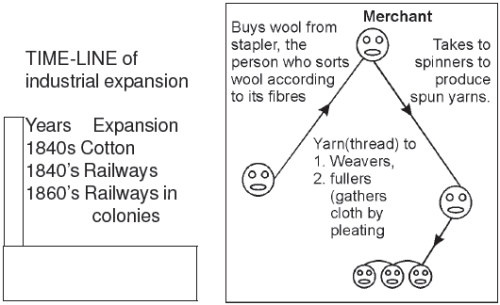
    During the seventeenth and eighteenth centuries, merchants would trade with rural people in textile production. A clothier would buy wool from a wool stapler, carry it to the spinners, and then, take the yarn to the weavers, fuller and dyers for further levels of production. London was the finishing centre for these goods. This phase in British manufacturing history is known as proto-industrialisation. In this phase, factories were not an essential part of industry. What was present instead was a network of commercial exchanges.

    The first symbol of the new era of factories was cotton. Its production increased rapidly in the late nineteenth century. Imports of raw cotton sky-rocketed from 2.5 million pounds in 1760 to 22 million pounds in 1787. This happened because of the invention of the cotton mill and new machines, and better management under one roof. Till 1840, cotton was the leading sector in the first stage of industrialisation.

    Most inventions in the textile production sector were met with disregard and hatred by the workers because machines implied less hand labour and lower employment needs. The Spinning Jenny was one such invention. Women in the woollen industry opposed and sought to destroy it because it was taking over their place in the labour market.

    Before such technological advancements, Britain imported silk and cotton goods from India in vast numbers. Fine textiles from India were in high demand in England. When the East India Company attained political power, they exploited the weavers and textile industry in India to its full potential, often by force, for the benefit of Britain. Later, Manchester became the hub of cotton production. Subsequently, India was turned into the major buyer of British cotton goods.

    During the First World War, British factories were too busy providing for war needs. Hence, demand for Indian textiles rose once again. The history of cotton in Britain is replete with such fluctuations of demand and supply.

    4. Why did industrial production in India increase during the First World War?

    Answer

    India witnessed increased industrial production during the First World War due to following reasons:
    → British industries became busy in producing and supplying war-needs. Hence, they stopped exporting British goods or clothes for colonial markets like that in India.
    → It was a good opportunity for Indian industries to fill in empty Indian markets with their products. It was done so. Therefore, industrial production in India increased.
    → Also the British colonial government asked Indian factories to supply the war needs like – jute bags, cloth or army uniforms, tents and leather boots, horse and mule saddle, etc.
    → The increased demands of variety of products led to the setting up of new factories and old ones increased their production.
    → Many new workers were employed and everyone was made to work longer hours.

  • NCERT Solutions Of The Making Of a Global World Class 10th Hostory

    Page No: 102

    Write in Brief

    1. Give two examples of different types of global exchanges which took place before the seventeenth century, choosing one example from Asia and one from the Americas.

    Answer

    Examples of the different types of global exchanges which took place before the seventeenth century:
    → Textiles, spices and Chinese pottery were exchanged by China, India and Southeast Asia in return for gold and silver from Europe.
    → Gold and foods such as potatoes, soya, groundnuts, tomatoes and chillies were first exported from the Americas to Europe.

    2. Explain how the global transfer of disease in the pre-modern world helped in the colonisation of the Americas.

    Answer

    The global transfer of disease in the pre-modern world helped in the colonisation of the Americas because the native American Indians were not immune to the diseases that the settlers and colonisers brought with them. The Europeans were more or less immune to small pox, but the native Americans, having been cut off from the rest of the world for millions of years, had no defence against it. These germs killed and wiped out whole communities, paving the way for foreign domination. Weapons and soldiers could be destroyed or captured, but diseases could not be fought against.

    3. Write a note to explain the effects of the following:
    (a) The British government’s decision to abolish the Corn Laws.
    (b) The coming of rinderpest to Africa.
    (c) The death of men of working-age in Europe because of the World War.
    (d) The Great Depression on the Indian economy.
    (e) The decision of MNCs to relocate production to Asian countries.

    Answer

    (a) The British government’s decision to abolish the Corn Laws was the inflow of cheaper agricultural crops from America and Australia. Many English farmers left their profession and migrated to towns and cities. Some went overseas. This indirectly led to global agriculture and rapid urbanisation, a prerequisite of industrial growth.

    (b) The coming of rinderpest to Africa caused a loss of livelihood for countless Africans. Using this situation to their advantage, colonising nations conquered and subdued Africa by monopolising scarce cattle resources to force Africans into the labour market.

    (c) Most of the victims of world war belonged to young generations of working men. As a result, it reduced the workforce in Europe, thereby reducing household income. The role of women increased and led to demand for more equality of status. It made the feminist movement stronger. Women started working alongside men in every field. Women and youngsters became more independent and free with long-term effects.

    (d) The impact of the Great Depression in India was felt especially in the agricultural sector. It was evident that Indian economy was closely becoming integrated to global economy. India was a British colony and exported agricultural goods and imported manufactured goods. The fall in agricultural price led to reduction of farmers’ income and agricultural export. The government did not decrease their tax and so, many farmers and landlords became more indebted to moneylenders and corrupt officials. It led to a great rural unrest in India.

    4. Give two examples from history to show the impact of technology on food availability.

    Answer

    Two examples from history to show the impact of technology on food availability were:

    → Faster railways, lighter wagons and larger ships helped transport food more cheaply and quickly from production units to even faraway markets.
    → Refrigerated ships helped transport perishable foods such as meat, butter and eggs over long distances.

    5. What is meant by the Bretton Woods Agreement?

    Answer

    The Bretton Woods Agreement was finalised in July 1944 at Bretton Woods in New Hampshire, USA. It established the International Monetary Fund and the World Bank to preserve global economic stability and full employment in the industrial world. These institutions also dealt with external surpluses and deficits of member nations, and financed post-war reconstructions.

    Discuss

    7. Explain the three types of movements or flows within international economic exchange. Find one example of each type of flow which involved India and Indians, and write a short account of it.

    Answer

    The three types of movements or flows within the international economic exchange are trade flows, human capital flows and capital flows or investments. These can be explained as—the trade in agricultural products, migration of labour, and financial loans to and from other nations.

    India was a hub of trade in the pre-modern world, and it exported textiles and spices in return for gold and silver from Europe. Many different foods such as potatoes, soya, groundnuts, maize, tomatoes, chillies and sweet potatoes came to India from the Americas after Columbus discovered it.
    In the field of labour, indentured labour was provided for mines, plantations and factories abroad, in huge numbers, in the nineteenth century. This was an instrument of colonial domination by the British.
    Lastly, Britain took generous loans from USA to finance the World War. Since India was an English colony, the impact of these loan debts was felt in India too. The British government increased taxes, interest rates, and lowered the prices of products it bought from the colony. Indirectly, but strongly, this affected the Indian economy and people.

    8. Explain the causes of the Great Depression.

    Answer

    The Great Depression was a result of many factors:

    → Prosperity in the USA during the 1920s created a cycle of higher employment and incomes. It led to rise in consumption and demands. More investment and more employment created tendencies of speculations which led to the Great Depression of 1929 upto the mid-1930s.
    → Stock market crashed in 1929. It created panic among investors and depositors who stopped investing and depositing. As a result, it created a cycle of depreciation.
    → Failure of the banks. Some of the banks closed down when people withdrew all their assets, leaving them unable to invest. Some banks called back loans taken from them at the same dollar rate inspite of the falling value of dollar. It was worsened by British change in policy to value pound at the pre-war value.

    9. Explain what is referred to as the G-77 countries. In what ways can G-77 be seen as a reaction to the activities of the Bretton Woods twins?

    Answer

    G-77 countries is an abbreviation for the group of 77 countries that demanded a new international economic order (NIEO); a system that would give them real control over their natural resources, without being victims of neo-colonialism, that is, a new form of colonialism in trade practised by the former colonial powers.
    The G-77 can be seen as a reaction to the activities of the Bretton Woods twins (the International Monetary Fund and the World Bank) because these two institutions were designed to meet the financial needs of industrial and developed countries, and did nothing for the economic growth of former colonies and developing nations.

  • Important Terms Of The Rise Of Nationalism in Europe History Class 10th

    SECTION A — THE FRENCH REVOLUTION AND THE IDEA OF A NATION, AND
    MAKING OF NATIONALISM IN EUROPE

    1. The first clear expression of nationalism came with the French Revolution in 1789.
    2. The French Revolution proclaimed that it was the people who would henceforth constitute the nation and shape its destiny.
    3. The revolutionary ideas spread in Europe after the outbreak of revolutionary wars and the rule of Napoleon.
    4. In early nineteenth century Europe, national unity was allied to the ideology of Liberalism.
    5. After the defeat of Napoleon in 1815, European governments were driven by a spirit of Conservatism, which led to repression and drove people to oppose monarchical governments.
    6. Giuseppe Mazzini, an Italian revolutionary, set up ‘Young Italy’ in Marseilles (France) and ‘Young Europe’ in Berne (Switzerland).
    7. Mazzini was described as ‘the most dangerous enemy of our social order’, by Metternich, the Austrian Chancellor, who hosted the Vienna Congress.

    SECTION B — THE AGE OF REVOLUTION (1830–1848) AND
    THE UNIFICATION OF GERMANY AND ITALY

    1. Liberalism and nationalism became associated with the revolution in many regions of Europe such as the Italian and German states, the provinces of the Ottoman Empire, Ireland and Poland.
    2. The first upheaval took place in France, in July 1830.
    3. The Greek War of Independence was another event which mobilised nationalist feelings among the educated elite in Europe.
    4. Culture played an important role in creating the idea of the nation. Art and poetry, stories, music helped express and shape nationalist feelings.
    5. Romanticism was a cultural movement which sought to develop a particular form of nationalist sentiment.
    6. Language too played an important role in developing nationalist sentiments.
    7. The 1830s saw a rise in prices, bad harvest, poverty in Europe. Besides the poor, unemployed and starving peasants, even educated middle classes, revolted.
    8. In 1848, an all-German National Assembly was voted for in Frankfurt.
    9. The issue of extending political rights to women became a controversial one.
    10. Conservative forces were able to suppress liberal movements in 1848, but could not restore the old order.
    11. After 1848, nationalism in Europe moved away from its association with democracy and revolution.
    12. In 1848, Germans tried to unite into a nation-state.
    13. Prussia took the lead under its Chancellor, Otto von Bismarck. Three wars over seven years with Austria, Denmark and France ended in victory for Prussia and a unified Germany.
    14. In January 1871, Prussian king, William I, was proclaimed German Emperor at a ceremony at Versailles.
    15. Italy was fragmented, before unification it was a part of the multinational Habsburg Empire in the north, centre under the Pope and the south under the Bourbon kings of Spain.
    16. Three Men – Giuseppe Mazzini, Chief Minister Cavour and Giuseppe Garibaldi played a leading role in unifying Italy during the 1830s.
    17. In 1861, Victor Emmanuel II was proclaimed the king of united Italy.
    18. In Britain, the formation of the nation state was not the result of a sudden upheaval but was the result of a long-drawn-out process.
    19. The Act of Union (1707) – united Scotland and England and “the United Kingdom of Great Britain” was formed.
    20. Ireland was forcibly incorporated into the United Kingdom in 1801. A new British nation was forged.

    SECTION C — VISUALISING THE NATION :
    NATIONALISM AND IMPERIALISM

    1. People and artists in the 18th and 19th centuries personified a nation.
    2. In France, Marianne became the allegory of the French nation, while Germania became the allegory of the German nation.
    3. By the 1870s nationalism no longer retained its idealistic liberal democratic sentiment but became a narrow creed with limited ends.
    4. The major European powers, manipulated the nationalist aspirations of the subject peoples in Europe to further their own imperialist aims.
    5. People everywhere developed their own specific variety of nationalism.
    6. The idea that societies should be organized into nation-states came to be accepted as natural and universal.
  • Important Terms Of The Nationalist Movement In Indo-China

    SECTION A — EMERGING FROM THE SHADOW OF CHINA
    THE DILEMMA OF COLONIAL EDUCATION AND
    HYGIENE, DISEASE AND EVERYDAY RESISTANCE

    1. Indo-China comprises the modern countries of Vietnam, Laos and Cambodia.
    2. Vietnam followed a Chinese system of government as well as Chinese culture.
    3. The French colonised Vietnam. After defeating China, they assumed control of Tonkin and Anaam.
    4. In 1887, French Indo-China was formed.
    5. Colonies were considered essential to supply natural resources and other essential goods. The French built infrastructure projects to help transport goods for trade, move military garrisons and control the entire region.
    6. The colonial economy in Vietnam was based on rice cultivation and rubber plantations. Very little industrialisation of Vietnam by France.
    7. To counter Chinese influence, the French systematically dismantled the traditional educational system and established French schools for the Vietnamese.
    8. The textbooks glorified French rule and culture.
    9. Students fought against discrimination against the Vietnamese in white collar jobs. Schools became important place for cultural and political battles. Education became an important part of the larger battle against colonialism and for independence.
    10. In 1902, the French part of Hanoi was hit by a rat menace. Vietnamese were paid to catch and kill the rats. Plague swept the area in 1903, as clever Vietnamese took to clipping the rats’ tails as proofs. They let the rats go.
    11. Colonialism was fought in such resistant acts in everyday life.

    SECTION B —

    (I) RELIGION AND ANTI-COLONIALISM
    (II) THE VISION OF MODERNISATION
    (III) THE COMMUNIST MOVEMENT AND VIETNAMESE NATIONALISM

    1. Religious beliefs of Vietnam were a mixture of Buddhism, Confucianism and local practices.
    2. The French introduced Christianity, their Missionaries were hostile to the easy-going attitude of the Vietnamese towards religion.
    3. Scholars’ Revolt of 1868 : Led by officials of the Imperial Court. Uprising in Ngu An and Ha Tien provinces killed a thousand Catholics. By the middle of the 18th century 300,000 people converted to Christianity. Revolt suppressed by the French.
    4. The Hoa Hao Movement began in 1939 under its founder Huynh Phu So.
    5. He performed miracles, helped the poor, opposed sale of brides, gambling and use of opium and alcohol.
    6. The French declared him mad and sent him to a mental asylum. Freed in 1946, but exiled to Laos. Followers sent to concentration camps.
    7. Vision of Modernisation : Two opinions held
      (i) Vietnamese traditions had to be strengthened to resist western domination.
      (ii) The second school felt that the Vietnamese had to learn from the West, while resisting its domination.
    8. Phan Boi Chau (1867-1940) formed the ‘Revolution Society’ (Duy Tan Hoi) in 1903 with Prince Cuong De as the lead. He wrote a book, ‘History of the Loss of Vietnam’ under the influence of the Chinese reformer Liang Qichao (1873-1929). He believed that the French should be driven out first and then monarchy should be restored in Vietnam.
    9. Phan Chu Trinh (1871-1926) differed strongly. He was totally opposed to monarchy and wanted to establish a democratic republic.
    10. Go East Movement : Some 300 Vietnamese students went to Japan in 1907-08 to acquire modern education. Their aim was to drive out the French and re-establish the Ngu Yen dynasty. They wanted Japanese help and established a Restoration Society in Tokyo. But after 1908, the Japanese closed the society, and sent many of them, including Phan Boi Chau to exile in China and Thailand.
    11. Whe Sun Yat Sen overthrew monarchy in China in 1911, a new association – Association for Restoration of Vietnam was formed. Their objective was to have a Democratic Republic and a Constitutional Monarchy in Vietnam.
    12. The Communist Movement
    13. The Great Depression of the 1930s led to unemployment, debts and rural uprisings in Vietnam.
    14. A new leader, Ho Chi Minh, appeared on the scene in 1930. He established the Vietnamese Communist (Vietnam Cong San Dang) Party, inspired by Europeon communists.
    15. Ho Chi Minh (He who enlightens) was born in Central Vietnam; later became an active member of the committee. He met Lenin and other leaders. After 30 years stay in Europe, Thailand and China he returned to Vietnam in May 1941. He became President of Vietnam Democratic Republic.
    16. In 1940, Japan occupied Vietnam. The League for the Independence of Vietnam (known as the Viet Minh) fought the Japanese, recaptured Hanoi and Ho Chi Minh became the chairman of the Democratic Republic of Vietnam in September 1943.
    17. Vietnamese Nationalism : The French set up a puppet regime under Bao Dai as Emperor. After years of fighting, the French were finally defeated in 1954 at Dien Bien Phu.
    18. The Battle of Dien Bien Phu (1953-1954)
    19. On 7 May, 1954, more than 16,000 soldiers of the French army were either killed or captured. The entire French commanding staff, including a General, 16 Colonels, 1749 officers were taken prisoner.
    20. Vietnam was divided into North and South Vietnam. Ho Chi Minh and Bao Dai became rulers in north and south respectively.
    21. The division led to war. The Bau Dai regime was overthrown by Ngo Dinh Diem. The south united and formed the National Liberation Front (NLF) and fought for unification of the country under Ho Chi Minh.
    22. Fear of communism made the US intervene in Vietnam and a bitter war was fought during 1965-1972. Finally, peace was restored in 1974.


    SECTION C — THE NATION AND ITS HEROES
    THE END OF WAR

    1. Women played no role in public life of the Vietnamese, but the freedom struggle led to an emerging new image of womanhood.
    2. Women like Trung sisters (39-43 CE) became idols. Same was the case with Trieu Au of 3rd century CE.
    3. In the 1960s, women were depicted as young, brave and dedicated. They were shown as warriors and workers.
    4. The image of the warrior woman was replaced with the image of worker woman, in the 1970s, when the end of the war was near.
    5. The US failed to achieve its objectives in the US Vietnam war.
    6. The US-Vietnam war was called the first television war.
    7. On 30 April, 1975 the North Liberation Front (NLF) occupied the presidential palace in Saigon and unified Vietnam.