Category: Class 11th
-
The Voice Of The Rain Class 11th Summary, NCERT Solution, Notes (Poem) Chapter 5
The Voice Of The Rain
by Walt Whitman
Content
-
NCERT Solutions of The Voice Of The Rain Class 11th Chapter 5 (Poem)
Page No: 42I. Think It Out1. There are two voices in the poem. Who do they belong to? Which lines indicate this?
2. What does the phrase “strange to tell” mean?
3. There is a parallel drawn between rain and music. Which words indicate this? Explain the similarity between the two.
4. How is the cyclic movement of rain brought out in the poem? Compare it with what you have learnt in science.
5. Why are the last two lines put within brackets?
6. List the pair of opposites found in the poem.
Answer
1. The two voices in the poem are the voice of the rain and the voice of the poet. The poem begins in a conversational tone. The lines are “And who art thou? Said I ……..” and ‘I am the poem of Earth’.
2. The phrase ‘strange to tell’ means that it is an unusual and extraordinary answer given by the rain drops to the poet who asked who ‘it was’.3. ‘I am the poem of Earth’
‘For song, issuing from its birth place
After fulfillment, wandering, reck’d orUnreck’d, duly with love returns. They both return to the place of their origin after fulfilling their tasks.4. The poet explains that the rain drops in the form of water vapour rise up from land and sea and then descend again on the earth and dry land in order to wash it down and hence comes back to its origin. This is the cyclic movement explained by the poet.
5. The last two lines are put within brackets because they do not form the voice of the rain or the poet. They only contain a general observation made by the poet about the course of a song.
6. (a) Day, night
(b) Reck’d, unreck’d
(c) Rise, descend2. Notice the following sentence patterns.- And who art thou? said I to the soft-falling shower.
- I am the Poem of Earth, said the voice of the rain.
- Eternal I rise
- For song…duly with love returns
Rewrite the above sentences in prose.Answer
1. I enquired the soft-falling rain about its identity.2. The voice of the rain introduced itself as the Poem of Earth.
3. The voice of the rain explained its upward movement towards the sky as eternal.
4. The poet says that, similar to the natural cycle of the rain, a song originates from the heart of the poet, travels to reach others and after fulfilling its purpose (whether acknowledged or not), it returns to the poet with all due love.
-
Summary of The Voice Of The Rain Class 11th Chapter 5 (Poem)
About the Poet
Walt Whitman, one of America’s most influential poets was born on May 31, 1819, in West Hills, Long Island, New York. He was the second of nine children and was immediately nicknamed “Walt” to distinguish him from his father. At 11, Walt Whitman was taken out of school by his father to help out with household income. He started to work as an office boy for a Brooklyn-based attorney team and eventually found employment in the printing business. In 1836, at the age of seventeen, he began his career as a teacher in the one-room school houses of Long Island. He continued to teach until 1841, when he turned to journalism as a full-time career.
At the outbreak of the Civil War, Whitman vowed to live a “cleansed” life. He worked as a freelance journalist and visited the wounded at New York City–area hospitals. He then traveled to Washington, D. C. in December 1862 to care for his brother who had been wounded in the war. Overcome by the suffering of the many wounded in Washington, Whitman decided to stay and work in the hospitals and stayed in the city for eleven years. Whitman struggled to support himself through most of his life. In Washington, he lived on a clerk’s salary and modest royalties.
But in 1873 his life took a dramatic turn for the worse. In January of that year he suffered a stroke that left him partially paralyzed. In May he traveled to Camden, New Jersey, to see his ailing mother, who died just three days after his arrival. Whitman found it impossible to continue with his job in Washington and relocated to Camden to live with his brother George and sister-in-law Lou.
On March 26, 1892, Walt Whitman passed away in Camden.
Poem: The Voice of the Rain
And who art thou? said I to the soft-falling shower,
Which, strange to tell, gave me an answer, as here translated:
I am the Poem of Earth, said the voice of the rain,
Eternal I rise impalpable out of the land and the bottomless sea,
Upward to heaven, whence, vaguely form’d, altogether changed, and
Yet the same,
I descend to lave the droughts, atomies, dust-layers of the globe,
And all that in them without me were seeds only, latent, unborn;
And forever, by day and night, I give back life to my own origin,
And make pure and beautify it;(For song, issuing from its birth-place, after fulfilment, wandering,
Reck’d or unreck’d, duly with love returns.)Introduction
‘The Voice of the Rain’ is an imaginary dialogue between the poet and the rain. The poet casually asks the rain who it is. To his surprise, the rain answers the question and tells about its birth and end. The poet understands the tale of rain and translates it for the readers.
Summary
The poet once asked the soft falling rain who it is. Strangely, the raindrops replied and said that it is the music of the Earth which is its birth place. It is born out of the land and sea in the form of water vapours and rises up in the sky to form clouds. Yet, at its core, it remains the same as it was at birth. It then returns to earth as little droplets which wash away the layers of dust, waters the soil and helps the seeds sprout again. It gives back life to the earth. It purifies and makes it beautiful over and over again. This cycle goes on eternally.
The poet compares the rain to a song. A song rises from the heart of a poet. Once it is complete, it is passed on from one person to another. It doesn’t matter to him whether anyone listens to it or not. After the poet has sung his song, it settles back into his heart which is its birth place. The song keeps rising again and again from there. Thus it purifies the poet’s heart and make it beautiful.
Main points
1. Poem – an imaginary dialogue between the poet and the rain.
2. Poet asks who it is.
3. Surprisingly, rain answers and tells how it originates.
4. It rises unseen from land and sea.
5. It forms clouds in the sky.
6. It returns to earth in the form of rains.
7. It gives back life to the earth and make it beautiful.
8. This cycle goes on forever. -
Discovering Tut: The Saga Continues Class 11th Summary, NCERT Solution, Notes Chapter 4
Discovering Tut: The Saga Continues
By A. R. Williams
Content
-
NCERT Solutions of Discovering Tut: The Saga Continues Class 11th Chapter 4
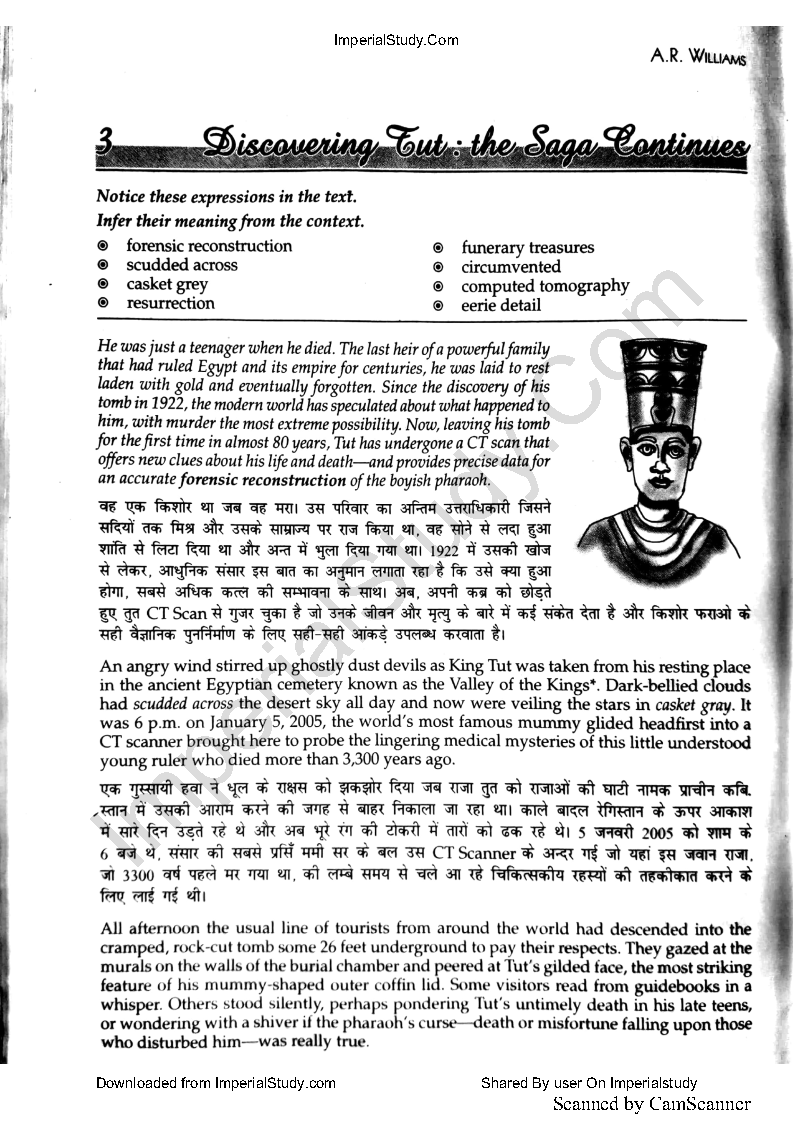
Page No: 221. Notice these expressions in the text. Infer their meaning from the context.forensic reconstruction
scudded across
casket grey
Resurrection
funerary treasures
Circumvented
computed tomography
eerie detail
Answer
Forensic reconstruction- It refers to the process of creating a face on the skull and see how the owner of the skull looked like. Here, it refers to the construction of the bust of King Tut based on the data received from CT scan.Scudded across- It refers to moving quickly. The phrase is used with reference to the movement of the ‘dark-bellied clouds’.
Casket grey- The words point out to the covering of the stars by the‘dark-bellied clouds’, the way jewels are kept in a casket (a jewel box).
Resurrection- It refers to a new beginning for something which is old and long forgotten. Here, it refers to the new life after death.
Funerary treasures- The valuable things with which the king was buried were no less than treasures as most of the items were made of pure gold. They are, thus, referred to as ‘funerary treasures’.
Circumvented- The thieves would easily bypass the guards with artfulness and rip the mummy apart to remove the gold.
Computed tomography- Also known as CT scan, it provides X-ray image of a body in cross section. It is used for diagnostic purposes.
Eerie detail- Uncanny description of the resulting image of the head of Tut visible through the CT scan.
Page No: 28
Understanding the Text
1. Give reasons for the following.
(i) King Tut’s body has been subjected to repeated scrutiny.Answer
King tut’s body has been subjected to to repeated scrutiny for the riches it was buried with. There has also been a lot of speculation about the manner of his death and the time of his death.(ii) Howard Carter’s investigation was resented.
Answer
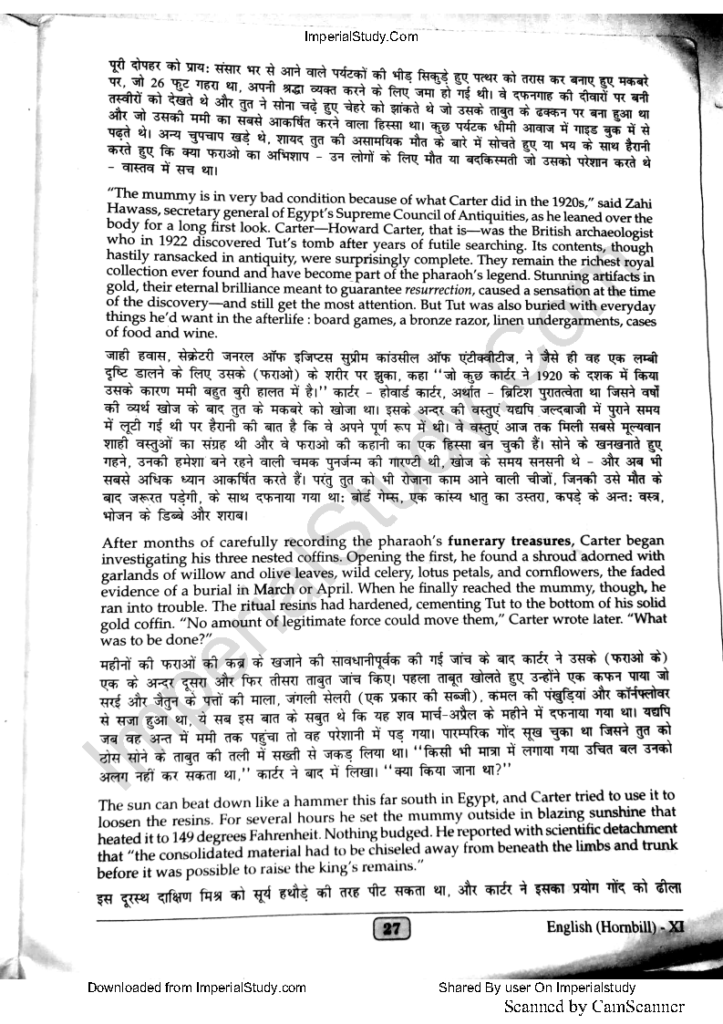
Howard Carter’s investigation was resented because he used unscientific methods to cut the body away from the wooden base. He also focused more on the discovery of gold than on thefascinating details of Tut’s life and the mysteries of his death.(iii) Carter had to chisel away the solidified resins to raise the king’s remains.
Answer
Carter found that the ritual resin that was used as a polish hashardened. The result was that the mummy was cemented to the bottom of the solid gold coffin.Neither the strongestforce could move the mummynor the burning sun could loosen the remains of the king.(iv) Tut’s body was buried along with gilded treasures.
Answer
The ancient royals of Egypt were fabulously wealthy. They believed inafterlife. They also believed that they could take their wealth with them. Sogilded treasures were buried with them.(v) The boy king changed his name from Tutankhaten to Tutankhamun.
Answer
Tutankhamun means ‘Living image of Amun’. He was a majorgod in ancient Egypt. King Amennotep smashed the images of Amun and closed his temples. Tut oversaw a restoration of the old ways. He also changed his name to express his belief on Amun.2.
(i) List the deeds that led Ray Johnson to describe Akhenaten as “wacky”.
Answer
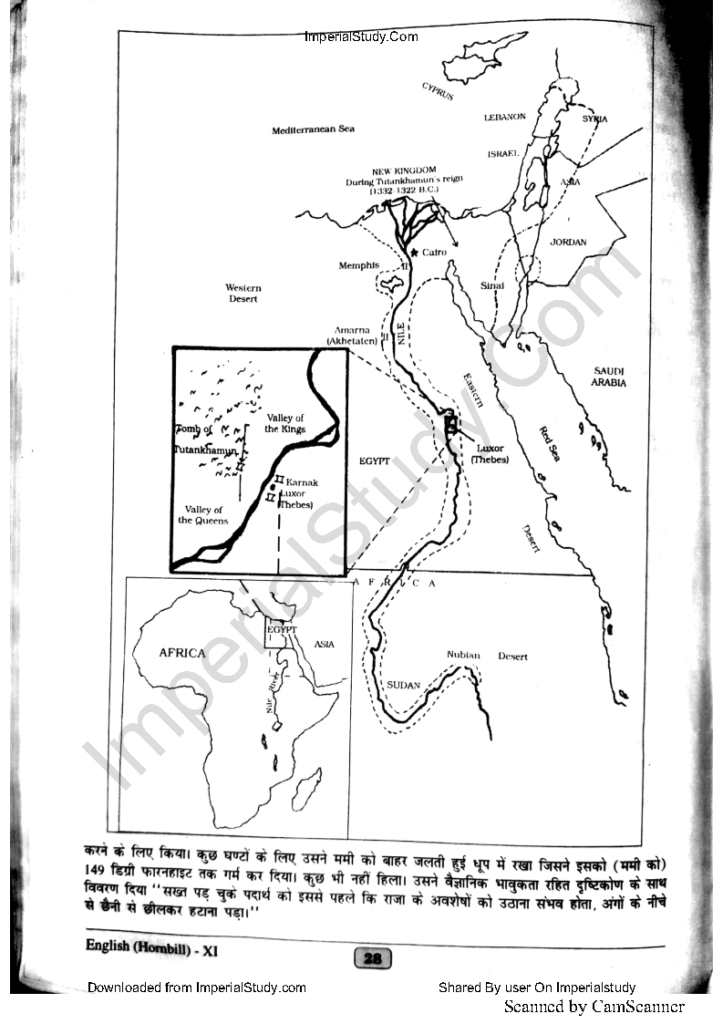
According to Ray Johnson Akhenten was wacky because:► He promoted the worship of Aten instead of Amun.► He moved the religious capital from Thebes to the new city of Akhetaten.► He smashed Amun’s images.► He closed Amun’s temples.► He changed his name to Akhenaten or servant of Aten.(ii) List the advances in technology that have improved forensic analysis.
Answer
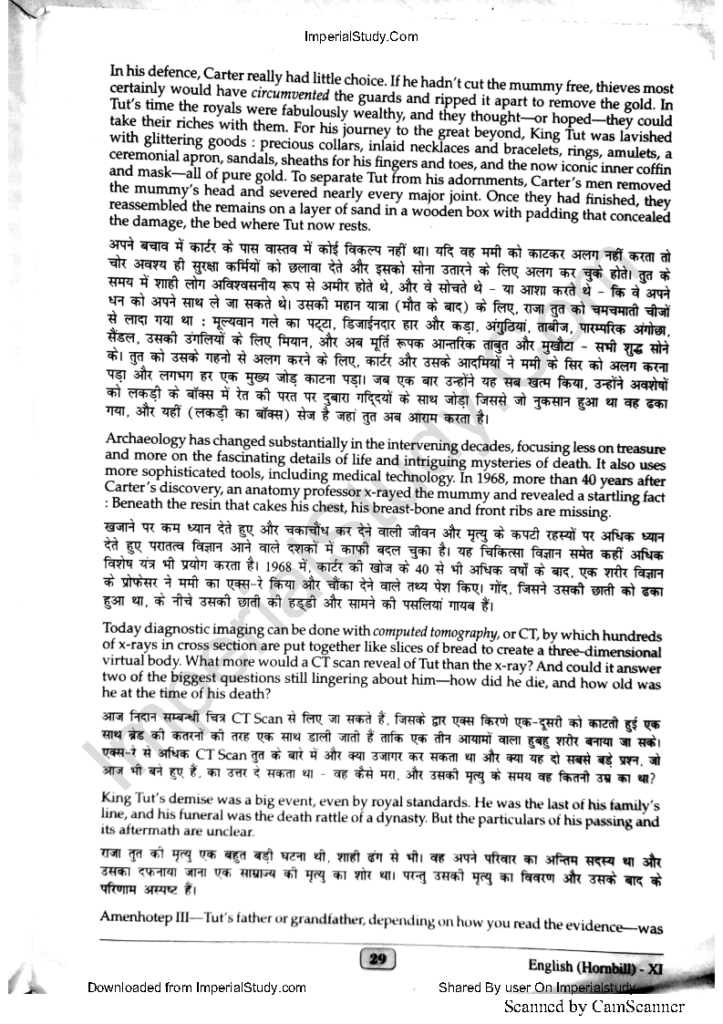
Today C.T. technology helps us to take hundreds of X-ray images in cross-sections. They can be put together likeslices of bread tp create three dimensional virtual body.This provides precise data for an accurate forensicreconstruction.(iv) Explain the statement, “King Tut is one of the first mummies to be scanned — in death, as in life …”AnswerThe above statement refers that there are hundreds of mummies in Egypt. ButTut’s is the first to be scanned. He remains the first evenin death, as he was the first among his countrymen whenhe lived. He was a ruler, an emperor.
Talking about the Text
1. Scientific intervention is necessary to unearth buried mysteries.
Answer
For
If you think history has any relevance in our life, we must get atthe truth. There are so many mysteries which remain unsolved. For example, we know very little about the Indus civilisation. The seals remainun-deciphered. This needs scientific investigation. Without scientificintervention they will remain in the dark.ORAgainstNo doubt we need to know the past. History has relevance in our life. But sometimes we take it too far. King Tut’s mummy has beenrepeatedly investigated. Inspite of spending millions of dollars, nothing newhas been revealed. We must utilise our resources to help the living rather than investigating the dead.
2. Advanced technology gives us conclusive evidence of past events.
Answer
For
Today technology is so advanced that we can reconstruct thepast. For example, we know how Pompeii was destroyed. But now we havereconstructed the whole city. We know precisely how the people lived.ORAgainst
It is an empty boast that advanced technology gives us conclusiveevidence of past events. Let us take the case of King Tut. It has been C.T.scanned. What can it tell us how he died. If he was murdered who murderedhim and why ? C.T. scan might give some idea how he died. But it cannotgive conclusive evidence.3. Traditions, rituals and funerary practices must be respected.
Answer
For
People who buried their dead with rituals and funerary practices did sowithreverence for their dead. They wanted to lie in peace, undisturbed. We mustrespect their sentiments.ORAgainstPeople in ancient times had some beliefs and funerary rituals. Byinvestigating into them we can know much about them. It adds to our knowledgeabout the progress of human civilisation in different parts of the world.Page No: 29Talking about Language2. What do you think are the reasons for the extinction of languages?
Answer
A language becomes extinct when its use is restricted to specific classes or categories of people. Secondly, the harshness of rules and lack of flexibility in usage also contribute in extinction of languages.3. Do you think it is important to preserve languages?
Answer
Yes, it is important to preserve languages as they are responsible for the development of culture of the community. It helps in preservation of one’s heritage and traditions. Language preservation ensures contact with one’s history and literature.4. In what ways do you think we could help prevent the extinction of languages and dialects?
Answer
Extinction of languages and dialects can be prevented through the following reasons.► Transferring the vocabulary and dialects of the language to the next generation.
► Teaching the languages in colleges and universities and encouraging students to specialise in the same.
► Teaching children to use mother-tongue.
► Remaining connected to one’s cultural roots.
► Respecting one’s language which will help in taking it forward to the coming generations.
Working with Words
1. Given below are some interesting combinations of words. Explain why they have been used together.
(i) ghostly dust devils
(ii) desert sky
(iii) stunning artefacts
(iv) funerary treasures
(v) scientific detachment
(vi) dark-bellied clouds
(vii) casket grey
(viii) eternal brilliance
(ix) ritual resins
(x) virtual bodyAnswer
(i) ghostly dust devils- it points out to the devilish or frightful movement of the dusty winds. It reflects the anger of the winds for disturbing the king from his resting place.(ii) desert sky- it refers to the dusty sky of the desert. The barren sky spread over the vast desert region portrays a sad and dry picture.
(iii) stunning artefacts- items found in the tomb were extremely beautiful. Usage of both the words together explains the ‘eternal brilliance’ of the objects.
(iv) funerary treasures- reference is to the fact that king was buried with numerous things which were no less than treasures as most of the items were made of pure gold.
(v) scientific detachment- it refers to an indifference towards science.
(vi) dark-bellied clouds- it refers to the dark clouds containing rain.
(vii) casket grey- the words point out to the stars being covered by the ‘dark-bellied clouds’, the way jewels are kept in a casket (a jewel box).
(viii) eternal brilliance- eternal refers to something that is timeless. Thus, eternal brilliance refers to timeless lustre and shine of the jewels and valuables of the king.
(ix) ritual resins- resins are used as a customary duty in the process of burying a body.
(x) virtual body- a body created through electronic images or CT scan. It resembles a real body and provides a very clear view.
2. Here are some commonly used medical terms. Find out their meanings.
CT scan MRI tomography Autopsy dialysis ECG Post mortem angiography biopsy AnswerCT scan- It refers to Computed Tomography. It provides X-ray image of a body in cross section. It is used for diagnostic purposes.
MRI- MRI is the short form of magnetic resonance imaging. It is a diagnostic tool.
Tomography- It refers to taking pictures of various sections of a human body in a three-dimensional view.
Autopsy- It refers to the post-mortem examination.
Dialysis- It is the process of filtration of bloodstream usually during kidney failure.
ECG- The electrocardiogram is a diagnostic tool that measures and records the electrical activity of the heart in exquisite detail.
Post mortem- It refers to the medical examination and dissection of a dead body to determine the cause of death
Angiography- Angiography is the examination of the blood vessels using x-rays and injecting of a radiopaque substance.
Biopsy- The removal and examination of a sample of tissue from a living body for diagnostic purposes is known as biopsy.
Content