Category: Class 9th

  • SHORT ANSWER TYPE QUESTIONS (3 MARKS) of Democracy in the Contemporary World Class 9th Social Science Civics

    Q.1. Who was Allende? [Important]
    Ans. Allende was the founder leader of the Socialist Party of Chile, a country in South America.
    He led the Popular Unity Coalition to victory in 1970 and became the President of Chile. As
    President he took several policy decisions to help the poor and the workers.

    Q.2. Why did the workers of Lenin Shipyard in Gdansk go on strike in 1980?
    Ans.
    The workers the Lenin Shipyard in the city of Gdansk went on a strike on 14 Aug 1980. The
    factory was owned by the government. The workers went on a strike demanding the factory
    to take back a crane operator, a woman worker, who was unjustly dismissed from the service.
    Q.3. What was the position that Nkrumah enjoyed in Ghana after its independence?
    Ans.
    Ghana became independent in 1957. After independence Nkrumah became the first Prime
    Minister and than the President of Ghana. He was an inspiration for democrats in Africa, but
    he got himself elected President for life. Soon after in 1966, he was overthrown by the military.
    Q.4. What role does General Assembly play in the UN?
    Ans.
    General Assembly is like the Parliament of UN where all the discussions take place. In that
    sense, the UN would appear to be a very democratic organisation. But the General Assembly
    cannot take any decision about what action should be taken in a conflict between countries.
    Q.5. State how Security Council helps in making the UN a democratic body.
    Ans.
    The Security Council has 15 members – 5 permanent and 10 non-permanent members. This
    15 member Security Council of the the UN takes crucial decisions. However, the real power
    is with the five permanent members; and they possess the veto power. So, Security Council
    doesn’t help much in making the UN a democratic body.
    Q.6. Give one example to prove that the global institution, IMF, fails to pass the simple test
    of democracy that is used for national governments.
    Ans.
    International Monetary Fund (IMF) is one of the biggest moneylenders in the world. But its
    173 member states do not have equal voting rights as the vote of each country is weighed by
    how much money it has contributed to the IMF. Nearly half of the voting power in the IMF
    is in the hands of only seven countries (US, Japan, France, UK, Saudi Arabia, China and
    Russia).
    Q.7. Should a democratic country wage a war and invade other countries for establishing
    democracy there? Give your opinion stating at least one example. [Important]
    Ans.
    In my opinion, the democratic countries do not have any right to wage a war in order to
    establish democracy in non-democratic countries. The attack of US on Iraq, blaming it for
    possessing the weapons of mass destruction, was more because of its own ambition than
    establishment of democracy there. Moreover, unless people of a nation are themselves actively
    engaged in a struggle to make their society democratic, external help will be hardly of any help.
    Q.8. The functioning of UN Security Council is undemocratic. Justify the statement by giving
    three suitable examples? [2010 (T-1)]
    Ans.
    (i) The real power is with the five permanent members.
    (ii) These members have veto power.
    (iii)Security council cannot take a decision if these permanent members say
    No to it.
    Q.9. What policies were adopted by Salvador Allende after his election as President of Chile
    in 1970? Assess any three reforms. [2010 (T-1)]
    Ans.
    (i) Reform of the educational system.
    (ii) Free milk for children.
    (iii)Redistribution of land to the landless farmers.
    Q.10. ‘International Monetary Fund is not truely democratic institution.’ Justify this statement
    with three examples. [2010 (T-1)]
    Ans.
    (i) IMF’s 173 member states do not have equal voting rights.
    (ii) The vote of each country is weighed by how much money it has contributed to the IMF.
    (iii)Nearly half of the voting power is in the hands of only seven countries.
    Q.11. Explain any three contributions of UN as a government of the world. [2010 (T-1)]
    Ans.
    (i) It is a global association of nations of the world to help in international law security
    economic development and social equity.
    (ii) It maintains peace and security among countries, it can put together on International Army.
    (iii) It can take action against the wrong doer.
    Q.12. Who was elected as President of Chile in 1970? What steps did he take to help the poor?
    [2010 (T-1)]
    Ans.
    Salvador Allende was elected president of Chile in 1970. (i) He reformed education system;
    (ii) He provide free milk for children; and (iii) He arranged redistribution of land to the
    landless farmers.
    Q.13. ‘The disintegration of the Soviet Union accelerated the process of expansion of
    democracy.’ Give reasons. [2010 (T-1)]
    Ans.
    Disintergration of the Soviet Union accelerated the process of democracy :
    (i) As it controlled many of its neighbouring communist countries in Eastern Europe.
    (ii) Countries controlled by it became democracies.
    (iii) Soviet Union comprised 15 Republics. They all emerged as independent countries, most
    of them as decomracies.

    Q.14. How was democracy re-established in Poland? [2010 (T-1)]
    Ans. Lech Walesa – an electrician, joined the strikers (workers of Lenin Shipyard). He became
    popular. The government agreed to the workers, demand. An independent trade union was

    formed. Soon it had one crore members. The government tried to put it down. Another wave
    of strike followed. This time it resulted in an agreement in 1989 for free elections. Walesa was
    elected President of Poland.
    Q.15. Give any three features of democracy. [2010 (T-1)]
    Ans.
    (i) Allende’s democratic government preferred government control on big industries and
    economy.
    (ii) Walesa wanted the market to be free of government interference.
    (iii) Michelle stands somewhere in the middle.

    Q.16. Who was Lech Walesa? How did he become famous in Poland? [2010 (T-1)]
    Ans. Lech Walesa was a former electrician of the Lenin Shipyard. He joined and then led the
    striking workers. He signed a 21 point agreement with the government that ended the strike.
    A new trade union called Solidarity was formed.
    General Jaruzeleski imposed martial law. Another wave of strike follwed in April 1989. Free
    election were held. Solidarity won 99 out of 100 seats. Walesa was elected President of
    Poland.

    Q.17. Who was Salvador Allende? Why was his policy opposed by the aristocrats?
    [2010 (T-1)]
    Ans.
    Salvador Allende was the President of Chile. The landlords, the rich and the church opposed
    his reforms and policies.

    Q.18. How did Solidarity come to power in Poland? [2010 (T-1)]
    Ans. On 11 September 1973 the military took over the seaport. The Defence Minister was arrested
    by the military. Allende was asked to resign. He addressed the nation on the radio. It was his
    last speech. He died in a military attack on the president’s house.


  • Multiple Choice Questions [Solved] [1 Marks] of Democracy in the Contemporary World Class 9th Social Science Civics

    MULTIPLE CHOICE QUESTIONS [1 MARK]

     “Workers of my homeland! I have faith in Chile and its future ……  It  will  be  a  moral lesson  to  castigate  felony,  cowardice,  and  treason.”  Who said this?                [Important]

    • General Augusto Pinochet (b) General  Alberto Bachelet

    (c)  Salvador Allende                                     (d)  Michelle Bachelet

    Ans. (c)

     When  did  the  military  coup  take  place  in Chile?

    • 12 1973 (b)  11 Sept. 1973       (c)  11 Sept. 1974        (d)  None of the above

    Ans. (b)

     Who  led  the  military  coup  in Chile  in 1973?

    • General Alberto Bachelet (b)   Michelle Bachelet

    (c)  General Augusto Pinochet                             (d)    Salvador Allende

    Ans. (c)

     What  is  a referendum?                                                                                      [Important]

    • A vote of  all the people  on  an important  national  issue
    • A vote  of  educated population
    • A vote  of men only                                (d)  None  of  the above

    Ans. (a)


         Who  was  elected as  President  of  Chile  in Jan. 2006?

    • Michelle Bachelet (b)  General Bachelet

    (c)  General  Pinochet                                      (d)  None  of  the above

    Ans. (a)

         Which  party  ruled  in  Poland  in 1980?

    • Polish Workers Party                               (b)  Polish Party

    (c)   Polish  United Workers’ Party                  (d)  None  of  the above

    Ans. (c)

         The  workers  of Lenin Shipyard  in the  city  of Gdansk  went  on a strike    on

    • 14 Aug 1980 (b)  15 Aug 1980         (c)  14 Sept 1980        (d)  None of the above

    Ans. (a)

         Who  was  the  leader  of  the  Solidarity  Movement  in Poland?

    • Pinochet (b) Lech Walesa         (c) Jaruzelski               (d)  None of the above

    Ans. (b)

         The  three  governments  of  Allende’s  Chile,  Walesa’s  Poland  and  Michelle’s  Chile  had a

    • Democratic form of  government            (b)  Martial law

    (c)   Communist  form of  government            (d)  All  the above

    Ans. (a)

             Which  Revolution  inspired  many  struggles  for  democracy  all  over Europe?

    [Important]

    • Russian Revolution (b)  American  Revolution

    (c)  French  Revolution                                     (d) Both (a) and   (b)

    Ans. (c)

            When  did  the  British  colonies  in  America  declare  themselves independent?

    (a)  1774 A.D.             (b) 1776 A.D.             (c) 1778 A.D.              (d)  1780 A.D.

    Ans. (b)

             What  is  meant  by  Universal  Adult Franchise?

    • Right to  vote  to property owners            (b)  Right  to  vote  to women

    (c)  Right  to vote  to  all adults                       (d) Right  to vote to   blacks

    Ans. (c)

             When  did  Ghana  become  independent  and  from  whom?

    • 1956, Dutch (b) 1957, France         (c) 1957, Britain         (d) 1958,  Germany

    Ans. (c)

             After Independence, who became the first Prime Minister and then the President of Ghana?

    • Patrice Lumamba (b) Jomo  Kenyatta     (c) Sam Nujoma         (d)  Kwame Nkrumah

    Ans. (b)

             By  2005,  about  how  many  countries  were  holding  multi-party  elections  in  the world?

    (a)  160                        (b) 240                        (c) 140                        (d) 260

    Ans. (c)

             When did Myanmar attain independence and what  type of government did it adopt?

    • 1946, communist (b)  1948, democracy

    (c)  1947, democracy                                     (d) 1948,  dictatorship

    Ans. (b)


             Which  award  has  been won by  Suu Kyi?                                                         [Important]

    • Literary Award (b) Oscar Award         (c) Nobel  Peace Prize   (d) None of the  above

    Ans. (c)

             Who  is  the  Chief  Administrative  Officer  of  the U.N.?

    • General Secretary   (b) Secretary  General   (c) Security General            (d) General

    Ans. (b)

             Which organ of the U.N. is responsible for maintaining peace and security among the countries?

    • General Assembly (b)  Security Council

    (c)  International  Court of Justice                  (d)  All  the above

    Ans. (b)

             Name  the  body  of  the  U.N.  which  acts  like  a Parliament.

    • General Assembly (b)  Security Council

    (c)  International  Court of Justice                  (d)  Social  and  Economic Council

    Ans. (a)

             How  many  members  does  the  Security  Council  consist  of ?

    (a)  5                            (b) 10                          (c) 15                          (d) 20

    Ans. (c)

             Name  the  five  permanent  members  of  the  Security  Council.                       [Important]

    • US, Germany,  France, China, Italy         (b) US,  Britain, Germany,  Italy,  France

    (c)  US,  France,  Switzerland, China, Russia  (d) US,  France, Britain,  Russia, China

    Ans. (d)

             Which  country  contributes  most  of  the  money  to U.N.?

    • K. (b) France                   (c) U.S.A.                    (d) China

    Ans. (c)

             The  President  of  the  World  Bank  has  always  been from

    • K. (b) U.S.A.                   (c) France                    (d) Russia

    Ans. (b)

             Who  was Wolfowitz?

    • President of S.A. (b)  President  of IMF

    (c)  President  of  World Bank                        (d)  President  of UNESCO

    Ans. (c)

             Which  party  ruled  Iraq  since 1968?

    • Baa’th Party (b)  Socialist  Baa’th Party

    (c)  Arab  Socialist Baa’th Party                      (d)  None  of  the above

    Ans. (c)

             In which year did Saddam Hussein become the President of Iraq? Which type of government  did  he  set up?

    • 1969, dictatorial government (b)  1970,  democratic government

    (c)  1979,  communist  government                 (d)  1979,  dictatorial government


             What  is  the  territory  under  the  immediate  political  control  of  another  state called?

    • Communist state                                       (b) Colony

    (c)  Democratic  state                                      (d)  None  of  the above

    Ans. (b)

             Which  one  of the  following  does  not  lead  to  the  spread  of democracy?

    • Struggle by the people                             (b)  End  of colonialism

    (c)   People’s  desire for  freedom                   (d)  Invasion  by  foreign countries

    Ans. (d)

             Use one of the following statements to complete the sentence : Democracy in the international  organisations  requires  that  …                                                                  [V.  Important]

    • the rich countries  should  have a  greater
    • countries should have a  say according to their  military
    • countries should  be treated with  respect  in  proportion to their
    • all countries  should  be  treated

    Ans. (d)

    31.   Which  one  of  the  following  situations is democratic?                              [2010 (T-1)]

    • General Pinochet, an Army General of Chile, led a coup and became the President of the
    • In China, always the Communist  Party only  wins  in elections  and forms  the
    • The government led by Jaruzelski in Poland, imposed martial law and imprisoned thousands of Solidarity members  who  took  part in
    • The African National Congress of South Africa drew up a constitution which gave most extensive rights  to  its

    Ans. (d)

    32.   Which  one  of  the  following  statements is incorrect?                                [2010 (T-1)]

    • America became  independent  from  British  rule  in 1776
    • They adopted a democratic  constitution in  1787
    • Many countries in Europe gave right  to vote  to only  propertied    people
    • In United States of America all the citizens including Blacks were given right to vote from the

    Ans. (d)

    33.   Which one of the following countries is not a permanent member of UN Security  Council?                                                                                                                         [2010 (T-1)]

    • China (b) France                   (c) Japan                     (d) Russia

    Ans. (c)

    34.   How  many  member  states  are  there  in  the  International  Monetary  Fund?  [2010 (T-1)]

    (a)  173                        (b) 192                        (c) 200                        (d) 190


    35.   Which country among the following was the only  country  by 1900,  where  every citizen  had  voting  right?                                                                                           [2010 (T-1)]

    • Australia (b) New Zealand        (c) Poland                    (d) USA

    Ans. (b)

    36.   Which country supported and controlled the autocratic government in Poland?[2010   (T-1)]

    • USA (b) China                    (c) Russia                    (d) UK

    Ans. (c)

    37.   What  is the  total number  of members  in the  UN    General Assembly?   [2010 (T-1)]

    (a)  200                        (b) 190                        (c) 193                        (d) 205

    Ans. (c)

    38.   Who  among  the  following  in UN  has  always  been a citizen of the    US ?         [2010 (T-1)]

    • Treasury Secretary (b)  President  of  the  World Bank

    (c)  Finance Secretary                                     (d)  Secretary General

    Ans.   (b)

    39.   Which  of  the  following  countries  was  the  first  to  give  universal  adult suffrage?

    [2010 (T-1)]

    • New Zealand (b) Britain                   (c) India                      (d) USA

    Ans. (a)

    40.   Soviet  Union  broke  in the year:                                                                   [2010 (T-1)]

    (a)  1930                      (b) 1900                      (c) 1991                      (d) 2001

    Ans. (c)

    41.   Which of the  following  does not  lead  to the  spread    of democracy?      [2010 (T-1)]

    • Struggle by people (b)  Invasion  by  foreign country

    (c)  End  of  colonialism                                  (d)  People’s  desire  for  freedom

    Ans. (b)

    42.   Who  was  the  leader  of  Solidarity  Movement in Poland?                         [2010 (T-1)]

    • Michelle Bachelete (b) Salvador Allende                                    (c) Lech Walesa          (d) Pinochet

    Ans. (c)

    43.   Why  was  International  Monetary  Fund  established?                               [2010 (T-1)]

    • To maintain  peace and security among  the   countries
    • Lends money  to  governments  of  member  nations  when  in  need
    • To implement  and  formulate  trade agreements
    • To take  decision  regarding misery  and poverty of  western  countries

    Ans. (b)

    44.   Which organ of the United Nations is responsible for maintaining peace  and  security  among  countries?                                                                                           [2010 (T-1)]

    • UN Security Council (b) International  Monetary Fund

    (c)  World  Bank                                              (d)  General Assembly


    45.  In  Myanmar,  Aung  San Suu  Kyi led :                                                        [2010 (T-1)]

    • National Congress (b)  United  Workers Party

    (c)  Communist Party                                     (d) The  National  League  for Democracy

    Ans. (d)

    46.  First  Prime  Minister  of  Ghana was :                                                          [2010 (T-1)]

    • Augusto Pinochet (b) Nkrumah               (c) General Bachelet  (d) Allende

    Ans. (b)

    47.  Strike  the  odd  one out :                                                                                [2010 (T-1)]

    • General Assembly (b) International  Court  of Justice

    (c)  Security Council                                      (d) Veto

    Ans. (d)

    48.  Choose  the  correct  meaning  of  the  term ‘‘Veto’’ :                                     [2010 (T-1)]

    • It means  to pass  a  decision  by majority
    • It means to pass a decision by two-third     majority
    • It means  to stop  a  decision  by a  single member
    • It means  to adopt  a  decision  by a  single member

    Ans. (c)

    49.  How  many  members  countries  are  there  in  Security  Council of UN?  [2010 (T-1)]

    (a)  25                          (b) 20                          (c) 15                          (d) 10

    Ans. (c)

    50.  Which of the following international institution direct asks the concerned government to show all its accounts and directs it to make change in its economic policy?  Choose the correct answer :                                                                                             [2010 (T-1)]

    • The General Assembly (b)  The  Economic  and  Social Council

    (c)  The  World Bank                                      (d)  The  Security Council

    Ans. (c)

    51.  A direct vote in which an entire electorate is asked to either accept or reject a particular proposal  is  termed as :                                                                                  [2010 (T-1)]

    • Coalition (b) Referendum          (c) Veto                       (d) Election

    Ans. (b)

    52.  Name  of  the  leader  in Myanmar  put  under  house  arrest is :                 [2010 (T-1)]

    • Ban Kimoon (b) Uthan                    (c)  Aung  San Suu Kyi      (d)  Khalida Zia

    Ans. (c)

    53.  Organisation  which  lends  money  to  governments  in  need is :                [2010 (T-1)]

    • NATO (b) IMF                       (c) UNESCO               (d) SAARC

    Ans. (b)

    54.  How  many  permanent  members  of  Security  Council  are  in the UNO?            [2010 (T-1)]

    (a)  5                            (b) 7                            (c) 10                          (d) 15


    55.  Which one of the following UN Secretary Generals said that  the  US  war  on Iraq  was illegal  ?                                                                                                            [2010 (T-1)]

    • Kofi Annan (b) Boutras Ghali        (c) Homerfield            (d)  None  of these

    Ans. (a)

    56.  Pinochet’s  military  dictatorship  came  to  an  end  in  Chile in :                [2010 (T-1)]

    (a)  1978                      (b) 1988                      (c) 1999                      (d) 2000

    Ans. (b)

    57.  General  Musharraf  brought  back  army  rule  in  Pakistan in :                [2010 (T-1)]

    (a)  1997                      (b) 1998                      (c) 1999                      (d) 2000

    Ans. (c)

    58.  ‘Gold Coast’ was  the  ancient  name  of :                                                     [2010 (T-1)]

    • Poland (b) Chile                     (c) Myanmar               (d) Ghana

    Ans. (d)

    59.  How  many  years  did  Pinochet  rule in Chile?                                            [2010 (T-1)]

    (a)  17                          (b) 20                          (c) 25                          (d) 10

    Ans. (a)

    60.  Which one of the following countries is a permanant member  of  the  Security  Council  ?                                                                                                                          [2010 (T-1)]

    • Germany (b) China                    (c) India                      (d) Pakistan

    Ans. (b)

  • NCERT Textbook Questions Solution’s of Democracy in the Contemporary World Class 9th Social Science Civics

    Page No: 3

    1. Why did President Allende address himself mainly to workers? Why were the rich unhappy with him?

    Answer

    President Allende was a socialist and had taken many several policy decisions to help workers and poor. Thus, he addressed himself mainly to workers.
    The rich were unhappy with him due to reform of the educational system, free milk for children and redistribution of land to the landless. He was opposed to foreign companies taking away natural resources like copper from the country.

    Page No: 4

    1. Did the army have any legal right to arrest the defence minister of the country? Should the army have the power to arrest any citizen?

    Answer

    No, the army didn’t have any legal right to arrest the defence minister of the country It is totally against the law. They also don’t have the power to arrest any citizen. The main duty of army is to protect the country from external threats.

    Activity

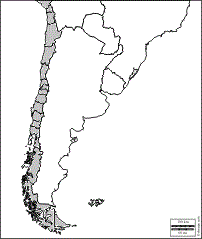
    1. Locate and shade Chile on the map. Which state in our country has a shape similar to Chile?

    Answer

    In our country, Kerala has a shape similar to Chile.

    Chile on the map

    Page No: 6

    1. Why was an independent trade union so important in Poland? Why are trade unions necessary?

    Answer
    Poland at that time had only one workers union controlled by the Polish United Workers’ Party. So there was autocratic rule of this party. People could not form independent unions which voiced their grievances. There was no freedom of speech.
    Trade unions are necessary as they help in maintaining or improving the conditions of the
    workers. They represent the workers’ views and demands to the management and fight for their rights.
    Page No: 10
    1. Looking at these maps, which period do you find most important in the expansion of democracy. Why?

    Answer

    The period after 1975 till 2000 AD is the most important period in the expansion of democracy. In this period, most of the countries in Africa became independent and supported democratic governments. The USSR broke up and 15 independent states emerged in which most of them go with democracy. Many colonised countries also gained independence and marches towards democracy.

    Page No: 11
    1. Why were women given voting rights much later than men in most countries? Why did this not happen in India?
    Answer
    Many European countries became democratic by the beginning of the twentieth century but women didn’t have voting rights because they were being not considered equal. They thought women were not capable of making decisions. They should stay at home, did household works and look after children. Thus, they were given voting rights much later than men.
    In India, constitutions makers didn’t make any discrimination against women and granted Universal Adult Franchise which gave voting rights to every c above the age of 18.
    Page No: 13
    1. What should be the policy of the government of India towards the military rulers of Myanmar?
    Answer
    The Government of India can support Suu Kyi in all international forums and demand her freedom without interfering in the domestic affairs of the government of Myanmar. It must fight for her freedom under Human Rights.
    Page No: 14
    1. Should there be a world government? If yes, who should elect it? And what powers should it have?
    Answer
    Yes, there should be a world government. It should have representatives of all the nations and every nation should have equal status. Each nation should send its own representatives, elected by their people. They should have powers to fight for Human Rights and Democracy.
    Page No: 15
    1. Should the permanent members of the UN give up the power to veto?
    Answer

    Yes, they should. The five veto powers should not be allowed to dictate terms to the rest of the world. They generally used this for their own interest.

    Exercise

    1. Which of the following does not lead to the spread of democracy?
    (a) Struggle by the people
    (b) Invasion by foreign countries
    (c) End of colonialism
    (d) People’s desire for freedom
    ► (b) Invasion by foreign countries

    2. Which of the following statements is true about today’s world?
    (a) Monarchy as a form of government has vanished .
    (b) The relationship between different countries has become more democratic than ever before.
    (c) In more and more countries rulers are being elected by the people.
    (d) There are no more military dictators in the world.
    ► (c) In more and more countries rulers are being elected by the people.

    Page No: 20

    3. . Use one of the following statements to complete the sentence:

    Democracy in the international organisations requires that …
    (a) The rich countries should have a greater say.
    (b) Countries should have a say according to their military power.
    (c) Countries should be treated with respect in proportion to their population.
    (d) All countries in the world should be treated equally..

    ► (d) All countries in the world should be treated equally..

    4. Based on the information given in this chapter, match the following countries and the path democracy has taken in that country.

    Country
    Path to Democracy
    (a) Chile
    (b) Nepal
    (c) Poland
    (d) Ghana
    (i) Freedom from British colonial rule
    (ii) End of military dictatorship
    (iii) End of one party rule
    (iv) King agreed to give up his powers

    Answer

    Country
    Path to Democracy
    (a) Chile
    (ii) End of military dictatorship
    (b) Nepal
    (iv) King agreed to give up his powers
    (c) Poland
    (iii) End of one party rule
    (d) Ghana
    (i) Freedom from British colonial rule

    5. What are the difficulties people face in a non-democratic country? Give answers drawing from the examples given in this chapter.

    Answer

    The difficulties people face in a non-democratic country are:
    → No freedom to elect their rulers.
    → People can’t form organisation or organise protest against the rulers.
    → No freedom of speech and expression.
    → Don’t have any say in government policies
    → Civic rights are curtailed.

    6. Which freedoms are usually taken away when a democracy is overthrown by the military?

    Answer

    The freedoms which are taken away when a democracy is overthrown by the military:
    → Freedom of electing their rulers.
    → Freedom of speech, expression and protest against any governmental policies.
    → People can’t form political parties or organisations.

    7. Which of the following positions can contribute to democracy at the global level? Give reasons for your answer in each case.
    a My country gives more money to international institutions. Therefore, I want to be treated with more respect and exercise more power.
    b My country may be small or poor. But my voice must be heard with equal respect, because these decisions will affect my country.
    c Wealthy nations will have a greater say in international affairs.They cannot let their interests suffer just because they are out numbered by poor nations.
    d Big countries like India must have a greater say in international organisations.

    Answer

    a. If any country gives more money to international institutions and its citizens want more respect and more power, it would not contribute to democracy at the global level. Every country and its citizens enjoy equal status whether it is a poor or a rich country. Equality is the basic principle of democracy.

    b. This position totally contributes to democracy at the global level as Democracy give equal right to every person. The wealth and size of a country don’t matter in a global democracy.

    c. This position does not lead to democracy at the global level because there should be no distinction made between the rich nations and the poor nations. All nations are equal in a Democracy.

    d. No, this position can’t contribute to democracy because the sizes or the geographical area of a country can’t determine the status of a nation in global democracy.

    8. Here are three opinions heard in a television debate on the struggle for democracy in Nepal. Which of these do you agree with and why?
    Guest 1: India is a democracy. Therefore, the Indian government must support the people of Nepal who are struggling against monarchy and for democracy.
    Guest 2: That is a dangerous argument. We would be in the same position as the US was in Iraq. Remember, no outside force can promote democracy.
    Guest 3: But why should we bother about the internal affairs of another country? We should be worried about our business interests there, not about democracy.

    Answer

    We can’t totally neglect our neighbours as what doing in their country as it must affect our behaviour also. So in my opinion, Guest 1 is right in some way. We have to adopt some measures that will support the people who are struggling against monarchy and for democracy. Not by using armed forces but by some other cooperations which will not hurt the sentiments of the people. This will also help India in maintaining a good relationship with a democratic country rather than a monarchical rule.

    Page No: 21

    9. In an imaginary country called Happyland, the people overthrew the foreign ruler and brought back the old royal family. They said: “After all their ancestors were our kings before foreigners started ruling us. It is good that we have one strong ruler, who can help us become rich and powerful”. When someone talked about democracy the wise men said it is a foreign idea. Their struggle was to throw the foreigners and their ideas out of the country. When someone demanded freedom for the media, the elders thought that too much criticism of the ruler would not help them improve their living standards. “After all, the king is so kind and interested in the welfare of all the subjects. Why create problems for him. Don’t we all want to be happy? ”

    After reading the above passage, Chaman, Champa and Chandru made the following observations:

    Chaman: Happyland is a democratic country because people were able to throw out the foreign rulers and bring back the king.
    Champa: Happyland is not a democratic country because people cannot criticise the ruler. The king may be nice and may provide economic prosperity, but a king cannot give a democratic rule.
    Chandru: What people need is happiness. So they are willing to allow their new ruler to take decisions for them. If people are happy it must be a democracy.

    What is your opinion about each of these statements? What do you think about the form of government in this country?

    Answer

    Chaman’s statement is incorrect because the overthrowing of a foreign power just amounts to gaining sovereignty.

    Champa’s statement is correct. A democracy is a rule of the people. The people should have the right to question their ruler.

    Chandru’s statement is incorrect. Happiness of the people is only one factor of a democracy. The people might be happy with the king, but he is not an elected representative.

  • Concept’s of Democracy in the Contemporary World Class 9th Social Science Civics

       CONCEPTS  

    • The March of Democracy has  met  with  setbacks  and successes  throughout
    • In 1900 there were only a few democratic After the Second World War, in 1950, more countries were added. The newly independent nations of Asia chose democracy. In 1975 colonies in Africa had become independent and most of them chose democracy as a form of government. A giant leap was taken in 1991. The fall of the Soviet Union  created 15  new  states  and  more democracies.

    Two  Tales  of Democracy

    • Many countries struggled for democracy, suffered In Chile, the democratic government of Allende was overthrown in 1973, and Pinochet became the military ruler. Democracy was restored again in Chile in 1988. In Poland, a non-democratic country, a one- party rule was replaced by  democracy  under  Lech Walesa.

    Two  Features  of  Democracy

    • Democracy, hence, is  a form of  government  that allows  people to choose their  own
    • People have the freedom to express their views, freedom to organise and freedom to protest against

    Phases  in  the  Expansion  of Democracy

    • By 2005, 140 countries have held multi-party More than 80 countries have made advances towards democracy  since 1980.
    • Stills there are many countries where people cannot elect their leaders. In Myanmar  the  elected leader Aung San Suu Kyi has been imprisoned by the military rulers (1990).  No  amount  of  international support  has  helped  in her

    Democracy  at  Global Level

    • Is it possible to have democracy  at  global level?  Not  at
    • The UN, the International Monetary Fund and the World Bank are global associations of the They attempt to maintain peace and security among the countries of the world. They give loans and  money  to governments.
    • They are not fully democratic. Five countries — US, UK, France, China and Russia — have the veto power in the Security The World Bank has a US President always and the International Monetary Fund is in  the hands  of  seven  powerful  nations.

    Promotion  of  Democracy

    • Many powerful countries like the United States of America  believe  that  democracy  should be promoted  in  the world  —  even  by
    • Powerful countries have launched  attacks  on  non-democratic
    • Iraq is the biggest USA and its allies attacked and occupied Iraq without UN sanction, on the pretext of Iraq possessing nuclear weapons.  They  have even  held  forced     elections.
    • The urge for democracy should  come  from  the people  and should  not  be
  • Hindi Summary of The Brook Poetry Class 9th.

    The Brook summary in hindi

    सारांश

    ‘द ब्रुक’ नामक कविता उत्तम पुरुष शैली में लिखी गई है और एक आत्मकथा वेफ रूप में प्रभावित करती है। यह कविता एक यात्रा की तरह बढ़ती है और भिन्न-भिन्न पड़ावों, अनेक प्रकार वेफ उतार-चढ़ाव, और अनेक गतिविध्यिों से गुशरती है।

    जलधरा की यात्रा पर्वतों से प्रारम्भ होती है जहाँ बगुला और ‘वूफट्स’ जैसी चिडि़याँ वास करती हैं और वह एक भरी-पूरी नदी में जाकर समाप्त होती है। मार्ग में जलधरा अनेक पहाडि़यों, गाँवों, शहरों, पुलों से गुशरती है। कभी जलधरा बड़ी शक्तिशाली गति से बहती है और कभी अत्यन्त ध्ीमी गति से। वह कभी पफसलों से भरे खेतों वेफ किनारों को काटती हुई चलती है। जलधरा में अनेक प्रकार की मछलियाँ तैरती हैं, वह पूफलों, पेड़ों और जंगली पौधें का घर है। जलधरा प्रेमियों वेफ मिलने का स्थान भी है और छोटी-छोटी चिडि़याँ भी उसकी धरा पर तैरती हैं। उसकी तेशी से बहती हुई धरा पर सूर्य की किरणें नृत्य करती हैं

    यह छोटी जलधरा अपनी यात्रा में पिफसलते, खिसकते, सरकते, नाचते, रुकते और किनारों से बाहर निकलते हुए आगे बढ़ती जाती है। चाँदनी और सितारों की रोशनी में वह बुदबुदाने लगती है। अपनी यात्रा में जलधरा अनेक अड़चनों, अवरोधें को पार करती हुई अन्त में अपने निर्धरित स्थान पर पहुँच जाती है। झरने की यात्रा मानव जीवन यात्रा वेफ समान है। कवि जलधरा और मानव जीवन की तुलना करते हुए अपनी यह विचारधरा सबवेफ सामने लाना चाहता है कि जलधरा निरंतर चलती रहती है, वह अनंत है परन्तु मानव जीवन अस्थायी है, अल्प या वुफछ समय वेफ ही लिए है। कवि चाहते हैं कि जिस तरह सारे उतार-चढ़ाव का जलधरा पर कोई प्रभाव नहीं पड़ता, उसकी यात्रा में बाध नहीं आती, उसी तरह मानव भी इससे शिक्षा ले और बाधाओं और दुखों से प्रभावित न हो और निरंतर कर्म करता रहे।

    Hindi Summary of The Brook Poetry Class 9th.

    Content’s