Category: Class 9th

  • Chapter 3 Coordinate Geometry RS Aggarwal Solution for Class 9th Maths

    Introduction toEuclid’s Geometry

    Question 1:

    Exercise 3A

    A theorem is a statement that requires a proof. Whereas, a basic fact which is taken for granted, without proof, is called an axiom.

    Example of Theorem: Pythagoras Theorem

    Example of axiom: A unique line can be drawn through any two points.

    Question 2:

    1. Line segment: The straight path between two points is called a line segment.
    2. Ray: A line segment when extended indefinitely in one direction is called a ray.
    3. Intersecting Lines: Two lines meeting at a common point are called intersecting lines, i.e., they have a common point.
    4. Parallel Lines: Two lines in a plane are said to be parallel, if they have no common point, i.e., they do not meet at all.
    5. Half-line: A ray without its initial point is called a half-line.
    6. Concurrent lines: Three or more lines are said to be concurrent, if they intersect at the same point.
    7. Collinear points: Three or more than three points are said to be collinear, if they lie on the same line.
    8. Plane: A plane is a surface such that every point of the line joining any two points on it, lies on it.

    Question 3:

    1. Six points: A,B,C,D,E,F
    2. Five line segments: , , , ,


    1. Four rays: , , ,


    1. Four lines: , , ,
    2. Four collinear points: M,E,G,B

    Question 4:


      1. and their corresponding point of intersection is R. and their corresponding point of intersection is P.
      2. , , and their point of intersection is R.
      3. Three rays are: , ,
      4. Two line segments are: ,

    Question 5:

    1. An infinite number of lines can be drawn to pass through a given point.
    2. One and only one line can pass through two given points.
    3. Two given lines can at the most intersect at one and only one point.
    4. , ,

    Question 6:

    1. False
    2. False
    3. False
    4. True
    5. False
    6. True
    7. True
    8. True
    9. True
    10. False
    11. False
    12. True
  • Chapter 2 Polynomials RS Aggarwal Solution for Class 9th Maths

    Real Numbers

    Question 1:

    Exercise 1A

    The numbers of the form , where p and q are integers and q ≠ 0 are known as rational numbers.

    Ten examples of rational numbers are:

    , , , , , , , , 1,

    Question 2:

    1. 5
    2. -3

    (v) 1.3

    (vi) -2.4

    (vii)

    Question 3:

    A rational number lying between and is

    Therefore, we have < < < < Or we can say that, < < < < That is, < < < <

    Therefore, three rational numbers between and are

    , and

    Question 5:

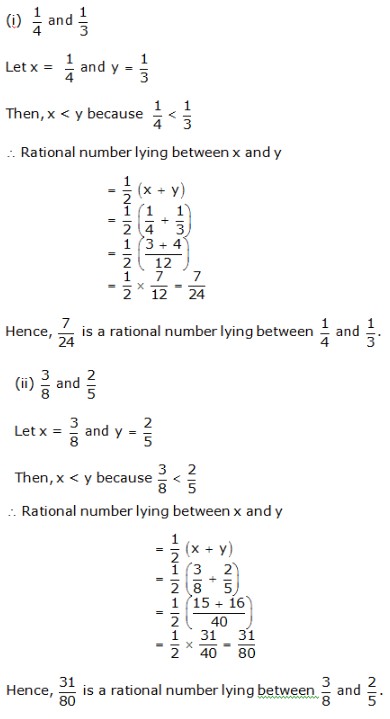
    Let and

    Then, x < y because <

    Or we can say that, That is, < .

    We know that, 8 < 9 < 10 < 11 < 12 < 13 < 14 < 15.

    Therefore, we have, < < < < < < < Thus, 5 rational numbers between, < are:

    , , , and

    Question 6:

    Let x = 3 and y = 4

    Then, x < y, because 3 < 4 We can say that, < .

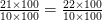
    We know that, 21 < 22 < 23 < 24 < 25 < 26 < 27 < 28.

    Therefore, we have, < < < < < < < Therefore, 6 rational numbers between 3 and 4 are:

    , , , and

    Question 7:

    Let x = 2.1 and y = 2.2

    Then, x < y because 2.1 < 2.2 Or we can say that, < Or,

    That is, we have, <

    We know that, 2100 < 2105 < 2110 < 2115 < 2120 < 2125 < 2130 < 2135 < 2140 <

    2145 < 2150 < 2155 < 2160 < 2165 < 2170 < 2175 < 2180 < 2185 < 2190 < 2195 <

    2200

    Therefore, we can have,

    Therefore, 16 rational numbers between, 2.1 and 2.2 are:

    So, 16 rational numbers between 2.1 and 2.2 are:

    2.105, 2.11, 2.115, 2.12, 2.125, 2.13, 2.135, 2.14, 2.145, 2.15, 2.155, 2.16, 2.165, 2.17,

    2.175, 2.18

    Exercise 1B

    Question 1:

    (i)

    If the prime factors of the denominator are 2 and/or 5 then the rational number is a terminating decimal.

    Since, 80 has prime factors 2 and 5, is a terminating decimal.

    (ii)

    If the prime factors of the denominators of the fraction are other than 2 and 5, then the rational number is not a terminating decimal.

    Since, 24 has prime factors 2 and 3 and 3 is different from 2 and 5, is not a terminating decimal.

    (iii)

    If the prime factors of the denominators of the fraction are other than 2 and 5, then the rational number is not a terminating decimal.

    Since 12 has prime factors 2 and 3 and 3 is different from 2 and 5, is not a terminating decimal.

    (iv)

    If the prime factors of the denominators of the fraction are other than 2 and 5, then the rational number is not a terminating decimal.

    Since 35 has prime factors 5 and 7, and 7 is different from 2 and 5, is not a terminating decimal.

    (v)

    If the prime factors of the denominator are 2 and/or 5 then the rational number is a terminating decimal.

    Since 125 has prime factor 5 only is a terminating decimal.

    Question 2:

    (i)

    = 0.625

    (ii)

    = 0.5625

    (iii)

    = 0.28

    (iv)

    = 0.458

    (v)

    = 2.41

    Question 3:

    1. Let x =

    i.e x = 0.333 …. (i)

    ⇒ 10x = 3.333 …. (ii) Subtracting (i) from (ii), we get 9x = 3

    ⇒ x = = Hence, 0. =

    1. Let x = 1.

    i.e x = 1.333 …. (i)

    ⇒10x = 13.333 …. (ii)

    Subtracting (i) from (ii) we get; 9x = 12

    ⇒ x = =

    Hence, 1. =

    1. Let x = 0.

    i.e x = 0.3434 …. (i)

    ⇒ 100x = 34.3434 …. (ii)

    Subtracting (i) from (ii), we get 99x = 34

    ⇒ x =

    Hence, 0. =

    1. Let x = 3.

    i.e x = 3.1414 …. (i)

    ⇒ 100x = 314.1414 …. (ii)

    Subtracting (i) from (ii), we get 99x = 311

    ⇒ x =

    Hence, 3. =

    1. Let x = 0.

    i.e. x = 0.324324 ….(i)

    ⇒ 1000x = 324.324324….(ii)

    Subtracting (i) from (ii), we get 999x = 324

    ⇒ x = =

    Hence, 0. =

    1. Let x = 0.

    i.e. x = 0.177 …. (i)

    ⇒ 10x = 1.777 …. (ii)

    and 100x = 17.777…. (iii) Subtracting (ii) from (iii), we get 90x = 16

    ⇒ x = =

    Hence, 0. =

    1. Let x = 0.

    i.e. x = 0.544 …. (i)

    ⇒ 10 x = 5.44 …. (ii) and 100x = 54.44 ….(iii)

    Subtracting (ii) from (iii), we get 90x = 49

    ⇒ x =

    Hence, 0. =

    (vii) Let x = Let x = 0.1 i.e. x = 0.16363 …. (i)

    ⇒ 10x = 1.6363 …. (ii)

    and 1000 x = 163.6363 …. (iii) Subtracting (ii) from (iii), we get

    990x = 162

    ⇒ x = = Hence, 0.1 =

    Question 4:

    1. True. Since the collection of natural number is a sub collection of whole numbers, and every element of natural numbers is an element of whole numbers
    2. False. Since 0 is whole number but it is not a natural number.
    3. True. Every integer can be represented in a fraction form with denominator 1.
    4. False. Since division of whole numbers is not closed under division, the value of , p and q are integers and q ≠ 0, may not be a whole number.
    5. True. The prime factors of the denominator of the fraction form of terminating

    decimal contains 2 and/or 5, which are integers and are not equal to zero.

    1. True. The prime factors of the denominator of the fraction form of repeating decimal contains integers, which are not equal to zero.
    2. True. 0 can considered as a fraction , which is a rational number.

    Question 1:

    Exercise 1C

    Irrational number: A number which cannot be expressed either as a terminating decimal or a repeating decimal is known as irrational number. Rather irrational numbers cannot

    be expressed in the fraction form, , p and q are integers and q ≠ 0

    For example, 0.101001000100001 is neither a terminating nor a repeating decimal and so is an irrational number.

    Also, etc are examples of irrational numbers.

    Question 2:

    (i)

    We know that, if n is a perfect square, then is a rational number. Here, 4 is a perfect square and hence, = 2 is a rational number. So, is a rational number.

    (ii)

    We know that, if n is a perfect square, then is a rational number. Here, 196 is a perfect square and hence is a rational number. So, is rational.

    (iii)

    We know that, if n is a not a perfect square, then is an irrational number. Here, 21 is a not a perfect square number and hence, is an irrational number. So, is irrational.

    (iv)

    We know that, if n is a not a perfect square, then is an irrational number. Here, 43 is not a perfect square number and hence, is an irrational number. So, is irrational.

    (v)

    , is the sum of a rational number 3 and irrational number .

    Theorem: The sum of a rational number and an irrational number is an irrational number.

    So by the above theorem, the sum, , is an irrational number.

    (vi)

    = + (-2) is the sum of a rational number and an irrational number.

    Theorem: The sum of a rational number and an irrational number is an irrational number.

    So by the above theorem, the sum, + (-2) , is an irrational number.

    So, is irrational.

    (vii)

    = × is the product of a rational number and an irrational number .

    Theorem: The product of a non-zero rational number and an irrational number is an irrational number.

    Thus, by the above theorem, × is an irrational number.

    So, is an irrational number.

    1. 0.

    Every rational number can be expressed either in the terminating form or in the non- terminating, recurring decimal form.

    Therefore, 0. = 0.6666

    Question 3:

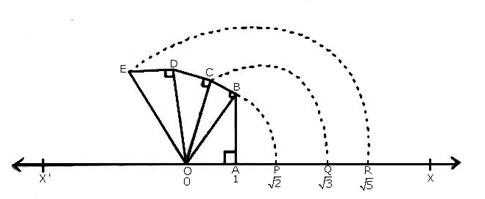
    Let X’OX be a horizontal line, taken as the x-axis and let O be the origin. Let O represent 0.

    Take OA = 1 unit and draw BA ⊥ OA such that AB = 1 unit, join OB. Then,

    With O as centre and OB as radius, drawn an arc, meeting OX at P. Then, OP = OB = units

    Thus the point P represents on the real line.

    Now draw BC ⊥ OB such that BC = 1 units Join OC. Then,

    With O as centre and OC as radius, draw an arc, meeting OX at Q. The, OQ = OC = units

    Thus, the point Q represents on the real line. Now draw CD ⊥ OC such that CD = 1 units

    Join OD. Then,

    Now draw DE ⊥ OD such that DE = 1 units Join OE. Then,

    With O as centre and OE as radius draw an arc, meeting OX at R. Then, OR = OE = units

    Thus, the point R represents on the real line.

    Question 4:

    Draw horizontal line X’OX taken as the x-axis Take O as the origin to represent 0.

    Let OA = 2 units and let AB ⊥ OA such that AB = 1 units

    Join OB. Then,

    With O as centre and OB as radius draw an arc meeting OX at P. Then, OP = OB =

    Now draw BC ⊥ OB and set off BC = 1 unit Join OC. Then,
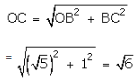
    With O as centre and OC as radius, draw an arc, meeting OX at Q. Then, OQ = OC =

    Thus, Q represents on the real line. Now, draw CD ⊥ OC as set off CD = 1 units Join OD. Then,

    With O as centre and OD as radius, draw an arc, meeting OX at R. Then OR = OD =

    Thus, R represents on the real line.

    Question 5:

    (i)

    Since 4 is a rational number and is an irrational number.

    So, is irrational because sum of a rational number and irrational number is always an irrational number.

    (ii)
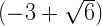
    Since – 3 is a rational number and is irrational.

    So, is irrational because sum of a rational number and irrational number is always an irrational number.

    (iii)

    Since 5 is a rational number and is an irrational number.

    So, is irrational because product of a rational number and an irrational number is always irrational.

    (iv)

    Since -3 is a rational number and is an irrational number.

    So, is irrational because product of a rational number and an irrational number is always irrational.

    (v)

    is irrational because it is the product of a rational number and the irrational number .

    (vi)

    is an irrational number because it is the product of rational number and irrational number .

    Question 6:

    1. True
    2. False
    3. True
    4. False
    5. True
    6. False
    7. False
    8. True
    9. True

    Exercise 1D

    Question 1:

    (i)

    We have:

    (ii)

    We have:

    Question 2:

    Question 3:

    (i) by

    (ii) by

    (iii) by

    Question 4:

    Question 5:

    Draw a line segment AB = 3.2 units and extend it to C such that BC = 1 units. Find the midpoint O of AC.

    With O as centre and OA as radius, draw a semicircle. Now, draw BD AC, intersecting the semicircle at D. Then, BD = units.

    With B as centre and BD as radius, draw an arc meeting AC produced at E. Then, BE = BD = units.

    Question 6:

    Draw a line segment AB = 7.28 units and extend it to C such that BC = 1 unit. Find the midpoint O of AC.

    With O as centre and OA as radius, draw a semicircle.

    Now, draw BD AC, intersecting the semicircle at D. Then, BD = units.

    With D as centre and BD as radius, draw an arc, meeting AC produced at E. Then, BE = BD = units.

    Question 7:

    Closure Property: The sum of two real numbers is always a real number. Associative Law: (a + b) + c = a + (b + c) for al real numbers a, b, c.

    Commutative Law: a + b = b + a, for all real numbers a and b.

    Existence of identity: 0 is a real number such that 0 + a = a + 0, for every real number a. Existence of inverse of addition: For each real number a, there exists a real number (-a) such that

    a + (-a) = (-a) + a= 0

    a and (-a) are called the additive inverse of each other. Existence of inverse of multiplication:

    For each non zero real number a, there exists a real number such that

    a and are called the multiplicative inverse of each other.

    Question 1:

    Exercise 1E

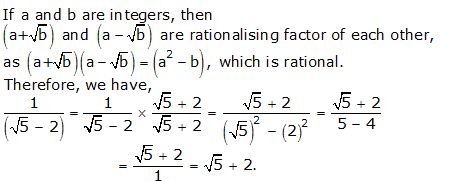
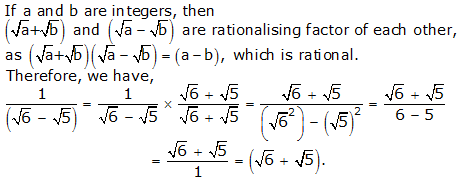
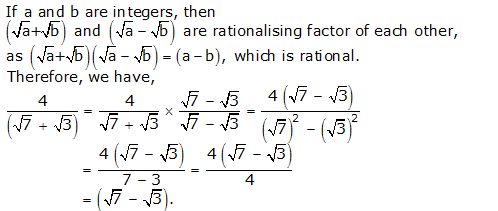
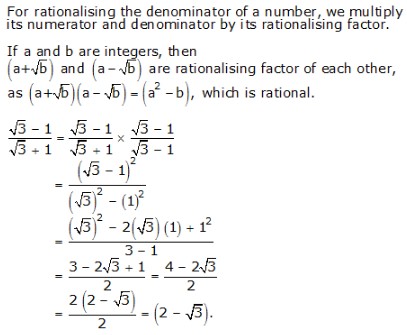
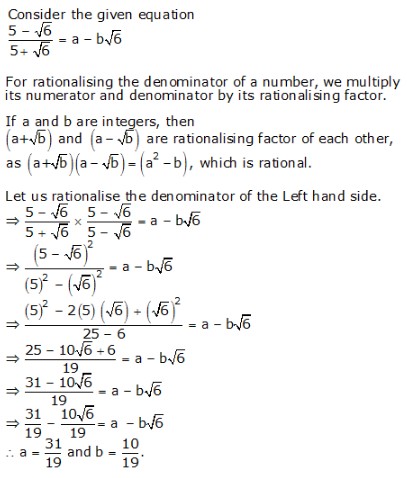
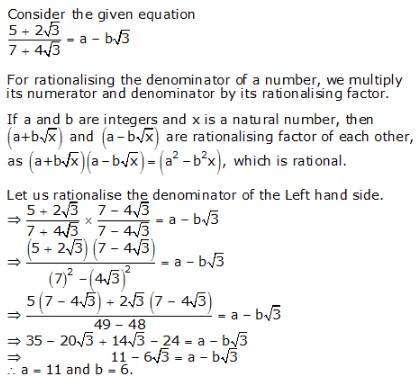
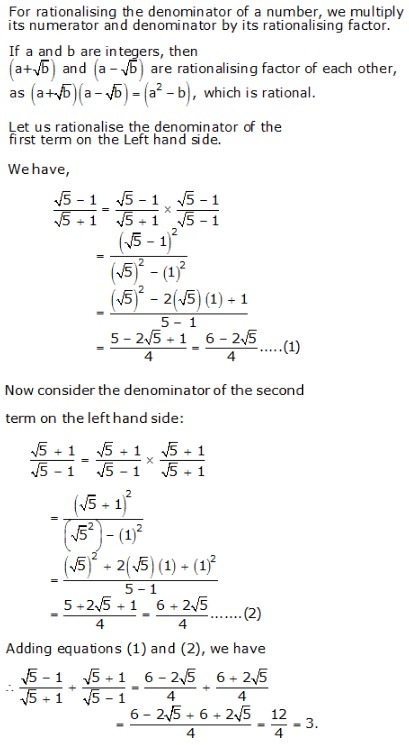
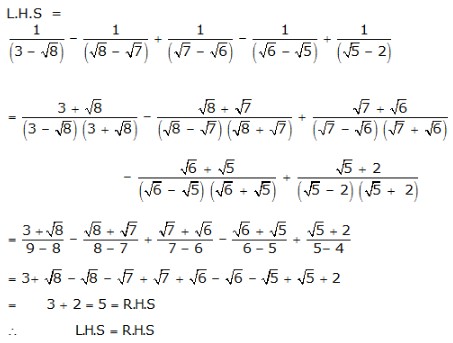
    On multiplying the numerator and denominator of the given number by , we get

    Question 2:

    On multiplying the numerator and denominator of the given number by , we get

    Question 3:

    Question 4:

    Question 5:

    Question 6:

    Question 7:

    Question 8:

    Question 9:

    Question 10:

    Question 11:

    Question 12:

    Question 13:

    Question 14:

    Question 15:

    Question 16:

    Question 17:

    Question 18:

    Exercise 1F

    Question 1:

    (i)

    (ii)

    (iii)
    Question 2:

    (i)

    (ii)

    (iii)
    Question 3:

    (i)

    (ii)

    (iii)
    Question 4:

    (i)

    (ii)

    (iii)
    Question 5:

    (i)

    (ii)

    (iii)

    Question 6:

    (i)

    (ii)

    (iii)

    Question 7:

    (i)

    (ii)
    (iii)

  • Class 9th English Grammer Notes

    English Grammer Notes For Class 9th study materila PDF download

    VERB FORMS

    The best way to know verb forms at a glance.

    PRESENT

    TENSE

    SIMPLE PRESENT

    PRESENT CONTINUOUS

    PRESENT PERFECT

    PRESENT PERFECT CONTINUOUS

    I/you/they play, He/she/It plays

    I am playing, they are playing. He/she/It is playing.

    I/we/you/they have played. He/she/it has played

    I/we/you/they have been playing. He/she/It has been playing.

    PAST TENSE

    SIMPLE PAST

    PAST CONTINUOUS

    PAST PERFECT

    PAST PERFECT CONTINUOUS

    I/we/you/he/she/It/ they played

    I/he/she/It was playing. We/you/they were playing.

    I/we/you/he/she/It/they had played.

    I/we/you/he/she/It/the y had been playing.

    FUTURE

    TENSE

    SIMPLE FUTURE

    FUTURE CONTINUOUS

    PRESENT PERFECT

    PRESENT PERFECT CONTINUOUS

    I/we/you/he/she/It/ they will/shall play.

    I/we/you/he/she/It/they will/shall be playing.

    I/we/you/he/she/It/they will/shall have played.

    I/we/you/he/she/It/the y will/shall have been playing.

    We use simple present tense

    • To talk about things in general, not about something happening now, but about something happening all the time:

    I play the flute.

    • To express scientific facts or permanent truths:

    Water boils at 100 degree centigrade.

    Sun rises in the East

    We use present continuous tense

    • to express an action taking place at the time of speaking: someone is knocking at the door.

    We use present perfect tense

    • to express an action that has just been completed:

    I have just got the letter from him.

    • to express an action completed sometime in the past but connected with the present.

    The Police have closed the road today.

    We use present perfect continuous tense

    • to express an action that began in the past and has been in the progress till the time of speaking.

    It has been raining for fifteen minutes.

    We use simple past tense

    to express actions finished before the time of speaking: We saw a suspense movie last night.

    We use past continuous tense

    • to express an action in progress at some moment before the time of speaking:

    It was raining hard at 5 o’clock last night.

    We use past perfect tense

    • To express an action completed before a given moment in the past:

    The message came after he had left the office.

    We use past perfect continuous tense

    • to express an action that began in the past and has been in the progress till the time of speaking:

    I have been waiting for the bus since 7 o’clock.

    We use simple future tense

    • to decide to do something at the time of speaking:

    I will go and take a cup of tea.

    • to express the speakers view:

    I think I will consult a doctor

    We use future continuous tense

    • to express an action which will be in the progress at a given moment in the future: tomorrow at 7 o’clock he will be flying to New York.

    We use future perfect tense

    • to express an action completed before a given moment in the future:

    But tomorrow he will have changed his profile.

    We use future perfect continuous tense

    • to express an action which will begin before a definite moment in the future, will continue up to that moment and will be in progress even at that moment:

    By 4 o’clock, baba ramdev will have been sitting in meditation for two hours.

    DETERMINERS

    Are the words which identify or specify a noun in some way. They do not describe a noun; they determine it; they point it out. eg-the best boy, that tree and my brother etc.

    KINDS OF DETERMINERS

    We have the following kinds of determiners;

    1. Articles (a, an, the )
    2. Demonstratives (this, that, these, those)
    3. Possessives (my, your, his, her, etc.)
    4. Distributives (either, neither, each, every)
    5. Quantifiers (some, any, much, several, etc.)
    6. Interrogatives (what, which, whose, etc.)

    Articles

    We already know that there are three articles in English: a, an, and the. Of these a and an are indefinite articles while the is the definite article.

    Uses of article A and An :

    • before countables in the singular number:

    A train, A question, An uncle, An umbrella

    • A before a countable in the singular number beginning with a consonant sound:

    A lecture, A one-eyed man (w sound)

    • An before a countable noun in the singular number beginning with vowel sound:

    An invention, An M.A. (here M is sounded as em; so it begins with vowel sound)

    Uses of article The

    • Before a noun whenever we want to make it particular: the train by which I came, the books I usually read
    • This article can be used with both countable (train, book) and uncountable (mercy, information). And also can be used with the countables both in the singular number (train) and the plural number (books).
    • With a noun that has already been mentioned:

    I got a watch as a gift.

    The watch is beautiful.

    • When it is clear from the situation which people or things we mean:

    The principal is taking round of the school.

    • With superlatives:

    The brightest star

    DEMONSTRATIVES

    • This and These refer to persons or objects close by. This is used before singular nouns and These before plural nouns:

    This book contains all information.

    These flowers are for you.

    • That and Those refer to persons or objects at a distance. That is used before singular nouns and Those before plural nouns:

    That car belongs to my father.

    Those cars are for sale.

    • This and
    • That can be used before the uncountables also:

    This food is not good.

    That rose is beautiful.

    POSSESSIVES

    Possessives can be used both before singular and plural nouns:

    My book, My books Your purse, Your purses.

    DISTRIBUTIVES

    Either

    It has two meanings

    • any of the two different persons or things:

    You can take either bus. (any of the two buses)

    • the both

    Restaurants have come up on either sides of the road. (on both the sides)

    Neither

    • It means opposite to either or it means not the one nor the other:

    Neither candidate deserves our support.

    Each, every

    • Each is used when we think of things separately, one by one:

    Talk to each child.

    • Every is used when we think of things as a group. The meaning is without exception:

    Every child needs love and protection.

    QUANTIFIERS

    • many and several suggest number, they are used with countables: many pens, several trees
    • some and any can be used with both countables and uncountables: some books, some tea

    any shirts, any bread

    • Much is generally used before the uncountables. It means: a large quantity of.

    Much labour, much loss

    • Many is used before the countables in the plural number. It means a large number of:

    Many students, many artists

    INTERROGATIVES

    • Determiners that helps to ask questions may be described as interrogatives like what, which, whose, etc.

    What train, which basket, whose bats

    MODALS

    Modals are verbs used to express the mood or attitude of the speaker. They are used to give advice, seek or give permission, make suggestions, make polite requests, give invitations, etc. The most commonly used modals are:

    • can, could, may, might, will, would, shall, should, must, ought to, need, dare
    • Asking for and giving permission:

    May, can, and could

    Preeti: Mummy, I ‘am awfully hungry. Can I eat these butter biscuits?

    Mother: Why not? You can eat all of them if you like.

    • Vinay: Could I use your phone please?

    Mr Bhushan: Yes of course.

    Ritu: May I go to the medical room madam? I “am feeling giddy.

    Madam: Yes please do.

    • To ask or give permission we use Can, could or may.

    Can is informal; could is very polite; may is formal. All of them are correct. The choice depends on the situation and the speaker’s relation to the listener.

    • Asking for things:

    Can, could, may, will

    • To ask for things we normally use can or could Can I have those pillow covers, please?

    Could you pass on the salt, please?

    • May is also possible, but being very formal is not preferred. However, we can use will if we like:
    • Will you pass on the salt, please?
    • Possibility:

    May, might

    Both may might are used to suggest possibility. But might suggests a lesser possibility than may.

    In these sentences, could is also possible:

    He could be in his office.

    But could suggests still lesser possibility.

    • Must doesn’t have a past tense form. So we can use must to talk about the present or the

    future:

    We must phone Sathish now {present}

    We must phone Sathish tomorrow {future}

    • Should is not as strong as must or have to. Look at this example:

    You should wear a helmet while driving a motor bike.

    • Ought to conveys the same sense as should. But it carries with it a sense of moral duty.

    You ought to take care of your old parents.

    ACTIVE AND PASSIVE VOICE

    • We can begin a sentence either with the subject or object. This fact decides whether a sentence is active or passive.
    • In other words, it is possible for us to recognise the active and the passive voice. For example, if a sentence has one of the helping verbs such as am, is, are, was, were, been, being, be and past participles of the verb like eaten, broken, spent, learnt, incented, discovered, it is passive voice.
    • Voice: Voice is the form of the verb which indicates whether a person or a thing does something or something has been done to a person or a thing.Kinds of voice: there are two kinds of voice, namely:
    • Active voice
    • Passive voice
    • Active Voice: When a verb form shows that the subject has done something, it is known as active voice.

    Ex: Madhavi wrote a letter.

    • Passive voice: when a verb form shows that something has been done to the subject, it known as passive voice.

    Ex: A letter was written by Madhavi.

    NOTE: we can turn active voice into passive voice by using some guide lines. It is not much difficult for us to change the voice of the verb.

    BASIC RULES

    -A sentence can be separated into subject(S), verb(V) and object(O).

    eg: MADHAVI S

    WROTE

    V

    A LETTER O

    -The object of the sentence must be turned into subject.

    eg: MADHAVI S

    WROTE

    V

    A LETTER O

    A LETTER WAS WRITTEN BY MADHAVI

    O

    V

    S

    -The ‘be’ form must be used according to the tense of the verb. eg: A letter ‘was’.

    TENSE

    FORM

    • Present Simple
    • Continuous Tense (Present)
    • Present Perfect Tense
    • Simple Past Tense
    • Past Continuous Tense
    • Past Perfect Tense
    • Simple Future Tense
    • Future Perfect Tense

    am/is/are + Past Participle am/is/are + being + Past Participle have/has + been + Past Participle was/were + Past Participle was/were + being + Past Participial had + been + Past Participle will/shall + be + Past Participle will/shall + have been + Past Participle

    -Past participle of the verb must be used. eg: A letter was written.

    -Preposition ‘by’ must be added. eg: A letter was written by

    -The subject must be made the object. eg: A letter was written by Madhavi.

    ACTIVE AND PASSIVE VOICE TABLE

    -An easy way to find out to change the active voice to passive voice and vice versa.

    DIRECT AND INDIRECT SPEECH

    Akshay said, “I am really sorry for the mistake.” (1)

    Akshay said that he was really sorry for the mistake (2)

    -There are two ways of reporting, what some body said.

    We produce the exact words of the speaker, as in above. This is called direct speech.

    Or, we can express the speech in our own words, as in (2) above. This is called indirect or reported speech.

    Direct speech is set off by inverted commas (” “) indirect speech usually begins as:

    Miru said that

    Shashank asked Dhanshree if

    Kiran told Puneet to

    We do not normally report someone’s words as soon as they are spoken, or at the place where they are spoken. Besides, the reporter is usually different from the actual speaker. So the reported speech differs from the direct speech in certain respects:

    Sushmita said, “I ‘am not free today, for somebody is coming to interview me.”

    Sushmita said that she was not free that day, for somebody was coming to interview her.

    -Besides dropping inverted commas and using some conjunctions(that, if, etc.), we have to take care of three things while reporting speeches:

    Tenses. Most of the times, the reported speech is in the past tense. (she was not free

    Somebody was coming )

    Personal pronouns like I, we, you, etc. And possessives like my, our, your, etc. , which change according to the situation. (she was , coming to interview her)

    Words detonating nearness of time and place are changed. (not free today- not free that day)

    DIRECT SPEECH

    INDIRECT SPEECH

    this/that

    these/those

    here

    there

    now

    then*

    Ago

    Before

    Today/tonight

    That day/that night

    Yesterday

    The day before/the previous day

    Tomorrow

    The next day/the following day

    The day before yesterday

    The day before the previous day

    The day after tomorrow

    The day after the next day

    Last week/year, etc.

    The previous week /year, etc.

    Next week/year, etc.

    The following week/year, etc.

    (*But then is very often omitted from the indirect speech)

    REPORTING VERB IN THE PRESENT OR FUTURE TENSE – THE TENSES IN THE REPORTED SPEECH UNCHANGED

    Prakhar says, “Arunima is not keeping well”.

    Prakhar says that Arunima is not keeping well.

    He will say, “Good music makes a good film.”

    He will say that good music makes a good film.

    REPORTING VERB IN A PAST TENSE

    THE TENSES IN THE REPORTED SPEECH CHANGE INTO A CORRESPONDING PAST TENSE

    IS/ARE/AM

    WAS/WERE

    WAS/WERE

    HAD BEEN

    HAD BEEN

    NO CHANGE

    HAS/HAVE

    HAD

    HAD

    NO CHANGE

    DO

    DID

    DID

    HAD DONE

    HAD DONE

    NO CHANGE

    WILL/SHALL

    (IN CERTAIN CASES, SHALL MIGHT BE CHANGED INTO SHOULD)

    WOULD

    MAY/CAN

    MIGHT/COULD

    WOULD/SHOULD/MIGHT/COULD /OUGHT TO/USED TO

    NO CHANGE

    MUST

    HAD TO

    There are situations in which even if the reporting verb is in the past tense, we leave the tenses in the reported speech unchanged:

    -The reported speech expresses a universal truth or a habitual fact:

    Our science teacher said, “The pole star does not change it’s position in the sky.”

    (The reported speech is a universal truth.)

    Our science teacher told us that the pole star does not change its position in the sky.

    I said to the tourist, “the Indian summer is usually very hot.”

    (This reported speech is habitual fact)

    I told the tourist that the Indian summer is usually very hot.

    -The reported speech describes a situation which still exists when the speech is reported :

    The station master said, “All the trains are running late because heavy rains have damaged some parts of the track.” (The situation continues to be unchanged at the time of reporting.) The station master said that all the trains are running late because heavy rains have damaged some parts of the track.

    -The reported speech contains two clauses, both in the past:

    Neeraj said to me, “Abhilash was unwell so she didn’t go to the school.”

    Neeraj told me that Abhilash was unwell so she didn’t go to the school.

    -However, in this case it would also be correct to say:

    Neeraj told me that Abhilash had been unwell, so she hadn’t gone to the school.

    PREPOSITION

    • A preposition is used to show the relationship of a noun or pronoun to another word in the sentence. Here are some common prepositions :

    About, above, after, at, behind, below, between, down, during, for, from, in, inside, of, off, on, through, to, under, with.

    • A prepositional phrase is made up of a preposition, its object, and all the words in between. The object of the preposition is the noun or pronoun that follows the preposition.

    The pirates buried their treasure under (preposition) a tree (object).

    1. kicked the ball between (preposition) the goalposts (object).
    • Examples of prepositional phrases –

    In the front, of cake, at the park, down the hill, across the street, under the bridge, from my big brother, behind the counter, after school, for breakfast, of the tree, during summer vacation.

    • Adjective phrases tell what kind or which one.

    She lives in a house with a red door. (What kind)

    The boy in the backseat was yelling loudly. (Which one)

    • Adverbial phrases tell how, when, or where.

    Tell the story in your own words. (How)

    Mr Raj jogs in the afternoon. (When)

    She ran behind the house. (Where)

  • Chapter 15 Probability Notes for Class 9th Maths


    Chapter 1 5 Probability

    • Probability: Probability is a quantitative measure of certainty.
    • Experiment: A job which produces some outcomes.
    • Trial: Performing an experiment.
    • Event: The group of outcomes, denoted by capital letter of English alphabets like A, B, E etc.
    • The empirical (or experimental) probability P(E) of an event E is given by

    • The probability of an event lies between 0 and 1 (0 and 1 are included)
    • Impossible event: Event which never happen.
    • Certain event: Event which definitely happen.
    • The probability of sure event is 1.
    • The probability of an impossible event is 0.
    • The probability of an event E is a number P(E) such that 0 < P(E) < I.
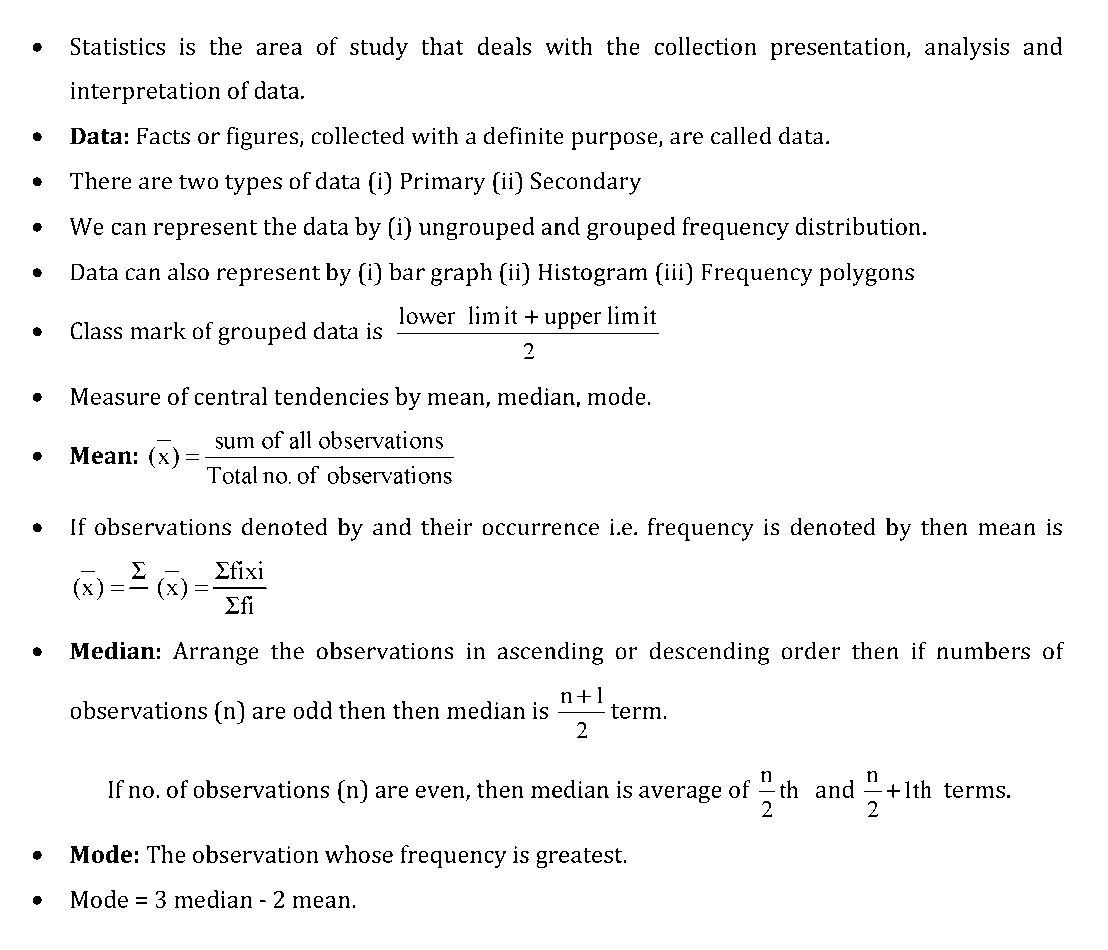
  • Chapter 14 Statistics Notes for Class 9th Maths

    1. Collection of Data
    2. Presentation of Data
    3. Graphical Representation of Data
    4. Measures of Central Tendency

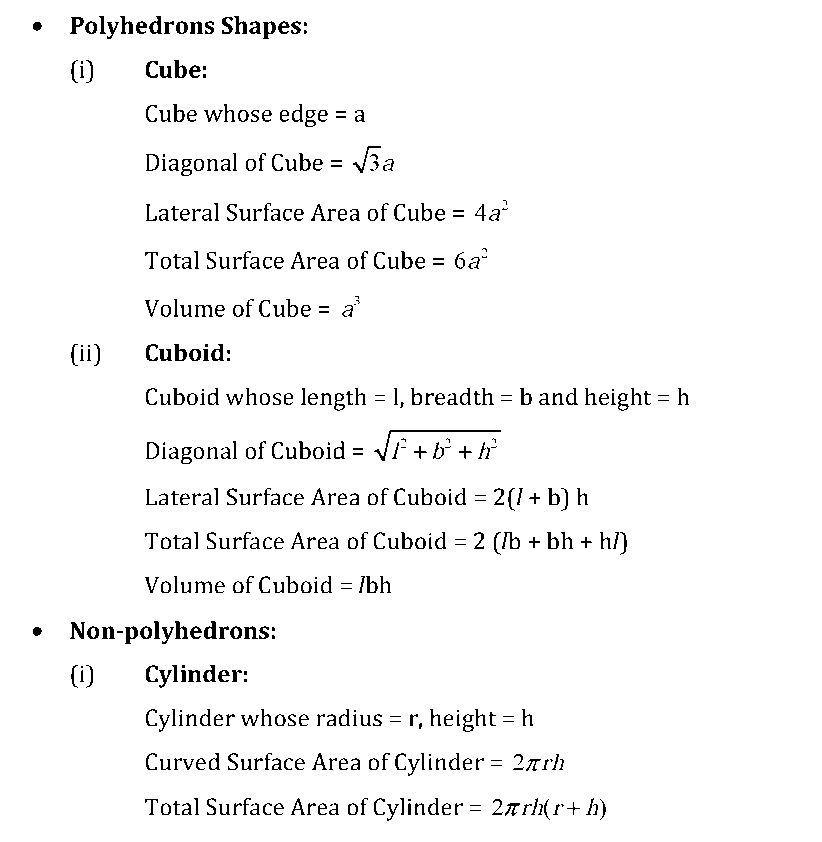
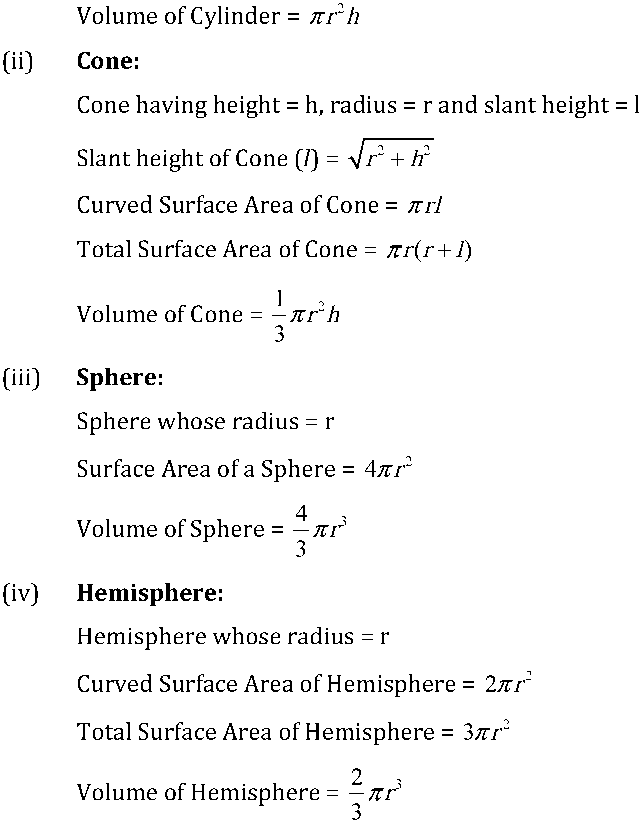
  • Chapter 13 Surface Areas and Volumes Notes for Class 9th Maths


    Chapter 13 Surface Areas and Volumes

    1. Surface Area of a Cuboid and a Cube
    2. Surface Area of a Right Circular Cylinder
    3. Surface Area of a Right Circular Cone
    4. Surface Area of a Sphere
    5. Volume of a Cuboid
    6. Volume of a Cylinder
    7. Volume of a Right Circular Cone
    8. Volume of a Sphere


  • Chapter 12 Heron’s Formula Notes for Class 9th Maths


    Chapter 12 Heron’s Formula

    1. Area of a Triangle – by Heron’s Formula
    2. Application of Heron’s Formula in finding Areas of Quadrilaterals
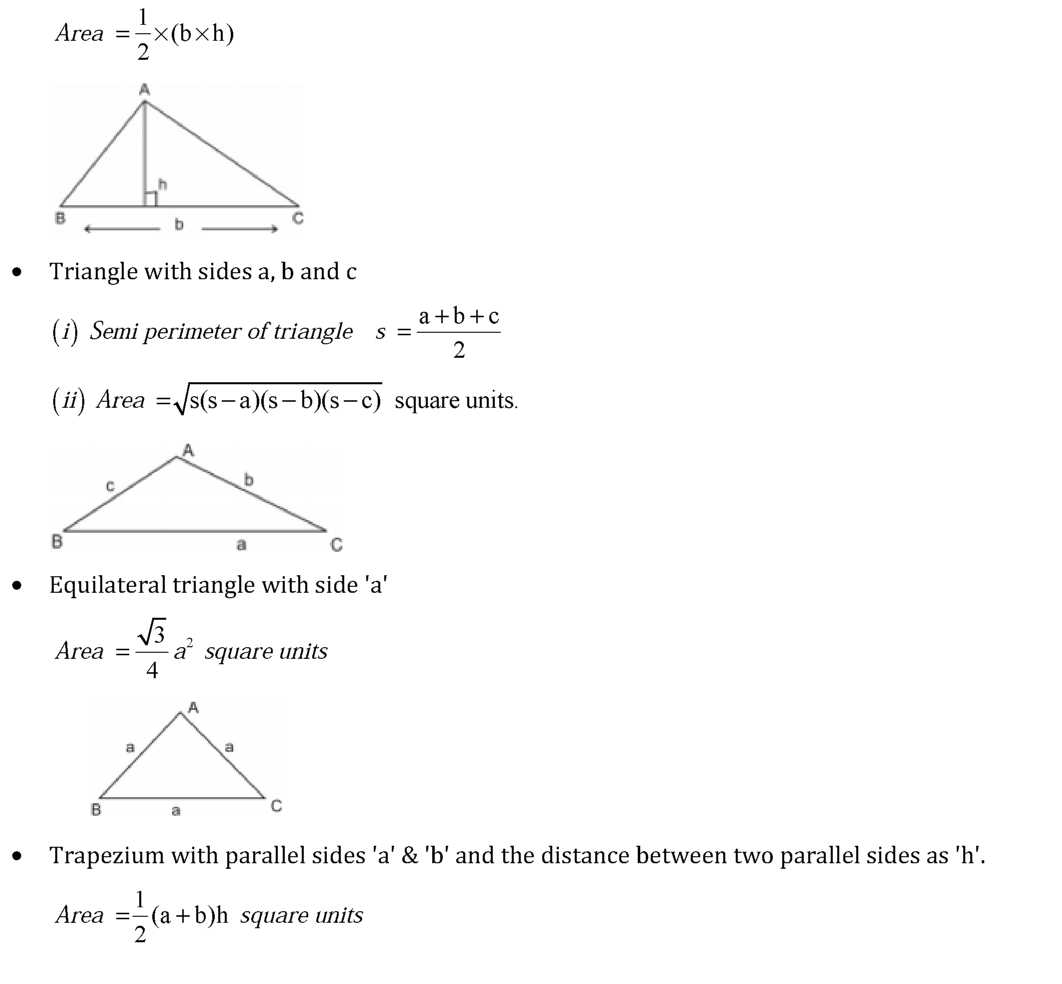
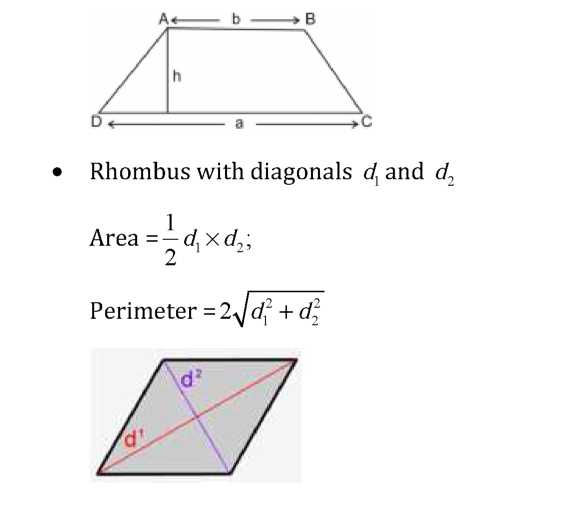
    • Triangle with base ‘b’ and altitude ‘h’ is


  • Chapter 11 Constructions Notes for Class 9th Maths

    Chapter 11 Constructions

    • Basic Constructions
    • Some Constructions of Triangles
    1. Use only ruler and compass while drawing constructions.
    2. Protractor may be used for drawing non-standard angles.
    3. Constructions of a triangle given its base, a base angle and the difference of the other two sides.
    4. Constructions of a triangle given its perimeter and its two base angles.
    5. A triangle can be constructed if its perimeter and two base angles are given.
    6. Geometrical construction is the process of drawing a geometrical figure using only two instruments-an ungraduated ruler and a pair of compasses.
    7. Some specific angles like 15°,30o,45o,60o,75o,90°, etc. can be constructed without using protractor.
    8. A triangle can be constructed if its base, base angle and the sum of the two sides or the difference of the other two sides are given.
  • Chapter 10 Circles Notes for Class 9th Maths


    Chapter 10 Circles

    • Circles and its Related Terms : A Review
    • Angle Subtended by a Chord at a Point
    • Perpendicular from the Centre to a Chord
    • Circle through Three Points
    • Equal Chords and their Distances from the Centre
    • Angle Subtended by an Arc of a Circle
    • Cyclic Quadrilaterals
    • Circle- circle is locus of such points which are at equidistant from a fixed point in a plane.
    • Concentric circle- Circle having same centre called concentric circle.
    • Two arc of a circle called congruent if they have the same degree measure.
    • If two arc equal then their corresponding chords are equal.
    • The perpendicular from centre to chord of circle, it bisects the chord and converse.
    • There is one and only one circle passing through three non-collinear points.
    • Equal chords of circle are equidistant from centre.
    • The angle subtend by an arc at the centre of circle is twice the angle which subtend at remaining part of circumference.
    • Any two angles in the same segment of the circle are equal.
    • Angle of semicircle is right angle.
    • Equal chords of circle subtend equals angle at the centre of circle.
    • If the all vertices of a quadrilateral lie on the circumference of circle, then quadrilateral called cyclic.
    • In a cycle quadrilateral the sum of opposite angles is 180o and converse.
    • The exterior angle of a cycle quadrilateral is equal to the opposite interior angle.
  • Chapter 9 Areas of Parallelograms and Triangles Notes for Class 9th Maths


    Chapter 9 Areas of Parallelograms and Triangles

    1. Figures on the same Base and Between the same Parallels
    2. Parallelograms on the same Base and between the same Parallels
    3. Triangles on the same Base and between the same Parallels


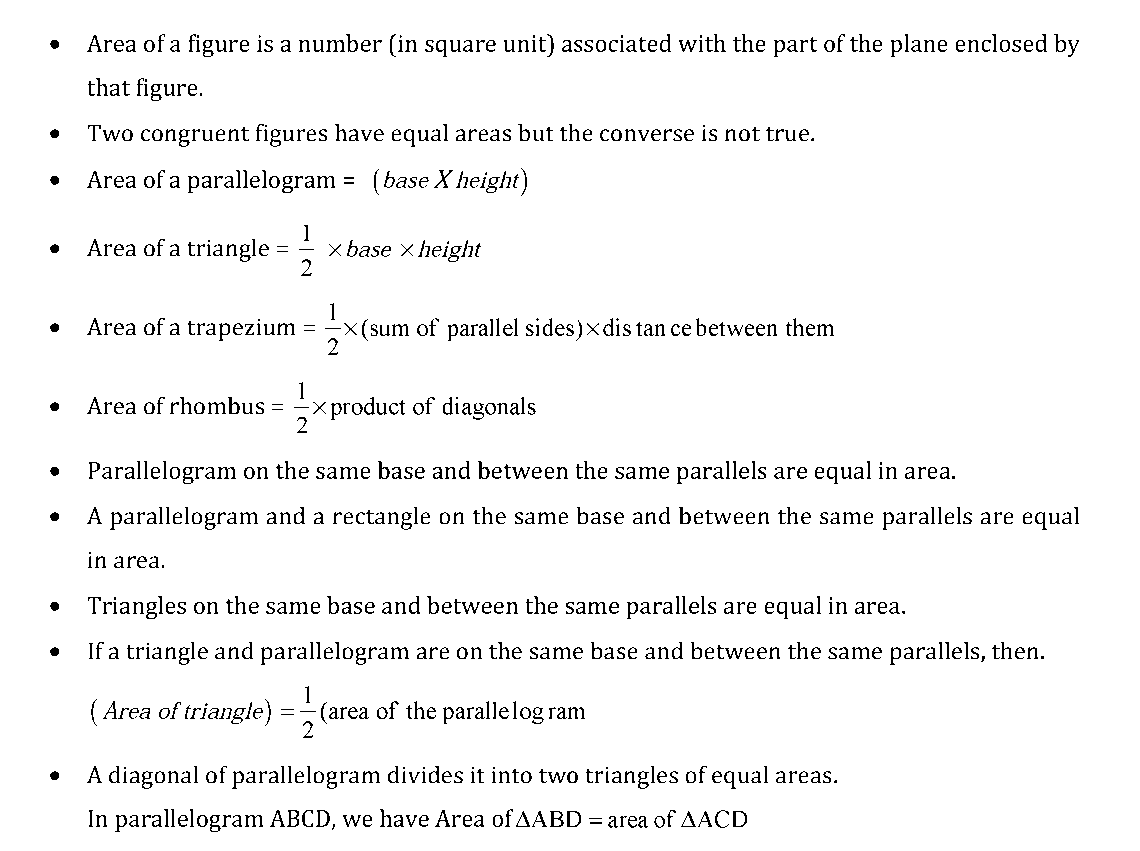
    • If a parallelogram and a triangle are on the same base and between the same parallel, then

    area of the triangle is equal to one half area of the parallelogram.

    • A median AD of a AABC divides it into two triangles of equal areas. Therefore ar(AABD)=ar(ACD )
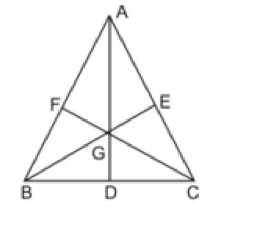
    • If the medians of a intersect at G, then ar(AAGB)=ar(AAGC )=ar(ABGC )=1 ar (AABC)

    • Triangles with equal bases and equal areas have equal corresponding altitude.