Category: Classes

  • Work and Energy Notes Class 9th Science Chapter 11

    CHAPTER 11 “Work & Energy”

    KEY CONCEPTS [ *rating as per the significance of concept]

    1

    Work Done By A Constant Force

    ***

    2

    Energy And Its Forms(Kinetic Energy & Potential Energy)

    Are Various Energy Forms Inter convertible?

    3

    Potential Energy Of An Object At A Height

    *****

    4

    Law Of Conservation Of Energy

    ****

    5

    Rate Of Doing Work & Commercial Unit Of Energy

    ****

    1. Work Done By A Constant Force
    • Work is a scalar quantity equal to the product of the displacement x and the

    component of the force Fx in the direction of the displacement..

    • Work is defined as a force acting upon an object to cause a displacement
    • Mathematically, work can be expressed by the following equation.
    • W= F x d cos q ( cos 00 = 1)
    • where F = force, d = displacement, and the angle (theta) is defined as the angle between the force and the displacement vector
    • Three things are necessary for the performance of work:
    • There must be an applied force F.
    • There must be a displacement x.
    • The force must have a component along the displacement
    Negative Work
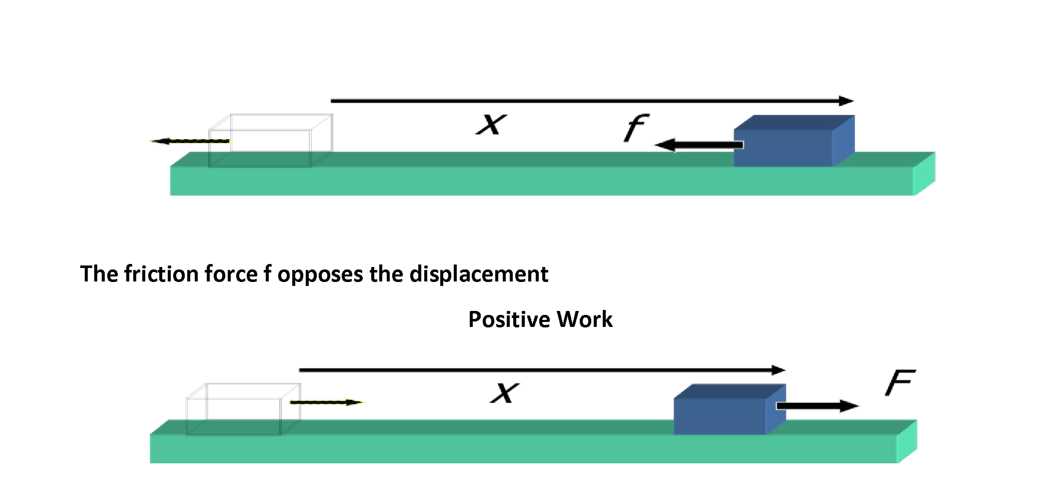
    Force F contributes to displacement x.

    Test Yourself:

    1. Calculate Work when F= 40 N and x = 4 m.
    2. Calculate Work when F = -10 N and x = 4 m.
    3. A lawn mower is pushed a horizontal distance of 20 m by a force of 200 N directed at an angle of 300 with the ground. What is the work of this force?
    4. A student lifts a 50 pound (lb) ball 4 feet (ft) in 5 seconds (s). How many joules of work has the student completed?
    2.Energy And Its Forms

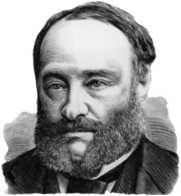
    James Joule

    The metric system unit of energy is the joule (J), after James Joule.

    • Mechanical energy is the energy which is possessed by an object due to its motion or its stored energy of position

    Forms of Energy

    • Kinetic energy : is the energy of motion

    Energy which a body possesses because of its motion, which occurs anywhere from an atomic level to that of a whole organism
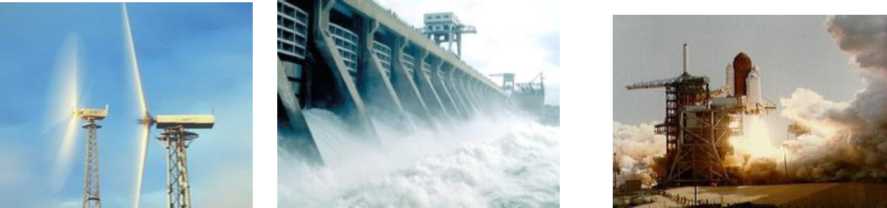
    Examples of Kinetic Energy: This is not an all-inclusive list.

    • Electrical – The movement of atoms
    • Electromagnetic or Radiant – The movement of waves
    • Thermal or Heat – The movement of molecules
    • Motion – The movement of objects
    • Sound – The movement through waves

    Engineers generally refer to thermal/heat energy as “internal energy” and use “kinetic energy” strictly in reference to motion.

    Potential Energy (Stored energy or gravitational energy)

    • The capacity to do work by virtue of position or configuration
    • an object can store energy as the result of its position or elastic source
    • Potential Energy is maximum at the maximum HEIGHT
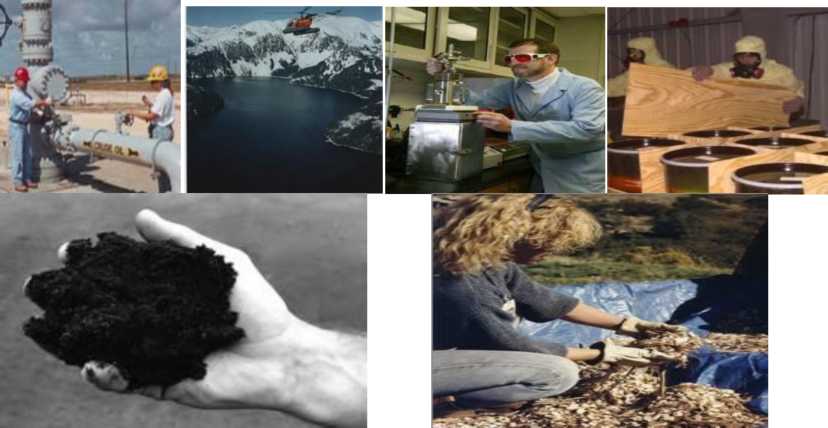
    Energy transformation involves the conversion of one form of energy into another form. Examples of energy transformation include:

    • Chemical – Food is consumed and converted into motion for playing sports or taking a test.
    • Radiant – Sunlight is consumed by plants and converted into energy for growth.
    • Electrical – Energy transferred to an oven is converted to thermal energy for heating our food.

    Now you know the basic forms of energy. The next question is “What are the energy sources?”

    There are renewable and nonrenewable sources of energy. A renewable energy source is a form of energy that is constantly and rapidly replenished by natural processes. Examples of renewable energy sources include:

    • Biomass – The use of a living or once living organism as fuel
    • Hydropower – The energy produced from the movement of water
    • Geothermal – The use of heat from within the Earth or from the atmosphere

    near oceans to warm houses or other buildings

    • Wind – The use of wind to generate electricity

    Solar – The use of the sun as a source of heat; for instance, to heat a room within a house, etc.

    Energy Conversion Examples

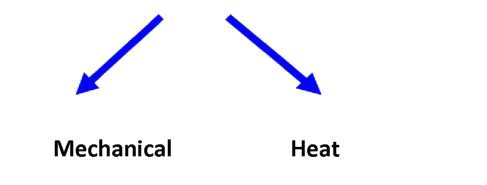
    Fossil fuels Chemical -> Heat -> Mechanical -> Electrical Solar cells Sunlight -> Electrical Wind turbines Kinetic ^ Mechanical -> Electrical Hydroelectric Gravitational potential -> Mechanical -> Electrical Nuclear Nuclear -> Heat -> Mechanical -> Electrical Vehicle System Conversion
    Test Yourself

    1. How much potential energy is lost by a 5Kg object to kinetic energy due a decrease in height of 4.5 m.
    2. Potential energy of an object at a height

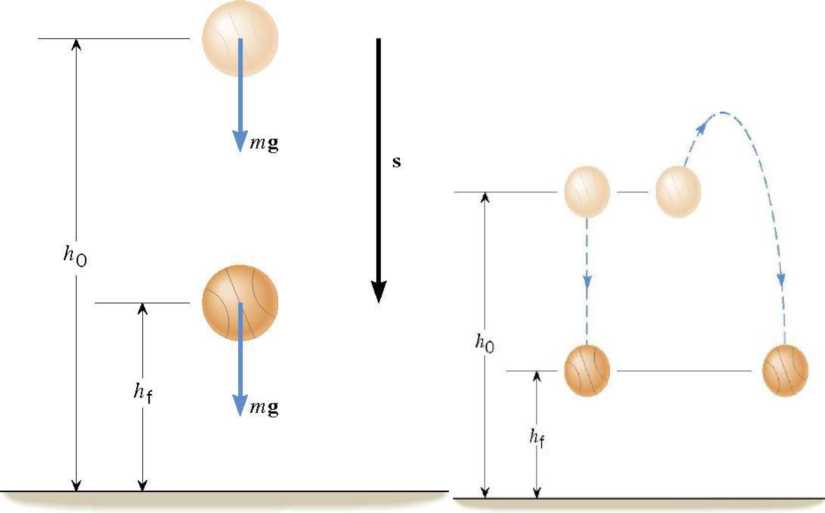
    An object increases its energy when raised through a height.

    The potential energy of an object at a height depends on the ground level or the zero level
    1. Law Of Conservation Of Energy

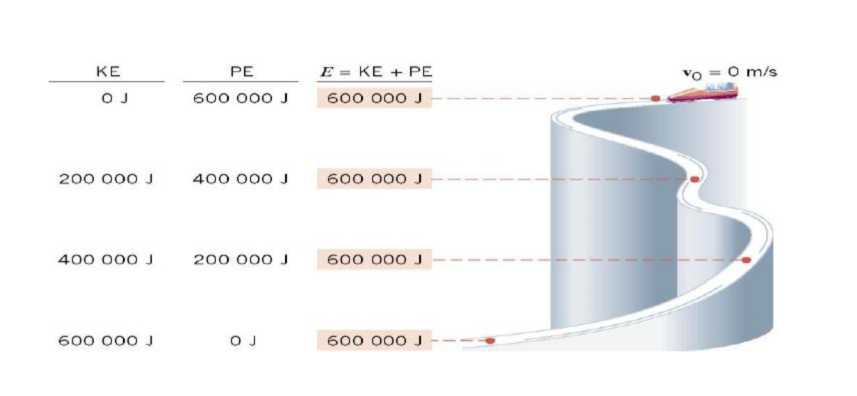
    The principle of Conservation of Mechanical Energy

    The total mechanical energy (E=KE+PE) of an object remains constant as the object moves, provided that the net work done by external non-conservative forces is zero, Wnc=0J Total mechanical energy: the sum of kinetic energy and gravitational potential energy E = KE + PE

    Wnc = (KEf – KE0) + (PEf – PE0)

    Wnc = (KEf + PEf) – (KE0 + PE0)

    Wnc = Ef – E0

    Ef = KEf + PEf) E0 = KE0 + PE0
    1. Rate of Doing Work & Commercial Unit Of Energy POWER

    Rate at which work is performed or energy is expended

    t

    Watt is the base unit of Power

    One watt is equal to 1 joule of work per second

    Types of Power

    • Electrical Power

    Uses electrical energy to do work

    • Mechanical Power

    Uses mechanical energy to do work (linear, rotary)

    • Fluid Power

    Uses energy transferred by liquids (hydraulic) and gases (pneumatic)

    • Power is the rate that we use energy.
    • Power = Work or Energy / Time
    • P = W/t = F x d/t = F v
    • The unit joule is too small .The bigger unit of energy called kilowatt hour (kW h) 1 kW h is the energy used in one hour

    at the rate of 1000 J s-1 (or 1 kW).

    1 kW h = 1 kW *1 h = 1000 W*3600 s = 3600000 J 1 kW h = 3.6 x 10⁶ J.

    Test Yourself

    1. A 5 Kg Cart is pushed by a 30 N force against friction for a distance of 10m in 5 seconds. Determine the Power needed to move the cart.
    2. A student lifts a 50.0 pound (lb) ball 4.00 feet (ft) in 5 .00seconds (s). How many watts of power are used to lift the ball?

    Important Points for Work Problems:

    • Always draw a free-body diagram, choosing the positive x-axis in the same direction as the displacement.
    • Work is negative if a component of the force is opposite displacement direction
    • Work done by any force that is at right angles with displacement will be zero (0).
    • For resultant work, you can add the works of each force, or multiply the resultant force times the net displacement.
    • Energy is the ability to move
    • Potential is stored energy (Statics)
    • Dependant on height
    • Kinetic is moving energy (Dynamics)
    • Dependant on velocity
    • Springs store energy dependant on distance and constant

    QUESTION BANK

    One mark questions

    1. Does work have a direction?
    2. Does the kinetic energy of an object depend on its direction of motion?
    3. Cam matter be converted into energy?
    4. Give an example of conversion of chemical energy into heat energy.

    Two marks questions

    1. Two persons do the same amount of work. The first person does it in 10 s and the second, in 20 s.Find the ratio of the power used by the person to that by the second person.
    2. A body of mass 25 g has a momentum of 0.40 kgm/s.Find its kinetic energy.
    3. Define work and write its units.
    4. By what factor does the kinetic energy of an object depend on its direction of motion?

    Three marks questions

    1. How much time will it take to perform 440 j of work at a rate of 11 W.
    2. A body of mass 3.0kg and a body B of mass 10 kg are dropped simultaneously from a height of 14.9m.Calculate their Momenta, their Potential energies and kinetic energies when they are 10m above the ground.
    3. lA man does 200j ofl work in 10 seconds and a boy does 100j of work in 4 seconds. Who is delivering more power? Find the Ratio of power delivered by the man to that by the boy.

    Five marks questions

    1. Show that the work done by a force is given by the product of the force and the projection of the displacement along the force.
    2. Find the expression for gravitational potential energy of a body of mass m at height h.
    3. Why does a person standing for a long time get tired when he does not appear to do any work?
    4. How can you justify that a body kept at a greater height has larger energy?
  • Gravitation Notes Class 9th Science Chapter 10


    CHAPTER 10- “GRAVITATION”

    KEY CONCEPTS [ *rating as per the significance of concept]

    1 Gravitation ***
    2 Universal Law Of Gravitation ****
    3 Free Fall **
    4 To Calculate The Value Of G ****
    5 Mass & Weight ***
    6 Weight Of The Object On Moon ***
    7 Thrust & Pressure ***
    8 Pressure In Fluids ***
    9 Buoyancy ****
    10 Why Objects Float Or Sink When Placed On The Surface Of Water? ***
    11 Archimedes’s Principle *****
    12 Relative Density ***

    Gravity is one of the most basic forces in the universe. It plays a fundamental role not only in the structure of our solar system but also in the way objects behave on Earth. In this section, we will talk about gravity on a small scale. We will discuss topics such as weight, free fall, and ballistics. We will learn the physics of phenomena we experience daily and take for granted

    1.Gravitation

    Gravitation is the force of attraction between two objects in the universe.

    Gravitation may be the attraction of objects by the earth.

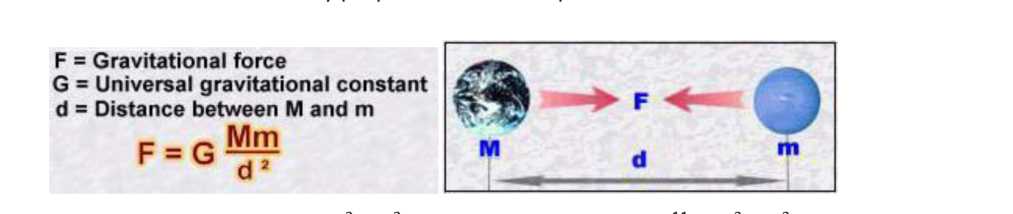
    This force is proportional to the product of masses of the objects and inversely proportional to the square of the distance between them. It is independent of medium.

    _ , , GMm

    Gravitational force = ——

    rz

    Eg If a body is dropped from a certain height, it falls downwards due to earth’s gravity.

    If a body is thrown upwards, it reaches a certain height and then falls downwards due to the earth’s gravity.

    • Gravitation may be the attraction between objects in outer space.

    Eg :- Attraction between the earth and moon.

    Attraction between the sun and planets.


    GRAVITY

    • A natural force that pulls all objects toward the center of the earth
    • keeps the moon orbiting
    • It holds stars together . . .
    • And binds galaxies together for billions of years ….Prevents Planets from losing their atmospheres.

    Test yourself:

    1. When we move from the poles to the equator. Hence, the value of g decreases. Why?
    2. What is the difference between gravity and gravitation?

    2.Universal law of gravitation: – “Inverse square law”- All bits of matter attract all other bits of matter

    • The universal law of gravitation states that, ‘Every object in the universe attracts every other object with a force which is directly proportional to product of the masses and inversely proportional to the square of the distance between them.’
    • The strength of the gravitational attraction between two objects depends on two factors:

    • The SI unit of G is N m2 kg -2 and its value is 6.673 x 10⁻¹¹ N m2 kg -2
    • How big the objects are (how much mass they have) and
    • How far apart they are.

    Test Yourself

    1. What is the difference between gravity and gravitation?
    2. What does it mean to say that the Force of gravity is proportional to the masses

    of the bodies, and inversely proportional to the distance between them?


    3. Free Fall

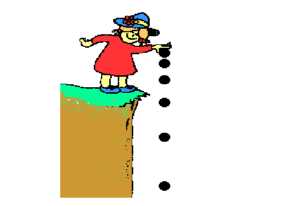
    • With negligible air resistance, falling objects can be considered freely falling. objects of different shapes accelerate differently (stone vs feather)

    Test Yourself

    1. A coin and a feather are dropped from the roof of a building. Which one will fall to the ground first

    4 .To calculate the value of” g “(acceleration due to gravity)

    • The acceleration due to gravity is denoted by g.
    • The unit of g is same as the unit of acceleration ms -2
    • From the second law of motion, force is the product of mass and acceleration.

    F = ma

    • For free fall, force is the product of mass and acceleration due to gravity.

    GMm

    F = mg or mg = =

    GM

    or g = — where M is the mass of the

    Earth and d is the distance between the object and the earth.

    • For objects near or on the surface of the earth d is equal to the radius of the earth R

    GMm

    • F = mg or mg = =

    GM

    • or g = —

    Test Yourself

    1. Calculate the value of g on the surface of earth.
    2. What is the difference between “weight” and “mass”?
    3. Mass and Weight:
    • Mass is a fundamental, universal property. You have the same amount of mass no matter where you are in the Universe.
    • Weight is not fundamental its value depends on circumstances in the Universe. Weight is a force. It is the resultant gravitational force exerted on a body with mass m by all the other bodies on the Universe.

    Weight = Fg = G m Me / R2 = mg where Me is the mass of the Earth and R is the radius of the Earth.

    Test Yourself

    1. An astronaut has 80 kg mass on earth (a)what is his weight on earth? (b) What

    will be his mass and weight on mars where g=3.7 m/s2

    1. When you put an object on a spring balance, do you get the mass of an object or its weight?

    2. Weight Of The Object On Moon
    • The mass of the moon is less than the mass of the earth. So the moon exerts lesser force on the objects than the earth.
    • The weight of an object on the moon is one sixth (1/6th) of its weight on the earth.
    • The weight of an object on the earth is the force with which the earth attracts the

    object and the weight of an object on the moon is the force with which the moon attracts the object.

    Celestial body Mass (kg) Radius (m)
    Earth 5.98 x 1024 6.37 x 10⁶
    Moon 7.36 x 10²² 1.74 x 10⁶

    Test Yourself

    1. What will be the weight of the body on the moon whose mass is12 kg?

    2. Thrust & Pressure
    • Thrust is the force acting on an object perpendicular to the surface.
    • Pressure is the force acting on unit area of a surface

    Thrust

    Pressure =

    Area

    • The SI unit of thrust is N/m2 or N m-2 . It is called Pascal (Pa).
    1. Pressure In Fluids
    • . Fluids exert pressure in all directions
    • Pressure exerted on fluids is transmitted equally in all directions.
    1. Buoyancy

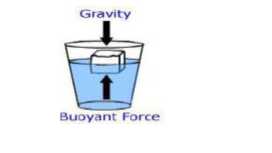
    When an object is immersed in a fluid it experiences an upward force called buoyant force. This property is called buoyancy or upthrust.

    1. Why objects float or sink when placed on the surface of water?
    • Take some water in a beaker. Take a piece of cork and an iron nail of the same mass. Place them on the water. The cork floats and the nail sinks.
    • If the density of an object is less than the density of a liquid, it will float on the liquid and if the density of an object is more than the density of a liquid, it will sink in the liquid.
    1. Archeimedes Principle
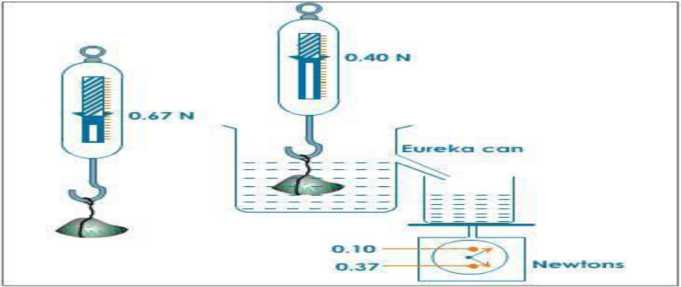
    • Archimedes’ principle states that, When a body is partially or fully immersed in a fluid it experiences an upward force that is equal to the weight of the fluid displaced by it.’


    12 .Relative density

    • The relative density of a substance is the ratio of the density of a substance to the density of water. It is a ratio of similar quantities and has no unit.

    QUESTION BANK

    One Mark questions

    1. Explain what Centrifugal force is.
    2. What do you mean by the weight of the body on moon.
    3. Give the value of G with proper units.
    4. Give the value of g with proper units.
    5. What is measured by physical balance?

    Two Marks questions

    1. At what height above the earth’s surface would the value of acceleration due to gravity be half of what it is on the surface? Take radius of earth to be R.

    2 . A body of 90 kg f on the surface of earth. How much will it weigh on the surface of moon whose mass is 1/9 and radius is V of that of earth?

    1. A piece of paper takes much longer to fall than a stone through the same distance. Explain the reason.
    2. Consider a heavenly body which has a mass twice that of the earth and radius thrice that of the earth .What will be the weight of the book on this heavenly body, if its

    weight on earth is 900 N?

    Three Marks questions

    1. Why gravitational force is usually unnoticeable?
    2. Prove that acceleration due to gravity is independent of mass of the body.
    3. How can the average density of the earth can be determined?
    4. What is buoyancy and buoyant force? Upon what factors do they depend Five Marks questions
    5. Find the percentage change in the weight of a body when it is taken from equator to poles. The polar radius is 6,357 Km and equatorial radius is 6,378 Km.
    6. The density of ice is 918kgm-3 and that of sea water is 1,030kgm-3.An iceberg floats with a portion 224 liters outside water. Find the volume of iceberg.
    7. What are the laws of flotation? Give some illustrations.
  • Force and Laws of Motion Notes Class 9th Science Chapter 9


    CHAPTER -9 “Force & Laws Of Motion”

    KEY CONCEPTS [ *rating as per the significance of concept]

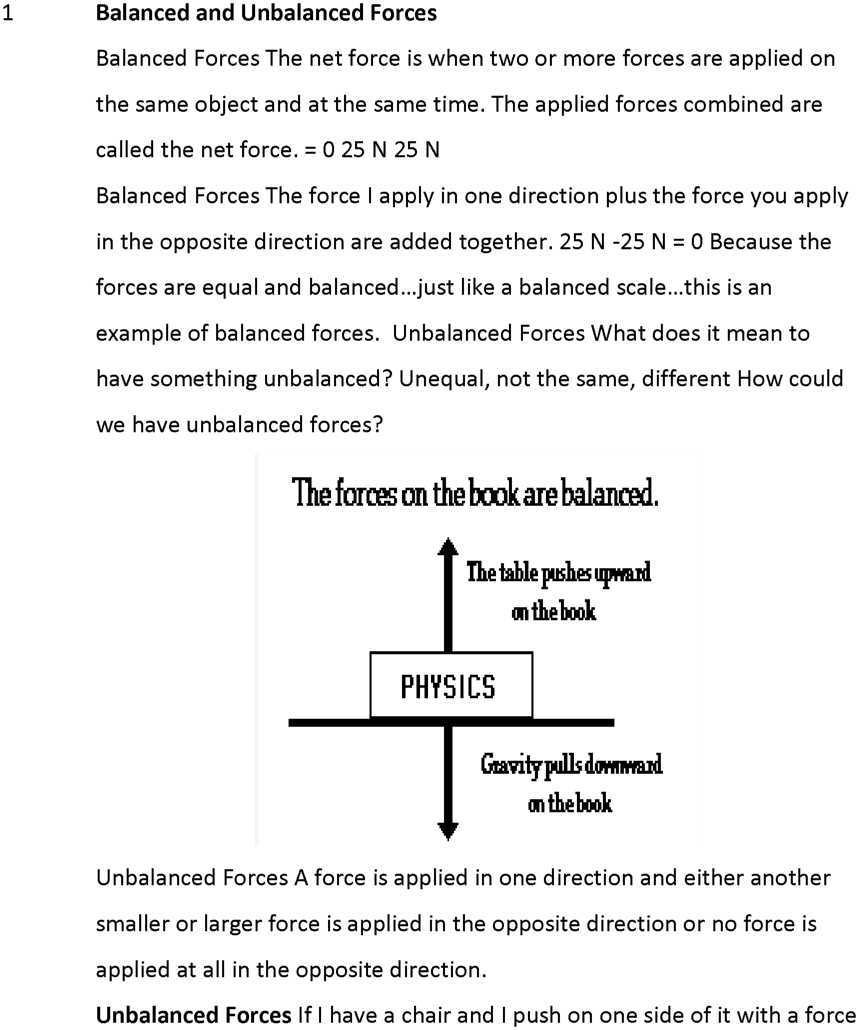
    1 Balanced and Unbalanced Forces ***
    2 Laws of Motion *****
    3 Inertia and Mass *****
    4 Conservation of Momentum ****


    The Effect of Mass

    A force applied to an automobile will not have the same effect as the same force applied to a pencil. An automobile resists accelerating much more than a pencil does, because it has more inertia, or mass.

    The acceleration of an object depends not only on how hard you push on it, but also on how much the object resists being pushed.

    What is the effect of mass on acceleration? This, too, turns out to be quite simple (I wonder why…). For the same force, an object with twice the mass will have half the acceleration. If it had three times the mass, the same force will produce one-third the acceleration. Four times the mass gives one-fourth of the acceleration, and so on.

    This type of relationship between quantities (double one, get half the other) is called an inverse proportion or inverse variation. In other words, then:

    Newton’s Second Law of Motion The acceleration of an object is dependent upon both force and mass. Thus, if the colliding objects have unequal mass, they will have unequal accelerations as a result of the contact force which results during the collision.

    Newton’s Third Law Newton’s Third Law is stated as:

    For every action there is an equal and opposite reaction.

    “action…reaction” means that forces always occur in pairs. (Forces are interactions between objects, like conversations are interactions between people.)

    Single, isolated forces never happen. The two forces involved are called the “action force” and the “reaction force.”

    These names are unfortunate for a couple of reasons :

    Either force in an interaction can be the “action” force or the “reaction” force

    The action and reaction forces exist at the same time.

    “equal” means

    Both forces are exactly the same size. They are equal in magnitude.

    Both forces exist at exactly the same time. They both start at exactly the same instant, and they both stop at exactly the same instant. They are equal in time.

    “opposite” means that the two forces always act in opposite directions – exactly 180o apart.

    Newton’s third law of motion In every interaction, there is a pair of forces acting on the two interacting objects. The size of the force on the first object equals the size of the force on the second object. The direction of the force on the first object is opposite to the direction of the force on the second object. Forces always come in pairs – equal and opposite action- reaction force pairs.

    Newton’s third law of motion applied to collisions between two objects. In a collision between two objects, both objects experience forces which are equal in magnitude and opposite in direction. Such forces cause one object to speed up (gain momentum) and the other object to slow down (lose momentum). According to Newton’s third law, the forces on the two objects are equal in magnitude.

    Test Yourself

    1. Can action reaction balance each other?
    2. What does a force do?

    3. Inertia and Mass

    Inertia is the tendency of an object to resist any change in its motion. An object will continue to move at the same speed in the same direction

    unless acted upon by an unbalanced force. Inertia & Mass Inertia & Mass of a bowling ball rolled down the road would eventually come to a stop. Friction is an unbalanced force that causes the ball to stop or slow down. Without friction, the ball would keep going.

    Inertia & Mass of a bowling ball and a tennis ball have the same inertia. Inertia & Mass If you had a tennis racket and I threw tennis ball at you, what would happen? If you had a tennis racket and I threw a bowling ball at you, what would happen? Why could you change the motion of the tennis ball but not the motion of the bowling ball?

    Mass is the amount of matter in an object. A bowling ball has more mass than a tennis ball. The greater the mass of an object the greater its inertia. Mass is the measurement of inertia.

    Test Yourself

    1. Why do we fall forward if we alight from a moving bus?
    2. Why does an athlete run for some distance before long jump?
    3. Conservation of Momentum

    Law of Conservation of Momentum

    In a closed system, the vector sum of the momenta before and after an impact must be equal.

    Before After

    m1v1 +m2v2 = m1v1‘ + m2v2

    Internal and External Forces


    QUESTION BANK

    One Mark questions

    1. Define momentum.
    2. State first law of motion.
    3. What is inertia?
    4. Can action and reaction balance each other?
    5. How does one climb up a rope?
    6. Why cannot we walk in space?
    7. What does rate of change of momentum represent?
    8. Why do we continuously paddle to keep the cycle moving?
    9. Why does a scooter tend to skid while executing a sharp turn?
    10. Which one would have more inertia : 10 kg mass & 5 kg mass?


    Two Marks questions

    1. Explain the functioning of shockers in cars.
    2. How much force is needed to pull an object of mass 40 kg in vertically upward direction with acceleration of 2.2 m / s2.
    3. Why does a fan keep moving for sometime when switched off?
    4. What do you mean by conservation of momentum?
    5. Inflated balloon lying on the surface of a floor moves forward when pricked with a pin. Why?


    Three Marks questions

    1. An iron sphere of mass 10 kg is dropped from a height of 80 cm, if ‘g’ = 10 m / s2. Calculate the momentum transferred to the ground by the body.
    2. What would be the force required to stop a car of mass 1000 kg and a loaded truck of mass 10,000 kg in 2 seconds each moving with velocity 5 m / s.
    3. Deduce law of conservation of momentum using third law of motion.


    Five Mark questions

    1. Name and define three different types of inertia & give an example of each.

  • Motion Notes Class 9th Science Chapter 8

    Chapter 8 : “Motion”

    KEY CONCEPTS [ [1]rating as per the significance of concept ]

    1

    Motion

    ****

    2

    Graphical Representation of Motion & Graphs

    ***

    3

    Equation of motion

    ****

    4

    Uniform Circular Motion

    **

    1 Motion (Uniform Motion And Non Uniform Motion, Acceleration and Velocity)

    • A particle is a point-like object, has mass but infinitesimal size
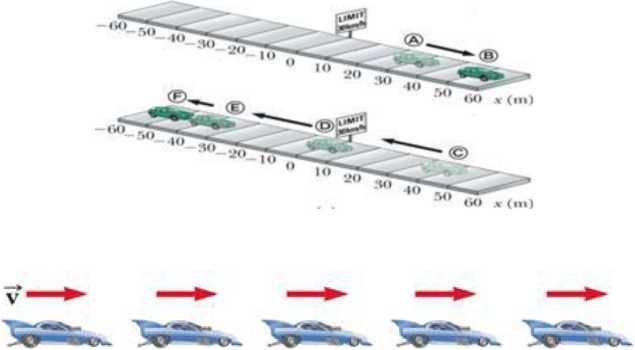
    • The object’s position is its location with respect to a chosen reference point, In the diagram, the road sign the reference point
    • Motion occurs when an object changes its position.

    Both Distance and Time are important in describing motion.

    • Sometimes you know motion has occurred even if you didn’t see it happen. (mail truck)
    • Relative motion: when two objects are moving in a plane (either in same direction or opposite) each have relative motion with respect to second. e.g. a person sitting in a train and watching a tree, in this case tree is stable but is assumed to be moving but with respect to train.

    Distance vs. Displacement

    • Distance: How far an object has moved. It has only magnitude without direction. (total)
    • Displacement: How far and in what direction an object has moved from its start position. i.e. the direct distance between two points.

    Speed

    • Speed = the distance an object travels in a given amount of time

    . distance

    • Speed =

    time

    Types of Speed

    • Constant speed: speed doesn’t change (set your car on cruise control)
    • Changing speed: Riding a bike for 5 km. Take off and increase speed, slow

    down up hill, speed up down hill, stop for stop sign. The trip took you 15 min

    (.25 h)

    . total distance

    • Average speed:

    c total time

    • Instantaneous speed: speed at any given time.

    Velocity

    • Velocity: includes speed and DIRECTION
    • Storm is moving at 20km/hr.
    • Should you be seeking shelter?
    • Suppose two trains are going with the same speed in opposite direction so they are having different velocities.
    • Race car going around an oval track might have constant speed, but different velocities at each point.

    Acceleration

    • Any change in velocity over a period of time is called acceleration.
    • The sign (+ or -) of indicates its direction. + sign shows the acceleration and – sign shows de-acceleration.
    • Uniform (constant) acceleration equation
    • a = v/t
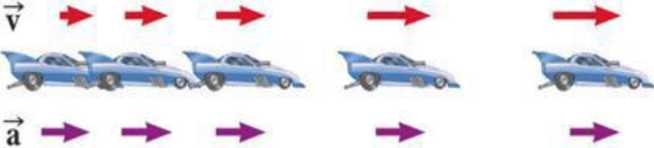
    • Images of car are equally spaced.
    • The car is moving with constant positive velocity (shown by red arrows maintaining the same size) .
    • The acceleration equals to zero
    • Images of car become farther apart as time increases
    • Velocity and acceleration are in the same direction
    • Acceleration is uniform (Arrows below the car maintain the same length)
    • Velocity is increasing (Arrows above the car are getting longer)
    • This shows positive acceleration and positive velocity

    Galileo Galilei Italian physicist and astronomer

    Formulated laws of motion for objects in free fall

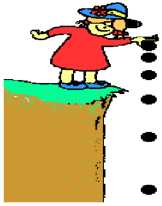
    • A freely falling object is any object moving freely under the influence of gravity

    alone.

    • It does not depend upon the initial motion of the object
    • Dropped – released from rest
    • Thrown downward
    • Thrown upward
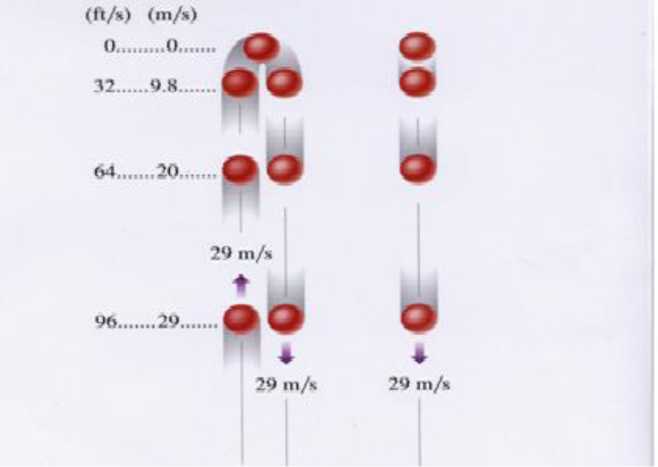
    • The acceleration of an object in free fall is directed downward, regardless of the initial motion
    • The magnitude of free fall acceleration (gravitational acceleration) is g = 9.80 m/s2
    • g decreases with increasing altitude
    • g varies with latitude, height and depth from earth surface.
    • 9.80 m/s2 is the average at the Earth’s surface
    • The italicized g will be used for the acceleration due to gravity
    • Not to be confused with g for grams

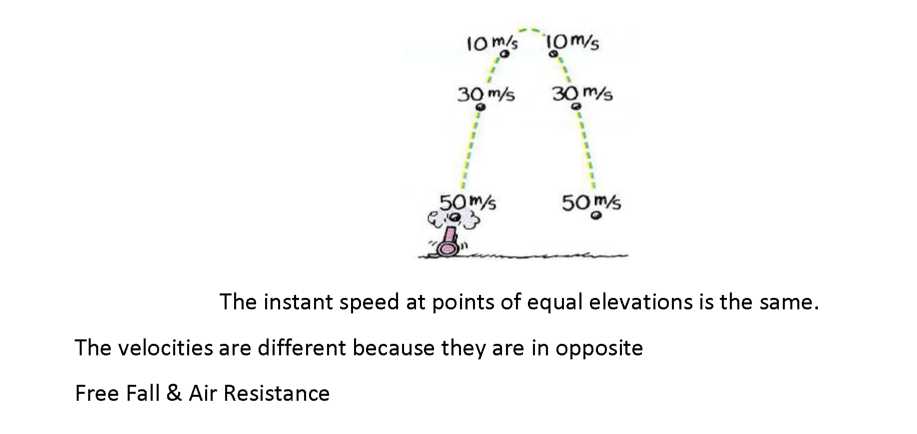
    With negligible air resistance, falling objects can be considered freely falling. objects of different shapes accelerate differently (stone vs feather)

    Speed both upward and downward

    Test Yourself:

    1. Give the equation for uniform motion.
    2. When a car stops after applying brakes, what is the final velocity?
    3. Uniform Circular Motion

    In this kind of motion the object moves on circle with fix speed but the direction is changed by the time so the velocity of the change so its called acceleration motion. This acceleration is called centrifugal acceleration. It is directed toward the centre.

    Test Yourself:

    1. What remains constant in uniform circular motion?
    2. What changes continuously in uniform circular motion?

    QUESTION BANK

    One Mark questions

    1. Can displacement be zero even when distance is not zero?
    2. Can the distance travelled by an object be smaller than magnitude of its displacement?
    3. A particle is moving with uniform velocity. What is its acceleration?
    4. How can you get speed of an object from its distance – time graph?
    5. How can you get distance of an object from its speed – time graph?
    6. A brick & an elephant are in free fall. What is common in their motion?
    7. When an object is thrown vertically upwards. What is its velocity at the highest point?
    8. Can velocity & acceleration point in opposite directions?
    9. Define acceleration.
    10. What is non uniform motion?

    Two Marks questions

    1. Differentiate scalars & vectors?
    2. What is retardation? How does it affect the speed?
    3. Can speed of a body vary with its velocity constant? Explain.
    4. Why is circular motion with constant speed called accelerated motion?
    5. State the difference between distance & displacement.
    6. What is the difference between speed & velocity?
    7. What does a speedometer & odometer indicate?

    Three Marks questions

    1. If an object is thrown vertically upwards with speed 49 ms-1. How long does it take to complete upward journey? What maximum height does it achieve?
    2. An object starting from rest covers 20 metres in first 2 seconds & 160 metres in next 4 seconds. What is its velocity after 7 seconds from the start?

    Five Marks questions

    1. Derive all the three equations of motion for uniform acceleration using graphical method.
    2. A car a moving at rate of 72km/h and applies brakes which provide a retardation of 5ms-2.
    3. How much time does the car takes to stop.
    4. How much distance does the car cover before coming to rest?
    5. What would be the stopping distance needed if speed of the car is doubled?
    1. sI unit of speed is m/s

  • Diversity in Living Organisms Notes Class 9th Science Chapter 7


    Chapter 7: “Diversity in Living Organisms”

    KEY CONCEPTS : [ *rating as per the significance of concept]

    CONCEPTS RATING
    Basis of classification ***
    Hierarchy of classification ****
    Kingdom Plantae *****
    Kingdom Animalia *****
    1. Each organism is different from all other organisms.
    2. In this activity, we decide which characteristics (we can run, but the Banyan tree can’t run is a characteristic) are important in forming the desired category.
    3. Greek thinker Aristotle classified animals according to whether they lived on land, in water or in air. This classification is a landmark in ideology, but has limitations. For example, animals that live in the sea include Corals, Whales, Octopus, Starfish, and Shark. In fact they are different from each other.
    4. Classification and Evolution: organisms are classified based on body design, hierarchy in developing, relation to evolution. Charles Darwin first described the idea of evolution in 1859 in his book ” The Origin of Species”
    5. The Biologists, such as Haeckel, Whittaker & Carl Woese tried to classify all living organisms into broad Kingdoms. The Whittaker proposed five kingdoms: Monera, Protista, Fungi, Plantae and Animalia. Carl Woese introduced by dividing Monera into Archaebacteria and Eubacteria.

    1. Monera: They have unicellular, Prokaryotic organisms (do not have defined nucleus or organelles). The cell wall may or may not present. The mode of nutrition is autotrophic (synthesizing food on their own) (or)heterotrophic (getting food from environment). Ex. Bacteria, Anabaena. ( (Please refer to Fig. 7.1 Monera NCERT Book Page-83)
    2. Protista: They have unicellular eukaryotic organisms (do have well defined nucleus or organelles). The body is covered by cilia, flagella for locomotion. The mode of nutrition is autotrophicorheterotrophic. Ex. Diatoms, protozoans.(Please refer to Fig. 7.2 NCERT Book Page-84)
    3. Fungi: These are multi-cellular eukaryotic organisms with cell wall, made up of Chitin. They do not perform Photosynthesis (heterotrophic), Saprophytic (derive nutrition from decaying material). Ex. Aspergillus, Penicillium, Mushroom, Rhizopus. The fungi living with algae forms Lichen (Symbiotic Association) .(Please refer to Fig. 7.3 NCERT Book Page-84).
    4. Plantae: These are multi-cellular eukaryotic organisms with cell wall, made up of Cellulose. Able to perform photosynthesis (autotrophic). Ex. Rice, wheat.
    5. Animalia: These are multi-cellular eukaryotic organisms without cell wall. They are not able to perform photosynthesis (heterotrophic). Ex Human beings, Peacock.

    (Please refer to Fig. 7.4 NCERT Book Page-85).

    DETAILS OF KINGDOM PLANTAE

    1. The kingdom Plantae is further classified as Thallophyta, Bryophyta, Pteridophyta, Gymnosperms, Angiosperms .
    2. Thallophyta: The plants do not have well defined body design, commonly called as” Algae”, mostly aquatic. Ex. Spirogyra, Ulothrix. (Please refer to Fig. 7.5 NCERT Book Page- 86).
    3. Bryophyta: These are commonly called as the “Amphibians of Kingdom”. The plant body is differentiated into roots like, stem like and leaf like structures. No specialized tissues for the conduction of water and food.Ex. Marchantia, Funaria. (Please refer to Fig. 7.6 NCERT Book Page-86).
    4. Pteridophyta: These are commonly called as the “First vascular land plants “. The plant body is differentiated into root, stem and leaf. Specialized tissues for the conduction of water and food are developed in these plants. The reproductive organs are inconspicuous. Ex. Marsilea, Fern. (Please refer to Fig. 7.7 NCERT Book Page-87).

    Special Note: The reproductive organs are inconspicuous in Thallophyta, Bryophyta, Pteridophyta are can’t develop seeds. They are together called as” Cryptogamae (NonFlowering Plants)”. The plants with well differentiated reproductive organs and that ultimately make seeds are called” Phanerogams (Flowering Plants)”. This group is further classified Gymnosperms (Bear naked Seeds) &Angiosperms (Bears seeds inside Fruit).

    1. Gymnosperms: These are commonly called as “Naked seed bearing plants”. They areusually perennial, evergreen and woody. Ex. Pinus, Cycas (Please refer to Fig. 7.8 NCERT Book Page-87).
    2. Angiosperms: These are commonly called as “Enclosed seed bearing plants”. Plants with seeds having a single cotyledon are called as” Monocotyledons or Monocots”. Plants with seeds having two cotyledons are called as “Dicots”. Ex. Ipomoea, Paphiopedium.

    (Please refer to Fig 7.9 &. 7.10 NCERT Book Page-87 ;Fig. 7.11 Page-88).

    DETAILS OF KINGDOM ANIMALIA

    These are Eukaryote, multicultural and hetero-tropic.

    They are further classified as Non- Chordates( Porifera, Coelenterata, Platyhelminthes , Nematoda, Annelida, Arthropoda, Mollusca, Echinodermata) and Chordates { Protochordata, Vertebrata ( Pisces, Amphibians, Reptilia, Aves, Mammalia)} .

    I.Non- Chordates

    1. Porifera: The word Porifera” means organisms with holes”. The canal system helps in circulating water, food, oxygen. They are non-motile with cellular level of organization and mainly marine organisms with hard outer coat called as Skeleton. They are commonly called as Sponges. Ex. Spongilla, Sycon( Please refer Fig. 7.12, NCERT Text Book Page- 89)
    2. Coelenterata: The wordCoelenterata” means organisms with body cavity

    calledCoelenteron” . They are radially symmetrical, Diploblastic ( two layers of cells), commonly called as Cnidarians ( Stinging cells for protection are present in the body). Ex. Hydra, Sea Anemone (Please refer Fig. 7.13, NCERT Text Book Page- 89).

    1. Platyhelminthes: The word Platyhelminthes means organisms with flatworms ( dorsocentrally flattened)”.They are bilaterally symmetrical Triploblastic ( three layers of cells ), either free-living or parasitic. No true Coelom is present – Acoelomates. Ex. Planaria( Free living) , Tape worm( Parasitic)( Please refer Fig. 7.14, NCERT Text Book Page- 90).
    2. Nematoda: The word Nematoda “means organisms with roundworms”. They are bilaterally symmetrical Triploblastic ( three layers of cells ), familiar with parasitic worms. The false Coelom is called as Pseudocoelome. Ex. Ascaris, Wuchereria (Filarial worm causes elephantiasis).)( Please refer Fig. 7.15, NCERT Text Book Page- 90).
    3. Annelida: The word Annelida ” means organisms with metameric-segmented”. They are bilaterally symmetrical Triploblastic(three layers of cells) with closed circulatory system, familiar with earth worms. The Coelom is called as true Coelom. Ex. Neris, Earth worm, Leech (Please refer Fig. 7.16, NCERT Text Book Page- 90).
    4. Arthropoda: The word Arthropoda “means organisms with jointed legs” They are bilaterally symmetrical Triploblastic(three layers of cells ), familiar with cockroaches. The Coelom is blood filled called as Haemo Coelom. Ex. Prawn, Scorpion, Housefly (Please refer Fig. 7.17, NCERT Text Book Page- 91).
    5. Mollusca: The word Mollusca “means organisms with soft body” They are bilaterally symmetrical, Triploblastic(three layers of cells), familiar with Octopus, Pila. Foot is for moving, kidney like organ for excretion, with open circulatory system. Ex. Unio, chiton( Please refer Fig. 7.18, NCERT Text Book Page- 91).
    6. Echinodermata: The word Echinodermata “means organisms with spiny skinned”. Exoskeleton is with calcium carbonate. They are radially symmetrical Triploblastic ( three layers of cells ) with coelomic cavity, familiar with Star fish. They are exclusively free-living marine animals. Ex. Sea Cucumber, Feather Star (Please refer Fig. 7.19, NCERT Text Book Page- 91).
    7. Chordates: They are further classified as two major groups such as Protochordata& Vertebrata
    8. .Protochordata: Notochord present in at least larval forms, but very rudimentary. It is a

    rod like supporting structure, runs along with nervous tissue from the gut of animal. They are bilaterally symmetrical, triploblastc(three layers of cells) with a Coelom, familiar with Amphioxus. Ex. Balanoglossus(Please refer Fig. 7.20, NCERT Text Book Page- 92).

    1. .Vertebrata: Notochord is replaced by vertebral column and internal skeleton. They are bilaterally symmetrical, triploblastic, coelomic and segmented having paired gill pouches. Vertebrates are grouped into five classes.
    2. Pisces: These are commonly called as “fishes”, exclusively aquatic. Body is streamlined and a tail for locomotion. Gills for respiration, heart is two chambered, cold blooded, skin is covered with scales, plates. They are cold-blooded animals. Skeleton of bone ( Rohu) / cartilage( Shark). They lay eggs. Ex. Lion Fish, Dog Fish (Please refer Fig. 7.21, NCERT Text Book Page- 92).
    3. Amphibians: These are commonly called as “Amphibians” because they can live on land and in water”. Body is streamlined and a webbed foot/ foot for locomotion. Gills or lungs or skin for respiration, heart is three chambered, cold blooded, skin is lack of scales, plates. They are cold-blooded animals. They lay eggs. Ex. Rana, Hyla (Please refer Fig. 7.22, NCERT Text Book Page- 93).
    4. Reptilia: These are commonly called as “Reptilians”. A lung for respiration, heart is three chambered (Crocodile heart is four chambered), skin have scales. They are cold-blooded animals. They lay eggs. Ex. Snakes, Turtles (Please refer Fig. 7.23, NCERT Text Book Page- 93).
    5. Aves :These are commonly called as “Birds”. A lung for respiration, heart is four chambered, fore limbs are modified for flight, skin has feathers. They are warm-blooded animals. They lay eggs. Ex. Ostrich (Flightless Bird), Pigeon, Sparrow (Please refer Fig. 7.24, NCERT Text Book Page- 94).
    6. Mammalia: These are commonly called as “animals with mammary glands for producing milk to nourish their young ones”. A lung for respiration, heart is four chambered, skin has hairs, sweat or oil glands. They are warm-blooded animals. They lay eggs (Platypus, Echidna), give birth to young ones poorly developed (Kangaroo) & give birth to developed young ones (Human beings). Ex. Lion, Whale, Bat (Please refer Fig. 7.25, NCERT Text Book Page- 94& Fig.7.26, classification of Animals, Page- 95).

    DETAILS OF NOMENCLATURE

    NOMENCLATURE: The system of scientific naming or nomenclature was introduced by Carolus Linnaeus. It is unique to identify in the world. We limit ourselves to writing the names of the Genus and Species of that particular organism. The world over, it has been agreed that both these names will be used in Latin forms.When printed is given in italics and when written by hand, the Genus and Species name have to be underlined separately. Ex. Ostrich (Common name): Struthiocamelus(scientific name with two parts namely the Genus and Species).


    QUESTION BANK

    1. What is the book written by Charles Darwin? (The Origin of Species)
    2. Who proposed the five kingdoms such as, Monera, Protista, Fungi, Plantae and Animalia? (Whittaker)
    3. Monera members areunicellular, Prokaryotic organisms, mention TRUE/ FALSE (TRUE)
    4. The Diatoms belongs to the kingdom ( Protista)
    5. TheAnabaena belongs to the kingdom (Monera)

    6 are commonly called as the”Amphibians of Plant Kingdom”.( Bryophyta)

    1. The warm-blooded animals with fore limbs modified for flight, skin has feathers are called

    as (Aves/Birds)

    1. Write the four salient features of Reptiles.
    2. Compare the Pisces and Amphibians.

    10..Write the five salient features of Mammalia, give two examples.

    QUESTION PAPER:FORMATIVE ASSESSMENT – I (For Practice)

    Time: 90 minutes

    Marks- 40

    * General Instructions

    1. Questions 1-5 (1 Mark each)
    2. Questions 11-15 (3Mark each)
    3. Questions 6-10 ( 2 Mark each)
    4. . Questions 16-17 (5Mark each)

    Q.1 Anabaena is member of the Phylum

    Q.2 Aspergillum is a member of the Phylum

    Q.3 Define the term Autotrophic mode of nutrition

    Q.4 The fungus living with algae is called as

    Q.5 Name the scientist who has divided the Monera into two sub-groups

    Q.6 Draw and label Paramecium.

    Q.7 Distinguish the meaning of terms Gymnosperms and Angiosperms.

    Q.8 What is Pseudocoelome? Give one example of it.

    Q.9 What is Haemocoelome? Give one example of it.

    Q.10 Write two salient features of mammalian group.

    Q.11 What is the basis of nomenclature of organisms, give the scientific name of Ostrich. Q.12 Give three salient features of Amphibia.

    Q.13 Mention three features of Chordates.

    Q.14. Draw and label Balanoglossus.

    Q.15 Give two salient features of Aves and mention one example of a flightless bird. Q.16 Write about the Hierarchy of Classification- Groups and mention basic unit of classification.

    Q.17 Give the salient features of Bryophytes and draw the diagram of Funaria.

  • Tissues Notes Class 9th Science Chapter 6

    Chapter 6: “Tissues”

    KEY CONCEPTS : [ *rating as per the significance of concept]

    CONCEPTS

    RATING

    Meristems in plants

    **

    Permanent tissues in plants

    ****

    Animal tissues

    *****

    1. Tissue is a group of cells having similar origin, structure& function. Study of tissues is called Histology
    2. In unicellular organism (Amoeba) single cell performs all basic functions, whereas in multi-cellular organisms (Plants and Animals) shows division of labor as Plant tissue & Animal tissues.
    3. Plant tissues are two types: Meristems & Permanent tissues.
    4. Meristems: The Meristems are the tissues having the power of cell division. It is found on those region of the plant which grows.
    5. Types of Meristems;
    6. The Apical meristems – It is present at the growing tip of the stem and roots and increases the length.
    7. The lateral meristems – present at the lateral side of stem anf root (cambium) and increases the girth.
    8. The intercalary meristems – present at internodes or base of the leaves and increases the length between the nodes.

    ( Please refer to Fig. 6.2: location of meristems in plant body , NCERT Book Page- 69).

    26. Permanent tissues: Two types such as Simple permanent tissues & Complex permanent tissues.

    1. Simple permanent tissues: subdivided as

    (i): Parenchyma: Tissues provide the support to plants.They are loosly packed and has large intracellular space.

    • Parenchyma with chlorophyll which performs photosynthesis is called as chlorenchyma.
    • The parenchyma with large air spaces to give buoyancy is called as aerenchyma .Parenchyma also stores food and water.
    1. Collenchyma: Tissue provides mechanical support, thickened at the corners, have very little intercellular space. It allows easy bending of various parts of a plants without breaking
    2. Sclerenchyma: Tissue makes the plant hard and stiff, thickened due to lignin and no intercellular space. Cells of this tissue are dead and commonly seen in the husk of coconut.

    (iv) Guard cells& Epidermal tissue: the tissue aids in protection and exchange of gases. Guard cells kidney shaped in dicots, dumb bell shaped in monocots to guard the stomata. The epidermal tissues of roots aid in absorption of water and minerals. The epidermal tissues in desert plants have a thick waxy coating of Cutin with waterproof quality. The epidermal tissues form the several layer thick Cork or the Bark of the tree. (Please refer to Fig. 6.3- 6.6, NCERTBook Page-70-73).

    1. Complex permanent tissues: The complex tissues are made of more than one type of cells. All these cells coordinate to perform a common function.

    They are subdivided as;

    Xylem: It consists of tracheids, vessels, xylem parenchyma and xylem fibers. The cells have thick walls,

    Function – aids in conduction of water and minerals.

    Phloem: It consists of sieve tubes, companion cells, phloem parenchyma, and phloem fibers.

    Function – Phloem transports food material to other parts of the plants.

    (Please refer to Fig. 6.7, NCERT Book Page-73).

    1. Animal tissues: Sub divided as epithelial tissue, connective tissue, muscular tissue and nervous tissue.
    2. Epithelial tissue: It is a protective covering forming a continuous sheet. Simple epithelium is the one which is extremely thin in one layer, whereas stratified epithelium are arranged in pattern of layers.

    Depending on shape and function they are classified as:

    1. Squamous epithelium in the lining of mouth and esophagus.
    2. Cuboidal epithelium in the lining of kidney tubules and salivary glands.
    3. Columnar epithelium in the intestine &Columnar epithelium with cilia in the lining of respiratory tract.
    4. Glandular epithelium in the Glands aids in a special function as gland cells, which can secrete at the epithelial surface.

    (Please refer to Fig. 6.9, NCERT Book Page-75). ii) Connective Tissue: Five Types, such as;

    1. Blood: The Blood is a fluid connective tissue. Blood plasma has RBCs (Red Blood Cells) WBCs (White Blood Cells) and platelets. Blood plasma contains proteins, salts and hormones. Blood flows and transports gases, digested food, hormones and waste materials.
    2. Bone: The bone is a connective tissue with hard matrix, composed of calcium and phosphorus. A bone is connected by another bone with another connective tissue called ligaments. A bone is connected by muscle with another connective tissue called tendon.
    3. Cartilage: The cartilage is a connective tissue with solid matrix composed of proteins and sugars. It is commonly seen in nose, ear, trachea, and larynx.
    4. Areolar Connective Tissue: It is found between the skin and muscles, around the blood vessels. It supports internal organs and aids in repair of tissues.
    5. Adipose Connective Tissue: It is filled with fat globules for the storage of fat.

    It acts as insulator. (Please refer to Fig. 6.10, NCERT Book Page-76).

    Muscular tissues: They have special contractile proteins responsible for movements. Three types, such as;

    Striated muscles/skeletal muscles/voluntary muscles :

    They are cylindrical, un-branched and multinucleated.They have dark bands and light bands. Unstriated muscles/smooth muscles/involuntary muscles:

    They are commonly called as Smooth muscles, having no striations (dark bands/ light bands are absent). Commonly found alimentary canal, uterus, Iris of an Eye. They are spindle shaped. Involuntary in nature

    Cardiac Muscles: They are commonly called as Heart muscles, cylindrical, branched and uni-nucleate. Involuntary in nature.(Please refer to Fig. 6.11, NCERT Book Page-77).

    Nervous Tissue: The tissue responds to stimuli. The brain, spinal cord and nerves are composed of nervous tissue or neurons. A neuron consists of Cell Body, cytoplasm, Nucleus, Dendrite, Axon, nerve ending. The neuron impulse allow us to move our muscles when we want to respond to stimuli. (Please refer to Fig. 6.12, NCERT Book Page-78).

    Question Bank

    1. Define the term tissue ( A group of cells forms tissue)
    2. What is Histology? ( Study of different tissues)
    3. How many types of meristems are present in plants? (3 : Apical meristems, Lateral meristem, Intercalary meristem )
    4. Name the Parenchyma with chlorophyll which performs photosynthesis

    (chlorenchyma)

    1. Which plant tissue makes the plant hard and stiff and thickened due to lignin with no

    intercellular spaces ( Sclerenchyma)

    1. Give the details of epidermal tissue in Plants. (For protection and exchange of gases. Guard cells kidney shaped in dicots, dumb bell shaped in monocots to guard the stomata. The epidermal tissues of roots aid in absorption of water and minerals.)
    2. Which elements constitute the Phloem? (Sieve tubes, companion cells, phloem parenchyma, and phloem fibers.)
    3. Distinguish between ligament and tendon (A bone to bone connective tissue called ligament. A bone to muscle connective tissue called tendon.)
    4. Name the three muscular tissues in the animals (Striated muscles ,Un- Striated

    muscles, Cardiac Muscles)

    1. Draw the neuron and label it (Please refer to Fig. 6.12, NCERT Book Page-78).

    QUESTION PAPER: FORMATIVE ASSESSMENT – I (For Practice)

    Marks- 40 Time: 90 minutes

    * General Instructions

    1. Questions 1-5 (1 Mark each) 2. Questions 6-10 ( 2 Mark each)

    1. Questions 11-15 (3Mark each) 4. . Questions 16-17 (5Mark each)

    Q.1 What is a group of cells that are similar in structure and work called?

    Q.2 Which is the hardest connective tissue?

    Q.3 What is the name of Blood matrix?

    Q.4 By what process permanent tissues are formed?

    Q.5 Two bones are connected with ligaments. Mention True/ False

    Q.6 What are the two main types of tissues found in plants?

    Q.7 Draw the structure of Stomata and label it.

    Q.8 Write the main functions of parenchyma Q.9 What are the fluid connective tissues?

    Q.10 What is the difference between voluntary and involuntary muscles?

    Q.11 Write a short notes on Cardiac muscles.

    Q.12 Draw a labeled diagram of areolar tissue.

    Q.13 Mention the three elements of Xylem tissue.

    Q.14. Write a short notes on Glandular Epithelium.

    Q.15. Write three significant points about Sclerenchyma Q.16 With the help of suitable diagram, describe the Phloem.

    Q.17 Draw and label the Nerve Cell.Explain in brief.

    X

  • The Fundamental Unit of Life Notes Class 9th Science Chapter 5

    Chapter 5: “The Fundamental Unit of Life”

    KEY CONCEPTS : [ *rating as per the significance of concept]

    CONCEPTS

    RATING

    Study of historical perceptive related to cell discovery

    Study of Microscope

    **

    Study of Hypotonic/Isotonic/

    Hypertonic solutions relation to osmosis.

    ****

    Cell wall

    ***

    Nucleus

    *****

    Cytoplasm

    ***

    Cell organelles

    *****

    1. All the living organisms are made up of fundamental unit of life called” cell”.
    2. The cell is a Latin word for “a little room”.
    3. The scientist Robert Hooke saw a little room in the cork (the bark of a tree) resembled the structure of a honeycomb. The use of the word “Cell” to describe these units is used till this day in Biology as” Cell Biology”.
    4. The Compound Microscope consist eye piece,objective lens and condenser to observe a cell after putting a drop of Safranin (for plant cell) and methylene blue (for animal cell). ( Please refer to Fig. 5.1: Compound Microscope NCERT Book Page-57)
    5. The scientist Leeuwenhoek saw free living cells in the pond water for the first time. ( father of microbiology)
    6. The scientist Robert Brown discovered the nucleus in the cell.
    7. The cell theory states that all the plants and animals are composed of cells, it was proposed by Schleiden and Schwann.
    8. The cell theory was further expanded by Virchow by suggesting that “all cells arise from the pre-existing cells”.
    9. The cells differ in size, shape, structure (Please refer to Fig. 5.2/5.3: Onion peel/Various cells in Human body, NCERT Book Page-57/58):Types of cells: Onion cells, Smooth muscle cell, Blood cells, Bone cell, Fat cell, Nerve cell, Ovum, Sperm etc. Each kind of cell performs specific function.
    10. A single cell may constitute a whole organism as in Amoeba, Chlamydomonas, Paramecium and Bacteria; these are called as unicellular organisms. Whereas in multi-cellular organisms (Human beings) division of labor is seen.
    11. The feature in almost every cell is same: Plasma membrane, nucleus and cytoplasm.
    12. Plasma membrane: It is the outermost covering of the cell.
    • It is called as selective permeable membrane (because it prevents movement of some materials).
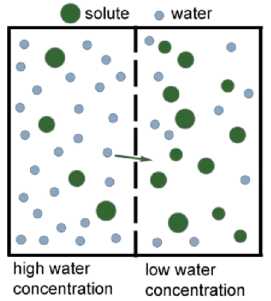
    • It helps in diffusion and osmosis
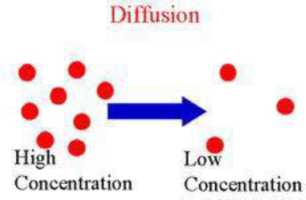
    • Diffusion: movement of substance from high concentration to low

    concentration.

    Eg; exchange of carbon dioxide or oxygen with external environment.

    osmosis: it is the passage of water from the region of high water concentration to a region of low water concentration through a selective permeable membrane.

    1. The cell gains water, if the medium surrounding the cell has a higher water concentration (Hypotonic solution) than the cell.
    2. The cell maintains the same water concentration as the cell (Isotonic solution), water crosses the cell membrane in both directions.
    3. The cell loses water, if the medium has lower water concentration (Hypertonic solution) than the cell.

    Note – The cell drinking is endosmosis;

    • omission of water is called ex-osmosis.

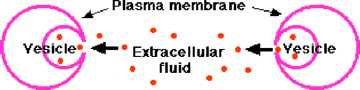
    ENDOCYTOSIS EXOCYTOSIS

    1. The cell engulfs food is called endocytosis and ejects solid is called exocytosis. Amoeba acquires food through endocytosis and excretion of solid is called exocytosis.
    2. The cell wall is a rigid outer covering composed of cellulose. It provides structural strength to plant cells. When a living cell loses water, there is shrinkage of contents of a cell away from the cell wall. This phenomenon is called as plasmolysis. The cell walls permit the cells of plants, fungi and bacteria to withstand very dilute (Hypotonic) external media without bursting.
    3. The Nucleus: It is a dark colored, spherical or oval, dot-like structure near the center of a cell called Nucleus. The nucleus plays a central role in cellular activities/ reproduction. The chromatin material gets organized into chromosomes. The chromosomes contain information for inheritance of features from parents to next generations in the form of DNA( Deoxyribo Nucleic Acid ) and protein molecules. The functional segments of DNA are called genes.
    4. In some organisms like Bacteria nucleus is not covered by nuclear membrane. Hence it is called as prokaryote. (Pro= primitive; karyote = karyon = nucleus.) The organisms with cells having a nuclear membrane are called eukaryotes.
    5. Differences between prokaryotes and eukaryotes( Please refer to Fig. 5.4: Prokaryotic cell NCERT Book Page-62)

    Prokaryotes

    Eukaryotes

    Size: generally small (1-10 |am)

    Size: generally large. (5-500 |am)

    Nuclear region: Not well defined and not surrounded by a nuclear membrane & known as nucleoids.

    Nuclear region: Well defined and surrounded by a nuclear membrane

    Chromosome: Single

    Chromosome: More than one chromosome

    Membrane-bound cell organelles absent

    Membrane-bound cell organelles present

    Eg- bacteria, blue green algae

    Eg fungi, plant cell and animal cell.

    1. Cell organelles: Every cell has fluid matrix (other than nucleus) is called cytoplasm. The nucleus and cytoplasm is together called as protoplasm. The protoplasm term was coined by Purkinje. It has important cell organelles: Endoplasmic Reticulum (ER), Golgi apparatus, Lysosomes, Mitochondria, Plastids, and vacuoles.
    2. Endoplasmic Reticulum (ER): It is a large network of membrane -bound tubules and vesicles.
    • There are two types of Endoplasmic Reticulum
    • Rough Endoplasmic Reticulum (RER) (It looks rough because Ribosomes are attached to its surface. They are the sites of protein synthesis).
    • Smooth Endoplasmic Reticulum (SER) (It looks smooth because Ribosomes are not attached to its surface. They are the sites of fat molecules synthesis).
    1. SER ; help in the functioning of enzymes and hormones to carryout biochemical activities.
    2. SER detoxifies many poisons and drugs from the cell.
    3. ER serves as channel for the transport of material between various regions of the cytoplasm and the nucleus.
    4. Proteins and fat molecules produced by ER helps in membrane biogenesis.
    5. Golgi apparatus: It was first described by a scientist Camillo Golgi. It is a system of membrane bound vesicles called cisterns. It functions include the storage,

    modification and package of cell products. The complex sugars are made from simple sugars in the Golgi apparatus. It is also involved in the formation of lysosomes.

    1. Lysosomes: They contain membrane-bound sacs with powerful digestive enzymes (enzymes are made by RER) to digest the worn-out cell organelles. When the cell gets damaged, lysosomes may burst and the enzymes digest their own cell, hence called as “Suicidal bags of a cell”. It is a waste disposal system of the cell.
    2. Mitochondria: It is covered by a double membrane. Outer membrane is very porous and the inner membrane is deeply folded. These folds create a large surface area for ATP (Adenosine Triphosphate) molecule synthesis. ATP is the energy currency of a cell; hence the Mitochondria are called as Power House of a Cell. Mitochondria have their own DNA and Ribosomes; therefore they can make their own proteins.
    3. Plastids: They are present only in plant cells. They are two types.
    4. Chromoplasts (Colored Plastids: Chloroplasts – Green pigmented and useful in Photosynthesis and also contains various other pigments like yellow or orange)
    5. Leucoplasts (White or colorless plastids; stores materials such as oils, proteins, fats etc. ) Plastids are also covered by a double membrane. The matrix is called Stroma, seat for enzymatic actions. Plastids have their own DNA and Ribosomes; therefore they can make their own proteins.
    6. Vacuoles: Storage sacs for solid or liquid contents. They are small in size in animals while plants have large, may occupy 50-90 % of the cell volume. Helps to provide turgidity and rigidity to the cell. Many substances like amino acids, sugars, organic acids and proteins are stored in vacuoles. In Amoeba food vacuole is specialized to play an important role.
    7. Cell: It is the fundamental structural unit of living organisms, helps in respiration, obtaining nutrition and clearing waste material or forming a new protein.

    Differences between Plant cell and Animal Cell

    (Please refer to Fig. 5.5 Animal cell & 5.6: Plant cell NCERT Book Page-63&64)

    ANIMAL CELL

    PLANT CELL

    Cell wall absent

    Cell wall present

    Plasma membrane is the outer layer which provides turgidity to the cell

    Cell wall is the outer layer which gives rigidity and turgidity to the cell

    Vacuoles are small in size

    Vacuoles are big in size

    Plastids are absent

    Plastids are present

    Nucleus lies in the centre.

    Nucleus lies on one side

    Question Bank

    1. All the living organisms are composed of fundamental unit called as ( Cell)
    2. Who discovered the nucleus in the cell ( Robert Brown)
    3. Who saw the free living cells for the first time ( Leeuwenhoek)
    4. Name two unicellular organisms ( Amoeba, Chlamydomonas,)
    5. Write two differences between prokaryotes and eukaryotes ( Nuclear

    region/ Chromosome)

    1. What are the two types of ERs ( RER/ SER)
    2. What are the functions of Golgi Bodies? (It includes the storage, modification and

    package of cell products. The complex sugars are made from simple sugars in the

    Golgi apparatus).

    1. What are the types of plastids (Chromoplasts& Leucoplasts)
    2. Which are the substances stored in vacuoles? (Substances like amino acids, sugars, organic acids and proteins are stored in vacuoles)
    3. Draw and label Animal cell & Plant cell( Ref NCERT Book Page-63&64)

    QUESTION PAPER:FORMATIVE ASSESSMENT – I (For Practice)

    Time: 90 minutes

    Marks- 40

    * General Instructions

    1. Questions 1-5 ( 1 Mark each)
    2. Questions 11-15 ( 3Mark each)
    3. Questions 6-10 ( 2 Mark each)
    4. . Questions 16-17 ( 5Mark each)

    Q.1 What is ATP, expand the term

    Q.2 Cellulose is a Fat (Mention,True/False)

    Q.3 Which cell organelle is synthesizing the enzymes for the Golgi Apparatus

    Q.4 The flexibility of the cell membrane to engulf food and other material is called

    Endocytosis (Mention, True / False)

    Q.5 What is the main function of Leucoplasts?

    Q.6 Draw the structure of Ovum.

    Q.7 Why the Plasma membrane is called as Selective Permeable Membrane?

    Q.8 Describe what is an isotonic solution Q.9 What is Plasmolysis?

    Q.10 Write any two parts of a Compound microscope.

    Q.11 Distinguish between Prokaryotic and Eukaryotic Cell.

    Q.12 Write about the three properties of Cytoplasm.

    Q.13 What is the significance of Vacuoles Q.14 Write a short notes on Mitochondria.

    Q.15 Explain the concept of diffusion.

    Q.16 Draw the structure of a plant Cell and label it.

    Q.17 Write the differences between a plant and animal cell.

    X

  • Structure of the Atom Notes Class 9th Science Chapter 4

    CHAPTER -4 “STRUCTURE OF ATOM” CONCEPTDETAILS

    KEY CONCEPTS : [ *rating as per the significance of concept]

    1. Dalton’s Atomic theory **
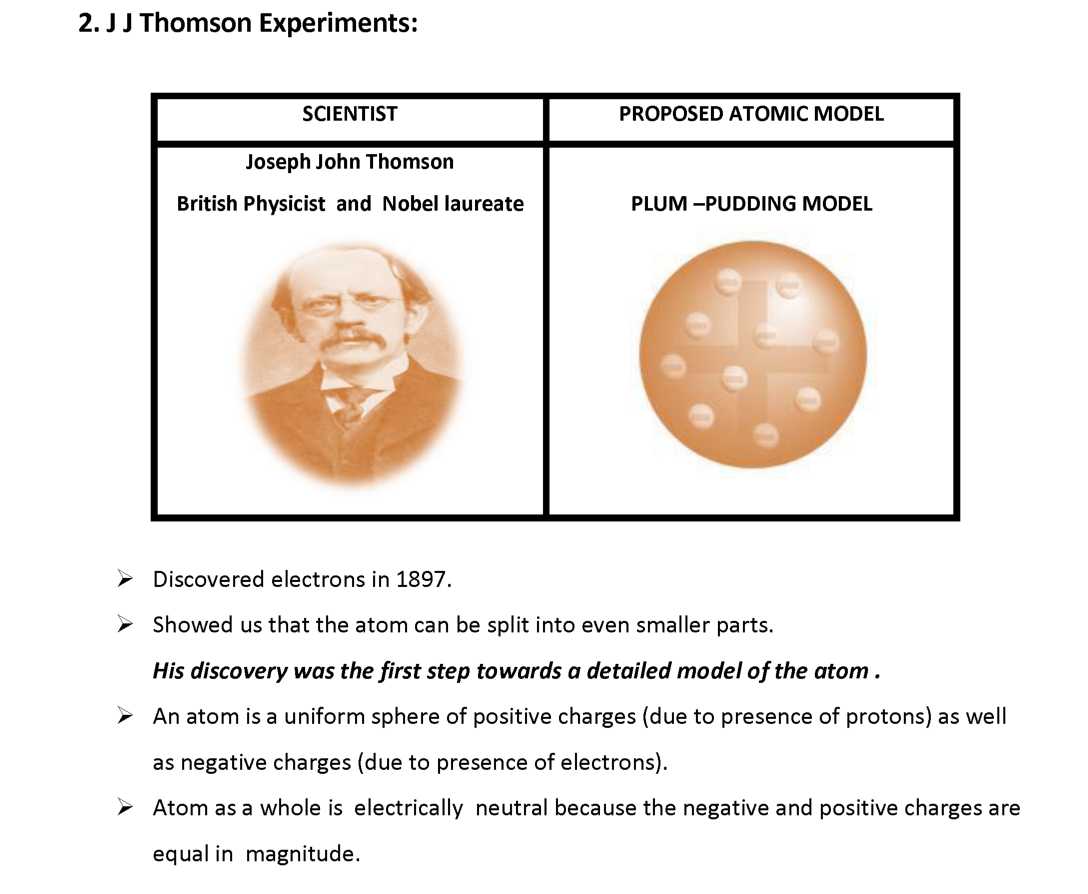
    2. J J Thomson Experiments ***
    3. Rutherford’s Scattering Experiments ********
    4. Sub atomic particles ******
    5. Atomic number & Mass number *****
    6. Neil Bohr’s Atomic Model ***
    7. Electronic Configuration & Valency *******
    8. Isotopes & Isobars ****

    • Pre requisites:
    • Difference between an atom & molecule.
    • Gram atomic mass & Molar mass.
    • Dalton’s Atomic theory.

    SURVEY ANALYSIS

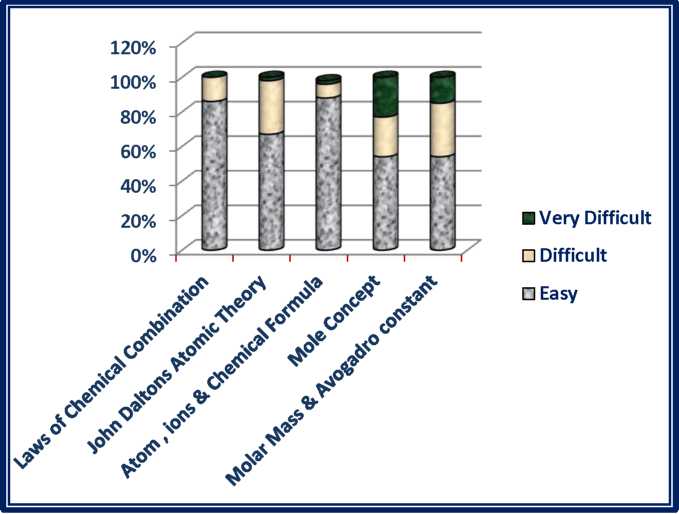
    Conceptual levels of comprehension on the basis of feedback taken from the students


    • First recorded evidence that atoms existed.
    • Using his theory, Dalton rationalized the various laws of chemical combination

    Dalton’s theory was based on the premise that the atoms of different elements could be distinguished by differences in their weights.

    • Limitations

    o The indivisibility of an atom was proved wrong , for, an atom can be further subdivided into protons, neutrons and electrons. o The atoms of same element are similar in all respects , but isotopes of same element have different mass.

    Dalton’s theory was based on the premise that the atoms of different elements could be distinguished by differences in their weights.

    • An electron is a negatively charged component of an atom which exists outside the nucleus. Each electron carries one unit of negative charge and has a very small mass as compared with that of a neutron or proton.

    Effects of Electric Field on Cathode Rays

    JJ Thomson used cathode ray tubes to demonstrate that the cathode ray responds to both magnetic and electric fields.

    Since the ray was attracted to a positive electric plate placed over the cathode ray tube (beam deflected toward the positive plate) he determined that the ray must be composed of negatively charged particles.

    He called these negative particles “electrons.”

    Limitation: Model failed to explain how protons and electrons were arranged in atom so close to each other.


    Eugene Goldstein:

    • E. Goldstein in 1886 discovered the presence of new radiations in a gas discharge and called them canal rays. These rays were positively charged radiations which ultimately led to the discovery of another sub-atomic particle.
    • Used a Cathode Ray Tube to study “canal rays” which had electrical and magnetic properties opposite of an electron
    • Canal Rays: The positively charged radiation produced in the discharge tube at low pressure and high voltage are called canal rays.

    Protons:

    The canal rays have positively charged sub-atomic, particles known as protons (p).

    Q.1 What was the model of an atom proposed by Thomson? Q.2 What is the nature of charge on electrons?

    Q.3 What are canal rays ?

    Q.4 State the nature of the constituents of canal rays.


    Experiment: Rutherford took a thin gold foil and made alpha particles , [ He2+ ] positively charged Helium fall on it.

    S.No OBSERVATION INFERENCE
    1. Most of the a-particles passed through Most of the space inside the atom is
    the gold foil without getting deflected. empty.
    2. Very few particles were deflected. Positive charge of the atom occupies
    very little space.
    3. A very few alpha particles, 1 in 100000 Nucleus of an atom is very small as
    completely rebound on hitting the gold compared to the total size.
    foil.

    • Limitation: In Rutherford’s atomic model , Nucleus & electrons are held together by electrostatic force of attraction which would lead to the fusion between them. This does not happen in the atom.

    Atomic radius ~ 100 pm = 1 x 10⁻¹⁰ m Nuclear radius ~ 5 x 10⁻³ pm = 5 x 10-15 m

    • In 1932, James Chadwick proved that the atomic nucleus contained a neutral particle which had been proposed more than a decade earlier by Ernest Rutherford officially discovered the neutron in 1932,
    • Chadwick received the Nobel Prize in 1935.

    A neutron is a subatomic particle contained in the atomic nucleus. It has no net electric charge, unlike the proton’s positive electric charge.

    Q.1 Who discovered the nucleus of the atom?

    Q.2 What is the charge on alpha particles ?

    Q.3 Which observation of Rutherford’s scattering experiment established the presence large empty space in atom?

    Q.4 What is the nature of charge on nucleus of atom?

    Q.5 Who discovered neutron ?

    1. Sub Atomic Particles:
    Name Symbol Location in the atom Charge Relative Mass Actual Mass (g)
    Electron E Around the nucleus 1- 1/1840 9.11 x 10 -28
    Proton P In the nucleus 1+ 1 1.67 x 10 -24
    Neutron n In the nucleus 0 1 1.67 x 10 -24

    Protons & Neutrons collectively are known as NUCLEONS.

    Q.1 Why is the relative mass of an electron is taken as negligible ? Q.2 Give the actual masses of electron & proton in kg?

    Q.3 What are nucleons?

    1. Atomic Number & Mass Number:

    “Atomic number of an element is defined as the number of unit positive charges on the nucleus (nuclear charge) of the atom of that element or as the number of protons present in the nucleus.”

    Atomic number, Z = Number of unit positive charge on the nucleus = Total number of unit positive charges carried by all protons present in the nucleus.

    = Number of protons in the nucleus (p)

    = Number of electrons revolving in the orbits (e)

    Eg :- Hydrogen – Atomic number = 1 (1 proton)

    Helium – Atomic number = 2 (2 protons)

    Mass number[ A] : It is defined as the sum of the number of protons & neutrons present in the nucleus of an atom.

    Mass Number = Mass of protons + Mass of neutrons Eg :- Carbon – Mass number = 12 (6 protons + 6 neutrons) Mass = 12u Aluminium – Mass number = 27 (13 protons + 14 neutrons) Mass = 27u


    Main Postulates of the Bohr Model [refer NCERT Text Book article 4.3 page number-49]
    Q.1 What happens when an electron jumps from lower to higher energy level?

    Q.2 Which energy shell is nearest to the nucleus of an atom?

    Q.3 Which energy shell has higher energy L or N ?

    1. Electronic configuration & Valency: Bohr and Bury Scheme – Important Rules
    S.No Electron Shell 2n2

    where n = shell number

    Maximum Capacity
    1 K Shell 2 x (1) 2 2 electrons
    2 L Shell 2 x (2) 2 8 electrons
    3 M shell 2 x (3) 2 18 electrons
    4 N shell 2 x (4) 2 32 electrons

    The outermost shell of an atom cannot accommodate more than 8 electrons, even if it has a capacity to accommodate more electrons. This is a very important rule and is also called the OCTET RULE. The presence of 8 electrons in the outermost shell makes the atom very stable.

    Q.1 An atoms has atomic number 13. What would be its configuration.

    Q.2 What is octet rule?

    Q.3 How many electrons M shell can accommodate?

    Q.4 If an atom has complete K and L shell, what would be its atomic number?

    1. Isotopes & Isobars:
    ISOTOPES ISOBARS
    Chemically same , physically different Chemically different , physically same
    Number of electrons is same Number of electrons is different .
    Cannot be separated by chemical means Can be separated by chemical means

    [ for application of isotopes refer NCERT Text Book article 4.6 page number-53]

    Q.1 Why atoms of isotopes are chemically same?

    Q.2 Give the representation of three isotopes of carbon which are C-12, C-13 and C-14.


    |L_QUESTIONJANKJ^HOTSJJ

    1. Mark Questions:
    2. Write the names of three elementary particles which constitute an atom.
    3. Name the scientist & his experiment to prove that nucleus of an atom is positively charged.
    4. Which is heavier , neutron or proton ?
    5. *How many times a proton is heavier than an electron?
    6. What was the model of an atom proposed by Thomson ?
    7. How many electrons at the maximum can be present in the first shell ?
    8. What type of charge is present on the nucleus of an atom?
    9. Give the number of protons in 35Cl17
    10. *What are iso bars ?
    11. Name the particles which determine the mass of an atom.
    12. Marks Questions:
    13. Define the following terms: a) Atomic number b) Mass number
    14. Write the charges on sub atomic particles.
    15. Identify the isotopes out of A , B , C & D ? 33A17 , 40B20 , 37C17 , 38D19
    16. * Give one Achievement and one limitation of J.J Thomson’s model of atom?
    17. What are valence electrons? Give example.
    18. *Which kind of elements have tendency to lose electron ? Give example.
    19. How many electrons are present in the valence shell of nitrogen & argon?
    20. State the maximum capacity of various shells to accommodate electrons.
    21. Give the symbol , relative charge & mass of the three sub atomic particles.
    22. From the symbol 32 S16 state :

    i) Atomic number of sulphur, ii) Mass number of sulphur iii) Electronic configuration of sulphur.

    1. Marks Questions:
    2. Why do Helium has Zero valency?
    3. An atom contains 3 protons , 3 electrons and 4 neutrons .What is its atomic number , mass number & valency?
    4. *How are the isotopes of hydrogen represented ?
    5. Write the complete symbol for the atom with the given atomic number [Z] & mass

    number[A].

    i) Z= 17 , A = 15 ; ii) Z=4 , A = 9; iii) Z= 92 ; A=233

    1. *What would be the electronic configuration of Na+ , Al3+ , O2- , Cl .

    5 Marks Questions:

    1. * a) Give the observations as well as inferences of Rutherford’s Scattering experiment for determining the structure of an atom.

    b) On the basis of above experiment write the main features of atomic model.

    1. Write the main postulates of Bohr’s Model of Atom.

    |poUare^xpectedto^now^^^|

    • The scientists who discovered subatomic particles.
    • Rutherford established the existence of nucleus.
    • Difference between Atomic number and Mass number
    • Electronic configuration & its relation with Valency.
    • Difference between Isotope and Isobar.
  • Atoms and Molecules Notes Class 9th Science Chapter 3

    CHAPTER – 3 Atoms and Molecules _concept details

    KEY CONCEPTS : [ *rating as per the significance of concept]

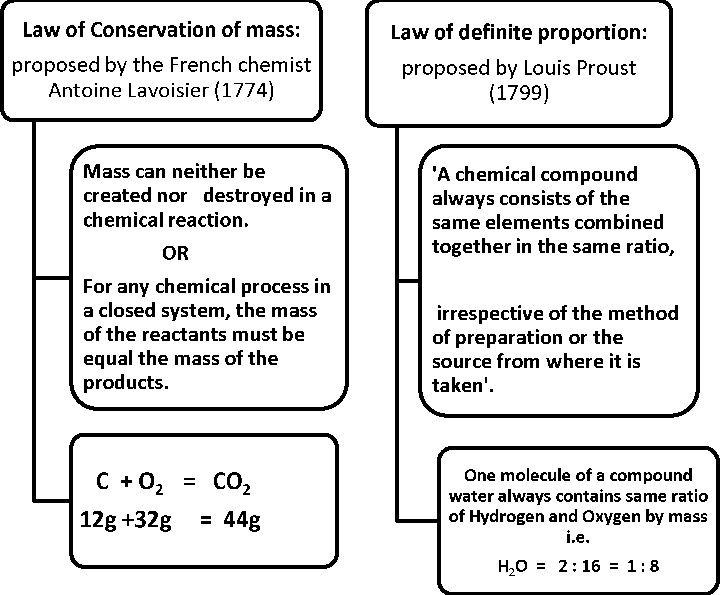
    1. Laws of Chemical Combination

    ***

    2. John Daltons Atomic Theory

    **

    3. Atoms, ions & Chemical Formula

    ****

    4. Mole Concept

    *****

    5. Molar Mass & Avogadro constant

    ****

    Verification of “Law of Conservation of mass”

    l.Laws of Chemical Combination |

    A solution of sodium chloride and silver nitrate are taken separately in the two limbs of an ‘H’ shaped tube. The tube is sealed and weighed precisely. The two reactants are made to react by inverting the tube. The following reaction takes place.

    AgNO3(aq) + NaCl (aq) -> AgCl (s) + NaNO3 (aq)

    The whole tube is kept undisturbed for sometime so that the reaction is complete. When the tube is weighed again it is observed that:

    Weight before the reaction = Weight after the reaction Limitation of “Law of definite proportion”

    This law does not hold good when the compound is obtained by using different isotopes of the combining elements .

    Q.1 Why chemical reactions are in accordance with the Law of conservation of mass? Q.2 Calculate the ratio of atoms present in 5 g of magnesium and 5 g of iron.

    [Atomic mass of Mg=24 u, Fe=56 u]

    1. John Daltons Atomic Theory |

    [ for postulates ,refer NCERT text book article 3.1.2 -page no.32 ]

    Using his theory, Dalton rationalized the various laws of chemical combination which were in existence at that time. However, he assumed that the simplest compound of two elements must be binary.

    Q.1 In what respect does Dalton’s Atomic theory hold good even today?

    Q.2 Which of the following is not the postulate of Dalton’s Atomic theory of matter ?

    1. Each element is made up of extremely small particles called atoms.
    2. Atoms of a given element are identical in chemical properties but have different

    physical properties.

    1. Atoms cannot be created nor destroyed.
    2. Compounds are formed by the chemical union of atoms of two or more elements in fixed proportion .
    3. Atoms ,Molecules, Ions & Chemical Formula |

    Atom

    Molecule

    -o-

    An atom is the smallest particle of an element which can take part in a chemical reaction. It may or may not exist freely.

    The smallest particle of matter (element or compound) which can exist in a free state.

    -0-

    O

    Each atom of an element shows all the properties of the element.

    The properties of a substance are the properties of its molecules.

    • MOLECULES OF ELEMENT: The molecules of an element are constituted by the same type of atoms.
    • MOLECULES OF COMPOUND: Atoms of different elements join together in definite proportions to form molecules of compounds.(hetero atomic molecules)
    • ATOMICITY : The number of atoms contained in a molecule of a substance (element or compound) is called its atomicity.

    Element

    Formula

    Atomicity

    Ozone

    O3

    3

    Phosphorus

    P4

    4

    Sulphur

    S8

    8

    Oxygen

    O2

    2

    • Based upon atomicity molecules can be classified as follows.

    Monoatomic molecules: Noble gases helium, neon and argon exist as He Ne and Ar

    respectively.

    Diatomic molecules: H2 , O2, N2,Cl2, CO , HCl .

    Triatomic molecules: O3 ,CO2 , NO2.

    • SYMBOLS
    • The abbreviation used to represent an element is generally the first letter in capital of the English name of element.

    Oxygen -> O Nitrogen -> N

    • When the names of two or more elements begin with the same initial letter, the initial letter followed by the letter appearing later in the name is used to symbolize the element

    Barium -> Ba Bismuth -> Bi

    Symbols of some elements are derived from their Latin names

    ELEMENT

    LATIN NAME

    SYMBOL

    Sodium

    Natrium

    Na

    Copper

    Cuprum

    Cu

    Potassium

    Kalium

    K

    Iron

    Ferrum

    Fe

    Mercury

    Hydragyrum

    Hg

    Tungsten

    Wolfram

    W

    Q.1 Give one example each of molecule of element & molecule of compound.

    Q.2 How does an atom differ from molecule ?

    Q.3 Name a triatomic gas.

    Q.4 Name the element represented by Hg, Pb, Au.

    Q.5 What is the difference between an atom of hydrogen and a molecule of hydrogen?

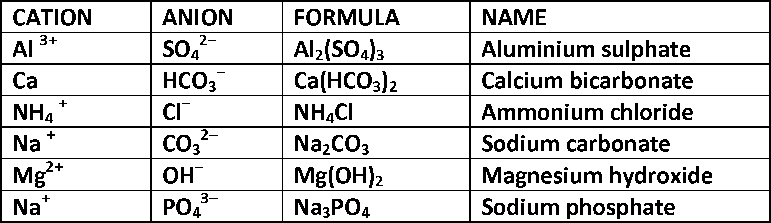
    Polyatomic Ion : A group of atoms carrying a charge is as polyatomic ion.

    eg: NH4+ – Ammonium Ion ; CO32- – Carbonate ion

    Valency : The number of electrons which an atom can lose , gain or share to form a bond.

    OR

    It is the combining capacity of an atom of the element.

    [ for valency of various cations & anions ,refer NCERT text book table 3.6, page no. 37 ]

    ♦♦♦ Chemical Formula: A chemical formula is a short method of representing chemical elements and compounds.

    Writing a Chemical Formula -CRISS-CROSS rule

    [ b]

    RULE 1 [a]

    write the correct symbols of two elements.

    Ex : Aluminium & Oxygen

    Al O

    above each symbol, write the correct valence

    Al3+ O2-

    [c]

    Criss-cross the valence and drop the algebraic sign.

    Al2O3

    RULE 2 >

    When the subscript is number 1, subscript is not written.

    Ex. Sodium Chloride

    – Na1+ Cl1- — NaCl

    RULE 3> When the valence of both elements are numerically equal , the subscripts are also not written.

    Ex. Calcium Oxide- – Ca2+ O2- — CaO

    RULE 4 > When there are multiple numbers of an individual polyatomic ion ,

    parentheses must be used to separate the polyatomic ion from the subscirpt.

    Ex. Ammonium Sulphate- – NH41+ SO/ ‘ (NH4)2 SO4

    EXAMPLES

    1. Mole Concept \

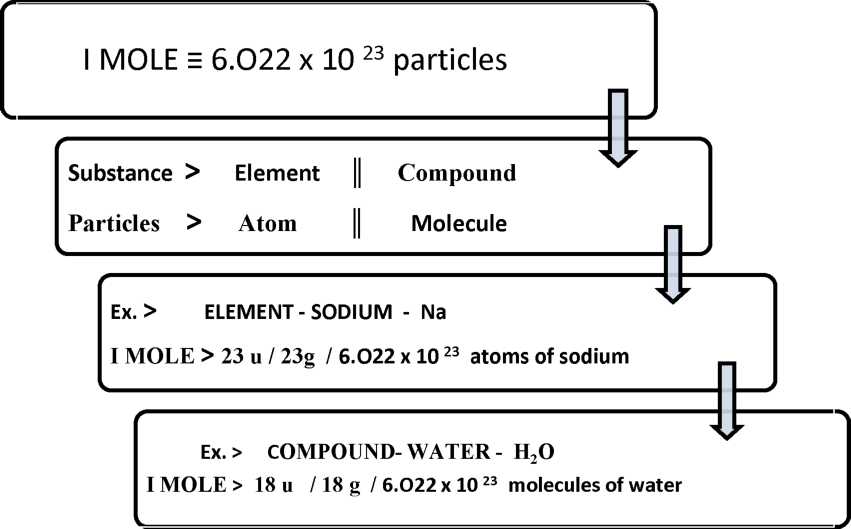
    The mole (mol) is the amount of a substance that contains as many elementary entities as there are atoms in exactly 12.00 grams of 12C

    The Avogadro constant is named after the early nineteenth century Italian scientist Amedeo Avogadro.

    S.No.

    Symbol / formula of atom / molecule

    Atomic / molecular mass ( u)

    lmole ( in g)

    Avogadro no.

    Molar mass ( g mol -1)

    1.

    O

    16 u

    16 g

    6.022 x 10²³ atoms

    16 g mol -1

    2.

    Nz

    28 u

    28 g

    6.022 x 10²³ molecules

    28 g mol -1

    3.

    HCl

    36.5 u

    36.5 g

    6.022 x 10²³ molecules

    36.5 g mol -1

    GRAM MOLECULAR MASS

    Gram molecular mass is the mass in grams of one mole of a molecular substance.

    Ex: The molecular mass of N2 is 28, so the gram molecular mass of N2 is 28 g.

    ATOMIC MASS UNIT

    An atomic mass unit or amu is one twelfth of the mass of an unbound atom of carbon-12. It is a unit of mass used to express atomic masses and molecular masses.

    Also Known As: Unified Atomic Mass Unit (u).

    MOLECULAR MASS : A number equal to the sum of the atomic masses of the atoms in a molecule. The molecular mass gives the mass of a molecule relative to that of the 12C atom, which is taken to have a mass of 12.

    Examples: The molecular mass of C2H6 is approximately 30 or [(2 x 12) + (6 x 1)]. Therefore the molecule is about 2.5 times as heavy as the 12C atom or about the same mass as the NO atom with a molecular mass of 30 or (14+16).

    Q.1 What term is used to represent the mass of 1 mole molecules of a substance? Q.2 What is the gram atomic mass of i) Hydrogen ii) oxygen ?

    Q.3 Calculate molar mass of C2H2.

    1. Molar Mass & Avogadro Constant |

    Ex: i) Convert 35 g of Al into mol.

    A: Molar mass of Al= 27 g

    27 g = 1mol

    1mol

    = 35 g x

    27 g

    = 1.3 mol of Al

    ii) How many grams of SiO2 are present in 0.8 mol ?

    A: Molar mass of SiO2 = 60.1 g

    1 mol = 60.1 g

    60.1g of SiO2

    = 0.8 mol of SiO2 x

    1mol of SiO2

    = 48.1 g SiO2

    Q.1 Calculate the mass of one atom of sodium?

    Q.2 The atomic mass of calcium is 40 u. What will be the number of calcium atoms in 0.4 u of calcium?

    Q.3 How many atoms of oxygen are present in 120 g of nitric acid ?

    1. Mark Questions:
    2. Who gave law of conservation of mass ?
    3. What term is used to represent the mass of 1 mole molecules of a substance?
    4. What name is given to the number 6.023 x 10 23 ?
    5. What is molecular mass?
    6. Give Latin names for sodium & mercury.
    7. *How many atoms are there in exactly 12 g of carbon ?
    8. Define mole.
    9. Calculate formula unit mass of CaCl2. [ At. Mass : Ca = 40 u , Cl = 35.5 u ]
    10. Name a diatomic gas.
    11. How many atoms are present in H2SO4.
    12. Marks Questions:
    13. Give the chemical symbols for the following elements: Gold, Copper , Potassium & Iron.
    14. *What do the following symbols represent – i) 1 H & i) H2
    15. Neon gas consists if single atoms , what mass of neon contain 6.022 x 10²³ atoms.
    16. What elements do the following compounds contain ? i) Water ii) Lead nitrate
    17. State the differences between an atom or a molecule.
    18. Molar Mass of water is 18 g mol-1 , what is the mass of 1 mole of water? .
    19. *The number of atoms in 1 mole of hydrogen is twice the number of atoms in one mole of helium. Why?
    20. Write the chemical formulas for the following:

    i) Silver oxide ii) Iron (III) sulphate

    1. Calculate molar mass of H2O2 & HNO3.
    2. What is the mass of 0.2 moles of oxygen molecules?
    3. Marks Questions:
    4. State the main postulates of John Dalton’s atomic theory.
    5. What are polyatomic ions ? Give two examples.
    6. State the following
    7. Law of conservation of mass. ii) Law of constant proportion
    8. What is the mass of :
    9. 1 mol of N atoms. ii) 4 mol of Al atoms.
    10. What is meant by the term atomicity ? State the atomicity of i) Phosphorous
    11. Sulphur

    5 Marks Questions:

    1. i) What is molecular formula ? State with example what information can be derived from a molecular formula .
    2. Write the names of the compounds represented by the following formulas: a) Mg(NO3)2 b) K2SO4 c )Ca3N2
    3. * i) What is gram molecular mass?
    4. Write the formulas & names of the compounds formed between :

    a) Ferrous and sulphide ions b) Aluminium and sulphate ions

    1. Potassium and chlorate ions d) Barium and chloride ions
    2. i) Calculate the number of moles for the following:

    a) 52 g of He b) 17 g of H2O

    1. How many molecules are present in 34 g of ammonia ?
    2. Calculate the mass of 0.5 mole of sugar (C12H22O11).

    You Are expected to know..

    • Laws of Chemical combination.
    • John Dalton’s imagination about atom & the limitation of his theory.
    • Difference between an atom & molecule.
    • Types of ions
    • Writing chemical formula of compounds.
    • Relationship between Mole , Molar Mass & Avogadro Constant
  • Is Matter Around Us Pure Notes Class 9th Science Chapter 2

    CHAPTER – 2 “Is Matter Around Us Pure”

    CONCEPT DETAIL

    KEY CONCEPTS : [ *rating as per the significance of concept ]

    1. Pure Substance & Mixture

    ***

    2. Types of Mixtures

    ****

    3. Methods of Separation of Mixtures

    ******

    4. Concentration & Types of Solutions

    *****

    5. Physical & Chemical Changes

    ***

    6. Alloys

    **

    -I- Pre requisites

    • Basic knowledge of particle nature of matter
    • Different states of matter

    SURVEY ANALYSIS

    Conceptual levels of comprehension on the basis of feedback taken from the students

    120%

    PURE SUBSTANCE

    MIXTURE

    • Pure substance consists of a single type of substance .

    • Mixture consists of two or more pure substances.

    • Pure substance cannot be

    separated into other substances by physical methods.

    • Mixture can be separated into its components by physical methods.

    • Pure substance has its own definite properties.

    • Mixture shows the

    properties of its components.

    Elements are made up of one kind of atoms only. Compounds are made up of one kind of

    1. Pure Substance & mixture |

    molecules only.

    Difference between Compound &Mixture [ refer NCERT text Book Tab.2.2, page 26]

    Q.1 Is air around us a compound or mixture?

    Q.2 Water is a compound. Justify.

    Q.3 Classify the following as element, compound and mixture: Iron, sea water, Milk Q.4 Are the naturally occurring material in nature chemically pure substances?

    ^TypesofMixtures^J

    Mixtures can also be grouped

    1. on the basis of their physical states:
     

    SOLID

    LIQUID

    GAS

    SOLID

    • Salt and sugar

    • Salt and water

    • Dust in air

    LIQUID

    • Mercury and copper

    • Alcohol and water

    • Clouds

    GAS

    • Hydrogen and palladium

    • Oxygen and water

    • Air

    ii) on the basis of miscibility:

    Homogeneous Mixture

    Heterogeneous Mixture

    • It consists of single phase.
    • Uniform composition.
    • Example: Sugar dissolved in water
    • It consists of two or more phase.
    • Does not have uniform composition.
    • Example: Air, sand and common salt.

    Q.1 Give one example for each of the following mixtures: i) Solid/solid (homogeneous)

    1. Solid/solid (heterogeneous) iii) Liquid/liquid (homogeneous) iv) Liquid/liquid (heterogeneous) v) Gas/liquid (homogeneous)..

    Q.2 Classify the following as homogeneous & heterogeneous mixture:

    1. sodium chloride & water ii) glucose & water iii) sand & water iv) air
    2. Separating the components of a mixture |

    The components of a heterogeneous mixture can be separated by

    • simple methods like –

    hand picking, sieving, & Winnowing

    • special techniques like –
    1. Evaporation : a mixture of salt and water or sugar and water.
    2. Centrifugation : Butter from curd, Fine mud particles suspended in water.
    3. Decantation (Using separating funnel) : Oil from water.
    4. Sublimation : Camphor from salt,
    5. Chromatography : Different pigments from an extract of flower petals.
    6. Distillation and fractional distillation : Separating components of Petroleum viii) Magnetic separation: Iron pins from sand.

    Q.1 Name the process you would use to :

    1. recover sugar from an aqueous sugar solution.
    2. separate mixture of salt solution and sand.

    Q.2 How will you separate a mixture of sand, water and mustard oil ?

    1. Concentration of Solution |

    The amount of solute present in a given amount (mass or volume) of solution.

    Amount of solute Amount of solute

    Concentration of a solution = OR

    Amount of solvent Amount of solution

    The concentration of a solution can be expressed as mass by mass percentage or as mass by volume percentage.

    Mass of solute

    Mass by mass percentage of a solution = x 100

    Mass of solution Mass of solute

    Mass by volume percentage of a solution = x 100

    Volume of solution

    lypefii^

    a) on the basis of size of solute particles:

    True solution

    Sol [ Colloid]

    Suspension

    • Homogeneous

    • Heterogeneous

    • Heterogeneous

    • Size of solute

    particles is less than

    q

    1 n m or 10 m .

    • Size of solute particles is between 1 nm to 1000 nm.

    • Size of solute particles is more than 1000 nm.

    • Particles cannot pass through filter paper.

    • Particles can pass through filter paper.

    • Particles cannot pass thorough filter paper.

    • Stable

    • Stable and settle only on centrifugation.

    • Unstable and settle down on its own.

    • Solution of sodium chloride in water, sugar & water.

    • Milk , Fog

    • muddy water, chalk & water,
    • smoke in the air.

    [ types of colloids : refer NCERT Text Book table 2.1, page 18 ]

    Colloidal solution is a heterogeneous mixture. It consists of two phases:-

    1. Dispersed phase : component present in small proportion
    2. Dispersion medium : component present in large proportion

    The particles of colloid are large enough to scatter a beam of light passing through it and make its path visible. Thus, they show Tyndall effect.

    The colloidal particles are moving at random in a zigzag motion in all directions.

    This type of zig-zag motion of colloidal particles is called Brownian movement.

    b) on the basis of amount of solute:

    Unsaturated solution

    Saturated Solution

    Supersaturated solution

    A solution which has lesser amount of solute that it can dissolve at a given temperature is known as unsaturated solution.

    A solution which has maximum amount of solute that it can dissolve at a given temperature is known as saturated solution.

    A solution which can dissolve amount of solute by increasing temperature saturated solution is known as supersaturated solution.

    c) on the basis of nature of solvent

    Aqueous solution

    Non-Aqueous solution

    The solution in which the solvent is water is known as aqueous solution.

    The solution in which the solvent is other than water (ether, alcohol or aceton) known as non-aqueous solution.

    Q.1 Classify the following substances into true solutions and colloidal solutions.

    Milk , ink , starch dissolved in water.

    Q.2 A solution has been prepared by dissolving 5g of urea in 95 g of water. What is the mass percent of urea in the solution?

    Q.3 Give an example of an aqueous solution in which gas is dissolved.

    1. Physical & Chemical Changes I

    Physical changes – Changes that do not result in the production of a new substance.

    • If you melt a block of ice, you still have H2O at the end of the change.
    • If you break a bottle, you still have glass.

    Examples : melting, freezing, condensing, breaking, crushing, cutting, and bending.

    Chemical changes – Changes that result in the production of another substance.

    • As in the case of autumn leaves, a change in color is a clue to indicate a chemical change.
    • a half eaten apple that turns brown.

    Q.1 Which of the following is an example of physical change?

    1. Mixing baking soda and vinegar together, and this causes bubbles and foam.
    2. A glass cup falls from the counter and shatters on the ground.
    3. Lighting a piece of paper on fire and the paper burns up and leaves ashes.
    4. Baking a birthday cake for your mother.

    Q.2. Which of the following is an example of chemical change?

    1. Filling up a balloon with hot air.
    2. Taking a glass of water and freezing it by placing it in the freezer.
    3. A plant collecting sunlight and turning it into food.
    4. Your dog ripping up your homework.
    5. Which change can be easily be reversed?
    6. Chemical Change
    7. Physical Change
    8. Both a physical and chemical change
    9. Neither a physical or chemical change

    |^.ANoysJ

    A material that has metallic properties and is composed of two or more chemical elements of which at least one is a metal .

    • These cannot be separated into their components by physical methods.
    • However, these are considered as mixture because these show the properties of its constituents and can have variable composition.

    The benefit of alloys is that you can combine metals that have varying characteristics to create an end product that is stronger, more flexible, or otherwise desirable to manufacturers.

    • Aluminium alloys are extensively used in the production of automotive engine parts.
    • Copper alloys have excellent electrical and thermal performance, good corrosion resistance, high ductility and relatively low cost.
    • Stainless steel alloys are used for many commercial applications such as watch straps, cutlery etc.
    • Titanium alloys have high strength, toughness and stiffness & are used in aerospace structures .

    Q,1 Why should we use alloys instead of pure metals? Q.2 State uses of Aluminium & Stainless steel alloys.

    ILQUESTIONJANKJ^HOTSJJ

    1. Mark Questions:
    2. What is meant by pure substance?
    3. What is meant by mass percentage of solution?
    4. Name the process of separation of miscible liquids.
    5. Arrange the following in decreasing order of size of the particles.

    True Solution , Suspension , Colloid.

    1. *Give an example of an aqueous solution in which gas is dissolved.
    2. Name the dispersion medium and dispersed phase in the white material inside an egg.
    3. What happens when hot saturated solution is cooled?
    4. How would you separate a mixture of chalk and water?
    5. *How much water should be added to 15 grams of salt to obtain 15 % salt solution?
    6. What type of mixtures are separated by technique of crystallization ?
    7. Marks Questions:
    8. Which of the following materials fall in the category of a pure substance?

    a) Ice b) Milk c) Iron d) Hydrochloric acid

    e) Calcium oxide f) Mercury g) Brick h) Wood.

    1. What do you understand by saturated solution and unsaturated solution?
    2. *What do you observe when sunlight passes through a dense forest?
    3. List two points of differences between homogeneous and heterogeneous mixtures.
    4. State the difference between aqueous & non aqueous solution .
    5. Which of the following will show “Tyndal Effect” & Why ?

    a) Salt Solution b) Milk c) Copper Sulphate Solution d) Starch Solution

    1. *How can we obtain pure copper sulphate from an impure sample?
    2. Give two differences between compounds and mixtures.
    3. Why is hydrogen considered as element ? Give two reasons.
    4. Why water is a compound and not a mixture?
    5. Marks Questions:
    6. Classify the following into elements, compounds and mixtures:

    a) Sodium b) Soil c) Sugar solution d) Silver e) Calcium carbonate f) Tin g) Silicon h) Coal i) Air j) Soap k) Methane l) Carbon dioxide m) Blood.

    1. Give any two applications of centrifugation.
    2. Which of the following is chemical change?

    a) Growth of a plant b) Rusting of iron c) Mixing of iron fillings and sand d) Cooking of food e) Digestion of food f) Freezing of water g) Burning of a candle.

    1. *State the difference between simple distillation & fractional distillation.
    2. * A solution contains 40 ml of ethanol mixed with 100 ml of water. Calculate the concentration in terms of volume by volume percentage of the solution.

    5 Marks Questions:

    1. *What is meant by Tyndall effect? What is its cause? Illustrate with example.
    2. How would you separate the mixture containing sulphur and sand ?
    3. What is crystallization? Give its two applications.
    4. How are sol, solution and suspension different from each other?
    5. How do we obtain coloured components, i.e. dye from Blue/Black ink ?

    |^ou^re^xpected^o^now^J

    • Types of mixtures.
    • Method of Separation of mixtures.
    • Types of solutions.
    • Concentration terms of solution.
    • Physical and Chemical Change.
    • Significance of alloys.