Category: Classes

  • Matter in Our Surroundings Notes Class 9th Science Chapter 1

    CHAPTER – 1 “Matter in our Surroundings”

    conceptdetails

    KEY CONCEPTS : [ *rating as per the significance of concept]

    1. Particle nature of Matter

    ***

    2. States of Matter

    ****

    3. Interchange in states of Matter

    *****

    4. Evaporation & Boiling

    ****

    5. Kelvin , Celsius scale

    ***

    -I- Pre requisites

    • Definition of matter.
    • Elementary idea of three physical states of matter.

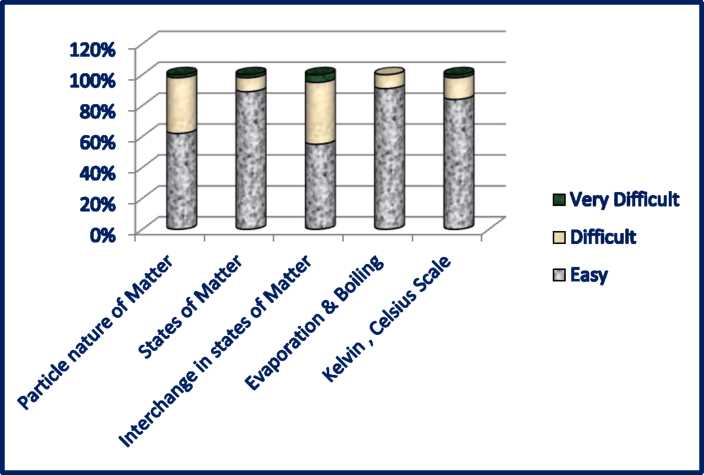
    SURVEY ANALYSIS

    Conceptual levels of comprehension on the basis of feedback taken from the students

    1. Particle Nature of Matter j

    [ refer NCERT text book activities 1.1 to 1.8 1

    • Anything that occupies space and has mass and is felt by senses is called matter.
    • Matter is the form of five basic elements the Panch tatva – air , earth fire , sky and water.
    • Characteristics of particles of matter
    • Made of tiny particles.
    • Vacant spaces exist in particles.
    • Particles are in continuous motion.
    • Particles are held together by forces of attraction.

    Q.1 Define matter.

    Q.2 What happens if you put copper sulphate crystals in water?

    [ refer NCERT text book activities 1.9 to 1.111

    Basis of Classification of Types

    • Based upon particle arrangement
    • Based upon energy of particles
    • Based upon distance between particles
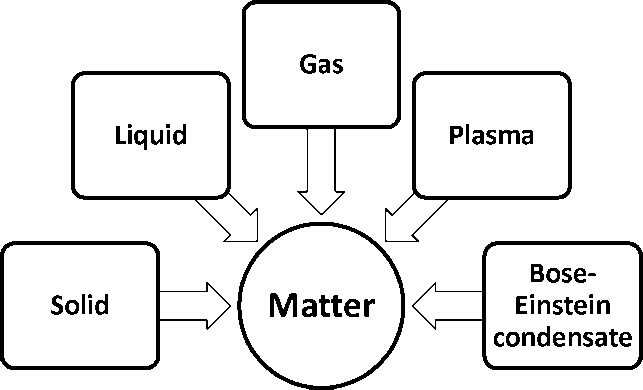
    • Five states of matter
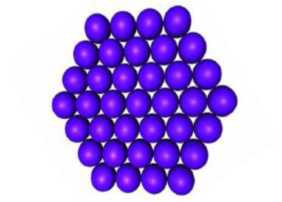
    • Fixed shape and definite volume .
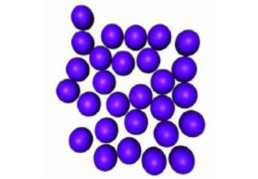
    • Not fixed shape but fixed volume.
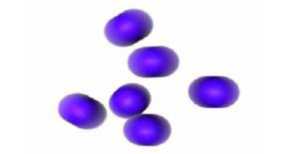
    • Neither fixed shape nor fixed volume.
    • Inter particle distances are smallest.
    • Inter particle distances are larger.
    • Inter particle distances are largest.

    Almost incompressible.

    Incompressible.

    Highly compressible.

    • High density and do not diffuse.
    • Inter particle forces of attraction are strongest.
    • Constituent particles are very closely packed.
    • Density is lower than solids and diffuse.
    • Inter particle forces of attraction are weaker than solids .
    • Constituent particles are less closely packed.
    • Density is least and diffuse.
    • Inter particle forces of attraction are weakest.
    • Constituent particles are free to move about.
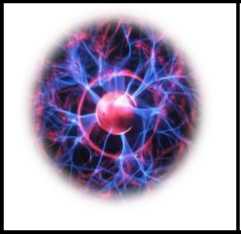
    1. Plasma (non -evaluative)

    A plasma is an ionized gas.

    A plasma is a very good conductor of electricity and is affected by magnetic fields.

    Plasma, like gases have an indefinite shape and an indefinite volume. Ex. Ionized gas

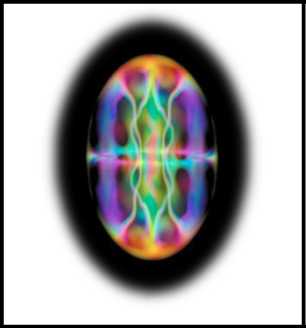
    1. Bose-Einstein condensate (non -evaluative)
    • A BEC is a state of matter that can arise at very low temperatures.
    • The scientists who worked with the Bose-Einstein condensate received a Nobel Prize for their work in 1995.
    • The BEC is all about molecules that are really close to each other (even closer than atoms in a solid).

    Microscopic Explanation for Properties of Solids

    Solids have a definite shape and a definite volume because the particles are locked into place

    Solids do not flow easily because the particles cannot move/slide

    past one another past one another

    Solids are not easily compressible because there is little free space between particles

    Microscopic Explanation for Properties of Liauids

    Liquids are not easily compressible and have a definite volume because there is little free space between particles.

    Liquids have an indefinite shape because the particles can lide

    past one another. past one another.

    Liquids flow easily because the particles can move/slide past one another.

    Microscopic Explanation for Properties of Gases

    Gases are easily compressible because there is a great deal of free space between particles

    Gases have an indefinite shape and an indefinite volume because the particles can move past one another.

    Gases flow very easily because the particles randomly move past one another.

    (non -evaluative)^

    Microscopic Explanation for Properties of Plasmas

    Plasmas have an indefinite shape and an indefinite volume because the particles can move past one another.

    Plasmas are easily compressible because there is a great deal of free space between particles.

    Plasmas are good conductors of electricity &are affected by magnetic fields because they are composed of ions

    Microscopic Explanation for Properties of BEC

    Particles are less energetic than solids because Exist at very low temperature .

    Particles are literally indistinguishable because they are locked into same space .

    BEC shows superfluidity because Particles can flow without friction.

    Q.1 A substance has a definite volume but no definite shape ? State whether this substance is a solid, a liquid or a gas.

    Q.2 Arrange the following substances in increasing order of force of attraction between the particles. (a) Milk (b) Salt (c) Oxygen.

    Q.3 A substance has neither a fixed shape nor a fixed volume . State whether it is a solid, a liquid or a gas.

    Q.4 The melting point of a substance is below the room temperature . Predict its physical state.

    3.Interchange in states of matter

    [ refer NCERT text book activities 1.12 to 1.14 1 Matter Can Change its State

    Water can exist in three states of matter –

    • Solid, as ice ,
    • Liquid, as the familiar water, and
    • Gas, as water vapour.

    Sublimation : The changing of solid directly into vapours on heating & vapours into solid on cooling. Ex. Ammonium chloride , camphor & iodine.

    1. Effect of change in temperature

    The temperature effect on heating a solid varies depending on the nature of the solid & the conditions required in bringing the change .

    • On increasing the temperature of solids, the kinetic energy of the particles increases which overcomes the forces of attraction between the particles thereby solid melts and is converted to a liquid.
    • The temperature at which a solid melts to become a liquid at the atmospheric pressure is called its melting point.
    • The melting point of ice is 273.16 K.
    • The process of melting, that is, change of solid state into liquid state is also known as fusion.
    1. Effect of Change of Pressure
    • Increasing or decreasing the pressure can change the state of matter. Applying pressure and reducing temperature can liquefy gases.
    • Solid carbon dioxide (CO2) is stored under high pressure. Solid CO2 gets converted directly to gaseous state on decrease of pressure to 1 atmosphere without coming into liquid state. This is the reason that solid carbon dioxide is also known as dry ice. Latent Heat :

    The hidden heat which breaks the force of attraction between the molecules during

    change of state.

    Fusion

    Vaporisation

    Heat energy required to change 1kg of solid into liquid.

    Heat energy required to change 1kg of liquid to gas at atmospheric pressure at its boiling point.

    Thus, we can say that pressure and temperature determine the state of a substance, whether it will be solid, liquid or gas.

    [ refer fig. 1.9 NCERT Text Book, page-8 ]

    Q.1

    What is vapour ?

    Q.2 Name the temperature at which the solid and liquid states of substance can exist

    together .

    Q.3

    What is the effect of pressure on boiling point?

    Q.4

    Name any two substances which sublime.

    Q.5

    Define Condensation.

    Q.6 For any substance, why does the temperature remain constant during the

    change of state?

    4. Evaporation & Boiling |

    • Particles of matter are always moving and are never at rest.
    • At a given temperature in any gas, liquid or solid, there are particles with different

    amounts of kinetic energy.

    • In the case of liquids, a small fraction of particles at the surface, having higher kinetic energy, is able to break away from the forces of attraction of other particles and gets converted into vapour .
    • This phenomenon of change of a liquid into vapours at any temperature below its boiling point is called evaporation.
    • Factors Affecting Evaporation
    • The rate of evaporation increases with an increase of surface area.
    • With the increase of temperature, more number of particles get enough kinetic energy

    to go into the vapour state.

    • Humidity is the amount of water vapour present in air. The air around us cannot hold more than a definite amount of water vapour at a given temperature. If the amount of water in air is already high, the rate of evaporation decreases.
    • Wind speed : the higher the wind speed , the more evaporation.

    Evaporation cause cooling.

    The particles of liquid absorb energy from the surrounding to regain the energy lost during evaporation,

    Evaporation Vs Boiling

    • Boiling is a bulk phenomenon. Particles from the bulk (whole) of the liquid change into vapour state.
    • Evaporation is a surface phenomenon. Particles from the surface gain enough energy to overcome the forces of attraction present in the liquid and change into the vapour state.

    Q.1 Which is the slow process, Evaporation or Boiling ?

    Q.2 State the effect of surface area on rate of evaporation.

    Q.3 Why are we able to sip hot tea faster from saucer rather than from a cup?

    5. kelvin & Celsius Scale

    • Kelvin is the SI unit of temperature, 00 C =273.16 K. we take 00 C = 273 K.
    • SI unit of temperature is Kelvin. T (K)= T (oC) +273
    • Kelvin scale of temperature has always positive sign , hence regarded as better scale than Celsius.
    • Atmosphere (atm) is a unit of measuring pressure exerted by a gas. The SI unit of pressure is Pascal (Pa):
    • 1 atmosphere = 1.01 x (10 to the power 5) Pa. The pressure of air in atmosphere is called

    atmospheric pressure. The atmospheric pressure at sea level is 1 atmosphere, and is

    taken as the normal atmospheric pressure.

    Q.1 What is the SI unit of temperature?

    Q.2 Kelvin scale of temperature is regarded as better scale than Celsius. Why?

    Q.3 Convert 10oC into Kelvin scale.

    QUESTIONANK HOTS

    1. Mark Questions:
    2. Pressure on the surface of a gas is increased. What will happen to the inter particle forces?
    3. Name the three states of matter.
    4. What happens when a liquid is heated ?
    5. A gas can exert pressure on the walls of the container. Assign reason.
    6. Convert the following temperature to Kelvin Scale (a) 100°C (b) 37°C
    7. What is meant by density?
    8. Give the characteristics of the particles of matter.
    9. Water droplets seen on the outer surface of a glass containing ice-cold water is due

    to .

    1. Change of gaseous state directly to solid state without going through liquid sate is

    called .

    1. . is a surface phenomenon.
    2. Marks Questions:
    3. Define Latent heat of vaporisation.
    4. Explain why temperature remain constant during the change of state of any substance?
    5. Define Sublimation with examples.
    6. *Do we sweat more on a dry day or humid day ? Justify your reason.
    7. Why do we see water droplets on the outer surface of a glass containing ice cold water?
    8. Convert the following temperature to the Kelvin scale (a) 25°C (b) 373°C
    9. List two properties that liquids have in common with solids.
    10. List two properties that liquids have in common with gases.
    11. *What will happen to the melting point temperature of ice if some common salt is added to it? Justify your answer.
    12. *How will you show that air has maximum compressibility?
    13. Marks Questions:
    14. Define the term (a) Latent heat of fusion (b) Latent heat of vaporization
    15. *State the effect of (i) surface area (ii) nature of the liquid on the rate of evaporation.
    16. *Liquids generally have lower density as compared to solids. But you must have observed that ice floats on water. Why?
    17. What is the physical state of water at 250°C, 100°C, 0°C?
    18. Give reasons :
    19. A sponge can be pressed easily; still it is called a solid.
    20. Water vapours have more energy than water at same temperature.

    6 . What are intermolecular forces ? How are these related to the three states of matter ?

    1. Is it possible to liquify atmospheric gases? If yes, suggest a method.

    5 marks Questions:

    1. a) What is meant by evaporation? What are the factors on which the rate of evaporation depend upon?

    1. How does evaporation causes cooling?
    2. State the properties of all the five states of matter.
    3. Define : Melting point , Freezing point & Boiling point

    You are expected to know

    • Particle nature of matter.
    • All five states of matter & their behaviour
    • Inter conversion of states of matter
    • Latent heat
    • Conversion between Kelvin scale & Celsius scale
  • The Invisible Man Chapter Wise Summary & Notes Class 12th English

    The Invisible Man

    Protagonist and Antagonist

    The story contains both external and internal conflict. In either case, both the protagonist and the antagonist is Griffin himself as he has made himself his own worst enemy. The external conflicts that Griffin causes are between Griffin and various members of the town as his invisibility is gradually discovered. People react with fear and then with terror as Griffin aggravates the situation by lashing out against people as soon as they figure him out. The people accept his existence with surprising lack of suspicion about the possibility of such an occurrence, which may be a lack on the author’s part. Once they believe that he exists, the primary goal is to apprehend and imprison him. Although motives are not elaborated upon, it would seem that different people in the town have different notions of what they might do when and if they could capture the man. Griffin also ultimately sees Kemp as an enemy although he had at first believed that Kemp would be both sympathetic and cooperative.

    The most important conflict is internal as Griffin himself struggles to live with his situation. He rationalizes his crimes rather than making any sane attempt to get people to understand his predicament. He uses force to get people to help him and goes from bad to worse in his attempts to replenish his research materials for experiments in reversing the process that rendered him invisible. There is no real depth of character. Griffin simply runs from place to place trying to survive by increasingly decadent methods.

    Climax

    The climax occurs when Griffin returns to Kemp’s house intending to make an example of Kemp for having betrayed him. Kemp escapes out the window but is soon followed by Griffin who can see him although he can’t see Griffin. The entire town is soon involved in the chase.

    Outcome

    The resolution is the death of Griffin. Once Kemp realizes what is happening he slows down and allows Griffin to catch him. Although Kemp is buffeted about a good bit for his efforts, Griffin is weaker than usual due to his injuries. Some of the men of the town are able to grasp invisible wrists and ankles and hold him down until the effort is no longer necessary.

    Synopsis

    The plot is simple and straightforward. Griffin, having rendered himself invisible with an earlier experiment, enters a town and sets up a lab in an inn where he works night and day to come up with a formula that will reverse his invisibility. When he slips up and accidentally reveals himself, he engages in immature and violent actions until he is forced

    Downloaded From ImperialStudy

    to run and find a new hiding place. As more people become aware of his existence, his situation becomes more perilous. Finally, he stumbles into the home of a former college professor whom he assumes will be interested in his experiments and willing to help him. The doctor, Mr. Kemp, however, reads newspaper accounts of Griffin’s insane actions against people in the town and betrays his trust. Griffin is hunted down, caught and killed, whereupon he becomes visible again. The little, inconspicuous victim of some of Griffin’s behavior is left with the stolen money and the documents that explain Griffin’s experiments. The story closes with the suggestion that Marvel himself might try the experiments if only he could figure them out.

    CHAPTER 1 The Strange Man’s Arrival

    A stranger arrives in Bramblehurst railway station. He is bundled from head to foot with only the tip of his nose showing. He enters the Coach & Horses Inn and demands a room and a fire. Mrs. Hall, the owner prepares a supper for him and offers to take his coat and hat, but he refuses to take them off. When he finally removes the hat, his entire head is swathed in a bandage. Mrs. Hall thinks he has endured some accident. She tries to get him to talk about himself, but he is taciturn with her, although not particularly rude.

    Notes – This introduction to the Invisible Man through the eyes of the town people is actually about midway through his own story. He has already gone from place to place trying to keep his cover and has committed two acts of violence, one against his own father and the other against the proprietor of a costume shop whom he tied and gagged in order to be able to steal clothing and money. Nevertheless, his intention at this point is simply to find a quiet place and work as quickly as possible to find an antidote to the invisibility. The primary thread of the story-that of the growing rumors and suspicions, which eventually contribute to his exposure-is begun.

    CHAPTER 2 Mr. Teddy Henfrey’s First Impressions

    Teddy Henfrey, a clock repairman, comes to the inn for tea. Mrs. Hall asks him to “repair the clock” in the stranger’s room. Teddy deliberately takes as long as he can with the clock, taking it apart and reassembling it for no reason. The stranger finally gets him to hurry up and leave. Offended, Teddy talks himself into believing that the stranger is someone of a suspicious nature, perhaps even wanted by the police and is wrapped up to conceal his identity. Teddy runs into Mr. Hall and warns him about the stranger, informing him that a “lot of luggage” will be coming. It would seem that the stranger intends to stay awhile.

    Mr. Hall goes home intending to investigate the stranger, but is put off by the short- tempered demeanor of his wife.

    Downloaded From ImperialStudy

    Notes – Mrs. Hall, although not a major character, is revealed as rather devious in a harmless sort of way. She really wants to know what the man’s disfigurement is; she assumes he has been in a horrible accident, and the motherly side of her wants to know how to express sympathy. She is a very good innkeeper under the circumstances. While she is not above using Teddy to pry for information, she does not contribute to the spread of rumors. In fact, we are told later that she defends him as long as he is faithful about paying his bill. Teddy is a character typical of the other people of the town. He wants to know the man’s story, and when he is rebuffed for his persistence, he begins to imagine all sorts of things. His imagination soon becomes fact to him, and he spreads his new knowledge to anyone who will listen.

    CHAPTER 3 The Thousand and One Bottles

    A stranger arrives in Bramblehurst railway station. He is bundled from head to foot with only the tip of his nose showing. He enters the Coach & Horses Inn and demands a room and a fire. Mrs. Hall, the owner prepares a supper for him and offers to take his coat and hat, but he refuses to take them off. When he finally removes the hat, his entire head is swathed in a bandage. Mrs. Hall thinks he has endured some accident. She tries to get him to talk about himself, but he is taciturn with her, although not particularly rude.

    The stranger’s luggage arrives at the inn. Numerous crates fill the deliveryman’s cart, some of them containing bottles packaged in straw. Fearenside, the cartman, owns a dog that starts to growl when the stranger comes down the steps to help with the boxes. The dog jumps for the stranger’s hand, but misses and sinks his teeth in a pant leg. The dog tears open the trouser leg, whereupon the stranger goes quickly back into the inn and to his room.

    Concerned about the possibility of injury, Mr. Hall goes to the stranger’s room. He gets a glimpse of what seems like a white mottled face before he is shoved by an unseen force back through the door. The stranger soon reappears at the door, his trousers changed, and gives orders for the rest of his luggage. The stranger unpacks 6 crates of bottles, which he arranges across the windowsill and all the available table and shelf space in the inn’s parlor-a space he seems to have commandeered for himself.

    Mrs. Hall enters later to tend to his needs and catches a quick glimpse of him without his glasses. His eyes seem hollow; he quickly puts his glasses on. She starts to complain about the straw on the floor, but he tells her to put it on the bill and to knock before entering his rooms. She points out that he could lock his door if he doesn’t want to be bothered, advice that he takes. He then works behind the locked door all afternoon. At one point, Mrs. Hall hears him raving about not being able to “go on.” She hears a sound like a bottle being broken. Later she takes him tea and notes the broken glass and a stain on the floor. He again tells her to “put it on the bill.”

    Downloaded From ImperialStudy

    Meanwhile Fearenside talks in the beer shop of Iping Hangar. Fearenside says that the stranger is a “black man,” an assumption derived from the absence of “pink flesh” when the trouser leg was ripped open. When reminded of the pink nose, Fearenside claims that the man must therefore be a “piebald,” or a part white, part black creature.

    Notes – Fearenside is more observant than even he realizes. Of course, Griffin knows that a close look at his torn pant leg will reveal a “missing” leg, but he also needs to get away from the dog until they can get the animal under control. Subtle differences among characters of the town are beginning to be revealed. Mrs. Hall notices a “hollow” look to the guest’s eyes, an appearance masked by the dark glasses he usually wears. His frustration is over the failure of his experiments; she notes the mess he makes but cleans up after him with minimal complaint when he gives her extra money. Fearenside, on the other hand, liberally discusses the “discoveries” he has made as a result of the brief encounter. Fearenside refers to horses as an example of the “patchy” color that can happen when black and white are mixed.

    CHAPTER 4 Mr. Cuss Interviews the Stranger

    The stranger works diligently in his room until the end of April with only occasional skirmishes with Mrs. Hall. Whenever she disapproves of anything he does, he quiets her with additional payment. He rarely goes out during the day, but goes out nearly every night, muffled up regardless of the weather.

    His identity becomes a topic of speculation in the town. Mrs. Hall defends him, repeating his own words that he is an “experimental investigator.” The view of the town is that he is a criminal trying to escape justice. Mr. Gould, the probationary assistant imagines that the man must be an “anarchist” who is preparing explosives.

    Another group of people believe he is a piebald and could make a lot of money if he chose to show himself at the fairs. All agree, however, that due to his habits of secrecy, they dislike him. The young men begin to mock his bearing; a song called “Bogey Man” becomes popular and children follow at a distance calling out “Bogey Man.”

    The curiosity of a general practitioner named Cuss is aroused, and he contrives for an interview. During the interview the stranger accidentally removes his hand from his pocket. Cuss is able to see down the empty sleeve to the elbow. Cuss questions him about “moving an empty sleeve.” The stranger laughs, then extends the empty sleeve toward Cuss’s face and pinches his nose. Cuss leaves in terror and tells his story to Bunting, the vicar.

    Notes – In spite of Hall’s defense, Griffin will be the cause of his own destruction. Perhaps it is the frustration of always having to guard his secret that causes him to act offensively when challenged, but in any case, he could have handled the situation differently. The deliberate pinching of Cuss’s nose is not only an unnecessary

    Downloaded From ImperialStudy

    affront, but is also a mark of Griffin’s immaturity. Bringing pain upon others for the sake of his own amusement, however, will soon deteriorate to performing criminal acts. In fact, although Bunting is about to become Griffin’s new victim, Griffin has already been foraging at night for places that he could rob in order to maintain his materials and keep up with his rent.

    This chapter nudges the plot forward a bit by bringing in Bunting the vicar. The actions which will follow begin to bring the town together in an awareness of a stranger in their midst.

    CHAPTER 5 The Burglary and the Vicarage

    Mrs. Bunting, the vicar’s wife, wakes up at the sound of bare feet walking through her house. She wakes her husband and the two watch and listen as a candle is lit and papers are rustled in the study. When they hear the telltale clink of money, Rev. Bunting rushes into the study with a raised poker, but the room appears to be empty. Their money disappears and at one point they hear a sneeze in the hallway but are unable to locate or see the intruder.

    Notes – Due to the necessity of running about naked, Griffin has caught a cold, which he is unable to completely hide. His sneezes begin to give him away even though people don’t yet understand what they are hearing. In robbing the Buntings, Griffin also sets himself up for accusations and criminal charges. Thus when his presence is discovered, it is inevitable that people will begin to expect the worst and will be concentrating on apprehending him rather than helping him.

    CHAPTER 6 The Furniture that Went Mad

    The Halls arise very early in the morning on Whit-Monday in order to take care of some private business having something to do with their wine cellar. In passing by the guest’s room, Mr. Hall notices that the door is ajar. A few minutes later, he sees that the bolts on the front door of the house are unlocked although he remembers shutting them on the previous night. The guest is not in his room, but his clothes, shoes, and even his hat are scattered about. As the Halls are investigating, the bed-clothes suddenly gather themselves into a bundle and toss themselves over the bottom rail. Then a chair flies toward Mrs. Hall. The legs of the chair are brought to rest against her back, propelling her out of the room. The door slams and is locked behind them. The Halls decide that the stranger is a spirit.

    They send for Sandy Wadgers, the blacksmith who is also supposed to be an exorcist. Wadgers is joined by Huxter, and together they ponder the likelihood of witchcraft and contemplate the propriety of breaking through the door in order to examine the situation more closely. However, before they can carry out any such action, the door opens and the stranger emerges, wrapped and bundled as usual. He distracts them long enough to enter

    Downloaded From ImperialStudy

    the parlor and slam the door against them. When Mr. Hall raps on the door and demands an explanation, the stranger tells him to “go to the devil” and “shut the door after you.”

    Notes – The panic is building for Griffin, while characterization is enhanced for the people in the town. Wadgers delays “breaking” into the room, using the excuse of propriety when the real and very human reason is apprehension. While they may talk of spirits and witchcraft in their leisure, it is clear that they have no real experience with such. The growing impression is that the Invisible Man is something evil. Griffin helps the idea along with his continued offenses.

    CHAPTER 7 The Unveiling of the Stranger

    The stranger remains locked in the parlor all morning. He rings his bell for Mrs. Hall several times, but she does not answer it. About noon, he emerges and demands to know why his meals have not been brought to him. Mrs. Hall tells him that his bill has not been paid in five days. She refuses to accept the excuse that he is waiting for a remittance. When he produces some money, she refuses it, saying she first wants to know why he doesn’t enter by doorways and move about like normal people.

    For his answer, the stranger removes all his head wrappings, including his nose and moustache. He thus looks like a person with a missing head. At the sound of screams a crowd of people run toward the inn. “Eye-witnesses” suddenly babble hysterical stories of the man attacking the servant girl, and brandishing a knife. Bobby Jaffers, the village constable, appears with a warrant.

    The stranger slaps Jaffers with his glove, but then says he will surrender. He will not accept handcuffs, however. As the constable, Halls and others watch, the man removes the rest of his clothes, becoming invisible before them. He tells them that he is invisible. Jaffers wants to take him in for questioning on suspicion of robbing the Bunting home. A scuffle ensues, and the stranger, now known as the “Invisible Man,” escapes.

    Notes – This is the last chapter in which Mrs. Hall has a significant presence, but the reader is left with the image of a very courageous, and spunky lady. She has, just a day before, been shoved out of one of her own rooms with a floating chair; she knows the man has entered and left by some mysterious means and yet she rejects his money and demands an explanation. Griffin’s own actions are quickly becoming offensive, violent and deliberately geared toward creating reactions of fear and terror in his victims. There seems to be no sense of humanity left in him; everything he does is first for survival, then for the sheer thrill of striking terror-simply because he can. He is like an evil schoolboy who enjoys pulling the legs off of flies just to see them squirm. It never occurs to him to try to solve his problem by any means other than violence and terror.

    Downloaded From ImperialStudy

    CHAPTER 8 In Transit

    An amateur naturalist named Gibbins is relaxing out on the downs and hears someone coughing, sneezing and swearing. Frightened, Gibbins gets up and runs home.

    Notes – This chapter simply indicates the passage of the Invisible Man through the countryside.

    CHAPTER 9 Mr. Thomas Marvel

    Marvel is an eccentric bachelor and local tramp who likes to be comfortable and take his time about things. He has come across a pair of boots in a ditch. He has tried them on and found them too big, and is occupied in contemplating the boots when he hears a voice nearby. Marvel talks about boots with the voice for several minutes before turning to see his visitor and finding no one there.

    First Marvel tells himself that he has had too much to drink, then that his imagination has played some sort of trick on him. The Invisible Man begins throwing things at Marvel to convince him that he is not just imagining the presence. Eventually the Man convinces Marvel that he is real and is in need of an accomplice who will first give him food, water and shelter. He delivers an unfinished threat of what he will do if Marvel betrays him.

    Notes – Marvel appears eccentric, unassuming and something of a loner, which would be bait to Griffin. He has no family, and apparently little money as he is first found contemplating whether or not he wants to keep a set of cast-off boots. He is fat, red faced, slow moving and doesn’t seem terribly bright, but that is merely the effect of Griffin having the advantage over him. As soon as he realizes his predicament, he begins to look for any possible means of escape. As for Griffin, he is “making use” of Marvel in the same way that he did the Halls, the stray cat, and even his own father. Whatever means he deems necessary to his purpose is enacted without thought or conscience.

    CHAPTER 10 Mr. Marvel’s Visit to Iping

    Iping has nearly recovered its earlier holiday atmosphere. As only a few people had actually made contact with the Invisible Man, the general population is soon able to reason him away as some trick of an overactive, holiday imagination.

    Around 4:00, Mr. Marvel enters town and is observed by Huxter to behave rather strangely. He makes his way down the street almost reluctantly. He stops at the foot of the steps to the Coach & Horses and seems to undergo a great struggle before finally entering. A few minutes later, he re-emerges, apparently having had a drink, and walks as if he is trying

    Downloaded From ImperialStudy

    to act nonchalant. Soon he disappears into the yard and re-emerges with a bundle wrapped in a tablecloth. Huxter thinks some robbery has taken place and tries to follow Marvel when he is tripped in a mysterious fashion and sent sprawling.

    Notes – Griffin has used Marvel to attempt to get his belongings out of the Coach & Horses. Marvel’s resistance manages to get attention, but not the attention he wants. Huxter thinks that Marvel has committed the robbery.

    CHAPTER 11 In the Coach Horses

    The narrator backtracks to explain what happened inside the Coach & Horses. Mr. Cuss and Mr. Bunting were in the parlor going through the belongings of the Invisible Man. Three large books labeled “Diary” are written in a cipher or code they do not understand.

    Suddenly the inn door opens and Mr. Marvel enters. They disregard him and begin studying the books again when an unseen force grabs each of them by the neck and begins pounding their heads on the table between questions about what they are doing with his things. The man demands his belongings, saying he wants his books and some clothes.

    Notes – Griffin is on the verge of insanity. He is probably terrified on two counts. One would be lest someone tamper with his notes or other belongings related to his experiments. The other would be lest someone should actually be able to decipher his records.

    CHAPTER 12 The Invisible Man Loses His Temper

    Mr. Hall and Teddy Henfrey are involved in a discussion behind the hotel bar when they hear a thump on the parlor door. They hear strange sounds as of things being thrown against the door and some bizarre conversation. Doors open and shut and they see Marvel taking off with Huxter trying to follow him. Suddenly Huxter executes a complicated leap in the air. Seconds later, Hall lands on the ground as if he had been attacked by a football player.

    Several other individuals are shoved aside or sent sprawling in the streets. Mr. Cuss calls for help, telling people that the “Man” has all of the vicar’s clothes. After breaking all the windows in the Coach & Horses and thrusting a chair through the parlor window of another citizen’s house, the Invisible Man disappears from Iping.

    Notes – Marvel has taken advantage of the situation, and rather than carrying Griffin’s material for him, has run off with it. The intervention of Huxter and the other individuals almost enables Marvel to get away with the precious books. Cuss quickly catches on to the fact that Griffin will be visible so long as he is carrying the bundle, but he is unaware of the existence of Marvel. The narrator tells us that “perhaps” the Invisible Man only intended to use the vicar’s clothes to cover his

    Downloaded From ImperialStudy

    retreat, but that at some chance blow he has “gone completely over the edge.” He throws or upends benches, chairs and boards, along with breaking windows. Eventually he catches up with Marvel and they head for the next town.

    CHAPTER 13 Mr. Marvel discusses His Resignation

    Mr. Marvel, propelled by the unrelenting shoulder grip and vocal threats of the Invisible Man, arrives in Bramblehurst. Marvel tries to reason his way out of the situation to no avail. The Invisible man needs a normal person to carry his books and is determined to make use of the fat, red-faced little man.

    Notes – This brief chapter serves to track Griffin’s movement to the next location and to show his crude behavior toward Marvel. Marvel tries reasoning, whining, and even suggesting that he may in the long run be a failure and thus “mess up” Griffin’s plans. Nothing works. For the moment, Griffin needs Marvel. If Marvel should drop in accordance with his professed heart condition, it would mean nothing to Griffin.

    CHAPTER 14 At Port Stowe

    Marvel arrives in Port Stowe and is seen resting on a bench outside of town. He has the books with him, but the bundle of clothing has been abandoned in the woods. As he sits there, an elderly mariner, carrying a newspaper, sits down beside him. Citing the paper, the mariner brings up the topic of an Invisible man.

    According to the newspaper, the man afflicted injuries on the constable at Iping. Certain evidence indicates that he took the road to Port Stowe. The mariner ponders the strange things such a man might be able to do-trespass, rob or even slip through a cordon of policeman.

    Marvel begins to confide in the mariner, saying he knows some things about this Invisible Man. Suddenly Marvel is interrupted by an attack of some kind of pain. He says it is a toothache, then goes on to say that the Invisible Man is a hoax. Marvel begins to move off, walking sideways with violent forward jerks.

    Later the mariner hears another fantastic story-that of money floating along a wall in butterfly fashion. The story is true, however. All about the neighborhood, money has been making off by the handful and depositing itself in the pockets of Mr. Marvel.

    Notes – Marvel tries to take advantage of a short respite to let someone else know about the Invisible Man, but he is caught by Griffin before he can complete his story. This chapter gives us a little insight as to how Griffin has been surviving to this point. He has been stealing money wherever he could find it. Now that he is obliged to remain invisible, however, he has to use Marvel as a repository for his ill-gotten gain. The irony is that although Griffin can steal unlimited amounts, he has no way to use the

    Downloaded From ImperialStudy

    money in his invisible condition. And Marvel, who is for a time nothing more than a helpless victim, will be the one to benefit in the end.

    CHAPTER 15 The Man Who Was Running

    Dr. Kemp happens to be day-dreaming out his window when he spots a short, fat man running down the hill as fast as he can go. The doctor notices that the man is running “heavy” as if his pockets are “full of lead.” Kemp’s reaction is one of contempt, but the people on the street who see him approaching react a bit differently. The running man is Marvel; his expression is one of terror. A short distance behind him, people hear the sound of panting and a pad like hurrying bare feet. Soon cries of “The Invisible Man is coming” are heard in the streets along with the slamming of doors as people bolt into their houses.

    Notes – This chapter simply introduces Kemp into the story. Kemp’s attitude is representative of the average established, self-confident, and self-sufficient individual. He sees a man in trouble, but his reaction in contemptuous instead of concern. He has heard warning cries about an Invisible Man, but clearly doesn’t believe any of it. He is a man who keeps himself apart form the concerns of the general public, is buried in his work, interested only in what award it will ultimately bring him.

    CHAPTER 16 In the lolly Cricketers

    The Jolly Cricketers is a tavern. The barkeep, a cabman, an American and an off-duty policeman are engaged in idle chat when marvel bursts through the door. Marvel begs for help, claiming the Invisible Man is after him.

    A pounding begins at the door and then a window is broken in. The Invisible Man doesn’t come in immediately, however. The barman checks the other doors, but by the time he realizes the yard door is open, the Invisible Man is already inside. Marvel, who is hiding behind the bar, is caught and dragged into the kitchen. The policeman rushes in and grips the invisible wrist of the hand that holds onto Marvel, but is abruptly hit in the face.

    People stumble over and into each other as all try to catch the Invisible Man. He yelps when the policeman steps on his foot, then flails wildly about with his Invisible fists and finally gives them the slip. The American fires five cartridges from his gun, sweeping his gun in a circular pattern as he fires. The chapter ends with the men feeling around for an invisible body.

    Notes – Griffin is injured in this chapter. He is thus forced to find shelter and help in the nearest possible place. But now, enough people have been involved in Griffin’s mayhem that it will be relatively easy to round up a posse of believers when the time comes to do so.

    Downloaded From ImperialStudy

    CHAPTER 17 Doctor Kemp’s Visitor

    Doctor Kemp is still working in his study when he hears the shots fired in the Cricketers. He opens his window and watches the crowd at the bottom of the hill for a few minutes, then returns to his writing desk. A few minutes later, he hears his doorbell ring, but his housekeeper says it was only a “runaway” ring.

    The doctor is at his work until 2 AM when he decides to go downstairs for a drink. On the way, he notices a spot of drying blood on his linoleum floor. Then he finds more blood on the doorknob of his own bedroom. In his room, his bedspread is smeared with blood, his sheet is torn, and bedclothes are depressed as if someone has been sitting there.

    The Invisible Man introduces himself to Kemp. He is Griffin, of University College. He explains that he made himself Invisible, but is wounded and desperately in need of shelter, clothes and food.

    Kemp loans him a dressing gown along with some drawers, socks and slippers. Griffin eats everything Kemp can rustle up and finally asks for a cigar. He promises to tell Kemp the story of his bizarre situation but insists that he must sleep first as he has had no sleep in nearly three days.

    Notes – Kemp’s reaction is in stark contrast to Marvel’s original reaction to Griffin. Although he finds the story hard to believe, he is too well educated and too intelligent to deny the evidence of his own eyes. Nor is he prey to hysterics or to working class superstitions. The idea of a spirit or witchcraft doesn’t even occur to him. His cool demeanor as he helps Griffin to the things he needs could be an indication of hope for the Invisible Man.

    CHAPTER 18 The Invisible Man Sleeps

    Griffin examines the windows of the room, then exacts a promise from Kemp that he will not be betrayed in his sleep and finally locks the door, barring Kemp from his own room.

    Kemp retires to his dining room to speculate upon the strange events. There he sees the day’s newspaper, which he had ignored earlier. He reads it eagerly, but assigns the more terrifying elements of the stores to “fabrication.” In the morning, he sends his housekeeper for all available papers and reads those as well. The papers contain stories of the previous evening’s events at the Cricketers along with a rather badly written account of Marvel’s experience. Marvel doesn’t tell how he came upon the money in his pockets, nor does he mention the location of the three books. Kemp becomes alarmed at the possibilities of what Griffin could do and writes a note to Colonel Adye at Port Burdock.

    Downloaded From ImperialStudy

    Notes – Kemp experiences his first apprehension because of what his own intelligence reveals to him rather than from the hysterical reports in the papers. He is motivated, however, from personal interest. When he recalls the behavior of Marvel, he realizes that Marvel-a mere tramp-was being pursued by Griffin. He suddenly realizes that Griffin is insane to the point of being homicidal.

    CHAPTER 19 Certain First Principles

    Griffin explains how he became invisible. He had been a medical student, but had dropped medicine and taken up physics. He discovered a formula of pigments that lowers the refractive index of a substance, allowing light to pass through it rather than being reflected or refracted. After experimenting with pigments for three years, he came upon the secret whereby animal tissue could be rendered transparent. He was continuously trying to hide his work from another professor. He was finally brought to a halt in his experimenting by a lack of funds, a problem he solved by robbing his own father. Because the money did not belong to him, his father shot himself.

    Notes – From this chapter through XXIII, the point of view changes as Griffin tells his own story. He explains how he became invisible and tells the story up to the time when he had first entered the Coach & Horses. He explains his use of and contempt for Marvel, justifying his own behavior as necessary to his survival.

    CHAPTER 20 Doctor Kemp’s Visitor

    Griffin explains how he had found lodging in a boarding house on Great Portland Street. After his father’s funeral, he went to his apartment to continue with his experiments. He successfully made a piece of cloth disappear, then he tried his process on a stray cat. The cat was not entirely successful, as the animal’s eyes and claws never completely disappeared.

    Later the next day he had a minor altercation with the landlord who brought reports of Griffin tormenting a cat in the night. The landlord wanted to know what Griffin was doing in the room and what all the paraphernalia was for. The two argued and Griffin shoved the landlord out of the room. Griffin knew he would have to act quickly, so he made arrangements to have his belongings stored, then he drank some of his own potion. In the evening the landlord returned with an ejection notice, but was too terrified at the stone white face of Griffin to serve it. In spite of extreme illness and pain, Griffin finished his treatment and watched himself gradually disappear.

    In the morning, the landlord, his stepsons and the elderly neighbor lady who had complained about the cat enter Griffin’s apartment and are astonished to see no one. A day later, afraid, lest his equipment reveal too much information, Griffin smashes the items and sets fire to the house. Believing that he has covered his tracks with impunity, he begins to

    Downloaded From ImperialStudy

    imagine all sorts of “wild and wonderful” things he will be able to do under the cover of invisibility.

    Notes – Griffin’s explanations are completely absent of any sense of humanity or conscience. His intentions suggest anarchy or lawlessness resulting from an absence of social restriction. Killing his own father seems to have killed his conscience, and the novelty of invisibility highlights his immaturity and seems to divorce him from a normal sense of responsibility.

    CHAPTER 21 In Oxford, Street

    Griffin continues to explain his experiences with invisibility. He soon discovered that being invisible had as many drawbacks as advantages. People ran into him and stepped on him. He had to be continually on guard as to the movements and positions of others in order to avoid accidental contact. To make matters worse, although people could not see him, dogs could detect him with their keen sense of smell. As he had to remain naked, he was soon uncomfortable. Also, he could not eat, as food was visible until it was fully assimilated into his system.

    At one point, he had run up the steps of a house in order to avoid a unit of a marching Salvation Army band. While he waited, two youngsters spotted the prints of his bare feet in the mud. Soon a crowd of people had gathered to look at the “ghost prints.” He leapt over the railing and ran through a bunch of back roads to avoid the press. Fortunately for him, his escape at that time was aided with the distraction created by conflagration engulfing his former dwelling.

    Notes – Griffin’s initial error was that he became so obsessed with a single scientific notion that he failed to take consequences into consideration. No doubt, he was not concerned about people reacting to him as though he were some kind of mutation or monster. As an albino human, he was already a marginalized individual who did not fit into ordinary society. College was the perfect place for him, but he was so concerned about the possibility of any one getting credit for his discovery that he failed to take advantage of collaboration and more mature knowledge that he might have had access to.

    CHAPTER 22 In the Emporium

    Griffin explains his first attempts to get clothing and render his situation more tolerable. He had gone into the Omniums, a large apartment type store where one could buy everything from groceries to clothing. He made his way to an area of bedsteads and mattresses, hoping that once the store closed for the night, he would be able to sleep on the mattresses and steal some clothes with which to mask his condition.

    Downloaded From ImperialStudy

    In the night, he procured a complete set of clothes for himself, helped himself to food in a refreshment department, and then slept in a pile of down quilts. He failed to awaken before the morning crew had entered, however, and was unable to escape as long as they could see him. Thus, he was forced to shed the clothing and run, naked, back out into the cold.

    Notes – Griffin was preoccupied with getting his food and clothes by illicit means. His plans are continually evil even as the reactions of other people are consistently behaviors of suspicion and rejection. At no point, does he consider trying to get anyone to understand his situation. His imagination drives him only toward evil, as if the grotesque and the evil are natural partners.

    CHAPTER 23 In Drury Lane

    Griffin’s peril increased daily. He had no clothes or shelter and dared not eat. Also, he soon realized that walking through the streets of London was going to result in an accumulation of dirt on his skin- which would make him visible in a grotesque way.

    He made his way into a costume shop, hoping to make way with some clothes and dark glasses after the proprietor had gone to bed. In the shopkeeper’s room, he had to stand and watch the man eat his breakfast. Furthermore, the man had exceptionally acute hearing and nearly discovered Griffin several times. When evening came, he was finally able to explore the house and found a pile of old clothes. In his excitement, he forgot about the noise he was making and was nearly caught when the shopkeeper investigated the noise. Unable to see the source, but positive someone was in the house, the proprietor went about locking all the doors in the house and pocketing the keys. In desperation, Griffin struck the old man on the head, then gagged and tied him with a sheet. Then he put together a costume of old clothes, stole all the money he could find and went out into the street.

    Believing his troubles were over, Griffin went into a restaurant and ordered a meal, but soon realized he couldn’t eat it without exposing his invisible face. He ordered the lunch and left, telling the proprietor that he would be back in ten minutes.

    Griffin went to “another place” (which happens to be the Coach & Horses Inn) and demanded a private room, explaining that he was “badly disfigured.” Thus, he had set himself up at Iping, hoping to find a way to reverse the process of invisibility. Here he was finally discovered.

    Notes – This chapter brings us current with events in the first chapter of the book.

    CHAPTER 24 In Oxford, Street

    Griffin tells how his original plan, after being discovered by the people of Iping, had been to get his books and get out of the country, but that plan had changed upon meeting

    Downloaded From ImperialStudy

    Kemp. He thinks that Kemp can work with him. Together they can set up a “reign of terror” to take full advantage of the Invisibility. Griffin does not realize that Kemp has already betrayed him and is only trying to keep him talking until the police arrive. Kemp stands in front of the window to keep Griffin from seeing the police, but Griffin soon hears them on the stairs and realizes he has been deceived.

    Griffin quickly begins to disrobe even as Kemp springs to the door and attempts to lock him in. A dropped key spoils the effort as the now invisible Griffin shoves him aside, then hurls his weight at Colonel Adye, the chief of the Burdock Police who is approaching on the stairs. Griffin escapes past two more policemen in the hall; they hear the front door of the house slam violently.

    Notes – In assuming that he can make demands and others will simply capitulate to him, Griffin has misjudged Kemp. Kemp is self-centered, but is not a murderer. As for Griffin himself, he appears to have abandoned any intention of searching for an antidote and is only interested in trying to terrorize as much of the country as he can. He wants to set himself up as a vindictive god with Kemp as his personal henchman.

    CHAPTER 25 The Hunting of the Invisible man

    Kemp explains the situation to the police, informing them of Griffin’s intentions to cause general mayhem. They talk of using dogs to sniff him out and of putting powdered glass in the streets.

    Notes – The narrator tells us that if he had used his time more wisely, Griffin may have been able to escape during the 24 hours it took the countryside to organized. He slept instead, however, and by the time he had awakened there was no escape possible.

    CHAPTER 26 The Wicksteed Murder

    By 2:00 in the afternoon, the entire countryside around Burdock has been mobilized. Men set out with guns, clubs and dogs, and the police warn the village people to lock their doors and stay inside. Griffin manages to evade his pursuers for a 24-hour period except for one encounter with a middle-aged man who had apparently cornered him. Griffin kills the man by beating him with an iron rod.

    CHAPTER 27 The Siege of Kemp’s House

    Kemp receives a letter telling him that the Reign of Terror is beginning and that Kemp himself will be the first execution for the sake of an example. Kemp decides that he himself will be the bait and that Griffin will be caught because he will have gone too far. A

    Downloaded From ImperialStudy

    knock at the door turns out to be Adye with news that Kemp’s housekeeper-who was carrying notes for the police-had been attacked and the notes taken from her.

    Griffin makes his presence known by smashing windows in Kemp’s house. During the battle that follows, Adye is shot. Griffin gets inside the house and tries to tell the police to “stand away” as he is after only Kemp. He swings an ax at them, but one of them manages to strike him with an iron poker. By this time Kemp has followed his housekeeper through a window and is nowhere to be found.

    Notes – The police express contempt for Kemp, believing he has run off and left them to face Griffin alone. The truth is, he has, because he knows Griffin will follow through on his threats. However, even though Kemp tries to escape, he does not forget his earlier idea of using himself as bait. It is ironic that he runs the same course he watched Marvel run just a couple days earlier. He, too, is white faced and terrified, but keeps his wits; whenever he finds a bit of uneven ground or a patch that is scattered with broken glass, he takes it, knowing it will slow down the invisible, barefooted Griffin.

    CHAPTER 28 The Hunter Hunted

    Griffin chases Kemp through the town. People begin to join in the chase. When Kemp realizes that the people are chasing Griffin, he stops running, which allows the Invisible Man to catch him. Even though people cannot see him, they are able to grab hold of him and keep him down. The effort is not needed for long as Griffin has been fatally injured and seems to have lost a lot of blood. As the town people watch, the effect of invisibility is gradually reversed, and soon, Griffin, now dead, is visible.

    Notes – When Griffin becomes visible, his albino condition is also revealed. It is interesting that the people are not horrified or even surprised. Nor is there any speculation about how this bizarre incident could have happened. The people watch as his broken, battered body slowly becomes visible from his extremities to the center of his being. It is only when his white face and hair and staring garnet eyes are revealed that someone calls for them to “cover that face” before the children in the town can see it.

    EPILOGUE

    Mr. Marvel, formerly the tramp, has become the landlord of the little inn near Port Stowe and the “owner” of all the information about Griffin. He has been able to keep all the money Griffin stole because lawyers could not identify the sources accurately. The books seem to have disappeared entirely; at least whenever anyone asks Marvel about them, he denies knowing anything. However, when the inn is closed and he is alone, he takes the books out of their hiding place and tries to study the “wonderful secrets.”

    Downloaded From ImperialStudy

    Notes – The epilogue implies that the people, represented by the tramp-turned-innkeeper, not only have learned very little from the experience of the invisible man, but that they would not be above trying the invisibility themselves if only they knew how to do it. Regardless of the horrors perpetrated by Griffin, it seems to be part of human nature to want to be able to cause chaos and commit obscenities with impunity. While Marvel says that he would not do the same things Griffin did, there is little doubt that anyone, given such advantage over others, would resist the temptation to dabble in behaviors that are unacceptable in normal civilized society.

    Downloaded From ImperialStudy
  • Chapter 6 Population Notes Class 9th Social Science Geography

    MAJOR QUESTIONS ABOUT THE POPULATION OF A COUNTRY.

    (a) Population size and distribution- How many people are there and where are they located?

    • Population growth and change. How has the population grown and changed over time?
    • Characteristics of the population- What are their age, sex, literacy levels, occupation structure and health condition.

    Population size and distribution

    • According to the census of 2001, India has the population of 1028 million (102 crores 8 lakh)
    • They are unevenly distributed over the vast area of 3.28 million sq. km.
    • The most populous state with 166 million people in U.P.
    • A least populous state is Sikkim with 0.5 million and Lakshadweep has only 60,000 population.
    • About half of India’s population lives just in 5 states. They are Uttar Pradesh, Maharashtra, Bihar, West Bengal and Andra Pradesh.

    Density of Population

    • The number of person per unit area [1 sq. km]
    • According to 2001 census, the average calamity of the population is 324 person/ sq. km. The highest density of population is in West Bengal with 904/ sq. km. Least density of population is in Arunachal Pradesh with 13/ Sq. km.

    Reason for differences in density of population.

    • Rugged terrain and unfavorable climatic conditions are responsible for the sparse population in the states like Jammu and Kashmir and Rajasthan etc.
    • Assam and most of the peninsular state have moderate population density, due to hilly, rocky nature, low rainfall and less fertile soil.
    • Northern Plains and Kerala have a high density of population due to flat plains with fertile soil and abundant rainfall.

    Population Growth

    It refers to the change in the number of inhabitants of a country during a specific period of time. It can be expressed in two ways:-

    1. Absolute number- It can be obtained by subtracting the earlier population from the latest population.
    2. Percentage change- It is studied that in percent per annum.

    Processes of population change

    There are 3 processes of population change

    1. Birth rate- The numbers of live births per 1000 persons in a year.
    2. Death rate- The number of deaths per 1000 persons in a year.
    3. Migration- The movement of the people across regions be territories. Migration is of two types.
    • Internal  Migration- The movement of the people within the country.
    • International Migration- The movement of the people b/w the countries.
    ‘Push’ and ‘Pull’ factors of Migration

    Push Factors- Most of the migrations are from rural to urban areas due to poverty and unemployed in rural areas.

    Pull Factor- Increase employment opportunities and better living conditions in urban areas.

    Age Composition

    It refers to the number of people in different age group.

    The population is grouped into 3 categories.

    1. Children (below 15 years)- They are economically unproductive and need to be provided with food, shelter, clothing etc.
    2. Working age (15-59 years)- They are economically productive and biologically reproductive.
    3. Aged (above 59 years)- They can be economically productive through retired.

    Sex Ratio

    • It refers to the numbers of females per 1000 males in the population.
    • The sex ratio has always been unfavorable for females in India.

    Literate

    A person aged 7 years and above who can read and write with understanding in any language.

    Occupational Structure

    The distribution of the population according to different types of occupation-

    Occupation is classified as primary secondary and tertiary.

    (a) Primary occupation includes agriculture, animal husbandry, fishing etc.

    (b) Secondary occupation includes manufacturing industry building and construction work.

    (c) Tertiary occupation includes transport, trade communications, banking etc.

    National Population Policy (NPP) 2000

    In 2000, government of India invited National Population Policy.

    Features

    • Imparting free and compulsory education up to 14 years of age.
    • Reducing infant mortality rate.
    • Achieving universal immunization of children.
    • Promoting delayed marriage for girls.
    • Creating awareness among the adolescents about sexually transmitted diseases (STD), need of food supplements etc.
  • Chapter 5 Nature Vegetation & Wildlife Notes Class 9th Social Science Geography

    • 47000- plants species are found in India. India stands the 10th place in the world and 4th in Asia.
    • 15000 species of flowering plants.
    • India has many non-flowering plants like firm, fungi etc.
    • 90000 species of animals.
    • A variety of fish are also found in water.

    Natural Vegetation

    • It refers to a plant community which has grown naturally without human aid and has been left undisturbed by a human for a long time, also known as a virgin vegetation.

    So, cultivated crop, fruits and orchards do not come under Natural Vegetation.

    Endemic species- Purely Indian

    Exotic Species – Come outside from India.

    Flora- refers to plant life.

    Fauna – refers to animal life.

    Factors that help in the growth of flora and fauna.

    • Relief Factors

    Land – Land affects the natural vegetation directly and indirectly. The nature of the land influences the types of vegetation.

    Soil – Different types of soils provide the basis for different types of vegetation.

    • Climatic factors

    Temperature – The fall in the temperature affects the types of vegetation and its growth.

    Photoperiod (Sunlight) – Due to longer duration of sunlight, trees grows faster in Summer.

    Precipitation – Areas of heavy rainfall have a dense forest in comparison with low rainfall.

     Importance of Forest

    • Forests are renewable resources and enhance the quality of the environment.
    • They modify local climate, control soil erosion and regulate stream flow.
    • They support a variety of industries, provide a livelihood for many communities.
    • It controls wind force and temperature and causes rainfall.
    • It provides humus to the soil and shelter to wildlife.

    The factors that cause the decline of forests

    • The growing demand for cultivated land.
    • Development of industries.
    • Mining
    • Urbanisation
    • Gazing of pastures.

    Eco-System

    • All the plants and animals in an area are interrelated and interdependent to each other in their physical environment.
    • Humans are also the part of eco-system.

    Types of Vegetation

    • Tropical Evergreen Forests (heavy rainfall areas)
    • Tropical Deciduous Forests (Rainfall b/w 200-70)
    • Tropical thorn forests and shrubs (less than 70 cm)
    • Montane Forests (Higher and decrease temperature areas)
    • Mangrove Forests (Coastal Reign)

    Tropical Evergreen Forests

    • These forests are found in the heavy rainfall areas, E.G. Western Ghats, Assam etc.
    • The trees are very tall up to 60 m height.
    • All kinds of vegetation i.c. tress, shrubs, and creepers are grown here giving multi layered structures.
    • There is no definite time for the trees to shed their leaves. So these forests appear green through out the year.
    • E Body, Mahogany, rosewood etc. are the important trees are found.
    • Elephant, Monkeys, Lemur etc. are the important animals.

    Tropical Deciduous Forests

    • These are the widespread forests in India.
    • They are found in the areas receiving rainfall between 200-700 cm.
    • Trees shed their leaves during the dry season.
    • On the basis of the availability of water. These are divided into moist and dry deciduous forests.

    Moist Deciduous Forests

    • They are found in the areas receiving rainfall between 200-100 cm. Eg- Jharkhand, west Orissa.
    • Teak bamboo sake etc. are the important trees.

    Dry Deciduous Forests

    • They are found in the areas receiving rainfall b/w 100-70 cm eg- Bihar and U.P.
    • Teak, Sal, Peepel etc. the important trees.

    The Thorn Forests and Shrubs

    • These are the forest found in the areas receives less than 70 cm rainfall. Eg- Parts of Gujarat, Rajasthan.
    • Acacias, palms cacti etc are the important plan species.
    • Trees are scattered and have long roots to get moisture.
    • The stems are succulent (sponge) to conserve water.
    • The leaves are thick and small to minimize evaporation.
    • Rat, mice, rabbits and camels etc are the important animals.

    Montane Forests

    In mountainous areas, the decrease in temperature affects the growth of vegetation.

    • Wet Temperate Forests- They are found between a height of 1000 and 2000 m eg. Oaks, chestnut.
    • Temperate Forests- They are found at the height of 1500-3000 m eg. pine, silver fir
    • Temperate Grasslands-  They are found in the higher elevation (height).
    • Alpine Vegetation- Found at the height of more than 3600 m. eg. Jumpers, pine.
    • The trees get (stunted) at the snow line.
    • Alpine grasslands are used by nomadic tribes like Gujjars and Bakarwals.
    • Tundra Vegetation- Lichens mosses are found at the higher altitude.

    Mangrove Forests

    • They are found in the coastal areas influenced by tides(winds).
    • roots of the plant are submerged under water.
    • Sundari trees are found in the Ganga-Brahmaputra delta, which provides durable hard timber.
    • Palm, coconut etc are the important trees.
    • Royal Bengal tiger, turtles crocodiles are animals.

    Wild Life

    • India is rich in wildlife.
    • There are 90000 animal species, 2000 species of birds and 2546 species of fish.
    • India also shares b/w 5 and 8 percent of worlds, amphibians, reptiles, and mammals.
    • Elephants are found in the forests of Assam, Karnataka etc.
    • One horned rhinoceros, Indian Bison, Nilgri etc are important animals.
    • India is the only country that has both tigers and lions.
    • Lions-Gir forests in Gujarat.
    • In the rivers and lakes turtles, crocodiles and gharials are found.
    • Peacocks, ducks, cranes, pigeons etc are the colorful birds.

    Importance of conservation of Wildlife

    • The animals provide us drought power, transportation, meats, and eggs.
    • The fish provide nutritive food.
    • Insects help in pollination of crops.
    • Every species has a role to play in the ecosystem.

    How are human beings responsible for balancing the ecosystem?

    • Hunting by greedy hunters.
    • Pollution due to chemical and industrial waste.
    • Acid deposits.
    • Reckless cutting of the forests.

    What are the steps taken by the Government to protect flora and fauna?

    • 14 biosphere reserves have been set up
    • Financial and technical assistance is provided too many botanical gardens since 1992.
    • Project Tiger, project Rhino etc have been introduced.
    • 89 National parks, 490 wildlife sanctuaries, and zoological gardens are set up.
  • Chapter 4 Climate Notes Class 9th Social Science Geography

    Climate

    It is a sum total of weather conditions and variations over a large are for a long period of time (more than 30 years)

    Weather 

    It is the state of the atmosphere over an area at any point in time.

    Elements of Weather and Climate

    The temperature, atmosphere, pressure, wind, humidity, and precipitation. (rainfall)

    India has monsoon type climate.

    Q. Temperature and precipitation vary from place to place and season to season why?

    • In Summer, the temperature reaches 50°C in some parts of Rajasthan while it is 20°C in Jammu and Kashmir.
    • On a winter night, the temperature in Jammu and Kashmir is minus 45°C whereas it is 22°C in thiruwanthpuram.
    • The annual precipitation in Meghalaya is more than 400 cm while it is less than 10 cm in parts of Rajasthan and Jammu and Kashmir.
    • Most of the parts of the country receive rainfall from June to September whereas Tamilnadu receives rainfall during October and November.
    • Coastal areas do nor experience much variations in climate conditions.

    Climate controls of any place

    There are six major controls of the climate of any place.

    They are latitude, altitude, pressure and wind system, distance from the sea, ocean currents be relief features.

    1. Latitude– Due to the curvature(curve) of the earth, solar energy received varies according to the latitude.
    2. Altitude– Temperature decreases with higher altitude (height)
    3. Wind System and Pressure- They affect the climate of any place.
    4. Distance from the sea – The places wear the sea have a moderate climate and the places away from the sea have extreme climate (continentality)
    5. Ocean Currents – The onshore winds affect the climate of coastal areas.
    6. Relief Features – High mountains act as barriers for cold or hot winds.

    Factors affecting India’s Climate

    1. Latitude – The tropic of cancer passes through the middle of the country. So, in the south of tropic of cancer we have a tropical climate and in the north of Tropic of cancer have a sub-tropical climate.
    2. Altitude – The Himalayas prevent the cold winds from central Asia from entering India, So we have milder winter.

    Pressure and Wind System

    The weather and climate are influenced by the following at atmospheric conditions. They are

    1. Pressure and winds
    2. Upper air circulation
    3. Cyclons

    The air always moves from high pressure are the too low-pressure area.

    In winter, a high pressure is formed north of Himalayas and so, the cold and dry winds blow towards the south.

    Jet System

    • These are the high altitude winds in the atmosphere. Their speed varies from 110 km/hr in summer and 184 km/hr in winter.
    • They have located over 27°-30° North Latitude (Westly) Jetstream
    • Easterly Jetstream blows over India over 14°N Latitude.

    The Mechanism of Monsoon in India

    • The differential heating and coding of land and water. The seas experience high pressure and the land experiences low pressure.
    • In summer, equatorial through is positioned over Ganga a plain.
    • The presence of high pressure is last of Madagascar.
    • The Tibetan plateau gets intensely heated during summer which results in strong vertical air current movement of air.
    • The movement of the westerly jet streams and easterly jet streams.

    Southern Oscillation (S.O.)

    Normally the south Pacific Ocean experiences high pressure and the Indian Ocean experience low pressure. But in recent years, there is a reversal in the pressure conditions, i.c. the Indian ocean experience high pressure and pacific ocean experiences low pressure. This periodical change is known as So.

    El Nino

    A warm ocean current flows over the Peruvian coast instead of the cold current, every 2 to 5 years. It is could as EL Nino.

    The Onset of the Monsoon

    • The monsoon in India is pulsating in nature.
    • The duration of the monsoon is between 100-120 days.
    • Monsoon Burst – Around the time of the arrival of monsoon, the normal rainfall increases suddenly and continues for several days.

    The onset of the monsoon in India

    • The monsoon arrives in the southern tip of Indian Peninsular by the first week of June.
    • Then it is branched off. One branch goes to the Bay of Bengal and other branch proceeds to Arabian sea.
    • The Arabian sea branch reaches Mumbai by 10th June and Bay of Bengal branch reaches Assam by this time.
    • The lofty mountain deflects the monsoon towards the west and the Arabian branch also reaches central India.
    • Both branches merge in the north-west and U.P., M.P., and Delhi etc. receive rainfall by June 29th.
    • By mid-July, Himachal Pradesh and the rest of the states receive rainfall.

    The Seasons

    There are 4 seasons identified in India. They are

    1. Cold Weather seasons (Winter)
    2. Hot Weather Seasons (Summer)
    3. Advancing Monsoon (Rainy)
    4. Retreating Monsoon (Transition)

    Cold Weather Seasons (Winter)

    • The cold weather seasons begins from mid-November and stays until February.
    • December and January are the coldest moths.
    • The temperature decreases from south to north.
    • The days are warm and nights are cold. Frost is common in the north.
    • The wind blows from land to see. So far most parts it is the dry season.
    • It is a season of cyclonic disturbances which causes winter rainfall.
    • The winter rainfall locally known as ‘Mahawat’ has great importance for the cultivation of rabi crops.
    • Peninsular India does not have much winter season.

    The Hot Weather Season (Summer)

    • March to May are the not-weather season in India.
    • In March the highest temperature 38°C is recorded in the Deccan plateau.
    • In April the highest temperature 45°C in North-West.
    • In peninsular India, the temperature remains lower due to the influence of Ocean.
    • It experiences rising temperature and falling air pressure.
    • Loo these are the strong, gust hot and dry winds blow during the day in the north.
    • Dust storms are common in north India.
    • It is a season of thunder storms, Violent Winds, and heavy rainfall.
    • In West Bengal, these storms are called ‘Kaal Baisakhi’.
    • Towards the end of the summer, Pre-monsoon showers are common is Kerala and Karnataka known as ‘Mango showers’ which help in the early repinning of Mangoes.

    Advancing Monsoon (The Rainy Season)

    • By early June, the low pressure intensifies in the northern plains which attacks the South-West monsoon winds.
    • The coming of South-West monsoon which brings rainfall in India.
    • Early in the season, Western Ghats receive more than 250 cm rainfall.
    • Mawsynram (Meghalaya) receives the highest rainfall in the world.
    • Rajasthan and parts of Gujarat receive scanty (less) rainfall.
    • An important feature of this season is ‘Monsoon break’.
    • Monsoon Break – Monsoon rains take place only for a few days at a time when there are rainless intervals known as ‘Monsson Break’.
    • Monsoon through determines the distribution of rainfall i.e., the places near the axis of through receives rainfall.
    • The monsoon is known for its uncertainties. It causes a flood in one part and causes drought in the other.
    • Since it is irregular, it disturbs the farming schedule of millions of farmer.

    Retreating Monsoon (Transition)

    • During October-November, South-West monsoon winds become weaker.
    • It is a period of transition from hot rainy season to dry winter.
    • Day temperature is high and nights are cool.
    • The weather becomes oppressive during the day due to high temperature and humidity are known as ‘October heat’.
    • It is the period of cyclones which are very destructive and causes great damage to life and property.

    Distribution of Rainfall

    • Parts of western coast and north-east receives more than 400 cm rainfall annually.
    • Parts of Gujarat, Rajasthan, Haryana, and Punjab receives less than 60 cm rainfall.
    • Leh in Jammu and Kashmir receives the lowest rainfall.
    • Monsoon is variable from year to year. So the areas of heavy rainfall are affected by floods and the areas of low rainfall are affected by droughts.

    Why is monsoon considered a unifying bond?

    • The seasonal alteration of the Wind Systems provides a rhythmic cycle of the season.
    • The Indian landscape, its animal and pant life, its agricultural calendar and the life of the people including their festivities revolve around monsoon.
    • Year after year, people throughout India eagerly await the arrival of the monsoon.
    • The monsoon wind binds the whole country by providing water to set agricultural activities.
    • The river valleys which carry this water unit the country as a single valley unit.
  • Chapter 3 Drainage Notes Class 9th Social Science Geography

    Drainage – The river system is an area.

    Drainage Basin- The area drained by a single river system.

    Water Divide– Any elevated area such as a mountain that separated two drainage Basin

    Drainage system in India

    Indian rivers are divided into two groups:-

    • Himalayan Rivers
    • Peninsular Rivers

    Distinguish between a Himalayan river and Peninsular river.

    Himalayan River

    • Most of the river Himalayan river is perennial because they have water throughout the year.
    • They receive water from rain as well as meeting of snow.
    • The Himalayan river has long courses.
    • They perform crosional activities and carry silt and sand.

    Peninsular River

    • Peninsular River is the seasonal river because their flow is dependent on rainfall.
    • During the dry season, even the large reduce into channels.
    • They have shorter and shallower courses.
    • Most of the peninsula rivers start in the Western Ghats and flow towards Bay of Bengal.

    River System

    A river along with his tributaries.

    Indus River System

    • The river Indus rises in Tibet, near Mansarowar lake.
    • It enters in India in the Ladakh district of Jammu and Kashmir.
    • The tributaries like Beas, Satluj, |Ravi, Chenab and Jhelum join together in the Indus at Mithankot in Pakistan.
    • Indus flows at the length of 2900 km.

    Indus Water Treaty

    This treaty (arguments) was signed between India and Pakistan in 1960. According to this treaty, India can use 20% of its water.

    The Ganga River System

    • The headwaters of Ganga called the ‘Bhagirathi’ is joined by ‘Alaknanda’ at devoprayag in Uttarakhand.
    • The tributaries like Yamuna, Ghaghara, Gandak and Kosi join it.
    • The river Yamuna rises at Yamunotri fancier joined Ganga at Allahabad.
    • The Chambal, the beta and the son are peninsular are the peninsular tributaries join in it.
    • At Tarakka in West Bengal, the river Ganga bifurcates(branched off)
    • One branch goes to southwards and joins the Bay of Bengal and other branch goes to Bangladesh and is joined by the Brahmaputra and is known as Meghma.
    • Largest Delta – Sunderbans Delta.
    • It has the length of 2500 km.

    The Brahmaputra River System

    • The Brahmaputra rises in Tibet east of Mansarovar lake.
    • Most of its course lies outside India.
    • At Namcha Barwa it takes a ‘U’ turn and enters India in Arunachal Pradesh (Dihang)
    • In Tibet, the Brahmaputra carries a smaller volume of water as it is a dry and cold region.
    • But in India, it carries a large volume of water as it passes through heavy rainfall areas.
    • Every year, the river Bhramputra causes widespread destruction due to floods in Assam and Bangladesh.

    Peninsular Rivers

    The Narmada and Tapi flow westwards through a rift valley.

    The Narmada Basin

    • It rises in the Amarkantak hills in Madhya Pradesh.
    • It flows towards the west and creates many beautiful locations like ‘Marble rocks’ near Jabalpur and ‘Deadhar falls’.

    The Tapi Basin

    • The Tapi river rises in the Satpura ranges in the Betul district of Madhya Pradesh.
    • It also flows in a rift valley.

    The Godavari Basin

    The Godavari is the largest peninsular river.

    • It rises in the Western Ghats in the Nasik district of Maharashtra Valley/
    • Its length is about 1500 km.
    • The tributaries like purna, Wardha etc. join in it.
    • The tributaries like Manjira, Pen Ganga, and Wain Ganga are very large. So they are known as ‘Dakshin Ganga’.

    The Mahanadi Basin

    • It rises in the highlands of Chhattisgarh.
    • The length-860 km.

    The Krishna Basin

    • Rises near Mahabaleshwar
    • Length-1400 km.

    The Kaveri Basin

    • Rises in the Brahmagiri ranges of Western Ghats.
    • Length- 760 km.

    Types of Lakes

    Lakes differ from each other in shape, size and other characteristics.

    1. Permanent Lakes- Most of the lakes are permanent
    2. Seasonal Lakes- Contain water during the rainy season. Sambhar lake in Rajasthan example of the seasonal lake.
    3. Some lakes are the result of the action of glaciers or ice-sheets.
    4. Ox-bow lakes- In the floodplains. Oxbow lakes ae found.
    5. Fresh water lakes. Eg. Dal lake, Nainital.

    Damming of rivers for the generation of Hydel power led to the formation of lakes.

    Water lake is the result of tectonic activity.

    Importance of lakes and river in the Economy

    • Lakes help to regulate (control) the flow of a river.
    • It prevents floodings during rainfall and maintains even flow of water during the dry season.
    • The river and lakes can be used for developing hydel power.
    • They moderate the climate of the surrounding and maintain aquatic eco-system.
    • They help to develop tourism and provide recreation (enjoy must fun)
    • Water from rivers is a natural resource which is essential for various human activities.
    • Kaveri joins the Bay of Bengal at Cuddalore in Tamil Nadu.

    Largest Salt Lake- Chillka Lake, Orissa.

    Freshwater Lake- Winlar Lake in Jammu and Kashmir.

  • Notes of Physical Features of India Chapter 2 Class 9th Social Science Geography

    Chapter – 2 Physical Features of India


    1. Major features of the earth are mountain, plateaus, plains islands and dessert.

    Origin of the Earth

    • Theory of plate tectonics- According to this theory, the upper part of the earth (crust) is made up of 7 major and some minor plates.
    • The movement of the plates results in folding, faulting, and volcanic activity.
    • There are 3 plates movements

    (a) Convergent Boundary- When some plates come towards each other convergent boundary is formed

    (b) Divergent Boundary- When some plates someone away from each other divergent boundary is formed.

    (c)Transform Boundary- When two plates come together, they may either collide or crumble or one may slide under the other.

    How were the Himalayas formed?

    • The Himalayas were once the part of Gondwana land.
    • The Gondwana land included India, Australia, South America, South Africa and Antarctica as one single land mass.
    • The conventional currents split the crust into pieces.
    • The Indo-Australia plate, which was separated from Gondwana land began to move towards the north.
    • Then, it collided with the much larger Eurasian plate.
    • As the result of the collision, Tethys was folded and the Himalayas were uplifted.

    Formation of Northen Plains

    • The Himalayan uplift out of Tethys Sea, resulted is the formation of a large basin.
    • In the due cause of time, these plains get filled with sediments brought down by Himalayan river.
    • A flat land of alluvial deposits led to the formation of Northen Plain.

    Major Physiographic Division

    • The Himalayan Mountains
    • The Northen plains
    • The Peninsular Plateau
    • The Indian Desert
    • The Coastal Plains
    • The Islands

    The Himalayan Mountain

    They are young fold mountains and runs in the west-east direction.

    They are highest and the most rugged mountains barriers in the world.

    They form an arc and covers the distance of 2400 km.

    The Himalayas consists of 3 parallel ranges i.e., Himadri, Himachal, Shivalik.

                                                                Himadri

    Himadri is the northern most range of Himalayas also known as great or inner Himalayas.

    Important Himalayas peaks are located here with the average height of 6000 m.

    It is composed of granite and snow bound.

    Himachal

    The range lying to the south of Himadri is called Himachal, also known as lesser Himalayan.

    Their height varies from 3700 m and 4500 m.

    The famous valleys like Kashmir, Kangra, and Kullu are located here.

    Shivalik

    It is the outer most range of Himalayas.

    These valleys are covered with gravel and aluminum. some important dunes are located like Deharadun, pattidum, and Kotlidum and located here. [Dunes – The valley lying lesser Himalayas and shivaliks]

    How are the Himalayas divided on the basis of the region?

    (i) Punjab Himalayas.

    The region lying between Indus and Satluj river.

    (II) Kumaon Himalayas

    The region lying between satluj and Kali river.

    (III) Nepal Himalayas

    The region lying between kali and Tista river.

    (IV) Assam Himalayas

    The region lying between Tista and Dihag river.


    Purvanchal/Eastern Hills

    • Beyond Dihang gorgl, the Himalayas bend sharply towards the south and spread along the eastern boundary.
    • They are composed of sand stone and covered with dense forests.
    • Purvanchal comprised of Parkai Hills, Naga Hills, Manipur hills and Mizo hills.

    Northern Plains

    • Northern Plains has been formed by the three rivers, i.e. Indus, Ganga, and the Brahmaputra.
    • They are formed of alluvial soil and are very fertile.
    • They are densely populated and agriculturally a very productive part of India. Due to sufficient water supply, favorable climate and fertile soil.

    River in Island

    In the lower course, the velocity of the river decrease which results in the formation of the river in the island.

    Distributes

    The river in their lower course split into numerous channels.

    Tributaries

    Many streams/rivers join the main rivers.

    Sections of Northern Plain

    Northern plain is divided into 3 sections.

    Punjab Plain-

    It lies to the western part of Northern Plain. It is formed by Indus and its tributaries.

    Ganga Plain

    It lies between ghagger and Tista rivers.

    Brahmaputra Plain

    It lies to the east of Ganga Plains.

    A region of Northern Plain

    The northern plain is divided into 4 regions.

    • Bhabur 

    The river after descending from mountains, deposit pebbles in a narrow belt of 8 to 16 km.

    • Terai

    All the streams disappear in the Bhabur belt and reemerge in a wet and marsley region.

    • Bhangar

    The region with older alluvium.

    • Khadar

    The region with newer alluvium. They are renewed every year and are very fertile.

    The Peninsular Plateau

    • The peninsular plateau is a tableland and composed of igneous, metamorphic and crystalline rocks.
    • It has broad and shallow valleys and rounded hills. It is divided into two:-

    (i) Central Highlands

    (ii) Deccan Plateau

    Central Highlands Deccan Plateau
     It lies to the north of Narmada

    River.

    It lies to the south of Narmada

    River.

    It is wider in the west and narrower

    in the east.

    It is a triangular land

    mass

     The Chambal, sind, betwa etc are the

    important river.

    It is higher in the west and slops

    eastwards.

     Bundelkhand and Baghilkhand are

    the eastward extension

    The Garo, the Khasi, the Jaintia

    are the important hill ranges.


    Compare and contrast western ghats and eastern ghats.

    They are continuous and higherthan eastern ghats,

    Western Ghats Eastern Ghats
    Western ghats are the western

    edge of the Deccan Plateau

    Eastern Ghats are the eastern

    edge of Deccan Plateau

    They are discontinuous and

    dissected by riveghats,

    Their average elevation is 900-

    1600 meters

    The elevation (height) is 600

    meters.

    Anaimade is the highest peak

    (2695 meter)

    Mahendragiri is the highest peak

    (1501 meter).

    Deccan Trap

    The black soil are in the peninsular plateau.

    The Indian Desert

    • The Indian desert lies to the western margins of the Aravali hills.
    • It is ab undulating sandy plain covered with sand dunes.
    • This area receive very low rainfall and has an arid climate with low vegetation.
    • Luni is the only large river.

    Barch and – The crescent-shaped dunes.

    Coastal Plains

    India has two coastal plain:-

    • Western Coast.
    • Eastern Coast
    • Western Costs lies between the Western Ghats and Arabian sea.
    • Eastern Coast lies between Eastern Ghats and Bay of Bengal.

    Western Coast

    It is divided into 3 sections

    • Konchan- Northern part of the western coast.
    • Kannad- untral part of the western coast.
    • Malabar- Southern part of the western coast.

    Also, Check: Chapter-1 India- Size and Location Notes Class 9th SST

    Eastern Coast

    It is divided into 2 sections.

    • Northern Circar – The northern part of Eastern Coast
    • Corom andel Coast- The southern part of Eastern Coast.

    The Islands

    India has two island groups

    • Andaman and Nicobar
    • Lakshadweep

    Lakshadweep Islands

    They lie close to Malabar coast of Kerala.

    Earlier they were known as Laccadive, Minicoy and Amindiee.

    In 1973 these islands  are name as Lakshadweep.

    It covers a small area of 32 sq. km.

    Kavaratti flead quarters.

    Andaman and Nicobar Islands

    They are located in Bay of bengal

    They are bigger in size, mumerous and scattered.

    Andaman islands are located in the north and nicobar islands in the south.

    They lie close to the equator and so they have an equatarial climate.

    Portblair is the headquarter of Andaman and Nicobar Islands.

    Each Physiographic divisions complements the others explain.

    The mountains are the major sources of water and forest. The northern plains are the granaries of the country..

    The plateau is the storehouse of minerals.

    The coastal regions and island groups provide sites for fishing and part activities.

  • NCERT Exemplar Problems Solutions PDF Download

    Get All NCERT Exemplar Problem Solution Of Class 12 to 6th With free PDF Download. “Exemplar Problems” in Science and Mathematics have been developed by the Department of Education in Science and Mathematics (DESM), National Council of Educational Research and Training (NCERT), for the secondary and higher secondary classes aiming for providing students a variety of quality problems in different formats having difficulty levels, namely, Multiple Choice Questions, Short Answer Questions, Long Answer Questions, etc.

    NCERT Exemplar Problems Solutions

    CBSE Class 12

    1. NCERT Exemplar Problems Solutions for Class 12 Maths
    2. NCERT Exemplar Problems Solutions for Class 12 Physics
    3. NCERT Exemplar Problems Solutions for Class 12 Chemistry
    4. NCERT Exemplar Problems Solutions for Class 12 Biology

    CBSE Class 11

    1. NCERT Exemplar Problems Solutions for Class 11 Maths
    2. NCERT Exemplar Problems Solutions for Class 11 Physics
    3. NCERT Exemplar Problems Solutions for Class 11 Chemistry
    4. NCERT Exemplar Problems Solutions for Class 11 Biology

    CBSE Class 10

    1. NCERT Exemplar Problems Solutions for Class 10 Maths
    2. NCERT Exemplar Problems Solutions for Class 10 Science

    CBSE Class 9

    1. NCERT Exemplar Problems Solutions for Class 9 Maths
    2. NCERT Exemplar Problems Solutions for Class 9 Science

    CBSE Class 8

    1. NCERT Exemplar Problems Solutions for Class 8 Maths
    2. NCERT Exemplar Problems Solutions for Class 8 Science

    CBSE Class 7

    1. NCERT Exemplar Problems Solutions for Class 7 Maths
    2. NCERT Exemplar Problems Solutions for Class 7 Science

    CBSE Class 6

    1. NCERT Exemplar Problems Solutions for Class 6 Maths
    2. NCERT Exemplar Problems Solutions for Class 6 Science
  • NCERT Exemplar Problems Solutions for Class 12 Physics

    Physics NCERT Exemplar Solution pdf download, get all Physics NCERT Exemplar problem solution here with Step by step problem solution of class 12th CBSE.

    NCERT Exemplar Problems Class 12 Physics

    Also check: NCERT Exemplar Problems Solutions for Class 12 Maths