Category: English

  • Word Meanings of Oh, I Wish I’d Looked After Me Teeth Class 9th.

    Word-Meaning
    •    Spotted – noticed
    • Perils – bad condition
    •    Choppers – (here) teeth
    • Brittle – hard but liable to break
    • Flashed – to move quickly
    • Paving the way –    Creating easy circumstances
    • Decay – to rot
    •    Murder – (here) very difficult experience
    • Despair –    loss of hope
    • Whine – to utter a cry of pain
    •    Reckoning – the action of calculating something
    •    Beckoning – summoning
    • Gobstoppers – a large, hard sweet
    • Choppers – teeth
    • Liquorice – candy made with the dried root of the liquorice plant.
    • Sherbet dabs – tiny sweets
    • Brittle – breakable
    • Conscience – soul
    • Pricked – punch
    • Pokin’ and fussin’ – checking carefully • Amalgum – a mixture of mercury and silver used to make fillings.

    Content’s

  • Summary of Oh, I Wish I’d Looked After Me Teeth Class 9th

    Summary

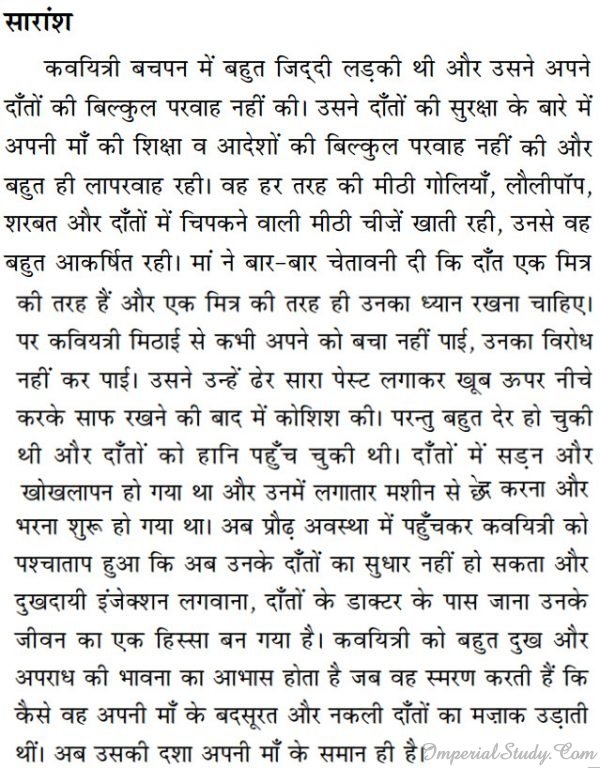
    The poet was very stubborn and negligent of dental hygiene during childhood. She was too careless and never listened to the instructions of her mother. She was too tempted by candies, lollies, sherbets and other sticky sweets. Her mother cautioned her time and again that a tooth is like a friend, and it should be looked after well.
    But the poet could not resist sweets. She tried to brush with up and down strokes, put lot of tooth paste on her teeth, but the damage was already done. Decay had given way to cavities and eventually to drillings and fillings.
    Now during adulthood, the poet regrets but nothing can change the condition of her teeth. Painful injections and visits to the dentist have become her routine. The poet feels so miserable and guilty over how she used to mock at her mothers ugly and false teeth. Now her condition is no different.

    Content’s

  • The Seven Ages By William Shakespeare Study Materials

    The Seven Ages

    By William Shakespeare

    Background of the Poem
    William Shakespeare was a great playwright and a poet, who reflected the intricacies and realities of life in a very subtle manner. In his famous play ‘As You Like It’, Jacques gives a speech about the seven stages in a man’s life. Jacques’ speech became a masterpiece and extracts of the speech are often quoted in literature. Since Jacques was a melancholy character, he presents a negative picture of life

    Content’s

    Tags: seven ages by william shakespeare, men and women merely players, ages by william shakespeare, men and women, poem the seven ages, seven ages class 9th, ages class 9th, seven ages class, questions of the seven ages, ages class,

  • Long Answer Questions of The Seven Ages Class 9th

    LONG ANSWER QUESTIONS

    1.    Describe the seven stages in a man’s life. What are the attributes of each stage according to Shakespeare?

    Or

    According to Shakespeare, there are seven stages in a man’s life and these stages are universal. Justify this statement in the light of poem ‘The Seven Ages’.

    [CBSE 2010 (Term II)]

    Ans. The seven stages in a man’s life are :

    1. Infancy,

    2.    School Boy,

    3. Lover,

    4. Soldier,

    5. Judge,

    6. Old Age,

    7.    Very old age.

    As an infant he only pukes and cries. As a school boy he moves about sulking, unwillingly carrying his school bag to the school. As a lover he keeps sighing like a furnace. As a soldier he is heroic, seeking reputation,
    willing to face total annihilation, he is rash and foolish. He risks his life to become immortal. As a judge he is wise, he gains weight, sports a beard and wears well-cut clothes and is always offering good advice to others. Sixth stage is of old age. He grows weak and thin. His teeth become loose and his legs become thin. In the seventh stage he is too old, without teeth, eyesight and taste. This is his second childhood and also the time to make his exit from the world.

    2.    What message does Shakespeare’s ‘The Seven Ages’ convey?    [CBSE 2010 (Term II)]

    Ans. Shakespeare wishes to point out that human life is transitory, we are in this world for a short span of time. We are born with predetermined destiny and we must accept our fate with grace and humility. Every human being has to pass through the necessary stages of childhood, adolescence, youth, middle age and finally death. Death and birth are like the ‘entrances’ and ‘exits’ of actors and are in God’s hands. So we should not complain or grumble but perform our roles with dignity. Since life is short we should not resort to arrogance or vanity. We are mere puppets in the hands of the puppet-master i.e. God, so gratitude and compliance is expected from us.

    3.    ‘‘Sighing like furnace, with a woeful ballad made to his mistress’ eyebrow.’’ Why does a lover behave thus?

    Ans. In his youth he becomes a lover. Falls in love and plays the role of a romantic lover. He writes love songs and when sad and separated from his beloved, he draws deep and hot breaths like the bellowes of a blacksmith. He writes sad tragic ballads, sentimental verses tragic and poetic descriptions of his love life. He is always unhappy and sad.

    4.    With eyes severe and beard of formal cut, full of wise saws and modern instances.” Which stage is this? State the reason for this kind of behaviour. [CBSE 2010 (Term II)]

    His eyes have a severe expression and his beard displays a formal cut. He is always giving wise advise to others, always connecting them with present day instances. This is the stage when man plays the role of a Magistrate. He accepts the bribe of chicken and meat. He is living a
    life of ease and has put on a good weight. He has been an irresponsible youth a sentimental fool/lover, a daring soldier, so the time is ripe for him to play this role of a wise adviser.

    5.    Why is the world compared to a stage by Shakespeare?

    Ans. Stage is a platform in a theatre, where actors perform their roles and all the action is enacted. The roles of the actors are written by the playwright and performed according to the directions of the director. Similarly, life is a performance and this world is akin to a stage, where men are born to perform certain roles, predetermined by God. Human beings cannot choose their roles, they are placed in situations and circumstances according to divine choice. Their births and deaths are also in God’s power. Shakespeare was one of the greatest dramatists of his time and each of the plays he wrote appeared to be small segments from life itself. So comparison of the world to a stage, life to a drama, is an age-old concept.

    6.    Describe the fourth and fifth stages of man’s life.

    Ans. In the fourth stage of his life, man performs the role of a soldier. He is fierce like a leopard, full of vigour and can be easily provoked. He is prone to jealousy and a desire to safeguard his reputation. In the fifth stage of his life he grows fat and huge, his eyes acquire a serious expression and his beard is very formal. He is always advising others and performs the role of a justice, who is desirous of impressing others.

    Content’s

  • Short Answer Questions of The Seven Ages Class 9th

    SHORT ANSWER QUESTIONS

    1.    What is the theme of the poem ‘The Seven Ages’?

    Ans. According to Shakespeare human life is transitory. There is nothing permanent in it. This poem is based on a speech given by a character Jacques who is a cynic in the well known play ‘As You Like It. For Jacques there is nothing noble or praiseworthy in a man’s life. He makes fun of all the seven ages of man and calls birth as ‘entry’ and death as ‘exit’.

    2.    Why does the poet say that the school boy creeps like a snail to school?

    Ans. The school boy is not very willing to go to school. He is disinterested and just walks slowly like a snail carrying his school bag. He is always whining and complaining.

    3.    Describe the fourth and fifth stages of man.

    OR

    What characteristics does the poet associate with fourth and fifth stages of man. [CBSE 2010 (Term I)]

    Ans. The fourth stage is of a soldier. He is fierce like
    a leopard full of vigour and can easily be provoked. He is jealous and always defensive to save his honour. In the fifth stage he is fat and huge. There is somberness in his eyes and his beard gives him a formal look. He is always full of advice for others and performs the role of a justice.

    4.    All the world’s a stage

    And all the men and women merely players;

    They have their exits and their entrances;

    And one man in his time plays many parts,

    His acts being seven ages.

    (a)    Why does the poet call the world a ‘stage’?

    (b)    What does the poet mean by ‘exits’ and ‘entrances’?

    (c)    How can one man play many parts?

    Ans. (a) Stage is a platform in a theatre where actors perform their parts. Similarly, life is also a peformance in which men and women play different parts. These roles are preordained and are in God’s power.

    (b)    The exits are deaths and entrances are births

    (c)    The various parts are the various stages in his life : Childhood, adolescence, youth, middle age and finally death.

    5.    At first the infant

    Mewling and puking in the nurse’s arms

    Then the whining schoolboy, with his satchel

    And shining morning face, creeping like snail.

    (a)    How is the life of a person like an infant?

    (b)    How does a schoolboy appear?

    (c)    The schoolboy is depicted as ‘shining’ and ‘whining’ Why?

    Ans. The first stage of man is of childhood an infant who cries and vomits in his nurses arms. He is helpless and depends on others for his every need. The next stage is of a school boy who carries his school bag, goes to school unwillingly and slowly like snail. At this time his face is always scrubbed and shining. But he is not a very willing student, he keeps whining and complaining.

    6.    Explain ‘All the world’s a stage’ with reference to the poem.    (CBSE 2010)

    Ans. In this poem life is compared to a play. First as man plays different roles in a play so also does he in a real life. As on a stage there is a particular entry and a particular exit of actors; in the same way in life man comes when he is born and departs when he dies. Just as a part is assigned to an actor, in the same God decides man’s role in life, what he has to do at various stages. Noting is in man’s hand.

    7.    What is the theme of the poem ‘The Seven Ages’.

    Or

    What do you think has the poet referred to as ‘an eventful history’ in the poem, The Seven Ages and why ?    [CBSE    2010    (Term    I)]

    Ans. Shakespeare said that human life is transitory. There is nothing permanent in it. This poem is based on a
    speech given by a character Jacques, who is a cynic, in the well known play ‘As You Like It. For Jacques there is nothing noble or praiseworthy in a man’s life. He makes fun of all the seven ages of man and calls birth as ‘entry’ and death as ‘exit’.

    8.    Write two characteristics of infant state mentioned in the poem ‘The Seven Ages’.

    (CBSE 2010)

    Or

    How does Shakespeare describe man in the first stage of life?    [CBSE    2010    (Term II)]

    Ans. The two characteristics of an infant stage are crying and vomiting out his milk. Whenever he needs anything he cries, whether he is hungry, sick, or wet. The only language he knows is of crying which attracts the attention of those who care for him. The only reaction he gives regarding his behaviour is by vomiting out his milk. These two traits characterise an infant.

    9.    Why has been the last stage of a man’s life referred to as second childishness’? [CBSE 2010 (Term II)]

    Ans. An infant has to depend on others for everything. Similarly, an old man is weak and ignorant of everything around him. He has no teeth, no sense of taste and is absolutely helpless.

    10.    What are the problems faced by a person in

    ‘Soldier’ stage?    [CBSE    2010    (Term II)]

    Or

    How does man as a soldier behave? (The Seven Ages)    [CBSE    2010    (Term II)]

    Ans. The fourth stage of a man is of a soldier. He is heroic, seeking reputation, willing to face total annihilation. He is fierce like a leapord, full of vigour and is easily provoked. He is jealous and defensive. He risks his life to become immortal.

    Content’s

  • Non-Multiple Choice Questions of The Seven Ages Class 9th

    Read the following extracts and answer the questions that follow :

    1.    All the world’s a stage

    and all the men and women merely players:

    They have exits and entrances;

    And one man in his time plays many parts,

    [CBSE 2010 (Term II)]

    (a)    What does the poet mean by the terms ‘exits and entrances?

    Ans. In this line ‘exits and entrances’ symbolise death and life respectively.

    (b)    What parallelism has the poet drawn between the stage and the world?

    Ans. Stage is a platform in a theatre where actors perform their act. Similarly, life is a also a theatre where men and women play their part and die.

    (c)    Which figure of speech has been used in the second line?

    Ans. Figure of speech used in second line is ‘Simile’.

    2.    Jealous in honour, sudden and quick in quarrel,

    Seeking the bubble reputation

    Even in the cannon’s mouth :

    [CBSE 2010 (Term II)]
    (a)    Who is the person being described in the above lines?

    Ans. The person described in the above lines is a soldier.

    (b)    What traits characterise this stage?

    Ans. A man in this stage is fierce and can be easily provoked. He is prone to jealousy and a desire to safeguard his reputation.

    (c)    Explain : ‘the bubble reputation’.

    Ans. Eagerness to seek reputation.

    3.    At first the infant Mewling and puking in the nurse’s arms Then the whining schoolboy, with his satchel And shining morning face, creeping like snail.

    (a)    How is the life of a person like an infant ?

    Ans. As an infant a man is totally dependent. Crying and vomiting milk in the nurse’s arms.

    (b)    How does a schoolboy appear ?

    Ans. A schoolboy appears to be sulking and unwillingly carrying his school bag to the school.

    (c)    The schoolboy is depicted as ‘shining’ and ‘whining’? Why ?

    Ans. Since he is a small boy, his face is shining and whining depicts his unwillingness to go to the school.

    Content’s

  • Multiple Choice Questions of The Seven Ages Class 9th

    MULTIPLE CHOICE QUESTIONS

    Read the following extracts and choose from the options given below :

    1.    Then a soldier

    Full of strange oaths, and bearded like the pard, Jealous in honour, sudden quick in quarrel,
    Seeking the bubble reputation Even in the cannon’s mouth.

    (a)    The pard is a symbol of:

    (i)    humility    (ii) fierceness

    (iii)    jealousy    (iv) love

    (b)    The    poetic device used    in the second line    is a :

    (i)    metaphor    (ii) simile

    (iii)    alliteration    (iv) irony

    (c)    The    soldier seeks    his    moment of glory    :

    (i)    through death on the battlefield

    (ii)    through his acts of chivalry

    (iii)    by rescuing a maiden in distress

    (iv)    making great promises of valour

    Ans : (a) (ii)    (b) (ii)    (c)    (i)

    2.    And then the justice,

    In fair round belly with good capon lined,

    With eyes severe and beard of formal cut,

    Full of wise saws and modern instances And so he plays his part.

    (a)    Which stage is being referred to here?

    (i) Sixth    (ii)    Third

    (iii) Fifth    (iv) Seventh

    (b)    “good capon lined” means :

    (i) riches    (ii)    filled with big, fat, male chicken

    (iii)    round belly (iv)    some gown

    (c)    How does he show his wisdom?

    (i)    By physical appearance

    (ii)    Keeping severe expression

    (iii)    By quoting wise sayings

    (iv)    By showing off

    Ans : (a) (iii) (b) (ii)    (c)    (iii)

    3.    Into the lean and slippered pantaloons with spectacles on nose and pouch on side,

    His youthful hose, well saved, a world too wide For his shrunk shank; and his big manly voice Turning again toward childish treble, pipes And whistles in his sound.

    (a)    Which stage of man is referred to here?

    (i)    Fifth    (ii)    Third

    (iii)    Seventh    (iv)    Sixth

    (b)    ‘Shrunk shank’ means

    (i)    socks    (ii)    thin legs

    (iii)    wrinkled    face    (iv)    twisted neck

    (c)    Why does his    voice    again    become childish?

    (i)    Suffers from sore throat

    (ii)    Remains unwell
    (iii)    Is like a child’s voice again

    (iv)    His old age weakens his voice

    Ans : (a) (iv)    (b)    (ii)    (c)    (iv)

    4.    Last scene of all

    That ends this strange eventful history,

    Is second childishness and mere oblivion,

    Sans teeth, sans eyes, sans taste, sans everything.

    (a)    Why is this last stage called, ‘second childishness’?

    (i)    Behaves like a child

    (ii)    Is without teeth, taste like a child

    (iii)    Pretends to be a child

    (iv)    Has no hair

    (b)    ‘mere oblivion’ means :

    (i) illness    (ii) weakness

    (iii) forgetfulness    (iv) no financial security

    (c)    Why is man’s life called ‘strange eventful history ’ ?

    (i)    due to uncertainty

    (ii)    due to lot of variety

    (iii)    due to strange happenings

    (iv)    like a story

    Ans : (a) (ii)    (b)    (iii) (c) (iii)

    5.    In fair round belly with capon lined With eye severe and beard of formal cut Full of wise saws and modern stances And so he plays his part.

    (a)    Which stage of man is the poet referring to in the above lines?

    (i)    Infancy    (ii)    Youth

    (iii)    Middle age    (iv)    Old age

    (b)    The round belly is suggestive of :

    (i)    A wise person (ii)    A fat person

    (iii)    A generous person

    (iv)    A person of importance

    (c)    By ‘wise saws’ the poet means :

    (i)    Words of wisdom

    (ii)    Shrewd behaviour

    (iii)    Pretence    (iv)    Words of    love

    Ans : (a) (iii)    (b)    (iv)    (c)    (i)

    Content’s
  • Textbook Question of The Seven Ages Class 9th

    Page No: 81

    1. On the basis of your understanding of the poem, answer the following questions by ticking the correct choice 

    (a) All the world is a stage is an extended metaphor for-
    (i)The life shown in well known plays
    (ii) Seeing the well known plays
    (iii) Life of well known plays
    (iv) Life of man that comes to an end

    Answer

    (iv) Life of man that comes to an end

    (b) All ‘have their exits and their entrances’ Exits and entrances refer to __________.
    (i) Birth and death
    (ii) Beginning and end of play
    (iii) Coming and going of actors
    (iv) The end of the Shakespearean era

    Answer

    (i) Birth and death

    Page No: 82

    (c) The seven roles that a man plays correspond to his___________.
    (i) chronological age in life
    (ii) desires
    (iii) mental age in life
    (iv) idea of a perfect life

    Answer

    (i) chronological age in life

    1. Having read this extract, identify the stages of a person’s life as Shakespeare has done. Write down these stages in your note book, and sum up the characteristics of each stage in two or three words. e.g.

    Stage Characteristic feature

    Infancy crying
    Answer
     

    Stage  Characteristic feature
    Infancy Crying, helpless
    Childhood Whining, bright, alert, active
    Lover sentimental, unhappy, poetic,
    tense
    Soldier quarrelsome, short tempered,
    foolishly looking for glory and
    fame in the jaws of death
    Justice Wise, mature, authoritative, responsible
    Old age getting weak and lean due to
    failing health, loss of manly
    voice
    Extreme Old Age Clueless ,dependent
    1. Explain the meaning of the following

    (a) __________ all the men and women merely players
    They have their exits and their entrances __________.

    Answer

    The quoted lines are from the poem “The Seven Ages” by William Shakespeare. The poet has compared the world to a stage and men and women with actors.All men and women appear on the stage of the world to play various roles. They are just stage artists. Their birth marks their appearance on the stage and death

    denotes their departure.

    (b) And then the lover
    Sighing like furnace__________.

    Answer

    The lines are taken from the poem “The Seven Ages” by William Shakespeare. With the help of a simile, the poet explains that on attaining adolescence, men fall in love. The passion of love becomes active like heat generated in a furnace. However, this surging passion also declines after crossing a certain point of time. In this line, the poet hints at momentary nature of human affairs.

    (c) a soldier,__________Seeking the bubble reputation
    Even in the cannon’s mouth.

    Answer

    The quoted lines are from the poem “The Seven Ages” by William Shakespeare.

    The poet has compared a young man to a soldier who takes his responsibilities very seriously and strives relentlessly when dedicated to a cause. In his youth, man seeks instant fame and is ready to take risks. However, when one seeks instant fame, there is a big risk of their reputation getting tainted, just like a bubble that rises and bursts instantly.

    7. Read the poem again and note down the metaphors and similes. Copy and complete the following chart.

    Item Metaphor Simile
    World All the world’s a stage
    Men, women
    school-boy
    lover
    soldier
    reputation
    voice

    Which comparison(s) do you find most interesting? Why?

    Answer 

    Item Metaphor Simile
    World All the world’s a stage
    Men, women men and women merely players
    school-boy Creeping like snail
    lover sighing like a furnace
    soldier bearded like the pard
    reputation bubble reputation
    voice big manly voice

    According to me school boy comparison is really interesting one. Here, poet shows a boy carrying a schoolbag but at the same time walking slowly towards school. He doesn’t want to go to school. This phase common in these days.

    Content’s

  • Word Meanings of The Seven Ages Class 9th

    Word-Meaning
    •    Players – actors • Time – lifetime • Parts – roles •    Ages – stages • Whining – grumbling • Sighing – drawing deep breath • Ballad – song • Jealous in honour – keen to guard his reputation • Bubble reputation – short-lived glory • Justice – judge •    Lined – filled with
    • Merely – just
    • Mewling – crying
    • Puking – vomiting
    • Satchel – a small bag for carrying school books.
    • Woeful – very sad
    • Pard – leopard
    • Cannon – a big gun that fired cannon-balls made of iron.
    • Capon – very big and fat
    • Oaths – solemn promises
    • Justice – judge
    • Slippered – wearing indoor shoes
    • Pantaloon – a funny old man on whom other people play tricks.
    • Pouch – a soft fold of loose skin that hangs down as a result of illness or old age.
    • Hose – tight-fitting leg coverings
    • Shank – legs from the knee to the ankle.
    • Treble – a high voice
    • Oblivion – forgetting everything and being forgotten by everybody. Sans – without (a french word).

    Content’s