Category: English

  • Summary of Lord Ullin’s Daughter Class 9th.

    Summary

    The poem ‘Lord Ullin’s Daughter’ is written in the form of a ballad by Thomas Campbell. Like all ballads it tells a story, but the story is of two unfortunate lovers, whose story ends in a tragedy.
    A Scottish chieftain of Ulva’s Isle falls in love with Lord Ullin’s daughter. Lord Ullin was simply disgusted with the alliance, so the lovers run away to escape the wrath of Lord Ullin. The lovers are chased on horse-back by Lord Ullin and his men. The lovers reach the shore of a tempestuous sea. The chieftain asks the boatman to row them to the other shore. He tells the boatman that he and his beloved would not be left alive if the boatman does not help them. The boatman is reluctant at first because of the tempest in the sea. Later he agrees to undertake the deadly voyage because he is awed by the girl’s beauty. He also rejects the chieftain’s offer of a pound of silver.
    As the boat enters the tempestuous waters, the storm grows more fierce, the waves rise very high. Soon the storm grows fiercer and the waves get menacing. Forceful wind and the raging water sink the boat. Lord Ullin’s daughter raises one hand for help and puts the other arm around her lover. Meanwhile Lord Ulllin reaches the shore and helplessly watches his daughter perish in the raging water before his eyes. His ‘come-back’ call and a promise of forgiveness prove to be of no avail because the lovers perish in the sea. Lord Ullin is full of remorse and regret but that proves futile after the death of his dear daughter.

    Content’s

  • Long Answer Questions of The Solitary Reaper Class 9th.

    1.    Discuss the effect of the Solitary Reaper’s song on the listeners. Why is it compared to the nightingale and the cuckoo?

    Ans. The poet describes the solitary reaper’s song, filling the deep valleys, sweeter than the voice of a nightingale. It is more welcome than a nightingale’s chant heard by weary travellers in the shady haunts of the Arabian desert. It is more thrilling than a cuckoo bird’s song which in spring time can break the silence of the seas. It made the poet stand motionless and still to listen and carry it with him in his heart as he mounted up the hill never to forget it evermore. References to the Arabian sands and Scotlands Hebrides (far-off Islands) impart an exotic feeling.

    2.    Discuss the scenic beauty of the background. How does it highlight the musicality of the song of the solitary reaper?

    Ans. The scenic beauty is captured and displayed by the poet in vale profound, overflowing with the sound (the solitary reaper’s song), “Weary bands of travellers in some shady haunts among the Arabian sands”. Breaking the silence of the seas among the farthest hebrides.

    3.    What impresses the poet? Why?

    Ans. William Wordsworth describes and exemplifies a once ‘in a lifetime kind of memory’ that is meant to be taken out of the storehouse of memory and enjoyed forever. The poet is struck by the beauty and the melody of the mountain girl, working in harmony with her surroundings. The maiden’s song enchants the poet and the melancholy strain makes him wonder at the content of the song. The melody and enchanting quality of her song reminds him ofthe nightingale and the cuckoo but the intensity of her song overflows and reverberates throughout the valley. Whether she was singing about a battle or common sorrows or illness of a loved one, the poet has no idea.

    The solitary reaper’s song leaves a lasting impression on the poet’s mind and he believes that the memory of this song will be with him forever.

    4.    What message does the poet wish to convey in the poem?

    Ans. What impresses the poet in the song is not its content but its emotionally expressive music. This feeling could have no ending and it communicates wordlessly something universal about human condition. Despite the ‘melancholy strain’, the poet proceeds on his way, his ‘heart’ carrying her music. For that reason the poem relates to an ‘ecstatic moment’ in which a passer-by transcends the limitations of mortality. Both the song and the poet can go on together. It also expresses the thought that the appeal and music is universal, language is not important.
    5.    Wordsworth had a wonderful experience listening to the highland girl while out for a walk in the countryside. He comes home and pens down his feelings in his diary immediately. Write his diary.[CBSE 2010 (Term I)]

    Dear Diary,

    Today, after a long time, I heard a song more melodious than a nightingale and a cuckoo bird. I am so thrilled that I want to pour my feelings into you. The highland lass who I heard singing while climbing the hill was so engrossed in her work of reaping the crop that she was totally oblivious of her surroundings. Although I could not understand the dialect she was singing in but from the melancholy notes of her song I was able to gauge that it related to some unhappy memories, or some battles fought long ago. I was so mesmerised and spellbound that I was held motionless and still. But the memory of her song will always remain fresh for me. It has left an indelible mark on my mind. Oh God! it is still resounding in my ears.

    Content’s

  • Short Answer Questions of The Solitary Reaper Class 9th.

    SHORT ANSWER QUESTIONS

    1.    Discuss the significance of the title of the poem.

    Ans. The poem’s title and theme are based on the fact that once in the course of his walking tours of Scotland William Wordsworth, the poet, and his sister came across a solitary reaper, a young highland lass, who was reaping and binding corn as it was the harvest time. As she was
    working peacefully all by herself, she was singing. Her song had a touch of sadness. The memory of this lone girl and the melancholy notes of her song remained with the poet for all time. Wordsworth’s poem “The Solitary Reaper” somehow immortalises her.

    2.    ‘Solitary Reaper’ is a poem that depicts a simple peasant girl gifted with an extraordinary voice. What qualities make the girl unforgettable?

    Ans. The melodious voice of the Solitary Reaper is unforgettable. It has tender melancholic strains, the sweetest human voice ever heard that haunted the poet for all time. He could not understand the dialect, nor the theme of her song. Her musical notes ran like water and surpassed the beauty of the songs of the nightingale and the cuckoo. The intensity and the enchanting quality of her song left an everlasting impression on the poet mind.

    3.    Give two examples of hyperbole and alliteration from the poem.

    Ans. ‘Silence of the seas,’ and ‘sings a melancholy strain’ ‘perhaps the plaintive numbers flow,’ these poetic repetition of the ‘S’ sound and ‘P’ sound is a device used by poets called alliteration. Hyperbole in also a poetic device in which something written or described is made to sound more exciting, better or dangerous. “O’ listen! for the vale profound is overflowing with the sound”. The sound of the reaper’s song is so powerful that it fills the deep valleys, it is an exaggeration.

    4.    Why is the song of the solitary reaper compared to the nightingale’s song?

    Ans. The nightingale is acclaimed as a song bird endowed with a sweet voice who is supposed to sing in a melodious and soothing way. The solitary reaper’s voice is also sweet and melodious. Her song is so sweetly melancholy that it leaves an indelible mark in the poet’s mind. Shady haunt is a cool resting place in an oasis in the Arabian desert where weary travellers are resting.

    5.    What arrested the attention of the poet out for a walk in the countryside ? [CBSE 2010 (Term I)]

    Ans. While walking in the countryside, the poet heard the solitary reaper’s song. He was struck by the fact that the girl was cutting the harvest alone and on a happy occassion singing a melancholy song. It was so melodious that it once caught poet’s attention. He finds her song sweeter than a nightingale and more thrilling than a cuckoo bird.

    6.    How could the poet hear the song of the Solitary Reaper, when it could be heard no more? [CBSE 2010 (Term I)]

    Ans. One day, while climbing up a hill, the poet hears solitary reaper’s song. The song reminds him of a nightingle and a cuckoo. He finds the song so enchanting that it leaves an indelible mark on the poet’s mind and he believes that the memory of the song will remain with him forever. This also shows that music has a universal appeal.

    7.    How do we know that the highland girl was engrossed in her work?    [CBSE    2010    (Term    I)]

    Ans. Once the poet comes across a highland girl while climbing up a hill. The young girl was reaping and binding the corn as it was the harvest time. As she was working peacefully all by herself, she was singing. The whole valley resounds with her melodious voice but she is ignorant of all this and is totally engrossed in her work.

    8.    What guesses does the poet make about the theme of the Solitary Reaper’s song? [CBSE 2010 (TermI)]

    Ans. The solitary reaper was singing the song in a dialect. The poet was unable to comprehend its meaning but was able to gauge from its sad note that it probably relates to some unhappy memories, some battles fought long ago. The poet also guesses that the song may be about the commonplace things like joys and sorrows.

    Content’s

  • Non-Multiple Choice Questions of The Solitary Reaper Class 9th.

    NON-MULTIPLE CHOICE QUESTIONS

    Read the following extracts and answer the questions given below :

    1.    Will none tell me what she sings? Perhaps the plaintive numbers flow For old, unhappy, far off things, And battles long ago.

    (a)    Explain the use of ‘perhaps’ in the second line.

    Ans. ‘Perhaps’ is used to show that poet is not sure about the theme of solitary reaper’s song.

    (b)    ‘Flow’, – what quality of the solitary reaper song is expressed here?

    Ans. The word ‘flow’ expresses the spontaneity of solitary reaper’s song.

    (c)    What is the poet’s guess?

    Ans. He guesses that she might be singing about some unhappy things of the past or the battles fought long ago.

    2.    Or is it some more humble lay,

    Familiar matter of today?

    Some natural sorrow, loss or pain,

    That has been, may be again.

    (a)    ‘It’ in the first line refers to :

    Ans. ‘It’ in the first line refers to solitary reaper’s song.

    (b)    Explain ‘humble lay’.

    Ans. It means that solitary reaper’s song may be about some ordinary people.

    (c)    What does the poet wish to convey by saying ‘that has been and may be again’ ?
    Ans. He wishes to convey that the song may be about some natural sorrow which can occur again.

    3.    Whatever the theme, the maiden sang As if her song could have no ending;

    I    saw her singing at her work

    And o ’er the sickle bending

    (a)    What other activities is the maiden doing besides singing ?

    Ans. Besides singing, the maiden is cutting and binding the grain.

    (b)    What makes the maiden’s song extraordinary?

    Ans. Maiden’s voice makes her song extraordinary.

    (c)    What effect does the song have over the poet ?

    Ans. The song left an indellible mark on the poet’s heart.

    4.    I listen’d, motionless and still And, as I mounted up the hill,

    The music in my heart I bore,

    Long after it was heard no more.

    (a)    Where does the poet go?

    Ans. The poet is climbing up the mouatain.

    (b)    How did the song affect the poet?

    Ans. The song left a permanent mark on the poet’s heart.

    (c)    What does the poet want to convey by ‘‘long after it was heard no more’’?

    Ans. The poet wants to say that the music is eternal and can give pleasure even when you do not hear it.

    Content’s

  • Multiple Choice Questions of The Solitary Reaper Class 9th

    MULTIPLE CHOICE QUESTIONS

    Read the following extracts and choose the correct option :

    1.    Alone she cuts and binds the grain,

    And sings a melancholy strain ;

    O    listen! for the vale profound Is overflowing with the sound.

    (a)    Identify ‘she’ from the above stanza.

    (i) A traveller    (iii) Solitary reaper

    (ii) The poet    (iv) None of the above

    (b)    How does the poet know that the song is melancholy when he cannot understand the words?

    (i)    From the girl’s expression

    (ii)    From the words of the song

    (iii)    From the tune

    (iv)    From her dress

    (c)    What effect does the girl’s song have over the surroundings?

    (i)    Has no effect

    (ii)    All people desert the valley

    (iii)    The valley echoes with the song

    (iv)    The valley is indifferent

    Ans : (a) (iii) (b) (iii) (c) (iii)

    2.    A voice so thrilling ne ’er was heard In spring-time from the cuckoo bird,

    Breaking the silence of the seas Among the farthest Hebrides.

    (a)    What is cuckoo bird famous for?

    (i)    Cheerfulness (ii) Thrill
    (iii)    Driving away tiredness

    (iv)    Welcoming the spring

    (b)    How does the Solitary Reaper’s song score over the song of the cuckoo?

    (i)    It is more far-reaching

    (ii)    It echoes more

    (iii)    It is more musical and fresh

    (iv)    It does not have any effect

    (c)    Hebrides means :

    (i)    a group of trees (ii) far off valleys

    (iii)    sea    (iv)    a group of islands off near Scotland

    Ans : (a) (iv)    (b)    (i)    (c)    (iv)

    3.    Will no one tell me what she sings?

    Perhaps the plaintive numbers flow For old, unhappy, far off things,

    And battles long ago.

    (a)    Explain the use    of ‘perhaps ’ in    the second line.

    (i)    The poet is    not    sure

    (ii)    He is double-minded

    (iii)    He is indifferent

    (iv)    None of these

    (b)    ‘Flow ’, – what quality of the solitary reaper song is expressed here?

    (i)    Its fluidity    (ii)    Its    evocativeness

    (iii)    Its spontaneity    (iv)    Its    music

    (c)    What is the poet’s guess?

    (i)    The theme is of spring

    (ii)    Of happiness and forgotten things

    (iii)    Of battles and sad events in the past

    (iv)    Of stories

    Ans :    (a) (i)    (b) (iii)    (c)    (iii)

    4.    Or is it some    more humble    lay,

    Familiar matter of today?

    Some natural sorrow, loss or pain,

    That has been, may be again.

    (a)    ‘It’ in the first line refers to

    (i) the valley    (ii)    the song

    (iii) the solitary reaper (iv) her dress

    (b)    Explain ‘humble lay’.

    (i)    A song about ordinary events

    (ii)    A song about extraordinary things

    (iii)    A song about modest things

    (iv)    A song about rich people

    (c)    What does the poet wish to convey by saying ‘that has been and may be again’?

    (i)    A natural loss, and pain

    (ii)    A natural event

    (iii)    Natural sorrow which can occur again

    (iv)    Both (i) and (iii)

    Ans :    (a) (ii)    (b) (i)    (c)    (iii)

    5.    Whatever    the    theme, the    maiden    sang

    As if her song could have no ending;

    I    saw her singing at her work

    And o’er the sickle bending

    (a)    What other activities is the maiden doing besides singing?

    (i)    She is ploughing    (ii)    binding the    corn

    (iii)    cutting grass    (iv)    none of the    above

    (b)    What makes the maiden’s song extraordinary?

    (i)    Its musicality    (ii)    Its eternal nature

    (iii)    Its theme    (iv)    Her voice

    (c)    What effect does the song have over the poet?

    (i)    Mesmerising    (ii)    Impressive

    (iii)    Invigorating    (iv)    No effect

    Ans : (a) (ii)    (b)    (ii)    (c)    (i)

    6.    I listen’d, motionless and still And, as I mounted up the hill,

    The music in my heart I bore,

    Long after it was heard no more.

    (a)    Where does the poet go?

    (i)    Down the valleys

    (ii)    Doesn’t go anywhere
    (iii)    Climbed up the mountain

    (iv)    Nowhere

    (b)    How did the song affect the poet?

    (i)    It impressed him

    (ii)    Served as an inspiration

    (iii)    Left a permanent mark on his heart

    (iv)    Had no effect

    (c)    What does the poet want to convey by “long after it was heard no more ”?

    (i)    Music is entertaining

    (ii)    Music is eternal and can give pleasure even when you do not hear it

    (iii)    Sad music is always remembered

    (iv)    The universal and permanent impression of music.

    Ans : (a) (iii)    (b)    (iii)    (c)    (iv)

    7.    Alone she cuts and binds the grain,

    And sings a melancholy strain ;

    O    listen! for the vale profound Is overflowing with the sound. [CBSE 2010 (Term I)]

    (a)    ‘melancholy strain ’ in the second line refers to :

    (i)    Sad song    (iii)    Happy song

    (ii)    Thrilling song    (iv)    Sweet song

    (b)    Identify the figure of speech in the above lines :

    (i)    Personification    (ii)    Metaphor

    (iii)    Imagery    (iv)    Alliteration

    (c)    The last two lines mean :

    (i)    Her voice is resounding in the valley

    (ii)    She is singing at a high pitch

    (iii)    Her voice is reaching outside the valley

    (iv)    She is asking everyone to listen to her

    Ans. (a) (i)    (b)    (iii)    (c)    (i)

    8.    No nightingale did ever chant More welcome notes to weary bands Of Travellers in some shady haunt Among Arabian Sands

    A voice so thrilling ne ’ver was heard In spring – time from the cuckoo – bird Breaking the silence of the seas Among the farthest Hebrides [CBSE 2010 (Term I)]

    (a)    According to the poet, nightingales sing :

    (i)    to welcome the travellers

    (ii)    to please themselves

    (iii)    to welcome the tired travellers

    (iv)    to get relief from their own pains

    (b)    The nightingales sing :

    (i)    in spring season in desert of Arabia

    (ii)    in autumn season in deserts

    (iii) in spring season in deserts of Thar

    (iv) in spring season in deserts of Egypt
    (c)    The effect of the voice of the cuckoo bird is :

    (i)    that    it    refreshes    the tired travellers

    (ii)    that    it    is spread    everywhere

    (iii)    that    it    seems to    welcome travellers

    (iv)    breaks    the seas’    silence

    Ans. (a) (iii) (b) (i)    (c)    (iv)

    Content’s

  • Textbook Question of The Solitary Reaper Class 9th.

    NCERT Solution Of The Solitary Reaper Class 9th.

    Page No: 71

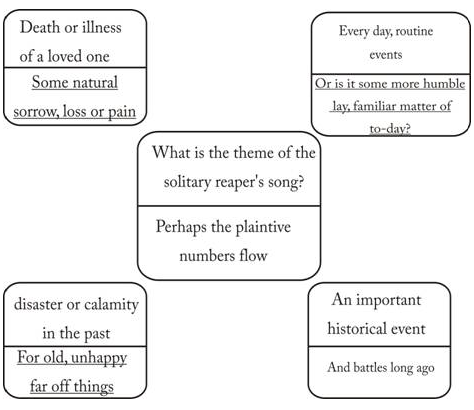
    5. The poet could not understand the words of the song, yet he raised several possibilities about its theme. In the diagram below are some of these possibilities. Read the third stanza again, and find the phrase that matches each. Copy and complete the diagram, writing each phrase in the empty boxes. Work in pairs.

     Answer

    Page No: 72

    6. On the basis of your understanding of the poem, answer the following questions by ticking the correct choice.(a) The central idea of the poem ‘The Solitary Reaper’ is__________.
    (i) well sung songs give us happiness
    (ii) melodious sounds appeal to all
    (iii) beautiful experience give us life-long pleasure
    (iv) reapers can sing like birds

    Answer

    (iii) beautiful experience give us life-long pleasure

    (b) In the poem ‘The Solitary Reaper’ to whom does the poet say ‘Stop here or gently pass’?
    (i) to the people cutting corn
    (ii) to himself
    (iii) to the people who make noise
    (iv) to all the passers by

    Answer

    (iv) to all the passers by

    (c) The Solitary Reaper is a narrative poem set to music. This form of verse is called a__________.
    (i) ballad
    (ii) soliloquy
    (iii) monologue
    (iv) sonnet

    Answer

    (i) ballad

    (d) The poet’s lament in the poem ‘The Solitary Reaper’ is that __________
    (i) he cannot understand the song
    (ii) he did not know the lass
    (iii) she stopped singing at once
    (iv) he had to move away

    Answer

    (i) he cannot understand the song

    (e) The setting of the poem is__________
    (i) Arabia
    (ii) Hebrides
    (iii) Scotland
    (iv) England

    Answer

    (iii) Scotland

    Page no: 73

    7. (a) Read the second stanza again, in which Wordsworth compares the solitary

    reaper’s song with the song of the nightingale and the cuckoo. On the basis of

    your reading (and your imagination), copy and complete the table below. (Work

    in groups of four, then have a brief class discussion.)

    Place

    Heard by

    Impact on listener

    Solitary Reaper

    Scottish Highlands

    The poet

    Holds him spellbound

    Nightingale

    Cuckoo

    Answer

    Place

    Heard by

    Impact on listener

    Solitary Reaper

    Scottish Highlands

    The poet

    Holds him spellbound

    Nightingale

    Arabian sands

    Travellers

    reduces the tiredness of travellers

    Cuckoo

    Hebrides

    People from far off lands

    has far-reaching effect, heralds the
    coming of spring, end of winter

    (b) Why do you think Wordsworth has chosen the song of the nightingale and the cuckoo for comparison with the solitary reaper’s song?

    Answer

    The nightingale and the cuckoo are known as song-birds. Many poets have written about their melodious notes and there is a reference to nightingale even in the Bible. So the poet has chosen their songs for comparison with the Solitary Reaper’s song.

    (c) As you read the second stanza, what pictures come to your mind? Be ready to describe them in your own words, to the rest of the class. (Do not be afraid to go beyond what the poet has written.)

    Answer

    The second stanza presented the scene of a alone girl standing between the field busy in cutting the grain and binding it.  She is singing the sad song while doing her job and the grief of that song is passing from the deep valley. The sadness of her song is so immense that no nightingale singing their song or even chanting.

    8. In the sixth line of the first Stanza, we read:
    “… and sings a melancholy strain…”
    This “s” sound at the beginning of sings and strain has been repeated. Poets often do this. Do you know why? Do you know what this “poetic repetition” is called? Can you find instances of this in The Solitary Reaper?

    Answer

    Poets often repeat such sounds to make the effect more intense and ornamental. This “poetic repetition” is called alliteration.

    In line 15 we find an instance of alliteration in “silence of the seas.” In line 18 we find alliteration in “perhaps the plaintive numbers flow.” Line 27 also has alliteration in “I saw her singing at her work.”

    9. In the first Stanza, some words or phrases have been used to show that the girl working in the fields is alone. Which are those words and phrases? What effect do they create in the mind of the reader?

    Answer

    The words and phrases that have been used to show that the girl working in the fields is alone are ‘single in the field’, ‘solitary’, ‘singing by herself’.
    The words and phrases create in the readers mind an image of a lonely Scottish maiden who is reaping and singing all alone in the field. While she is working, she is singing a sad melancholy song. The song is so intense that the poet asks the passersby to listen but to not disturb her.

    Content’s

  • Word Meanings of The Solitary Reaper Class 9th.

    Word-Meaning
    •    Behold – see, just look • Solitary – alone •    Yon – distant • Welcome notes – pleasant music •    Shady haunt – cool, resting place • Weary band tired group of caravan • Theme – subject matter •    Maiden – young unmarried girl • Mounted – climbed •    Bore – carried

    Content’s

  • Summary of The Solitary Reaper Class 9th

    Summary

    ‘The Solitary Reaper’ is William Wordsworth’s rendition of the delight a simple peasant girl derives from nature and how the entire atmosphere reverberates with that happiness.
    The poet sees a highland girl reaping the harvest and singing. The poet compares her song with the song of a nightingale, soothing his sorrows, easing his weariness, just the same way as the nightingale welcomes the weary travellers in the shady oasis of the Arabian sands. The maiden’s song is also compared to the song of the cuckoo bird which is the harbinger of summer and ushers in happiness. The song of the maiden is as thrilling and persuasive as the song of the cuckoo bird which is effective enough to break the silence of the seas.
    The poet cannot understand the dialect of the song, he is unable to comprehend its meaning, but is able to gauge from its sad tone that it probably relates to some unhappy memory, some battles fought long ago. The poet also feels that the song may be about the commonplace things like joys or sorrows.
    The poet feels that the girl’s song would have no end and would continue forever. The poet saw the girl singing as she bent over her sickle. The song of the maiden was so mesmerising and spellbinding that it held the poet motionless and still. When the poet started mounting the hill, the song could not be heard but it left an indelible mark on the poet’s heart. For the poet, it would always remain a fresh evocative memory. The poem also shows how the appeal of music is universal.

    Content’s