- Circles and its Related Terms : A Review
- Angle Subtended by a Chord at a Point
- Perpendicular from the Centre to a Chord
- Circle through Three Points
- Equal Chords and their Distances from the Centre
- Angle Subtended by an Arc of a Circle
- Cyclic Quadrilaterals
- Circle- circle is locus of such points which are at equidistant from a fixed point in a plane.
- Concentric circle- Circle having same centre called concentric circle.
- Two arc of a circle called congruent if they have the same degree measure.
- If two arc equal then their corresponding chords are equal.
- The perpendicular from centre to chord of circle, it bisects the chord and converse.
- There is one and only one circle passing through three non-collinear points.
- Equal chords of circle are equidistant from centre.
- The angle subtend by an arc at the centre of circle is twice the angle which subtend at remaining part of circumference.
- Any two angles in the same segment of the circle are equal.
- Angle of semicircle is right angle.
- Equal chords of circle subtend equals angle at the centre of circle.
- If the all vertices of a quadrilateral lie on the circumference of circle, then quadrilateral called cyclic.
- In a cycle quadrilateral the sum of opposite angles is 180o and converse.
- The exterior angle of a cycle quadrilateral is equal to the opposite interior angle.
Category: Maths
-
Chapter 10 Circles Notes for Class 9th Maths
-
Chapter 9 Areas of Parallelograms and Triangles Notes for Class 9th Maths
Chapter 9 Areas of Parallelograms and Triangles- Figures on the same Base and Between the same Parallels
- Parallelograms on the same Base and between the same Parallels
- Triangles on the same Base and between the same Parallels
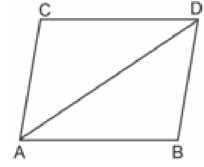


• If a parallelogram and a triangle are on the same base and between the same parallel, thenarea of the triangle is equal to one half area of the parallelogram.
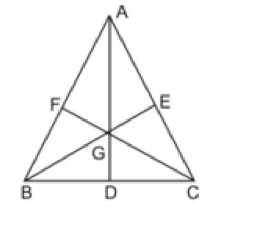
- A median AD of a AABC divides it into two triangles of equal areas. Therefore ar(AABD)=ar(ACD )
- If the medians of a intersect at G, then ar(AAGB)=ar(AAGC )=ar(ABGC )=1 ar (AABC)
- Triangles with equal bases and equal areas have equal corresponding altitude.
-
Chapter 8 Quadrilaterals Notes for Class 9th Maths
- Angle Sum Property of a Quadrilateral
- Types of Quadrilaterals
- Properties of a Parallelogram
- The Mid-Point Theorem
- Sum of the angles of a quadrilateral is 360o
- A diagonals of a parallelogram divides it into two congruent triangles.
- In a parallelogram
- diagonals bisect each other.
- opposite angles are equal.
- opposite sides are equal
- Diagonals of a square bisects each other at right angles and are equal, and vice-versa.
- A line through the mid-point of a side of a triangle parallel to another side bisects the third side. (mid-point theorem)
- The line through the mid points of sides of a D || to third side and half of it.
- A quadrilateral is a parallelogram, if
- its opposite angles are equal.
- its opposite sides are equal.
- its diagonals bisect each other.
- a pair of opposite sides is equal and parallel.
- Diagonals of a rectangle bisect each other and are equal and vice-versa.
- Diagonals of a rhombus bisect each other at right angles and vice-versa.
- A line through the mid-point of a side of a triangle parallel to another side bisects the third side.
- The line-segment joining the mid-points of any two sides of a triangle is parallel to the third side and is half of it.
-
Chapter 7 Triangles Notes for Class 9th Maths
- Congruence of Triangles
- Criteria for Congruence of Triangles
- Some Properties of a Triangle
- Inequalities in a Triangle
- Triangle- A closed figure formed by three intersecting lines is called a triangle. A triangle has three sides, three angles and three vertices.
- Congruent figures- Congruent means equal in all respects or figures whose shapes and sizes are both the same for example, two circles of the same radii are congruent. Also two squares of the same sides are congruent.
- Congruent Triangles- two triangles are congruent if and only if one of them can be made to superpose on the other, so as to cover it exactly.
• If two triangles ABC and PQR are congruent under the correspondence A « P, B « Q and C « R then symbolically, it is expressed as DABC @ DPQR

- In congruent triangles corresponding parts are equal and we write ‘CPCT’ for corresponding parts of congruent triangles.
• SAS congruency rule – Two triangles are congruent if two sides and the included angle of one triangle are equal to the two sides and the included angle of the other triangle. For example: DABC and DPQR as shown in the figure satisfy SAS congruent criterion.

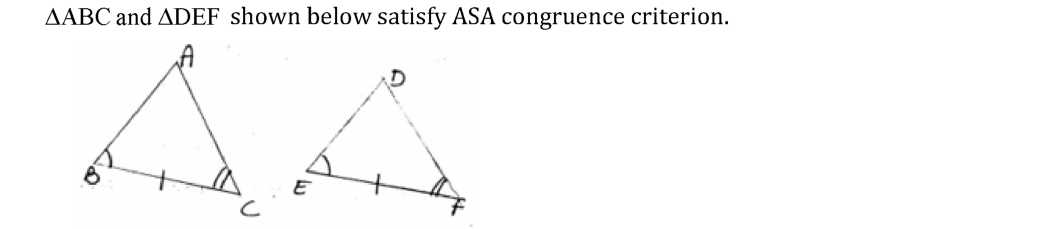
• ASA Congruence Rule- Two triangles are congruent if two angles and the included side ofone triangle are equal to two angles and the included side of other triangle. For examples
- AAS Congruence Rule- Two triangle are congruent if any two pairs of angles and one pair of corresponding sides are equal for example DABC and DDEF shown below satisfy AAS
- Angle opposite to equal sides of a triangle are equal.
congruence criterion.
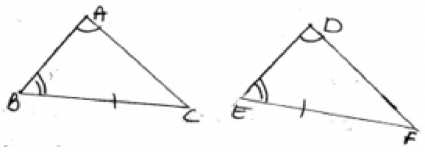
- AAS criterion for congruence of triangles is a particular case of ASA criterion.
- Isosceles Triangle- A triangle in which two sides are equal is called an isosceles triangle.

- Sides opposite to equal angles of a triangle are equal.
- Each angle of an equilateral triangle is 60o.
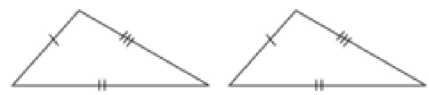
- SSS congruence Rule – If three sides of one triangle are equal to the three sides of another triangle then the two triangles are congruent for example DABC and DDEF as shown in
the figure satisfy SSS congruence criterion.
- RHS Congruence Rule- If in two right triangles the hypotenuse and one side of one triangle are equal to the hypotenuse and one side of the other triangle then the two triangle are congruent. For example: DABCand DPQR shown below satisfy RHS
congruence criterion.
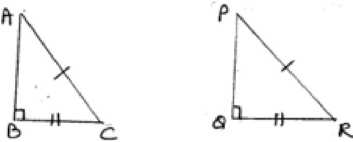
RHS stands for right angle – Hypotenuse side.- A point equidistant from two given points lies on the perpendicular bisector of the line segment joining the two points and its converse.
- A point equidistant from two intersecting lines lies on the bisectors of the angles formed by the two lines.
- In a triangle, angle opposite to the longer side is larger (greater)
- In a triangle, side opposite to the large (greater) angle is longer.
- Sum of any two sides of a triangle is greater than the third side.
-
Chapter 6 Lines and Angles Notes for Class 9th Maths
- Basic Terms and Definitions
- Intersecting Lines and Non-Intersecting Lines
- Pairs of Angles
- Parallel Lines and a Transversal
- Lines Parallel to the same Line
- Angle Sum Property of a Triangle
- Point- We often represent a point by a fine dot made with a fine sharpened pencil on a piece of paper.
- Line- A line is completely known if we are given any two distinct points. Line AB is represented by as AB . A line or a straight line extends indefinitely in both the directions.
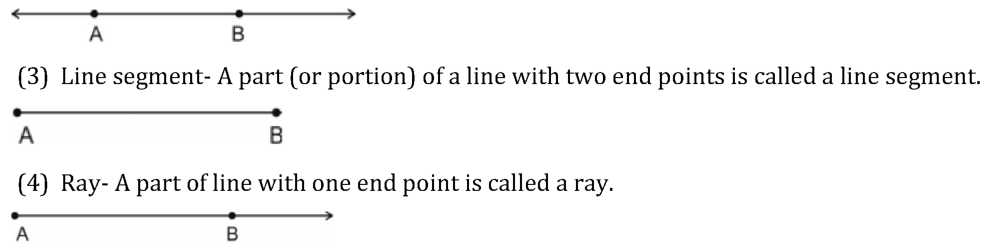
(5) Collinear points- If three or more points lie on the same line, they are called collinear points otherwise they are called non-collinear points.
Types of Angles-
- Acute angle- An acute angle measure between Oo and 90o
- Right angle- A right angle is exactly equal to 90o
- Obtuse angle- An angle greater than 90o but less than 180o
- Straight angle- A straight angle is equal to 180o
- Reflex angle- An angle which is greater than 180o but less than 360o is called a reflex angle.
- Complementary angles- Two angles whose sum is 90o are called complementary angles.
- Supplementary angle- Two angles whose sum is 180o are called supplementary angles.
- Adjacent angles- Two angles are adjacent, if they have a common vertex, a common arm and their non-common arms are on different sides of common arm.
- Linear pair- Two angles form a linear pair, if their non-common arms form a line.
- Vertically opposite angles- Vertically opposite angles are formed when two lines intersect each other at a point.
TRANSVERSAL:
- Corresponding angles
- Alternate interior angles
- Alternate exterior angles
- Interior angles on the same side of the transversal.
- If a transversal intersects two parallel lines, then
- each pair of corresponding angles is equal.
- each pair of alternate interior angles is equal.
- each pair of interior angle on the same side of the transversal is supplementary.
- If a transversal interacts two lines such that, either
- any one pair of corresponding angles is equal, or
- any one pair of alternate interior angles is equal or
(iii) any one pair of interior angles on the same side of the transversal is supplementary then the lines are parallel.
- Lines which are parallel to a given line are parallel to each other.
- The sum of the three angles of a triangle is 180°
- If a side of a triangle is produced, the exterior angle so formed is equal to the sum of the two interior opposite angles.
-
Chapter 5 Introduction to Euclid’s Geometry Notes for Class 9th Maths
Chapter – 5 Introduction to Euclid’s Geometry
- Euclid’s Definitions, Axioms and Postulates
- Equivalent Versions of Euclid’s Fifth Postulate
The Greeks developed geometry is a systematic manner Euclid (300 B.C.) a greek mathematician, father of geometry introduced the method of proving mathematical results by using deductive logical reasoning and the previously proved result. The Geometry of plane figure is known as “Euclidean Geometry”.
Axioms: The basic facts which are taken for granted without proof are called axioms some Euclid’s axioms are:
- Things which are equal to the same thing are equal to one another. i.e. a = b, b = c ^ a = c
- If equals are added to equals, the wholes are equal i.e. a = b ^ a + c = b + c
- If equals are subtracted from equals, the remainders are equal i.e. a = b ^ a – c = b – c
- Things which coincide with one another are equal to one another.
- The whole is greater than the part.
Postulates: Axioms are the general statements, postulates are the axioms relating to a particular field.
Educlid’s five postulates are.
- A straight line may be drawn from any one point to any other point.
- A terminated line can be produced indefinitely.
- A circle can be drawn with any centre and any radius.
- All right angles are equal to one another.
- If a straight line falling on two straight lines makes the interior angles on the same side of it
taken together less than two right angles, then the two straight lines, if produced indefinitely
meet on that side on which the angles are less than two right angles.
Statements: A sentence which is either true or false but not both, is called a statement. eg. (i) 4+9=6 If is a false sentence, so it is a statement.
(ii) Sajnay is tall. This is not a statement because he may be tall for certain persons and may not be taller for others.
Theorems: A statement that requires a proof is called a theorem. eg. (i) The sum of the angles of triangle is 180°.
(ii) The angles opposite to equal sides of a triangles are equal.
Corollary – Result deduced from a theorem is called its corollary.
-
Chapter 4 Linear Equations in Two Variables Notes for Class 9th Maths
Chapter – 4 Linear Equations in Two Variables
- Linear Equations
- Solution of a Linear Equation
- Graph of a Linear Equation in Two Variables
- Equations of Lines Parallel to x-axis and y-axis
- An equation of the form ax + by + c = 0 where a, b and c are real numbers such that a and b are not both zero is called a linear equation in two variables.
- A pair of values of x and y which satisfy the equation ax + by + c = 0 is called a solution of the equation.
- Graph: The graph of every linear equation in two variables is a straight line. Every point on the graph of a linear equation in two variables is two variables is a solution of the linear equation. Conversely, every solution of the linear equation is a point on the graph of the linear equation.
- A linear equation in two variables has infinitely many solutions.
- The graph of every linear equation in two variables is a straight line.
- y = 0 is the equation of x-axis and x = 0 is equation of y-axis.
- The graph of x = a is a straight line parallel to the y-axis.
- The graph of y = a is a straight line parallel to the x-axis.
- An equation of the type y = mx represent a line passing through the origin.
-
Chapter 3 Coordinate Geometry Notes for Class 9th Maths
Chapter – 3 Coordinate Geometry
- Cartesian System
- Plotting a Point in the Plane with given Coordinates
- Coordinate Geometry: The branch of mathematics in which geometric problems are solved
through algebra by using the coordinate system is known as coordinate geometry.
- Coordinate System: Coordinate axes: The position of a point in a plane is determined with
reference to two fixed mutually perpendicular lines, called the coordinate axes.

In this system, position of a point is described by ordered pair of two numbers.
Ordered pair: A pair of numbers a and b listed in a specific order with ‘a’ at the first place and ‘b’ at the second place is called an ordered pair (a,b)
Note that (a,b) ^ (b,a)
Thus (2,3) is one ordered pair and (3,2) is another ordered pair.
In given figure O is called origin.
The horizontal line X1 OX is called the X-axis.
The vertical line YOY’ is called the Y-axis.
P(a,b) be any point in the plane. ‘a’ the first number denotes the distance of point from Y-axis and ‘b’ the second number denotes the distance of point from X-axis. a – X – coordinate | abscissa of P. b – Y – coordinate | ordinate of P.
The coordinates of origin are (0,0)
Every point on the x-axis is at a distance o unit from the X-axis. So its ordinate is 0.
Every point on the y-axis is at a distance of unit from the Y-axis. So, its abscissa is 0.
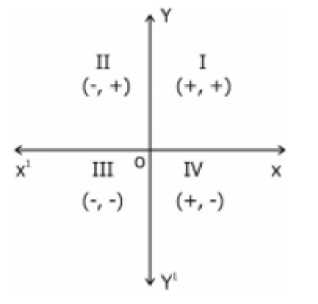
Note: Any point lying on X – axis or Y – axis Y-axis does not lie in any quadrant.
-
Chapter 2 Polynomials Notes for Class 9th Math
- Polynomials in one Variable
- Zeroes of a Polynomial
- Remainder Theorem
- Factorisation of Polynomials
- Algebraic Identities
- Constants: A symbol having a fixed numerical value is called a constant.
- Variables: A symbol which may be assigned different numerical values is known as variable.
- Algebraic expressions: A combination of constants and variables. Connected by some or all of the operations +, -, X and is known as algebraic expression.
- Terms: The several parts of an algebraic expression separated by ‘+’ or ‘-‘ operations are called the terms of the expression.
- Polynomials: An algebraic expression in which the variables involved have only nonnegative integral powers is called a polynomial.
- 5x2 – 4x2 – 6x – 3 is a polynomial in variable x.
3
- (ii) 5 + 8x2 + 4x-2 is an expression but not a polynomial.
Polynomials are denoted by p(x), q(x) and r(x)etc.
- Coefficients: In the polynomial x3 + 3x2 + 3x +1, coefficient of x3, x2, x are1,3,3 respectively
and we also say that +1 is the constant term in it.
- Degree of a polynomial in one variable: In case of a polynomial in one variable the highest
power of the variable is called the degree of the polynomial.
- Classification of polynomials on the basis of degree.
Degree Polynomial Example
- 1 Linear x +1, 2x + 3etc.
- 2 Quadratic ax2 + bx + c etc.
- 3 Cubic x3 + 3x2 +1 etc. etc.
- 4 Biquadratic x4 -1
Classification of polynomials on the basis of no. of terms
Polynomial & Examples. Monomial – S3Sx31Yetc.
3
No. of terms
(i) 1
Binomial – (3 + 6x), (x – 5y) etc.
(ii) 2
(iii) 3
Trinomial- 2x2 + 4x + 2 etc. etc.
- Constant polynomial: A polynomial containing one term only, consisting a constant term is called a constant polynomial the degree of non-zero constant polynomial is zero.
- Zero polynomial: A polynomial consisting of one term, namely zero only is called a zero polynomial. The degree of zero polynomial is not defined.
- Zeroes of a polynomial: Let p(x) be a polynomial. If p(a) =0, then we say that is a zero of the polynomial of p(x).
- Remark: Finding the zeroes of polynomial p(x) means solving the equation p(x)=0.
- Remainder theorem: Let f (x) be a polynomial of degree n > I and let a be any real
number. When f(x) is divided by (x – a) then the remainder is f (a)
- Factor theorem: Let f(x) be a polynomial of degree n > 1 and let a be any real number.
- If f (a) = 0 then (x – a) is factor of f (x)
- If (x – a) is factor of f (x)then f (a) = 0
- Factor: A polynomial p(x) is called factor of q(x) divides q(x) exactly.
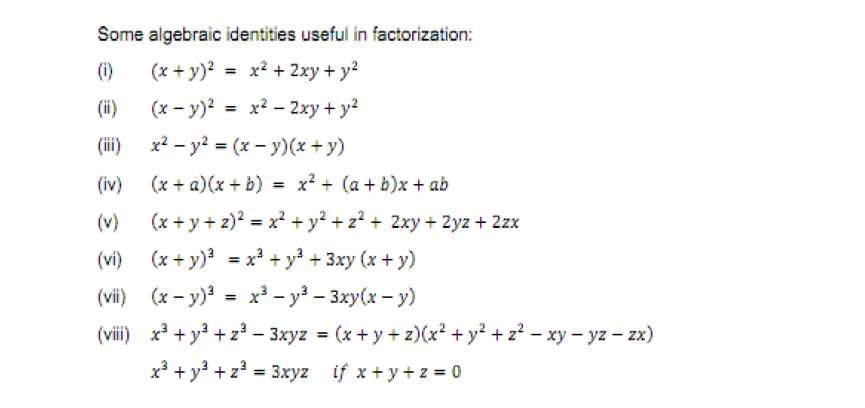
- Factorization: To express a given polynomial as the product of polynomials each of degree less than that of the given polynomial such that no such a factor has a factor of lower degree, is called factorization.
-
Chapter 1 Number Systems Notes for Class 9th Maths
CHAPTER – 1
NUMBER SYSTEMS
- Rational Numbers
- Irrational Numbers
- Real Numbers and their Decimal Expansions
- Operations on Real Numbers
- Laws of Exponents for Real Numbers