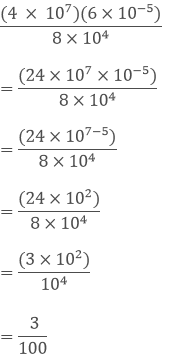
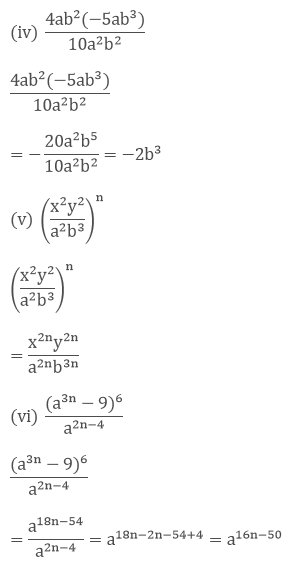
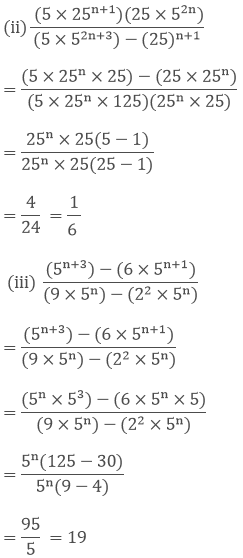
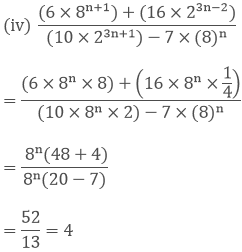
Category: RD Sharam Solution

  • Chapter 2 Polynomials RD Sharam Solution for Class 9th Maths

    Chapter 2: Exponents Of Real Numbers Exercise – 2.1

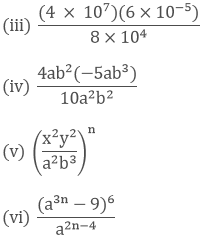
    Question: 1

    Simplify the following: 

    (i) 3(a4 b3)10 × 5 (a2 b2)3 

    (ii) (2x-2 y3)3 
    Solution:

    (i) 3(a4 b3)10 × 5 (a2 b2)3 

    = 3(a40 b30) × 5(a6 b6)

    = 15 (a46 b36

    (ii) (2x-2 y3)3 

    (23 × -2 × 3 y3 × 3) = 8x-6y9 
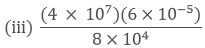
     

    Question: 2

    If a = 3 and b = – 2, find the values of: 

    (i) a+ bb 

    (ii) a+ ba 

    (iii) ab + ba 

    Solution:

    (i) We have,

    aa + bb 

    = 3+ (−2) −2

     = 33 + (−1/2)2 

    = 27 +1/4 

    = 109/4 

    (ii) ab + ba

     = 3−2 + (−2)3

     = (1/3)2 + (−2)3

     = 1/9 – 8

     = −(71/9) 

    (iii) We have, 

    ab + ba 

    = (3 + (−2))3(−2) 

    = (3 − 2))−6

     = 1−6 = 1 


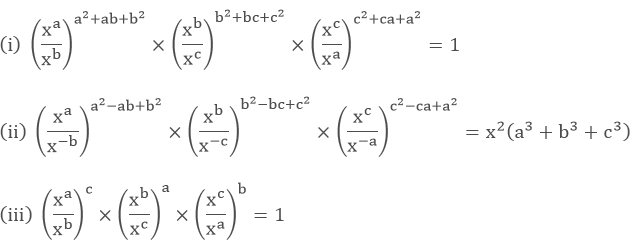
    Question: 3

    Prove that:
    Solution:

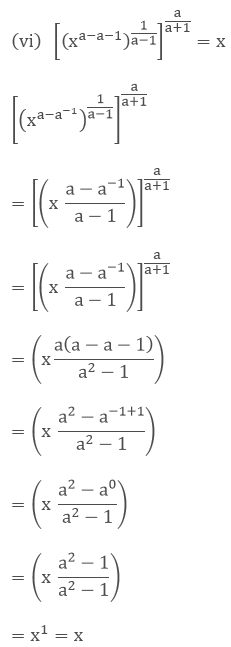
    (i) To prove

    Left hand side (LHS) = Right hand side (RHS) Considering LHS,
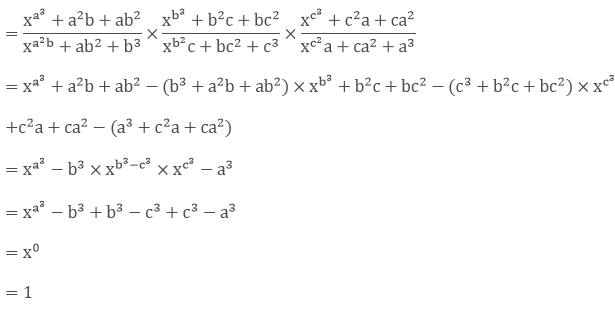
    Or, Therefore, LHS = RHS Hence proved

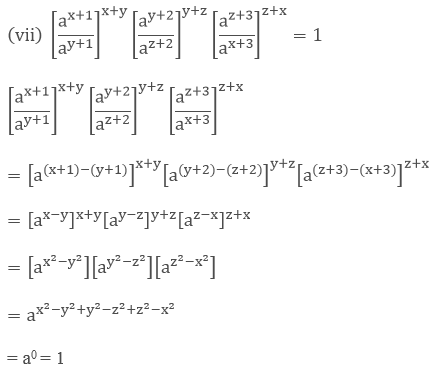
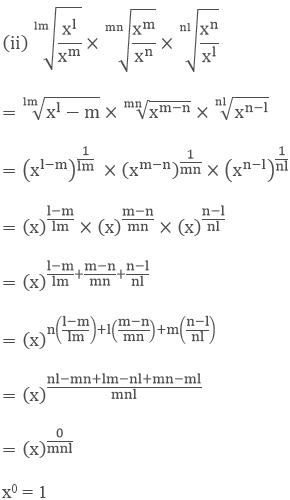
    (ii) To prove, 

    Left hand side (LHS) = Right hand side (RHS) Considering LHS,
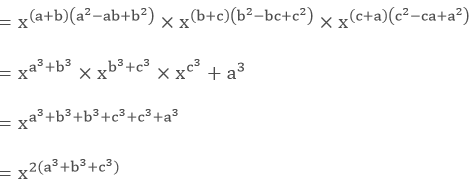
    Therefore, LHS = RHS Hence proved

    (iii) To prove, 
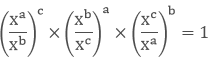
    Left hand side (LHS) = Right hand side (RHS) Considering LHS,
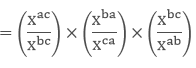
    = xac−bc × xba−ca × xbc−ab

    = xac − bc + ba − ca + bc − ab

    = x0

    = 1

    Therefore, LHS = RHS

    Hence proved 


    Question: 4

    Prove that: 
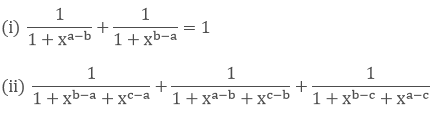
    Solution:
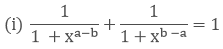
    Left hand side (LHS) = Right hand side (RHS) Considering LHS,
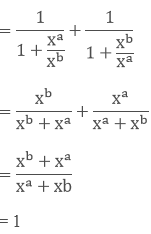
    Therefore, LHS = RHS Hence proved

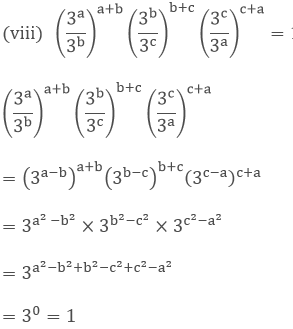
    Left hand side (LHS) = Right hand side (RHS) Considering LHS,
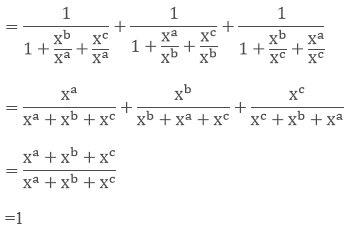
    Therefore, LHS = RHS Hence proved


    Question: 5

    Prove that:
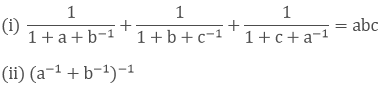
    Solution:

    (i) To prove,

    Left hand side (LHS) = Right hand side (RHS) Considering LHS,
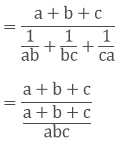
    = abc

    Therefore, LHS = RHS Hence proved

    (ii) To prove,
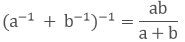
    Left hand side (LHS) = Right hand side (RHS) Considering LHS,
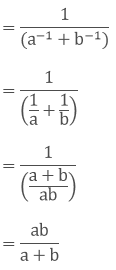
    Therefore, LHS = RHS

    Hence proved 


    Question: 6

    If abc = 1, show that

    Solution:

    To prove,

    Left hand side (LHS) = Right hand side (RHS) Considering LHS,
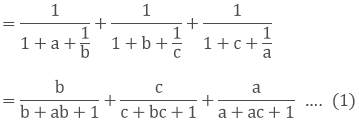
    We know abc = 1

    c = 1/ab

    By substituting the value c in equation (1), we get
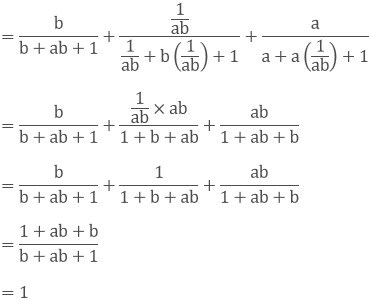
    Therefore, LHS = RHS Hence proved 


    Question: 7

    Simplify: 
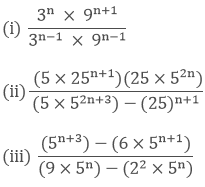
    Solution:
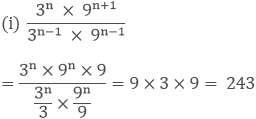
     

    Question: 8

    Solve the following equations for x: 

    (i) 72x+3 = 1 

    (ii) 2x+1 = 4x−3 

    (iii) 25x+3 = 8x+3 

    (iv) 42x = 1/32 

    (v) 4x−1 × (0.5)3−2x = (1/8)x 

    (vi) 23x−7 = 256 

    Solution:

    (i) We have,

    ⟹ 72x+3 = 1

    ⟹ 72x+3 = 70 

    ⟹ 2x + 3 = 0

    ⟹ 2x = -3

    ⟹ x = −3/2 

    (ii) We have,

    = 2x+1 = 4x−3

    = 2x+1 = 22x−6

    = x + 1 = 2x – 6

    = x = 7

    (iii) We have,

    = 25x+3 = 8x+3

    = 25x+3 = 23x+9

    = 5x + 3 = 3x + 9

    = 2x = 6

    = x = 3

    (iv) We have,

    = 42x = 1/32

    = 24x = 1/25

    = 24x = 2−5

    = 4x = – 5

    x = -5/4

    (v) We have,

    4x−1 × (0.5)3−2x = (1/8)x

    22x−2 × (1/2)3−2x = (1/2)3x

    22x−2 × 22x−3 = (1/2)3x

    22x−2+ 2x−3 = (1/2)3x

    24x−5 = 2−3x

    4x-5 = -3x

    7x = 5

    x = 5/7

    (vi) 23x−7 = 256

    23x−7 = 28

    3x – 7 = 8

    3x = 15

    x = 5


    Question: 9

    Solve the following equations for x: 

    (i) 22x − 2x+3 + 24 = 0 

    (ii) 32x+4 + 1 = 2 × 3x+2 

    Solution:

    (i) We have, ⟹ 22x − 2x+3 + 24 = 0 

    ⟹ 22x + 24 = 2x.23 

    ⟹ Let 2x = y 

    ⟹ y2 + 24 = y × 23 

    ⟹ y2 − 8y + 16 = 0 

    ⟹ y− 4y − 4y + 16 = 0 

    ⟹ y(y – 4) – 4(y – 4) = 0

    ⟹ y = 4

    ⟹ x2 = 22 

    ⟹ x = 2

    (ii) We have,

    32x+4 + 1 = 2 × 3x+2

    (3x+2)+ 1 = 2 × 3x+2

    Let 3x+2 = y

    y2 + 1 = 2y

    y2 − 2y + 1 = 0

    y2 − y − y + 1 = 0

    y(y − 1) − 1(y − 1) = 0

    (y − 1)(y − 1) = 0

    y = 1


    Question: 10

    If 49392 = a4b2c3, find the values of a, b and c, where a, b and c, where a, b, and c are different positive primes. 

    Solution:

    Taking out the LCM, the factors are 24, 32 and 73 a4b2c3 = 24, 32 and 73

    a = 2, b = 3 and c = 7 [Since, a, b and c are primes]


    Question: 11

    If 1176 = 2a × 3b × 7c, Find a, b, and c. 

    Solution:

    Given that 2, 3 and 7 are factors of 1176.

    Taking out the LCM of 1176, we get 23 × 31 × 72 = 2a × 3b × 7c 

    By comparing, we get

    a = 3, b = 1 and c = 2.


    Question: 12

    Given 4725 = 3a × 5b × 7c, find 

    (i) The integral values of a, b and c 

    (ii) The value of 2−a × 3× 7c 

    Solution:

    (i) Taking out the LCM of 4725, we get

    33 × 52 × 71 = 3a × 5b × 7c

    By comparing, we get

    a = 3, b = 2 and c = 1.

    (ii) The value of 2−a × 3× 7c 

    Sol:

    2-a × 3× 7c = 2−3 × 32 × 71

    2−3 × 32 × 71 = 1/8 × 9 × 7

    63/8


    Question: 13

    If a = xyp−1, b = xyq−1 and c = xyr−1, prove that aq−r br−p cp−q = 1 

    Solution:

    Given, a = xyp−1, b = xyq−1 and c = xyr−1 

    To prove, aq−rbr−pcp−q = 1

    Left hand side (LHS) = Right hand side (RHS)

    Considering LHS, = aq−r br−p cp−q …… (i)

    By substituting the value of a, b and c in equation (i), we get

    = (xyp−1)q−r(xyq−1)r−p(xyr−1)p−q 

    = xypq−pr−q+rxyqr−pq−r+pxyrp−rq−p+q 

    = xypq−pr−q+ r+qr−pq−r+p+rp−rq−p+q 

    = xy0 

    = 1

    Chapter 2: Exponents Of Real Numbers Exercise – 2.2

    Question: 1

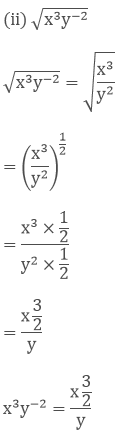
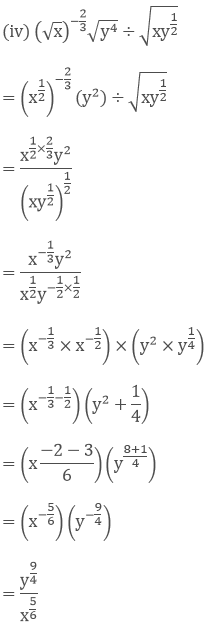
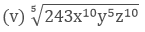
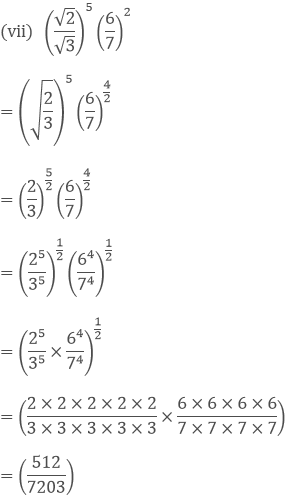
    Assuming that x, y, z are positive real numbers, simplify each of the following
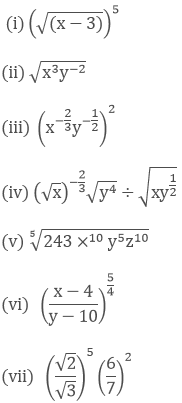
    Solution:
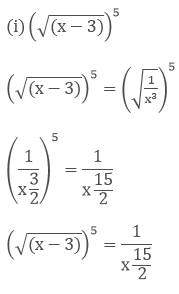
    = (243x10y5z10)1/5

    = (243)1/5x10/5y5/5z10/5

    = (35)1/5x2yz2

    = 3x2yz2
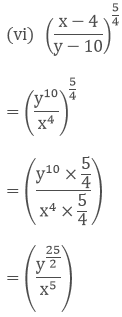
     

    Question: 2

    Simplify
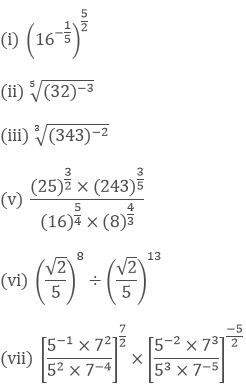
    Solution:
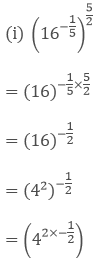
    = (4-1)

    = 1/4
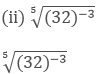
    = [(25)−3]1/5

    = (2−15)1/5

    = 2−3

    = 1/23 = 1/8
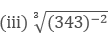
    = [(343)−2]1/3

    = (343)−2×1/3

    = (73)−2/3

    = (7−2)

    =(1/72)

    = (1/49)

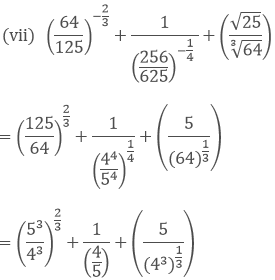
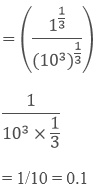
    (iv) (0.001)1/3

    = (1/1000)1/3

    = (1/103)1/3
    = 721-20 × 525/2 – 21/2

    = 71 × 54/2

    = 71 × 52

    = 7 × 25

    = 175


    Question: 3

    Prove that

    (ii) 93/2 − 3 × 50 − (1/81)−1/2
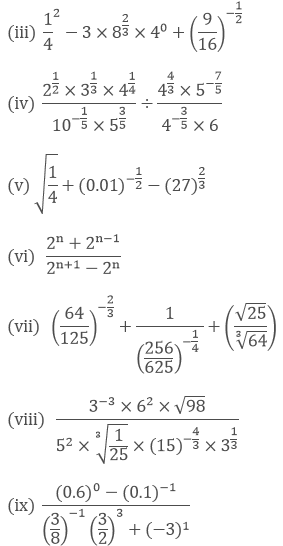
    Solution:
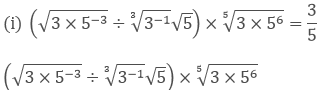
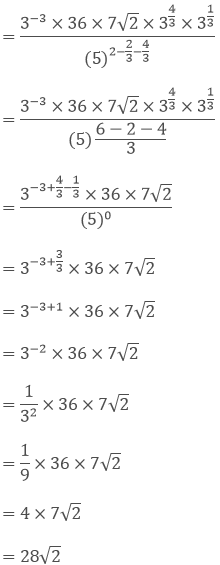
    = ((3 × 5−3)1/2 ÷ (3−1)1/3(5)1/2) × (3 × 56)1/6

    = ((3)1/2(5−3)1/2 ÷ (3−1)1/3(5)1/2) × (3 × 56)1/6

    = ((3)1/2(5)−3/2 ÷ (3)−1/3(5)1/2) × ((3)1/6 × (5)6/6)

    = ((3)1/2 − (−1/3) × (5)−3/2−1/2) × ((3)1/6 × (5))

    = ((3)5/6 × (5)−2) × ((3)1/6 × (5))

    = ((3)5/6+1/6 × (5)−2+1)

    = ((3)6/6 × (5)−1)

    = ((3)1 × (5)−1)

    = ((3) × (5)−1)

    = ((3) × (1/5))

    = (3/5)

    (ii) 93/2 − 3 × 50 − (1/81)−1/2

    = (32)3/2 − 3 − (1/92)−1/2
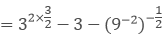
    = 3− 3 − (9)−2×−1/2

    = 27 − 3 − 9

    = 15

    = 24 − 3 × 23×2/3 + 4/3

    = 16 − 3 × 22 + 4/3

    = 16 − 3 × 4 + 4/3

    = 16 − 12 + 4/3

    = (12 + 4)/3

    = 16/3

    = 2 × 1 × 5

    = 10
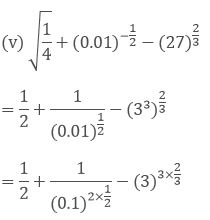
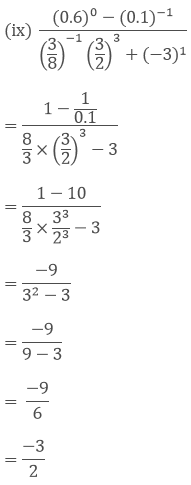
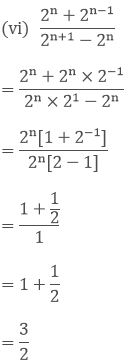
    = 1/2 + 1/(0.1)1 − (3)2

    = 1/2 +1/(0.1) −9

    = 1/2 + 10 − 9

    = 1/2 + 1

    = 3/2
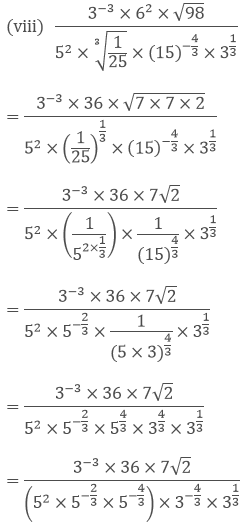
    = (5/4)2 + 5/4 + 5/4

    = 25/16 + 10/4

    = 25/16 + 40/16

    = (26 + 40)/16

    = 65/16
     

    Question: 4

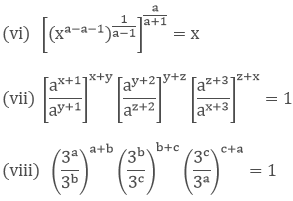
    Show that
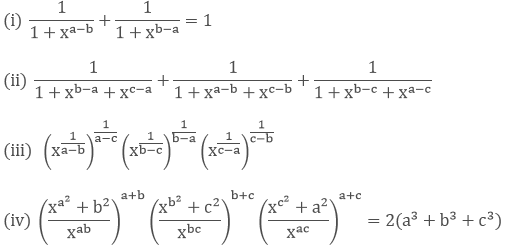
    (v) (xa−b)a + b (xb−c)b + c(xc − a)c + a = 1
    Solution:
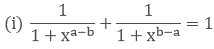
    Left hand side (LHS) = Right hand side (RHS)

    Considering LHS,
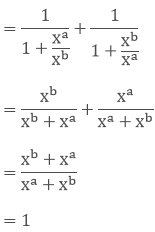
    Therefore, LHS = RHS

    Hence proved

    Left hand side (LHS) = Right hand side (RHS)

    Considering LHS,
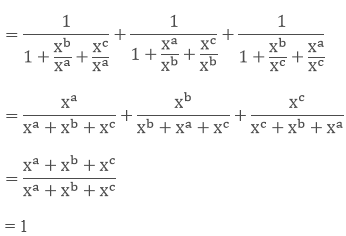
    Therefore, LHS = RHS

    Hence proved
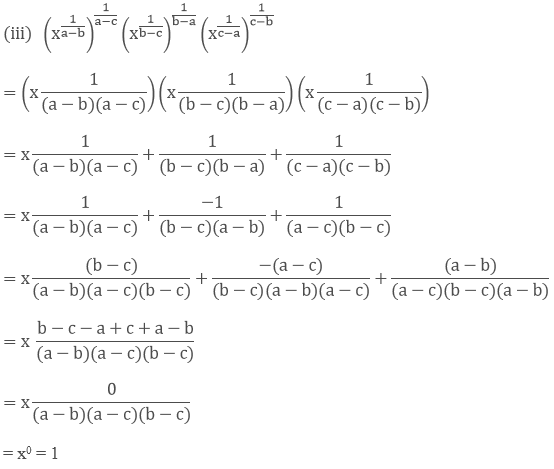
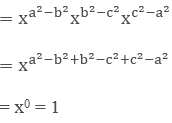
    (v) (xa−b)a + b (xb−c)b + c(xc − a)c + a = 1

    (xa−b)a+b(xb−c)b+c(xc−a)c+a
     

    Question: 5

    If 2x = 3y = 12z, show that 1/z = 1/y + 2/x

    Solution:

    2x = 3y = (2 × 3 × 2)z

    2x = 3y = (22 × 3)z

    2x = 3y = (22z × 3z)

    2x = 3y = 12z = k

    2 = k1/x

    3 = k1/y

    12 = k1/z

    12 = 2 × 3 × 2

    12 = k1/z = k1/y × k1/x × k1/x

    k1/z = k2/x + 1/y

    1/z = 1/y + 2/x


    Question: 6

    If 2x = 3= 6−z, show that 1/x + 1/y + 1/z = 0

    Solution:

     2x = 3y = 6−z

    2x = k

    2 = k1/x

    3y = k

    3 = k1/y

    6−z = k

    k = 1/6z

    6 = k−1/z

    2 × 3 = 6

    k1/x × k1/y = k−1/z

    1/x + 1/y = −1/z [by equating exponents]

    1/x + 1/y + 1/z = 0


    Question: 7

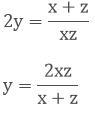
    If ax = by = cz and b2 = ac, then show that

    Solution:

    Let ax = by = cz = k

    a = k1/x, b = k1/y, c = k1/z

    Now,

    b2 = ac

    (k1/y)2 = k1/x × k1/z

    k2/y = k1/x + 1/z

    2/y = 1/x + 1/z
     

    Question: 8

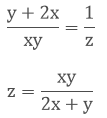
    If 3x = 5y = (75)z, Show that

    Solution:

    3x = k

    3 = k1/x

    5y = k

    5 = k1/y

    75z = k

    75 = k1/z

    31 × 52 = 751

    k1/x × k2/y = k1/z

    1/x + 2/y = 1/z
     

    Question: 9

    If (27)= 9/3x, find x

    Solution:

    We have,

    (27)x = 9/3x

    (33)x = 9/3x

    33x = 9/3x

    33x = 32/3x

    33x = 32−x

    3x = 2 − x [On equating exponents]

    3x + x = 2

    4x = 2

    x = 2/4

    x = 1/2

    Here the value of x is ½


    Question: 10

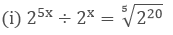
    Find the values of x in each of the following
    (ii) (23)4 = (22)x

    (iii) (3/5)x(5/3)2x = 125/27

    (iv) 5x−2 × 32x−3 = 135

    (v) 2x−7 × 5x−4 = 1250
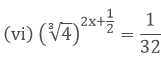
    (vii) 52x+3 = 1
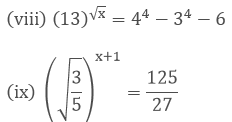
    Solution:

    We have
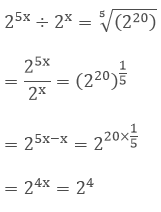
    = 4x = 4 [On equating exponent]

    x = 1

    Hence the value of x is 1

    (ii) (23)4 = (22)x

    We have

    (23)4 = (22)x

    = 23×4 = 22×x

    12 = 2x

    2x = 12 [On equating exponents]

    x = 6

    Hence the value of x is 6

    (iii) (3/5)x(5/3)2x = 125/27

    We have

    (3/5)x(5/3)2x = 125/27
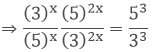
    ⇒ 52x−x/32x−x  = 53/33

    ⇒ 5x/3x = 53/33

    ⇒ (5/3)x = (5/3)3

    x = 3 [on equating exponents]

    Hence the value of x is 3

    (iv) 5x−2 × 32x−3 = 135

    We have,

    5x−2 × 32x−3 = 135

    ⇒ 5x−2 × 32x−3 = 5 × 27

    ⇒ 5x−2 × 32x−3 = 51 × 33

    ⇒ x − 2 = 1, 2x − 3 = 3 [On equating exponents]

    ⇒ x = 2 + 1, 2x = 3 + 3

    ⇒ x = 3, 2x = 6

    ⇒ x = 3

    Hence the value of x is 3

    (v) 2x−7 × 5x−4 = 1250

    We have

    2x−7 × 5x−4 = 1250

    ⇒ 2x−7 × 5x−4 = 2 × 625

    ⇒ 2x−7 × 5x−4 = 2 × 54

    ⇒ x − 7 = 1

    ⇒ x = 8, x − 4 = 4

    ⇒ x = 8

    Hence the value of x is 8
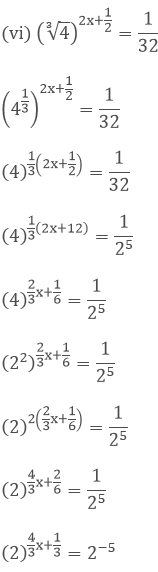
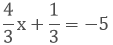
    4x + 1 = -15

    4x = -15 – 1

    4x = -16

    x = (-16)/4

    x = – 4

    Hence the value of x is 4

    (vii) 52x+3 = 1

    52x+3 = 1 × 50

    2x + 3 = 0 [By equating exponents]

    2x = −3

    x = −3/2

    Hence the value of x is −3/2
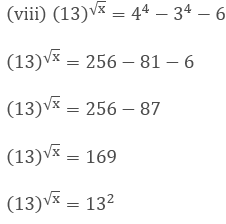
    √x = 2 [By equating exponents]

    (√x)2 = (2)2

    x = 4

    Hence the value of x is 4
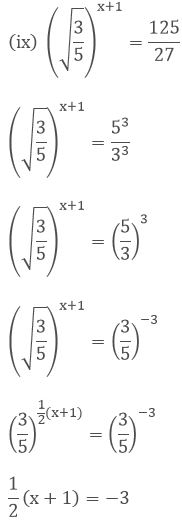
    x + 1 = – 6

    x = – 6 – 1

    x = -7

    Hence the value of x is 7


    Question: 11

    If x = 21/3 + 22/3, show that x3 − 6x = 6

    Solution:

    x3 − 6x = 6

    x = 21/3 + 22/3

    Putting cube on both the sides, we get

    x3  = (21/3 + 22/3)3

    As we know, (a + b)3 = a3 + b3 + 3ab(a + b)

    x3 = (21/3)3 + (22/3)3 + 3(21/3)(22/3)(21/3 + 22/3)

    x= (21/3)3 + (22/3)3 + 3(21/3+2/3)(x)

    x3 = (21/3)3 + (22/3)3 + 3(2)(x)

    x3 = 6 + 6x

    x3 – 6x = 6

    Hence proved


    Question: 12

    Determine (8x)x, if 9x+2 = 240 + 9x.

    Solution:

     9x+2 = 240 + 9x

    9x .92 = 240 + 9x

    Let 9x be y

    81y = 240 + y

    81y – y = 240

    80y = 240

    y = 3

    Since, y = 3

    Then,

    9x = 3

    32x = 3

    Therefore, x = ½

    (8x)x = (8 × 1/2)1/2

    = (4)1/2

    = 2

    Therefore (8x)x = 2


    Question: 13

    If 3x+1 = 9x-2, find the value of 21+x

    Solution:

    3x+1 = 9x-2

    3x+1 = 32x-4

    x + 1 = 2x – 4

    x = 5

    Therefore the value of 21+x = 21+5 = 26 = 64


    Question: 14

    If 34x = (81)-1 and (10)1/y = 0.0001, find the value of 2-x+4y.

    Solution:

    34x = (81)-1 and (10)1/y = 0.0001

    34x = (3)-4

    x = -1

    And, (10)1/y = 0.0001

    (10)1/y = (10)−4

    1/y = -4

    y = 1/−4

    To find the value of 2-x+4y, we need to substitute the value of x and y

    2-x+4y = 21+4(1/−4) = 21-1 = 20 = 1


    Question: 15

    If 53x = 125 and 10y = 0.001. Find x and y.

    Solution:

    53x = 125 and 10y = 0.001

    53x = 53

    x = 1

    Now,

    10y = 0.001

    10y = 10-3

    y = -3

    Therefore, the value of x = 1 and the value of y = – 3


    Question: 16

    Solve the following equations

    (i) 3x+1 = 27 × 34

    (iii) 3x−1 × 52y−3 = 225

    (iv) 8x+1 = 16y+2 and (1/2)3+x = (1/4)3y

    Solution:

    (i) 3x+1 = 27 × 34

    3x+1 = 33 × 34

    3x+1 = 33+4

    x + 1 = 3 + 4 [By equating exponents]

    x + 1 = 7

    x = 7 − 1

    x = 6
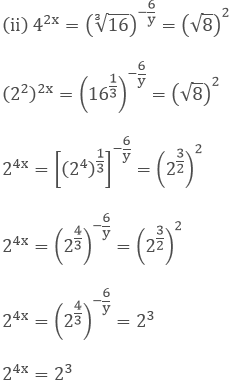
    4x = 3 (By equating exponents)
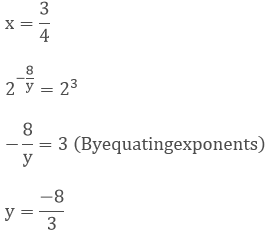
    (iii) 3x−1 × 52y−3 = 225

    3x−1 × 52y−3 = 3× 52

    x − 1 = 2 [By equating exponents]

    x = 3

    3x−1 × 52y−3 = 32 × 52

    2y − 3 = 2 [By equating exponents]

    2y = 5

    y = 5/2

    (iv) 8x+1 = 16y+2 and (1/2)3+x = (1/4)3y

    (23)x+1 and (2−1)3+x = (2−2)3y

    3x + 3 = 4y + 8 and − 3 − x = −6y

    3x + 3 = 4y + 8 and 3 + x = 6y

    3x + 3 = 4y + 8 and y = (3+x)/6

    3x + 3 = 4y + 8… eq1
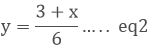
    Substitute eq2 in eq1
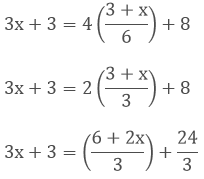
    3(3x + 3) = 6 + 2x + 24

    9x + 9 = 30 + 2x

    7x = 21

    x = 21/7

    x = 3

    Putting value of x in eq2

    y = 1

    (v) 4x−1 × (0.5)3−2x = (1/8)x

    22x−2 × (5/10)3−2x = (1/23)x

    22x−2 × (1/2)3−2x = 2−3x

    22x−2 × 2−3+2x = 2−3x

    2x − 2 − 3 + 2x = −3x [By equating exponents]

    4x + 3x = 5

    7x = 5x = 5/7
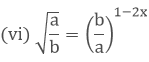
    (a/b)1/2 = (a/b)−(1−2x)1/2 = −1 + 2x [By equating exponents]

    1/2 + 1 = 2x

    2x = 3/2

    x = ¾


    Question: 17

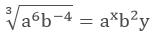
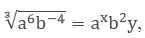
    If a and b are distinct positive primes such that
    , find x and y

    Solution:

    (a6b−4)1/3 = axb2y

    a6/3b−4/3 = axb2y

    a2b−4/3 = axb2y

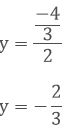
    x = 2, 2y = −4/3
     

    Question: 18

    If a and b are different positive primes such that

    (ii) (a + b)−1(a−1 + b−1) = axby, find x and y

    Solution:
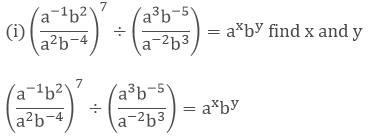
    (a−1−2b2+4)7 ÷ (a3+2b−5−3) = axby

    (a−3b6)7 ÷ (a5b−8) = axby

    (a−21b42) ÷ (a5b−8) = axby

    (a−21−5b42+8) = axby

    (a−26b50) = axby

    x = −26, y = 50

    (ii) (a + b)−1(a−1 + b−1) = axby, find x and y

    (a + b)−1(a−1 + b−1)
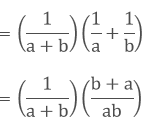
    = 1/ab

    = (ab)−1 = a−1b−1

    By equating exponents

    x = −1, y = −1

    Therefore x + y + 2 = −1 − 1 + 2 = 0


    Question: 19

    If 2x × 3y × 5z = 2160, find x, y and z. Hence compute the value of 3x × 2−y × 5−z

    Solution:

    2x × 3y × 5z = 2160

    2x × 3y × 5z = 24 × 33 × 51

    x = 4, y = 3, z = 1

    3x × 2−y × 5−z = 34 × 2−3 × 5−1
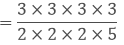
    = 81/40


    Question: 20

    If 1176 = 2a × 3b × 7c, find the values of a, b and c.

    Solution:

    Hence compute the value of 2a × 3b × 7−c as a fraction

    1176 = 2a × 3b × 7c

    23 × 31 × 72 = 2a × 3b × 7c

    a = 3, b = 1, c = 2

    We have to find the value of 2a × 3b × 7−c

    2a × 3b × 7−c = 23 × 31 × 7−2
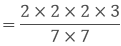
    = 24/49


    Question: 21

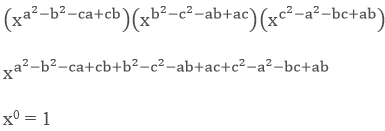
    Simplify
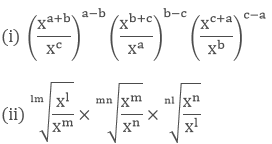
    Solution:
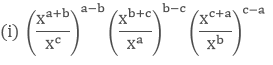
    (xa+b−c)a−b(xb+c−a)b−c(xc+a−b)c−a
     

    Question: 22

    Show that
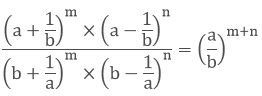
    Solution:
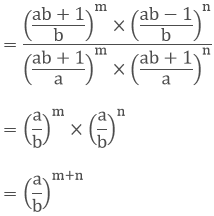
    Hence, LHS = RHS


    Question: 23

    (i) If a = xm+nyl, b = xn+lym and c = xl+myn, prove that am−nbn−lcl−m = 1

    (ii) If x = am+n, y = an+l and z = al+m, prove that xmynzl = xnylzm

    Solution:

    (i) If a = xm+nyl, b = xn+lym and c = xl+myn, prove that am−nbn−lcl−m = 1

    (xm+nyl)m−n(xn+lym)n−l(xl+myn)l−m

    = (x(m+n)(m−n)yl(m−n))(x(n+l)(n−l)ym(n−l))(x(l+m)(l−m)yn(l−m))

    = x0y0 = 1

    (ii) If x = am+n, y = an+l and z = al+m, prove that xmynzl = xnylzm

    LHS = xmynzl

    (am+n)m(an+l)n(al+m)l
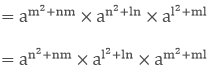
    =a(m+n)na(n+l)la(l+m)m

    = xnylzm

  • Chapter 1 Number Systems RD Sharam Solution for Class 9th Maths

    Chapter 1: Number System Exercise – 1.1

    Question: 1

    Is 0 a rational number? Can you write it in the form P/Q, where P and Q are integers and Q ≠ 0?

    Solution:

    Yes, 0 is a rational number and it can be written in P ÷ Q form provided that Q?

    0 is an integer and it can be written various forms, for example

    0 ÷ 2, 0 ÷ 100, 0 ÷ 95 etc.


    Question: 2

    Find five rational numbers between 1 and 2

    Solution:

    Given that to find out 5 rational numbers between 1 and 2

    Rational number lying between 1 and 2

    = 3/2

    = 1 < 3/2 < 2

    Rational number lying between 1 and 3/2

    = 5/4

    = 1 < 5/4 < 3/2

    Rational number lying between 1 and 5/4

    Rational number lying between 3/2 and 2

    = 9/8

    = 1 < 9/8 < 5/4

    Rational number lying between 3/2 and 2

    = 7/4

    = 3/2 < 7/4 < 2

    Rational number lying between 7/4 and 2

    = 15/8

    = 7/4 < 15/8 < 2

    Therefore, 1 < 9/8 < 5/4 < 3/2 < 7/4 < 15/8 < 2


    Question: 3

    Find out 6 rational numbers between 3 and 4

    Solution:

    Given that to find out 6 rational numbers between 3 and 4

    We have,

    3 × 7/7 = 21/7 and

    4 × 6/6 = 28/7

    We know 21 < 22 <  23 < 24 < 25 < 26 < 27 < 28

    21/7 < 22/7 < 23/7 < 24/7 < 25/7 < 26/7 < 27/7 < 28/7

    3 < 22/7 < 23/7 < 24/7 < 25/7 < 26/7 < 27/7 < 4

    Therefore, 6 rational numbers between 3 and 4 are

    22/7, 23/7, 24/7, 25/7, 26/7, 27/7

    Similarly to find 5 rational numbers between 3 and 4, multiply 3 and 4 respectively with 6/6 and in order to find 8 rational numbers between 3 and 4 multiply 3 and 4 respectively with 8/8 and so on.


    Question: 4

    Find 5 rational numbers between 3/5 and 4/5

    Solution:

    Given to find out the 5 rational numbers between 3/5 and 4/5

    To find 5 rational numbers between 3/5 and 4/5, 3/5 and 4/5 with 6/6

    We have,

    3/5 × 6/6 = 18/30

    4/5 × 6/6 = 24/30

    We know 18 < 19 < 20 < 21 < 22 <  23 < 24

    18/30 < 19/30 < 20/30 < 21/30 < 22/30 < 23/30 < 24/30

    3/5 < 1930 < 20/30 < 21/30 < 22/30 < 23/30 < 4/5

    Therefore, 5 rational numbers between 3/5 and 4/5 are 19/30, 20/30, 21/30, 22/30, 23/30


    Question: 5

    Answer whether the following statements are true or false? Give reasons in support of your answer.

    (i) Every whole number is a rational number

    (ii) Every integer is a rational number

    (iii) Every rational number is an integer

    (iv) Every natural number is a whole number

    (v) Every integer is a whole number

    (vi) Every rational number is a whole number

    Solution:

    (i)  True. As whole numbers include and they can be represented

    For example – 0/10, 1/1, 2/1, 3/1….. And so on.

    (ii) True. As we know 1, 2, 3, 4 and so on, are integers and they can be represented in the form of 1/1, 2/1, 3/1, 4/1.

    (iii) False. Numbers such as 3/2, 1/2, 3/5, 4/5 are rational numbers but they are not integers.

    (iv) True. Whole numbers include all of the natural numbers.

    (v) False. As we know whole numbers are a part of integers.

    (vi) False. Integers include -1, -2, -3 and so on…….which is not whole number

    Chapter 1: Number System Exercise – 1.2

    Question: 1

    Express the following rational numbers as decimals:

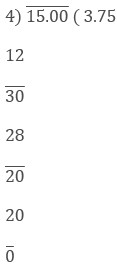
    (i) 42/100

    (ii) 327/500

    (iii) 15/4

    Solution:

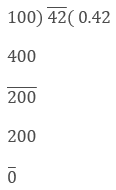
    (i) By long division method

    Therefore, 42/100 = 0.42

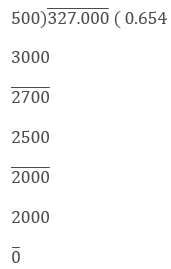
    (ii) By long division method

    Therefore, 327/500 = 0.654

    (iii) By long division method

    Therefore, 15/4 = 3.75


    Question: 2

    Express the following rational numbers as decimals:

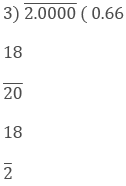
    (i)  2/3 

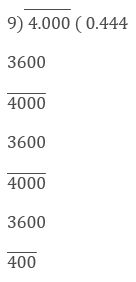
    (ii) – (4/9)

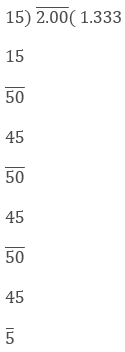
    (iii) – (2/15)

    (iv) – (22/13)

    (v)   437/999 

    Solution:

    (i) By long division method

    Therefore, 2/3 = 0.66

    (ii) By long division method

    Therefore, – 4/9 = – 0.444

    (iii) By long division method

    Therefore, 2/15 = -1.333

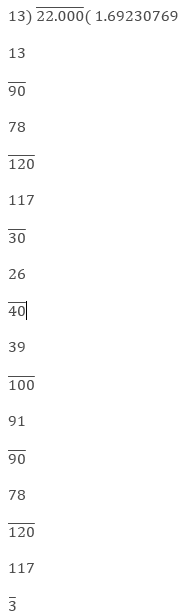
    (iv) By long division method

    Therefore, – 22/13 = – 1.69230769

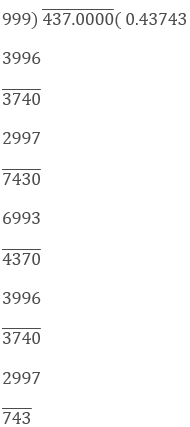
    (v) By long division method

    Therefore, 437/999 = 0.43743


    Question: 3

    Look at several examples of rational numbers in the form of p/q (q ≠ 0), where p and q are integers with no common factor other than 1 and having terminating decimal representations. Can you guess what property q must satisfy?

    Solution:

    A rational number p/q is a terminating decimal

    only, when prime factors of q are q and 5 only. Therefore,

    p/q is a terminating decimal only, when prime

    factorization of q must have only powers of 2 or 5 or both.

    Chapter 1: Number System Exercise – 1.3

    Question: 1

    Express each of the following decimals in the form of rational number.

    (i)  0.39

    (ii) 0.750

    (iii) 2.15

    (iv) 7.010

    (v)  9.90

    (vi) 1.0001

    Solution:

    (i) Given,

    0.39 = 39/100

    (ii) Given,

    0.750 = 750/1000

    (iii) Given,

    2.15 = 215/100 

    (iv) Given, 9.101

    (iv) Given,

    7.010 = 7010/1000

    (v) Given,

    9.90 = 990/100

    (vi) Given,

    1.0001 = 10001/10000


    Question: 2

    Express each of the following decimals in the form of rational number (p/q)

    Solution:

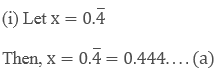
    Multiplying both sides of equation (a) by 10, we get,

    10x = 4.44…. (b)

    Subtracting equation (1) by (2)

    9x = 4

    x = 4/9

    Hence,= x = 4/9 

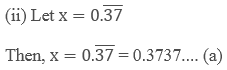
    Multiplying both sides of equation (a) by 100, we get,

    100 x = 37.37….  (b)

    Subtracting equation (1) by (2)

    99 x = 37

    x = 37/99

    Hence,= x = 37/99

    Chapter 1: Number System Exercise – 1.4

    Question: 1

    Define an irrational number.

    Solution:

    An irrational number is a real number which can be written as a decimal but not as a fraction i.e. it cannot be expressed as a ratio of integers. It cannot be expressed as terminating or repeating decimal.


    Question: 2

    Explain how an irrational number is differing from rational numbers?

    Solution:

    An irrational number is a real number which can be written as a decimal but not as a fraction i.e. it cannot be expressed as a ratio of integers. It cannot be expressed as terminating or repeating decimal.

    For example, 0.10110100 is an irrational number

    A rational number is a real number which can be written as a fraction and as a decimal i.e. it can be expressed as a ratio of integers. . It can be expressed as terminating or repeating decimal.

    For examples,

    0.10 andboth are rational numbers


    Question: 3

    Find, whether the following numbers are rational and irrational

    (i) √7

    (ii)  √4

    (iii) 2 + √3

    (iv) √3 + √2

    (v) √3 + √5

    (vi) (√2 – 2)2

    (vii)  (2 – √2) (2 + √2)

    (viii) (√2 + √3)2

    (ix) √5 – 2

    (x) √23

    (xi) √225

    (xii) 0.3796

    (xiii) 7.478478…

    (xiv) 1.101001000100001…..

    Solution:

    (i) √7 is not a perfect square root so it is an Irrational number.

    (ii) √4 is a perfect square root so it is an rational number.

    We have,

    √4 can be expressed in the form of

    a/b, so it is a rational number. The decimal representation of √9 is 3.0. 3 is a rational number.

    (iii) 2 + √3

    Here, 2 is a rational number and √3 is an irrational number

    So, the sum of a rational and an irrational number is an irrational number.

    (iv) √3 + √2

    √3 is not a perfect square and it is an irrational number and √2 is not a perfect square and is an irrational number. The sum of an irrational number and an irrational number is an irrational number, so √3 + √2 is an irrational number.

    (v) √3 + √5

    √3 is not a perfect square and it is an irrational number and √5 is not a perfect square and is an irrational number. The sum of an irrational number and an irrational number is an irrational number, so √3 + √5 is an irrational number.

    (vi) (√2 – 2)2

    We have, (√2 – 2)2

    = 2 + 4 – 4√2

    = 6 + 4√2

    6 is a rational number but 4√2 is an irrational number.

    The sum of a rational number and an irrational number is an irrational number, so (√2 + √4)2 is an irrational number.

    (vii) (2 -√2) (2 + √2)

    We have,

    (2 – √2) (2 + √2) = (2)2 – (√2)2 [Since, (a + b)(a – b) = a2 – b2]

    4 – 2 = 2/1

    Since, 2 is a rational number.

    (2 – √2)(2 + √2) is a rational number.

    (viii) (√2 +√3)2

    We have,

    (√2 + √3)2 = 2 + 2√6 + 3 = 5+√6   [Since, (a + b)2 = a2 + 2ab + b2

    The sum of a rational number and an irrational number is an irrational number, so (√2 + √3)2 is an irrational number.

    (ix) √5 – 2

    The difference of an irrational number and a rational number is an irrational number. (√5 – 2) is an irrational number.

    (x) √23

    √23 = 4.795831352331….

    As decimal expansion of this number is non-terminating, non-recurring so it is an irrational number.

    (xi) √225

    √225 = 15 = 15/1

    √225 is rational number as it can be represented in p/q form.

    (xii) 0.3796

    0.3796, as decimal expansion of this number is terminating, so it is a rational number.

    (xiii) 7.478478……

    7.478478 = 7.478, as decimal expansion of this number is non-terminating recurring so it is a rational number.

    (xiv) 1.101001000100001……

    1.101001000100001……, as decimal expansion of this number is non-terminating, non-recurring so it is an irrational number


    Question: 4

    Identify the following as irrational numbers. Give the decimal representation of rational numbers:

    (i) √4

    (ii) 3 × √18

    (iii) √1.44

    (iv) √(9/27)

    (v) – √64

     (vi) √100

    Solution:

    (i) We have,

    √4 can be written in the form of

    p/q. So, it is a rational number. Its decimal representation is 2.0

    (ii). We have,

    3 × √18

    = 3 × √2 × 3 × 3

    = 9×√2

    Since, the product of a ratios and an irrational is an irrational number. 9 ×√2 is an irrational.

    3 ×√18 is an irrational number.

    (iii) We have,

    √1.44

    = √(144/100)

    = 12/10

    = 1.2

    Every terminating decimal is a rational number, so 1.2 is a rational number.

    Its decimal representation is 1.2.

    (iv) √(9/27) 

    We have,

    √(9/27)

    =3/√27

    = 1/√3

    Quotient of a rational and an irrational number is irrational numbers so

    1/√3 is an irrational number.

    √(9/27) is an irrational number.

    (v) We have,

    -√64

    = – 8

    = – (8/1)

    = – (8/1) can be expressed in the form of a/b,

    so – √64 is a rational number.

    Its decimal representation is – 8.0.

    (vi) We have,

    √100

    = 10  can be expressed in the form of a/b,

    So √100 is a rational number

    Its decimal representation is 10.0.


    Question: 5

    In the following equations, find which variables x, y and z etc. represent rational or irrational numbers:

    (i) x2 = 5

    (ii) y2 = 9

    (iii) z2 = 0.04

    (iv) u2 = 174

     (v) v2 = 3

    (vi) w2 = 27

    (vii) t2 = 0.4

    Solution:

    (i) We have,

    x2 = 5

    Taking square root on both the sides, we get

    X = √5

    √5 is not a perfect square root, so it is an irrational number.

    (ii) We have,

    = y2 = 9

    = 3

    = 3/1 can be expressed in the form of a/b, so it a rational number.

    (iii) We have,

    z2 = 0.04

    Taking square root on the both sides, we get

    z = 0.2

    2/10 can be expressed in the form of a/b, so it is a rational number.

    (iv) We have,

    u2 = 17/4

    Taking square root on both sides, we get,

    u = √(17/4)

    u = √17/2

    Quotient of an irrational and a rational number is irrational, so u is an Irrational number.

    (v) We have,

    v2 = 3

    Taking square root on both sides, we get,

    v = √3

    √3 is not a perfect square root, so v is irrational number.

    (vi) We have,

    w2 = 27

    Taking square root on both the sides, we get,

    w = 3√3

    Product of a irrational and an irrational is an irrational number. So w is an irrational number.

    (vii) We have,

    t2 = 0.4

    Taking square root on both sides, we get,

    t = √(4/10)

    t = 2/√10

    Since, quotient of a rational and an Irrational number is irrational number. t2 = 0.4 is an irrational number.


    Question: 6

    Give an example of each, of two irrational numbers whose:

    (i) Difference in a rational number.

    (ii) Difference in an irrational number.

    (iii) Sum in a rational number.

    (iv) Sum is an irrational number.

    (v) Product in a rational number.

    (vi) Product in an irrational number.

    (vii) Quotient in a rational number.

    (viii) Quotient in an irrational number.

    Solution:

    (i) √2 is an irrational number.

    Now, √2 -√2 = 0.

    0 is the rational number.

    (ii) Let two irrational numbers are 3√2 and √2.

    3√2 – √2 = 2√2

    5√6 is the rational number.

    (iii) √11 is an irrational number.

    Now, √11 + (-√11) = 0.

    0 is the rational number.

    (iv) Let two irrational numbers are 4√6 and √6

    4√6 + √6

    5√6 is the rational number.

    (iv) Let two Irrational numbers are 7√5 and √5

    Now, 7√5 × √5

    = 7 × 5

    = 35 is the rational number.

    (v) Let two irrational numbers are √8 and √8.

    Now, √8 × √8

    8 is the rational number.

    (vi) Let two irrational numbers are 4√6 and √6

    Now, (4√6)/√6

    = 4 is the rational number

    (vii) Let two irrational numbers are 3√7 and √7

    Now, 3 is the rational number.

    (viii) Let two irrational numbers are √8 and √2

    Now √2 is an rational number.


    Question: 7

    Give two rational numbers lying between 0.232332333233332 and 0.212112111211112.

    Solution:

    Let a = 0.212112111211112

    And, b = 0.232332333233332…

    Clearly, a < b because in the second decimal place a has digit 1 and b has digit 3 If we consider rational numbers in which the second decimal place has the digit 2, then they will lie between a and b.

    Let. x = 0.22

    y = 0.22112211… Then a < x < y < b

    Hence, x, and y are required rational numbers.


    Question: 8

    Give two rational numbers lying between 0.515115111511115 and 0. 5353353335

    Solution:

    Let, a = 0.515115111511115…

    And, b = 0.5353353335..

    We observe that in the second decimal place a has digit 1 and b has digit 3, therefore, a < b.

    So If we consider rational numbers

    x = 0.52

    y = 0.52062062…

    We find that,

    a < x < y < b

    Hence x and y are required rational numbers.


    Question: 9

    Find one irrational number between 0.2101 and 0.2222 … =

    Solution:

    Let, a = 0.2101 and,

    b = 0.2222…

    We observe that in the second decimal place a has digit 1 and b has digit 2, therefore a < b in the third decimal place a has digit 0.

    So, if we consider irrational numbers

    x = 0.211011001100011….

    We find that a < x < b

    Hence x is required irrational number.


    Question: 10

    Find a rational number and also an irrational number lying between the numbers 0.3030030003… and 0.3010010001…

    Solution:

    Let,

    a = 0.3010010001 and,

    b = 0.3030030003…

    We observe that in the third decimal place a has digit 1 and b has digit

    3, therefore a < b in the third decimal place a has digit 1. So, if we

    consider rational and irrational numbers

    x = 0.302

    y = 0.302002000200002…..

    We find that a < x < b and, a < y < b.

    Hence, x and y are required rational and irrational numbers respectively.


    Question: 11

    Find two irrational numbers between 0.5 and 0.55.

    Solution:

    Let a = 0.5 = 0.50 and b = 0.55

    We observe that in the second decimal place a has digit 0 and b has digit

    5, therefore a < 0 so, if we consider irrational numbers

    x = 0.51051005100051…

    y = 0.530535305353530…

    We find that a < x < y < b

    Hence x and y are required irrational numbers.


    Question: 12

    Find two irrational numbers lying between 0.1 and 0.12.

    Solution:

    Let a = 0.1 = 0.10

    And b = 0.12

    We observe that In the second decimal place a has digit 0 and b has digit 2.

    Therefore, a < b.

    So, if we consider irrational numbers

    x = 0.1101101100011… y = 0.111011110111110… We find that a < x < y < 0

    Hence, x and y are required irrational numbers.


    Question: 13

    Prove that √3 + √5 is an irrational number.

    Solution:

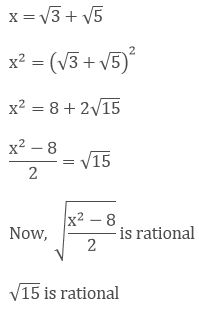
    If possible, let √3 + √5 be a rational number equal to x.

    Then,

    Thus, we arrive at a contradiction.

    Hence, √3 + √5 is an irrational number.

  • Class 9th Math R.D. Sharma Solutions

    RD Sharam Solution Class Of class 9th Mathematics Presented By ImperialStudy. With Step By Step Math Solution. If you are Getting Problem In RD Sharam Solution Solution So, Here We Provide Full Solutions Of Class IX Math Students Also We provide RS Aggarwal Solution Of Class 9thNCERT Solution Class 9th Maths &

    RD Sharam Solution for Class 9 – Maths

    • RD Sharam Solution for Class 9th Maths: Chapter 1 Number Systems
    • RD Sharam Solution for Class 9th Maths: Chapter 2 Polynomials
    • RD Sharam Solution for Class 9th Maths: Chapter 3 Coordinate Geometry
    • RD Sharam Solution for Class 9th Maths: Chapter 4 Linear Equations in Two Variables
    • RD Sharam Solution for Class 9th Maths: Chapter 5 Introduction to Euclid’s Geometry
    • RD Sharam Solution for Class 9th Maths: Chapter 6 Lines and Angles
    • RD Sharam Solution for Class 9th Maths: Chapter 7 Triangles
    • RD Sharam Solution for Class 9th Maths: Chapter 8 Quadrilaterals
    • RD Sharam Solution for Class 9th Maths: Chapter 9 Areas of Parallelograms and Triangles
    • RD Sharam Solution for Class 9th Maths: Chapter 10 Circles
    • RD Sharam Solution for Class 9th Maths: Chapter 11 Constructions
    • RD Sharam Solution for Class 9th Maths: Chapter 12 Heron’s Formula
    • RD Sharam Solution for Class 9th Maths: Chapter 13 Surface Areas and Volumes
    • RD Sharam Solution for Class 9th Maths: Chapter 14 Statistics
    • RD Sharam Solution for Class 9th Maths: Chapter 15 Probability