Category: Science

  • Force and Laws of Motion NCERT Solutions for Class 9th Science: Chapter 9

    In-Text Questions Solved

    Ncert Textbook Page 118
    Question 1. Which of the following has more inertia:
    (a) a rubber ball and a stone of the same size?
    (b) a bicycle and a train?
    (c) a five-rupees coin and a one-rupee coin?
    Answer:
    (a) A stone of the same size
    (b) a train
    (c) a five-rupees coin
    As the mass of an object is a measure of its inertia, objects with more mass have more inertia.

    Question 2. In the following example, try to identify the number of times the velocity of the ball changes.
    “A football player kicks a football to another player of his team who kicks the football towards the goal The goalkeeper of the opposite team collects the football and kicks it towards a player of his own team”.
    Also identify the agent supplying the force in each case.
    Answer:
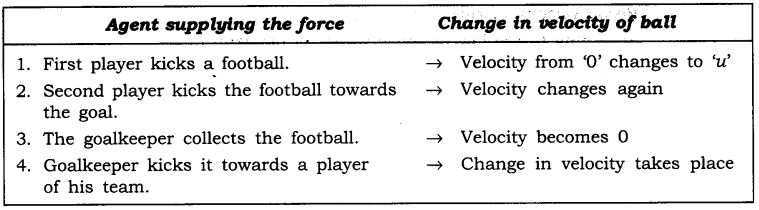
    ncert-solutions-for-class-9-science-force-and-laws-of-motion-1
    The velocity of football changed four times.

    Question 3. Explain why some of the leaves may get detached from a tree if we vigorously shake its branch.
    Answer: When the tree’s branch is shaken vigorously the branch attain motion but the leaves stay at rest. Due to the inertia of rest, the leaves tend to remain in its position and hence detaches from the tree to fall down.

    Question 4. Why do you fall in the forward direction when a moving bus brakes to a stop and fall backwards when it accelerates from rest?
    Answer: When a moving bus brakes-to a stop: When the bus is moving, our body is also in motion, but due to sudden brakes, the lower part of our body comes to rest as soon as the bus stops. But the upper part of our body continues to be in motion and hence we fall in forward direction due to inertia of motion.
    When the bus accelerates from rest we fall backwards: When the bus’ is stationary our body is at rest but when the bus accelerates, the lower part of our body being in contact with the floor of the bus comes in motion, but the upper part of our body remains at rest due to inertia of rest. Hence we fall in backward direction.

    Ncert Textbook Page 126-127
    Question 1. If action is always equal to the reaction, explain how a horse can pud a cart?
    Answer: The third law of motion states that action is always equal to the reaction but they act on two different bodies.
    In this case the horse exerts a force on the ground with its feet while walking, the ground exerts an equal and opposite force on the feet of the horse, which enables the horse to move forward and the cart is pulled by the horse.

    Question 2. Explain, why is it difficult for a fireman to hold a hose, which ejects a large amount of water at a high velocity.
    Answer: The water that is ejected out from the hose in the forward direction comes out with a large momentum and equal amount of momentum is developed in the hose in the opposite direction and hence the hose is pushed backward. It becomes difficult for a fireman to hold a hose which experiences this large momentum.

    Question 3. From a rifle of mass 4 kg, a bullet of mass 50 g is fired with an initial velocity of 35 m/s. Calculate the initial recoil velocity of the rifle.
    Answer:
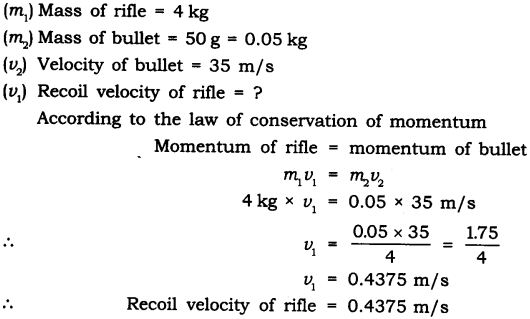
    ncert-solutions-for-class-9-science-force-and-laws-of-motion-2

    Question 4. Two objects of masses 100 g and 200 g are moving along the same line and direction with velocities of 2 m/s and 1 m/s respectively.
    They collide and after the collision the first object moves at a velocity of 1.67 m./s. Determine the velocity of the second object.
    Answer:
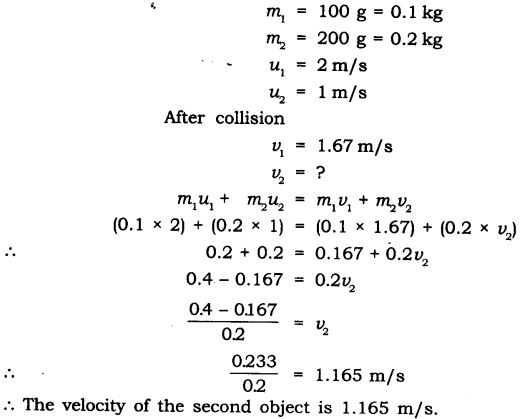
    ncert-solutions-for-class-9-science-force-and-laws-of-motion-3

    Questions From NCRT Textbook

    Question 1. An object experiences a net zero external unbalanced force. Is it possible for the object to be travelling with a non-zero velocity? If yes, state the conditions that must be placed on the magnitude and direction of the velocity. If no, provide a reason.
    Answer: When an object experiences a net zero external unbalanced force, in accordance with second law of motion its acceleration is zero. If the object was initially in a state of motion, then in accordance with the first law of motion, the object will continue to move in same direction with same speed. It means that the object may be travelling with a non-zero velocity but the magnitude as well as direction of velocity must remain unchanged or constant throughout.

    Question 2. When a carpet is beaten with a stick, dust comes out of it. Explain.
    Answer: The carpet with dust is in state of rest. When it is beaten with a stick the carpet is set in motion, but the dust particles remain at rest. Due to inertia of rest the dust particles retain their position of rest and falls down due to gravity.

    Question 3. Why is it advised to tie any luggage kept on the roof of a bus with a rope?
    Answer: In moving vehicle like bus, the motion is not uniform, the speed of vehicle varies and it may apply brake suddenly or takes sudden turn. The luggage will resist any change in its state of rest or motion, due to inertia and this luggage has the tendency to fall sideways, forward or backward.
    To avoid the fall of the luggage, it is tied with the rope.

    Question 4. A batsman hits a cricket ball which then rolls on a level ground. After covering a short distance, the ball comes to rest. The ball slows to a stop because
    (a) the batsman did not hit the ball hard enough.
    (b) velocity is proportional to the force exerted on the ball.
    (c) there is a force on the ball opposing the motion.
    (d) there is no unbalanced force on the ball, so the ball would want to come to rest.
    Answer: (c) there is a force 6n the ball opposing the motion.

    Question 5. A truck starts from rest and rolls down a hill with a constant acceleration. It travels a distance of 400 m in 20 s. Find its acceleration. Find the force acting on it if its mass is 7 tonnes (Hint : 1 tonne = 1000 kg).
    Answer:
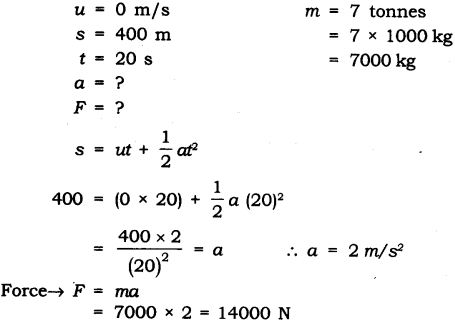
    ncert-solutions-for-class-9-science-force-and-laws-of-motion-4

    Question 6. A stone of lkg is thrown with a velocity of 20 ms~1 across the frozen surface of a lake and comes to rest after travelling a distance of 50 m. What is the force of friction between the stone and the ice?
    Answer:
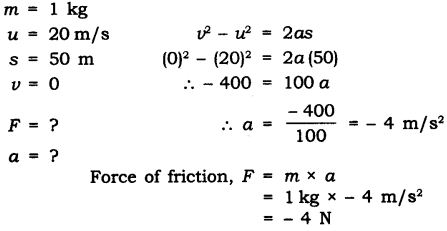
    ncert-solutions-for-class-9-science-force-and-laws-of-motion5

    Question 7. 40000 kg engine pulls a train of 5 wagons, each of 2000 kg, along a horizontal track. If the engine exerts a force of 40000 N and the track offers a friction force of 5000 N, then calculate:
    Answer:
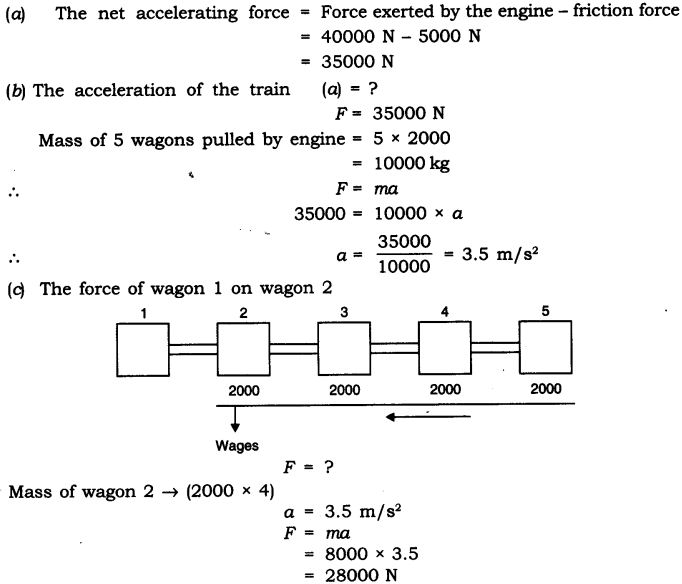
    ncert-solutions-for-class-9-science-force-and-laws-of-motion-6

    Question 8. An automobile vehicle has a mass of 1500 kg. What must be the force between the vehicle and road if the vehicle is to be stopped with a negative acceleration of 1.7 ms-2?
    Answer:
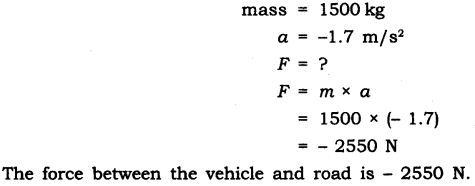
    ncert-solutions-for-class-9-science-force-and-laws-of-motion-7

    Question 9.What is the momentum of an object of mass m, moving with a velocity v?.
    (a) (mv)2           (b) mv2                    (c) 1/2 mv2                   (d) mv
    Answer: (d) mv

    Question 10.Using a horizontal force of 200 N, we intend to move a wooden cabinet across a floor at a constant velocity. What is the friction force that will be exerted on the cabinet?
    Answer:
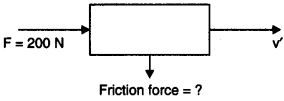
    ncert-solutions-for-class-9-science-force-and-laws-of-motion-8
    As the wooden cabinet moves across the floor at a constant velocity and the force applied is 200 N. Hence the frictional force that will be exerted on the cabinet will be less than 200 N.

    Question 11.Two objects each of mass 1.5 kg, are moving in the same straight line but in opposite directions. The velocity of each object is 2.5 ms-1 before the collision during which they stick together. What will be the velocity of the combined object after collision?
    Answer:
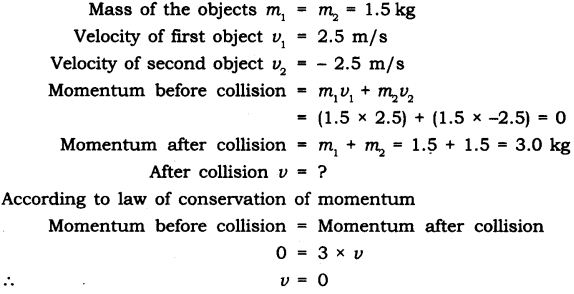
    ncert-solutions-for-class-9-science-force-and-laws-of-motion-9

    Question 12. According to the third law of motion when we push on an object, the object pushes back on us with an equal and opposite force. If the object is a massive truck parked along the roadside, it will probably not move. A student justifies this by answering that the two opposite and equal forces cancel each other. Comment on this logic and explain why the truck does not move.
    Answer: The mass of truck is too large and hence its inertia is too high. The small force exerted on the truck cannot move it and the truck remains at rest. For the truck to attain motion, an external large amount of unbalanced force need to be exerted on it.

    Question 13. A hockey ball of mass 200 g travelling at 10 ms-1 is struck by a hockey stick so as to return it along its original path with a velocity at 5 ms-1. Calculate the change of momentum occurred in the motion of the hockey ball by the force applied by the hockey stick.
    Answer:
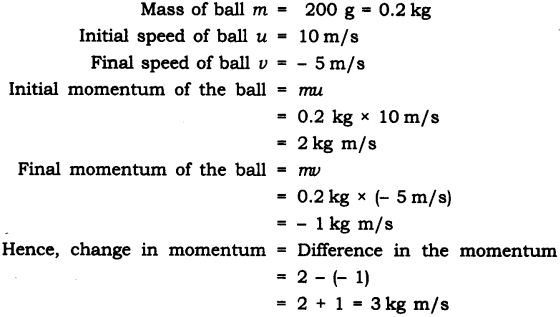
    ncert-solutions-for-class-9-science-force-and-laws-of-motion-10

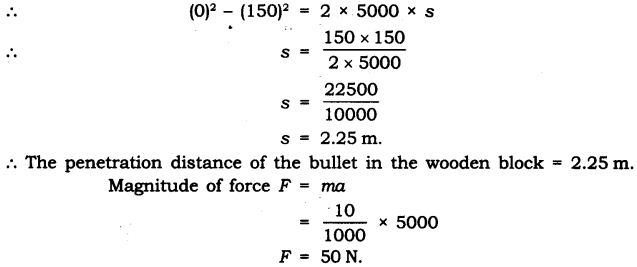
    Question 14. A bullet of mass 10 p travelling horizontally with a velocity of 150 m-1 strikes a stationary wooden block and comes to rest in 0.03 s. Calculate the distance of penetration of the bullet into the block. Also calculate the magnitude of the force exerted by the wooden block on the bullet.
    Answer:
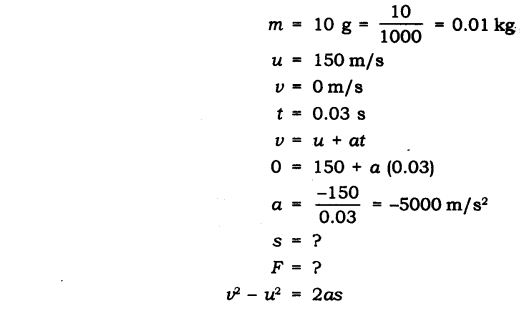
    ncert-solutions-for-class-9-science-force-and-laws-of-motion-11
    ncert-solutions-for-class-9-science-force-and-laws-of-motion-12

    Question 15. An object of mass 1 kg travelling in a straight line with a velocity of 10 ms-1 collides with, and sticks to, a stationary wooden block of mass 5 kg. Then they both move off together in the same straight line. Calculate the total momentum just before the impact and just after the before the impact and just after the impact. Also, calculate the velocity of the combined object.
    Answer:
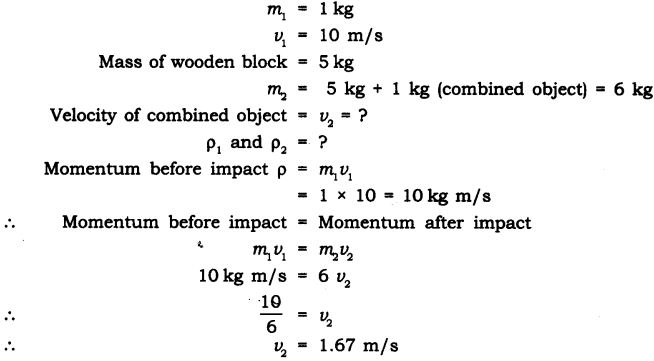
    ncert-solutions-for-class-9-science-force-and-laws-of-motion-13

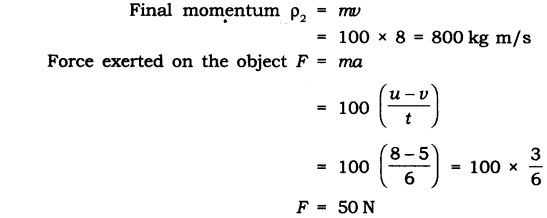
    Question 16. An object of mass 100 kg is accelerated uniformly from a velocity of 5 ms-1 to 8 ms-1 in 6 s. Calculate the initial and final momentum of the object. Also, find the magnitude of the force exerted on the object.
    Answer:
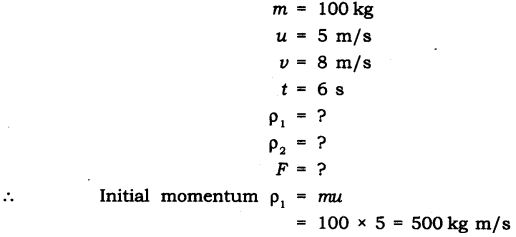
    ncert-solutions-for-class-9-science-force-and-laws-of-motion14
    ncert-solutions-for-class-9-science-force-and-laws-of-motion-15

    Question 17. Akhtar, Kiran and Rahul were riding in a motorcar that was moving with a high velocity on an expressway when an insect hit the windshield and got stuck on the windscreen. Akhtar and Kiran started pondering over the situation. Kiran suggested that the insect suffered a greater change in momentum as compared to the change in momentum of the motorcar (because the change in the velocity of insect was much more than that of the motorcar). Akhtar said that since the motorcar was moving with a larger velocity, it exerted a larger force on the insect. And as a result the insect died. Rahul while putting an entirely new explanation said that both the motorcar and the insect experienced the same force and a change in their momentum. Comment on these suggestions.
    Answer: Rahul gave the correct reasoning and explanation that both the motorcar and the insect experienced the same force and a change in their momentum. As per the law of conservation of momentum.
    When 2 bodies collide:
    Initial momentum before collision = Final momentum after collision
    mu1+ mu= mv1+ mv2
    The equal force is exerted on both the bodies but, because the mass of insect is very small it will suffer greater change in velocity.

    Question 18. How much momentum will a dumb-bell of mass 10 kg transfer to the floor if it falls from a height of 80 cm? Take its downward acceleration to be 10 ms-2.
    Answer:
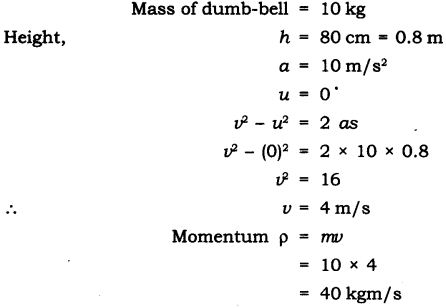
    ncert-solutions-for-class-9-science-force-and-laws-of-motion-16

    Additional Exercises

    Question 1. The following is the distance-time table on an object in motion:
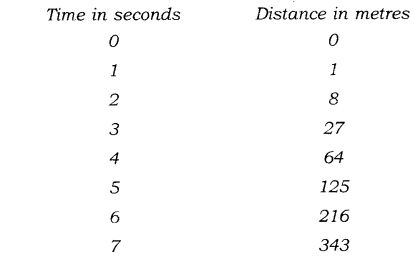
    ncert-solutions-for-class-9-science-force-and-laws-of-motion-17
    (a) What conclusion can you draw about the acceleration? Is it constant, increasing, decreasing, or zero?
    (b) What do you infer about the forces acting on the object?
    Answer: As per given table initial speed of the object is zero. Applying the relation
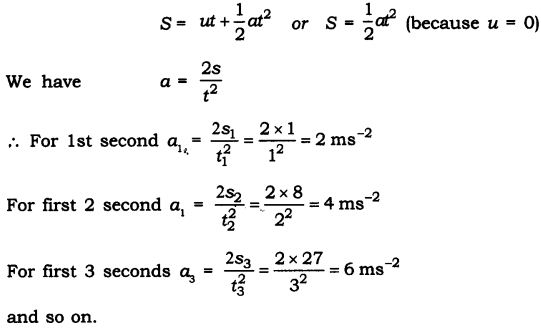
    ncert-solutions-for-class-9-science-force-and-laws-of-motion-18

    Question 2. Two persons manage to push a motorcar of mass 1200 kg at a uniform velocity along a level road. The same motorcar can be pushed by three persons to produce an acceleration of 0.2 ms-2. With what force does each person push the motorcar? (Assume that all persons push the motorcar with the same muscular effort.)
    Answer: Let each person applies a force F on a motorcar of mass, m = 1200 kg.
    When two persons push the car, they just manage to move it at a uniform velocity. It means that their combined force 2F is just balanced by force of friction due to road and car moves with a uniform velocity.
    When three persons push the car, they apply a total force 3F on the car.
    Now net unbalanced force’ on the car = force applied by three persons – frictional force

    ncert-solutions-for-class-9-science-force-and-laws-of-motion-19

    Question 3. A hammer of mass 500 g, moving at 50 ms-1, strikes a nail. The nail stops the hammer in a very short time of 0.01 s. What is the force of the nail on the hammer?
    Answer:
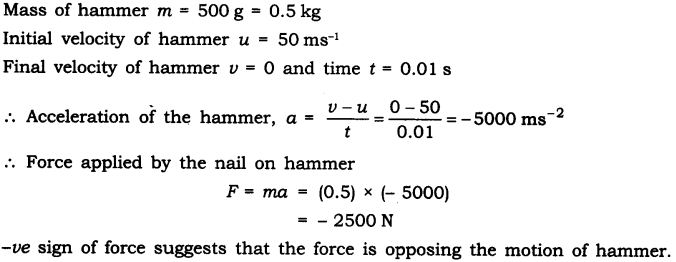
    ncert-solutions-for-class-9-science-force-and-laws-of-motion-20

    Question 4. A motorcar of mass 1200 kg is moving along a straight line with a uniform velocity of 90 km/h. Its velocity is slowed down to 18 km/h in 4 s by an unbalanced external force. Calculate the acceleration and change in momentum. Also calculate the magnitude of the force required.
    Answer:
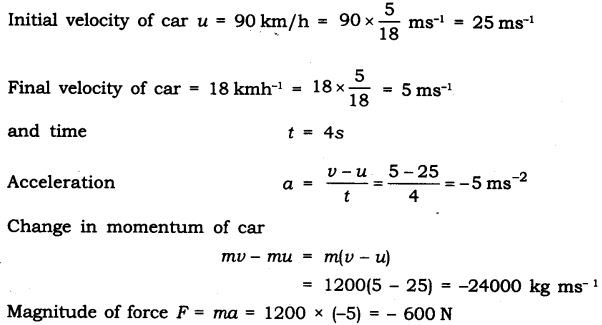
    ncert-solutions-for-class-9-science-force-and-laws-of-motion-21
    -ve sign of acceleration, charge in momentum and force suggests that the force is opposing the motion of motor car.

    Question 5. A large truck and a car, both moving with a velocity of magnitude v, have a head- on collision and both of them come to a halt after that. If the collision lasts for 1 s:
    (a) Which vehicle experiences the greater force of impact?
    (b) Which vehicle experiences the greater change in momentum?
    (c) Which vehicle experiences the greater acceleration?
    (d) Why is the car likely to suffer more damage than the truck?
    Answer:
    (a) During head on collision forces applied by truck and car are action-reaction forces. Hence both vehicles experience same (equal) force of impact.
    (b) Here initial velocity of both car and truck is same equal to v and final velocity of both is zero. But mass of truck is much more than that of car, hence change in momentum of truck is more than change in momentum of car.
    (c) For same force of impact, the acceleration of car will have greater magnitude because its mass is less.
    (d) Car suffers more damage than the truck, as acceleration of car is more, its velocity falls to zero in a shorter time and consequently, its momentum changes in a shorter time.

    More Questions Solved

    I. Multiple Choice Questions
    Choose the correct option:
    1. The S.I. unit of force is
    (a) kgm/s (b) kgm/s2
    (c) Newton ( (d) Newton-meter
    2. The product of mass and velocity gives a physical quantity
    (a) force (b) inertia
    (c) momentum (d) Newton
    3. The rate of change of momentum of an object is proportional to
    (a) mass of the body (b) velocity of the body
    (c) net force applied on the body (d) none of these .
    4. If two balls of different masses are dropped on sand, the depths of penetration is same if:
    (a) heavier ball is dropped faster than lighter ball
    (b) lighter ball is dropped faster than heavier ball
    (c) the product ‘mi/ is same for both bodies
    (d) none of these
    5. The coin remains at rest in the figure shown. This is due to

    ncert-solutions-for-class-9-science-force-and-laws-of-motion-22
    (a) inertia of rest
    (b) two forces act on the coin which balance each other
    (c) no unbalanced force acts on it
    (d) all of these
    6. A force of 50 N moves a body.
    (a) Frictional force exerted on the body is less than 50 N
    (b) Frictional force exerted on the body is more than 50 N
    (c) None of these
    (d) Both (a) and (b)
    7. Fielder giving a swing while catching a ball is an example of
    (a) inertia (b) momentum
    (c) Newton’s II law of motion (d) Newton’s I law of motion
    8. Action and reaction forces
    (a) acts on same body (b) act on different bodies
    (c) act in same direction (d) both (a) and (c)
    9. When we stop pedaling the bicycle it stops because
    (a) the earths gravitational force acts on it
    (b) it is not accelerated
    (c) no unbalanced force acts on it
    (d) frictional force acts on it
    10. A football and a stone has same mass
    (a) both have same inertia (b) both have same momentum
    (c) both have different inertia (d) both have different momentum
    Answer. 1—(c), 2—(c), 3—(c), 4-(c), 5-(d), 6-(a), 7-(c), 8-(b), 9-(d), 10-(a).

    II. Very Short Answer Type Questions
    Question 1. Define force.
    Answer: It is a push or pull on an object that produces acceleration in the body on which it acts. 4

    Question 2. What is S.I. unit of force?
    Answer: S.I. unit of force is Newton.

    Question 3. Define one Newton.
    Answer: A force of one Newton produces an acceleration of 1 m/s2 on an object of mass 1 kg. .
    1 N = 1 kg m/s2

    Question 4. What is balanced force?
    Answer: When forces acting on a body from the opposite direction do not change the state of rest or of motion of an object, such forces are called balanced forces.

    Question 5. What is frictional force?
    Answer: The force that always opposes the motion of object is called force of friction.

    Question 6. What is inertia?
    Answer: The natural tendency of an object to resist a change in their state of rest or of uniform motion is called inertia.

    Question 7. State Newton’s first law of motion.
    Answer: An object remains in a state of rest or of uniform motion in a straight line unless acted upon by an external unbalanced force.

    Question 8. State Newton’s second law of motion.
    Answer: The rate of change of momentum of an object is proportional to the applied unbalanced force in the direction of the force.

    Question 9. What is momentum?
    Answer: The momentum of an object is the product of its mass and velocity and has the same direction as that of the velocity. The S. I. unit is kg m/s. (p = mv)

    Question 10. State Newton’s III law of motion.
    Answer: To every action, there is an equal and opposite reaction and they act on two different bodies.

    Question 11. Which will have more inertia a body of mass 10 kg or a body of mass 20 kg?
    Answer: A body of mass 20 kg will have more inertia.

    Question 12. Name the factor on which the inertia of the body depends.
    Answer: Inertia of a body depends upon the mass of the body.

    Question 13. Name two factors which determine the momentum of a body.
    Answer: Two factors on which momentum of a body depend is mass and velocity. Momentum is directly proportional to the mass and velocity of the body.

    Question 14. What decides the rate of change of momentum of an object?
    Answer: The rate of change of momentum of an object is proportional to the applied unbalanced force in the direction of force.

    Question 15. The diagram shows a moving truck. Forces A, B,
    C and D are acting on the truck.
    Name the type of forces acting on a truck.
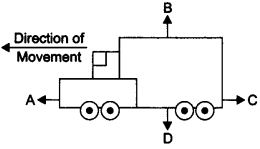
    ncert-solutions-for-class-9-science-force-and-laws-of-motion-23
    Answer: The forces A, B, C and D acting on the truck are:
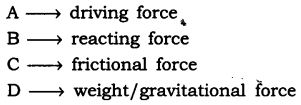
    ncert-solutions-for-class-9-science-force-and-laws-of-motion-24

    III. Short Answer Type Questions
    Question 1. State the difference in balanced and unbalanced force.
    Answer:

    ncert-solutions-for-class-9-science-force-and-laws-of-motion-25

    Question 2. What change will force bring in a body?
    Answer: Force can bring following changes in the body:

    1. It can change the speed of a body.
    2. It can change the direction of motion of a body,
    3. It can change the shape of the body.

    Question 3. When a motorcar makes a sharp turn at a high speed, we tend to get thrown to one side. Explain why?
    Answer: It is due to law of inertia. When we are sitting in car moving in straight line, we tend to continue in our straight-line motion. But when an unbalanced force is applied by the engine to change the direction of motion of the motorcar. We slip to one side of the seat due to the inertia of our body.

    Question 4. Explain why it is dangerous to jump out of a moving bus.
    Answer: While moving in a bus our body is in motion. On jumping out of a moving bus our feet touches the ground and come to rest. While the upper part of our body stays in motion and moves forward due to inertia of motion and hence we can fall in forward direction.
    Hence, to avoid this we need to run forward in the direction of bus.

    Question 5. Why do fielders pull their hand gradually with the moving ball while holding a catch?
    Answer: While catching a. fast moving cricket ball, a fielder on the ground gradually pulls his hands backwards with the moving ball. This is done so that the fielder increases the time during which the high velocity of the moving ball decreases to zero. Thus, the acceleration of the ball is decreased and therefore the impact of catching the fast moving ball is reduced.

    Question 6. In a high jump athletic event, why are athletes made to fall either on a cushioned bed or on a sand bed?
    Answer: In a high jump athletic event, athletes are made to fall either on a cushioned bed or on a sand bed so as to increase the time of the athlete’s fall to stop after making the jump. This decreases the rate of change of momentum and hence the force.

    Question 7. How does a karate player breaks a slab of ice with a single blow?
    Answer: A karate player applied the blow with large velocity in a very short interval of time on the ice slab which therefore exerts large amount of force on it and suddenly breaks the ice slab.

    Question 8. What is law of conservation of momentum?
    Answer: Momentum of two bodies before collision is equal to the momentum after collision.
    In an isolated system, the total momentum remain conserved.

    Question 9. Why are roads on mountains inclined inwards at turns?
    Answer: A vehicle moving on mountains is in the inertia of motion. At a sudden turn there is a tendency of vehicle to fall off the road due to sudden change in the line of motion hence the roads are inclined inwards so that the vehicle does not fall down the mountain.

    Question 10. For an athletic races why do athletes have a special posture with their right foot resting on a solid supporter?
    Answer: Athletes have to run the heats and they rest their foot on a solid supports before start so that during the start of the race the athlete pushes the support with lot of force and this support gives him equal and opposite push to start the race and get a good start to compete for the race.

    Question 11.Why do you think it is necessary to fasten your seat belts while travelling in your vehicle?
    Or
    How are safety belts helpful in preventing any accidents?
    Answer: While we are travelling in a moving car, our body remains in the state of rest with respect to the seat. But when driver applies sudden breaks or stops the car our body tends to continue in the same state of motion because of its inertia. Therefore, this sudden break may cause injury to us by impact or collision. Hence, safety belt exerts a force on our body to make the forward motion slower.

    Question 12. Explain how momentum gets conserved in collision of two bodies.
    Answer: Consider two bodies i.e., balls A and B, the mass and initial velocities are mAuA and mBuBrespectively before collision. The two bodies collide and force is exerted by each body. There is change in their velocities due to collision.
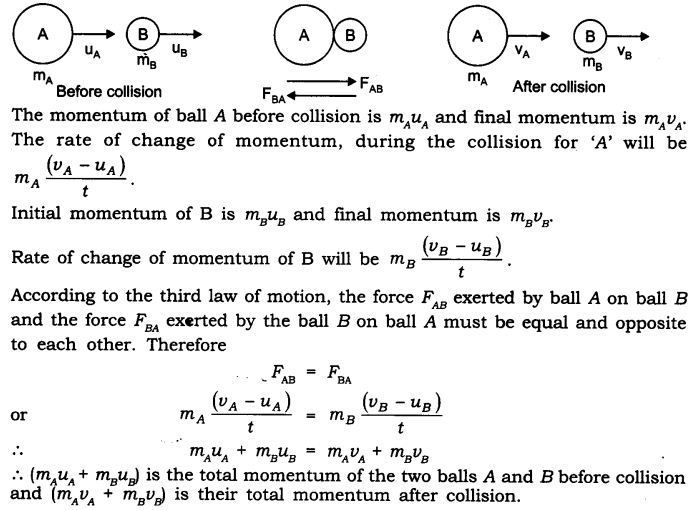
    ncert-solutions-for-class-9-science-force-and-laws-of-motion-26
    ∴ The total momentum of the two balls remains unchanged or conserved provided no other external force acts.

    Question 13. When you kick a football it flies away but when you kick a stone you get huh why?
    Answer: This is because stone is heavier than football and heavier objects offer larger inertia.
    When we kick a football its mass is less and inertia is also less so force applied by our kick acts on it and hence it shows larger displacement but in case of stone, it has larger mass and offers larger inertia. When we kick (action) the stone it exerts an equal and opposite force (reaction) and hence it hurts the foot.

    Question 14. If a person jumps from a height on a concrete surface he gets hurt. Explain.
    Answer: When a person jumps from a height he is in state of inertia of motion. When he suddenly touches the ground he comes to rest in a very short time and hence the force exerted by the hard concrete surface on his body is very high, and the person gets hurt.

    Question 15. What is the relation between Newton’s three laws of motion?
    Answer: Newton’s first law explains about the unbalanced force required to bring change in the position of the body.
    Second law states/explains about the amount of force required to produce a given acceleration.
    And Newton’s third law explains how these forces acting on a body are interrelated.

    Question 16. Give any three examples in daily life which are based on Newton’s third law of motion.
    Answer: Three examples based on Newton’s third law are :

    1. Swimming: We push the water backward to move forward.
      action – water is pushed behind
      reaction – water pushes the swimmer ahead
    2. Firing gun: A bullet fired from a gun and the gun recoils.
      action – gun exerts force on the bullet
      reaction – bullet exerts an equal and opposite force on the gun
    3. Launching of rocket
      action – hot gases from the rocket are released reaction – the gases exert upward push to the rocket

    Question 17. A bullet of m.ass 20 g is horizontally fired with a velocity 150 m/s from a pistol of mass 2 kg. What is the
    recoil velocity of the pistol?
    Answer:
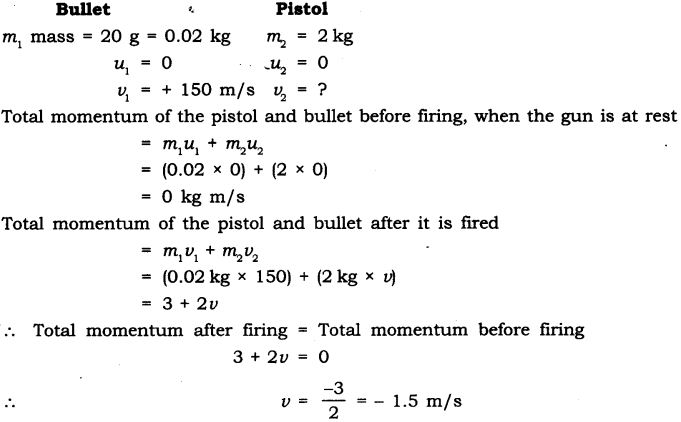
    ncert-solutions-for-class-9-science-force-and-laws-of-motion-27

    Question 18. Negative sign indicates that the direction in which the pistol would recoil is opposite to that of bullet.
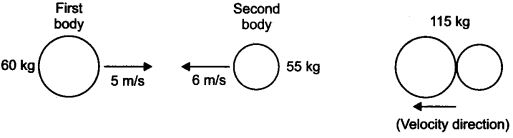
    ncert-solutions-for-class-9-science-force-and-laws-of-motion28
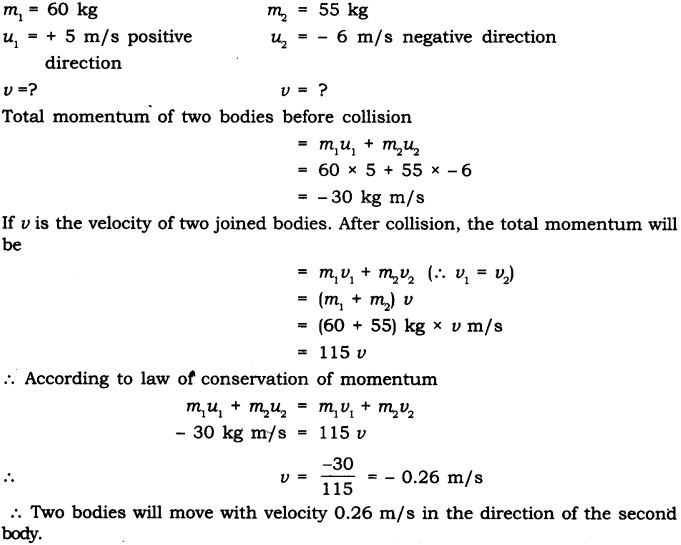
    Two bodies as shown in the figure collide with each other and join thereafter. With what velocity will they move after combining together?
    Answer:
    ncert-solutions-for-class-9-science-force-and-laws-of-motion29

    IV. Long Answer Type Questions
    Question 1. Explain Newton’s second law of motion and with the-help of an example show how it is used in sports.
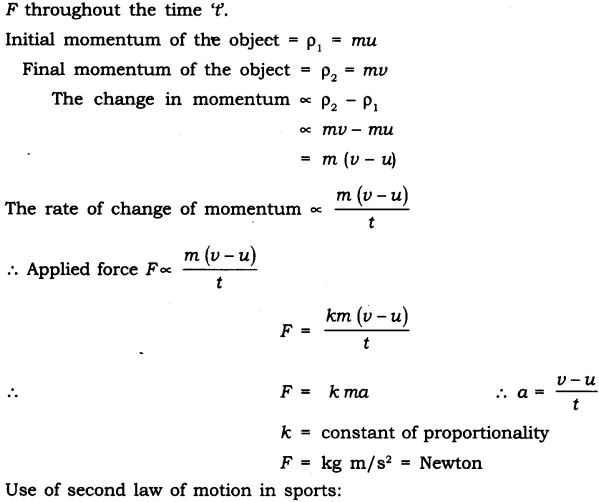
    Answer: Newton’s second law of motion: The rate of change of momentum of an object is proportional to the applied unbalanced force in the direction of the force.
    Let us assume:
    Object of mass m, is moving along a straight line with an initial velocity ‘u’, It is uniformly accelerated to velocity v in time ‘t by the application of force,
    ncert-solutions-for-class-9-science-force-and-laws-of-motion-30
    In cricket field, the fielder gradually pulls his hands backward while catching a ball. The fielder catches the ball and gives swing to his hand to increase the time during which the high velocity of the moving ball decreases to zero.
    The acceleration of the ball is decreased and therefore the impact of catching the fast moving ball4s reduced.
    If not done so, then the fast moving ball will exert large force and may hurt the fielder.

    Question 2. State all 3 Newton’s law of motion. Explain inertia and momentum.
    Answer:
    Newton’s I law of motion: An object remains in a state of rest or of uniform motion in a straight line unless acted upon by an external unbalanced force.
    Newton’s II law of motion: The rate of change of momentum of an object is proportional to the applied unbalanced force in the direction of the-force.
    Newton’s III law of motion: To every action, there is an equal and opposite reaction and they act on two different bodies.
    Inertia: The natural tendency of an object to resist a change in their state of rest or of uniform motion is called inertia.
    Momentum: The momentum of an object is the product of its mass and velocity and has the same direction as that of the velocity. Its S.I. unit is kgm/s. p = m x v

    Question 3. Define force. Give its unit and define it. What are different types forces?
    Answer: Force: It is a push or pull on an object that produces acceleration in the body on which it acts.
    A force can do 3 things on a body
    (a) It can change the speed of a body.
    (b) It can change the direction of motion of a body.
    (c) It can change the shape of the body.
    The S.I. unit of force is Newton.
    Newton: A force of one Newton produces an acceleration of 1 m/s2 on an object of mass 1 kg.
    1N = 1kg m/s2
    Types of forces:

    1. Balanced force: When the forces acting on a body from the opposite direction do not change the state of rest or of motion of an object, such forces are called balanced forces.
    2. Unbalanced force: When two opposite forces acting on a body move a body in the direction of the greater force or change the state of rest, such forces are called as unbalanced force.
    3. Frictional force: The force that always opposes the motion of object is called force of friction.

    Question 4. What is inertia? Explain different types of inertia. Give 3 examples in daily life which shows inertia.
    Answer:
    Inertia: The natural tendency of an object to resist change in their state of rest or of motion is called inertia.
    The mass of an object is a measure of its inertia. Its S.I. unit is kg.
    Types of inertia:
    Inertia of rest: The object at rest will continue to remain at rest unless acted upon by an external unbalanced force.
    Inertia of motion: The object in the state of uniform motion will continue to remain in motion with same speed and direction unless it is acted upon by an external unbalanced force. .
    Three examples of inertia in daily life are:

    1. When we are travelling in a vehicle and sudden brakes are .applied we tend to fall forward.
    2. When we shake the branch of a tree vigorously, leaves fall down.
    3. If we want to remove the dust from carpet we beat the carpet so that dust fall down.

    V. Activity-based Questions
    Question 1.

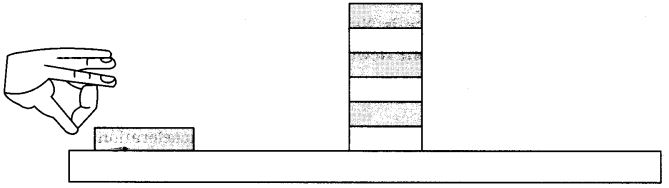
    • Make a pile of similar carom coins on a table, as shown in the figure.
    • Attempt a sharp horizontal hit at the bottom of the pile using another carom coin or striker. If the hit is strong enough the bottom coin moves out quickly. Once the lowest coin is removed, the inertia of the other coins makes them ‘fall’ vertically on the table.
      Inertia: It is the tendency of a body to maintain its state of rest or of motion.
      ncert-solutions-for-class-9-science-force-and-laws-of-motion-31

    Question 2.

    • Set a five-rupees coin on a stiff card covering an empty glass tumbler standing on a table as shown in the figure.
    • Give the card a sharp horizontal flick with a finger. If we do it fast then the card shoots away, allowing the coin to fall vertically into the glass tumbler due to its inertia.
    • The inertia of the coin tries to maintain its state of rest even when the card flows off.
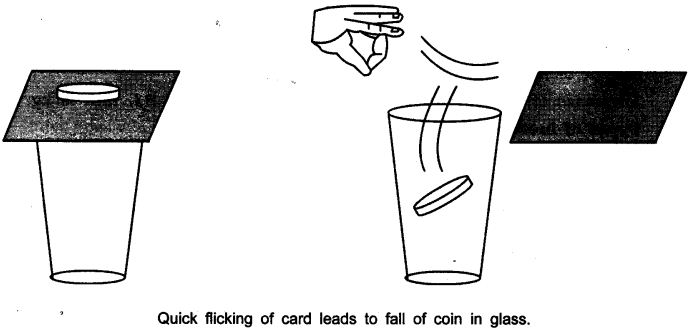
      ncert-solutions-for-class-9-science-force-and-laws-of-motion32

    Answer: The force applied on the card due to flicking changes the inertia of the card but the coin resist a change and stay at the rest i.e. inertia of rest and due to gravity falls down in the tumbler.

    Question 3.

    • Place a water-filled tumbler on a tray.
    • Hold the tray and turn around as fast as you can.
    • We observe that the water spills. Why?

    Answer: The water-filled in tumbler and tray are at rest. On moving/turning around the tray at faster speed the water spills because the tray and the tumbler comes into motion while the water in the tumbler remain at inertia of rest.

    Question 4.

    • Request two children to stand on two separate carts as shown on the next page.
    • Give them a bag full of sand or some other heavy object. Ask them to play a game of catch with the bag.
    • Does each of them receive an instantaneous reaction as a result of throwing the sand bag (action)?
    • You can paint a white line on cartwheels to observe the motion of the two carts when the children throw the bag towards each other.

    Answer. Yes, in this case each of them receives an instantaneous reaction as a result of throwing the sand bag.
    This activity explain Newton’s III law of motion i.e., the force is exerted forward in throwing the bag full of sand and the person who is throwing it gets pushed backward.
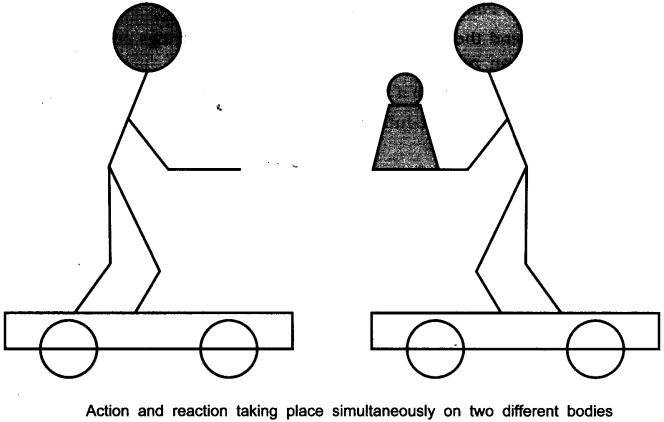
    ncert-solutions-for-class-9-science-force-and-laws-of-motion-33

    Question 5.

    • Take a big rubber balloon and inflate it fully. Tie its neck using a thread. Also using adhesive tape, fix a straw on the surface of this balloon.
    • Pass a thread through the straw and hold one end of the thread in your hand or fix it on the wall.
    • Ask your friend to hold the other end of the thread or fix it on a wall at some distance. The arrangement is shown in the figure below.
    • Now remove the thread tied on the neck of balloon. Let the air escape from the mouth of the balloon.
    • Observe the direction in which the straw moves.
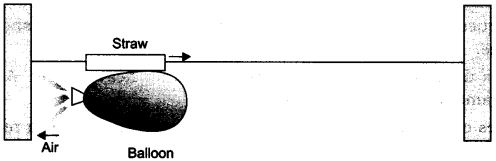
      ncert-solutions-for-class-9-science-force-and-laws-of-motion34
      Observation:
      When the air escapes out from the balloon the straw moves in the opposite direction of the air moved out of the balloon.
      This activity explains the law of conservation of momentum and Newton’s III law of motion.
      Initial momentum = Final momentum

    Question 6.

    • Take a test tube of good quality glass material and put a small amount of water in it. Place a stop cork at the mouth of it.
    • Now suspend the test tube horizontally by two strings or wires as shown in the figure on next page.
    • Heat the test tube with a burner until water vaporises and the cork blows out.
    • Observe that the test tube recoils in the direction opposite to the direction of the cork.
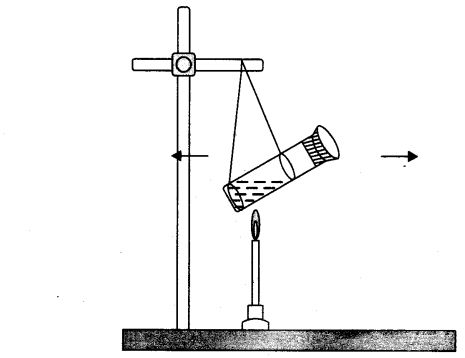
      ncert-solutions-for-class-9-science-force-and-laws-of-motion-35
      Observation:
      The cork is pushed out in forward direction by the hot steam. The test tube is pushed in the backward direction.
      It explain Newton’s III law of motion and conservation of momentum.

    VI. Value-based Questions
    Question 1. Class V students were playing cricket with the cork hall in the school campus. Charu a senior student told them about the accidents that can occur due to cork ball in the campus and also advised them to bring soft cosco ball to play the game.
    (a) Why it was safe to play with soft ball and not with hard cork ball?
    (b) A player pulls his hands backwards after holding the ball shot at high speed. Why?
    (c) What value of Charu is seen in this act?
    Answer:
    (a) The soft ball will have less inertia as compared to the heavy ball and it would not hurt the players.
    (b) By pulling the hand backwards it reduces the force exerted by the ball on hands.
    (c) Charu showed the value of being responsible and helpful by nature.

    Question 2. Saksham saw his karate expert friend breaking a slate. He tried to break the slate but Saksham’s friend stopped him from doing so and told him that it would hurt, one needs lot of practice in doing so.
    (a) How can a karate expert break the slate without any injury to his hand?
    (b) What is Newton’s third law of motion?
    (c) What value of Saksham’s friend, is seen in the above case?
    Answer:
    (a) A karate player applies the blow with large velocity in a very short interval of time on the slate, therefore large force is exerted on the slate and it breaks.
    (b) To every action there is an equal and opposite reaction, both act on different bodies.
    Saksham’s friend showed the value of being responsible and caring friend.
  • Motion NCERT Solutions for Class 9th Science: Chapter 8

    NCERT Solutions For Class 9 Science Motion

    NCERT Solutions For Class 9 Science Chapter 8 Motion
    NCERT Solutions For Class 9 Science Chapter 8 Motion
    NCERT Solutions For Class 9 Science Chapter 8 Motion
    NCERT Solutions For Class 9 Science Chapter 8 Motion
    NCERT Solutions For Class 9 Science Chapter 8 Motion
    NCERT Solutions For Class 9 Science Chapter 8 Motion
    NCERT Solutions For Class 9 Science Chapter 8 Motion
    NCERT Solutions For Class 9 Science Chapter 8 Motion
    NCERT Solutions For Class 9 Science Chapter 8 Motion
    NCERT Solutions For Class 9 Science Chapter 8 Motion
    NCERT Solutions For Class 9 Science Chapter 8 Motion
    NCERT Solutions For Class 9 Science Chapter 8 Motion
    NCERT Solutions For Class 9 Science Chapter 8 Motion
    NCERT Solutions For Class 9 Science Chapter 8 Motion
    NCERT Solutions For Class 9 Science Motion
    NCERT Solutions For Class 9 Science Motion
    NCERT Solutions For Class 9 Science Chapter 8 Motion
    NCERT Solutions For Class 9 Science Chapter 8 Motion
    NCERT Solutions For Class 9 Science Chapter 8 Motion
    NCERT Solutions For Class 9 Science Chapter 8 Motion

  • Diversity in Living Organisms NCERT Solutions for Class 9th Science: Chapter 7

    In-Text Questions Solved

    Ncert textbook Page 80
    Question 1. Why do we classify organisms?
    Answer: For easier and convenient study we classify organisms.

    Question 2. Give three examples of the range of variations that you see in life-forms around you.
    Answer:
    (a) Small cat and big cow
    (b) Grass and banyan tree
    (c) Black crow and green parrot

    Ncert textbook Page 82
    Question 1. Which do you think is a more- basic characteristic for classifying organisms?
    (a) the place where they live.
    (b) the kind of cells they are made of. Why?
    Answer: Classification based on living place is more basic as there can be wide variations in organisms living in a given place.

    Question 2. What is the primary characteristic on which the first division of organisms is made?
    Answer: Nature of cell is the primary characteristics on which the first division of organisms is decided. Based on this criterion life forms can be classified into prokaryotes or eukaryotes.

    Question 3. On what bases are plants and animal’ out into different categories?
    Answer: Mode of nutrition and presence or absence of cell walls.

    Ncert textbook Page 83
    Question 1. Which organisms are called primitive and how are they different from the so-called – advanced organisms?
    Answer: Organisms with simple cellular structure and no division of labour are called
    primitive.
    Advanced organisms, like mammals have millions of cells and there are different organs and organ system for different biological functions.

    Question 2. Will adiKznced organisms be the same as complex organisms? Why? t
    Answer: Yes, advanced organisms means greater degree of evolution which leads to more complexity.

    Ncert textbook Page 85
    Question 1. Whaf is the criterion for classification of organisms as belonging to kingdom Monera or Protista?
    Answer: It is the presence or absence of a well defined nucleus. Monera has no nuclear membrane, while Protista shows well defined nucleus.

    Question 2. In which kingdom will you place an organism which is single-celled, eukaryotic and
    photosynthetic?
    Answer: Protista.

    Question 3. In the hierarchy of classification, which grouping will have the smallest number of organisms with a maximum of characteristics in common and which will have the largest number of organisms?
    Answer: Organisms belonging to Kingdom Monera will have the small number of organisms with a maximum of characteristics in common. And kingdom Animalia will have the largest number of organisms.

    Ncert textbook Page 88
    Question 1. Which division among plants has the simplest organisms?
    Answer: Thallophyta or algae.

    Question 2. How are pteridophytes different from the phanerogams?
    Answer: Pteridophytes have naked embryo and inconspicuous reproductive organ whereas — phanerogams have well-differentiated reproductive organs and covered embryo.

    Question 3. How do gymnosperms and angiosperms differ from each other?
    Answer: Seeds are naked in Gymnosperms and are covered in angiosperms.

    Ncert textbook Page 94
    Question 1. How do poriferan animals differ from coelenterate animals?
    Answer:

    • Animals from Porifera show cellular level of organisation, while those from Coelenterata show tissue level of organisation.
    • In Porifera there is no division of labour, while in Coelenterata some division of labour is seen.
    • Porifera do not have coelom, while coelenterata have coelom.

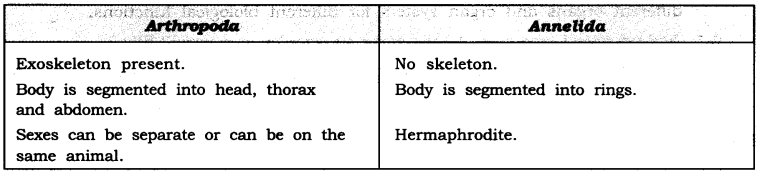
    Question 2. How do annelid animals differ from arthropods?
    Answer:
    ncert-solutions-for-class-9-science-diversity-in-living-organisms-6

    Question 3. What are the differences between amphibians and reptiles?
    Answer:
    ncert-solutions-for-class-9-science-diversity-in-living-organisms-7

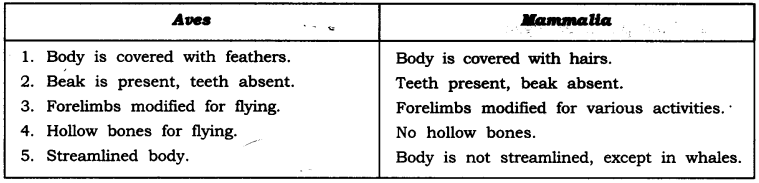
    Question 4. What are the differences between animals belonging to the Aves group and those in the mammalia group?
    Answer:
    ncert-solutions-for-class-9-science-diversity-in-living-organisms-8

    Questions From Textbook

    Question 1. What are the advantages of classifying organisms?
    Answer: Advantages of classification:

    • Better categorization of living beings based on common characters.
    • Easier study for scientific research.
    • Better understanding of human’s relation and dependency on other organisms.
    • Helps in cross breeding and genetic engineering for commercial purposes.

    Question 2. How would you choose between two characteristics to be used for developing a hierarchy  in classification?
    Answer: Gross Character will “form-the basis of start of the hierarchy and fine character -will -form “the basis of further steps of single the hierarchy.
    Example:

    1. Presence of vertebral column in human beings can be taken under vertebrata.
    2. Presence of four limbs makes them members of Tetrapoda.
    3. Presence of mammary glands keeps them under mammalia.

    Question 3. Explain the basis for grouping organisms into five kingdoms.
    Answer: Basis Of Clasiffication:
    (a) Number of cells
    (b) Layer of cells
    (c) Presence or absence of cell wall
    (d) Mode of nutrition
    (e) Level Of organization

    Question 4. What are the major divisions in the Plantae? What is the basis for these divisions?
    Answer: Major Divisions of Kingdom plantea:

    Division Basis of Classification
    Thallophyta or Algae Thallus like body
    Bryophyta Body is divided into leaf and stem
    Pteridophyta Body is divided into root, stem and leaf
    Gymnosperm Seed bearing, naked seeds
    Angiosperm Seed bearings covered seeds

    Question 5. How are the criteria for deciding divisions in plants different from the criteria for deciding the subgroups among animals?
    Answer: In plants body basic structure is a major criteria based on which Thallophytes are different from Bryophytes. Apart from this absence or presence of seeds is another important criteria. Gymnosperms and angiosperms are further segregated based on if seeds are covered or not. It is clear that it is the morphological character which makes the basis for classification of plants.
    In animals classification is based on more minute structural variations. So in place of morphology, cytology forms the basis. Animals are classified based on layers of cells, presence or absence of coelom. Further higher the hierarchy animals are classified based on presence or absence of smaller features, like presence or absence of four legs.

    Question 6. Explain how animals in Vertebrata are classified into further subgroups.
    Answer: Vertebrata is divided into two superclasses, viz. Pisces and Tetrapoda. Animals of Pisces have streamlined body with fins and tails to assist in swimming. Animals of Tetrapoda have four limbs for locomotion.
    Tetrapoda is further classified into following classes:
    (a) Amphibia: Are adapted to live in water and on land. Can breathe oxygen through skin when under water.
    (b) Reptilia: These sire crawling animals. Skin is hard to withstand extreme temperatures.
    (c) Aves: Forelimbs are modified into wings to assist in flying. Beaks are present. Body is covered with feathers.
    (d) Mammalia: Mammary glands present to nurture young ones. Skin is covered with hair. Most of the animals are viviparous.

    More Questions Solved

    I. Very Short Answer Type Questions
    Question 1. Who wrote the book “The Origin of Species”?
    Answer: Charles Darwin in 1859.

    Question 2. Who proposed the classification of organisms into 5 kingdom?
    Answer: Robert Whittaker (1959).

    Question 3. Define species.
    Answer: All organisms that <are similar to breed and perpetuate.

    Question 4. Give example of the organism belonging to Monera and Protista Kingdom.
    Answer: Monera—Anabaena, blue-gr^en algae Protista—Eugleno, Paramecium, Amoeba

    Question 5. Name the appendages used for movement by organism belonging to Protista kingdom
    Answer:
    Paramecium – Cilia
    Euglena – Flagella
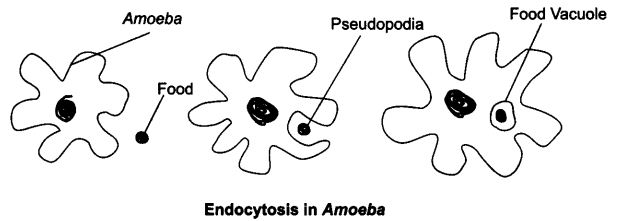
    Amoeba – Pseudopodia

    Question 6. What is lichen?
    Answer: The symbiotic association of fungi and blue-green algae, is called lichen.

    Question 7. What is symbiotic relationship?
    Answer: It is a relationship between two organisms in which both of them are benefitted, e.g., fungi gets food from blue-green algae and in return blue-green gets shelter [lichens].

    Question 8. What is saprophytic nutrition?
    Answer: The organisms using dead and decaying organic matter as food are said to show saprophytic nutrition.

    Question 9. Give simple dassificatian of plant kingdom.
    Answer:
    ncert-solutions-for-class-9-science-diversity-in-living-organisms-1

    Question 10. Name the plant amphibian.
    Answer: Biyophyta e.g. Funaria (Moss).

    Question 11. What are cryptogamae?
    Answer: The plants with inconspicuous reproductive organs are called cryptogamae, e.g., fern.

    Question 12. Give examples of pteridophyte.
    Answer: Marsilea and Fern.

    Question 13. Name the reproductive organ of plants.
    Answer: Flower.

    Question 14. What are gymnosperms?
    Answer: The group of plants that bear naked seeds e.g., pines, deodar.

    Question 15. What are angiosperms?
    Answer: The group of plants with covered seeds are called angiosperms. These are flowering plants.

    Question 16. What are cotyledons?
    Answer: Plant embryos in seeds have structures called cotyledons. Cotyledens are also known as seed leaves.

    Question 17. Name the phylum of an animals with pores on it.
    Answer: Porifera e.g., sponge.

    Question 18. Name the phylum of Jellyfish
    Answer: Coelenterata or Cnidaria.

    Question 19. What is the meaning of triploblastic?
    Answer: Animals which have three layers of cells from which differentiated tissues -can be made.

    Question 20. What is bilateral symmetry?
    Answer: When the left and right halves of the body have same design it is called bilateral symmetry.

    Question 21. What is the meaning of “cold-blooded animal”?
    Answer: Those animals who show the variation in their body temperature according to the surroundings are called cold-blooded animals, e.g., fish, amphibians, reptiles.

    Question 22. Name two mammals that lay eggs.
    Answer: Platypus and echidna.

    Question 23. Name three mammals that live in water.
    Answer: Whale, platypus and Dolphins.

    Question 24. Name a fish with skeleton made up of cartilage.
    Answer: Shark.

    Question 25. Name two fish which have skeleton made up of both bone and cartilage.
    Answer: Tuna and rohu.

    Question 26. Name the reptile with four-chambered heart.
    Answer: Crocodile.

    II. Short Answer Type Questions
    Question 1. Give the characteristics of Monera.
    Answer:
    (a) Organisms are unicellular, do not have a defined nucleus.
    (b) Organisms may‘‘have cell wall or may not have cell wall.
    (c) Mode of nutrition is either autotrophic or heterotrophic.

    Question 2. Give the characteristics of Protista.
    Answer:
    (a) Organsims are unicellular and eukaryotic.
    (b) Use appendages for locomotion like cilia, flagella, etc.
    (c) Nutrition is either autotrophic or heterotrophic.
    (d) E.g., algae, protozoa.

    Question 3. Give the difference between thallophyta and bryophyta.
    Answer:

    Thallophyta Bryophyta
    Body is thallus like not differentiated into -root, stem. Example: Spirogyra. Plant Body is differentiated into stem and leaf like structures. Example: Moss.

    Question 4. What are hermaphrodites? Give two examples.
    Answer: When an organism has both the sexes, i.e., it can produce both sperms and eggs are called hermaphrodites. Example: Sponges, earthworms.

    Question 5. Give the difference between monocots and dicots.
    Answer:

    Monocots Dicots
    1. Seeds with one cotyledon.2. Leaves have parallel venation.

    3. Root system—fibrous.

    Seeds with two cotyledons.Leaves have reticulate venation.

    Root system—tap root.

    Question 6. Give the difference between two types of symmetry that animals show.
    Answer: Symmetry—Bilateral and Radial

    Bilateral Symmetry Radial Symmetry
    Any organism that has same design on left and right halves of the body. Example: Earthworm, spider, cockroach. Any organisms with a body design such that it can be divided into two equal halves from any radius. Example: Starfish sea urchin.

    Question 7. Differentiate between vertebrates and invertebrates.
    Answer:

    Vertebrates Invertebrates
    1. Notochord is present.2. True internal skeleton present. Notochord is absent.No true internal skeleton present.

    Question 8. Name the phylum of the following animals:
    (a) Tapeworm (b) Starfish
    (c) Jellyfish     (d) Octopus
    Answer:
    (a) Tapeworm – Flatyhelminthes
    (b) Starfish – Echinodermatai
    (c) Jellyfish – Coelenterata
    (d) Octopus – Mollusca

    Question 9. Identify the phylum for the following characteristics given:
    (a) Organisms with joint appendages.
    (b) Organisms are generally flat worms.
    (c) Body is segmented.
    (d) Skin of organisms is full of spikes.
    Answer:
    (a) Arthropoda
    (b) Platyhelminthes
    (c) Ann elida
    (d) Echinodermata

    Question 10. State the features of all chordates.
    Answer: All chrodates  possess the following features:

    1. Have a notochord
    2. Have a dorsal nerve chord
    3. Are triploblastic
    4. Have paired gill pouches

    Question 11. Give general characteristics of Porifera.
    Answer:
    (a) Animals with pores all over the body.
    (b) Body is not well differentiated.
    (c) Non-motile animals, remain attached to solid support.
    (d) Body is covered with hard outer skeleton. Example, sponges.

    Question 12. How are pores or holes all over the body of Porifera important?
    Answer: The pores or holes present all over the body of the organisms lead to a canal system that helps in circulating water throughout the body to bring in food and oxygen.

    Question 13. Give general characteristics of ‘Platyhelminthes’?
    Answer:
    (a) These are flat worms.
    (b) Most of them are parasites.
    (c) Animals are triploblastic
    (d) No true internal body cavity.
    E.g., Tapeworm, planaria, Liver fluke.

    Question 14. Give specific characteristics of Coelenterata.
    Answer:
    (a) Water living animals.
    (b) Body is made of two layers of cells.
    (c) Some of them live in colonies (corals), while others have solitary life-span {Hydra).
    (d) Body cavity present.

    Question 15. Give the characteristics of Arthropoda with 2 examples.
    Answer:
    (a) Arthropoda means jointed legs’.
    (b) Animals are bilaterally symmetrical and segmented.
    (c) It has an open circulatory system.
    (d) This is the largest group of animals.
    Example: Spider, scorpionts, crabs, house flies.

    Question 16. Give the characteristic features of Echinodermata.
    Answer:
    (a) Spikes present on skin.
    (b) Free living, marine animals.
    (c) Triploblastic and have a coelomic cavity.
    (d) Have a peculiar water driven tube system used for moving around.
    (e) Have hard calcium carbonate structure that is used as a skeleton.
    Example, Starfish, seaurchin.

    Question 17. Give the characteristics of mammals.
    Answer:
    (a) Mammals are warm-blooded animals.
    (b) Four-chambered heart.
    (c) Mammary glands for production of milk to nourish their younger one.
    (d) Skin has hairs, sweat glands and oil glands.
    (e) Most of them produce their young ones (viviparous).

    Question 18. What are the conventions followed for writing the scientific names?
    Answer: The conventions followed while writing the scientific names are:
    1. The name of the genus begins with a capital letter.
    2. The name of the species begins with a small letter.
    3. When printed, the scientific name is given in italics.
    4. When written by hand, the genus name and the species name have to be underlined separately.

    Question 19. Differentiate between algae and fungi
    Answer:

    Algae Fungi
    1. Contain chlorophyll (green in colour).2. Autotrophic nutrition.

    3. Food is stored in the form of starch.

    1. Do not contain chlorophyll (non-green)2. Heterotrophic nutrition.

    3. Food is stored in the form of glycogen.

    Question 20. Name the phylum of the following organisms, whose exclusive characteristics is given below:
    (a) Hollow bones                                            (b) Jointed appendages
    (c) Flat worm                                                   (d) Round worms, parasitic
    (e) Soft body, muscular marine animal (f) Radially symmetrical, spiny skin.
    Answer:
    (a) Phylum chordata, subphylum—vertebrata, class—Aves
    (b) Phylum—Arthropoda
    (c) Phylum—Platyhelmithes
    (d) Phylum—Aschelminthes
    (e) Phylum—Mollusca
    (f) Phylum—Echinodermata

    Question 21. Give the characteristibs of amphibians.
    Answer: Amphibians are vertebrates that lives on land and in water.
    (a) They are cold-blooded.
    (b) Heart is three-chambered.

    (c) Fertilization is external.
    (d) Respiration through lungs on land and through moist skin when in water. Example, Frog, Toads

    Question 22. Give the characteristics of Aves.
    Answer:
    (a) Aves/birds can fly.
    (b) Streamlined body.
    (c) Hollow and light bones.
    (d) Forelimbs are modified into wings.
    (e) Warm-blooded animals, heart with four chambers.
    (f) Egg laying animals.
    (g) Beak present, teeth are absent.

    Question 23. Why do most of the amphibians lay their eggs in water and reptiles lay their eggs on land?
    Answer: Amphibians lay their eggs in water because the tadpeles or young, ones that hatch out of egg has gills at initial stages, that allows them; to breathe in water.
    In case of reptiles the young ones that hatch out does not have gplls> and the hatching of eggs requires warmth that is given by the mother, reptile.

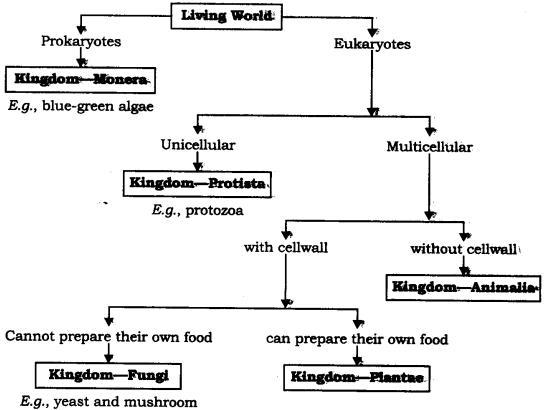
    Question 24. Give the hierarchy of 5 kingdom classification of living world.
    Answer:
    ncert-solutions-for-class-9-science-diversity-in-living-organisms-2

    III.Long Answer Type Questions
    Question 1. What is the importance of classification?
    Answer: Classification is important because:
    (a) Classification makes the study of wide variety, of organisms, systematic and easier.
    (b) It projects a picture of all organisms and their interrelation with each other.
    (c) It provides a base for the study of other branches of biology.
    (d) It is useful in the study of ecology, which deals with; the inter-relation of an organism with their environment.
    (e) It helps to establish a hierarchy of groups of organisms.

    Question 2. What are the characteristic features of mammals?
    Answer: Characteristics features of mammals: –
    (a) Body is covered with hair.
    (b) Skin is provided with sweat and sebaceous glands.
    (c) Heart is four-chambered.
    (d) Fertilization is internal.
    (e) Females have mammary glands to produce milk to nourish their young ones.
    (f) External ear—pinna, present.
    (g) Eyes have eye lids.
    (h) Warm-blooded.
    (i) Respiration through lungs,
    (j) Body cavity divided’ into- thorax and1 abdomen by muscular diaphragm.

    Question 3. What are the characteristic features of reptiles?
    Answer: The characteristics of reptiles:
    (a) Dry scaly, impermeable skin.
    (b) Respiration through lungs.
    (e) Cold-blooded
    (d) Internal fertilization.
    (e) Heart is three chambered’.
    (f) Two pairs of pentadactyl limbs are present.

    Question 4. What are the basis for classification of organisms?
    Answer: The basis for classification are:
    (a) Presence or absence of nucleus.
    (b) Organisms are unicellular, or multicellular.
    (c) Level of organisation.
    (d) Autotrophic mode of nutrition or heterotrophic mode of nutrition.
    (e) Of the organisms that perform photosynthesis (Plants), their level, or organisation of the body.
    (f) Of the animals, how does the individuals body develop and organise its different parts.

    Question 5. Give the characteristics of fiat worms, round worms and segmented worm. Give their phylum.
    Answer:
    ncert-solutions-for-class-9-science-diversity-in-living-organisms-3

    Flat worms Round worms Segmented worms
    Phylum—Platyhelminthes Phylum Nematoda Phylum Annelida
    Dorsoventrally flat, i.e., flat body from top to bottom. Body is cylindrical. Body is segmented from head to tail.
    No true body cavity. Pseudocoelom (Sort of body (cavity). True body cavity.
    Mostly hermaphrodite, i.e., male and female sex organs present in the same individual. Sexes are separate. May be unisexual or bisexual.

    Question 6. Give the classification of plant kingdom.
    Answer:
    ncert-solutions-for-class-9-science-diversity-in-living-organisms-4

    Question 7. Differentiate (5 points)‘between monocot and dicot plants.
    Answer:

    Monocot Plants Dicot Plants
    1. Fibrous root2. Parallel venation

    3. Seeds with one cotyledon

    4. Vascular bundles are scattered.

    5. Flowers are trimerous

    Tap rootReticulate venation.

    Seeds with two cotyledons

    Vascular bundles are arranged in rings.

    Flowers are pentamerous, flowers or tetramerous

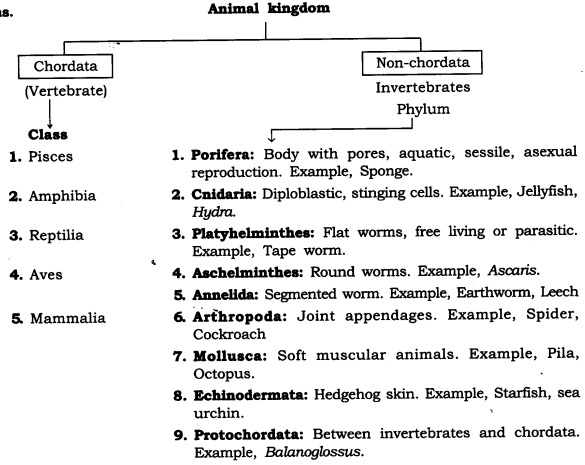
    Question.8. Give the outline classification of animal kingdom.
    Answer.
    ncert-solutions-for-class-9-science-diversity-in-living-organisms-5

    V. Activity – Based Questions
    Question 1.

    1.  We have heard of ‘desi’ cows and Jersey cows.
    2. Does a desi cow look like a Jersey cow?
    3. Do all desi cows look alike.
    4. Will we be able to identify a Jersey cow in a crowd of desi cows that don’t look like each other?
    5. What is the basis of our identification?

    Answer:

    1. Desr cow is different in size’ and colour.
    2. Most of the desi cows look alike, not all.
    3. Yes, Jersey cow can be spotted’ from the group.
    4. Basis of identification:
    5. Size, horn shape, skin colour, height, etc.

    Question 2.

    • Soak seeds of green gram, wheat, maize, peas and tamarind Once they become tender, try to split the seed. Do all the seeds break into two nearly equal halves?
    • The seeds that do are the dicot seeds and the seeds that don’t are then; monocot seeds.
    • Now take a look at the roots, leaves and flowers of these plants.
    • Are the roots, tap roots or fibrous?
    • Do the leaves have parallel or reticulate venation?
    • How many petals are found in the flowers of these plants?
    • Can you write down further characteristics of monocots and dicots on the basis of these observations?

    Answer:

    Characteristics Green gram Wheat Maize Peas Tamarind
    1. Roots

    2. Cotyledon

    3. Venation in leaves

    4. Vascular bundle

    5. Flowers

    Tap rootDicotyledon.

    Reticulate

    In a ring

    Pentamerous

    Fibrous rootMonocotyledon

    Parallel

    Not in a ring

    Trimerous

    Fibrous rootMonocotyledon

    Parallel

    Not in a ring

    Trimerous

    Tap rootDicotyledon

    Reticulate

    In a ring

    Pentamerous

    rap root

    Dicotyledon

    Reticulate

    In a ring

    Pentamerous

    Question 3. Find out the. names of the following, animals and plants in as many: languages as you can.
    Answer: It is difficult to remember names of a species in different languages This problem means there was a need for some system to create unifhrm naming convention: Hence system of nomenclature and classification was devised

    Animals  Plants
    1. Frog—Rana tigrina2. Human—Homo Sapiens

    3. Peacock—Pam cristatus

    4. Honeybee—Apis cerena, Apis indica.

    1. Touch me not—Mimosa pudica.2. Neem—Azadirachta indica.

    3. Maize—Zea mays.

    VI. Value – Based Questions
    Question 1. Many medicinal plants every year are getting extinct. A group of students who had gone for educational trip clicked photographs of endangered plants. These photograph were used by the school laboratory to study these plants.
    (a) Name two endangered plants.
    (b) Name any one medicinal plant and give its medicinal use.
    (c) What value of students is reflected in the above act?
    Answer:
    (a) Two endangered plants are:
    (i) Euphrasia
    (ii) Ubnus rubra
    (b) Aloe-vera. Juice of Aloe-vera is used in case of indigestion, treating dkin infection etc.
    (c) Students are caring citizens, shows responsible behaviour.

    Question 2. Due to global warming coral is getting diminished in all the oceans/ water bodies. People in Lakshadweep island protects their corals by not allowing people/tourist to scape take few pieces away.
    (a) Name the phylum of coral.
    (b) What is coral made up of.
    (c) What values of people in Lakshadweep island is reflected?
    Answer:
    (a) Phylum of coral is coelenterata.
    (b) Coral is made up of calcium carbonate.
    (c) People in Lakshadweep island reflect the value of-being-responsible (Citizen, respecting environment and nature.

  • Tissues NCERT Solutions for Class 9th Science: Chapter 6

    IN-TEXT QUESTIONS SOLVED

    NCERT Textbook Page 69

    Question 1. What is a tissue?
    Answer: A group of cells that are similar in structure and work together to do a peculiar function is called tissue.

    Question 2. What is the utility of tissues in multicellular organisms?
    Answer: Tissues provide structural strength, mechanical strength, show division of labour.

    NCERT Textbook Page 74

    Question 1. Name types of simple tissues.
    Answer: The types of simple tissues are parenchyma, collenchyma, sclerenchyma and aerenchyma.

    Question 2. Where is apical meristem found?
    Answer: Apical meristem is found at the tip of root or shoot of the plant.

    Question 3. Which tissue makes up the husk of coconut?
    Answer: The husk of coconut is made of sclerenchymatous tissue.

    Question 4. What are the constituents of phloem?
    Answer: Phloem is made up of four types of elements sieve tube, companion cells, phloem fibres and phloem parenchyma.

    NCERT Textbook Page 78

    Question 1. Name the tissue responsible for movement in our body.
    Answer: 1. Muscular tissue, 2. Nervous tissue, combination of both the tissues are responsible for movement in our body.

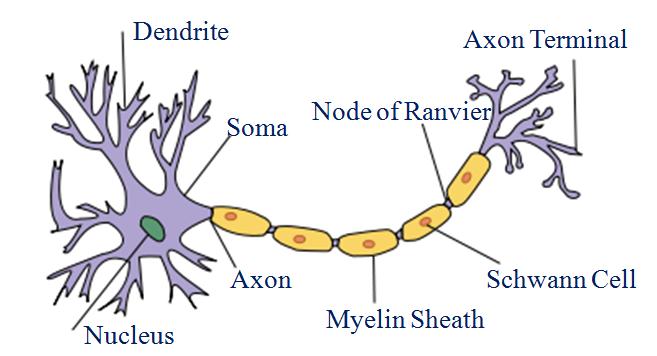
    Question 2. What does a neuron look like?
    Answer: A neuron consists of a cell body with a nucleus and cytoplasm, from which long thin hair like parts arise. Each neuron has a single long part called the axon, and many small, short branched parts called dendrite. An individual nerve cell is called neuron, it may be up to a metre long.
    ncert-solutions-for-class-9-science-tissues-1

    Question 3. Give three features of cardiac muscles.
    Answer: Feature of cardiac muscles
    (1) Heart muscles (cardiac muscles) are cylindrical, branched and uninucleated
    (2) They are striated muscle fibres.
    (3) They are involuntary muscles, cannot be controlled by us.

    Question 4. What are the Junctions of areolar tissue?
    Answer: Areolar tissue are connective tissues found in animal. It is found between skin and muscles, around blood vessels and nerves and in the bone marrow.
    It fills the space inside the organs, supports internal organs and helps in the repair of tissues.

    QUESTIONS FROM NCERT TEXTBOOK

    Question 1. Define the term “tissue”.
    Answer: Group of cells that are similar in structure and perform same function is called a tissue.

    Question 2. How many types of elements together make up the xylem tissue? Name them.
    Answer: The xylem is made up of vessels, trachieds, xylem fibres and xylem parenchyma.

    Question 3. How are simple tissues different from complex tissues in plants?
    Answer: Simple tissues are made up of one type of cells which coordinate to perform a common function.
    Complex tissues are made up of more than one type of cells. All these coordinate to perform a common function.

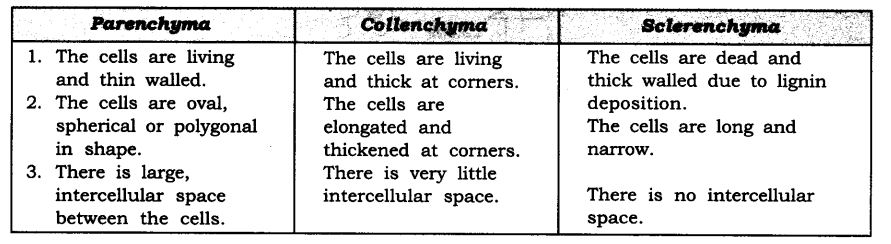
    Question 4. Differentiate between parenchyma, collenchyma and sclerenchyma on the basis of their cell wall. 
    Answer: Parenchyma: The cells have thin cell walls made up of cellulose. Collenchyma: The cells have cell walls thickened at the comers due to pectin deposition.
    Sclerenchyma: Their walls are thickened due to lignin deposition.

    Question 5. What are the functions of stomata?
    Answer: The outermost layer of the cell is called epidermis and is very porous. These pores are called stomata. These stomata help in transpiration and exchange of gases.

    Question 6. Diagrammatically show the difference between the three types of muscle fibres.
    Answer: Striated muscles
    (1) They are connected to bones (Skeletal muscles).
    (2) They are voluntary muscles.
    (3) The cells are long, cylindrical with many nucleus and are unbranched.
    Smooth muscles
    (1) They are found in alimentary canal and lungs.
    (2) They are involuntary muscles.
    (3) They are spindle in shape and have single nucleus.
    Cardiac muscles
    (1) They are found in heart.
    (2) They are involuntary in action.
    (3) They are branched and have one nucleus.
    ncert-solutions-for-class-9-science-tissues-2

    Question 7. What is the specific function of the cardiac muscle?
    Answer: (1) Cardiac muscles cells are cylindrical, branched and uninucleated.
    (2) They are involuntary muscles.
    (3) They show rhythmically contraction and relaxation throughout life.
    (4) Their rhythmic contraction and relaxation helps in pumping action of heart.

    Question 8. Differentiate between striated, unstriated and cardiac muscles on the basis of their structure and location in the body.
    Answer:
    ncert-solutions-for-class-9-science-tissues-3

    Question 9. Draw a labelled diagram of neuron.
    Answer:
    ncert-solutions-for-class-9-science-tissues-1

    Question 10. Name the following:
    (1) Tissue that forms the inner lining of our mouth.
    (2) Tissue that connect muscle to bone in humans.
    (3) Tissue that trar-carts food in plants.
    (4) Tissue that siwea j’ut in our body.
    (5) Connective tissue with a fluid matrix.
    (6) Tissue present in the brain.
    Answer: (1) Squamous epithelium (2) Tendons
    (3) Phloem (4) Areolar tissue
    (5) Blood (6) Nervous tissue

    Question 11. Identify the type of tissue in the following: Skin, bark of tree, bone, lining of kidney tubule, vascular bundle.
    Answer: (a) Skin—Striated squamous epithelium
    (b) Bark of tree—Cork, protective tissue
    (c) Bone—Connective tissue
    (d) Lining of kidney tubule—Cuboidal epithelium tisse
    (e) Vascular bundle—Conducting tissue

    Question 12. Name the regions in which parenchyma tissue is present.
    Answer: In the pith of the roots and stems. When it contains chlorophyll, it is called chlorenchyma, found in green leaves. In aquatic plants, parenchyma contains large air cavities and help them to float. Such type of parenchyma is called aerenchyma.

    Question 13. What is the role of epidermis in plants?
    Answer: Cells of epidermis forms a continuous layer without intercellular spaces. It protects all the parts of plants.

    Question 14. How does the cork act as a protective tissue?
    Answer: Cork acts as a protective tissue because its cells are dead and compactly arranged without intercellular spaces. They have deposition of suberin on the walls that make them impervious to gases and water.

    Question 15. Complete the table:
    ncert-solutions-for-class-9-science-tissues-4
    Answer:
    ncert-solutions-for-class-9-science-tissues-5

    MORE QUESTIONS SOLVED

    I. Multiple Choice Questions
    Choose the correct option:
    1. The cells of cork are dead and have a chemical in their walls that makes them impervious to gases and water. The chemical is
    (a) lignin (b) suberin
    (c) cutin (d) wax
    2. The flexibility in plants is due to a tissue called,
    (a) chlorenchyma (b) parenchyma
    (c) sclerenchyma (d) collenchyma
    3. The tissue present in the lining of kidney tubules and ducts of salivary glands is
    (a) squamous epithelium tissue (b) glandular epithelium tissue
    (4 cuboidal epithelium tissue (d) columnar epithelium tissue
    4. The connective tissue that connects muscle to bone is called
    (a) ligament (b) tendon
    (d) cartilage (d) areolar
    5. The tissue that helps in the movement of our body are
    (a) muscular tissue (b) skeletal tissue
    (c) nervous tissue (d) all of the above
    6. Monocyte, basophil, eosinophil and neutrophil are the examples of different types of
    (a) red blood cells (b) white blood cells
    (c) areolar tissue (d) compact bone
    7. The spindle shaped cells, uninucleated and unbranched are present in muscular tissue of 
    (a) striated muscles (b) smooth muscles
    (c) cardiac muscle (d) both (a) and (b)
    8. Sieve tubes and companion cells are present in
    (a) xylem (b) phloem
    (c) cork (d) cambium
    9. The size of the stem increases in the width due to
    (a) apical meristem (b) intercalary meristem
    (c) primary meristem (d) lateral meristem
    10. Blood and lymph are types of
    (a) muscular tissue (b) epithelial tissue
    (c) connective tissue (d) permanent tissue
    11. Cartilage and bone are types of
    (a) muscular tissue (b) connective tissue
    (c) meristematic tissue (d) epithelial tissue
    12. Xylem and phloem are examples of
    (a) epidermal tissue (b) simple tissue
    (c) protective tissue (d) complex tissue
    13. A tissue whose cells are capable of dividing and re-dividing is called
    (a) complex tissue (b) connective tissue
    (c) protective tissue (d) meristematic tissue
    14. The tissue that helps in the secretion and absorption and is found in the inner lining of the alimentary canal is
    (a) ciliated epithelium (b) cuboidal epithelium
    (c) squamous epithelium (d) columnar epithelium
    Answer: 1—(b), 2—(d), 3—(c), 4—(b), 5—(d), 6—(b), 7—(b), 8—(b), 9—(d), 10—(c),11—(b), 12—(d), 13—(d), 14—(d).

    II.Very Short Answer Type Questions

    Question 1. Name the tissues responsible for the movement of the body.
    Answer: Muscle tissue and nervous tissue

    Question 2. How does neuron look like?
    Answer: A neuron is the unit cell of nervous tissue. It is a thread-like structure with cell body and axon.

    Question 3. Name the types of simple tissues.
    Answer: (a) Parenchyma (b) Collenchyma (c) Sclerenchyma

    Question 4. Name the types of complex tissues.
    Answer: Xylem and phloem.

    Question 5. Where is apical meristem found? .
    Answer: It is present at the growing tips of stem and root, it increases the length of the stem and roots.

    Question 6. Which tissue make up the husk of coconut?
    Answer: Sclerenchyma.

    Question 7. What are the constituents of phloem?
    Answer: Phloem constitutes the sieve tubes, companion cell, phloem parenchyma and phloem fibres.

    Question 8. Define aerenchyma.
    Answer: When the cells have air-filled large cavities of parenchyma, it is called aerenchyma. Aerenchyma helps aquatic plants in floating.

    Question 9. What is the utility of tissues in multicellular organisms?
    Answer: It helps in growth, organisation of different organs and performing functions.

    Question 10. Name the two types of tissues.
    Answer: Plant tissues and animal tissues.

    Question 11. Name the two types of plant tissue.
    Answer: Meristematic tissue and permanent tissue.

    Question 12. What is differentiation?
    Answer: The process of taking up a permanent shape, size and function by cells is called differentiation.

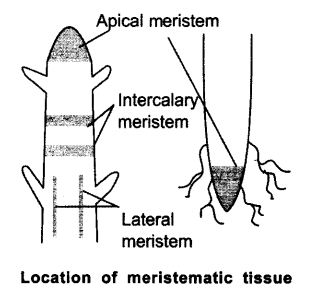
    Question 13. Name the three types of meristematic tissues.
    Answer: The three types are:
    (a) Apical tissue—tips of root and shoot
    (b) Lateral tissue—sides of stem
    (c) Intercalary tissue—at nodes

    Question 14. Where is apical tissue found?
    Answer: Present at the tips of roots and stems.

    Question 15. Tissues present at the lateral surface of the stem are called apical tissues. Put (T) if true and put (F) if false.
    Rewrite the answer if (F).
    Answer: (F). Tissues present at the lateral surface of the stem are called lateral tissue.

    Question 16. Which tissues are present at the nodes of the plants?
    Answer: Intercalary tissue.

    Question 17. What are the various types of blood cells?
    Answer: There are three types:
    (a) RBC’s
    (b) WBC’s and
    (c) Platelets.

    Question 18. What are tracheids?
    Answer: They are elongated cells with tapering ends.

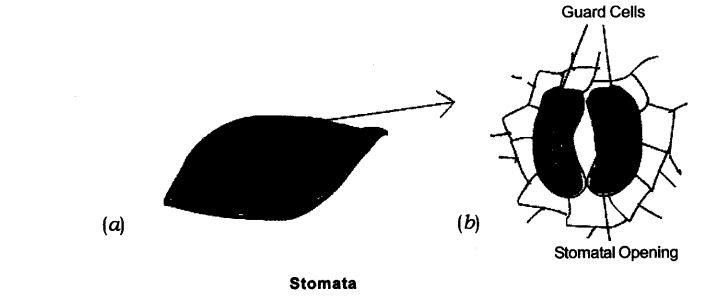
    Question 19. What are guard cells?
    Answer: Each stomata is bounded by a pair of specialised kidney-shaped epidermal cells called guard cells.

    Question 20. Epithelial tissue is the simplest tissue. Write (F) for false or (T) for true.
    Answer: (T).

    Question 21. What are the functions of cuboidal epithelium?
    Answer: It helps in absorption, excretion, secretion, it also provides mechanical support.

    III. Short Answer Type Questions

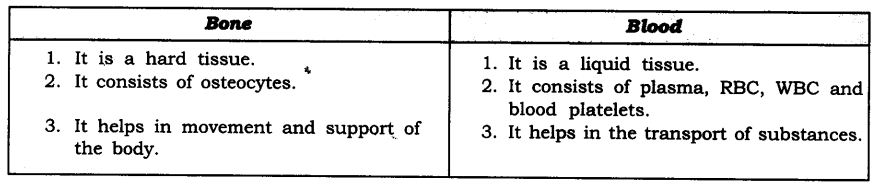
    Question 1. Give four differences between bone and cartilage.
    Answer:
    ncert-solutions-for-class-9-science-tissues-6

    Question 2. Give the functions of bone.
    Answer: The functions of bone are:
    (i) It provides shape to the body.
    (ii) It provides skeletal support to the body.
    (iii) It anchors the muscles.
    (iv) It protects the vital body organs like brain, lungs, etc.

    Question 3. Give the functions of cartilage. .
    Answer: (i) It provides support and flexibility to the body parts.
    (ii) It smoothens surface at joints.

    Question 4. Fill in the blanks:
    (i) Water and minerals are conducted by ………………….
    (ii) In higher plants food is conducted by ……………………..
    (iii) Blood is a ……………. tissue.
    (iv) Bone consists of………….cells.
    (v) Cartilage consists of………………..cells.
    (vi) Fibres are absent in………….type of connective tissue.
    Answer: (i) Xylem (ii) Phloem
    (iii) Connective (iv) Osteocyte
    (v) Chondrocyte (vi) Blood

    Question 5. What are the functions of areolar tissue?
    Answer: Functions are:
    (i) It helps in repair of tissues after an injury.
    (ii) It also helps in combating foreign toxins.
    (iii) It fixes skin to underlying muscles.

    Question 6. Give difference between xylem and phloem.
    Answer:
    ncert-solutions-for-class-9-science-tissues-7
    Question 7. What are fibres?
    Answer: Fibres consist of very long, narrow and thick cells. Example, jute fibre.

    Question 8. Name the tissues for the following:
    (a) Stores fat in animal body.
    (b) Divides and re-divides to grow in plants.
    (c) Tissue that joins hone to hone.
    (d) Covers the external surface of animal body.
    Answer: (a) Adipose tissue
    (b) Meristematic tissue .
    (c) Ligament
    (d) Epithelial tissue.

    Question 9. What is stomata?
    Answer: Stomata are small pores present on the surface of a leaf which helps in the exchange of gases and in transpiration.

    Question 10. Why does epidermal tissue have no intercellular space?
    Answer: The epidermal (layer) tissue forms a protective outer covering for the plants and it protects the internal parts of the plant. It aid in the protection against loss of water, mechanical injury and invasion by parasitic fungi.
    For this protective role to play the continuation of cells is necessary, hence it does not have intercellular space.

    Question 11. Name and give the function of each cell of xylem:.
    Answer: Xylem consists of tracheids, vessels, xylem parenchyma and xylem fibres.
    Tracheids and vessels—Allows the transport of water and minerals.
    Xylem parenchyma—Stores food and helps in the sideways conduction of water.
    Xylem fibres—Are supportive in function.

    Question 12. What is the function and location of stratified squamous epithelium?
    Answer: Stratified squamous epithelium is present in the skin. The layers of cells are arranged to prevent wear and tear.

    Question 13. Give difference between ligament and tendon.
    Answer:
    ncert-solutions-for-class-9-science-tissues-8

    Question 14. Give difference between striated muscles and unstriated muscles.
    Answer:
    ncert-solutions-for-class-9-science-tissues-9

    Question 15. State the difference between bone and blood.
    Answer:
    ncert-solutions-for-class-9-science-tissues-10

    Question 16. Name all different types of tissues present in animal.
    Answer: There are four main types of tissues present in animal. ‘
    (a) Epithelial tissue present on the outer and inner lining of the body.
    (b) Muscular tissue are made up of muscles, help in movement.
    (c) Connective tissue connects the different organs in the body.
    (d) Nervous tissue consists of nerve cells and are present in the nervous system.

    Question 17. Why is blood called connective tissue?
    Answer: The blood is composed of cells and plasma. Plasma is a fluid and cells like red blood cells, white blood cells and platelets are present in it. All these cells are connected due to plasma. It also transports food, water to different parts of the body and connects them.

    Question 18. Name three types of muscle tissues and give function of each.
    Answer: Three types of muscle tissues are:
    (a) Striated muscle (b) Smooth muscle (c) Cardiac muscle
    (a) Striated muscle: These muscles show alternate light and dark bands or striations. They are involuntary and present in skeletal tissues,, help in movement of body and bones.
    (b) Smooth muscle: These are involuntary muscles, control the movement of food in alimentary canal, contraction and relaxation of blood vessels. Present in iris, uterus etc.
    (c) Cardiac muscle: These muscles are present in heart, help in the rhythmic contraction and relaxation throughout the life.

    Question 19. State the difference between simple tissues of plants.
    Answer: The simple tissues of plants are:
    (i) Parenchyma (v) Collenchyma (iii) Sclerenchyma
    ncert-solutions-for-class-9-science-tissues-11

    Question 20. With the help of diagram show the difference between striated muscle fibre, smooth muscle fibre and cardiac muscle fibre.
    Answer:
    ncert-solutions-for-class-9-science-tissues-12
    ncert-solutions-for-class-9-science-tissues-13

    Question 21. Name different types of meristematic tissue and draw diagram to show their location.
    Answer: The 3 different types of meristematic tissue are:
    (a) Apical meristem—Function: growth in length.
    (b) Lateral meristem—Function: growth in thickness.
    (c) Intercalary meristem—Function: growth in intemodes.
    ncert-solutions-for-class-9-science-tissues-14

    Question 22. Explain the structure, function and location of nervous tissue.
    Answer: Structure: Nervous tissue consists of cells called nerve cells joined end to end (neurons). A neuron (nerve cell) consists of a cell body with nucleus and cytoplasm. From these cell body a long thin hair-like parts arise called axon and many short branched parts called dendrites.
    Location: Nervous tissue are present in brain, spinal cord and nerves. Function: Nervous tissue receives the stimuli and transmit the stimulus rapidly from one place to another within the body. The nerve impulse allows us to move our muscles and respond to any stimuli.

    Question 23. Give the flow chart of plant tissues.
    Answer:
    ncert-solutions-for-class-9-science-tissues-111

    IV.Long Answer Type Questions

    Question 1. Write a note on plant tissues.
    Answer: Plant tissues consist of two main types of tissue.
    ncert-solutions-for-class-9-science-tissues-15
    Parenchyma: Present in soft parts of the plant.
    Collenchyma: Provides mechanical support to plant present in stalks. Sclerenchyma: They provide strength and flexibility to the plants.
    Xylem: Conduct water in plants from root to shoot. Consists of tracheids, vessels, xylem parenchyma and xylem fibres.
    Phloem: Conduct food to all parts of plant. Consist of sieve tubes, companion cell, phloem parenchyma and phloem fibres.

    Question 2. Show the types of animal tissues using flow chart.
    Answer:
    ncert-solutions-for-class-9-science-tissues-16

    Question 3. What is connective tissue? Explain its types.
    Answer: The connective tissue consists of different types of cells, all of them perform same function.
    ncert-solutions-for-class-9-science-tissues-17
    Areolar connective tissue: It is found between the skin and muscles, around blood vessels and nerves and in the bone marrow.
    Areolar tissue fills the space inside the organs. It supports internal organs and helps in repair of tissues.
    Adipose tissue: Adipose tissue stores fat, found below the skin and between internal organs. The cells of this tissue are filled with fat globules. It acts as insulator due to fat storage.
    Blood: It has a fluid called plasma, in plasma are present red blood cells, white blood cells and platelets. Blood flows all over the body and helps in the transport of gases, digested food, hormones and waste material to different parts of the body.
    Lymph: Lymph carries digested fat and lot of white blood cells in the plasma. Bone: It forms the framework that supports the body. It supports the different parts of our body. It is strong and non-flexible tissue.
    Cartilage: It is present in nose, ear, trachea and larynx. It smoothens bone surfaces at joints.
    Tendon: It connects bone and muscles. These tissues are fibrous, flexible and with lot of strength.
    Ligament: It connects bone to ‘bone. It is elastic, has lot of strength.

    Question 4.Describe ‘epidermis’ in plants.
    Answer: Epidermis forms the entire outermost layer of the plant. It is made up of single cell layer. It protects all the internal parts of the plant.
    On aerial parts, epidermis secretes waxy, water-resistant layer on their outer surface. This helps in protection against loss of water, mechanical injury and invasion of parasitic fungi.
    In leaves, epidermis consists of small pores called stomata. These pores helps in the transpiration and exchange of gases, like oxygen and carbon dioxide for plants.
    In roots, epidermis have long hair-like parts that provide greater surface for water absorption.
    In desert plants, epidermis has a thick waxy coating of cutin which acts as a water proofing agent.

    Question 5. Explain the “complex tissue” of plants.
    Answer: Complex tissues are made up of more than one type of cells. All these cells co-ordinate to perform common function. These are—xylem and phloem. Both are conducting tissues and form a vascular bundle.
    Xylem consists of—tracheids, vessels, xylem parenchyma and xylem fibres. Most of these cells are dead. Tracheids and vessels helps in water transportation, parenchyma stores food and helps in the sideways conduction of water and fibres are mainly supportive in function.
    Phloem is made up of four types of elements—sieve tubes, companion cells, phloem fibres and phloem parenchyma. It helps in the transportation of food in both the directions, i.e. from leaves to roots and to other parts of the plant.

    V. Activity-Based Questions

    Question 1. • Take two glass jars and fill them with water.
    • Now, take two onion bulbs and place one on each jar, as shown in the figure given below.
    ncert-solutions-for-class-9-science-tissues-18
    • Observe the growth of roots in both the bulbs for a few days.
    • Measure the length of roots on day 1, 2 and 3.
    • On day 4, cut the root tips of the onion bulb in jar 2 by about 1cm. After this, observe the growth of roots in both the jars and measure their lengths each day for five more days and record the observations in tables, like the table
    From the above observations, answer the following questions:
    (a) Which of the two onions has longer roots? Why?
    (b) Do the roots continue growing even after we have removed their tips?
    (c) Why would tips stop growing in jar 2 after we cut them?
    Answer: (a) The onion in jar 1 has longer roots, as the growth of roots continues in it due to intact root tips.
    (b) The roots did not continue to grow in jar 2 after cutting down their tips.
    ncert-solutions-for-class-9-science-tissues-19
    (c) The tips of root stopped growing in jar 2 because the tips of these roots were cut down and the tissues which helps in the growth of roots i.e., meristematic tissues are removed from it.

    Question 2. • Take a plant stem and with the help of your teacher cut into very thin slices or sections.
    • Now, stain the slices with safranin. Place one neatly cut section on a slide, and put a drop of glycerine.
    • Cover with a cover-slip and observe under a microscope. Observe the various types of cells and their arrangement.
    • Answer the following on the basis of your observations:
    (a) Are all cells similar in structure?
    (b) How many types of cells can be seen?
    (c) Can we think of reasons why there would be so many types of cells?
    ncert-solutions-for-class-9-science-tissues-20
    Answer:
    (a) No, all cells are not similar in structure, we see variety of cells with different shape and size.
    (b) We can see at least ten different types of cells in the slide. .
    (c) Yes, there are variety of cells so that each group of cell does a specific role in the overall growth of plant.

    Question 3. • Take a freshly plucked leaf of Rheo.
    • Stretch and break it by applying pressure.
    • While breaking it, keep it stretched gently so that some peel or skin projects out from the cut.
    • Remove this peel and put it in a petridish filled with water.
    • Add a few drops of safranin.
    • Wait for a couple of minutes and then transfer it onto a slide. Gently place a cover slip over it.
    Answer: (a) The slide shows epidermal cells with stomatal pores as shown in Fig. (a).
    (b) On focusing stomata pores under microscope. We can see guard cells and stomata pore as shown in Fig. (b).
    ncert-solutions-for-class-9-science-tissues-21

    VI. Value-Based Questions

    Question 1. A group of students completed the project of finding the botanical names of all the trees present in the school campus. They prepared metal plates with names carved on it, to fix it on the plant trunks. Shreya was concerned that if the metal plate is fixed into tree many cells of the tree may get damaged. But the group members explained her that the outer layer of trunk does not have living cells and there won’t be any damage to the tree.
    (a) What type of cells are present on the outer layer of the bark/tree trunk?
    (b) How does the cprk act as a protective tissue?
    (c) What value of the group is seen in the above cast?
    Answer: (a) On the outer layer of the tree trunk/bark all thick layer of dead cells is present which acts as protective tissue.
    (b) In cork, all cells are dead without intercellular spaces, the walls of the cells have deposition of suberin.
    (c) The students in a group show team effort, peer learning and co-operatiye.

    Question 2. A paralytic patient was unable to walk. ‘The family member of the patient took the outmost care of the patient.
    (a) Name two tissues responsible for the movement of a body.
    (b) Name the tissues present in brain and spine.
    (c) What value of the family members is seen in the above case?
    Answer: (a) The two tissues responsible for movement of the body are muscular tissue and nervous tissue.
    (b) The tissues present in brain and spine are nervous tissues.
    (c) The family members showed the value of being caring, responsible, dutiful and kind.

  • The Fundamental Unit of Life NCERT Solutions for Class 9th Science: Chapter 5

    IN-TEXT QUESTIONS SOLVED

    NCERT Textbook Page 59
    Question 1. Who discovered cells, and how?
    Answer: Robert Hooke discovered cells in 1665 while examining a thin slice of cork through a self-designed microscope. He saw that the cork resembled the structure of a honey comb consisting of many little compartments. These small boxes are called cells.

    Question 2. Why the cell is called the structural and Junctional unit of life?
    Answer: A cell is capable of independently carrying out all necessary activities of life. So, they are called basic or functional unit of life.

    NCERT Textbook Page 61
    Question 1. How do substances like C02 and water move in and out of the cell? Discuss.
    Answer: CO2 moves by diffusion and H2O move by osmosis through cell membrane.

    Question 2. Why is the plasma membrane called a selectively permeable membrane?
    Answer: It is called selectively permeable membrane because it allows the entry and exit of some substances, not all.

    NCERT Textbook Page 63
    Question 1. Fill in the gaps in the following table illustrating differences between prokaryotic and eukaryotic cells.
    Answer:
    ncert-solutions-for-class-9-science-the-fundamental-unit-of-life-1

    NCERT Textbook Page 65
    Question 1. Can you name the two organelles we have studied that contain their own genetic material?
    Answer: The two organelles which have their own genetic material are:
    1. Mitochondria 2. Plastids

    Question 2. If the organisation of a cell is destroyed due to some physical or chemical influence, what will happen?
    Answer: The cell will not be able to revive and lysosomes will digest it.

    Question 3. Why are lysosomes known as suicide hags?
    Answer: When the cell gets damaged, lysosomes may burst, and the enzymes digest their own cell. Therefore lysosomes are known as suicide bags.

    Question 4. Where are proteins synthesised inside the cell?
    Answer: The proteins are synthesised in the ribosomes that are also known as protein factories.

    QUESTIONS FROM NCERT TEXTBOOK

    Question 1. Make a comparison and write down ways in which plant cells are also different from animal cells.
    Answer:
    ncert-solutions-for-class-9-science-the-fundamental-unit-of-life-2

    Question 2. How is prokaryotic cell different from a eukaryotic cell?
    Answer: Prokaryotic cell is generally smaller in size (1-10 pm), nuclear region is poorly defined, the cell organelles are not membrane-bound and has a single chromosome.
    Eukaryotic cell is generally larger in size (5-100 pm), nuclear region is well defined with nuclear membrane. Membrane-bound cell organelles are present and has more than one chromosome.

    Question 3. What would happen if the plasma membrane ruptures or breaks down?
    Answer: If plasma membrane ruptures or breaks down then molecules of some substances will freely move in and out.

    Question 4. What would happen to the life of a cell if there was no Golgi apparatus?
    Answer: Golgi apparatus has the function of storage, modification and packaging of the products in vesicles. If there were no Golgi bodies, packaging and dispatching of materials synthesised by the cell will be stocked.

    Question 5. Which organelle is known as the powerhouse of the cell? Why?
    Answer: Mitochondria is known as powerhouse of the cell because it releases the energy required for different activities of life.

    Question 6. Where do the lipids and proteins constituting the cell membrane get synthesised?
    Answer: Lipids and proteins are synthesised in ER [Endoplasmic Reticulum].

    Question 7. How does Amoeba obtain it’s food?
    Answer: Amoeba take it’s food by the cell membrane which forms the food vacuole.
    ncert-solutions-for-class-9-science-the-fundamental-unit-of-life-3

    Question 8. What is osmosis?
    Answer: Osmosis is the process of movement of water molecule from a region of higher water concentration through a semi-permeable membrane to a region of lower water concentration.

    Question 9. Carry out the following osmosis experiment:
    Take four peeled potato halves and scoop each one out to make potato cups, one of these potato cups should be made from a boiled potato. Put each potato cup in a trough containing water.
    Now,
    (a) Keep cup A empty
    (b) Put one teaspoon sugar in cup B
    (c) Put one teaspoon salt in cup C ‘
    (d) Put one teaspoon sugar in the boiled potato cup D
    Keep these for two hours. Then observe the four potato cups and answer the following:
    (i) Explain why water gathers in the hollowed portion of B and C.
    (ii) Why is potato A necessary for this experiment?
    (iii) Explain why water does not gather in the hollowed out portions of A and D.
    Answer:
    ncert-solutions-for-class-9-science-the-fundamental-unit-of-life-4
    (i) Water gathers in B and C because in both the situations there is difference in the concentration of water in the trough and water in the cup of Potato. Hence, osmosis takes place as the potato cells act as a semi-permeable membrane.
    (ii) Potato A is necessary for this experiment for comparison, it acts as a control.
    (iii) Water does not gather in the hollowed out portions of A and D. As cup of A does not have change in the concentration for water to flow. For osmosis to occur one of the concentration should be higher than the other.
    In cup D, the cells are dead and hence the semi-permeable membrane does not exists for the flow of water and no osmosis takes place.

    MORE QUESTIONS SOLVED

    I. Multiple Choice Questions
    Choose the correct option:
    1. The inner membrane of mitochondria is folded because
    (a) it has no space inside (b) it helps in transportation of material
    (c) it increases the surface area (d) it stores more food
    2. Proteins are formed in
    (a) Golgi bodies (b) nucleus
    (c) plastids (d) ribosomes
    3. The organelle that helps in the membrane biogenesis is
    (a) lysosome (b) Golgi bodies
    (c) endoplasmic reticulum (d) ribosome
    4. The solution in which a cell will gain water by osmosis is termed as
    (a) isotonic solution (b) hypertonic
    (c) hypotonic solution (d) both (a) and (b)
    5. The root hair absorbs water by the process called
    (a) diffusion (b) osmosis
    (c) endocytosis (d) plasmolysis
    6. The animal cell which does not possess nucleus is
    (a) egg of hen ‘ (b) white blood cell
    (c) red blood cell (d) nerve cell
    7. The nucleus of the cell was discovered by
    (a) Robert Hooke (b) Leeuwenhoek
    (c) Robert Brown (d) Purkinje
    8. The plant cells are more rigid than the animal cell due to
    (a) cell wall (b) vacuoles
    (4 plastids (d) both (a) and (b)
    9. The opening and closing of stomata is due to
    (a) sunlight (b) osmosis
    (4 plasmolysis (d) endocytosis
    10. The cells with jio membrane bound organelles, and the chromosomes are composed of only nucleic acids are
    (a) plant cells (b) animal cells
    (c) prokaryotic cells (d) eukaryotic cells
    Answer. 1—(c), 2—(d), 3—(4. 4—(c), 5—(b), 6—(c), 7—(4, 8—(d), 9—(b), 10—(c).

    II. Very Short Answer Type Questions
    Question 1. What are plastids? Name the different types of plastids found in plant cell.
    Answer: Plastids are organelles found only in plants. They are:
    (a) Chloroplast-Containing chlorophyll
    (b) Chromoplast-Containing carotenoids and xanthophyll (coloured plastids)
    (c) Leucoplast-Wllite or colourless plastids

    Question 2. What is plasma membrane made up of?
    Answer: Plasma membrane is made up of proteins and lipids.

    Question 3. What did Robert Hooke observed first in cork cell?
    Answer: Robert Hooke observed that cork consists of box like compartments which formed a honeycomb structure.

    Question 4. Name the autonomous organelles in the cell.
    Answer. Chloroplasts and mitochondria are the autonomous organelles in the cells.

    Question.5. What does protoplasm refer to?
    Answer: Protoplasm refer to cytoplasm and nucleus.

    Question 6. Name two cells which keep changing their shape.
    Answer: Amoeba and white blood cells.

    Question 7. Name the smallest cell and the longest cell in human body.
    Answer: The smallest cell is the red blood cell or sperm cell in male. Longest cell is the nerve cell.

    Question 8. Name 3 features seen/present in almost every cell.
    Answer: Plasma membrane, nucleus and cytoplasm.

    Question 9.What is diffusion?
    Answer: When gases like C02, 02, move across the cell membrane, this process is called diffusion.

    Question 10.What is osmosis? This takes place from high water concentration to low water concentration.
    Answer: The movement of water molecules through a selectively permeable membrane is called osmosis. This takes place from high water concentration to low water concentration.

    Question 11. What is the full form of DNA?
    Answer: DNA —> Deoxyribo Nucleic Acid.

    Question 12. What is the Junction of chromosome?
    Answer: Chromosomes contain information for the inheritance of features from parents to next generation in the form of DNA molecules.

    Question 13. Name the organelles present in liver of animals for detoxifying many poisons and drugs. 
    Answer: In the liver of animal cells smooth endoplasmic reticulum helps in detoxifying many poisons and drugs.

    Question 14. What is the energy currency of the cell?
    Answer: ATP—Adenosine Triphosphate.

    Question 15. What is the function of ribosome?
    Answer: Ribosomes help in protein synthesis.

    Question 16. Where are genes located in the cell?
    Answer: Genes are located in the chromosomes in the nucleus of the cell.

    Question 17. Name the cell organelles that helps in packaging?
    Answer: Golgi apparatus.

    Question 18. Name the cell organelle which helps in the transportation of material.
    Answer: Endoplasmic reticulum.

    Question 19. Name the cell organelle due to which leaves, flowers and fruits get their colour.
    Answer: Chromoplast.

    Question 20. Name the cell organelle which helps in the formation of lysosome.
    Answer: Golgi apparatus.

    Question 21. Name the cleansing organelle in the cell.
    Answer: Lysosomes.

    Question 22. Name two cells with cell wall.
    Answer: Onion cell (plant cell) and fungi.

    Question 23. Why does mitochondria have largely folded inner membrane?
    Answer: Mitochondria is the site for cellular respiration and provides energy to the cell. The largely folded inner membrane provides the increased surface area for ATP-generating chemical reactions.

    Question 24. Which organelle makes the digestive enzyme of lysosome?
    Answer: Rough endoplasmic reticulum makes the digestive enzyme of lysosomes.

    Question 25. What are cisterns?
    Answer: The golgi bodies consist Of a system of membrane-bound vesicles arranged in stacks called cisterns.

    III. Short Answer Type Questions
    Question 1. State two conditions required for osmosis.
    Answer: (i) The difference in the concentration of water, one should have higher concentration than the other.
    (ii) Semi-permeable membrane is also required through which water will flow.

    Question 2. What is plasmolysis?
    Answer: When a living plant cell loses water through osmosis there is shrinkage or contraction of the contents of the cell away from the cell wall. This phenomenon is known as plasmolysis.

    Question 3. How does fungi and bacteria can withstand much greater changes in the surrounding medium than animal cells?
    Answer: The cell wall present in fungi and bacteria permits these cells to withstand very dilute external medium without bursting.
    The cells take up water by osmosis, swells, and builds the pressure against the cell wall. The wall exerts an equal pressure against the swollen cell. It is because of the cell wall, such cells can withstand much greater changes in the surrounding medium than animal cells.

    Question 4. Give the function of nuclear membrane.
    Answer: The nuclear membrane present as outer covering in the nucleus allows the transfer of material inside and out of the nucleus to cytoplasm.

    Question 5. Name the cell-organelles that have their own DNA and ribosomes.
    Answer: The cell organelles with their own DNA and ribosomes are mitochondria and plastids.

    Question 6. State the difference between smooth endoplasmic reticulum and rough endoplasmic reticulum.
    Answer:
    ncert-solutions-for-class-9-science-the-fundamental-unit-of-life-5

    Question 7. What is endocytosis?
    Answer: The cell membranes flexibility allows the cell engulf in food and other material from its external environment. This process is known as endocytosis. E.g., Amoeba acquires its food through such processes.

    Question 8. What is the function of vacuoles?
    Answer: Vacuoles are storage sacs for solid or liquid content. In plant cells it provides turgidity and rigidity to the cell. In single-celled organisms vacuoles store food, e.g., Amoeba.

    Question 9. When we put raisins in water, why do they swell?
    Answer: Raisins are dry with less water inside, when they are kept in water, osmosis takes place, water flows through the cell wall, cell membrane of the raisins and therefore it swells.

    Question 10. Why are lysosomes called suicidal bags?
    Answer: Lysosomes contain digestive enzymes in it and helps in the cleaning of cell by digesting any foreign materials entering the cell, such as bacteria, food and old cell organelles.
    When the lysosomes burst, the digestive enzyme digest its own cell. Hence it is called as suicidal bag.

    Question 11. What is nucleoid?
    Answer: The nuclear region in some cells are poorly defined due to the absence of a nuclear membrane, it contains only nucleic acid. This undefined nuclear region with nucleic acid in it is called nucleoid.

    Question 12. What is the role, of cell organelles in the cell?
    Answer: Each kind of cell organelles performs a specific function such as making new material, clearing of the waste, transporting material, etc.

    Question 13. Label the figure and answer the questions:
    (i) A – It is the packaging organelle
    (ii) B – Provides energy
    (iii) C – helps in the transport of material
    (iv) D – Carries the information.
    ncert-solutions-for-class-9-science-the-fundamental-unit-of-life-6
    Answer. (i) A – Golgi body (ii) B – Mitochondria
    (iii) C – Endoplasmic reticulum (iv) D – Nucleus

    Question 14. What is the function of nucleus in a cell?
    Answer: The nucleus plays a very important role in the reproduction of cells. It also helps the single cell to divide and form two new daughter cells.
    It plays an important role in determining how the cell will develop and what form it will exhibit at maturity, by directing the chemical activities of the cell.

    Question 15. What is the Junction of plastids?
    Answer: Plastids are present only in plant cells. There are two types of plastids chromoplasts (coloured plastids) and leucoplasts (white or colourless)
    Chromoplast—Consists of coloured pigments and gives different colours to flowers, fruits and leaves. The green colour pigment present in leaf is called chlorophyll which helps in the photosynthesis and a plastid with chlorophyll is called chloroplast.
    Leucoplast—It stores starch, oil and protein granules in it.

    Question 16. Do vacuoles store some material? If yes, name them.
    Answer: Yes, vacuoles also store some important substances required in life of the plant cell. These are amino acids, sugars, various organic acids and some proteins. In some unicellular organisms, e.g. Amoeba, vacuoles also store food.

    Question 17. Explain the structure and function of Golgi bodies.
    Answer: Structures: Golgi bodies consist of a system of membrane-bound vesicles arranged in stacks parallel to each other called cisterns. These membranes have connections with the membrane of endoplasmic reticulum (ER).
    Functions:
    (1) The material synthesised near the ER is packaged and dispatched to various target inside and outside the cell through Golgi apparatus.
    (2) It also stores, modifies and helps in the packaging of products in vesicles.
    (3) In some cases, complex sugars may be made from simple sugars in it.
    (4) It also helps in the formation of lysosomes.
    ncert-solutions-for-class-9-science-the-fundamental-unit-of-life-7

    Question 18. What are ribosomes? Where are they located in the cell? What is their function?
    Answer: Ribosomes are spherical organelles present in the cell which are either freely distributed in the cytoplasm or may be attached to the endoplasmic reticulum.
    It consists of ribosomal RNA (Ribonucleic acid) and proteins.
    Functions of Ribosomes: It helps in the synthesis of proteins.

    Question 19. What is the difference in chromatin, chromosomes and gene?
    Answer: (1) Chromatin: It is a fine network of thread-like structure made up of DNA or RNA. It gets condense to form chromosomes.
    (2) Chromosome: The chromosomes are made from chromatin material and are located iri the cell.
    (3) Genes are found in chromosomes.

    Question 20. Why do plant cells have more in number and big-sized vacuoles as compared to the animal cells?
    Answer: Plant cells attain turgidity and rigidity due to the more number of vacuoles as well as large-sized vacuoles help the plant cells to withstand the wear and tear, external environmental conditions.
    They also help in the storage of essential material required by plants for their growth like amino acids, sugar and various organic substances.

    Question 21. Explain the following terms:
    (a) Plasma membrane
    (b) Cytoplasm
    (c) Nucleus.
    Answer: (a) Plasma membrane: It is a thin membrane which controls the passage of materials in and out of the cell. It is also called as selectively permeable membrane. It makes the outer boundary of the cell and is made up of lipo-protein,
    (b) Cytoplasm: It is transparent jelly-like thick substance present in the cell. It makes the ground of the cell in which all the cell organelles are suspended.
    (c) Nucleus: It is a double-layered membrane structure which contains chromosomes required for the inheritance of characteristics from one generation to the other.

    Question 22. What is membrane biogenesis?
    Answer: The endoplasmic reticulum helps in the manufacture of proteins and fat molecules or lipids which are important for the cell function. These proteins and lipids help in the building of the cell membrane. This process is known as membrane biogenesis.

    Question 23. Which organelle is known as powerhouse of the cell?
    Answer: Mitochondria is known as powerhouse of the cell because they store energy in the form of ATP. [Adenosine Triphosphate]

    Question 24. What are genes?
    Answer: Gene is a segment of DNA. They are located on chromosomes in linear fashions. One gene may perform one or more function. Genes are carrier of genetic codes.

    Question 25. Draw various cells of human body.
    Answer:
    ncert-solutions-for-class-9-science-the-fundamental-unit-of-life-8

    IV. Long Answer Type Questions
    Question 1. Give five points of differences between plant cell and animal cell.
    Answer:
    ncert-solutions-for-class-9-science-the-fundamental-unit-of-life-9

    Question 2. Give five points of differences between prokaryotic cell and eukaryotic cell.
    Answer:
    ncert-solutions-for-class-9-science-the-fundamental-unit-of-life-10

    Question 3. Draw a neat labelled diagram of plant cell and label its parts.
    Answer:
    ncert-solutions-for-class-9-science-the-fundamental-unit-of-life-11

    Question 4. Draw a neat labelled diagram of animal cell.
    Answer:
    ncert-solutions-for-class-9-science-the-fundamental-unit-of-life-12

    Question 5. Name the cell organelle for the following:
    (a) Present only in plant cell, provides strength and rigidity to the cell.
    (b) It is the site for lipids synthesis and helps in detoxification of drugs.
    (c) The inner membrane is folded to form cristae, it has its own DNA and proteins.
    (d) It helps in the formation of lysosomes.
    (e) It imparts colour to the fruit and flowers.
    Answer: (a) Cell wall
    (b) Smooth endoplasmic reticulum
    (c) Mitochondria
    (d) Golgi apparatus
    (e) Chromoplast

    V. Value-Based Questions
    Question 1. Vasu was helping his mother in laying the table when they had some guest for dinner. Vasu was about to sprinkle salt on salad for dressing. His mother stopped him from doing so and told him that it is too early to sprinkle salt on the salad, he should do so only when they are seated for having the dinner.
    (a) What would happen if salt is sprinkled on the salad?
    (b) Which property of cells is seen in adding salt to it?
    (c) What value of Vasu is seen?
    Answer: (a) On sprinkling of some salt on the salad, the salad will release water.
    (b) The salt outside the salad acts as hypertonic solution as it has less water concentration and therefore the cell looses water by osmosis.
    (c) Vasu showed the value of being very helpful, caring and responsible.

    Question 2. Anu is a five year old girl who joined the swimming classes. After the first class she was worried when she saw her wrinkled fingers. She asked her elder sister about the wrinkling and shrinking of her fingers. Her sister explained Anu why it was so.
    (a) Why did the fingers wrinkle after swimming?
    (b) What caused the shrinking/wrinkling of fingers?
    (c) What value of Anu is seen in the above cast?
    Answer: (a) Fingers wrinkled because the cells of the skin lost some water.
    (b) This happened because of the difference in the concentration of water in the skin cells and swimming pool’s water.
    (c) Anu showed the value of aware citizen and a good learner who clarifies the doubts.

    Question 3. Two sailors got marooned on the island, both of them were very thirsty and one of the sailors tried to drink sea water. The other sailor immediately stopped him from drinking the salty water of sea and suggested to wait for some help, stay calm and patient.
    (a) What would happen if the sailor drinks salty water?
    (b) What is osmosis?
    (c) What value of sailors is reflected in the above act?
    Answer: (a) On drinking sally water, exosmosis in the intestine will cause dehydration and vomiting.
    (b) The movement of water molecules through a permeable membrane is called osmosis.
    (c) Sailors showed the value of being patient, composed, empathy and determination.

    Question 4. Sachin’s mother wanted to use some eggs for incubation. Sachin helped his mother in separating rotten and spoilt eggs from the good ones. He took a bucket of water to separate them.
    (a) How can one separate the rotten eggs from the good ones using water?
    (b) What is the shell of egg made up of?
    (c) What value of Sachin is seen in this act?
    Answer: (a) We can separate the rotten eggs by dipping them in water. The eggs that will float in water are rotten eggs and the one that sinks are good one.
    (b) Egg shell is made up of calcium carbonate.
    (c) Sachin showed the value of being helpful, responsible behaviour.

  • Structure of the Atom NCERT Solutions for Class 9th Science: Chapter 4

    In-Text Questions Solved 

    Ncert Textbook Page  47
    Question 1. What are canal rays?
    Answer: Canal rays are positively charged radiations which led to the discovery of positively charged sub-atomic particle called proton.

    Question 2. If an atom contains one electron and one proton, will it carry any charge or not?
    Answer: The atom will be electrically neutral as one – ve charge balances one + ve charge.

    Ncert Textbook Page 49
    Question 1. On the basis of Thomson’s model of an atom, explain how the atom is neutral as a whole.
    Answer: According to Thomson’s model of an atom
    (i) An atom consists of a positively charged sphere and the electrons are embedded in it,
    (ii) The negative and positive charges are equal in magnitude. So the atom is electrically neutral.

    Question 2. On the basis of Rutherford’s model of an atom, which sub-atomic particle is present in the nucleus of an atom?
    Answer: As per Rutherford’s model of an atom, the protons which are positively charged are present in the nucleus of an atom.

    Question 3. Draw a sketch of Bohr’s model of an atom with three shells.
    Answer:
    ncert-solutions-class-9-science-chapter-4-structure-atom-1

    Question 4. What do you think would be the observation if the a-particle scattering experiment is carried out using a foil of a metal other than gold?
    Answer: On using any metal foil, the observations of the a-particle scattering experiment would remain the same as all atoms would have same structure.

    Ncert Textbook Page 49
    Question 1. Name the three sub-atomic particles of an atom.
    Answer: The sub-atomic particles of an atom are
    ncert-solutions-class-9-science-chapter-4-structure-atom-2

    Question 2. Helium atom has an atomic mass of 4 u and two protons in its nucleus. How many neutrons does it have?
    Answer:
    ncert-solutions-class-9-science-chapter-4-structure-atom-3

    Ncert Textbook Page 50
    Question 1. Write the distribution of electrons in carbon and sodium atoms.
    Answer:
    ncert-solutions-class-9-science-chapter-4-structure-atom-4

    Question 2. If K and L shells of an atom are full, then what would be the total number of electrons in the atom?
    Answer: K shell can hold 2 electrons and L shell can hold 8 electrons.When both the shells are full, there will be (8 + 2) 10 electrons in the atom.

    Ncert Textbook Page 52
    Question 1. How will you find the valency of chlorine, sulphur and magnesium?
    Answer:
    ncert-solutions-class-9-science-chapter-4-structure-atom-5
    ncert-solutions-class-9-science-chapter-4-structure-atom-6

    Ncert Textbook Page 52
    Question 1. If number of electrons in an atom is 8 and number of protons is also 8, then
    (i) What is the atomic number of the atom? and
    (ii) What is the charge on the atom?
    Answer:
    ncert-solutions-class-9-science-chapter-4-structure-atom-7

    Question 2. With the help of given Table 4.1, find out the mass number of oxygen and sulphur atom.
    Table: Composition of Atoms of the First Eighteen Elements with Electron Distribution in Various Shells
    ncert-solutions-class-9-science-chapter-4-structure-atom-8
    ncert-solutions-class-9-science-chapter-4-structure-atom-9
    Answer:
    ncert-solutions-class-9-science-chapter-4-structure-atom-10

    Ncert Textbook Page 53
    Question 1. For the symbol H, D and T tabulate three sub-atomic particles found in each of them
    Answer:
    ncert-solutions-class-9-science-chapter-4-structure-atom-11

    Question 2. Write the electronic configuration of any one pair of isotopes and isobar.
    Answer. Isotopes: Atoms of same element having same atomic number but different mass number.
    ncert-solutions-class-9-science-chapter-4-structure-atom-12

    Questions from NCERT Text Book

    Question 1. Compare the properties of electrons, protons and neutrons.
    Answer:
    ncert-solutions-class-9-science-chapter-4-structure-atom-1

    Question 2. What are the limitations of J.J. Thomson’s model of the atom?
    Answer: According to J.J. Thomson’s model of an atom, the electrons are embedded all over in the positively charged spheres. But experiments done by other scientists showed that protons are present only in the centre of the atom and electrons are distributed around it.

    Question 3. What are the limitations of Rutherford’s model of the atom?
    Answer: According to Rutherford’s model of an atom the electrons are revolving in a circular orbit around the nucleus. Any such particle that revolves would undergo acceleration and radiate energy. The revolving electron would lose its energy and finally fall into the nucleus, the atom would be highly unstable. But we know that atoms are quite stable.

    Question 4. Describe Bohr’s model of the atom.
    Answer: Bohr’s model of the atom
    (1) Atom has nucleus in the centre.
    (2) Electrons revolve around the nucleus.
    (3) Certain special orbits known as discrete orbits of electrons, are allowed inside the atom.
    (4) While revolving in discrete orbits the electrons do not radiate energy.
    (5) These orbits or shells are called energy levels.
    (6) These orbits or shells are represented by the letters K, L, M, N or the numbers n = 1, 2, 3, 4
    ncert-solutions-class-9-science-chapter-4-structure-atom-2

    Question 5. Compare all the proposed Bohr’s models of an atom given in this chapter.
    Answer:
    ncert-solutions-class-9-science-chapter-4-structure-atom-3

    Question 6. Summarise the rules for writing of distribution of electrons in various shells for the first eighteen elements.
    Answer: The rules for writing of distribution of electrons in various shells for the first eighteen elements are:
    (i) The maximum number of electrons present in a shell is given by the formula-2 n2
    ∵ n = orbit number i.e., 1, 2, 3
    ∵ Maximum number of electrons in different shells are:
    K shell n = 1 2n2 => 2(1)2 = 2
    L shell n = 2 2n2 => 2(2)2 = 8
    M shell n = 3 2n2 => 2(3)2 = 18
    N shell n = 4 2n2 => 2(4)2 = 32
    (ii) The maximum number of electrons that can be accommodated in the outermost orbit is 8.
    (iii) Electrons are not accommodated in a given shell unless the inner shells are filled. (Shells are filled step-wise).

    Question 7. Define valency by taking examples of silicon and oxygen.
    Answer: Valency is the combining capacity of an atom.
    Atomic number of oxygen = 8 Atomic number of silicon = 14 K L M
    Electronic configuration of oxygen = 2 6 –
    Electronic configuration of silicon =2 8 4
    In the atoms of oxygen the valence electrons are 6 (i.e., electrons in the outermost shell). To fill the orbit, 2 electrons are required. In the atom of silicon, the valence electrons are 4. To fill this orbit 4 electrons are required.
    Hence, the combining capacity of oxygen is 2 and of silicon is 4.
    i.e., Valency of oxygen = 2
    Valency of silicon = 4

    Question 8. Explain with examples:
    (i) Atomic number (ii) Mass number,
    (iii) Isotopes and (iv) Isobars.
    Give any two uses of isotopes.
    Answer: (i) Atomic number: The atomic number of an element is equal to the number of protons in the nucleus of its atom. e.g., Oxygen has 6 protons hence atomic no. = 6.
    (ii) Mass number: The mass number of an atom is equal to the number of protons and neutrons in its nucleus.
    Nucleons = number of protons + number of neutrons Example: Protons + Neutrons = Nucleus = Mass number  6 + 6 = 12
    ncert-solutions-class-9-science-chapter-4-structure-atom-4
    (iii) Isotopes: Isotopes are atoms of the same element which have different mass number but same atomic number.
    ncert-solutions-class-9-science-chapter-4-structure-atom-5
    (iv) Isobars: Isobars are atoms having the same mass number but different atomic numbers.
    ncert-solutions-class-9-science-chapter-4-structure-atom-6
    Both calcium and argon have same mass number but different atomic number.
    Two uses of isotopes are:
    (i) An isotope of iodine is used in the treatment of goitre.
    (ii) An isotope of uranium is used as a fuel in nuclear reactors.

    Question 9. Na+ has completely filled K and L shells. Explain.
    Answer: Sodium atom (Na), has atomic number =11
    Number of protons =11
    Number of electrons = 11
    Electronic configuration of Na = K L M – 2 8 1
    Sodium atom (Na) looses 1 electron to become stable and form Na+ ion. Hence it has completely filled K and L shells.

    Question 10. If bromine atom is available in the form of say, two isotopes 7935Br (49.7%) and 8135Br (50.3%), calculate the average atomic mass of bromine atom.
    Answer:
    ncert-solutions-class-9-science-chapter-4-structure-atom-7

    Question 11. The average atomic mass of a sample of an element X is 16.2 u. What are the percentages of isotopes 168X and 188X in the sample?
    Answer: Let the percentage of 168X be x and the percentage of 168X be 100 – x.
    ncert-solutions-class-9-science-chapter-4-structure-atom-8

    Question 12. If Z = 3, what would be the valency of the element? Also, name the element.
    Answer: Z = 3, (i.e, atomic number —> z)
    ∴ Electronic configuration = 2, 1
    Valency = 1
    Name of the element is lithium.

    Question 13. Composition of the nuclei of two atomic species X and Y are given as under
    X – Y
    Protons =6 6
    Neutrons = 6 8
    Give the mass number of X and Y. What is the relation between the two species?
    Answer: Mass number of X = Protons + Neutrons
    = 6 + 6 = 12
    Mass number of Y = Protons + Neutrons = 6 + 8 = 14
    As the atomic number is same i.e., = 6.
    [atomic number = number of protons].
    Both X and Y are isotopes of same element.

    Question 14. For the following statements, write T for True and F for False.
    (a) J.J. Thomson proposed that the nucleus of an atom contains only nucleons.
    (b) A neutron is formed by an electron and a proton combining together. Therefore,it is neutral.
    (c) The mass of an electron is about 1/2000 times that of proton.
    (d) An isotope of iodine is used for making tincture iodine, which is used as a medicine.
    Answer: (a) False (b) False
    (c) True (d) False

    Put tick against correct choice and cross (x) against wrong choice in questions 15, 16 and 17.
    Question 15. Rutherford’s alpha-particle scattering experiment was responsible for the discovery of
    (a) Atomic nucleus (c) Proton
    (b)Electron (d)neutron
    Answer: (a) Atomic nucleus

    Question 16.Isotopes of an element have
    (a) the same physical properties (c) different number of neutrons
    (b)different number of neutrons (d) different atomic numbers.
    Answer: (c) different number of neutrons

    Question 17. Number of valence electrons in Ct ion are :
    (a) 16 (b) 8
    (c) 17 (d) 18
    Answer: (b) 8

    Question 18. Which one of the following is a correct electronic configuration of sodium?
    (a) 2, 8 (b) 8, 2, 1
    (c) 2, 1, 8 (d) 2, 8, 1
    Answer: (d) 2, 8, 1

    Question 19. Complete the following table.
    ncert-solutions-class-9-science-chapter-4-structure-atom-9
    Answer:
    ncert-solutions-class-9-science-chapter-4-structure-atom-10

    More -Questions Solved

    I. Multiple Choice Questions
    Choose the correct option:
    1. The nucleons are
    (a) protons and electrons (b) neutrons and electrons
    (c) protons and neutrons (d) none of these
    2. The isotope deuterium of hydrogen has
    (a) no neutrons and one proton (b) one neutron and two protons
    (c) one electron and two neutron (d) one proton and one neutron
    3. The electrons present in the outermost shell are called
    (a) valency electrons (b) octate electrons
    (c) duplet electrons (d) valence electron
    4. An a-particle contains
    (a) 4 positive charge and 2 mass unit
    (b) 2 positive charge and 4 mass unit
    (c) 2 positive charge and 2 mass unit
    (d) 4 positive charge and 4 mass unit
    5. The atomic number of sodium is 11 and its mass number is 23. It has
    (a) 11 neutrons and 12 protons (b) 12 protons and 11 electrons
    (c) 11 electrons and 12 neutrons (d) 12 electrons and 11 neutrons
    6. The electronic configuration of chlorine is
    (a) 2, 7 (b) 2, 8, 8, 7
    (c) 2, 8, 7 (d) 2, 7, 8
    7. The isotope used to remove the brain tumours and treatment of cancer is
    (a) U-235 (b) Na-24
    (c) Iodine (d) Co-60
    8. The isobars among the following is
    ncert-solutions-class-9-science-chapter-4-structure-atom-11
    9. The elements with same valence electrons and form same type of ions
    ncert-solutions-class-9-science-chapter-4-structure-atom-12
    10. In the α-scattering experiment, few α-particles rebounded because
    (a) Most of the space in the atom is occupied.
    (b) Positive charge of the atom occupies very little space.
    (c) The mass of the atom is concentrated in the centre.
    (d) all positive charge and mass of the atom is concentrated in small volume.
    Answer: 1—(c), 2—(d), 3—(d), 4—(b), 5—(c), 6—(c), 7—(d), 8—(b), 9—(d), 10—(d).

    II. Very Short Answer Type Questions
    Question 1. Draw the atomic structure of hydrogen atom.
    Answer:
    ncert-solutions-class-9-science-chapter-4-structure-atom-13

    Question 2. Why are some elements chemically inert?
    Answer: Because their outermost shell is completely filled.

    Question 3. Why is atom electrically neutral?
    Answer: It has same number of protons and electrons, (positive charge = negative charge).

    Question 4. What is the charge and mass of a-particles?
    Answer: Charge is + 2
    Mass is 4 a.m.u.

    Question 5. What are valence electrons?
    Answer: Electrons present in the outermost shell of an atom are called valence electrons.

    Question 6. An atom has atomic number 12, what is its valency and name the element?
    Answer: Atomic number = 12
    ∴ Protons = Electrons = 12 Electrons Configuration = K L M -2 8 2
    ∴ Valency = 2
    Element is magnesium.

    Question 7. Find the number of neutrons in 2713X.
    Answer: Mass number = 27
    ∴ p + n = 27 p = 13, (Atomic No. = Number of protons)
    ∴ 13 + n = 27
    ∴ n = 14
    ∴ Neutron =14

    Question 8. Where is the mass of atoiji concentrated?
    Answer: Mass of an atom is concentrated in nucleus.

    Question 9. Name two elements with same number of protons and neutrons?
    Answer: Carbon (Protons = Neutrons = 6)
    Oxygen (Protons = Neutrons = 8)

    Question 10. Draw the atomic structure of sodium atom.
    Answer: 
    ncert-solutions-class-9-science-chapter-4-structure-atom-29

    Question 11. Name the isotope used for treatment of cancer.
    Answer: Isotope of cobalt.

    Question 12. AZX What does this symbol represent?
    Answer: X —> Symbol of element
    A —> Mass number
    Z —> Atomic number

    Question 13. Can the value of ‘Z’ be same for two different atoms?
    Answer: No, (Z = atomic number), two different atoms cannot have same atomic number.

    Question 14. Can the value of A’ be same for two different atom?
    Answer: Yes, it can be e.g. Ca and Ar has A-40 (i.e., mass number).

    III. Short Answer Type Questions
    Question 1. Name the scientist who discovered protons and neutrons in an atoms.
    Answer: Protons were discovered by E. Goldstein in 1866 and neutrons were discovered by J, Chadwick in 1932.

    Question 2. What is the contribution of Bohr and Bury together in the structure of atom’s explanation?
    Answer: Both Bohr and Bury gave the distribution of electrons into different atoms by giving the formula 2n2, where n = shell number.

    Question 3. Draw the atomic structure of (i) an atom with same number of sub-atomic particles, (ii) an atom with same number of electrons in L and M shell.
    Answer: (i) An atom with same number of sub-atomic particles is 24He
    No. of protons = 2
    No. of electrons = 2
    ncert-solutions-class-9-science-chapter-4-structure-atom-14
    (ii) An atom with L and M shell filled —->K L M- 2 8 8
    ncert-solutions-class-9-science-chapter-4-structure-atom-15

    Question 4. What is an octate? Why would atoms want to complete their octate?
    Answer: When the outermost shell of an atom i.e., L, M or N are completely filled with 8 electrons in the shell, it is said an octate. Atoms would want to complete their octate because they want to become stable.

    Question 5. Find the valency of 147N and 3517Cl.
    Answer: The atomic number of nitrogen = 7, No. of protons = 7, No. of electrons = 7
    Electronic configuration = K L M =2 5 –
    Valency = 3
    Because either it will gain three electrons or share 3 electrons to complete its octate.
    The atomic number of chlorine = 17, p = 17, e=17
    Electronic configuration = K L M= 2 8 7
    Valency = 1
    Because it will gain 1 electron to complete its octate.

    Question 6. Pick up the isotopes among the following and state reason.
    ncert-solutions-class-9-science-chapter-4-structure-atom-16
    Answer: The isotopes are 3517X and 3717X as both the atoms show same atomic number but different mass number.

    Question 7. Pick up atoms which have same number of neutrons from the following:
    ncert-solutions-class-9-science-chapter-4-structure-atom-17
    Answer:
    ncert-solutions-class-9-science-chapter-4-structure-atom-18

    Question 8. What are nucleons? What is the name given to those atoms which have same number of nucleons in it?
    Answer: Protons and neutrons present in the nucleus are called nucleons Isobaric elements have same number of nucleons in it.
    ncert-solutions-class-9-science-chapter-4-structure-atom-19

    Question 9. Give the difference between three sub-atomic particles.
    Answer: Three sub-atomic particles are electron, proton and neutron
    ncert-solutions-class-9-science-chapter-4-structure-atom-20

    Question 10. Give the names of three atomic species of hydrogen.
    Answer: Three atomic species of hydrogen are:
    ncert-solutions-class-9-science-chapter-4-structure-atom-21

    Question 11. Atomic Mass exists as whole number, why do we write the atomic mass of chlorine as 35.5 u.
    Answer: Chlorine has two isotopes and the mass of an atom is taken as the average mass of all the naturally occurring atoms of that element.
    ncert-solutions-class-9-science-chapter-4-structure-atom-22

    Question 12. Give difference between isotopes, and isobars.
    Answer:
    ncert-solutions-class-9-science-chapter-4-structure-atom-23

    Question 13. Number of protons and electrons are same in an atom. Then why is it wrong to say that atomic number of an atom is equal to its number of electrons.
    Answer: Atomic number ≠ Number of electrons, although number of protons = number of electrons because the electron’s number can change in an atom by loss, or gain of it. But the proton’s number remain constant (as it does not take part in loss or gain).

    Question 14. An atom is electrically neutral, on loss or gain of electrons why does it become charged?
    Answer: An atom is electrically neutral because of same number of protons and electrons. But it becomes charged, to become stable atom, loses or gains electrons. Hence,
    Number of protons ≠ Number of electrons
    If it loses electrons p > e; hence +ve charge is obtained.
    If it gains electrons e > p; hence -ve charge is obtained.

    Question 15. What is valency? Explain different types of valencies.
    Answer: The combining capacity of an atom is called its valency. There are 2 types of valencies.
    ncert-solutions-class-9-science-chapter-4-structure-atom-24
    Some atoms also show zero valency when there outermost shell is completely filled.

    Question 16. With the help of an activity in daily life, how can you prove that atoms are divisible.
    Answer: Activity

    • Take a scale, rub it on hair, try to attract a small bit of paper.
    • Now divide the bit of paper further into smaller pieces.
    • Again bring the charged scale near to this pieces of papers.
    • You will observe that the bits of paper still get attracted.

    Conclusion: This activity shows that atom contains charges and these charges are opposite in nature which shows the attraction. Hence here scale and paper both are oppositely charged and hence attract each other. Also, every atom has at least one sub-atomic particle.
    ncert-solutions-class-9-science-chapter-4-structure-atom-25

    Question 17. In the structure of an atom why are protons present in the centre and are not pulled outside by the electrons as both are oppositely charged with same unit of charge?
    Answer: Protons are heavy with mass 1 unit and hence are concentrated in the centre
    of the atom. The mass of electrons is negligible i.e.1/1800 times less than that of protons. Hence are not able to attract the protons and pull them out of the nucleus, although their charge is of same value.

    Question 18. According to you, among the structure of atom studied which model is correct and why?
    Answer: Bohr’s model of an atom is the best model and is correct because it gives the explanation of nucleons (protons and neutrons) in the centre and how electrons revolve around the nucleons in their discrete, special orbits, so electrons don’t loose/radiate energy and remain bonded in their shell.

    IV. Long Answer Type Questions
    Question 1. Give an activity to understand the implications of Rutherford’s a scattering experiment by a gold foil.
    Answer: To understand the implications of Rutherford’s a-particle scattering experiment:
    Activity: Let a child stand in front of a wall with his eyes closed. Let him throw stones at the wall from a distance. He will hear sound for each strike of stone on the wall. This is like a nucleus of the atom. But if a blind-folded child has to throw stones at a barbed-wire fence, most of the stones would not hit the fencing and no sound would be heard.
    This is because there are lots of gap in the fence which allows the stone to pass through them. This is like empty space in an atom through which a-particles will pass through. Based on the above activity and similar reasoning Rutherford concluded the a-particle scattering experiment as:
    (1) Most of the space inside the atom is empty as a-particles passed through the foil.
    (2) Very few particles deflected from their path, this show that positive charge occupies less space.
    (3) A very small fraction of a-particles are deflected by 180°, this shows that all the positive charge and mass of the gold atom were concentrated in a very small volume within the atom.

    Question 2. What are isotopes? State its characteristics, give uses of isotopes?
    Answer: Atoms of same element with same atomic number but different mass number are isotopes.
    Characteristics: 
    (1) Physical properties of the isotopes are different e.g. mass, density.
    (2) Chemical properties of the isotopes are same due to same number of electrons.
    Uses:
    (1) Uranium isotope is used as a fuel in nuclear reactor (U-235).
    (2) Cobalt isotope is used for treatment of cancer (Co-60).
    (3) Iodine isotope is used in the treatment of goitre.

    Question 3. Explain Rutherford’s α-particle scattering experiment and give its observation and conclusion drawn.
    Answer: Rutherford’s α-particle scattering experiment:
    Fast moving α-particles were made to fall on a thin gold foil. Particles have + 2 charge and 4u mass, and considerable amount of energy.
    ncert-solutions-class-9-science-chapter-4-structure-atom-26
    Observations:
    (1) Most of the α-particles passed straight through the foil.
    (2) Some of the α-particles were deflected by small angles by the foil.
    (3) One out of every 12000 particles rebounded.
    Conclusion from observation:
    (1) Most of the space inside the foil is empty.
    (2) Positive charge of atom occupies very less space.
    (3) Mass of the atom is concentrated in the centre with all positive charge concentrated in small volume within the atom.

    Question 4. Establish the relationship between atomic number, mass number, isotopes, isobars and valency of an atom.
    Answer: Atomic number — Gives the number of protons (Z)
    Mass number — Gives the number of protons and neutrons (A)
    Isotopes — When atoms of same element have same number of protons (Z) but different number of a neutrons (s) such atoms are called isotopes.
    Isobars — When atom of different element have same mass number (A) but different atomic number (Z) such atoms are called isobars.
    Valency — It is the combining capacity of an atom.
    ncert-solutions-class-9-science-chapter-4-structure-atom-27

    V. Value – Based Questions
    Question 1. Aryan could not solve the following question in the group; his group mate explained him and solved his difficulty. The question was as follows:
    What information do you get from the given figure about the atomic number, mass number and valency of the given atom X’.
    ncert-solutions-class-9-science-chapter-4-structure-atom-28
    (a) What is the answer for-the above question?
    (b) Name the element X’.
    (c) What value of Aryan’s friend is reflected in this behaviour?
    Answer: (a) The atomic number is 5.
    The mass number is 11.
    The valency is 3.
    (b) The element X’ is boron.
    (c) Aryan’s friend showed the value of helping and caring nature.

  • Atoms and Molecules NCERT Solutions for Class 9th Science: Chapter 3

    IN-TEXT QUESTIONS SOLVED

    NCERT Textbook Page 32
    Question 1. In a reaction 5.3 g of sodium carbonate reacted with 6 g of ethanoic acid. The products were 2.2 g of carbon dioxide, 0.9 g water and 8.2 g of sodium ethanoate. Show that these observations are in agreement with the law of conservation of mass carbonate.
    Answer.
    ncert-solutions-for-class-9-science-atoms-and-molecules-1
    ncert-solutions-for-class-9-science-atoms-and-molecules-2

    IN-TEXT QUESTIONS SOLVED

    NCERT Textbook Page 32
    Question 1. In a reaction 5.3 g of sodium carbonate reacted with 6 g of ethanoic acid. The products were 2.2 g of carbon dioxide, 0.9 g water and 8.2 g of sodium etkanoate. Show that these observations are in agreement with the law of conservation of mass carbonate.
    Answer:
    ncert-solutions-for-class-9-science-atoms-and-molecules-3

    Question 2. Hydrogen and oxygen combine in the ratio of 1 : 8 by mass to form water. What mass of oxygen gas would be required to react completely with 3 g of hydrogen gas?
    Answer: Ratio of H : O by mass in water is:
    Hydrogen : Oxygen —> H2O
    ∴ 1 : 8 = 3 : x
    x = 8 x 3
    x = 24 g
    ∴ 24 g of oxygen gas would be required to react completely with 3 g of hydrogen gas.

    Question 3. Which postulate of Dalton’s atomic theory is the result of the law of conservation of mass?
    Answer: The postulate of Dalton’s atomic theory that is the result of the law of conservation of mass is—the relative number and kinds of atoms are constant in a given compound. Atoms cannot be created nor destroyed in a chemical reaction.

    Question 4. Which postulate of Dalton’s atomic theory can explain the law of definite proportions?
    Answer: The relative number and kinds of atoms are constant in a given compound.

    NCERT Textbook Page 35
    Question 1. Define the atomic mass unit.
    Answer: One atomic mass unit is equal to exactly one-twelfth (1/12th) the mass of one atom of carbon-12. The relative atomic masses of all elements have been found with respect to an atom of carbon-12.

    Question 2. Why is it not possible to see an atom with naked eyes?
    Answer: Atom is too small to be seen with naked eyes. It is measured in nanometres.
    1 m = 109 nm

    NCERT Textbook Page 39
    Question 1. Write down the formulae of
    (i) Sodium oxide
    (ii) Aluminium chloride
    (iii) Sodium sulphide
    (iv) Magnesium hydroxide
    Answer: The formulae are
    ncert-solutions-for-class-9-science-atoms-and-molecules-4

    Question 2. What is meant by the term chemical formula?
    Answer: The chemical formula of the compound is a symbolic representation of its composition, e.g., chemical formula of sodium chloride is NaCl.

    Question 3. How many atoms are present in a
    (i) H2S molecule and
    (ii) P043- ion?
    Answer: (i) H2S —> 3 atoms are present
    (ii) P043- —> 5 atoms are present

    NCERT Textbook Page 40
    Question 1. Calculate the molecular masses of H2, O2, Cl2, C02, CH4, C2H2,NH3, CH3OH.
    Answer: The molecular masses are:
    ncert-solutions-for-class-9-science-atoms-and-molecules-5

    Question 2.Calculate the formula unit masses of ZnO, Na2O, K2C03, given atomic masses of Zn = 65 u, Na = 23 u, K = 39 u, C = 12 u, and O = 16 u.
    Answer: The formula unit mass of
    (i) ZnO = 65 u + 16 u = 81 u
    (ii) Na2O = (23 u x 2) + 16 u = 46 u + 16 u = 62 u
    (iii) K2C03 = (39 u x 2) + 12 u + 16 u x 3
    = 78 u + 12 u + 48 u = 138 u

    NCERT Textbook Page 42
    Question 1. If one mole of carbon atoms weigh 12 grams, what is the mass (in grams) of 1 atom of carbon?
    Answer:
    ncert-solutions-for-class-9-science-atoms-and-molecules-6

    Question 2. Which has more number of atoms, 100 grams of sodium or 100 grams of iron (given atomic mass of Na = 23 u, Fe = 56 u)?
    Answer:
    ncert-solutions-for-class-9-science-atoms-and-molecules-7

    QUESTIONS FROM NCERT TEXTBOOK

    Question 1. A 0.24 g sample of compound of oxygen and boron was found by analysis to contain 0.096 g of boron and 0.144 g of oxygen. Calculate the percentage composition of the compound by weight.
    Answer: Boron and oxygen compound —> Boron + Oxygen
    0.24 g —> 0.096 g + 0.144 g
    ncert-solutions-for-class-9-science-atoms-and-molecules-1

    Question 2. When 3.0 g of carbon is burnt in 8.00 g oxygen, 11.00 g of carbon dioxide is produced. What mass of carbon dioxide will be formed when 3.00 g of carbon is burnt in 50.00 g of oxygen? Which law of chemical combination will govern your answer?
    Answer: The reaction of burning of carbon in oxygen may be written as:
    ncert-solutions-for-class-9-science-atoms-and-molecules-2
    It shows that 12 g of carbon bums in 32 g oxygen to form 44 g of carbon dioxide. Therefore 3 g of carbon reacts with 8 g of oxygen to form 11 g of carbon dioxide. It is given that 3.0 g of carbon is burnt with 8 g of oxygen to produce 11.0 g of CO2. Consequently 11.0 g of carbon dioxide will be formed when 3.0 g of C is burnt in 50 g of oxygen consuming 8 g of oxygen, leaving behind 50 – 8 = 42 g of O2. The answer governs the law of constant proportion.

    Question 3. What are poly atomic ions? Give examples.
    Answer: The ions which contain more than one atoms (same kind or may be of different kind) and behave as a single unit are called polyatomic ions e.g., OH, SO42-, CO32-.

    Question 4. Write the chemical formulae of the following:
    (a) Magnesium chloride
    (b) Calcium oxide
    (c) Copper nitrate
    (d) Aluminium chloride
    (e) Calcium carbonate.
    Answer: (a) Magnesium chloride
    Symbol —> Mg Cl
    Change —> +2 -1
    Formula —> MgCl2
    (b) Calcium oxide
    Symbol —> Ca O
    Charge —> +2 -2
    Formula —> CaO
    (c) Copper nitrate
    Symbol —> Cu NO
    Change +2 -1
    Formula -4 CU(N03)2
    (d) Aluminium chloride
    Symbol —> Al Cl
    Change —> +3 -1
    Formula —> AlCl3
    (d) Calcium carbonate
    Symbol —> Ca CO3
    Change —> +2 -2
    Formula —> CaC03

    Question 5. Give the names of the elements present in the following compounds:
    (a) Quick lime
    (b) Hydrogen bromide
    (c) Baking powder
    (d) Potassium sulphate.
    Answer: (a) Quick lime —> Calcium oxide
    Elements —> Calcium and oxygen
    (b) Hydrogen bromide
    Elements —> Hydrogen and bromine
    (c) Baking powder —> Sodium hydrogen carbonate
    Elements —> Sodium, hydrogen, carbon and oxygen
    (d) Potassium sulphate
    Elements —> Potassium, sulphur and oxygen

    Question 6. Calculate the molar mass of the following substances.
    (a) Ethyne, C2H2
    (b) Sulphur molecule, S8
    (c) Phosphorus molecule, P4 (Atomic mass of phosphorus = 31)
    (d) Hydrochloric acid, HCl
    (e) Nitric acid, HNO3
    Answer: The molar mass of the following: [Unit is ‘g’]
    (a) Ethyne, C2H2 = 2 x 12 + 2 x 1 = 24 + 2 = 26 g
    (b) Sulphur molecule, S8 = 8 x 32 = 256 g
    (c) Phosphorus molecule, P4=4 x 31 = i24g
    (d) Hydrochloric acid, HCl = 1 x 1 + 1 x 35.5 = 1 + 35.5 = 36.5 g
    (e) Nitric acid, HN03 = 1 x 1 + 1 x 14 + 3 x 16 = 1 + 14 + 48 = 63 g

    Question 7. What is the mass of
    (a) 1 mole of nitrogen atoms?
    (b) 4 moles of aluminium atoms (Atomic mass of aluminium = 27)?
    (c) 10 moles of sodium sulphite (Na2S03)?
    Answer: (a) Mass of 1 mole of nitrogen atoms = 14 g
    (b) 4 moles of aluminium atoms
    Mass of 1 mole of aluminium atoms = 27 g
    ∴ Mass of 4 moles of aluminium atoms = 27 x 4 = 108 g
    (c) 10 moles of sodium sulphite (Na2SO3)
    Mass of 1 mole of Na2SO3 = 2 x 23 + 32 + 3 x 16 = 46 + 32 + 48 = 126 g
    ∴ Mass of 10 moles of Na2SO3 = 126 x 10 = 1260 g

    Question 8. Convert into mole.
    (a) 12 g of oxygen gas
    (b) 20 g of water
    (c) 22 g of Carbon dioxide.
    Answer: (a) Given mass of oxygen gas = 12 g
    Molar mass of oxygen gas (O2) = 32 g
    Mole of oxygen gas 12/32 = 0.375 mole
    (b) Given mass of water = 20 g
    Molar mass of water (H2O) = (2 x 1) + 16 = 18 g
    Mole of water = 20/18 = 1.12 mole
    (c) Given mass of Carbon dioxide = 22 g
    Molar mass of carbon dioxide (CO2) = (1 x 12) + (2 x 16)
    = 12 + 32 = 44 g
    ∴ Mole of carbon dioxide = 22/44 = 0.5 mole

    Question 9. What is the mass of:
    (a) 0.2 mole of oxygen atoms?
    (b) 0.5 mole of water molecules?
    Answer: (a) Mole of Oxygen atoms = 0.2 mole
    Molar mass of oxygen atoms = 16 g
    Mass of oxygen atoms = 16 x 0.2 = 3.2 g
    (b) Mole of water molecule = 0.5 mole
    Molar mass of water molecules = 2 x 1 + 16= 18 g .
    Mass of H2O = 18 x 0.5 = 9 g

    Question 10. Calculate the number of molecules of sulphur (S8) present in 16 g of solid sulphur.
    Answer: Molar mass of S8 sulphur = 256 g = 6.022 x 10²³ molecule
    Given mass of sulphur = 16 g
    ncert-solutions-for-class-9-science-atoms-and-molecules-3

    Question 11. Calculate the number of aluminium ions present in 0.051 g of aluminium oxide. (Hint: The mass of an ion is the same as that of an atom of the same element. Atomic mass of Al = 27 u)
    Answer: Molar mass of aluminium oxide Al203
    = (2 x 27) + (3 x 16)
    = 54 + 48 = 102 g.
    ncert-solutions-for-class-9-science-atoms-and-molecules-4

    MORE QUESTIONS SOLVED

    I. Multiple Choice questions
    Choose the correct option:
    1. The atomicity of K2Cr2O7 is
    (a) 9 (b) 11
    (c) 10 (d) 12
    2. The formula for quick lime is
    (a) CaCl2 (b) CaCO3
    (c) Ca(OH)2 (d) CaO
    3. The symbol of cadmium is
    (a) Ca (b) Cu
    (c) Cm (d)Cd
    4. All noble gas molecules are
    (a) monoatomic
    (c) triatomic
    5. The valency of nitrogen in NH3 is
    (a) 1 (b)3
    (c) 4 (d) 5
    6. The formula of ethanol is C2H5—OH. Its molecular mass is
    (a) 46 u (b) 34 u
    (c) 34 g (d) 46 g
    7. How many moles are present in 28 g of nitrogen atoms?
    (a) 1 mole (b) 2.3 moles
    (c) 0.5 mole (d) 2 moles
    8. The molecular mass of x is 106. x among the following is
    (a) CaC03 (b) S03
    (c) Na2C03 (d) NaCl
    9. Which among the following is not a postulate of Dalton’s atomic theory?
    (a) Atoms cannot be created or destroyed.
    (b) Atoms of different elements have different sizes, masses and chemical properties.
    (c) Atoms of same elements can combine in only one ratio to produce more than one compound.
    (d) Atoms are very tiny particles which cannot be divided further.
    10. Pick up the wrong pairs/combination
    (a) 6.022 x 10²³ molecules of oxygen = 32 g of oxygen
    (b) 6.022 x 10²³ ions of sodium = 23 g of Na
    (c) 6.022 x 10²³ atoms of C = 24 g of carbon
    (d) 6.022 x 10²³ atoms of H = 1 g of H atoms
    Answer. 1—(b), 2—(d), 3—(d), 4—(a), 5—(b), 6-(a), 7—(d), 8—(c), 9—(c), 10—(c).

    II. Very Short Answer Type Questions
    Question 1. Define law of conservation of mass. 
    Answer: In a chemical reaction mass can neither be created nor destroyed.
    E.g., 2Na + Cl2 ——–> 2NaCl
    2 x 23 + 2 x 35.5 ——> 2(23 + 35.5)

    Question 2. Explain law of constant proportion.
    Answer: In a chemical substance the elements are always present in definite proportions by mass.
    E.g., In water, the ratio of the mass of hydrogen to the mass of oxygen H : O is always 1:8

    Question 3. Who coined the term atom?
    Answer: John Dalton coined the term atom.

    Question 4. Define atom.
    Answer: The smallest particle of matter, which can take part in a chemical reaction is called atom.

    Question 5. Define molecule.
    Answer: The smallest particle of an element or compound which can exist independently is called molecule.

    Question 6. Define atomicity.
    Answer: The number of atoms constituting a molecule is known as its atomicity.

    Question 7. What is atomic mass unit?
    Answer: The sum of the atomic masses of all the atoms in a molecule of the substance is expressed.in atomic mass unit. E.g., H20 = 1 x 2 + 16 = 18 amu

    Question 8. How do atoms exist?
    Answer: Atoms exist in the form of atom, molecule or ions.

    Question.9. Give the atomicity of phosphorous and nitrogen.
    Answer. The atomicity of phosphorus is P4 i.e., 4.
    The atomicity of nitrogen is N2 i.e., 2.

    Question 10. What is an ion?
    Answer: Charged atom is called as an ion. The ion can be positively charged called cation or negatively charged called anion.

    Question 11. Give one example of cation and anion.
    Answer: Cation => Na+
    Anion => Cl

    Question 12. Give one difference between cation and anion.
    Answer: Cations are positively charged ion.
    Anions are negatively charged ion.

    Question 13. Give the chemical formula for ammonium sulphate.
    Answer: Ammonium sulphate
    NH4+ SO42-
    Chemical formula —-> (NH4)2S04.

    Question 14. What is Avogadro’s constant?
    Answer: The Avogadro’s constant (6.022 x 10²³) is defined as the number of atoms that are present in exactly 12 g of carbon-12.

    Question 15. Find the molecular mass of H20.
    Answer: Molecular mass of H20
    = (2 x 1) + (16)
    = 2 + 16 = 18 u

    III. Short Answer Type Questions
    Question 1. Give the unit to measure size of atom and give size of hydrogen atom.
    Answer: The unit to measure size of atom, is nanometer, size of hydrogen atom is 10-10m.

    Question 2. What is IUPAC, give its one function?
    Answer: IUPAC is International Union for Pure and Applied Chemistry. It approves the names of elements.

    Question 3. Give the Latin name for sodium, potassium, gold and mercury.
    Answer: Sodium —> Natrium, Gold —> Aurum
    Potassium —> Kalium, Mercury —> Hydrargyrum

    Question 4. What is the ratio by mass of combining elements in H20, C02 and NH3?
    Answer: H2O ratio by mass of combining elements 2 : 16 —>1 : 8 (H : O)
    C02 ratio by mass of combining elements 12 : 32—> 3 : 08 (C : O)
    NH3 ratio by mass of combining elements 14 : 3—>14 : 3 (N : H)

    Question 5. Define valency and give the valency for the following elements:
    Magnesium, Aluminium, Chlorine and Copper.
    Answer: Valency: The combining capacity of an element is called its valency. Valency of the following elements:
    Magnesium – 2
    Aluminium – 3
    Chlorine – 1
    Copper – 2

    Question 6. What is polyatomic ton? Give one example.
    Answer: A group of atoms carrying a charge is known as a polyatomic ion.
    E.g., Ammonium – NH4+
    Nitrate – N03

    Question 7. Write down the formula for:
    Copper nitrate, calcium sulphate and aluminium hydroxide.
    Answer: Chemical formula:
    Copper nitrate —> Cu(N03)
    Calcium sulphate —> CaS04 Aluminium hydroxide Al(OH)3

    Question 8. What is formula unit mass? How is it different from molecular mass?
    Answer: The formula unit mass of a substance is a sum of the atomic masses of all atoms in a formula unit of a compound. The constituent particles of formula unit mass are ions and the constituent particles of molecular mass are atoms.

    Question 9. Find the number of moles in the following:
    (i) 50 g of H2O
    (ii) 7 g of Na
    Answer: Number of moles in
    (i) Molar mass of H2O = 18 g
    Given mass of H2O = 50 g
    ncert-solutions-for-class-9-science-atoms-and-molecules-5

    Question 10. Find the number of atoms in the following:
    (i) 0.5 mole of C atom
    (ii) 2 mole of N atom
    Answer: (i) 0.5 mole of C atom:
    Number of atoms in 1 mole of C atom = 6.022 x 10²³ atoms
    Number of atoms in 0.5 mole of C atom = 6.022 x 1023 x 0.5
    = 3.011 x 10²³ atoms
    (ii) 2 mole of N atom:
    Number of atoms in 1 mole of N atom = 6.022 x 10²³ atoms
    Number of atoms in 2 mole of N atom = 6.022 x 2 x 1023
    = 1.2044 x 1024 atoms

    Question 11. Find the mass of the following:
    (i) 6.022 x 10²³ number of O2 molecules
    (ii) 1.5 mole of CO2 molecule
    Answer: (i) 6.022 x 10²³ number of 02 molecules:
    Mass of 1 mole of Omolecule = 6.022 x 10²³ molecules = 32 g
    (ii) 1.5 mole of CO2 molecule:
    Mass of 1 mole of C02 molecule = 6.022 x 10²³ molecules = 44 g
    Mass of 1.5 mole C02 molecule = 44 x 1.5 = 66 g

    Question 12. Show the relationship between mole, Avogadro number and mass.
    Answer:
    ncert-solutions-for-class-9-science-atoms-and-molecules-6
    ncert-solutions-for-class-9-science-atoms-and-molecules-7

    Question 13. What are the rules for writing the symbol of an element?
    Answer: IUPAC —> International Union of Pure and Applied Chemistry approves name of elements.
    Symbols are the first one or two letters of the element’s name in English. The first letter of a symbol is always written as a capital letter (upper case) and the second letter as a small letter (lower case).
    e.g., Hydrogen —> H Helium —> He
    Some symbols are taken from the names of elements in Latin, German or Greek.
    e.g., Symbol of iron is Fe, its Latin name is Ferrum.
    Symbol of sodium is Na, its Latin name is Natrium.

    Question 14. Explain relative atomic mass and relative molecular mass.
    Answer: Relative atomic mass: It can be defined as the number of times one atom of given element is heavier than 1/12 th of the mass of an atom of carbon-12. Relative Molecular Mass: It is defined as the number of times one molecule
    of a substance or given element is heavier than 1/12 th of the mass of one atom of carbon-12.

    Question 15. The formula of carbon-dioxide is CO2. What information do you get from this formula? 
    Answer: (i) CO2 represents carbon-dioxide.
    (ii) CO2 is one molecule of carbon-dioxide.
    (iii) CO2 is one mole of carbon-dioxide i.e., it contains 6.022 x 10²³ molecules of carbon dioxide.
    (iv) CO2 contains 1 atom of carbon and two atoms of oxygen.
    (v) CO2 represents 44 g of molar mass.

    Question.16. State 3 points of difference between an atom and an ion.
    Answer.
    ncert-solutions-for-class-9-science-atoms-and-molecules-8

    Question 17. Calculate the formula unit mass of NaCl and CaCl2.
    (Na = 23, Cl = 35.5, Ca = 40)
    Answer: Formula unit mass of NaCl = 23 + 35.5
    = 58.5 u
    Formula unit mass of CaCl2 = 40 + (2 x 35.5)
    = 40 + 71 = 111 u

    Question 18. The ratio by mass for hydrogen and oxygen in water is given as 1 : 8 respectively. Calculate the ratio by number of atoms for a water molecule.
    Answer: The ratio by number of atoms for a water molecule are:
    ncert-solutions-for-class-9-science-atoms-and-molecules-9
    Thus, the ratio by number of atoms for water is H : O = 2 : 1.

    Question 19. Write down the chemical formula for the following compounds:
    (a) Aluminium carbonate
    (b) Calcium sulphide
    (c) Zinc carbonate
    (d) Copper phosphate
    (e) Magnesium bicarbonate
    (f) Aluminium hydroxide.
    Answer: The chemical formula are:
    ncert-solutions-for-class-9-science-atoms-and-molecules-10
    ncert-solutions-for-class-9-science-atoms-and-molecules-11

    Question 20. Give the atomicity of the following compounds:
    (a) Ca(OH)2 (d) H2S04
    (b) Mg(HC03)2 (e) Al2(S04)3
    (c) Cu20. (f) MgCl2
    Answer: The atomicity of the molecules are:
    ncert-solutions-for-class-9-science-atoms-and-molecules-12

    Question 21. Explain the difference between 20, 02 and 03.
    Answer: 2O —> It represents 2 atoms of oxygen (cannot exist independently).
    O2 —> It represents one molecule of oxygen (made up of 2 atom) can exist freely.
    O3 —> It represents one molecule of ozone (made up of 3 atoms) it can exist independently.

    IV. Long Answer Type Questions
    Question 1. (a) How do atoms exist?
    (b) What is atomicity?
    (c) What are polyatomic ions?
    Answer: (a) Atoms of some elements are not able to exist independently. For such elements atoms form molecules and ions. In case of metals and inert gases atoms can exist independently.
    ncert-solutions-for-class-9-science-atoms-and-molecules-13
    (b) The number of atoms constituting a molecule is known as its atomicity.
    E.g.,O3 —> atomicity is 3
    O2 —> atomicity is 2
    (c) Polyatomic ions: When more than two atoms combine together and act like an atom with a charge on it is called polyatomic ion.
    E.g., OH, N03, NH4+

    Question 2. Calculate
    (a) the mass of one atom of oxygen
    (b) the mass of one molecule of oxygen
    (c) the mass of one mole of oxygen gas
    (d) the mass of one ion of oxygen
    (e) the number of atoms in 1 mole of oxygen molecule
    Answer:
    ncert-solutions-for-class-9-science-atoms-and-molecules-14
    ncert-solutions-for-class-9-science-atoms-and-molecules-15

    Question 3. What is meant by atomic mass, gram atomic mass of an element? Why is the mass have different expressions i.e., ‘u’ and ‘g’?
    Answer: The atoms are very tiny and their individual mass cannot be calculated as it is negligible. Hence the mass of atoms is expressed in units with respect to a fixed standard. Initially hydrogen atom with mass 1 was taken as standard unit by Dalton. Later, it was replaced by oxygen atom (0=16). But due to the isotopes the masses were found in fractions instead of whole number. Hence, carbon (C=12) isotope was taken as standard unit and was universally accepted.
    The atomic mass unit is equal to one twelfth (1/12) the mass of an atom of carbon-12, its unit is u.
    Gramatomic mass: When the atomic mass of an element is expressed in grams, it is called the gramatomic mass of the element.
    The mass of atoms, molecules is expressed in ‘u’ and the mass of moles i.e., molar mass is expressed in g.

    Question 4. Define a mole. Give the significance of the mole.
    Answer: Mole-One mole of any species (atoms, molecules, ions or particles) is that quantity or number having a mass equal to its atomic or molecular mass in grams.
    1 mole = 6.022 x 10²³ in number (atoms, molecules, ions or particles)
    Significance of the mole
    1. A mole gives the number of entities present i.e, 6.022 x 10²³ particles of the substance.
    2. Mass of 1 mole is expressed as M grams.
    ncert-solutions-for-class-9-science-atoms-and-molecules-16

    V. Activity-Based Questions

    • Take one of the following sets X and Y of chemicals—
      X                                      –               Y
      (i) Copper sulphate – Sodium carbonate
      (ii) Barium chloride – Sodium sulphate
      (iii) Lead nitrate – Sodium chloride
      ncert-solutions-for-class-9-science-atoms-and-molecules-17
    • Prepare separately 95% solution of any one pair of substances listed under X and Y in water.
    • Take little amount of solution of Y in a conical flask and some solution of X in an ignition tube.
    • Hang the ignition tube in the flask carefully; see that the solutions do not get mixed.
    • Put a cork on the flask as shown in figure.
    • Weigh the flask with its contents carefully.
    • Now tilt and swirl the flask, so that the solutions X and Y get mixed.
    • Weigh again.
    • What happens in the reaction flask?
    • Do you think that a chemical reaction has taken place?
    • Why should we put a cork on the mouth of the flask?
    • Does the mass of the flask and its contents change?

    Answer:

    • In the reaction flask both the reactants combined to give new products.
    • Yes.
    • We should put a cork on the mouth of the flask so that no other gases in the air combine or get added into the reaction, neither any gas formed in the reaction should escape.
    • No. The mass of the flask before and after reaction do not change.

    VI. Value – Based Questions
    Question 1. A customer buys a gold jewellery, he is told that the jewellery has 90% gold and the rest copper. He is given a bill which amounts 100% charges of gold. The customer refuses to pay the bill for 100% gold but brings it to 90% gold amount and settles the bill.
    (a) How many atoms of gold are present in 1 gram of gold?
    (b) What is the ratio of gold and copper in the jewellery?
    (c) What value of customer is reflected in the above statement?
    Answer:
    ncert-solutions-for-class-9-science-atoms-and-molecules-18

  • Is Matter Around Us Pure NCERT Solutions for Class 9th Science: Chapter 2

    IN-TEXT QUESTIONS SOLVED

    NCERT Textbook Page 15
    Question 1. What is meant by a substance?
    Answer: A pure substance consists of a single type of particles.

    Question 2. List the points of differences between homogeneous and heterogeneous mixtures.
    Answer:
    ncert-solutions-for-class-9-science-is-matter-around-us-pure-1

    NCERT Textbook Page 18
    Question 1. Differentiate between homogeneous and heterogeneous mixtures with examples.
    Answer:
    ncert-solutions-for-class-9-science-is-matter-around-us-pure-1

    Question 2. How are sol, solution and suspension different from each other?
    Answer:
    ncert-solutions-for-class-9-science-is-matter-around-us-pure-2

    Question 3. To make a saturated solution, 36 g of sodium chloride is dissolved in 100 g of water at 293 K. Find its concentration at this temperature.
    Answer: Mass of solute (sodium chloride) = 36 g
    Mass of solvent (water) = 100 g
    Mass of solution = Mass of solute + Mass of solvent
    = 36 g + 100 g = 136 g
    ncert-solutions-for-class-9-science-is-matter-around-us-pure-3

    NCERT Textbook Page 24
    Question 1. How will you separate a mixture containing kerosene and petrol (difference in their boiling points is more than 25°C), which are miscible with each other?
    Answer: A mixture of kerosene and petrol which are miscible with each other can be separated by distillation.
    Method

    • Take a mixture in a distillation flask.
    •  Fit it with a thermometer.
    • Arrange the apparatus as shown in the figure.
    • Heat the mixture slowly.
    • Petrol vaporises first as it has lower boiling point. It condenses in the condenser and is collected from the condenser outlet.
    •  Kerosene is left behind in the distillation flask.
      ncert-solutions-for-class-9-science-is-matter-around-us-pure-4

    Question 2. Name the technique to separate
    (i) butter from curd,
    (ii) salt from sea-water,
    (iii) camphor from salt.
    Answer: (i) Centrifugation,
    (ii) Evaporation,
    (iii) Sublimation.

    Question 3. What type of mixtures are separated by the technique of crystallisation?
    Answer: Crystallisation technique is used to purify solid with some impurities in it. Example: Salt from sea-water.

    NCERT Textbook Page 24
    Question 1. Classify the following as chemical or physical changes:

    • cutting of trees,
    • melting of butter in a pan,
    • rusting of almirah,
    • boiling of water to form steam,
    • passing of electric current, through water and the water breaking down into hydrogen and oxygen gas,
    • dissolving common salt in water,
    • making a fruit salad with raw fruits and
    • burning of paper and wood.

    Answer:
    ncert-solutions-for-class-9-science-is-matter-around-us-pure-5

    Question 2. Try segregating the things around you as pure substances or mixtures
    Answer: Pure substances—Water, bread, sugar and gold.
    Mixtures—Steel, plastic, paper, talc, milk and air.

    QUESTIONS FROM NCERT TEXTBOOK

    Question 1. Which separation techniques will you apply for the separation of the following?
    (a) Sodium chloride from its solution in water.
    (b) Ammonium chloride from a mixture containing sodium chloride and ammonium chloride.
    (c) Small pieces of metal in the engine oil of a car.
    (d) Different pigments from an extract of flower petals.
    (e) Butter from curd.
    (f) Oil from water.
    (g) Tea leaves from tea.
    (h) Iron pins from sand.
    (i) Wheat grains from husk.
    (j) Fine mud particles suspended in water.
    Answer: (a) Evaporation
    (b) Sublimation
    (c) Filtration
    (d) Chromatography
    (e) Centrifugation
    (f) Separating funnel
    (g) Filtration
    (h) Magnetic separation
    (i) Winnowing/ sedimentation
    (j) Decantation and filtration

    Question 2. Write the steps you would use for making tea. Use the words, solution, solvent, solute, dissolve, soluble, insoluble, filtrate and residue.
    Answer: 1. Take a cup of water in a container as solvent and heat it.
    2. Add sugar in it which is solute. Heat it till all sugar dissolves.
    3. You get a solution of water and sugar.
    4. Sugar is soluble in water completely.
    5. Add half a tea-spoon of tea-leaves, it is insoluble in water.
    6. Boil the content, add milk which is also soluble in water, boil again.
    7. Filter the tea with the help of strainer, the tea collected in cup is filtrate and the tea leaves collected on the strainer is residue.

    Question 3. Pragya tested the solubility of three different substances at different temperatures and collected, the data as given below (results are given in the following table, as grams of substance dissolved in 100 grams of water to form a saturated solution).
    ncert-solutions-for-class-9-science-is-matter-around-us-pure-6
    (a) What mass of potassium nitrate would be needed to produce a saturated solution of potassium nitrate in 50 grams of water at 313 K?
    (b) Pragya makes a saturated solution of potassium chloride in water at 353 K and leaves the solution to coo! at room temperature. What would she observe us the solution cools? Explain.
    (c) Find the solubility of each salt at 293 K. Which salt has the highest solubility at this temperature?
    (d) What is the effect of change of temperature on the solubility of a salt?
    Answer:
    ncert-solutions-for-class-9-science-is-matter-around-us-pure-7

    Question 4. Explain the following giving examples:
    (a) Saturated solution
    (b) Pure substance
    (c) Colloid
    (d) Suspension
    Answer: (a) Saturated solution: In a given solvent when no more solute can dissolve further at a given temperature is called saturated solution.
    (b) Pure substance: A pure substance consists of a single type of particles. E.g., gold, silver.
    (c) Colloid: A colloid is a solution in which the size of solute particles are bigger than that of true solution. These particles cannot be seen with our naked eyes, they are stable, e.g., ink, blood.
    (d) Suspension: It is a heterogeneous mixture in which the solute particles are big enough to settle down, e.g., chalk-water, paints, etc.

    Question 5. Classify each of the following as a homogeneous or heterogeneous mixture: soda water, wood, air. soil, vinegar, filtered tea.
    Answer: Homogeneous: Soda water, vinegar, filtered tea.
    Heterogeneous: Wood, air, soil.

    Question 6. How would, you confirm that a colourless liquid given to you is pure water?
    Answer: By finding the boiling point of a given colourless liquid. If the liquid boils at 100°C at atmospheric pressure, then it is pure water. This is because pure substances have fixed melting and boiling point.

    Question 7. Which of the following materials fall in the category of a “pure substance”?
    (a) Ice (b) Milk (c) Iron
    (d) Hydrochloric acid (e) Calcium oxide (f) Mercury
    (g) Back (h) Wood (i) Air.
    Answer: Pure substances are: Ice, iron, hydrochloric acid, calcium oxide and mercury.

    Question 8. Identify the solutions among the following mixtures.
    (a) Soil (b) Sea water
    (c) Air (d) Coal
    (e) Soda water.
    Answer: Solutions are: Sea water soda water and air.

    Question 9. Which of the following will show “Tyndall effect”?
    (a) Salt solution (b) Milk
    (c) Copper sulphate solution (d) Starch solution.
    Answer: Milk and starch solution.

    Question 10. Classify the following into elements, compounds and mixtures.
    (a) Sodium (b) Soil (c) Sugar solution
    (d) Silver (e) Calcium carbonate (f) Tin
    (g) Silicon (h) Coal (i) Air
    (j) Soap (k) Methane (l) Carbon dioxide
    (m) Blood
    Answer: Elements – Compounds – Mixtures
    Sodium – Calcium carbonate –  Sugar solution
    Silver – Methane – Soil
    Tin – Carbon dioxide – Coal
    Silicon – Soap – Air ,Blood

    Question 11. Which of the following are chemical changes?
    (a) Growth of a plant (b) Rusting of iron
    (c) Mixing of iron filings and sand (d) Cooking of food
    (e) Digestion of food (f) Freezing of water
    (g) Burning of a candle.
    Answer: Chemical changes are:
    (a) Growth of a plant (b) Rusting of iron
    (c) Cooking of food (d) Digestion of food
    (e) Burning of a candle

    MORE QUESTIONS SOLVED

    I. Multiple Choice Questions
    Choose the correct option:
    1. Fog, clouds are an example of
    (a) aerosol (b) colloid
    (c) suspension (d) emulsion
    2. Sponge can be compressed, it is a
    (a) solid (b) liquid
    (c) gas (d) foam
    3. An impure sample of potash alum can be purified by
    (a) evaporation (b) crystallisation
    (c) centrifugation (d) filtration
    4. Chalk dissolved in water is an example of
    (a) true solution (b) colloid
    (c) suspension (d) saturated solution
    5. 50 gm sugar is dissolved in a glass of water at 30°C. On heating this solution it will
    (a) crystallise (b) evaporate
    (4 become unsaturated (d) sugar will char
    6. Which of the following shows tyndall effects?
    (a) salt solution (b) sugar solution
    (c) starch solution (d) copper sulphate solution
    7. Pick up the odd one out.
    (a) brass ‘ (b) air
    (c) sand (d) graphite
    8. Which of the following is liquid-liquid solution?
    (a) face-cream (b) emulsion
    (c) milk (d) all of these
    9. To separate two miscible liquids by fractional distillation, it should have one of the following condition
    (a) should be miscible (b) should be immiscible
    (c) difference in the boiling point should be less than 25 K
    (d) none of these
    10. To obtain toned and double toned milk from full-cream milk we can
    (a) filtrate it (b) sediment it
    (c) distillate it – (d) centrifuge it
    11. The separation technique which involves the difference in their densities is
    (a) sublimation (b) separation by separating funnel
    (c) centrifugation (d) both (b) and (c)
    Answer: 1—(a). 2—(a), 3—(b), 4—(c), 5—(c), 6—(c), 7—(d), 8—(d), 9—(c), 10—(d), 11-(d).

    II. Very Short Answer Type Questions
    Question 1. Define solvent.
    Answer: The component of the solution that dissolves the other component in it is called the solvent.

    Question 2. Define solute.
    Answer: The component of the solution that is dissolved in the solvent is called solute.

    Question 3. What is ‘tincture of iodine’?
    Answer: A solution of iodine in alcohol is known as tincture of iodine. It has iodine (solid) as the solute and alcohol (liquid) as the solvent.

    Question 4. What are alloys?
    Answer: The homogeneous mixture of two or more metals or a metal and non-metal is called an alloy. E.g., steel is an alloy of iron and carbon.

    Question 5. Give one example of gas in liquid solution.
    Answer: Cold-drinks, carbon dioxide gas as solute is mixed with water as a solvent.

    Question 6. How can a solution be dilute or concentrated?
    Answer: The amount of solute dissolving in a solvent decides whether the solution is dilute or concentrated.

    Question 7. What is “concentration of a solution”?
    Answer: The concentration of a solution is the amount of solute present in a given amount of solution or the amount of solute dissolved in a given mass or volume of solvent.

    Question 8. State the difference between aqueous and, non-aqueous solution.
    Answer: Aqueous solutions have water as solvent and non-aqueous solutions do not haVe water as solvent.

    Question 9. What is “solubility” of a solute?
    Answer: The amount of the solute present in the saturated solution at the given temperature is called its solubility.

    Question 10. What is saturated solution?
    Answer: The maximum amount of solute dissolved in a solvent at given temperature is called saturated solution, where no more solute can dissolve further.

    Question 11. What is unsaturated solution?
    Answer: If the amount of solute contained in a solution is less than the saturation level, it is called an unsaturated solution.

    Question 12. How can you convert saturated solution into unsaturated or vice-versa?
    Answer: Saturated solution on heating becomes unsaturated and unsaturated solution on cooling becomes saturated.

    Question 13. Why water is called universal solvent?
    Answer: Water can dissolve large number of substances in it.

    Question 14. What is Tyndall effect?
    Answer. The scattering of light by colloidal particles is known as Tyndall effect.

    Question 15. How can we separate colloidal mixtures?
    Answer: By centrifugation, in a centrifuge machine the colloidal solution is kept in a test tube, rotated very fast and due to centrifugal force the colloidal particles are separated.

    Question 16. What is emulsion?
    Answer: When both the dispersed phase and dispersing medium is liquid, it is called emulsion. E.g., milk, face cream.

    Question 17. What is aerosol?
    Answer. When the solid or liquid is dispersed in a gas it is called aerosol. E.g., smoke, fog.

    Question 18. What is the principle for separation of immiscible liquids?
    Answer: The principle of separating immiscible liquids into layers depending on their densities. The less denser liquid collects at the top and more denser liquid at the bottom. ‘

    Question 19. What is chromatography?
    Answer: Chromatography is the technique used for separation of those solutes that dissolve in the same solvent.

    Question 20. What is distillation?
    Answer: Distillation is the separation technique of two miscible liquids that boils without decomposition and have sufficient difference in their boiling points.

    Question 21. How can you separate two liquids that have less than 25 K difference of boiling points?
    Answer: To separate a mixture of two or more miscible liquids for which the difference in boiling points is less than 25 K, is fractional distillation.

    Question 22. What is condenser?
    Answer: It is an apparatus used to convert gas into liquid by cooling it.

    Question 23. What is crystallisation?
    Answer: When a saturated solution is heated and allowed to cool slowly, crystal of the solute dissolved in the saturated solution are separated from it. It is used to purify solids.

    III. Short Answer Type Questions
    Question 1. Why is mixture called impure substance?
    Answer: Mixture consists of different components which retain their properties and can be easily separated by physical processes, hence it is called as impure substance.

    Question 2. Give the differences between mixture and compound.
    Answer:
    ncert-solutions-for-class-9-science-is-matter-around-us-pure-8

    Question 3. Distinguish between a physical change and chemical change.
    Answer:
    ncert-solutions-for-class-9-science-is-matter-around-us-pure-9

    Question 4. State the properties of a solution.
    Answer: Properties of a solution are:

    1. A solution is a homogeneous mixture.
    2. Particles of a solution are smaller than 1 nm and cannot be seen by naked eyes.
    3. Do not scatter beam of light.
    4. Solute particles cannot be separated from the mixture by the process of filtration and thus, solution is stable.

    Question 5. State the properties of a suspension.
    Answer: Properties of a suspension

    • Suspension is a heterogeneous mixture having particle size greater than 100 nm.
    • The particles of a suspension can be seen by naked eyes.
    • Particles can scatter a beam of light.
    • It is unstable.

    Question 6. What is a colloidal solution?
    Answer: It is a heterogeneous solution which appears to be homogeneous, particles size is very small and so cannot be seen with naked eyes but it is stable. E.g., milk and blood.

    Question 7. State the properties of colloidal solution.
    Answer: Properties of colloidal solution.

    •  It is a heterogeneous mixture having particle size between 1 nm to 100 nm.
    • Size of particles is very small, cannot be seen with naked eyes.
    • It scatters a beam of light.
    • They are stable as the particles do not settle when left undisturbed.

    Question 8. Give the applications of centrifugation.
    Answer: Application of centrifugation are:

    1. Used in diagnostic laboratories for blood and urine test.
    2. Used in dairies and home to separate butter from cream.
    3. Used in a washing machines to squeeze out water from wet clothes.

    Question 9. Give the applications of chromatography.
    Answer: Applications of chromatography are

    1. To separate colours in a dye.
    2. To separate pigments from natural colours.
    3. To separate drugs from blood.

    Question 10. Why is crystallisation better than evaporation?
    Answer: Crystallisation is a process that separates a pure solid in the form of its crystals from a solution. Crystallisation is better than evaporation because during Evaporation

    • Some solids decompose or some, like sugar may get charred on heating to dryness.
    • Some impurities may remain dissolved in the solution even after filtration which on evaporation contaminates the solid.

    Question 11. How will you separate a mixture of oil and water?
    Answer: To separate a mixture of oil and water, we need a separating funnel as both are immiscible liquids. Pour the mixture in separating funnel and let the funnel stand undisturbed for sometime. So that separate layer of oil and water are formed. Open the stopcock of the separating funnel and pour out the lower layer of water carefully.

    Question 12. A student is given a mixture of naphthalene ball’s powder and common salt. He need to separate this mixture. How will he do this?
    Answer: The properties of both naphthalene and common salt should be known, before we choose the separation technique.
    Naphthalene is a sublimate which on heating changes to gaseous state directly. Hence to separate a volatile compound (sublimate) from a non-volatile compound (non-sublimate), the sublimation process is used.
    ncert-solutions-for-class-9-science-is-matter-around-us-pure-10
    In a China dish the mixture is kept, and is placed on a stand. An inverted funnel is kept over the mixture in China dish with plugged stem. The sublimate on heating gets collected on the funnel and common salt remains in the China dish.

    Question 13. How can we obtain different gases from air?
    Answer: Air is a homogeneous mixture and its components can be separated by fractional distillation.
    ncert-solutions-for-class-9-science-is-matter-around-us-pure-11

    Question 14. Draw a flow diagram to show the water purification system in water works.
    Answer:
    ncert-solutions-for-class-9-science-is-matter-around-us-pure-12
    In filtration tank water passes through different layers of sand and gravel as shown in the above figure this is for adsorption of impurities.
    The clear water reaches a chlorinated tank where water is mixed with bleaching powder/chlorine to kill bacteria and then supplied to houses.

    Question 15. Why is air considered as a mixture and not compound?
    Answer: Air is considered as a mixture because it exhibits following properties:

    1. Each component present in air retains its properties.
    2. Each component can be separated by simple physical processes.
    3. The components do not have any fixed proportion. All gases are present in different amount. Example, in greener area—more oxygen and water vapour is present; near industrial area—air consists of lot of impurities and smoke suspended in it.

    Question 16. How can you prove that water is a compound?
    Answer: Water is a compound because if we pass electricity through it then at two different electrodes, we get two different gases i.e., oxygen and hydrogen during electrolysis of water. The ratio of oxygen: hydrogen is 1 : 2 by number of molecules.

    • The properties of oxygen and hydrogen gases sire entirely different from that of liquid water.
    • The ratio of oxygen: hydrogen combination is always constant i.e., 1: 2 by volume.
    • To separate the components of water, we need electrolytic cell, and it is not a simple process.

    Question 17. How can we convert saturated solution into unsaturated by heating?
    Answer: Saturated solution is said to be saturated at a given temperature when there is no more scope of solute particles to dissolve /dissociate into water. It is because the solute particle has taken all the inter molecular space present in the solvent.
    On heating, the molecules of solvent gain kinetic energy, start vibrating and try to move away from each other thereby accommodating some more solute particle in this space and hence it becomes an unsaturated solution.

    Question 18. What is the difference in fog and smoke?
    Answer: Fog is a colloidal solution with liquid dispersed in gas.
    Smoke is a colloidal solution with solid dispersed in gas.

    Question 19. If 20g of salt is present is 220 g of solution, calculate the concentration of solution:
    ncert-solutions-for-class-9-science-is-matter-around-us-pure-13

    IV. Long Answer Type Questions
    Question 1. Give the difference between true solution, colloidal solution and suspension.
    Answer: The difference between true solution, colloidal solution and suspension
    ncert-solutions-for-class-9-science-is-matter-around-us-pure-14

    Question 2. State the different types of colloids with examples.
    Answer: Different colloids are formed due to different dispersed phase and dispersing
    ncert-solutions-for-class-9-science-is-matter-around-us-pure-15

    Question 3. (a) Define solution.
    (b) Give different types of solutions with one example each.
    Answer: (a) Solution: It is a homogeneous mixture of two or more substances. It consists of solute and solvent.
    (b) Different types of solution:
    (i) Based on solvent—Aqueous and non-aqueous Aqueous solution has water as solvent (sugar + water) Non-aqueous solution has some other solvent but not water. Example, (sulphur + carbon disulphide)
    (ii) Depending on the amount of solute dissolved in solvent—Dilute solution and concentrated solution
    Dilute solution—Less amount of solute particles are present in a solvent.
    Concentrated solution—Amount of solute present in its maximum capacity in a solvent.
    (iii) Amount of solute present in its maximum capacity at a given temperature—Saturated and unsaturated solution.
    Saturated solution—It is a solution in which no more solute can further dissolve in a given solvent at a given temperature.
    Unsaturated solution—It is a solution in which some more solute can dissolve in a solvent at a given temperature.
    (iv) Depending on the size of solute particles
    ncert-solutions-for-class-9-science-is-matter-around-us-pure-16

    Question 4. How can you separate the following mixtures?
    (a) Sand + iron (b)Cream from milk
    (c) Salt + water (d) Ammonium chloride + NaCl
    (e) Copper sulphate + water (f) Rice and dal (uncooked)
    (g) Gases from air (h) Petrol and diesel from crude oil
    (i) Drugs from blood (j) Acetone from water
    Answer:
    ncert-solutions-for-class-9-science-is-matter-around-us-pure-17

    V. Value-Based Questions
    Question 1. Anil’s sister acddentally added some water into the bottle containing olive oil and she was afraid of the scolding. Anil helped his sister and separated the water from olive oil using bottle as separating funnel.
    (a) What is the principle of using and working of separating funnel?
    (b) Suggest two separation techniques used to separate liquid mixtures.
    (c) What value of Anil is seen in the above case?
    Answer: (a) The principle of separating funnel is difference in the densities of two liquids.
    (b) Liquid mixtures can be separated by distillation and fractional distillation.
    (c) Anil showed the value of helping, caring and responsible behaviour.

    Question 2. Preeti saw a labour entering into the sewage manhole immediately after removing the lid. She promptly stopped the labour from entering into the manhole and told him to wait for some time before he enters into it.
    (a) What will happen if the labour immediately enters into the manhole for cleaning) after removing the lid?
    (b) Name main gases that are released from the manhole.
    (c) What value of Preeti is seen in the above act?
    Answer: (a) If the labour immediately enters the manhole on removing its lid he would die due to suffocation and inhalation of poisonous gases which are compressed and released by sewage.
    (b) Gases released from the sewage manhole are methane, carbon dioxide and hydrogen sulphide.
    (c) Preeti shows the value of moral responsible behaviour and aware citizen.

    Question 3. Prasanna wanted to buy a deodorant from the shop. While buying a bottle he felt that it was slightly heavier than usual deodorant bottle that he purchased everytime. He read the weight mentioned on the bottle and told the shopkeeper to weigh the same. He found the bottle was heavy and on opening the deodorant bottle he found it half-filled with water. He complained the matter to the consumer authority.
    (a) Define density.
    (b) Apart from water what is the other substance that some shopkeepers add into the deodorant.
    (c) What value of Prasanna is reflected in this act?
    Answer: (a) Density of any substance is defined to be the mass of the substance per unit volume.
    (b) One can add some cheap gases or compressed air in the deodorant bottles.
    (c) Prasanna showed the value of being having leadership quality, rightful, aware and responsible citizen.

    Question 4. Rita’s father always got his vehicle checked for pollution control. He got it tested for the aerosol if released by his car. He also uses unleaded petrol and makes use of public transport wherever possible. He sparingly use his car.
    (a) What is aerosol?
    (b) What happens when smoke released from vehicle mixes with fog?
    (c) What are the values of Rita’s father is reflected here?
    Answer: (a) When the solid or liquid is dispersed in a gas it is called aerosol e.g. smoke.
    (b) When smoke mixes with fog it forms smog.
    (c) Rita’s father is an aware citizen, environmentally concerned and dutiful.

  • Improvement in Food Resources NCERT Solutions for Class 9th Science: Chapter 15

    In-Text Questions Solved

    Ncert Textbook Page 204
    Question 1. What do we get from cereals, pulses, fruits and vegetables?
    Answer: Cereals give carbohydrates which provide energy.
    Pulses give proteins which build our body.
    Vegetables and fruits provide vitamins and minerals.

    Ncerrt Textbook Page 205
    Question 1. How do biotic and abiotic factors affect crop production?
    Answer: Factors responsible for loss of grains, during storage and production are:
    (a) Biotic factors like rodents, pests, insects, etc.
    (b) Abiotic factors like temperature, humidity, moisture, etc.
    Combination of both biotic and abiotic factors causes :

    1. infestation of insects
    2. weight loss
    3. poor germination ability
    4. degradation in quality
    5. discolouration
    6. poor market price

    Question 2. What are the desirable agronomic characteristics for crop improvements?
    Answer: Desirable agronomic characteristics for crop improvements are:
    (a) Tallness and profuse branching are desirable characters for fodder crops.
    (b) Dwarfness is desired in cereals, so that less nutrients are consumed by these crops.

    Ncert Textbook Page 206
    Question 1. What are macro-nutrients and why are they called macro-nutrients?
    Answer: Macro-nutrients are the essential elements which are utilised by plants in large quantities. Many macro-nutrients are required by the plants for the following functions:

    • As the constituent of protoplasm
    • N, P, S are present in proteins
    • Ca is present in cell wall
    • Mg is important constituent of chlorophyll

    Question 2. How do plants get nutrients?
    Answer: Plants get nutrients from air, water and soil. There are, sixteen nutrients essential for the growth of plants. Carbon and Oxygen are supplied by water. The remaining thirteen nutrients are supplied by soil.

    Ncert Textbook Page 207
    Question 1. Compare the use of manure and fertilizers in maintaining soil fertility.
    Answer: Effects of using manures on soil quality:

    1. The manures enrich the soil with nutrients.
    2. They provide a lot of organic matter (humus) to the soil and thus restores water retention capacity of sandy soils and drainage in clayey soil.
    3. The addition of manures reduces soil erosion.
    4.  They provide food for soil organisms, like soil friendly bacteria.

    Effects of using fertilizers on soil quality:

    1. By the continuous use of fertilizers, the soil becomes powdery, dry and rate of soil erosion increases.
    2. By the use of fertilizers, the organic matter decreases which further decreases the porosity of soil and the plant roots do not get oxygen properly,
    3. The nature of soil changes to acidic or basic.

    Ncert Textbook Page 208
    Question 1. Which of the following conditions will give the most benefits? Why?
    (a) Farmers use high-quality seeds, do not adopt irrigation or use fertilizers.
    (b) Farmers use ordinary seeds, adopt irrigation and use fertilizer.
    (c) Farmers use quality seeds, adopt irrigation, use fertilizer and use crop protection measures.
    Answer: In this, (c) Farmers use quality seeds, adopt irrigation, use fertilizer and use crop protection measures.
    Use of any quality seeds is not sufficient until they are properly irrigated, enriched with fertilizers and protected from biotic factors. Hence, option (c) will give the most benefits.

    Ncert Textbook Page 209
    Question.1. Why should preventive measures and biological control methods be preferred for protecting crops?
    Answer. Diseases in plants are caused by pathogens. To get rid of pathogens, some preventive measures and biological control methods are used as they are simple, economic and minimise pollution without affecting the soil quality.

    Question 2. What factors may be responsible for losses of grains during storage?
    Answer: The factors responsible for losses of grains during storage are:

    • Abiotic factors like moisture (present in food grains), humidity (of air) and temperature.
    • Biotic factors like insects, rodents, birds, mites, bacteria and fungi.

    Ncert Textbook Page 210
    Question 1. Which method is commonly used for improving cattle breeds and why ?
    Answer: Cross breeding is a process in which indigenous varities of cattle are crossed by exotic breeds to get a breed which is high yielding. During cross breeding, the desired characters are taken into consideration. The offspring should be high yielding, should have early maturity and should be resistant to climatic conditions.

    Ncert Textbook Page 211
    Question 1. Discuss the implications of the following statement:
    “It is interesting to note that poultry is India’s most efficient converter of low fibre food stuff (which is unfit for human consumption) into highly nutritious animal protein food”.
    Answer: The basic aim of poultry farming is to raise domestic fowl for egg production and chicken meat. These poultry birds are not only the efficient converters of agricultural by-products, particularly cheaper fibrous wastes (which is unfit for human consumption but can be formulated into cheaper diets for poultry birds) into high quality meat and also help in providing egg, feathers and nutrient rich manure. For this reasons, it is said that, “poultry is India’s most efficient converter of low fibre food stuff into highly nutritious animal protein food”.

    Ncert Textbook Page 211
    Question 1. What management practices are common in dairy and poultry farming?
    Answer:

    1. Shelter: Dairy animals and poultry birds require proper shelter, i.e., well designed dairy and hygienic shelter.
    2. Feeding: To get good yield of food product, proper feed is provided to dairy animals and poultry birds.
    3. Caring for animal health: Animal and birds must be protected from diseases caused by virus, bacteria or fungi.

    Question 2. What are the differences between broilers and layers and in their management?
    Answer: The poultry bird groomed for obtaining meat is called broiler. The egg laying poultry bird is called layer.
    The housing, nutritional and environmental requirements of broilers are somewhat different from those of egg layers.
    The ration (daily food requirement) for broilers is protein rich with adequate fat. The level of vitamins A and K is kept high in the poultry feeds while layers require enough space and proper lightning.

    Ncert Textbook Page 213
    Question 1. How are fish obtained?
    Answer: There are two ways of obtaining fish. One is from natural resources, which is called capture fishing. The other way is by fish farming, which is called culture fishery.

    Question 2. What are the advantages of composite fish culture?
    Answer:  In composite fish culture, a combination of five or six fish species is used in a single fish pond. These species are selected so that they do not compete for food among them and are having different types of food habits. As a result, the food available in all the parts of the pond is used. For example, Catlas are surface feeders, Rohus feed in the middle-zone of the pond, Mrigals and Common Carps are bottom feeders and Grass Carps feed on the weeds, together these species can use all the food in the pond without competing with each other. This increases the fish yield from pond.

    Ncert Textbook Page 213
    Question 1. What are the desirable characters of bee varieties suitable for honey production?
    Answer:

    1. The variety of bee should be able to collect a large amount of honey.
    2.  The bees should stay in a given beehive for a longer period.
    3. The bees should have capacity of breeding well.
    4. The variety of bee should be disease resistant.

    Question 2. What is pasturage and how is it related to honey production?
    Answer: The pasturage means the flowers available to the bees for nectar and pollen collection. In addition to adequate quantities of pasturage, the kind of flowers available will determine the taste of the honey.

    Questions From NCERT Textbook

    Question 1. Explain any one method of crop production which ensures high yield.
    Answer:  One method used for crop production which ensures high yield is plant breeding. It is the science involved in improving the varieties of crops by breeding plants. The plants from different areas/places is picked up with desired traits and then hybridisation or cross-breeding of these varieties is done to obtain a plant/crop of desired characteristic.
    The high yielding crop variety shows the following characteristics:
    High yield, early maturation, less water for irrigation, better quality seeds are produced, less fertilizers required, adapts itself to the environmental conditions.

    Question 2. Why are manure and fertilizers used in fields?
    Answer: They are used to ensure good vegetative growth (leaves, branches and flowers), giving rise to healthy plants, that results in high crop production.

    Question 3. What are the advantages of inter-cropping and crop rotation?
    Answer:  Advantages of using inter-cropping:

    1. It helps to maintain soil fertility.
    2. It increases productivity per unit area.
    3. Save labour and time.
    4. Both crops can be easily harvested and processed separately.

    Advantages of using crop rotation:

    1. It improves the soil fertility.
    2. It avoids depletion of a particular nutrient from soil.
    3. It minimise pest infestation and diseases.
    4. It helps in weed control.
    5. It prevents change in the chemical nature of the soil.

    Question 4. What is genetic manipulation? How is it useful in agricultural practices?
    Answer: Genetic manipulation is a process of incorporating desirable (genes) characters into crop varieties by hybridisation. Hybridisation involves crossing between genetically dissimilar plants. This is done for production of varieties with desirable characteristics like profuse branching in fodder crops, high yielding varieties in maize, wheat, etc.
    Genetic manipulation is useful in developing varieties which shows:

    • Increased yield
    • Better quality
    • Shorter and early maturity period
    • Better adaptability to adverse environmental conditions
    • Desirable characteristics

    Question 5. How do storage grain losses occur?
    Answer: The factors responsible for loss of grains during storage are:

    1. Abiotic factors like moisture (present in foodgrains), humidity (of air) and temperature.
    2. Biotic factors like insects, rodents, birds, mites and bacteria.

    Question 6. How do good animal husbandry practices benefit farmers?
    Answer: Good animal husbandry practices are beneficial to the farmers in the following ways:

    1. Improvement of breeds of the domesticated animals.
    2. Increasing the yield of foodstuffs such as milk, eggs and meat.
    3. Proper management of domestic animals in terms of shelter, feeding, care and protection against diseases.
      Which ultimately helps the farmers to improve their economic condition.

    Question 7. What are the benefits of cattle farming?
    Answer:  Cattle farming is beneficial in the following ways:

    1. Milk production is increased by high yielding animals.
    2. Good quality of meat, fibre and skin can be obtained.
    3. Good breed of draught animals can be obtained.

    Question 8.  For increasing production, what is common in poultry, fisheries and bee-keeping?
    Answer: Through cross breeding, the production of poultry, fisheries and bee-keeping can be increased.

    Question 9.  How do you differentiate between capture fishing, mariculture, and aquaculture?
    Answer:
    Capture fishing: It is the fishing in which fishes are captured from natural resources like pond, sea water and estuaries.
    Mariculture: It is the culture of fish in marine water. Varieties like prawns, oysters, bhetki and mullets are cultured for fishing.
    Aquaculture: It is done both in fresh water and in marine water.

    More Questions Solved 

    I. Multiple Choice Questions 
    Choose the correct option:
    1.  The use of fertilizers in farming is an example of
    (a) No cost production (b) Low cost production
    (c) High cost production (d) None of these
    2.  Nitrogen, phosphorus, potassium are examples of
    (a) micro-nutrients (b) macro-nutrients
    (c) fertilizer (d) both (ct) and (b)
    3.  Xanthium, Parthenium, Cyperinus are the examples of
    (a) diseases (b) pesticides
    (c) weeds (d) pathogens
    4. Mullets, bhetki, pearl spots, prawns, mussels are the example of
    (a) marine fishes (b) fresh-water fishes
    (c) finned fishes (d) shell fish
    5.  Apis cerana indica is commonly known as
    (a) Indian cow (b) Indian buffalo
    (c) Indian bee (d) None of these
    6. The production and management of fish is called
    (a)pisciculture (b) apiculture
    (c) sericulture(d) aquaculture
    7. Catla and Rohu are examples of
    (a) freshwater fish (b) marine water fish
    (c) both (a) and (b)(d) none of these
    8.Pasturage is related to
    (a) cattle (b) fishery
    (c) apiculture (d) poultry
    9. Growing two oronore crops in definite patterns is known as
    (a) crop rotation (b) inter-cropping
    (d) organic cropping(c) mixed cropping
    10. Leghorn and Aseel are related to
    (a) apiculture (b) dairy farming
    (c) pisciculture (d) poultry
    Answer:  1—(c), 2—(b), 3—(c), 4—(a), 5—(c), 6-(a), 7-(a), 8—(c), 9—(b), 10—(d).

    II. Very Short Answer Type Questions 
    Question 1. Name any two fodder crops.
    Answer:  Berseem, oats or sudan grass are raised as food for the livestock, called fodder crops.

    Question 2. What do you understand b.y photoperiod of sunlight?
    Answer: Photoperiod are related to the duration of sunlight required for plant growth.

    Question 3. Name two kharif crops.
    Answer: Paddy and soyabean.

    Question 4. Name two rabi crops.
    Answer:  Wheat and gram.

    Question 5. Define hybridisation.
    Answer: Hybridisation refers to crossing between genetically dissimilar plants, to obtain, better variety of crops.

    Question 6. What are genetically modified crops?
    Answer: By introducing a gene with required characters into a crop for its improvement is called genetically modified crop.

    Question 7. “Shorter the duration of the crop from sowing to harvesting, the more economical is the variety”. Give reason for this.
    Answer: Due to short duration of crop growth, farmers can grow more crops in a year, and reduce the cost of drop production.

    Question 8. Name different types of crop production practices involved in India.
    Answer: They are (a) no cost production, (b) low cost production and (c) high cost production.

    Question 9. Who provides nutrients to plants?
    Answer: Nutrients to plants are provided by air, water and soil.

    Question 10. What are macro-nutrients?
    Answer: The nutrients required by plants in larger quantity is called macro-nutrients. They are nitrogen, phosphorus, potassium, calcium, magnesium and sulphur.

    Question 11. Name the nutrients that plant obtain from air and water.
    Answer: Air – Carbon and oxygen Water- Hydrogen and oxygen

    Question 12. State the difference between compost and vermi-compost.
    Answer: The compost is obtained by decomposition of organic waste like animal excreta, plant waste etc. naturally due to decomposition by bacteria.
    Vermi-compost: To hasten the process of decomposition redworms are added to this organic matter to obtain compost.

    Question 13. Name any two weeds.
    Answer: Parthenium and Xanthium.

    Question 14. What causes disease in plants?
    Answer:  It is caused by pathogens such as bacteria, fungi and viruses.

    Question 15. Name two Indian cattle.
    Answer: Bos indicus – cows 4 Bos bubalis – buffaloes

    Question 16.  Name two exotic breeds of cattle.
    Answer: Jersey and Brown Swiss

    Question 17. Name two variety of food required for milch animals.
    Answer:

    • Maintenance requirement – food required to keep animal healthy
    • Milk producing requirement – food required for increased lactation Animal food includes roughage and concentrate also.

    Question 18.  State the meaning of capture fishing and culture fishing.
    Answer: Capture fishing: It is done from natural resources.
    Culture fishing: It is done by fish farming.

    Question 19. Name four marine fish varieties.
    Answer: Pomphret, mackerel, tuna and sardines.

    Question 20. What is apiculture?
    Answer: Keeping bee for obtaining honey commercially is called apiculture.

    Question 21. Name the products obtained from apiculture.
    Answer: Honey and wax both are obtained from apiculture.

    III. Short Answer Type Questions
    Question 1. What are the major group of activities involved for improving of crop yields?
    Answer:

    • Crop variety improvement
    • Crop production improvement
    • Crop protection improvement

    Question 2. What are the different ways/ methods of hybridisation?
    Answer:  Hybridisation can be

    • Intervarietal – between different varieties of crops
    • Interspecific – between two species of same genus
    • Intergeneric – between two different genera

    Question 3. What are the main characters required in a crop during its improvement practices?
    Answer: The useful characters that are required in a crop during its improvement:
    (a) Disease resistance (b) Response to fertilizer
    (c) Product quality and (d) High yield.

    Question 4. State the difference between macro-nutrients and micro-nutrients.
    Answer:
    ncert-solutions-for-class-9-science-improvement-in-food-resources-1

    Question 5. How do deficiency of nutrients affect the crop?
    Answer: Deficiency of any nutrient affects physiological processes in plants including reproduction, growth and susceptibility to diseases.

    Question 6. State the difference between manure and fertilizer.
    Answer:
    ncert-solutions-for-class-9-science-improvement-in-food-resources-2

    Question 7. What are the harmful effects of fertilizer? .
    Answer. It causes soil and water pollution. Continuous use can also destroy soil fertility.

    Question 8. What is organic farming?
    Answer: It is the farming in which no chemical fertilizers, pesticides or herbicides are used. But uses all organic matter for its growth like manure, neem leaves as pesticides and for grain storage.

    Question 9. State the preventive and control measures used before grains are stored.
    Answer:

    • Cleaning of the grains
    • Proper drying of the produce in sunlight, there should be no moisture.
    • Fumigation of produce using chemicals that kills pest.

    Question 10. Name few varieties of bees used for commercial honey production.
    Answer:
    Apis cerana indica – Indian bee
    A. dorsata – rock bee (local varieties)
    A. florae – the little bee
    A. mellifera – Italian bee variety

    Question 11. What decide the quantity and quality of honey production in apiary?
    Answer: For quality of honey: The pasturage, f.e., the kind of flowers available to the bees for nectar and pollen collection will determine the taste of the honey. For quantity of honey: Variety of bee used for the collection of honey. For example, A. mellifera is used to increase yield of honey.

    Question 12. How are crops useful to us? What do they provide?
    Answer: Crops provide us food for our daily body nutrient. Carbohydrate for energy
    requirement – Cereals such as wheat, rice, maize.
    Protein for body building — Pulses like gram, lentil
    Fats for energy — Oil seed like mustard, sunflower
    Vitamins and minerals — From vegetables, spices and fruits
    Fodder crops — For livestocks

    Question 13. What are the factors for which variety improvement of crop is done?
    Answer:
    (a) Higher yield: It increases production of crop.
    (b) Biotic and abiotic resistance: Crop should be resistant to biotic factors
    like diseases, insects, pests and abiotic factor like drought, salinity, heat, cold, frost and water logging.
    (c) Change in maturity duration: Short-duration maturity allows farmer to grow more crops in a year and reduces the cost of crop production.
    (d) Wider adaptability: Crop’should be able to adapt to changing environmental conditions.
    (e) Desirable agronomic characteristics: The tallness and dwarfness of crop. Dwarfness is required for cereals, so that less nutrients are consumed.

    Question 14. Name the sources and the nutrients supplied by them to the plants.
    Answer:
    ncert-solutions-for-class-9-science-improvement-in-food-resources-4

    Question 15. What are manures? Give its classification.
    Answer: Manures contain large ‘ quantities of organic matter and supplies small quantities of nutrients to the soil. It is prepared naturally by the decomposition of animal waste, excreta and plant waste.

    • It helps in the soil enrichment with nutrients.
    • It helps in improving the soil structure.
    • It helps in increasing the water holding capacity in sandy soils.
    • In clayey soils it helps in the water drainage and prevent water logging. Manure is classified based on the kind of biological material used to make it as : (i) Compost (ii) Vermi-compost (iitj Green manure
      (i) Compost: The farm waste and livestock excreta, along with vegetable waste, sewage waste, weeds, straws etc. are allowed to decompose in a pit is called compost. The compost is rich in nutrients.
      (ii) Vermi-compost: When the above given matter is allowed to decompose in the pit along with some earthworms, the decomposition speeds up and is called vermi-composting.
      (iii) Green manure: Some plants like sun-hemp or guar are grown and then mulched by ploughing them into the soil. This is done before the sowing of crop seeds into the field.
      These green plants present in the soil acts as green manure which enriches the soil in nitrogen and phosphorus.

    Question 16. What are fertilizers? Excess use of fertilizers is not advisable, explain?
    Answer: Fertilizers are obtained artificially on commercial basis. It is a chemical which contains the nutrients required for the crop to grow. Fertilizers supply various nutrients as they are nutrient specific e.g.-urea provides nitrogen. Mixed fertilizer provides any two mixture of nutrients. They are expensive but their use yield large production hence are a factor of high cost farming.
    Excessive use of fertilizers are not advisable as:
    (a) It leads to soil and water pollution.
    (b) It can destroy the fertility of soil. As the soil is not replenished, micro¬organisms in the soil are harmed by fertilizers.

    Question 17. What are the different patterns of cropping?
    Or
    What are the different cropping systems?
    Answer:  Different ways/patterns / systems of growing crop’s are:
    (a) Mixed cropping (b) Inter-cropping (c) Crop rotation.
    Mixed cropping: It is a method in which two or more crops grow simultaneously on the same piece of land.
    Example, Wheat + grain, wheat + mustard or groundnut + sunflower.
    This helps in the reduction of risk factor and provides insurance against failure of one of the crops.
    Inter-cropping: It is a method of growing two or more crops simultaneously on the same field in a definite patterns. A few row of one crop alternate with a few rows of second crop.
    Example, soyabean + maize or bajra + lobia
    Crop rotation: The growing of different crops on a piece of land in a pre¬planned succession is known as crop rotation.
    The availability of moisture and irrigation facility decides the choice of crop to be cultivated after one harvest.

    Question 18.  How does insect pests attack the plant and affect it?
    Answer: Insect pests attack the plants in three ways:

    1. They cut the root, stem and leaf.
    2. They suck the cell sap from various parts of the plant.
    3. They bore into stem and fruits.

    This way they affect the health of the crop and reduces yield.

    Question 19. Give different methods of weed control.
    Answer: Weeds can be controlled by different methods:
    (a) Weedicides: These are the chemicals sprayed on the weeds to kill them. Excessive use is poisonous and causes environmental pollution.
    (b) Mechanical removal: In this method weeds are uprooted by removing manually or by machines.
    (c) Preventive methods: Proper seed bed preparation, timely sowing of crops, intercropping and crop rotation helps in weed control.

    Question 20. What are the new variety/traits obtained by cross breeding of Indian and exotic breeds of poultry?
    Answer: The new variety/traits obtained by cross breeding of Indian and exotic breeds of poultry are:

    1. Number and quality of chicks
    2. Dwarf broiler parent for commercial chick production
    3. Summer adaptation capacity/tolerance to high temperature
    4. Low maintenance requirements
    5. Reduction in the size of the egg-laying bird with ability to utilise more fibrous and cheaper diet, formulated using agricultural by-products

    Question 21. State the difference between egg-layers and broiler.
    Answer:
    ncert-solutions-for-class-9-science-improvement-in-food-resources-3

    IV. Long Answers Type Questions 
    Question 1. What are the various methods of irrigation in India?
    Answer: Most of agriculture in India is rain-fed, several different kinds of irrigation system are adopted to supply water to agricultural lands. The resources are- wells, canals, rivers and tanks.

    • Wells: Dug wells and tube wells. In dug wells water is collected from water— bearing strata.
    • Tubewells: Can tap water from deeper strata.
    • Canals: Most extensive irrigation system. Canals receive water from reservoirs or rivers. The main canal is divided into branch canals having further distributaries to irrigate fields.
    • River lift system: Water is directly drawn from the river for supplementing irrigation in areas close to rivers.
    • Tanks: These are small storage reservoirs, which intercept and store the run-off of smaller catchment areas.

    Question 2. Large amount of food grains get spoiled every year in India due to improper storage of food grains. How can this be avoided?
    Answer: Food grains get spoiled by insects, fungi, rodents, bacteria, moisture, temperature in the place of storage.
    Storage losses can be minimised by following preventive and control measures.

    1. The seeds/grains that are to be stored should be dry, with no moisture in it.
    2. The grains should be cleaned.
    3. The grains should be fumigated using chemicals that kills pest.
    4. The storage houses should be water proof.
    5. The grains should be stored in sealed gunny bags or metal containers,
    6. The bags should be stacked in order i.e. in pile for proper fumigation, and should be kept few centimetres away from the wall.
    7. The ventilators if any should be closed tightly, to avoid birds visiting the storage house and destroying the grains.
    8. The walls and the floor should be water-proof with no holes in it, to avoid rodents, pests.

    Question 3. Explain different types of fisheries.
    Answer: The different types of fisheries are marine fisheries, inland fisheries, capture fishing, mariculture and aquaculture.

    • Marine fisheries: Marine fishes are caught using fishing nets. Large schools of fishes is located by satellites. Some are farmed in sea water.
    • Mariculture: Marine fishes are cultured in seawater this culture of fisheries is called mariculture.
    • Inland fisheries: The fisheries done in fresh water resources like canals, ponds, reservoirs and rivers is called inland fisheries.
    • Capture fishing: It is done in sea-water, estuaries and lagoons.
    • Aquaculture: Culture of fish done in different water bodies is called aquaculture.

    Question 4. What are the practices used for dairy industry?
    Answer: The practices required for raising daily animals to get the optimum yield are:
    (i) Shelter, (ii) feeding, (iii) rearing of animals, (iv) breeding.
    (i) Shelter: The shelter should be clean, spacious and airy.
    (ii) Feeding: Proper food is essential for dairy animals, two types of food are roughage and concentrates. Proper feed at proper time is required for dairy animals.
    (iii) Rearing of animals: Providing them proper health care and protection from pathogens, diseases and proper vaccination.
    (iv) Breeding: The crossing of different variety of milch animals to obtain a breed that can produce more yield of milk.

    V. Value-based Questions 
    Question 1. A group of Eco Club students made a compost pit in the school, they collected all bio-degradable waste from the school canteen and used it to prepare the compost.
    (a) Name two waste that can be used for the compost and two wastes obtained from canteen which cannot be used for the compost making?
    (b) What is the other important component required for making the compost?
    (c) What values of Eco Club students are reflected in this act?
    Answer:
    (a) Two waste used for compost are vegetable peels and fruit peels. Two waste material that cannot be used as compost are polythene bags and plastic items.
    (b) Bacteria and fungi present in soil are the other important component for making compost.
    (c) Eco Club students reflect the value of group work, responsible citizens.

    Question 2. Surjeet read an article in the newspaper that prolonged and excess use of pesticides and fertilizers leads to cancer in human beings. He also saw the increased number of cancer patients in his town. He started educating the farmers in his town to minimize or stop the use of chemicals in farming and adopt the organic farming.
    (a) What is the most common pesticide used in our country?
    (b) Give one difference in organic farming and chemical farming.
    (c) What value of Surjeet is seen in the above act?
    Answer:
    (a) The common pesticide is DDT.
    (b) Organic farming: It is a farming system with minimal or no use of chemicals as fertilizers, herbicides, pesticides etc.
    Chemical farming: Generally, chemicals are used as fertilizers, herbicides, pesticides etc. to increase crop yield.
    (c) Surjeet showed the value of responsible person, leadership quality, initiative taker and a concerned citizen

    Question 3. Large number of Bhetki fish died and got crushed in the turbines of hydroelectric power stations while they migrated from river to sea. The environmentalist gave power plant the solution to this problem. Now all Bhetki fish is removed with the help of special technique and hence do not enter the turbines to crush and die.
    (a) What is pisciculture?
    (b) Suggest two different varieties of fish.
    (c) What value of environmentalist is reflected in the above case?
    Answer:
    (a) The rearing of fish on large scale is called pisciculture.
    (b) Two varieties of fish are bony and cartilaginous.
    (c) Environmentalist showed the value of concerned and caring individuals.

    Question 4. A group of gardening club students prepared a kitchen garden in the school campus and did organic farming to grow the vegetables. Then the students presented their group work in the assembly to spread the awareness and make students understand the importance of organic products.
    (a) What is horticulture?
    (b) What is green manure?
    (c) State the values of gardening club students.
    Answer:
    (a) Production of vegetables and fruits commercially is called horticulture.
    (b) The green plants like guar or sun hemp are turned into the soil which enriches the soil with nitrogen and phosphorus and is called green manure.
    (c) Values of gardening club students are aware individuals and responsible behaviour.

  • Matter in Our Surroundings NCERT Solutions for Class 9th Science: Chapter 1

    IN-TEXT QUESTIONS SOLVED

    NCERT Textbook Page 3
    Question 1. Which of the following are matter?
    Chair, air, love, smell, hate, almonds, thought, cold, cold-drink, smell of perfume.
    Answer: Chair, air, almonds and cold-drink.

    Question 2. Give reasons for the following observation:
    The smell of hot sizzling food reaches you several metres away, but to get the smell from cold food you have to go close.
    Answer: The smell of hot sizzling food reaches severed metres away, as the particles of hot food have more kinetic energy and hence the rate of diffusion is more than the particles of cold food.

    Question 3. A diver is able to cut through water in a swimming pool. Which property of matter does this observation show?
    Answer: A diver is able to cut through water in a swimming pool. This shows that the particles of water have intermolecular space and has less force of attraction.

    Question 4. What are the characteristics of the particles of matter?
    Answer. The characteristics of the particles of matter are:
    (1) Particles have intermolecular space.
    (2) Particles have intermolecular force.
    (3) Particles of matter are moving continuously.

    NCERT Textbook Page 6
    Question 1. The mass per unit volume of a substance is called density.
    (density = mass/volume).
    Arrange the following in order of increasing density: air, exhaust from chimneys, honey, water, chalk, cotton and iron.
    Answer: Increasing density:
    air < exhaust from chimneys < cotton < water < honey < chalk < iron.

    Question 2. (a) Tabulate the differences in the characteristics of states of matter.
    (b) Comment upon the following: rigidity, compressibility, fluidity, filling a gas container, shape, kinetic energy and density.
    Answer: (a) Difference in the characteristics of 3 states of matter.
    ncert-solutions-for-class-9-science-matter-in-our-surroundings-1
    (b) Comment on:
    (i) Rigidity: The tendency of a substance to retain/maintain their shape when subjected to outside force.
    (ii) Compressibility: The matter has intermolecular space. The external force applied on the matter can bring these particles closer. This property is called compressibility. Gases and liquids are compressible.
    (iii) Fluidity: The tendency of particles to flow is called fluidity. Liquids and gases flow.
    (iv) Filling of a gas container: Gases have particles which vibrate randomly in all the directions. The gas can fill the container.
    (v) Shape: Solids have maximum intermolecular force and definite shape.
    Whereas liquids and gases takes the shape of container.
    (vi) Kinetic energy: The energy possessed by particles due to their motion is called kinetic energy. Molecules of gases vibrate randomly as they have maximum kinetic energy.
    (vii) Density: It is defined as mass per unit volume, the solids have highest density.

    Question 3. Give reasons
    (a) A gas fills completely the vessel in which it is kept.
    (b) A gas exerts pressure on the walls of the container.
    (c) A wooden table should be called a solid.
    (d) We can easily move our hand in air but to do the same through a solid block of wood we need a karate expert.
    Answer: (a) The molecules of gas have high kinetic energy due to which they keep moving in all directions and hence fill the vessel completely in which they are kept.
    (b) A gas exerts pressure on the walls of the container because the molecules of the gas are in constant random motion due to high kinetic energy. These molecules constantly vibrate, move and hit the walls of the container thereby exerting pressure on it.
    (c) The molecules/particles of wooden table are tightly packed with each
    other, there is no intermolecular space, it cannot be compressed, it cannot flow, all these characteristics are of solid. So wooden table should be called a solid. ‘
    (d) We can easily move our hand in air but to do the same through a solid block of wood we need a karate expert. It is because the molecules of air has less force of attraction between them and a very small external force can separate them and pass through it. But in case of solids, the molecules have maximum force of attraction, the particles are tightly bound due to this force. Hence large amount of external force is required to pass through solid.

    Question 4. Liquids generally have lower density as compared to solids. But you must have observed that ice floats on water. Find out why.
    Answer: Ice is a solid but its density is lower than water due to its structure. The molecules in ice make a cage like structure with lot of vacant spaces, this makes ice float on water.

    NCERT Textbook Page 9
    Question 1. Convert the following temperature to Celsius scale:
    (a) 300 K (b) 573 K
    Answer. (a) 300 – 273 = 27°C (b) 573 – 273 = 300°C

    Question.2. What is the physical state of water at:
    (a) 250°C (b) 100°C
    Answer: (a) 250°C = gas (b) 100°C liquid as well as gas

    Question 3. For any substance, why does the temperature remain constant during the change of state?
    Answer: During the change of state of any matter heat is supplied to the substance. The molecules of this matter use heat to overcome the force of attraction between the particles, at this period of time, temperature remains constant. This extra heat is acquired by the molecules in the form of hidden heat called latent heat to change from one state of matter to the other state.

    Question 4. Suggest a method to liquefy atmospheric gases?
    Answer: The atmospheric gases are taken in a cylinder with piston fitted on it. By cooling and applying pressure on them, the gases can be liquefied.
    ncert-solutions-for-class-9-science-matter-in-our-surroundings-2

    NCERT Textbook Page 10
    Question 1. Why does a desert cooler cool better on a hot dry day?
    Answer: The outer walls of the cooler get sprinkled by water constantly. This water evaporates due to hot dry weather. Evaporation causes cooling of inside air of cooler. This cool air is sent in the room by the fan.

    Question 2. How does the water kept in an earthen pot (matka) become cool during summer?
    Answer: The earthen pot is porous with lot of pores on it, the water oozes out through these pores and the water gets evaporated at the surface of the pot thereby causing cooling effect. This makes the pot cold and the water inside the pot cools by this process.

    Question 3. Why does our palm feel cold when we put some acetone or petrol or perfume on it?
    Answer: Acetone, petrol or perfume evaporate when they come into contact with air. The evaporation causes cooling sensation in our hands.

    Question 4. Why are we able to sip hot tea or milk faster from a saucer rather than a cup?
    Answer: Tea in a saucer has larger surface area than in a cup. The rate of evaporation is faster with increased surface area. The cooling of tea in saucer takes place sooner than in a cup. Hence we are able to sip hot tea or milk faster from a saucer rather than a cup.

    Question 5. What type of clothes should we wear in summer?
    Answe: We should wear light coloured cotton clothes in summer. Light colour because it reflects heat. Cotton clothes because it has pores in it, which absorbs sweat and allows the sweat to evaporate faster thereby giving cooling effect.

    QUESTIONS FROM NCERT TEXTBOOK

    Question 1. Convert the following temperatures to the Celsius scale.
    (a) 293 K (b) 470 K.
    Answer: (a) 293 K into °C
    293 – 273 = 20°C
    (b) 470 K into °C 470 – 273 = 197°C

    Question 2. Convert the following temperatures to the Kelvin scale.
    (a) 25°C (b) 373°C.
    Answer: (a) 25°C into K
    25 + 273 = 298 K
    (b) 373°C into K 4 373 + 273 = 646 K

    Question 3. Give reason for the following observations.
    (a) Naphthalene balls disappear with time without leaving any solid.
    (b) We can get the smell of perfume sitting several metres away.
    Answer: (a) Naphthalene balls disappear with time without leaving any solid, because naphthalene balls sublime and directly changes into vapour state without leaving any solid.
    (b) We can get the smell of perfume sitting several metres away because perfume contain volatile solvent and diffuse faster and can reach people sitting several metres away.

    Question 4. Arrange the following substances in increasing order of forces of attraction between the particles—water, sugar, oxygen.
    Answer: Oxygen —> water —> sugar.

    Question 5. What is the physical state of water at—
    (a) 25°C (bj 0°C (cj 100°C
    Answer: (a) 25°C is liquid (b) 0°C is solid or liquid
    (c) 100°C is liquid and gas

    Question 6. Give two reasons to justify
    (a) water at room temperature is a liquid.
    (b) an iron almirah is a solid at room temperature.
    Answer: (a) Water at room temperature is a liquid because its freezing point is 0°C and boiling point is 100°C.
    (b) An iron almirah is a solid at room temperature because melting point of iron is higher than room temperature.

    Question 7. Why is ice at 273 K more effective in cooling than water at the same temperature?
    Answer: Ice at 273 K will absorb heat energy or latent heat from the medium to overcome the fusion to become water. Hence the cooling effect of ice is more than the water at same temperature because water does not absorb this extra heat from the medium.

    Question 8. What produces more severe bums, boiling water or steam?
    Answer: Steam at 100°C will produce more severe bums as extra heat is hidden in it called latent heat whereas the boiling water does not have this hidden heat.

    Question 9. Name A, B, C, D, E and F in the following diagram showing change in its state
    ncert-solutions-for-class-9-science-matter-in-our-surroundings-3
    Answer: A —> Liquefication/melting/fusion B —> Vapourisation/evaporation C—>Condensation D—> Solidification E —> Sublimation F —> Sublimation

    MORE QUESTIONS SOLVED

    I. Multiple Choice Questions
    Choose the correct option:
    1. Evaporation of a liquid occurs at
    (a) boiling point
    (b) a fixed temperature
    (c) temperature lower than boiling point
    (d) all temperatures
    2. The conversion of gas into liquid is called
    (a) freezing (b) condensation
    (c) sublimation (d) fusion
    3. The fusion is the process in which
    (a) liquid changes into solid (b) solid changes into liquid
    (c) solid changes into gas (d) gas changes into solid
    4. The ice floats on water because
    (a) its density is more than water (b) its density is less than water
    (c) it has less intermolecular space (d) none of the above
    5. Ice at 0°C is more effective in cooling than water at the same temperature because
    (a) it holds latent heat
    (b) the molecules use the heat to overcome the force of attraction
    (c) both (a) and (b)
    (d) none of the above
    6. The density of water is maximum at
    (a) 0°C (b) 100°C
    (c) 4°C (d) 273 K
    7. Solids and gases mix/dissolve in water
    (a) because water is a good solvent
    (b) because water has intermolecular space
    (c) diffusion is faster in water
    (d) all of the above
    8. Choose the correct statement from the following:
    (a) the volume of gas ” expands on heating
    (b) two gases cannot diffuse into each other
    (c) gas is converted into solid, it is called condensation
    (d) gases cannot diffuse in solids
    9. As the pressure of air decreases, the boiling point of the liquid
    (a) decreases (b) increases
    (c) does not changes (d) none of these
    10. Which among the following can exist in vapour state?
    (a) oxygen (b) hydrogen
    (c) carbon dioxide (d) water
    11. At normal pressure (1 atmospheric pressure) the boiling point of water is
    (a) 98°C (b) 100°C
    (c) 110°C (d) 90°C
    12. The pressure of air is measured in atmosphere and pascal. 1 atmospheric pressure is equal to
    (a) 1.0 1 32 5 x 10⁵ Pa (b) 1.01325 x 10⁴ Pa
    (c) 10.1325 x 10⁵ Pa (d) 10.1325 x 10⁶ Pa
    13. Cooking of rice at higher altitudes is difficult because
    (a) water boils at 100°C (b) water boils at <100°C
    (c) boiling point of water is constant (d) none of the above
    Answer: 1—(c), 2—(b), 3—(b), 4—(b), 5—(e), 6—(c), 7—(d), 8—(a), 9—(a), 10—(rf), 11 ~(b), 12—(a), 13-(b).

    I. Very Short Answer Type Questions
    Question 1. Define matter.
    Answer: Anything that occupies space and has mass is called matter.

    Question 2. State different states of matter with an example.
    Answer: Matter has 3 different states
    ncert-solutions-for-class-9-science-matter-in-our-surroundings-4

    Question 3. What is diffusion?
    Answer. The intermingling of molecules of one substance with that of the other is called diffusion.

    Question 4. What happen to the rate of diffusion if the temperature is increased?
    Answer: With increased temperature, the rate of diffusion also increases as the particles gain energy and vibrate more.

    Question 5. Name the state of matter that have the tendency to maintain their shape when subjected to outside force.
    Answer: Solid.

    Question 6. Define melting point.
    Answer: The temperature at which a solid melts to become liquid at the atmospheric pressure is called its melting point.

    Question 7. Define boiling point.
    Answer: The temperature at which a liquid starts boiling at the atmospheric pressure is known as its boiling point.

    Question 8. Define latent heat of vaporization.
    Answer: Latent heat of vaporization is the heat energy required to change 1 kg of a liquid to gas at atmospheric pressure at its boiling point.

    Question 9. Define latent heat of fusion.
    Answer: Latent heat of fusion is the amount of heat energy required to change 1 kg of solid into liquid at its melting point.

    Question 10. Define sublimation.
    Answer: Sublimation is the change of gaseous state directly to solid state without going through liquid state and vice-versa.

    Question 11. What is dry ice?
    Answer: Solid carbon dioxide obtained by cooling and applying pressure on carbon dioxide gas. It does not melt so it is called dry ice.

    Question 12. What is humidity?
    Answer: The air holds water vapour, this air with water is called humid air and the phenomenon is called humidity.

    Question.13. Give two properties of solid.
    Answer. (1) Solids have fixed shape and are rigid. (2) Solids cannot be compressed.

    Question.14. What will happen if the pressure is reduced on solid carbon dioxide (dry ice)?
    Answer. If the pressure is reduced on solid carbon dioxide it will directly change into gaseous state without melting.

    Question 15. dame any three substances that show sublimation.
    Answer: Ammonium chloride, camphor and naphthalene balls.

    Question 16. Sponge is solid, but we can still compress it. Why?
    Answer: Sponge is a solid with minute pores in it. When we press the sponge the air present in these pores is released out and hence we are able to compress it.

    Question 17. What is normal atmospheric pressure?
    Answer: The atmospheric pressure at sea level is 1 atmosphere and taken as the normal atmospheric pressure.

    Question 18. What is Kelvin?
    Answer: Kelvin is the SI unit of temperature (0°C = 273 K).

    Question 19. Give two examples of diffusion.
    Answer: Milk drops dissolved in water and perfume sprayed in a room.

    Question 20. Give the temperature at which water exists in two different phases/states.
    Answer: At 0°C water can be in solid or in liquid state.
    At 100°C water can be in liquid or in gaseous state.

    II. Short Answer Type Questions
    Question 1. Why do we see water droplets collected on the outer surface of a glass container, containing ice?
    Answer: The water vapour present in air, comes in contact with the cold outer surface of the container thereby condensing it to form water droplets.

    Question 2. Explain why solids have fixed shape but liquids and gases do not have fixed shape.
    Answer: Solids have fixed shape due to strong intermolecular force of attraction between them. The liquids and gases have molecules with less intermolecular force of attraction and hence they can flow and take shape of the container.

    Question 3. Liquids and gases can be compressed but it is difficult to compress solids. Why?
    Answer: Liquids and gases have intermolecular space, on applying pressure externally on them the molecules can come closer thereby minimizing the space between them. But in case of solids there is no intermolecular space to do so.

    Question 4. A balloon when kept in sun, bursts after some time. Why?
    Answer: The balloon has air filled in it. The balloon when kept in sun gets heated and the air inside it also gets heated. The molecules of air get energy, and vibrate faster thereby exerting large force on the walls of the balloon. Due to this expansion of gases the balloon bursts.

    Question 5. Why do people perspire a lot on a hot humid day?
    Answer: On a hot, humid day, due to the heat our body starts sweating for the cooling mechanism i.e., by evaporation and gets cooling effect. But the air cannot hold any more water on a humid day and therefore the sweat or perspiration is seen.

    Question 6. Distinguish between evaporation and boiling.
    Answer:
    ncert-solutions-for-class-9-science-matter-in-our-surroundings-5

    Question 7. Why is it advisable to use pressure cooker at higher altitudes?
    Answer: At higher altitudes, the atmospheric pressure is low and the water boils very fast and evaporates at faster rate therefore the pressure is required to increase the cooking process and this is done by using pressure cooker which increases the pressure inside the container and cooks food faster.

    Question 8. What are fluids?
    Answer: The states of matter that can flow due to less intermolecular force of attraction, are liquids and gases and are called as fluids.

    Question 9. One kg cotton and one kg sand, which is more denser? Why?
    Answer: One kg sand is more denser than 1 kg cotton because density = mass/volume .
    The volume required by cotton is more than the sand and density and volume are inversely proportional.

    Question 10. Why is water liquid at room temperature?
    Answer: At room temperature, the molecules of water have some intermolecular force of attraction and the room temperature cannot provide sufficient heat for these molecules to overcome their force of attraction and therefore remain in liquid phase.

    Question 11. State the differences between solid, liquid and gas.
    Answer:
    ncert-solutions-for-class-9-science-matter-in-our-surroundings-6

    Question 12. Cotton in solid but it floats on water. Why?
    Answer: Cotton has large number of pores, in which air is trapped. Hence reducing its density and increasing the volume. Therefore cotton floats on water. But when these pores get filled with water it starts sinking.

    Question 13. Why arc solids generally denser than liquids and gases?
    Answer: Density of a substance is given by a formula= Mass/Volume
    In case of solids the molecules are tightly packed and hence large mass is concentrated in very small volume. Hence their density is more. But in case of liquids and gases, their molecules have intermolecular space and hence they don’t have large mass concentrated in small volume. So the density of solids is generally more than that of the liquids and gases.

    Question 14. On a hot sunny day, why do people sprinkle water on the roof or open ground?
    Answer: During hot sunny day, the surface of roof or ground absorbs large amount of heat and remains hot, on sprinkling water on these surfaces, the water absorbs large amount of heat from the surface due to its large latent heat of vaporisation thereby allowing the hot surface to cool.

    Question 15. On a hot sunny dug why do we feel pleasant sitting under a tree?
    Answer: Tree has lot of leaves which constantly show transpiration. Transpiration is loss of water through small tiny pores of leaves called stomata. When this water comes on the surface of leaf the water evaporates thereby causing cooling effect. Therefore we feel pleasant sitting under the tree on a hot sunny day.

    Question 16. The U’mpeuiUnc at which liquids change into vapours is very high, for example, water vaporises at 100°C then how is n possible for water to evaporate at room temperature or at are other temperature?
    Answer: The molecules of water present on the surface of the exposed area which are in very small fraction, gains the energy from the surrounding. With this higher kinetic energy they are able to break the force of attraction between them and hence get converted into vapour state.
    This phenomenon of change of a liquid into vapours that takes place at any temperature below its boiling point is called evaporation.
    ncert-solutions-for-class-9-science-matter-in-our-surroundings-7

    Question 17. Name the factors that affix l evaporation.
    Answer: The rate of evaporation will increase with
    (1) an increase of surface area,
    (2) an increase of temperature,
    (3) a decrease in humidity,
    (4) an increase in wind speed.
    ncert-solutions-for-class-9-science-matter-in-our-surroundings-8

    Question 18. The melting point of ice is 273.16 K. What does this mean? Explain in detail.
    Answer: Ice is solid at 0°C i.e., 273° K. The molecules of ice are tightly packed. These molecules have to overcome the force of attraction with which they are held
    and hence they gain this heat from the surrounding but the temperature remains the same as their energy is used to overcome the force of attraction between the particles. The particles have their state and starts vibrating freely and a stage reaches when the solid ice melts and is converted to liquid state at the same temperature i.e., 273 K.

    Question 19. How is the high compressibility property of gas useful to us?
    Answer: The gases have high compressibility. This property is used in the following situation:
    (1) LPG (liquefied petroleum gas) is a fuel which is made up of petroleum gas. On compressing this petroleum gas it forms liquid.
    (2) Oxygen cylinders in the hospitals have compressed gas filled in it.
    (3) CNG (compressed natural gas) is a natural gas, methane, which is compressed and used as a fuel in vehicles and at home.

    Question 20. With the help of an example, explain how diffusion of gases in water is essential?
    Answer: The gases from the atmosphere diffuse and dissolve in water. Gases like oxygen and carbon dioxide diffuse in water, are essential for the survival of aquatic animals and plants.
    Animals breathe in this oxygen dissolved in water for their survival and plants can use carbon dioxide dissolved in water for photosynthesis.

    IV. Long Answer Type Questions
    Question 1. Pressure and temperature determine the state of a substance. Ex-plane this in detail.
    Answer: (1) Any matter i.e., solid, liquid or gas when experiences an increase in temperature then they change their state.
    ncert-solutions-for-class-9-science-matter-in-our-surroundings-9
    Take ice cubes in a beaker or heat them slowly, the temperature increases and the ice melts to form liquid. Heat this liquid further it will become steam.
    (2) On lowering down the temperature of any matter, show change in their state.
    ncert-solutions-for-class-9-science-matter-in-our-surroundings-10
    Take the steam that is coming out of a boiling water and allow it to cool down, it condenses to form water and on further cooling of this water we get ice.
    (3) On applying pressure and reducing temperature we can liquefy gases or change them into solid.
    Example: Take carbon-dioxide gas, reduce its temperature and apply lot of pressure on it so that it changes into solid carbon dioxide, called diy ice, which is used as refrigerant for cooling.
    If the pressure on it is decreased it directly changes into gas.
    In LPG cylinders, the petroleum gas is cooled and with lot of pressure changes it into liquid state.
    While using this LPG, we release the pressure exerted on it and hence it comes out in the form of gas.

    Question 2. Explain giving examples the various factors on which rate of evaporation depends.
    Answer: The rate of evaporation depends on the following factors:
    (1) Surface area: If the surface area is increased the rate of evaporation also increases.
    (a) To dry the clothes we spread them to dry faster.
    (b) Tea in saucer cools faster than in a cup.
    (2) Temperature: If the temperature is increased the rate of evaporation also increases. Due to increase in temperature the particles gain more kinetic energy and change their phase from liquid to gaseous. Water will evaporate faster in sun than in shade.
    (3) Humidity: It is the amount of water vapour present in air. The air can hold definite amount of water vapour, at a given temperature. If the amount of water vapour is high in the air then the rate of evaporation decreases. On hot and humid day, desert coolers are not effective as the air cannot hold any more moisture to get the cooling effect.
    (4) Wind speed: With the increase in wind speed, the rate of evaporation increases. The particles of water vapour move away with the wind, decreasing the amount of water vapour in the surrounding.

    V. Value-Based Questions
    Question 1. Adil parked his bicycle on a sunny day in a parking stand of his school campus. When the school got over Adil saw his burst cycle type. Thereafter he kept less air in his cycle types and did not inflate them fully.
    (a) Why did the type burst?
    (b) Why is air compressible?
    (c) What value of Adil is reflected in the above act?
    Answer: (a) The tyre burst because the air inside the tyre got heated and therefore exerted pressure on the walls of the tyre.
    (b) Air is compressible because it has large intermolecular space.
    (c) Adil showed the value of intelligence, awareness and self responsibility.

    Question 2. Akshay’s friend visited his house in Mumbai and he was surprised to see air conditioners installed in all of his rooms. His friend advised Akshay to use water-coolers and save electricity. On this Akshay told, him that the water-cooler is not at all effective in coastal areas.
    (a) Why are water-cooler not effective in coastal areas?
    (b) What are the other two factors on which evaporation of water depends?
    (c) What value of Akshay’s friend is seen in this act?
    Answer: (a) Water coolers are not effective in coastal areas due to high rate of humidity.
    (b) The other two factors on which evaporation of water depends are temperature and surface area.
    (c) Akshay’s friend showed the value of concerned citizen, morally responsible and friendly in nature.

    Question 3. Sita lived in a village and could, not afford refrigerator in her house. She knew how to keep water cold and preserve all perishable items in her house. She kept ivet cloth surrounding the earthen pot to keep water cool, she also kept vegetables fresh by keeping them in wet gunny bag and timely sprinkled water over it.
    (a) Why did Sita keep wet cloth surrounding the earthen pot?
    (b) Suggest one more method of keeping the house cool in summer.
    (c) What value of Sita is reflected in the above case?
    Answer: (a) The wet cloth gave the cooling effect to the pot, as the water in the cloth evaporated and evaporation causes cooling effect.
    (b) By sprinkling some water on the lawn/veranda of the house can keep the house cool.
    (c) Sita showed the value of responsible behaviour.

    Question 4. Shreya commutes in a CNG fitted van to school every day along with many other students. She told the van driver to get the CNG connection certified and timely checked it for any leakage or loose connection of pipes. She told the driver to be more careful during summers.
    (a) What is CNG?
    (b) Why should one be more careful with CNG cylinders during summer?
    (c) What value of Shreya is seen in the above act?
    Answer: (a) CNG is Compressed Natural Gas used as fuel.
    (b) During summers, the CNG connections and cylinder need to be checked because the gas expands due to heat and if there would be any leakage then it would cause fire in the vehicle.
    (c) Shreya showed the value of concerned citizen and morally responsible behaviour.