Category: Science

  • The p Block Elements Notes for Class 12 Chemistry

    CBSE Class 12 Chemistry
    Quick Revision Notes
    Chapter 7

    The P-Block Elements

    • The p-Block elements: Elements belonging to groups 13 to 18 of the periodic table are called p-block elements.
    • General electronic configuration of p-block elements: The p-block elements are characterized by the ns2np1-6 valence shell electronic configuration.
    • Representative elements: Elements belonging to the s and p-blocks in the periodic table are called the representative elements or main group elements.
    • Inert pair effect: The tendency of ns2 electron pair to participate in bond formation decreases with the increase in atomic size. Within a group the higher oxidation state becomes less stable with respect to the lower oxidation state as the atomic number increases. This trend is called ‘inert pair effect’. In other words, the energy required to unpair the electrons is more than energy released in the formation of two additional bonds.

    GROUP 15 ELEMENTS

    • Nitrogen family: The elements of group 15 – nitrogen (N), phosphorus (P), arsenic (As), antimony (Sb) and bismuth (Bi) belong to configuration is ns^njP.
    • Atomic and ionic radii:
    1. Covalent and ionic radii increase down the group.
    2. There is appreciable increase in covalent radii from N to P.
    3. There is small increase from As to Bi due to presence of completely filled d or f orbitals in heavy elements.
    • Ionisation energy:
    1. It goes on decreasing down the group due to increase in atomic size.
    2. Group 15 elements have higher ionisation energy than group 14 elements due to smaller size of group 15 elements.
    3. Group 15 elements have higher ionization energy than group 16 elements because they have stable electronic configuration i.e., half-filled p-orbitals.
    • Allotropy: All elements of Group 15 except nitrogen show allotropy.
    • Catenation:
    1. Nitrogen shows catenation to some extent due to triple bond but phosphorus shows catenation to maximum extent.
    2. The tendency to show catenation decreases down the group.
    • Oxidation states:
    1. The common oxidation states are +3, +5 and -3.
    2. The tendency to show -3 oxidation state decreases down the group because of decrease in electronegativity by the increase in atomic size.
    3. The stability of +5 oxidation state decreases whereas stability of +3 oxidation state increases due to inert pair effect.
    4. Nitrogen shows oxidation states from -3 to +5.
    5. Nitrogen and phosphorus with oxidation states from +1 to +4 undergo oxidation as well as reduction in acidic medium. This process is called disproportionation.

    SHNO2 ^ HNO3 + H2 O + 2NO

    • Reactivity towards hydrogen:
    1. All group 15 elements from trihydrides, MH3.
    2. It belongs to sj? hybridisation.
    3. The stability of hydrides decreases down the group due to decrease in bond dissociation energy down the group.

    NH3 > PH3 > AsH3 > SbH3 > BiH3

    • Boiling point:

    PH3 < AsH3 < NH3 < SbH3 < BiH3

    1. Boiling point increases with increase in size due to increase in van der Waals forces.
    2. Boiling point of NH3 is more because of hydrogen bonding.
    • Bond angle:

    NH3 (107.8°) > PHs (99.5°) > AsH3(91.8°) w SbHs (91.3°) > BiHs (90°)

    1. Electronegativity of N is highest. Therefore, the lone pairs will be towards nitrogen and hence more repulsion between bond pairs. Therefore bond angle is the highest. After nitrogen, the electronegativity decreases down the group.
    2. Basicity decreases as NH3> PH3> AsH3> SbH3< BiH3. This is because the lone pair of electrons are concentrated more on nitrogen and hence the basicity will be maximum in the case of NH3. It will decrease down the group as the electronegativity decreases down the group. The reducing power of hydrides increases down the group due to decrease in bond dissociation energy down the group.
    • Reactivity towards oxygen:
    1. All group 15 elements from trioxides (M2Os) and pentoxides (M2O5).
    2. Acidic character of oxides decreases and basicity increases down the group. This is because the size of nitrogen is very small.
    3. It has a strong positive field in a very small area. Therefore, it attracts the electrons of water O-H bond to itself and release H+ ions easily.
    4. As we move down the group, the atomic size increases and so, the acidic character of oxide decreases and basicity increases down the group.
    • Reactivity towards halogen:

    Group 15 elements form trihalides and pentahalides.

    1. Trihalides: These are covalent compounds and become ionic down the group with sp3 hybridisation, pyramidal shape.
    2. Pentahalides
    3. . They are lewis acids because of the presence of vacant d – orbitals.
    4. . They possess sjPd hybridisation and hence possess trigonalbirpyamidal shape.

    PCk + Cl- ^ [PCk]-

    1. PCl5 is ionic in solid state and exist as [PCl/{\+[PClQ\~
    2. In PCl5, there are three equatorial bonds and two axial bonds. The axial bonds are longer than equatorial bonds because of greater repulsion from equatorial bonds.
    3. Nitrogen does not form pentahalides due to absence of d- orbitals.
    • Reactivity towards metals: All elements react with metals to form binary compounds in -3 oxidation state.
    • Anomalous behaviour of nitrogen: The behaviour of nitrogen differs from rest of the elements.

    Reasons:

    1. It has a small size.
    2. It does not have d – orbitals
    3. It has high electronegativity
    4. It has high ionization enthalpy
    • Dinitrogen:
    1. Preparation:

    Heat

    NHiCl{aq) + NaNO2 (aq) ► N2(g) + 2 H2O(I) + NaCl{aq)

    Heat

    (NH^)2Cr2Oi y N2 + IH2O + Cr2Os

    Heat

    Ba(Ns)2 y Ba + 3N2

    1. Physical Properties:
    2. It is a colourless, odourless, tasteless and non – toxic gas.
    3. It is chemically un-reactive at ordinary temperature due to triple bond in N = N which has high bond dissociation energy.
    • Ammonia:
    1. Ammonia molecule is trigonal pyramidal with nitrogen atom at the apex.
    2. It has 3 bond pairs and 1 lone pair.
    3. N is sp^ hybridised.
    4. Preparation:

    Haber’s process:

    N2(g) + 3H2(g)^2NHs(g)

    AfH0 = —46.1 kJ mol~1

    Pressure 200×10 Pa Temperature 773 K Catalyst is FeO with small amounts of K2O and

    Al2Os

    • Nitric Acid:

    Ostwald Process: The NO thus formed is recycled and the aqueous HNOs can be concentrated by distillation upto ~ 68% by mass. Further concentration to 98% can be achieved by dehydration with concentrated H2SO^ . Nitric acid is strong oxidizing agent in the concentrated as well as in the dilute state.

    Pt/Rh gauge 500k, 9 bar

    ANHs + 502ANO + QH2O

    2NO + O2 ^2NO2

    3NO2(9) + H2O(I) ^ 2HNOs(aq) + NO(g)

    Phosphorus:

    1. It shows the property of catenation to maximum extent due to most stable P – P bond.
    2. It has many allotropes, the important ones are:
    3. White phosphorus
    4. Red phosphorus
    5. Black phosphorus
    • White phosphorus:
    1. Discrete tetrahedral P4 molecules
    2. Very reactive
    3. Glows in dark
    4. Translucent waxy solid
    5. Soluble in C/S2but insoluble in water
    6. It has low ignition temperature, therefore, kept under water

    Red phosphorus

    1. Polymeric structure consisting of chains of P4 units linked together
    2. Less reactive than white phosphorus
    3. Does not glow in dark
    4. Has an iron grey lustre
    5. Insoluble in water as well as CS2
    • Black phosphorus
    1. Exists in two forms – a black phosphorus and /3 black phosphorus
    2. Very less reactive
    3. Has an opaque monoclinic or rhombohedral crystals

    573k in an inert atmosphere for several days

    White phosphorus > Red phosphorus

    High pressure,473K

    White phosphorus > Black phosphorus

    In a sealed tube,803K

    Red phosphorus > Black phosphorus

    • Phosphine
    1. It is highly poisonous, colourless gas and has a smell of rotten fish.
    2. Preparation

    Ca3P2 + QH2 O ^ 3Ca(OH)2 + 2PH3

    Calcium Water Calcium Phosphine

    Phosphide Hydroxide

    Ca3P2 + QHCl ^ ZCaCl2 + 2PH3

    Phosphine

    P4 + 3NaOH + SH2 O ^ 3NaH2 PO2 + PH3

    Sodium Phosphine

    Hypophosphite

    • ChloridesofPhosphorous:

    a) Phosphorus Trichloride

    1. It is a colourless oily liquid.
    2. Preparation

    P4 + IOCl2 ^ APCh

    P4 + 10SO2Cl2 ^ APCl3 + 10502

    1. With water,

    It gets hydrolysed in the presence of moisture.

    PCk + SH2O ^ H3PO3 + 3HCl

    1. Pyramidal shape, sp3 hybridisation
    2. With acetic acid

    3CH3 COOH + PCl3 ^ CH3 COCl + H3PO3

    1. . With alcohol

    3C2HhOH + PCl3 ^ ZC2H3Cl + H3PO3

    b) Phosphorus pentachloride

    C2H3OH + PCl3 ^ C2H3Cl + POCl3 + HCl

    1. Yellowish white powder.
    2. Trigonalbipyramidal shape, sp3dhybridisation .
    3. Preparation

    4.

    P4 + IOSO2Cl2 ^ APCl3 + IOSO2

    1. With water
    2. PCl5 + H2O -> POCl3 + 2HCl POCl3 + 3H2O ^ H3PO4 + 3HCl
    3. With acetic acid
    4. ZCH3 COOH + PCl3 -± CH3 COCl + POCl3 + HCl
    5. With alcohol 10. With metals

    2Ag + PCl5 ^ 2AgCl + PCl3 Sn + 2PCk ^ SnCl4 + 2PCl3

    GROUP 16 ELEMENTS • Oxidation states:

    1. They show -2, +2, +4, +6 oxidation states.
    2. Oxygen does not show +6 oxidation state due to absence of d – orbitals.
    3. Po does not show +6 oxidation state due to inert pair effect.
    4. The stability of -2 oxidation state decreases down the group due to increase in atomic size and decrease in electronegativity.
    5. Oxygen shows -2 oxidation state in general except in OF2and O2F2
    6. Thus, the stability of +6 oxidation state decreases and +4 oxidation state increases due to inert pair effect.
    • Ionisation enthalpy:
    1. Ionisation enthalpy of elements of group 16 is lower than group 15 due to half-filled p- orbitals in group 15 which is more stable.
    2. However, ionization enthalpy decreases down the group.
    • Electron gain enthalpy:
    1. Oxygen has less negative electron gain enthalpy than S because of small size of O.
    2. From S to Po electron gain enthalpy becomes less negative to Po because of increase in atomic size.
    • Melting and boiling point:
    1. It increases with increase in atomic number.
    2. Oxygen has much lower melting and boiling points than sulphur because oxygen is diatomic (O2 ) and sulphur is octatomic (S%).
    • Reactivity with hydrogen:
    1. All group 16 elements form hydrides.
    2. They possess bent shape.
    3. Bond angle:
    • Acidic nature: H2O < H2S < H2Se < H2Te

    This is because the H-E bond length increases down the group. Therefore, the bond dissociation enthalpy decreases down the group.

    • Thermal stability: H2 O < H2 S < H2 Se < H2 Te < H2 Po

    This is because the H-E bond length increases down the group. Therefore, the bond dissociation enthalpy decreases down the group.

    • Reducing character: H2 O < H2 S < H2 Se < H2 Te < H2 Po

    This is because the H-E bond length increases down the group. Therefore, the bond dissociation enthalpy decreases down the group.

    • Reactivity with oxygen: EO2 and EOs
    1. Reducing character of dioxides decreases down the group because oxygen has a strong positive field which attracts the hydroxyl group and removal of H+ becomes easy.
    2. Acidity also decreases down the group.
    3. SO2 is a gas whereas SeO2 is solid. This is because SeO2 has a chain polymeric structure whereas SO2 forms discrete units.
    • Reactivity with halogens: EX2, EX4 and EX6
    1. The stability of halides decreases in the order F— > Cl- > Br- > I—.
    2. This is because E-X bond length increases with increase in size.
    3. Among hexa halides, fluorides are the most stable because of steric reasons.
    4. Dihalides are sp3 hybridised and so, are tetrahedral in shape.
    5. Hexafluorides are only stable halides which are gaseous and have sj?d? hybridisation and octahedral structure.
    6. H2O is a liquid while H2S is a gas. This is because strong hydrogen bonding is present in water. This is due to small size and high electronegativity of O.

    Oxygen:

    The compounds of oxygen and other elements are called oxides.

    Heat/MnO2

    2KClOs2 KCl + 302

    Finely divided metals

    2H2O2(a,q) >■ 2 H2O(l) + O2(g)

    Heat

    2Ag2O(s) > 4 Ag(s) + O2 (g)

    2HgO(s) A 2Hg(l) + O2 (g)

    A

    2Pb3O4(s) —> 6PbO{s) + O2(g)

    Re d lead

    2PbO2(s) A 2PbO(s) + O2{g)

    • Oxides: The compounds of oxygen and other elements are called oxides.
    • Types of oxides:

    SO2 + H2O ^ H2SO3(Sulphurous acid)

    Na2O + H2O ^ 2NaOH K20 + H20^2K0H CaO + H2O —> Ca(OH)2{/tex}

    1. Acidic oxides: Non- metallic oxides are usually acidic in nature.
    2. Basic oxides: Metallic oxides are mostly basic in nature. Basic oxides dissolve in water forming bases e.g.,
    3. Amphoteric oxides: They show characteristics of both acidic as well as basic oxides.

    Al2O3 + 6HCl(aq) ^ 2AlCh(aq) + 3H2O

    Al2O3 + WaOH(aq) + 3H2O(I) ^ 2Na3[Al{OH)Q\(aq)

    1. Neutral oxides: These oxides are neither acidic nor basic. Example: Co, NO and N2O
    • Ozone:
    1. Preparation: It is prepared by passing silent electric discharge through pure and dry oxygen 10 – 15 % oxygen is converted to ozone.

    302(g) ^ 203(g)]AH = +142fcJmol-1

    1. Structure of Ozone: Ozone has angular structure. Both O = O bonds are of equal bond length due to resonance.
    • Sulphur:

    1. Sulphur exhibits allotropy:

    1. Yellow Rhombic (a – sulphur)
    2. Monoclinic (/?- sulphur)

    369K

    1. a — sulphur > |3 — sulphur
    2. At 369 K both forms are stable. It is called transition temperature.
    3. Both of them have S8 molecules.
    4. The ring is puckered and has a crown shape.
    5. Another allotrope of sulphur – cyclo Se ring adopts a chair form.
    6. S2is formed at high temperature (~1000 K).
    7. It is paramagnetic because of 2 unpaired electrons present in anti bonding7T[1] orbitals like

    O2.

    • Sulphuric acid:

    By contact process

    |S8 + 02^S02

    V2O5/2bar 720k

    2502 (g) + O2 (g) ► 2 SO3 {g)

    AH6 = -196.6feJ mol-1

    SOs (g) + H2SO4 ^ H2S2O7(oleum)

    H2S2O7 + H2O ^ 2H2SO4

    (96-98%)

    1. Preparation:
    2. Exothermic reaction and therefore low temperature and high pressure are favourable.
    3. It is dibasic acid or diprotic acid.
    4. It is a strong dehydrating agent.
    5. It is a moderately strong oxidizing agent.

    GROUP 17 ELEMENTS

    • Atomic and ionic radii: Halogens have the smallest atomic radii in their respective periods because of maximum effective nuclear charge.
    1. Halogens have maximum negative electron gain enthalpy because these elements have only one electron less than stable noble gas configuration.
    2. Electron gain enthalpy becomes less negative down the group because atomic size increases down the group.
    • Electronegativity:
    1. These elements are highly electronegative and electronegativity decreases down the group.
    2. They have high effective nuclear charge.
    • Bond dissociation enthalpy:
    1. Bond dissociation enthalpy follows the order: Cl2> Br2> F2> I2
    2. This is because as the size increases bond length increases.
    3. Bond dissociation enthalpy of Cl2 is more than F2 because there are large electronic repulsions of lone pairs present in F2.
    • Colour: All halogens are coloured because of absorption of radiations in visible region which results in the excitation of outer electrons to higher energy levels.
    • Oxidising power:
    1. All halogens are strong oxidisingagents because they have a strong tendency to accept electrons.
    2. Order of oxidizing power is: F2 > Cl2 > Br2 > I2
    • Reactivity with Hydrogen:
    1. Acidic strength: HF <HCl<HBr< HI
    2. Stability: HF >HCl>HBr> HI. This is because of decrease in bond dissociation enthalpy.
    3. Boiling point: HCl<HBr< HI < HF. HF has strong intermolecular H bonding. As the size increases van der Waals forces increases and hence boiling point increases.
    4. % Ionic character: HF >HCl>HBr> HI Dipole moment: HF >HCl>HBr> HI. Electronegativity decreases down the group.
    5. Reducing power: HF <HCl<HBr< HI
    6. Halogens react with metals to form halides.
    7. Ionic character: MF >MCl>MBr> MI. The halides in higher oxidation state will be more covalent than the one in the lower oxidation state.
    • Interhalogen compounds:

    Reactivity of halogens towards other halogens:

    1. Binary compounds of two different halogen atoms of general formula X Xh are called interhalogen compounds where n = 1, 3, 5, or 7. All these are covalent compounds.
    2. Interhalogen compounds are more reactive than halogens because X-X is a more polar bond than X-X bond.
    3. All are diamagnetic.
    4. Their melting point is little higher than halogens.
    5. XX’ (CIF, BrF, BrCl, ICl, IBr, IF) (Linear shape) XX’3 (CIF3,BrF3, IF3, ICl3) (Bent T- shape) XX’s -CIF5,BrF5, IF$, (square pyramidal shape) XX’7 -IFj (Pentagonal bipyramidal shape)
    • Oxoacids of halogens:

    HClOA ^ H+ + ClOlMost Stable

    1. Fluorine forms only one oxoacid HOF (Fluoric (I) acid or hypofluorous acid) due to high electronegativity.
    2. Acid strength:
    3. Reason:
    4. Acid strength: HOF >HOCl>HOBr> HOI. This is because Fluorine is most electronegative.

    GROUP 18 ELEMENTS:

    • Ionisation enthalpy:
    1. They have very high ionization enthalpy because of completely filled orbitals.
    2. Ionisation enthalpy decreases down the group because of increase in size.
    • Atomic radii: Increases down the group because the number of shells increases down the group.
    • Electron gain enthalpy: They have large electron gain enthalpy because of stable electronic configuration.
    • Melting and boiling point: It has low melting and boiling point due to the presence of only weak dispersion forces.
    • Shapes:

    XeF2 is linear, XeF4 is square planar and XeFft is distorted octahedral. KrF2 is known but no true compound of He Ne and Arare known.

    • Compounds of Xe and F:

    673fe,16ar

    • Xe + F2 y XeF2

    873k/7bar

    • Xe d 2F2 y XeF4

    573fc/60-706ar

    • Xe + SF2 > XeFft
    • XeF4 + O2F2 ^ XeFft + O2

    XeF2, XeF4 and XeFft are powerful fluorinating agents.

    • Compounds of Xe and O:

    QXeF4 + UH2O ^ 4Xe + 2XeO3 + 24HF + 3O2 XeFft + 3H2O ^ XeO3 + QHF

    1. Ionisation enthalpy: They have very high ionization enthalpy because of small size as compared to other groups.

  • General Principles and Processes of Isolation of Elements Notes for Class 12 Chemistry

    CBSE Class-12 Chemistry Quick Revision Notes
    Chapter-06: General Principles and Processes of Isolation of Elements

    • Minerals:

    The naturally occurring chemical substances in the earth’s crust which are obtained by mining are known as minerals.

    • Metals may or may not be extracted profitably from them.
    • Ores:

    The rocky materials which contain sufficient quantity of mineral so that the metal can be extracted profitably or economically are known as ores.

    • Gangue:

    The earthy or undesirable materials present in ore are known as gangue.

    • Metallurgy:
    • The entire scientific and technological process used for isolation of the metal from its ores is known as metallurgy.
    • Chief Ores and Methods of Extraction of Some Common Metals:

    Sodium metal

    1. Occurrence: Rock salt (NaCl), Feldspar (Na3AlSi3O8)
    2. Extraction method: Electrolysis of fused NaCl or NaCl/ CaCl2
    3. Inference: Sodium is highly reactive and hence, it reacts with water.

    Copper metal

    1. Occurrence: Copper pyrites (CuFeS2), Malachite (CuCO3.Cu(OH)2), Cuprite ( Cu2O) Copper glance (Cu2S)
    2. Extraction method: Roasting of sulphide partially and reduction.

    2 Cu2O + Cu2S ^ 6 Cu +SO2

    1. Inference: It is self-reduction in a specially designed converter. Sulphuric acid leaching is also employed.

    Aluminium metal

    1. Occurrence: Bauxite:(AlOx(OH)3-2x where 0 < x < 1), Cryolite (Na3AlF6), Kaolinite (Al2(OH)4Si2O5 )
    2. Extraction method: Electrolysis of Al2O3 dissolved in molten cryolite or in Na3AlCl6
    3. Inference: A good source of electricity is needed in the extraction of Al Zinc metal
    4. Occurrence: Zinc blende or Sphalerite (ZnS), Zincite (ZnO), Calamine (ZnCO3)
    5. Extraction method: Roasting and then reduction with carbon.
    6. Inference: The metal may be purified by fractional distillation.

    Lead metal

    1. Occurrence: Galena (PbS)
    2. Extraction: Roasting of the sulphide ore and then reduction of the oxide.
    3. Inference: Sulphide ore is concentrated by froth floatation process.

    Silver metal

    1. Occurrence: Argentite (Ag2S)
    2. Extraction method: Sodium cyanide leaching of the sulphide ore and finally replacement of Ag by Zn.
    3. Inference: It involves complex formation and displacement.

    Gold metal

    1. Occurrence: Native, small amounts in many ores such as those of copper and silver
    2. Extraction method: Cyanide leaching, same as in case of silver
    3. Inference: Gold reacts with cyanide to form complex Iron metal
    4. Occurrence: Haematite (Fe2O3), Magnetite (Fe3O4), Siderite (FeCO3), Iron pyrites (FeS2)
    5. Extraction method: Reduction with the help of CO and coke in blast furnace.
    6. Inference: Limestone is added as flux which removes SiO2 as calcium silicate (slag) floats over molten iron and prevents its oxidation. Temperatures approaching 2170 K is required.
    • Steps of metallurgy:
    1. Concentration of ore
    2. Conversion of concentrated ore to oxide
    3. Reduction of oxide to metal
    4. Refining of metal
    • Concentration of ore:

    The process of removal unwanted materials like sand, clay, rocks etc from the ore is known as concentration, ore – dressing or benefaction. It involves several steps which depend upon physical properties of metal compound and impurity (gangue). The type of metal, available facilities and environmental factors are also taken into consideration.

    • Hydraulic washing (or gravity separation):

    It is based on difference in densities of ore and gangue particles. Ore is washed with a stream of water under pressure so that lighter impurities are washed away whereas heavy ores are left behind.

    • Magnetic separation:

    This method is based on the difference in magnetic and non – magnetic properties of two components of ore (pure and impure). This method is used to remove tungsten ore particles from cassiterite (SnO2). It is also used to concentrate magnetite (Fe3O4), chromite (FeCr2O4) and pyrolusite (MnO2) from unwanted gangue.

    • Froth floatation process:

    It is based on the principle that sulphide ores are preferentially wetted by the pine oil or fatty acids or xanthates etc., whereas the gangue particles are wetted by the water. Collectors are added to enhance the non-wettability of the mineral particles.

    Froth stabilizers such as cresols, aniline etc., are added to stabilize the froth.

    If two sulphide ores are present, it is possible to separate the two sulphide ores by adjusting proportion of oil to water or by adding depressants.

    For example, in the case of an ore containing ZnS and PbS, the depressant used is NaCN. It selectively prevents ZnS from coming to froth but allows PbS to come with the froth.

    • Leaching (Chemical separation):

    It is a process in which ore is treated with suitable solvent which dissolves the ore but not the impurities.

    • Purification of Bauxite by leaching ( Baeyer’s process):
    1. Step 1:

    Al2O3 (s) + 2NaOH(aq) + 3H2O(l) > 2Na[Al(OH)4](aq)

    1. Step 2:

    2Na[Al(OH)4](aq) + CO2(g) > Al2O3.XH2O(s) + 2NaHCO3(aq)

    1. Step 3:

    Al2O3.XH2O(s) Hea‘*lK >Al2O3(s) + XH2O(g)

    1. Concentration of Gold and Silver Ores by Leaching:

    4M(s) + 8CN(aq) + 2H2O(aq) + O2(g) > 4[M(CN)2](aq) + 4OH(aq)

    2[M (CN)2] (aq) + Zn(s) > [Zn(CN)4]2- (aq) + 2M (s)

    Where [M =Ag or Au]

    • Conversion of ore into oxide:

    It is easier to reduce oxide than sulphide or carbonate ore. Therefore, the given ore should be converted into oxide by any one of the following method:

    1. roasting
    2. calcination
    • Roasting:
    1. It is a process in which ore is heated in a regular supply of air at a temperature below melting point of the metal so as to convert the given ore into oxide ore.
    2. Sulphide ores are converted into oxide by roasting
    3. It is also used to remove impurities as volatile oxides
    4. example – 2ZnS + 3O2 > 2ZnO + 2SO2
    • Calcination
    1. It is a process of heating ore in limited supply of air so as to convert carbonate ores into oxides.
    2. Carbonate ores are converted into oxide by roasting
    3. It is also used to remove moisture and volatile impurities.
    4. Example – CaCO3 Heat > CaO + CO2
    • Reduction of oxide to metal:

    The process of converting metal oxide into metal is called reduction. It needs a suitable reducing agent depending upon the reactivity or reducing power of metal. The common reducing agents used are carbon or carbon monoxide or any other metals like Al, Mg etc.

    • Thermodynamic principles of metallurgy:

    Some basic concepts of thermodynamics help in understanding the conditions of temperature and selecting suitable reducing agent in metallurgical processes:

    1. Gibbs free energy change at any temperature is given by AG = AH – TAS where AG is free energy change, AH is enthalpy change and AS is entropy change.
    2. The relationship between AG6 and K is AG6 = -2.303 RT log K where K is equilibrium constant. R = 8.314 JK-1 mol-1, T is temperature in Kelvin.
    3. A negative AG means +ve value of K i.e., products are formed more than the reactants. The reaction will proceed in forward direction.
    4. If AS is +ve, on increasing temperature the value of TAS increases so that TAS > AH and AG will become negative.
    • Coupled reactions:

    If reactants and products of two reactions are put together in a system and the net AG of two possible reactions is -ve the overall reaction will take place. These reactions are called coupled reactions.

    • Ellingham diagrams:

    The plots between AfG6 of formation of oxides of elements vs. temperature are called Ellingham diagrams. It provides a sound idea about selecting a reducing agent in reduction of oxides. Such diagrams help in predicting the feasibility of a thermal reduction of an ore. AG must be negative at a given temperature for a reaction to be feasible.

    • Limitations of Ellingham Diagrams:

    It does not take kinetics of reduction into consideration, i.e., how fast reduction will take place cannot be determined.

    • Reduction of iron oxide in blast furnace:

    Reduction of oxides takes place in different zones.

    1. At 500 – 800 K (lower temperature range in blast furnace)

    3Fe2O3 + CO > IFe3O4 + CO2 Fe3O4 + 4CO > 3Fe + 4CO2 Fe2O3 + CO > 2FeO + CO2

    1. At 900 – 1500 K (higher temperature range in blast furnace)

    C + CO2 > 2CO FeO + CO > Fe + CO2

    1. Limestone decomposes to CaO and CO2

    CaCO3 Heat > CaO + CO2

    1. Silica (impurity) reacts with CaO to form calcium silicate which forms slag. It floats over molten iron and prevents oxidation of iron.

    CaO + SiO2 > CaSiO3

    Calcium Silicate (slag)

    • Types of iron:
    1. Pig iron: The iron obtained from blast furnace is called pig iron. It is impure from of iron contains 4% carbon and small amount of S,.P, Si and Mn. It can be casted into variety of shapes.
    2. Cast iron: It is made by melting pig iron with scrap iron and coke using hot air blast. It contains about 3% of carbon content. It is extremely hard and brittle.
    3. Wrought iron: It is the purest form of commercial iron. It is also called malleable iron. It is prepared by oxidative refining of pig iron in reverberatory furnace lined with haematite which oxidises carbon to carbon monoxide.

    Fe2O3 + 3C ^ 2Fe + 3CO

    The substance which reacts with impurity to form slag is called flux e.g. limestone is flux.

    S + O2 ^ SO2

    4P + 5O2 ^ 2P2O5

    Si + O2 ^ SiO2

    CaO + SiO2 ^ CaSiO3 (slag)

    3CaO + P2O5 ^ Ca3(PO4)2(slag)

    The metal is removed and freed from slag by passing through rollers.

    • Electrolytic Reduction (Hall – Heroult Process):

    Purified bauxite ore is mixed with cryolite (Na3AlF6) or CaF2 which lowers its melting point and increases electrical conductivity. Molten mixture is electrolysed using a number of graphite rods as anode and carbon lining as cathode.

    The graphite anode is useful for reduction of metal oxide to metal.

    2Al2O3 + 3C ^ 4Al + 3CO2

    Al2O3 mecmly^s > 2Al3+ + 3O2

    At cathode: Al3+ (melt) + 3e” ^ Al(l)

    At anode: C(s) + O2~ (melt) ^ CO(g) + 2e~

    C(s) + 2O2~(melt) ^ CO2(g) + 4e”

    Graphite rods get burnt forming CO and CO2. The aluminium thus obtained is refined electrolytically using impure Al as anode, pure Al as cathode and molten cryolite as electrolyte.

    At anode: Al ^ Al3++ 3e”

    (Impure)

    At cathode: Al3+ + 3e~^ Al(pure)

    • Electrolysis of molten NaCl:

    NaCl ^ Na + + Cl~

    (Mohen)

    At cathode: Na+ + e — Na At anode: 2Cl —— Cl2 + 2e

    Thus sodium metal is obtained at cathode and Cl2 (g) is liberated at anode.

    • Refining:

    It is the process of converting an impure metal into pure metal depending upon the nature of metal.

    • Distillation:

    It is the process used to purify those metals which have low boiling points, e.g., zinc, mercury, sodium, potassium. Impure metal is heated so as to convert it into vapours which changes into pure metal on condensation and is obtained as distillate.

    • Liquation:

    Those metals which have impurities whose melting points are higher than metal can be purified by this method. In this method, Sn metal can be purified. Tin containing iron as impurities heated on the top of sloping furnace. Tin melts and flows down the sloping surface where iron is left behind and pure tin is obtained.

    • Electrolytic refining:

    In this method, impure metal is taken as anode, pure metal is taken as cathode, and a soluble salt of metal is used as electrolyte. When electric current is passed, impure metal forms metal ions which are discharged at cathode forming pure metal.

    At anode: M — Mn+ + ne~

    (Impure)

    At cathode: Mn++ ne~ — M

    (Pure)

    • Zone refining:

    It is based on the principle that impurities are more soluble in the melt than in the solid state of the metal. The impure metal is heated with the help of circular heaters at one end of the rod of impure metal. The molten zone moves forward along with the heater with impurities and reaches the other end and is discarded. Pure metal crystallizes out of the melt. The process is repeated several times and heater is moved in the same direction. It is used for purifying semiconductors like B, Ge, Si, Ga and In.

    • Vapour phase refining:

    Nickel is purified by Mond’s process. Nickel, when heated in stream of carbon monoxide forms volatile Ni(CO)4 which on further subjecting to higher temperature decomposes to give pure metal.

    Ni + 4CO 330-3S0k — Ni(CO)4 4S0-470k — Ni + 4CO

    Impure 4 Pure

    • Van- Arkel method:

    It is used to get ultra pure metals. Zr and Ti are purified by this process. Zr or Ti are heated in iodine vapours at about 870 K to form volatile ZrI4 or TiI4 which are heated over tungsten filament at 1800K to give pure Zr or Ti.

    Ti + 2Lj —— TiI4 —— Ti + 2I2

    Impure Pure

    Zr + 2I2 — ZrI4 — Zr + 2I2

    Impure Pure

    Chromatographic method:

    It is based on the principle of separation or purification by chromatography which is based on differential adsorption on an adsorbent. In column chromatography, Al2O3 is used as adsorbent. The mixture to be separated is taken in suitable solvent and applied on the column. They are then eluted out with suitable solvent (eluent). The weakly adsorbed component is eluted first. This method is suitable for such elements which are available only in minute quantities and the impurities are not very much different in their chemical behaviour from the element to be purified.


  • Surface Chemistry Notes for Class 12 Chemistry

    CBSE Class 12 Chemistry
    Quick Revision Notes
    Chapter 5
    Surface Chemistry

    • Adsorption:
    1. The accumulation of molecular species at the surface rather than in the bulk of a solid or liquid is termed as adsorption.
    2. It is a surface phenomenon.
    3. The concentration of adsorbate increases only at the surface of the adsorbent.
    • Adsorbate: It is the substance which is being adsorbed on the surface of another substance.
    • Adsorbent: It is the substance present in bulk, on the surface of which adsorption is taking place.
    • Desorption: It is the process of removing an adsorbed substance from a surface on which it is adsorbed.
    • Absorption:
    1. It is the phenomenon in which a substance is uniformly distributed throughout the bulk of the solid.
    2. It is a bulk phenomenon.
    3. The concentration is uniform throughout the bulk of solid.
    • Sorption: When adsorption and absorption take place simultaneously, it is called sorption.
    • Enthalpy or heat of adsorption: Since, adsorption occurs with release in energy, i.e., it is exothermic in nature. The enthalpy change for the adsorption of one mole of an adsorbate on the surface of adsorbent is called enthalpy or heat of adsorption.
    • Types of adsorption: There are different types of adsorption namely,
    1. Physical adsorption
    2. Chemical adsorption
    • Physical adsorption
    1. If the adsorbate is held on a surface of adsorbent by weak van der Waals’ forces, the adsorption is called physical adsorption or physisorption.
    2. It is non-specific.
    3. It is reversible.
    4. The amount of gas depends upon nature of gas, i.e., easily liquefiable gases like NH3, CO2, gas adsorbed to greater extent than H2 and He. Higher the critical

    temperature of gas, more will be the extent of adsorption.

    1. The extent of adsorption increases with increase in surface area, e.g. porous and finely divided metals are good adsorbents.
    2. There are weak van der Waals’ forces of attraction between adsorbate and adsorbent.
    3. It has low enthalpy of adsorption (20 – 40 kJ mol-1).
    4. Low temperature is favourable.
    5. No appreciable activation energy is needed.
    6. It forms multimolecular layers.
    • Chemical adsorption or chemisorption:
    1. If the forces holding the adsorbate are as strong as in chemical bonds, the adsorption process is known as chemical adsorption of chemisorption.
    2. It is highly specific.
    3. It is irreversible.
    4. The amount of gas adsorbed is not related to critical temperature of the gas.
    5. It also increases with increase in surface area.
    6. There is strong force of attraction similar to chemical bond.
    7. It has enthalpy heat of adsorption (180 – 240 kJ mol-1).
    8. High temperature is favourable.
    9. High activation energy is sometimes needed.
    10. It forms unimolecular layers.
    • Factors affecting adsorption of gases on solids:

    a. Nature of adsorbate: Physical adsorption is non-specific in nature and therefore every gas gets adsorbed on the surface of any solid to a lesser or greater extent. However, easily liquefiable gases like NH3,HCl, CO2, etc. which have higher critical temperatures are

    absorbed to greater extent whereas H2, O2, N2 etc. are adsorbed to lesser extent. The

    chemical adsorption being highly specific, therefore, a gas gets adsorbed on specific solid only if it enters into chemical combination with it.

    1. Nature of adsorbent: Activated carbon, metal oxides like aluminum oxide, silica gel and clay are commonly used adsorbents. They have their specific adsorption properties depending upon pores.
    2. Specific area of the adsorbent: The greater the specific area, more will be the extent of adsorption. That is why porous or finely divided forms of adsorbents adsorb larger quantities of adsorbate. The pores should be large enough to allow the gas molecules to enter.
    3. Pressure of the gas: Physical adsorption increases with increase in pressure.
    • Adsorption isotherm:
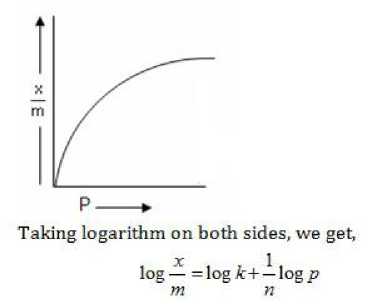
    • The variation in the amount of gas adsorbed by the adsorbent with pressure at constant temperature can be expressed by means of a curve is termed as adsorption isotherm.
    • Freundlich Adsorption isotherm: The relationship between ^ and pressure of the gas at constant temperature is called adsorption isotherm and is given by

    3L = kp’/n(n > 1)

    Where x- mass of the gas adsorbed on mass m of the adsorbent and the gas at a particular temperature k and n depends upon the nature of gas

    • The solid^-first increases with increase in pressure at low pressure but becomes independent of pressure at high pressure.

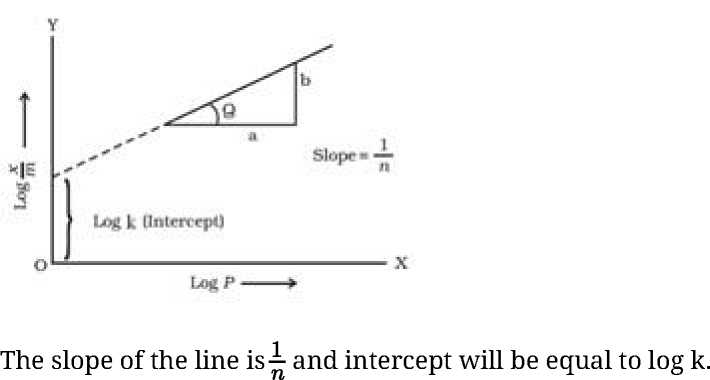
    Taking logarithm on both sides, we get,

    Iog^ = IogA:+ ^logp

    • If we plot a graph between log^ and log P, we get a straight line.

    • Catalyst: These are substances which alter the rate of a chemical reaction and themselves remain chemically and quantitatively unchanged after the reactionand the phenomenon is known as catalysis.
    • Promoters: These are the substances which increase the activity of catalyst. Example –

    Mo is promoter whereas Fe is catalyst in Haber’s Process.

    Fe(s)/Mo(s)

    N2{g) + 3#2(s) ► 2NH3{g)

    • Catalytic poisons (Inhibitors): These are the substances which decrease the activity of catalyst. Example -Arsenic acts as catalytic poison in the manufacture of sulphuric acid by ‘contact process.’
    • Types of catalysis:

    There are two types of catalysis namely,

    1. Homogeneous catalysis: When the catalyst and the reactants are in the same phase, this kind of catalytic process is known as homogeneous catalysis.
    2. Heterogeneous catalysis: When the catalyst and the reactants are in different phases, the catalytic process is said to be heterogeneous catalysis.
    3. Activity of catalyst: It is the ability of a catalyst to increase the rate of a chemical reaction.
    4. Selectivity of catalyst: It is the ability of catalyst to direct a reaction to yield a particular

    product (excluding others).

    For example: CO and H2 react to form different products in presence of different catalysts as follows:

    Ni

    1.

    Cu/ZnO-Cr2 O3

    2.

    Cu

    3.

    • Shape – selective catalysis: It is the catalysis which depends upon the pore structure of the catalyst and molecular size of reactant and product molecules. Example – Zeolites are shape – selective catalysts due to their honey- comb structure.
    • Enzymes: These are complex nitrogenous organic compounds which are produced by living plants and animals. They are actually protein molecules of high molecular mass. They are biochemical catalysts
    • Steps of enzyme catalysis:
    1. Binding of enzyme to substrate to form an activated complex.
    2. Decomposition of the activated complex to form product.
    • Characteristics of enzyme catalysis:
    1. They are highly efficient. One molecule of an enzyme can transform 106 molecules of reactants per minute.
    2. They are highly specific in nature. Example – Urease catalysis hydrolysis of urea only.
    3. They are active at optimum temperature (298 – 310 K). The rate of enzyme catalysed reaction becomes maximum at a definite temperature called the optimum temperature.
    4. They are highly active at a specific pH called optimum pH.
    5. Enzymatic activity can be increased in presence of coenzymes which can be called as promoters.

    1 2 j. 2 4-

    1. Activators are generally metal ions Na , Co2 and Cu2 etc. They weakly bind to enzyme and increase its activity.
    2. Influence of inhibitors (poison): Enzymes can also be inhibited or poisoned by the presence of certain substances.
    • True solution:
    1. It is homogeneous.
    2. The diameter of the particles is less than 1 nm.
    3. It passes through filter paper.
    4. Its particles cannot be seen under a microscope.
    • Colloids:
    1. It appears to be homogeneous but is actually heterogeneous.
    2. The diameter of the particles is 1 nm to 1000 nm.
    3. It passes through ordinary filter paper but not through ultra-filters.
    4. Its particles can be seen by a powerful microscope due to scattering of light.
    • Suspension:
    1. It is heterogeneous.
    2. The diameter of the particles are larger than 1000 nm.
    3. It does not pass through filter paper.
    4. Its particles can be seen even with naked eye.
    • Dispersed phase: It is the substance which is dispersed as very fine particles.
    • Dispersion medium: It is the substance present in larger quantity.
    • Classification of colloids on the basis of the physical state of dispersed phase and dispersion medium:

    Name

    Dispersed phase

    Dispersed medium

    Examples

    Solid sol

    solid

    Solid

    Coloured gem stones

    Sol

    Solid

    Liquid

    Paints


    Aerosol

    Solid

    Gas

    Smoke, dust

    Gel

    Liquid

    Solid

    Cheese, jellies

    Emulsion

    Liquid

    Liquid

    Hair cream, milk

    Aerosol

    Liquid

    Gas

    Mist, fog, cloud

    Solid sol

    Gas

    Solid

    Foam rubber, pumice stone

    Foam

    Gas

    Liquid

    Whipped cream

    • Classification of colloids on the basis of nature of interaction between dispersed phase and dispersion medium, the colloids are classified into two types namely,
    1. Lyophobic sols
    2. Lyophilic sols
    • Lyophobic sols:
    1. These colloids are liquid hating.
    2. In these colloids the particles of dispersed phase have no affinity for the dispersion medium.
    3. They are not stable.
    4. They can be prepared by mixing substances directly.
    5. They need stabilizing agents for their preservation.
    6. They are irreversible sols.
    • Lyophilic sols:
    1. These colloids are liquid loving.
    2. In these colloids, the particles of dispersed phase have great affinity for the dispersion medium.
    3. They are stable.
    4. They cannot be prepared by mixing substances directly. They are prepared only by

    special methods.

    1. They do not need stabilizing agents for their preservation.
    2. They are reversible sols.
    • Classification of colloids on the basis of types of particles of the dispersed phase:

    There are three types of colloids based on the type of dispersed phase, namely,

    1. Multimolecular colloids: The colloids in which the colloidal particles consist of aggregates of atoms or small molecules. The diameter of the colloidal particle formed is less than 1 nm.
    2. Macromolecular colloids: These are the colloids in which the dispersed particles are themselves large molecules (usually polymers). Since these molecules have dimensions comparable to those of colloids particles, their dispersions are called macromolecular colloids, e.g., proteins, starch and cellulose form macromolecular colloids.
    3. Associated colloids (Micelles): Those colloids which behave as normal, strong electrolytes at low concentrations, but show colloidal properties at higherconcentrations due to the formation of aggregated particles of colloidal dimensions. Such substances are also referred to as associated colloids.
    • Kraft Temperature (Tk):Micelles are formed only above a certain temperature called Kraft temperature.
    • Critical Micelle Concentration (CMC): Micelles are formed only above a particular concentration called critical micelle concentration.
    • Soaps: These are are sodium or potassium salts of higher fatty acids e.g., sodium stearate CH3(CH2)i6COO-Na+
    • Methods of preparation of colloids:
    1. Chemical methods: Colloids can be prepared by chemical reactions leading to the formation of molecules. These molecules aggregate leading to formation of sols.
    2. Electrical disintegration or Bredig’s Arc method: In this method, electric arc is struck

    between electrodes of the metal immersed in the dispersion medium. The intense heat produced vaporizes the metal which then condenses to form particles of colloidal size.

    1. Peptization: It is the process of converting a precipitate into colloidal sol by shaking it with dispersion medium in the presence of a small amount of electrolyte. The electrolyte used for this purpose is called peptizing agent.
    • Purification of colloids:
    1. Dialysis: It is a process of removing a dissolved substance from a colloidal solution by means of diffusion through a suitable membrane.
    2. Electro dialysis. The process of dialysis is quite slow. It can be made faster by applying an electric field if the dissolved substance in the impure colloidal solution is only an electrolyte.
    3. Ultrafiltration: It is the process of separating the colloidal particles from the solvent and soluble solutes present in the colloidal solution by specially prepared filters, which are permeable to all substances except the colloidal particles.
    4. Ultracentrifugation: In this process, the colloidal solution is taken in a tube which is placed in ultracentrifuge. On rotating the tube at very high speed, the colloidal particles settle down at the bottom of the tube and the impurities remain in solution. The settled particles are mixed with dispersion medium to regenerate the sol.
    • Properties of colloids:

    Positively charged colloidal particles:

    1. These include hydrated metallic oxides such as Fe2O3.#H2O, Cr2O3.a;H2O, Al2O3.

    CCH2O

    1. Basic dye stuff like malachite green, methylene blue sols.
    2. Example – Haemoglobin (blood).

    Negatively charged colloidal particles:

    1. Metallic sulphides like As2S3, Sb2S3 sols.
    2. Acid dye stuff like eosin, methyl orange, Congo red sols.
    3. Examples – Starch sol, gum, gelatin, clay, charcoal, egg albumin, etc.
    4. Colour: The colour of colloidal solution depends upon the wavelength of light scattered by the colloidal particles which in turn depends upon the nature and size of particles. The colour also depends upon the manner in which light is received by the observer.
    5. Brownian movement: Colloidal particles move in zig – zag path. This type of motion is due to colliding molecules of dispersion medium constantly with colloidal particles.
    6. Colligative properties: The values of colligative properties (osmotic pressure, lowering in vapour pressure, depression in freezing point and elevation in boiling point) are of small order as compared to values shown by true solutions at the same concentrations.
    7. Tyndall effect: The scattering of a beam of light by colloidal particles is called Tyndall effect. The bright cone of light is called the Tyndall cone.
    8. Charge on colloidal particles: Colloidal particles always carry an electric charge. The nature of this charge is the same on all the particles in a given colloidal solution and may be either positive or negative.
    9. Helmholtz electrical double layer: When the colloidal particles acquire negative or positive charge by selective adsorption of one of the ions, it attracts counter ions from the medium forming a second layer. The combination of these two layers of opposite charges around colloidal particles is called Helmholtz electrical double layer.
    10. Electrokinetic potential or zeta potential: The potential difference between the fixed layer and the diffused layer of opposite charges is called electrokinetic potential or zeta potential.
    11. Electrophoresis: The movement of colloidal particles under an applied electric potential is called electrophoresis.
    12. Coagulation or precipitation: The process of settling of colloidal particles as precipitate is called coagulation.

    • Hardy – Schulze rules:

    1. Oppositely charged ions are effective for coagulation.
    2. The coagulating power of electrolyte increases with increase in charge on the ions used for coagulation. Examples – Al3+> Ba2+> Na+ for negatively charged colloids. Fe (CN)6]4->

    PO^ >S0^ >Cl for positively charged colloids.

    • Types of emulsions:
    1. Water dispersed in oil: When water is the dispersed phase and oil is the dispersion medium. E.g. butter
    2. Oil dispersed in water: When oil is the dispersed phase and water is the dispersion medium. E.g. milk
    • Emulsification: It is the process of stabilizing an emulsion by means of an emulsifier.
    • Emulsifying agent or emulsifier: These are the substances which are added to stabilize the emulsions. Examples – soaps, gum
    • Demulsification: It is the process of breaking an emulsion into its constituent liquidsby freezing, boiling, centrifugation or some chemical methods.


  • Chemical Kinetics Notes for Class 12 Chemistry

    CBSE Class 12 Chemistry
    Quick Revision Notes
    Chapter 4
    Chemical Kinetics

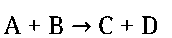
    Where d[B] is small change in conc. of ‘B’ and dt is small interval of time

    Chemical kinetics: It is the branch of chemistry that deals with the study of reaction rates and their mechanisms.

    Rate of reaction: It is the change in concentration of reactant (or product) in unit time.

    The unit of rate of reaction is mol

    where d[A] is small change in conc. of ‘A’ and dt is small interval of time

    Where d[C] is small change in conc. of ‘C’ and dt is small interval of time

    Where d[D] is small change in conc. of ‘D’ and dt is small interval of time

    Rate law or rate equation: It is the expression which relates the rate of reaction with concentration of the reactants. The constant of proportionality ‘k’ is known as rate constant.

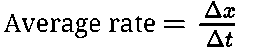
    Average rate: It is the rate of reaction measured over a long time interval.

    where is Ax change in concentration and At is large interval of time.

    Instantaneous rate: It is the rate of reaction when the average rate is taken over a particular moment of time. Instantaneous rate

    where dx is small change in conc. and dt is the smallest interval of time.

    It is the expression which relates the rate of reaction with concentration of the reactants.

    Rate constant: When the concentration of reactants is unity, then the rate of reaction

    is known as rate constant. It is also called specific reaction rate.

    The constant of proportionality ‘k’ is known as rate constant.

    Molecularity of a reaction: The total number of atoms, ions or molecules of the reactants involved in the reaction is termed as its molecularity. It is always in whole number and is never more than three. It cannot be zero.

    Order of a reaction: The sum of the exponents (power) of the concentration of reactants in the rate law is termed as order of the reaction. It can be in fraction. It can be zero also.

    Order cannot be determined with a given balanced chemical equation. It can be experimentally determined.

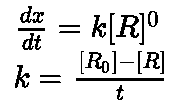
    Integrated rate law for zero order reaction: R ^ P

    If we plot a graph between concentration of R vs time t, the graph is a straight line with slope equal to -k and intercept is equal to [Ro].

    • Half- life of a reaction: The time taken for a reaction, when half of the starting material has reacted is called half- life of a reaction.

    It is independent of initial concentration for first order reaction.

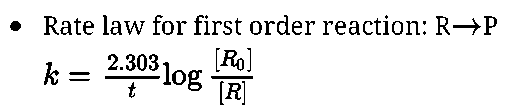
    where ‘k’ is rate constant or specific reaction rate, [Ro] is initial molar conc., [R] is final molar conc. after time ‘t’.

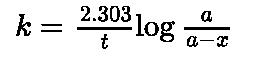
    where ‘a’ is initial conc. reacted in time ‘t’ final conc., after time ‘t’ is (a – x).

    • If we plot a graph between ln[R] with time, we get a straight line whose slope = – k and intercept ln[Ro].
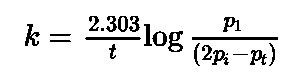
    • To calculate rate constant for first order gas phase reaction of the type

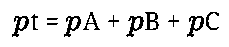
    Where pi is initial pressure of A, pt is total pressure of gaseous mixture containing A , B, C

    • Pseudo first order reaction: The reaction which is bimolecular but order is one is called pseudo first order reaction. This happens when one of the reactants is in large excess.Example – Acidic hydrolysis of ester (ethyl acetate).

    • Activation energy (Ea): It is extra energy which must be possessed by reactant molecules so that collision between reactant molecules is effective and leads to the formation of product molecules.
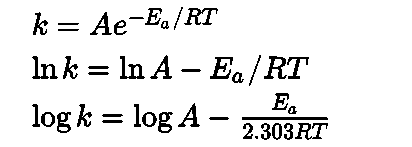
    • Arrhenius equation of reaction rate: It gives the relation between rate of reaction and temperature.

    where k = rate constant, A = frequency factor, Ea = energy of activation R = gas constant, T = temperature in Kelvin,

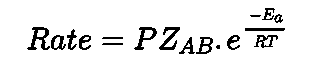
    • Probability factor or Steric factor

    Where ZAB represents the collision frequency of reactants, A and B,represents the fraction of molecules with energies equal to or greater than Ea and P is called the probability or steric factor.

    • Mechanism of reaction: It is the sequence of elementary processes leading to the overall stoichiometry of a chemical reaction.
    • Activated complex: It is an unstable intermediate formed between reacting molecules. Since, it is highly unstable and it readily changes into product.
    • Rate determining step: It is the slowest step in the reaction mechanism.
    • The number of collisions per second per unit volume of the reaction mixture is known as collision frequency (Z).
  • Electro chemistry Notes for Class 12 Chemistry

    CBSE Class 12 Chemistry
    Quick Revision Notes
    Chapter 3
    Electrochemistry

    • Oxidation: It is defined as a loss of electrons while reduction is defined as a gain of electrons.

    In a redox reaction, both oxidation and reduction reaction takes place simultaneously.

    • Direct redox reaction: In a direct redox reaction, both oxidation and reduction reactions take place in the same vessel. Chemical energy is converted to heat energy in a direct redox reaction.
    • Indirect redox reaction: In indirect redox reactions, oxidation and reduction take place in different vessels.

    In an indirect redox reaction, chemical energy is converted into electrical energy.The device which converts chemical energy into electrical energy is known as an electrochemical cell.

    • In an electrochemical cell:
    1. The half-cell in which oxidation takes place is known as oxidation half-cell
    2. The half-cell in which reduction takes place is known as reduction half-cell.
    3. Oxidation takes place at anode which is negatively charged and reduction takes place at cathode which is positively charged.
    4. Transfer of electrons takes place from anode to cathode while electric current flows in the opposite direction.
    5. An electrode is made by dipping the metal plate into the electrolytic solution of its soluble salt.
    6. A salt bridge is a U shaped tube containing an inert electrolyte in agar-agar and gelatine.
    • Salt bridge: A salt bridge maintains electrical neutrality and allows the flow of electric current by completing the electrical circuit.
    • Representation of an electrochemical cell:
    1. Anode is written on the left while the cathode is written on the right.
    2. Anode represents the oxidation half-cell and is written as: Metal/Metal ion (Concentration)
    3. Cathode represents the reduction half-cell and is written as: Metal ion (Concentration)/Metal
    4. Salt bridge is indicated by placing double vertical lines between the anode and the cathode
    5. Electrode potential is the potential difference that develops between the electrode and its electrolyte. The separation of charges at the equilibrium state results in the potential difference between the metal and the solution of its ions. It is the measure of tendency of an electrode in the half cell to lose or gain electrons.
    6. Standard electrode potential: When the concentration of all the species involved in a half cell is unity, then the electrode potential is known as standard electrode potential. It is denoted as E0.
    • According to the present convention, standard reduction potentials are now called standard electrode potential.
    • Types of electrode potential: There are 2 types of electrode potentials namely,
    1. Oxidation potential
    2. Reduction potential
    • Oxidation potential: It is the tendency of an electrode to lose electrons or get oxidized.
    • Reduction potential: It is the tendency of an electrode to gain electrons or get reduced.

    Oxidation potential is the reverse of reduction potential.

    • The electrode having a higher reduction potential have higher tendency to gain electrons and so it acts as a cathode whereas the electrode having a lower reduction potential acts as an anode.
    • The standard electrode potential of an electrode cannot be measured in isolation.
    • According to convention, the Standard Hydrogen Electrode is taken as a reference electrode and it is assigned a zero potential at all temperatures.
    • Reference electrode: Standard calomel electrode can also be used as a reference electrode
    • SHE: Standard hydrogen electrode consists of a platinum wire sealed in a glass tube and carrying a platinum foil at one end. The electrode is placed in a beaker containing

    an aqueous solution of an acid having 1 Molar concentration of hydrogen ions. Hydrogen gas at 1 bar pressure is continuously bubbled through the solution at 298 K. The oxidation or reduction takes place at the Platinum foil. The standard hydrogen electrode can act as both anode and cathode.

    • If the standard hydrogen electrode acts as an anode:

    If the standard hydrogen electrode acts as a cathode:

    In the electrochemical series, various elements are arranged as per their standard reduction potential values.

    A substance with higher reduction potential value means that it has a higher tendency to get reduced. So, it acts as a good oxidising agent.

    A substance with lower reduction potential value means that it has a higher tendency to get oxidised. So, it acts as a good reducing agent.

    The electrode with higher reduction potential acts as a cathode while the electrode with a lower reduction potential acts as an anode.

    The potential difference between the 2 electrodes of a galvanic cell is called cell potential and is measured in Volts.

    The cell potential is the difference between the reduction potential of cathode and anode.

    E cell = E cathode – E anode

    Cell potential is called the electromotive force of the cell (EMF) when no current is drawn through the cell.

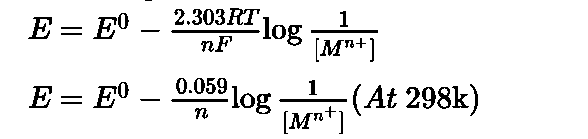
    Nernst studied the variation of electrode potential of an electrode with temperature and concentration of electrolyte.

    Nernst formulated a relationship between standard electrode potential E0 and electrode potential E. [1]

    At equilibrium, cell potential Ecteell becomes zero.

    Relationship between equilibrium constant Kc and standard cell potential E0cell:

    Work done by an electrochemical cell is equal to the decrease in Gibbs energy

    The substances which allow the passage of electricity through them are known as conductors.

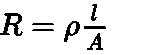
    Every conducting material offers some obstruction to the flow of electricity which is called resistance. It is denoted by R and is measured in ohm.

    The resistance of any object is directly proportional to its length l and inversely proportional to its area of cross section A.

    Where p is called specific resistance or resistivity.

    The SI unit of specific resistivity is ohm metre.

    The inverse of resistance is known as conductance, G

    Unit of conductance is ohm-1 or mho. It is also expressed in Siemens denoted by S. The inverse of resistivity is known as conductivity. It is represented by the symbol The SI unit of conductivity is Sm-1. But it is also expressed in Scm-1.

    Conductivity = Conductance * Cell constant

    For measuring the resistance of an ionic solution, there are 2 problems:

    1. Firstly, passing direct current changes the composition of the solution
    2. Secondly, a solution cannot be connected to the bridge like a metallic wire or a solid conductor.

    Conductivity cell: The problem of measuring the resistance of an ionic solution can be resolved by using a source of alternating current and the second problem is resolved by using a specially designed vessel called conductivity cell.

    A conductivity cell consists of 2 Pt electrodes coated with Pt black. They have area of cross section A and are separated by a distance T. Resistance of such a column of solution is given by the equation:

    Whereis called cell constant and is denoted by the symbol

    Molar conductivity of a solution: It is defined as the conducting power of all the ions

    Material Downloaded From ImperialStudy

    / 7

    produced by dissolving 1 mole of an electrolyte in solution.

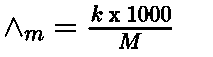
    Molar conductivity

    WhereConductivity and M is the molarity Unit of Molar conductivity is Scm2 mol- 1

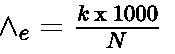
    • Equivalent conductivity: It is the conductivity of all the ions produced by dissolving one gram equivalent of an electrolyte in solution. Unit of equivalent conductivity is S cm2 (g equiv) -1

    Equivalent conductivity:

    • Kohlrausch’s Law of independent migration of ions: According to this law, molar conductivity of an electrolyte, at infinite dilution, can be expressed as the sum of individual contributions from its individual ions.
    • If the limiting molar conductivity of the cations is denoted byand that of the anions bythen the limiting molar conductivity of electrolyte is:

    Molar conductivity,

    Where v+ and v- are the number of cations and anions per formula of electrolyte

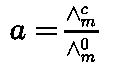
    • Degree of dissociation: It is ratio of molar conductivity at a specific concentration ‘c’ to the molar conductivity at infinite dilution. It is denoted by.

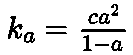
    • Dissociation constant:WhereKa is acid dissociation constant, ‘c’ is

    concentration of electrolyte, a is degree of ionization.

    • Faraday constant: It is equal to charge on 1 mol of electrons. It is equal to 96487 C mol-1 or approximately equal to 96500 C mol-1.
    • Faraday’s first law of electrolysis: The amount of substance deposited during electrolysis is directly proportional to quantity of electricity passed.
    • Faraday’s second law of electrolysis: If same charge is passed through different electrolytes, the mass of substance deposited will be proportional to their equivalent weights.
    • Products of electrolysis: The products of electrolysis depend upon
    • The nature of electrolyte being electrolyzed and the nature of electrodes. If electrode is inert like platinum or gold, they do not take part in chemical reaction i.e. they neither lose nor gain electrons. If the electrodes are reactive then they will take part in chemical reaction and products will be different as compared to inert electrodes.
    • The electrode potentials of oxidizing and reducing species. Some of the

    electrochemical processes although feasible but slow in their rates at lower voltage, these require extra voltage, i.e. over voltage at which these processes will take place. The products of electrolysis also differ in molten state and aqueous solution of electrolyte.

    • Primary cells: A primary cell is a cell in which electrical energy is produced by the reaction occurring in the cell, e.g. Daniel cell, dry cell, mercury cell. It cannot be recharged.
    • Dry Cell:

    At anode At cathode

    The net reaction:

    • Mercury Cell: The electrolyte is a paste of KOH and ZnO.

    At Anode:

    At cathode:

    The net reaction:

    • Secondary cells: Those cells which are used for storing electricity, e.g., lead storage battery, nickel – cadmium cell. They can be recharged.
    • Lead storage battery:

    Anode:

    Cathode:

    The overall cell reaction consisting of cathode and anode reactions is:

    On recharging the battery, the reaction is reversed.

    • Nickel cadmium cell: It is another type of secondary cell which has longer life than lead storage cell but more expensive to manufacture.

    The overall reaction during discharge is

    • Fuel cells:

    At Anode:

    At cathode:

    • Overall reaction:

    • Corrosion:

    Oxidation:

    Reduction:

    • Galvanization: It is a process of coating zinc over iron so as to protect it from rusting.
    • Cathodic protection: Instead of coating more reactive metal on iron, the use of such metal is made as sacrificial anode.
    1. Electrode potential increases with increase in the concentration of the electrolyte and decrease in temperature.

      Nernst equation when applied to a cell, it helps in calculating the cell potential.


  • Solutions Notes for Class 12 Chemistry

    CBSE Class 12 Chemistry
    Quick Revision Notes
    Chapter 2
    Solutions

    The difference in boiling points of solution Tb and pure solvent T® is called elevation in boiling point

    • Solutions: Solutions are the homogeneous mixtures of two or more than two components.
    • Binary solution: A solution having two components is called a binary solution.
    • Components of a binary solution.

    It includes solute and solvent.

    1. When the solvent is in solid state, solution is called solid solution.
    2. When the solvent is in liquid state, solution is called liquid solution.
    3. When the solvent is in gaseous state, solution is called gaseous solution.
    • Concentration: It is the amount of solute in given amount of solution.
    • Mass by volume percentage (w/v): Mass of the solute dissolved in 100 mL of solution.
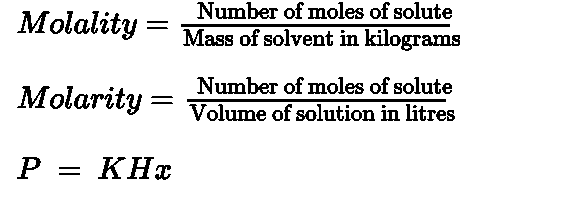
    • Molality (m) is the number of moles of solute present in 1kg of solvent.
    • Molarity (M) is the number of moles of solute present in 1L of solution.
    • Normality is the number of gram equivalent of solute dissolved per litre of solution.
    • Solubility: It is the maximum amount that can be dissolved in a specified amount of solvent at a specified temperature.
    • Saturated solution: It is a solution in which no more solute can be dissolved at the same temperature and pressure.
    • In a nearly saturated solution if dissolution process is an endothermic process, solubility increases with increase in temperature.
    • In a nearly saturated solution if dissolution process is an exothermic process, solubility decreases with increase in temperature.
    • Henry’s Law: It states “at a constant temperature the solubility of gas in a liquid is directly proportional to the pressure of gas”. In other words, “the partial pressure of gas in vapour phase is proportional to the mole fraction of the gas in the solution”.
    • When a non-volatile solute is dissolved in a volatile solvent, the vapour pressure of solution is less than that of pure solvent.
    • Raoult’s law: It states that “for a solution of volatile liquids the partial vapour pressure of each component in the solution is directly proportional to its mole fraction”.
    • Using Dalton’s law of partial pressure the total pressure of solution is calculated.

    • Comparison of Raoult’ law and Henry’s law: It is observed that the partial pressure of volatile component or gas is directly proportional to its mole fraction in solution. In case of Henry’s Law the proportionality constant is KH and it is different from p10 which is partial pressure of pure component. Raoult’s Law becomes a special case of Henry’s Law when KH becomes equal to p10 in Henry’s law.
    • Classification of liquid-liquid solutions: It can be classified into ideal and non-ideal solutions on basis of Raoult’s Law.

    • Ideal solutions:

    1. The solutions that obey Raoult’s Law over the entire range of concentrations are known as ideal solutions.

    3. The intermolecular attractive forces between solute molecules and solvent

    molecules are nearly equal to those present between solute and solvent molecules i.e. A-A and B-B interactions are nearly equal to those between A-B.

    Non-ideal solutions:

    1. When a solution does not obey Raoult’s Law over the entire range of concentration, then it is called non-ideal solution.

    3. The intermolecular attractive forces between solute molecules and solvent

    molecules are not equal to those present between solute and solvent molecules i.e. A-A and B-B interactions are not equal to those between A-B

    • Types of non- ideal solutions:
    1. Non ideal solution showing positive deviation
    2. Non ideal solution showing negative deviation
    • Non ideal solution showing positive deviation
    1. The vapour pressure of a solution is higher than that predicted by Raoult’s Law.
    2. The intermolecular attractive forces between solute-solvent molecules are weaker than those between solute-solute and solvent-solvent molecules i.e., A-B < A-A and B-B interactions.
    • Non ideal solution showing negative deviation
    1. The vapour pressure of a solution is lower than that predicted by Raoult’s Law.
    2. The intermolecular attractive forces between solute-solvent molecules are stronger than those between solute-solute and solvent-solvent molecules i.e. A-B > A-A and B-B interactions.
    • Azeotopes: These are binary mixtures having same composition in liquid and vapour

    phase and boil at constant temperature. Liquids forming azeotrope cannot be

    separated by fractional distillation.

    • Types of azeotropes: There are two types of azeotropes namely,
    1. Minimum boiling azeotrope
    2. Maximum boiling azeotrope

    • The solutions which show a large positive deviation from Raoult’s law form minimum

    boiling azeotrope at a specific composition.

    • The solutions that show large negative deviation from Raoult’s law form maximum

    boiling azeotrope at a specific composition.

    • Colligative properties: The properties of solution which depends on only the number of solute particles but not on the nature of solute are called colligative properties.
    • Types of colligative properties: There are four colligative properties namely,
    1. Relative lowering of vapour pressure
    2. Elevation of boiling point
    3. Depression of freezing point
    4. Osmotic pressure
    • Relative lowering of vapour pressure: The difference in the vapour pressure of pure solvent p\j[1] and solution pi represents lowering in vapour pressure(p® —pi).
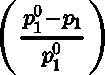
    • Relative lowering of vapour pressure: Dividing lowering in vapour pressure by vapour pressure of pure solvent is called relative lowering of vapour pressure

    • Relative lowering of vapour pressure is directly proportional to mole fraction of solute. Hence it is a colligative property.

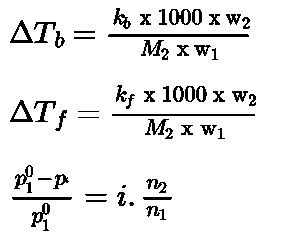
    • For a dilute solution elevation of boiling point is directly proportional to molal concentration of the solute in solution. Hence it is a colligative property.

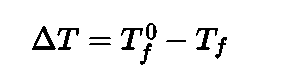
    • Depression of freezing point: The lowering of vapour pressure ofsolution causes a lowering of freezing point compared to that of pure solvent.The difference in freezing point of the pure solvent T® and solution Tf is called the depression in freezing point.

    passage of solvent into solution through a semipermeable membrane is called osmotic pressure.

    • Osmotic pressure is a colligative property as it depends on the number of solute particles and not on their identity.
    • For a dilute solution, osmotic pressure (7r) is directly proportional to the molarity (C) of the solution i.e. 7r= CRT
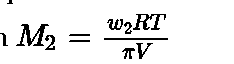
    • Osmotic pressurecan also be used to determine the molar mass of solute using the equatioi

    • Isotonic solution: Two solutions having same osmotic pressure at a given temperature are called isotonic solution.
    • Hypertonic solution: If a solution has more osmotic pressure than other solution it is called hypertonic solution.
    • Hypotonic solution: If a solution has less osmotic pressure than other solution it is called hypotonic solution.
    • Reverse osmosis: The process of movement of solvent through a semipermeable membrane from the solution to the pure solvent by applyingexcess pressure on the solution side is called reverse osmosis.
    • Colligative properties help in calculation of molar mass of solutes.
    • Abnormal molar mass: Molar mass that is either lower or higher than expected or normalmolar mass is called as abnormal molar mass.
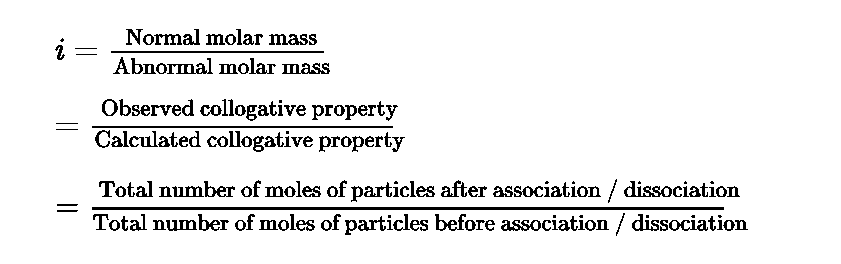
    • Van’t Hoff factor: Van’t Hoff factor (i)accounts for the extent of dissociation or association.

    • For a dilute solution depression in freezing point is a colligative property because it is

    directly proportional to molal concentration of solute.

    • Osmosis: The phenomenon of flow of solvent molecules through a semi permeable membrane from pure solvent to solution is called osmosis.
    • Osmotic pressure: The excess pressure that must be applied to solution to prevent the
      • Value of i is less than unity in case solute undergo association and the value of i is greater than unity in case solute undergo dissociation.
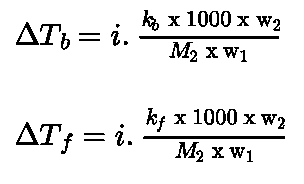
    1. Inclusion of van’t Hoff factor modifies the equations for colligative properties as:

  • The Solid State Notes for Class 12 Chemistry

    CBSE Class 12 Chemistry
    Quick Revision Notes
    Chapter 1
    The Solid State

    Solid: Solid is a state of matter in which the constituting particles are arranged very closely.The constituent particles can be atoms, molecules or ions.

    Properties of solids:

    1. They have definite mass, volume and shape.
    2. They are compressible and rigid.
    3. Intermolecular distances are very short and hence the intermolecular forces are strong.
    4. Their constituent particles have fixed position. sand can only oscillate about their mean positions.

    Classification of on the basis of the arrangement of constituent particles:

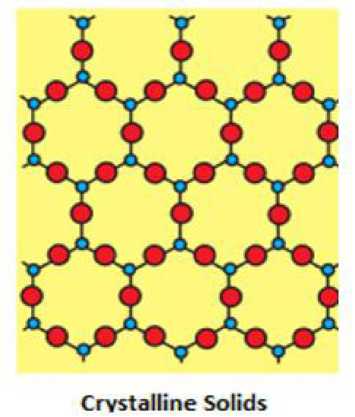
    • Properties of crystalline solids:
    • They have a definite geometrical shape.
    • They have a long range order.
    • They have a sharp melting point.
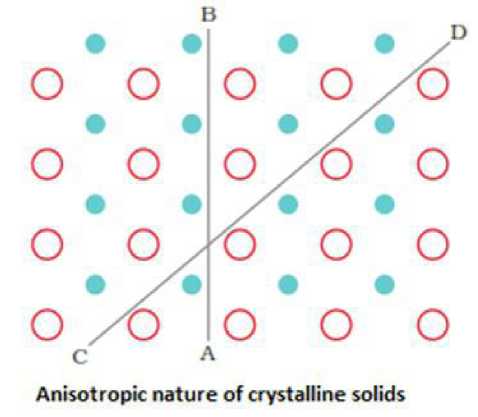
    • They are anisotropic in nature i.e. their physical properties show different values when measured along different directions in the same crystal.
    • They have a definite and characteristic heat of fusion.
    • They are called true solids.
    • When cut with a sharp edged tool , they split into two pieces and the newly generated surfaces are plain and smooth.

    • Polymorphic forms or polymorphs:

    The different crystalline forms of a substance are known as polymorphic forms or polymorphs .For example: graphite and diamond.

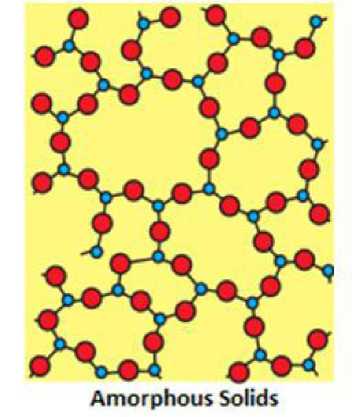
    • Characteristics of amorphous solids:
    1. They have an irregular shape.
    2. They have a short range order.
    3. They gradually soften over arrange of temperature.
    4. They are isotropic in nature i.e. their physical properties are the same in all directions.
    5. When cut with a sharp edged tool, they cut into two pieces with irregular surfaces.
    6. They do not have definite heat of fusion.
    7. They are called pseudo solids or super cooled liquids. This is because they have a tendency to flow,though very slowly.
    • Types of crystalline solids:

    A. Molecular Solids

    Constituent Particles: Molecules

    Type of solid

    Constituent

    Particles

    Bonding/

    Attractive

    Forces

    Electrical

    conductivity

    physical

    nature

    Melting

    point

    Examples

    Non

    polar

    solids

    Molecules

    Dispersion or London forces

    Insulator

    Soft

    Very

    low

    Ar,CCl4,H2,I2,C02

    Polar

    solids

    Molecules

    Dipole-

    dipole

    interactions

    Insulator

    Soft

    low

    HCl, solid SO2, solid NH3

    Hydrogen

    bonded

    Molecules

    Hydrogen

    bonding

    Insulator

    Hard

    low

    H20 (ice)

    B. Ionic Solids

    Constituent Particles: Ions

    Bonding/Attractive Forces: Coulombic or Electrostatic

    Electrical Conductivity: Insulators in solid state but conducts in molten state and in

    aqueous solutions

    Physical Nature: Hard but brittle

    Melting Point: High

    Examples: CaF2, ZnS, MgO, NaCl

    C. Metallic Solids

    Constituent Particles: Positive ions in a sea of delocalized electrons Bonding/Attractive Forces: Metallic bonding

    Electrical Conductivity: Conductors in solid state as well as in molten state Physical Nature: Hard but malleable and ductile Melting Point: Fairly high

    Examples: Fe ,Cu, Ag, Mg

    D. Covalent or NetworkSolids Constituent Particles: Atoms Bonding/Attractive Forces: Covalent bonding

    Electrical Conductivity: Conductors in solid state as well as in molten state Physical Nature: Hard but malleable and ductile Melting Point: Fairly high

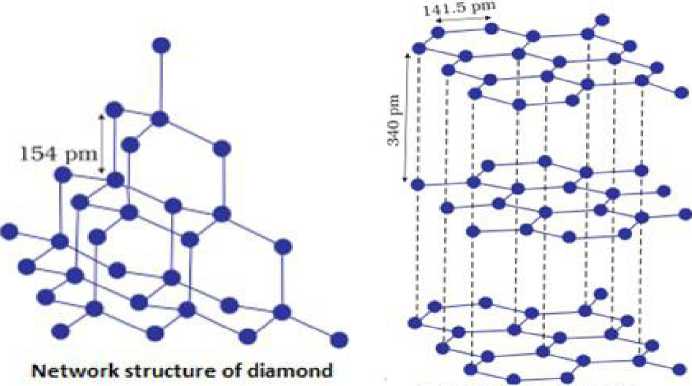
    Examples: Si02, (quartz), SiC, C (diamond), C(graphite)

    Network structure of graphite

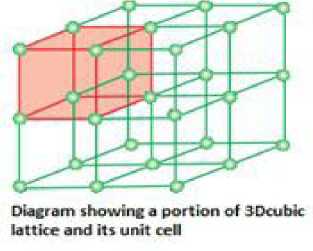
    • Crystal lattice: A regular ordered arrangement of constituent particles in three dimensions is called crystal lattice.

    • Lattice points or lattice sites:the fixed positions on which the constituent particles are presentare called lattice points or lattice sites. A group of lattice points which when repeated over and over againin3dimensions give the complete crystal lattice.
    • Unit cell: It is defined as the smallest repeating unit in space lattice which when repeated over and over again generates the complete crystal lattice. The crystal can consist of an infinite number of unit cells.
    1. Dimensions of the unit cell along the three edges ,a, b and c:these edges may or may not be mutually perpendicular.
    2. Inclination of the edges to each other:this is denoted by the angle between the edges a,fi , andrespectively.cdsthe angle between the edges b and c,/3isthe angle between the edges a and c ,and7is the angle between a and b.
     

    i — 1

    c!

    i


    J0L-A–


    Parameters which characterise a unit cell

    • Seven crystal systems:
    1. Cubic: o:=/3=7=90o ,a=b=c
    2. Tetragonal: a=/3=7=90° ; a=by^c
    3. Orthorhombic: cl={3=j=90°; a^by^c
    4. Monoclinic: o:=7=90°,^:90°; ay^by^c
    5. Hexagonal: o:=/3=90°,7=120°; a=by^c
    6. Rhombohedral or trigonal: a= /3=7y^90°;a=b=c
    7. Triclinic: o:y^/3y^7y^90O;ay^by^c
    • Types of unit cells:
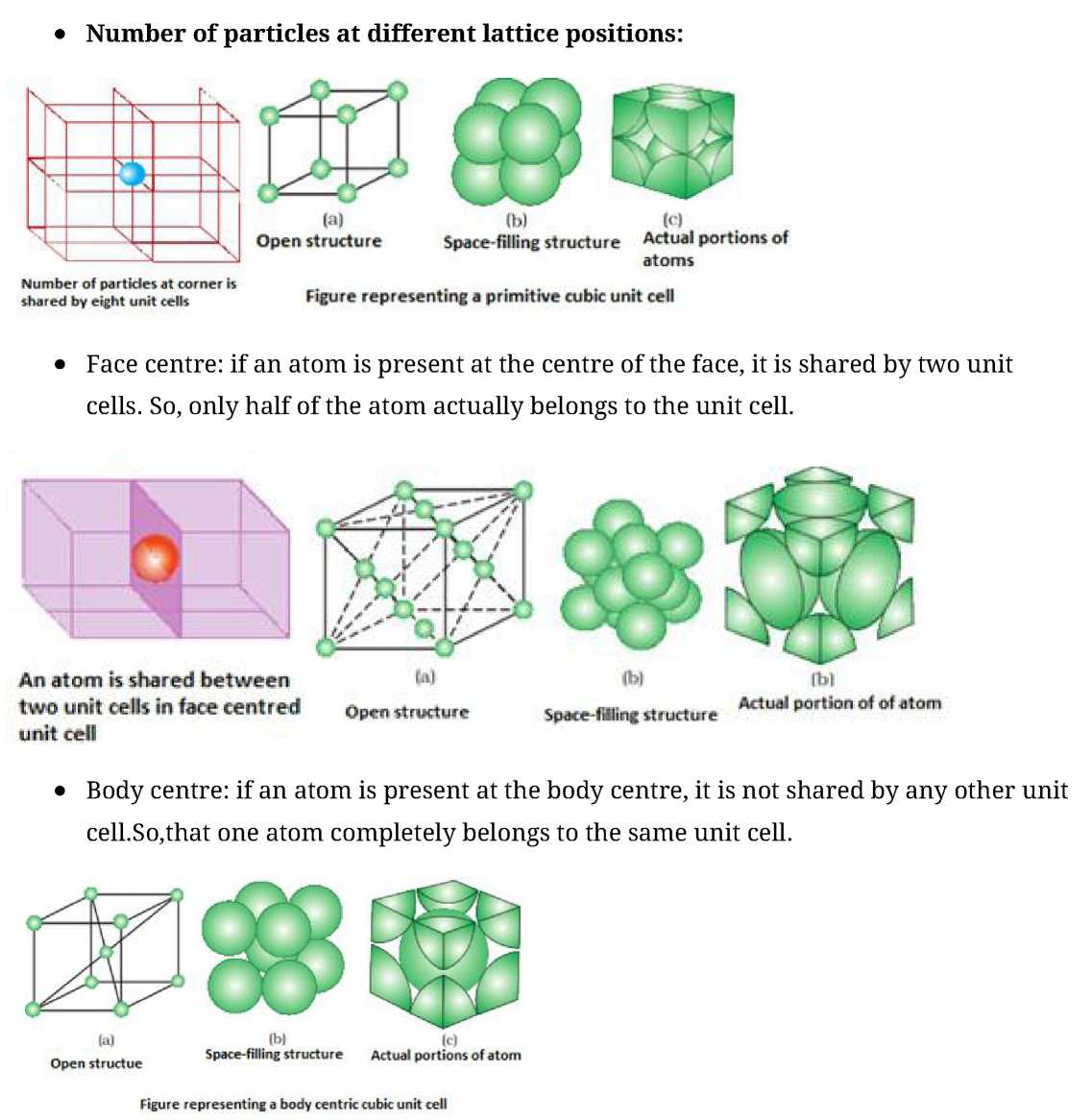
    1. Primitive or simple unit cells have constituent particles only at its corners.
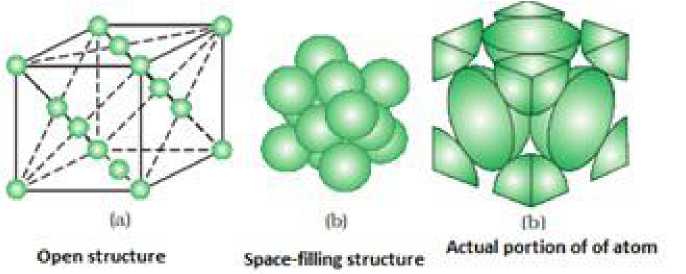
    2. Centered unit cells are those unit cells in which one or more constituent particles are present at positions in addition to those present at the corners.
    • Types of centered unit cells:
    1. Face centered unit cell: It consists of one constituent particle present at the centre of each face in addition to those present at the corners.
    2. Body centered unit cell: It consists of a one constituent particle is present at its body centre in addition to those present at the corners.
    3. End centered unit cell: It consists of one constituent particle present at the centre of any

    two opposite faces in addition to those present at the corners.

    • End centre: f an atom is present at the edge centre, it is shared by four unit cells. So, only one fourth of an atom belongs to the unit cell.
    • Number of atoms in different unit cells:
    1. Primitive unit cell have latom

    1. Face centered unit cell have 3 atoms
    2. Body centered unit cell have 2atoms
    • Coordination number: Coordination number is the number of nearest neighbours of a particle.
    • Close packed structures:

    ccccccce

    One dimensional close packing of spheres

    • Close packing in two dimensions: It is generated by stacking the rows of close packed spheres in two ways:

    i) Square close packing and ii) Hexagonal close packing.

    • Close packing in three dimensions: They can be obtained by stacking the two dimensional layers one above the other. It can be obtained in two ways:

    i) Square close packed layers and ii) Hexagonal close packed layers.

    • Square close packing: Here, the spheres of the second row ware placed exactly above those of the first row. This way the spheres are aligned horizontally as well as vertically. The arrangement is AAA type. The coordination number is 4.

    • Hexagonal close packing: Here, these spheres of these bond row are placed above the first one in as taggered manner in such a way that its spheres fit in the depression of the first row. The arrangement is ABAB type. The coordination number is 6.

    Hexagonal dose packing of spheres in two dimensions

    • Three dimensional close packing from two dimensional square close packed

    Covering the octahedral voids: Here, octahedral voids of these bond layer may be covered by the spheres of the third layer. It gives rise to ABCABCABC type pattern. The three dimensional structure is called cubic close packed structure or face centered cubic structure. The coordination number is 12.Example: Cu, Ag.

    • In hexagonal close packing or cubic close packing arrangement, the octa hedral and tetrahedral voids are present. The number of octahedral voids present in a lattice is equal to the number of close packed particles. The number of tetrahedral voids is twice the number of octahedral voids.

    For example:

    If the number of close packed particles = n

    Number of particles present in octahedral voids = n

    Then, the number of particles present in tetrahedral voids = 2n

    • Packing efficiency: It is the percentage of total space occupied by constituent particles (atoms, molecules orions).

    x 100%

    Packing Efficiency =

    Volume occupied by spheres
    Total volume of unit cell

    • Packing efficiency for face centered unit cell =74%
    • Packing efficiency for body centered cubic unit cell =68%
    • Packing efficiency for simple cubic unit cell =52.4%
    • Radius ratio in an octahedral void: For an atom to occupy an octahedral void, its radius must be 0.414 times the radius of the sphere.

    i =o-414

    • Radius ratio for tetrahedral void: For an atom to occupy a tetrahedral void, its radius must be 0.225 times the radius of the sphere.

    i = °-225

    • Density of a unit cell is same as the density of the substance.
    • Relationship between radius of constituent particle(r) and edge length(a):

    Simple cubic unit cell: a=2r Face centered unit cell: a=2y/2r Body centered unit cell: a=

    1.

    2.

    3.

    1.

    2.

    v3

    • Volume of a unit cell=(edge length)3=a3

    Simple cubic unit cell: Volume= (2r)3

    2

    Face centered unit cell: Volume= (2\/2r) Body centered unit cell: Volume=

    • Number of atoms in a unit cell(z):

    1. Simple cubic unit cell: z=1
    2. Face centered unit cell: z=4
    3. Body centered unit cell: z=2
    • Density of unit cell=
    • Crystal defects are basically irregularities in the arrangement of constituent particles.
    • Types of defects:
    1. Point defects- Point defects are the irregularities or deviations from ideal arrangement around a point or an atom in a crystalline substance.
    2. Line defects- Line defects are the irregularities or deviations from ideal arrange ment in entire rows of lattice points.

    Impurity defect!

    Different types of point defects:

    Different types of stoichiometric defects for non- ionic solids:

    Vacancy defect

    • Interstitial defect: A crystal is said to have interstitial defect when some constituent particles (atoms or molecules) occupy an interstitial site. This defect results in increase in density of the substance.

    Interstitial defect

    • Different types of stoichiometric defects for ionic solids:

    Schottky defects

    • Frenkel or dislocation defect: In this defect, the smaller ion (usually cation) is dislocated from its normal site to an interstitial site. It creates a vacancy defect a tits original site and an interstitial defect a tits new location. It does not change the density of the solid. Frenkel defect is shown by ionic substance in which there is a larged difference in the size of ions. It includes ZnS,AgCl,AgBrand Agl.

    Frenkei defects

    • Different types of non-stoichiometric defects:

    • Metal deficiency: This defect arises because of absence of metal ions from its lattice sites. The electrical neutrality is maintained by an adjacention having a higher positive charge.
    • Reasons for the cause of metal excess defect:
    1. Anionic vacancies: A compound may have an extra metal ion if the negative ion is absent from its lattice site.This empty lattice site is called a hole.To maintain electrical neutrality this site is occupied by an electron. The hole occupied by an electron is called f-centre or Farbenz enter centre. The F- centre is responsible for the colour of the compound.
    2. Presence of extracations: A compound is said to have extracations if a cation is present in the interstitial site. An electron is present in the interstitial site to maintain the electrical neutrality.
    • Classification of solids based on their electrical conductivities:
    1. Conductors: The solids with conductivities ranging between 104 to 10 7o/im_1m_1 are called conductors.

    nrj

    1. Insulators: These are the solids with very low conductivities ranging between to

    .

    1. Semi- conductors: These are the solids with conductivities in the intermediate range from

    tol04ofom_1m_1.

    1. Intrinsic semiconductors: These are those semiconductors in which the forbidden gap is small. Only some electrons may jump to conduction band and show some conductivity. They have very low electrical conductivity. Example: Silicon, germanium.
    2. Extrinsic semiconductors: When an appropriate impurity is added to an intrinsic semiconductor, it is called extrinsic semi conductors. Their electrical conductivity is high.
    • Doping: The process of adding an appropriate amount of suitable impurity to increase the conductivity of semiconductors is known as doping.
    1. The n-type semiconductors: They are formed when silicon is doped with electron rich impurity like group 15 elements. The increase in conductivity is due to the negatively charged electrons.
    2. The p-type semiconductors: They are formed when silicon is doped with electron deficient impurity like group 13 elements. The increase in conductivity is due to the positively charged holes.
    • Types of extrinsic semiconductors:
    • Diode: It is a combination of n-type and p-type semiconductors and is used as a rectifier.
    • Transistors: They are made by sandwiching a layer of one type of semiconductor between two layers of the other type of semi conductor. The npn and pnp type of transistors are used to detector amplify radio or audio signals.
    • The 12- 16 compounds: These compounds are formed by the combination of group 12 and group 16 compounds.They possess an average valency of 4.Examples – ZnS,CdS,CdSe and HgTe.
    • The 13- 15 compounds: These compounds are formed by the combination of group 13 and group 15 compounds.They possess an average valency of 4.Examples – InSb,AlP and GaAs.
    • Every substance has some magnetic properties associated with it. The origin of these properties lies in the electrons.
    • Each electron in an atom behaves like at in y magnet. Its magnetic moment originates from two types of motions:

    (i) its orbital motion around the nucleus and (ii) its spin around its own axis.

    • Classification of substances based on their magnetic properties:

    1. Paramagnetic substances: These are those substances which are weakly attracted by the magnetic field. It is due to presence of one or more unpaired electrons.
    2. Diamagnetic substances: Diamagnetic substances are weakly repelled by a magnetic field. Diamagnetism is shown by those substances in which all the electrons are paired and there are no unpaired electrons.
    3. Ferromagnetic substances: These are those substances which are attracted every strongly by a magnetic field.
    4. Anti ferromagnetic substances: They have equal number of parallel and anti parallel magnetic dipoles resulting in a zero net dipolemoment.
    5. Ferrimagnetic substances: They have unequal number of parallel and anti parallel magnetic dipoles resulting in an at dipole moment.


  • Environmental Issues Notes Biology Class 12th

    [docxpresso file=”https://www.imperialstudy.com/wp-content/uploads/2019/02/bio_16.odt” comments=”true” SVG=”true”]

  • Biodiversity and Conservation Notes Biology Class 12th

    [docxpresso file=”https://www.imperialstudy.com/wp-content/uploads/2019/02/bio_15.odt” comments=”true” SVG=”true”]

  • Ecosystem Notes Biology Class 12th

    [docxpresso file=”https://www.imperialstudy.com/wp-content/uploads/2019/02/bio_14.odt” comments=”true” SVG=”true”]