Category: Civics

  • Extra Questions of What is Democracy? Why Democracy? Class 9th Social Science Civics

    SHORT ANSWER TYPE QUESTIONS 

    Q.1. How can you say that every government that holds an election is not a democracy? Give an example to prove your point. [Important]

    Ans. It is true that every government that holds an election is not a democracy. In many dictatorships and monarchies, there are formally elected parliaments and governments but the real power is with those who are not elected. Pakistan under General Musharraf could not be called a democracy because people there elected their representatives to the national and provincial assemblies but the power to take final decision rested with army officials and with General Musharraf

    Q.2. In China, elections are held after every five years. Inspite of this, China does not have a democratic government. Why?

    Ans. In China, elections are regularly held after every five years for electing the country’s Parliament. The Parliament has the power to appoint the President of the country. It has nearly 3,000 members elected from all over China. Some members are elected by the Army. Before contesting elections, a candidate needs the approval of the Chinese Communist Party. The government is always formed by the Communist Party.

    Q.3. In which way is the right to vote denied in Saudi Arabia and Fiji?

    Ans. In Saudi Arabia women do not have the right to vote.

    In Fiji, the electoral system is such that the vote of an indigenous Fiji has more value than that of an Indian Fijian. In both the countries, the right to vote is denied as there is no political equality. In a democracy, each adult citizen must have one vote and each vote must have one value.

    Q.4. Why has India never had a famine of the level which occurred in China in 1958-61?

    Ans. In China’s famine of 1958-61, nearly three crore people died. In those days India’s economic condition was not much better than China. Yet India did not have a famine of the kind China had. The reason was the difference in the economic policies of the two countries. Democratic government in India responded to the food shortage in a way that Chinese government did not.

    If China too had had multi-party elections, an opposition party and a press free to criticise the government, so many people would not have died in the famine.

    Q.5. ‘Democracy is based on consultation and discussion.’ Explain.

    Ans. Consultation and discussion help democracy prosper. A democratic decision always involves many persons, discussions and meetings. When a number of people put their heads together, they are able to point out possible mistakes in any decision. This reduces the chances of rash or irresponsible decisions. Thus democracy improves the quality of decision-making.

    Q.6. Why is it not possible for the people to rule directly but through elected representatives?

    Ans. The people cannot rule directly but only through their elected representatives because, firstly, modern democracies involve such a large number of people that it is physically impossible for them to sit together and take a collective decision. Secondly, even if they could, the citizens do not have the time, the desire or the skill to take part in all the decisions.

    Q.7. Is it possible for any country to become a perfect democracy? Give reasons.

    Ans. No country is a perfect democracy as every democracy has to realise the ideals of democratic decision-making. This cannot be achieved once and for all. This requires a constant effort to save and strengthen democratic forms of decision-making. What we do as citizens can make a difference to making our country more or less democratic.

    Q.9. Why is Democracy considered the best form of government? Give three reasons.

    [2010 (T-1)]

    Ans. Democarcy is a more accountable form of government.

    (i) It improves the quality of decision-making

    (ii) It enchances the dignity of citizens.

    (iii)It allows us to correct its own mistakes

    Q.10. What is the role of citizen in promoting democracy? [2010 (T-1)]

    Ans. Every citizen should be able to play equal role in decision-making. For this a citizen not only needs an equal right to vote but also needs to have equal information, basic education, equal resources.

    Q.11. Explain any three differences between democratic country and non-democratic country? [2010 (T-1)]

    Ans. In a Democratic country–

    (i) Each adult citizen has a vote;(ii) Each vote has one value; and (iii) Free and fair elections are held.

    In a non-democratic country — (i) Election do not offer a choice and fair opportunity; (ii) Rulers are not elected by the people; and (ii) The rulers have unlimited power.

    Q.12. Is China a democratic country or not? Give two arguments in favour of your answer.

    [2010 (T-1)]

    Ans. China is not a democratic country. (i) Only those who are members of the Chinese Communist Party or eight smaller parties allied to it are allowed to contest elections; (ii) Before contesting elections a candidate needs the approval of the Chinese Communist Party.

    Q.13. Explain any three features of democracy. [2010 (T-1)]

    Ans. According to a Democarcy— (i) Rulers elected by the people take all the major decisions.

    (ii) Elections offer a choice and fair opportunity to the people to change the corrent rulers; and (ii) This choice and opportunity is available to all the people on an equal basis.

    Q.14. Why is Zimbabwe not considered a democratic country? [2010 (T-1)]

    Ans. It is ruled by ZANU-PF, the party that led the freedom struggle. Its leader, Robert Mugabe has been ruling the country since independence. Elections are held regularly but always won by the ZANU-PF. President Mugabe uses unfair means in the elections. He has changed the constitution several times to increase the power of the president. Radio and TV are controlled by the government.

    Q.15. How does democracy in a country enhance the diginity of an individual? State three points. [2010 (T-1)]

    Ans. (i) Democracy is based on the principal of political equality on recognising that the poorest and the least educated has the same status as the rich and the educated.

    (ii) People are not subjects of a ruler they are the rulers themselves.

    (iii) Even when they make mistakes, they are responsible for their conduct.

    Q.16. ‘‘Elections in China do not represent people verdict.’’ Explain. [2010 (T-1)]

    Ans. In China the elections do not offer the people any serious choice. They have to choose the ruling party and the candidates approved by it. Can it be called a choice? There is only are political party and people have to vote for its candidates.

    Q.17. ‘‘Democracy allows people to correct their own mistakes’’. Support the given statement with three points. [2010 (T-1)]

    Ans. The advantage in a democarcy is that mistakes made by a government cannot be hidden for long. There is a space for public discussion on these mistakes and there is room for correction.

    Either the rulers have to change their decisions or they can be changed

    Q.18. Explain any three major political changes that took place recently in India’s neighborhood? [2010 (T-1)]

    Ans. (i) Pakistan–General Musharaff led a military coup.

    (ii) Nepal–In 2005 the new king dismissed the elected government.

    (iii) Iraq–Sadaam Hussain’s regime was overthrown.

    LONG ANSWER TYPE QUESTIONS 

    Q.1. What were the steps taken by Musharraf in Pakistan to empower himself?

    [Important]

    Ans. In Pakistan, General Pervez Musharraf led a military coup in October 1999. He overthrew a democratically elected government and declared himself the ‘Chief Executive’ of the country. Later he changed his designation to President and in 2002 held a referendum in the country that granted him a five year extension. This referendum was based on fraud and malpractices. In 2002, he issued a ‘Legal Framework Order’ that amended the Constitution of Pakistan. According to this order, the President could dismiss the national or provincial assemblies.

    Q.2. With reference to Zimbabwe, describe how the popular approval of rulers is necessary in a democracy but not sufficient.

    Ans. In Zimbabwe, since Independence in 1980, elections have been held regularly and always won by ZANU-PF, the party that led the freedom struggle. Its leader, President Robert Mugabe, is popular but also uses unfair practices in elections. His government has changed the Constitution several times to increase the powers of the President and make him less accountable. Opposition party workers are harassed. Public protests and demonstrations against the government are declared illegal. There is a law that limits the right to criticise the President.

    Q.3. On the basis of the various examples given in the chapter, state what should be the four features of a democracy. [V. Important]

    Ans. Four features of a democracy are –

    (i) Representatives elected by the people take all the major decisions.

    (ii) Elections offer a choice and fair opportunity to the people to change the current rulers.

    (iii) This choice and opportunity is available to all the people on an equal basis.

    (iv) The exercise of this choice leads to a government limited by basic rules of the constitution and citizens’ rights.

    Q.4. Enumerate the arguments given against democracy.

    Ans. Some of the arguments against democracy are as follows :

    (i) Leaders keep changing in a democracy. This leads to instability.

    (ii) Democracy is all about political competition and power play, with no scope for morality.

    (iii) Since so many people are to be consulted in a democracy, it leads to delays.

    (iv) Elected leaders do not know the best interest of the people; so it leads to bad decisions.

    (v) Democracy leads to corruption as it is based on electoral competition.

    Q.5. How does democracy provide a method to deal with differences and conflicts?

    Ans. In any society people are bound to have differences of opinions and interests. These differences are particularly sharp in a country like India which has lot of social diversity. The preference of one group may class with those of the other groups. Democracy provides the only peaceful solution to this problem. In democracy, no one is a permanent winner or a permanent loser.

    Different groups can live with one another peacefully. In a diverse country like ours, democracy keeps our country together.

    Q.6. Write any four diadvantages of democracy. [2010 (T-1)]

    Ans. (1) Leaders keep changing in a democracy. This leads to instability. (2) Democracy is all about political competition and power play. There is no scope for morality. (3) So many people have to be consulted in a Democracy that it leads tro delays. (4) Elected leaders do not know the best interest of the people. It leads to bad decisions.

    Q.7. How does a democratic government rule within limits set by Constitutional Law? Give three reasons. [2010 (T-1)]

    Ans. A democratic government cannot do whatever it likes simply because it has won an election.

    Every major decision has to go through a series of consultations. Every office bearer has certain rights and responsibilities assigned by the constitution and the law. A democratic government rules within limits set by constitutional law and citizens rights.

    Q.8. What is the significance of the rule of law and respect for rights in democratic country?

    State four points. [2010 (T-1)]

    Ans. A democractic government cannot do whatever it likes simply because it has won an election.

    It has to respect some basic rules. In particular it has to respect some guarantees to the minorities. Every major decision has go through a series of consultation. Every office bearer has certain rights and responsibilities assigned by the constitutition and the law. Each is accountable not but only to law to other independent officials.

    Q.9. Why is democracy called a ‘‘government by discussion’’? [2010 (T-1)] Ans. It is called a ‘‘government by discussion’’ because a democracy is based on consultation and discussion. A democratic decision always involves many persons discussions and meetings.

    When a member of people together think over a certain matter they are able to point out possible mistakes. This takes time. But there is big advantage in taking time. This reduces rush decisions, problems are not resolved by brutal force but by peaceful discussions. It offers best alternative that we know.

    Q.10. Why does a democratic country always need a constitution? [2010 (T-1)] Ans. All countries that are democratic will have constitutions. After the war of independence against Great Britain the Americans gave themselves a constitution. After the revolution the French people approved a democratic constitution. Since then it has became a practice in all democracies to have a written constitution.

    Q.11. ‘‘Democracy enhances the dignity of citizen.’’ Justify this statement. [2010 (T-1)] Ans. Democracy is based on the principle of political equality on recognising that the poorest and the least educated has the same status as the rich and the educated. People are not subjects of a ruler. They are the rulers themselves. Even when they make mistakes they are responsible for their conduct

    Q.12. ‘‘Democracy improve the quality of decision making.’’ Explain. [2010 (T-1)] Ans. Democracy provides a method to deal with differences and conflicts. In any society people are bound to have difference of opinions and interests. These differences are particularly sharp a country like ours which has an amazing social diversity. People belong to different regions speak different languages, practise different religions and have different castes. Preferences of a groups can clash with those of other groups. Democracy provides the only peaceful solution to this problem. In democracy no one is a permanent winner. No one a permanent loser. In a diverse country like India, democracy keeps our country together.

    Q.13. Give any four reasons why democracies resolve conflict in a better way than other forms of governments. [2010 (T-1)]

    Ans. Democracies resolve conflict in a better way. Reasons — (i) It improves the quality of decision making. It has scope for consultation and discusion. (ii) In a Democracy conflicts are not solved by brutal force but by peaceful solutions. (iii) Even even when people/associations/ government make mistakes for a democracy allows them to correct their mistakes; and (iv) Democracy provides a forum for consultations and discussions to resolve conflicts.

    Q.14. Despite its demerits why is democracy the most preferred form of government? Explain.

    [2010 (T-1)]

    Ans. Despite its demerits democracy is still the most preferred form of government as it is— (i) a more accountable form of government. It responds to the needs of the people because the constitution requires it; and (ii) Better decision came for when many heads together strive to do so, this reduces the chance of rash decisions or irresponsible decisions plus a democracy enhances the dignity of citizens. It is clearly better than any other form of government.

    Q.15. Why is democracy government a better government? Mention four reasons. [2010 (T-1)] Ans. A democratic government is a better government as— (i) it offers better changes of a good decision; (ii) it is always likely to respect people wishes and allows; (iii) different kinds of people to live together; and (iv) even when it fails to do something for the people it allows a way of correcting its mistakes and offers more dignity to all citizens. That is why a democracy is considered the best form of government.
  • NCERT Solutions of What is Democracy? Why Democracy? Class 9th Social Science Civics

    Page No: 37

    Exercises

    1. Here is some information about four countries. Based on this information, how would you classify each of these countries. Write ‘democratic’, ‘undemocratic’ or ‘not sure’ against each of these.
    (a) Country A: People who do not accept the country’s official religion do not have a right to vote.
    (b) Country B: The same party has been winning elections for the last twenty years.
    (c) Country C: Ruling party has lost in the last three elections.
    (d) Country D: There is no independent election commission.

    Answer

    (a) Undemocratic
    (b) Not sure
    (c) Democratic
    (d) Undemocratic

    2. Here is some information about four countries. Based on this information, how would you classify each of these countries. Write ‘democratic’, ‘undemocratic’ or ‘not sure’ against each of these.
    (a) Country P: The parliament cannot pass a law about the army without the consent of the Chief of Army.
    (b) Country Q: The parliament cannot pass a law reducing the powers of the judiciary.
    (c) Country R: The country’s leaders cannot sign any treaty with another country without taking permission from its neighbouring country.
    (d) Country S: All the major economic decisions about the country are taken by officials of the central bank which the ministers cannot change.

    Answer

    (a) Undemocratic
    (b) Democratic
    (c) Undemocratic
    (d) Undemocratic

    3. Which of these is not a good argument in favour of democracy? Why?
    (a) People feel free and equal in a democracy.
    (b) Democracies resolve conflict in a better way than others.
    (c) Democratic government is more accountable to the people.
    (d) Democracies are more prosperous than others.

    Answer

    Option ‘D’ Democracies are more prosperous than others is not a good argument in favour of democracy as there are many countries such as Sri Lanka, India which opted for democracy but not prosperous where other countries such as China or Saudi Arabia which have communist and monarchy rule respectively are more prosperous. The prosperity of any country depends on the correct policies of the government. It also depends on the availibility of natural resources not with the form of government. Democracy can’t guarantee prosperity.

    Page No: 38

    4. Each of these statements contains a democratic and an undemocratic element. Write out the two separately for each statement.
    (a) A minister said that some laws have to be passed by the parliament in order to conform to the regulations decided by the World Trade Organisation (WTO).
    (b) The Election Commission ordered re-polling in a constituency where large-scale rigging was reported.
    (c) Women’s representation in the parliament has barely reached 10 per cent. This led women’s organisations to demand one-third seats for women.

    Answer

    (a) A minister said that some laws have to be passed by the parliament – Democratic element
    to the regulations decided by the World Trade Organisation (WTO). – Undemocratic element

    (b) The Election Commission ordered re-polling in a constituency – Democratic element
    large-scale rigging was reported – Undemocratic element

    (c) This led women’s organisations to demand one-third seats for women. – Democratic element
    Women’s representation in the parliament has barely reached 10 percent. – Undemocratic element

    5. Which of these is not a valid reason for arguing that there is a lesser possibility of famine in a democratic country?
    (a) Opposition parties can draw attention to hunger and starvation.
    (b) Free press can report suffering from famine in different parts of
    the country.
    (c) Government fears its defeat in the next elections.
    (d) People are free to believe in and practise any religion.

    Answer

    Option ‘d’ is not a valid reason for arguing that there is a lesser possibility of famine in a democratic country. This is because practising a religion has nothing to do with preventing famine.

    6. There are 40 villages in a district where the government has made no provision for drinking water. These villagers met and considered many methods of forcing the government to respond to their need. Which of these is not a democratic method?
    (a) Filing a case in the courts claiming that water is part of right to life.
    (b) Boycotting the next elections to give a message to all parties.
    (c) Organising public meetings against government’s policies.
    (d) Paying money to government officials to get water.

    Answer

    Option ‘d’, which advocates paying the government officials money, is an undemocratic method.

    7.Write a response to the following arguments against democracy.
    (a) Army is the most disciplined and corruption-free organisation in the country. Therefore army should rule the country.
    (b) Rule of the majority means the rule of ignorant people. What we need is the rule of the wise, even if they are in small numbers.
    (c) If we want religious leaders to guide us in spiritual matters, why not invite them to guide us in politics as well. The country should be ruled by religious leaders.

    Answer

    A democracy is  government elected by the people, from among the people themselves. The Army is integral in protecting the country, but it is not elected by the people; hence, it cannot form a democratic government. The second statement is not true as all people are intelligent to some extent. The third statement is dangerous because bringing religion into politics can cause serious conflict.

    8. Are the following statements in keeping with democracy as a value? Why?
    (a) Father to daughter: I don’t want to hear your opinion about your marriage. In our family children marry where the parents tell them to.
    (b) Teacher to student: Don’t disturb my concentration by asking me questions in the classroom.
    (c) Employee to the officer: Our working hours must be reduced according to the law.

    Answer

    (a) This statement of father is undemocratic as every adult has right to choose their life partner. The father does not have right to impose their choice on daughter.

    (b) This statement also is not under democratic setup. The student have right to ask question. This is undemocratic if his right is denied.

    (c) The third statement is democratic as it calls for a rule of law which is beneficial for the employees.

    9. Consider the following facts about a country and decide if you would call it a democracy. Give reasons to support your decision.
    (a) All the citizens of the country have right to vote Elections are held regularly.
    (b) The country took loan from international agencies. One of the conditions for given loan was that the government would reduce its expenses on education and health.
    (c) People speak more than seven languages but education is available only in one language, the language spoken by 52 percent people of the country.
    (d) Several organisations have given a call for peaceful demonstrations and nation wide strikes in the country to oppose these policies. Government has arrested these leaders.
    (e) The government owns the radio and television in the country. All the newspapers have to get permission from the government to publish any news about government’s policies and protests.

    Answer

    (a) This is democracy as only democratic setup allow right to vote and also election at regular time period.

    (b) A democratic country has to look after the welfare of its people. The condition of reducing of expenses on health and education is against the welfare of the people.

    (c) In democracy, education is available in all languages as it basic right. Official language can be the language of majority of people.

    (d) In a democracy, people have right to express their opinion in peaceful manner. It is undemocratic behaviour.

    (e) This is undemocratic nature as in democracy freedom of press and media is must. If government own radio and television then freedom of press violated.

  • Notes of What is Democracy? Why Democracy? Class 9th Social Science Civics

       WHAT IS DEMOCRACY? WHY DEMOCRACY NOTES

    Q.1 Write a broad definition of democracy.

    ANS. Democracy is a form of government in which the rules are elected by the people. Democracy form of government in which

    • Rules elected by the people take all the major decision.
    • Elections offer a choice and fair opportunity to the people to change the current rules.
    • This choice and opportunity is available to all the people an equal basis.
    • The exercise of this choice leads to a government limited by basic rules of the constitution and citizen rights.

    Q2.  write any 5 arguments against democracy?

    Ans. Leaders keep changing in a democracy. This leads to instability.

    • Democracy is all about political competition and power play. There is no scope for morality.
    • So many people have to be consulted in a democracy that it leads to delay
    • Elected leaders do not know the best interest of the people. It leads to lead decision.
    • Democracy leads to corruption for it is based on electoral competition.

    Q3. Briefly state some of the argument in support of democracy?

    ANS. A democratic government is the better government because it is a more accountable form of government.

    • Democracy improves the quality of decision making.
    • Democracy provides methods to deal with difference and conflicts.
    • Democracy enhances the dignity of citizens.
    • Democracy is better than other forms of government because it allows us to correct it’s our mistakes.

    Q.4. Democratic government is a better government because it is a more accountable form of government. Explain.

    Ans  Democracy is better than any other form of government in responding to the needs of the people.

    • A men democratic government may and come respond to the people’s need, but it all depends on the wishes of the people who rule.
    • If the rulers don’t want to they don’t have to act according to the wishes of the people.
    • Democracy requires that the rulers have to attend to the needs of the people.
  • Concept’s of What is Democracy? Why Democracy? Class 9th Social Science Civics

    WHAT IS DEMOCRACY?

    1.Democracy is a form of government in which the rulers are elected by the people.

    • Myanmar where the army rules, Dictator Pinochet’s rule in Chile, or President
      Nkrumah’s rule in Ghana was not democratic. They were not chosen by the people.
    • Hereditary kings, like the king of Nepal or Saudi Arabia, are also not democratic rulers.
      They rule because they were born into noble families.

    2. In a democracy final decision making power must rest with those elected by the people.


    •  In Pakistan, President Musharraf has the power to dismiss national and state assemblies; so the final powers rest with the army and the General himself. We cannot call it a democracy.

    3. A democracy must be based on a free and fair election where those currently in power have a fair chance of losing.

    • For example, in Mexico elections have been held every six years since 1980. But the same party, PRI, has won the elections. Obviously, there has been rigging and malpractices, with freedom denied to the opposition. This is not what a democracy should be.

    4. In a democracy, people’s will is ascertained by each adult citizen having one vote and each vote has one value. Democracy is based on the fundamental principle of political equality.

    5. A democratic government rules within limits set by constitutional and citizens’ rights.

    • A democratic government cannot do what it likes after winning the elections. It has to
      respect certain basic rules and is accountable not only to the people but also to other
      independent officials.


    WHY DEMOCRACY?

    Points Against
    There has been a criticism of democracy by various people. The charges are that :
    It creates instability by changing its leaders frequently.

    • Democracy is about power play and political competition. There is no scope for morality.
    • So many people have to be consulted before any issue is solved. It leads to delay.
    • Elected leaders do not know the best interest of the people.
    • It leads to corruption for it is based on electoral corruption.
    • Ordinary people do not know what is good for them, so decision making should not be
      left to them.
  • Notes Of Political Parties Class 10th Civics Chapter 6

    Political Parties

    1. Define political parties

    Ans. 1) Political parties are a group of people which come together to contest elections and hold power in govt.
    2.) They agree on certain policies and program and aim for collective good.

    2. What are components of a political party?

    Ans. The leaders, active members, and followers.

    Function of political parties

    • Parties contest election elections are fought among candidates put up by political parties types of candidates.
    1. Party candidate ex. India
    2. Independent candidate ex. USA.
    • Parties put forward policies and programs and voters choose from them- a party reduces a vast multi-trade of opinion into a few basic positions which it supports. A govt. is expected a base its policies on to line taken by reading party.
    • Party places a decisive robs in making law for the country. For must be passed in parliament.
    • Parties from and run govt.
    • Partied recruit leaders train them to make them ministers to run the govt.
    • Those parties that loose in the election by the role of opposition parties.
    1. They express different views and criticize govt. for its failure.
    • Parties shape public opinion-
    1. They raise, highlight issues.
    2. Parties sometimes start a movement for the resolution the problem of people.
    • Parties provide people to access to govt. machinery and welfare scheme implemented by Govt.

    Necessity of Political parties-

    • If there are no political parties no one will be able to make promises to the people.
    • Though govt. can be formed, their ability is uncertain.
    • Elected representatives met be responsible for the welfare of the nation.

    How many parties should we have?

    • More than 750 parties are requested by election commission of India.
    • Usually, only a handful of parties are effective in the race to win elections and form the govt.

    Different parties system

    1. A) One party system- In some countries only one party is allowed to control and run govt. ex. China.
    2. B) It is not a democratic opinion. Any democratic system allows at least 2 parties to compete in election.
    3. II) A) Two party system- In some countries power usually changes between main parties.
    4. B) Though several parties exist only 2 main parties have the chance of winning a majority of seats. Ex. America, U.S.A.

    III)      A) Multiple party system- Many parties compete for power and more than 2 parties have a chance of coming to power.

    1. B) In the system govt. is formed by various parties coming together in a collection.
    2. C) When several parties in a multi-party system join hand for the purpose of contesting elections and using parties. It is called alliance or a front. For ex. National Democratic Alliance united progressive alliance and left the front.
    3. D) The multi-party system often leads to political instability.
    4. E) This system allows a variety of interest and opinions to enjoy political representation.
    • Party system evolves over a long time, depending on the nature of society, its social and geographical diversity in such a large country is not easily absorbed by 2 or even 3 parties.

    National Political Parties

    • Democracy that follow a federal system all over the world have 2 kind of political parties.
    1. Parties that present in only one of federal units.
    2. Parties that are present in several or all units of the federation.
    • National Parties- It is a country-wide party which units in the various state. All the units follow same policies and program.
    • State Parties- They are registered by the election commission. All the parties are treated equally by E.C. symbol are load by EC.
    1. What is meant by recognized political parties?

    Ans. i) The political parties that are recognized by E.C. These parties are given unique symbols.

    ii)Parties that enjoy these privileged and special privileges are called political recognized party.

    State parties A party that gets at least 6% of the total votes in an election to legislative assembly and aims at least 2 seats.

    National parties a party that gets at least 6% of that votes in an election to lok sabha and wins at least 4 seats.

    Indian National Congress-

    • It is the oldest party founded in 1885 and has experienced many splits.
    • Under Jawaharlal Nehru, the party will to build a modern secular democratic responsibility in India.
    • It was ruling party till 1977 and then found 1980 to 1989.
    • It believes in secularism and welfare of weaker section and memories.
    • It supports new economic reforms with a human face.

    Bharatiya Janta Party-

    • It was founded in 1980 by receiving the erstwhile Bharatiya jana sangh.
    • Drawaing Inspiration from India’s culture and values.
    • Cultural nationalism (or Hindustrea) is an important element in its conception of Indian nationhood and politics.
    • It wants full territorial and political integration of Jammu and Kashmir with India a uniform civil code for all people living in country irrespective of religion and ban on religious comorsion.
    • It has support throughout India come to power in 1988 as head of NDA(National Democratic Alliance)

    Bahujan Samaj Party

    • It was formed in 1984 under the leadership of Kanshi Ram
    • It seeks to represent and secure power for Bahujan Samaj which include the dalits, odinasis, OBC and religious minority.
    • Oraws inspiration from the Ideas and teaching of sahu maharaj, mahatma phale, periyar ramaswami naiker and Bhabasaheb ambedkar.
    • Stands for security interest and welfare of Dalits and oppression people.

    Communist party of India-

    • Formed in 1925 believes un Marxism-Leninism, secularism and democracy opposed to the forces of secessionism and communalism.
    • It splits into 2 in1964 and which lead to the formation of CPI(n).

    National Congress Party-

    • Formed in 1999 following a split in the congress party.
    • Espouses democracy, Gandhian soculorism equity, social justice ad federalism wants that high office in govt. be confined to internal born citizens of the country.

    Challenges of political parties

    1. Importance of state parties?

    Ans. 1) The No. And strength of state parties made the parliament of  India more desire.

    2)Since no national parties are able to form govt. at the center, they are formed to make alliances with state parties.

    3) This enables the state parties to be the part of central govt.

    4) This has strengthened democracy and federalism in India.

    1. Challenges to political parties?

    Ans. 1) Look of internal democracy within the party- Power is concentrated in the hands of few people. Parties do not keep member ship register, do nothold organized meetings, do not conduct internal elections so an ordinary worker do not get sufficient information of the happening inside the party.

    2)  Dynastic succession- In many parties, the top position are always controlled by members of one family. It is impossible for an ordinary worker to rise to the top of a party.

    3) Growing role of money and muscle power- In election, parties nominate the candidate who can raise money. In some cases parties nominal criminals to win election.

    4) Parties do not offer a meaningful choice to vote. In recent years there has been a decline in the ideological difference in parties. Ex. Labour parties and the Conservative party in Britain is very little. They agree on more fundamental aspect but differ only in details on how policies are to be formed and implemented.

    How can parties be reformed-

    1. Effects to reform political partied and leader?

    Ans. 1) Constitution was amended to prevent election M.P.s and M.A.s from changing parties. This is known as Anti-defection. If anybody does say he/she will lose sent in the legislature.

    2) It is mandatory for every candidate who contests election to file an efficient giving details of his property, criminal cases pending against him/her.

    3) The E.C. passed an order making at necessary for political parties to hold organisation election and to full income tax returns.

    2. Suggestion to reform political parties and leaders?

    Ans. 1) A law should be made to regulate the internal affairs of political parties. They should maintain member ship register to follow its own constitution.

    2) 1/3 seats must be reserved for women.

    3) There should be state funding of election.

    2. other ways in which parties can be reformed?

    Ans. 1) People can put pressure on political parties this can be done through politicians, publicity, and organization. Ordinary citizens, pressure groups and movement and media can play an important role in this If political parties feel they would lose public support by not taking up reforms, they would become more serious about reforms.

    2)  Political parties can improve if those wants this join political parties quantity of democracy depends on degree of public participation.

    Civics Class 10th | Notes, NCERT Solution, Extra Questions, PDF Download


  • Notes of Outcomes Of Democracy Class 10th Civics Chapter 7

    7- Outcomes of Democracy

    How do we access democracy’s outcomes

    How do you say that democracy is a better form of Govt.?

    Ans. 1) Democracy promotes equality among citizens.

    2) It enhances the dignity of individual.

    3) It improves the quality of decision making.

    4) /it provides a method to resolve conflicts.

    5) It allows room to correct mistakes.

    The dilemma of democracy: Democracy is seen to be good in principle, but felt to not so good in practice.

    Important feature of democracy
    • Democracies have formed, the constitution they hold election they have parties they provide a right to the citizen.
    • The first step towards thinking carefully about the outcomes of democracy is to recognize that democracy is just a form of govt.

    Accountable, responsive & Legitimate govt.

    How can we say that democracy is accountable, Responsive and legitimate?

    Ans. 1) People have right to choose the ruler and have control over them.

    2) People can participate in decision making.

    3) Democracy produces a govt. that is accountable to the citizen and responsive to the needs and expectation of the citizens.

    4) Democracy is based on deliberation and negotiation.

    5) Democratic decisions are acceptable to the citizens.

    6) Citizens have right to examine the process of decision making it is called transparency.

    7) A Legitimate democratic govt. is people’s own govt.

    Economic Growth and Development

    1. What are factors that economic development depends on?

    Ans. Country’s population size, global situation, Co-Operation from other countries, economic priorities adopted by the government.

    Reduction of inequality and poverty

    • Democracies are based on political equality all individuals have equal weight in electing representatives.
    • Parallel to the process of bringing individual into the political area on an equal footing, we find growing economic inequalities.
    • A small no. of ultra rich enjoy a highly disproportionate share of wealth and incomes.
    • Democracies do not appear to be very successful on reducing economic inequalities.

    Accommodation of Social Diversity

    Democracy usually develops a procedure to conduct their competition this reduces the possibility of these tensions becoming expensive.

    How do Democracies accommodate social diversity?

    Ans. 1) No society can fully resolve conflicts among different groups.

    2) Democracy is best suited to negotiate to differences.

    3) Nondemocratic rules often term a blind eye to social differences.

    4) Ability to handle social differences, conflict and decision is a plus pointed democracy.

    Democracies must fulfill 2 conditions in order to achieve outcome:

    1. It is necessary to understand that democracy does not simply rule by the majority opinion. The majority always needs to work with the minority so that govt. function to represent the general view.
    2. It is also necessary that rule by the majority does not become rule by majority community in terms of religion on race or linguistic. Majority means in case every decision or in case of every election, different persons and group may and can form a majority remains democracy only as long as every citizen has a chance of being in majority at some point of time.

    Dignity and Freedom of citizens

    Role play by democracies to ensure dignity and freedom of citizens?

    Ans. 1) Democracy stand much superior to among other form of govt. in promotion dignity and freedom to the individual.

    2) Women are given equal treatment in democratic society.

    3) Equal status and equal opportunities are assured to disadvantaged and discriminated.

    How examination of Democracy never gets over?

    Ans. As democracy passes one test, it produces another test. As people get some benefit democracy, they ask for more and want to make democracy even better. That is why, when we ask people about the way democracy function, they will always come up with more expectation an may complain. The fact that people are complaining is itself a testimony to the success of democracy it shows that people have developed awareness and ability to expect and to look critically at power holder and high and the mighty. A public expression of dissatisfaction with democracy shows the success of the democratic project: A transformation peoples from the status of the subject into that of citizens.

    Long struggle by women have created some sensitivity today that respect to and equal treatment of women is necessary ingredients of democratic society explain?

    Ans.

    • The principle of Equality: Democracy follow the principle of equal voting right is given to all irrespective of people’s caste, colour, and gender.
    • Lega’s base: Democracy do not give equal treatment and respect to women. But once the principle of equality is to recognize it becomes easier for women to struggle against what is more acceptable
    • Women’s Political Representation.

    Explain any 4 areas in which democracy has failed?

    Ans.

    1. Corruption: The record of democracies shows us that most of the democratic countries have failed to remove corruption.
    2. Nonattentive to needs of people: A democratic govt. should be attentive to needs and demand of people, but unfortunately, the record of democracy is not impressive on this issue.
    3. Economic growth and development: Democracy has failed on this issue. If one considers all democracies and all dictatorship for that 60 years dictatorship has a slightly higher rate of common growth.
    4. Production of Inequality: One expects democracies to reduce economic disparities. Most of the democracies of the world have failed on this issue.
    5. Reduction of Poverty: In most of the democracy a small number of Alta rich enjoy a highly disproportionate wealth and income. These at the bottom have little to depend upon.

    Thanks <3
    If you have any queries just comments below 🙂

  • SHORT ANSWER TYPE QUESTIONS (3 MARKS) of Democracy in the Contemporary World Class 9th Social Science Civics

    Q.1. Who was Allende? [Important]
    Ans. Allende was the founder leader of the Socialist Party of Chile, a country in South America.
    He led the Popular Unity Coalition to victory in 1970 and became the President of Chile. As
    President he took several policy decisions to help the poor and the workers.

    Q.2. Why did the workers of Lenin Shipyard in Gdansk go on strike in 1980?
    Ans.
    The workers the Lenin Shipyard in the city of Gdansk went on a strike on 14 Aug 1980. The
    factory was owned by the government. The workers went on a strike demanding the factory
    to take back a crane operator, a woman worker, who was unjustly dismissed from the service.
    Q.3. What was the position that Nkrumah enjoyed in Ghana after its independence?
    Ans.
    Ghana became independent in 1957. After independence Nkrumah became the first Prime
    Minister and than the President of Ghana. He was an inspiration for democrats in Africa, but
    he got himself elected President for life. Soon after in 1966, he was overthrown by the military.
    Q.4. What role does General Assembly play in the UN?
    Ans.
    General Assembly is like the Parliament of UN where all the discussions take place. In that
    sense, the UN would appear to be a very democratic organisation. But the General Assembly
    cannot take any decision about what action should be taken in a conflict between countries.
    Q.5. State how Security Council helps in making the UN a democratic body.
    Ans.
    The Security Council has 15 members – 5 permanent and 10 non-permanent members. This
    15 member Security Council of the the UN takes crucial decisions. However, the real power
    is with the five permanent members; and they possess the veto power. So, Security Council
    doesn’t help much in making the UN a democratic body.
    Q.6. Give one example to prove that the global institution, IMF, fails to pass the simple test
    of democracy that is used for national governments.
    Ans.
    International Monetary Fund (IMF) is one of the biggest moneylenders in the world. But its
    173 member states do not have equal voting rights as the vote of each country is weighed by
    how much money it has contributed to the IMF. Nearly half of the voting power in the IMF
    is in the hands of only seven countries (US, Japan, France, UK, Saudi Arabia, China and
    Russia).
    Q.7. Should a democratic country wage a war and invade other countries for establishing
    democracy there? Give your opinion stating at least one example. [Important]
    Ans.
    In my opinion, the democratic countries do not have any right to wage a war in order to
    establish democracy in non-democratic countries. The attack of US on Iraq, blaming it for
    possessing the weapons of mass destruction, was more because of its own ambition than
    establishment of democracy there. Moreover, unless people of a nation are themselves actively
    engaged in a struggle to make their society democratic, external help will be hardly of any help.
    Q.8. The functioning of UN Security Council is undemocratic. Justify the statement by giving
    three suitable examples? [2010 (T-1)]
    Ans.
    (i) The real power is with the five permanent members.
    (ii) These members have veto power.
    (iii)Security council cannot take a decision if these permanent members say
    No to it.
    Q.9. What policies were adopted by Salvador Allende after his election as President of Chile
    in 1970? Assess any three reforms. [2010 (T-1)]
    Ans.
    (i) Reform of the educational system.
    (ii) Free milk for children.
    (iii)Redistribution of land to the landless farmers.
    Q.10. ‘International Monetary Fund is not truely democratic institution.’ Justify this statement
    with three examples. [2010 (T-1)]
    Ans.
    (i) IMF’s 173 member states do not have equal voting rights.
    (ii) The vote of each country is weighed by how much money it has contributed to the IMF.
    (iii)Nearly half of the voting power is in the hands of only seven countries.
    Q.11. Explain any three contributions of UN as a government of the world. [2010 (T-1)]
    Ans.
    (i) It is a global association of nations of the world to help in international law security
    economic development and social equity.
    (ii) It maintains peace and security among countries, it can put together on International Army.
    (iii) It can take action against the wrong doer.
    Q.12. Who was elected as President of Chile in 1970? What steps did he take to help the poor?
    [2010 (T-1)]
    Ans.
    Salvador Allende was elected president of Chile in 1970. (i) He reformed education system;
    (ii) He provide free milk for children; and (iii) He arranged redistribution of land to the
    landless farmers.
    Q.13. ‘The disintegration of the Soviet Union accelerated the process of expansion of
    democracy.’ Give reasons. [2010 (T-1)]
    Ans.
    Disintergration of the Soviet Union accelerated the process of democracy :
    (i) As it controlled many of its neighbouring communist countries in Eastern Europe.
    (ii) Countries controlled by it became democracies.
    (iii) Soviet Union comprised 15 Republics. They all emerged as independent countries, most
    of them as decomracies.

    Q.14. How was democracy re-established in Poland? [2010 (T-1)]
    Ans. Lech Walesa – an electrician, joined the strikers (workers of Lenin Shipyard). He became
    popular. The government agreed to the workers, demand. An independent trade union was

    formed. Soon it had one crore members. The government tried to put it down. Another wave
    of strike followed. This time it resulted in an agreement in 1989 for free elections. Walesa was
    elected President of Poland.
    Q.15. Give any three features of democracy. [2010 (T-1)]
    Ans.
    (i) Allende’s democratic government preferred government control on big industries and
    economy.
    (ii) Walesa wanted the market to be free of government interference.
    (iii) Michelle stands somewhere in the middle.

    Q.16. Who was Lech Walesa? How did he become famous in Poland? [2010 (T-1)]
    Ans. Lech Walesa was a former electrician of the Lenin Shipyard. He joined and then led the
    striking workers. He signed a 21 point agreement with the government that ended the strike.
    A new trade union called Solidarity was formed.
    General Jaruzeleski imposed martial law. Another wave of strike follwed in April 1989. Free
    election were held. Solidarity won 99 out of 100 seats. Walesa was elected President of
    Poland.

    Q.17. Who was Salvador Allende? Why was his policy opposed by the aristocrats?
    [2010 (T-1)]
    Ans.
    Salvador Allende was the President of Chile. The landlords, the rich and the church opposed
    his reforms and policies.

    Q.18. How did Solidarity come to power in Poland? [2010 (T-1)]
    Ans. On 11 September 1973 the military took over the seaport. The Defence Minister was arrested
    by the military. Allende was asked to resign. He addressed the nation on the radio. It was his
    last speech. He died in a military attack on the president’s house.


  • Multiple Choice Questions [Solved] [1 Marks] of Democracy in the Contemporary World Class 9th Social Science Civics

    MULTIPLE CHOICE QUESTIONS [1 MARK]

     “Workers of my homeland! I have faith in Chile and its future ……  It  will  be  a  moral lesson  to  castigate  felony,  cowardice,  and  treason.”  Who said this?                [Important]

    • General Augusto Pinochet (b) General  Alberto Bachelet

    (c)  Salvador Allende                                     (d)  Michelle Bachelet

    Ans. (c)

     When  did  the  military  coup  take  place  in Chile?

    • 12 1973 (b)  11 Sept. 1973       (c)  11 Sept. 1974        (d)  None of the above

    Ans. (b)

     Who  led  the  military  coup  in Chile  in 1973?

    • General Alberto Bachelet (b)   Michelle Bachelet

    (c)  General Augusto Pinochet                             (d)    Salvador Allende

    Ans. (c)

     What  is  a referendum?                                                                                      [Important]

    • A vote of  all the people  on  an important  national  issue
    • A vote  of  educated population
    • A vote  of men only                                (d)  None  of  the above

    Ans. (a)


         Who  was  elected as  President  of  Chile  in Jan. 2006?

    • Michelle Bachelet (b)  General Bachelet

    (c)  General  Pinochet                                      (d)  None  of  the above

    Ans. (a)

         Which  party  ruled  in  Poland  in 1980?

    • Polish Workers Party                               (b)  Polish Party

    (c)   Polish  United Workers’ Party                  (d)  None  of  the above

    Ans. (c)

         The  workers  of Lenin Shipyard  in the  city  of Gdansk  went  on a strike    on

    • 14 Aug 1980 (b)  15 Aug 1980         (c)  14 Sept 1980        (d)  None of the above

    Ans. (a)

         Who  was  the  leader  of  the  Solidarity  Movement  in Poland?

    • Pinochet (b) Lech Walesa         (c) Jaruzelski               (d)  None of the above

    Ans. (b)

         The  three  governments  of  Allende’s  Chile,  Walesa’s  Poland  and  Michelle’s  Chile  had a

    • Democratic form of  government            (b)  Martial law

    (c)   Communist  form of  government            (d)  All  the above

    Ans. (a)

             Which  Revolution  inspired  many  struggles  for  democracy  all  over Europe?

    [Important]

    • Russian Revolution (b)  American  Revolution

    (c)  French  Revolution                                     (d) Both (a) and   (b)

    Ans. (c)

            When  did  the  British  colonies  in  America  declare  themselves independent?

    (a)  1774 A.D.             (b) 1776 A.D.             (c) 1778 A.D.              (d)  1780 A.D.

    Ans. (b)

             What  is  meant  by  Universal  Adult Franchise?

    • Right to  vote  to property owners            (b)  Right  to  vote  to women

    (c)  Right  to vote  to  all adults                       (d) Right  to vote to   blacks

    Ans. (c)

             When  did  Ghana  become  independent  and  from  whom?

    • 1956, Dutch (b) 1957, France         (c) 1957, Britain         (d) 1958,  Germany

    Ans. (c)

             After Independence, who became the first Prime Minister and then the President of Ghana?

    • Patrice Lumamba (b) Jomo  Kenyatta     (c) Sam Nujoma         (d)  Kwame Nkrumah

    Ans. (b)

             By  2005,  about  how  many  countries  were  holding  multi-party  elections  in  the world?

    (a)  160                        (b) 240                        (c) 140                        (d) 260

    Ans. (c)

             When did Myanmar attain independence and what  type of government did it adopt?

    • 1946, communist (b)  1948, democracy

    (c)  1947, democracy                                     (d) 1948,  dictatorship

    Ans. (b)


             Which  award  has  been won by  Suu Kyi?                                                         [Important]

    • Literary Award (b) Oscar Award         (c) Nobel  Peace Prize   (d) None of the  above

    Ans. (c)

             Who  is  the  Chief  Administrative  Officer  of  the U.N.?

    • General Secretary   (b) Secretary  General   (c) Security General            (d) General

    Ans. (b)

             Which organ of the U.N. is responsible for maintaining peace and security among the countries?

    • General Assembly (b)  Security Council

    (c)  International  Court of Justice                  (d)  All  the above

    Ans. (b)

             Name  the  body  of  the  U.N.  which  acts  like  a Parliament.

    • General Assembly (b)  Security Council

    (c)  International  Court of Justice                  (d)  Social  and  Economic Council

    Ans. (a)

             How  many  members  does  the  Security  Council  consist  of ?

    (a)  5                            (b) 10                          (c) 15                          (d) 20

    Ans. (c)

             Name  the  five  permanent  members  of  the  Security  Council.                       [Important]

    • US, Germany,  France, China, Italy         (b) US,  Britain, Germany,  Italy,  France

    (c)  US,  France,  Switzerland, China, Russia  (d) US,  France, Britain,  Russia, China

    Ans. (d)

             Which  country  contributes  most  of  the  money  to U.N.?

    • K. (b) France                   (c) U.S.A.                    (d) China

    Ans. (c)

             The  President  of  the  World  Bank  has  always  been from

    • K. (b) U.S.A.                   (c) France                    (d) Russia

    Ans. (b)

             Who  was Wolfowitz?

    • President of S.A. (b)  President  of IMF

    (c)  President  of  World Bank                        (d)  President  of UNESCO

    Ans. (c)

             Which  party  ruled  Iraq  since 1968?

    • Baa’th Party (b)  Socialist  Baa’th Party

    (c)  Arab  Socialist Baa’th Party                      (d)  None  of  the above

    Ans. (c)

             In which year did Saddam Hussein become the President of Iraq? Which type of government  did  he  set up?

    • 1969, dictatorial government (b)  1970,  democratic government

    (c)  1979,  communist  government                 (d)  1979,  dictatorial government


             What  is  the  territory  under  the  immediate  political  control  of  another  state called?

    • Communist state                                       (b) Colony

    (c)  Democratic  state                                      (d)  None  of  the above

    Ans. (b)

             Which  one  of the  following  does  not  lead  to  the  spread  of democracy?

    • Struggle by the people                             (b)  End  of colonialism

    (c)   People’s  desire for  freedom                   (d)  Invasion  by  foreign countries

    Ans. (d)

             Use one of the following statements to complete the sentence : Democracy in the international  organisations  requires  that  …                                                                  [V.  Important]

    • the rich countries  should  have a  greater
    • countries should have a  say according to their  military
    • countries should  be treated with  respect  in  proportion to their
    • all countries  should  be  treated

    Ans. (d)

    31.   Which  one  of  the  following  situations is democratic?                              [2010 (T-1)]

    • General Pinochet, an Army General of Chile, led a coup and became the President of the
    • In China, always the Communist  Party only  wins  in elections  and forms  the
    • The government led by Jaruzelski in Poland, imposed martial law and imprisoned thousands of Solidarity members  who  took  part in
    • The African National Congress of South Africa drew up a constitution which gave most extensive rights  to  its

    Ans. (d)

    32.   Which  one  of  the  following  statements is incorrect?                                [2010 (T-1)]

    • America became  independent  from  British  rule  in 1776
    • They adopted a democratic  constitution in  1787
    • Many countries in Europe gave right  to vote  to only  propertied    people
    • In United States of America all the citizens including Blacks were given right to vote from the

    Ans. (d)

    33.   Which one of the following countries is not a permanent member of UN Security  Council?                                                                                                                         [2010 (T-1)]

    • China (b) France                   (c) Japan                     (d) Russia

    Ans. (c)

    34.   How  many  member  states  are  there  in  the  International  Monetary  Fund?  [2010 (T-1)]

    (a)  173                        (b) 192                        (c) 200                        (d) 190


    35.   Which country among the following was the only  country  by 1900,  where  every citizen  had  voting  right?                                                                                           [2010 (T-1)]

    • Australia (b) New Zealand        (c) Poland                    (d) USA

    Ans. (b)

    36.   Which country supported and controlled the autocratic government in Poland?[2010   (T-1)]

    • USA (b) China                    (c) Russia                    (d) UK

    Ans. (c)

    37.   What  is the  total number  of members  in the  UN    General Assembly?   [2010 (T-1)]

    (a)  200                        (b) 190                        (c) 193                        (d) 205

    Ans. (c)

    38.   Who  among  the  following  in UN  has  always  been a citizen of the    US ?         [2010 (T-1)]

    • Treasury Secretary (b)  President  of  the  World Bank

    (c)  Finance Secretary                                     (d)  Secretary General

    Ans.   (b)

    39.   Which  of  the  following  countries  was  the  first  to  give  universal  adult suffrage?

    [2010 (T-1)]

    • New Zealand (b) Britain                   (c) India                      (d) USA

    Ans. (a)

    40.   Soviet  Union  broke  in the year:                                                                   [2010 (T-1)]

    (a)  1930                      (b) 1900                      (c) 1991                      (d) 2001

    Ans. (c)

    41.   Which of the  following  does not  lead  to the  spread    of democracy?      [2010 (T-1)]

    • Struggle by people (b)  Invasion  by  foreign country

    (c)  End  of  colonialism                                  (d)  People’s  desire  for  freedom

    Ans. (b)

    42.   Who  was  the  leader  of  Solidarity  Movement in Poland?                         [2010 (T-1)]

    • Michelle Bachelete (b) Salvador Allende                                    (c) Lech Walesa          (d) Pinochet

    Ans. (c)

    43.   Why  was  International  Monetary  Fund  established?                               [2010 (T-1)]

    • To maintain  peace and security among  the   countries
    • Lends money  to  governments  of  member  nations  when  in  need
    • To implement  and  formulate  trade agreements
    • To take  decision  regarding misery  and poverty of  western  countries

    Ans. (b)

    44.   Which organ of the United Nations is responsible for maintaining peace  and  security  among  countries?                                                                                           [2010 (T-1)]

    • UN Security Council (b) International  Monetary Fund

    (c)  World  Bank                                              (d)  General Assembly


    45.  In  Myanmar,  Aung  San Suu  Kyi led :                                                        [2010 (T-1)]

    • National Congress (b)  United  Workers Party

    (c)  Communist Party                                     (d) The  National  League  for Democracy

    Ans. (d)

    46.  First  Prime  Minister  of  Ghana was :                                                          [2010 (T-1)]

    • Augusto Pinochet (b) Nkrumah               (c) General Bachelet  (d) Allende

    Ans. (b)

    47.  Strike  the  odd  one out :                                                                                [2010 (T-1)]

    • General Assembly (b) International  Court  of Justice

    (c)  Security Council                                      (d) Veto

    Ans. (d)

    48.  Choose  the  correct  meaning  of  the  term ‘‘Veto’’ :                                     [2010 (T-1)]

    • It means  to pass  a  decision  by majority
    • It means to pass a decision by two-third     majority
    • It means  to stop  a  decision  by a  single member
    • It means  to adopt  a  decision  by a  single member

    Ans. (c)

    49.  How  many  members  countries  are  there  in  Security  Council of UN?  [2010 (T-1)]

    (a)  25                          (b) 20                          (c) 15                          (d) 10

    Ans. (c)

    50.  Which of the following international institution direct asks the concerned government to show all its accounts and directs it to make change in its economic policy?  Choose the correct answer :                                                                                             [2010 (T-1)]

    • The General Assembly (b)  The  Economic  and  Social Council

    (c)  The  World Bank                                      (d)  The  Security Council

    Ans. (c)

    51.  A direct vote in which an entire electorate is asked to either accept or reject a particular proposal  is  termed as :                                                                                  [2010 (T-1)]

    • Coalition (b) Referendum          (c) Veto                       (d) Election

    Ans. (b)

    52.  Name  of  the  leader  in Myanmar  put  under  house  arrest is :                 [2010 (T-1)]

    • Ban Kimoon (b) Uthan                    (c)  Aung  San Suu Kyi      (d)  Khalida Zia

    Ans. (c)

    53.  Organisation  which  lends  money  to  governments  in  need is :                [2010 (T-1)]

    • NATO (b) IMF                       (c) UNESCO               (d) SAARC

    Ans. (b)

    54.  How  many  permanent  members  of  Security  Council  are  in the UNO?            [2010 (T-1)]

    (a)  5                            (b) 7                            (c) 10                          (d) 15


    55.  Which one of the following UN Secretary Generals said that  the  US  war  on Iraq  was illegal  ?                                                                                                            [2010 (T-1)]

    • Kofi Annan (b) Boutras Ghali        (c) Homerfield            (d)  None  of these

    Ans. (a)

    56.  Pinochet’s  military  dictatorship  came  to  an  end  in  Chile in :                [2010 (T-1)]

    (a)  1978                      (b) 1988                      (c) 1999                      (d) 2000

    Ans. (b)

    57.  General  Musharraf  brought  back  army  rule  in  Pakistan in :                [2010 (T-1)]

    (a)  1997                      (b) 1998                      (c) 1999                      (d) 2000

    Ans. (c)

    58.  ‘Gold Coast’ was  the  ancient  name  of :                                                     [2010 (T-1)]

    • Poland (b) Chile                     (c) Myanmar               (d) Ghana

    Ans. (d)

    59.  How  many  years  did  Pinochet  rule in Chile?                                            [2010 (T-1)]

    (a)  17                          (b) 20                          (c) 25                          (d) 10

    Ans. (a)

    60.  Which one of the following countries is a permanant member  of  the  Security  Council  ?                                                                                                                          [2010 (T-1)]

    • Germany (b) China                    (c) India                      (d) Pakistan

    Ans. (b)

  • NCERT Textbook Questions Solution’s of Democracy in the Contemporary World Class 9th Social Science Civics

    Page No: 3

    1. Why did President Allende address himself mainly to workers? Why were the rich unhappy with him?

    Answer

    President Allende was a socialist and had taken many several policy decisions to help workers and poor. Thus, he addressed himself mainly to workers.
    The rich were unhappy with him due to reform of the educational system, free milk for children and redistribution of land to the landless. He was opposed to foreign companies taking away natural resources like copper from the country.

    Page No: 4

    1. Did the army have any legal right to arrest the defence minister of the country? Should the army have the power to arrest any citizen?

    Answer

    No, the army didn’t have any legal right to arrest the defence minister of the country It is totally against the law. They also don’t have the power to arrest any citizen. The main duty of army is to protect the country from external threats.

    Activity

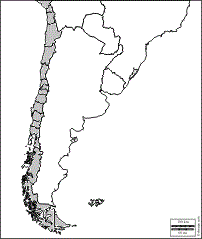
    1. Locate and shade Chile on the map. Which state in our country has a shape similar to Chile?

    Answer

    In our country, Kerala has a shape similar to Chile.

    Chile on the map

    Page No: 6

    1. Why was an independent trade union so important in Poland? Why are trade unions necessary?

    Answer
    Poland at that time had only one workers union controlled by the Polish United Workers’ Party. So there was autocratic rule of this party. People could not form independent unions which voiced their grievances. There was no freedom of speech.
    Trade unions are necessary as they help in maintaining or improving the conditions of the
    workers. They represent the workers’ views and demands to the management and fight for their rights.
    Page No: 10
    1. Looking at these maps, which period do you find most important in the expansion of democracy. Why?

    Answer

    The period after 1975 till 2000 AD is the most important period in the expansion of democracy. In this period, most of the countries in Africa became independent and supported democratic governments. The USSR broke up and 15 independent states emerged in which most of them go with democracy. Many colonised countries also gained independence and marches towards democracy.

    Page No: 11
    1. Why were women given voting rights much later than men in most countries? Why did this not happen in India?
    Answer
    Many European countries became democratic by the beginning of the twentieth century but women didn’t have voting rights because they were being not considered equal. They thought women were not capable of making decisions. They should stay at home, did household works and look after children. Thus, they were given voting rights much later than men.
    In India, constitutions makers didn’t make any discrimination against women and granted Universal Adult Franchise which gave voting rights to every c above the age of 18.
    Page No: 13
    1. What should be the policy of the government of India towards the military rulers of Myanmar?
    Answer
    The Government of India can support Suu Kyi in all international forums and demand her freedom without interfering in the domestic affairs of the government of Myanmar. It must fight for her freedom under Human Rights.
    Page No: 14
    1. Should there be a world government? If yes, who should elect it? And what powers should it have?
    Answer
    Yes, there should be a world government. It should have representatives of all the nations and every nation should have equal status. Each nation should send its own representatives, elected by their people. They should have powers to fight for Human Rights and Democracy.
    Page No: 15
    1. Should the permanent members of the UN give up the power to veto?
    Answer

    Yes, they should. The five veto powers should not be allowed to dictate terms to the rest of the world. They generally used this for their own interest.

    Exercise

    1. Which of the following does not lead to the spread of democracy?
    (a) Struggle by the people
    (b) Invasion by foreign countries
    (c) End of colonialism
    (d) People’s desire for freedom
    ► (b) Invasion by foreign countries

    2. Which of the following statements is true about today’s world?
    (a) Monarchy as a form of government has vanished .
    (b) The relationship between different countries has become more democratic than ever before.
    (c) In more and more countries rulers are being elected by the people.
    (d) There are no more military dictators in the world.
    ► (c) In more and more countries rulers are being elected by the people.

    Page No: 20

    3. . Use one of the following statements to complete the sentence:

    Democracy in the international organisations requires that …
    (a) The rich countries should have a greater say.
    (b) Countries should have a say according to their military power.
    (c) Countries should be treated with respect in proportion to their population.
    (d) All countries in the world should be treated equally..

    ► (d) All countries in the world should be treated equally..

    4. Based on the information given in this chapter, match the following countries and the path democracy has taken in that country.

    Country
    Path to Democracy
    (a) Chile
    (b) Nepal
    (c) Poland
    (d) Ghana
    (i) Freedom from British colonial rule
    (ii) End of military dictatorship
    (iii) End of one party rule
    (iv) King agreed to give up his powers

    Answer

    Country
    Path to Democracy
    (a) Chile
    (ii) End of military dictatorship
    (b) Nepal
    (iv) King agreed to give up his powers
    (c) Poland
    (iii) End of one party rule
    (d) Ghana
    (i) Freedom from British colonial rule

    5. What are the difficulties people face in a non-democratic country? Give answers drawing from the examples given in this chapter.

    Answer

    The difficulties people face in a non-democratic country are:
    → No freedom to elect their rulers.
    → People can’t form organisation or organise protest against the rulers.
    → No freedom of speech and expression.
    → Don’t have any say in government policies
    → Civic rights are curtailed.

    6. Which freedoms are usually taken away when a democracy is overthrown by the military?

    Answer

    The freedoms which are taken away when a democracy is overthrown by the military:
    → Freedom of electing their rulers.
    → Freedom of speech, expression and protest against any governmental policies.
    → People can’t form political parties or organisations.

    7. Which of the following positions can contribute to democracy at the global level? Give reasons for your answer in each case.
    a My country gives more money to international institutions. Therefore, I want to be treated with more respect and exercise more power.
    b My country may be small or poor. But my voice must be heard with equal respect, because these decisions will affect my country.
    c Wealthy nations will have a greater say in international affairs.They cannot let their interests suffer just because they are out numbered by poor nations.
    d Big countries like India must have a greater say in international organisations.

    Answer

    a. If any country gives more money to international institutions and its citizens want more respect and more power, it would not contribute to democracy at the global level. Every country and its citizens enjoy equal status whether it is a poor or a rich country. Equality is the basic principle of democracy.

    b. This position totally contributes to democracy at the global level as Democracy give equal right to every person. The wealth and size of a country don’t matter in a global democracy.

    c. This position does not lead to democracy at the global level because there should be no distinction made between the rich nations and the poor nations. All nations are equal in a Democracy.

    d. No, this position can’t contribute to democracy because the sizes or the geographical area of a country can’t determine the status of a nation in global democracy.

    8. Here are three opinions heard in a television debate on the struggle for democracy in Nepal. Which of these do you agree with and why?
    Guest 1: India is a democracy. Therefore, the Indian government must support the people of Nepal who are struggling against monarchy and for democracy.
    Guest 2: That is a dangerous argument. We would be in the same position as the US was in Iraq. Remember, no outside force can promote democracy.
    Guest 3: But why should we bother about the internal affairs of another country? We should be worried about our business interests there, not about democracy.

    Answer

    We can’t totally neglect our neighbours as what doing in their country as it must affect our behaviour also. So in my opinion, Guest 1 is right in some way. We have to adopt some measures that will support the people who are struggling against monarchy and for democracy. Not by using armed forces but by some other cooperations which will not hurt the sentiments of the people. This will also help India in maintaining a good relationship with a democratic country rather than a monarchical rule.

    Page No: 21

    9. In an imaginary country called Happyland, the people overthrew the foreign ruler and brought back the old royal family. They said: “After all their ancestors were our kings before foreigners started ruling us. It is good that we have one strong ruler, who can help us become rich and powerful”. When someone talked about democracy the wise men said it is a foreign idea. Their struggle was to throw the foreigners and their ideas out of the country. When someone demanded freedom for the media, the elders thought that too much criticism of the ruler would not help them improve their living standards. “After all, the king is so kind and interested in the welfare of all the subjects. Why create problems for him. Don’t we all want to be happy? ”

    After reading the above passage, Chaman, Champa and Chandru made the following observations:

    Chaman: Happyland is a democratic country because people were able to throw out the foreign rulers and bring back the king.
    Champa: Happyland is not a democratic country because people cannot criticise the ruler. The king may be nice and may provide economic prosperity, but a king cannot give a democratic rule.
    Chandru: What people need is happiness. So they are willing to allow their new ruler to take decisions for them. If people are happy it must be a democracy.

    What is your opinion about each of these statements? What do you think about the form of government in this country?

    Answer

    Chaman’s statement is incorrect because the overthrowing of a foreign power just amounts to gaining sovereignty.

    Champa’s statement is correct. A democracy is a rule of the people. The people should have the right to question their ruler.

    Chandru’s statement is incorrect. Happiness of the people is only one factor of a democracy. The people might be happy with the king, but he is not an elected representative.

  • Concept’s of Democracy in the Contemporary World Class 9th Social Science Civics

       CONCEPTS  

    • The March of Democracy has  met  with  setbacks  and successes  throughout
    • In 1900 there were only a few democratic After the Second World War, in 1950, more countries were added. The newly independent nations of Asia chose democracy. In 1975 colonies in Africa had become independent and most of them chose democracy as a form of government. A giant leap was taken in 1991. The fall of the Soviet Union  created 15  new  states  and  more democracies.

    Two  Tales  of Democracy

    • Many countries struggled for democracy, suffered In Chile, the democratic government of Allende was overthrown in 1973, and Pinochet became the military ruler. Democracy was restored again in Chile in 1988. In Poland, a non-democratic country, a one- party rule was replaced by  democracy  under  Lech Walesa.

    Two  Features  of  Democracy

    • Democracy, hence, is  a form of  government  that allows  people to choose their  own
    • People have the freedom to express their views, freedom to organise and freedom to protest against

    Phases  in  the  Expansion  of Democracy

    • By 2005, 140 countries have held multi-party More than 80 countries have made advances towards democracy  since 1980.
    • Stills there are many countries where people cannot elect their leaders. In Myanmar  the  elected leader Aung San Suu Kyi has been imprisoned by the military rulers (1990).  No  amount  of  international support  has  helped  in her

    Democracy  at  Global Level

    • Is it possible to have democracy  at  global level?  Not  at
    • The UN, the International Monetary Fund and the World Bank are global associations of the They attempt to maintain peace and security among the countries of the world. They give loans and  money  to governments.
    • They are not fully democratic. Five countries — US, UK, France, China and Russia — have the veto power in the Security The World Bank has a US President always and the International Monetary Fund is in  the hands  of  seven  powerful  nations.

    Promotion  of  Democracy

    • Many powerful countries like the United States of America  believe  that  democracy  should be promoted  in  the world  —  even  by
    • Powerful countries have launched  attacks  on  non-democratic
    • Iraq is the biggest USA and its allies attacked and occupied Iraq without UN sanction, on the pretext of Iraq possessing nuclear weapons.  They  have even  held  forced     elections.
    • The urge for democracy should  come  from  the people  and should  not  be