Category: Geography

  • Chapter 6 Population Notes Class 9th Social Science Geography

    MAJOR QUESTIONS ABOUT THE POPULATION OF A COUNTRY.

    (a) Population size and distribution- How many people are there and where are they located?

    • Population growth and change. How has the population grown and changed over time?
    • Characteristics of the population- What are their age, sex, literacy levels, occupation structure and health condition.

    Population size and distribution

    • According to the census of 2001, India has the population of 1028 million (102 crores 8 lakh)
    • They are unevenly distributed over the vast area of 3.28 million sq. km.
    • The most populous state with 166 million people in U.P.
    • A least populous state is Sikkim with 0.5 million and Lakshadweep has only 60,000 population.
    • About half of India’s population lives just in 5 states. They are Uttar Pradesh, Maharashtra, Bihar, West Bengal and Andra Pradesh.

    Density of Population

    • The number of person per unit area [1 sq. km]
    • According to 2001 census, the average calamity of the population is 324 person/ sq. km. The highest density of population is in West Bengal with 904/ sq. km. Least density of population is in Arunachal Pradesh with 13/ Sq. km.

    Reason for differences in density of population.

    • Rugged terrain and unfavorable climatic conditions are responsible for the sparse population in the states like Jammu and Kashmir and Rajasthan etc.
    • Assam and most of the peninsular state have moderate population density, due to hilly, rocky nature, low rainfall and less fertile soil.
    • Northern Plains and Kerala have a high density of population due to flat plains with fertile soil and abundant rainfall.

    Population Growth

    It refers to the change in the number of inhabitants of a country during a specific period of time. It can be expressed in two ways:-

    1. Absolute number- It can be obtained by subtracting the earlier population from the latest population.
    2. Percentage change- It is studied that in percent per annum.

    Processes of population change

    There are 3 processes of population change

    1. Birth rate- The numbers of live births per 1000 persons in a year.
    2. Death rate- The number of deaths per 1000 persons in a year.
    3. Migration- The movement of the people across regions be territories. Migration is of two types.
    • Internal  Migration- The movement of the people within the country.
    • International Migration- The movement of the people b/w the countries.
    ‘Push’ and ‘Pull’ factors of Migration

    Push Factors- Most of the migrations are from rural to urban areas due to poverty and unemployed in rural areas.

    Pull Factor- Increase employment opportunities and better living conditions in urban areas.

    Age Composition

    It refers to the number of people in different age group.

    The population is grouped into 3 categories.

    1. Children (below 15 years)- They are economically unproductive and need to be provided with food, shelter, clothing etc.
    2. Working age (15-59 years)- They are economically productive and biologically reproductive.
    3. Aged (above 59 years)- They can be economically productive through retired.

    Sex Ratio

    • It refers to the numbers of females per 1000 males in the population.
    • The sex ratio has always been unfavorable for females in India.

    Literate

    A person aged 7 years and above who can read and write with understanding in any language.

    Occupational Structure

    The distribution of the population according to different types of occupation-

    Occupation is classified as primary secondary and tertiary.

    (a) Primary occupation includes agriculture, animal husbandry, fishing etc.

    (b) Secondary occupation includes manufacturing industry building and construction work.

    (c) Tertiary occupation includes transport, trade communications, banking etc.

    National Population Policy (NPP) 2000

    In 2000, government of India invited National Population Policy.

    Features

    • Imparting free and compulsory education up to 14 years of age.
    • Reducing infant mortality rate.
    • Achieving universal immunization of children.
    • Promoting delayed marriage for girls.
    • Creating awareness among the adolescents about sexually transmitted diseases (STD), need of food supplements etc.
  • Chapter 5 Nature Vegetation & Wildlife Notes Class 9th Social Science Geography

    • 47000- plants species are found in India. India stands the 10th place in the world and 4th in Asia.
    • 15000 species of flowering plants.
    • India has many non-flowering plants like firm, fungi etc.
    • 90000 species of animals.
    • A variety of fish are also found in water.

    Natural Vegetation

    • It refers to a plant community which has grown naturally without human aid and has been left undisturbed by a human for a long time, also known as a virgin vegetation.

    So, cultivated crop, fruits and orchards do not come under Natural Vegetation.

    Endemic species- Purely Indian

    Exotic Species – Come outside from India.

    Flora- refers to plant life.

    Fauna – refers to animal life.

    Factors that help in the growth of flora and fauna.

    • Relief Factors

    Land – Land affects the natural vegetation directly and indirectly. The nature of the land influences the types of vegetation.

    Soil – Different types of soils provide the basis for different types of vegetation.

    • Climatic factors

    Temperature – The fall in the temperature affects the types of vegetation and its growth.

    Photoperiod (Sunlight) – Due to longer duration of sunlight, trees grows faster in Summer.

    Precipitation – Areas of heavy rainfall have a dense forest in comparison with low rainfall.

     Importance of Forest

    • Forests are renewable resources and enhance the quality of the environment.
    • They modify local climate, control soil erosion and regulate stream flow.
    • They support a variety of industries, provide a livelihood for many communities.
    • It controls wind force and temperature and causes rainfall.
    • It provides humus to the soil and shelter to wildlife.

    The factors that cause the decline of forests

    • The growing demand for cultivated land.
    • Development of industries.
    • Mining
    • Urbanisation
    • Gazing of pastures.

    Eco-System

    • All the plants and animals in an area are interrelated and interdependent to each other in their physical environment.
    • Humans are also the part of eco-system.

    Types of Vegetation

    • Tropical Evergreen Forests (heavy rainfall areas)
    • Tropical Deciduous Forests (Rainfall b/w 200-70)
    • Tropical thorn forests and shrubs (less than 70 cm)
    • Montane Forests (Higher and decrease temperature areas)
    • Mangrove Forests (Coastal Reign)

    Tropical Evergreen Forests

    • These forests are found in the heavy rainfall areas, E.G. Western Ghats, Assam etc.
    • The trees are very tall up to 60 m height.
    • All kinds of vegetation i.c. tress, shrubs, and creepers are grown here giving multi layered structures.
    • There is no definite time for the trees to shed their leaves. So these forests appear green through out the year.
    • E Body, Mahogany, rosewood etc. are the important trees are found.
    • Elephant, Monkeys, Lemur etc. are the important animals.

    Tropical Deciduous Forests

    • These are the widespread forests in India.
    • They are found in the areas receiving rainfall between 200-700 cm.
    • Trees shed their leaves during the dry season.
    • On the basis of the availability of water. These are divided into moist and dry deciduous forests.

    Moist Deciduous Forests

    • They are found in the areas receiving rainfall between 200-100 cm. Eg- Jharkhand, west Orissa.
    • Teak bamboo sake etc. are the important trees.

    Dry Deciduous Forests

    • They are found in the areas receiving rainfall b/w 100-70 cm eg- Bihar and U.P.
    • Teak, Sal, Peepel etc. the important trees.

    The Thorn Forests and Shrubs

    • These are the forest found in the areas receives less than 70 cm rainfall. Eg- Parts of Gujarat, Rajasthan.
    • Acacias, palms cacti etc are the important plan species.
    • Trees are scattered and have long roots to get moisture.
    • The stems are succulent (sponge) to conserve water.
    • The leaves are thick and small to minimize evaporation.
    • Rat, mice, rabbits and camels etc are the important animals.

    Montane Forests

    In mountainous areas, the decrease in temperature affects the growth of vegetation.

    • Wet Temperate Forests- They are found between a height of 1000 and 2000 m eg. Oaks, chestnut.
    • Temperate Forests- They are found at the height of 1500-3000 m eg. pine, silver fir
    • Temperate Grasslands-  They are found in the higher elevation (height).
    • Alpine Vegetation- Found at the height of more than 3600 m. eg. Jumpers, pine.
    • The trees get (stunted) at the snow line.
    • Alpine grasslands are used by nomadic tribes like Gujjars and Bakarwals.
    • Tundra Vegetation- Lichens mosses are found at the higher altitude.

    Mangrove Forests

    • They are found in the coastal areas influenced by tides(winds).
    • roots of the plant are submerged under water.
    • Sundari trees are found in the Ganga-Brahmaputra delta, which provides durable hard timber.
    • Palm, coconut etc are the important trees.
    • Royal Bengal tiger, turtles crocodiles are animals.

    Wild Life

    • India is rich in wildlife.
    • There are 90000 animal species, 2000 species of birds and 2546 species of fish.
    • India also shares b/w 5 and 8 percent of worlds, amphibians, reptiles, and mammals.
    • Elephants are found in the forests of Assam, Karnataka etc.
    • One horned rhinoceros, Indian Bison, Nilgri etc are important animals.
    • India is the only country that has both tigers and lions.
    • Lions-Gir forests in Gujarat.
    • In the rivers and lakes turtles, crocodiles and gharials are found.
    • Peacocks, ducks, cranes, pigeons etc are the colorful birds.

    Importance of conservation of Wildlife

    • The animals provide us drought power, transportation, meats, and eggs.
    • The fish provide nutritive food.
    • Insects help in pollination of crops.
    • Every species has a role to play in the ecosystem.

    How are human beings responsible for balancing the ecosystem?

    • Hunting by greedy hunters.
    • Pollution due to chemical and industrial waste.
    • Acid deposits.
    • Reckless cutting of the forests.

    What are the steps taken by the Government to protect flora and fauna?

    • 14 biosphere reserves have been set up
    • Financial and technical assistance is provided too many botanical gardens since 1992.
    • Project Tiger, project Rhino etc have been introduced.
    • 89 National parks, 490 wildlife sanctuaries, and zoological gardens are set up.
  • Chapter 4 Climate Notes Class 9th Social Science Geography

    Climate

    It is a sum total of weather conditions and variations over a large are for a long period of time (more than 30 years)

    Weather 

    It is the state of the atmosphere over an area at any point in time.

    Elements of Weather and Climate

    The temperature, atmosphere, pressure, wind, humidity, and precipitation. (rainfall)

    India has monsoon type climate.

    Q. Temperature and precipitation vary from place to place and season to season why?

    • In Summer, the temperature reaches 50°C in some parts of Rajasthan while it is 20°C in Jammu and Kashmir.
    • On a winter night, the temperature in Jammu and Kashmir is minus 45°C whereas it is 22°C in thiruwanthpuram.
    • The annual precipitation in Meghalaya is more than 400 cm while it is less than 10 cm in parts of Rajasthan and Jammu and Kashmir.
    • Most of the parts of the country receive rainfall from June to September whereas Tamilnadu receives rainfall during October and November.
    • Coastal areas do nor experience much variations in climate conditions.

    Climate controls of any place

    There are six major controls of the climate of any place.

    They are latitude, altitude, pressure and wind system, distance from the sea, ocean currents be relief features.

    1. Latitude– Due to the curvature(curve) of the earth, solar energy received varies according to the latitude.
    2. Altitude– Temperature decreases with higher altitude (height)
    3. Wind System and Pressure- They affect the climate of any place.
    4. Distance from the sea – The places wear the sea have a moderate climate and the places away from the sea have extreme climate (continentality)
    5. Ocean Currents – The onshore winds affect the climate of coastal areas.
    6. Relief Features – High mountains act as barriers for cold or hot winds.

    Factors affecting India’s Climate

    1. Latitude – The tropic of cancer passes through the middle of the country. So, in the south of tropic of cancer we have a tropical climate and in the north of Tropic of cancer have a sub-tropical climate.
    2. Altitude – The Himalayas prevent the cold winds from central Asia from entering India, So we have milder winter.

    Pressure and Wind System

    The weather and climate are influenced by the following at atmospheric conditions. They are

    1. Pressure and winds
    2. Upper air circulation
    3. Cyclons

    The air always moves from high pressure are the too low-pressure area.

    In winter, a high pressure is formed north of Himalayas and so, the cold and dry winds blow towards the south.

    Jet System

    • These are the high altitude winds in the atmosphere. Their speed varies from 110 km/hr in summer and 184 km/hr in winter.
    • They have located over 27°-30° North Latitude (Westly) Jetstream
    • Easterly Jetstream blows over India over 14°N Latitude.

    The Mechanism of Monsoon in India

    • The differential heating and coding of land and water. The seas experience high pressure and the land experiences low pressure.
    • In summer, equatorial through is positioned over Ganga a plain.
    • The presence of high pressure is last of Madagascar.
    • The Tibetan plateau gets intensely heated during summer which results in strong vertical air current movement of air.
    • The movement of the westerly jet streams and easterly jet streams.

    Southern Oscillation (S.O.)

    Normally the south Pacific Ocean experiences high pressure and the Indian Ocean experience low pressure. But in recent years, there is a reversal in the pressure conditions, i.c. the Indian ocean experience high pressure and pacific ocean experiences low pressure. This periodical change is known as So.

    El Nino

    A warm ocean current flows over the Peruvian coast instead of the cold current, every 2 to 5 years. It is could as EL Nino.

    The Onset of the Monsoon

    • The monsoon in India is pulsating in nature.
    • The duration of the monsoon is between 100-120 days.
    • Monsoon Burst – Around the time of the arrival of monsoon, the normal rainfall increases suddenly and continues for several days.

    The onset of the monsoon in India

    • The monsoon arrives in the southern tip of Indian Peninsular by the first week of June.
    • Then it is branched off. One branch goes to the Bay of Bengal and other branch proceeds to Arabian sea.
    • The Arabian sea branch reaches Mumbai by 10th June and Bay of Bengal branch reaches Assam by this time.
    • The lofty mountain deflects the monsoon towards the west and the Arabian branch also reaches central India.
    • Both branches merge in the north-west and U.P., M.P., and Delhi etc. receive rainfall by June 29th.
    • By mid-July, Himachal Pradesh and the rest of the states receive rainfall.

    The Seasons

    There are 4 seasons identified in India. They are

    1. Cold Weather seasons (Winter)
    2. Hot Weather Seasons (Summer)
    3. Advancing Monsoon (Rainy)
    4. Retreating Monsoon (Transition)

    Cold Weather Seasons (Winter)

    • The cold weather seasons begins from mid-November and stays until February.
    • December and January are the coldest moths.
    • The temperature decreases from south to north.
    • The days are warm and nights are cold. Frost is common in the north.
    • The wind blows from land to see. So far most parts it is the dry season.
    • It is a season of cyclonic disturbances which causes winter rainfall.
    • The winter rainfall locally known as ‘Mahawat’ has great importance for the cultivation of rabi crops.
    • Peninsular India does not have much winter season.

    The Hot Weather Season (Summer)

    • March to May are the not-weather season in India.
    • In March the highest temperature 38°C is recorded in the Deccan plateau.
    • In April the highest temperature 45°C in North-West.
    • In peninsular India, the temperature remains lower due to the influence of Ocean.
    • It experiences rising temperature and falling air pressure.
    • Loo these are the strong, gust hot and dry winds blow during the day in the north.
    • Dust storms are common in north India.
    • It is a season of thunder storms, Violent Winds, and heavy rainfall.
    • In West Bengal, these storms are called ‘Kaal Baisakhi’.
    • Towards the end of the summer, Pre-monsoon showers are common is Kerala and Karnataka known as ‘Mango showers’ which help in the early repinning of Mangoes.

    Advancing Monsoon (The Rainy Season)

    • By early June, the low pressure intensifies in the northern plains which attacks the South-West monsoon winds.
    • The coming of South-West monsoon which brings rainfall in India.
    • Early in the season, Western Ghats receive more than 250 cm rainfall.
    • Mawsynram (Meghalaya) receives the highest rainfall in the world.
    • Rajasthan and parts of Gujarat receive scanty (less) rainfall.
    • An important feature of this season is ‘Monsoon break’.
    • Monsoon Break – Monsoon rains take place only for a few days at a time when there are rainless intervals known as ‘Monsson Break’.
    • Monsoon through determines the distribution of rainfall i.e., the places near the axis of through receives rainfall.
    • The monsoon is known for its uncertainties. It causes a flood in one part and causes drought in the other.
    • Since it is irregular, it disturbs the farming schedule of millions of farmer.

    Retreating Monsoon (Transition)

    • During October-November, South-West monsoon winds become weaker.
    • It is a period of transition from hot rainy season to dry winter.
    • Day temperature is high and nights are cool.
    • The weather becomes oppressive during the day due to high temperature and humidity are known as ‘October heat’.
    • It is the period of cyclones which are very destructive and causes great damage to life and property.

    Distribution of Rainfall

    • Parts of western coast and north-east receives more than 400 cm rainfall annually.
    • Parts of Gujarat, Rajasthan, Haryana, and Punjab receives less than 60 cm rainfall.
    • Leh in Jammu and Kashmir receives the lowest rainfall.
    • Monsoon is variable from year to year. So the areas of heavy rainfall are affected by floods and the areas of low rainfall are affected by droughts.

    Why is monsoon considered a unifying bond?

    • The seasonal alteration of the Wind Systems provides a rhythmic cycle of the season.
    • The Indian landscape, its animal and pant life, its agricultural calendar and the life of the people including their festivities revolve around monsoon.
    • Year after year, people throughout India eagerly await the arrival of the monsoon.
    • The monsoon wind binds the whole country by providing water to set agricultural activities.
    • The river valleys which carry this water unit the country as a single valley unit.
  • Chapter 3 Drainage Notes Class 9th Social Science Geography

    Drainage – The river system is an area.

    Drainage Basin- The area drained by a single river system.

    Water Divide– Any elevated area such as a mountain that separated two drainage Basin

    Drainage system in India

    Indian rivers are divided into two groups:-

    • Himalayan Rivers
    • Peninsular Rivers

    Distinguish between a Himalayan river and Peninsular river.

    Himalayan River

    • Most of the river Himalayan river is perennial because they have water throughout the year.
    • They receive water from rain as well as meeting of snow.
    • The Himalayan river has long courses.
    • They perform crosional activities and carry silt and sand.

    Peninsular River

    • Peninsular River is the seasonal river because their flow is dependent on rainfall.
    • During the dry season, even the large reduce into channels.
    • They have shorter and shallower courses.
    • Most of the peninsula rivers start in the Western Ghats and flow towards Bay of Bengal.

    River System

    A river along with his tributaries.

    Indus River System

    • The river Indus rises in Tibet, near Mansarowar lake.
    • It enters in India in the Ladakh district of Jammu and Kashmir.
    • The tributaries like Beas, Satluj, |Ravi, Chenab and Jhelum join together in the Indus at Mithankot in Pakistan.
    • Indus flows at the length of 2900 km.

    Indus Water Treaty

    This treaty (arguments) was signed between India and Pakistan in 1960. According to this treaty, India can use 20% of its water.

    The Ganga River System

    • The headwaters of Ganga called the ‘Bhagirathi’ is joined by ‘Alaknanda’ at devoprayag in Uttarakhand.
    • The tributaries like Yamuna, Ghaghara, Gandak and Kosi join it.
    • The river Yamuna rises at Yamunotri fancier joined Ganga at Allahabad.
    • The Chambal, the beta and the son are peninsular are the peninsular tributaries join in it.
    • At Tarakka in West Bengal, the river Ganga bifurcates(branched off)
    • One branch goes to southwards and joins the Bay of Bengal and other branch goes to Bangladesh and is joined by the Brahmaputra and is known as Meghma.
    • Largest Delta – Sunderbans Delta.
    • It has the length of 2500 km.

    The Brahmaputra River System

    • The Brahmaputra rises in Tibet east of Mansarovar lake.
    • Most of its course lies outside India.
    • At Namcha Barwa it takes a ‘U’ turn and enters India in Arunachal Pradesh (Dihang)
    • In Tibet, the Brahmaputra carries a smaller volume of water as it is a dry and cold region.
    • But in India, it carries a large volume of water as it passes through heavy rainfall areas.
    • Every year, the river Bhramputra causes widespread destruction due to floods in Assam and Bangladesh.

    Peninsular Rivers

    The Narmada and Tapi flow westwards through a rift valley.

    The Narmada Basin

    • It rises in the Amarkantak hills in Madhya Pradesh.
    • It flows towards the west and creates many beautiful locations like ‘Marble rocks’ near Jabalpur and ‘Deadhar falls’.

    The Tapi Basin

    • The Tapi river rises in the Satpura ranges in the Betul district of Madhya Pradesh.
    • It also flows in a rift valley.

    The Godavari Basin

    The Godavari is the largest peninsular river.

    • It rises in the Western Ghats in the Nasik district of Maharashtra Valley/
    • Its length is about 1500 km.
    • The tributaries like purna, Wardha etc. join in it.
    • The tributaries like Manjira, Pen Ganga, and Wain Ganga are very large. So they are known as ‘Dakshin Ganga’.

    The Mahanadi Basin

    • It rises in the highlands of Chhattisgarh.
    • The length-860 km.

    The Krishna Basin

    • Rises near Mahabaleshwar
    • Length-1400 km.

    The Kaveri Basin

    • Rises in the Brahmagiri ranges of Western Ghats.
    • Length- 760 km.

    Types of Lakes

    Lakes differ from each other in shape, size and other characteristics.

    1. Permanent Lakes- Most of the lakes are permanent
    2. Seasonal Lakes- Contain water during the rainy season. Sambhar lake in Rajasthan example of the seasonal lake.
    3. Some lakes are the result of the action of glaciers or ice-sheets.
    4. Ox-bow lakes- In the floodplains. Oxbow lakes ae found.
    5. Fresh water lakes. Eg. Dal lake, Nainital.

    Damming of rivers for the generation of Hydel power led to the formation of lakes.

    Water lake is the result of tectonic activity.

    Importance of lakes and river in the Economy

    • Lakes help to regulate (control) the flow of a river.
    • It prevents floodings during rainfall and maintains even flow of water during the dry season.
    • The river and lakes can be used for developing hydel power.
    • They moderate the climate of the surrounding and maintain aquatic eco-system.
    • They help to develop tourism and provide recreation (enjoy must fun)
    • Water from rivers is a natural resource which is essential for various human activities.
    • Kaveri joins the Bay of Bengal at Cuddalore in Tamil Nadu.

    Largest Salt Lake- Chillka Lake, Orissa.

    Freshwater Lake- Winlar Lake in Jammu and Kashmir.

  • Notes of Physical Features of India Chapter 2 Class 9th Social Science Geography

    Chapter – 2 Physical Features of India


    1. Major features of the earth are mountain, plateaus, plains islands and dessert.

    Origin of the Earth

    • Theory of plate tectonics- According to this theory, the upper part of the earth (crust) is made up of 7 major and some minor plates.
    • The movement of the plates results in folding, faulting, and volcanic activity.
    • There are 3 plates movements

    (a) Convergent Boundary- When some plates come towards each other convergent boundary is formed

    (b) Divergent Boundary- When some plates someone away from each other divergent boundary is formed.

    (c)Transform Boundary- When two plates come together, they may either collide or crumble or one may slide under the other.

    How were the Himalayas formed?

    • The Himalayas were once the part of Gondwana land.
    • The Gondwana land included India, Australia, South America, South Africa and Antarctica as one single land mass.
    • The conventional currents split the crust into pieces.
    • The Indo-Australia plate, which was separated from Gondwana land began to move towards the north.
    • Then, it collided with the much larger Eurasian plate.
    • As the result of the collision, Tethys was folded and the Himalayas were uplifted.

    Formation of Northen Plains

    • The Himalayan uplift out of Tethys Sea, resulted is the formation of a large basin.
    • In the due cause of time, these plains get filled with sediments brought down by Himalayan river.
    • A flat land of alluvial deposits led to the formation of Northen Plain.

    Major Physiographic Division

    • The Himalayan Mountains
    • The Northen plains
    • The Peninsular Plateau
    • The Indian Desert
    • The Coastal Plains
    • The Islands

    The Himalayan Mountain

    They are young fold mountains and runs in the west-east direction.

    They are highest and the most rugged mountains barriers in the world.

    They form an arc and covers the distance of 2400 km.

    The Himalayas consists of 3 parallel ranges i.e., Himadri, Himachal, Shivalik.

                                                                Himadri

    Himadri is the northern most range of Himalayas also known as great or inner Himalayas.

    Important Himalayas peaks are located here with the average height of 6000 m.

    It is composed of granite and snow bound.

    Himachal

    The range lying to the south of Himadri is called Himachal, also known as lesser Himalayan.

    Their height varies from 3700 m and 4500 m.

    The famous valleys like Kashmir, Kangra, and Kullu are located here.

    Shivalik

    It is the outer most range of Himalayas.

    These valleys are covered with gravel and aluminum. some important dunes are located like Deharadun, pattidum, and Kotlidum and located here. [Dunes – The valley lying lesser Himalayas and shivaliks]

    How are the Himalayas divided on the basis of the region?

    (i) Punjab Himalayas.

    The region lying between Indus and Satluj river.

    (II) Kumaon Himalayas

    The region lying between satluj and Kali river.

    (III) Nepal Himalayas

    The region lying between kali and Tista river.

    (IV) Assam Himalayas

    The region lying between Tista and Dihag river.


    Purvanchal/Eastern Hills

    • Beyond Dihang gorgl, the Himalayas bend sharply towards the south and spread along the eastern boundary.
    • They are composed of sand stone and covered with dense forests.
    • Purvanchal comprised of Parkai Hills, Naga Hills, Manipur hills and Mizo hills.

    Northern Plains

    • Northern Plains has been formed by the three rivers, i.e. Indus, Ganga, and the Brahmaputra.
    • They are formed of alluvial soil and are very fertile.
    • They are densely populated and agriculturally a very productive part of India. Due to sufficient water supply, favorable climate and fertile soil.

    River in Island

    In the lower course, the velocity of the river decrease which results in the formation of the river in the island.

    Distributes

    The river in their lower course split into numerous channels.

    Tributaries

    Many streams/rivers join the main rivers.

    Sections of Northern Plain

    Northern plain is divided into 3 sections.

    Punjab Plain-

    It lies to the western part of Northern Plain. It is formed by Indus and its tributaries.

    Ganga Plain

    It lies between ghagger and Tista rivers.

    Brahmaputra Plain

    It lies to the east of Ganga Plains.

    A region of Northern Plain

    The northern plain is divided into 4 regions.

    • Bhabur 

    The river after descending from mountains, deposit pebbles in a narrow belt of 8 to 16 km.

    • Terai

    All the streams disappear in the Bhabur belt and reemerge in a wet and marsley region.

    • Bhangar

    The region with older alluvium.

    • Khadar

    The region with newer alluvium. They are renewed every year and are very fertile.

    The Peninsular Plateau

    • The peninsular plateau is a tableland and composed of igneous, metamorphic and crystalline rocks.
    • It has broad and shallow valleys and rounded hills. It is divided into two:-

    (i) Central Highlands

    (ii) Deccan Plateau

    Central Highlands Deccan Plateau
     It lies to the north of Narmada

    River.

    It lies to the south of Narmada

    River.

    It is wider in the west and narrower

    in the east.

    It is a triangular land

    mass

     The Chambal, sind, betwa etc are the

    important river.

    It is higher in the west and slops

    eastwards.

     Bundelkhand and Baghilkhand are

    the eastward extension

    The Garo, the Khasi, the Jaintia

    are the important hill ranges.


    Compare and contrast western ghats and eastern ghats.

    They are continuous and higherthan eastern ghats,

    Western Ghats Eastern Ghats
    Western ghats are the western

    edge of the Deccan Plateau

    Eastern Ghats are the eastern

    edge of Deccan Plateau

    They are discontinuous and

    dissected by riveghats,

    Their average elevation is 900-

    1600 meters

    The elevation (height) is 600

    meters.

    Anaimade is the highest peak

    (2695 meter)

    Mahendragiri is the highest peak

    (1501 meter).

    Deccan Trap

    The black soil are in the peninsular plateau.

    The Indian Desert

    • The Indian desert lies to the western margins of the Aravali hills.
    • It is ab undulating sandy plain covered with sand dunes.
    • This area receive very low rainfall and has an arid climate with low vegetation.
    • Luni is the only large river.

    Barch and – The crescent-shaped dunes.

    Coastal Plains

    India has two coastal plain:-

    • Western Coast.
    • Eastern Coast
    • Western Costs lies between the Western Ghats and Arabian sea.
    • Eastern Coast lies between Eastern Ghats and Bay of Bengal.

    Western Coast

    It is divided into 3 sections

    • Konchan- Northern part of the western coast.
    • Kannad- untral part of the western coast.
    • Malabar- Southern part of the western coast.

    Also, Check: Chapter-1 India- Size and Location Notes Class 9th SST

    Eastern Coast

    It is divided into 2 sections.

    • Northern Circar – The northern part of Eastern Coast
    • Corom andel Coast- The southern part of Eastern Coast.

    The Islands

    India has two island groups

    • Andaman and Nicobar
    • Lakshadweep

    Lakshadweep Islands

    They lie close to Malabar coast of Kerala.

    Earlier they were known as Laccadive, Minicoy and Amindiee.

    In 1973 these islands  are name as Lakshadweep.

    It covers a small area of 32 sq. km.

    Kavaratti flead quarters.

    Andaman and Nicobar Islands

    They are located in Bay of bengal

    They are bigger in size, mumerous and scattered.

    Andaman islands are located in the north and nicobar islands in the south.

    They lie close to the equator and so they have an equatarial climate.

    Portblair is the headquarter of Andaman and Nicobar Islands.

    Each Physiographic divisions complements the others explain.

    The mountains are the major sources of water and forest. The northern plains are the granaries of the country..

    The plateau is the storehouse of minerals.

    The coastal regions and island groups provide sites for fishing and part activities.

  • Chapter-1 India- Size and Location Notes Class 9th SST

    Location

    1. India is a vast country and it lies in the northern atmosphere.
    2. Its latitude extends between 8*4 N and 37*6 N.
    3. Its longitude is between 68.7 E and 97.25 E.
    4. Tropic of cancer divides the country into 2 equal parts.
    5. Andaman and Nicobar islands lie in the bay of Bengal in the south-east and Lakshadeep island in the Arabian sea in the south-west.

    Size

    1. Total geographical area of India is 3.28 million sq km.
    2. It accounts 2.4% of total world’s geographical area.
    3. India is the seventh largest country in the world.
    4. India has the land boundary of 15200 km and it has the coastline of 7516.6 km.
    5. India is bounded by the young fold mountains in the north, north-west, and northeast.

    Ques. The sun rises two hours earlier in Arunachal Pradesh as compared to Gujarat in the west but the watches show the same time, How does this happen?

    1. From Gujarat to Arunachal Pradesh there is a time lag of two hours.
    2. In order to avoid the time confusion, we have taken 82.30 E, as the standard Meridian of India.
    3. It passes through Mirzapur will have the same time.

    Ques. The Central location of India as a head of the Indian Ocean is considered of great significance, why?

    • India has a central location in West Asia and East Asia.
    • The trans-Indian ocean routes connect the countries of Europe.
    • The Deccan Peninsula which protects into Indian ocean connects the countries of West Asia, Europe, and Africa.
    • The long coastline gives India an important position in the Indian ocean.
    • The various passes across the mountains provide passage to ancient travellers.
    • The ideas and commodities were unchanged through these passes.


    Answer the following questions.

    Q. Name the group of the island lying in the Arabian Sea?

    Ans. Lakshadweep island

    Q. Name the countries which are larger than India?

    Ans. Russia, China, Canada, U.S.A., Brazil, Australia.

    Q. Which island group of India lies to its south-east?

    Ans. Andaman and Nicobar island

    Q. Which island countries are our southern neighbors?

    Ans. Srilanka and Maldives

     India’s Neighbours

    • India has 29 states and 7 union territories.
    • India shares its land boundary with Pakistan, Afghanistan in the North West. China, Nepal, Bhutan in the north. Bangladesh, Myanmar is the east. Srilanka and Maldives are our southern neighbors across the sea.
    • India is separated by Srilanka by a network channel called Palk Strait and Gulf of Mannar.
    • The Maldives are situated to the south of Lakshadweep Islands.
  • India Climate Vegetation and Wildlife NCERT Solutions for Class 6th Geography Chapter 8

    NCERT Solutions for Class 6th Social Science: Chapter 8 – India Climate Vegetation and Wildlife

    Class 6 Social Science (Geography) Chapter 8 India Climate Vegetation and Wildlife NCERT Solution is given below.

    Question 1:
    Answer the following questions briefly.
    (a) Which winds bring rainfall in India? Why is it so important?
    (b) Name the different seasons in India.
    (c) What is natural vegetation?
    (d) Name the different types of vegetation found in India.
    (e) What is the difference between evergreen forest and deciduous forest?
    (f) Why is tropical rainforest also called evergreen forest?

    Answer:
    (a) The monsoon winds bring rainfall in India. In India, agriculture is dependent on rains. Good monsoons mean adequate rain, and a bountiful crop.
    (b) The different seasons in India are: the cold weather season (winter), the hot weather season (summer), the south west monsoon season (rainy season) and the season of retreating monsoons (autumn).
    (c) The grass, shrubs and trees that grow without interference or help from human beings are called natural vegetation.
    (d) The different types of vegetation found in India are: tropical evergreen forests or rainforests, tropical deciduous forests, thorny bushes, mountain vegetation and mangrove forests.
    (e) Tropical rainforests or evergreen forests are found in areas receiving heavy rainfall. They are very dense. They shed their leaves at different times of the year.
    As a result, they always appear green.
    Tropical deciduous forests are also called monsoon forests. They are less dense. They shed their leaves at a particular time of the year.
    (f) The tropical rainforests are also called evergreen forests as they remain green throughout the year. This is because they shed their leaves at different times of the year.

    Question 2:
    Tick the correct answers.
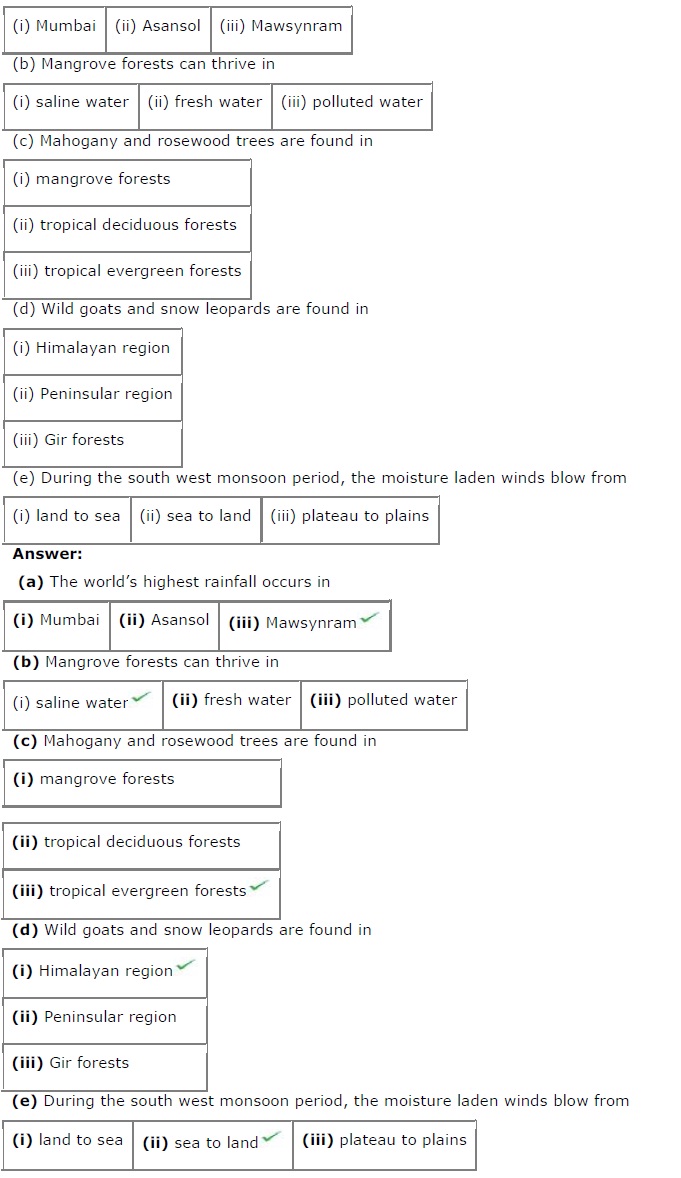
    (a) The world’s highest rainfall occurs in

    Question 3:
    Fill in the blanks.
    (a) Hot and dry winds known as __________ blow during the day in the summers.
    (b) The states of Andhra Pradesh and Tamil Nadu receive a great amount of rainfall during the season of _____________.
    (c) __________ forest in Gujrat is the home of ___________.
    (d) __________ is a well-known species of mangrove forests.
    (e) __________ are also called monsoon forests.

    Answer:
    (a) Hot and dry winds known as loo blow during the day in the summers.
    (b) The states of Andhra Pradesh and Tamil Nadu receive a great amount of rainfall during the season of retreating monsoons.
    (c) Gir forest in Gujrat is the home of Asiatic lions.
    (d) Sundari is a well-known species of mangrove forests.
    (e) Tropical deciduous forests are also called monsoon forests.

  • Our Country – India NCERT Solutions for Class 6th Geography Chapter 7

    NCERT Solutions for Class 6th Social Science: Chapter 7 – Our Country – India

    Class 6 Social Science (Geography) Chapter 7 Our Country – India NCERT Solution is given below.

    Question 1:
    Answer the following questions briefly.
    (a) Name the major physical divisions of India.
    (b) India shares its land boundaries with seven countries. Name them.
    (c) Which two major rivers fall into the Arabian Sea?
    (d) Name the delta formed by the Ganga and the Brahmaputra.
    (e) How many States and Union Territories are there in India? Which States have a common Capital?
    (f) Why do a large number of people live in the Northern plains?
    (g) Why is Lakshadweep known as a coral island?

    Answer:
    (a) The major physical divisions of India are: mountains, plateaus, plains, coasts and islands.
    (b) The countries with which India shares its land boundaries are: Pakistan, Afghanistan, China, Nepal, Bhutan, Bangladesh and Myanmar.
    (c) The two major rivers that fall into the Arabian Sea are: Narmada and Tapi.
    (d) The Sunderban delta is formed by the Ganga and the Brahmaputra.
    (e) There are 28 States and 7 Union Territories in India. Punjab and Haryana are the States that have a common Capital (Chandigarh).
    (f) The Northern Indian plains have been formed by the alluvial deposits laid down by rivers. These river plains provide fertile land for cultivation. This is why a large number of people live in the Northern plains.
    (g)Lakshadweep Islands have been formed from corals, that is, the skeletons of tiny marine animals called Polyps. Hence, Lakshadweep Islands are known as coral islands.

    Question 2:
    Tick the correct answers.
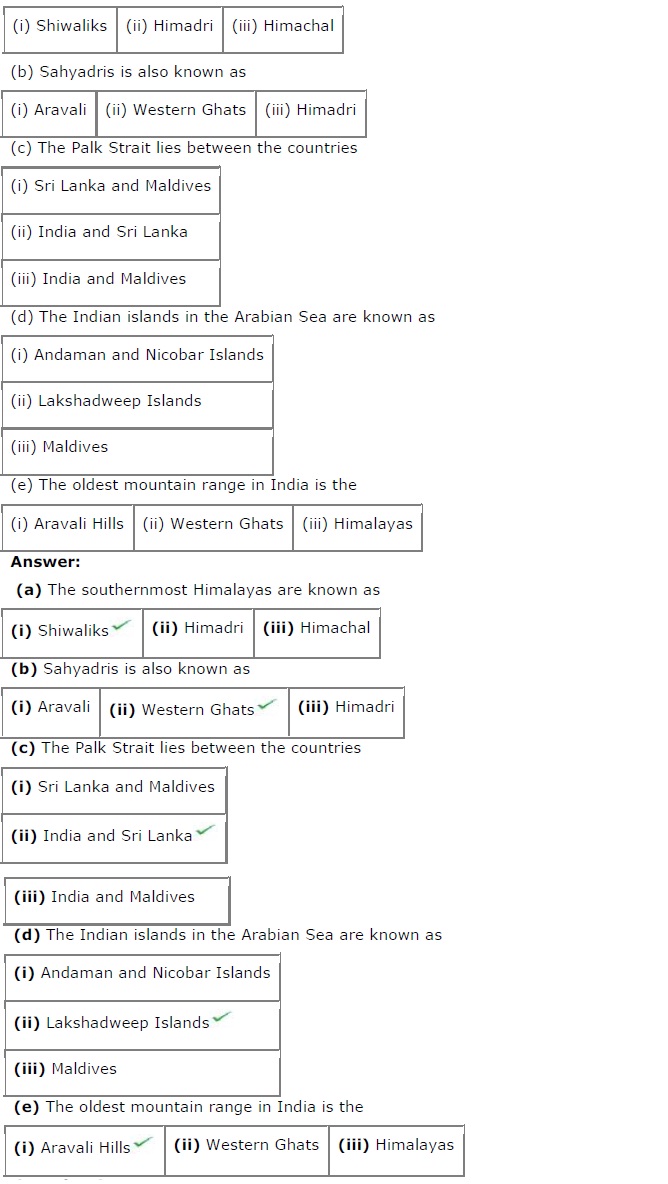
    (a) The southernmost Himalayas are known as

    Question 3:
    Fill in the blanks.
    (a) India has an area of about __________.
    (b) The Greater Himalayas are also known as ___________.
    (c) The largest state in India in terms of area is ___________.
    (d) The river Narmada falls into the ____________ Sea.
    (e) The latitude that runs almost halfway through India is ___________.
    Answer:
    (a) India has an area of about 3.28 million square kilometres.
    (b) The Greater Himalayas are also known as Himadri.
    (c) The largest state in India in terms of area is Rajasthan.
    (d) The river Narmada falls into the Arabian Sea.
    (e) The latitude that runs almost halfway through India is the Tropic of Cancer.

  • Major Landforms of the Earth NCERT Solutions for Class 6th Geography Chapter 6

    Class 6 Social Science – Geography NCERT Text book Answers of Chapter 6. NCERT Solutions Class VI Social Science – Geography includes answers of all the questions of Major Landforms of the Earth provided in NCERT Text Book which is prescribed for class 6 in schools.

    NCERT Solutions for Class 6th Social Science: Chapter 6 – Major Landforms of the Earth

    Class 6 Social Science (Geography) Chapter 6 Major Landforms of the Earth NCERT Solution is given below.

    Question 1:
    Answer the following questions briefly.
    (a) What are the major landforms?
    (b) What is the difference between a mountain and a plateau?
    (c) What are the different types of mountains?
    (d) How are mountains useful to man?
    (e) How are plains formed?
    (f) Why are the river plains thickly populated?
    (g) Why are mountains thinly populated?

    Answer:
    (a) The major landforms are: mountains, plateaus and plains.
    (b)

    Mountain Plateau
    A mountain is any natural elevation of the Earth’s surface. It is considerably higher than the surrounding area. A plateau is an elevated flat land. It is a flat-topped table land standing above the surrounding area.
    Mountains have peaks. Plateaus are flattened highlands.

    (c) The different types of mountains are: fold, block and volcanic.
    (d)
    Usefulness of Mountains
    Mountains are a storehouse of water. Many rivers have their source in the glaciers. Reservoirs are made to harness this water for consumption, irrigation and generating electricity.
    River valleys and terraces are ideal for cultivation of crops.
    Mountains have a rich variety of flora and fauna. Mountains provide an idyllic site for tourists.
    (e) Most of the plains are formed by rivers and their tributaries. The rivers flow down the slopes of mountains and erode them. They carry forward the eroded material. Then they deposit their load (consisting of stones, sand and silt) along their courses and in their valleys. It is from these deposits that plains are formed.
    (f) A lot of flat lands are available in plains. Also, the available land is generally fertile. Hence, plains are the most useful areas for human habitation as well as for cultivation. Transport network can also be easily constructed in plains. Thus, plains are very thickly populated regions of the world.
    (g) Mountains have very harsh cold climate. The slopes of the mountains are very steep. Also, mountains offer very little land for farming. For these reasons, mountains are thinly populated.

    Question 2:
    Tick the correct answers.
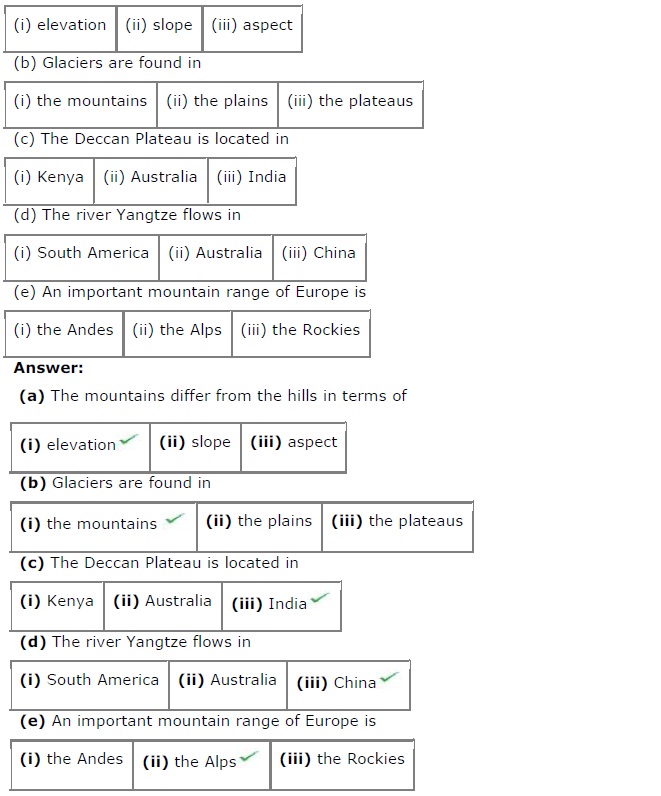
    (a) The mountains differ from the hills in terms of

    Question 3:
    Fill in the blanks.
    (a) A ________ is an unbroken flat or a low-level land.
    (b) The Himalayas and the Alps are examples of _________ types of mountains.
    (c) __________ areas are rich in mineral deposits.
    (d) The _________ is a line of mountains.
    (e) The _________ areas are most productive for farming.

    Answer:
    (a) A plain is an unbroken flat or a low-level land.
    (b) The Himalayas and the Alps are examples of fold types of mountains.
    (c) Plateau areas are rich in mineral deposits.
    (d) The Himalayas is a line of mountains.
    (e) The plain areas are most productive for farming.

  • Major Domains of the Earth NCERT Solutions for Class 6th Geography Chapter 5

    NCERT Solutions for Class 6th Social Science: Chapter 5 – Major Domains of the Earth

    Class 6 Social Science (Geography) Chapter 5 Major Domains of the Earth NCERT Solution is given below.

    Question 1:
    Answer the following questions briefly.
    (a) What are the four major domains of the Earth?
    (b) Name the major continents of the Earth.
    (c) Name the two continents that lie entirely in the Southern Hemisphere.
    (d) Name the different layers of atmosphere.
    (e) Why is the Earth called the ‘blue planet’?
    (f) Why is the Northern Hemisphere called the Land Hemisphere?
    (g) Why is the biosphere important for living organisms?

    Answer:
    (a) The four major domains of the Earth are: lithosphere, hydrosphere, atmosphere and biosphere.
    (b) The seven major continents of the Earth are: Asia, Europe, Africa, North America, South America, Australia and Antarctica.
    (c) The two continents that lie entirely in the Southern Hemisphere are: Australia and Antarctica.
    (d) The different layers of atmosphere are: troposphere, stratosphere, mesosphere, thermosphere and exosphere.
    (e) The Earth is called the ‘blue planet’ because more than 71 per cent of its surface is covered with water.
    (f) The Northern Hemisphere is called the Land Hemisphere because the greater part of Earth’s landmass lies in the Northern Hemisphere.
    (g)The biosphere is the narrow zone of contact between land, water and air. It is in this zone that life, that is unique to Earth, exists. All the living organisms are linked to each other and to the biosphere for survival.

    Question 2:

    Question 3:
    Fill in the blanks.
    (a) The deepest point on the Earth is _________ in the Pacific Ocean.
    (b) The _________ Ocean is named after a country.
    (c) The _________ is a narrow contact of land, water and air that supports life.
    (d) The continents of Europe and Asia together are known as __________.
    (e) The highest mountain peak on the Earth is __________.

    Answer:
    (a) The deepest point on the Earth is Marina Trench in the Pacific Ocean.
    (b) The Indian Ocean is named after a country.
    (c) The biosphere is a narrow contact of land, water and air that supports life.
    (d) The continents of Europe and Asia together are known as Eurasia.
    (e) The highest mountain peak on the Earth is Mount Everest.