Category: Geography

  • Maps NCERT Solutions for Class 6th Geography Chapter 4

    NCERT Solutions for Class 6th Social Science: Chapter 4 – Maps

    Class 6 Social Science (Geography) Chapter 4 Maps NCERT Solution is given below.

    Question 1:
    Answer the following questions briefly.
    (a) What are the three components of a map?
    (b) What are the four cardinal directions?
    (c) What do you mean by the term ‘the scale of the map’?
    (d) How are maps more helpful than a globe?
    (e) Distinguish between a map and a plan.
    (f) Which map provides detailed information?
    (g) How do symbols help in reading maps?

    Answer:
    (a) The three components of a map are: distance, direction and symbol.
    (b) The four cardinal directions are: North, South, West and East
    (c) The scale of a map is the ratio between the actual distance on the ground and the distance shown on the map.
    (d) A globe is useful when we want to study the Earth as a whole. But, when we want to study only a part of the Earth, it is of little help. For this purpose, we use maps. A map can represent the entire Earth’s surface or a part of it.
    Maps can be used to show the physical features of the Earth (mountains, plains, oceans, rivers, etc.), the political divisions of the Earth (countries, states, cities, villages, etc.), and certain specific information (roads, rainfall, forests, industries, etc.)
    (e)

    Map Plan
    A map is a representation or a drawing of the Earth’s surface or a part of it drawn on a flat surface according to a scale. A plan is a drawing of a small area on a large scale.
    It can be used for representing large areas like continents or countries (large scale maps), and also for representing a small area like a village or a town (small scale maps). It is used for representing those things  that cannot be represented in a map. For example, the length and the breadth of a room cannot be shown in a map. For this purpose, a plan is used.

    (f) A large scale map provides detailed information.
    (g)As it is not possible to draw on a map the actual shape and size of different features (e.g., buildings, roads, bridges), they are shown by using certain standard letters, shades, colours, pictures and lines. These symbols give a lot of information in a little space. Using these symbols, maps can be drawn easily. The use of symbols makes maps simple to read.

    Question 2:
    Tick the correct answers.
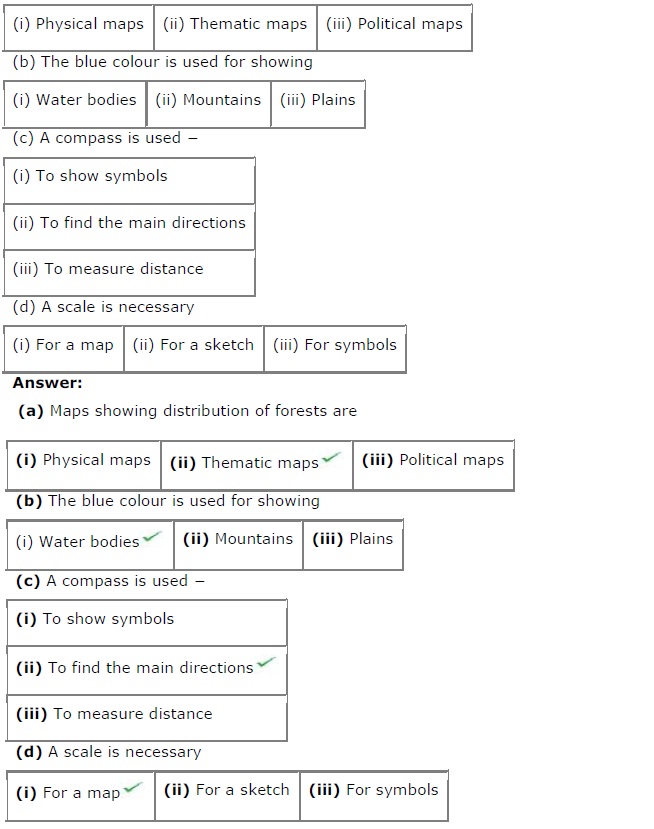
    (a) Maps showing distribution of forests are

  • Motions of the Earth NCERT Solutions for Class 6th Geography Chapter 3

    Class 6 Social Science – Geography NCERT Text book Answers of Chapter 3. NCERT Solutions Class VI Social Science – Geography includes answers of all the questions of Motions of the Earth provided in NCERT Text Book which is prescribed for class 6 in schools.

    National Council of Educational Research and Training (NCERT) Book Solutions for Class 6
    Subject: Social Science – Geography
    Chapter: Chapter 3 – Motions of the Earth

    NCERT Solutions for Class 6th Social Science: Chapter 3 – Motions of the Earth

    Class 6 Social Science (Geography) Chapter 3 Motions of the Earth NCERT Solution is given below.

    Question 1:

    Answer the following questions briefly.
    (a) What is the angle of inclination of the Earth’s axis with its orbital plane?
    (b) Define rotation and revolution.
    (c) What is a leap year?
    (d) Differentiate between the Summer and Winter Solstice.
    (e) What is an equinox?
    (f) Why does the Southern Hemisphere experience Winter and Summer Solstice in different times than that of the Northern Hemisphere?
    (g) Why do the Poles experience about six months day and six months night?

    Answer:

    (a) The angle of inclination of the Earth’s axis with its orbital plane is 66½°.
    (b) Rotation is the movement of the Earth on its axis. Revolution is the movement of the Earth around the Sun in a fixed path or orbit.
    (c) Earth takes 365¼ days to revolve around the Sun. However, for the sake of convenience, we consider a year as consisting of 365 days. The six hours (1/4th of 24 hours) that are ignored make one day (24 hours) over a span of four years. This surplus day is added to the month of February. Thus, every fourth year, February has 29 days, and such a year (with 366 days) is known as a leap year.
    (d)

    Summer Solstice Winter Solstice
    It is the position of the Earth when the rays of the Sun fall directly on the Tropic of Cancer. It is the position of the Earth when the rays of the Sun fall directly on the Tropic of Capricorn
    In this position, the North Pole is tilted towards the Sun. In this position, the North Pole is tilted away from the Sun.
    A larger portion of the Northern Hemisphere gets light from the Sun; hence, it is summer in the Northern Hemisphere. A larger portion of the Southern Hemisphere gets light from the Sun; hence, it is winter in the Northern Hemisphere.
    During this period in the Northern Hemisphere, days are longer than nights. During this period in the Northern Hemisphere, nights are longer than days.

    (e) Equinox is the position of the Earth when the rays of the Sun fall directly on the Equator. At this position, neither of the Poles is tilted towards the Sun. As a result, the entire Earth has equal days and equal nights.
    (f) When the North Pole is tilted towards the Sun, the Northern Hemisphere experiences Summer Solstice. At this time, since the South Pole is tilted away from the Sun, the Southern Hemisphere experiences Winter Solstice. When the North Pole is tilted away from the Sun, the Northern Hemisphere experiences Winter Solstice. At this time, since the South Pole is tilted towards the Sun, the Southern Hemisphere experiences Summer Solstice.
    (g) The Poles experience about six months of day and six months of night because of the tilt of the Earth on its axis. Because of this tilt, each Pole is tilted towards and away from the Sun for about six months each.
    When the North Pole is tilted towards the Sun, it experiences continuous daylight for six months. It is night for the same time period at the South Pole. These conditions are reversed when the South Pole is tilted towards the Sun.

    Question 2:

    Tick the correct answers

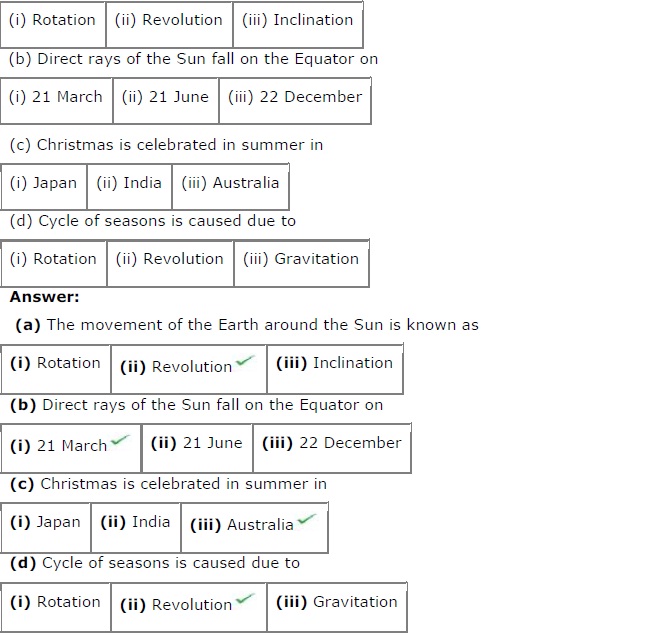
    (a) The movement of the Earth around the Sun is known as

    Question 3:

    Fill in the blanks.
    (a) A leap year has ________ number of days.
    (b) The daily motion of the Earth is _________.
    (c) The Earth travels around the Sun in _________ orbit.
    (d) The Sun’s rays fall vertically on the Tropic of _________ on 21st June.
    (e) Days are shorter during _________ season

    Answer:

    (a) A leap year has 366 number of days.
    (b) The daily motion of the Earth is rotational.
    (c) The Earth travels around the Sun in a fixed elliptical orbit.
    (d) The Sun’s rays fall vertically on the Tropic of Cancer on 21st June.
    (e) Days are shorter during winter season.

  • Globe Latitudes and Longitudes NCERT Solutions for Class 6th Geography Chapter 2

    Class 6 Social Science – Geography NCERT Text book Answers of Chapter 2. NCERT Solutions Class VI Social Science – Geography includes answers of all the questions of Globe Latitudes and Longitudes provided in NCERT Text Book which is prescribed for class 6 in schools.

    National Council of Educational Research and Training (NCERT) Book Solutions for Class 6
    Subject: Social Science – Geography
    Chapter: Chapter 2 – Globe Latitudes and Longitudes

    NCERT Solutions for Class 6th Social Science: Chapter 2 – Globe Latitudes and Longitudes

    Class 6 Social Science (Geography) Chapter 2 Globe Latitudes and Longitudes NCERT Solution is given below.

    Question 1:

    Answer the following questions briefly.
    (a) What is the true shape of the Earth?
    (b) What is a globe?
    (c) What is the latitudinal value of the Tropic of Cancer?
    (d) What are the three heat zones of the Earth?
    (e) What are the parallels of latitude and meridians of longitudes?
    (f) Why does the Torrid Zone receive maximum amount of heat?
    (g) Why is it 5.30 P.M. in India and 12.00 noon in London?

    Answer:

    (a) Earth is slightly flattened at the North and South Poles, and bulges in the middle. The shape of the Earth is described as a ‘geoid’, that is, ‘an Earth-like shape’.
    (b) Globe is a true model (miniature form) of the Earth.
    (c) The Tropic of Cancer lies 23½ ° north of the Equator.
    (d) The three heat zones of the Earth are: the Torrid Zone, the Temperate Zone and the Frigid Zone.
    (e) All parallel circles from the Equator up to the Poles are called parallels of latitudes.

    The lines of references running from the North Pole to the South Pole are called meridians of longitudes.

    (f) The area between the Tropic of Cancer and the Tropic of Capricorn is known as the Torrid Zone. The mid-day Sun is exactly overhead at least once a year on all the latitudes in this area; hence, this area receives maximum amount of heat.
    (g) In London, the Greenwich Mean Time (GMT) is followed. The Indian Standard Meridian is located 82½° east of the Prime Meridian. Thus the Indian Standard Time (IST) is 5 hours and 30 minutes ahead of GMT. So, when it is 12 noon in London, it
    is 5.30 P.M. in India.

    Question 2:

    Tick the correct answers.
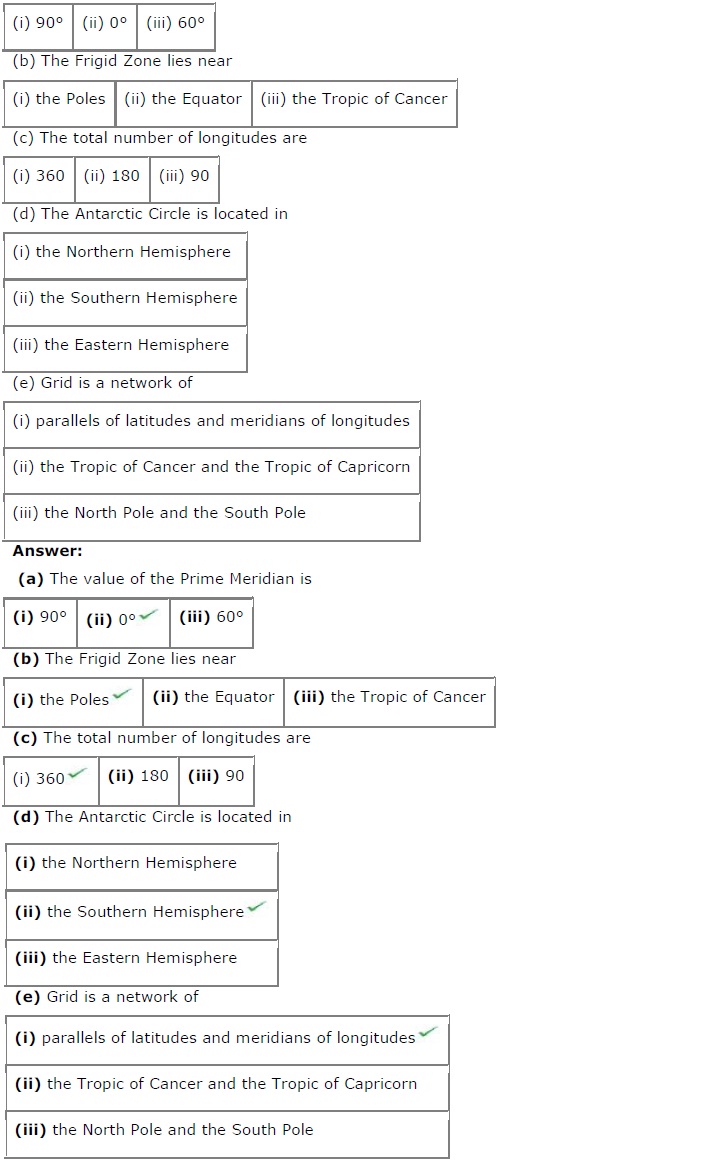
    (a) The value of the Prime Meridian is

    Question 3:

    Fill in the blanks.

    (a) The Tropic of Capricorn is located at __________.
    (b) The Standard Meridian of India is _________.
    (c) The 0° Meridian is also known as __________.
    (d) The distance between the longitudes decreases towards _________.
    (e) The Arctic Circle is located in the _________ Hemisphere.

    Answer:

    (a) The Tropic of Capricorn is located at 23½° south of the Equator.
    (b) The Standard Meridian of India is 82½° E.
    (c) The 0° Meridian is also known as the Prime Meridian.
    (d) The distance between the longitudes decreases towards the Poles.
    (e) The Arctic Circle is located in the Northern Hemisphere.

  • The Earth in the Solar System NCERT Solutions for Class 6th Geography Chapter 1

    Class 6 Social Science – Geography NCERT Text book Answers of Chapter 1. NCERT Solutions Class VI Social Science – Geography includes answers of all the questions of The Earth in the Solar System provided in NCERT Text Book which is prescribed for class 6 in schools.

    National Council of Educational Research and Training (NCERT) Book Solutions for Class 6
    Subject: Social Science – Geography
    Chapter: Chapter 1 – The Earth in the Solar System

    NCERT Solutions for Class 6th Social Science: Chapter 1 – The Earth in the Solar System

    Class 6 Social Science (Geography) Chapter 1 The Earth in the Solar System NCERT Solution is given below.

    Question 1:

    Answer the following questions briefly.
    (a) How does a planet differ from a star?
    (b) What is meant by the ‘Solar System’?
    (c) Name all the planets according to their distance from the Sun.
    (d) Why is the Earth called a unique planet?
    (e) Why do we see only one side of the Moon always?
    (f) What is the Universe?

    Answer:

    (a) Stars are big and hot celestial bodies made up of gases. They have their own heat and light, which they emit in large amounts. Planets are also celestial bodies, but they do not have their own heat and light. They are lit by the light of stars.

    (b) The Sun, eight planets, satellites and some other celestial bodies known as asteroids and meteoroids form the solar system.

    (c) In order of their distance from the sun, the eight planets are: Mercury, Venus, Earth, Mars, Jupiter, Saturn, Uranus and Neptune.

    (d) Conditions favourable to support life are probably present only on Earth. The Earth is neither too hot nor too cold. It has water and air, which are very essential for our survival. The air has life-supporting gases like oxygen. Because of these reasons, the Earth is a unique planet in the solar system.

    (e) The Moon moves around the Earth in about 27 days. It takes exactly the same time to complete one spin. As a result, only one side of the Moon is visible to us on the Earth.

    (f) A galaxy is a huge system of billions of stars, and clouds of dust and gases. Millions of such galaxies make up the universe.

    Question 2:

    Tick the correct answers.

    (a) The planet known as the “Earth’s Twin” is

    (b) Which is the third nearest planet to the Sun?

    (c) All the planets move around the Sun in a

    (d) The Pole Star indicates the direction to the

    (e) Asteroids are found between the orbits of

    Answer:

    (a) The planet known as the “Earth’s Twin” is

    (b) Which is the third nearest planet to the Sun?

    (c) All the planets move around the Sun in a

    (d) The Pole Star indicates the direction to the

    (e) Asteroids are found between the orbits of

    Question 3:

    Fill in the blanks.
    (a) A group of ________ forming various patterns is called a ________.
    (b) A huge system of stars is called _________.
    (c) ________ is the closest celestial body to our Earth.
    (d) ________ is the third nearest planet to the Sun.
    (e) Planets do not have their own _________ and __________.

    Answer:
    (a) A group of stars forming various patterns is called a constellation.
    (b) A huge system of stars is called a galaxy.
    (c) The Moon is the closest celestial body to our Earth.
    (d) Earth is the third nearest planet to the Sun.
    (e) Planets do not have their own heat and light.

  • Notes Of Water Resources Class 10th Geography Chapter-3

    Chapter-3
    Water Resources

    Notes

    Reasons for water scarcity

    • Due to the variations in special seasonal and animal precipitation.
    • Over Exploitation, excessive use and unequal access to water.
    • Water Scarcity is the outcome of large and growing population.
    • A large population means more water for domestic and of produce more food.
    • Water resources are exploited to expand agricultural production, which leads to decline in ground water level.
    • It affects water availability and food security of the people.
    • Intensive urbanization and industrialization.
    • 22% hydro-electricity in India is generated from water.
    • Most of the water is polluted by domestic and industrial wastes, chemicals, pesticides, fertilizers etc.

    Managing and conserving water resources is the need of the hour- Explain

    • To safeguard ourselves from health hazards.
    • To ensure food security.
    • For continuation of our livelihood and productive activities.
    • To prevent the degradation of eco-system.

    Hydraulic structure in Ancient India-

    • In the first century B.C. at sringaverapur water harvesting system was existed using the flood water from Ganga river.
    • During the time of Chandragupta Maurya, dams lakes etc.were built.
    • Irrigation system was found in Kalinga, NagarjunaKonda, Bennur and Kohlapur.
    • In the 11th Century, Bhopal lake was built.
    • In the 14th Century, Lltush constructed a tank in HousKhas(Delhi).


    Why are dams called Multi-purpose projects-

    Dams are built for irrigation, electricity generation, water supply for domestic and industrial uses, flood control, recreation, navigation, fishing etc.

    • Nehru “Dams are temples of modern India.”


    In recent years, multi-purpose projects are opposed by many-state-

    • Regulating and damming of rivers affect their natural flow, resulting in excessive sedimentation at the bottom of the reservoir.
    • Dams make it difficult for the aquatic fauna to migrate.
    • Existing vegetation and soils are submerged under water.
    • Building of dams creates large scale displacement of local communities. They have to give up their hand, livelihood etc.
    • Irrigation changed the cropping pattern. The farmers shift to intensive and commercial crops.
    • The social gap between rich and poor are widened.
    • Floods occur due to the sedimentation in the reservoir and life and property are devastated.
    • Earthquakes, water-borne diseases, pollution from the excessive use of water.

    Rain Water Harvesting

    Traditional methods in India used for water harvesting-

    • In the hilly areas, the people make diversion challenges like ‘guls’ or ‘kuls’.
    • Rooftop rainwater harvesting is being practiced to store drinking water in Rajasthan.
    • Innundation channels are developed in West-Bengal.
    • In the arid and semi-arid regions, agricultural fields are converted into rainfed storage structure. Eg- Khadins in Jaisalmer, Johads in Rajasthan.

    Geography Class 10th | Notes, NCERT Solution, Extra Questions, PDF Download

  • Notes Of Forest And Wildlife Resources Geography Class 10th

    Chapter-2
    Forest and Wildlife resources

    Notes

    According to I.U.C.N. existing plant and animal species are divided into 6 categories.

    1. Normal Species- The species whose population leaves are considered to be normal for their survival eg. Cattle, Sal.
    2. Endangered Species- The species which are in the danger of extinction. The survival is very difficult if the negative factors like- hunting, deforestation etc. continued. Eg- Indian Wild Ass.
    3. Vulnerable Species- The species whose population are declined. They may move into the endangered category in the near future. Eg- Asiatic elephant.
    4. Rare Species- The Species with small population. They may move into the endangered or vulnerable category in the near future.
    5. Endemic Species- The Species which are found only in particular areas. Eg- Nicobar Pigeon.
    6. Extinct Species– The Species which are nor found after searches. Eg- Pink head duck, etc.

    Causes for the Depletion of flora and fauna-

    1. Transforming nature into a resource. Eg- Tress into furniture.
    2. Expansion of railways, agriculture, scientific forestry etc. during colonial periods.
    3. Shifting cultivation (slash and burn) practiced in Tribal belts.
    4. Large scale development projects, Eg- Narmada valley project in Madhya Pradesh. Nearly 40000 hectares of land forest have inundated.
    5. Mining, Eg- Buna Tiger Reserve in west Bengal is threatened by the ongoing do lomite mining.
    6. According to the environmentalists, grazing and furl-wood collectors are the major causes for the depletion for the flora and fanna.

    Factors that led to the decline in bio-diversity-

    1. Habitat destruction, hunting, Poaching, Environmental pollution, Poisoning, forest fires etc. are some of the cause for the decline in bio-diversity.

    Causes for the environmental degradation-

    1. Inequitable consumption of resources, differential sharing of responsibility to protect the environment.
    2. Over population in third-world countries.

    The Destruction of forests and wildlife is not just a biological issue-Explain?

    1. Bio logical loss is correlated with the cultural loss.
    2. Many indigenous and forest dependent communities are marginalized and impoverished.
    3. Within the por, the women are affected more than men, because they take the responsibility of collection of fuel, fodder and water.
    4. Walking more than 10 km, per day to collect these, will create health problems to the women and also do not get time to look after home and children.
    5. Droughts and deforestation induced floods are the other results of deforestation.
    6. Poverty is the direct outcome of deforestation.

    Steps taken by the government to protect flora and fauna-

    1. The Indian wildlife act was implemented in 1972 to protect the habitats.
    2. It aimed banned hunting, protecting habitats and restricting trade in wildlife.
    3. Many national parts and wildlife sanctuaries were set up by central and state governments.
    4. Projects like tiger project, rhinocerous were announced.
    5. Under the wildlife the act of 1980 and 1986 several hundreds of butterflies, moths etc. were included in the list of protected species.
    6. In 1991, for the first time, six species of plants were also included in the list.


    Types and distribution of forests-

    1. Reserved Forests-More than half of the total forest area comes under reserved forests. They have great important to conserve forests and wildlife. Eg. J.K.
    2. Protected Forests- Almost one-third of the total forest area comes under protected forests. Eg- Punjab, Haryana, Bihar.
    3. Un classed Forests- The Forest and weste lands belongs to both government and private individuals and communities. Eg- North-Eastern states.

    Protected forests and Reserved forests are together known as permanent forests.

    Madhya Pradesh has largest area under permanent forests.

    How communities have conserved forests and wildlife-

    1. Many communities are struggling to conserve the habitats along with government officials.
    2. In Sariska Tiger reserve (Rajasthan) villagers fought against mining and protected the habitats of plants and animals.
    3. The inhabitants of 5 villages in Alwar district of Rajasthan have protected 1200 hectors of forest by making their own rules and regulations.
    4. The Chipko Movement in the Himalayan region resisted deforestation and encouraged afforestation program.
    5. The ecological farming like ‘BeelBachaoAndolan’ and ‘Navdanya’ were introduced by the farmers without the use of chemical fertilizers.
    6. The joint Forest Management (J.F.M.) programmed was started in Orissa in 1988 and introduced with the collaboration of villager.

    Get All geography class 10th Notes 

  • Important Terms Of Resources And Development Class 10th Geography

    # Resource : Natura endowments in the form of land, water, vegetation, and minerals are called natural resources. Resources are materials which can be transformed in such a way that they become more valuable and usefu# for fulfilling human needs.

    # Types of Resources : Resources are classified into various categories such as natura# and human-made, renewable and non-renewable, individual, community, nationa# and
    international resources.

    # Natura and Human-Made or Man-Made Resources : Natura resources include land, soil, water, vegetation, wildlife, minerals and power resources. Resources created by humans are called human-made resources like engineering, technology, machines, buildings, monuments paintings and socia institutions.

    # Biotic and Abiotic Resources : Resources obtained from the biosphere like forests, wildlife, fisheries, livestock, human beings, etc., which have life, are called biotic resources.
    Resources which are obtained from non-living things are called abiotic resources. Iron,
    copper, gold and lead are abiotic resources.

    # Human Resources : These resources are made up of the human beings living in the world. They are the most important resource of a nation.

    # Renewable and Non-Renewable Resources : Some resources have the ability to renew
    themselves in a given period of time. Plants and animals have the ability to regenerate.
    Minerals are non-renewable resources. They cannot be remade. Some of the important
    renewable resources are water, forests, solar, wind and tidal energy.
    # Resource Development: Some natural resources cannot be used directly. While using the natural resources, we must keep in mind the nature, type and the size of the resources. Ocean water, solar energy, wind energy and climate are inexhaustible resources. Iron, tin, copper, gold, and silver are exhaustible but reusable resources. We must reuse and recycle the resources.

    # Resource Planning: This is a technique or skill of proper utilization of resources. Resource
    planning consists of three stages —
    Preparation of an inventory of resources — This stage includes surveying, mapping and measurement of characteristics and properties of resources.
    Evaluation in terms of availability for development — This stage includes the
    examination of resources from the point of view of technology, economy, and need.
    Planning of exploitation of resources — This stage is related to systematic planning
    which emphasizes on the use and reuse of the resources. Resource planning helps to reduce
    wastage and keeps the environment pollution free.
    Conservation of resources — The management of resources by the humans is known as
    conservation. It is the judicious and planned use of the natura# resources.

    # Land resources — India has a variety of relief features like mountains, plateaus, and plains. 43% of the country is covered by plains and they provide cultivable land for growing crops. 30% of the country is covered by mountains and they provide natural resources like forests and wildlife. 27% of the country is covered by plateaus which contain mineral resources, forests and some arable land.

    # Total area of India is 3.28 million square kilometers. 44% of the total land area of India is the net sown area. 22% is covered by forests, 4% is a culturable waste, 11% is fallow land, 4% are permanent pastures, 14% land is not available for cultivation and 1% is covered by miscellaneous tree crops.

    # The landuse pattern in India is determined by both physical factors such as topography, climate, soil types as well as human factors such as population density, technological capability, and culture and traditions etc.

    # The degradation of natural vegetation is caused by overgrazing by animals, deforestation, careless management of forests and degradation of land. At present, about 130 million hectares of degraded land exists in India.

    # Soil: The uppermost layer of the earth’s crust, which is loose, fragmented and useful for plants is called soil.

    # Soil Formation: The factors that contribute to the formation and fertility of the soil are parent rocks, climate, plant, animal and local topography. The soils are made out of rocks.

    The rocks disintegrate and decompose under the processes of weathering and erosion.

    # Soil Types: The soils of India are classified into the following types —# Alluvial Soil 2 Black Soil 3 Red Soil 4 Laterite Soil 5 Mountain Soil 6 Desert Soil.

    # Alluvial Soil: It is of two types — khadar and banger. It is found mainly in the Northern Plains and Coastal Strips of the Eastern Coast.

    # Black Soil: It is derived from the Deccan Traps. It occurs in areas like Maharashtra, Western Madhya Pradesh, and Gujarat. It is known for the cultivation of cotton.

    # Red Soil: It is formed in areas of igneous and metamorphic rocks. It is found in parts of Tamil Nadu, Karnataka, Andhra Pradesh, Orissa, and Jharkhand.

    # Laterite Soil: It is the intensively leached soil of the monsoon climate. It is found in the hills of the Deccan, Karnataka, Kerala, Orissa and parts of Assam and Meghalaya.

    # Mountain Soil: It is characterized by the deposition of organic materials derived from the vegetative cover. It is found in Meghalaya, Arunachal Pradesh, Eastern ranges, Uttarakhand, Himachal Pradesh and Jammu and Kashmir.

    # Desert Soil: It is found in the arid areas of Rajasthan, Punjab, and Haryana.

    # Soil Erosion: The removal of soil from one place to another by some natural agent is called soil erosion. Conservation of lands and plantation of trees are the methods adopted to reduce soil erosion
  • Notes Of Resources And Development Geography Class 10th

    Chapter-1
    Resources and Development

    Resource

    • Everything available in our earth which can be used to satisfy our needs.
    • It is technologically accessible, economically jeasible and culturally acceptable.

    Classification Of Resources

    On The Basis Of Origin, Resources Are Classified In Two Groups:

    1. Biotic: The resources which are found in the biosphere and have life example flora and fauna.
    2. Abiotic: Composed of non living things. Example: Rock, metals.

    On The Basis Of Exhaustibility:

    1. Renewable Resources: The resources which can be renewed or reproduce. Example: water and solar energy.
    2. Non-Renewable Resources: Those resources which cannot be renewed or replenished easily. Formation takes place million of year. Example: fossil fuels, minerals

    On The Basis Of Ownership:

    1. Individual Resources: Resources and privately by individual. Example: land by farmer.
    2. Community Owned Resources: Resources which are accessible to all the members of community of playground burial ground.
    3. National Resources: The resources which belong to a nation easy roadway Railway ocean water 12 nautical miles (22.3 km)
    4. International Resources: The resources which do not belongs to a particular Nation. Eg: Ocean resources beyond 200 km.

    On The Basis Of States Of Development:

    1. Potential Resources: The resources which are founded in a region but have not been utilized. Eg: Wind and solar energy in Gujarat and Rajasthan.
    2. Development Resources: The resources which are survey and their quality and quantity are determined. Eg: Tree in forest
    3. Stock: The resources which have the potential to satisfy the human needs. But human do not have the technology to use them. Eg: Water (hydrogen, oxygen)
    4. Reserve: The resources which can be put in the use with the help of technology. But they are use has not been started. Eg: Hydro electricity from water.


    Sustainable Economic Development:

    Development should take place without damaging the environment

    First Earth summit-> Rio de Janeiro in 1992


    Resource Planning

    It is the widely accepted strategy for judicious use of resources.


    Importance Of Resource Planning In India

    • India has great diversity in the availability of resources
    • Some region or self-sufficient while some other reasons has a shortage of resources. Eg: Jharkhand mineral resources, Rajasthan- no water resources.
    • A balance resource planning is necessary


    Resource Planning Ways

    • Identification of resources by surveying, mapping, etc
    • Making a planning structure with the help of technology
    • Matching the resource development plans with National Development plan
    • Conservation of resources-importance
    • Resources are necessary for any development activity
    • Overutilization and irrational consumption may lead to social economic and environmental problem.
    • To overcome their problems we should conserve them.


    Land Resources:

    • Land is the most important natural resource. All the economic activity is performed on land.
    • It supports natural vegetation and animal live human life.
    • It is the finite resources.


    Name The Different Relief Features And Their Uses:

    • 43%- Plans (For Agriculture industry)
    • 30%- mountain (water, tourism, ecology)
    • 27%- Plateans (Minerals, Fossil Fuels)


    Soil As A Resource

    • It is the most important renewable resource.
    • Medium of plant growth and supports different living organisms.

    Factors That Help In The Formation Of Soil:

    Relief, parent rock, climate, vegetation and other forms of life and time. The natural forces like raining, water, temperature, Wind, glaciers, etc also help.


    Classification Of Soil:


    Alluvial  Soil:

    • It is the widely spread soil in india and the entire northern plain is made up of this soil.
    • They are deposited by the three important Himalayan river system i.e Ganga, Indus, Brahmaputra
    • According to their age alluvial soil is of two types:

    * Khadar (Newer Alluvial)

    * Bangar (Older Alluvial)

    • They are very fertile and contain potash, phosphoric acid and lime.
    • Ideal for the cultivation of sugar cane, paddy, wheat, pulses, etc.
    • Areas of alluvial soil are intensely cultivated and densely populated.


    Black Soil:

    • Its black in color also known as regur soil.
    • This soil is idea for growing cotton, so it is known as black cotton soil.
    • coelomates and parent rock are the foctors in the formation of black soil.
    • They have the capacity to hold moisture contain lime, potash, etc and poor in phospheric acid contents.
    • They develop deep cracks during summers which help in the content of proper aeration of the soil.
    • Ideal for tea, coffee, cashews, etc.


    Laterite soil:

    • The word ‘Laterite’ is derived from the Latin word ‘later’ means brick.
    • It is found in the areas of high temperature and heavy rain fall.
    • Humus content is very low because most of the microorganisms like bacteria get destroyed drying summers.
    • Ideal for growing tree, coffee and cashew nuts.


    Arid soils:

    • They are of red to brown in colors.
    • They re sandy and saline.
    • Due to the dry climate and high temperature, the soil lacks of humus and moisture. They are found in the areas like western rajasthan.


    Forest soils:

    • Forest soils are found in the hilly and mountainous areas.
    • In the snow covered areas of the Himalayas, the soil experiences denudation.
    • They are acidic and has low humus content.


    Soil Erosion:

    The denudation of the soil cover and its washing down is known as soil erosion.

    • Human activities that cause soil erosion are deforestation, overgrazing, construction, mining, etc.
    • Natural forces like wind, glaciers and water.


    Kinds Of Erosion:

    • Gully Erosion: Running water cuts through the soil and make deep channels. Soil becomes Uncultivable, known as bad.
    • Sheet Erosion: Soil is removed in large areas in the form of sheet.
    • Wind Erosion: Soil is removed at the time of heavy wind.

    Measures Taken For Soil Conservation:

    • Contour Ploughing: Ploughing along the contour lines.
    • Terrace Farming: Steps can be cut out on the slopes.
    • Strip Cultivation: Strips of grass are left to grow between the crops.
    • Shelter Belts: Trees are grown in rows.
    • Stabilization of sand lines by planting thorny bushes.
  • Geography Class 10th | Notes, NCERT Solution, Extra Questions, PDF Download

    In This Section, ImperialStudy Team Provide You The Best Geography Notes, Geography Solutions And Geography Extra Questions, NCERT Solutions Of Class 10th For Helping In Your Studies. We Try To Help In Your Lessons If You Find Any Problems related To any Points Or Topic Plese Comment Down We Try To Solve It.

    As You Scroll Down To The Post You Found Different Study Materials For Geography  Class Xth . You Can Also Download Free PDF File after Register at The End tries To Learn Online Which Also Help Us!

    Geography (Contemporary India – II)

    1. Resources And Development

    2. Forest And Wildlife Resources 

    3. Water Resources 

    • Notes Of Water Resources
    • Important Terms Of Water Resources
    • Questions And Answers Of Water Resources
    • Map Work Of Water Resources

    4. Agriculture 

    • Notes Of Agriculture
    • Important Terms Of Agriculture
    • Questions And Answers Of Agriculture
    • Map Work Of Agriculture

    5. Minerals And Energy Resources 

    6. Manufacturing Industries

    • Notes Of Manufacturing Industries
    • Important Terms Of Manufacturing Industries
    • Questions And Answers Of Manufacturing Industries
    • Map Work Of Manufacturing Industries

    7. Life Lines of National Economy 

    • Notes Of Life Lines of National Economy
    • Important Terms Life Lines of National Economy
    • Questions And Answers of Life Lines of National Economy
    • Map Work of Life Lines of National Economy


    Others

    History (India And The Contemporary World II)

    Political Science (Democratic Politics II)

    Economics (Understanding Economics Development II)