Category: Social Science

  • Concept’s of Poverty as a Challenge Class 9th Social Science Economics


    3 POVERTY AS A CHALLENGE
    CONCEPTS
    • Who are poor? In our daily life we come across many poor people such as landless labourers in villages, people living in jhuggis, daily wage workers at construction sites, child labourers in dhabas, rickshaw-pullers, domestic servants, cobblers, beggars, etc.
    • Meaning of Poverty : Usually the levels of income and consumption are used to define poverty. In India, poverty has been defined as a situation in which a person fails to earn income sufficient to buy him bare means of subsistence.
    • Other Indicators of Poverty : Now poverty is looked through other indicators like illiteracy level, lack of access to health care, lack of job opportunities, lack of access to safe drinking water, sanitation, etc. Nowadays, the concept of social exclusion is becoming very common in the analysis of poverty.
    • Estimates of Poverty : The incidence of poverty in India was around 55 per cent in 1973 which declined to 36 per cent in 1993 and further to 26 per cent in 2000.

    Social groups which are most vulnerable to poverty are Scheduled Caste and Scheduled Tribe households.

    • Inequality of Incomes within a Family : In poor families, old people, women and female children are denied equal access to family’s available resources. They are the poorest of the poor.
    • Inter-State Disparities : The proportion of poor people is not the same in every state. In 20 states and union territories the poverty ratio is less than the national average. Orissa and Bihar are the poorest states of India with poverty ratios of 47 per cent and 43 per cent respectively. Lowest incidence of poverty is found in Jammu and Kashmir with poverty ratio of just 3.5 per cent.
    • Global Poverty Scenario : There has been substantial decline in global poverty. However, it is marked with great regional differences. Poverty has declined more in China and South-East Asian countries.
    • Causes of Poverty : There are a number of causes for the widespread poverty in India. These are :
      1. Rapid growth of population, particularly among the poor is considered a major cause of Indian poverty.
      2. Our agricultural sector has failed to generate much employment opportunities for the farm labourers. Similarly, our industries could not provide much job for the job seekers.
      3. One of the major causes of poverty is the unequal distribution of land and other resources. Various land reform measures introduced after Independence could not improve the life of millions of rural poor because of their poor implementation.
      4. Social factors : People in India, including the very poor, spend a lot of money on social occasions like marriages, festivals, etc. Poor people hardly have any savings; they are, thus forced to borrow. Unable to pay because of poverty, they became victims of indebtedness.

    Joint family system has prevented people from doing hard work.

    Steps taken by the Government for Poverty Alleviation

    Our government’s strategy to poverty reduction has been twofold. One, promotion of economic growth and, two, targeted poverty alleviation programmes.

    Poverty Alleviation Programmes : To address the poor, a need for targeted anti-poverty programmes was strongly felt.

    Some of them are given below :

      1. Prime Minister Rojgar Yojana (PMRY) : The aim of this programme (which was started in 1993) was to create self-employment opportunities for educated unemployed youth in rural areas and small towns.
      2. Rural Employment Generation Programme (REGP) : REGP was launched in 1995 to create self-employment opportunities in rural areas.
      3. Swarna Jayanti Gram Swarojgar Yojana (SGSY) : SGSY was started in 1999. The programme aims at bringing the assisted poor families above the poverty line.
      4. Pradhan Mantri Gramodaya Yojana (PMGY) was launched in 2000.
      5. Antyodaya Anna Yojana (AAY) for ‘the poorest of poors’ and elders.
      6. National Food for Work Programme (NFWP) was launched in 2004.
      7. National Rural Employment Guarantee Act (NREGA) was passed in September 2005. The Act provides 100-days assured employment every year to every rural household in 200 districts.

    The Challenges Ahead

    Though poverty has declined in India, poverty reduction remains India’s most compelling challenge. We will have to do something special to fight against wide regional disparities. We must broaden the definition of poverty from ‘a minimum subsistence level of living to a reasonable level of living’. Bigger challenges before us are : providing health care, education and job security for all the achieving gender equality.


  • LONG ANSWER TYPE QUESTIONS (4 MARKS) of People as Resources Class 9th Social Science Economics

    LONG ANSWER TYPE QUESTIONS (4 MARKS)


    Q.1. Describe in brief the role of human resources in economic development.
    Ans. Role of Human Resource.
    (i) Higher Productivity. Investment in human capital yields a return just like investment in
    physical capital. This can be seen directly in form of higher incomes earned because of
    higher productivity of the more educated or the better trained persons as well as the higher
    productivity of healthier people. India’s Green Revolution and IT Revolution are good
    examples of human resources development.
    (ii)
    Better Utilisation of Resources. Countries like Japan have invested in human resource.
    They did not have any natural resource. They could become rich/developed because of
    investments in people specially in the fields of education and health. These people have
    made efficient use of other resources like land and capital. Efficient technology developed
    by people have made these countries developed.
    (iii)
    Source of Demand. Human beings make demand for the output of goods and services
    produced in the country. Expansion of market for various types of foods and services
    further leads to increase in production.
    Q.2. Is it necessary to check population growth?
    Ans.
    India has vast manpower. But she could not utilise this manpower for country’s economic
    development. Rather, population growth has posed a big threat for the country. It needs to be
    controlled without further delay. It has become a big hurdle in the way of country’s economic
    development in the following ways :
    (i) Despite considerable growth in national income, per capita income could not increase
    much due to fast population growth.
    (ii) Fast population growth is considered as one of the major causes of unemployment in
    India.
    (iii) Heavy pressure of population has led to the problem of overcrowding in cities, unplanned
    urbanisation, emergence of slums etc.
    All these factors lead us to believe that rapidly growing population has become a big
    challenge before the Indian economy. It is the biggest roadblock in the path of its
    economic development. Indian poverty is deeply rooted in population growth. It, therefore,
    becomes highly necessary to check population growth in India.
    Q.3. What are the strategies that the government has undertaken to reduce unemployment?
    [CBSE 2010]
    Ans. Strategies undertaken by the government to reduce unemployment.
    (i) Rural Self-Employment Scheme : Our government has introduced various schemes for  creating self-employment opportunities in rural areas. In April 1999, Swarna Jayanti
    Gram-Sewa Rozgar Yojana (SGSY) was introduced whose main aim was to improve
    opportunities of self-development in rural areas.
    (ii)
    Wage-employment Schemes : Main objective of this scheme was to provide
    opportunities for wage earning to rural people. Since June 23, 1999, all these schemes
    were merged with Jawahar Gram Samridhi Yojana (JGSY).
    (iii)
    Various schemes for providing employment to educated in urban areas : Various
    schemes (like Prime Minister Rozgar Yojana PMRY), Swarn Jayanti Shahri Rozgar Yojana
    (SJSRY) has been started by the government for providing employment to the educated
    youth in urban area.
    Q.4. What is an economic activity? What are various activities undertaken in the primary
    sector, secondary sector and tertiary sector? [CBSE 2010]
    Ans. Economic activities :
    All such activities which give us some income are called economic
    activities. Pulling cycle-rickshaw, cleaning houses, selling vegetables and working in schools,
    factories, banks etc. are economic activities.
    Activities undertaken in Primary, Secondary and Tertiary sectors :
    (i) Primary Sector : Activities concerned with collecting or making available material
    provided by nature are included in primary sector like agriculture, poultry farming,
    mining, fishing etc.
    (ii)
    Secondary Sector : The activities which are associated with transforming raw material or
    primary products into commodities useful to man such as manufacturing etc.
    (iii)
    Tertiary Sector : The activities which are essential for running modern factories in a big
    way are termed as tertiary sector. Activities like trading, banking, health, education,
    insurance etc. are included in tertiary sector.
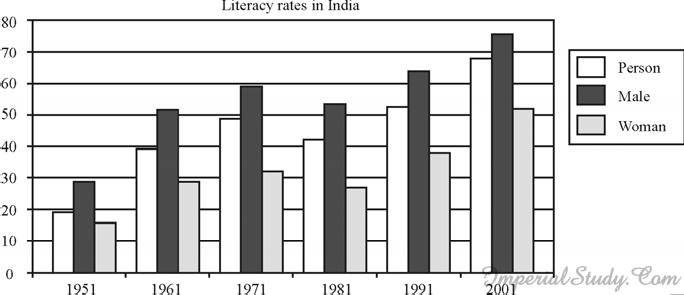
    Q.5. Study the graph and answer the following questions : [CBSE 2010]

    (a) By how much have literacy rates of the population gone up since 1951? 1
    (b) Why is the literacy rate lower among women? 1
    (c) Explain two measures introduced by the government to improve enrolment in elementary
    education in the country. 2
    Ans. (a) Literacy rate of population in 1951 was 19%, while in 2001 the rate shot up to 65%.
    So there is an increase of 46% in 50 years.

    (b) Literacy rate is low among women because of sex-discrimination. Females are not
    provided equal opportunities of education in rural areas as of male members of family.
    (c)
    Sarva Siksha Abhiyan : Main objective of this initiative introduced by Central
    government was to provide elementary education to all children in the age group of 6-14
    years by 2010.
    Mid-day Meal Scheme : This scheme was introduced to encourage attendance and
    retention of children and improve their nutritional status.
    Q.6. Why did Japan emerge as a developed country inspite of its poor natural resource?
    [2010 (T-1)]
    Ans.
    Japan emerged as a developed country inspite of its poor natural resource because :
    (i) as they did not have any other resource they invested in the development of human
    resource and import other required resources.
    (ii) they invested in better health and education facilities for people to make them efficient so
    that they can efficiently use resources like land and capital.
    (iii) efficiency and the technology evolved by the educated and literate people have made it
    rich and developed.
    (iv) they provide skill based education to the population so that they largely supported in the
    national income.
    Q.7. Discuss about the employment scenario in the three sectors in India. [2010 (T-1)]
    Ans. Primary Sector :
    Agriculture is the most labour absorbing sector of the economy. In recent
    years, there has been a decline in the dependence of population on agriculture partly because
    of disguised unemployment. Some of the surplus is moving from primary to secondary or
    tertiary sectors.
    Secondary Sector : Small scale manufacturing units absorb most of the labour in secondary
    sector.
    Tertiary Sector : Various new services have started employing labour in tertiary sector like
    biotechnology, information technology and so on.
    Q.8. “In the past and present migration of the people from rural to urban areas has shown
    an upward trend.” What factors compel the rural people to migrate to cities?
    [2010 (T-1)]
    Ans.
    People have started moving from rural to urban areas because of the following factors :
    (i)
    Education facilities : Urban areas have more organised and better quality education
    facilities opportunities vocational education and education in specialised areas has
    increased in urban areas. In urban areas focus is on increasing access, quality,
    vocationalisation and networking on the use of information technology.
    (ii)
    Health facilities : Availability of better hospitals and medical facilities make people move
    from rural to urban areas. States like Bihar and Uttar Pradesh has poor health indices.
    Therefore, in search of proper medical assistance people often move from rural to urban
    sectors.
    (iii)
    Employment facilities : Disguised unemployment in primary sector and rise of
    employment opportunities in secondary and tertiary sector has given rise to migration of
    people from rural areas to urban areas. In order to increase the income of family, people
    move from one occupation to another and one area to another.

    Q.9. How does Sarva Shiksha Abhiyan help in improving elementary education in India?
    [2010 (T-1)]
    Ans.
    ‘Sarva Shiksha Abhiyan’ aims at providing elementary education to all children in the age group
    of 6-14 years of age by the year 2010. It is the initiative of central government in partnership
    with the states, the local government and the community for achieving the goal of
    universalisation of elementary education.
    As a result of Sarva Shiksha Abhiyan there has been a significant growth in literacy rate from
    18% in 1951 to 65% in 2001. The primary school system has expanded to over 5,00,000
    villages in India. Mid day meal scheme has also started by government to ensure attendence
    and improve nutritional states of the children. Sarva Shiksha Abhiyan has added to the literate
    population of India.
    Q.10. Explain some strategies made by Government to solve the problem of unemployment in
    India. [2010 (T-1)]
    Ans.
    (i) Opening schools in villages : Opening vocational and elementary schools in villages
    create employment opportunities for people living these. Earlier people were involved in
    primary sector only but now they have better employment opportunities in other sectors
    also.
    (ii)
    Small scale manufacturing : Opening opportunities of self-employment in the form of
    small scale manufacturing units like basket weaving etc adds to the employment
    opportunities in removes disguised and seasonal unemployment away people.
    (iii)
    Introduction to modern farming methods : Use of modern farming methods gave the
    surplus members of family to get involved in other employment opportunities.
    (iv)
    Proper health facilities : Improvement in health facilities in urban and rural areas
    improved in quality of human resource which in turn work more efficiently and
    contributed to national income.
    Q.11. How the investment in Human Capital can be of immense importance for a society as a
    whole? State any four advantages. [2010 (T-1)]
    Ans.
    Human Capital can be defined as the knowledge, ability, skill and physical capactity of the
    people which help them to produce more.
    Human beings can be turned into resources only if their qualitative aspects are developed.
    Education and health are the major human resource inputs of a country. Human capital is
    beneficial both individually as well as socially.
    (i) Human capital contributes to the social development of the country.
    (ii) Human capital contributes to the economic development of the country.
    (iii) Human capital helps in proper utilisation of resources available or imported in the country.
    (iv) Human capital also contributes in the race of development from an underdeveloped to a
    developed nation.
    Q.12. Explain difference between vicious and virtuous cycle of life with reference to human
    resource. [2010 (T-1)]
    Ans.
    Quality of present human resource affects the quality of human resource for the coming
    generation. For example, educated parents are found to invest more heavily on the education,
    health and nutrition of their child. They are more conscious about the qualtiy upbringing of
    their child. Thus, they create a virtuous cycle of life.

    On the other hand, uneducated parents who are themselves lacking in education, health,
    nutrition and hygiene and are not conscious of the importance of these in the lives of their
    children. They are unable to provide quality upbringing of their children. Thus, they create a
    vicious cycle of life.

  • SHORT ANSWER TYPE QUESTIONS (3 MARKS) of People as Resources Class 9th Social Science Economics

    SHORT ANSWER TYPE QUESTIONS (3 MARKS)


    Q.1. Is begging an economic activity?
    Ans.
    No. Begging is a non-economic activity. Two reasons can be given in support of it. One, the
    beggar receives money without doing anything. Second, begging is an unlawful activity and
    cannot become an economic activity.
    Q.2. Why are domestic services performed by women not treated as economic activities?
    Ans. Domestic Services by Women.
    In India, most women generally look after domestic affairs like cooking of food, washing of
    clothes, cleaning of utensils, looking after children, etc. They are not treated as
    economic / productive activities. This is mainly because of two reasons :
    (i) Such activities are performed out of love and affection and hence their valuation is not
    possible.
    (ii) They do not add to the flow of goods and services in the economy.
    Q.3. Are the following activities economic or non-economic activities? Give reasons.
    (a) Vilas sells fish in the village market.
    (b) Vilas cooks food for his family.
    (c) Sakal works in a private firm.
    (d) Sakal looks after his younger brother and sister.
    Ans. (a) It is an economic activity, as it involves remuneration.
    (b) It is a non-economic activity, as it is a domestic service.
    (c) It is an economic activity, as it is done in expectation of monetary reward.
    (d) It is a non-economic activity, as it is done out of love and affection.
    Q.4. Differentiate between Market Activities and Non-Market Activities.
    Ans. Difference between Market Activities and Non-Market Activities.
    Economic activities can be classified into market activities and non-market activities. Market
    activities involve remuneration to anyone who performs the activity. These include production
    of goods and services for sale in the market. On the other hand, non-market activities are the
    production activities performed for self-consumption. These include consumption and
    processing of primary products and own account production of fixed assets.
    Q.5. Differentiate between voluntary and involuntary unemployment. Give an example.
    Ans.
    A person is said to be unemployed when he is able and willing to work at the prevailing wage
    rate but does not find work. This is involuntary unemployment. If some persons are voluntarily
    unemployed (i.e., they prefer to remain out of work at prevailing wage rates) they will not be
    treated as unemployed. This is voluntary unemployment.
    Q.6. Distinguish between labour force and work force.
    Ans.
    Labour force of a country includes all those persons in the age group of 15-60, who are
    actually working or willing to work. Workforce, on the other hand, consists of persons who are
    actually engaged in some kind of work and excludes those who are willing to work but do not
    find work. Thus, the difference between the two (i.e. labour force and workforce) is the number
    of persons unemployed.
    Q.7. What is the nature of unemployment as found in India?
    Ans. Nature of unemployment in India.
    In India, unemployment is widespread. Unemployment is found both in its rural and urban
    areas. There is seasonal and disguised unemployment in its rural areas. People here are
    dependent on agriculture. Certain months do not provide much work to the people depending
    upon agriculture.
    In urban areas, educated unemployment has become a serious problem. Many educated youths
    are not able to find jobs. Unemployment among graduates and post-graduates has increased
    faster than among the matriculates.
    Q.8. ‘Unemployment is an economic as well as a social evil.’ Explain the statement.
    Ans. Unemployment — A Serious Problem
    Today, unemployment is considered one of the most threatening problems before the country.
    The society is deprived of the goods and services that the unemployed people could have
    produced. Unemployment among the educated persons is more serious. This is due to
    investments made in them.
    Unemployment is not only an economic evil, it is a social problem too. Unemployment spreads
    social unrest and tension as unemployed people are a frustrated class of the society.
    Q.9. Discuss the factors responsible for the distribution of population in India.
    [CBSE 2010]
    Ans. Physical factors
    like shape and height of land, resources, climate etc. that affect distribution
    of population in India like;
    Resources : Areas rich in resources (e.g., coal, oil, wood etc.) tend to be densely populated
    like western Europe.
    Shape and height of land : Low land which is flat, e.g., Ganges valley in India.
    Climate : Areas with moderate temperature climates tend to be densely populated as there is
    enough rain and heat to grow crops like U.K.
    Human factors : Political, social and economic factors also affect distribution of population
    in India like good job opportunities encourage high population densities, particularly in large
    cities like Mumbai, Bangalore, Ahmedabad having dense population.
    z Countries with stable governments tend to have high population density.
    Q.10. Why is human resource the most important resource? What steps can be taken to
    improve the quality of human resource? How does an improved quality of human

    resource help in establishing a virtuous cycle? [CBSE 2010]
    Ans. z Existing ‘human resource’ is further developed by becoming more educated and healthy,
    which adds to the productive power of the country just like ‘physical capital formation’. So
    human resource is the most important resource.
    z Steps to be taken to improve quality of human resource :
    Quality of human resource can be improved through better education, food and health
    facilities. The quality of population depends upon the literacy rate, health of a person
    indicated by life expectancy and skill formation acquired by the people of the country.
    Role of improved quality of human resource in establishing a virtuous cycle :
    z Better contribution to productive power of country : Existing human resource with
    good educational background can acquire specific skills in a better way and can contribute
    to national productivity more efficiently.

    z Higher earnings and greater contributions to society :
    Improved quality of human resources can give higher rates of return in future in the form
    of higher earnings and greater contributions to society.
    Q.11. How does unemployment have a detrimental impact on the overall growth of an
    economy? [CBSE 2010]
    Ans.
    z Wastage of manpower resource : In case of unemployment, manpower who is an asset for
    an economy turns into liability because utilisation of manpower becomes nil.
    z Economic overload : Unemployment tends to increase economic overload because
    dependence of unemployed on the working population increases. So the quality of life is
    adversely affected.
    z Unemployement leads to social waste : Inability of educated people who are willing to
    work to find gainful employment implies a great social waste. Increase in employment in
    an indicator of a depressed economy.
    Q.12. What is the Sarva Shiksha Abhiyan? What are its objectives? [2010 (T-1)]
    OR
    Write a short note on sarva Shiksha Abhiyan.
    Ans.
    Sarva Shiksha Abhiyan’ is a significant step towards providing elementary education to all the
    children of the age group 6-14 years by the year 2010. It is a time bound initiative of central
    government, in partnership with the states, the local government and the community for
    achieving the goal of universalisation of elementary education. They also took an initiative to
    increase the enrollment of students in elementary education by introducing the schemes like
    mid-day meal.
    Q.13. Define human resource. When does a human resource become human capital?
    [2010 (T-1)]
    Ans.
    The population of a country available for the production activities is called human resource.
    Human resource becomes human capital when there is investment made in the form of
    education, training and medical care. When the existing ‘human resource’ is further developed
    by becoming more educated and healthy, we call it ‘human capital formation’. Human capital
    adds to the productive power of the country. It is the stock of skills and productive knowledge
    embodied in them.
    Q.14. What is unemployment? How many types it is? Explain. [2010 (T-1)]
    OR
    How will you explain the term unemployment?
    OR
    What is meant by unemployment? Name the types of unemployment that exist in rural
    as well as urban areas.
    OR
    Define unemployment and explain its any two types.
    Ans.
    Unemployment is said to exist when people who are willing to work at the prevailing wages
    rates cannot find jobs. When we talk of unemployed people, we refer to those in the age group
    of 15-59 years. Children below 15 years of age and the old people above 60 are not considered
    while counting the number of unemployed In India, unemployment is found both in rural and urban areas. In rural areas there is seasonal
    and disguised unemployment. In urban areas there is educated unemployment.
    Unemployment in rural areas :
    (i) Disguised unemployment : When more persons are working in a job than actually
    required, the situation is termed as disguised unemployment. For example, if in an
    agricultural activity eight people are engaged but this work activity actually requires the
    services of five people, then three persons are extra. It these three people out of eight are
    withdrawn, total production will remain unaffected.
    (ii)
    Seasonal Unemployment : Seasonal unemployment occurs when people are able to find
    jobs only during some months of the year. This kind of unemployment is generally found
    in agricultural sector.
    Umemployment in urban sector :
    Educated unemployment :
    Many people who are unable to get employment even after
    having academic and professional qualification are called educated unemployed.
    Q.15. What is Infant Mortality Rate? Why infant mortality rate is decreasing? [2010 (T-1)]
    Ans.
    Infant Mortality Rate (IMR) is the total number of children dying under one year of age in a
    particular period of time.
    Infant Mortality Rate is decreasing due to following reasons :
    (i) Increase in life expectancy due to improved medical facilities.
    (ii) Better protection of children from infection, ensuring nutrition along with mother and
    child care.
    Q.16. Why is human capital significant? Mention three points. [2010 (T-1)]
    OR
    Why is the human resource important for development?
    OR
    People are the greatest resource that a country has. Explain.
    Ans.
    Human resource is a positive asset and a precious national resource which needs to be
    cherished, nurtured and developed with tenderness and care, coupled with dynamism.
    Contribution to national income : Skilled, educated and healthy population work for
    contribution in production activities. Better specialised labour can be easily adapted.
    Therefore, investment in human capital yields a return just like investment in physical capital.
    Investment in human resource can give high rates of return in the future. This investment on
    people is the same as investment in land and capital. A child with proper education and health
    can yield a high return in the future in the form of higher earnings and greater contribution
    to society.

    Q.17. What does IMR stand for? Write its functions. [2010 (T-1)]
    Ans. Infant mortality rate (IMR) is the number of children who die under one year of age in a year.
    IMR has come down form 147 in 1951 to 75 in 2000.
    Functions of IMR is that it indicates the increase in life expectancy and improvement in child
    care which is useful in assessing the future progress of the country. Reduction in infant
    mortality involves the protection of children from infection, ensuring nutrition along with
    mother and child care.

    Q.18. Explain in detail the disadvantages of unemployment. [2010 (T-1)]
    Ans. Disadvantages of unemployment are :
    (i) It leads to wastage of man power resources. It turns the population into liability for
    economy instead of asset. It even fills the country’s youth with the feeling of hopelessness
    and despair.
    (ii) It increases the economic load. The dependence of unemployed on the working population
    increases. Due to unemployment which adversely affects the quality of life of an
    individual as well as society.
    (iii) It affects the overall growth of an economy. It indicates a depressed economy and wastage
    of resources which could have been gainfaully employed.


    Q.19. Give three measures taken by government to improve literacy condition in India.
    [2010 (T-1)]
    Ans.
    (i) Opening of Navodaya Vidyalayas : Government has started to estabish Navodaya
    Vidyalayas in each district vocational streams have been developed to equip large number
    of high school students with occupations related to knowledge and skills.
    (ii)
    Sarva Shiksha Abhiyan : It is a significant step towards providing elementary education
    to all the children of age group 6-14 years. It is an initiative of the central government in
    partnership with states, local government and the community for achieving the goal of
    universalisation of elementary education.
    (iii)
    Mid-day Meal Scheme : It is a programme aimed to encourage attendance and retention
    of children in schools and improve their nutritional status.

    Q.20. Suggest any three ways to transform population load into an asset. [2010 (T-1)]
    Ans. The three ways to transform population load into an asset are :
    (i) To improve literacy rate : Education provides new aspirations and developed values of
    life. Education helps in enhancing the national income, cultural richness nad increases the
    efficiency of governance.
    (ii) Health : The health of a person helps him to realise his potential and the ability to fight
    illness. Increase in longevity of life in an indicator of good quality of life marked by self


    confidence. It involves protection of children from infection, ensuring nutrition and along
    with mother and child care.
    (iii)
    Formation of skills : Providing vocational and skilled based education helps the people
    to get employment and therefore they contribute to the national income later on.
    Q.21. What are the two types of economic activity? State two characteristics of each.
    [2010 (T-1)]
    Ans.
    Economic activities are those activities which add value to the national income. Economic
    activities have two parts :
    (i) Market activities.
    (ii) Non-market activities.
    Market activities : (i) These are the activities performed for payment or profit. (ii) They
    include production of goods and services.
    Non-market activities : (i) These involve production for self-consumption. (ii) It includes
    consumption of primary production and production of fixed assets.

    Q.22. How are children of educated parents different from those of uneducated parents? Give
    three points of difference. [2010 (T-1)]
    Ans.
    (i) Children of educated parents get better opportunity and support in their education.
    (ii) Their nutritional values are taken more care by the educated parents in comparison to
    uneducated parents.
    (iii) They do not lack in hygiene as the educated parents are conscious about it.

  • Multiple Choice Questions [Solved] [1 Marks] of People as Resources Class 9th Social Science Economics


     MULTIPLE CHOICE QUESTIONS (1 MARK)


    Q.1. Why is literacy rate low among the females?
    (a) lack of equal education opportunities (b) lack of transport facilities
    (c) lack of infrastructure (d) lack of income
    Ans. (a)
    Q.2. In which state was the literacy rate highest as per 2001 study?
    (a) Kerala (b) Madhya Pradesh (c) Bihar (d) Orissa
    Ans. (a)
    Q.3. Which of the following is a significant step towards providing elementary education to
    all the children in the age group of 6-14 years? [CBSE 2010]
    (a) Sarva Siksha Abhiyan (b) Adult Education Programme

    (c) Mid-day meal (d) None of the above
    Ans. (a)
    Q.4. Market activity refers to production for

    (a) exchange (b) earning income (c) earning profit (d) all the above
    Ans. (d)
    Q.5. Increase in longevity of life is an indicator of
    (a) good quality of life (b) improvement in health sector
    (c) better HDI (Human Development Index) (d) all the above
    Ans. (a)
    Q.6. Self-consumption is
    (a) non-production activity (b) non-market activity

    (c) non-economic activity (d) none of the above
    Ans. (b)
    Q.7. Secondary sector includes

    (a) trade (b) marketing (c) manufacturing (d) education
    Ans. (c)
    Q.8. One who can read and write in any language with understanding is termed as
    (a) student (b) adult (c) child (d) literate
    Ans. (d)
    Q.9. What is India’s position in scientific and technical manpower in the world?
    (a) first (b) second (c) third (d) fourth
    Ans. (c)
    Q.10. Investment in human capital is expenditure on
    (a) education (b) training (c) medical care (d) all the above
    Ans. (d)
    Q.11. The scheme for the establishment of residential schools to impart education to talented
    children from rural areas is
    (a) Kendriya Vidyalayas (b) Navodaya Vidyalayas
    (c) Sarvodaya Vidyalayas (d) None of the aboves
    Ans. (b)
    Q.12. Services of housewives are included in
    (a) national income (b) domestic income (c) household income (d) none of the above
    Ans. (d)
    Q.13. Infant mortality rate refers to the death of a child under the age of
    (a) 1 year (b) 2 years (c) 3 years (d) 4 years
    Ans. (a)
    Q.14. Choose the non-market activities
    (i) Vilas sells fish in the village market (ii) Vilas cooks food for his family
    (iii) Sakal works in a private firm
    (iv) Sakal looks after his younger brother and sister
    (a) (i) & (ii) (b) (iii) & (iv) (c) (i) & (iii) (d) (ii) & (iv)
    Ans. (d)
    Q.15. Choose the primary sector activities
    (i) Forestry (ii) Poultry farming
    (iii) Animal husbandry (iv) Manufacturing
    (a) (i) (b) (i), (ii), (iii) (c) (ii), (iii), (iv) (d) All the above
    Ans. (b)
    Q.16. Tertiary sector provides
    (a) services (b) goods

    (c) both goods and services (d) none of the above
    Ans. (a)


    Q.17. Quality of population depends upon [CBSE 2010]
    (a) literacy rate (b) health (c) skill (d) all the above
    Ans. (d)
    Q.18. People as a resource refers to their
    (a) educational skills (b) productive skills (c) health skills (d) none of the above
    Ans. (b)
    Q.19. Seasonal unemployement is found in
    (a) urban areas (b) rural areas

    (c) in remote areas (d) both in rural and urban areas
    Ans. (b)

    Q.20. Bribe taking is an
    (a) economic activity (b) marketing activity

    (c) non-economic activity (d) none of the above
    Ans. (c)

    Q.21. The persons who are not working by choice are covered under
    (a) seasonal unemployment (b) disguised unemployment

    (c) educated unemployment (d) none of the above
    Ans. (d)

    Q.22. Disguised unemployment occurs when the number of persons working on a farm is
    (a) only what is required (b) more than required
    (c) less than required (d) None of the above
    Ans. (b)
    Q.23. If a person in rural areas cannot find jobs during some months of the year, which type
    of employment is this called? [CBSE 2010]
    (a) Structural unemployment (b) Cyclical unemployment
    (c) Seasonal unemployment (d) None of these
    Ans. (c)
    Q.24. What is the literacy rate of India as per 2001 census? [CBSE 2010]
    (a) 60% (b) 62% (c) 65% (d) 70%
    Ans. (c)
    Q.25. According to 2001 census, sex-ratio of India is : [CBSE 2010]
    (a) 921 females per 1000 (b) 930 females per 1000
    (c) 928 females per 1000 (d) 933 females per 1000
    Ans. (b)
    Q.26. Which of the following sectors is related to agriculture, forestry and dairy?
    [CBSE 2010]
    (a) Primary Sector (b) Tertiary Sector (c) Secondary Sector (d) None of the above
    Ans. (a)
    Q.27. PHC stands for [CBSE 2010]
    (a) Public Health Club (b) Private Health Club

    (c) Primary Health Centre (d) None of these
    Ans. (c)


    Q.28. In which of the following fields is disguised unemployment found? [2010 (T-1)]
    (a) Industries (b) Agriculture (c) Mining (d) Fisherise
    Ans. (b)

    Q.29. What is the major aim of Sarva Siksha Abhiyan? [2010 (T-1)]
    (a) To provide elementary education to women
    (b) To provide elementary education to the rural poor
    (c) To provide elementary education to all children in the age group 6-14 years
    (d) To provide elementary education to the urban poor
    Ans. (c)

    Q.30. Which one of the following is related to the tertiary sector? [2010 (T-1)]
    (a) Agriculture (b) Forestry (c) Mining (d) Communication
    Ans. (d)
    Q.31. Which one among the following is the most labour absorbing sector? [2010 (T-1)]
    (a) Agriculture (b) Fisheries (c) Poultry farming (d) Mining
    Ans. (a)
    Q.32. Which is an economic activity in the following? [2010 (T-1)]
    (a) Work of Nurse at her home (b) Work of Doctor at their home
    (c) Work of Teacher in the school (d) None of the above
    Ans. (c)
    Q.33. Which one of the following is considered important to create a ‘virtuous cycle’ by the

    parents? [2010 (T-1)]
    (a) To sand their children to the school
    (b) To provide goods food to their children
    (c) To join their children in corporate schools
    (d) To take care of the health and education of their children
    Ans. (d)
    Q.34. Infant mortality rate in 2000 was : [2010 (T-1)]

    (a) 85 (b) 70 (c) 75 (d) 35
    Ans. (c)
    Q.35. What is the life expectancy in India according to the census of 2000? [2010 (T-1)]
    (a) 72 years (b) 53 years (c) 64 years (d) 80 years
    Ans. (c)
    Q.36. Tenth Plan endeavoured to increase enrolment in higher education from 6% to :
    [2010 (T-1)]
    (a) 7% (b) 9% (c) 10% (d) 12%
    Ans. (b)
    Q.37. Decrease in IMR (Infant Mortality Rate) of a country signifies : [2010 (T-1)]

    (a) Increase in life expectancy (b) Increase in GNP
    (c) Economic development of a country (d) Increase in number of colleges in a country
    Ans. (a)


    Q.38. Strike the odd one out (with reference to population) : [2010 (T-1)]
    (a) Education (b) Medical Care (c) Training (d) Computers
    Ans. (d)
    Q.39. The number of females per thousand males refers to : [2010 (T-1)]

    (a) Sex Ratio (b) Literacy Rate
    (c) Infant Mortality Rate (d) Birth Rate

    Ans. (a)
    Q.40. At Rampur village, in an agricultural field 6 men are required for weeding, but 10 people
    are doing the work. This kind of employment is known as : [2010 (T-1)]

    (a) Disguised unemployment (b) Seasonal unemployment
    (c) Rural unemployment (d) All of these

    Ans. (a)
    Q.41. Which one of the following is not a cause of urban unemployment? [2010 (T-1)]
    (a) Mass migration from rural to urban areas
    (b) Slow rate of economic development
    (c) Maladjustment between the demand and supply of labour
    (d) Caste system
    Ans. (d)
    Q.42. Census refers to : [2010 (T-1)]
    (a) Total no. of babies born
    (b) Official counting of population done after every then years
    (c) Total no. of infants that are vaccinated
    (d) Recording of Births and Deaths every year
    Ans. (b)
    Q.43. Which one of the following statements is correct with reference to tertiary sector?
    [2010 (T-1)]
    (a) In these activities goods are either grown on the earth or dug out from the earth
    (b) These activities transform primary goods into some commodities with the help of manual
    labour or machines
    (c) These activities generate services rather than goods
    (d) This sector is primarily known as service sector
    Ans. (d)
    Q.44. When there is investment made in the form of education, training and medical care, the
    population becomes : [2010 (T-1)]
    (a) Working capital (b) Human capital (c) Fixed capital (d) Capital growth
    Ans. (b)
    Q.45. Education contributes towards the growth of a society. It also enhances the : [2010 (T-1)]

    (a) National income (b) Cultural richness
    (c) Efficiency of governance (d) All of the above

    Ans. (d)

    Q.46. Educated unemployment is partly because of : [2010 (T-1)]
    (a) slower rate of industrial expansion (b) improper educational system
    (c) both a and b (d) none of these
    Ans. (c)
    Q.47. The workforce population of India includes people from the age group of : [2010 (T-1)]
    (a) 10-59 years (b) 15-59 years (c) 20-59 years (d) 25-59 years
    Ans. (b)
    Q.48. Activities like trade, transport, health, banking, insurance etc. are included in the
    ________ sector. [2010 (T-1)]
    (a) Secondary (b) Primary

    (c) Manufacturing (d) Tertiary
    Ans. (d)

    Q.49. In rural India, two types of unemployment exist : [2010 (T-1)]
    (a) Disguised and optional (b) Seasonal and undisguised

    (c) Seasonal and optional (d) Seasonal and disguised
    Ans. (d)

    Q.50. Number of babies born for every 1000 people during a year is called [2010 (T-1)]
    (a) Death rate (b) Birth rate

    (c) Growth rate (d) Population increase
    Ans. (b)


    Q.51. In the secondary sector, which is the most labour absorbing unit? [2010 (T-1)]
    (a) Small scale manufacturing
    (b) Medium scale manufacturing
    (c) Large scale manufacturing
    (d) None of these
    Ans. (a)
    Q.52. Which one of the following cannot be regarded as building of the human capital in a
    country? [2010 (T-1)]

    (a) Spending resources on education (b) Providing training of industrial workers
    (c) Increasing salary of workers (d) Providing health to all
    Ans. (c)

    Q.53. Government has set schools in each district called [2010 (T-1)]
    (a) Army Schools
    (b) Navodaya Vidyalayas
    (c) Sainik Schools
    (d) Missionary Schools
    Ans. (b)
    Q.54. Number of deaths for every 1000 people in a year is called [2010 (T-1)]

    (a) Death Rate (b) Birth Rate

    (c) Decrease Rate (d) Population Decrease
    Ans. (a)


  • NCERT Textbook Questions Solution’s of People as Resources Class 9th Social Science Economics

    Questions Within The Lesson


    Q.1. Looking at the photograph (as given in the textbook) can you explain how a doctor,
    a teacher, a engineer and a tailor are an asset to the economy?
    Ans.
    Doctors, teachers, engineers and tailors are assets to the economy because of their existing
    skills and abilities.
    Q.2. Do you notice any difference between the two friends? What are those?
    Ans. Difference between two friends — Sakal and Vilas
    (i) Sakal’s parents wanted him to study, while Vilas’s mother cannot afford to send him to
    school. Moreover, Vilas was a patient of arthritis.
    (ii) Sakal was meritorious and interested in studies, while Vilas wasn’t.
    (iii) Sakal completed his vocational course in computer and got a well paid job, while Vilas
    was faced to sell fish like his mother.
    (iv) Sakal earns a good amount of money, while Vilas earns only a meagre income.
    Q.3. Say whether these activities are economic or non-economic activities : Vilas sells fish in
    the village market. Vilas cooks food for his family. Sakal works in a private firm. Sakal
    looks after his younger brother and sister.
    Ans.
    See S.A.Qs. No. 3.
    Q.4. (a) Has the literacy rate of the population increased since 1951?
    (b) In which year India had the highest literacy rates?
    (c) Why literacy rate is high among the males of India?
    (d) Why are women less educated than men?
    (e) How would you calculate literacy rate in India?
    (f) What is your projection about India’s literacy rate in 2010?
    Ans.
    (a) Yes. (b) In 2001.
    (c) Males in India are provided better educational opportunities.
    (d) Because of sex discrimination, females are not treated at par with males. Females are not
    provided equal educational opportunities.
    (e)
    Literacy Rate = Total literate people in the age group of 17 years and above
    Total number of people in the age group of 17 years and above
    (f) India’s literacy rate may rise to nearly 75 percent.
    Table 2.1 : Number of institutions of higher education, enrolment and facility
    Year Number of Number of Students Teachers
    Colleges Universities
    1950–51 750 30 2,63,000 24,000
    1990–91 7,345 177 49,25,000 2,72,000
    1996–97 9,703 214 67,55,000 3,21,000
    1998–99 11,089 238 74,17,000 3,42,000
    Q.5. Discuss this table in the classroom and answer the following questions.
    1. Is the increase in number of colleges adequate to admit the increasing number of students?
    2. Do you think we should have more number of universities?
    3. What is the increase noticed among the teachers in the year 1998-99.
    4. What is your idea about future colleges and universities?
    Ans. 1. Yes. 2. No.
    3. The number of teachers in 1998-99 increased by 21,000m when compared with that in
    1996–97.
    4. The number of colleges and universities in future will increase.
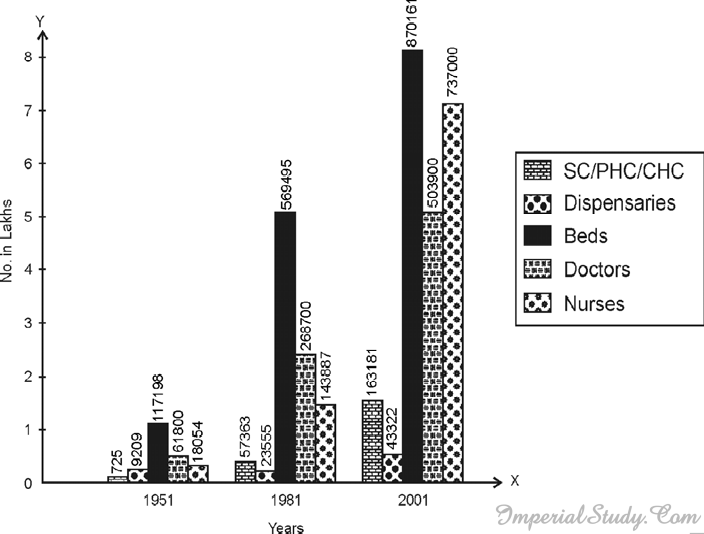
    Q.6. Table 2.2 : Health infrastructure over the years.

    1951 1981 2001
    SC/PHC/CHC
    Dispensaries and Hospitals
    Beds
    Doctors (Allopathy)
    Nursing Personnel
    725
    9,209
    1,17,198
    61,800
    18,054
    57,363
    23,555
    5,69,495
    2,68,700
    1,43,887
    1,63,181
    43,322
    8,70,161
    5,03,900
    7,37,000


    Study the Table 2.2 and answer the following questions.
    1. What is the percentage increase in dispensaries from 1951 to 2001?
    2. What is the percentage increase in doctors and nursing personnel from 1951 to 2001?
    3. Do you think the increase in the number of doctors and nurses adequate for India?
    If not, why?
    4. What other facilities would you like to provide in a hospital?
    5. Discuss about the hospital you have visited?
    6. Can you draw a graph using this table?
    Ans.
    1. 370 per cent
    2. 715 per cent increase in case of doctors and 3982 per cent in case of nursing personnel.
    3. No, because the number of doctors and nurses per thousand of population is very low
    compared to advanced countries.
    4. There should be sufficient number of doctors, nurses and beds in a hospital. Besides, a
    hospital must be equipped with all modern facilities.
    5. I have visited a MCD hospital in Delhi. The hospital had all basic facilities.
    Graph showing health infrastructure over the years.
     

    QUESTIONS IN THE EXERCISE


    Q.1. What do you understand by ‘people as a resource’?
    Ans.
    People as a resource is a way of referring to the country’s working population in terms of their
    existing productive skills and abilities.
    Q.2. How is human resource different from other resources like land and physical capital?
    Ans.
    Human resource is different from other resources like land and physical capital. Human
    resource refers to human capital which can make use of land and capital. Land and capital
    cannot become useful on their own.
    Population becomes a human resource when there is investment made in form of education,
    training and medical care. On the other hand, land is a natural resource. And physical capital
    includes tools, machines, buildings, raw materials, etc. Land and physical capital, therefore, are
    tangible.
    Q.3. What is the role of education in human capital formation?
    Ans.
    Education is the most important component of human resource development. The role of
    education in human capital formation can be judged from the following facts :
    (i) Education increases labour productivity.
    (ii) Education modifies /improves human behaviour.
    (iii) It develops personality and sense of national consciousness among the people which are
    important for rapid economc growth.
    (iv) It promotes science and technology.
    Q.4. What is the role of health in human capital formation?
    Ans. Role of Health in Human Capital Formation.
    Unhealthy persons become a liability and healthy persons prove an asset for the economy.
    Therefore, improvement in the health status of the population is regarded very essential.
    Improved health contributes to economic growth in the following ways :
    (i) It reduces production loss caused by worker’s illness.
    (ii) It increases the efficiency of workers.
    (iii) It permits the use of natural and other resources.
    (iv) It increases the enrolment of children in schools and makes them better able to learn.
    Q.5. What part does health play in an individual’s working life?
    Ans. Role of health in an individual’s working life.
    Health is a yardstick of one’s well-being. Efficiency of a person largely depends on his health.
    If a person falls sick quite often, he will not be able to do his job/work efficiently. Therefore,
    his income will be low. Because of low level of income, he will not be able to get proper food
    and proper education for his children. This will further reduce his efficiency of work and
    thereby income. In fact, good health improves the quality of life.
    Q.6. What are the various activities undertaken in the primary sector, secondary sector and
    tertiary sector?
    Ans. Classification of Economic Activities.
    The economic activities of an economy can broadly be classified into three main producing
    sectors. These are :
    Primary sector. Primary sector produces goods by exploiting natural resources. Therefore, the
    activities of this sector include agriculture, forestry, animal husbandry, fishing, poultry and
    mining.
    Secondary sector. It converts raw materials into finished goods. It includes all manufacturing
    and construction activities.
    Tertiary sector. This sector includes trade, transport, communication, banking, education,
    health, tourism, insurance etc. i.e. all those producing services.

    Q.7. What is the difference between economic activities and non-economic activities?
    Ans. Difference between Economic and Non-Economic Activities.

    Economic Activities Non-Economic Activities
    1. Economic activities bring income
    to their performers.
    1. Non-economic activities do not bring
    income to their performers.
    2. Income accruing from economic
    activities is included in the country’s
    national income.
    2. These activities are not accounted in the
    national income.

    Q.8. Why are women employed in low-paid work?
    Ans.
    Women in India are generally employed in low-paid work. This is because of the reason that
    most women have meagre education and low skill formation as compared to men. They work
    under insecure working conditions. Besides, Indian women prefer to work at nearby places
    only. Also, they have to go on frequent maternity leave. All these factors force them to work
    at low wages. However, women with higher education and skill formation are paid at par with
    men.
    Q.9. How will you explain the term unemployment?
    Ans.
    Unemployment is said to exist when people who are willing to work at the current prevailing
    wages cannot find work/job. If some one is not interested in doing work at the ongoing wage
    rate or outside his/her domestic domain he/she will not be counted as unemployed.
    Q.10. What is the difference between disguised unemployment and seasonal unemployment?
    Ans. Disguised Unemployment.
    When more persons are working in a job than actually required, the situation is termed as
    disguised unemployment. For example, if in an agricultural activity eight people are engaged
    but this work/activity actually requires the services of five people, then three persons are extra.
    If these three people out of eight are withdrawn, total production will remain unaffected.
    Seasonal Unemployment.
    Seasonal unemployment occurs when people are able to find jobs only during some months of
    the year. This kind of unemployment is generally found in the agricultural sector.
    Q.11. Why is educated unemployment a peculiar problem of India?
    Ans. Problem of Educated unemployment.
    The joblessness among the educated, i.e. matriculates
    and above, is called educated unemployment. Unemployment problem signifies the wastage of
    human resources. If unemployment is high among the educated persons the quantum of
    wastage of resources will be greater. This is due to investments in education and skill
    formation. There is a feeling of hopelessness among the educated youth. India has to spend a
    lot of money on education every year. People who should have been assets for the economy
    have turned into a liability. In this way educated unemployment is one of the big problems for
    India.
    Q.12. In which field do you think India can build the maximum employment opportunity?
    Ans.
    India can build the maximum employment opportunity in the agricultural sector. Agriculture
    is the most labour absorbing sector of the economy. Multiple cropping may help a lot in this
    regard.

    Q.13. Can you suggest some measures in the education system to mitigate the problem of the
    educated unemployed?
    Ans. Measures to Reduce Educated Unemployment.
    The education system in India is not
    employment oriented. There is too much emphasis on general education rather than vocational
    education. More employment exchange offices may be opened in the country. Though these
    employment exchanges do not directly provide employment, they are of great assistance in
    directing the educated job seekers to the possible areas of employment.
    Q.14. Can you imagine some village which initially had no job opportunity but later came up
    with many?
    Ans.
    There was a village inhabited by several families, Initially the village was self-reliant in the
    sense that each family produced all goods to meet the needs of its members. But later, it came
    up with many job opportunities. One of the families decided to send one of its sons to an
    agriculture college. After completing his education, he became an agro-engineer in the village.
    Inspired by this, all the families of the village requested the panchayat to open a school in the
    village. The panchayat opened a school with the help of the government and a teacher was
    recruited for the school. After some time, one of the families sent its daughter for training in
    tailoring. After getting necessary training, she started stitching clothes for the villagers. Thus,
    there was another job – that of a tailor in the village. In this way, many jobs were created in
    the village.
  • Concept’s of People as Resources Class 9th Social Science Economics

    CONCEPTS
    * Human beings perform many activities which can be grouped into economic and non
    economic.
    Economic Activities : Economic activities refer to those activities of man which are
    undertaken for a monetary gain or to satisfy his/her wants. The activities of workers, farmers,
    shopkeepers, manufacturers, doctors, lawyers, taxi drivers, etc. fall under this category.
    Non-Economic Activities : Non-economic activities are ones that are not undertaken for any
    monetary gain. These are also called unpaid activities, e.g., Puja-paath, housekeeping, helping
    the poor or disabled, etc.


    *Classification of Economic Activities. Various economic activities can be classified into
    three main sectors, that is primary sector, secondary sector and tertiary sector. The 
    primary sector includes activities like agriculture, forestry, animal husbandry, fishing, poultry, farming and mining. In this sector, goods are produced by exploiting nature. In the secondary sector, manufacturing (small and large) and construction activities are included. The tertiary sector (also called service sector) provides various types of services like transport, education,banking, insurance, health, tourism, etc.


    *Market Activities and Non-Market Activities. Economic activities, i.e. production of goods
    and services can be classified into market activities and non-market activities. Market
    activities are performed for remuneration. Non-market activities are the activities carried out
    for self-consumption.


    *Activities of Women. Women generally look after domestic affairs like cooking of food,
    washing of clothes, cleaning of utensils, housekeeping and looking after children.


    *Human Capital. Human capital is the stock of skill and productive knowledge embodied in
    human beings. Population (human beings) become human capital when it is provided with
    better education, training and health care facilities.


    *People as a Resource. People as resource is a way of referring to a country’s workforce in terms of their existing skills and abilities.


    *Human Capital Formation. When the existing human resource is further developed by
    spending on making the workforce more educated and healthy, it is called human capital
    formation.


    *Quality of Population. The quality of population depends upon the literacy rate, life
    expectancy and skills formation acquired by the people of the country.


    *Role of Education. Education is the most important component of human resource
    development.
    In view of its contribution towards the growth of the society, government expenditure on
    education as a percentage of GDP rose from 0.64% in 1951-52 to 3.98% in 2002-03.
    However, our national goal is 6% of GDP.
    There has been considerable improvement in the country’s health standard. For instance, the
    life expectancy at the time of birth in India rose from 37.2 years in 1951 to 63.9 years in
    2001. Similarly, infant mortality rate has come down from 147 to 70 during the same time
    period.
    * Unemployment. Unemployment is said to exist when people who are willing to work at the prevailing wage rates cannot find jobs. When we talk of unemployed people, we refer to
    those in the age group of 15-59 years. Children below 15 years of age and the old people
    above 60 are not considered while counting the number of unemployed.


    * Nature of Unemployment in India. Seasonal unemployment occurs when people fail to get work during some months of the year (that is, during off-season). Farm labourers usually face this kind of problem. Disguised unemployment is another kind of unemployment found in
    rural areas. Such kind of problem arises due to excessive pressure of population on
    agriculture. Disguised unemployment refers to a situation wherein the number of workers in
    a job is more than actually required to do the job. The extra number of workers are
    disguisedly unemployed.
    Consequences of Unemployment :
    (i) Unemployment leads to wastage of manpower resource.
    (ii) Unemployment tends to increase the economic overload that is dependence of the
    unemployed on the working population.
    (iii) Unemployment may lead to increase in social unrest and tension.


    *Health. Health is another very important component of human resource development.
    Efficiency of workers largely depends on their health.

  • LONG ANSWER TYPE QUESTIONS (4 MARKS) of The Story of Village Palampur Class 9th Social Science Economics

    LONG ANSWER TYPE QUESTIONS (4 MARKS)


    Q.1. Why it is necessary to increase the area under cultivation? Explain.
    Ans.
    (a) Farming – main activity : In Palampur, farming is the main activity as 75% of population
    earn their living through farming. Unfortunately, not all people engaged in farming have
    sufficient land for cultivation. So it is necessary to increase area under cultivation.
    (b)
    Use of modern farming methods : Use of HYV seeds, improved methods of irrigation,
    pesticides, insecticides and chemical fertilisers and new harvesting techniques require
    larger farming land area of cultivation. In small area, they are not successful and the cost
    involved is also high.
    (c) Land area under cultivation is fixed in Palampur. Since 1960, in Palampur, there has been
    no expansion in land area. So some of the wastelands in the village had been converted
    to cultivable land. More alternatives are required of such type.
    Q.2. What is the main source of capital for medium and large farmers? How is it different
    from the small farmers? Explain.
    Ans.
    (a) Surplus wheat selling : Main source of capital for medium and large farmers is supply
    of surplus wheat in market as they own large area of cultivable land. They retain part of
    wheat for their own use and sell rest of wheat in market. While for small farmers, no
    surplus wheat is available so they arrange capital from large farmers or village
    moneylenders or the traders.
    (b)
    Extra work to landowner or large farmers : In order to get loan from landowner or large
    farmers they have to pay higher interest rates and also extra work on their fields to repay
    the loan, while medium and large farmers can devote their full time to their own land.
    Q.3. Why modern farming methods require more inputs which are manufactured in industry?
    Explain.
    Ans.
    (a) A modern farming method requires higher investment : Use of HYV seeds, pesticides,
    insecticides, electric tubewells etc. require more initial investment as all are costly affairs.

    (b) HYV seeds require more water, chemical fertilisers : HYV seeds would give higher
    yield only in combination of HYV seeds, irrigation, chemical fertilisers, pesticides etc.
    (c)
    More electricity consumption : Use of electric tubewells, mechanical harvesters require
    more electricity for their operation to produce better results.
    Q.4. What were the main terms on which Savita got a loan from Tejpal Singh? How can
    Savita be benefitted if she gets a loan from the bank?
    Ans. Savita arranged money for capital from a big farmer – Tejpal Singh, who belongs
    to the same village.
    Main terms decided to get loan of Rs 3000.
    (a) Interest rate of 24%.
    (b) Loan given for the period of 4 months.
    (c) Extra work to be done by Savita on Tejpal Singh’s field.
    (d) Tejpal Singh would give her Rs 35 per day as wages.
    These conditions were very tough for a small farmer like Savita but these had to be agreed
    upon. If she could arrange money from cooperative society or bank she could repay the
    loan in easy instalments on reasonable interest rate of 16–18% and no need to put extra
    working hours on other’s land.
    Q.5. What was the basic aim of the ‘Green Revolution’ in India? How did it affect the market
    economy?
    Ans.
    The introduction of HYV seeds and the increased use of fertilisers and irrigation are known
    collectively as the Green Revolution which was associated with increase in production of food
    grains in India and make India self-sufficient in foodgrains.
    Impact of Green Revolution on market economy
    (a) Increased production of foodgrains like wheat and rice : Foodgrain yields continued
    to increase throughout the 1980s. In financial year 1980, almost 75 percent of the total
    cropped area under wheat was sown with HYV seeds.
    (b)
    Increased income disparities, higher income growth and reduced incidence of
    poverty
    : Green revolution has increased income disparities, higher income growth and
    reduced incidence of poverty.
    Q.6. What are the different ways of increasing production on the same piece of land. Explain
    any four points. [2010 (T-1)]
    OR
    What are the different ways of increasing production on the same piece of land. Explain
    with the help of examples.
    OR
    State four steps of optimal utilisation of land.
    Ans.
    Land area under cultivation is fixed. So, the ways of increasing farm produce on the same
    piece of land are :
    (i)
    Multiple cropping : It is the most common way of increasing production on a given piece
    of land. Under it, more than one crop is grown on the same piece of land during the year.
    Indian farmers should grow atlest two main crops in a year. Some farmers have been
    growing a third crop also over the past twenty years.
    (ii) Green Revolution : It was brought in India in the late 1960s, the use of HYV (High
    Yielding Variety) seeds for increase in production of rice and wheat. It promised to
    produce much greater amount of grains on a single plant.
    (iii)
    Use of modern technology : By the use of well developed able to cultivate their land with
    greater efficiency. Farmers use pumpsets for irrigation, threshers for threshing, harvesters
    for harvesting, tractors for floughing etc.
    (iv)
    Use of chemical fertilizers and pesticides : Use of chemical fertilisers and pesticides
    improves fertility of soil and reduces pest respectively for the particular period of
    production. This improves the quantity of production.
    Q.7. Who provides labour for farming in Palampur? How are they paid for their work?
    [2010 (T-1)]
    Ans.
    After land, labour is the second most necessary factor for production. Small farmers along with
    the other numbers of their family cultivate their own fields. Thus, they provide the labour
    required for farming themselves. Medium and large scale farmers hire farm labourers to work
    on their fields.
    Farm labourers either engaged from landless families or the families cultivating small piece of
    land.
    Farm labourers do not have any right over the crops grown on the land. They are paid in the
    following ways :
    (i) Wages are paid to them in form of cash or kind, i.e., crops.
    (ii) Government has set up minimum wages for farm labourers to be Rs 60 per day but
    unfortunately they do not get this much and are mostly exploited.
    (iii) Sometimes poor farm labourers work for meal also.
    (iv) Sometimes they are employed on daily basis and sometimes for the whole year. Thus,
    durations of their employment is not fixed.
    Q.8. What are the four requirements for production of goods and services? Explain.
    OR [2010 (T-1)]
    What are the four requirements of production? Explain with examples.
    Ans.
    There are four requirements of production of goods and services. These requirements are
    known as factors of production.
    These are :
    (i) Land : By land we mean not only the level surface but all gifts of nature which are
    amenable to human control, such as water, forests, minerals etc.
    (ii)
    Labour : Manpower required to do the work. The mental and physical work done by
    people in an organisation comes under labour.
    (iii)
    Physical Capital : It means a variety of inputs required at every stage during production.
    They can be classified as :
    (a)
    Fixed capital : It includes tools, machines and building that can be used for
    production for many years.
    (b)
    Working capital : Money in land and raw material that has to be used in current
    products are included in working capital.
    (iv)
    Enterprise : It means need of knowledge and enterprise to put together all other factors
    of production and ability to sell the produce in the market. This is also called human
    capital.


    Q.9. What is Green Revolution? Explain some of its features. [2010 (T-1)]
    Ans. Green Revolution is a revoluton with farmers using modern methods for higher yields and
    achieving self sufficiency in the production of wheat and rice. It includes use of High Yielding
    Variety (HYV) seeds, irrigation, chemical fertilizers, pesticides etc for producing best results.
    Farmers of Punjab, Haryana and Western Uttar Pradesh were the first to try it in the late 1960s.
    Factors responsible for Green Revolution are :
    (i) Increase in yield : HYV seeds promised to produce much greater amounts of grains on
    a single plant. As a result, the same piece of land produce for larger quantities of food
    grains.
    (ii) Use of modern technology : Use of modern technology like tractors, harvesters, tubewells

    etc have made the implementation of green revolution possible in the environment.
    (iii)
    Use of chemical fertilisers and pesticides : Unlike traditional fertilisers and manures, use
    of chemical fertilisers has increased as a requirement with HYV seeds which improves the
    quality and quantity of the produce.
    Q.10. Explain any two positive and two negative effects of Green Revolution. [2010 (T-1)]
    OR
    Explain two achievements and two drawbacks of Green Revolution in Indian agriculture.
    Ans.
    Green Revolution was started in the late 1960s with an aim of achieving self sufficiency in the
    production of grains like wheat and rice.
    Two positive effects and achievements of green revolution are :
    (i)
    Increase in productivity of grains : Use of HYV seeds produced much more amount of
    wheat and rice in comparison to traditional seeds.
    (ii)
    Modernisation of agriculture : HYV seeds required well-developed irrigation, use of
    chemical fertilisers and pesticides. Use of farm machinery has also encouraged in the
    green revolution which resulted in development and modernisaton of agriculture. It also
    increased the surplus in the field of agriculture.
    Two Negative effects and drawbacks of Green Revolution :
    (i)
    Decline in fertility of soil : Too much use of chemical fertilisers resulted in decline of
    fertility of soil. Farmers have to use more and more chemical fertilisers which increases
    the lost of production.
    (ii)
    Level of groundwater : Use of groundwater for cultivation with the help of tubwells have
    caused decline in level of ground water.
    Q.11. What are the difficulties faced by small farmers in arranging capital in comparison with
    medium and large farmers. [2010 (T-1)]
    Ans.
    Modern farming methods require a great deal of capital, so the small farmers face more
    difficulties in arranging capital in comparison with mediun and large farmers.
    Most of the small farmers have to borrow money from for large farmers or the village money
    lenders or the traders who supply various inputs for cultivation. The rate of interest on such
    loans is very high. This put the small farmers in great distrerss to repay the loans.
    Unlike small farmers, medium and large farmers have their own savings from farming. They
    sale their good amount of surplus and earn more income. This incomes they utilise in arranging
    capital for next season of production.

    Q.12. Is Palampur a developed village? Explain by presenting four arguments. [2010 (T-1)]
    OR
    How can you say that Palampur is a well developed village?
    Ans.
    Palampur is a well developed village. This can be made clear from the following
    arguments :
    (i)
    Multiple cropping : Farmers of Palampur have adapted multiple cropping. They plant
    three crops on a year and never leave their land idle.
    (ii)
    Modern facilities of agriculture : They have a well developed system of irrigation.
    Electricity came early in Palampur. They use modern machinery like tractors, harvesters
    etc for farming. Use of HYV seeds and chemical fertilisers is also noticed in Palampur.
    (iii)
    Markets and Education : There are small markets setup in Palampur which have all the
    daily need commodities available. Kareem is also running computer classes and a good
    number of students are learning there. High schools and education for women is available
    here.
    (iv)
    Transportation : People of Palampur have facilities of transporting goods to other towns
    and village with a good transportation system and well developed roads.
    Q.13. What are the various ways through which farmers can get loan? Write their advantages
    and disadvantages. [2010 (T-1)]
    Ans.
    Farmers can get loans through the following ways :
    (i)
    Large farmers or village moneylenders : Most of the small farmers prefer taking loans
    from large farmers or village moneylenders.
    Advantages of taking loans from such
    sources are :
    (a) They are flexible in terms and conditions of repayment and rate of interest.
    (b) They know the lenders personally so get loans without collateral security.
    Disadvantages :
    (a) Rate of interest is very high.
    (b) Small farmers are exploited and are trapped in virous circle of poverty.
    (ii)
    Banks and coperative scieties : Although, very few number of small farmers approach
    banks for loan but they provide them better services.
    Advantages of loans from banks and
    cooperatives :
    (a) No exploitation of farmers.
    (b) Uniform and nominal rate of interest for all.
    Disadvantages :
    (a) Needs propr security and have set terms and conditions.
    Q.14. Differentiate between fixed capital and working capital. State any four points.
    [2010 (T-1)]
    Ans.
    Both fixed capital and working capital are the parts of physical capital required for production.
    (i)
    Fixed Capital :
    (a) It includes fixed factors of production which are used for years.
    (b) Tools and machines range from very simple tools such as a farmer’s plough to
    sophisticated machines such as generators, turbines etc.
    (c) It includes tools, machines, buildings etc.

    (d) They remain constant for many years of production and increased or decreased only
    when needed.
    (ii)
    Working Capital :
    (a) It includes variable factors of production which are needed to be arranged every time
    at the time of production.
    (b) Whatever money and raw material required for production are included in it.
    (c) It is required to be arranged according to the desired production.
    (d) They are dynamic depending upon the profits and income of last season.
    Q.15. Explain four efforts that can be made to increase non-farming production activities in
    villages? [2010 (T-1)]
    Ans.
    Non-farming production activities should be increased in the village. Unlike farming, non-farm
    activities required very less land and capital.
    (i) Loans can be made available to villagers on low rates of interest so that people with less
    savings can set up non-farm activities.
    (ii) Markets should be made available to sell the goods produced in non-farm activities.
    (iii) Development of goods transport, communication system and proper storage of goods
    should be established to increase the opportunities for non-farm activities in the village.

    Q.16. Explain any four non-farming activities in Palampur village. [2010 (T-1)]
    Ans. Most of the people living in palampur village are involved in production activities. Only 25%
    of the people working in Palampur village are engaged in activities other than agriculture.

    Various non-farm activities in Palampur village are :
    (a)
    Dairy : It is a common activity at Palampur village. People feed their buffalos on jowar
    and bajra and sold their milk in Raiganj village. Two traders from Shahpur town have set
    up collection cum chilling centres at Raiganj from where the milk is transported to far
    away towns and cities.
    (b)
    Small scale manufacturing units : People get involved in very simple production
    methods in their homes only with their family members. They make baskets, pottery etc
    small things and sell them in the markets nearby.
    Shopkeepers : People get involved in trade, they buy goods from nearby whole sale markets
    and sell them in the village. They sell wide range of items like sugar, tea, oil, soap etc. They
    open shops for eatables near bus stands.
    Transport : People also get involved in providing transportation services like rickshaws,
    tongas, jeeps, tractors, trucks, bullok cart, bagey etc. The number of people involved in
    transport has grown over the last several years.
    Q.17. What do you mean by Green Revolution? Why was the initial impact of Green
    Revolution limited to wheat and only to a few regions? [2010 (T-1)]
    Ans.
    Green Revolution is a revolution which started in the late 1960s with an aim of achieving self
    sufficiency in the production of grains like wheat and rice.
    The initial impact of Green Revolution was limited to wheat and only to a few regions because
    initially only the farmers of Punjab, Haryana nad Uttar Pradesh by out the modern farming
    method in India. They used tubewells for irrigation and made use of HYV seeds, chemical
    fertilisers and pesticides in farming. Capital required for using HYV seeds was very high.
    Therefore small farmers and many backward regions could not use the modern techniques.

    Results and markets for wheat were better therefore, HYV seeds were utilised more for
    growing wheat initially. Use of HYV seeds require all other modern techniques of cultivation
    also therefore for initial time it remained unapproachable in many backward villages and small
    farmers which work without electricity or own poor farm distribution.

    Q.18. What is land? Suggest any three ways to sustain land. [2010 (T-1)]
    Ans. Land is the levelled surface and other natural resources such as water, forests, minerals etc
    used for production of goods and services.
    Excessive use of chemical fertilisers or modern techniques of farming destroys land and all
    other natural resources.
    Land can be sustained through following ways :

    (i) Limited use of chemical fertilisers : Chemical fertilisers should be used in a limited
    number and only as the per the requirement. Excessive use of chemical fertilisers destroys
    the fertility of land.
    (ii)
    Crop rotation : Crops should be planted in such a way that land gets time of restore its
    fertility. Different nutrients are required with different lands, therefore planning of
    multiple cropping should be done in such a way that the land is also able to restore the
    lost nutrients.
    (iii)
    Waste of chemical fertilisers : Waste of chemical fertilisers or pesticides should not be
    thrown in the water bodies of village as this will pollute the water.
    (iv)
    Adequate use of ground water : Ground water should be adequately used so that there
    is minimum wastage of ground water

  • SHORT ANSWER TYPE QUESTIONS (3 MARKS) of The Story of Village Palampur Class 9th Social Science Economics

    SHORT ANSWER TYPE QUESTIONS (3 MARKS)


    Q.1. What was the major impact of electricity on the farmers of Palampur? Explain.
    Ans.
    Electricity reaching in Palampur transformed irrigation system as electric-run tubewells could
    be used to irrigate much larger areas of land more effectively. Electric tubewell would draw
    water from well electrically and no manual handling required. Electricity has also facilitated
    the harvesting of crops with electric harvesters.
    Q.2. What is the basic aim of production. What are the essential four requirements for
    production?
    Ans.
    Basic aim of production was to produce goods and services that we want. Four requirements
    for production of goods and services were :
    z Land and other natural resources like water, forests, minerals
    z Labour, i.e. people who would do the work. Each worker is providing the labour necessary
    for production.
    z Third requirement is physical capital, i.e. variety of inputs required at every stage during
    production
    z Fourth requirement is knowledge and enterprise to be able to put together land, labour and
    physical capital and produce an output.
    Q.3. What do you mean by working capital? How does it affect the day-to-day activities in
    farming?
    Ans.
    Raw materials and money in hand is known as working capital. Some money is always
    required during production to make payments and buy other necessary items. Working capital
    is related with day-to-day activities in farming like use of seeds, pesticides, insecticides,
    manure, wages of labour etc. So production in farming is high for more working capital.
    Higher working capital would facilitate more purchase of seeds, fertilisers and wages, so
    higher yield would be there.
    Q.4. What do you mean by Rabi crops and Kharif crops? When are they sown and harvested?
    Give examples also.
    Ans. Rabi crops 
    are grown in winter season (between October to December) and harvested in
    spring season (between mid-late April to mid-late June). Potato, wheat, barley, mustard are
    Rabi crops.

    Kharif crops are sown in rainy season (from July to September) and harvested in autumn
    season. Examples of Kharif crops are jowar and bajra, sugarcane, cotton, red chillies etc.
    Q.5. What is the difference between multiple cropping and modern farming method?
    Ans.
    To grow more than one crop on a piece of land during the year is known as multiple cropping.
    For example, sugarcane is sown along with wheat in winter season as sugarcane is harvested
    once every year. Modern farming methods are the use of improved methods and techniques to
    be used in agriculture to increase yield per hectare. Use of HYV seeds, insecticides, pesticides,
    electric tubewell etc. are modern farming methods.
    Q.6. Modern farming methods require the farmers to invest more cash than before. Why?
    Explain.
    Ans.
    Yes, modern farming methods like use of HYV seeds, chemical fertilisers, electric tubewell for
    irrigation require higher investment in farming because they carry higher cost than traditional
    one. HVY seeds need more water and also chemical fertilisers and pesticides to produce best
    results. Higher use of chemicals cause environmental degradation also.
    Q.7. What was the major disadvantage associated with HYV seeds? Explain.
    Ans.
    Biggest disadvantage associated with HYV seeds is bigger requirement of water and also
    chemical fertilisers and pesticides to produce best results. Higher yields are possible only from
    combination of HYV seeds, irrigation, chemical fertilisers, pesticides etc. Chemical fertilisers
    and pesticides degrade our environment killing necessary bacterias in soil. Poor farmers could
    not afford HYV seeds due to increased requirement of fertilisers and machinery. New
    machinery replaced manual labour leading to unemployment and rural-urban migration.
    Q.8. What are the various farming and non-farming activities in village Palampur?
    [2010 (T-1)]
    Ans. Farming activities :
    Farming is the main production activity in Palampur. About 75% of the
    people depend upon farming for their livelihood. They use methods of multiple farming and
    modern farming techniques for increase in their productivity. Well developed irrigational
    facilities and use of HYV seeds has improved in production levels of agriculture in Palampur.
    Non-farming activities : Non farming activities in Palampur includes dairy farming. Small
    scale manufacturing units, shop-keeping and transportation activities. Milk is transported to
    nearby and far of towns. Family members, without hired labours run small manufacturing units
    with simple techniques shop keepsrs buy various goods from wholesale markets in cities and
    sell them in villages. Road transport facilities includes rickshaws, tongs, jeeps, tractors, trucks
    and bullock carts.
    Q.9. What do the scientific reports indicate about the modern farming methods? Mention any
    three points. [2010 (T-1)]
    Ans.
    Scientific reports indicate that the modern farming methods has overused the natural resource
    base.
    l Green revolution, due to increased use of chemical fertilisers, has led to loss of soil
    fertility.
    l Use of ground water with due help of tubewells for irrigation has reduced the level of
    ground water.
    l Use of chemical fertilisers resulted in loss of soil fertility. Therefore, farmers are forced
    to use more and more chemical fertilisers to achieve the production levels which in turn
    raises the cost of production.

    Q.10. What are the sources of irrigation in Palampur? [2010 (T-1)]
    Ans. Palampur holds a well developed system of irrigation. Due to introduction of electricity
    irrigation system transformed from Persian wheels to electric-run tubewells. Initially, the first
    few tubewells were installed by the government and then by mid of 1970s the entire cultivated
    area of 200 hectare was irrigated by privately installed tubewells.
    Q.11. Explain any three types of production activities in Palampur. [2010 (T-1)]

    Ans. (i) Farming at Palampur : Farming is the main activity in village Palampur. Land area
    available for farming is fixed. Expansion in production is done due to methods of multiple
    cropping and use of modern farming methods.
    (ii)
    Dairy farming : Dairy is a common activity in many families of Palampur. Many families
    have cows and buffalos. They feed them on jowar nad bajra. They sell milk either in the
    village or in nearby villages or town.
    (iii)
    Small-scale manufacturing : People at Palampur are Angaged in same kind of small
    scale and cottage industries. Simple techniques of production are used on a small scale.
    Such small scale units are mostly carried at home or in fields with the help of family
    members. Sugarcan curshing, carpet Neaving and basket – making activities are carried
    under such production units.

    Q.12. State any three advantages of multiple cropping. [2010 (T-1)]
    Ans. Advantages of multiple cropping are :
    (a) Efficient use of land : Land is not left idle at any time of the year and therefore more

    efficiently used in the process of production.
    (b)
    Increase of production : It increases the production on a piece of land during the year.
    (c)
    Increase in income : Multiple cropping increases the agricultural income of the country
    as well as for the farmers.
    Q.13. What is Green Revolution? Which crop is benefitted the most due to Green Revolution?
    [2010 (T-1)]
    Ans.
    Green Revolution is a revolution of using modern farming methods for higher yield and
    achieving the self sufficiency in the production of wheat and rice. It includes use of High Yielding
    Variety (HYV) seeds, irrigation, chemical fertilisers, pesticides etc for producing best results.
    Wheat is benefitted most due to Green Revolution.
    Q.14. What are the problems do form labourers face in terms of employment? Explain any
    three problems. [2010 (T-1)]
    Ans.
    Problems faced by farm labourers are :
    (a)
    Unadequate wages : Government has fixed the minimum wages as Rs 60 day but they
    donot usually get this amount of money.
    (b)
    Availability of labour : Too much availability of labour forces the labourers to work on
    lower wages.
    (c)
    Duration of employment : Labourers are sometimes employed on the daily wages and
    sometimes for the whole year. They do not have surety of job.
    Q.15. Explain any three modern farming methods of Agriculture. [2010 (T-1)]
    Ans.
    (i) Use of HYV seeds : Use of High Yielding Variety seeds promises larger quantity of
    production of foodgrains.

    (ii) Use of farm machinery : Use of machinery for irrigation, harvesting, threshing etc
    improves the quality of work as well as reduces time consumption.
    (iii)
    Use of chemical fertilisers and pesticides : Use of chemical fertilisers and pesticides
    ensure the farmers about the better upbringing of crops in quality and quantity.
    Q.16. Many factors are responsible for the poor economic condition of farm labourers like Dala
    and Ramkali. Can you explain a few of these factors? [2010 (T-1)]
    Ans.
    The factors responsible for poor economic conditions of farm labourers like Dala and Ramkali
    are :
    (i)
    Use of modern farming techniques : Use of modern farming techniques make it difficult
    for farm labourers to get work. Tractors are used foor ploughing, harvesters for harvesting,
    threshers for threshing and weedicide for removing weeds. This leaves very less or no
    work for farm labourers.
    (ii)
    Poorly Paid : Due to heavy competition for work among the farm labourers, people agree
    to work for lower wages. The minimum wages for a farm labourer set by government is
    Rs 60 per day but they are generally paid only half of it. This forces them to take loan
    from local money lenders which put them in the vicious circle of poverty.