Category: Social Science

  • Social Science NCERT Solutions for Class 6th

    NCERT Solutions of Class VI Social Science books is given here. Click on the chapter number/name to view Class 6 NCERT Book Solution.

    NCERT Solutions for Class 6 Geography

    1. Geography Chapter 1 – The Earth in the Solar System NCERT Solutions for Class 6th 
    2. Geography Chapter 2 – Globe Latitudes and Longitudes NCERT Solutions for Class 6th 
    3. Geography Chapter 3 – Motions of the Earth NCERT Solutions for Class 6th 
    4. Geography Chapter 4 – Maps NCERT Solutions for Class 6th 
    5. Geography Chapter 5 – Major Domains of the Earth NCERT Solutions for Class 6th 
    6. Geography Chapter 6 – Major Landforms of the Earth NCERT Solutions for Class 6th 
    7. Geography Chapter 7 – Our Country – India NCERT Solutions for Class 6th 
    8. Geography Chapter 8 – India Climate-Vegetation and Wildlife NCERT Solutions for Class 6th 

    NCERT Solutions for Class 6 History

    • History Chapter 1 – What, Where, How and When? NCERT Solutions for Class 6th
    • History Chapter 2 – On The Trial of the Earliest People NCERT Solutions for Class 6th
    • History Chapter 3 – From Gathering to Growing Food NCERT Solutions for Class 6th
    • History Chapter 4 – In the Earliest Cities NCERT Solutions for Class 6th
    • History Chapter 5 – What Books and Burials Tell Us NCERT Solutions for Class 6th
    • History Chapter 6 – Kingdoms, Kings and an Early Republic NCERT Solutions for Class 6th
    • History Chapter 7 – New Questions and Ideas NCERT Solutions for Class 6th
    • History Chapter 8 – Ashoka, The Emperor Who Gave Up War NCERT Solutions for Class 6th
    • History Chapter 9 – Vital Villages, Thriving Towns NCERT Solutions for Class 6th
    • History Chapter 10 – Traders, Kings and Pilgrims NCERT Solutions for Class 6th
    • History Chapter 11 – New Empires and Kingdoms NCERT Solutions for Class 6th
    • History Chapter 12 – Buildings, Paintings and Books NCERT Solutions for Class 6th

    NCERT Solutions for Class 6 Civics

    • Civics Chapter 1 – Understanding Diversity NCERT Solutions for Class 6th
    • Civics Chapter 2 – Diversity and Discrimination NCERT Solutions for Class 6th
    • Civics Chapter 3 – What is Government NCERT Solutions for Class 6th
    • Civics Chapter 4 – Key Elements of a Democratic Government NCERT Solutions for Class 6th
    • Civics Chapter 5 – Panchayati raj NCERT Solutions for Class 6th
    • Civics Chapter 6 – Rural Administration NCERT Solutions for Class 6th
    • Civics Chapter 7 – Urban Administration NCERT Solutions for Class 6th
    • Civics Chapter 8 – Rural Livelihoods NCERT Solutions for Class 6th
    • Civics Chapter 9 – Urban Livelihoods NCERT Solutions for Class 6th
  • India Climate Vegetation and Wildlife NCERT Solutions for Class 6th Geography Chapter 8

    NCERT Solutions for Class 6th Social Science: Chapter 8 – India Climate Vegetation and Wildlife

    Class 6 Social Science (Geography) Chapter 8 India Climate Vegetation and Wildlife NCERT Solution is given below.

    Question 1:
    Answer the following questions briefly.
    (a) Which winds bring rainfall in India? Why is it so important?
    (b) Name the different seasons in India.
    (c) What is natural vegetation?
    (d) Name the different types of vegetation found in India.
    (e) What is the difference between evergreen forest and deciduous forest?
    (f) Why is tropical rainforest also called evergreen forest?

    Answer:
    (a) The monsoon winds bring rainfall in India. In India, agriculture is dependent on rains. Good monsoons mean adequate rain, and a bountiful crop.
    (b) The different seasons in India are: the cold weather season (winter), the hot weather season (summer), the south west monsoon season (rainy season) and the season of retreating monsoons (autumn).
    (c) The grass, shrubs and trees that grow without interference or help from human beings are called natural vegetation.
    (d) The different types of vegetation found in India are: tropical evergreen forests or rainforests, tropical deciduous forests, thorny bushes, mountain vegetation and mangrove forests.
    (e) Tropical rainforests or evergreen forests are found in areas receiving heavy rainfall. They are very dense. They shed their leaves at different times of the year.
    As a result, they always appear green.
    Tropical deciduous forests are also called monsoon forests. They are less dense. They shed their leaves at a particular time of the year.
    (f) The tropical rainforests are also called evergreen forests as they remain green throughout the year. This is because they shed their leaves at different times of the year.

    Question 2:
    Tick the correct answers.
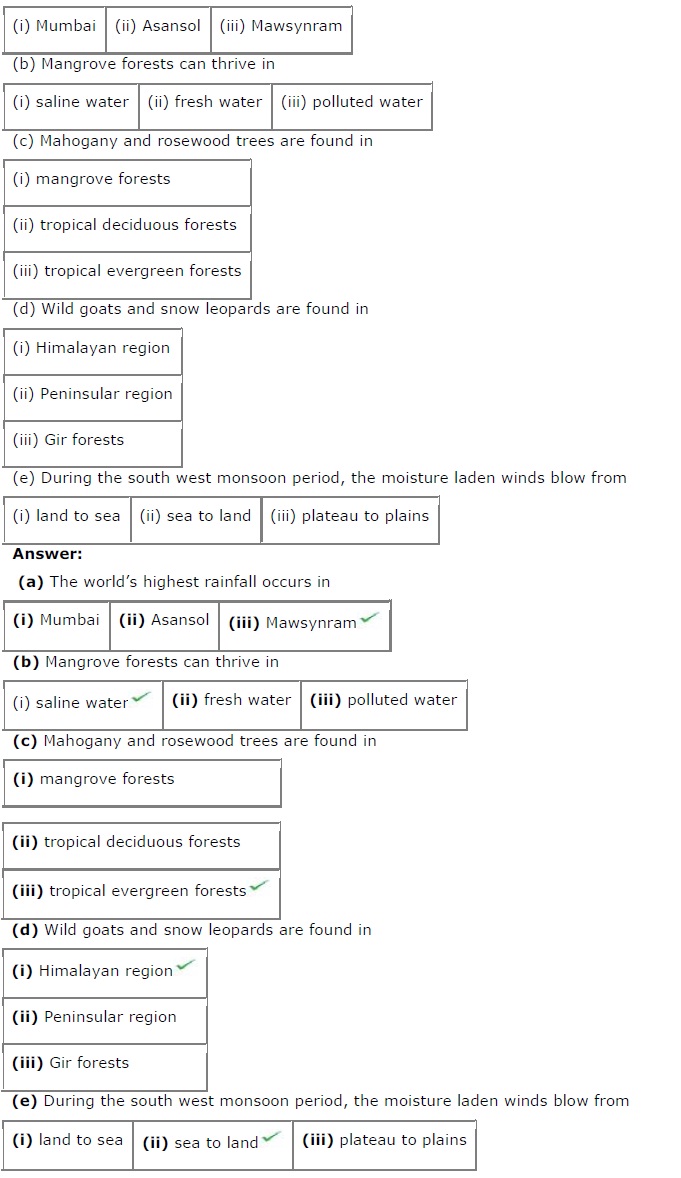
    (a) The world’s highest rainfall occurs in

    Question 3:
    Fill in the blanks.
    (a) Hot and dry winds known as __________ blow during the day in the summers.
    (b) The states of Andhra Pradesh and Tamil Nadu receive a great amount of rainfall during the season of _____________.
    (c) __________ forest in Gujrat is the home of ___________.
    (d) __________ is a well-known species of mangrove forests.
    (e) __________ are also called monsoon forests.

    Answer:
    (a) Hot and dry winds known as loo blow during the day in the summers.
    (b) The states of Andhra Pradesh and Tamil Nadu receive a great amount of rainfall during the season of retreating monsoons.
    (c) Gir forest in Gujrat is the home of Asiatic lions.
    (d) Sundari is a well-known species of mangrove forests.
    (e) Tropical deciduous forests are also called monsoon forests.

  • Our Country – India NCERT Solutions for Class 6th Geography Chapter 7

    NCERT Solutions for Class 6th Social Science: Chapter 7 – Our Country – India

    Class 6 Social Science (Geography) Chapter 7 Our Country – India NCERT Solution is given below.

    Question 1:
    Answer the following questions briefly.
    (a) Name the major physical divisions of India.
    (b) India shares its land boundaries with seven countries. Name them.
    (c) Which two major rivers fall into the Arabian Sea?
    (d) Name the delta formed by the Ganga and the Brahmaputra.
    (e) How many States and Union Territories are there in India? Which States have a common Capital?
    (f) Why do a large number of people live in the Northern plains?
    (g) Why is Lakshadweep known as a coral island?

    Answer:
    (a) The major physical divisions of India are: mountains, plateaus, plains, coasts and islands.
    (b) The countries with which India shares its land boundaries are: Pakistan, Afghanistan, China, Nepal, Bhutan, Bangladesh and Myanmar.
    (c) The two major rivers that fall into the Arabian Sea are: Narmada and Tapi.
    (d) The Sunderban delta is formed by the Ganga and the Brahmaputra.
    (e) There are 28 States and 7 Union Territories in India. Punjab and Haryana are the States that have a common Capital (Chandigarh).
    (f) The Northern Indian plains have been formed by the alluvial deposits laid down by rivers. These river plains provide fertile land for cultivation. This is why a large number of people live in the Northern plains.
    (g)Lakshadweep Islands have been formed from corals, that is, the skeletons of tiny marine animals called Polyps. Hence, Lakshadweep Islands are known as coral islands.

    Question 2:
    Tick the correct answers.
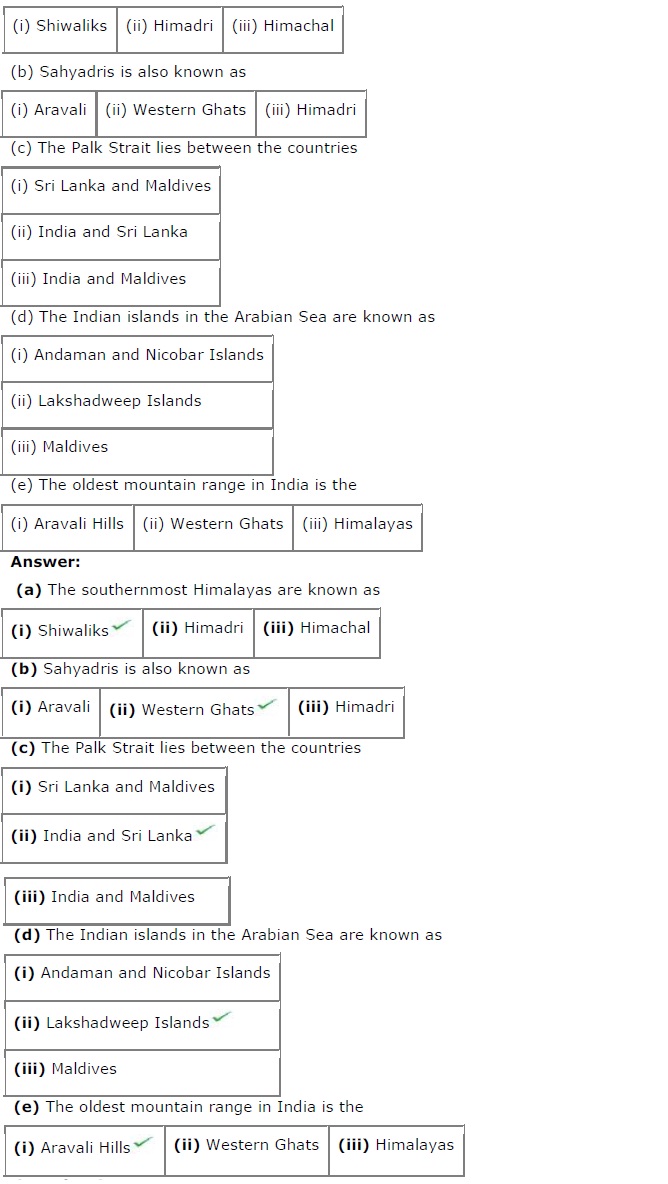
    (a) The southernmost Himalayas are known as

    Question 3:
    Fill in the blanks.
    (a) India has an area of about __________.
    (b) The Greater Himalayas are also known as ___________.
    (c) The largest state in India in terms of area is ___________.
    (d) The river Narmada falls into the ____________ Sea.
    (e) The latitude that runs almost halfway through India is ___________.
    Answer:
    (a) India has an area of about 3.28 million square kilometres.
    (b) The Greater Himalayas are also known as Himadri.
    (c) The largest state in India in terms of area is Rajasthan.
    (d) The river Narmada falls into the Arabian Sea.
    (e) The latitude that runs almost halfway through India is the Tropic of Cancer.

  • Major Landforms of the Earth NCERT Solutions for Class 6th Geography Chapter 6

    Class 6 Social Science – Geography NCERT Text book Answers of Chapter 6. NCERT Solutions Class VI Social Science – Geography includes answers of all the questions of Major Landforms of the Earth provided in NCERT Text Book which is prescribed for class 6 in schools.

    NCERT Solutions for Class 6th Social Science: Chapter 6 – Major Landforms of the Earth

    Class 6 Social Science (Geography) Chapter 6 Major Landforms of the Earth NCERT Solution is given below.

    Question 1:
    Answer the following questions briefly.
    (a) What are the major landforms?
    (b) What is the difference between a mountain and a plateau?
    (c) What are the different types of mountains?
    (d) How are mountains useful to man?
    (e) How are plains formed?
    (f) Why are the river plains thickly populated?
    (g) Why are mountains thinly populated?

    Answer:
    (a) The major landforms are: mountains, plateaus and plains.
    (b)

    Mountain Plateau
    A mountain is any natural elevation of the Earth’s surface. It is considerably higher than the surrounding area. A plateau is an elevated flat land. It is a flat-topped table land standing above the surrounding area.
    Mountains have peaks. Plateaus are flattened highlands.

    (c) The different types of mountains are: fold, block and volcanic.
    (d)
    Usefulness of Mountains
    Mountains are a storehouse of water. Many rivers have their source in the glaciers. Reservoirs are made to harness this water for consumption, irrigation and generating electricity.
    River valleys and terraces are ideal for cultivation of crops.
    Mountains have a rich variety of flora and fauna. Mountains provide an idyllic site for tourists.
    (e) Most of the plains are formed by rivers and their tributaries. The rivers flow down the slopes of mountains and erode them. They carry forward the eroded material. Then they deposit their load (consisting of stones, sand and silt) along their courses and in their valleys. It is from these deposits that plains are formed.
    (f) A lot of flat lands are available in plains. Also, the available land is generally fertile. Hence, plains are the most useful areas for human habitation as well as for cultivation. Transport network can also be easily constructed in plains. Thus, plains are very thickly populated regions of the world.
    (g) Mountains have very harsh cold climate. The slopes of the mountains are very steep. Also, mountains offer very little land for farming. For these reasons, mountains are thinly populated.

    Question 2:
    Tick the correct answers.
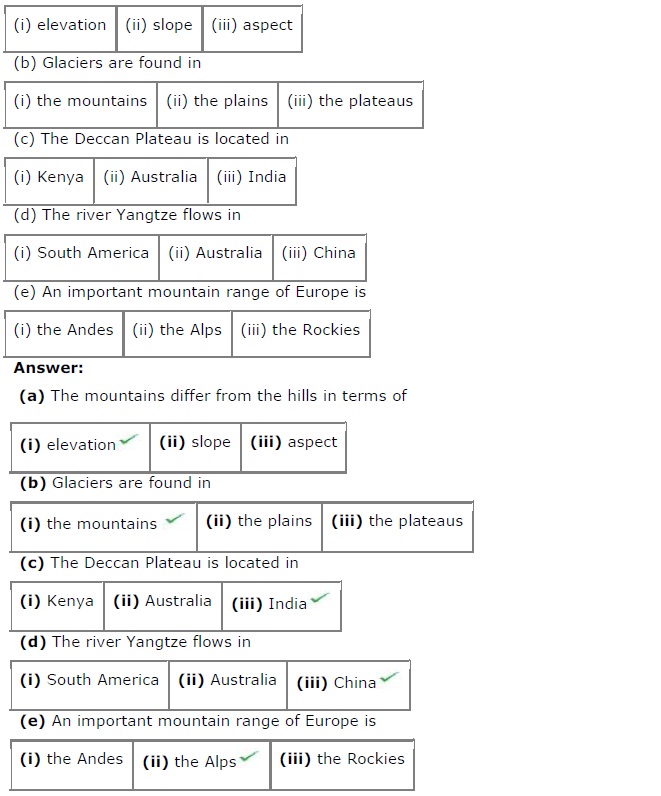
    (a) The mountains differ from the hills in terms of

    Question 3:
    Fill in the blanks.
    (a) A ________ is an unbroken flat or a low-level land.
    (b) The Himalayas and the Alps are examples of _________ types of mountains.
    (c) __________ areas are rich in mineral deposits.
    (d) The _________ is a line of mountains.
    (e) The _________ areas are most productive for farming.

    Answer:
    (a) A plain is an unbroken flat or a low-level land.
    (b) The Himalayas and the Alps are examples of fold types of mountains.
    (c) Plateau areas are rich in mineral deposits.
    (d) The Himalayas is a line of mountains.
    (e) The plain areas are most productive for farming.

  • Major Domains of the Earth NCERT Solutions for Class 6th Geography Chapter 5

    NCERT Solutions for Class 6th Social Science: Chapter 5 – Major Domains of the Earth

    Class 6 Social Science (Geography) Chapter 5 Major Domains of the Earth NCERT Solution is given below.

    Question 1:
    Answer the following questions briefly.
    (a) What are the four major domains of the Earth?
    (b) Name the major continents of the Earth.
    (c) Name the two continents that lie entirely in the Southern Hemisphere.
    (d) Name the different layers of atmosphere.
    (e) Why is the Earth called the ‘blue planet’?
    (f) Why is the Northern Hemisphere called the Land Hemisphere?
    (g) Why is the biosphere important for living organisms?

    Answer:
    (a) The four major domains of the Earth are: lithosphere, hydrosphere, atmosphere and biosphere.
    (b) The seven major continents of the Earth are: Asia, Europe, Africa, North America, South America, Australia and Antarctica.
    (c) The two continents that lie entirely in the Southern Hemisphere are: Australia and Antarctica.
    (d) The different layers of atmosphere are: troposphere, stratosphere, mesosphere, thermosphere and exosphere.
    (e) The Earth is called the ‘blue planet’ because more than 71 per cent of its surface is covered with water.
    (f) The Northern Hemisphere is called the Land Hemisphere because the greater part of Earth’s landmass lies in the Northern Hemisphere.
    (g)The biosphere is the narrow zone of contact between land, water and air. It is in this zone that life, that is unique to Earth, exists. All the living organisms are linked to each other and to the biosphere for survival.

    Question 2:

    Question 3:
    Fill in the blanks.
    (a) The deepest point on the Earth is _________ in the Pacific Ocean.
    (b) The _________ Ocean is named after a country.
    (c) The _________ is a narrow contact of land, water and air that supports life.
    (d) The continents of Europe and Asia together are known as __________.
    (e) The highest mountain peak on the Earth is __________.

    Answer:
    (a) The deepest point on the Earth is Marina Trench in the Pacific Ocean.
    (b) The Indian Ocean is named after a country.
    (c) The biosphere is a narrow contact of land, water and air that supports life.
    (d) The continents of Europe and Asia together are known as Eurasia.
    (e) The highest mountain peak on the Earth is Mount Everest.

  • Maps NCERT Solutions for Class 6th Geography Chapter 4

    NCERT Solutions for Class 6th Social Science: Chapter 4 – Maps

    Class 6 Social Science (Geography) Chapter 4 Maps NCERT Solution is given below.

    Question 1:
    Answer the following questions briefly.
    (a) What are the three components of a map?
    (b) What are the four cardinal directions?
    (c) What do you mean by the term ‘the scale of the map’?
    (d) How are maps more helpful than a globe?
    (e) Distinguish between a map and a plan.
    (f) Which map provides detailed information?
    (g) How do symbols help in reading maps?

    Answer:
    (a) The three components of a map are: distance, direction and symbol.
    (b) The four cardinal directions are: North, South, West and East
    (c) The scale of a map is the ratio between the actual distance on the ground and the distance shown on the map.
    (d) A globe is useful when we want to study the Earth as a whole. But, when we want to study only a part of the Earth, it is of little help. For this purpose, we use maps. A map can represent the entire Earth’s surface or a part of it.
    Maps can be used to show the physical features of the Earth (mountains, plains, oceans, rivers, etc.), the political divisions of the Earth (countries, states, cities, villages, etc.), and certain specific information (roads, rainfall, forests, industries, etc.)
    (e)

    Map Plan
    A map is a representation or a drawing of the Earth’s surface or a part of it drawn on a flat surface according to a scale. A plan is a drawing of a small area on a large scale.
    It can be used for representing large areas like continents or countries (large scale maps), and also for representing a small area like a village or a town (small scale maps). It is used for representing those things  that cannot be represented in a map. For example, the length and the breadth of a room cannot be shown in a map. For this purpose, a plan is used.

    (f) A large scale map provides detailed information.
    (g)As it is not possible to draw on a map the actual shape and size of different features (e.g., buildings, roads, bridges), they are shown by using certain standard letters, shades, colours, pictures and lines. These symbols give a lot of information in a little space. Using these symbols, maps can be drawn easily. The use of symbols makes maps simple to read.

    Question 2:
    Tick the correct answers.
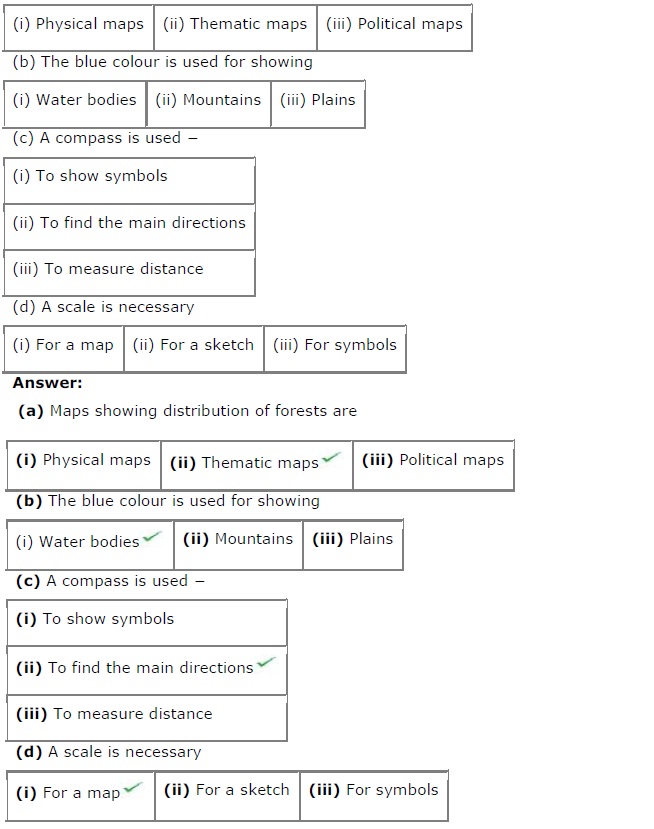
    (a) Maps showing distribution of forests are

  • Motions of the Earth NCERT Solutions for Class 6th Geography Chapter 3

    Class 6 Social Science – Geography NCERT Text book Answers of Chapter 3. NCERT Solutions Class VI Social Science – Geography includes answers of all the questions of Motions of the Earth provided in NCERT Text Book which is prescribed for class 6 in schools.

    National Council of Educational Research and Training (NCERT) Book Solutions for Class 6
    Subject: Social Science – Geography
    Chapter: Chapter 3 – Motions of the Earth

    NCERT Solutions for Class 6th Social Science: Chapter 3 – Motions of the Earth

    Class 6 Social Science (Geography) Chapter 3 Motions of the Earth NCERT Solution is given below.

    Question 1:

    Answer the following questions briefly.
    (a) What is the angle of inclination of the Earth’s axis with its orbital plane?
    (b) Define rotation and revolution.
    (c) What is a leap year?
    (d) Differentiate between the Summer and Winter Solstice.
    (e) What is an equinox?
    (f) Why does the Southern Hemisphere experience Winter and Summer Solstice in different times than that of the Northern Hemisphere?
    (g) Why do the Poles experience about six months day and six months night?

    Answer:

    (a) The angle of inclination of the Earth’s axis with its orbital plane is 66½°.
    (b) Rotation is the movement of the Earth on its axis. Revolution is the movement of the Earth around the Sun in a fixed path or orbit.
    (c) Earth takes 365¼ days to revolve around the Sun. However, for the sake of convenience, we consider a year as consisting of 365 days. The six hours (1/4th of 24 hours) that are ignored make one day (24 hours) over a span of four years. This surplus day is added to the month of February. Thus, every fourth year, February has 29 days, and such a year (with 366 days) is known as a leap year.
    (d)

    Summer Solstice Winter Solstice
    It is the position of the Earth when the rays of the Sun fall directly on the Tropic of Cancer. It is the position of the Earth when the rays of the Sun fall directly on the Tropic of Capricorn
    In this position, the North Pole is tilted towards the Sun. In this position, the North Pole is tilted away from the Sun.
    A larger portion of the Northern Hemisphere gets light from the Sun; hence, it is summer in the Northern Hemisphere. A larger portion of the Southern Hemisphere gets light from the Sun; hence, it is winter in the Northern Hemisphere.
    During this period in the Northern Hemisphere, days are longer than nights. During this period in the Northern Hemisphere, nights are longer than days.

    (e) Equinox is the position of the Earth when the rays of the Sun fall directly on the Equator. At this position, neither of the Poles is tilted towards the Sun. As a result, the entire Earth has equal days and equal nights.
    (f) When the North Pole is tilted towards the Sun, the Northern Hemisphere experiences Summer Solstice. At this time, since the South Pole is tilted away from the Sun, the Southern Hemisphere experiences Winter Solstice. When the North Pole is tilted away from the Sun, the Northern Hemisphere experiences Winter Solstice. At this time, since the South Pole is tilted towards the Sun, the Southern Hemisphere experiences Summer Solstice.
    (g) The Poles experience about six months of day and six months of night because of the tilt of the Earth on its axis. Because of this tilt, each Pole is tilted towards and away from the Sun for about six months each.
    When the North Pole is tilted towards the Sun, it experiences continuous daylight for six months. It is night for the same time period at the South Pole. These conditions are reversed when the South Pole is tilted towards the Sun.

    Question 2:

    Tick the correct answers

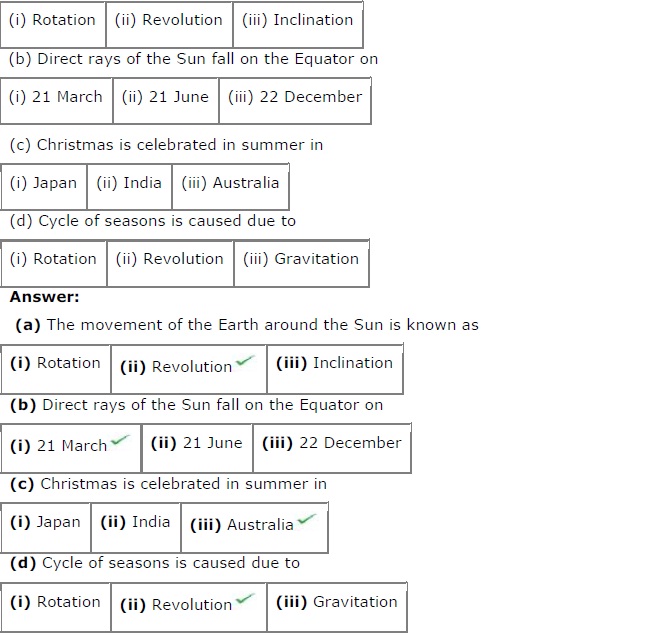
    (a) The movement of the Earth around the Sun is known as

    Question 3:

    Fill in the blanks.
    (a) A leap year has ________ number of days.
    (b) The daily motion of the Earth is _________.
    (c) The Earth travels around the Sun in _________ orbit.
    (d) The Sun’s rays fall vertically on the Tropic of _________ on 21st June.
    (e) Days are shorter during _________ season

    Answer:

    (a) A leap year has 366 number of days.
    (b) The daily motion of the Earth is rotational.
    (c) The Earth travels around the Sun in a fixed elliptical orbit.
    (d) The Sun’s rays fall vertically on the Tropic of Cancer on 21st June.
    (e) Days are shorter during winter season.

  • Globe Latitudes and Longitudes NCERT Solutions for Class 6th Geography Chapter 2

    Class 6 Social Science – Geography NCERT Text book Answers of Chapter 2. NCERT Solutions Class VI Social Science – Geography includes answers of all the questions of Globe Latitudes and Longitudes provided in NCERT Text Book which is prescribed for class 6 in schools.

    National Council of Educational Research and Training (NCERT) Book Solutions for Class 6
    Subject: Social Science – Geography
    Chapter: Chapter 2 – Globe Latitudes and Longitudes

    NCERT Solutions for Class 6th Social Science: Chapter 2 – Globe Latitudes and Longitudes

    Class 6 Social Science (Geography) Chapter 2 Globe Latitudes and Longitudes NCERT Solution is given below.

    Question 1:

    Answer the following questions briefly.
    (a) What is the true shape of the Earth?
    (b) What is a globe?
    (c) What is the latitudinal value of the Tropic of Cancer?
    (d) What are the three heat zones of the Earth?
    (e) What are the parallels of latitude and meridians of longitudes?
    (f) Why does the Torrid Zone receive maximum amount of heat?
    (g) Why is it 5.30 P.M. in India and 12.00 noon in London?

    Answer:

    (a) Earth is slightly flattened at the North and South Poles, and bulges in the middle. The shape of the Earth is described as a ‘geoid’, that is, ‘an Earth-like shape’.
    (b) Globe is a true model (miniature form) of the Earth.
    (c) The Tropic of Cancer lies 23½ ° north of the Equator.
    (d) The three heat zones of the Earth are: the Torrid Zone, the Temperate Zone and the Frigid Zone.
    (e) All parallel circles from the Equator up to the Poles are called parallels of latitudes.

    The lines of references running from the North Pole to the South Pole are called meridians of longitudes.

    (f) The area between the Tropic of Cancer and the Tropic of Capricorn is known as the Torrid Zone. The mid-day Sun is exactly overhead at least once a year on all the latitudes in this area; hence, this area receives maximum amount of heat.
    (g) In London, the Greenwich Mean Time (GMT) is followed. The Indian Standard Meridian is located 82½° east of the Prime Meridian. Thus the Indian Standard Time (IST) is 5 hours and 30 minutes ahead of GMT. So, when it is 12 noon in London, it
    is 5.30 P.M. in India.

    Question 2:

    Tick the correct answers.
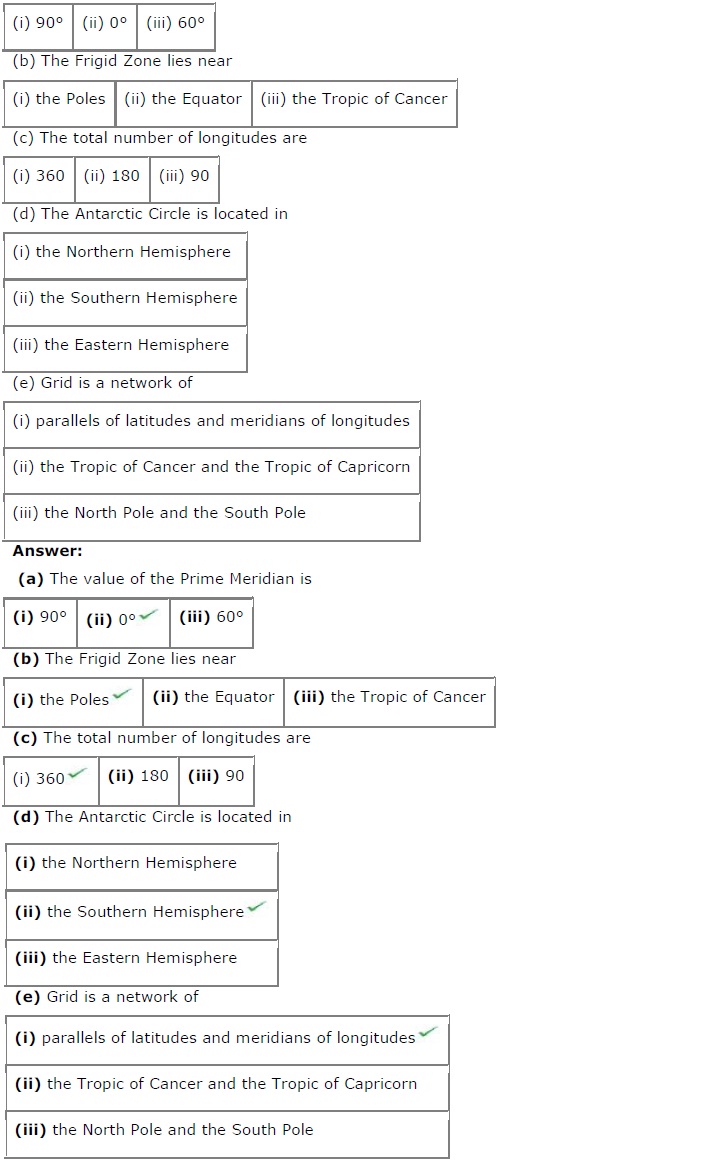
    (a) The value of the Prime Meridian is

    Question 3:

    Fill in the blanks.

    (a) The Tropic of Capricorn is located at __________.
    (b) The Standard Meridian of India is _________.
    (c) The 0° Meridian is also known as __________.
    (d) The distance between the longitudes decreases towards _________.
    (e) The Arctic Circle is located in the _________ Hemisphere.

    Answer:

    (a) The Tropic of Capricorn is located at 23½° south of the Equator.
    (b) The Standard Meridian of India is 82½° E.
    (c) The 0° Meridian is also known as the Prime Meridian.
    (d) The distance between the longitudes decreases towards the Poles.
    (e) The Arctic Circle is located in the Northern Hemisphere.

  • The Earth in the Solar System NCERT Solutions for Class 6th Geography Chapter 1

    Class 6 Social Science – Geography NCERT Text book Answers of Chapter 1. NCERT Solutions Class VI Social Science – Geography includes answers of all the questions of The Earth in the Solar System provided in NCERT Text Book which is prescribed for class 6 in schools.

    National Council of Educational Research and Training (NCERT) Book Solutions for Class 6
    Subject: Social Science – Geography
    Chapter: Chapter 1 – The Earth in the Solar System

    NCERT Solutions for Class 6th Social Science: Chapter 1 – The Earth in the Solar System

    Class 6 Social Science (Geography) Chapter 1 The Earth in the Solar System NCERT Solution is given below.

    Question 1:

    Answer the following questions briefly.
    (a) How does a planet differ from a star?
    (b) What is meant by the ‘Solar System’?
    (c) Name all the planets according to their distance from the Sun.
    (d) Why is the Earth called a unique planet?
    (e) Why do we see only one side of the Moon always?
    (f) What is the Universe?

    Answer:

    (a) Stars are big and hot celestial bodies made up of gases. They have their own heat and light, which they emit in large amounts. Planets are also celestial bodies, but they do not have their own heat and light. They are lit by the light of stars.

    (b) The Sun, eight planets, satellites and some other celestial bodies known as asteroids and meteoroids form the solar system.

    (c) In order of their distance from the sun, the eight planets are: Mercury, Venus, Earth, Mars, Jupiter, Saturn, Uranus and Neptune.

    (d) Conditions favourable to support life are probably present only on Earth. The Earth is neither too hot nor too cold. It has water and air, which are very essential for our survival. The air has life-supporting gases like oxygen. Because of these reasons, the Earth is a unique planet in the solar system.

    (e) The Moon moves around the Earth in about 27 days. It takes exactly the same time to complete one spin. As a result, only one side of the Moon is visible to us on the Earth.

    (f) A galaxy is a huge system of billions of stars, and clouds of dust and gases. Millions of such galaxies make up the universe.

    Question 2:

    Tick the correct answers.

    (a) The planet known as the “Earth’s Twin” is

    (b) Which is the third nearest planet to the Sun?

    (c) All the planets move around the Sun in a

    (d) The Pole Star indicates the direction to the

    (e) Asteroids are found between the orbits of

    Answer:

    (a) The planet known as the “Earth’s Twin” is

    (b) Which is the third nearest planet to the Sun?

    (c) All the planets move around the Sun in a

    (d) The Pole Star indicates the direction to the

    (e) Asteroids are found between the orbits of

    Question 3:

    Fill in the blanks.
    (a) A group of ________ forming various patterns is called a ________.
    (b) A huge system of stars is called _________.
    (c) ________ is the closest celestial body to our Earth.
    (d) ________ is the third nearest planet to the Sun.
    (e) Planets do not have their own _________ and __________.

    Answer:
    (a) A group of stars forming various patterns is called a constellation.
    (b) A huge system of stars is called a galaxy.
    (c) The Moon is the closest celestial body to our Earth.
    (d) Earth is the third nearest planet to the Sun.
    (e) Planets do not have their own heat and light.

  • Notes of Peasants and Farmers Class 9th History chapter 6

    • This chapter deals with the lives of peasants and farmers of three locations:
    → the small cottagers in England.
    → the wheat farmers of the USA.
    → the opium producers of Bengal.

    The Coming of Modern Agriculture in England

    • Before sixteenth century, in large parts of England, the countryside was open.
    • The common land was there which is accessible to all villagers where they can graze their animals, collect forest products, catch fish and hunt animals.
    • With the rise in population, the demand for food grains also increased.
    → Rich farmers began dividing and enclosing common land

    • After the mid-eighteenth century, this enclosure process expanded through the countryside.

    • British Parliament passed 4000 Acts legalizing these enclosures.

    New Demands for Grain

    • After mid-eighteenth century, the demand of foodgrains increased in England because:
    → Rise in Population
    → People began to live and work in urban areas
    → War between France and England

    The Age of Enclosures

    • In the nineteenth century grain production in England grew as quickly as population by
    (i) bringing new land under cultivation
    (ii) growing turnip and clover, these crops improved the soil and made it more fertile.

    What Happened To the Poor?

    • Enclosures found their customary rights gradually disappearing
    → Now everything was available on payment basis only

    • By 1800, labourers were being paid wages and employed only during harvest time.

    The Introduction of Threshing Machines

    • During the Napoleonic Wars, farmers began buying the new threshing machines that had come into the market, fearing a shortage of labour.
    • After the war, soldiers returned to the villages and needed alternative jobs to survive.
    • As their jobs were taken over by the machines, people were not able to find jobs.
    • Thus, they started threatening farmers through letters urging them to stop using machines that deprived workmen of their livelihood.
    → Most of these letters were signed in the name of Captain Swing.

    Bread Basket and Dust Bowl – Case Study of US

    • Till the 1780s, white American settlements were confined to a small narrow strip of coastal land in the east.
    • White Americans lived in a narrow strip of coastal land in the east.
    • Native American groups survived by hunting, gathering, fishing or by doing shifting cultivation.
    The Westward move and Wheat Cultivation
    • After the formation of USA, white settlers started moving towards west, America seemed to be a land of promise.
    • White settlers drove American Indians westwards and settled in the Applachian, than in Mississippi valley, cleared land and sowed corn and wheat.

    The Wheat Farmers

    • Rise in the urban population increased the demand for wheat and encouraged farmers to produce wheat.
    • Spread of Railways and First World War created more demand.

    The Coming of New Technology

    • Through the nineteenth century, the farmers entered the mid-western prairies and they needed new types of implements to break the sod and the soil.

    • Before the 1830s, to harvest crop they initially used cradle or sickle.
    → In 1831 Cyrus McCormick invented the first Mechanical reaper.

    • By early twentieth century, most farmers were using combined harvesters to cut grain.

    What Happened to the Poor?

    • Many of them bought these machines on loans, however, many were not able to pay back their debts, deserted their farms and looked jobs elsewhere

    • Unsold foodgrains stocks piled up.
    → Wheat prices fell and export markets collapsed.
    → This created the grounds for the Great Agrarian Depression of the 1930s.

    Dust Bowl

    • In the 1930s terrifying duststorms rolled in.

    • People were blinded and choked, cattle were suffocated to death.

    • Sand buried fences, covered fields and coated the surfaces of rivers till the fish died.
    → Machines were logged with dust, damaged beyond repair.

    • The entire landscape was ploughed, stripped of all grass, tractors had turned the soil over and broken the sod into dust.

    • They came because the early 1930s were years of persistent drought.


    The Indian Farmer and Opium Production

    • The British imposed a regular system of land revenue, increase revenue rates, and expand the area under cultivation.

    • By the end of the nineteenth century, India became a major center for the production of sugarcane, cotton, jute, wheat and several other crops for export.

    A Taste for Tea: The Trade with China

    • The English East India Company was buying tea and silk from China.

    • The Confucian rulers of China, the Manchus were not willing to allow the entry of foreign goods. → English could buy tea only by paying in silver coins or bullion which meant an outflow of treasure from England.

    • The English traders wanted a community which could be easily sold in China so that the import of tea could be financed in a profitable way.

    • Western merchants began an illegal trade in opium in the mid-eighteenth century.


    Where did Opium come from?

    • When the British conquered Bengal, they made a ffort to produce opium in the lands under their control.

    • With the growth of the market for opium in China, export from Bengal ports increased.

    • The Indian farmers were not willing to produce opium because:
    → They were not willing to divert their best fields for opium cultivation because it would have resulted in poor production cereals and pulses.
    → Many cultivators did not own land. For opium cultivation, they had to lease land from landlords and pay rent.
    → The cultivation of opium was a difficult process and time-consuming.
    → The government paid a very low price for the opium which made it an unprofitable proposition.

    How Were Unwilling Cultivators Made to Produce Opium?

    • By giving advance loan, the cultivator was forced to grow opium on a specified area of land and hand over the produce to the agents once the crop had been harvested.

    • The cultivator also had to accept the low price offered for the produce.

    • British wanted to buy very cheap and sell at high premium to the opium agents in Calcutta. Thus, the British wanted to earn huge profit in the opium trade.

    • By the early eighteenth century, the cultivators began to refuse the advances.
    → Many cultivators sold their crop to traveling traders who offered higher prices.

    • By 1773, the British government in Bengal had established a monopoly to trade in opium.

    • By the 1820s, the British found that there was a drastic fall in opium production in their territories.

    • The production of opium was increasing outside the British territories.
    → It was produced in Central India and Rajasthan which were not under British control. The local traders in these regions were offering much higher prices to peasants.

    • The Government instructed its agents in those princely states to confiscate all opium and destroy the crops.

    Also read: