Category: Social Science

  • Notes Of The Making Of a Global World Class Xth History

    SECTION A — THE PRE-MODERN  WORLD

    • Globalisation is an economic system associated with the free movement of capital goods, technology, ideas and people across the globe. It developed mainly through trade, migration of those who were seeking better life and movement of
    • Travellers, traders, priests and pilgrims travelled vast distances in search of knowledge, opportunity, spiritual fulfilment or to escape persecution. They carried articles, values, skills and even
    • The Silk Route is a pre-modern trade route over land and sea which affected cultures of China, Central Asia and the Besides trade, art, literature and philosophical ideas were also exchanged.
    • Food travelled : Potatoes from North & South America and the Caribbean islands travelled to the rest of the world, when it was accidently discovered by Christopher
    • Precious metals from mines of Peru and Mexico enhanced European trade with Asia. The Europeans conquered and carried diseases like “small pox,” to South
    • Europe leaped ahead of other continents due to Renaissance, Industrial Revolution, capitalism, ideas of the French and American
    • Colonies were established by Europeans all over the

    SECTION B — THE 19TH CENTURY (1815–1914)    ECONOMY

    • The 19th century saw international economic exchange by 3 types of movements or flows – Trade flow, Larbour flow and Capital
    • Industrial Revolution changed the consumption and production pattern of the
    • Demand for food increased, England imposed Corn Laws but tried to withdraw them under pressure from urban dwellers and industrialists. It led to import of cheap agricultural products into
    • Countries like Eastern Europe, Russia, America and Australia increased their food productivity to meet British needs, and became
    • Global Migration took place and nearly 50 million people migrated from Europe to America and Australia in the 19th century due to poverty, hunger and to escape religious
    • Technology reached its highest peak in Europe with the invention of Railways, Steamships, Telegraph and Shipbuilding. Meat trade at this time is a fine example of interdependence of teachnology and

    Late 19th century saw colonisation at huge scale by Britain, France and followed by Spain, Portugal, Germany and Belgium. The USA also became a colonial power by the 1890s. Most regions of Asia and Africa became colonies of the West.

    • Rinderpest or the Cattle Plague arrived in Africa from Europe. It destroyed nearly 90% of the livestock and destroyed the livelihood of the Natives. Mine owners and colonial powers benefitted by it and Africa ceased to be a free
    • A new system of slavery — Indentured labour imigration from India started to the Caribbean Islands, Mauritius, Fiji, Ceylon and
    • Though cheated and treated badly, they adapted to their new environment and cultural fusion took place as a result of this process of
    • Indian entrepreneurs, some bankers like Nattukottai and Chettiars financed export of agriculture to Central and South-East They even followed the Europeans to Africa.
    • Industrial Revolution in England changed the balance of trade between England and India. Indian handicraft and agriculture were destroyed and Britain enjoyed a trade surplus with India. Their exports increased and imports

    SECTION  C  — THE  INTER-WAR ECONOMY

    • The First World War (1914–1918) transformed the socio-economic and political structure of  the world.
    • The war killed 9 million and injured 20 million people by using new, modern weapons of mass
    • Economic Transformation took place in the form of shift in investment and capital The war encouraged war-related goods.
    • The USA became international creditor of Europe, Russia beame a communist country in 1917.
    • The League of Nations was formed to end all future
    • Post-war Britain faced a steep war-debt and her position as a world economic power ended. Unemployment increased, grain prices fell due to overproduction. After the war Eastern Europe revived its wheat production, leading to a glut.
    • The US recovered from the post-war crisis at a great speed due to the introduction of mass production.
    • Henry Ford introduced the assembly line production. His T-model Ford was the world’s first mass produced
    • Mass production lowered the costs and prices of engineered goods. These was a housing and consumer boom in the 1920s, which ultimately led to the Great Depression of 1929.
    • Markets crashed in 1929, and led to failure of banks, and the American crisis affected other countries. By 1933, over 4000 banks closed and between 1929-32 about 110,000 companies collapsed.
    • India was also affected by the Great Depression. Indian exports and imports declined extensively, prices fell. Bengal jute growers suffered the most. Large scale migration took place from villages to towns and

    SECTION D — REBUILDING OF A WORLD ECONOMY : THE    POST-WAR  ERA

    • The Second World War (1939–1945) was even more devastating than the
    • About 3% of the world population perished, more civilians than fighting
    • Two countries — USA and the USSR emerged as superpowers in the post-war
    • International organisations like the UNO and others were established to maintain peace and stability.
    • Two lessons were learnt by the economists and the politicians in the post-war system
      • to ensure mass consumption in an industrial society by high and stable
      • to ensure full employment and government control of flows of goods, capital and
    • Bretton Woods Agreement (July 1944). To ensure a stable economy a framework was agreed upon at the United Nations Monetary and Financial Conference held at Bretton Woods in New Hampshire, USA. It established the International Monetary Fund (IMF) and the World
    • The IMF was to deal with external surpluses and deficits of its member
    • The World Bank was an International Bank for reconstruction and development and was to finance the post-war
    • Bretton Woods System was based on a fixed exchange rate. National currencies were pegged to the American dollar at a fixed rate. The western powers, the USA specially, controlled the decision-making provisions such as the right to veto. It linked national currencies and the monetary
    • The Bretton Woods System benefitted the Western industrial nations and Japan and brought immense trade and income to
    • Post-war era saw rapid decolonisation and many countries in Asia and Africa became independent nations, supported by UNO and
    • Group of 77 or G-77 was organised by developing countries to demand a new international economic order (NIEO) which would give these countries real control over their national resources, raw materials, manufactured goods in their
    • MNCs or multinational companies were established in the 1950s and 1960s and operated in several


  • Notes Of Nationalism In India Class Xth

    SECTION A — THE FIRST WORLD WAR,  KHILAFAT AND   NON-COOPERATION

    • The First World War (1914-1918) was a turning point in the history of Indian National Movement.
    • It created a new political and economic
    • National Movement spread to new areas, influenced new social groups, developed new modes of Nationalists could demand new concessions from Great Britain.
    • But the war did not end hardships caused by it to millions of the poor in
    • Hardships suffered during the war – Huge defence expenditure, rise in prices, famines or crop failure (1918-19-20-21). Nearly 12 to 13 million people died (Census 1921) due to the famine.
    • Anger caused by forced recruitment of army in the villages. At this stage Gandhiji emerged on the  national
    • New Ideas – Satyagraha, a novel way of fighting the colonial rule in India. A non-aggressive, peaceful mass agitation against oppression and injustice. Gandhiji knew India could never match the British in
    • Satyagraha means insistence on A moral force, not passive resistance.
    • Gandhiji organised Satyagraha Movements in Champaran, Bihar (1916), Kheda district of Gujarat (1917) and amongst cotton mill workers in Ahmedabad (1918).
    • These campaigns established him as the leader of the
    • Rowlatt Act (1919), Jallianwala Bagh massacre (13 April, 1919) and the Khilafat Movement led Gandhiji to start his Non-Cooperation Movement in
    • Khilafat Movement was led by two brothers Shaukat Ali and Muhammad Ali; was founded to fight for Khilafat rights, and was against the harsh treatment given to the Khalifa, Emperor of the Turkish Empire, after the First World
    • Gandhiji convinced the Congress to join hands with the Khilafat Movement and start a Non-Cooperation Campaign for
    • Non-Cooperation with the British rule, programme adopted at the Nagpur Session of Congress in


    SECTION B — DIFFERING STRANDS WITHIN THE    MOVEMENT

    • Non-Cooperation began in January
    • Many groups joined it for their own specific
    • Swaraj did mean the same to
      • Movement in Towns : Middle class took up the fight. Students, teachers, lawyers gave up studies, jobs, practice and joined it in thousands. Council elections boycotted. Foreign goods    Liquor shops picketed.
        • Movement in the countryside : Peasants and tribals took over the struggle which turned violent at times. In Awadh, Baba Ramchandra fought against landlords and talukdars. In 1920, Jawaharlal Nehru and Baba Ramchandra formed Oudh Kisan

        In Andhra Pradesh : The peasants of Gudem Hills led a guerilla movement against the British. Their leader, Alluri Sitaram Raju, advocated use of force. He was captured and executed  in 1924.

        • Movement in Plantations : Workers in Assam agitated to move freely, a protest against the Inland Emigration Act (1859) which prevented them from leaving the plantation without
        • The Chauri-Chaura incident of 1922 made Gandhiji call off the


        SECTION C — TOWARDS  CIVIL  DISOBEDIENCE

        • R. Das and Motilal Nehru founded the Swaraj Party within the Congress to fight elections for the Councils and demand reform.
        • The Simon Commission (1928) led to protests throughout
        • At the Lahore Session of the Congress (Dec. 1929) the Congress adopted the resolution of Complete Swaraj as its 26th January, 1930 to be celebrated as Independence Day.
        • Gandhiji gave the call for Civil Disobedience
        • He chose ‘Salt’ as the symbol of unity of the nation. Called the ‘Salt Tax’ as most inhuman. The movement started on 31 January, 1930. He made eleven demands in a letter to the Viceroy Lord His demands covered every class from industrialists to peasants.
        • Famous Dandi March began on March 12, 1930. On 6th April 1930, Gandhiji reached Dandi, a village in Gujarat and broke the Salt Law by boiling water and manufacturing salt. Thus began the Civil Disobedience
        • The Non-Cooperation Movement (1920-22) attempted to bring the government to a standstill by non-cooperating with the
        • The Civil Disobedience Movement aimed at paralysing the government by performing illegal
        • Boycott of foreign goods, non-payment of taxes, breaking forest laws were its main
        • The British Government followed a policy of brutal repression. Arrested all the leaders including Gandhiji and Nearly 100,000 people were arrested.
        • Lord Irwin, the Viceroy, signed a pact with Gandhiji on 5 March, 1931. Gandhiji agreed to attend the Second Round Table Conference and the British agreed to release all political prisoners.
        • Gandhiji returned from the Second Round Table Conference disappointed in December Civil Disobedience started  again.
        • By 1934 the Movement lost its
        • What Swaraj meant to different social groups who joined the Civil Disobedience
        • To the countryside : Rich peasant communities expected the revenue tax to be reduced, when the British refused to do so, they did not rejoin the movement in 1932.
          • The Poor were the peasants who rented the land from landlords. Depression made them unable to pay rent and wanted it to be reduced. Their relationship with the Congress became
          • The Business Classes. After the war, their huge profits were reduced, wanted protection against import of foreign goods. The failure of the Round Table Conference, curbed their enthusiasm for the Civil Disobedience
          • The industrial working class did not participate in a large number. They joined because of low wages and poor working conditions. Congress was reluctant to include workers’ demands as it would alienate the
          • Women and the Civil Disobedience Movement. 1930 was the year when women entered the struggle for Independence on a massive scale. During Gandhiji’s  Dandi March, they joined protest marches, picketed foreign clothes and shops. But Congress did not encourage them or gave  them important posts in the

          Limits  of  Civil Disobedience

          • The Dalits or the Untouchables did not actively participate in the movement, they demanded reservation of seats, separate electorates. Dr B.R. Ambedkar, the leader of the Dalits, formed an association in 1930, called the Depressed Classes Association. He clashed with
          • Gandhiji began a fast unto death against separate electorate. Finally Poona Pact between the two leaders (1932) gave reserved seats in Provincial and Central Councils but were voted by general
          • Muslim political organisations also kept away from the
          • Congress seemed more visibly associated with Hindu religious nationalist groups. The leader of the Muslim League M.A. Jinnah wanted reserved seats for Muslims in Central Assembly. Civil Disobedience Movement started in an atmosphere of distrust and suspicion between the two


          SECTION D — THE SENSE OF COLLECTIVE    BELONGING

          • Collective belonging comes through experiences of common struggles. A common history and fiction, through folklore, songs and popular prints and
          • Bharat Mata became the symbol of
          • Bakim Chandra Chattopadhyay created the image in his song “Vande Mataram” in his novel ‘Anand Math’ (1870s). Abanindranath Tagore painted Bharat Mata as a calm, composed, divine and spiritual
          • Rabindranath Tagore of Bengal and Natesa Sastri of Madras compiled songs, ballads, myths and
          • Reinterpretation of History : Indians delved in the past history and discovered India’s greatness and achievements in mathematics, literature, religion, culture, philosophy, crafts and

          Conclusion : Gandhiji channelised the anger against colonial government into a common struggle for freedom in the first half of the 20th century. He saw the emergence of a nation wanting to liberate itself from the colonial rule, in spite of all its differences.

  • Notes of The Story of India – Size and Location Class 9th Social Science Geography

    Topics in the chapter:

    • India’s Location
    • Its Size
    • India and the World
    • Its neighbours

    Introduction: India is one of the oldest civilisations and have a remarkable history. After Independence from British rule, it achieved multi-faceted socio-economic progress. Also made a remarkable progress in the field of agriculture, industry, technology and overall economic development.

    India’s Location

    • Lies entirely in Northern hemisphere between latitudes 8°4′ N and 37°6′ N and longitudes 68°7′ E and 97°25′ E.

    • Divided by Tropic of cancer (23°30′ N) in almost two equal parts.

    • In Southeast, Andaman and Nicobar islands lie in Bay of Bengal.

    • In Southwest, Lakshadweep islands lie in Arabian Sea.

    Its Size

    • Total Area of India is 3.28 million square km which is 2.4 percent of the total area of the world.

    • It is seventh largest country in the world in terms of landmass.

    • It has land boundary of about 15,200 km and the total length of the coast line of the mainland
    including Andaman and Nicobar and Lakshadweep islands is 7,516.6 km.

    • In the northwest, north and north east of India, young folds mountains bounds it.

    • South of about 22° north latitude, India narrows and finally extends towards the Indian Ocean. It also divides it into two seas, the Arabian Sea on the west and the Bay of Bengal on its east.

    • The latitudinal and longitudinal extent of the mainland is about 30°.

    • India’s east-west extent appears to be smaller than the north-south extent.

    • The time along the Standard Meridian (82°30′ E) passing through Mirzapur in UP is taken as the Indian Standard Time for whole country.

    • The time gap between Arunachal Pradesh present in the east and Gujarat present in the west is about 2 hours. The latitudinal extent influences the duration of day and night, as one moves from south to north.

    India and the World

    • India is located in the centre of the World between East and the West Asia.

    • The routes across the Indian ocean which connect the countries of Europe in the West and the countries of East Asia provide a strategic central location to India.

    • The Deccan Peninsula* helps India to establish close contact with West Asia, Africa and Europe from the western coast and with Southeast and East Asia from the eastern coast.

    • The Ocean which is south of India given name Indian Ocean as no other country has a long coastline on the Indian Ocean as India has.

    • The land routes of India are much older than sea route. Various passes across mountains in the north have provided passages to the ancient travellers as ocean limited such interaction for a long time.

    • The land routes helped India in the exchange of ideas and commodities since ancient times.

    • India have propagated the ideas of the Upanishads and the Ramayana, the stories of Panchtantra, the Indian numerals and the decimal system as well as given spices, muslin and other merchandise to different countries.

    • Also, the influence of Greek sculpture, and the architectural styles of dome and minarets from West Asia can be seen in different parts of India.

    Its neighbours

    • India is comprised of 29 states and 7 union territories and shares its land boundary with:
    → Northwest: Pakistan and Afghanistan
    → North: China, Nepal, Bhutan
    → East: Myanmar and Bangladesh
    → South: Sri Lanka and Maldives

    • Sri Lanka is separated from India by a narrow channel of sea formed by the Palk Strait and the Gulf of Mannar

    • Maldives Islands are situated to the south of the Lakshadweep Islands.

    * A peninsula is a piece of land that is bordered by water on three sides but connected to mainland on one side.

    Do You Know from Chapter

    • The southernmost point of the Indian Union– ‘Indira Point’ got submerged under the sea water in 2004 during the Tsunami.

    • Since the opening of the Suez Canal in 1869, India’s distance from Europe has been reduced by 7,000 km.

    • Before 1947, there were two types of states in India – the provinces and the Princely states.
    → Provinces were ruled directly by British officials who were appointed by the Viceroy.
    → Princely states were ruled by local, hereditary rulers, who acknowledged sovereignity in return for local autonomy.

    Important Map

    India - Size and Location Important map
  • LONG ANSWER TYPE QUESTIONS (4 MARKS) of India – Size and Location Class 9th Social Science Geography

    LONG ANSWER TYPE QUESTIONS (4 MARKS)
    Q.1. Which are the countries with which India shares land boundaries? Write a short note about India’s position among its neighbours.
    Ans. India shares its land boundaries with Pakistan and Afghanistan in the northwest, China (Tibet), Nepal and Bhutan in the north and Myanmar and Bangladesh in the east.
    India stands apart from the rest of Asia with the Himalayas acting as a natural barrier to the north and northwest and the Purvanchals in the northeast. Thus, the land boundary of India is protected by mountain ranges, giving India a safer location with respect to its neighbours. India occupies the most eminent position within the Indian subcontinent and has strong geographical and historical links with its neighbours. India shares strong bilateral relationships with its neighbours socially, culturally and economically. Social and cultural exchange with our neighbours has strengthened our position on account of our rich cultural heritage. Economically, we have good trade relations with our neighbours. Politically also, we share good relations with most of our neighbours. The SAARC endeavours to maintain good relations among the neighbouring countries in South Asia.
    Q.2. Write a note on the location and size of India [Importnat]
    Ans. India is a vast country. It is located in South Asia. From south to north India’s mainland extends between 8°4’N and 37°6’N latitudes. It is located in the Northern Hemisphere. The Tropic of Cancer (23°30’N) passes roughly through the middle of the country.
    From west to east India extends between 68°7’E and 97°25’E longitudes. It is located in the Eastern Hemisphere.
    To the southeast of India’s mainland lie the Andaman and Nicobar Islands in the Bay of Bengal and to the southwest lie the Lakshadweep Islands in the Arabian Sea.
    The landmass of India covers an area of 3.28 million square km. From the point of view of size it is the seventh largest country of the world. It accounts for 2.4 per cent of the total

    The Andaman and Nicobar Islands lie to the southeast of Indian mainland in the Bay of Bengal. The Lakshadweep Islands lie in the Arabian Sea to the southwest of India’s mainland, close to the Malabar coast of Kerala.The Andaman and Nicobar Islands lie to the southeast of Indian mainland in the Bay of Bengal. The Lakshadweep Islands lie in the Arabian Sea to the southwest of India’s mainland, close to the Malabar coast of Kerala.
    The Andaman and Nicobars are formed of the Great Andamans and the Little Andamans in the
    north and Nicobar Islands in the south. They are groups of numerous big and small islands.
    The southernmost point of the Indian Union is located in one of these Islands. These islands are of great strategic importance to India. They lie close to the equator and have equatorial climate. They lie along the trans-Indian Ocean route and close to the south and southeast Asia. Port Blair is the official headquarters of Andaman and Nicobar.
    The Lakshadweep Islands are a group of small coral islands lying close to the southern section of the west coast of India. In 1973 the Laccadive, Minicoy and Amindive Islands were renamed as Lashadweep. It covers a small area of 32 sq. km. Kavaratti island is the administrative headquarters of Lakshadweep. Both the group of islands are rich in flora and fauna and natural beauty, enhancing India’s geographical entity.
    Q.6. How has India’s geographic location aided the nation?
    Ans. India is a southward extension of the Asian Continent. It has a central location between the East and the West Asia. To the north of India lie the lofty mountain ranges of the Himalayas which serve as a natural barrier separating Indian subcontinent from the rest of Asia. The land routes through the mountain passes had served as channels for exchange of culture and commodities since ancient times. To its south the landmass tapers and the Deccan Peninsula protrudes into the Indian Ocean providing opportunities for flourishing maritime trade. The trans-Indian Ocean routes which connect the countries of Europe in the west and the countries of East Asia provide a strategic central location to India. India is able to establish close contacts with oil rich countries of West Asia and countries of Africa and Europe from its western coast via the Arabian Sea. The Suez Canal sea-route provides India the shortest route to industrial Europe and America. India has commercially favourable contacts with Southeast and East Asia and Australia from its eastern coast via the Bay of Bengal and Indian Ocean. Thickly populated countries of Southeast Asia and China lie close to India. This augments the development of trade and cultural relations. Thus, India’s geographical location has aided in the development and progress of the nation.
    Q.7. The Tropic of Cancer passes half-way through the country. What does this imply?
    Ans. The mainland of India extends between latitudes 8°4/N and 37°6/N. The Tropic of Cancer, 23°30/N, passes halfway through the country. This has its implications for the climate of India as well as influences the duration of day and night.
    Places on either side of the Tropic of Cancer experience tropical climate. The tropical monsoon type of climate that India experiences is extreme on account of the Tropic of Cancer. Places further south of Indian Union away from the Tropic of Cancer have more equable climate being closer to equator. Places further north of the Tropic of Cancer have subtropical climate. The sun shines directly on the Tropic of Cancer on 21st June or Summer Solstice. Countries in the Northern Hemisphere including India experience summer during this part of the year. It is also associated with maximum heating of tropics during this period that influences advance of monsoons or rainy season.
    Areas along the Tropic of Cancer have their longest day on 21st June. These areas have their shortest day on 22nd December or Winter Solstice when the sun rays are directly overhead the Tropic of Capricorn.


  • SHORT ANSWER TYPE QUESTIONS (3 MARKS) of India – Size and Location Class 9th Social Science Geography

    SHORT ANSWER TYPE QUESTIONS (3 MARKS)

    Q.1. What is the longitudinal extent of India? State its two implications. [Important]
    Ans. The mainland of India extends between longitudes 68°7’E and 97°25’E. The east-west extent is 2933 km in length.
    The longitudinal extension shows that India is located in the Eastern Hemisphere and places can be located with reference to longitudes.
    On account of the 30° longitudinal extension (97°25′-68°7′ = 29°18′, approximately 30°) there is a time difference of 2 hours (30° *4 min = 120 mins or 2 hours) in local time between the eastern and western limits of India. However, a standard time (5 hours 30 min ahead of GM.T.) is adopted according to the local time of the central meridian of the country, 82°30’E.

    Q.2. Describe briefly the geographic location of India in Asia. What is the significance of India’s geographic location?

    Ans. The Indian landmass has a central location between the East and the West Asia. India is a southward extension of the Asian Continent.

    The trans-Indian Ocean routes which connect the countries of Europe in the west and the countries of East Asia provide a strategic central location to India. The Deccan Peninsula protrudes into the Indian Ocean, thus helping India to establish close contact with oil rich countries of West Asia as well as Africa and Europe from the western coast and the Southeast and East Asia from the eastern coast via sea and ocean routes and air routes.

    Q.3. What is the latitudinal extent of India? How does it affect India?

    Ans. The latitudinal extension of the mainland of India is between 8°4′ N and 37°6′ N. The north-south extension is 3214 km in length.

    The latitudinal extension shows that India is located entirely in the Northern Hemisphere. The wide latitudinal extent of nearly 30 degrees results in wide variation in climate. The southern parts gets more heat from the sun than the northern parts.

    Differences in the duration of day and night is much less in the south of India at lower latitudes, e.g. as in Kanniyakumari. But the difference increases further north, e.g. as in Jammu and Kashmir, as it is further away from the equator.

    Q.4. What is the southernmost point of the Indian Union called? Describe its location in India and its current situation.

    Ans. The southern-most point of the Indian Union is known as the Indira Point. It is located on the Nicobar Islands, the southern section of the Andaman and Nicobar group of islands. The islands are located in the Bay of Bengal lying to the southeast of India’s mainland.

    The Indira Point got submerged under the seawater in December 2004 during the destructive Tsunami that hit the Andaman and Nicobar Islands.

    Q.5. Why is the difference in the duration of day and night very little in Kanniyakumari while it is not so in the northern part of the country? Give specific reasons for your answer.

    Ans. Kanniyakumari in Tamil Nadu is located at the southern-most tip of India’s mainland. The latitude 8°4′ N passes close to it. The place is thus near the equator and lies close to the equatorial region. As the sun shines directly over the equator all throughout the year, the duration of day and night is almost equal here. Hence, in Kanniyakumari the difference in the duration of day and night is very little, maximum around 45 minutes only.

    But in the northern part of the country located to the north of the Tropic of Cancer away from the equator, the difference between the length of day and night becomes increasingly greater.

    Q.6. How have mountain passes been helpful to India since historic times?

    Ans. The various mountain passes across the Himalayan range and other mountains in the north have provided passages to travellers since ancient time. The land routes via mountain passes have contributed in the exchange of ideas and commodities since historic times. The ideas of Upanishads and the Ramayana, the stories of Panchtantra, the Indian numerals and the decimal system could thus reach many parts of the world. The spices, muslin and other merchandise were taken from India to different countries. On the other hand, the architectural styles of dome and minarets from West Asia and influence of Greek sculpture, which can be seen in different parts of India, came from other countries to India.

    Q.7. How has the long coastline been beneficial to India?Q.7. How has the long coastline been beneficial to India?
    Ans. The Arabian Sea and the Bay of Bengal, extensions of the Indian Ocean, lie to the west and east of Indian Peninsula, and the Indian Ocean lies to its south. The total length of the coastline of the mainland of India including Andaman & Nicobar and Lakshadweep is 7516.6 km. The long coastline of India has helped in maritime trade since ages. The central location of India at the head of Indian Ocean has provided it a strategic location along the trans-Indian Ocean routes. India is able to establish close contact with West Asia, Africa and Europe from western coast and with Southeast and East Asia from the eastern coast. The long coastline has also played a major role in influencing the climate of India. It provides opportunities for fishing and extraction of petroleum. It serves as a natural boundary protecting India.
    Q.8. Which ocean is named after India? Give two reasons as to why it was named after India.
    [important]
    Ans. The Indian Ocean is named after India. India is the only country which has the credit of an ocean named after it.
    The Arabian Sea and the Bay of Bengal, extensions of the Indian Ocean, lie to the west and east of Indian Peninsula, and the Indian Ocean lies to its south. No other country has a long coastline on the Indian Ocean as India. The central location of India at the head of the Indian Ocean has provided India a strategic location of great significance along the trans-Indian Ocean route.
    It is India’s eminent position in the Indian Ocean which justifies the naming of the ocean after India.
    Q.9. What is the Standard Meridian of India? From where does it pass? [2010 (T-1)]
    Ans. The Standard Meridian of India (82°30′ E) passing through Mirzapur in Uttar Pradesh is taken as the Standard time for the whole country.
    Q.10. What was the contribution of land routes to India in ancient times? Explain any three.
    [2010 (T-1)]
    Ans. India’s contacts with the outside world have continued through the ages, through the land routes and sea routes.
    (i) These routes have contributed in the exchange of ideas and commodities since ancient times. The ideas of Upanishads and the Ramayana, the stories of Panchtantra, the Indian numerals and the decimal system could reach many parts of the world.
    (ii) The spices, muslin and other merchandise were taken away from India to different countries through this land routes.
    (iii) The influence of Greek sculpture and the architectural styles of domes and minarets from West Asia can be seen in different parts of our country.
    Q.11. Which meridian has been selected as the Standard Meridian of India? [2010 (T-1)]
    Ans. (i) 82°32′ E has been selected as the Standard Meridian of India.
    (ii) From Gujarat to Arunachal Pradesh, there is a time lag of two hours. To bring the whole country under one time set, 82°32′ E latitude which passes at the centre of the country is taken as a standard time for the whole country in order to maintain uniformity of time. Q.12. Why India is called a subcontinent? Write any three points. [2010 (T-1)]
    Ans. India is called a subcontinent because of the following reasons :
    (i) It is a distinct geographic unit separated from the Asian continent by the majestic
    Himalayas and its extensions.

    (ii) It has its own culture as distinct from the rest of Asia.(ii) It has its own culture as distinct from the rest of Asia.
    (iii) The climate of Indian subcontinent is characterised by monsoon type of climate.
    Q.13. What is latitude? What is the latitudinal extent of India? [2010 (T-1)]
    Ans. (i) The position of a place, measured in degrees North or South of the equator. It is mostly
    calculated on the basis of angular distance of a place north-south of the equator.
    (ii) The main land of India extends between latitutdes 8°4′ N and 37°6′ N and longitudes 68°7′ E and 97°25′ E.
    Q.14. Name the southernmost point of Indian Union. It is visible today? [2010 (T-1)]
    Ans. The southernmost point of the Indian union is ‘Indira point’. It submerged under the sea water in 2004 during the Tsunami. The entire landmass was erased from the map of India.
    Q.15. Do you think naming the Indian Ocean after a country is justified. Why? [2010 (T-1)]
    Ans. Yes, because no other country has a long coastline on the Indian Ocean as India has. It is because of India’s eminent position in the Indian Ocean which justifies the naming of an ocean after it.
    Q.16. How does India occupy an important strategic position in South Asia? Illustrate your answer by explaining three suitable points. [2010 (T-1)]
    Ans. India occupies an important strategic position in South Asia on the following points :
    (i) The Indian landmass has a central location between the East and the West Asia.
    (ii) The trans-Indian ocean routes which connect the countries of Europe in the west and the countries of East Asia provide a strategic central location to India.
    (iii) The Deccan peninsula protrudes into the Indian Ocean has helped India to establish close contact with West Asia, Africa and Europe from the western coast and with Southeast and East Asia from the eastern coast.
    Q.17. What is latitudinal extent of India? How is the latitudinal spread in India advantageous to her? State two points. [2010 (T-1)]
    Ans. The latitudinal extent of India lies between 8°4′ N and 37°6′ N. This means that the longitudinal expanse is about 30° from west to east. The advantages of longitudinal spread :
    (i) influences the duration of the day and night as one moves from South to North (ii) It also helps to take advantages of the Indian Ocean, the Arabian Sea on the west and the Bay of Bengal on its east for sea movements.
    Q.18. Give a reason for the following statement : [2010 (T-1)]
    (a) 82° 30 E Latitude has been selected as the Standard Meridian of India.
    (b) The distance between India and Europe has been reduced by 7000 km. with the opening of Suez Canal.
    (c) Days and night are almost of equal duration at Kanniyakumari.
    Ans. (a) There is a time lag of at least 2 hours if one moves from west to east – from Gujarat to Arunachal Pradesh. The local time at Arunachal Pradesh would be at least 2 hours ahead of Gujarat. To avoid such differences in local time, Indian Standard Time (IST) has been fixed on 82°30′ E to give the whole country a uniform time.
    (b) Before the opening up of Suez Canal in 1869, ships from Europe had to make detour journey via (Cape of Good Hope) African coast after traversing a distance of about 15000 km.
    (c) Kanniyakumari in Tamil Nadu is located at the southern-most tip of India’s mainland. The latitude 8°4′ N passes close to it. The place is thus near the equator and lies close to the

    equatorial region. As the sun shines directly over the equator throughout the year, the durations of day and night are almost equal here. Hence, in Kanniyakumari the difference in the duration of day and night is very little, maximum around 45 minutes only.equatorial region. As the sun shines directly over the equator throughout the year, the durations of day and night are almost equal here. Hence, in Kanniyakumari the difference in the duration of day and night is very little, maximum around 45 minutes only.
    Q.19. Why is there a difference of 2 hours in local time between the eastern-most part of Arunachal Pradesh and western-most part of Gujarat? Explain. [2010 (T-1)]
    Ans. The local time in Arunachal Pradesh is two hours ahead of Gujarat because of longitudinal differences. Time is calcullated on the basis of 4 minutes for every 1° of longitude towards East and West of Greenwich Meridian Time (GMT). The difference between Arunachal and Gujarat is 30° East longitude. Therfore, the differences of time between these two places 30 x 4 = 120 minutes or two hours.
    Q.20. Explain why Ahmedabad and Kolkata are able to see the noon sun exactly overhead in
    a year but not Delhi. [2010 (T-1)]
    Ans. Kolkata and Ahmedabad is located very close to the Tropic of Cancer and as such both the places see the noon exactly overhead in a year. Delhi, on the other hand is located far north of the Tropic of Cancer and does not enjoy it.
    Q.21. Why do we need a Standard Meridia for India? Explain. [2010 (T-1)]
    Ans. Due to vastness of the country there is a difference of time between places as one moves from east to west and vice versa. In order to set right this problem Stardard Meridia is needed.

  • Multiple Choice Questions [Solved] [1 Marks] of India – Size and Location Class 9th Social Science Geography

    MULTIPLE CHOICE QUESTIONS (1 MARK)

    Q.1. Indian Standard Time or I.S.T. is how many hours ahead or behind of G.M.T. or Universal Time?
    (a) 5 hrs 30 min behind GM.T. (b) 15 hrs ahead of G.M.T.
    (c) 5 hrs 30 min ahead of GM.T. (d) None of the above
    Ans. (c)
    Q.2. Which of the following has reduced India’s distance from Europe by 7000 km?
    (a) Suez Canal (b) Panama Canal
    (c) Indira Gandhi Canal (d) Buckingham Canal
    Ans. (a)
    Q.3. Which of the following influences the duration of the day and night, as one moves from south to north?
    (a) Longitudinal extent (b) Latitudinal extent
    (c) Standard Meridian (d) All the above
    Ans. (b)
    Q.4. The Standard Meridian of India, 82°30’E passes through which of the following places?
    (a) Kanniyakumari in Tamil Nadu (b) Walong in Arunachal Pradesh
    (c) Kachchh in Gujarat (d) Mirzapur in Uttar Pradesh
    Ans. (d)

    Q.5. The sun rises two hours earlier in Arunachal Pradesh as compared to Gujarat. What time will the watch show in Gujarat if it is 6 am in Arunachal Pradesh? [Important]Q.5. The sun rises two hours earlier in Arunachal Pradesh as compared to Gujarat. What time will the watch show in Gujarat if it is 6 am in Arunachal Pradesh? [Important]
    (a) 4.16 am (b) 7.44 am (c) 6 am (d) 5.44 am
    Ans. (c)
    Q.6. If the local time at Dwarka (69°01’E) in Gujarat to the west of India is 6 am, what will be the local time at Dibrugarh (94°58’E approximately 95°), in Assam, in the east?
    [Important]
    (a) 4.16 am (b) 6 am (c) 7.44 am (d) 7.44 pm
    Ans. (c)
    Q.7. From Arunachal Pradesh to Gujarat there is a time lag of :
    (a) 24 hours (b) 12 hours (c) 2 hours (d) 30 minutes
    Ans. (c)
    Q.8. Both the latitudinal and longitudinal extent of India’s mainland is about 30°. But on looking at the map of India which of the following alternatives do you observe about India’s size? [Important]
    (a) East-west extent appears to be smaller than north-south extent
    (b) East-west extent appears to be larger than north-south extent
    (c) East-west and north-south extent appears equal
    (d) North-south extent appears to be smaller than east-west extent Ans. (a)
    Q.9. Approximately what is the latitudinal and longitudinal extent of the mainland of India?
    [Important]
    (a) 97° (b) 68° (c) 30° (d) 8°
    Ans. (c)
    Q.10. Which geographical feature bounds India’s mainland south of 22°N latitude?
    (a) Young Fold Mountains (b) Sandy Desert
    (c) Lava Plateaus (d) Seas and Ocean
    Ans. (d)
    Q.11. By which geographical feature is India bounded in the north-west, north and north-east?
    (a) Seas (b) Lave Plateaus
    (c) Young Fold Mountains (d) Sandy Desert
    Ans. (c)
    Q.12. What is India’s size with respect to other countries of the world?
    (a) First (b) Third (c) Fourth (d) Seventh
    Ans. (d)
    Q.13. Which of the following figures shows the total area of India’s landmass?
    (a) 2.4 million square km (b) 3.28 million square km
    (c) 32.8 million square km (d) 3.28 million km
    Ans. (b)
    Q.14. Which of the following groups of islands belonging to the Indian territory lies in the Arabian Sea?
    (a) Andaman and Nicobar Islands (b) Sri Lanka
    (c) Lakshdweep (d) Maldives
    Ans. (c)

    Q.15. Which of the following groups of islands belonging to the Indian territory lies in the Bay of Bengal?Q.15. Which of the following groups of islands belonging to the Indian territory lies in the Bay of Bengal?
    (a) Andaman and Nicobar Islands (b) Sri Lanka
    (c) Lakshadweep (d) Maldives
    Ans. (a)
    Q.16. Which latitude passes through the southern-most point of India’s mainland?
    (a) 8°4/N (b) 37°6/N (c) 8°4’S (d) 82°30’E
    Ans. (a)
    Q.17. Which of the following is the western-most longitude of India?
    (a) 97°25’E (b) 68°7’E (c) 68°7’E (d) 82°32’E
    Ans. (b)
    Q.18. The eastern-most longitude of India is _
    (a) 97°25’E (b) 68°7’E (c) 77°6’E (d) 82°32’E
    Ans. (a)
    Q.19. Which of the following parallels of latitude divides India into two almost equal parts?
    (a) Equator (b) Tropic of Capricorn
    (c) Tropic of Cancer (d) Prime Meridian
    Ans. (c)
    Q.20. Which of the following is the longitudinal extent of India?
    (a) 8°4/N and 37°6/N (b) 68°7/N and 97°25’E
    (c) 68°7’E and 97°25/W (d) 8°4’E and 37°6’E
    Ans. (b)
    Q.21. Which of the following places of India is located on the three seas? [Important]
    (a) Port Blair (b) Kavaratti
    (c) Kanniyakumari (d) Kochi
    Ans. (c)
    Q.22. India achieved multi-faceted socio-economic progress during which of the following periods?
    (a) Since ancient times (b) During medieval period
    (c) In the 21st century (d) During the last five decades
    Ans. (d)
    Q.23. Which of the following Union Territories is located along the west coast of India?
    (a) Andaman and Nicobar Islands (b) Chandigarh
    (c) Dadra and Nagar Haveli (d) Puducherry
    Ans. (c)
    Q.24. How many states and Union Territories are there in India?
    (a) 28 states and 7 Union Territories including Delhi
    (b) 23 States and 12 Union Territories
    (c) 26 states and 9 Union Territories
    (d) 30 States and 5 Union Territories
    Ans. (a)

    Q.25. Which of the following ports of India is closest to the Suez Canal route?Q.25. Which of the following ports of India is closest to the Suez Canal route?
    (a) Kolkata (b) Chennai (c) Kochi (d) Mumbai
    Ans. (d)
    Q.26. Which of the following is the oldest route of contact between India and other countries of the world?
    (a) Ocean routes (b) Maritime contact (c) Land routes (d) Air routes
    Ans. (c)
    Q.27. Due to which of the following reasons is the Indian Ocean named after India?
    (a) India has a strategic location along the trans-Indian Ocean routes
    (b) No other country has a long coastline on the Indian Ocean as India
    (c) India is centrally located at the head of the Indian Ocean
    (d) All the above Ans. (d)
    Q.28. Which of the following longitudes is selected as the Standard Meridian for India?
    (CBSE 2010)
    (a) 68°7’E (b) 82°30’E (c) 97°25’E (d) 23°30/N
    Ans. (b)
    Q.29. In which of the following places, would you find the least difference in the duration between day time and night time?
    (a) Kanniyakumari (b) Leh (b) Srinagar (d) Itanagar
    Ans. (a)
    Q.30. Tropic of Cancer passes through which of these states [2010 (T-1)]
    (a) Orissa (b) Tripura (c) Bihar (d) Punjab
    Ans. (b)
    Q.31. Which one of the following is the southern-most Latitude of India? [2010 (T-1)]
    (a) 8° 4′ North (b) 8° 4′ South (c) 6° 4′ South (d) 6° 4′ North
    Ans. (c)
    Q.32. The latitudinal extent of India lies between [2010 (T-1)]
    (a) 7° 5′ N and 26° 5′ N (b) 8° 4′ N and 37° 6′ N
    (c) 12° 5′ N and 27° 5′ N (d) 12° 5′ N and 37° 6′ N
    Ans. (b)
    Q.33. The Tropic of Cancer does not pass through [2010 (T-1)]
    (a) Rajasthan (b) Tripura (c) Jharkhand (d) Bihar
    Ans. (d)
    Q.34. Which meridian is fixed as a Standard Meridian of India? [2010 (T-1)]
    (a) 82/° E (b) 84/° E (c) 86° E (d) 81° E
    Ans. (a)
    Q.35. The easternmost longitude of India is : [2010 (T-1)]
    (a) 97° 25′ E (b) 77° 6′ E (c) 68° 7′ E (d) 82° 32′ E
    Ans. (a)

    Q.36. What is the position of India in the world in respect of area? [2010 (T-1)]Q.36. What is the position of India in the world in respect of area? [2010 (T-1)]
    (a) 8th position (b) 7th position (c) 6th position (d) 2nd position
    Ans. (b)
    Q.37. Which one of the following forms the southern-most tip of the Indian mainland?
    [2010 (T-1)]
    (a) Indira Point (b) Kanniyakumari (c) Palk Strait (d) Kavaratti
    Ans. (b)
    Q.38. Which line divides India into approximately two equal parts? [2010 (T-1)]
    (a) Equator (b) Tropic of Cancer
    (c) Tropic of Capricorn (d) None of these
    Ans. (b)
    Q.39. Which country among the India’s neighbours is the smallest? [2010 (T-1)]
    (a) Nepal (b) Bhutan (c) Sri Lanka (d) Bangladesh
    Ans. (b)
    Q.40. How many states and Union Territories does India have? [2010 (T-1)]
    (a) India has 26 States and 7 Union Territories
    (b) India has 25 States and 7 Union Territories
    (c) India has 28 States and 7 Union Territories
    (d) India has 28 States and 6 Union Territories
    Ans. (c)
    Q.41. India’s total area accounts for what percentage of the geographical area of the world?
    [2010 (T-1)]
    (a) 2.9% (b) 3.2% (c) 2.4% (d) 4.2%
    Ans. (c)
    Q.42. Which one of the following routes are the oldest and provided India relationships with other countries? [2010 (T-1)]
    (a) Land routes (b) Sea routes (c) Air routes (d) Rail routes
    Ans. (a)
    Q.43. India has land boundary of about [2010 (T-1)]
    (a) 18,200 km (b) 7516.6 km (c) 15,200 km (d) 2458 km
    Ans. (c)
    Q.44. Which one of the following straits separates India from Sri Lanka? [2010 (T-1)]
    (a) Sunda Strait (b) Johor Strait (c) Bering Strait (d) Palk Strait
    Ans. (d)
    Q.45. Which neighbouring country would you reach if you were to sail across the Palk Strait?
    [2010 (T-1)]
    (a) Myanmar (b) Maldives (c) Bangladesh (d) Sri Lanka
    Ans. (d)
    Q.46. The neighbouring countries that share their boundaries with India are : [2010 (T-1)]
    (a) Pakistan and Afghanistan (b) Myanmar and Bangladesh
    (c) China and Nepal (d) All the above
    Ans. (d)

    Q.47. Which one of the following Indian states does not share its boundary with Pakistan?Q.47. Which one of the following Indian states does not share its boundary with Pakistan?
    [2010 (T-1)]
    (a) Jammu and Kashmir (b) Rajasthan
    (c) Gujarat (d) Haryana
    Ans. (d)
    Q.48. A narrow channel of sea separating two land-masses is called : [2010 (T-1)]
    (a) Gulf (b) Strait (c) Isthmus (d) Bay
    Ans. (b)
    Q.49. The western-most Union Territory of India is [2010 (T-1)]
    (a) Lakshwadeep (b) Daman and Diu (c) Puducherry (d) Dadar and Nagar Haveli Ans. (b)
    Q.50. Which of the following states does not share any international boundary? [2010 (T-1)]
    (a) Rajasthan (b) West Bengal (c) Uttarakhand (d) Madhya Pradesh
    Ans. (d)
    Q.51. The four states which are situated along the Himalayas are : [2010 (T-1)]
    (a) Jammu and Kashmir, Himachal Pradesh, Uttarakhand, Arunachal Pradesh
    (b) Gujarat, Maharashtra, Haryana, Rajasthan
    (c) Gujarat, Chhattisgarh, Bihar, Jharkhand
    (d) Bihar, West Bengal, Orissa, Uttar Pradesh Ans. (a)
    Q.52. What is the length of Indian coastline? [2010 (T-1)]
    (a) 8716 km (b) 7165 km (c) 9515 km (d) 7516 km
    Ans. (d)
    Q.53. Which of these countries do not share land borders with India? [2010 (T-1)]
    (a) Russia (b) Bhutan (c) Myanmar (d) Pakistan
    Ans. (a)
    Q.54. Which one of the following water bodies separate Sri Lanka from India? [2010 (T-1)]
    (a) Palk Strait and Gulf of Khambhat (b) Palk Strait and Gulf of Mannar
    (c) Gulf of Mannar and 10° Channel (d) 10° Channel and Gulf of Khambhat
    Ans. (b)

  • NCERT Textbook Questions Solution’s of India – Size and Location Class 9th Social Science Geography

    National Council of Educational Research and Training (NCERT) Book Solutions for Class 9
    Subject: Social Science – Geography
    Chapter: Chapter 1 – India – Size and Location

    Question 1. Choose the right answer from the four alternatives given below.

    (i) Tropic of Cancer does not pass through

    (a) Rajasthan
    (b) Orissa
    (c) Chhattisgarh
    (d) Tripura

    Answer : (b)

    (ii) The easternmost longitude of India is

    (a) 97° 25′ E
    (b) 68° 7′ E
    (c) 77° 6′ E
    (d) 82° 32′ E

    Answer : (a)

    (iii) Uttarakhand, Uttar Pradesh, Bihar, West Bengal and Sikkim have common frontier with

    (a) China
    (b) Nepal
    (c) Bhutan
    (d) Myanmar

    Answer : (c)

    (iv) If you intended to visit Kavaratti during your summer vacations, which one of the following Union Territories of India will you be going to?

    (a) Puducherry
    (b) Lalcshadweep
    (c) Bangladesh
    (d) Nepal

    Answer (b)

    (v) My friend hails from a country which does not share land boundary with India. Identify the country.

    (a) Bhutan
    (b) Bangladesh
    (c) Tajikistan
    (d) Nepal

    Answer (b)

    Question 2.  Answer the following questions briefly.

    (i) Name the group of islands lying in the Arabian Sea.

    Answer : Lakshadweep Islands lie in the Arabian Sea.

    (ii) Name the countries which are larger than India.

    Answer : Russia, Canada, USA. China, Australia and Brazil are the countries that are larger than India.

    (iii) Which island group of India lies to its South-East?

    Answer : Andaman and Nicobar Islands lie to the South-East of India.

    (iv) Which island countries are our Southern neighbours?

    Answer : Sri Lanka and Maldives are the two island countries that are the Southern neighbours of India.

    Question 3. The Sun rises two hours earlier in Arunachal Pradesh as compared to Gujarat in the West but the watches show the same time. How does this happen?

    Answer : From Gujarat to Arunachal Pradesh there is a time lag of two hours, but the watches show the same time because the time along the Standard Meridian of India (82 0 30′ E) passing through Mirzapur in Uttar Pradesh is taken as the standard time for the whole country. Because the same standard time for the whole country has been adopted, the watches show the same time in Arunachal Pradesh and Gujarat and in all parts of the country.

    Question 4. The central location of India at the head of the Indian Ocean is considered of great significance. Why?

    Answer : The Indian landmass has a central location between East and West Asia. India is a southward extension of the Asian continent.

    The trans Indian Ocean routes which connect the countries of Europe in the West to the countries of East Asia provide a strategic central location to India.

    The Deccan peninsula protrudes into the Indian Ocean, thus helping India to establish close contact with West Asia, Africa and Europe from the Western coast and South-East and East Asia from the Eastern coast.

    No other country has a long coastline on the Indian Ocean as India has.

    Thus, India’s eminent position in the Indian Ocean Justifies the naming of an ocean after it.

    Map Skills

    Question 1. Identify the following with the help of map reading.
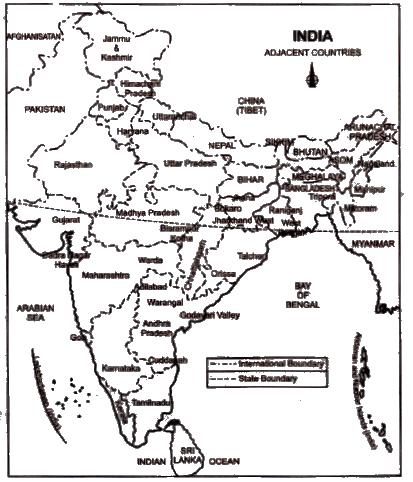
    NCERT Solutions for Class 9th Social Science Geography : Chapter 1 India - Size and Location

    (i) The island groups of India lying in the Arabian Sea and the Bay of Bengal.

    Answer : Lakshadweep Islands and Andaman and Nicobar Islands

    (ii) The countries constituting the Indian Sub-continent.

    Answer : Pakistan, Afghanistan, Nepal, Bhutan, Myanmar and Bangladesh.

    (iii) The states through which the Tropic of Cancer passes.

    Answer : Gujarat, Rajasthan, Madhya Pradesh, Chhattisgarh, Jharkhand, Paschim Banga, Tripura and Mizoram.

    (iv) The northernmost latitude in degrees.

    Answer : 37° 6’N

    (v) The southernmost latitude of the Indian mainland in degrees.

    Answer : 8° 4’N

    (vi) The eastern and the Westernmost longitude in degrees.

    Answer : 68° 7’E and 97° 25’E

    (vii) The place situated on the three seas.

    Answer : Kanyakumari

    (viii)The straight separating Sri Lanka from India.

    Answer : Palk Strait

    (ix) The Union Territories of India.

    Answer : Andaman and Nicobar Islands, Chandigarh, Dadra and Nagar Haveli, Daman and Diu, Lakshadweep, Puducherry and Delhi.

    Project/Activity

    (i) Find out the longitudinal and latitudinal extent of your state.

    Answer : Do it yourself. Sample answeris given below

    My state is Uttar Pradesh longitudinally it extends from 77°4’E to 84°39’E. Latitudinally it extends from about 30 0 20’N to about 23°53’N.

    (ii) Collect information about the ‘Silk Route: Also find out the new developments which are improving communication routes in the regions of the high altitude.

    Answer : (a) Do it yourself. It is given in your History book. Some information is given below

    The Silk Road or Silk Route refers to a historical network of interlinking trade routes across the Afro-Eurasian landmass that connected East, South. and Western Asia with the Mediterranean and European world, as well as parts of North and East Africa.

    The land routes were supplemented by sea routes, which extended from the Red Sea to coastal India, China and South-East Asia.

    Extending 4,000 miles (6,500 km), the Silk Road gets its name from the lucrative Chinese silk trade along it. which began during the Han Dynasty (206 BCE – 220 CE). The central Asian sections of the trade routes were expanded around 114 BCE by the Han dynasty largely through the missions and explorations of Zhang Qian, but earlier trade routes across the continents already existed.

    In the late Middle Ages. transcontinental trade over the land routes of the Silk Road declined as sea trade increased. In recent years, both the maritime and overland Silk Routes are again being used, often closely following the ancient routes.

    (b) Communication routes in regions of high altitude are now-a-days through helicopter (for closer distances) and through high altitude railways like the Ouinghai railway in China linking Lhasa (capital of Tibet) with the rest of the world. More information can be found on this railway from the internet.

  • Concept’s of The Story of India – Size and Location Class 9th Social Science Geography

    Location

    • India lies entirely in the Northern Hemisphere.
    • India’s mainland extends between 8°4’N and 37°8N latitudes, and 68°7’E and 97°25’E
    longitudes.
    • The Tropic of Cancer (23°30N) divides India into two almost equal parts.
    Size
    • Covering an area of 3.28 million square kilometres, India’s total area is 2.4% of the total geographical area of the world.
    • India is the world’s seventh largest country with a land boundary of about 15,200 km, with total length of the coastline being 7,516.6 km.
    • India’s east-west extent appears to be smaller than the north-south extent.
    India and the World
    • The Indian landmass is centrally located between West and East Asia.
    • India’s protruding Deccan Peninsula helped India to establish close contacts with West Asia, Africa and Europe, South-east and East Asia.
    • India’s contacts with the world via land routes are much more than her maritime contacts.
    • India has contributed a lot to the world in forms of ideas, philosophies (Upanishads, Ramayana, Panchatantra) and mathematics (Indian numerals and decimal system).
    • In exchange, India’s architecture was influenced by Greek sculpture and architectural styles from West Asia.
    India’s Neighbours
    • India has an important position in South Asia and has 28 States and 7 Union Territories.
    • India shares its boundaries with Pakistan, Afghanistan, China, Nepal, Bangladesh, Myanmar, and Bhutan.
    • The southern neighbors across the sea consist of the two island countries, namely Maldives and Sri Lanka.
    • India stands apart from the rest of Asia.