Blog

  • Chapter 3 Drainage Notes Class 9th Social Science Geography

    Drainage – The river system is an area.

    Drainage Basin- The area drained by a single river system.

    Water Divide– Any elevated area such as a mountain that separated two drainage Basin

    Drainage system in India

    Indian rivers are divided into two groups:-

    • Himalayan Rivers
    • Peninsular Rivers

    Distinguish between a Himalayan river and Peninsular river.

    Himalayan River

    • Most of the river Himalayan river is perennial because they have water throughout the year.
    • They receive water from rain as well as meeting of snow.
    • The Himalayan river has long courses.
    • They perform crosional activities and carry silt and sand.

    Peninsular River

    • Peninsular River is the seasonal river because their flow is dependent on rainfall.
    • During the dry season, even the large reduce into channels.
    • They have shorter and shallower courses.
    • Most of the peninsula rivers start in the Western Ghats and flow towards Bay of Bengal.

    River System

    A river along with his tributaries.

    Indus River System

    • The river Indus rises in Tibet, near Mansarowar lake.
    • It enters in India in the Ladakh district of Jammu and Kashmir.
    • The tributaries like Beas, Satluj, |Ravi, Chenab and Jhelum join together in the Indus at Mithankot in Pakistan.
    • Indus flows at the length of 2900 km.

    Indus Water Treaty

    This treaty (arguments) was signed between India and Pakistan in 1960. According to this treaty, India can use 20% of its water.

    The Ganga River System

    • The headwaters of Ganga called the ‘Bhagirathi’ is joined by ‘Alaknanda’ at devoprayag in Uttarakhand.
    • The tributaries like Yamuna, Ghaghara, Gandak and Kosi join it.
    • The river Yamuna rises at Yamunotri fancier joined Ganga at Allahabad.
    • The Chambal, the beta and the son are peninsular are the peninsular tributaries join in it.
    • At Tarakka in West Bengal, the river Ganga bifurcates(branched off)
    • One branch goes to southwards and joins the Bay of Bengal and other branch goes to Bangladesh and is joined by the Brahmaputra and is known as Meghma.
    • Largest Delta – Sunderbans Delta.
    • It has the length of 2500 km.

    The Brahmaputra River System

    • The Brahmaputra rises in Tibet east of Mansarovar lake.
    • Most of its course lies outside India.
    • At Namcha Barwa it takes a ‘U’ turn and enters India in Arunachal Pradesh (Dihang)
    • In Tibet, the Brahmaputra carries a smaller volume of water as it is a dry and cold region.
    • But in India, it carries a large volume of water as it passes through heavy rainfall areas.
    • Every year, the river Bhramputra causes widespread destruction due to floods in Assam and Bangladesh.

    Peninsular Rivers

    The Narmada and Tapi flow westwards through a rift valley.

    The Narmada Basin

    • It rises in the Amarkantak hills in Madhya Pradesh.
    • It flows towards the west and creates many beautiful locations like ‘Marble rocks’ near Jabalpur and ‘Deadhar falls’.

    The Tapi Basin

    • The Tapi river rises in the Satpura ranges in the Betul district of Madhya Pradesh.
    • It also flows in a rift valley.

    The Godavari Basin

    The Godavari is the largest peninsular river.

    • It rises in the Western Ghats in the Nasik district of Maharashtra Valley/
    • Its length is about 1500 km.
    • The tributaries like purna, Wardha etc. join in it.
    • The tributaries like Manjira, Pen Ganga, and Wain Ganga are very large. So they are known as ‘Dakshin Ganga’.

    The Mahanadi Basin

    • It rises in the highlands of Chhattisgarh.
    • The length-860 km.

    The Krishna Basin

    • Rises near Mahabaleshwar
    • Length-1400 km.

    The Kaveri Basin

    • Rises in the Brahmagiri ranges of Western Ghats.
    • Length- 760 km.

    Types of Lakes

    Lakes differ from each other in shape, size and other characteristics.

    1. Permanent Lakes- Most of the lakes are permanent
    2. Seasonal Lakes- Contain water during the rainy season. Sambhar lake in Rajasthan example of the seasonal lake.
    3. Some lakes are the result of the action of glaciers or ice-sheets.
    4. Ox-bow lakes- In the floodplains. Oxbow lakes ae found.
    5. Fresh water lakes. Eg. Dal lake, Nainital.

    Damming of rivers for the generation of Hydel power led to the formation of lakes.

    Water lake is the result of tectonic activity.

    Importance of lakes and river in the Economy

    • Lakes help to regulate (control) the flow of a river.
    • It prevents floodings during rainfall and maintains even flow of water during the dry season.
    • The river and lakes can be used for developing hydel power.
    • They moderate the climate of the surrounding and maintain aquatic eco-system.
    • They help to develop tourism and provide recreation (enjoy must fun)
    • Water from rivers is a natural resource which is essential for various human activities.
    • Kaveri joins the Bay of Bengal at Cuddalore in Tamil Nadu.

    Largest Salt Lake- Chillka Lake, Orissa.

    Freshwater Lake- Winlar Lake in Jammu and Kashmir.

  • Is MBA through Distance education worth?

    Master of Business Administration(MBA) is considered as the most rewarding course in the business world today.  The students who aspire to be global business leaders tend to join the MBA programme. Every year thousands of students write tough examinations throughout the world to get an entry into the prestigious universities to pursue MBA degree. Employers hire MBA candidates expecting good managerial skills from them. Even in the times of tough economy, companies would like to hire MBA students. Generally, MBA is considered as an intensive programme. Students need to be very serious to learn those powerful managerial and networking skills.

    There are two ways to pursue the MBA degree. One is the traditional university programme and the other is MBA via distance education programmes. Distance education MBA students need not attend any classes. They will be provided with study materials to learn the theoretical concepts at their home. Though distance education MBAs are not valued as highly as regular MBAs, they got their own set of rewards!

    Nowadays, the distance education MBA and online MBA are slowly gaining the momentum in the market. Because of the online schools like udacity, edx, Khan Academy etc, the online education is getting more recognition than ever before. Due to various reasons, few candidates may not be able to pursue a regular MBA. It may be due to their jobs or lack of money to pay the tuition fees. For those people, distance education or online education makes it possible to get MBA certification.

    Why is regular MBA more valuable than distance education MBA?

    One cannot expect all the benefits of regular MBA programme by doing a distance education MBA. The main reason that differentiates the regular MBA and distance education MBA is the network. Reputed universities invite successful people from different business sectors to interact with their students. They carry many programmes to create exposure and network building skills in their students.

    Distance education MBA lacks in many areas when compared to regular MBA programmes.  The candidates who are pursuing regular MBA will have immense scope to network with mentors and peers right from the university. Whereas distance education candidates may not have any score on the network.

    Distance education MBAs also lack practical training! They are good if you want to learn managerial concepts. But some online MBA programmes are as intensive as a full-time MBA training. Everyday video lessons, interacting with the other students in the forums etc. Distance courses also add a lot of toll on the learning process. It’s tough to carry on the lessons without the teachers and proper self-discipline. Many students fail to study the lessons all by themselves. They even do not attend any virtual lessons as there is no compulsion from anybody.

    Why is it worth to pursue MBA through distance education?

    Full-time MBA is always preferable to distance education MBA. However, it may not possible for everyone to pursue regular MBA either because of money constraints or time constraints. Many prestigious universities charge thousands of dollars even for the distance education programmes. If you want a great job and a super career through an MBA degree, then distance learning mode to get MBA degree is not right. It may be a time and money wastage affair in this scenario adds lots of value to the learning process. Due to this many new wave employers and recruiters are considering to hire even the distance MBA students.

    There are many top universities in the world offering a distance education MBA program. Though they are a bit costly, they add lots of boost to your career. If you are a working professional in corporate sectors, MBA online degree from the prestigious university can help you to grab a promotion. Distance education MBA from regional universities also help the Government employees to get promoted. Always join a reputed university if you want to enroll in a distance MBA.

    In India, distance education MBAs are not considered as a degree in the mainstream hiring process. Most of the reputed companies do not even consider these MBAs as degrees. They are often seen as the poor substitutes for the real MBA programmes.

    So, distance education MBA adds some value to your career if you are already employed in a good organization. If you are a fresher, distance MBA may not be a good choice for you. Employers always prefer the freshers with regular MBA degree. However, if you still want to pursue distance education MBA, enroll yourself in the reputed universities. Though the reputed universities charge you a huge fee even for the distance programmes, they got more acceptance than the tier 2 universities. In most cases, distance education MBA programmes may never act as a turning point in your career. Do not expect any huge career shifts with distance education programmes.

  • Best weekend courses for working professionals in Delhi

    Pursuing a valuable weekend course can help you enhance your skills without worrying about your work schedule. We bring you top 5 institutes with the most beneficial weekend courses for working professionals in Delhi. Take a look:

    1. inlingua New Delhi

    If you already have a good command over English language, you may skip this, but inlingua New Delhi offers a wide selection of English courses to choose from. You can check out their career Skills Course which focuses on English usage in a global workspace, or an advanced level English language course for overall improvement in oral as well as written English.


    They conduct special batches over the weekends, or sometimes early morning during the week for working professionals.


    1. Barry John Acting Studio

    This one is for those who are ready to do some legwork on their off-days. If you have a genuine passion for the art of acting, this school can be a great place for you.


    They also have a Film Direction Workshop, which covers all the basics of filmmaking, like editing, camera, lights, sound, and screenwriting for an overall taste of the filmmaking life. The classes are held over weekends.


    1. All India Management Association

    The Professional Certificate Programme in Digital Marketing & Analysis offered by All India Management Association covers the basics of marketing and advertising concepts.


    The course also offers an in-depth insight into digital marketing and analytical tools such as SEO, SEM, mobile marketing, web analytics, etc. Spanning over 3months, the classes are held online over the weekend. That makes it super convenient for working people.


    1. Institute Of Management Technology

    Time-bound working professionals can check out this correspondence management programme. However, you must keep in mind that this course is going to be super-intensive, so you might have to bid goodbye to your social life for a while.


    Institute of Management Technologyconducts3-hour classes on Friday and Saturday evenings, along with7-hour-long sessions on Sundays. However, to make things a little easier, they allow you to complete the 3-year programme within 5years of joining.


    1. Fore School Of Management

    Fore School of Management is the perfect place for you if you’ve been intending to get an MBA degree, but don’t want to leave your job. The course has been designed especially for working professionals, making this part-time PGDM provide you with the best of both the worlds.


    Apart from the diploma, Fore School of Management also offers super specialization courses like Certification in Six Sigma and Certification in Project Management. However, the best part remains that they let you complete this 3-year programme over a span of 5 years.They also take in requests to re-appear for an exam in case a student has missed it due to some inconvenience.

    Did we miss out on something? Let us know!

  • Notes of Physical Features of India Chapter 2 Class 9th Social Science Geography

    Chapter – 2 Physical Features of India


    1. Major features of the earth are mountain, plateaus, plains islands and dessert.

    Origin of the Earth

    • Theory of plate tectonics- According to this theory, the upper part of the earth (crust) is made up of 7 major and some minor plates.
    • The movement of the plates results in folding, faulting, and volcanic activity.
    • There are 3 plates movements

    (a) Convergent Boundary- When some plates come towards each other convergent boundary is formed

    (b) Divergent Boundary- When some plates someone away from each other divergent boundary is formed.

    (c)Transform Boundary- When two plates come together, they may either collide or crumble or one may slide under the other.

    How were the Himalayas formed?

    • The Himalayas were once the part of Gondwana land.
    • The Gondwana land included India, Australia, South America, South Africa and Antarctica as one single land mass.
    • The conventional currents split the crust into pieces.
    • The Indo-Australia plate, which was separated from Gondwana land began to move towards the north.
    • Then, it collided with the much larger Eurasian plate.
    • As the result of the collision, Tethys was folded and the Himalayas were uplifted.

    Formation of Northen Plains

    • The Himalayan uplift out of Tethys Sea, resulted is the formation of a large basin.
    • In the due cause of time, these plains get filled with sediments brought down by Himalayan river.
    • A flat land of alluvial deposits led to the formation of Northen Plain.

    Major Physiographic Division

    • The Himalayan Mountains
    • The Northen plains
    • The Peninsular Plateau
    • The Indian Desert
    • The Coastal Plains
    • The Islands

    The Himalayan Mountain

    They are young fold mountains and runs in the west-east direction.

    They are highest and the most rugged mountains barriers in the world.

    They form an arc and covers the distance of 2400 km.

    The Himalayas consists of 3 parallel ranges i.e., Himadri, Himachal, Shivalik.

                                                                Himadri

    Himadri is the northern most range of Himalayas also known as great or inner Himalayas.

    Important Himalayas peaks are located here with the average height of 6000 m.

    It is composed of granite and snow bound.

    Himachal

    The range lying to the south of Himadri is called Himachal, also known as lesser Himalayan.

    Their height varies from 3700 m and 4500 m.

    The famous valleys like Kashmir, Kangra, and Kullu are located here.

    Shivalik

    It is the outer most range of Himalayas.

    These valleys are covered with gravel and aluminum. some important dunes are located like Deharadun, pattidum, and Kotlidum and located here. [Dunes – The valley lying lesser Himalayas and shivaliks]

    How are the Himalayas divided on the basis of the region?

    (i) Punjab Himalayas.

    The region lying between Indus and Satluj river.

    (II) Kumaon Himalayas

    The region lying between satluj and Kali river.

    (III) Nepal Himalayas

    The region lying between kali and Tista river.

    (IV) Assam Himalayas

    The region lying between Tista and Dihag river.


    Purvanchal/Eastern Hills

    • Beyond Dihang gorgl, the Himalayas bend sharply towards the south and spread along the eastern boundary.
    • They are composed of sand stone and covered with dense forests.
    • Purvanchal comprised of Parkai Hills, Naga Hills, Manipur hills and Mizo hills.

    Northern Plains

    • Northern Plains has been formed by the three rivers, i.e. Indus, Ganga, and the Brahmaputra.
    • They are formed of alluvial soil and are very fertile.
    • They are densely populated and agriculturally a very productive part of India. Due to sufficient water supply, favorable climate and fertile soil.

    River in Island

    In the lower course, the velocity of the river decrease which results in the formation of the river in the island.

    Distributes

    The river in their lower course split into numerous channels.

    Tributaries

    Many streams/rivers join the main rivers.

    Sections of Northern Plain

    Northern plain is divided into 3 sections.

    Punjab Plain-

    It lies to the western part of Northern Plain. It is formed by Indus and its tributaries.

    Ganga Plain

    It lies between ghagger and Tista rivers.

    Brahmaputra Plain

    It lies to the east of Ganga Plains.

    A region of Northern Plain

    The northern plain is divided into 4 regions.

    • Bhabur 

    The river after descending from mountains, deposit pebbles in a narrow belt of 8 to 16 km.

    • Terai

    All the streams disappear in the Bhabur belt and reemerge in a wet and marsley region.

    • Bhangar

    The region with older alluvium.

    • Khadar

    The region with newer alluvium. They are renewed every year and are very fertile.

    The Peninsular Plateau

    • The peninsular plateau is a tableland and composed of igneous, metamorphic and crystalline rocks.
    • It has broad and shallow valleys and rounded hills. It is divided into two:-

    (i) Central Highlands

    (ii) Deccan Plateau

    Central Highlands Deccan Plateau
     It lies to the north of Narmada

    River.

    It lies to the south of Narmada

    River.

    It is wider in the west and narrower

    in the east.

    It is a triangular land

    mass

     The Chambal, sind, betwa etc are the

    important river.

    It is higher in the west and slops

    eastwards.

     Bundelkhand and Baghilkhand are

    the eastward extension

    The Garo, the Khasi, the Jaintia

    are the important hill ranges.


    Compare and contrast western ghats and eastern ghats.

    They are continuous and higherthan eastern ghats,

    Western Ghats Eastern Ghats
    Western ghats are the western

    edge of the Deccan Plateau

    Eastern Ghats are the eastern

    edge of Deccan Plateau

    They are discontinuous and

    dissected by riveghats,

    Their average elevation is 900-

    1600 meters

    The elevation (height) is 600

    meters.

    Anaimade is the highest peak

    (2695 meter)

    Mahendragiri is the highest peak

    (1501 meter).

    Deccan Trap

    The black soil are in the peninsular plateau.

    The Indian Desert

    • The Indian desert lies to the western margins of the Aravali hills.
    • It is ab undulating sandy plain covered with sand dunes.
    • This area receive very low rainfall and has an arid climate with low vegetation.
    • Luni is the only large river.

    Barch and – The crescent-shaped dunes.

    Coastal Plains

    India has two coastal plain:-

    • Western Coast.
    • Eastern Coast
    • Western Costs lies between the Western Ghats and Arabian sea.
    • Eastern Coast lies between Eastern Ghats and Bay of Bengal.

    Western Coast

    It is divided into 3 sections

    • Konchan- Northern part of the western coast.
    • Kannad- untral part of the western coast.
    • Malabar- Southern part of the western coast.

    Also, Check: Chapter-1 India- Size and Location Notes Class 9th SST

    Eastern Coast

    It is divided into 2 sections.

    • Northern Circar – The northern part of Eastern Coast
    • Corom andel Coast- The southern part of Eastern Coast.

    The Islands

    India has two island groups

    • Andaman and Nicobar
    • Lakshadweep

    Lakshadweep Islands

    They lie close to Malabar coast of Kerala.

    Earlier they were known as Laccadive, Minicoy and Amindiee.

    In 1973 these islands  are name as Lakshadweep.

    It covers a small area of 32 sq. km.

    Kavaratti flead quarters.

    Andaman and Nicobar Islands

    They are located in Bay of bengal

    They are bigger in size, mumerous and scattered.

    Andaman islands are located in the north and nicobar islands in the south.

    They lie close to the equator and so they have an equatarial climate.

    Portblair is the headquarter of Andaman and Nicobar Islands.

    Each Physiographic divisions complements the others explain.

    The mountains are the major sources of water and forest. The northern plains are the granaries of the country..

    The plateau is the storehouse of minerals.

    The coastal regions and island groups provide sites for fishing and part activities.

  • 6 Most Popular Distance Education Professional Courses in India

    Distance education courses are one of the best ways to complete education when you can not afford going colleges regularly. Often students after 12th boards take up a job and could not able to make it to the college.

    Or if you are doing a job, and wishing for a higher position. Then distance education courses like MBA can help you quite a lot.

    But the question is what are some of the most Popular Distance Education Professional Courses in India?

    Well just to answer this question, we have handpicked some of the most professional education distance courses which are available in India. So you can quickly decide what is better for yourself and your career.

    Furthermore, you can check out the Distance Education Hub website to find some suitable colleges for yourself.

    6 Most Popular Distance Education Professional Courses in India:

    MBA:

    MBA is one of the top course that you must do. The course would be profitable if you are doing a job and expecting a pay hike in short period. An MBA degree will not just give you a better pay cheque. Also, it will open up lots of opportunities for you. Hence, as a result, you will quickly score a job as a manager in a big company. Or you can launch your startup.

     An MBA degree also will give you a career satisfaction and will teach you how to deal with problems. This learning will eventually help you to increase your confidence level.

    Talking about eligibility, well you can do an MBA course from any background. However, you have to have a 3 year’s bachelor degree with 50 percent of minimum marks.

    MCA:

    MCA stands for Master of Computer Application. It is a three year course. The course was designed to meet the growing demand of professionals in the field of Information technology(IT). With this course you will be able to get a job as a Software Programmer, Software Engineer, Software Developer, Systems Analyst, Software Application Architect, Software Consultant and so many other job options.

    For applying for an MCA course, the candidate should have studied B.C.A or B.Sc Computer Science or B.Sc Information Technology and scored a minimum 60 percent marks.

    BBA:

    BBA is a good option if you have just passed 12th and looking ahead to get into the management field. It gives you the early concepts of management and business studies. The course will help you to learn about the management concepts way before an MBA degree. Even the course will also help you in getting into an MBA college easily. 

    Also if you do not plan to go for an MBA degree in future, then a BBA degree will help you to get enough job opportunities. To adopt a BBA course the candidate needs to have minimum 50 percent marks in their 12th board examination.

    BCA:

    BCA stands for Bachelor of Computer Applications. It is the early stage course of the MCA. The course gives a student an advantage to learn about the information technology at an early stage. Also, it walks a student through all the different concepts of programming language and computer fundamentals. As a result, the student will be able to develop mobile apps, web apps and so on. BCA course is a good option if one does not want to go for B tech but still want to score a job in the IT sector.

    For adopting a BCA course, the candidate should have mathematics in their higher secondary syllabus and a minimum marks of 50 percent.

    PGDCA:

    PGDCA is a must do the course if you are planning to become an aspiring programmer. The course teaches you everything about computer programming. Such as C, C++, Java and so on. Also, it teaches you Tally and other application and computer fundamentals. After completing the course, you will be able to score a programmer job at various organizations. However, the course would only be beneficial if you go to MCA at first.

    Talking about PGDCA eligibility, the candidate needs to pass their 12th and bachelor degree with mathematics subject. Also, the minimum percentage is 50.

    B.Ed:

    In the end, we have the B.Ed. It is a must do the course if you are planning to become a teacher. With a bachelor of arts degree will not help you in achieving anything. Instead, if you go for a B.Ed degree, it will give you a lot of opportunities. Science and arts students can do this course to get a government job as a teacher. Also, the course for B.Ed is quite low compared to any other course. Plus you can go for distance and regular studies.

    For a B.Ed degree, the candidate should belong from a Bachelor of Arts (B.A), Bachelor of Science (B.Sc.) or Bachelor of Commerce (B.Com.) stream with at least 50% marks.

    So those were the top 6 Most Popular Distance Education Professional Courses in India. If you have any further questions, then do comment below.

  • NCERT Exemplar Problems Solutions PDF Download

    Get All NCERT Exemplar Problem Solution Of Class 12 to 6th With free PDF Download. “Exemplar Problems” in Science and Mathematics have been developed by the Department of Education in Science and Mathematics (DESM), National Council of Educational Research and Training (NCERT), for the secondary and higher secondary classes aiming for providing students a variety of quality problems in different formats having difficulty levels, namely, Multiple Choice Questions, Short Answer Questions, Long Answer Questions, etc.

    NCERT Exemplar Problems Solutions

    CBSE Class 12

    1. NCERT Exemplar Problems Solutions for Class 12 Maths
    2. NCERT Exemplar Problems Solutions for Class 12 Physics
    3. NCERT Exemplar Problems Solutions for Class 12 Chemistry
    4. NCERT Exemplar Problems Solutions for Class 12 Biology

    CBSE Class 11

    1. NCERT Exemplar Problems Solutions for Class 11 Maths
    2. NCERT Exemplar Problems Solutions for Class 11 Physics
    3. NCERT Exemplar Problems Solutions for Class 11 Chemistry
    4. NCERT Exemplar Problems Solutions for Class 11 Biology

    CBSE Class 10

    1. NCERT Exemplar Problems Solutions for Class 10 Maths
    2. NCERT Exemplar Problems Solutions for Class 10 Science

    CBSE Class 9

    1. NCERT Exemplar Problems Solutions for Class 9 Maths
    2. NCERT Exemplar Problems Solutions for Class 9 Science

    CBSE Class 8

    1. NCERT Exemplar Problems Solutions for Class 8 Maths
    2. NCERT Exemplar Problems Solutions for Class 8 Science

    CBSE Class 7

    1. NCERT Exemplar Problems Solutions for Class 7 Maths
    2. NCERT Exemplar Problems Solutions for Class 7 Science

    CBSE Class 6

    1. NCERT Exemplar Problems Solutions for Class 6 Maths
    2. NCERT Exemplar Problems Solutions for Class 6 Science
  • NCERT Exemplar Problems Solutions for Class 12 Physics

    Physics NCERT Exemplar Solution pdf download, get all Physics NCERT Exemplar problem solution here with Step by step problem solution of class 12th CBSE.

    NCERT Exemplar Problems Class 12 Physics

    Also check: NCERT Exemplar Problems Solutions for Class 12 Maths

  • Communication Systems NCERT Exemplar Problems Solutions Physics

    NCERT Exemplar Problems Class 12 Physics Chapter 15 Communication Systems

    Multiple Choice Questions (MCQs)

    Single Correct Answer Type
    Question 1. Three waves A, B and C of frequencies 1600 kHz, 5 MHz and 60 MHz respectively are to be transmitted from one place to another. Which of the following is the most appropriate mode of communication?
    (a) A is transmitted via space wave while B and C are transmitted via sky wave
    (b) A is transmitted via ground wave, B via sky wave and C via space wave
    (c) B and C are transmitted via ground wave while A is transmitted via sky wave
    (d) B is transmitted via ground wave while A and C are transmitted via space wave
    Solution: (b)
    Key concept: The radio waves emitted from a transmitter antenna can reach the receiver antenna by the following mode of operation.
    • Ground wave propagation
    • Sky wave propagation
    • Space wave propagation
    Mode of communication frequency range:
    • Ground wave propagation— 500 kHz to 1710 kHz
    • Sky wave propagation — 2 MHz to 40 MHz
    • Space wave propagation— 54 MHz to 42 GHz
    So, A is transmitted via ground wave, B via sky wave and C via space wave.

    Question 2. A loom long antenna is mounted on a 500 m tall building. The complex can become a transmission tower for waves with λ.
    (a) ~400m (b) -25 m (c) -150 m (d) -2400 m
    Solution: (a) Length of the building (l) is
    l = 500 m
    and length of antenna = 100 m
    and we know, wavelength of the wave which can be transmitted by
    L =λ/4. So, λ~ 4l= 4 x 100 = 400 m
    Wavelength (λ) is nearly equal to 400 m.

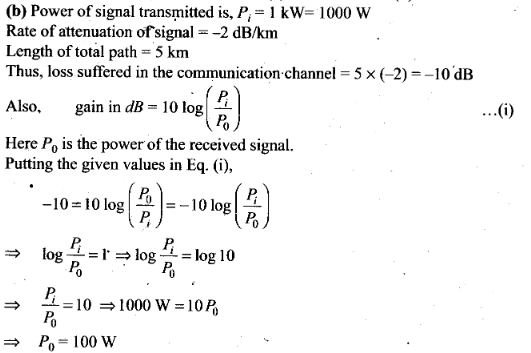
    Question 3. A1 kW signal is transmitted using a communication channel which provides attenuation at the rate of -2dB per km. If the communication channel has a total length of 5 km, the power of the signal received is [gain in dB =10 log10(p0/pi)]
    (a) 900 W (b) 100 W (c) 990 W (d) 1010 W
    Solution:
    ncert-exemplar-problems-class-12-physics-communication-systems-1

    Question 4. A speech signal of 3 kHz is used to modulate a carrier signal of frequency 1 MHz, using amplitude modulation. The frequencies of the side bands will be
    (a) 1.003 MHz and 0.997 MHz (b) 3001 kHz and 2997 kHz
    (c) 1003 kHz and 1000 kHz (d) 1 MHz and 0.997 MHz
    Solution: (a)
    Key concept: The process of changing the amplitude of a carrier wave in accordance with the amplitude of the audio frequency (AF) signal is known as amplitude modulation (AM).
    In AM, frequency of the carrier wave remains unchanged.
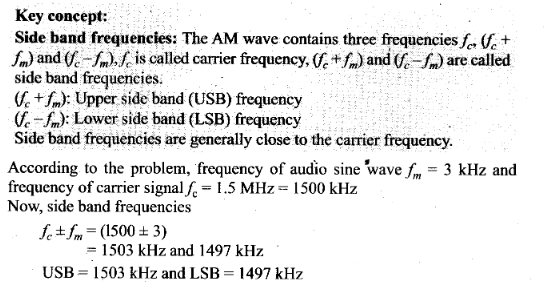
    Side band frequencies: The AM wave contains three frequencies fc, (fc + fm) and (fc -fm),fc is called carrier frequency, (fc +fm) and (fc -fm) are called side band frequencies.
    (fc +fm): Upper side band (USB) frequency
    (fc -fm): Lower side band (LSB) frequency
    Side band frequencies are generally close to the carrier frequency.
    According to the problem, frequency of carrier signal is fc = 1 MHz and frequency of speech signal = 3 kHz
    = 3 x 10⁻³ MHz
    = 0.003 MHz
    We know that, Frequencies of side bands = (fc ± fm) = (1 + 0.003) and (1 – 0.003)
    So, side band frequencies are 1.003 MHz and 0.997 MHz.

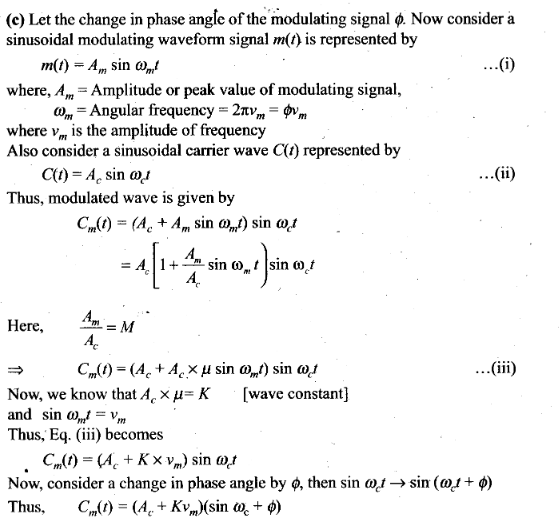
    Question 5. A message signal of frequency ωm is superposed on a carrier wave of frequency ωc to get an Amplitude Modulated Wave (AM). The frequency of the AM wave will be
    ncert-exemplar-problems-class-12-physics-communication-systems-2
    Solution: (b)
    Key concept: The process of changing the amplitude of a carrier wave in accordance with the amplitude of the audio frequency (AF) signal is known as amplitude modulation (AM).
    In AM, frequency of the carrier wave remains unchanged or we can say that the frequency of modulated wave is equal to the frequency of carrier wave. Now, according to the problem, frequency of carrier wave is fc.
    Thus the amplitude modulated wave also has frequency fc.

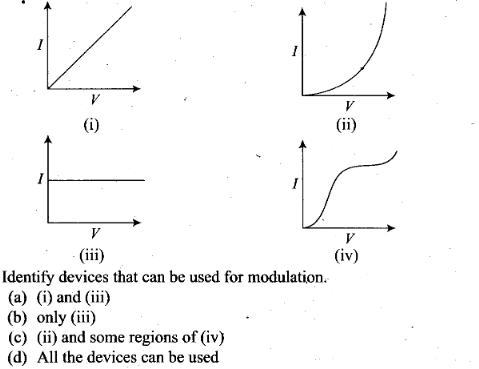
    Question 6. I-V Characteristics of 4 devices are shown in figure.
    ncert-exemplar-problems-class-12-physics-communication-systems-3
    Solution: Key concept: A square law modulator is the device which can produce modulated waves by the application of the message signal and the carrier wave.
    Square law modulator is used for modulation purpose. Characteristics shown by (i) and (iii) correspond to linear devices.
    And by (ii) corresponds to square law device which shows non-linear relations. Some part of (iv) also follow square law.
    Hence, (ii) and (iv) can be used for modulation.

    Question 7. A male voice after modulation-transmission sounds like that of a female to the receiver. The problem is due to
    (a) poor selection of modulation index (selected 0 < m <1)
    (b) poor bandwidth selection of amplifiers
    (c) poor selection of carrier frequency
    (d) loss of energy in transmission.
    Solution: (b) In this problem, the frequency of modulated signal received becomes more, due to improper selection of bandwidth.
    This happens because bandwidth in amplitude modulation is equal to twice the frequency of modulating signal.
    But, the frequency of male voice is less than that of a female.

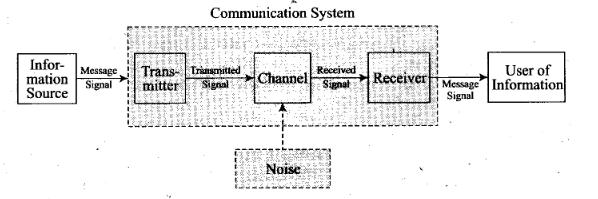
    Question 8. A basic communication system consists of
    A. transmitter.
    B. information source.
    C. user of information.
    D. channel.
    E. receiver.
    Choose the correct sequence in which these are arranged in a basic communication system.
    (a) ABCDE (b) BADEC (c) BDACE (d) BEADC
    Solution: (b) A basic communication system consists of an information source, a transmitter, a link (channel) and a receiver or a communication system is the set-up used in the transmission and reception of information from one place to another.
    The whole system consist of several elements in a sequence. It can be represented as the diagram given below:
    ncert-exemplar-problems-class-12-physics-communication-systems-4

    Question 9. Identify the mathematical expression for amplitude modulated wave,
    ncert-exemplar-problems-class-12-physics-communication-systems-5
    Solution:
    ncert-exemplar-problems-class-12-physics-communication-systems-6

    One or More Than One Correct Answer Type

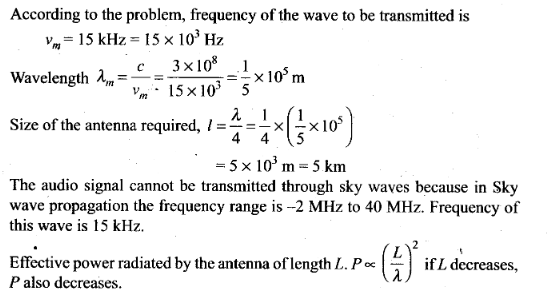
    Question 10. An audio signal of 15 kHz frequency cannot be transmitted over long distances without modulation, because
    (a) the size of the required antenna would be at least 5 km which is not convenient
    (b) the audio signal cannot be transmitted through sky waves
    (c) the size of the required antenna would be at least 20 km, which is not convenient
    (d) effective power transmitted would be very low, if the size of the antenna is less than 5 km
    Solution: (a, b, d)
    Key concept: Size of the antenna or aerial. For transmitting a signal, we need an antenna or an aerial. This antenna should have a size comparable to the wavelength of the signal (at least 1/4 in dimension) so that the antenna properly senses the time variation of the signal. For an electromagnetic wave of frequency 20 kHz, the wavelength λ is 15 km. Obviously, such a long antenna is not possible to construct and operate. Hence direct transmission of such baseband signals is not practical. We can obtain transmission with reasonable antenna s if transmission frequency is high (for example,
    if n is 1 MHz, then λ is 300 m). Therefore, there is a need of translating the information contained in our original low frequency baseband signal into high or radio frequencies before transmission.
    Effective power radiated by an antenna: A theoretical study of radiation from a linear antenna (length l) shows that the power radiated is proportional to (1/λ)2 . This implies that for the same antenna length, the power radiated increases with decreasing λ, i.e., increasing frequency. Hence, the effective power radiated by a long wavelength baseband signal would be small. For a good transmission,we need high powers and hence this also points out to the need of using high frequency transmission.
    ncert-exemplar-problems-class-12-physics-communication-systems-7

    Question 11. Audio sine waves of 3 kHz frequency are used to amplitude modulate a carrier signal of 1.5 MHz. Which of the following statements are true?
    (a) The side band frequencies are 1506 kHz and 1494 kHz
    (b) The bandwidth required for amplitude modulation is 6 kHz
    (c) The bandwidth required for amplitude modulation is 3 MHz
    (d) The side band frequencies are 1503 kHz and 1497 kHz
    Solution: (b, d)
    ncert-exemplar-problems-class-12-physics-communication-systems-8
    Also,bandwidth =2 fm=2 x 3=6 KHz

    Question 12. A TV transmission tower has a height of 240 m. Signals broadcast from this tower will be received by LOS communication at a distance of (assume the radius of earth to be (6.4 x 10⁶ m)
    (a) 100 km (b) 24 km (c) 55 km (d) 50 km
    Solution: (b, c, d)
    ncert-exemplar-problems-class-12-physics-communication-systems-9
    Therefore, the range of 55.4 km covers the distance 24 km, 55 km and 50 km.

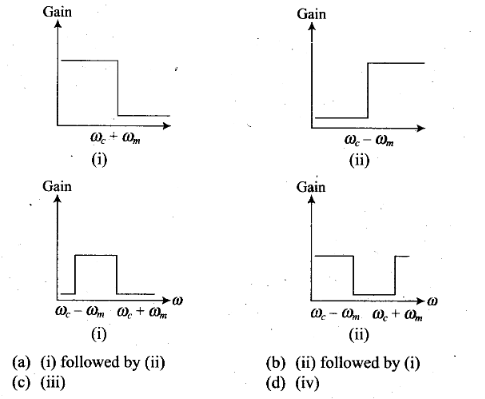
    Question 13. The frequency response curve (figure) for the filter circuit used for production of AM wave should be
    ncert-exemplar-problems-class-12-physics-communication-systems-10
    Solution:(a, b, c)
    Key concept:
    (i) Side band frequencies-. The AM wave contains three frequencies fc ,(fc +fm) and (fc-fm),fc is called carrier frequency, (fc +fm) and (fc -fm) are called side band frequencies.
    (fc + fm)- Upper side band (USB) frequency
    (fc – fm): Lower side band (LSB) frequency
    Side band frequencies are generally close to the carrier frequency,
    (ii) Bandwidth: The two side bands lie on either side of the carrier frequency at equal frequency interval ωm.
    So, bandwidth = {(ωc + ωm) – (ωc – ωm)} = 2ωm
    ncert-exemplar-problems-class-12-physics-communication-systems-11
    To produce an amplitude modulated wave, bandwidth is given by the difference between upper side band frequency and lower side band frequency. Bandwidth = ωUSB – ωLSB = (ωc + ωm) – (ωc – ωm)

    Question 14. In amplitude modulation, the modulation index m is kept less than or equal to 1 because
    (a) m> 1, will result in interference between carrier frequency and message frequency, resulting into distortion.
    (b) m > 1, will result in overlapping of both side bands resulting into loss of information
    (c) m > 1, will result in change in phase between carrier signal and message signal.
    (d) m > 1, indicates amplitude of message signal greater than amplitude of carrier signal resulting into distortion.
    Solution: (b, d)
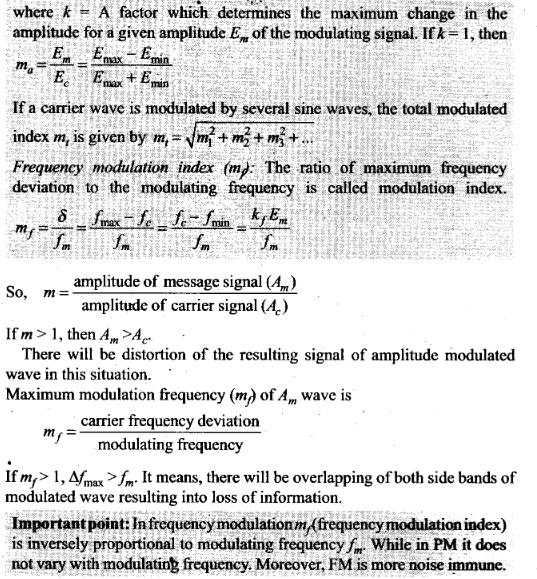
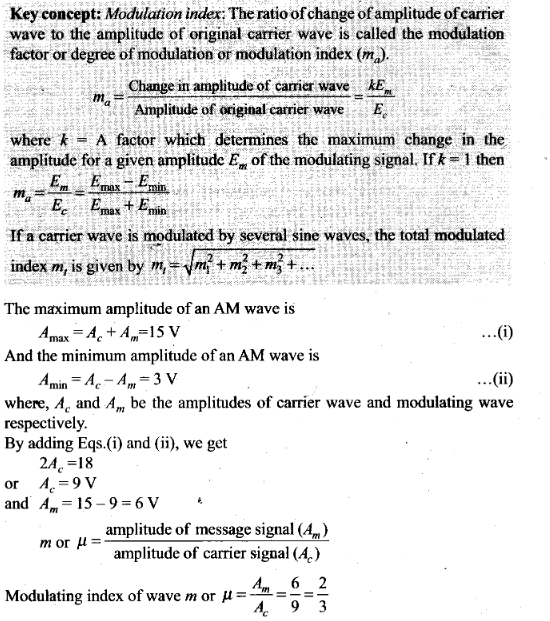
    Key concept: Modulation index: The ratio of change of amplitude of carrier wave to the amplitude of original carrier wave Is called the modulation factor or degree of modulation or modulation index (ma).
    ncert-exemplar-problems-class-12-physics-communication-systems-12
    ncert-exemplar-problems-class-12-physics-communication-systems-13
    Very Short Answer Type Questions

    Question 15. Which of the following would produce analog signals and which would produce digital signals?
    (a) A vibrating tuning fork
    (b) Musical sound due to a vibrating sitar string
    (c) Light pulse
    (d) Output of NAND gate
    Solution: Analog and digital signals are the gateway of information or we can say that they are used to transmit information through electric signals. In both these signals, the information such as any audio or video is transformed into electric signals.
    The difference between analog and digital technologies is that in analog technology, information is translated into electric pulses of varying amplitude. In digital technology, translation of information is into binary formal (zero or one) where each bit is representative of two distinct amplitudes. So, output of a NAND gate and a light pulse produces a digital signal.
    Thus, (a) and (b) would produce analog signal and (c) and (d) would produce digital signals.

    Question 16. Would sky waves be suitable for transmission of TV signals of 60 MHz frequency?
    Solution: A signal to be transmitted through sky waves must have a frequency range of 1710 kHz to 40 MHz.
    But, here the frequency of TV signals are 60 MHz which is beyond the required range (frequency range: there is a maximum frequency of EM waves called critical frequency, above which wave cannot reflect back).
    So, sky waves will not be suitable for transmission of TV signals of 60 MHz frequency.
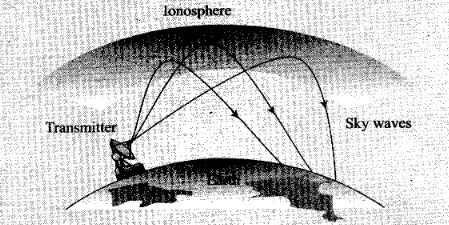
    Important point: Sky wave propagation: These are the waves which are reflected back to the earth by ionosphere.
    Ionosphere is a layer of atmosphere having charged particles, ions and electrons and extended above 80 km – 300 km from the earth’s surface.
    ncert-exemplar-problems-class-12-physics-communication-systems-14

    Question 17. Two waves A and B of frequencies 2 MHz and 3 MHz, respectively are beamed in the same direction for communication via sky wave. Which one of these is likely to travel longer distance in the ionosphere before suffering total internal reflection?
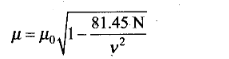
    Solution: We know that refractive index p of a layer is
    ncert-exemplar-problems-class-12-physics-communication-systems-15
    The refractive index of wave B is more than refractive index of wave A because frequency of wave B is more than wave A (as refractive index increases with frequency increases).
    Sin i / sin r = µ (lesser the value of r larger the value of µ )
    For higher frequency wave (i.e., higher refractive index) the angle of refraction is less, i.e., bending is less. So, wave B travels longer distance in the ionosphere before suffering total internal reflection.
    Importance point: Refractive index of a medium is that characteristic which decides speed of light in it.
    Dependence of Refractive index:
    (i) Nature of the media of incidence and refraction.
    (ii) Colour of light or wavelength of light.
    (iii) Temperature of the media: Refractive index decreases with the increase in temperature.
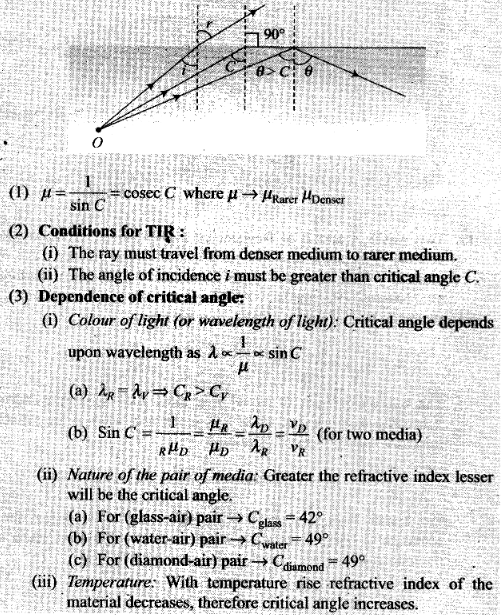
    Total internal reflection: When a ray of light goes from denser to rarer medium it bends away from the normal and as the angle of incidence in denser medium increases, the angle of refraction in rarer medium also increases and at a certain angle, angle of refraction becomes 90°. This angle of incidence is called critical angle (C).
    When angle of incidence exceeds the critical angle then light ray comes back into the same medium after reflection from interface. This phenomenon is called Total internal reflection (TIR).
    ncert-exemplar-problems-class-12-physics-communication-systems-16

    Question 18. The maximum amplitude of an AM wave is found to be 15 V while its minimum amplitude is found to be 3 V. What is the modulation index?
    Solution:
    ncert-exemplar-problems-class-12-physics-communication-systems-17

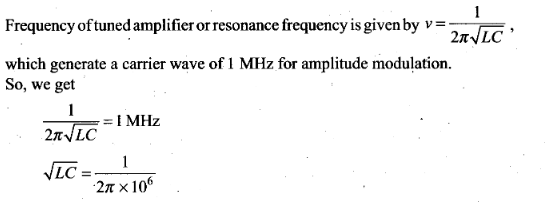
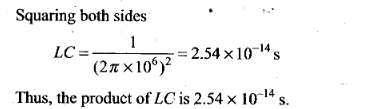
    Question 19. Compute the LC product of a tuned amplifier circuit required to generate a carrier wave of 1 MHz for amplitude modulation.
    Solution:
    ncert-exemplar-problems-class-12-physics-communication-systems-18
    ncert-exemplar-problems-class-12-physics-communication-systems-19

    Question 20. Why is an AM signal likely to be more noisy than a FM signal upon transmission through a channel?
    Solution: An AM signal likely to be more noisy than FM signal through a channel because in case of AM, the instantaneous voltage of carrier waver waves is varied by the modulating wave voltage So, during the transmission, noise signals can also be added and receiver assumes noise a part of the modulating signal. In case of FM, the frequency of carrier waves is changed as the change in the instantaneous voltage of modulating waves. This can be done by mixing and not while the signal transmitting in channel. So, noise does not affect FM signal or simply we can say that noise signals are difficult to filter out in AM reception whereas FM receivers easily filter out noise.
    Important point: In frequency modulation mf (frequency modulation index) is inversely proportional to modulating frequency fm. While in PM it does not vary with modulating frequency. Moreover, FM is more noise immune.

    Short Answer Type Questions

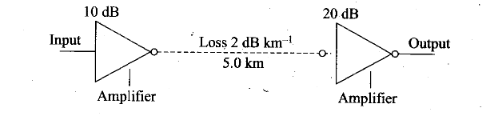
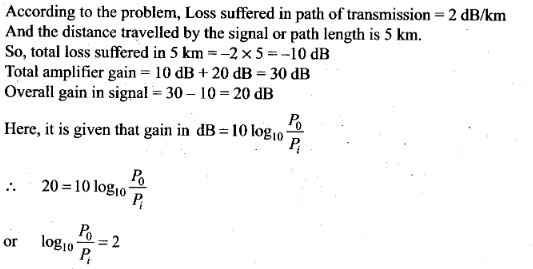
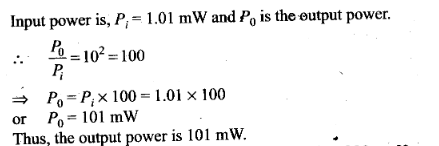
    Question 21. Figure shows a communication system. What is the output power when input signal is of 1.01 mW? [Gain in dB = 10 log10 (P0 / P1)]
    ncert-exemplar-problems-class-12-physics-communication-systems-20
    Solution:
    ncert-exemplar-problems-class-12-physics-communication-systems-21
    ncert-exemplar-problems-class-12-physics-communication-systems-22

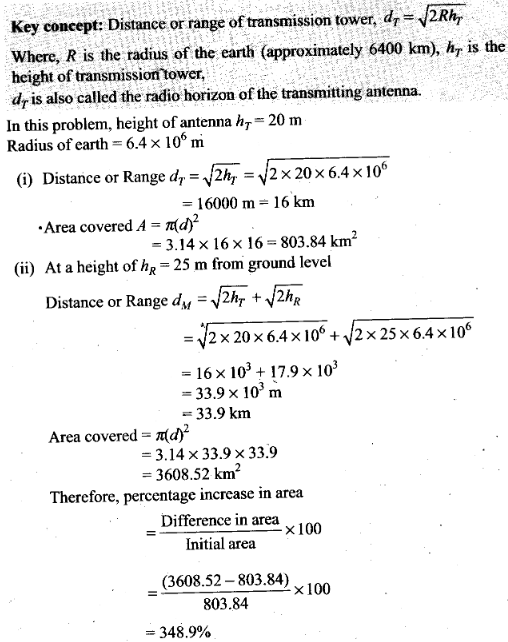
    Question 22. A TV transmission tower antenna is at a height of 20 m. How much service area can it cover if the receiving antenna is (i) at ground level, (ii) at a height of 25 m? Calculate the percentage increase in area covered in case (ii) relative to case (i).
    Solution:
    ncert-exemplar-problems-class-12-physics-communication-systems-23

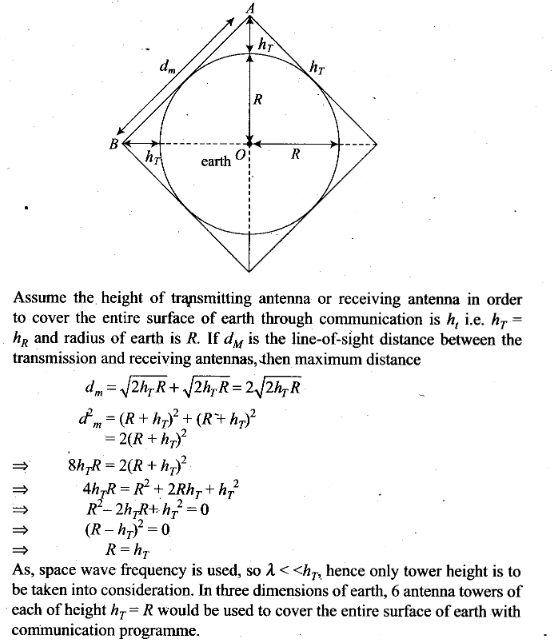
    Question 23. If the whole earth is to be connected by LOS communication using space waves (no restriction of antenna size or tower height), what is the minimum number of antennas required? Calculate the tower height of these antennas in terms of earth’s radius.?
    Solution:
    Key concept: Distance or range of transmission tower, dT =√2RhT
    where, R is the radius of the earth (approximately 6400 km). hT is the height of transmission tower, .
    dT is also called the radio horizon of the transmitting antenna.
    Let us consider the figure given below to solve this problem.
    Assume the height of transmitting antenna or receiving antenna in order to cover the entire surface of earth through communication is h1, i.e. hT = hR and radius of earth is R. If dM is the line-of-sight distance between the transmission and receiving antennas, then maximum distance
    ncert-exemplar-problems-class-12-physics-communication-systems-24

    Question 24. The maximum frequency for reflection of sky waves from a certain layer of the ionosphere is found to be fmax= 9(Nmax)1/2, where Nmax is the maximum electron density at that layer of the ionosphere.
    On a certain day it is observed that signals of frequencies higher than 5 MHz are not received by reflection from the F1 layer of the ionosphere while signals of frequencies higher than 8 MHz are not received by reflection from the F2 layer of the ionosphere. Estimate the maximum electron densities of the F1 and F2 layers on that day.
    Solution:
    ncert-exemplar-problems-class-12-physics-communication-systems-25

    Question 25. On radiating (sending out) and AM modulated signal, the total radiated power is due to energy carried by ωc, (ωc – ωm) and (ωc + ωm). Suggest ways to minimise cost of radiation without compromising on information.
    Solution:
    Key concept: Side band frequencies. The AM wave contains three frequencies ωc, (ωc + ωm) and (ωc – ωm), ωc is called carrier frequency, (ωc + ωm) and ( ωc – ωm) are called side band frequencies.
    c + ωm) = Upper side band (USB) frequency
    c – ωm) =Lower side band (LSB) frequency
    Side band frequencies are generally close to the carrier frequency.
    Only side band frequencies contain information in amplitude modulated signal, [only (ωc+ ωm) and (ωc + ωm)].
    Here, the total radiated power is due to energy carried by ωc, (ωc – ωm) and (ωcm)
    For reduction of cost of radiation without compromising on information ωc can be left and transmitting the frequencies (ωc + ωm), (ωc – ωm) or both (ωc + ωm) and (ωc – ωm).

    Long Answer Type Questions

    Question 26. The intensity of a light pulse travelling along a communication channel decreases exponentially with distance x according to the relation I = I0e-ax, where I0 is the intensity at x = 0 and α is the attenuation constant.
    (a) Show that the intensity reduces by 75% after a distance of (In4/α).
    (b) Attenuation of a signal can be expressed in decibel (dB) according to the relation dB=10 log10(I/I0).What is the attenuation in dB/km for an optical fibre in which the intensity falls by 50% over a distance of 50 km?
    Solution:
    ncert-exemplar-problems-class-12-physics-communication-systems-26
    ncert-exemplar-problems-class-12-physics-communication-systems-27
    ncert-exemplar-problems-class-12-physics-communication-systems-28

    Question 27. A 50 MHz sky wave takes 4.04 ms to reach a receiver via re-transmission from a satellite 600 km above Earth’s surface. Assuming re-transmission time by satellite negligible, find the distance between source and receiver. If communication between the two was to be done by Line of Sight (LOS) method, what should size and placement of receiving and transmitting antenna be?
    Solution: Let the receiver is at point A and source is at B.
    ncert-exemplar-problems-class-12-physics-communication-systems-29
    ncert-exemplar-problems-class-12-physics-communication-systems-30

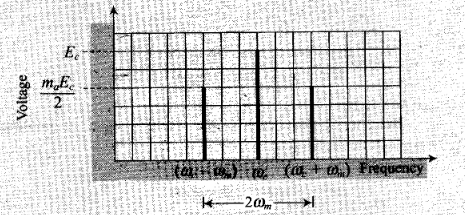
    Question 28. An amplitude modulated wave is as shown in figure. Calculate
    (i) the percentage modulation,
    (ii) peak carrier voltage and
    (iii) peak value of information voltage
    ncert-exemplar-problems-class-12-physics-communication-systems-31
    Solution:
    ncert-exemplar-problems-class-12-physics-communication-systems-32

    Question 29. (i) Draw the plot of amplitude versus ω for an amplitude modulated wave whose carrier wave (ω > ωc) is carrying two modulating signals, ω1 and ω2 2> ω1).
    (ii) Is the plot symmetrical about ωc? Comment especially about plot in region (ω < ωc ).
    (iii) Extrapolate and predict the problems one can expect if more waves are to be modulated.
    (iv) Suggest solutions to the above problem. In the process can one understand another advantage of modulation in terms of bandwidth?
    Solution:
    ncert-exemplar-problems-class-12-physics-communication-systems-33
    (ii) In the plotted graph shown, we note that frequency spectrum is not symmetrical about ωc. Crowding of spectrum is present for ω < ωc.
    (iii) If more modulating signals are present then there will be more crowding in the modulation signal in the region ω <ωc. That will result more chances of mixing of signal.
    (iv) To accommodate more signals, we should increase bandwidth and frequency carrier waves ωc. This shows that large carrier frequency
    enables to carry more information (i.e., more ωm) and the same will in turn increase bandwidth.

    Question 30. An audio signal is modulated by a carrier wave of 20 MHz such that the bandwidth required for modulation is 3 kHz. Could this wave be demodulated by a diode detector which has the values of R and C as
    (i) R = 1 kΩ, C= 0.01 µF?
    (ii) R= 10 kΩ, C=0.01 µF?
    (iii) R = 10 kΩ, C = 0.1 µF?
    Solution:
    ncert-exemplar-problems-class-12-physics-communication-systems-34
    ncert-exemplar-problems-class-12-physics-communication-systems-35

  • Semiconductor Electronics: Materials, Devices and Simple Circuits NCERT Exemplar Problems Solutions Physics

    NCERT Exemplar Problems Class 12 Physics Chapter 14 Semiconductor Electronics: Materials, Devices and Simple Circuits

    Multiple Choice Questions (MCQs)

    Single Correct Answer Type
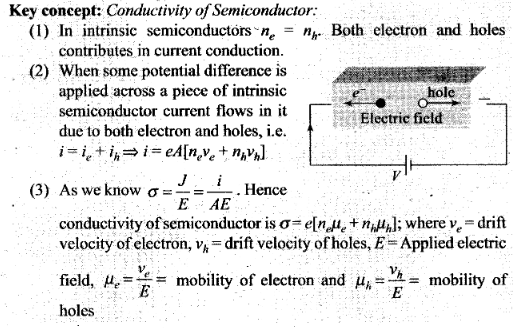
    Question 1. The conductivity of a semiconductor increases with increase in temperature, because
    (a) number density of free current carries increases
    (b) relaxation time increases
    (c) both number density of carries and relaxation time increase
    (d) number density of carries increases, relaxation time decreases but effect of decrease in relaxation time is much less than increase in number density .
    Solution: (d)
    ncert-exemplar-problems-class-12-physics-semiconductor-electronics-materials-devices-and-simple-circuits-1
    ncert-exemplar-problems-class-12-physics-semiconductor-electronics-materials-devices-and-simple-circuits-2

    Question 2.
    ncert-exemplar-problems-class-12-physics-semiconductor-electronics-materials-devices-and-simple-circuits-3
    Solution: (b)
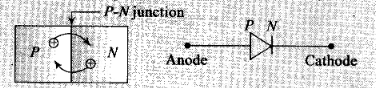
    Key concept: P-N Junction Diode:
    – When a P-type semiconductor is suitably joined to an N-type semiconductor, then resulting arrangement is called P-N junction or P-N junction diode.
    ncert-exemplar-problems-class-12-physics-semiconductor-electronics-materials-devices-and-simple-circuits-4
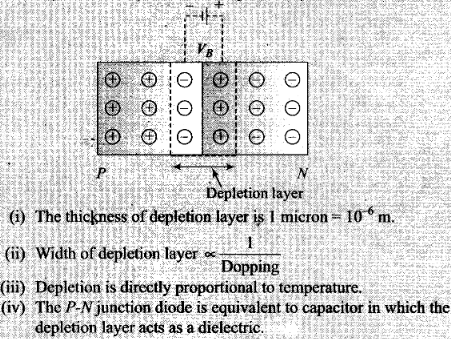
    (1) Depletion region: On account of difference in concentration of charge carrier in the two sections of P-N junction, the electrons from N-region diffuse through the junction into P-region and the hole from P region diffuse into N-region.
    Due to diffusion, neutrality of both N and P-type semiconductor is disturbed, a layer of negative charged ions appear near the junction in the P-crystal and a layer of positive ions, appears near the junction in N-crystal. This layer is called depletion layer.
    ncert-exemplar-problems-class-12-physics-semiconductor-electronics-materials-devices-and-simple-circuits-5
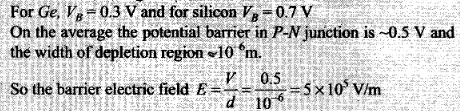
    (2) Potential barrier: The potential difference created across the P-N junction due to the diffusion of electron and holes is called potential barrier.
    ncert-exemplar-problems-class-12-physics-semiconductor-electronics-materials-devices-and-simple-circuits-6
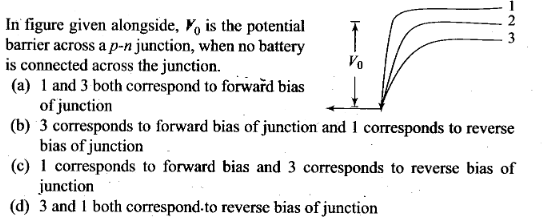
    Height of potential barrier is decreases when p-n junction is forward biased, it opposes the potential barrier junction, when p-n junction is reverse biased, it supports the potential barrier junction, resulting increase in potential barrier across the junction.

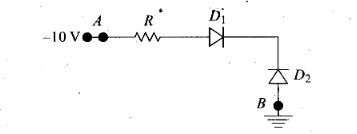
    Question 3. In figure given on next page, assuming the diodes to be ideal
    (a) D1 is forward biased and D2 is reverse biased and hence current flows from A to B
    (b) D2 is forward biased and D1 is reverse biased and hence no current flows from B to A and vice-versa
    (c) D1 and D2 are both forward biased and hence current flows from A to B
    (d) D1 and D2 are both reverse biased and hence no current flows from A to B and vice-versa
    ncert-exemplar-problems-class-12-physics-semiconductor-electronics-materials-devices-and-simple-circuits-7
    Solution:
    ncert-exemplar-problems-class-12-physics-semiconductor-electronics-materials-devices-and-simple-circuits-8

    Question 4. A 220 V AC supply is connected between points A and B (figure). What will be the potential difference V across the capacitor?
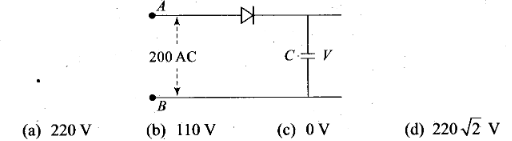
    ncert-exemplar-problems-class-12-physics-semiconductor-electronics-materials-devices-and-simple-circuits-9
    Solution: (d)
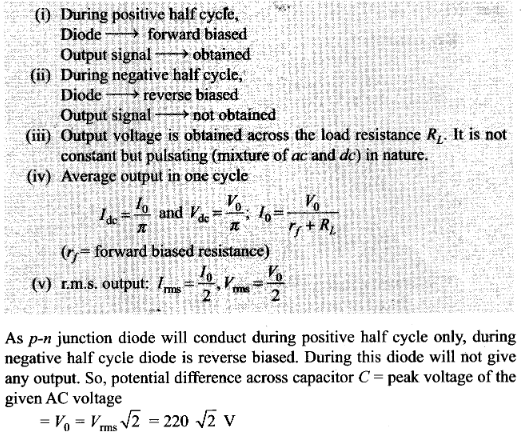
    Key concept: Half wave rectifier: When the P-N junction diode rectifies half of the ac wave, it is called half wave rectifier.
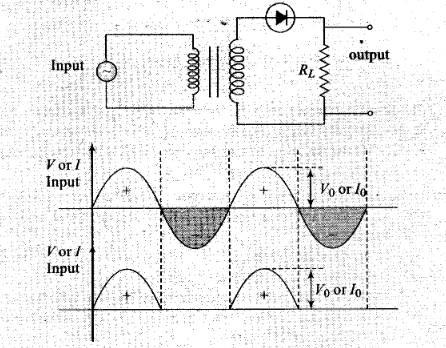
    ncert-exemplar-problems-class-12-physics-semiconductor-electronics-materials-devices-and-simple-circuits-10
    ncert-exemplar-problems-class-12-physics-semiconductor-electronics-materials-devices-and-simple-circuits-11

    Question 5. Hole is
    (a) an anti-particle of electron
    (b) a vacancy created when an electron leaves a covalent bond
    (c) absence of free electrons
    (d) an artificially created particle
    Solution: (b) Concept of holes in the semiconductor:

    1. .When an electron is removed from a covalent bond, it leaves a vacancy behind. An electron from a neighbouring atom can move into this vacancy, leaving the neighbour with a vacancy. In this way the vacancy formed is called a hole (or cotter), and can travel through the material and serve as an additional current carriers.
    2. A hole is considered as a seat of positive charge, having magnitude of charge equal to that of an electron.
    3. Holes acts as a virtual charge, although there is no physical charge on it.
    4. Effective mass of hole is more than an electron.
    5. Mobility of hole is less than an electron.

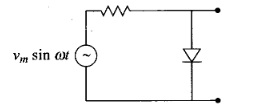
    Question 6. The output of the given circuit in figure is given below.
    ncert-exemplar-problems-class-12-physics-semiconductor-electronics-materials-devices-and-simple-circuits-12
    (a) would be zero at all times
    (b) would be like a half wave rectifier with positive cycles in output
    (c) would be like a half wave rectifier with negative cycles in output
    (d) would be like that of a full wave rectifier
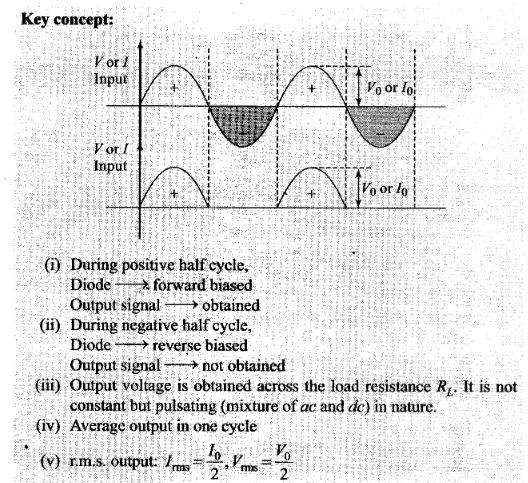
    Solution: (c)
    ncert-exemplar-problems-class-12-physics-semiconductor-electronics-materials-devices-and-simple-circuits-13
    When the diode is forward biased during positive half cycle of input AC voltage, the resistance of p-n junction is low. The current in the circuit is maximum. In this situation, a maximum potential difference will appear across resistance connected in a series of circuit. This result into zero output voltage across p-n junction.
    And when the diode is reverse biased during negative half cycle of AC voltage, the p-n junction is reverse biased. The resistance of p-n junction becomes high which will be more than resistance in series. That is why, there will be voltage across p-n junction with negative cycle in output, hence option (c) is correct.

    Question 7. In the circuit shown in figure given below, if the diode forward voltage between A and B is
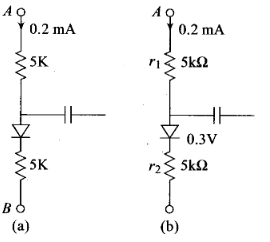
    ncert-exemplar-problems-class-12-physics-semiconductor-electronics-materials-devices-and-simple-circuits-14
    (a) 1.3 V (b) 2.3 V (c) 0 (d) 0.5 V
    Solution:
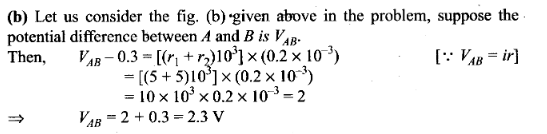
    ncert-exemplar-problems-class-12-physics-semiconductor-electronics-materials-devices-and-simple-circuits-15

    Question 8. Truth table for the given circuit is
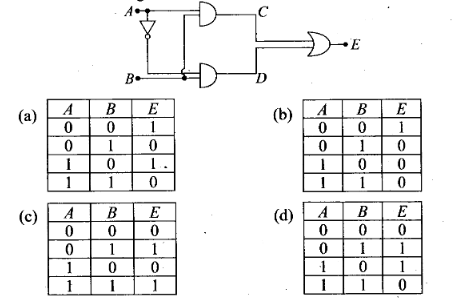
    ncert-exemplar-problems-class-12-physics-semiconductor-electronics-materials-devices-and-simple-circuits-16
    Solution:
    ncert-exemplar-problems-class-12-physics-semiconductor-electronics-materials-devices-and-simple-circuits-17

    One or More Than One Correct Answer Type

    Question 9. When an electric field is applied across a semiconductor
    (a) electrons move from lower energy level to higher energy level in the conduction band
    (b) electrons move from higher energy level to lower energy level in the conduction band
    (c) holes in the valence band move from higher energy level to lower energy level
    (d) holes in the valence band move from lower energy level to higher energy level
    Solution: (a, c)
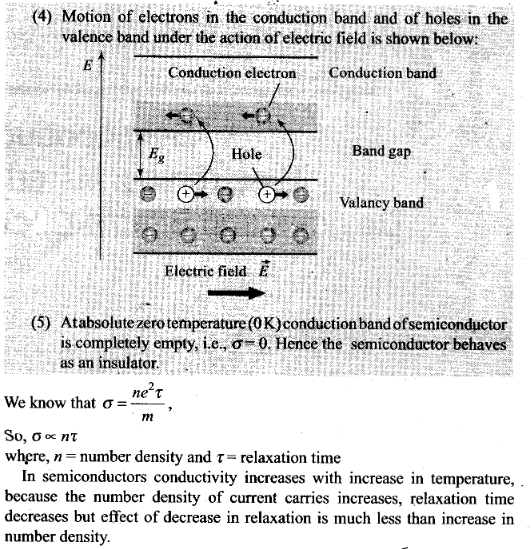
    In valence band electrons are not capable of gaining energy from external electric field. While in conduction band the electrons can gain energy from external electric field.
    When electric field is applied across a semiconductor, the electrons in the conduction band (which is partially filled with electrons) get accelerated and acquire energy. They move from lower energy level to higher energy level. While the holes in valence band move from higher energy level to lower energy level, where they will be having more energy.

    Question 10. Consider an n-p-n transistor with its base-emitter junction forward biased and collector base junction reverse biased. Which of the following statements are true?
    (a) Electrons crossover from emitter to collector
    (b) Holes move from base to collector
    (c) Electrons move from emitter to base
    (d) Electrons from emitter move out of base without going to the collector.
    Solution: (a, c)
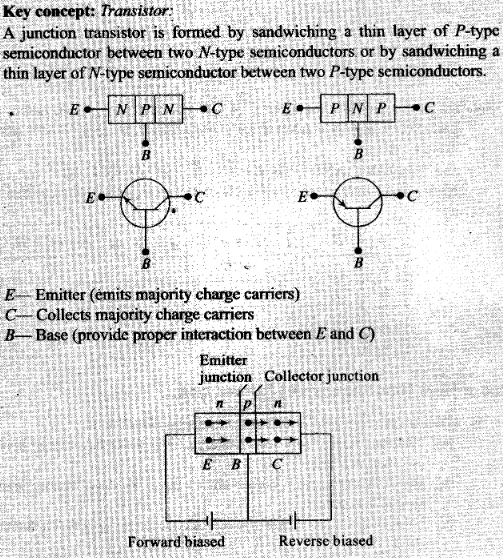
    ncert-exemplar-problems-class-12-physics-semiconductor-electronics-materials-devices-and-simple-circuits-18
    In normal operation base-emitter is forward biased, i.e., the positive pole of emitter base battery is connected to base and its negative pole is connected to the emitter. And collector base junction is reverse biased, i.e., the positive pole of the collector base battery is connected to collector and negative pole to base. Thus, electron moves from emitter to base and crossover from emitter to collector.

    Question 11.
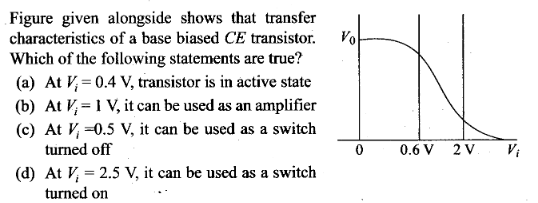
    ncert-exemplar-problems-class-12-physics-semiconductor-electronics-materials-devices-and-simple-circuits-19
    Solution: (b, c, d) According to above graph transfer characteristics of a base biased common emitter transistor, we note that .
    (a) when Vi= 0.4 V, output voltage remain same,there is no collection current. So, transistor circuit is not in active state.
    (b) when Vi = 1 V (This is in between 0.6 V to 2 V), the transistor circuit is in active state and when input is increasing output is decreasing because when CE is used as an amplifier input and output voltages are 180° out of phase. Then it is used as an amplifier.
    (c) when Vi = 0.5 V, there is no collector current. The transistor is in cut off state. The transistor circuit can be used as a switch to be turned off.
    (d) when Vi = 2.5 V, the collector current becomes maximum and transistor is in a saturation state and can used as switch turned on state.

    Question 12. In a n-p-n transistor circuit, the collector current is 10 mA. If 95 per cent of the electrons emitted reach the collector, which of the following statements are true?
    (a) The emitter current will be 8 mA
    (b) The emitter current will be 10.53 mA
    (c) The base current will be 0.53 mA
    (d) The base current will be 2 mA
    Solution: (b, c) According to the problem, the collector current is 95% of electrons reaching the collector after emission. And collector current, IC = 10 mA
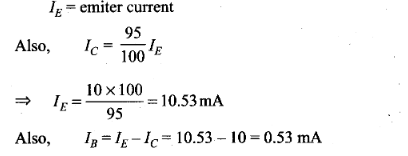
    ncert-exemplar-problems-class-12-physics-semiconductor-electronics-materials-devices-and-simple-circuits-20

    Question 13. In the depletion region of a diode
    (a) there are no mobile charges
    (b) equal number of holes and elections exist, making the region neutral
    (c) recombination of holes and electrons has taken place
    (d) immobile charged ions exist
    Solution: (a, b, d) On account of difference in concentration of charge carrier in the two sections of P-N junction, the electrons from N-rcgion diffuse through the junction into P-region and the hole from P-region diffuse into N-region.
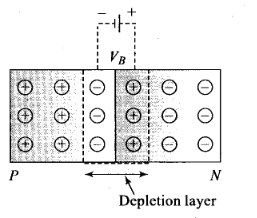
    ncert-exemplar-problems-class-12-physics-semiconductor-electronics-materials-devices-and-simple-circuits-21
    Due to diffusion, neutrality of both N-and P-type semiconductor is disturbed, a layer of negative charged ions appear near the junction in the P-crystal and a layer of positive ions appears near the junction in N-crystal. This layer is called depletion layer.
    The thickness of depletion layer is 1 micron = 10-6 m.
    Width of depletion layer ∞ 1/Dopping
    Depletion is directly proportional to temperature.
    Important point: The P-N junction diode is equivalent to capacitor in which the depletion layer acts as a dielectric.

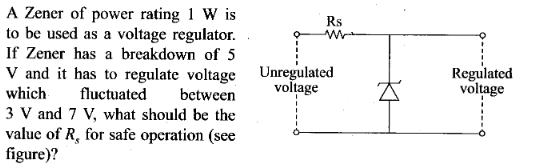
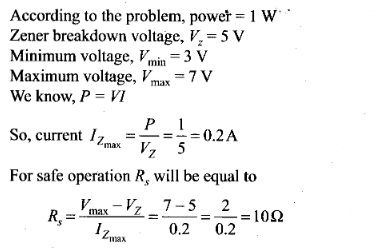
    Question 14. What happens during regulation action of a Zener diode?
    (a) The current and voltage across the Zener remains fixed
    (b) The current through the series Resistance (Rs) changes
    (c) The Zener resistance is constant
    (d) The resistance offered by the Zener changes
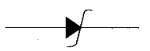
    ncert-exemplar-problems-class-12-physics-semiconductor-electronics-materials-devices-and-simple-circuits-22
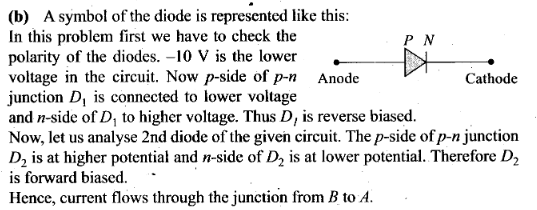
    Solution: (b, d) Symbolically zener diode represents like this:
    In the forward bias, the zener diode acts as an ordinary diode. It can be used as a voltage regulator.
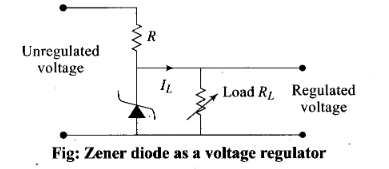
    ncert-exemplar-problems-class-12-physics-semiconductor-electronics-materials-devices-and-simple-circuits-23
    A zener diode when reverse biases offers constant voltage drop across in terminals as unregulated voltage is applied across circuit to regulate. Then during regulation action of a Zener diode, the current through the series resistance Rs changes and resistance offered by the Zener changes. The current through the Zener changes but the voltage across the Zener remains constant.

    Question 15. To reduce the ripples in rectifier circuit with capacitor filter
    (a) RL should be increased
    (b) input frequency should be decreased .
    (c) input frequency should be increased
    (d) capacitors with high capacitance should be used
    Solution: (a, c, d)
    Ripple factor may be defined as the ratio of r.m.s. value of the ripple voltage to the absolute value of the DC component of the output voltage, usually expressed as a percentage. However ripple voltage is also commonly expressed as the peak-to-peak value. Ripple factor (r) of a full wave rectifier using capacitor filter is given by
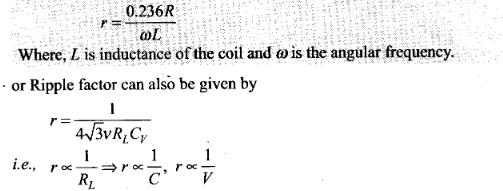
    ncert-exemplar-problems-class-12-physics-semiconductor-electronics-materials-devices-and-simple-circuits-24
    Ripple factor is inversely proportional to RL, C and v.
    Thus to reduce r, RL should be increased, input frequency v should be increased and capacitance C should be increased.

    Question 16. The breakdown in a reverse biased p-n junction is more likely to occur due to
    (a) large velocity of the minority charge carriers if the doping concentration is small
    (b) large velocity of the minority charge carriers if the doping concentration is large
    (c) strongelectricfieldinadepletionregionifthedopingconcentrationissmall
    (d) strong electric field in the depletion region if the doping concentration is large
    Solution: (a, d)
    Reverse biasing: Positive terminal of the battery is connected to the N-crystal and negative terminal of the battery is connected to P-crystal.
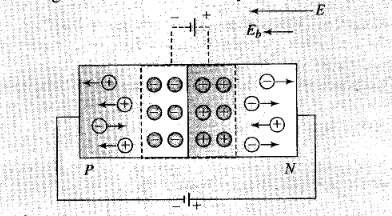
    ncert-exemplar-problems-class-12-physics-semiconductor-electronics-materials-devices-and-simple-circuits-25
    (i) In reverse biasing width of depletion layer increases
    (ii) In reverse biasing resistance offered RReverse = 105 Ω
    (iii) Reverse bias supports the potential barrier and no current flows across the junction due to the diffusion of the majority carriers.
    (A very small reverse current may exist in the circuit due to the drifting of minority carriers across the junction)
    (iv) Break down voltage: Reverse voltage at which break down of semiconductor occurs. For Ge it is 25 V and for Si it is 35 V.
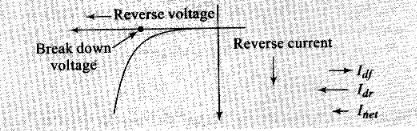
    ncert-exemplar-problems-class-12-physics-semiconductor-electronics-materials-devices-and-simple-circuits-26
    So, we conclude that in reverse biasing, ionization takes place because the minority charge carriers will be accelerated due to reverse biasing and striking with atoms which in turn cause secondary electrons and thus more number of charge carriers.
    When doping concentration is large, there will be a large number of ions in the depletion region, which will give rise to a strong electric field.

    Very Short Answer Type Questions

    Question 17. Why are elemental dopants for Silicon or Germanium usually chosen from group XIII or group XV?
    Solution: When pure semiconductor material is mixed with small amounts of certain specific impurities with valency different from that of the parent material, the number of mobile electrons/holes drastically changes. The process of addition of impurity is called doping. The size of the dopant atom should be compatible such that their presence in the pure semiconductor does not distort the semiconductor but easily contribute the charge carriers on forming covalent bonds with Silicon or Germanium atoms, which are provided by group XIII or group XV elements.

    Question 18. Sn, C and Si, Ge are all group XIV elements. Yet, Sn is a conductor, C is an insulator while Si and Ge are semiconductors. Why?
    Solution: The conduction level of any element depends on the energy gap between its conduction band and valence band.
    In conductors, there is no energy gap between conduction band and valence band. For insulator, the energy gap is large and for semiconductor the energy gap is moderate.
    The energy gap for Sn is 0 eV, for C is 5.4 eV, for Si is 1.1 eV and for Ge is 0.7 eV related to their atomic size. Therefore Sn is a conductor, C is an insulator, and Ge and Si are semiconductors

    Question 19. Can the potential barrier across a p-n junction be measured by simply connecting a voltmeter across the junction?
    Solution: We cannot measure the potential barrier across a p-n junction by a voltmeter because the resistance of voltmeter is very high as compared to the junction resistance. Potential of potential barrier for Ge is VB = 0.3 V and for silicon is VB = 0.7 V.
    On the average the potential barrier in P-N junction is ~0.5 V.

    Question 20. Draw the output waveform across the resistor in the given figure.
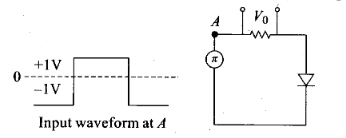
    ncert-exemplar-problems-class-12-physics-semiconductor-electronics-materials-devices-and-simple-circuits-27
    Solution: The diode act as a half wave rectifier, it offers low resistance when forward biased and high resistance when reverse biased. So the output is obtained only when positive input is given,so the output waveform is
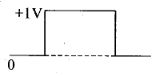
    ncert-exemplar-problems-class-12-physics-semiconductor-electronics-materials-devices-and-simple-circuits-28

    Question 21. The amplifiers X, Y and Z are connected in series. If the voltage gains of X, Y and Z are 10,20 and 30, respectively and the input signal is 1 mV peak value, then what is the output signal voltage (peak value).
    (i) if DC supply voltage is 10 V?
    (ii) if DC supply voltage is 5 V?
    Solution: Total voltage amplification is defined as the ratio of output signal voltage and input signal voltage.
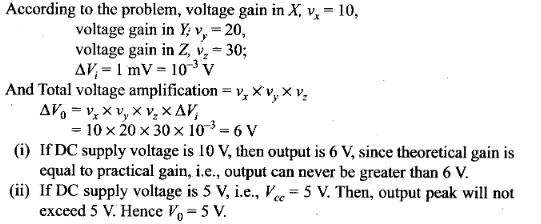
    ncert-exemplar-problems-class-12-physics-semiconductor-electronics-materials-devices-and-simple-circuits-29

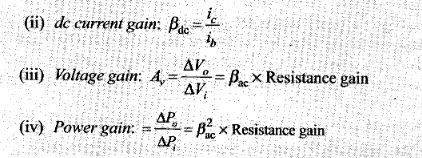
    Question 22. In a CE transistor amplifier, there is a current and voltage gain associated with the circuit. In other words there is a power gain. Considering power a measure of energy, does the circuit violate conservation of energy?
    Solution:

    ncert-exemplar-problems-class-12-physics-semiconductor-electronics-materials-devices-and-simple-circuits-30
    ncert-exemplar-problems-class-12-physics-semiconductor-electronics-materials-devices-and-simple-circuits-31
    The power gain is very high in CE transistor amplifier. In this circuit, the extra power required for amplified output is obtained from DC source. Thus, the circuit used does not violate the law of conservation.

    Short Answer Type Questions

    Question 23. (i) Name the type of a diode whose characteristics are shown in figure (a) and (b).
    (ii) What does the point P in fig. (a) represent?
    (iii) What does the points P and Q in fig. (b) represent?
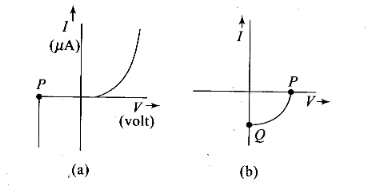
    ncert-exemplar-problems-class-12-physics-semiconductor-electronics-materials-devices-and-simple-circuits-32
    Solution:
    (i) Fig. (a) represents the characteristics of Zener diode and curve (b) is of solar cell.
    (ii) In fig. (a), point P represents Zener breakdown voltage.
    (iii) In fig. (b), the point Q represents zero voltage and negative current. Which means the light falling on solar cell with atleast minimum threshold frequency gives the current in opposite direction to that due to a battery connected to solar cell. But for the point Q the battery is short circuited. Hence it represents the short circuit current.
    And the point Pin fig. (b) represents some open circuit, voltage on solar cell with zero current through solar cell.
    It means, there is a battery connected to a solar cell which gives rise to the equal and opposite current to that in solar cell by virtue of light falling on it.

    Question 24. Three photo diodes D1, D2 and D3 are made of semiconductors having band gaps of 2.5 eV, 2 eV and 3 eV, respectively. Which ones will be able to detect light of wavelength 6000 Å ?
    Solution:Key concept: In Photo diodes electron and hole pairs are created by junction photoelectric effect. That is the covalent bonds are broken by the EM radiations absorbed by the electron in the V.B. These are used for detecting light signals.
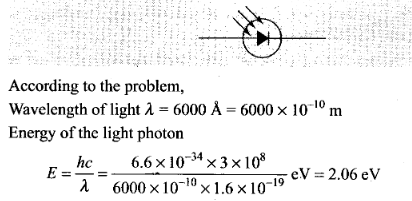
    ncert-exemplar-problems-class-12-physics-semiconductor-electronics-materials-devices-and-simple-circuits-33
    The incident radiation which is detected by the photodiode D2 because energy of incident radiation is greater than the band-gap.

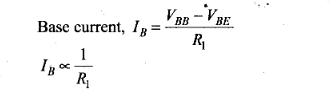
    Question 25. If the resistance R1 is increased (see figure), how will the readings of the ammeter and voltmeter change?
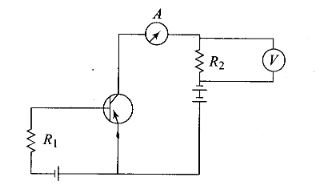
    ncert-exemplar-problems-class-12-physics-semiconductor-electronics-materials-devices-and-simple-circuits-34
    Solution: Let us redrawn the circuit diagram to find the change in reading of ammeter and voltmeter.
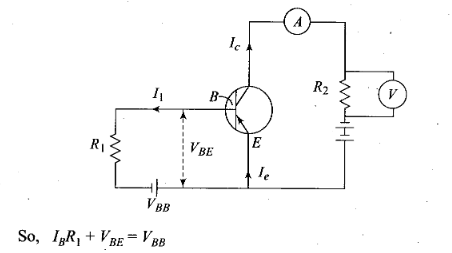
    ncert-exemplar-problems-class-12-physics-semiconductor-electronics-materials-devices-and-simple-circuits-35
    ncert-exemplar-problems-class-12-physics-semiconductor-electronics-materials-devices-and-simple-circuits-36
    So, R1 is increased, IB is decreased.
    Now, the current in ammeter is collector current IC.
    IC =βIB as IB is decreased, IC is also decreased and the reading of voltmeter and ammeter also decreased.

    Question 26. Two car garages have a common gate which needs to open automatically when a car enters either of the garages or cars enter both. Draw a circuit that resembles this situation using diodes for this situation.
    Solution: As car enters in either of the garages or both, the common gate opened automatically.
    This means that if any one input is high, output will high otherwise low.
    The device is shown like this:
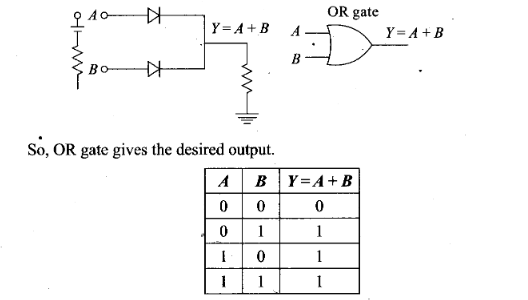
    ncert-exemplar-problems-class-12-physics-semiconductor-electronics-materials-devices-and-simple-circuits-37

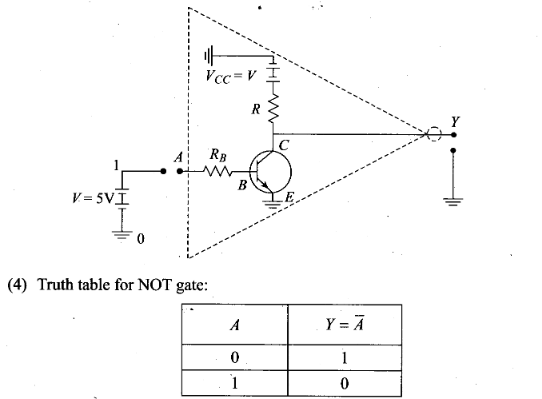
    Question 27. How would you set up a circuit to obtain NOT gate using a transistor?
    Solution:
    (1)It has only one input and only one output.
    (2)Boolean expression is Y = Ᾱ and is read as “y equals not A” .
    Logical symbol of NOT gate.
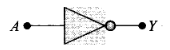
    ncert-exemplar-problems-class-12-physics-semiconductor-electronics-materials-devices-and-simple-circuits-38
    (3)Realization of NOT gate: The transistor is so biased that the collector voltage VCC = V (Voltage corresponding to 1 state)
    The resistors R and RB are so chosen that if the input is low, i.e. 0, the transistor is in the cut off and hence the voltage appearing at the output will be the same as applied V = 5 V. Hence Y= V(or state I)
    If the input is high, the transistor current is in saturation and the net voltage at the output Y is 0 (in state 0).
    ncert-exemplar-problems-class-12-physics-semiconductor-electronics-materials-devices-and-simple-circuits-39

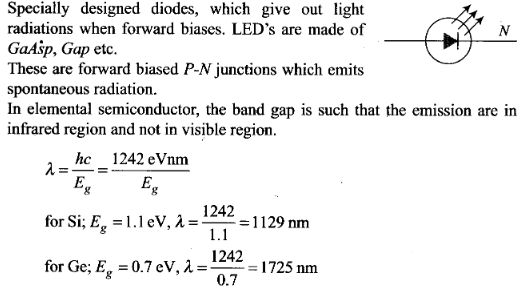
    Question 28. Explain why elemental semiconductor cannot be used to make visible LEDs.
    Solution:
    ncert-exemplar-problems-class-12-physics-semiconductor-electronics-materials-devices-and-simple-circuits-40

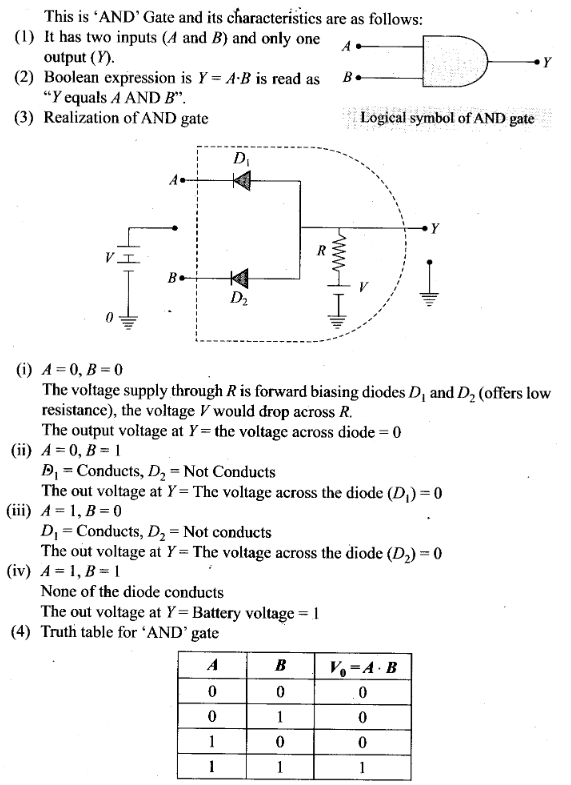
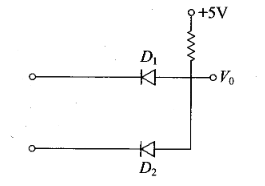
    Question 29. Write the truth table for the circuit shown in figure given below. Name the gate that the circuit resembles.
    ncert-exemplar-problems-class-12-physics-semiconductor-electronics-materials-devices-and-simple-circuits-41
    Solution:
    ncert-exemplar-problems-class-12-physics-semiconductor-electronics-materials-devices-and-simple-circuits-42

    Question 30.
    ncert-exemplar-problems-class-12-physics-semiconductor-electronics-materials-devices-and-simple-circuits-43
    Solution:
    ncert-exemplar-problems-class-12-physics-semiconductor-electronics-materials-devices-and-simple-circuits-44

    Long Answer Type Questions

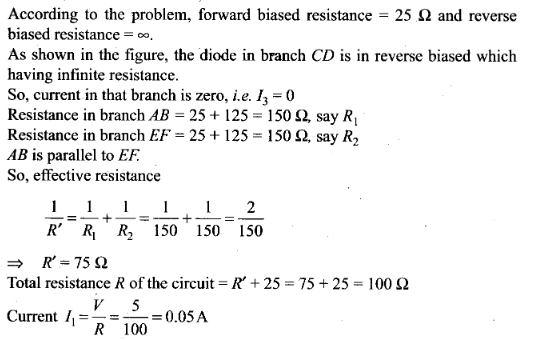
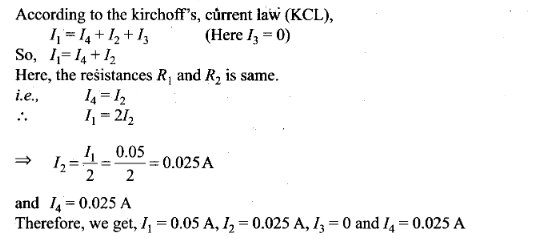
    Question 31. If each diode in figure has a forward bias resistance of 25 Ω and infinite resistance in reverse bias, what will be the values of the currents I1, I2, I3 and I4?
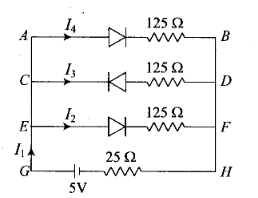
    ncert-exemplar-problems-class-12-physics-semiconductor-electronics-materials-devices-and-simple-circuits-45
    Solution:
    ncert-exemplar-problems-class-12-physics-semiconductor-electronics-materials-devices-and-simple-circuits-46
    ncert-exemplar-problems-class-12-physics-semiconductor-electronics-materials-devices-and-simple-circuits-47

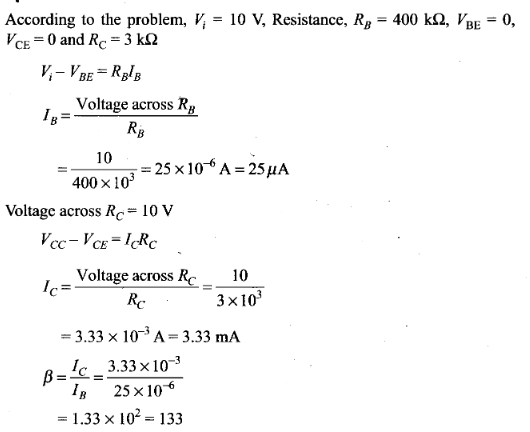
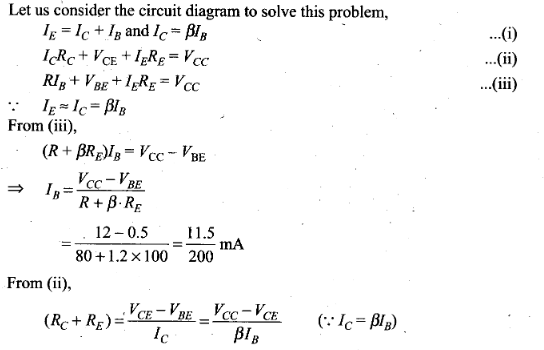
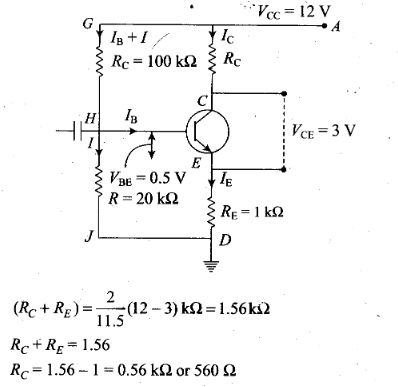
    Question 32. In the circuit shown in figure, when the input voltage of the base resistance is 10 V, VBE is zero and VCE is also zero. Find the values of IB, IC and β .
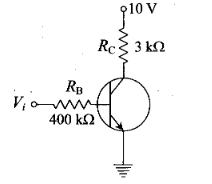
    ncert-exemplar-problems-class-12-physics-semiconductor-electronics-materials-devices-and-simple-circuits-48
    Solution:
    ncert-exemplar-problems-class-12-physics-semiconductor-electronics-materials-devices-and-simple-circuits-49

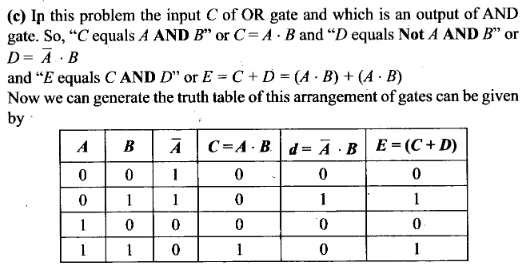
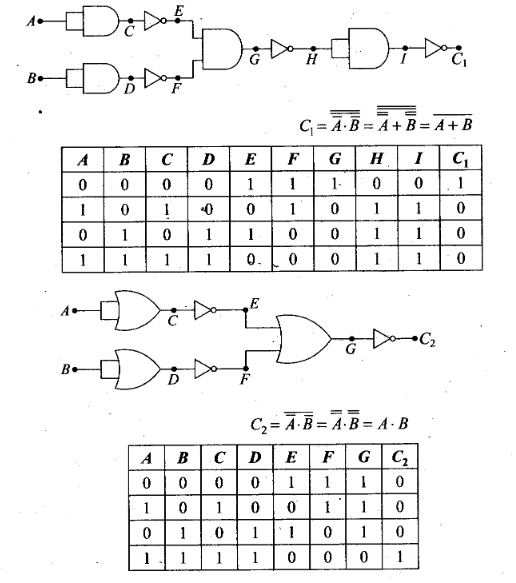
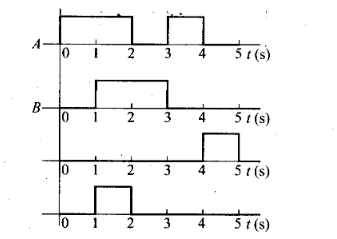
    Question 33. Draw the output signals C1 and C2 in the given combination of gates.
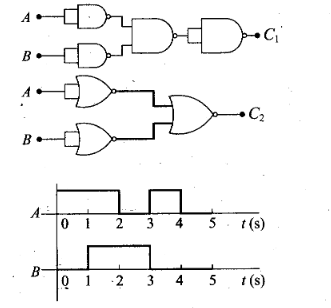
    ncert-exemplar-problems-class-12-physics-semiconductor-electronics-materials-devices-and-simple-circuits-50
    Solution:
    ncert-exemplar-problems-class-12-physics-semiconductor-electronics-materials-devices-and-simple-circuits-51
    ncert-exemplar-problems-class-12-physics-semiconductor-electronics-materials-devices-and-simple-circuits-52

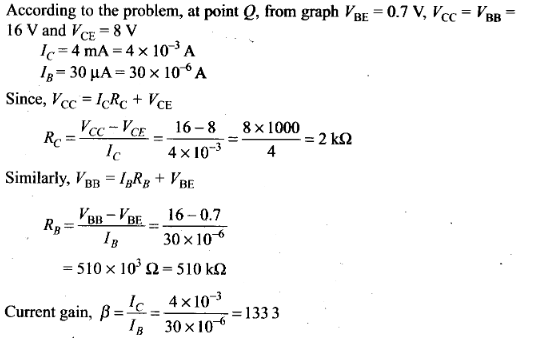
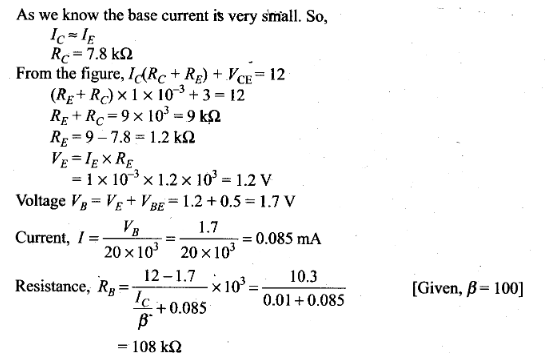
    Question 34. Consider the circuit arrangement shown in figure for studying input and output characteristics of n-p-n transistor in.CE configuration.
    Select the values of RB and RC for a transistor whose VBE = 0.7 V so that the transistor is operating at point Q as shown in the characteristics (see figure).
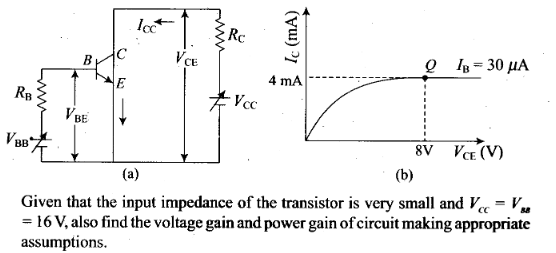
    ncert-exemplar-problems-class-12-physics-semiconductor-electronics-materials-devices-and-simple-circuits-53
    Solution:
    ncert-exemplar-problems-class-12-physics-semiconductor-electronics-materials-devices-and-simple-circuits-54
    ncert-exemplar-problems-class-12-physics-semiconductor-electronics-materials-devices-and-simple-circuits-55

    Question 35. Assuming the ideal diode, draw the output waveform for the circuit given in figure, explain the waveform.
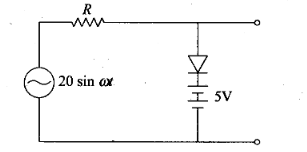
    ncert-exemplar-problems-class-12-physics-semiconductor-electronics-materials-devices-and-simple-circuits-56
    Solution:
    Key concept: An ideal diode is a diode in which it has a very large resistance in reverse biased and very, low resistance in forward biased. So, it acts like a perfect conductor when voltage is applied forward biased and like a perfect insulator when voltage is applied reverse biased.
    In reverse biased when the input voltage is equal to or less than 5 V diode,then it will offer high resistance in comparison to resistance (R) in series. Now, diode appears in open circuit. The input waveform is then passed to the output terminals. The result with sin wave input is to dip off all positive going portion above 5 V.
    If input voltage is greater than +5 V, diode is in conducting state, then it will be conducting as if forward biased offering low resistance in comparison to R. But there will be no voltage in output beyond 5 V as the voltage beyond +5 V will appear across R.
    When input voltage is negative, there will be opposition to 5 V battery in p-n junction input voltage becomes more than -5 V, the diode will be reverse biased. It will offer high resistance in comparison to resistance R in series. Now junction diode appears in open circuit. The input wave form is then passed on to the output terminals.
    The output waveform will be like this (as shown below).
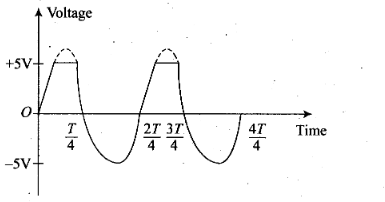
    ncert-exemplar-problems-class-12-physics-semiconductor-electronics-materials-devices-and-simple-circuits-57

    Question 36. Suppose a n-type wafer is‘created by doping Si crystal having 5 x 1028 atoms/m3 with 1 ppm concentration of As. On the surface 200 ppm boron is added to create ‘p’ region in this wafer. Considering ni = 1.5 x 10¹⁶ m-3,
    (i) Calculate the densities of the charge carriers in the n and p regions,
    (ii) Comment which charge carriers would contribute largely for the reverse saturation current when diode is reverse biased.
    Solution: n-type wafer is created when As is implanted in Si crystal. The number of majority carriers electrons due to doping of As is
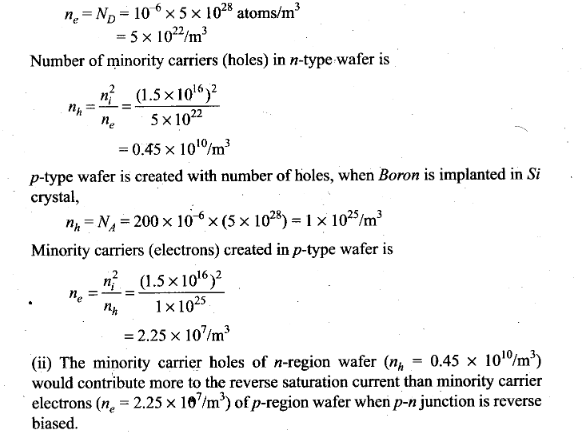
    ncert-exemplar-problems-class-12-physics-semiconductor-electronics-materials-devices-and-simple-circuits-58

    Question 37. An XOR gate has the following truth table.
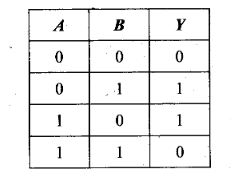
    ncert-exemplar-problems-class-12-physics-semiconductor-electronics-materials-devices-and-simple-circuits-59
    It is represented by following logic relation Y = Ᾱ . B + A . B’ . Build this gate using AND, OR and NOT gates.
    Solution: XOR gate can be realized by the combination of two NOT gates, two AND gates and one OR gate. According to the problem, the logic relation for the . given truth table is
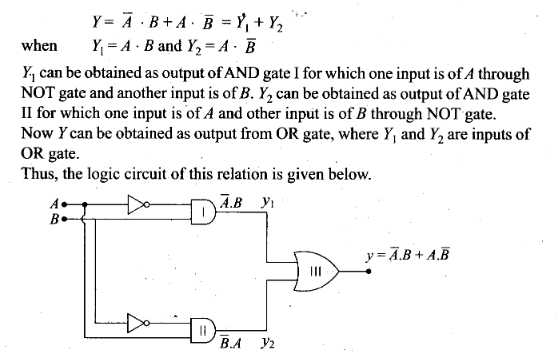
    ncert-exemplar-problems-class-12-physics-semiconductor-electronics-materials-devices-and-simple-circuits-60

    Question 38. Consider a box with three terminals on top of it as shown in figure.
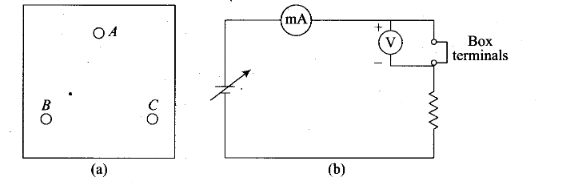
    ncert-exemplar-problems-class-12-physics-semiconductor-electronics-materials-devices-and-simple-circuits-61
    Three components namely, two germanium diodes and one resistor are connected across these three terminals in some arrangement.
    A student performs an experiment in which any two of these three terminals are connected in the circuit as shown in figure.
    The student obtains graphs of current-voltage characteristics for unknown combination of components between the two terminals connected in the circuit. The graphs are
    (i) when A is positive and B is negative .
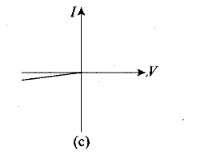
    ncert-exemplar-problems-class-12-physics-semiconductor-electronics-materials-devices-and-simple-circuits-62
    ncert-exemplar-problems-class-12-physics-semiconductor-electronics-materials-devices-and-simple-circuits-63
    ncert-exemplar-problems-class-12-physics-semiconductor-electronics-materials-devices-and-simple-circuits-64
    Solution: The V-I characteristics of these graph is discussed in points:
    (a)In V-I graph of condition (i), a reverse characteristics is shown in fig. (c). Here A is connected to n-side of p-n junction I and B is connected top-side of p-n junction I with a resistance in series.
    (b)In V-I graph of condition (ii), a forward characteristics is shown in fig. (d), where 0.7 V is the knee voltage of p-n junction I. 1/slope = (1/1000) Ω.
    It means A is connected to n-side of p-n junction I and B is connected to p-side of p-n junction I and resistance R is in series of p-n junction I between A and B.
    (c)In V-I graph of condition (iii), a forward characteristics is shown in figure (e) , where 0.7 V is the knee voltage. In this case p-side of p-n junction II is connected to C and n-side of p-n junction II to B.
    (d)In V-I graphs of conditions (iv), (v), (vi) also concludes the above connection of p-n junctions I and II along with a resistance R.
    Thus, the arrangement of p-n I, p-n II and resistance R between A, B and C will be as shown in the figure.
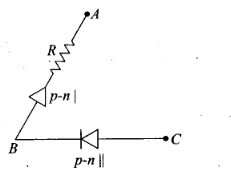
    ncert-exemplar-problems-class-12-physics-semiconductor-electronics-materials-devices-and-simple-circuits-65

    Question 39. For the transistor circuit shown in figure, evaluate VE, RB, RE, given IC= 1 mA, VCE= 3, VBE = 0.5 V and VCC= 12 V, β= 100.
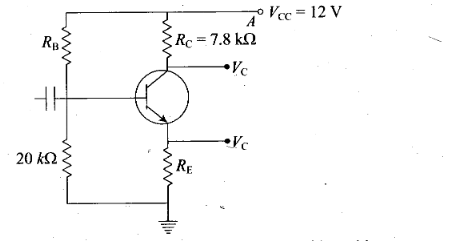
    ncert-exemplar-problems-class-12-physics-semiconductor-electronics-materials-devices-and-simple-circuits-66
    Solution: Let us redraw the circuit diagram given here to solve this problem.
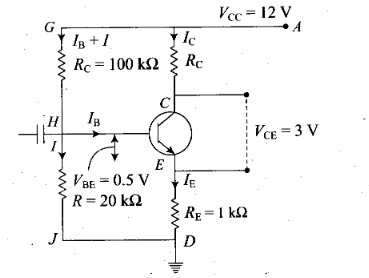
    ncert-exemplar-problems-class-12-physics-semiconductor-electronics-materials-devices-and-simple-circuits-67
    ncert-exemplar-problems-class-12-physics-semiconductor-electronics-materials-devices-and-simple-circuits-68

    Question 40. In the circuit shown in figure, find the value of Rc .

    .
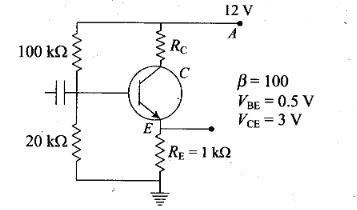
    ncert-exemplar-problems-class-12-physics-semiconductor-electronics-materials-devices-and-simple-circuits-69
    Solution:
    ncert-exemplar-problems-class-12-physics-semiconductor-electronics-materials-devices-and-simple-circuits-70
    ncert-exemplar-problems-class-12-physics-semiconductor-electronics-materials-devices-and-simple-circuits-71

  • Nuclei NCERT Exemplar Problems Solutions Physics

    NCERT Exemplar Problems Class 12 Physics Chapter 13 Nuclei

    Multiple Choice Questions (MCQs)

    Single Correct Answer Type
    Question 1. Suppose we consider a large number of containers each containing initially 10000 atoms of a radioactive material with a half life of 1 year. After 1 year,
    (a) all the containers will have 5000 atoms of the material
    (b) all the containers will contain the same number of atoms of the material but that number will only be approximately 5000
    (c) the containers will in general have different numbers of the atoms of the material but their average will be close to 5000
    (d) none of the containers can have more than 5000 atoms
    Solution: (c)
    Key concept: Half life ( T1/2):
    Radioactivity is a process due to which a radioactive material spontaneously decays. Time interval in which the mass of a radioactive substance or the number of its atom reduces to half of its initial value is called the half life of the substance.
    ncert-exemplar-problems-class-12-physics-nuclei-1
    In half-life (t= 1 yr) of the material on the average half the number of atoms will decay. Therefore, the containers will in general have different number of atoms of the material, but their average will be approx 5000.

    Question 2. The gravitational force between a H-atom and another particle of mass m will
    ncert-exemplar-problems-class-12-physics-nuclei-2
    Solution: (b)
    Key concept: The gravitational force between a H-atom and another
    particle of mass m will be given by Newton’s law, F = G M.m/r2
    Here M is the effective mass of Hydrogen atom.
    Let us learn how to find the effective mass of a Hydrogen atom.
    Suppose you start with a proton and an electron separated by a large distance. The mass of this system is just mproton + melectron.
    Now let the proton and electron fall towards each other under their mutual electrostatic attraction. As they fall they will speed up, so by the time the proton and electron are about one hydrogen atom radius apart they are moving with a high speed. Note that we haven’t added or removed any energy, so the mass/energy of the system is still mproton + melectron.
    The trouble is that this would not form a hydrogen atom because the proton and electron will just speed past each other and fly away again. To form a hydrogen atom we have to take the kinetic energy of the electron and proton out of the system so we can bring them to a stop. Let’s call the kinetic energy Ek. This energy has a mass given by Einstein’s famous equation E = mc2, so die mass of our atom is the mass we started with less the energy we’ve taken out:
    ncert-exemplar-problems-class-12-physics-nuclei-3
    ncert-exemplar-problems-class-12-physics-nuclei-4

    Question 3. When a nucleus in an atom undergoes a radioactive decay, the electronic energy levels of the atom
    (a) do not change for any type of radioactivity
    (b) change for α and β-radioactivity but not for γ-radioactivity
    (c) change for α -radioactivity but not for others
    (d) change for β-radioactivity but not for others
    Solution: (b)
    Key concept:
    ncert-exemplar-problems-class-12-physics-nuclei-5
    A /3-particle carries one unit of negative charge (-e), an α-particle carries 2 units of positive charge (+ 2e ) and γ (particle) carries no charge. Hence electronic energy levels of the atom charges for α and β decay, but not for γ-decay.

    Question 4. Mx and My denote the atomic masses of the parent and the daughter nuclei respectively in a radioactive decay. The Q-value for a βdecay is Q1 and that for a β+decay is Q2. If me denotes the mass of an electron, then which of the following statements is correct?
    ncert-exemplar-problems-class-12-physics-nuclei-6
    Solution: (a)
    Key concept: Q value or energy of nuclear reaction: The energy absorbed or released during a nuclear reaction is known as Q-value of nuclear reaction.
    Q-value = (Mass of reactants – mass of products)c2 Joules
    = (Mass of reactants – mass of products) amu
    If Q < 0, the nuclear reaction is known as endothermic. (The energy is absorbed in the reaction)
    If Q > 0, the nuclear reaction is known as exothermic. (The energy is released in the reaction)
    ncert-exemplar-problems-class-12-physics-nuclei-7

    Question 5. Tritium is an isotope of hydrogen whose nucleus triton contains 2 neutrons and 1 proton. Free neutrons decay into p + e + n . If one of the neutrons in Triton decays, it would transform into He3 nucleus. This does not happen. This is because
    (a) Triton energy is less than that of a He3 nucleus
    (b) The electron created in the beta decay process cannot remain in the nucleus
    (c) Both the neutrons in triton have to decay simultaneously resulting in a nucleus with 3 protons, which is not a He3 nucleus.
    (d) Free neutrons decay due to external perturbations which is absent in triton nucleus .
    Solution: (a)
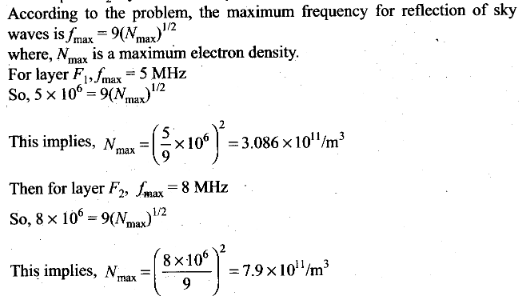
    ncert-exemplar-problems-class-12-physics-nuclei-8

    Question 6. Heavy stable nuclei have more neutrons than protons. This is because of the fact that .
    (a) neutrons are heavier than protons
    (b) electrostatic foree between protons are repulsive
    (c) neutrons decay into protons through beta decay
    (d) nuclear forces between neutrons are weaker than that between protons
    Solution: (b)
    ncert-exemplar-problems-class-12-physics-nuclei-111

    Question 7. In a nuclear reactor, moderators slow down the neutrons which come out in a fission process. The moderator used have light nuclei. Heavy nuclei will not serve the purpose, because
    (a) they will break up
    (b) elastic collision of neutrons with heavy nuclei will not slow them down
    (c) the net weight of the reactor would be unbearably high
    (d) substances with heavy nuclei do not occur in liquid or gaseous state at room temperature
    Solution: (b)
    Key concept: A moderator is a material used in a nuclear reactor to slow down the neutrons produced from fission. By slowing the neutrons down the probability of a neutron interacting with Uranium-235 nuclei is greatly increased thereby maintaining the chain reaction. Moderators are made from materials with light nuclei which do not absorb the neutrons but rather slow them down by a series of collisions.
    The moderator only slows neutrons down in order to increase the interaction with Uranium nuclei. They do not give any protection if the reaction goes out of control. 1 fa chain reaction is heading out of control the reactors needs to be able to reduce the concentration of neutrons. For this the reactor uses control rods. Control rods are matte from material with the ability to absorb neutrons. Cadmium and Boron are examples of suitable materials. By inserting.control rods between the fuel rods the chain reaction can be slowed dowp-or shut down. Withdrawing the control rods can restart or speed up the reaction.
    In our given question, the moderator used have light nuclei (like proton). When protons undergo perfectly elastic collision with the neutron emitted their velocities are exchanged, i.e., neutrons come to rest and protons move with the velocity of neutrons.
    Heavy nuclei will not serve the purpose because elastic collisions of neutrons with heavy nuclei will not slow them down.

    One or More Than One Correct Answer Type

    Question 8. Fusion processes, like combining two deuterons to form a He nucleus are impossible at ordinary temperatures and pressure. The reasons for this can be traced to the fact
    (a) nuclear forces have short range
    (b) nuclei are positively charged
    (c) the original nuclei must be completely ionized before fusion can take place
    (d) the original nuclei must first break up before combining with each other
    Solution: (a, b)
    Key coneept:
    Nuclear Fusion: In nuclear fusion two or more than two lighter nuclei combine to form a single heavy nucleus. The mass of a single nucleus so formed is less than the sum of the masses of parent nuclei. This difference in mass results in the release of tremendous amount of energy To achieve fusion, you need to create special conditions to overcome this tendency.
    Here are the conditions that make fusion possible:
    High Temperature: The high temperature gives the hydrogen atoms enough energy to overcome the electrical repulsion between the protons.
    • Fusion requires temperatures about 100 million Kelvin (approximately six times hotter titan the sun’s core).
    • At these temperatures, hydrogen is a plasma, not a gas. Plasma is a high-energy state of matter in which all the electrons are stripped from atoms and move freely about.
    • The sun achieves these temperatures by its large mass and the force of gravity compressing this mass in the core. We must use energy from microwaves, lasers and ion particles to achieve these temperatures.
    High pressure: Pressure squeezes the hydrogen atoms together. They must be within 1 x 10-15 metres of each other to fuse.
    • The sun uses its mass and the force of gravity to squeeze hydrogen atoms together in its core.
    • We must squeeze hydrogen atoms together by using intense magnetic fields, powerful lasers or ion beams.
    Fusion processes are impossible at ordinary temperatures and pressures. The reason is that nuclei are positively charged and nuclear forces are short range strongest forces. In order to force two hydrogen nuclei together, we need to have a very high pressure, or a very high temperature, or both. A high pressure helps because it causes all the hydrogen nuclei in the sun to squeeze into a smaller space. Then there is more chance of one hydrogen bumping into another. A high temperature helps because it makes the hydrogen nuclei move faster. They need this extra speed so that they can get close together and join. It is as if the nucleus has to break through a barrier, and so the faster it is moving, the greater chance it has.
    So, at the “normal” temperature and pressure on earth, a hydrogen nucleus has basically no chance of ever joining with another hydrogen nucleus.
    Important point: We know that in the middle of the sun, where the temperature is about 16 million degrees, and the pressure is 250 billion atmospheres, hydrogen nuclei will sometimes have enough energy to join together. (An atmosphere is the “normal”, pressure of the air here on earth. A pressure of 250 billion atmospheres is like having a large mountain piled on top of you!)

    Question 9. Samples of two radioactive nuclides A and B are taken. λA and λB are the disintegration constants of A and B respectively. In which of the following cases, the two samples can simultaneously have the same decay rate at any time?
    (a) Initial rate of decay of A is twice the initial rate of decay of B and λA = λB
    (b) Initial rate of decay of A is twice the initial rate of decay of B and λA > λB
    (c) Initial rate of decay of B is twice the initial rate of decay of A and λA > λB
    (d) Initial rate of decay of B is same as the rate of decay of A at t = 2h and λA < λB
    Solution: (b, d)
    Key concept:
    Law of radioactive disintegration : According to Rutherford and Soddy law for radioactive decay is as follows:
    “At any instant the rate of decay of radioactive atoms is proportional to the number of atoms present at that instant.” i.e.
    dN/dt ∞ N => dN/dt = -λN
    it can be proved that N=N0e-λ1
    In terms of mass M— M0e-λ1
    where N = Number of atoms remains undecayed after time t,
    N0 = Number of atoms present initially (i.e., at t = 0),
    M = Mass of radioactive nuclei at time t,
    M0 = Mass ofradioactive nuclei at time t = 0,
    N0-N= Number of disintegrated nucleus in time t,
    dN/dt= rate of decay, λ = Decay constant or disintegration constant or radioactivity constant or Rutherford Soddy’s constant or the probability of decay per unit time of a nucleus.
    The samples of the two radioactive nuclides A and B can simultaneously have the same decay rate at any time if initial rate of decay of A is twice the initial rate of decay of B and λA > λB.
    Also, when initial rate of decay of B is the same as rate of decay of A at t = 2h and λB < λA.

    Question 10.
    ncert-exemplar-problems-class-12-physics-nuclei-10
    Solution:
    ncert-exemplar-problems-class-12-physics-nuclei-11
    Hence at point P, rate of decay for both A and B is the same.

    Very Short Answer Type Questions

    Question 11. He23 and He13 nuclei have the same mass number. Do they have the same binding energy?
    Solution: The nuclei He23 and He13 have the same mass number. He23 has two protons and one neutron. He23 has one proton and two neutrons. As He3 has only one proton hence the repulsive force between protons is missing in 1He3, so the binding energy of 1He3 is greater than that of 2He3.

    Question 12. Draw a graph showing the variation of decay rate with number of active nuclei.
    Solution:
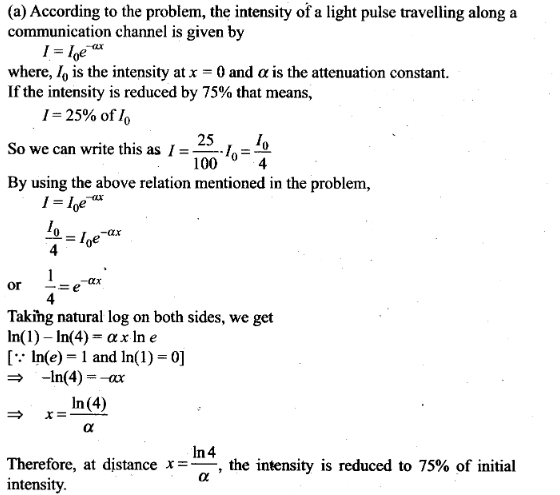
    ncert-exemplar-problems-class-12-physics-nuclei-12

    Question 13. Which sample AoxB shown in figure has shorter mean-life?
    ncert-exemplar-problems-class-12-physics-nuclei-13
    Solution:
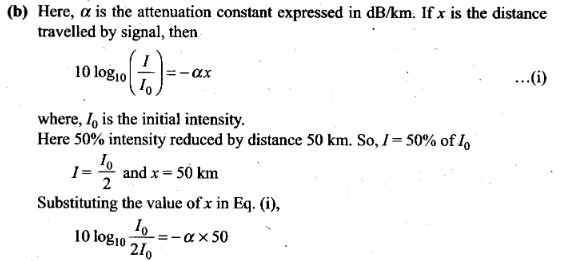
    Key concept:
    Mean (or average) life (ґ) : The time for which a radioactive material remains active is defined as mean (average) life of that material.
    • It is defined as the sum of lives of all atoms divided by the total number of atoms.
    ncert-exemplar-problems-class-12-physics-nuclei-14
    ncert-exemplar-problems-class-12-physics-nuclei-15
    ncert-exemplar-problems-class-12-physics-nuclei-16
    Question 14. Which one of the following cannot emit radiation and why? Excited nucleus, excited electron.
    Solution:
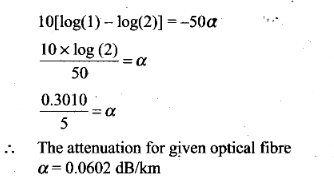
    Key concept: The energy of internal motion of a nucleus is quantized. A typical nucleus has a set of allowed energy levels, including a ground state (state of lowest energy) and several excited states. Because of the great strength of nuclear interactions, excitation energies of nuclei are typically of the order of the order of 1 MeV, compared with a few eV for atomic energy levels. In ordinary physical and chemical transformations the nucleus always remains in its ground state. When a nucleus is placed in an excited state, either by bombardment with high-energy particles or by a radioactive transformation, it can decay to the ground state by emission of one or more photons called gamma rays or gamma-ray photons, with typical energies of 10 keV to 5 MeV. This proceks is called gamma (γ) decay.
    Excited electron cannot emit radiation because energy of electronic energy levels is in the range of eV and not MeV ( mega electron volt), y-radiations have energy of the order of MeV.

    Question 15. In pair annihilation, an electron and a positron destroy each other to produce gamma radiations. How is the momentum conserved?
    Solution: In pair annihilation, an electron and a positron destroy each other to produce 2yphotons which move in.opposite directions to conserve linear momentum. The annihilation is shown below:
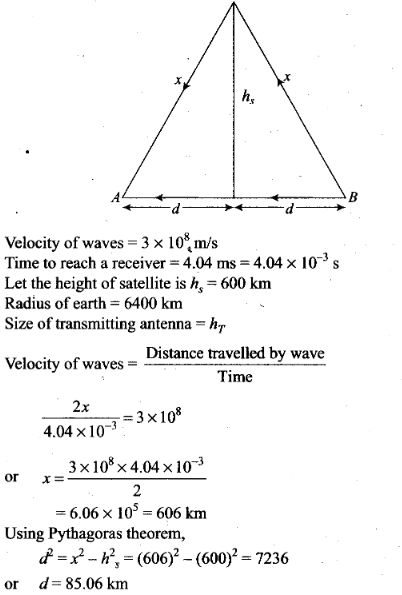
    ncert-exemplar-problems-class-12-physics-nuclei-17

    Short Answer Type Questions

    Question 16. Why do stable nuclei never have more protons than neutrons?
    Solution: The reason is that protons, being charged particles, repel each other. This repulsion becomes so great in nuclei with more than 10 protons or so, that an excess of neutrons which produce only attractive forces, is required for stability.
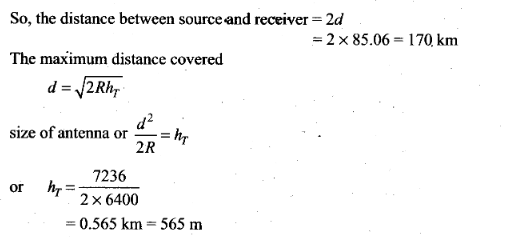
    Important point: As you get to heavier elements, with each new proton you add, there is a larger repulsive force. The nuclear force is attractive and stronger than the electrostatic force, but it has a finite range. So you need to add extra neutrons, which do not repel each other, to add extra attractive force. You eventually reach a point where the nucleus is just too big, and tends to decay via alpha decay or spontaneous fission.
    To view this in quantum mechanical terms, the proton potential well is not as deep as the neutron well due to the electrostatic repulsion. [Due to the Pauli exclusion principle, you only get two particles per level (spin up and spin down)]. If one well is filled higher than the other, you tend to get a beta decay to even them out. As the nuclei get larger, the neutron well gels deeper as compared to the proton well and you get more neutrons than protons.

    Question 17. Consider a radioactive nucleus A which decays to a stable nucleus C through the following sequence:
    A -> B -> C
    Here B is an intermediate nuclei which is also radioactive. Considering that there are N0 atoms of A initially, plot the graph showing the variation of number of atoms of A and B versus time.
    Solution: Consider radioactive nucleus A have N0 atoms of A initially; or at t = 0, NA = N0 (maximum) whole NB = 0. As time increases, NA decreases exponentially and the number of atoms of B increases. After some time NB becomes maximum. As B is an intermediate nuclei which is also radioactive, it also start decaying and finally drop to zero exponentially by radioactive decay law. We can represent the situation as shown in the graph.
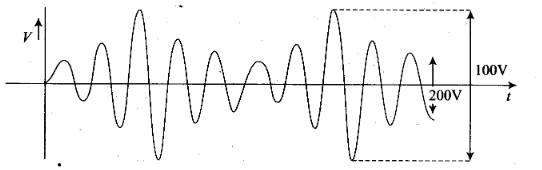
    ncert-exemplar-problems-class-12-physics-nuclei-18

    Question 18. A piece of wood from the ruins of an ancient building was found to have a 14 C activity of 12 disintegrations per minute per gram of its carbon content. The 14 C activity of the living wood is 16 disintegrations per minute per gram. How long ago did the tree, from which the wooden sample came, die? Given half-life of 14 C is 5760 yr.
    Solution:
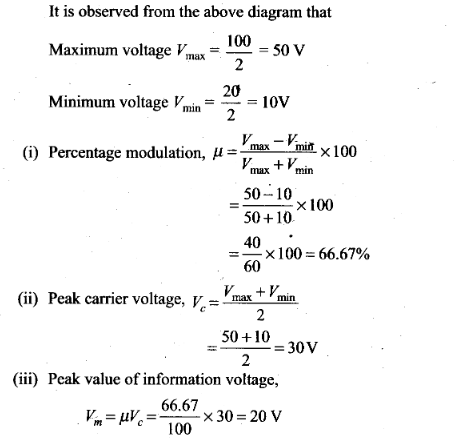
    Key concept:
    Carbon dating: Radiocarbon dating (also referred to as carbon dating or carbon-14 dating) is a method tor determining the age of an object containing organic material by using the properties of radiocarbon -14(14 C), a radioactive isotope of carbon.
    Radiocarbon, or carbon 14, is an isotope of the element carbon that is unstable and weakly radioactive. The stable isotopes are carbon 12 and carbon 13.
    Carbon 14 is continually being formed in the upper atmosphere by the effect of cosmic ray neutrons on nitrogen 14 atoms. It is rapidly oxidized in air to form carbon dioxide and enters the global carbon cycle.
    Plants and animals assimilate carbon 14 from carbon dioxide throughout their lifetimes. When they die, they stop exchanging carbon with the biosphere and their carbon 14 content then starts to decrease at a rate determined by the law of radioactive decay.
    Radiocarbon dating is essentially a method designed to measure residual radioactivity. By knowing how much carbon 14 is left in a sample, the age of the organism when it died can be known. It must be noted though that radiocarbon dating results indicate when the organism was alive but not when a material from that organism was used.
    ncert-exemplar-problems-class-12-physics-nuclei-19
    ncert-exemplar-problems-class-12-physics-nuclei-20

    Question 19. Are the nucleons fundamental particles, or do they consist of still smaller parts? One way to find out is to probe a nucleon just as Rutherford probed an atom. What should be the kinetic energy of an electron for it to be able to probe a nucleon? Assume the diameter of a nucleon to be approximately 10-15 m.
    Solution:
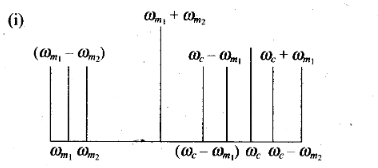
    Key concept: A nucleon is one of the particles that makes up the atomic nucleus. Each atomic nucleus consists of one or more nucleons, and each atom in turn consists of a cluster of nucleons surrounded by one of more electrons. There are two known kinds of nucleon: the neutron and the proton. The mass number of a given atomic isotope is identical to its number of nucleons. Thus the term nucleon number may be used in place of the more common terms mass number or atomic mass number.
    For resolving two objects separated by distance d, the wavelength A of the proving signal must be less than d. Therefore, to detect separate parts inside a nucleon, the electron must have a wavelength less than 10-15 m.
    ncert-exemplar-problems-class-12-physics-nuclei-21
    Important point: Until the 1960s, nucleons were thought to be elementary particles, each of which would not then have been made up of smaller parts. Now they are known to be composite particles, made of three quarks bound together by the so-called strong interaction. The interaction between two or more nucleons is called intemucleon interactions or nuclear force, which is also ultimately caused by the strong interaction. (Before the discovery of quarks, the term “strong interaction” referred to just intemucleon interactions.)

    Question 20. A nuclide 1 is said to be the mirror isobar of nuclide 2 if Z1=N2 and Z2 = N1 (a) What nuclide is a mirror isobar of 1123Na ? (b) Which nuclide out of the two mirror isobars have greater binding energy and why?
    Solution:
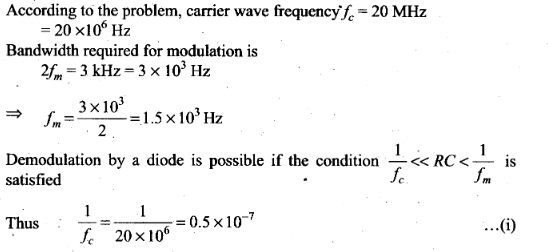
    Key concept: Mirror nuclei are nuclei where the number of protons of element one (Z1) equals the number of neutrons of element two (N2), the number of protons of element two (Z2) equal the number of neutrons in element one (N1) and the mass number is the same.
    Pairs of mirror nuclei have the same spin and parity. If we constrain to odd number of nuclcons(A), then w find mirror nuclei that differ one another by exchanging a proton by a neutron. Interesting to observe is their binding energy which is mainly due to the strong interaction and also due to Coulomb interaction. Since the strong interaction is invariant to protons and neutrons one can expect these mirror nuclei to have very similar binding energies.
    ncert-exemplar-problems-class-12-physics-nuclei-22

    Long Answer Type Questions

    Question 21. Sometimes a radioactive nucleus decays into a nucleus which itself is radioactive. An example is
    ncert-exemplar-problems-class-12-physics-nuclei-23
    Assume that we start with 1000 38 S nuclei at time t = 0. The number of 38 Cl is of count zero at t = 0 and will again be zero at t =∞, At what value of t, would the number of counts be a maximum?
    Solution:
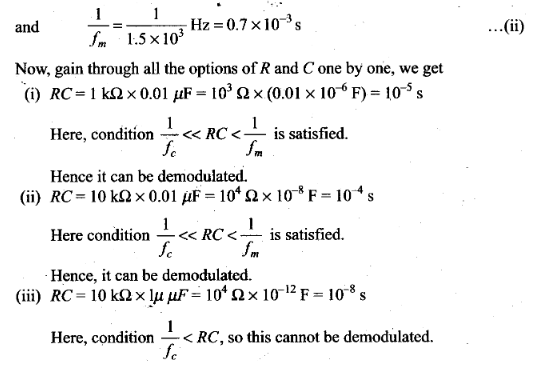
    ncert-exemplar-problems-class-12-physics-nuclei-24
    ncert-exemplar-problems-class-12-physics-nuclei-25
    ncert-exemplar-problems-class-12-physics-nuclei-26

    Question 22. Deuteron is a bound state of a neutron and a proton with a binding energy B = 2.2 MeV. A γ-ray of energy E is aimed at a deuteron nucleus to try to break it into a (neutron + proton) such that the n and p move in the direction of the incident γ-ray. If E = B, show that this cannot happen. Hence, calculate how much bigger than B must be E be for such a process to happen.
    Solution: Given the binding energy of a deuteron, B = 2.2 MeV Let kinetic energy and momentum of neutron and proton be Kn, KP and pn, pp respectively.
    From conservation of energy,
    ncert-exemplar-problems-class-12-physics-nuclei-27

    Question 23. The deuteron is bound by nuclear forces just as H-atom is made up of p and e bound by electrostatic forces. If we consider the force between neutron and proton in a deuteron as given in the form a coulomb potential but with an effective charge e’.
    ncert-exemplar-problems-class-12-physics-nuclei-28
    Solution:
    ncert-exemplar-problems-class-12-physics-nuclei-29

    Question 24. Before the neutrino hypothesis, the beta decay process was thought to be the transition.
    n —> p + e
    If this was true, show that if the neutron was at rest, the proton and electron would emerge with fixed energies and calculate them. Experimentally, the electron energy was found to have a large range.
    Solution:
    ncert-exemplar-problems-class-12-physics-nuclei-30
    ncert-exemplar-problems-class-12-physics-nuclei-31

    Question 25. The activity R of an unknown radioactive nuclide is measured at hourly intervals. The result found are tabulated as follows:
    ncert-exemplar-problems-class-12-physics-nuclei-32
    Solution:
    ncert-exemplar-problems-class-12-physics-nuclei-33
    ncert-exemplar-problems-class-12-physics-nuclei-34
    ncert-exemplar-problems-class-12-physics-nuclei-35

    Question 26. Nuclei with magic number of proton Z = 2, 8, 20, 28, 50, 52 and magic number of neutrons N = 2, 8, 20, 28, 50, 82 and 126 are found to be very stable.
    (i) Verify this by calculating the proton, separation energy SP for 120 Sn (Z= 50) and 121 Sb(Z= 51).
    The proton separation energy for a nuclide is the minimum energy required to separate the least tightly bound proton from a nucleus of that nuclide. It is given by
    ncert-exemplar-problems-class-12-physics-nuclei-36
    Solution:
    ncert-exemplar-problems-class-12-physics-nuclei-37
    Important point: “Magic Numbers” in Nuclear Structure Careful observation of the nuclear properties of elements, showed certain patterns that seemed to change abruptly at specific key elements. Mayer noticed that magic numbers applied whether one counts the number of neutrons (A). the atomic number (Z), or the sum of the two, known as mass number (A). I-xamples are Helium Z = 2, Lead Z = 82, Helium A = 2, Oxygen N = 8, Lead A = 126, Neon A = 20, Silicon A = 28.
    Magic numbers in the nuclear structure have been coming up during all this time, but no plausible explanation for their existence has ever been given. Interestingly, there are peaks and dips for binding energy, repeating every fourth nucleon. This periodicity is one clear indication of a geometrical structure within the nucleus. In particular, those nuclei that can be thought of as containing an exact number of alpha particles (2P + 2A), are more tightly bound than their neighbours. This effect is more pronounced for the lightest nuclei, but is still perceptible up to A – 28. For those nuclei with A > 20, the number of neutrons exceeds the number of protons, so some sort of distortion occurs wi thin the cluster.
    It is found that nuclei with even numbers of protons and neutrons are more stable than those with odd numbers. This comes from the fact that the physical structure must have an even number of vertices. A type of regular polyhedron would satisfy this condition, since no regular polyhedron exists with an odd number of vertices. These specific “magic numbers” of neutrons or protons which seem to be particularly favoured in terms of nuclear stability are:
    2, 8. 20. 28, 50, 82, 126
    . Note that the structure must apply to both protons and neutrons individually, so that we can speak of “magic nuclei” where any one nucleon type, or their sum, is at a magic number. .
    The existence of these magic numbers suggests closed shell configurations, like the shells in atomic structure. They represent one line of reasoning which led to the development of a shell model of the nucleus. Other forms – of evidence suggesting shell structure include the following.

    1. Enhanced abundance of those elements for which Z or N is a magic number.
    2. The stable elements at the end of the naturally occurring radioactive series all have a “magic number” of neutrons or protons.
    3. The neutron absorption cross-sections for isotopes where N = magic number are much lower than surrounding isotopes.
    4. The binding energy for the last neutron is a maximum for a magic neutron number and drops sharply for the next neutron added.
    5. Electric quadrupole moments are near zero for magic number nuclei.
    6. The excitation energy from the ground nuclear state to the first excited state is greater for closed shells.

    Visualizing the densely packed nucleus in terms of orbits and shells seems much less plausible than the corresponding shell model for atomic electrons. You can easily believe that an atomic electron can complete many orbits without running into anything, but you expect protons and neutrons in a nucleus to be in a continuous process of collision with each other. But dense-gas type models of nuclei with multiple collisions between particles didn’t fit the data, and remarkable patterns like the “magic numbers” in the stability of nuclei suggested the seemingly improbable shell structure.