forensic reconstruction
scudded across
casket grey
Resurrection
funerary treasures
Circumvented
computed tomography
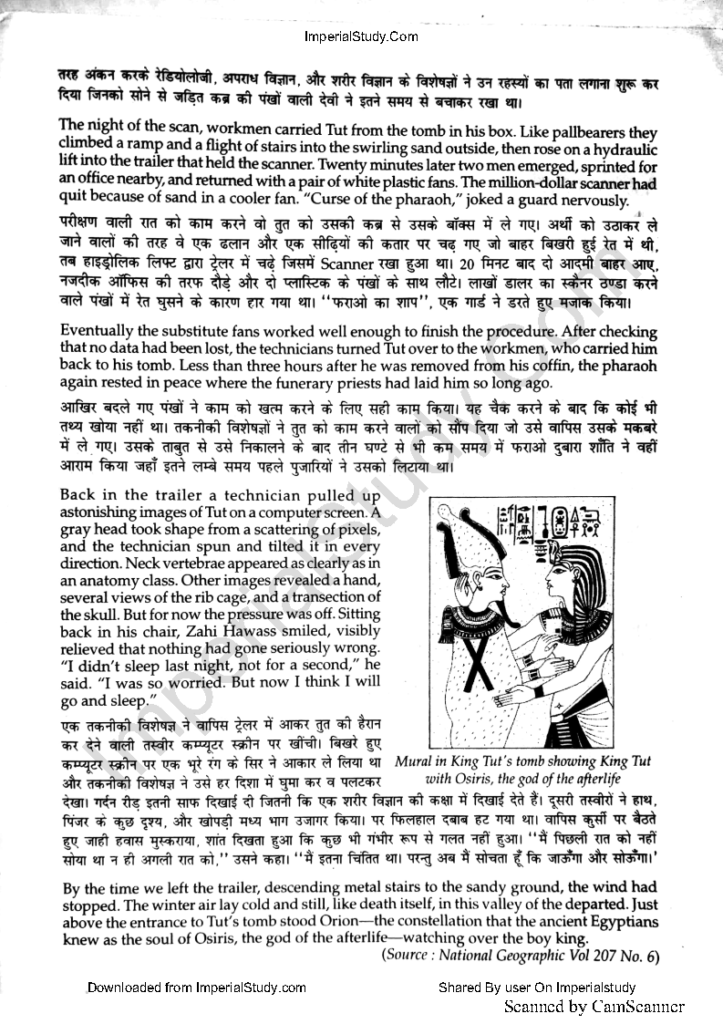
eerie detail
Answer
Forensic reconstruction- It refers to the process of creating a face on the skull and see how the owner of the skull looked like. Here, it refers to the construction of the bust of King Tut based on the data received from CT scan.
Scudded across- It refers to moving quickly. The phrase is used with reference to the movement of the ‘dark-bellied clouds’.
Casket grey- The words point out to the covering of the stars by the‘dark-bellied clouds’, the way jewels are kept in a casket (a jewel box).
Resurrection- It refers to a new beginning for something which is old and long forgotten. Here, it refers to the new life after death.
Funerary treasures- The valuable things with which the king was buried were no less than treasures as most of the items were made of pure gold. They are, thus, referred to as ‘funerary treasures’.
Circumvented- The thieves would easily bypass the guards with artfulness and rip the mummy apart to remove the gold.
Computed tomography- Also known as CT scan, it provides X-ray image of a body in cross section. It is used for diagnostic purposes.
Eerie detail- Uncanny description of the resulting image of the head of Tut visible through the CT scan.
Page No: 28
Understanding the Text
1. Give reasons for the following.
(i) King Tut’s body has been subjected to repeated scrutiny.
Answer
King tut’s body has been subjected to to repeated scrutiny for the riches it was buried with. There has also been a lot of speculation about the manner of his death and the time of his death.
(ii) Howard Carter’s investigation was resented.
Answer
Howard Carter’s investigation was resented because he used unscientific methods to cut the body away from the wooden base. He also focused more on the discovery of gold than on thefascinating details of Tut’s life and the mysteries of his death.
(iii) Carter had to chisel away the solidified resins to raise the king’s remains.
Answer
Carter found that the ritual resin that was used as a polish hashardened. The result was that the mummy was cemented to the bottom of the solid gold coffin.Neither the strongestforce could move the mummynor the burning sun could loosen the remains of the king.
(iv) Tut’s body was buried along with gilded treasures.
Answer
The ancient royals of Egypt were fabulously wealthy. They believed inafterlife. They also believed that they could take their wealth with them. Sogilded treasures were buried with them.
(v) The boy king changed his name from Tutankhaten to Tutankhamun.
Answer
Tutankhamun means ‘Living image of Amun’. He was a majorgod in ancient Egypt. King Amennotep smashed the images of Amun and closed his temples. Tut oversaw a restoration of the old ways. He also changed his name to express his belief on Amun.
2.
(i) List the deeds that led Ray Johnson to describe Akhenaten as “wacky”.
Answer
According to Ray Johnson Akhenten was wacky because:
(ii) List the advances in technology that have improved forensic analysis.
Answer
Today C.T. technology helps us to take hundreds of X-ray images in cross-sections. They can be put together likeslices of bread tp create three dimensional virtual body.This provides precise data for an accurate forensicreconstruction.
The above statement refers that there are hundreds of mummies in Egypt. ButTut’s is the first to be scanned. He remains the first evenin death, as he was the first among his countrymen whenhe lived. He was a ruler, an emperor.
Talking about the Text
1. Scientific intervention is necessary to unearth buried mysteries.
Answer
For
If you think history has any relevance in our life, we must get atthe truth. There are so many mysteries which remain unsolved. For example, we know very little about the Indus civilisation. The seals remainun-deciphered. This needs scientific investigation. Without scientificintervention they will remain in the dark.
No doubt we need to know the past. History has relevance in our life. But sometimes we take it too far. King Tut’s mummy has beenrepeatedly investigated. Inspite of spending millions of dollars, nothing newhas been revealed. We must utilise our resources to help the living rather than investigating the dead.
2. Advanced technology gives us conclusive evidence of past events.
Answer
For
Today technology is so advanced that we can reconstruct thepast. For example, we know how Pompeii was destroyed. But now we havereconstructed the whole city. We know precisely how the people lived.
Against
It is an empty boast that advanced technology gives us conclusiveevidence of past events. Let us take the case of King Tut. It has been C.T.scanned. What can it tell us how he died. If he was murdered who murderedhim and why ? C.T. scan might give some idea how he died. But it cannotgive conclusive evidence.
3. Traditions, rituals and funerary practices must be respected.
Answer
For
People who buried their dead with rituals and funerary practices did sowithreverence for their dead. They wanted to lie in peace, undisturbed. We mustrespect their sentiments.
2. What do you think are the reasons for the extinction of languages?
Answer
A language becomes extinct when its use is restricted to specific classes or categories of people. Secondly, the harshness of rules and lack of flexibility in usage also contribute in extinction of languages.
3. Do you think it is important to preserve languages?
Answer
Yes, it is important to preserve languages as they are responsible for the development of culture of the community. It helps in preservation of one’s heritage and traditions. Language preservation ensures contact with one’s history and literature.
4. In what ways do you think we could help prevent the extinction of languages and dialects?
Answer
Extinction of languages and dialects can be prevented through the following reasons.
► Transferring the vocabulary and dialects of the language to the next generation.
► Teaching the languages in colleges and universities and encouraging students to specialise in the same.
► Teaching children to use mother-tongue.
► Remaining connected to one’s cultural roots.
► Respecting one’s language which will help in taking it forward to the coming generations.
Working with Words
1. Given below are some interesting combinations of words. Explain why they have been used together.
(i) ghostly dust devils
(ii) desert sky
(iii) stunning artefacts
(iv) funerary treasures
(v) scientific detachment
(vi) dark-bellied clouds
(vii) casket grey
(viii) eternal brilliance
(ix) ritual resins
(x) virtual body
Answer
(i) ghostly dust devils- it points out to the devilish or frightful movement of the dusty winds. It reflects the anger of the winds for disturbing the king from his resting place.
(ii) desert sky- it refers to the dusty sky of the desert. The barren sky spread over the vast desert region portrays a sad and dry picture.
(iii) stunning artefacts- items found in the tomb were extremely beautiful. Usage of both the words together explains the ‘eternal brilliance’ of the objects.
(iv) funerary treasures- reference is to the fact that king was buried with numerous things which were no less than treasures as most of the items were made of pure gold.
(v) scientific detachment- it refers to an indifference towards science.
(vi) dark-bellied clouds- it refers to the dark clouds containing rain.
(vii) casket grey- the words point out to the stars being covered by the ‘dark-bellied clouds’, the way jewels are kept in a casket (a jewel box).
(viii) eternal brilliance- eternal refers to something that is timeless. Thus, eternal brilliance refers to timeless lustre and shine of the jewels and valuables of the king.
(ix) ritual resins- resins are used as a customary duty in the process of burying a body.
(x) virtual body- a body created through electronic images or CT scan. It resembles a real body and provides a very clear view.
2. Here are some commonly used medical terms. Find out their meanings.
| CT scan | MRI | tomography |
| Autopsy | dialysis | ECG |
| Post mortem | angiography | biopsy |
CT scan- It refers to Computed Tomography. It provides X-ray image of a body in cross section. It is used for diagnostic purposes.
MRI- MRI is the short form of magnetic resonance imaging. It is a diagnostic tool.
Tomography- It refers to taking pictures of various sections of a human body in a three-dimensional view.
Autopsy- It refers to the post-mortem examination.
Dialysis- It is the process of filtration of bloodstream usually during kidney failure.
ECG- The electrocardiogram is a diagnostic tool that measures and records the electrical activity of the heart in exquisite detail.
Post mortem- It refers to the medical examination and dissection of a dead body to determine the cause of death
Angiography- Angiography is the examination of the blood vessels using x-rays and injecting of a radiopaque substance.
Biopsy- The removal and examination of a sample of tissue from a living body for diagnostic purposes is known as biopsy.
Content
Summary of the Chapter Discovering Tut: The Saga Continues
This is an article regarding mummy of Tut, who was considered as the last heir of the powerful family that ruled Egypt. He died in his last teens. His death has been a mystery since his tomb was first discovered in 1922. After 80 years his tomb had been extracted again for a CT scan in 2005. This may lead to discover something new about his life and death. When the Tomb of Tut was taken away, an angry wind stirred up ghostly dust devils.
The area was surrounded by a lot of tourists nearby. They gazed at wall paintings and Tut’s preserved dead body. Some of them were thinking how Tut might have died in his late Teens. According to Zahi Hawass, Secretary General of Egypt’s Supreme Council of Antiquities it the mummy of Tut was damaged by James Carter, a British Archaeologist who investigated the mummy in 1922. He was buried with everything he might have been using in his day to day life.
Carter when found Mummy Tut was cemented to the bottom of his solid gold coffin. He tried to loosen the resin by putting the mummy in the blazing sunshine but he failed. He had to use the chisel to remove the mummy as thieves would have cut it and taken all the gold. Ancient Egyptian use to believe that dead person takes all his belongings with them. Thus the dead person was buried with his belongings. Tut was buried with gold jewelries.
Archaeology has changed over a period of time. Archaeologist’s nowadays looked for details of ancient life and mysteries of death instead of treasures. More sophisticated tools and modern methods like CT scan is introduced in archaeology. Now after the CT scan, his tomb was investigated. King Tut’s demise was a big event, even by royal standards. He was the last of his family’s line, and his funeral was the death rattle of a dynasty. But the particulars of his passing away and its aftermath are unclear.
Tut took the thrown at very young age. He became king after Smenkhkare, who succeed Akhenaten. Tut ruled for about 9 years. The Egyptian Mummy Project, which began an inventory in late 2003, has recorded almost 600 so far and is still counting. The next phase: scanning the mummies with a portable CT machine. Tut was one of the first Mummy to get investigated under CT scan. A CT machine scanned the mummy head to toe, creating 1,700 digital X-ray images in cross section.
They were looking for how the mummy has been protected for so long. The million-dollar scanner had quit because of sand in a cooling fan. After three hours of CT scan, Tuts mummy was carried back to its tomb. The CT scanned image was observed on a computer screen. The image was observed and analyzed. The whole process got completed properly and nothing went seriously wrong.
Content
Content
Page No: 13
1. Notice these expressions in the text. Infer their meaning from the context.
honing our seafaring skills
ominous silence
Mayday calls
pinpricks in the vast ocean
a tousled head
Answer
honing our seafaring skills: this refers to the efforts made by the author and his wife, to perfect or sharpen their seafaring skills.
ominous silence: the silence here refers to an impending danger.
Mayday calls: Mayday calls are radio-telephonic words which signal aircrafts or ships stuck in a disastrous situation.
pinpricks in the vast ocean: this phrase expresses the search for two small islands in the vast ocean.
a tousled head: this refers to hair in disarray or the disarranged hair of the author’s son, Jonathan
Page No: 18
Understanding the Text
1. List the steps taken by the captain
(i) to protect the ship when rough weather began.
(ii) to check the flooding of the water in the ship.
Answer
(i) In order to protect the ship from rough weather, the capitan decided to slow it down. So he dropped the storm jjb and lashed heavy mooring rope in a loop across the stern. Then they doubled fatened everything and went through their life-raft drill
(ii) To check the flooding of water in the ship, he put waterproof hatch covers across the gaping holes which diverted the water to the side. When the two hands pump blocked and electric pump short circuited, he found another electric pump, connected it to an outpipe and started it.
2. Describe the mental condition of the voyagers on 4 and 5 January.
Answer
On January 4 and 5, the voyagers felt relieved after rigorous practice of continuous pumping. They had their first meal in almost two days. Their respite was short-lived. They faced dangerous situation on January 5. Fear of deah loomed large. They were under great mental stress.
3. Describe the shifts in the narration of the events as indicated in the three sections of the text. Give a subtitle to each section.
Answer
The first section: The first section opens on a cheerful note. The narrator and his family are all set for their ultimate dream- to take up an around-the-world voyage like Captain James Cook did. They have perfected their seafaring skills. They begin the voyage and despite of the bad weather, they celebrate Christmas on the ‘Wavewalker’.
The second section: This part of narration covers the hazards faced by the voyagers. There is a shift in the narration from cheerful to intense. They find themselves in an extremely fatal and disastrous situation. A huge wave hits their boat and the narrator is thrown overboard. Despite getting injured, he maintains his composure and applies every possible way to tackle the critical situation. They manage to pump out maximum amount of water out of the boat in about 36 hours. But as they continue to face bad weather conditions the narrator loses hope. The children remain fearless, courageous and optimistic throughout.
The third section: The children provide moral support to the narrator and he continues with his efforts. Under the captaincy of the narrator, they manage to reach Ile Amsterdam. The narrator proves his seamanship and receives the title of “the best daddy” and “the best captain” from his children.
The above three sections can be subtitled as follows:
a) The first section: Round-the-world voyage begins
b) The second section: The attack of the big wave
c) The third section: Ultimate victory
Talking about the Text
1. What difference did you notice between the reaction of the adults and the children when faced with danger?
Answer
There was lot of difference between the way in which the adults and children reacted when faced danger. The adults lose hope and wait for their end with a heavy heart. At this point, they are motivated by the children. The children offer moral support to the adults. They display maturity and tolerance. Jonathan expresses his fearlessness and courage when he says that they are not afraid of dying if they all can be together. Sue expresses her love and gratitude for her parents by making a greeting card. She is strong enough to not let her parents know about her serious injuries. She did not want to bother her parents in the times of crisis.
2. How does the story suggest that optimism helps to endure “the direst stress”?
Answer
Optimism is a determination to overcome difficulties. It raises one’s spirits and helps one overcome stress and difficulty with ease. The story displays courage and optimism throughout. Survival happens only because of the optimistic struggle that the family carries on with.
The level of perseverance in the author rises when Jonathan says, “we’re not afraid of dying if we can all be together. Besides, the caricatures of him and Mary, drawn by Sue, helps his determination and optimism to grow many folds. The positive outlook of the children infuses positivity in the narrator. He rigorously calculates their position and finally asks Larry to steer a course of 185 degrees. Though he had lost all hope by then, he did not show it and optimistically told Larry that they would spot the island by about 5 P.M. Fortunately, their struggle and optimism pays off and they manage to find Ile Amsterdam by evening.
Such experiences teach us the potential that courage, perseverance and tolerance hold. It explains how one must react in the direst of the situations. It teaches us that one must never lose hope and try to find reasons to stay positive in the face of adversity. In such situations one must try his/her best to remain calm and composed and understand the power of unity and team work. Moreover, the importance of common sense, putting continuous efforts to overcome the catastrophe and the significance of being extra cautious and careful are learnt from such hazardous experiences.
4. Why do you think people undertake such adventurous expeditions in spite of the risk involved?
Answer
The spirit to experience unique elements of nature, undaunted passion and willingness to accept challenges drive people to take up adventurous expeditions. The people who involve themselves in such activities are very well aware of the risk involved in them. But due to their passion and enthusiasm to do something unique and great, they willingly accept such challenges. Also, their desire to be in the lap of nature and experience its beauty pushes them to such expeditions.
Thinking about Language
1. We have come across words like `gale’ and `storm’ in the account. Here are two more words for `storm’: typhoon, cyclone. How many words does your language have for `storm’?
Answer
In Hindi, ‘storm’ is known as ‘aandhi’, ‘toofan’ ‘andhad’, etc.
Page No: 19
2. Here are the terms of different kinds of vessels: yacht, boat, canoe, ship, steamer, schooner. Think of similar terms in your language.
Answer
‘Naav’, ‘Nauka’, ‘Jahaaz’ and ‘Kishti’ are some of the various words used in Hindi for the word ‘boat’.
3. ‘Catamaran’ is a kind of a boat. Do you know which Indian language this word is derived from? Check the dictionary.
Answer
The word ‘Catamaran’ is derived from Tamil word ‘Kattumaram’.
4. Have you heard any boatmen’s songs? What kind of emotions do these songs usually express?
Answer
Yes, Boatmen’s songs usually express love and nostalgia. It revolves around the longing to meet a loved one. It may also express their love for the sea.
Working with Words
1. The following words used in the text as ship terminology are also commonly used in another sense. In what contexts would you use the other meaning?
Knot stern boom hatch anchor
Answer
b) a group of persons.
Stern: firm, strict, uncompromising, harsh, hard etc.
Boom: a) deep, prolonged, resonant sound
b) to progress or flourish
c) to hit hard
Hatch: a) to bring forth, produce.
b) derive, concoct
c) to draw, cut, or engrave lines
Anchor: a) a person or thing that can be relied upon for support
b) host of an event.
2. The following three compound words end in-ship. What does each of them mean?
Answer
| Take on sth: | to begin to have a particular quality or appearance; to assume sth |
| take sb on: | to employ sb; to engage sb to accept sb as one’s opponent in a game,contest or conflict |
| Take sb/sth on: | to decide to do sth; to allow sth/sb to enter e.g. a bus, plane or ship; to take sth/sb on board |
Airship: It is a self-propelled lighter-than-air aircraft with the means of controlling the direction of the flight.
Flagship: It is a ship carrying the flag officer or the commander of a fleet, squadron. It displays the officer’s flag.
Lightship: It refers to a ship anchored in a specific location flashing a very bright light for the guidance of ships, as in avoiding dangerous areas.
3. The following are the meaning listed in the dictionary against the phrase `take on’. In which meaning is it used in the third paragraph of the account:
Answer
In the third paragraph, in lines: “… we took on two crewman to help us tackle … roughest seas…”, the word “took on” suggests to take somebody on i.e., to employ or engage somebody.
Content

Content
Summary of the Chapter We’re Not Afraid To Die…If We Can All Be Together
This is the story of a 37 year old businessman who went to repeat the round the world vogue made 200 years ago by Captain James Cook. He along with his family which includes narrator, his wife Marry, his son Jonathan 6 year old, his daughter Suzanne, 7 year old.
They were accompanied by two crewmen, an American Larry and a Swiss Herb in order to help them in roughest seas of Indian Ocean. He and his wife were enhancing their skill for their dream of sailing across the world. Save water, the name of the ship they had, been professionally built and been tested in the roughest weather it could face.
The first leg of their journey was planned for 3 years, 105000 kilometer journey. On their second day out of cape town, they started getting encountered by strong winds. The situation continued until next few weeks. They enjoyed on Christmas despite bad weather hoping for some improvement in weather in New Year. But on January 2nd, the situation got worse. The huge waves were there to haunt them. There was endless sea rolling toward them. Then they prepared themselves with lift raft drills, life jackets etc and double lashed everything.
Now the situation came were wind dropped, and sky immediately grew dark. A wave that was perfectly vertical and initially appeared like a cloud stroked their ship. He was hurt badly. Everywhere there was water on the ship. Both crewmen were pumping out like mad people. Suzzane was hurt badly but the aim of the narrator at this point in time was to save the life of his family. He was consistently working to fix the holes and repairing the ship otherwise it would have surely sunk. He was facing a lot of problems when their hand pumps started to block up with garb ages and other stuff were floating and blocking the pumps and the short circuits were creating an additional problem.
Despite several hindrances, he kept on trying for the survival of his family. He was also supported by his family members during this. Sue, despite being hurt badly was not expressing her pain, as she did not want her father to worry about this at that point in time. He remembered about a spare pump he had, and it worked in order to pump out water from the ship. He gets that he would not be able to sail the ship to Australia, and so calculated for nearby islands there were two small islands in the east direction, few hundred kilometers. They were getting no signals on the radio.
Next morning Jan 3rd, the pumps had made water level under control, but still, somewhere there was a big leakage. On January 4th night weather started again to deteriorate and on next morning on 5th, It became worse. Jonathan told that if his all family members are together he is not afraid of dying. Marry got some beef and biscuits. They were now hoping for the best. The narrator made some calculations. It was difficult as the compass was not working properly.
Finally, at 2 p.m., He came to the conclusion that they could get an island at 185 degrees, he asked Larry to go accordingly. Then narrator went for a nap. He woke up at 6 and was thinking he missed the island, but Jonathan showed him the nearby island where they had reached. They were happy and cheerful as they got what they had been fighting for, their Survival.
Content
| Padding transient |
Now look up the dictionary to see if your inference is right.
Paddling: To move a boat by means of paddles.
Transient: Something that stays at a place for a short time-period.
‘Cardboard’ refers to the photograph only. This word has been used because photograph it lost it colur and also clarity of its images.
2. What has the camera captured?
Answer
The camera has captured some happy moments from the childhood of the poet’s mother. It was a scene taken from a beach where she had gone with her cousins and her uncle for a sea holiday. The girls were paddling in the water.
3. What has not changed over the years? Does this suggest something to you?
Answer
The sea has not changed over the years. It is still the same. The sea symbolizes eternity.
4. The poet’s mother laughed at the snapshot. What did this laugh indicate?
Answer
This laugh indicates her remembering her past. She looked back to her childhood with nostalgia and remembered the innocent joys of her childhood days.
5. What is the meaning of the line “Both wry with the laboured ease of loss”.
Answer
The line refers to the sea holiday as remembered by her mother and the poet remembering her mother’s laughing face. Both these now belong to the past. Her mother is no more now.
6. What does “this circumstance” refer to?
Answer
‘This circumstance’ refers to the present situation of the poet wherein the poet is absorbed in the painful memory of her dead mother. Looking at the photograph and thinking of her mother’s laughter, the poet also realises that it has been the same number of years since her mother died as her mother’s age in the photograph.
Content