Blog

  • Accounts from Incomplete Records Notes Class 11th Accountancy

    Accounts from Incomplete Records

    Meaning

    Accounting records which are not maintained in accordance with the principles of double entry system are known as accounts from incomplete records or single entry system of accounting.

    Features of Incomplete Records

    1. Unsystematic method
    2. Maintenance of personal accounts
    3. Maintenance of cash book
    4. No uniformity
    5. Dependence on original vouchers
    6. Less degree of accuracy
    7. Suitability

    Advantages and Uses of Single Entry System

    It is observed that many businessmen keep incomplete records because of the following reasons:

    1. Adequate knowledge of accounting principles not required
    2. Less expensive
    3. Less time consumed
    4. Convenient
    5. Suitable for small concerns

    Limitations of Single Entry System

    Limitations of single entry system are

    1. The arithmetical accuracy of accounts under single entry system cannot be ensured as trial balance cannot be prepared.
    2. Correct ascertainment and evaluation of financial results of business operations cannot be made.
    3. A problem in raising funds from outsiders and planning for future business activities may arise as analysis of profitability, liquidity and solvency of the business cannot be done.
    4. Filling of insurance claim with an insurance company by the owner in case of loss of inventory by fire or theft becomes difficult.
    5. Convincing the income tax authorities about the reliability of the computed income becomes difficult.
    6. Avoiding misappropriation of assets may become difficult as assets accounts are not maintained and it may be difficult to keep full control.
    7. Correct profit earned or loss incurred during the accounting period is not known as trading and profit and loss account cannot be prepared.

    Profit Ascertainment/Statement of Profit or Loss under Single Entry System

    Every business firm wishes to ascertain the results as operations to assess its efficiency, success and failure. This gives rise to the need for preparing the financial statements to disclose.

    1. The profit made or loss sustained by the firm due a given period.
    2. The amount of assets and liabilities as at the closing date of the accounting period.

    This can be done in two ways:

    1. Preparing the statement of affairs as at the beginning and at the end of the accounting period called statement of affairs or net worth methods.
    2. Conversion method, i.e. by preparing trading the profit and loss account and the balance sheet putting the accounting records in proper order. Conversion method is not in syllabus. Therefore, it has been discussed.

    Statement of Affairs or Net Worth Method

    A statement of affairs is a statement of all assets and liabilities. It is a statement in which assets are shown on one side and the liabilities on the other, just as in case of a balance sheet. The difference between the totals of the two sides is the capital. Under this method, statement of assets and liabilities as at the beginning and at the end of the relevant accounting period is prepared, ascertain the amount of change in the capital during the period.

    A statement of affairs is similar to, though not the same as a balance sheet.

    Statement of Affairs (Format)
    As at..

    It is the total of liabilities side is deducted from the total of assets side of the statement of affairs, the balance will be taken as capital.

    It is based on the accounting equation as

    Capital = Assets – Liabilities

    • Preparation of Statement of Profit or Loss

    Once the amount of capital, both at the beginning and at the end is computed with the help of statement of affairs, a statement of profit or loss is prepared to ascertain the exact amount of profit or loss made during the year.

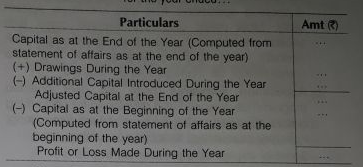
    The difference between the opening and closing capital represents its increase or decrease which is to be adjusted for withdrawals made by the owner or any fresh capital introduced by him during the accounting period in order to arrive at the amount of profit or loss made during the period.

    Statement of Profit or Loss (Format)
    For the year ahead..

    The same computation can be done in the form of an equation as follows:

    Profit or Loss = Capital at the End – Capital at the Beginning + Drawings During the year – Capital Introduced During the year

  • Financial Statements of Non-for-Profit Organisations Notes Class 11th Accountancy

    Financial Statements of Non-for-Profit Organisations

    Meaning

    Not-for-profit organizations also are known as non-profit organizations refer to the organizations that are set for the welfare of the society and are set-up as charitable institutions which function without any profit months. Non-profit organizations are separate legal entity not owned by any individual or enterprises. Examples, non-profit organisations are clubs, hospitals, libraries, schools, societies for promotion of sports, arts and culture etc.

    • Receipts and Payments Account

    The receipts and payments account is the summary of cash and bank transactions which helps in the preparation of income and expenditure account. It is prepared at the end of the accounting period and is summary of cash book, classifying receipts and payments under various heads along with cash and bank balances in the beginning and at the end of the accounting period.

    Receipts are recorded on the debit side and payments are recorded on the credit side of the account. The account is maintained on cash basis of accounting.

    Every receipt and payment, whether capital revenue and irrespective of the period is recorded in this account. The purpose of preparing this account is to ascertain cash in hand and cash at bank at the end of the year.

    Salient Features of Receipts and Payments Account

    1. Nature Receipts and payments account is a real account in nature. It is basically a summary of the cash book. Cash receipts are recorded on the debit side, while cash payments are entered on the credit side.
    2. Period in this account, all receipts and payments irrespective of the period to which they pertain are shown.
    3. Capital and revenue all cash receipts and cash payments whether of capital nature or of revenue nature are included.
    4. Distinction No distinction is made in receipts/payments made in cash or through bank. With the exception of the opening and closing balances, the total amount of each receipt and payment is shown in this account.
    5. Adjustment of non-cash items Non-cash items such as depreciation, outstanding expenses, accrued income etc., are not shown in this account.
    6. Opening and closing balance it begins with opening balance of cash in hand and cash at bank (or bank overdraft) and close with the year-end balance of cash in hand/cash at bank (or bank overdraft). In fact, the closing balance in this account (difference between the total amount of receipts and payments) which is usually a debit balance reflects cash in hand and cash at bank unless there is a bank overdraft.

    Limitations of Receipts and Payments Account

    1. No adjustments as the receipts and payments account is not prepared on accrual basis, therefore no adjustments are made in it.
    2. Does not show income and expenditure income and expenditure is not shown by this account.
    3. No particular accounting period Receipts and payment account does not show the amount received or paid only for a particular period.

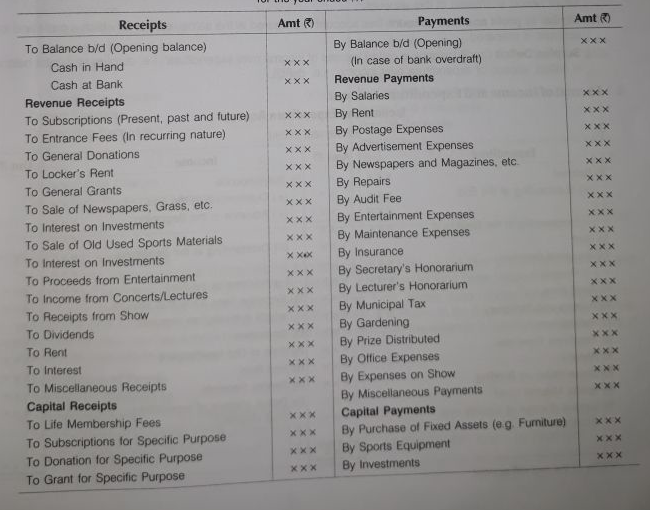
    Format of Receipts and Payments Account

    Receipts and Payments Account

    For the year ended..
    1. Income and Expenditure Account

    It is the summary of income and expenditure for the accounting year. Income and expenditure account in nominal account in nature and serves the same purpose and the profit and loss account of a business organisation does. Income and expenditure account is prepared at the end of accounting period to ascertain net operating results. All the revenue items relating to the current period are shown in this account, the expenditure and losses on the expenditure side and incomes and gains on the income side of the account. It shows the operating results in the form of surplus (i.e. excess of income over expenditure) or deficit (i.e. excess expenditure over income) which is transferred to the capital fund shown in the balance sheet. The income and expenditure account is prepared on the accrual basis.

    Features of Income and Expenditure Account

    1. Nature it is a nominal account.
    2. No capital items No capital items are entered in this account.
    3. Debit and credit sides its debit side includes all the expenses pertaining to the particular period and certain side includes all the incomes pertaining to the same period.
    4. Opening and closing balances no opening and closing balances are recorded in it.
    5. Only current period items No item either revenue or expenditure, pertaining to the past period or the future period is entered in this account.
    6. Similar to profit and loss account this account is prepared in the same manner in which a profit and loss account is prepared.
    7. Surplus/Deficit Credit balance is called ‘excess of income over expenditure’, i.e. surplus and debit balance is called ‘excess of expenditure over income’, i.e. deficit.

    The format of Income and Expenditure Account

    Income and Expenditure Account
    For the year ended..
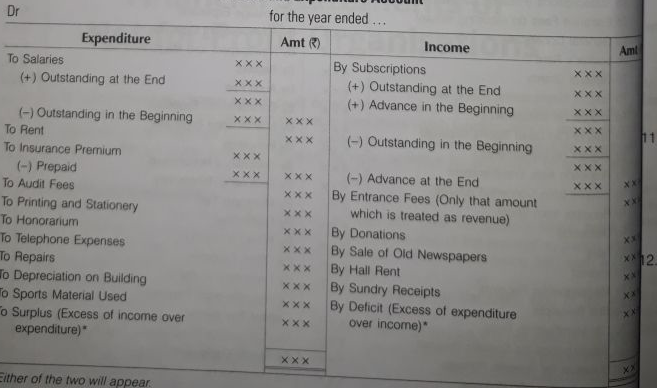
    • Either of the two will appear.


    • Balance Sheet

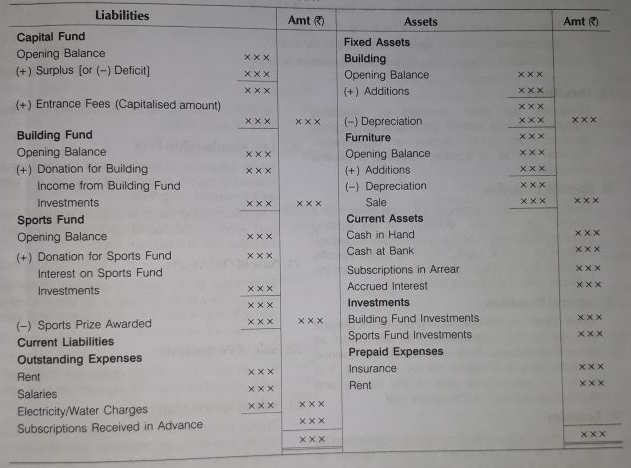
    Balance Sheet is prepared by not-for-profit organisation to ascertain the financial position of the organisation. It is prepared on the same pattern as that of the business entities. Balance sheet is prepared at the end of the accounting period after preparing income and expenditure account.

    Sometimes, balance sheet needs to be prepared at the beginning of the year in order to find out the opening balance of the capital/general fund. The balance sheet shows assets on the right hand side and liabilities are shown on the left hand side along with capital fund or gener.al fund.

    The capital fund or general fund is in place of the capital and the surplus or deficit as per incomes and expenditure account shall be added to/deducted from this fund.

    1. Format of Balance Sheet

    Balance Sheet

    As at..
    • Fund Based Accounting

    The accounting where receipts and incomes relating to a particular fund are credited to that particular fund and payments and expenses are debited to that particular fund, it is known as fund based accounting.

    These funds are created for specific purposes, e.g. prize fund, sports fund, library fund, building fund, endowment fund etc. If the fund account has a credit balance, it is shown in the balance sheet on the liabilities side. If the fund account has a debit balance, i.e. the fund is less than the balance, it is transferred to the debit of income and expenditure account.

    • Classification of Funds

    Funds may be classified as

    1. Unrestricted Funds
    2. Restricted Funds

    Various types of restricted funds are as follows:

    1. Endowment fund
    2. Annuity fund
    3. Loan fund
    4. Fixed assets fund
    5. Prize fund

    Subscriptions

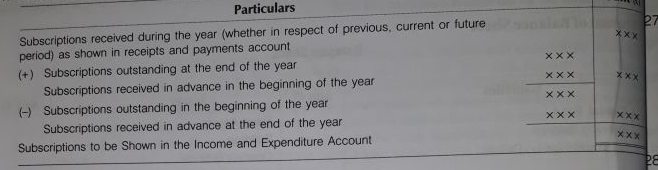
    It is the membership fee paid by the members on annual basis. It is the main source of income of non-prime organisations. Subscriptions relating to the current year whether received or not, are shown in the credit side and income and expenditure account. Subscriptions not received, i.e. outstanding are shown on the assets side and balance sheet. Subscriptions received in advanced for the following year are shown on the liabilities side in the balance sheet.

    Table Showing Calculation of Subscriptions
    Donation

    Donations are often received by charitable institutions. It is a sort of gift in cash or properly received from some person or organisation. Donation can be for specific purposes or general purposes.

    Specific Donation

    When the donations received are to be utilized for a specific purpose say, extension of the existing building, construction of a new computer laboratory, creation of a book bank, etc. it is called specific donation. It should be capitalized and shown on the liabilities side of a balance sheet.

    General Donation

    When donations are utilized to promote the general purpose of the organisation, they are called as general donations. They are treated as revenue receipts, as it is a regular source of income. It is shown on the income side of the income and expenditure account of the current year.

    Legacies

    The amount received by a non-profit organisation as per the will of a deceased person is termed as legacy. It is treated as a capital receipt and shown on the liabilities side. However, legacies of small amount may be treated as income and shown on the income side of the income and expenditure account.

    Entrance Fees

    Entrance fee also known as admission fee is paid only once by the member at the time of becoming a member. As entrance fee is paid by a member only once, it is argued that it should be treated as a capital receipt and transferred to capital fund. However, it should be treated as revenue receipt and credited to the income and expenditure account, when the amount is small to cover the expenses of admission. NCERT guidelines advocate treating of entrance fees as revenue item.

    Life Membership Fees

    When lump sum amount is paid by the member instead of paying periodic, subscription, it is treated as life member-ship fees.

    Life membership fee is treated as a capital received and added to the capital fund/general fund on the liabilities side of a balance sheet.

    1. Sale of Old Assets

    Book value of an asset is credited to the asset account. Any profit on sale of an asset is credited and loss on sale of an asset is debited to income and expenditure account.

    Sale of Periodicals

    It is an item of recurring nature and shown in the credit side of income and expenditure account.

    Sale of Sports Material

    Sports materials are consumable assets. Sales sports material (used material like old balls, bills net etc.) is the regular feature with any sport club is usually shown as an income in the income and expenditure account.

    Payment of Honorarium

    Honorarium is the amount paid to the person who is not an employee of the institution and has voluntary undertaken a service. It is debited to income and expenditure account.

    Endowment Fund

    It is a fund arising from a bequest or gift, the income of which is devoted for a specific purpose. Hence, it is a capital receipt and shown on the liabilities of the balance sheet as an item of a spend purpose fund.

    Government Grants

    Various institutions like schools. Colleges, public hospitals etc., depend on government grants for their activities. Grants which are recurring in nature are treated as revenue receipt and credited to income and expenditure account. However, grants of capital nature such as building grant are treated as capital receipt and transferred to building account.

    Special Funds

    Certain special funds are created for certain purpose/activities, e.g. prize funds, match, fund, sports fund, etc. The income earned from such funds is added to the respective fund and not credited to income and expenditure account and also the expenses incurred on such specific purposes are also deducted from the special fund.

    Special Receipts

    When there is a receipt of amount by non-profit organisations for special occasions, it is referred to as special receipts. Such amounts are credited to a separate account and expenses against these receipts are debited to it. The balance is transferred to the credit side of income and expenditure account.

    Sale of Old Newspapers

    Amount which is realized by selling of old newspapers is treated as income and credited to income and expenditure account.

    Revenue Receipts

    Revenue receipts are shown on the credit side of income and expenditure account, e.g. rent, interest on investment, proceeds from concerts, shows, etc.

    Revenue Expenses

    Revenue expenses are the expenses which are incurred for performing day-to-day activities or expenses which are recurring in nature, e.g. salary, rent, etc. It also includes expenses incurred on the maintenance of fixed assets, e.g. repairs, depreciation etc.

    Capital Expenditure

    Capital expenditures are shown on the assets side of balance sheet, e.g. expenditure on purchases of books, furniture, medicines, postage, etc.

    Calculation of the Cost of Consumable Goods

    Consumable goods are the items which are consumed during the year such as stationery, sports material, foodstuff, medicines, postage etc.
    Non-Profit organisations have stock of consumable goods at the end of the year. The income and expenditure account will show correct surplus/deficit, only if the goods consumed are debited to income and expenditure account and closing stock is shown in the balance sheet.

    The amount of goods consumed during the year is calculated as follows:

    1. Preparation of the Income and Expenditure Account and the Balance Sheet from the Receipts and Payments Account with the Additional Information

    Step 1 Prepare the opening balance sheet to find out the opening balance of capital fund (in case it is not given), taking into account the opening cash and bank balances given in receipts and payments account and other assets and liabilities given in additional information. The difference between the assets and liabilities is the capital fund or general fund or accumulated fund.

    Step 2Identify from the receipts side, i.e. debit side of the receipts and payments account, the revenue receipts and the capital receipts.

    1. Capital receipts are shown in the appropriate assets and liabilities account and then incorporated in the balance sheet.
    2. Record the revenue receipts on the income side, i.e. credit side of income and expenditure account, after making suitable adjustments so that all revenue receipts for the current year are shown.

    Step 3From the receipts and payments account, identify the revenue and capital payments from the payments side, i.e. credit side.

    1. Capital payments are shown in the appropriate assets and liabilities account and then incorporated in the balance sheet.
    2. Record the revenue payments on the expenditure side, i.e. debit side of the income and expenditure account, for the current year after making necessary adjustments.

    Step 4There are certain items which do not appear in receipts and payments account but are to be recorded in income and expenditure account. They are depreciation on fixed assets- it is to be shown on the debit side, loss on sale of fixed assets- to be shown on the debit side, profit on sale of fixed assets-to be shown on the credit side.

    Step 5 Surplus/Deficit in the income and expenditure account is calculated and transferred to the capital fund shown in the balance sheet. Excess of incomes over expenditure is surplus and excess of expenditure over incomes is deficit.

    Step 6 Prepare closing balance sheet by taking into consideration the opening balance of assets, liabilities and opening capital fund, surplus/deficit, purchase and sale of assets during the year.

  • Financial Statement II (With Adjustments) Notes Class 11th Accountancy

    Financial Statement II (With Adjustments)

    1. Needs for Adjustments in Preparing the Final Accounts

    The purpose of making various adjustments is to ensure that the final accounts must reveal the true profit or loss and true financial position of the business.

    1. It helps us to record those adjustment which were left or committed and were not recorded in the accounts.
    2. A proper recording of adjusting entries assists us to separate all the financial transactions into a year-wise category.
    3. Recording of adjusting entries provides us the room for making various provisions which are made at the end of year, after assessing the entire year’s performance.

    The Item which Usually Need Adjustments

    • Closing stock

    Accounting Treatment

    Adjusting Entry Trading Account Balance Sheet
    Closing Stock A/c Dr

    To Trading A/c

    (Being the closing stock recorded in the books)

    Shown on the credit side. Shown on the assets side under current assets.
    • Outstanding Expenses

    Accounting Treatment

    Adjusting Entry Trading Account Profit and Loss Account Balance Sheet
    Concerned Expenses A/c Dr

    To Outstanding Expenses A/c

    (Being the unpaid expenses provided)

    (If it is a direct expenses, e.g. wages)

    Added to the concerned expenses on the debit side.

    (If it is an indirect expenses, e.g. salaries)

    Added to the concerned expenses on the debit side.

    Shown on the liabilities side as a current liability.


    • Prepaid/Unexpired Expenses

    Accounting Treatment

    Adjusting Entry Trading Account Profit and Loss Account Balance Sheet
    Prepaid

    Expenses A/c Dr

    To Concerned Expenses A/c

    (Being concerned expenses paid in advance)

    (If it is a direct expenses, e.g. wages)

    Deducted from the concerned expenses on the debit side.

    (If it is an indirect expenses, e.g. insurance premium)

    Deducted from the concerned expenses on the debit side.

    Shown on the assets side as a current assets.


    Accrued Income

    Accounting Treatment

    Adjusting Entry Profit and Loss Account Balance Sheet
    Accrued Income A/c Dr

    To Concerned Income A/c

    (Being concerned income receivable)

    Added to the respective income on the credit side. Shown on the assets side as a current asset.
    • Income received in Advance

    Accounting Treatment

    Adjusting Entry Profit and Loss Account Balance Sheet
    Concerned Income A/c Dr

    To Income Received in Advance A/c

    (Being adjustment for unearned income)

    Deducted from the concerned income on the credit side. Shown on the liabilities side.
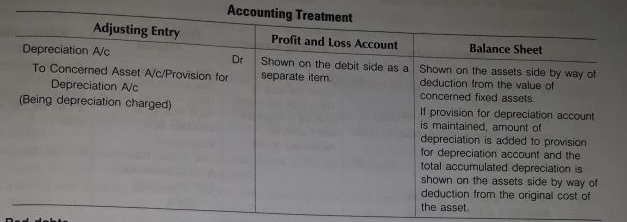
    • Depreciation

    Accounting Treatment

    • Bad debts

    Accounting Treatment

    • Provision for doubtful debts

    Accounting Treatment

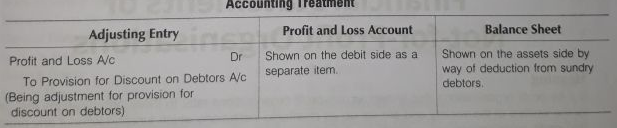
    • Provision for discount on debtors

    Accounting Treatment

    • Manager’s Commission

    Accounting Treatment

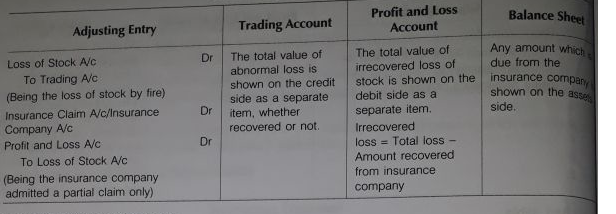
    • Abnormal or Accidental Losses

    Accounting Treatment

    • Goods taken for personal use

    Accounting Treatment

    • Goods distributed as free samples

    Accounting Treatment

  • 5 Tips To Write The Perfect Answer In CBSE Board Exams

    Writing an answer during the exam also plays an equally important role while preparing for exams. After thorough preparation, if a student is not able to present the answers on the exam sheet properly, all the effort towards their preparation will go in vain.

    Apart from the preparations, students should also have a good skill in writing or presenting answers for a particular question in a clear and concise way. Even a small error caused by their negligence may reflect on their final results.

    Here are few simple exam writing tips to help you understand how to answer exam questions.

    • Plan according to the time. There will be very less time to solve the paper and working under this time constraints in the exam room can be quite difficult. Hence, never waste even a second of your time. Read the complete question paper and other instructions in the allotted time of 15 to 20 min and plan accordingly which questions to be attempted first.
    • Most of the examiners who check our answer scripts also emphasize on proper presentation of the answer script. Therefore, students should take care of their handwriting and maintain a proper space between the numbers. The diagrams or the flowchart should not be messy, it should be present clearly with neat formal labelling. Remember not to strike or overwrite as this will make the answer paper look untidy.
    • For subjects like Biology and other Science related questions, write only what is required. Before starting the answer, read and understand the given question carefully. Try to limit your answer to the requirement and do not just write answers to fill the pages. This won’t fetch any marks instead you lose marks. Most of the students write their answer lengthier as they believe, ‘longer the answer, the more it will score.’ But it’s an absolutely absurd as the examiner only looks for the appropriate and valid answers, not the stories.
    • Try to make your answers more interesting and attractive by adding more examples, presenting in points, by drawing a neatly labelled diagram, as examiners give more importance to equations, images, subtitles and neat handwriting while allotting marks. Never use any short forms in your answer booklets like didn’t and can’t, instead of this use did not and cannot. Always use common and low-frequency words to explain your answer and do not squeeze words on the same line. Present the answers in points as they are easy to read and easy to evaluate for the evaluators. Maintain a proper spacing between each word and remember to leave some space before starting the next question as it makes the answer script to look clean and tidy.
    • Do not be in a hurry in writing your answer. After carefully reading the question, plan the structure of your answer. Short and very short answers can be explained in 5 to 6 points or in two paragraphs. But coming to the long or essay answers, students should be very careful in answering this type of essay answers. Most essays should have an introduction, three main points, and a conclusion. For example: If you are asked a question about Write a short note on Ecosystem? Here you need to elaborate the complete points about the Ecosystem, its definition, different types, diagrams if any, and few examples. Remember to present the answer in paragraphs or in points, but make it clear and simple for an examiner to evaluate.

    These were a few tips on how to write the perfect answer in CBSE Board exams

    All the very best!!!

    For more tips and guidance, subscribe to BYJU’S YouTube Channel to watch interactive video lessons on various exam topics and also join interesting student discussion forums to get involved in the various discussions and learn interesting concepts.

  • Financial Statement I (Without Adjustments) Notes Class 11th Accountancy

    Financial Statement I (Without Adjustments)

    1. Meaning

    Financial statements are the final products of an accounting process which begins with the identification of accounting information and recording it in the books of primary entry. Financial statements are prepared by following the accounting concepts and conventions. These are the statements prepared at the end of accounting period and give information about the financial position and preformed of an enterprise.

    A complete set of financial statements include

    1. Balance sheet (or position statement) which shows the financial position of an enterprise at a particular point of time.
    2. Trading and profit and loss account (or income statement) which shows the financial performance of business operations during an accounting period.
    3. Schedules and notes to accounts forming a part of balance sheet and profit and loss account.

    Objectives and Importance of Financial Statement

    The basic objectives of preparing financial statements are

    1. To present a true and fair view of the financial performance of the business.
    2. To present a true and fair view of the financial position of the business.

    Various other objectives and importance of financial statements are as follows:

    1. Helps in determination of gross profit/gross loss
    2. Helps in determination of net profit/ net loss
    3. Comparison with the previous years
    4. Calculation of rations
    5. Maintaining provisions and reserves

    Users of Financial Statements

    Internal Users

    1. Owners
    2. Management
    3. Employees and workers

    External Users

    1. Creditors
    2. Investors
    3. Banks and financial institutions
    4. Government its authorities
    5. Other parties
    6. Researchers

    Income Statement

    Income statement is prepared at the close of the year discloses the manner in the amount of profit and loss is arrived at, Income statement is divided in trading account and profit and loss account.

    1. Trading Account

    Trading account is the first stage is the preparation of the final accounts. The trading account ascertains the rest from basic operational activities of the business.

    Trading account is prepared to know the gross profit earned or gross loss incurred during the accounting period. Entries or items of debit side are opening side, purchases and other direct expenses and on credit side sales and closing stock are recorded.

    The excess of sales over purchases and direct expenses is called gross profit, if the amount of purchase including direct expenses is more than the sales revenue, the resultant figure is gross loss.

    The computation of gross profit can be shown in the form of equation as

    Gross Profit = Net Sales – Cost of Goods Sold

    Where, Net Sales = Total Sales – Sales Return

    Cost of Goods Sold = Opening Stock + Net Purchases + Direct Expenses – Closing Stock

    Net Purchases = Total Purchases – Purchases Return

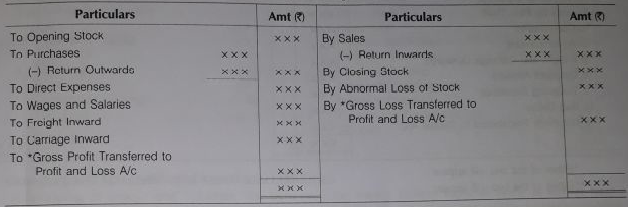
    1. Format of Trading Account

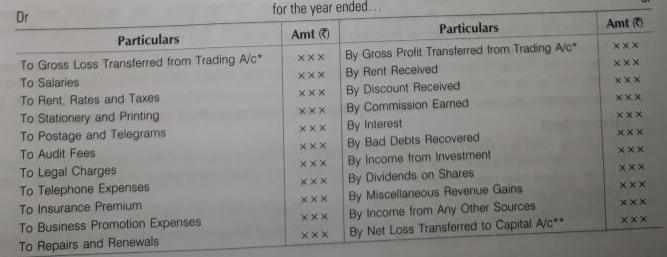
    Profit and Loss Account

    For the year ended..

    Dr Cr

    • Either gross profit or gross loss shall appear.
    1. Profit and Loss Account

    Profit and loss account is prepared after the preparation of trading account. It shows the financial performance of a business during an accounting period. It prepared to as certain the net profit earned or net loss incurred by the business entity during an accounting period.

    Balance of trading account (gross profit or gross loss) is transferred to profit and loss account. The indirect expenses are transferred to the debit side of the profit and loss account. All revenues/gains other than sales are transferred to the credit side of the profit and loss account.

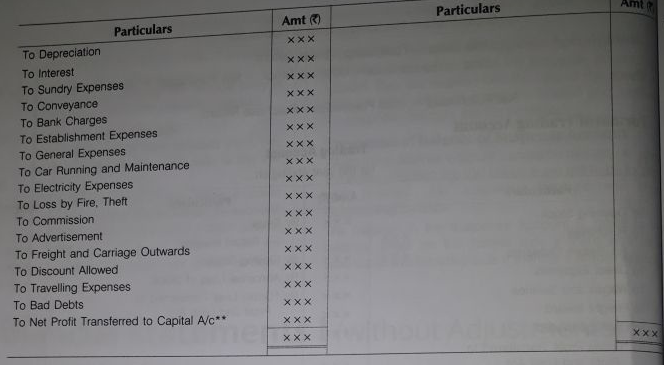
    It the total of the credit side of the profit and loss account is more than the total of the debit side, the difference is the new profit for the period, of which is being prepared.

    On the other hand, if the total of the debit side is more than the total of the credit side, the difference is the net loss incurred by the business firm.

    In an equation form, it is shown as follows:

    Net Profit = Gross Profit + Other Incomes – Indirect Expenses

    1. Format of Profit and Loss Account

    Profit and Loss Account

    For the year ended..

    • Either of the two will appear.
    • Either of the two will appear.

    Operating Profit and Net Profit

    1. Operating Profit it is the profit earned through normal operations and activities of the business. Operating profit arises as a result of carrying out operating activities. Operating activities are the principle revenue producing activities of the enterprise and are those activities that are not investing or financing activities, means the excess of operating revenue over operating expenses or it is the excess of gross profit own operating expenses. It is also known as Earnings Before Interest and Tax (EBIT).

    It is calculated as

    Operating Profit = Net Sales – Operating Cost

    Or

    = Net Sales – (Cost of goods sold + Administration and office expenses + Selling and distribution expenses)

    Or

    = Net Profit + Non-Operating Expenses – Non-Operating Income

    Operating expenses include office and administrative expenses, selling and distribution expenses, case discount allowed, interest on bill payable and other short-term debts, bad debts and so on.

    Net Profit = Sales (Cash and Credit) – Sales Return

    1. Net Profit means the excess of revenue (operating or non-operating) over expenses and losses (operating and non-operating). In other words, net profit is arrived at by deducting non-operating expenses and adding non- operating incomes form and in operating profit.

    Non- Operating expenses are expenses which are incidental or indirect to the main operations of the business, they include interest on loan, charities and donations, loss on sale of fixed assets, extraordinary losses due theft, loss by fire and so on

    Non- Operating incomes includes receipt of interest, rent, dividend, profit on sale of fixed assets etc.

    Also Check out: TS Grewal Solutions for Adjustments in Preparation of Financial Statements Class 11 Accountancy Chapter 18

    Balance Sheet

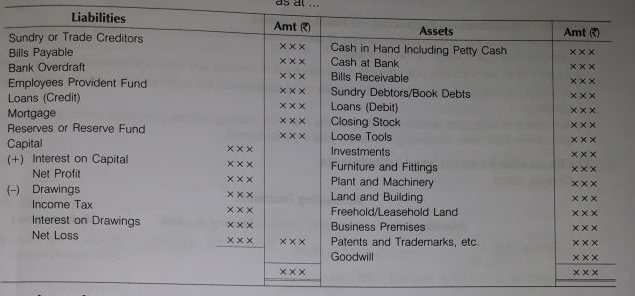
    The balance sheet is a statement prepared for showing the financial position of the business summarizing the assets and liabilities at a given date. It is prepared at the end of the accounting period after the trading and profit and loss account have been prepared.

    The assets reflect debit balances and liabilities (including capital) reflect credit balances.

    It is called a balance sheet because it is a statement of balances of ledger accounts.

    1. Format of Balance Sheet

    Balance Sheet
    As at..

    Grouping and Marshalling of Assets and Liabilities

    1. Grouping of assets and liabilities the term grouping means putting together items of similar nature under a common heading. The various item appearing in the balance sheet can also be properly grouped, e.g. the balance of accounts of cash, bank, debtors etc. can be grouped and shown under the heading of ‘current assets’.
    2. Marshalling of assets and liabilities Marshalling refers to the arrangement of assets and liabilities in a particular order. In a balance sheet the assets and liabilities are arranges either in the order of liquidity or permanence.
    3. Order of performance In case of performance, the most permanent assets or liabilities are out on the top in a balance sheet and thereafter they are arranged in their reducing level of permanence.

    In other words, in case of assets, the ones which are to be used permanently in the business and are not meant to be sold are written first, e.g. goodwill and the ones which are most liquid are written last, e.g. cash in hand.

    In case of liabilities, the payments to be made which are least urgent are written first, e.g. capital and the payments to be made which are most urgent are written last, e.g. short-term liabilities say short-term creditors (i.e. firstly capital, then long-term liabilities and at last short-term liabilities).

    1. Order of Liquidity ‘liquidity’ means the facility with which the assets may be converted into cash. In case of liquidity, the order is reversed.

    In case of assets, the most liquid assets are written first, e.g. cash is hand and the least liquid assets are written last, e.g. goodwill.

    In case of liabilities, the most urgent payments to be made are written first, e.g. short-term creditors and the least urgent payments to be made are written last, e.g. capital (i.e. firstly short-term liabilities, then long-term liabilities and in last capital).

    It can be better understood with the general format of balance sheet in order of liquidity.

    Methods of Preparation of Financial Statements

    The financial statements, i.e. trading and profit and loss account and balance sheet can be presented in two ways:

    1. Horizontal from Under this form of presentation, the items are presented in ‘T’ shape, i.e. the items are shown side by side in trading and profit and loss account and also in the balance sheet. This form of preparing financial statements has been already discussed in the chapter.
    2. Vertical form Under vertical presentation, the final accounts are prepared in a form of statement, i.e. the items are presented in a single column with different items being shown one below the other in purposeful sequence.
  • Rectification of Errors Notes Class 11th Accountancy.

    Rectification of Errors

    1. Meaning of Errors

    Errors are unintentional omission or commission of amounts and accounts in the process of recording transactions.

    1. Classification of Errors

    Keeping in view the nature of error, errors can be classified into the following four categories:

    1. Errors of commission these are the errors which are committed due to wrong positing of transactions, wrong totaling or wrong balancing of the accounts, wrong casting of the-subsidiary books or wrong recording of amount in the books of original entry. These errors affect the accuracy of trial balance.

    Errors of commission can be classified into following:

    1. Errors of recording
    2. Errors of casting
    3. Errors of carrying
    4. Errors of posting

    Errors of omission this kind of error arises with a transaction is partially or completely omitted be recorded in the books of accounts.

    These can be of two types:

    1. Error of complete omission which does affect the accuracy of trial balance.
    2. Error of partial omission which affect accuracy of trial balance.

    Errors of principle transactions recorded in contravention of the accounting principles, are known as error of principle. An error of principle may occur due to the incorrect classification of expenditure or receipt between capital and revenue as it may lead to under/ over stating of income or assets or liabilities.

    This error does not affect the trial balance as amounts are placed on the correct side but in a wrong account.

    1. Compensating errors when two or more errors are committed in such a way that the net effect of these errors on the debits and credits of accounts is nil or nullified, such errors are called compensating errors. These errors do not affect the tallying of trial balance.
    2. Rectification of Errors

    Rectification of errors is the procedure of rectifying the errors committed and to set right the accounting records.

    These are various objectives or reasons for which the errors are rectified, they are as follows:

    1. For the preparation of correct accounting records.
    2. For ascertainment of correct net profit or loss.
    3. For exhibiting true financial position of the organization by preparing the balance sheet with correct data.

    Rectification of Errors which do not Affect the Trial Balance or Two-sided Errors

    Two-sided errors are those errors that have been committed on the both sides, i.e. debit and credit. These are the errors which do not affect the trial balance or are not disclosed by trial balance and are committed in two or more accounts.

    Examples of such errors are as follows:

    1. Errors of complete omission.
    2. Errors of recording in the books of original entry.
    • Errors of posting involving the posting to wrong account on correct side with correct amount.
    1. Errors of principle.
    2. Compensating errors.

    These errors can be rectified by recording a journal entry giving the correct debit and credit to the concerned accounts which were affected by error.

    The rectification process involves the following steps:

    Step 1 Wrong Entry Write the entry which has already been passed in the books, i.e. the wrong entry.

    Step 2 Reverse of wrong entry write the reverse of the above entry, the wrong entry, to notify the effect of wrong entry.

    Step 3 Correct entry write the entry which should have been passed, i.e. the correct entry.

    Step 4 Rectifying entry write the net effect in step 2 and step 3.

    1. Rectification of Errors Affecting Trial Balance or One-sided Errors

    One-sided errors are those errors, which have occurred in one-side ‘debit or credit’ of an account. These are the errors which effects trial balance and affects only one account.

    Examples of such errors are:

    1. Error due to partial omission.
    2. Error of casting.
    • Error in carrying forward.
    1. Error in totaling or balancing of an account.
    2. Errors of posting

    (other than an error of posting a correct amount in the wrong account but on the correct side).

    1. Omission of posting the total of a subsidiary book.
    • Omission of an account from trial balance.
    • Entering the balance of an account in the wrong amount column of the trial balance.
    1. Wrong totaling of the trial balance.

    6. Rectification of Errors Depend on the stage at which the errors are located

    1. Before preparation of trial balance this is a stage, when errors are located and rectified after the closing of accounts, i.e. after transferring the difference in trial balance to suspense account but before the preparation of financial statements.
      When one-sided errors are located after the preparation of trial balance, rectifications are carried out by passing a journal entry with the help of respective account which is affected by the error and suspense account.
      A suspense account is used to complete the
      double entry, as only one account is debited/credited for rectification of one-sided error. It should be noted unless otherwise stated, errors are normally rectified before the preparation of final accounts, i.e. with the help of suspense account.
    1. Suspense Account

    Suspense account is an account used on a temporary basis for any transaction or balance that cannot be identified.

    Suspense account is used for rectifying the errors which affect the trial balance, the errors which do not affect the trial balance are not rectified with the help of suspense account.

    The errors are rectified by passing their double entry in the debit side or credit side of the suspense account.

    1. Preparation of Suspense Account

    If the debit side of the trial balance exceeds the credit side, the differences is put on the credit side of the trial balance.

    In this case, ‘suspense account’ will show a credit balance or if the credit side of the trial balance exceeds the debit side, the difference is put on the debit side of trial balance.

    In this case, ‘suspense account’ will show a debit balance.

    Opening of suspense account avoids delay in the preparation of financial statements.

    1. Disposal of Balance of Suspense Account

    When the errors which affect the suspense account located, they are rectified with the help of the suspense account, when all such errors are located and rectified, the suspense account stands balanced.

    1. Treatment of Balance of Suspense Account

    When the suspense account cannot be close, i.e. when the errors affecting the trial balance are still to be located and rectified, the suspense account will show outstanding balance.

    The balance in the suspense account is taken to the balance sheet on the assets side if there is a debit balance or the liabilities side if there is a credit balance.

  • Bills of Exchange Notes Class 11th Accountancy

    Bills of Exchange

    Meaning

    According to Section 5 of the Negotiable Instruments Act, 1881, a bill of exchange is defined as an instrument in writing containing an unconditional order, signed by the maker directing a certain person to pay a certain sum of money only to or to the order of a certain person or to the bearer of the instrument.

    A bill of exchange is generally drawn by the creditor upon his debtor, It has to be accepted by the drawee (debtor) or someone on his behalf.

    Features of a Bill of Exchange

    1. It must be in writing.
    2. It is an order to make payment.
    3. The order to make payment is unconditional.
    4. The maker of the bill of exchange must sign it.
    5. The payment to be made must be certain.
    6. The date on which payment is to be made must also be certain.
    7. It must be payable to a certain person.
    8. The amount mentioned in the bill of exchange is payable either on demand or on the expiry of a fixed period of time.
    9. It must be stamped as per the requirement of law.
    10. Parties to a Bill of Exchange

    There are three parties to a bill of exchange:

    1. Drawer The maker of the bill of exchange is the drawer, i.e. the person who draws the bill. He is the person who has granted credit to the person on whom the bill of exchange is drawn.
    2. Drawee the person upon whom the bill of exchange is drawn for his acceptance is a drawee. Drawee is the person to whom credit has been granted.
    3. Payee he is the person to whom the payment is to be made, i.e. the person in whose favour the bill is made.

    Advantages of a Bill of Exchange

    1. Framework of relationship
    2. Certainity of terms and conditions
    3. Convenient means of credit
    4. Conclusive proof
    5. Easy transferability

    Types of a Bill of Exchange

    There are two types of a bill of exchange:

    1. Trade Bill a trade bill is a bill of exchange drawn and accepted for a trade transaction, i.e. purchase and sale of goods.
    2. Accommodation bill an accommodation bill is a bill of exchange accepted for mutual help.

    Promissory Note

    According to Section 4, of the Negotiable Instruments Act, 1861, a promissory note is defined as an instrument in writing (not being a bank note or a currency note), containing an unconditional undertaking signed by the make, to pay a certain sum of money only to or to the instrument. A promissory note does not require any acceptance because the maker of the promissory note himself promises to make the payment.

    Features of a Promissory Note

    1. It must be in writing.
    2. It must contain an unconditional promise to pay.
    3. The sum payable must be certain.
    4. It must be signed by the maker.
    5. It must be payable to a certain person. It should be properly stamped.

    Parties to a Promissory Note

    There are two parties to a promissory note:

    1. Maker or drawer the person who makes or draws the promissory note to pay a certain amount is called maker. He is the person who has availed the credit. He is also called the promisor.
    2. Payee the person in whose favour the promissory note is drawn, i.e. the person to whom the payment is to be made is called the payee. He is also called the promise.

    Terms Related to Accounting of Bill of Exchange

    Following are the important terms related to accounting of bills of exchange:

    1. Term of a bill is referred to as the period the date on which a bill is drawn and the date on which it becomes due.
    2. Days of grace are three extra days added to the period of bill.
    3. Due date of a bill it is the date on which the payment of the bill is due, i.e. the date on which the term of bill expires.
    4. Date of maturity of a bill the date which comes after adding three days of grace to the due date of a bill is called the date of maturity.
    5. Bill at sight or demand the instruments in which no time for payment is mentioned are known as bill at sight. These are also known as instruments payable on demand.

    A bill of exchange or promissory note is payable on demand, when no time for payment is specified, where it is expressed to be payable on demand or at sight on presentment.

    1. Bill after date the instrument in which time for payment is mentioned are bill after sight.

    A Promissory note or bill of exchange is a time instrument when it is expressed to be a payable after specified period, on a specific day, after sight, on the happening of event which is certain to happen.

    1. Holder of a negotiable instrument (i.e. bill of exchange promissory note or cheque) is a person entitled in his own name to be possession thereof and to receive or recover the amount due thereon from the parties to it.

    Calculation of Due Date of a Bill

    The calculation of due date of a bill in various cases is calculated as follows:

    Cases Due Date
    When the bill is made payable on a specific date. The specific date will be the due date.
    When the bill is made payable at a stated number of month(s) after date. That date on which the term of the bill shall expire will be the due date Calculation of due date will be in terms of calendar months, ignore the number of days in a month.
    When the bill is made payable at a stated number of days after date. That date which comes after adding stated number of days to the date of bill, shall be the due date. The date of bill is excluded.
    When the due date is a public holiday. The preceding business day will be the due date.
    When the due date is an emergency/unforeseen holiday. The next following day will be the due date.

    Calculation of the Date of Maturity in Case of Time Bills

    To arrive at the date of maturity in case of time bills, three days of grace are added to the due date. This can be better explained with the help of examples given below.

    When the bill is made payable at a stated number of days after date

    A Bill dated 1st January 2013 is payable after 60 days after date.
    The date of maturity will be 5th March, 2013
    [30 days of January + 28 days of February + 2 days of March + 3 days of grace]

    When the bill is made payable at a stated number of months after date

    A bill dated 1st January, 2013 is payable 3 months after date.
    The date of maturity will be 4th April, 2013
    [3 months from 1st January, 2013 is 1st April, 2013 adding 3 days of grace, the due date will be 4th April, 2013]

    When the maturity date falls on a day which is a public holiday

    Suppose the date of maturity is 15th August, 2013 (Independence Day) it being a public holiday, it falls due on 14th August, 2013.

    When the maturity date falls on a day which is an emergency/unforeseen holiday

    Suppose the date of maturity falls on an unforeseen holiday, then the next working day will be taken as the date of maturity.

    Accounting Treatment of Bills of Exchange and Promissory Note

    1. When the bill is retained till the date of maturity

    When the drawer retains the bill with him till the date of its maturity, the drawer receives the money from the drawee on the maturity date.

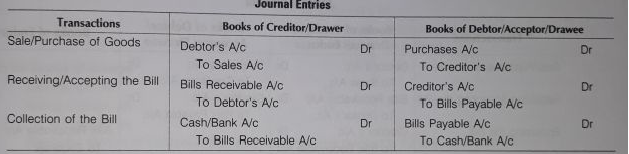
    Journal Entries

    2. When the bill is sent to bank for collection
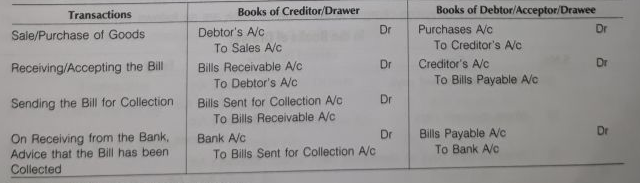
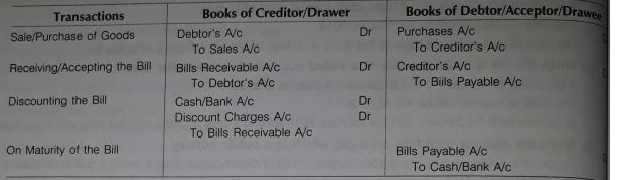
    Sometimes, the bill is sent to the bank with instruction that the bill should be retained till maturity and realized on its due date, i.e. the bank should keep the bill till maturity and collect is amount from the acceptor on that date, it is known as ‘bill sent for collection’. The bank credits the net proceed to the customer’s account, after charging for the service. The balance in the bills sent for collection account is shown in the balance sheet as an asset.


    Journal Entries

    1. When the bill is discounted with bank

    In case, a holder of the bill is in need of money, he may discount it through the bank, to obtain cash, i.e. the holder of the bill takes amount from a bank against the bill before the due date. This process is known as discounting of the bill. The bank charges an amount for this purpose and it is termed as ‘discounting charges’.

    The charges depend upon the rate of interest and the period of maturity. It is be noted, discounting charges are calculated on the remaining period of the bill, i.e. from the date of discounting till the due date. The bank gets the amount from the drawee on the due date.

    Journal Entries

    2. When the bill is endorsed or negotiated in favour of a creditor
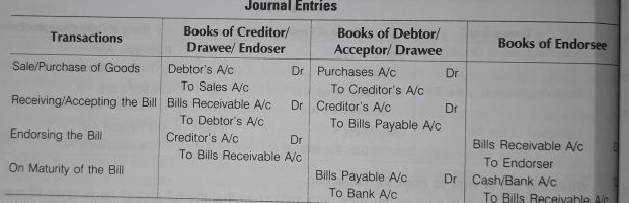
    Transfer of a bill of exchange or promissory note to another person is referred to as endorsement negotiation. The person receiving it becomes entitled to receive the payment. The bill can be internal endorsed by the drawer by putting his signature at the back of the bill along with the name of the panty,

    Whom it is being transferred. The act of signing and transferring the bill is called endorsement.

    A Bill is said to have been negotiated or endorsed, when the holder of a bill transfers the bill to a third party. The person who endorses the bill is called the endorser. The person to whom the bill is endorsed is called endorsee.


    Journal Entries

    Dishonour of a bill

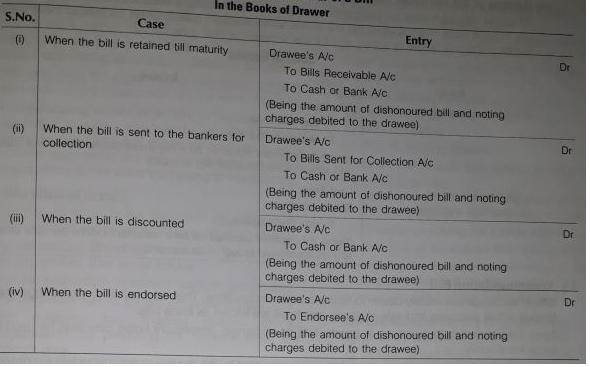
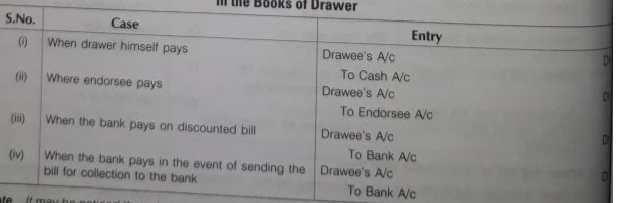
    When the drawee or acceptor of the bill fails or is unable to make the payment on the date of maturity, a bill is said to have been dishonored. The holder of the bill may present the bill through a notary public. A bill get the dishonor of the bill noted. Noting authenticated the fact of dishonour , for providing this services fess is charged by notary public which is called nothing charges.

    The entries recorded for noting charges in the drawer’s book as follows:


    In the Books of Drawer

    Note:It may be noticed that whosever pays the nothing charges. Ultimately these have to be borne by the drawee. This is because he is responsible for the dishonour of the bill and hence, he has to bear these expenses. For recording the noting charges in his books, the drawee opens noting charges account. He debits the noting charges account and credits the drawer’s account.


    Journal Entries on Dishonour of Bill

    In the Books of Drawer

    In the books of drawee

    Bills Payable A/C Dr

    Noting Charges A/C Dr

    To Drawer’s A/c

    (Being the amount of dishonour bill and noting charges credited to the drawer)

    Note:When the bill is dishonoured, in all the circumstances drawee or acceptor account is debited when entries are passed in the books of drawer and drawer’s and drawer’s account is always credited and bills payable account is always debited, when entries are passed in the books of drawee.

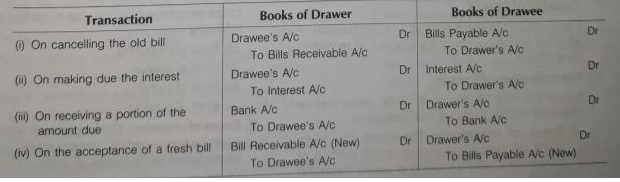
    1. Renew of the bill

    When the acceptor of the bill is difficult to meet the obligation of the bill on maturity he may request the drawer for extension of time for payment (i.e. to substitute the old bill when a new bill), if the drawer agrees the old bill cancelled and the fresh bill with new terms of payment is drawn and duty accepted and delivered. This is termed as renewal of bill.

    The noting of the bill is not required as the cancellation is mutually agreed. However, the drawer may charges interest from the drawee for the extended period of credit.

    Journal Entries

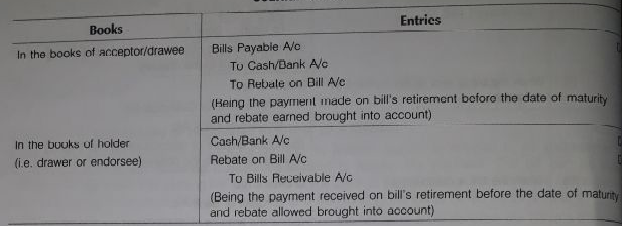
    1. Retiring of the bill under rebate

    When the drawee makes the payment before the date of maturity, a bill is said to be referred or retiring of a bill. In such case, the holder of the bill allows some discount called rebate on bills to the drawee. For the holder of the bill, rebate is a loss and for the acceptor, it is a gain.

    Journal Entries

    1. Accommodation Bill

    Bills of exchange are usually drawn to facilitate trade transactions. That is to say bills of exchange are meant finance actual purchase and sale of goods and these are known as trade bills.

    Apart from financing transactions in goods, bills of exchange, promissory notes may also be used for raised funds temporarily.

    Such a bill is called an ‘accommodation bill’ as it is accepted by the drawee to accommodate the drawer. Hence, the drawer is called the ‘accommodating party’ and the drawer is called the accommodation party.

    When the accommodation parties agree to raise the funds through an accommodation bill for mutual benefits. It can be done in any of the following two ways:

    1. The drawer and the drawee share the proceeds in an agreed ratio.
    2. Each draw a bill and each accepts a bill.

    In the first case, the discounting charges are shared by drawer and drawee in the ratio in which they share to proceeds. But in the second case, the discount is not shared as each party retains the entire proceeds of the drawn and discounted by him. On maturity, each party meets his acceptance.

    Accounting treatment of accommodation billEntries are made in the same manner as are made for on bills, no special entries are passed for accommodation bills. Also, in case, the proceeds of the bills are shared an entry for the proportionate amount of discount along with the entry for remittance.

  • Depreciation Notes Class 11th Accountancy

    Depreciation

    1. Meaning

    ‘Depreciation’ means decline in the value of a fixed asset due to use, passage of time or obsolescence.

    2. Depreciation and Other Similar Terms

    The term depreciation covers depletion, amortization and obsolescence.

    • Depletion The term depletion is used in respect of natural resources or wasting assets like mines, quarries oil reserves etc. There occurs an erosion in the value of these natural resources due to the extraction of these resources which is called as depletion. The main difference between depletion a depreciation is, depletion is concerned with the exhaustion of economic resources but depreciation relates to usage of an asset.
    • Amortisation term amortization rerefers towriting-off the value of intangible assets like patents, copyrights, trademarks, goodwill etc., which can be utilized only for a specified time period.
    • Obsolescence Decline in the economic value of the assets due to innovation or improve technique or equipment and market decline or to change in taste and fashion, is reffered to the obsolescence.
      In short,
      Depreciation- Fixed assets except for land
      Depletion- Natural resources like mines
      Amortisation- Intangible assets like patent
      Obsolescence- Plants machinery and irwentory

    Causes of Depreciation

    Various causes of depreciation, spelt out as part of the definition of depreciation in AS-6 are as follows:

    1. Physical wear and tear
    2. Passage or efflux of time
    3. Expiry of legal rights
    4. Obsolescence
    5. Abnormal reasons


    Need for Depreciation

    1. Matching of cost and revenue
    2. Consideration of Tax
    3. True and fair financial position
    4. Compliance with the law


    Factors Affecting the Amount of Depreciation

    1. Cost of Assets
    2. Estimated Net Residual Value (NRV)
    3. Estimated useful life

    Methods of Calculating Depreciation

    1. Straight Line Method Under this method, a fixed and equal amount in the form depreciation, according to a fixed percentage on the original cost, is written-off each year over the expected useful life of the asset. It is also known as original cost method or fixed instalment method. It is the earliest and widely used methods of providing depreciation.
      The depreciation under this method is calculated by using the following formula:

    Depreciation=Cost of Assets – Estimated NRV
    ……………………………………………………..
    Estimated Useful Life

    If the annual depreciation amount is given, then we can calculate the rate of depreciation, with the following formula:

    The rate of Depreciation=Annual Depreciation on Amount
    ……………………………………………………….
    Cost of Asset * 100

    2. Written down the method under this method, depreciation is changed over the book value of the asset. It involves charging a fixed rate on the written down value. The amount of depreciation goes on reducing year after year. As the book value keeps on reducing by the amount charge, it is also known as reducing balance method or diminishing balance method.

    Under the written down value method, the rate of depreciation is computed by using the following formula:

    Methods of recording depreciation

    1. Charging depreciation to asset account under this method, depreciation is directly charged to the asset account, i.e. depreciation is deducted from the depreciation cost of the asset (credited to the asset account) and changes (or debited) to profit and loss account.

    Journal Entries

    For Recording Purchase of Asset

    Asset A/c Dr

    To Cash/Bank/Vendor A/c

    (Being the asset purchased)

    For Providing Depreciation

    Depreciation A/c Dr

    To Asset A/c

    (Being the depreciation provided)

    For Closing Depreciation Account

    Profit and Loss A/c Dr

    To Depreciation A/c

    (Being the transfer of depreciation account to profit and loss account)

    Treatment in balance sheet under this method, the fixed asset appear its net book value/ written down value (i.e., cost less depreciation charged till date) on the assets side of balance sheet and not at its original (historical) cost.

    1. Creating Provision for depreciation account/ accumulated depreciation account under this method, a separate account named as ‘provision for depreciation’ ‘of accumulated depreciation’ account is created and the annual depreciation is transferred to this account.

    Journal Entries

    For Recording Purchase of Asset

    Asset A/c Dr

    To Bank/Cash/Vendor A/c

    For Providing Depreciation

    Depreciation A/c Dr

    To Provision for Depreciation A/c

    For Closure of Depreciation Account

    Profit and loss A/c Dr

    To Depreciation A/c

    Treatment in balance sheet in the balance sheet, the fixed asset continues to appear at its original cost on the asset side. The depreciation charged till that date appears in the provision for depreciation account, which is shown either on the ‘liabilities side’ of the balance sheet or by way of deduction from the original cost of the asset concerned on the asset side of the balance sheet.

    1. Disposal of Asset

    Disposal of an asset can take place either (a) at the end of its useful life or (b) during its useful life (due to obsolescence or nay other abnormal factors.)

    If the asset is sold at the end of its useful life, the amount realized on account of the sale of asset as scrap should be credited to the asset account and the balance is transferred to profit and loss account. If the sale proceeds exceed the book value of the asset, there is profit and if the sale proceeds fail short of written down value, loss in incurred.

    Journal Entries

    For Recording Sale of Asset

    Cash/Bank A/c Dr

    To Asset A/c

    (Being the assets sold)

    For Recording Profit/Loss on sale

    1. In case of Profit

    Asset A/c Dr

    To Profit and Loss A/c

    (Being the transfer of profit on sale of asset)

    1. In case of Loss

    Profit and loss A/c Dr

    To Asset A/c

    (Being the transfer of loss on sale of asset)

    1. Asset Disposal Account

    The account created to provide a complete picture of all the transactions involved in sale/disposal of an asset under one account head is ‘asset disposal account’.

    This account is opened when a part of asset is sold and provision for depreciation account exist.

    Dr Asset Disposal Account Cr

    1. Provisions

    The account set aside for the purpose of providing for any known liability or uncertain loss or expense, the amount of which cannot be ascertained with certainity is referred to as provision.

    Examples of provisions are provision for depreciation, provision for repairs ad renewals etc.

    1. Importance of Provision
    2. To meet anticipated losses and liabilities
    3. To meet known losses and liabilities
    4. To present correct financial statements
    5. Accounting Treatment and Disclosure of Provision

    Provision is a charge against the profit and is created by debiting and loss account. In the balance sheet, the amount of provision may be shown either

    1. On the assets side, by way of deduction from the concerned asset.
    2. On the liability side along with the current liabilities.
    3. Reserves

    Reserves are referred to as the amount set aside from profits and retained in the business to provide for certain future needs like growth and expansion or to meet future contingencies. Examples of reserves are general reserve, workmen compensation fund, etc. Reserves are not a charge against profit but are the appropriation of profit.

    1. Types of Reserves

    Reserves are generally classified into

    1. Revenue Reserves The reserve created from revenue profits which arise out of the normal operating activity of the business and are otherwise freely available for distribution as dividend are known as revenue reserves.

    Revenue reserves can be classified into

    1. General Reserve the reserve which is not created for a specified purpose is general reserve. It is also known as free reserve or contingency reserve.
    2. Specific reserve These are the reserves that are created for some specific purpose and can be utilized only for that purpose.

    Examples of specific reserve are given below:

        • Dividend equalization reserve
        • Workmen compensation reserve
        • Investment fluctuation fund
        • Debenture redemption reserve
    1. Capital reservethe reserves which are created out of capital profits and are not available for distribution as dividend are known as capital reserve. Capital reserves can be used for working off capital losses or issue of bonus shares in case of a company.

    Examples of capital profits are premium on issue of shares of debentures, profit on sale of fixed assets etc.

    1. Importance of Reserves
    2. Reserves strength the financial position of an enterprise.
    3. The amount set aside as reserves may be utilized for the purpose of meeting of future contingency.
    4. Creation of reserves help in the expansion of business operations or for bringing uniformity in distribution of dividends.
    5. Creation of certain reserves is also required by law, e.g. investment allowance reserve, debenture redemption, etc.
    6. Accounting Treatment and Disclosure of Reserve

    Reserves are not a change against profit but are the appropriation of profits. Hence, reserves are transferred to the profit and loss appropriation account. Reserves are shown under the head reserves and surplus on the liabilities of the balance sheet.

  • Trial Balance Notes Class 11th Accountancy.

    Trial Balance

    1. Meaning

    Trial balance is a statement prepared with the debit and credit balances of ledger accounts to test the arithmetical accuracy of the books.

    1. Objectives, Needs or Functions of Preparing a Trial Balance
    2. Ascertain the arithmetical accuracy of the ledger accounts
    3. Helps in locating errors
    4. Summary of the ledger accounts
    5. Helps in the preparation of final accounts
    6. Balance Method of Preparing Trial Balance

    Balance method is the most commonly used method of preparing trial balance as it facilities the preparation of final accounts. Under this method, trial balance is prepared by showing the balances of all ledger accounts (including cash and bank accounts) and then totaling up the debit and credit column of the trial balance to assure their correctness. The account balances are used because the balance summaries the net effect of all transactions relating to an account and helps in preparing the financial statements. Trial balance can be prepared under this method, only when all the ledger accounts have been balanced.

    1. Steps to Prepared a Trial Balance

    Step 1 The balances of each account in the ledger are ascertained.

    Step 2 List each account and place its balance in the debit or credit column (if an account has a zero balance, it may be included in the trial balance with zero in the column for its normal balance).

    Step 3 Compute the total of debit balances column.

    Step 4 Compute the total of debit balances column.

    Step 5 Verify that the sum of the debit balances equal the sum of credit balances. If they do not tally, it indicates that there are some errors. So, one must check the correctness of the balances of all accounts.

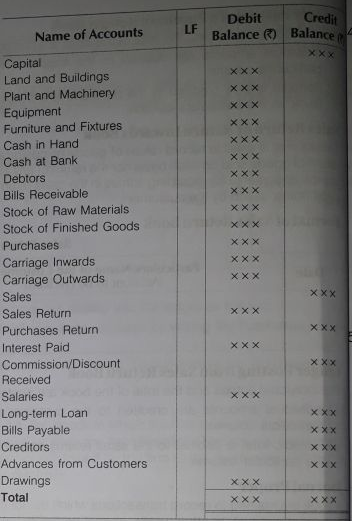
    1. Format of Trial Balance

    An illustrative trial balance indicating list of various accounts with their respective balances (i.e. debit or credit) is shown as below.

    1. Errors not Disclosed by Trial Balance
    2. Errors of complete omission
    3. Errors of principles
    4. Compensating errors
    5. Incorrect amount entered in the journal
    6. Posting to the wrong account.
    7. An entry posted twice in the ledger.

    Bank Reconciliation Statement

    1. Meaning

    Bank reconciliation statement is prepared mainly to reconcile the different between the bank balance as shown by the cash book and bank pass book.

    1. Need and importance of Bank Reconciliation Statement
    2. It helps in locating any error that may have been committed enter in the cash book or in the pass book.
    3. It helps in bringing out the unnecessary delay in the collection of cheques by the bank.
    4. Embezzlements are avoided by regular periodic reconciliation.
    5. The customer is assured of the correctness of bank balance shown by the pass book, by prepared a bank reconciliation statement.
    6. It helps the management to keep a track of cheque which has been sent to the bank for collection.
    7. Bank Pass Book (or Bank Statement)

    Bank pass book id a copy of the customer’s account in books of a bank to customer/account holder so that entries can be complete with entries in cash book and the difference can determined.

    1. Reasons of Different between Cash Book and Pass Book Balances

    The differences between the cash book and the bank pass book is caused by

    1. Differences due to timing on recording any transaction

    The factors affecting time gap includes

        1. Cheques issued by the bank but not yet presented for payment.
        2. Cheques paid/deposited into the bank but not yet collected.
    1. Transactions recorded by the bank
    2. Direct debits made by the bank on behalf of the customer.
    3. Amounts directly deposited in the bank account by the customer.
    4. Interest and dividend collected by the bank.
    5. Direct payments made by the bank on behalf of the customers.
    6. Interest credited by the bank but not recorded in the cash book.
    7. Cheque deposited/bills discounted dishonored.
    8. Differences caused by errors
    9. Errors committed in recording transactions by the firm.
    10. Errors committed in recording transactions by the bank.
    11. Preparation of Bank Reconciliation System without Adjusting Cash Book Balance

    Under this approach, the balance as per cash book or the balance as per pass book is taken as the starting item. The debit balance or favourable balance as per the cash books means the balance of deposits held at the bank. Such a balance will be credit balance or favourable balance as per the pass book.

    On the other hand, the credit balance or unfavourable balance as per the cash book indicates bank overdraft. Such a balance will be a debit balance or unfavourable balance as per the pas book. An overdraft is treated as negative figure on a bank reconciliation statement. When the starting point or the first item in the statement is the overdraft (unfavourable) balance, it is to be shown on the minus side. It is to be noted, all the items in case of overdraft are debit in the same manner, as in the cash of favourable balances (Whether cash/pass book). Unfavourable balance or overdrafts implies credit balance in cash book of debit balance in pass book.

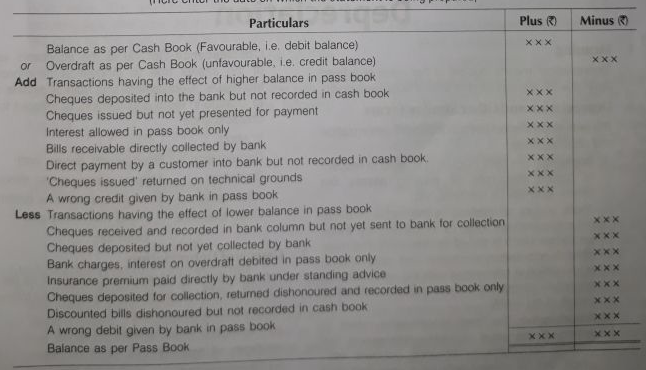
    Format of bank reconciliation statement when the bank balance as per cash book is taken as a starting point.
    Bank Reconciliation Statement

    As on…

    (Here enter the date on which the statement is being prepared)

    • When the balance as per Pass Book is taken as the starting point, the treatment of all items will be reversed, i.e. item that are added, will be deducted and item that are deducted will be added.
    • Either favourable balance or overdraft shall appear.
    • If the total of ‘plus item column’ exceeds the total of ‘minus items column’ the difference between the two is termed as an overdraft.
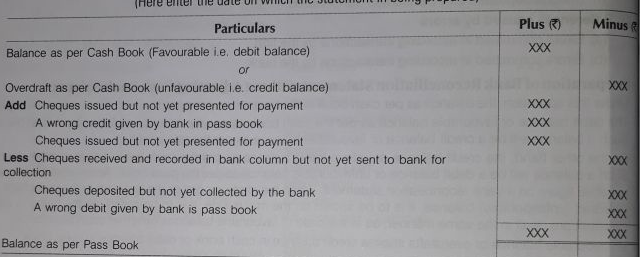
    1. Preparation of Bank Reconciliation Statement with Adjusted/Amended Cash Book Balance

    Another method of preparing bank reconciliation statement is on the basis of the balance of amended cash book. There are a number of items that appears only in the pass book so therefore, it is recommended that the cash book should be prepared to work out the adjustment balance (also known as amended balance) of the cash book and then prepare the bank reconciliation statement.

    Bank Reconciliation Statement

    As on…

    (Here enter the date on which the statement in being prepared)

    • When balance as per pass book is taken as the starting point, the treatment of all items will be reversed i.e. items that are added will be debuted and items to be deducted will be added.
  • Journal and Ledger Notes Class 11th Accountancy

    Journal and Ledger

    1. Rules of Debit and Credit

    Debit (Dr) means to enter an amount of transaction on the left side of an account and credit (Cr) means to enter an amount on the side of an account. Depending on the nature of account, both debit and credit may represent increase or decrease.

    Rules for debit and credit according to traditional classification (i.e. personal, real and nominal)

    Types of Accounts Rules for Debit Rules for Credit
    Personal Accounts Debit the receiver Credit the giver
    Real Accounts Debit what comes in Credit what goes out
    Nominal Accounts Debit all expenses and losses Credit all incomes and gains


    Rules for debit and credit according to modern classification or accounting equation based classification

    Types of Accounts Types of Accounts Rules for Credit
    Assets Accounts Debit the increase Credit the decrease
    Liabilities Accounts Debit the decrease Credit the increase
    Capital Accounts Debit the decrease Credit the increase
    Revenue Accounts Debit the decrease Credit the increase
    Expenses Accounts Debit the increase Credit the decrease
    1. Book of Original Entry (Journal)

    Journal is the book of original entry or prime entry. Journal is a book in which transaction are recorded in the order in which they occur, i.e. in chronological order. The process of recording a transaction in a journal is called journalizing. An entry mode in the journal is called a journal entry.

    1. Format of a Journal

    Journal

    Date

    (1)

    Particulars

    (2)

    LF

    (3)

    Amt (Dr)

    (4)

    Amt (Cr)

    (5)

    1. Simple and Compound Journal Entries

    The journal entry is the basic record of a business transaction. It may be simple or compound.

    1. Simple entry when only two accounts are involved to record a transaction, it is called a simple journal entry. In this one account is debited and another account is credit with an equal amount.
    2. Compound entry when the number of accounts to be debited and credit is more than one, entry made for recording the transaction is called compound journal entry. In other words, it involves multiple accounts.
    3. Recording in Journal

    Entries are recorded in journal on the basis of source documents following the rules of debit and credit.

    A Quick Glance of Some Important Journal Entries

    Transactions Journal Entry
    Cash brought into the business as capital Cash/Bank A/C Dr

    To Capital A/C

    Cash and other assets brought into business Building A/c Dr

    Plant and Machinery/Furniture A/c Dr

    Cash A/c Dr

    To Capital A/c

    Goods purchased on cash Purchases A/c Dr

    To Cash/Bank A/C

    Goods purchased on credit Purchases A/c Dr

    To Supplier’s A/c

    Cash Sales Cash A/c Dr

    To Sales A/c

    Sales of goods on Credit Customer A/c Dr

    To Sales A/c

    Opening a bank account Bank A/c Dr

    To Cash A/c

    Purchase of assets for cash Assets A/c Dr

    To Cash/Bank A/c

    Sale or disposal of any old asset at loss Cash/Bank A/c Dr

    Loss on Sale of Assets A/c

    To Asset A/c

    Sale or disposal of any old asset at profit Cash/Bank A/c Dr

    To Loss on Sale of Assets A/c

    To Asset A/c

    Cash withdrawn for personal use Drawings A/c Dr

    To Cash A/c

    Goods withdrawn for personal use Drawings A/c Dr

    To Purchase A/c

    Goods given as Charity Charity A/c Dr

    To Purchase A/c

    Goods returned by the customer Return Inwards A/c Dr

    To Customer A/c

    Goods returned to the supplier Supplier’s A/c Dr

    To Return Outwards A/c

    Withdrawn of cash from bank Cash A/c (Office Use) Dr

    Drawings A/c (Personal Use) Dr

    To /Bank A/c

    1. Balancing of Single Column Cash Book

    The cash book is balanced in the same way as an account in the ledger. On the left side, all cash transaction relating to cash receipts (debits) and on the right side all transactions relating the cash payments (credits) and entered date wise. When a cash book is maintained, a separate cash account in the ledger is not opened.

    1. Ledger Posting from Single Column Cash Book

    Posting of debit side and credit side of cash book is carried out as follows:

    Debit Side The left side or debit side of the cash book shows the receipts of the cash. The account appears on the debit side of the cash book are credited to their respective ledger accounts by written ‘By Cash’ in the particulars column because cash has been received in respect of them.

    Credit Side The right side or credit side of the cash book shows all the payments made in cash. The accounts appearing on the credit side of the cash book are debited to the ledger accounts by entering ‘To Cash’ in the particulars column as cash/cheque has been paid in respect of them.

    1. Two-Column or Double Column Cash Book (Cash Book with Discount Column)

    Two-Column cash book is a cash book which has two columns on each side of the cash book. One for cash and anotherfor discount (allowed and received).


    Format of Two-Column Cash Book

    Two-Column Cash Book

    Dr Cr

    Date Particulars LF Discount

    (Rs.)

    Cash

    (Rs.)

    Date Particulars Lf Discount

    (Rs.)

    Cash

    (Rs.)

    ↓ ↓

    Receipts Payments

    1. Balancing of Two-Column Cash Book

    Cash Columns are balanced in the same manner as in the case of single column cash book. Discount columns are not balanced but are totaled. Amount in the discount column on the side is the amount allowed as cash discount, it is an expenses for the business and amount in the discount column on the credit side is the amount received as cash discount on the payments made, it is an income for the business.

    1. Ledger Posting from Double Column Cash Book

    Cash Column The process of posting of entries in the cash column is same as in case of single column cash book.

    Discount Column on each side is separately totaled. Total of discount column on debit side, i.e. receipt side is posted to the debit of discount allowed account, as it is an expense for the business and total of discount column on credit side, i.e. payment side is posted to the credit of discount received account as is an income for the business.

    1. Three-column or Triple-column Cash Book (Cash Book with Bank and Discount Column)

    Three-Column cash book is a cash book which has three columns on each side. One for cash, one for bank and one for discount. In other words, it can be said that three-column cash book represents two accounts, i.e. cash account and bank account. Hence, there is no need to open these accounts in the ledger.

    As cash and bank accounts are both asset account therefore cash and bank transactions are recoded in the cash and bank column respectively, following the rule debit the increase in asset and credit the decrease in asset. All the cash receipts, deposits into the bank and discount allowed are recorded on debit side and all cash payments, withdrawals from bank and discount received are recorded on credit side.

    Format of Two-Column Cash Book

    Two-Column Cash Book

    Dr Cr

    Date Particulars LF Discount

    (Rs.)

    Cash

    (Rs.)

    Bank

    (Rs.)

    Date Particulars Lf Discount

    (Rs.)

    Cash

    (Rs.)

    Bank

    (Rs.)

    ↓ ↓

    Receipts Payments

    1. Balancing of Three-column Cash Book

    Cash columns are balanced in the same manner as in case of single column cash book. The process for balancing the bank column is also the same.

    However, it is possible that the bank allows the firm to withdraw more than the balance (the amount deposited), i.e. overdraft.

    1. Ledger Posting of Three-column Cash Book

    Posting of debit side and credit side of cash book is carried out as follows:

    Debit Side the left side or debit side of the cash book shows the receipt of cash. Transactions written in the cash and bank column on debit side are credited to their respective ledger account by written ‘By Cash’ (for cash transactions) and ‘By Bank’ (for bank transactions) in the particulars column. ‘Amount Column’ records the amount of the transaction.

    Discount allowed is individually posted to the credit of related account. Total of discount column is posted to the debit of discount allowed account.

    Credit Side The right side or credit side of the cash book shows all the payments made in cash.

    Transactions written in cash and bank column or credit side are debited to their respective ledger accounts by written ‘To Cash’ (for cash transactions) and ‘To Bank’ (for bank transactions) in the ‘Particulars Column’ records the amount of transaction.

    Discount received individually is posted to the debit of related account. Total of the discount column is posted to the credit of discount received account.

    1. Petty Cash Book

    Petty Cash Book is the book which is used for the purpose of recording the payment of petty cash expenses.

    Petty Cash Book is prepared by petty cashier to record petty expenses (of small amounts). This book is prepared to save valuable time of main (head) cashier from bothering about small and irrelevant cash expenses. For transferring cash to petty cash account, cash account is credited and petty cash account is debited.

    1. Format of Petty Cash Book

    The format of petty cash book may be designed according to the requirements of the business. However, the simplest format is given:

    1. Balancing the Pretty Cash Book

    Petty cash book is balanced in the same manner as a simple cash book. The columns for payments and expenses are totaled and the total equals in the ‘total payment column’. A petty cash book is balanced at the end of the month or a specified period.

    1. Posting the Petty Cash Book
    2. Entries in the petty cash book are posted into the ledger accounts at the end of the specified period, i.e. monthly or quarterly or as the cash may be.
    3. Petty cash book is not posted directly in the ledger. For posting the petty cash book. A petty cash account is opened in the ledger.
    4. When petty cash is advanced to the petty cashier, it is recorded by the chief cashier on the credit side as ‘By petty cash A/c’.
    5. At the end of specified period, a journal entry is first prepared on the basis of the petty cash book, debiting each expenses account individually as per the total shown by respective column and crediting the petty cash account with the total expenditure incurred during the period. Thereafter, posting is made to the debit of each expenses account by written ‘To Petty Cash A/c’.
    6. Purchase Book or Purchase Journal

    Purchase journal records all credit purchases of goods (i.e. goods in which the enterprise deals in). Cash purchases and purchases of goods other than goods in which the firm deals, are not recorded in purchases journal or book.

    The source documents for recording entries in the books are invoices or bills received by the firm from the suppliers of the goods with the amounts net of trade discount/quantity discount. Purchase book is also known as invoice book/bought book.

    1. Format of a Purchases Book

    Purchases Book

    1. Ledger Posting of Purchases Book

    The individual entries and the total of the purchases book are posted into the ledger as follows:

    1. Individual amounts are daily posted to the credit of supplier’s accounts by written ‘By Purchases A/c’ in the particulars column.
    2. Periodic total is posted to the debit of purchases amount by written ‘To sundries as per purchases book’ in the particulars column.
    3. Sales Book for Sales Journal

    Sales book records all credit sale of merchandise (i.e. the goods in which the firm deals in). It does not record the cash sales or merchandise or any other asset other than the merchandise. The source documents recording entries in the sales journal are sales invoice or bill issued by the firm to the customers with the net trade discount/quality discount. It is also known as day book.

    1. Format of a Sales Book

    Sales Book

    1. Ledger posting of the Sales Book

    The individual entries and the total of the sales book are posted into the ledger as follows:

    1. Individual amounts are daily posted to the debit of customer’s accounts by written ‘To Sales A/c’ in the particulars column.
    2. Periodic total is posted to the credit of sales account by writing ‘By Sundries as per Sales Book’ in the particulars column.
    3. Purchase Return or Return Outwards Book

    In this book, purchase returns of goods are recorded. It does not record the returns of goods purchased on cash basis not the returns of purchases other than the goods in which the firm deals in. The entries are usually made the particulars return book on the basis of debit notes issues to the suppliers and credit notes received from the suppliers.

    1. Format of a Purchases Return Book

    Purchase Return Book

    1. Ledger Posting of a Purchase Return Book

    The individual entries and the total of the book are posted into the ledger as follows:

    1. Individual amounts are debited to the supplier’s account by written ‘To Purchase Return A/c’ in the particulars column.
    2. Periodic total is credited to the purchase return account by written ‘By Sundries as per Purchase Return Book’ in the particulars column.
    3. Sales Return or Return Inwards Book

    This journal is used to record return of goods by customers that had been sold on credit. It does not record the return of goods sold on cash basis not the return of any asset other than the goods in which the firm deals in. The source documents for recording entries in the sales return journal are the credit notes issues to the customers or debit notes issued by the customers.

    1. Format of sales Return Book

    Sales Return Book

    1. Ledger Posting from Sales Return Book

    The individual entries and the total of the book are posted into the ledger as follows:

    1. Individual amounts are credited to the customer’s accounts by written ‘By Sales Return A/c’ in the particulars column.
    2. Periodic total is debited to the sales returns accounts by written ‘To Sundries as per Sales Return Book’ in the particulars column.
    3. Journal Proper

    A Book maintained to record transactions which do not find place in special journals, is known as journal proper or journal residual. In other words, journal proper records transactions which cannot be recorded in any other subsidiary book such as cash book, purchase book, sales book, purchase return book, sales return book.


    Following transactions are recorded in journal proper:

    1. Opening Entries
    2. Closing Entries
    3. Adjustment Entries
    4. Rectification Entries
    5. Transfer Entries
    6. Other Entries in addition to the above mentioned entries, recording of the following transactions is also done in the journal proper.
    7. At the time of dishonor of a cheque, the entry for cancellation for discount received or discount allowed earlier.
    8. Purchase/Sale of items on credit other than goods.
    9. Goods withdrawn by the owner for personal use.
    10. Goods distributed as samples for sales promotion.
    11. Endorsement and dishonor of bills of exchange.
    12. Transaction in respect of consignment and joint venture, etc.
    13. Loss of goods by fire/theft/spoilage.