Blog

  • NCERT Solutions of What is Democracy? Why Democracy? Class 9th Social Science Civics

    Page No: 37

    Exercises

    1. Here is some information about four countries. Based on this information, how would you classify each of these countries. Write ‘democratic’, ‘undemocratic’ or ‘not sure’ against each of these.
    (a) Country A: People who do not accept the country’s official religion do not have a right to vote.
    (b) Country B: The same party has been winning elections for the last twenty years.
    (c) Country C: Ruling party has lost in the last three elections.
    (d) Country D: There is no independent election commission.

    Answer

    (a) Undemocratic
    (b) Not sure
    (c) Democratic
    (d) Undemocratic

    2. Here is some information about four countries. Based on this information, how would you classify each of these countries. Write ‘democratic’, ‘undemocratic’ or ‘not sure’ against each of these.
    (a) Country P: The parliament cannot pass a law about the army without the consent of the Chief of Army.
    (b) Country Q: The parliament cannot pass a law reducing the powers of the judiciary.
    (c) Country R: The country’s leaders cannot sign any treaty with another country without taking permission from its neighbouring country.
    (d) Country S: All the major economic decisions about the country are taken by officials of the central bank which the ministers cannot change.

    Answer

    (a) Undemocratic
    (b) Democratic
    (c) Undemocratic
    (d) Undemocratic

    3. Which of these is not a good argument in favour of democracy? Why?
    (a) People feel free and equal in a democracy.
    (b) Democracies resolve conflict in a better way than others.
    (c) Democratic government is more accountable to the people.
    (d) Democracies are more prosperous than others.

    Answer

    Option ‘D’ Democracies are more prosperous than others is not a good argument in favour of democracy as there are many countries such as Sri Lanka, India which opted for democracy but not prosperous where other countries such as China or Saudi Arabia which have communist and monarchy rule respectively are more prosperous. The prosperity of any country depends on the correct policies of the government. It also depends on the availibility of natural resources not with the form of government. Democracy can’t guarantee prosperity.

    Page No: 38

    4. Each of these statements contains a democratic and an undemocratic element. Write out the two separately for each statement.
    (a) A minister said that some laws have to be passed by the parliament in order to conform to the regulations decided by the World Trade Organisation (WTO).
    (b) The Election Commission ordered re-polling in a constituency where large-scale rigging was reported.
    (c) Women’s representation in the parliament has barely reached 10 per cent. This led women’s organisations to demand one-third seats for women.

    Answer

    (a) A minister said that some laws have to be passed by the parliament – Democratic element
    to the regulations decided by the World Trade Organisation (WTO). – Undemocratic element

    (b) The Election Commission ordered re-polling in a constituency – Democratic element
    large-scale rigging was reported – Undemocratic element

    (c) This led women’s organisations to demand one-third seats for women. – Democratic element
    Women’s representation in the parliament has barely reached 10 percent. – Undemocratic element

    5. Which of these is not a valid reason for arguing that there is a lesser possibility of famine in a democratic country?
    (a) Opposition parties can draw attention to hunger and starvation.
    (b) Free press can report suffering from famine in different parts of
    the country.
    (c) Government fears its defeat in the next elections.
    (d) People are free to believe in and practise any religion.

    Answer

    Option ‘d’ is not a valid reason for arguing that there is a lesser possibility of famine in a democratic country. This is because practising a religion has nothing to do with preventing famine.

    6. There are 40 villages in a district where the government has made no provision for drinking water. These villagers met and considered many methods of forcing the government to respond to their need. Which of these is not a democratic method?
    (a) Filing a case in the courts claiming that water is part of right to life.
    (b) Boycotting the next elections to give a message to all parties.
    (c) Organising public meetings against government’s policies.
    (d) Paying money to government officials to get water.

    Answer

    Option ‘d’, which advocates paying the government officials money, is an undemocratic method.

    7.Write a response to the following arguments against democracy.
    (a) Army is the most disciplined and corruption-free organisation in the country. Therefore army should rule the country.
    (b) Rule of the majority means the rule of ignorant people. What we need is the rule of the wise, even if they are in small numbers.
    (c) If we want religious leaders to guide us in spiritual matters, why not invite them to guide us in politics as well. The country should be ruled by religious leaders.

    Answer

    A democracy is  government elected by the people, from among the people themselves. The Army is integral in protecting the country, but it is not elected by the people; hence, it cannot form a democratic government. The second statement is not true as all people are intelligent to some extent. The third statement is dangerous because bringing religion into politics can cause serious conflict.

    8. Are the following statements in keeping with democracy as a value? Why?
    (a) Father to daughter: I don’t want to hear your opinion about your marriage. In our family children marry where the parents tell them to.
    (b) Teacher to student: Don’t disturb my concentration by asking me questions in the classroom.
    (c) Employee to the officer: Our working hours must be reduced according to the law.

    Answer

    (a) This statement of father is undemocratic as every adult has right to choose their life partner. The father does not have right to impose their choice on daughter.

    (b) This statement also is not under democratic setup. The student have right to ask question. This is undemocratic if his right is denied.

    (c) The third statement is democratic as it calls for a rule of law which is beneficial for the employees.

    9. Consider the following facts about a country and decide if you would call it a democracy. Give reasons to support your decision.
    (a) All the citizens of the country have right to vote Elections are held regularly.
    (b) The country took loan from international agencies. One of the conditions for given loan was that the government would reduce its expenses on education and health.
    (c) People speak more than seven languages but education is available only in one language, the language spoken by 52 percent people of the country.
    (d) Several organisations have given a call for peaceful demonstrations and nation wide strikes in the country to oppose these policies. Government has arrested these leaders.
    (e) The government owns the radio and television in the country. All the newspapers have to get permission from the government to publish any news about government’s policies and protests.

    Answer

    (a) This is democracy as only democratic setup allow right to vote and also election at regular time period.

    (b) A democratic country has to look after the welfare of its people. The condition of reducing of expenses on health and education is against the welfare of the people.

    (c) In democracy, education is available in all languages as it basic right. Official language can be the language of majority of people.

    (d) In a democracy, people have right to express their opinion in peaceful manner. It is undemocratic behaviour.

    (e) This is undemocratic nature as in democracy freedom of press and media is must. If government own radio and television then freedom of press violated.
  • Notes of What is Democracy? Why Democracy? Class 9th Social Science Civics

       WHAT IS DEMOCRACY? WHY DEMOCRACY NOTES

    Q.1 Write a broad definition of democracy.

    ANS. Democracy is a form of government in which the rules are elected by the people. Democracy form of government in which

    • Rules elected by the people take all the major decision.
    • Elections offer a choice and fair opportunity to the people to change the current rules.
    • This choice and opportunity is available to all the people an equal basis.
    • The exercise of this choice leads to a government limited by basic rules of the constitution and citizen rights.

    Q2.  write any 5 arguments against democracy?

    Ans. Leaders keep changing in a democracy. This leads to instability.

    • Democracy is all about political competition and power play. There is no scope for morality.
    • So many people have to be consulted in a democracy that it leads to delay
    • Elected leaders do not know the best interest of the people. It leads to lead decision.
    • Democracy leads to corruption for it is based on electoral competition.

    Q3. Briefly state some of the argument in support of democracy?

    ANS. A democratic government is the better government because it is a more accountable form of government.

    • Democracy improves the quality of decision making.
    • Democracy provides methods to deal with difference and conflicts.
    • Democracy enhances the dignity of citizens.
    • Democracy is better than other forms of government because it allows us to correct it’s our mistakes.

    Q.4. Democratic government is a better government because it is a more accountable form of government. Explain.

    Ans  Democracy is better than any other form of government in responding to the needs of the people.

    • A men democratic government may and come respond to the people’s need, but it all depends on the wishes of the people who rule.
    • If the rulers don’t want to they don’t have to act according to the wishes of the people.
    • Democracy requires that the rulers have to attend to the needs of the people.
  • Concept’s of What is Democracy? Why Democracy? Class 9th Social Science Civics

    WHAT IS DEMOCRACY?

    1.Democracy is a form of government in which the rulers are elected by the people.

    • Myanmar where the army rules, Dictator Pinochet’s rule in Chile, or President
      Nkrumah’s rule in Ghana was not democratic. They were not chosen by the people.
    • Hereditary kings, like the king of Nepal or Saudi Arabia, are also not democratic rulers.
      They rule because they were born into noble families.

    2. In a democracy final decision making power must rest with those elected by the people.


    •  In Pakistan, President Musharraf has the power to dismiss national and state assemblies; so the final powers rest with the army and the General himself. We cannot call it a democracy.

    3. A democracy must be based on a free and fair election where those currently in power have a fair chance of losing.

    • For example, in Mexico elections have been held every six years since 1980. But the same party, PRI, has won the elections. Obviously, there has been rigging and malpractices, with freedom denied to the opposition. This is not what a democracy should be.

    4. In a democracy, people’s will is ascertained by each adult citizen having one vote and each vote has one value. Democracy is based on the fundamental principle of political equality.

    5. A democratic government rules within limits set by constitutional and citizens’ rights.

    • A democratic government cannot do what it likes after winning the elections. It has to
      respect certain basic rules and is accountable not only to the people but also to other
      independent officials.


    WHY DEMOCRACY?

    Points Against
    There has been a criticism of democracy by various people. The charges are that :
    It creates instability by changing its leaders frequently.

    • Democracy is about power play and political competition. There is no scope for morality.
    • So many people have to be consulted before any issue is solved. It leads to delay.
    • Elected leaders do not know the best interest of the people.
    • It leads to corruption for it is based on electoral corruption.
    • Ordinary people do not know what is good for them, so decision making should not be
      left to them.
  • Social Science NCERT Solutions for Class 6th

    NCERT Solutions of Class VI Social Science books is given here. Click on the chapter number/name to view Class 6 NCERT Book Solution.

    NCERT Solutions for Class 6 Geography

    1. Geography Chapter 1 – The Earth in the Solar System NCERT Solutions for Class 6th 
    2. Geography Chapter 2 – Globe Latitudes and Longitudes NCERT Solutions for Class 6th 
    3. Geography Chapter 3 – Motions of the Earth NCERT Solutions for Class 6th 
    4. Geography Chapter 4 – Maps NCERT Solutions for Class 6th 
    5. Geography Chapter 5 – Major Domains of the Earth NCERT Solutions for Class 6th 
    6. Geography Chapter 6 – Major Landforms of the Earth NCERT Solutions for Class 6th 
    7. Geography Chapter 7 – Our Country – India NCERT Solutions for Class 6th 
    8. Geography Chapter 8 – India Climate-Vegetation and Wildlife NCERT Solutions for Class 6th 

    NCERT Solutions for Class 6 History

    • History Chapter 1 – What, Where, How and When? NCERT Solutions for Class 6th
    • History Chapter 2 – On The Trial of the Earliest People NCERT Solutions for Class 6th
    • History Chapter 3 – From Gathering to Growing Food NCERT Solutions for Class 6th
    • History Chapter 4 – In the Earliest Cities NCERT Solutions for Class 6th
    • History Chapter 5 – What Books and Burials Tell Us NCERT Solutions for Class 6th
    • History Chapter 6 – Kingdoms, Kings and an Early Republic NCERT Solutions for Class 6th
    • History Chapter 7 – New Questions and Ideas NCERT Solutions for Class 6th
    • History Chapter 8 – Ashoka, The Emperor Who Gave Up War NCERT Solutions for Class 6th
    • History Chapter 9 – Vital Villages, Thriving Towns NCERT Solutions for Class 6th
    • History Chapter 10 – Traders, Kings and Pilgrims NCERT Solutions for Class 6th
    • History Chapter 11 – New Empires and Kingdoms NCERT Solutions for Class 6th
    • History Chapter 12 – Buildings, Paintings and Books NCERT Solutions for Class 6th

    NCERT Solutions for Class 6 Civics

    • Civics Chapter 1 – Understanding Diversity NCERT Solutions for Class 6th
    • Civics Chapter 2 – Diversity and Discrimination NCERT Solutions for Class 6th
    • Civics Chapter 3 – What is Government NCERT Solutions for Class 6th
    • Civics Chapter 4 – Key Elements of a Democratic Government NCERT Solutions for Class 6th
    • Civics Chapter 5 – Panchayati raj NCERT Solutions for Class 6th
    • Civics Chapter 6 – Rural Administration NCERT Solutions for Class 6th
    • Civics Chapter 7 – Urban Administration NCERT Solutions for Class 6th
    • Civics Chapter 8 – Rural Livelihoods NCERT Solutions for Class 6th
    • Civics Chapter 9 – Urban Livelihoods NCERT Solutions for Class 6th
  • India Climate Vegetation and Wildlife NCERT Solutions for Class 6th Geography Chapter 8

    NCERT Solutions for Class 6th Social Science: Chapter 8 – India Climate Vegetation and Wildlife

    Class 6 Social Science (Geography) Chapter 8 India Climate Vegetation and Wildlife NCERT Solution is given below.

    Question 1:
    Answer the following questions briefly.
    (a) Which winds bring rainfall in India? Why is it so important?
    (b) Name the different seasons in India.
    (c) What is natural vegetation?
    (d) Name the different types of vegetation found in India.
    (e) What is the difference between evergreen forest and deciduous forest?
    (f) Why is tropical rainforest also called evergreen forest?

    Answer:
    (a) The monsoon winds bring rainfall in India. In India, agriculture is dependent on rains. Good monsoons mean adequate rain, and a bountiful crop.
    (b) The different seasons in India are: the cold weather season (winter), the hot weather season (summer), the south west monsoon season (rainy season) and the season of retreating monsoons (autumn).
    (c) The grass, shrubs and trees that grow without interference or help from human beings are called natural vegetation.
    (d) The different types of vegetation found in India are: tropical evergreen forests or rainforests, tropical deciduous forests, thorny bushes, mountain vegetation and mangrove forests.
    (e) Tropical rainforests or evergreen forests are found in areas receiving heavy rainfall. They are very dense. They shed their leaves at different times of the year.
    As a result, they always appear green.
    Tropical deciduous forests are also called monsoon forests. They are less dense. They shed their leaves at a particular time of the year.
    (f) The tropical rainforests are also called evergreen forests as they remain green throughout the year. This is because they shed their leaves at different times of the year.

    Question 2:
    Tick the correct answers.
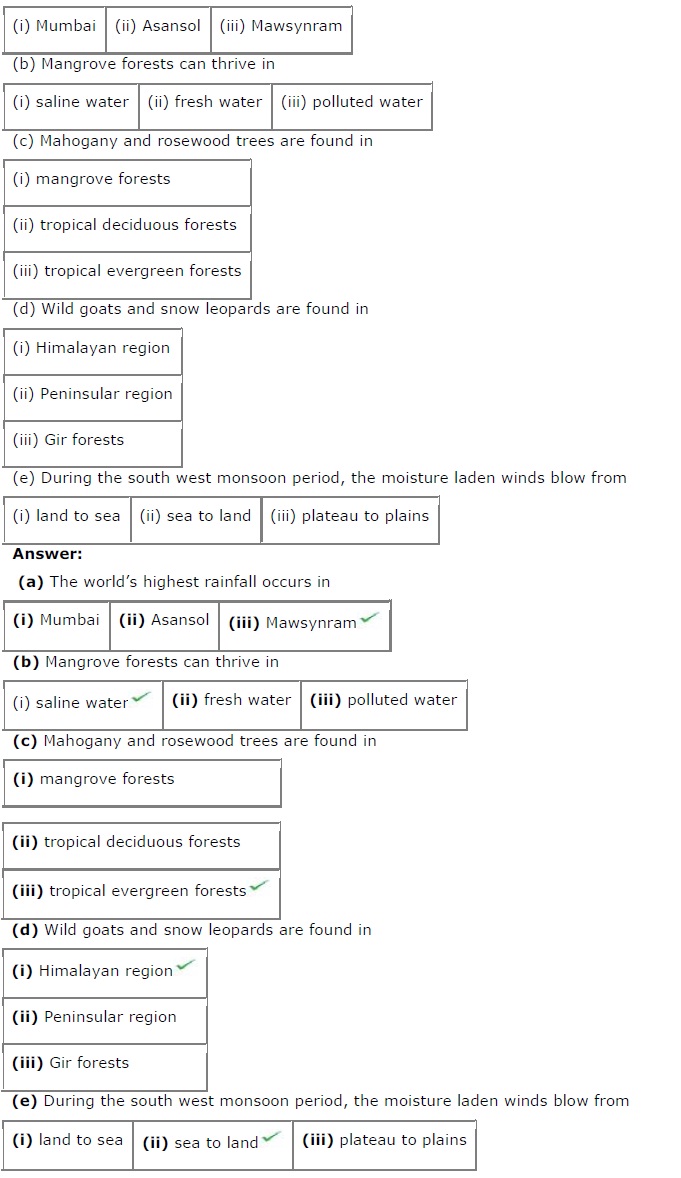
    (a) The world’s highest rainfall occurs in

    Question 3:
    Fill in the blanks.
    (a) Hot and dry winds known as __________ blow during the day in the summers.
    (b) The states of Andhra Pradesh and Tamil Nadu receive a great amount of rainfall during the season of _____________.
    (c) __________ forest in Gujrat is the home of ___________.
    (d) __________ is a well-known species of mangrove forests.
    (e) __________ are also called monsoon forests.

    Answer:
    (a) Hot and dry winds known as loo blow during the day in the summers.
    (b) The states of Andhra Pradesh and Tamil Nadu receive a great amount of rainfall during the season of retreating monsoons.
    (c) Gir forest in Gujrat is the home of Asiatic lions.
    (d) Sundari is a well-known species of mangrove forests.
    (e) Tropical deciduous forests are also called monsoon forests.

  • Our Country – India NCERT Solutions for Class 6th Geography Chapter 7

    NCERT Solutions for Class 6th Social Science: Chapter 7 – Our Country – India

    Class 6 Social Science (Geography) Chapter 7 Our Country – India NCERT Solution is given below.

    Question 1:
    Answer the following questions briefly.
    (a) Name the major physical divisions of India.
    (b) India shares its land boundaries with seven countries. Name them.
    (c) Which two major rivers fall into the Arabian Sea?
    (d) Name the delta formed by the Ganga and the Brahmaputra.
    (e) How many States and Union Territories are there in India? Which States have a common Capital?
    (f) Why do a large number of people live in the Northern plains?
    (g) Why is Lakshadweep known as a coral island?

    Answer:
    (a) The major physical divisions of India are: mountains, plateaus, plains, coasts and islands.
    (b) The countries with which India shares its land boundaries are: Pakistan, Afghanistan, China, Nepal, Bhutan, Bangladesh and Myanmar.
    (c) The two major rivers that fall into the Arabian Sea are: Narmada and Tapi.
    (d) The Sunderban delta is formed by the Ganga and the Brahmaputra.
    (e) There are 28 States and 7 Union Territories in India. Punjab and Haryana are the States that have a common Capital (Chandigarh).
    (f) The Northern Indian plains have been formed by the alluvial deposits laid down by rivers. These river plains provide fertile land for cultivation. This is why a large number of people live in the Northern plains.
    (g)Lakshadweep Islands have been formed from corals, that is, the skeletons of tiny marine animals called Polyps. Hence, Lakshadweep Islands are known as coral islands.

    Question 2:
    Tick the correct answers.
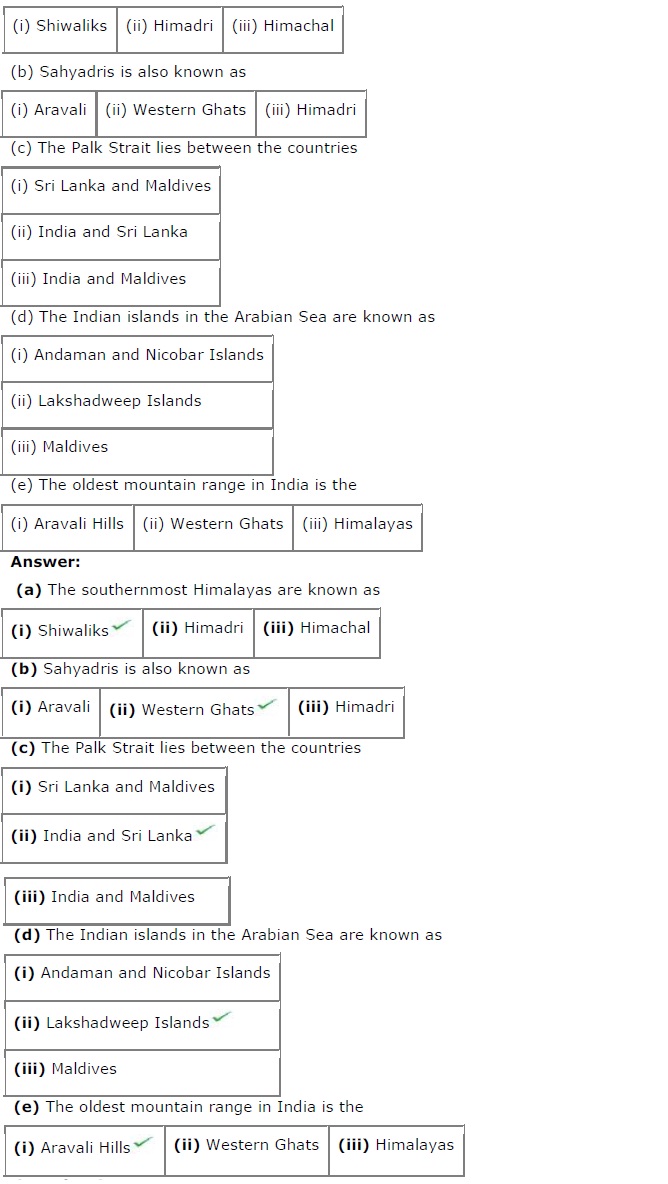
    (a) The southernmost Himalayas are known as

    Question 3:
    Fill in the blanks.
    (a) India has an area of about __________.
    (b) The Greater Himalayas are also known as ___________.
    (c) The largest state in India in terms of area is ___________.
    (d) The river Narmada falls into the ____________ Sea.
    (e) The latitude that runs almost halfway through India is ___________.
    Answer:
    (a) India has an area of about 3.28 million square kilometres.
    (b) The Greater Himalayas are also known as Himadri.
    (c) The largest state in India in terms of area is Rajasthan.
    (d) The river Narmada falls into the Arabian Sea.
    (e) The latitude that runs almost halfway through India is the Tropic of Cancer.

  • Major Landforms of the Earth NCERT Solutions for Class 6th Geography Chapter 6

    Class 6 Social Science – Geography NCERT Text book Answers of Chapter 6. NCERT Solutions Class VI Social Science – Geography includes answers of all the questions of Major Landforms of the Earth provided in NCERT Text Book which is prescribed for class 6 in schools.

    NCERT Solutions for Class 6th Social Science: Chapter 6 – Major Landforms of the Earth

    Class 6 Social Science (Geography) Chapter 6 Major Landforms of the Earth NCERT Solution is given below.

    Question 1:
    Answer the following questions briefly.
    (a) What are the major landforms?
    (b) What is the difference between a mountain and a plateau?
    (c) What are the different types of mountains?
    (d) How are mountains useful to man?
    (e) How are plains formed?
    (f) Why are the river plains thickly populated?
    (g) Why are mountains thinly populated?

    Answer:
    (a) The major landforms are: mountains, plateaus and plains.
    (b)

    Mountain Plateau
    A mountain is any natural elevation of the Earth’s surface. It is considerably higher than the surrounding area. A plateau is an elevated flat land. It is a flat-topped table land standing above the surrounding area.
    Mountains have peaks. Plateaus are flattened highlands.

    (c) The different types of mountains are: fold, block and volcanic.
    (d)
    Usefulness of Mountains
    Mountains are a storehouse of water. Many rivers have their source in the glaciers. Reservoirs are made to harness this water for consumption, irrigation and generating electricity.
    River valleys and terraces are ideal for cultivation of crops.
    Mountains have a rich variety of flora and fauna. Mountains provide an idyllic site for tourists.
    (e) Most of the plains are formed by rivers and their tributaries. The rivers flow down the slopes of mountains and erode them. They carry forward the eroded material. Then they deposit their load (consisting of stones, sand and silt) along their courses and in their valleys. It is from these deposits that plains are formed.
    (f) A lot of flat lands are available in plains. Also, the available land is generally fertile. Hence, plains are the most useful areas for human habitation as well as for cultivation. Transport network can also be easily constructed in plains. Thus, plains are very thickly populated regions of the world.
    (g) Mountains have very harsh cold climate. The slopes of the mountains are very steep. Also, mountains offer very little land for farming. For these reasons, mountains are thinly populated.

    Question 2:
    Tick the correct answers.
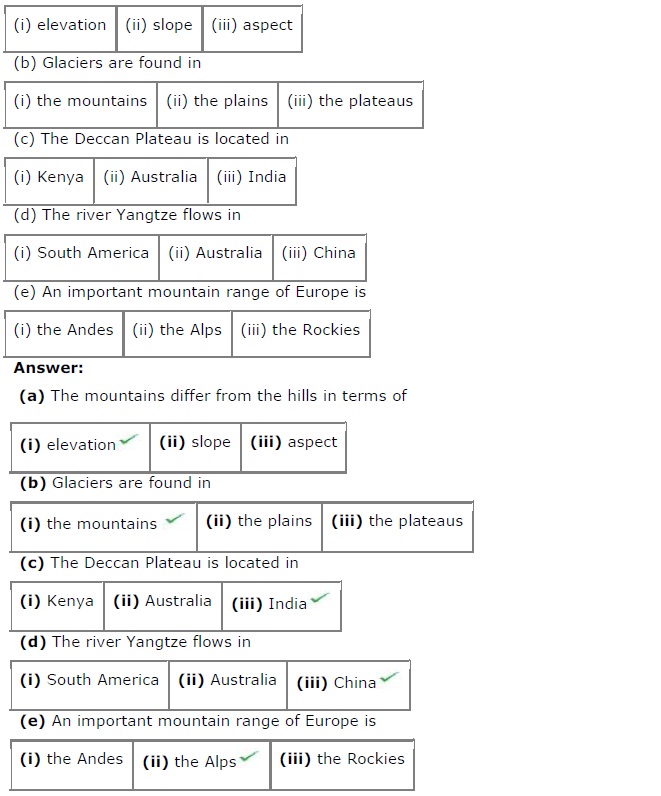
    (a) The mountains differ from the hills in terms of

    Question 3:
    Fill in the blanks.
    (a) A ________ is an unbroken flat or a low-level land.
    (b) The Himalayas and the Alps are examples of _________ types of mountains.
    (c) __________ areas are rich in mineral deposits.
    (d) The _________ is a line of mountains.
    (e) The _________ areas are most productive for farming.

    Answer:
    (a) A plain is an unbroken flat or a low-level land.
    (b) The Himalayas and the Alps are examples of fold types of mountains.
    (c) Plateau areas are rich in mineral deposits.
    (d) The Himalayas is a line of mountains.
    (e) The plain areas are most productive for farming.

  • Major Domains of the Earth NCERT Solutions for Class 6th Geography Chapter 5

    NCERT Solutions for Class 6th Social Science: Chapter 5 – Major Domains of the Earth

    Class 6 Social Science (Geography) Chapter 5 Major Domains of the Earth NCERT Solution is given below.

    Question 1:
    Answer the following questions briefly.
    (a) What are the four major domains of the Earth?
    (b) Name the major continents of the Earth.
    (c) Name the two continents that lie entirely in the Southern Hemisphere.
    (d) Name the different layers of atmosphere.
    (e) Why is the Earth called the ‘blue planet’?
    (f) Why is the Northern Hemisphere called the Land Hemisphere?
    (g) Why is the biosphere important for living organisms?

    Answer:
    (a) The four major domains of the Earth are: lithosphere, hydrosphere, atmosphere and biosphere.
    (b) The seven major continents of the Earth are: Asia, Europe, Africa, North America, South America, Australia and Antarctica.
    (c) The two continents that lie entirely in the Southern Hemisphere are: Australia and Antarctica.
    (d) The different layers of atmosphere are: troposphere, stratosphere, mesosphere, thermosphere and exosphere.
    (e) The Earth is called the ‘blue planet’ because more than 71 per cent of its surface is covered with water.
    (f) The Northern Hemisphere is called the Land Hemisphere because the greater part of Earth’s landmass lies in the Northern Hemisphere.
    (g)The biosphere is the narrow zone of contact between land, water and air. It is in this zone that life, that is unique to Earth, exists. All the living organisms are linked to each other and to the biosphere for survival.

    Question 2:

    Question 3:
    Fill in the blanks.
    (a) The deepest point on the Earth is _________ in the Pacific Ocean.
    (b) The _________ Ocean is named after a country.
    (c) The _________ is a narrow contact of land, water and air that supports life.
    (d) The continents of Europe and Asia together are known as __________.
    (e) The highest mountain peak on the Earth is __________.

    Answer:
    (a) The deepest point on the Earth is Marina Trench in the Pacific Ocean.
    (b) The Indian Ocean is named after a country.
    (c) The biosphere is a narrow contact of land, water and air that supports life.
    (d) The continents of Europe and Asia together are known as Eurasia.
    (e) The highest mountain peak on the Earth is Mount Everest.

  • Maps NCERT Solutions for Class 6th Geography Chapter 4

    NCERT Solutions for Class 6th Social Science: Chapter 4 – Maps

    Class 6 Social Science (Geography) Chapter 4 Maps NCERT Solution is given below.

    Question 1:
    Answer the following questions briefly.
    (a) What are the three components of a map?
    (b) What are the four cardinal directions?
    (c) What do you mean by the term ‘the scale of the map’?
    (d) How are maps more helpful than a globe?
    (e) Distinguish between a map and a plan.
    (f) Which map provides detailed information?
    (g) How do symbols help in reading maps?

    Answer:
    (a) The three components of a map are: distance, direction and symbol.
    (b) The four cardinal directions are: North, South, West and East
    (c) The scale of a map is the ratio between the actual distance on the ground and the distance shown on the map.
    (d) A globe is useful when we want to study the Earth as a whole. But, when we want to study only a part of the Earth, it is of little help. For this purpose, we use maps. A map can represent the entire Earth’s surface or a part of it.
    Maps can be used to show the physical features of the Earth (mountains, plains, oceans, rivers, etc.), the political divisions of the Earth (countries, states, cities, villages, etc.), and certain specific information (roads, rainfall, forests, industries, etc.)
    (e)

    Map Plan
    A map is a representation or a drawing of the Earth’s surface or a part of it drawn on a flat surface according to a scale. A plan is a drawing of a small area on a large scale.
    It can be used for representing large areas like continents or countries (large scale maps), and also for representing a small area like a village or a town (small scale maps). It is used for representing those things  that cannot be represented in a map. For example, the length and the breadth of a room cannot be shown in a map. For this purpose, a plan is used.

    (f) A large scale map provides detailed information.
    (g)As it is not possible to draw on a map the actual shape and size of different features (e.g., buildings, roads, bridges), they are shown by using certain standard letters, shades, colours, pictures and lines. These symbols give a lot of information in a little space. Using these symbols, maps can be drawn easily. The use of symbols makes maps simple to read.

    Question 2:
    Tick the correct answers.
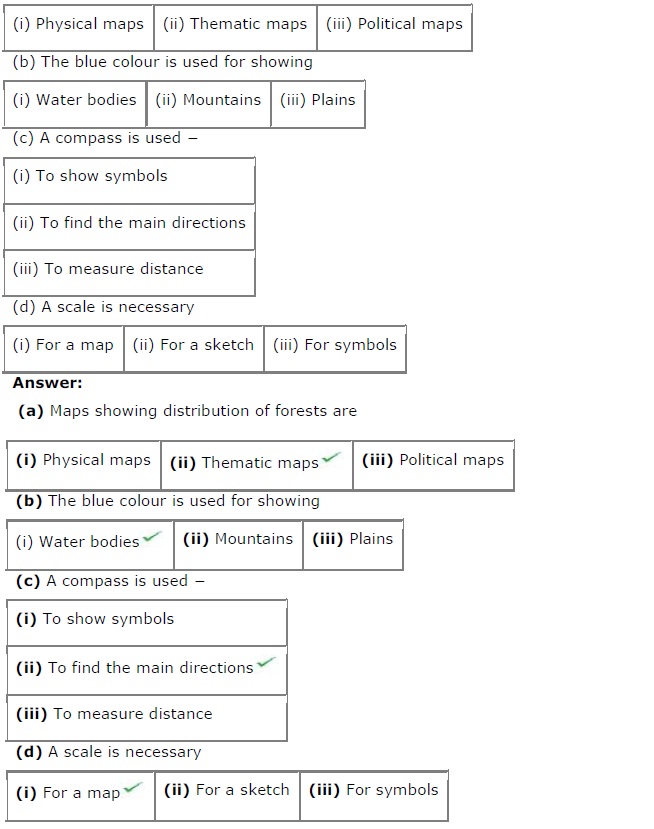
    (a) Maps showing distribution of forests are

  • Motions of the Earth NCERT Solutions for Class 6th Geography Chapter 3

    Class 6 Social Science – Geography NCERT Text book Answers of Chapter 3. NCERT Solutions Class VI Social Science – Geography includes answers of all the questions of Motions of the Earth provided in NCERT Text Book which is prescribed for class 6 in schools.

    National Council of Educational Research and Training (NCERT) Book Solutions for Class 6
    Subject: Social Science – Geography
    Chapter: Chapter 3 – Motions of the Earth

    NCERT Solutions for Class 6th Social Science: Chapter 3 – Motions of the Earth

    Class 6 Social Science (Geography) Chapter 3 Motions of the Earth NCERT Solution is given below.

    Question 1:

    Answer the following questions briefly.
    (a) What is the angle of inclination of the Earth’s axis with its orbital plane?
    (b) Define rotation and revolution.
    (c) What is a leap year?
    (d) Differentiate between the Summer and Winter Solstice.
    (e) What is an equinox?
    (f) Why does the Southern Hemisphere experience Winter and Summer Solstice in different times than that of the Northern Hemisphere?
    (g) Why do the Poles experience about six months day and six months night?

    Answer:

    (a) The angle of inclination of the Earth’s axis with its orbital plane is 66½°.
    (b) Rotation is the movement of the Earth on its axis. Revolution is the movement of the Earth around the Sun in a fixed path or orbit.
    (c) Earth takes 365¼ days to revolve around the Sun. However, for the sake of convenience, we consider a year as consisting of 365 days. The six hours (1/4th of 24 hours) that are ignored make one day (24 hours) over a span of four years. This surplus day is added to the month of February. Thus, every fourth year, February has 29 days, and such a year (with 366 days) is known as a leap year.
    (d)

    Summer Solstice Winter Solstice
    It is the position of the Earth when the rays of the Sun fall directly on the Tropic of Cancer. It is the position of the Earth when the rays of the Sun fall directly on the Tropic of Capricorn
    In this position, the North Pole is tilted towards the Sun. In this position, the North Pole is tilted away from the Sun.
    A larger portion of the Northern Hemisphere gets light from the Sun; hence, it is summer in the Northern Hemisphere. A larger portion of the Southern Hemisphere gets light from the Sun; hence, it is winter in the Northern Hemisphere.
    During this period in the Northern Hemisphere, days are longer than nights. During this period in the Northern Hemisphere, nights are longer than days.

    (e) Equinox is the position of the Earth when the rays of the Sun fall directly on the Equator. At this position, neither of the Poles is tilted towards the Sun. As a result, the entire Earth has equal days and equal nights.
    (f) When the North Pole is tilted towards the Sun, the Northern Hemisphere experiences Summer Solstice. At this time, since the South Pole is tilted away from the Sun, the Southern Hemisphere experiences Winter Solstice. When the North Pole is tilted away from the Sun, the Northern Hemisphere experiences Winter Solstice. At this time, since the South Pole is tilted towards the Sun, the Southern Hemisphere experiences Summer Solstice.
    (g) The Poles experience about six months of day and six months of night because of the tilt of the Earth on its axis. Because of this tilt, each Pole is tilted towards and away from the Sun for about six months each.
    When the North Pole is tilted towards the Sun, it experiences continuous daylight for six months. It is night for the same time period at the South Pole. These conditions are reversed when the South Pole is tilted towards the Sun.

    Question 2:

    Tick the correct answers

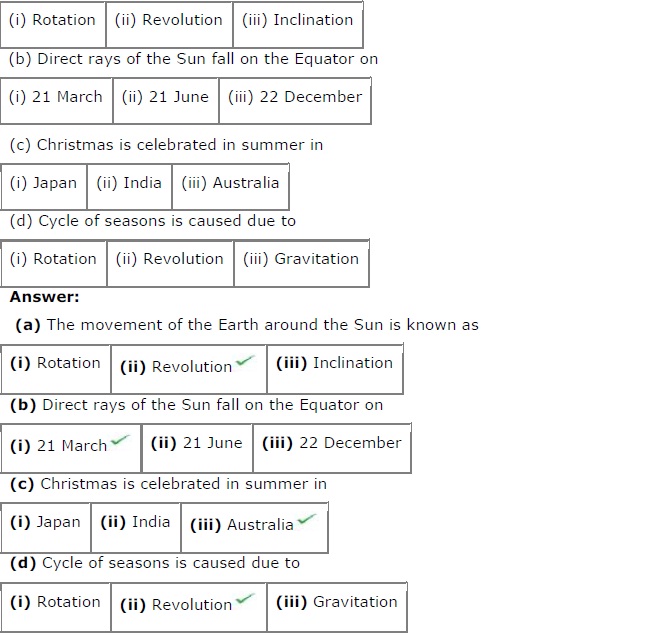
    (a) The movement of the Earth around the Sun is known as

    Question 3:

    Fill in the blanks.
    (a) A leap year has ________ number of days.
    (b) The daily motion of the Earth is _________.
    (c) The Earth travels around the Sun in _________ orbit.
    (d) The Sun’s rays fall vertically on the Tropic of _________ on 21st June.
    (e) Days are shorter during _________ season

    Answer:

    (a) A leap year has 366 number of days.
    (b) The daily motion of the Earth is rotational.
    (c) The Earth travels around the Sun in a fixed elliptical orbit.
    (d) The Sun’s rays fall vertically on the Tropic of Cancer on 21st June.
    (e) Days are shorter during winter season.