Blog

  • TS Grewal Solutions for Accounting Procedures – Rules of Debit and Credit Class 11 Accountancy Chapter 6

    TS Grewal Solutions for Class 11 Accountancy Chapter 6 – Accounting Procedures – Rules of Debit and Credit

    Question 1.
    Following accounts are being maintained in the books of Shri Ashok. Classify them under Assets, Liabilities, Expenses and Revenue Accounts.
    (i) Land; (ii) Investments; (iii) Building; (iv) Interest Received; (v) Salary;(vi) Bank Overdraft; (vii) Debtors; (viii) Creditors; (ix) Bad Debts; (x) Capital; (xi) Depreciation; (xii) Motor Vehicles; (xiii) Freight; (xiv) Wages; (xv) Goodwill; (xvi) Repairs.
    Solution:
    ts-grewal-solutions-class-11-accountancy-chapter-6-accounting-procedures-rules-debit-credit--Q1

    Question 2.
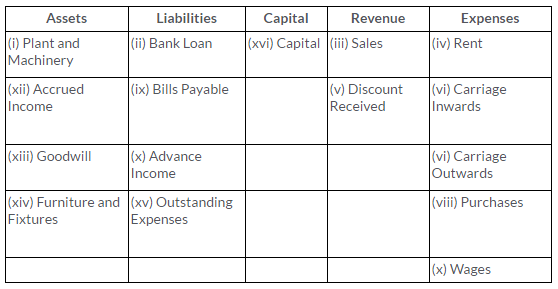
    Classify the following into assets, liabilities, capital, revenue, and expenses:
    (i) Plant and Machinery; (ii) Bank Loan; (iii) Sales; (iv) Rent; (v) Discount Received; (vi) Carriage Inwards; (vii) Carriage Outwards; (viii) Purchases;(ix) Bills Payable; (x) Wages; (xi) Advance Income; (xii) Accrued Income;(xiii) Goodwill; (xiv) Furniture and Fixtures; (xv) Outstanding Expenses;(xvi) Capital.
    Solution:
    ts-grewal-solutions-class-11-accountancy-chapter-6-accounting-procedures-rules-debit-credit--Q2

    Question 3.
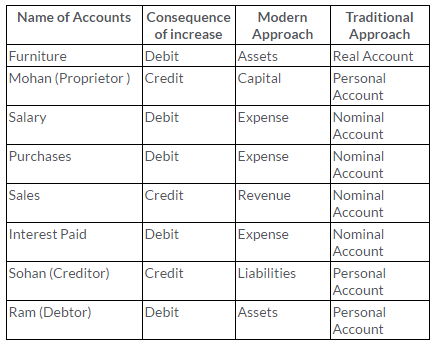
    On which side will be the increase in the following accounts recorded? Also, mention the nature of the account:
    i. Furniture A/c
    ii. Mohan (Proprietor)
    iii. Salary A/c
    iv. Purchases A/c
    v. Sales A/c
    vi. Interest Paid A/c
    vii. Sohan (Creditor)
    viii. Ram (Debtor)
    Solution:
    ts-grewal-solutions-class-11-accountancy-chapter-6-accounting-procedures-rules-debit-credit--Q3

    Question 4.
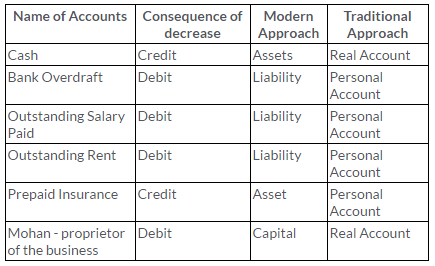
    On which side will be the decrease in the following accounts recorded? Also, mention the nature of the account:
    i. Cash
    ii. Bank Overdraft
    iii. Outstanding Salary paid
    iv. Outstanding Rent
    v. Prepaid Insurance
    vi. Mohan, Proprietor of the business
    Solution:
    ts-grewal-solutions-class-11-accountancy-chapter-6-accounting-procedures-rules-debit-credit--Q4

    Question 5.
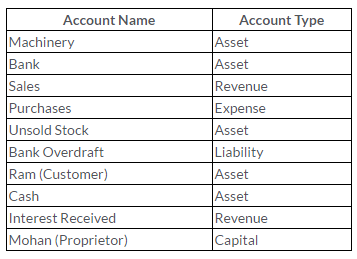
    Following is the list of various accounts. Find out which are Assets, Liabilities, Capital, Revenue or Expense Accounts:
    i. Machinery
    ii. Bank
    iii. Sales
    iv. Purchases
    v. Unsold Stock
    vi. Bank Overdraft
    vii. Ram (Customer)
    viii. Cash
    ix. Interest Received
    x. Mohan (Proprietor)
    Solution:
    ts-grewal-solutions-class-11-accountancy-chapter-6-accounting-procedures-rules-debit-credit--Q5

    Question 6.
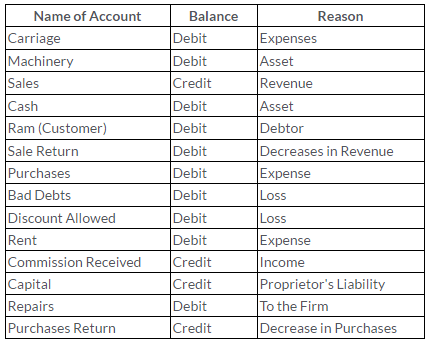
    You are given a number of accounts below. State which of them will show a debit balance and which a credit balance:
    i. Carriage
    ii. Machinery
    iii. Sales
    iv. Cash
    v. Ram (Customer)
    vi. Sales Return
    vii. Purchases
    viii. Bad Debts
    ix. Discount Allowed
    x. Rent
    xi. Commission Received
    xii. Capital
    xiii. Repairs
    xiv. Purchases Return
    Solution:
    ts-grewal-solutions-class-11-accountancy-chapter-6-accounting-procedures-rules-debit-credit--Q6

    Question 7.
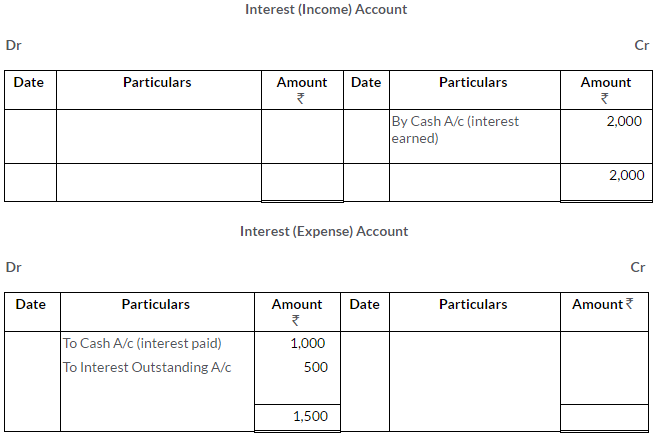
    Put the following transactions on the proper side of an Interest Account:
    i. Interest earned Rs.2,000
    ii. Interest paid Rs.1,000
    iii. Interest due Rs.500
    Solution:
    ts-grewal-solutions-class-11-accountancy-chapter-6-accounting-procedures-rules-debit-credit--Q7

    Question 8.
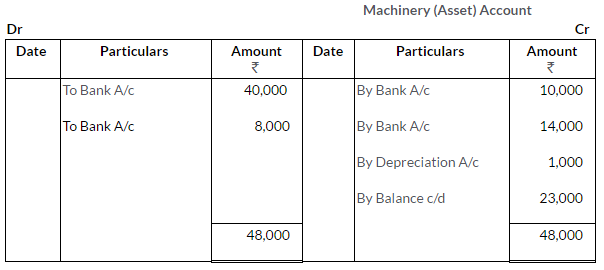
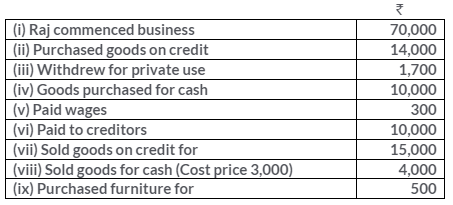
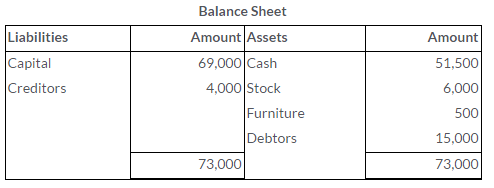
    ts-grewal-solutions-class-11-accountancy-chapter-6-accounting-procedures-rules-debit-credit-8
    Solution:
    ts-grewal-solutions-class-11-accountancy-chapter-6-accounting-procedures-rules-debit-credit--Q8

    Question 9.
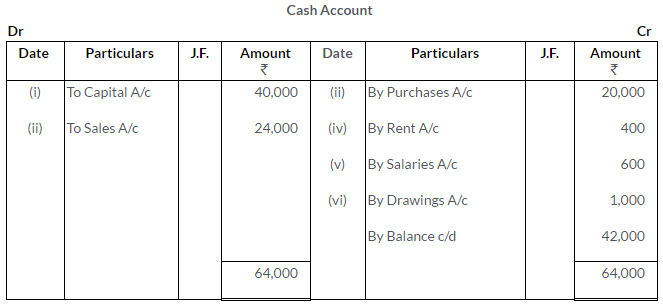
    ts-grewal-solutions-class-11-accountancy-chapter-6-accounting-procedures-rules-debit-credit-9
    Solution:
    ts-grewal-solutions-class-11-accountancy-chapter-6-accounting-procedures-rules-debit-credit--Q9

    Question 10.
    ts-grewal-solutions-class-11-accountancy-chapter-6-accounting-procedures-rules-debit-credit-10
    Solution:
    ts-grewal-solutions-class-11-accountancy-chapter-6-accounting-procedures-rules-debit-credit--Q10

    Question 11.
    ts-grewal-solutions-class-11-accountancy-chapter-6-accounting-procedures-rules-debit-credit-Q11-1
    Solution:
    ts-grewal-solutions-class-11-accountancy-chapter-6-accounting-procedures-rules-debit-credit--Q11

    Question 12.
    Solution:
    ts-grewal-solutions-class-11-accountancy-chapter-6-accounting-procedures-rules-debit-credit--Q12
    ts-grewal-solutions-class-11-accountancy-chapter-6-accounting-procedures-rules-debit-credit-Q12-1

    Question 13.
    ts-grewal-solutions-class-11-accountancy-chapter-6-accounting-procedures-rules-debit-credit-Q13-1
    Solution:
    ts-grewal-solutions-class-11-accountancy-chapter-6-accounting-procedures-rules-debit-credit--Q13

    Question 14.
    ts-grewal-solutions-class-11-accountancy-chapter-6-accounting-procedures-rules-debit-credit-Q14-1
    Solution:
    ts-grewal-solutions-class-11-accountancy-chapter-6-accounting-procedures-rules-debit-credit--Q14

    Question 15.
    ts-grewal-solutions-class-11-accountancy-chapter-6-accounting-procedures-rules-debit-credit-Q15-1
    Solution:
    ts-grewal-solutions-class-11-accountancy-chapter-6-accounting-procedures-rules-debit-credit--Q15

  • TS Grewal Solutions for Accounting Equation Class 11 Accountancy Chapter 5

    TS Grewal Solutions for Class 11 Accountancy Chapter 5 – Accounting Equation

    Question 1.
    ts-grewal-solutions-class-11-accountancy-chapter-5-accounting-equation--Q1
    Solution:
    ts-grewal-solutions-class-11-accountancy-chapter-5-accounting-equation-Q1
    Question 2.
    ts-grewal-solutions-class-11-accountancy-chapter-5-accounting-equation--Q2

    Solution:
    ts-grewal-solutions-class-11-accountancy-chapter-5-accounting-equation-Q2
    Question 3.
    ts-grewal-solutions-class-11-accountancy-chapter-5-accounting-equation--Q3

    Solution:
    ts-grewal-solutions-class-11-accountancy-chapter-5-accounting-equation-Q3
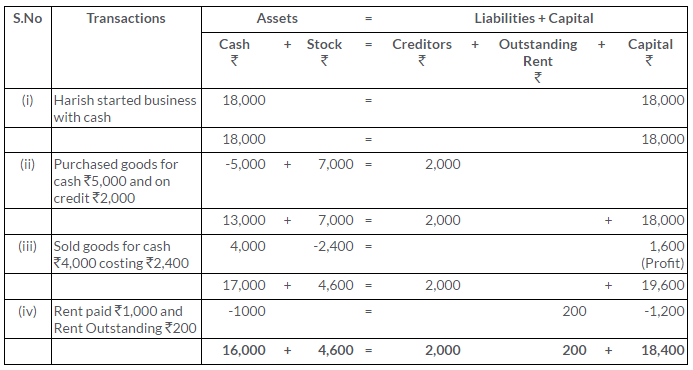
    Question 4.
    What will be the effect of the following on the Accounting Equation?
    i. Harish started business with cash Rs.18,000
    ii. Purchased goods for cash 5,000 and on credit Rs.2,000
    iii. Sold goods for cash Rs.4,000 (costing Rs.2,400)
    iv. Rent paid Rs.1,000 and rent outstanding Rs.200
    (Delhi 1998)
    Solution:
    ts-grewal-solutions-class-11-accountancy-chapter-5-accounting-equation-Q4
    Question 5.
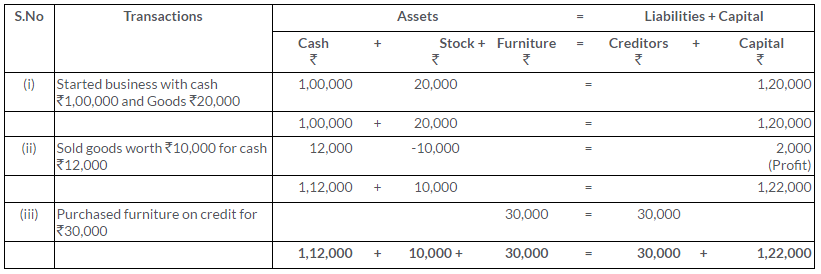
    Prepare Accounting Equation from the following:
    i. Started business with cash Rs.1,00,000 and Goods Rs.20,000.
    ii. Sold goods worth Rs.10,000 for cash Rs.12,000.
    iii. Purchased furniture on credit for Rs.30,000.
    (Delhi 2011)
    Solution:
    ts-grewal-solutions-class-11-accountancy-chapter-5-accounting-equation-Q5
    Question 6.
    Prepare an Accounting Equation and Balance Sheet on the following basis:
    i. Ajeet started business with cash Rs.20,000.
    ii. He purchased furniture for Rs.2,000.
    iii. He paid rent of Rs.200.
    iv. He purchased goods on credit Rs.3,000.
    v. He sold goods (cost price Rs.2,000) for Rs.5,000 on cash.
    Solution:
    ts-grewal-solutions-class-11-accountancy-chapter-5-accounting-equation-Q6
    Question 7.
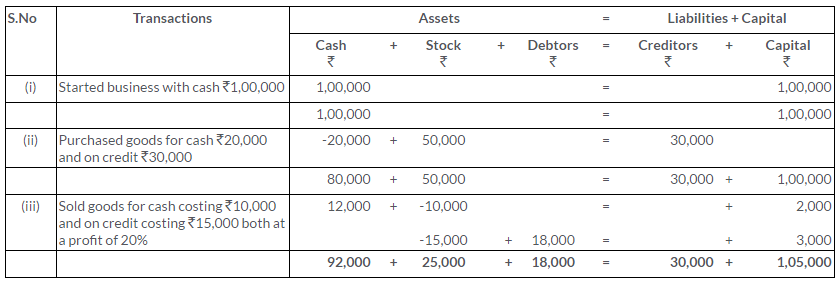
    Prepare an Accounting Equation from the following:
    i. Started business with cash Rs.1,00,000.
    ii. Purchased goods for cash Rs.20,000 and on credit Rs.30,000.
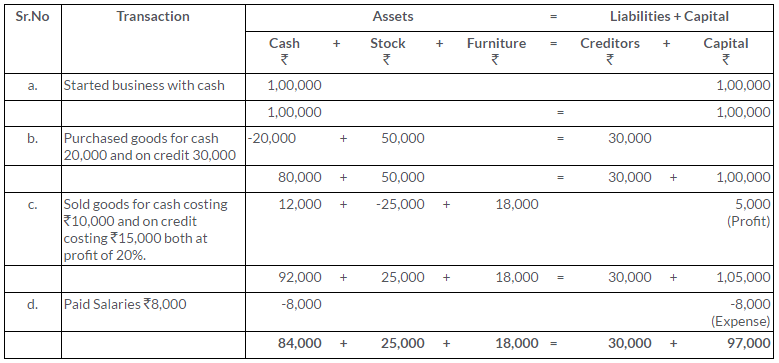
    iii. Sold goods for cash costing Rs.10,000 and on credit costing Rs.15,000 both at a profit of 20%.
    (Delhi 2010)
    Solution:
    ts-grewal-solutions-class-11-accountancy-chapter-5-accounting-equation-Q7
    Question 8.
    ts-grewal-solutions-class-11-accountancy-chapter-5-accounting-equation--Q8

    Solution:
    ts-grewal-solutions-class-11-accountancy-chapter-5-accounting-equation-Q8
    Question 9.
    ts-grewal-solutions-class-11-accountancy-chapter-5-accounting-equation--Q9

    Solution:
    ts-grewal-solutions-class-11-accountancy-chapter-5-accounting-equation-Q9
    Question 10.
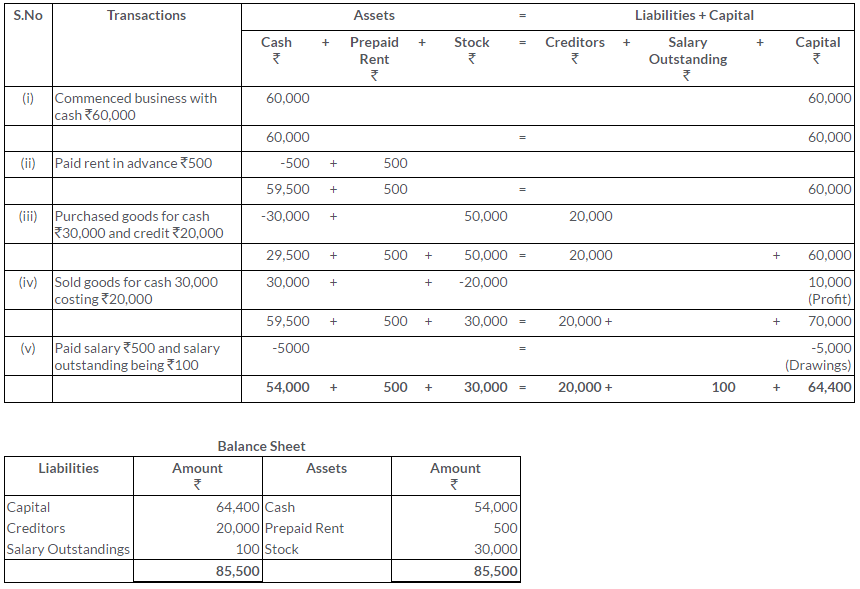
    Prove that the Accounting Equation is satisfied in all the following transactions of Suresh. Also prepare a Balance sheet.
    i. Commenced business with cash Rs.60,000.
    ii. Paid rent in advance Rs.500.
    iii. Purchased goods for cash Rs.30,000 and credit Rs.20,000.
    iv. Sold goods for cash Rs.30,000 costing Rs.20,000.
    v. Paid salary 500 and salary outstanding being Rs.100
    vi. Bought motorcycle for personal use Rs.5,000.
    Solution:
    ts-grewal-solutions-class-11-accountancy-chapter-5-accounting-equation-Q10
    Question 11.
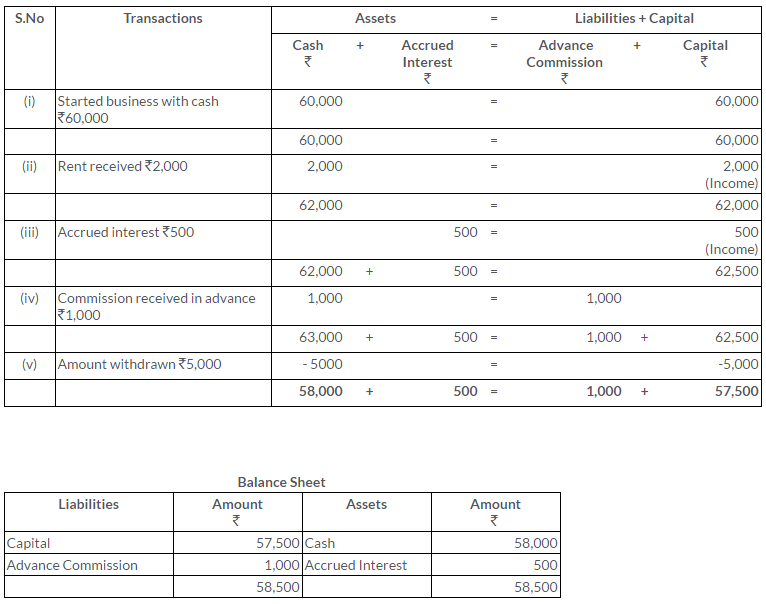
    Show the effect of the following transactions on assets, liabilities and capital using the Accounting Equation. Also prepare a Balance sheet:
    i. Started business with cash Rs.60,000
    ii. Rent received Rs.2,000
    iii. Accrued interest Rs.500
    iv. Commission received in advance Rs.1,000
    v. Amount withdrawn Rs.5,000
    [Hint : Capital = Opening Capital Rs.60,000 + Rent Received Rs.2,000 + Accrued Interest Rs.500 – Drawings Rs.5,000 = Rs.57,500]
    Solution:
    ts-grewal-solutions-class-11-accountancy-chapter-5-accounting-equation-Q11
    Question 12.
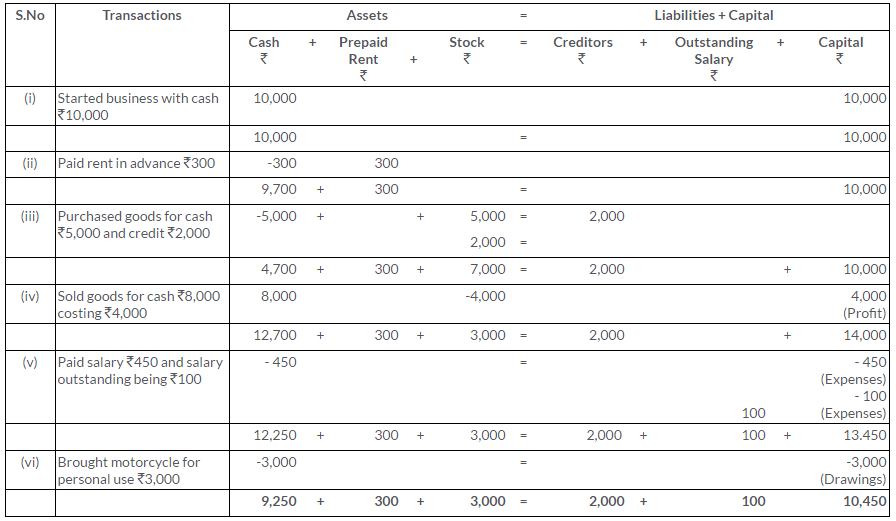
    Prove that the Accounting Equation is satisfied in all the following transactions of Sameer Goel :
    (i) Started business with cash Rs.10,000.
    (ii) Paid rent in advance Rs.300.
    (iii) Purchased goods for cash 5,000 and credit Rs.2,000.
    (iv) Sold goods for cash Rs.8,000 costing Rs.4,000.
    (v) Paid salary Rs.450 and salary outstanding being Rs.100.
    (vi) Bought motorcycle for personal use Rs.3,000.
    (KVS 1997)
    Solution:
    ts-grewal-solutions-class-11-accountancy-chapter-5-accounting-equation-Q12
    Question 13.
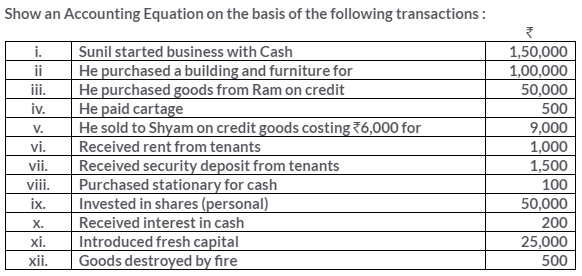
    Show the Accounting Equation on the basis of the following transactions and present a Balance sheet on the last new equation balance:
    ts-grewal-solutions-class-11-accountancy-chapter-5-accounting-equation--Q13
    Solution:
    ts-grewal-solutions-class-11-accountancy-chapter-5-accounting-equation-Q13
    ts-grewal-solutions-class-11-accountancy-chapter-5-accounting-equation-Q13-1
    Question 14.
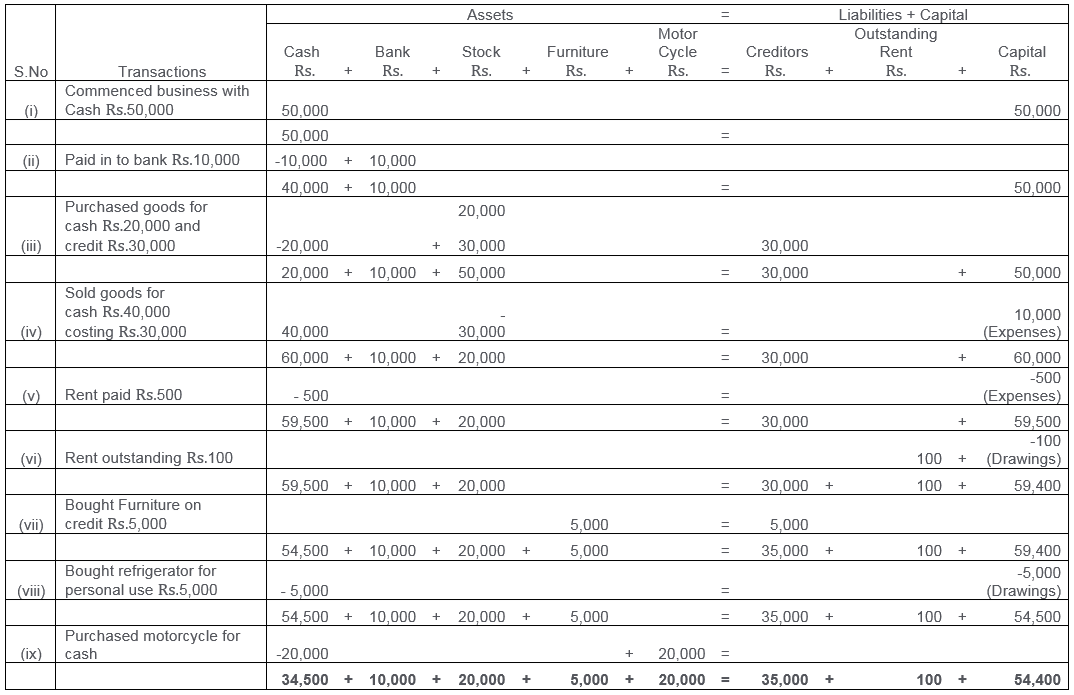
    Raghunath had the following transaction in an accounting year:
    i. Commenced business with cash Rs.50,000.
    ii. Paid into bank Rs.10,000.
    iii. Purchased goods for cash Rs.20,000 and credit Rs.30,000.
    iv. Sold goods for cash Rs.40,000 costing Rs.30,000.
    v. Rent paid Rs.500.
    vi. Rent outstanding Rs.100.
    vii. Bought furniture Rs.5,000 on credit.
    viii. Bought refrigerator for personal use Rs.5,000.
    ix. Purchased motorcycle for cash Rs.20,000.
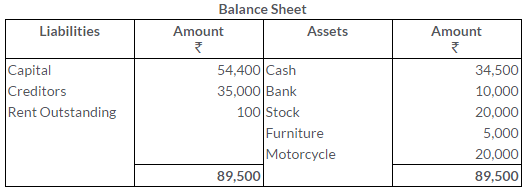
    Create an Accounting Equation to show the effect of the above transactions on his assets, liabilities and capital and also show his final Balance sheet.
    Solution:
    ts-grewal-solutions-class-11-accountancy-chapter-5-accounting-equation-Q14
    ts-grewal-solutions-class-11-accountancy-chapter-5-accounting-equation-Q14-1
    Question 15.
    Prepare an Accounting Equation from the following:
    i. Started business with cash Rs.50,000 and goods Rs.30,000.
    ii. Purchased goods for cash 30,000 and on credit from Karan Rs.20,000.
    iii. Goods costing Rs.40,000 were sold for Rs.55,000.
    iv. Withdraw cash for personal use Rs.10,000.
    v. Rent outstanding Rs.2,000.
    (MSE Chandigarh)
    Solution:
    ts-grewal-solutions-class-11-accountancy-chapter-5-accounting-equation-Q15
    Question 16.
    Show an Accounting Equation on the basis of the following transactions:
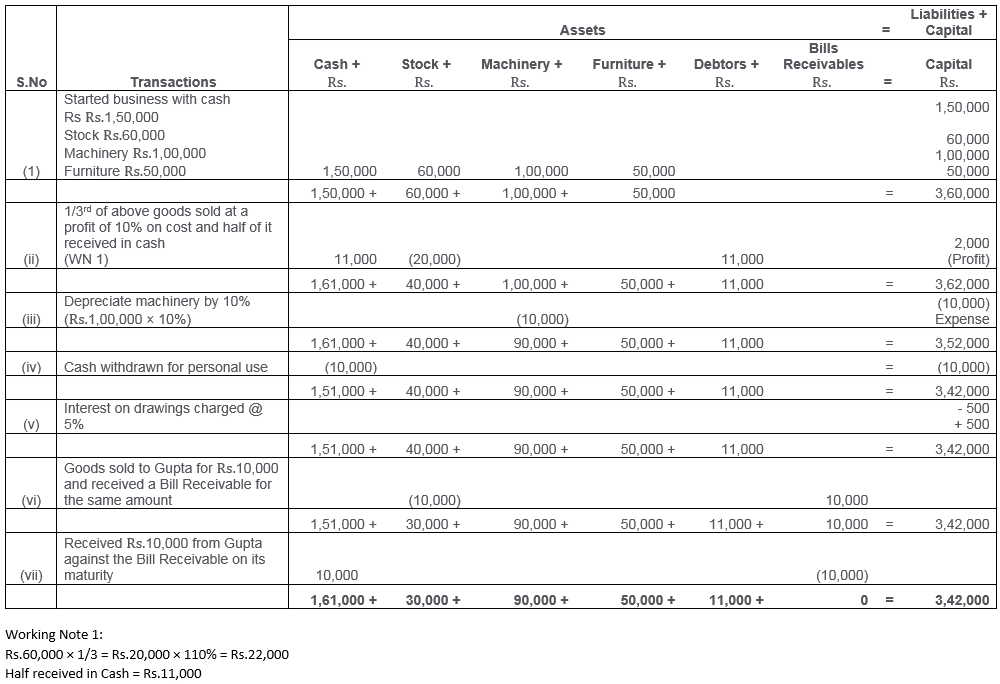
    i. D. Mahapatra commenced business with cash Rs.1,50,000; goods Rs.60,000; machinery Rs.1,00,000 and furniture Rs.50,000.
    ii. 1/3rd of the above goods sold at a profit of 10% on cost and half of the payment is received in cash.
    iii. Depreciation on machinery provided @10%.
    iv. Cash withdrawn for personal use 10,000.
    v. Interest on drawings charged @5%.
    vi. Goods sold to Gupta for Rs.10,000 and received a Bill Receivable for the same amount for 3 months.
    vii. Received Rs.10,000 from Gupta against the Bills Receivable on its maturity.
    [Hints:
    1. Opening Capital Rs.3,60,000 = Cash Rs.1,50,000 + Stock Rs.60,000 + Machinery Rs.1,00,000 + Furniture Rs.50,000
    2. Liabilities: Nil]
    Solution:
    ts-grewal-solutions-class-11-accountancy-chapter-5-accounting-equation-Q16
    Question 17.
    ts-grewal-solutions-class-11-accountancy-chapter-5-accounting-equation--Q17
    Solution:
    ts-grewal-solutions-class-11-accountancy-chapter-5-accounting-equation-Q17
    Question 18.
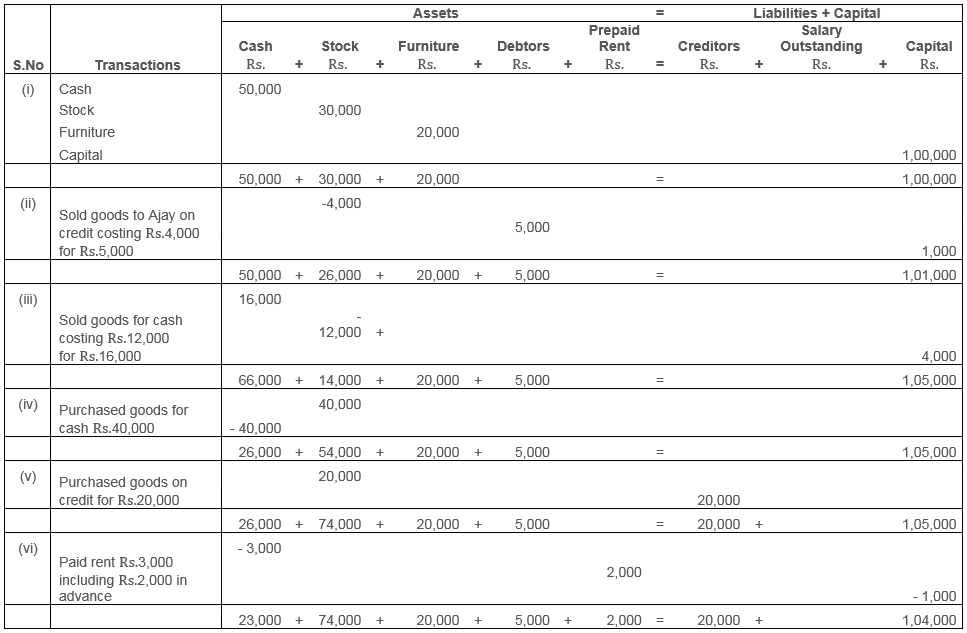
    Create an Accounting Equation on the basis of the following transactions:
    i. Commenced business with cash Rs.50,000, goods Rs.30,000 and furniture Rs.20,000.
    ii. Sold goods to Ajay on credit costing Rs.4,000 for Rs.5,000.
    iii. Sold goods for cash costing Rs.12,000 for Rs.16,000.
    iv. Purchased goods for cash Rs.40,000.
    v. Purchased goods on credit for Rs.20,000.
    vi. Paid rent Rs.3,000 including Rs.2,000 in advance.
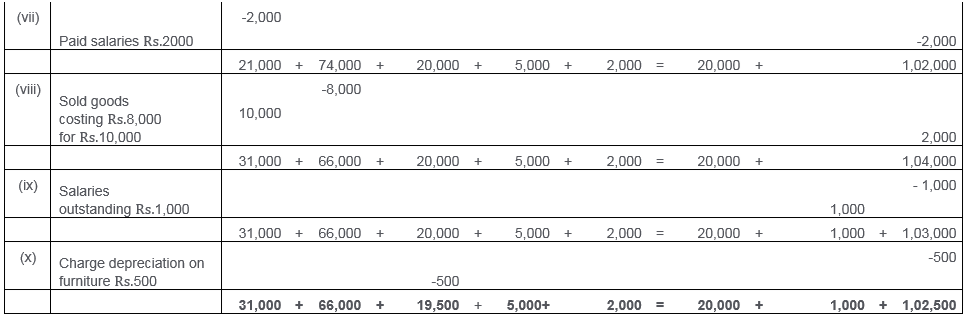
    vii. Paid salaries Rs.2000.
    viii. Sold goods costing Rs.8,000 for Rs.10,000.
    ix. Salaries outstanding Rs.1,000.
    x. Charge depreciation on furniture Rs.500.
    Solution:
    ts-grewal-solutions-class-11-accountancy-chapter-5-accounting-equation-Q18
    ts-grewal-solutions-class-11-accountancy-chapter-5-accounting-equation-Q18-1
    Question 19.
    Prepare Accounting Equation from the following:
    a. Started business with cash Rs.1,00,000.
    b. Purchased goods for cash Rs.20,000 and on credit Rs.30,000.
    c. Sold goods for cash costing Rs.10,000 and on credit costing Rs.15,000 both at profit of 20%.
    d. Paid salaries Rs.8,000.
    [Delhi 2012]
    Solution:
    ts-grewal-solutions-class-11-accountancy-chapter-5-accounting-equation-Q19
    Question 20.
    Show the accounting equation on the basis of following transactions:
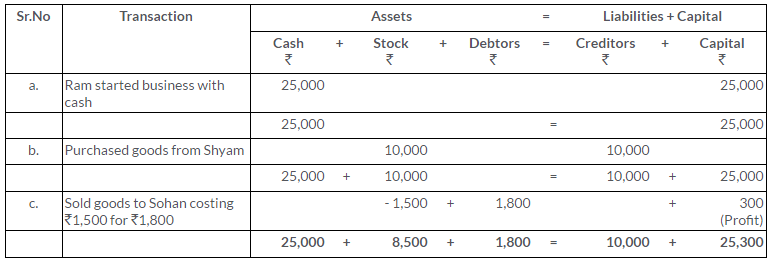
    a. Ram started business with Rs.25,000.
    b. Purchased goods from Shyam Rs.10,000.
    c. Sold goods to Sohan costing Rs.1,500 for Rs.1,800.
    [MSE Chandigarh 2015]
    Solution:
    ts-grewal-solutions-class-11-accountancy-chapter-5-accounting-equation-Q20
    Question 21.
    If the capital of a business is Rs.3,00,000 and liabilities are Rs.50,000, loss 70,000, calculate the total assets of the business.
    Solution:
    ts-grewal-solutions-class-11-accountancy-chapter-5-accounting-equation-Q21
    Question 22.
    If total assets of a business are Rs.1,30,000 and net worth is Rs.80,000, calculate the creditors.
    [Hint: Net worth = Assets – Liabilities]
    Solution:
    ts-grewal-solutions-class-11-accountancy-chapter-5-accounting-equation-Q22
    Question 23.
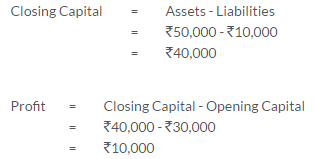
    A commenced his cloth business on 1st April 2014 with a capital of Rs.30,000. On 31st March 2015, his assets were worth Rs.50,000 and liabilities of Rs.10,000. Find out his closing capital and profits earned during the year.
    Solution:
    ts-grewal-solutions-class-11-accountancy-chapter-5-accounting-equation-Q23
    Question 24.
    If capital of a business is Rs.1,40,000 and liabilities are of Rs.80,000, calculate the total assets of the business.
    Solution:
    ts-grewal-solutions-class-11-accountancy-chapter-5-accounting-equation-Q24
    Question 25.
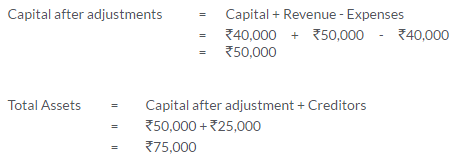
    Calculate the total assets if:
    i. Capital is Rs.40,000.
    ii. Creditors are Rs.25,000.
    iii. Revenue during the period is Rs.50,000.
    iv. Expenses during the period are Rs.40,000.
    (Delhi 2001)
    Solution:
    ts-grewal-solutions-class-11-accountancy-chapter-5-accounting-equation-Q25
    Question 26.
    a. A had a capital of Rs.75,000 on 1st April 2015. He had also goods amounting to Rs.15,000 which he had purchased on credit and the payment had not been made. Find out the value of the total assets of the business.
    b. After a period of one month, he came to know that he had suffered a loss of Rs.1,700. He withdrew Rs.800 for his personal use. Find out his capital and assets of the business.
    Solution:
    ts-grewal-solutions-class-11-accountancy-chapter-5-accounting-equation-Q26
    Question 27.
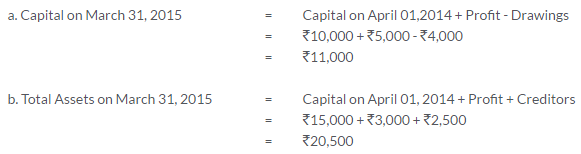
    a. Mohan started a business on 1st April 2014 with a capital of Rs.10,000 and borrowed Rs.3,000 from a friend. He earned a profit ofRs.5,000 during the year ended 31st march, 2013 and withdrew cash Rs.4,000 for private use. What is his capital on 31st March, 2015?
    b. Mahesh started a business with capital of Rs.15,000 on 1st April, 2014. During the year he made a profit of Rs.3,000. He owes Rs.2,500 to suppliers of goods. What is the total of assets in his business on 31st March, 2015?
    Solution:
    ts-grewal-solutions-class-11-accountancy-chapter-5-accounting-equation-Q27
    Question 28.
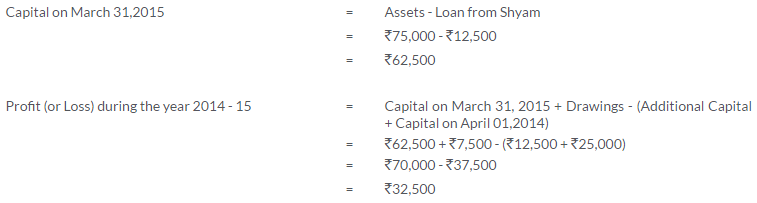
    Mohan stared a business on 1st April 2014 with a capital of Rs.25,000 and a loan of Rs.12,500 borrowed from Shyam. During 2014-15 he had introduced additional capital of Rs.12,500 and had withdrew Rs.7,500 for personal use. On 31st March 2015 his assets were Rs.75,000. Find out his capital as on 31st March,2015 and profit made or loss incurred during the year 2014 – 15.
    Solution:
    ts-grewal-solutions-class-11-accountancy-chapter-5-accounting-equation-Q28
    Question 29.
    On 31st March, 2015, the total assets and external liabilities were Rs.2,00,000 and Rs.6,000 respectively. During the year, the proprietor had introduced capital of Rs.20,000 and withdrawn Rs.12,000 for personal use. He made a profit of Rs.20,000 during the year.
    Calculate the capital as on 1st April, 2014.
    Solution:
    ts-grewal-solutions-class-11-accountancy-chapter-5-accounting-equation-Q29

  • TS Grewal Solutions for Basic Accounting Terms Class 11 Accountancy Chapter 2

    TS Grewal Solutions for Class 11 Accountancy Chapter 2 – Basic Accounting Terms

    Question 1.
    Mr. Gopal started business for buying and selling of readymade garments with Rs.8, 00,000 as an initial investment. Out of this he paid Rs.4,00,000 for the purchase of garments and Rs.50,000 for furniture and Rs.50,000 for computers and the remaining amount was deposited into the bank. He sold some of the ladies and kids garments for Rs.3,00,000 for cash and some garments for Rs.1,50,000 on credit to Mr. Rajesh. Subsequently, he bought men’s garments of Rs.2,00,000 from Mr. Satish. In the first week of the next month, a fire broke out in his office and stock of garments worth Rs.1,00,000 was destroyed. Later on, some garments which cost Rs.1,20,000 were sold for Rs.1,30,000. Expenses paid during the same period were Rs.15,000. Mr. Gopal withdrew Rs.20,000 from business for his domestic use.
    From the above, answer the following:

    1. What is the amount of capital with which Mr. Gopal started the business?
    2. What fixed assets did he buy?
    3. What is the value of the goods purchased?
    4. Who is the creditor and state the amount payable to him?
    5. Who is the debtor and what is the amount receivable from him?
    6. What is the total amount of expenses?
    7. What is the amount of drawings of Mr. Gopal?

    Solution:

    1. Initial capital introduced by Mr. Gopal for starting the business of Readymade Garments” is Rs.8,00,000.
    2. He purchased two Fixed Assets i.e., Furniture and Computer. Therefore,
      Total Fixed Assets bought by him
      = Furniture + Computer
      Rs.50,000 + Rs.50,000  = Rs.1,00,000
    3. Value of the goods purchased by Mr. Gopal (Proprietor) = Purchase of Garments + Purchase of Men’s Garments
      =4,00,000 + 2,00,000
      Rs.6,00,000
    4. The creditor of the business is Mr. Satish with Rs.2, 00,000 being payable to him.
    5. The debtor of the business is Mr. Rajesh with Rs.1,50,000 being the amount to be received from him.
    6. Total amount of expenses is Rs.15,000.
    7. The amount of drawings of Mr. Gopal is Rs.20,000.
  • Long Answer Questions of Patol Babu, Film Star Class 10th English Chapter 5.

    1. Patol Babu reached home and was overcome with mixed feelings of happiness for a good performance but disappointment for being sidelined with such a speaking role. He writes a diary entry in this state of mind. Write the diary for him.
    Ans : Dear Diary,
    It was a day of mixed emotions, happiness and disappointment packed together. I had gone to Faraday House with great expectations and imagine I was asked to utter just ‘oh’! How I died an instant death? All my hopes and aspirations were dashed to pieces. But still I kept my cool. I remembered the advice of my mentor and perfected every bit of my role. Almost everyone, even the hero Chanchal Kumar praised my good work. But the mechanical, inhuman nature of the film-folk hurt me when the time came to collect my twenty rupees, I could not remain there. No money could measure my hard-work and dedication. I know even twenty rupees are needed at home but I felt they were not a worthy remuneration. I hope I am right! God alone knows!
    Patol Babu
    2. Naresh Dutt, the director, was surprised to find Patol Babu missing. He had seen Patol Babu’s meticulous nature and eye for minute details.
    No one ever went away without taking the money. Despite his busy schedule, Naresh Dutt couldn’t forget Patol Babu. He found out the details of Patol Babu’s hard work from other people around. He writes a letter to his friend regarding the hardwork some insignificant people put in and yet their contribution goes unacknowledged. Write the letter for him.
    Ans :Service Lane,
    ABC City
    5 Sept. 2010
    Dear Mohan,
    In our busy lives we seldom notice exceptional people who look quite ordinary. I wish to recount such an incident to you when I had hired a man, who was 52 years old named Patol Babu for a minuscule role. He just had to utter one word ‘oh’! I was told later by my staff and other people that Patol Babu, after the initial disappointment, had practiced that word in all different kind of ways. He gave a superb performance but we were too busy in other technicalities and looking after lead actors to notice it. I was amazed to discover that he did not want to collect his money. Maybe we have erred in some way.
    I am sure we did not value his capability. Nevertheless I will go to his home personally and try to make amends and talk to him. That will really ease my guilt.
    Will share the rest with you later.
    Your friend,
    Naresh Dutt
    3. Give a character sketch of Patol Babu giving evidence from the text.
    Ans : Patol Babu was a modest, talented and timid man.
    He was an artist at heart — emotional, talented but too prone to being hurt. He was full of dramatic skills and could deliver powerful dialogues. He had been a great hit, doing theatre for ‘jatras’ and people specially flocked to see him. He was a perfectionist and packed in a very pow erful performance for his minuscule role. His ‘Oh!’ had modulation of voice, body language and great dramatic skills. He was most emotional and felt really hurt to see the neglect in the eyes of the director. Patol babu is an ideal artist who is not wordly wise and a dreamer who is not practical.

    Content’s

  • Short Answer Questions of Patol Babu, Film Star Class 10th English Chapter 5.

    1. Who was Nishikanto Babu and what proposal
    did he bring for Patol Babu?
    Ans :
    Nishikanto Babu was Patol Babu’s neighbour and
    he brought a film offer for Patol Babu. Nishikanto’s rela
    tive, Naresh Dutt was looking for someone like Patol Babu
    for his film and Nishikanto had suggested Patol’s name.
    2. This kind of offer was ‘‘beyond his wildest
    dreams’’. Why?
    Ans :
    Patol Babu was already 52 years old and virtually
    unknown, in the field of acting. So he was pleasantly sur
    prised that a nonentity like him had received a film offer.
    Moreover, he was very modest in his bearing and for quite
    sometime had nurtured such kind of dreams.
    3. What kind of fame had Patol Babu achieved in
    ‘Jatras’?
    Ans :
    At some time in his life, Patol Babu had a real
    passion for the stage. He had been simply obssessed. In the
    ‘Jatras’ he was very well-known and always in demand.
    His name appeared in handbills many times and people
    bought tickets specially to see him perform.
    4. What desperate efforts were made by Patol
    Babu to earn a decent living?
    [C.B.S.E. 2012 (T-2)]
    Ans :
    Initially Patol Babu had a job in a railway factory.
    In 1934, he was offered higher salary as a clerk in a fa
    mous company. Later he shifted to Calcutta and soon lost
    his job due to war. He tried his hard at a variety store
    which only lasted for 5 years. He worked in a Bengali
    firm, then as an insurance agent but nothing lasted.
    5. What details of the role were furnished by
    Naresh Dutt, the film’s director, to Patol Babu?
    Ans :
    Patol Babu was supposed to enact the role of a
    pedestrian who is absent-minded and short-tempered.
    There were some dialogues also according to Naresh Dutt
    and it was supposed to be a proper speaking part.
    6. Describe the scene outside the Faraday House
    briefly.
    Ans :
    A big crowd had already gathered outside the
    building. A bus was carrying the equipment, There were
    cameras, stands, crowds of people everywhere. Most of the
    people were busy carrying the equipment, carting it here
    and there.
    7. Why was Patol Babu particular about getting
    his dialogues in advance?
    Ans :
    Patol Babu was a perfectionist. He wished to
    practice his dialogues beforehand so that he did not make
    a spectacle of himself in front of the lead actors. He was
    too enthusiastic and didn’t wish to make any mistake in his
    performance.
    8. ‘‘Patol Babu glanced at the paper… and found
    a sudden throbbing in his head. The heat was
    unbearable.” Why did this happen?
    [C.B.S.E. 2012 (T-2)]
    Or
    What were Patol Babu’s ‘dialogues’ and what
    was his reaction on seeing them?
    Ans :
    Patol Babu found that he had to speak just one
    word, that too a monosyllable ‘Oh!’ He had been promised
    a proper speaking part and after a long wait and great
    expectation, he felt too depressed to see his small role. He
    felt cheated and quite demoralised.
    9. What kind of practice did Patol Babu do?
    Ans :
    Patol Babu practised speaking ‘Oh!’ a thousand
    times. He tried to give it a different inflection, add all

    kinds of emotions and styles to this word. He practiced his
    body language, how he would act during collision with the
    hero, how he would fling his arms, how his body would
    crouch in pain and surprise.
    10. What justification is rendered by Sasanko regarding Patol Babu’s speaking role?
    Ans :
    Sasanko was a very clever and tactful person. He
    told Patol Babu that he had a regular speaking part and he
    was indeed very lucky to get such a part in Baren
    Mullick’s film. Most of the people had only crowd scenes
    and even the lead actor had no lines to speak that day.

    11. Why did Patol Babu disappear before collect
    ing his payment? [C.B.S.E. 2012 (T-2)]
    Ans : Patol Babu was happy at his performance because

    he felt that he had done his best. But he was crestfallen at
    the indifferent behaviour of the film people. So he felt that
    no money could compensate for his great efforts and the
    hard work he had put in. He had been simply exhausted
    after the long wait and hard work he had put in. Now the
    reward of twenty rupees looked too meagre and insufficient.
    12. Which message is the author trying to convey
    through the lesson ‘Patol Babu’?
    [C.B.S.E. 2012 (T-2)]
    Ans :
    Through the lesson, Patol Babu, the writer depicts
    the dreams and aspiations of the small timers and the apathy of film makers for whom making films is a business.
    Patol Babu, a talented and emotional artist, who is artist at
    heart and full of dramatic skills, was asked to perform a
    role after 52 years. Quite excited, he rehearsed the single
    word (oh) he was asked to speak. Everybody praised his
    performance but he did not wait there to collect his remuneration. Naresh Dutt asked for him but next minute all
    that was forgotton and the camera started rolling for another shot

  • Non-Multiple Choice Questions of Patol Babu, Film Star Class 10th English Chapter 5.

    Read the following extracts and answer the questions
    that follow :
    1.
    ‘‘I hope the part calls for some dialogue ?’’‘‘Certainly.
    It’s a speaking part. You have acted before, haven’t you?’’
    (a) Identify the two people exchanging the above
    dialogue.
    Ans
    : This dialogue is between Naresh Dutt and Patol
    Babu.
    (b) What reservations are expressed by the first
    person? Why?
    Ans
    : Patol Babu wishes to confirm if he has a speaking
    part.
    (c) Do you believe the information given by the
    second speaker is truthful? Why/Why not?
    Ans
    : No, Patol Babu did not have any dialogue to speak.
    He just has to utter one monosyllable ‘Oh!’
    2. Patol Babu hadn’t expected such news at the start of
    the day. That an offer to act in film would come to a 52 years
    old nonentity like him was beyond his wildest dreams.
    (a) Why didn’t Patol Babu expect such news?
    Ans
    : He hadn’t got any acting offers for the last 52
    years for a film.
    (b) Why did he consider himself a nonentity after
    acting in theatre?
    Ans
    : He was extremely modest and there was a large
    gap of years between his threatre days and this offer.
    (c) What was his reaction?
    Ans
    : He was thrilled and very pleasantly surprised.
    3. ‘‘Counting your chickens again before they’re
    hatched, are you ? No wonder you could never make a go of
    it.’’
    (a) Describe the context of the above statement.
    Ans
    : Patol’s wife believes that Patol Babu was too happy
    prematurely.
    (b) Why does the speaker use the expression, “never
    make a go of it’’?
    Ans
    : His wife believes that Patol Babu could not be
    successful after so many years.
    (c) Do you think that the prediction made above
    proved to be true ? Why/ Why not?
    Ans
    : No, Patol Babu did perfectly the part he was given
    to play, even if it was a tiny role.
    4. ‘‘Is that so ? Well, I suggest you go and wait in the
    shade there. We have a few things to attend to before we get
    going ?

    (a) Who is the speaker and the listener?
    Ans
    : The speaker is Naresh Dutt and the listener is Patol
    Babu.
    (b) What is the context of the above statement?
    Ans
    : This is said when Patol Babu reports for shooting
    at the set.
    (c) What does the above statement reflect about
    the speaker’s attitude?
    Ans
    : The speaker is not much bothered about Patol
    Babu’s arrival.
    5. ‘‘As an artist your aim should be to make the most of
    your opportunity and squeeze the last drop of meaning out
    of your lines.’’
    (a) Who was supposed to have said these lines and
    to whom?
    Ans
    : These lines were spoken by Gagon Pakrashi to Patol
    Babu.
    (b) Discuss the relevance of the above statement in
    the given context?
    Ans
    : Patol Babu is trying to derive inspiration from his
    mentor’s advice.
    (c) Do you think, the listener followed these
    instructions? How? To what extent?
    Ans
    : Yes, Patol Babu perfected the little role he was
    given after remembering his mentor’s words.

    Content’s

  • Multiple Choice Questions of Patol Babu, Film Star Class 10th English Chapter 5.

    1. Read the following extracts and choose the
    correct option.
    1.
    At one time Patol Babu had a real passion for
    the stage, in fact, it verged on obsession.
    (i) Patol Babu during his earlier years had been
    (a) a singer (c) in street plays
    (b) a theatre artist (d) in movies
    (ii) He was obsessed because :
    (a) he always talked about it
    (b) he kept trying to get more and more
    roles
    (c) he worked without money
    (d) he kept repeating many dialogues
    (iii) Patol Babu was by nature :
    (a) an artist (c) a perfectionist
    (b) a lyric writer (d) temperamental
    Answers : (i) (b) (ii) (d) (iii) (c)
    2. ‘‘Fine, I wouldn’t have come to you for just a

    walk-on part’’.
    (i) The speaker is
    (a) Patol Babu
    (c) Naresh Dutt
    (b) Patol’s wife (d) Baren Mullick

    (ii) The speaker proves to be ______ what he

    says.
    (a) a cheater
    (c) untrue
    (b) a crook (d) exaggerating

    (iii) The result of this on Patol Babu was:
    (a) encouraging (c) lukewarm
    (b) very demoralising (d) bad
    Answers : (i) (c) (ii) (d) (iii) (a)
    3. The heat was stifling. The Jacket weighed a ton.
    Patol Babu couldn’t keep standing in one spot
    any more, his legs felt heavy.
    (i) Patol Babu’s condition became bad because :
    (a) it was very hot
    (b) he had no place to stand
    (c) there was so much crowd
    (d) he felt depressed
    (ii) The reason for the Patol Babu’s condition
    was :
    (a) he was made to wait for a long time
    (b) he was treated badly
    (c) he had to speak just one word
    (d) he wasn’t paid
    (iii) Patol Babu had not expected this to happen
    because of :
    (a) his expectations
    (b) Naresh Dutt’s assurances
    (c) his wife’s jibes
    (d) the director’s orders
    Answers : (i) (d) (ii) (c) (iii) (b)
    4. Patol Babu felt that he could write a whole thesis
    on that one monosyllabic exclamation.
    (i) Patol Babu rehearsed
    (a) his actions
    (b) the hero’s dialogues
    (c) the exclamation ‘Oh!’.
    (d) his songs
    (ii) By writing a thesis, it is meant that :
    (a) Patol Babu was a scholar
    (c) he could guide others
    (b) he was going to the library
    (d) he became an expert
    (iii) Patol Babu did this because he believed :
    (a) one must practice hard for whatever one
    does
    (c) one must ask for money
    (b) one must discuss with others
    (d) one must never make any committment
    Answers : (i) (c) (ii) (d) (iii) (a)
    5. What was twenty rupees when measured
    against the intense satisfaction of a small job
    done with perfection and dedication.
    (i) Twenty rupees was the amount meant for :
    (a) refreshments
    (b) payment for his role
    (c) transportation
    (d) hiring him
    (ii) The above sentence reveals that Patol Babu
    was
    (a) an accountant
    (b) very emotional and passionate about
    his work
    (c) money-minded
    (d) not foresighted
    (iii) Patol Babu didn’t collect the money because
    he felt :
    (a) he felt the money was too less
    (b) no money could compensate for his
    committment
    (c) no one was giving him any attention
    (d) they should deliver the money home.
    Answers : (i) (b) (ii) (b) (iii) (b)
    6. Counting your chickens again before they are
    hatched, are you? No wonder you could never
    make a go of it.
    [C.B.S.E. 2012 (T-2)]
    (i)
    Who is the speaker?
    (a) Patol Babu
    (b) Patol Babu’s wife
    (c) Naresh Dutt
    (d) Chanchal Kumar
    (ii) What topic was being discussed?
    (a) a role in the shoot
    (b) money
    (c) writing books
    (d) none of the above
    (iii) “make a go of it” means
    (a) to act hard
    (b) to fail
    (c) become successful
    (d) to cheat
    Answers : (i) (b) (ii) (a) (iii) (c)
    7. Ten minutes later Naresh Dutt went looking for
    Patol Babu near the pan shop and found that he
    was not there. “That’s odd- the man hadn’t been
    paid yet. What a strange fellow!”
    (i) Where had Patol Babu gone?
    (a) to his guru Mr. Pakrashi’s place
    (b) to Karali Babu’s house for Kali puja
    (c) back to his home.
    (d) for the shooting of his TV serial
    (ii) Why was Naresh Dutt looking for Patol
    Babu?
    (a) He wanted him to know that everybody
    liked his performance.
    (b) He wanted to give him his payment.
    (c) He wanted him to meet the director of
    the movie.
    (d) He wanted him to reshoot.
    (iii) What does the incident tell us about Patol
    Babu ?
    (a) that he was an eccentric man
    (b) that he was a busy man
    (c) that satisfcation mattered more to him
    than money
    (d) that he was a good actor
    Answers : (i) (c) (ii) (b) (iii) (c)


    Content’s

  • NCERT Solution of Patol Babu, Film Star Class 10th English Chapter 5.

    Textbook Question of Patol Babu, Film Star Class X English Chapter 5th


    Page No: 67
    3. Answer the following questions briefly
     

    (a) What was the news that Nishikanto Ghosh gave Patol Babu?

    Answer

    Nishikanto Babu told Patol Babu that his brother-in-law, who was in the film business, was looking for an actor for a film they were shooting. The character he described reminded Nishikanto Babu of Patol Babu so he gave him his address and asked him to get in touch with him.

    (b) How did Patol Babu react? Why?

    Answer
    Patol Babu was taken aback by the acting offer. He was surprised as it seemed unbelievable to him that a 52-year old nobody like him was getting a chance to act in a film.

    (c) Why had Patol Babu lost his first job in Calcutta?

    Answer

    The Second World War had resulted in Patol Babu being retrenched from his nine-year-old clerical job at Hudson and Kimberley.

    (d) How does Patol Babu reconcile to the dialogue given to him?

    Answer

    Initially Patol Babu was very dejected to know that he was required to speak just one word ‘Oh!’, but later he accepted it because the director told him that he was the only one who had the speaking part that day. Even the lead actor had no dialogues to speak that day.

    (e) Who was Mr. Pakrashi? How do his words help Patol Babu in enacting his role?

    Answer

    Mr. Pakrashi was Patol Babu’s mentor. He was a wonderful actor, without a tract of vanity in him. He said, “Remember one thing, Patol; however small a part you’re offered, never consider it beneath your dignity to accept it.” These words influenced Patol Babu a lot and they helped him enact his role with confidence and determination. From these words, Patol Babu drew spirit, energy, inspiration and dignity to enact such a small role. He no more felt his role in the movie to be condescending.

    (f) How do we know that Patol Babu was a meticulous man?

    Answer

    Patol Babu was indeed a meticulous man. When he got his dialogue, monosyllabic exclamation ‘Oh!’, he tried his best to give his best. First he tried to understand different inflections of ‘Oh!’ when spoken in different tones carrying different meanings. He was a true actor. He enunciated the syllable in various ways. Along with, he worked out how he would react physically when the collision take place, how his features would be twisted in pain, how he would express pain and surprise. he performed in various ways infront of a large glass window. When his turn came, he even suggested for a rehearsal. He calculated his steps and timed it excellently well. All these things shows his hard-work and pain taking attitude.

    (g) Why did Mr. Mullick turn down Patol Babu’s request for a rehearsal?

    Answer

    Mr Mullick was a very busy and preoccupied director. He had no patience to grant rehearsal for an insignificant role. Moreover, the scene had to be shot in sunlight and as the clouds were seen approaching, he had to take the shot quickly. So he declined Patol Babu’s request for a rehearsal.

    (h) What were the special touches that Patol Babu gave to his role to make it more authentic?

    Answer

    Patol Babu was given the role of an absent-minded pedestrian who collided with the hero Chanchal Kumar on his way from his car to office. First of all, he himself rehearsed his own bit. He worked out his steps, his reactions and his face expressions. When the shot was ready, he suggested to Barren Mullick if he had a newspaper open in his hand then it would be more natural and realistic. then, he calculated his speed and distance of the spot where the collision was to take place and expressed his feelings of anguish, surprise and irritation in proper ratio proportion. In this way, he timed it very well.

    4. Discuss the following questions in detail and write the answers in your notebooks:

    (a) ‘I hope the part calls for some dialogue?’ Who says this? Why does he /she ask this question?

    Answer

    Patol babu said this. He asked Naresh Dutt, the producer of the film to know about this role and the dialogue so as to be very clear in mind what he has to do exactly because Naresh Dutt has not told him anything about it as yet.

    (b) ‘Were these people pulling his legs? Was the whole thing a gigantic hoax?
    A meek, harmless man like him, and they had to drag him into the middle of the city to make a laughing stock out of him. How could anyone be so cruel?’ Why does Patol Babu have these thoughts?

    Answer

    Patol babu has all these thoughts as soon as he gets the dialogue from Jyoti. It is a single exclamatory word ‘Oh!’. He feels upset and displeased at this dialogue. He has spoiled his day. He has come to all the way into the middle of the city for such a small dialogues.

    (c) Patol Babu is an amateur actor for whom walk-on part in a movie turns into an ultimate challenge. Discuss.

    Answer

    Patol Babu is initially very disappointed because of the small role he had been given. Then he is reminded of his mentor’s words that “however small a part, never consider it beneath your dignity to accept it”. Motivated by these words, Patol Babu decides to rehearse his part before the final shoot. He chooses a reclusive spot to practice. As he practices, he realises that a monosyllabic exclamation could be said in different ways and carried different meanings. He also rehearsed how he would react physically when the collision took place – he would twist his face in pain, fling his arms, and crouch to show pain and surprise. He really worked hard at his part and performed it to perfection.

    (d) Do you agree with the statement that Patol Babu is a practical man who comes to terms with whatever life has to offer? Give reasons for your answer.

    Answer

    Yes, I do agree with this statement. Patol Babu has to struggle hard to earn his livelihood. But he does not lose heart. He tried many jobs, every means of earning a livelihood. He is an iron-willed man, undeterred by hardships of life.

    As soon as he gets an offer to play a walk on part in a movie, he accepted it. He performs it to his own utmost satisfaction. he puts all the labour and imagination into one shot. It is true that he needs money but he does not run after it. He performs his act with perfection, dedication and experience intense satisfaction of true actor.
    (e) Why does Patol Babu walk away before he can be paid for his role? What does this reveal about his character?Answer

    Patol Babu executed his part to perfection. However, he wondered whether the immense effort he had put in to enact a small role would be appreciated by everybody or not. The film unit usually got hold of some people, made them do their parts and paid them a small amount. They were not bothered about the quality of performance.
    Although Patol Babu performed a small role, he felt that taking money for it would be trivialising his performance. He was a true actor for whom creative satisfaction was foremost and not money.

    (f) Do you think making a movie is an easy job? Discuss with reference to the story

    Answer

    The story, Patol Babu, Film Star, describes a film shoot. Film making is a long and tedious process. Every scene has to be rehearsed many times before it is finally shot. Plenty of heavy equipments and expensive cameras are used. Film actors have to shoot in extreme weather conditions, sometimes in front of large crowds. The noise and extreme weather can, at times, distract an actor. The production unit has to see minor details, arrange for actors for small roles, and arrange for props. In short making a film is a combined effort of many people.

    Page No: 68

    5. Here are some lines from the lesson. What do they tell us about Patol Babu’s character?

    passionate actor
    diligent
    unassuming
    talented
    genial
    mercenary
    short-tempered
    introvert
    meticulous
    modest
    humble
    arrogant

    (b) Indeed, there was a time when people bought tickets especially to see him_____________
    (c) ‘I was with Hudson and Kimberley for nine years and wasn’t late for a single day.’ _____________

    (d) It didn’t matter if the part was small, but, if he had to make the most of it, he had to learn his lines beforehand. How small he would feel if he muffed in the presence of so many people_____________

    (e) Patol Babu cleared his throat and started enunciating the syllable in various ways.
    Along with that he worked out how he would react physically when the collision took place–how his features would be twisted in pain, how he would fling out his arms, how his body would crouch to express pain and surprise–all these he performed in various ways in front of a large glass window_____________

    (f) It is true that he needed money very badly, but what was twenty rupees when measured against the intense satisfaction of a small job done with perfection and dedication? _____________

    Answer

    (b) talented
    (c) punctual
    (d) meticulous
    (e) passionate actor
    (f) humble

    6. 

    (a)
    Then he had a job in a Bengali firm which he gave up in disgust when his boss began to treat him in too high-handed a fashion
    stimulate the imagination
    (b)
    A faint memory was stirred up in
    Patol Babu’s mind.
    to surrender or relinquish
    (c)
    At first he opened a variety store which he had to wind up after five years.
    staged
    (d)
    In Jatras, in amateur theatricals, to gain control over one’s actions in playsput up by the club in his neighbourhood, Patol Babu was always in demand
    to gain control over one’s actions
    (e)
    Patol Babu was about to step forward when he was pulled up short by a voice shouting ‘Silence!
    shut down
    (f)
    Patol Babu pulled himself together
    Stopped
    Answer
    (a)
    Then he had a job in a Bengali firm which he gave up in disgust when his boss began to treat him in too high-handed a fashion
    to surrender or relinquish
    (b)
    A faint memory was stirred up in
    Patol Babu’s mind.
    stimulate the imagination
    (c)
    At first he opened a variety store which he had to wind up after five years.
    shut down
    (d)
    In Jatras, in amateur theatricals, to gain control over one’s actions in playsput up by the club in his neighbourhood, Patol Babu was always in demand
    staged
    (e)
    Patol Babu was about to step forward when he was pulled up short by a voice shouting ‘Silence!
    stopped
    (f)
    Patol Babu pulled himself together
    to gain control over one’s action

    Page No: 69

    7. After Patol Babu returns home he recounts his experience in front of the camera to his wife. In pairs write out the exchange in the form of a dialogue and enact it before the class. You may start like this….
    Patol Babu’s wife: So what happened at the shooting today? Did you get to do your role?
    Patol Babu: Oh, Yes, I had the time of my life____________

    Answer
     

    Patol Babu’s wife: So what happened at shooting today? Did you get to do your role?

    Patol Babu: Oh, yes, I had the time of my life. Did you know that filmmaking is very different from stage production?

    Patol Babu’s wife: Oh really? Who was the director of the film?

    Patol Babu: Baren Mullick. He has three smash hits in a row!

    Patol Babu’s wife: Tell me about your part?

    Patol Babu: Well….well… it was a very short role… but everybody loved my performance. Do you know there are cameras focused at every angle? You get a chance to rehearse your part. It is very different from stage.

    Patol Babu’s wife: So how many lines did you get to speak?

    Patol Babu: Well… I forgot to tell you my role was with the hero of the film—Chanchal Kumar.

    Patol Babu’s wife: But you are not telling me anything about your role.

    Patol Babu: I will…I will…but first give me something to eat. I am really hungry. I will take you to show this film when it is released. I promise. Come let’s eat something.

    Writing Task 
     

    9. Patol Babu writes a letter to Nishikanto Ghosh to thank him for being instrumental in his getting a role in a film. He also shares his experience at the film shoot including the excitement and deep satisfaction that he derived from the same. Write the letter in about 200 words.

    Answer

    Dear Nishikanto Babu,

    How are you? Hope you are doing fine. It was indeed a pleasure meeting you the other day. I wanted to thank you for recommending me for that role.

    At first, I was surprised that an acting offer would come my way after so many years. However, as you know how passionate I am about acting that I just couldn’t refuse. When I reached the shooting site, I realised how different acting in a film was than acting on stage. I saw so many new things—cameras, lights, make up artists, production people, etc. It was a completely new experience for me. I must confess something—I was initially disappointed with my role and dialogue. It was a very small part with almost no dialogue. however, my mentor’s advice motivated me and I rehearsed and performed my part to perfection. In fact I can say that it was my finest performance till date.

    I am very grateful to you as it was because of you that I had this fantastic experience at the first place.

    I must also add that your brother-in-law is a thorough gentleman. He took good care of me. Thanks again.

    Yours truly,
    Patol Babu

    Content’s

  • Word Meanings of Patol Babu, Film Star Class 10th English Chapter 5.
    WORD–MEANINGS
    l genial : sociable, kind l pedestrian : traveller on foot l crucial : important l suspended : hanging l oblong : rectangular with unequal sides l tremor : quiver l perspiration : sweat l hubbub : noise l resumed : begin again l scribble : to write quickly l gigantic : great l hoax : fraud l meek : timid l embezzlement : cheating of money l mellow : to soften by age l edification : improve morally l obeisance : gesture expressing respect l inflection : modulation of voice l monosyllabic : word of one syllable l collision : to collide with someone l apathy : indifference l anticipation : expecting something before due time l commended : praised l excruciating : acutely painful


    Content’s