Blog

  • Circles Notes Class 11th Maths

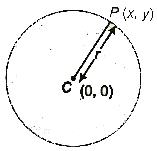
    Circle is defined as the locus of a point which moves in a plane such that its distance from a fixed point in that plane is constant.
    CBSE Class 11 Maths Notes Circles

    Standard Forms of a Circle

    (i) Equation of circle having centre (h, k) and radius (x — h)2 + (y — k)2 = a2.

    If centre is (0, 0), then equation of circle is x2 + y2 = a2.

    (ii) When the circle passes through the origin, then equation of the circle is x2 + y2 — 2hx — 2ky = 0.
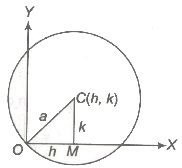
    CBSE Class 11 Maths Notes Circles

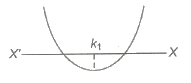
    (iii) When the circle touches the X-axis, the equation is x2 + y2 — 2hx — 2ay + h2 = O.
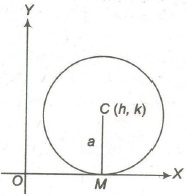
    CBSE Class 11 Maths Notes Circles

    (iv) Equation of the circle, touching the Y-axis is x2 + y2 — 2ax — 2ky + k2 = 0.
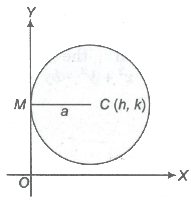
    CBSE Class 11 Maths Notes Circles

    (v) Equation of the circle, touching both axes is x2 + y2 — 2ax — 2ay + a2 = O.
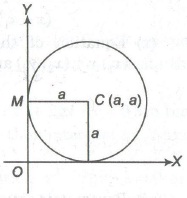
    CBSE Class 11 Maths Notes Circles

    (vi) Equation of the circle passing through the origin and centre lying on the X-axis is x2 + y2 — 2ax = O.
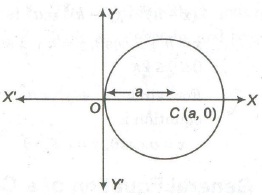
    CBSE Class 11 Maths Notes Circles

    (vii) Equation of the circle passing through the origin and centre lying on the Y-axis is x2 + y2 – 2ay = 0.
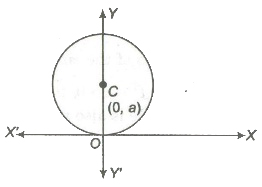
    CBSE Class 11 Maths Notes Circles

    (viii) Equation of the circle through the origin and cutting intercepts a and b on the coordinate axes is x2 + y2 — by = 0.
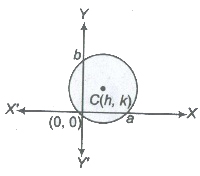
    CBSE Class 11 Maths Notes Circles

    (ix) Equation of the circle, when the coordinates of end points of a diameter are (x1, y1) and (x2, y2) is

    (x — x1)(x — x2) + (y – y1)(y — y2) = 0.

    (x) Equation of the circle passes through three given points (x1, y1), (x2, y2) and (x3, y3) is
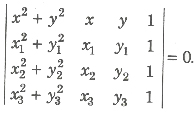
    CBSE Class 11 Maths Notes Circles

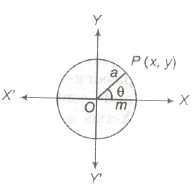
    (xi) Parametric equation of a circle

    (x – h)2 + (y – k)2 = a2 is
    x = h + a cosθ, y = k + a sinθ,
    0 ≤ θ ≤ 2π
    For circle x2 + y2 = a2, parametric equation is
    x = a cos θ, y = a sin θ
    CBSE Class 11 Maths Notes Circles

    General Equation of a Circle

    The general equation of a circle is given by x2 + y2 + 2gx + 2fy + c = 0, where centre of the circle = (- g, – f)

    Radius of the circle = √g2 + f2 – c

    1. If g2 + f2 – c > 0, then the radius of the circle is real and hence the circle is also real.
    2. If g2 + f2 – c = 0, then the radius of the circle is 0 and the circle is known as point circle.
    3. If g2 + f2 – c< 0, then the radius of the circle is imaginary. Such a circle is imaginary, which is not possible to draw.

    Position of a Point with Respect to a Circle

    A point (x1, y1) lies outside on or inside a circle

    S ≡ x2 + y2 + 2gx + 2fy + c = 0, according as S1 > , = or < 0
    where, S1 = x12 + y12 + 2gx1, + 2fy1+ c

    Intercepts on the Axes

    The length of the intercepts made by the circle x2 + y2 + 2gx + 2fy + c = 0 with X and Y-axes are

    2√g2 – c and 2√g2 – c.

    1. If g2 > c, then the roots of the equation x2 + 2gx + c = 0 are real and distinct, so the circle x2 + y2 + 2gx + 2fy + c = 0 meets the X-axis in two real and distinct points.
    2. If g2 = c, then the roots of the equation x2 + 2gx + c = 0 are real and equal, so the circle touches X-axis, then intercept on X-axis is O.
    3. If g2 < c, then the roots of the equation x2 + 2gx + c = 0 are imaginary, so the given circle does not meet X-axis in real point. Similarly, the circle x2 + y2 + 2gx + 2fy + c = 0 cuts the Y-axis in real and distinct points touches or does not meet in real point according to f2 >, = or < c

    Equation of Tangent

    A line which touch only one point of a circle.

    1. Point Form

    1. The equation of the tangent at the point P(x1, y1) to a circle x2 + y2 2gx + 2fy + c= 0 is xx1 + yy1 + g(x + x1) + f(y + y1) + c = 0
    2. The equation of the tangent at the point P(x1, y1) to a circle x2 + y2 is xx1 + yy1 = r2

    2. Slope Form

    (i) The equation of the tangent of slope m to the circle x2 + y2 + 2gx + 2fy + c = 0

    are y + f = m(x + g) ± √(g2 + f2 — c)(1 + m2)

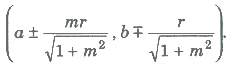
    (ii) The equation of the tangents of slope m to the circle (x – a)2 (y – b)2 = r2 are y – b = m(x – a) ± r√(1 + m2) and the coordinates of the points of contact are
    CBSE Class 11 Maths Notes Circles

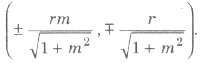
    (iii) The equation of tangents of slope m to the circle x2 + y2 = r2 are y = mx ± r√(1 + m2)and the coordinates of the point of contact are
    CBSE Class 11 Maths Notes Circles

    3. Parametric Form

    The equation of the tangent to the circle (x – a)2 + (y – b)2 = r2 at the point (a + r cos θ, b + r sinθ) is (x – a) cos θ + (y – b) sin θ = r.

    Equation of Normal

    A line which is perpendicular to the tangent.

    1. Point Form

    1. (i) The equation of normal at the point (x1, y1) to the circle x2 + y2 + 2gx + 2fy + c = 0 is
      y – y1 = [(y1 + f)(x – x1)]/(x1 + g)
      (y1 + f)x – (x1 + g)y + (gy1 – fx1) = 0
    2. (ii) The equation of normal at the point (x1, y1) to the circle
      x2 + y2 = r2 is x/x1 = y/y1

    2. Parametric Form

    The equation of normal to the circle x2 + y2 = r2 at the point (r cos θ, r sin θ) is

    (x/r cos θ) = (y/r sin θ)

    or y = x tan θ.

    Important Points to be Remembered

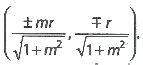
    (i) The line y = mx + c meets the circle in unique real point or touch the circle

    x2 + y2 + r2, if r = |c/√1 + m2

    and the point of contacts areCBSE Class 11 Maths Notes Circles
    (ii) The line lx + my + n = 0 touches the circle x2 + y2 = r2, if r2(l2 + m2) = n2.

    (iii) Tangent at the point P (θ) to the circle x2 + y2 = r2 is x cos θ + y sin θ = r.

    (iv) The point of intersection of the tangent at the points P(θ1) and Q(θ2) on the circle x2 + y2 = r2
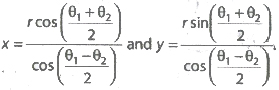
    CBSE Class 11 Maths Notes Circles

    (v) Normal at any point on the circle is a straight line which is perpendicular to the tangent to the curve at the point and it passes through the centre of circle.

    (vi) Power of a point (x1, y1) with respect to the circle x2 + y2 + 2gx + 2fy + c = 0 is x12 + y12 + 2gx1 + 2fy1 + c.

    (vii) If P is a point and C is the centre of a circle of radius r, then the maximum and minimum distances of P from the circle are CP + r and CP — r , respectively.

    (viii) If a line is perpendicular to the radius of a circle at its end points on the circle, then the line is a tangent to the circle and vice-versa.

    Pair of Tangents

    (i) The combined equation of the pair of tangents drawn from a point P(x1, y1) to the circle x2 + y2 = r2 is
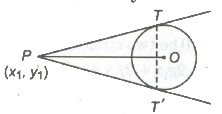
    CBSE Class 11 Maths Notes Circles

    (x2 + y2 – r2)(x12+ y12 – r12) = (xx1 + yy1 – r2)2
    or SS1 = T2
    where, S = x2 + y2 – r2, S1 = x12+ y12 – r12
    and T = xx1 + yy1 – r2

    (ii) The length of the tangents from the point P(x1, y1) to the circle x2 + y2 + 2gx + 2fy + c = 0 is equal to

    (iii) Chord of contact TT’ of two tangents, drawn from P(x1, y1) to the circle x2 + y2 = r2 or T = 0.

    Similarly, for the circle

    x2 + y2 + 2gx + 2fy + c = 0 is

    xx1 + yy1 + g(x + x1) + f(y + y1) + c = 0

    (iv) Equation of Chord Bisected at a Given Point The equation of chord of the circle S ≡ x2 + y2 + 2gx + 2fy + c = 0 bisected at the point (x1, y1) is give by T = S1.
    i.e., xx1 + yy1 + g (x + x1) + f (y + y1) + c
    = x12 + y12 + 2gx1 + fy1 + c

    (v) Director Circle The locus of the point of intersection of two perpendicular tangents to a given circle is called a director circle. For circle x2 + y2 = r2, the equation of director circle is x2 + y2 = 2r2.

    Common Chord

    The chord joining the points of intersection of two given circles is called common chord.
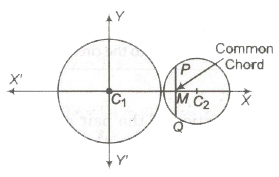
    CBSE Class 11 Maths Notes Circles

    (i) If S1 = 0 and S1 = 0 be two circles, such that

    S1 ≡ x2 + y2 + 2g1x + 2f1y + c1 = 0
    and S2 ≡ x2 + y2 + 2g2x + 2f2y + c2 = 0
    then their common chord is given by S1 — S2 = 0

    (ii) If C1, C2 denote the centre of the given circles, then their common chord

    PQ = 2 PM = 2√(C1P)2 – C1M)2

    (iii) If r1, and r2 be the radii of ‘two circles, then length of common chord is
    CBSE Class 11 Maths Notes Circles

    Angle of Intersection of Two Circles

    The angle of intersection of two circles is defined as the angle between the tangents to the two circles at their point of intersection is given by

    cos θ = (r12 + r22 – d2)/(2r1r2)
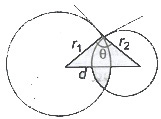
    CBSE Class 11 Maths Notes Circles

    Orthogonal Circles

    Two circles are said to be intersect orthogonally, if their angle of intersection is a right angle.

    If two circles

    S1 ≡ x2 + y2 + 2g1x + 2f1y + C1 = 0 and

    S2 ≡ x2 + y2 + 2g2x + 2f2y + C2 = 0 are orthogonal, then 2g1g2 + 2f1f2 = c1 + c2

    Family of Circles

    (i) The equation of a family of circles passing through the intersection of a circle x2 + y2 + 2gx + 2fy + c = 0 and line

    L = lx + my + n = 0 is S + λL = 0

    where, X, is any real number.

    (ii) The equation of the family of circles passing through the point A(x1, y1) and B (x1, y1) is

    CBSE Class 11 Maths Notes Circles

    (iii) The equation of the family of -circles touching the circle

    S ≡ x2 + y2 + 2gx + 2fy + c = 0 at point P(x1, Y1) is

    xx2 + y2 + 2gx + 2fy + c + λ, [xx1 + yy1 + g(x + x1) + f(Y+ Y1) + c] = 0 or S + λL = 0, where L = 0 is the equation of the tangent to

    S = 0 at (x1, y1) and X ∈ R

    (iv) Any circle passing through the point of intersection of two circles S1 and S2 is S1 +λ(S1— S2) = 0.

    Radical Axis

    The radical axis of two circles is the locus of a point which moves in such a way that the length of the tangents drawn from it to the two circles are equal.

    A system of circles in which every pair has the same radical axis is called a coaxial system of circles.

    The radical axis of two circles S1 = 0 and S2 = 0 is given by S1 — S2 = 0.
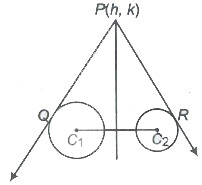
    CBSE Class 11 Maths Notes Circles

    1. The radical axis of two circles is always perpendicular to the line joining the centres of the circles.
    2. The radical axis of three vertices, whose centres are non-collinear taken in pairs of concurrent.
    3. The centre of the circle cutting two given circles orthogonally, lies on their radical axis.
    4. Radical Centre The point of intersection of radical axis of three circles whose centre are non-collinear, taken in pairs, is called their radical centre.

    Pole and Polar

    If through a point P (x1, y1) (within or outside a circle) there be drawn any straight line to meet the given circle at Q and R, the locus of the point of intersection of tangents at Q and R is called the polar of P and po.:.at P is called the pole of polar.
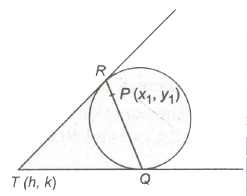
    CBSE Class 11 Maths Notes Circles

    1. Equation of polar to the circle x2 + y2 = r2 is xx1 + yy1 = r2.
    2. Equation of polar to the circle x2 + y2 + 2gx + 2fy + c = 0 is xx1 + yy1 + g(x + x1) + f(y + y1) + c = 0
    3. Conjugate Points Two points A and B are conjugate points with respect to a given circle, if each lies on the polar of the other with respect to the circle.
    4. Conjugate Lines If two lines be such that the pole of one lies on the other, then they are called conjugate lines with respect to the given circle.

    Coaxial System of Circles

    A system of circle is said to be coaxial system of circles, if every pair of the circles in the system has same radical axis.

    1. The equation of a system of coaxial circles, when the equation of the radical axis P ≡ lx + my + n = 0 and one of the circle of the system S = x2 + y2 + 2gx + 2fy + c = 0, is S + λP = 0.
    2. Since, the lines joining the centres of two circles is perpendicular to their radical axis. Therefore, the centres of all circles of a coaxial system lie on a straight line, which is perpendicular to the common radical axis.

    Limiting Points

    Limiting points of a system of coaxial circles are the centres of the point circles belonging to the family.

    Let equation of circle be x2 + y2 + 2gx + c = 0

    ∴ Radius of circle = √g2 — c

    For limiting point, r = 0

    ∴ √g2 — c = 0 &rArr;g = ± √c

    Thus, limiting points of the given coaxial system as (√c, 0) and (—√c, 0).

    Important Points to be Remembered

    (i) Circle touching a line L=O at a point (x1, y1) on it is

    (x — x1)2 + (y — y1)2 + XL = 0.

    (ii) Circumcircle of a A with vertices (x1, y1), (x2, y2), (x3, y3) is
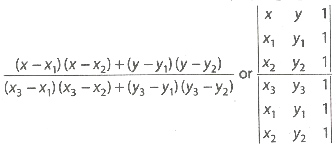
    CBSE Class 11 Maths Notes Circles

    (iii) A line intersect a given circle at two distinct real points, if the length of the perpendicular from the centre is less than the radius of the circle.

    (iv) Length of the intercept cut off from the line y = mx + c by the circle x2 + y2 = a2 is
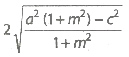
    CBSE Class 11 Maths Notes Circles

    (v) In general, two tangents can be drawn to a circle from a given point in its plane. If m1and m2 are slope of the tangents drawn from the point P(x1, y1) to the circle x2 + y2 = a2, then

    CBSE Class 11 Maths Notes Circles

    (vi) Pole of lx + my + n = 0 with respect to x2 + y2 = a2 isCBSE Class 11 Maths Notes Circles
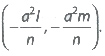
    (vii) Let S1 = 0, S2 = 0 be two circles with radii r1 , r2, then S1/r1 ± S2/r2 = 0 will meet at right angle.

    (viii) The angle between the two tangents from (x1, y1) to the circle x2 + y2 = a2 is 2 tan-1 (a/√S1).

    (ix) The pair of tangents from (0, 0) to the circle x2 + y2 + 2gx + 2fy + c = 0 are at right angle, if g2 + f2 = 2c.

    (x) If (x1, y1) is one end of a diameter of the circle x2 + y2 + 2gx + 2fy + c = 0, then the other end will be (-2g – x1, -2f – y1).

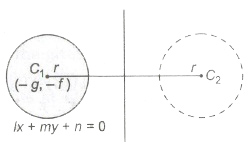
    Image of the Circle by the Line Minor

    Let the circle be x2 + y2 + 2gx + 2fy + c = 0
    CBSE Class 11 Maths Notes Circles

    and line minor lx + my + n = 0.

    Then, the image of the circle is

    (x — X1)2 + (y — y1)2 =r2

    where, r = √g2 + f2 — c

    Diameter of a Circle

    The locus of the middle points of a system of parallel chords of a circle is called a diameter of the circle.

    (i) The equation of the diameter bisecting parallel chords y = mx + c of the circle x2 + y2 = a2 is x + my = 0.

    (ii) The diameter corresponding to a system of parallel chords of a circle always passes through the centre of the circle and is perpendicular to the parallel chords.

    Common Tangents of Two Circles

    Let the centres and radii of two circles are C1, C2 and r1, r2, respectively.

    1. (i) When one circle contains another circle, no common tangent is possible.
      Condition, C1C2 < r1 – r2
    2. (ii) When two circles touch internally, one common tangent is possible.
      Condition , C1C2 = r1 – r2
    3. (iii) When two circles intersect, two common tangents are possible.
      Condition, |r1 — r2| < C1C2 < |r1 + r2|
    4. (iv) When two circles touch externally, three common tangents are possible.
      Condition, C1C2 = r1 + r2
    5. (v) When two circles are separately, four common tangents are possible.
      Condition, C1C2 > r1 + r2

    Important Points to be Remembered

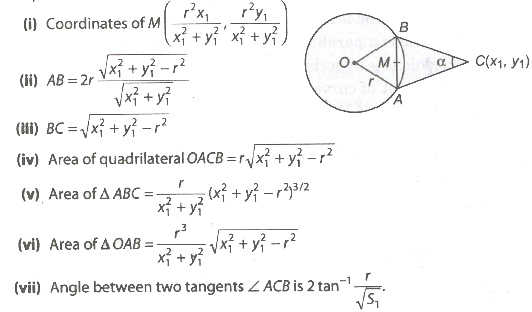
    Let AS is a chord of contact of tangents from C to the circle x2 + y2 = r2. M is the mid-point of AB.
    CBSE Class 11 Maths Notes Circles

  • Rectangular Axis & Straight Lines Notes Class 11th Maths

    Coordinate Geometry

    The branch of Mathematics in which geometrical problem are solved through algebra by using the coordinate system, is known as coordinate geometry.

    Rectangular Axis

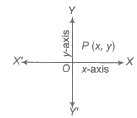
    Let XOX’ and YOY’ be two fixed straight lines, which meet at right angles at O. Then,

    CBSE Class 11 Maths Notes Rectangular Axis and Straight Lines

    (i) X’OX is called axis of X or the X-axis or abscissa.

    (ii) Y’OY is called axis of Yor the Y-axis or ordinate.

    (iii) The ordered pair of real numbers (x, y) is called cartesian coordinate .

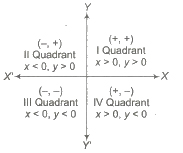
    Quadrants

    The X and Y-axes divide the coordinate plane into four parts, each part is called a quadrant which is given below.

    CBSE Class 11 Maths Notes Rectangular Axis and Straight Lines

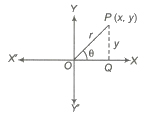
    Polar Coordinates

    In ΔOPQ,

    CBSE Class 11 Maths Notes Rectangular Axis and Straight Lines

    cos θ = x / r and sin θ = y / r ⇒ x = r cos θ and y = r sin θ

    where, r = √x2 + y2

    The polar coordinate is represented by the symbol P(r,θ).

    Distance Formula

    (i) Distance between two points P (x1, y1) and Q (x2, y2), is

    √(x2 – x1)2 + (y2 – y1)2.

    CBSE Class 11 Maths Notes Rectangular Axis and Straight Lines

    (ii) If points are (r1 , θ1) arid (r2, θ2), then distance between them is

    √r21 + r22 – 2r1r2cos(θ1 – θ2).

    (iii) Distance of a point (x1, y1) from the origin is √x21 + y21.

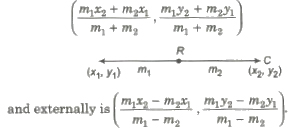
    Section Formula

    (i) The coordinate of the point which divides the joint of (x1, y1) and (x2, y2) in the ratio m1: m2 internally, is

    CBSE Class 11 Maths Notes Rectangular Axis and Straight Lines

    (ii) X-axis divides the line segment joining (x1, y1) and (x2, y2) in the ratio – y1 : y2.

    Similarly, Y-axis divides the same line segment in the ratio – x1 : x2.

    (iii) Mid-point of the joint of (x1, y1) and (x2, y2) is (x1 + x2 / 2 , y1 + y2 / 2)

    (iv) Centroid of ΔABC with vertices (x1, y1), (x2, y2) and (x3, y3), is

    (x1 + x2 + x3 / 3 , y1 + y2 + y3 / 3).

    (v) Circumcentre of ΔABC with vertices A(x1, y1), B(x2, y2) and C(x3, y3), is

    CBSE Class 11 Maths Notes Rectangular Axis and Straight Lines

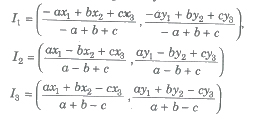
    (vi) Incentre of Δ ABC with vertices A(x1, y1), B(x2, y2) and C(x3, y3) and whose sides are a, band c, is

    (ax1 + bx2 + cx3 / a + b + c , ay1 + by2 + cy3 / a + b + c).

    (vii) Excentre of ΔABC with vertices A(x1, y1), B(x2, y2) and C(x3, y3) and whose sides are a, band c, is given by

    CBSE Class 11 Maths Notes Rectangular Axis and Straight Lines

    Area of Triangle/Quadrilateral

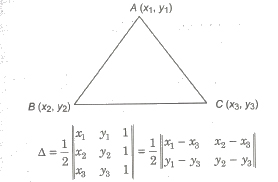
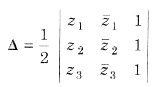
    (i) Area of ΔABC with vertices A(x1, y1), B(x2, y2) and C(x3, y3), is

    CBSE Class 11 Maths Notes Rectangular Axis and Straight Lines

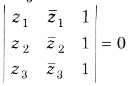
    These points A, Band C will be collinear, if Δ = O.

    (ii) Area of the quadrilateral formed by joining the vertices

    CBSE Class 11 Maths Notes Rectangular Axis and Straight Lines

    (iii) Area of trapezium formed by joining the vertices

    CBSE Class 11 Maths Notes Rectangular Axis and Straight Lines

    Shifting/Rotation of Origin/Axes

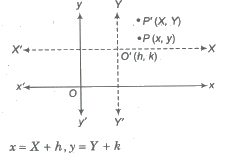
    Shifting of Origin

    Let the origin is shifted to a point O'(h, k). If P(x, y) are coordinates of a point referred to old axes and P’ (X, Y) are the coordinates of the same points referred to new axes, then

    CBSE Class 11 Maths Notes Rectangular Axis and Straight Lines

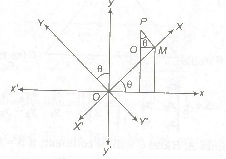
    Rotation of Axes

    Let (x, y) be the coordinates of any point P referred to the old axes and (X, Y) be its coordinates referred to the new axes (after rotating the old axes by angle θ). Then,

    X = x cos θ + y sin θ and Y = y cos θ + x sin θ

    CBSE Class 11 Maths Notes Rectangular Axis and Straight Lines

    Shifting of Origin and Rotation of Axes

    If origin is shifted to point (h, k) and system is also rotated by an angle θ in anti-clockwise, then coordinate of new point P’ (x’, y’) is obtained by replacing

    x’= h + x cos θ + y sin θ

    and y’ = k – x sin θ + y cos θ

    Locus

    The curve described by a point which moves under given condition(s) is called its locus.

    Equation of Locus

    The equation of the locus of a point which is satisfied by the coordinates of every point.

    Algorithm to Find the Locus of a Point

    Step I Assume the coordinates of the point say (h,k) whose locus is to be found.

    Step II Write the given condition in mathematical form involving h, k.

    Step III Eliminate the variable(s), if any.

    Step IV Replace h by x and k by y in the result obtained in step III. The equation so obtained is the locus of the point, which moves under some stated condition(s).

    Straight Line

    Any curve is said to be a straight line, if two points are taken on the curve such that every point on the line segment joining any two points on it lies on the curve.

    General equation of a line is ax + by + c = o.

    Slope (Gradient) of a Line )

    The trigonometric tangent of the angle that a line makes with the positive direction of the X-axis in anti-clockwise sense is called the slope or gradient of the line.

    So, slope of a line, m = tan θ

    where, θ is the angle made by the line with positive direction of X-axis.

    Important Results on Slope of Line

    (i) Slope of a line parallel to X-axis, m = 0.
    (ii) Slope of a line parallel to Y-axis, m = ∞.
    (iii) Slope of a line equally inclined with axes is 1 or -1 as it makes an angle of 45° or 135°, with X-axis.
    (iV) Slope of a line passing through (x, y,) and (x2, y2) is given by

    m = tan θ = y2 – y1 / x2 – x1.

    Angle between Two Lines

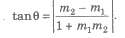
    The angle e between two lines having slopes m1 and m2 is

    CBSE Class 11 Maths Notes Rectangular Axis and Straight Lines

    (i) Two lines are parallel, iff m1 = m2.
    (ii) Two lines are perpendicular to each other, iff m1m2 = – 1.

    Equation of a Straight Line

    General equation of a straight line is Ax + By + C = 0.

    (i) The equation of a line parallel to X-axis at a distance b from it, is given by

    y = b

    (ii) The equation of a line parallel to Y-axis at a distance a from it, is given by

    x = a

    (iii) Equation of X-axis is

    y = 0

    (iv) Equation of Y-axis is

    x = 0

    Different Form of the Equation of a Straight Line

    (i) Slope Intercept Form The equation of a line with slope m and making an intercept c on Y-axis, is

    y = mx + c

    If the line passes through the origin, then its equation will be

    y= mx

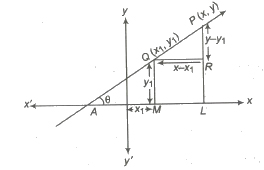
    (ii) One Point Slope Form The equation of a line which passes through the point (x1, y1) and has the slope of m is given by

    (y – y1) = m (x – x1)

    (iii) Two Points Form The equation of a line’ passing through the points (x1, y1) and (x2, y2) is given by

    (y – y1) = (y2 – y1 / x2 – x1) (x – x1)

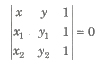
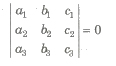
    This equation can also be determined by the determinant method, that is

    CBSE Class 11 Maths Notes Rectangular Axis and Straight Lines

    (iv) The Intercept Form The equation of a line which cuts off intercept a and b respectively on the X and Y-axes is given by

    x / a + y / b = 1

    The general equation Ax + By + C = 0 can be converted into the intercept form, as

    x / – (C A) + y / – (C B) = 1

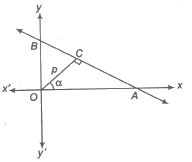
    (v) The Normal Form The equation of a straight line upon which the length of the perpendicular from the origin is p and angle made by this perpendicular to the X-axis is α, is given by

    x cos α + Y sin α = p

    CBSE Class 11 Maths Notes Rectangular Axis and Straight Lines

    (vi) The Distance (Parametric) Form The equation of a straight line passing through (x1, y1) and making an angle θ with the positive direction of x-axis, is

    x – x1 / cos θ = y – y1 / sin θ = r

    where, r is the distance between two points P(x, y) and Q(x1, y1).

    CBSE Class 11 Maths Notes Rectangular Axis and Straight Lines

    Thus, the coordinates of any point on the line at a distance r from the given point (x1, y1) are (x1 + r cos θ, y1 + r sin θ). If P is on the right side of (x1, y1) then r is positive and if P is on the left side of (x1, y1) then r is negative.

    Position of Point(s) Relative to a Given Line

    Let the equation of the given line be ax + by + C = 0 and let the Coordinates of the two given points be P(x1, y1) and Q(x2, y2).

    (i) The two points are on the same side of the straight line ax + by + c = 0, if ax1 + by1 + c and ax2 + by2 + c have the same sign.

    (ii) The two points are on the opposite side of the straight line ax + by + c = 0, if ax1 + by1 + c and ax2 + by2 + c have opposite sign.

    (iii) A point (x1, y1) will lie on the side of the origin relative to a line ax + by + c = 0, if ax1+ by1 + c and c have the same sign.

    (iv) A point (x1, y1) will lie on the opposite side of the origin relative to a line ax + by + c = 0, if ax1 + by1 + c and c have the opposite sign.

    (v) Condition of concurrency for three given lines ax1 + by1 + c1 = 0, ax2 + by2 + c2 and ax3 + by3 + c3 = 0 is a3(b1c2 – b2c1) + b3(c1a2 – a1c2) + c3(a1b2 – a2b1) = 0

    orCBSE Class 11 Maths Notes Rectangular Axis and Straight Lines

    (vi) Point of Intersection of Two Lines Let equation of lines be ax1 + by1 + c1 = 0 and ax2 + by2 + c2 = 0, then their point of intersection is

    (b1c2 – b2c1 / a1b2 – a2b1, c1a2 – c2a1 / a1b2 – a2b1).

    Line Parallel and Perpendicular to a Given Line

    (i) The equation of a line parallel to a given line ax + by + c = 0 is ax + by + λ = 0, where λ is a constant.

    (ii) The equation of a line perpendicular to a given line ax + by + c = is bx – ay + λ = 0, where λ is a constant.

    Image of a Point with Respect to a Line

    Let the image of a point (x1, y1) with respect to ax + by + c = 0 be (x2, y2), then

    x2 – x1 / a = y2 – y1 / b = – 2 (ax1 + by1 + c) / a2 + b2

    (i) The image of the point P(x1, y1) with respect to X-axis is Q(x1 – y1).

    (ii) The image of the point P(x1, y1) with respect to Y-axis is Q(-x1, y1).

    (iii) The image of the point P(x1, y1) with respect to mirror Y = x is Q(y1, x1).

    (iv) The image. of the point P(x1, y1) with respect to the line mirror y == x tan θ is

    x = x1 cos 2θ + y1 sin 2θ
    Y = x1 sin 2θ – y1 cos 2θ

    (v) The image of the point P(x1, y1) with respect to the origin is the point (-x1, y1).

    (vi) The length of perpendicular from a point (x1, y1) to a line ax + by + c = 0 is

    CBSE Class 11 Maths Notes Rectangular Axis and Straight Lines

    Equation of the Bisectors

    The equation of the bisectors of the angle between the lines

    a1x + b1y + c1 = 0

    and a2x + b2y + c2 = 0

    are given by

    a1x + b1y + c1 / √a21 + b21 = &plusmn a2x + b2y + c2 / √a22 + b22

    (i) If a1 a2 + b1 b2 > 0, then we take positive sign for obtuse and negative sign for acute.

    (ii) If a1 a2 + b1 b2 < 0, then we take negative sign for obtuse and positive sign for acute .

    Pair of Lines

    General equation of a pair of straight lines is ax2 + 2hxy + by2 + 2gx + 2fy + c = 0.

    Homogeneous Equation of Second Degree

    A rational, integral, algebraic equation in two variables x and y is said to be a homogeneous equation of the second degree, if the sum of the indices of x and y in each term is equal to 2.

    The general form of homogeneous equation of the second degree x and y is ax2 + 2hxy + by2 = 0, which passes through the origin.

    Important Properties

    If ax2 + 2hxy + by2 = 0 be an equation of pair of straight lines.

    (i) Slope of first line, m1 = – h + √h2 – ab / b

    and slope of second line, m2 = – h – √h2 – ab / b

    m1 + m2 = – 2h / b = – Coefficient of xy / Coefficient of y2

    and m1 m2 = a / b = Coefficient of x2 / Coefficient of y2

    Here, m1 and m2 are

    (a) real and distinct, if h2 > ab.

    (b) coincident, if h2 = ab.

    (c) imaginary, if h2 < ab.

    (ii) Angle between the pair of lines is given by

    tan θ = 2√h2 – ab / a + b

    (a) If lines are coincident, then h2 = ab
    (b) If lines are perpendicular, then a + b = o.

    (iii) The joint equation of bisector of the angles between the lines represented by the equation ax2 + 2hxy + by2 = 0 is

    x2 – b2 / a – b = xy / h ⇒ hx2 – (a – b)xy – hy2=0.

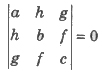
    (iv) The necessary and sufficient condition ax2 + 2hxy + by2 + 2gx + 2fy + C = 0 to represent a pair of straight lines, if abc + 2fgh – af2 – bg2 – ch2 = 0

    orCBSE Class 11 Maths Notes Rectangular Axis and Straight Lines

    (v) The equation of the bisectors of the angles between the lines represented by ax2 + 2hxy + by2 + 2gx + 2fy + c = 0 are given by

    (x – x1)2 – (y – y1)2 / a – b = (x – x1) (y – y1) / h,

    where, (x1, y1) is the point of intersection of the lines represented by the given equation.

    (vi) The general equation ax2 + 2hxy + by2 + 2gx + 2fy + C = 0 will represent two parallel lines, if g2 – ac > 0 and a / h = h / b = g / f and the distance between them is 2√g2 – ac / a(a + b) or 2√f2 – bc / b(a + b).

    (vii) If the equation of a pair of straight lines is ax2 + 2hxy + by2 + 2gx + 2fy + C = 0, then the point of intersection is given by

    (hf – bg / ab – h2, gh – af / ab – h2).

    (viii) The equation of the pair of lines through the origin and perpendicular to the pair of lines given by ax2 + 2hxy + by2 = 0 is bx2 – 2hxy + ay2 = 0.

    (ix) Equation of the straight lines having the origin to the points of intersection of a second degree curve ax2 + 2hxy + by2 + 2gx + 2fy + c = 0 and a straight line Lx + my + n = 0 is

    ax2 + 2hxy + by2 + 2gx(Lx + my / – n) + 2fy(Lx + my / – n) + c (Lx + my / – n)2 = 0.

    Important Points to be Remembered

    1. A triangle is an isosceles, if any two of its median are equal.

    2. In an equilateral triangle, orthocentre, centroid, circumcentre, incentre coincide.

    3. The circumcentre of a right angled triangle is the mid-point of the hypotenuse.

    4. Orthocentre, centroid, circumcentre of a triangle are collinear, Centroid divides the line joining orthocentre and circumcentre in the ratio 2: 1.

    5. If D, E and F are the mid-point of the sides BC, CA and AB of MBC, then the centroid of Δ ABC = centroid of Δ DEF.

    6. Orthocentre of the right angled Δ ABC, right angled at A is A

    7. Circumcentre of the right angled Δ ABC, right angled at A is B + C / 2.

    8. The distance of a point (x1, y1) from the ax + by + c = 0 is

    d = |ax1 + by1 + c / √a2 + b2|

    9. Distance between two parallel lines a1x + b1y + c1 = 0 and a1x + b1y + c2 = 0 is given by

    d = |c2 – c1 / √a2 + b2|.

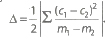
    10. The area of the triangle formed by the lines y =m1x + c1, y = m2x + c2 and y = m3x + c3 is .

    CBSE Class 11 Maths Notes Rectangular Axis and Straight Lines.

    11. Area of the triangle formed by the line ax + by + c = 0 with the coordinate axes is Δ = c2 / 2|ab|.

    12. The foot of the perpendicular(h,k) from (x1, y1) to the line ax + by + c = 0 is given by h – x1 / a = k – y1 / b = – (ax1 + by1 + c) / a2 + b2.

    13. Area of rhombus formed by ax ± by ± c = 0 is |2c2 / ab|.

    14. Area of the parallelogram formed by the lines

    a1x + b1y + c1 = 0, a2x + b2y + c2 = 0, a1x + b1y + d1 = 0 and a2x + b2y + d2 = 0 is

    |(d1 – c1) (d2 – c2 / a1b2 – a2b1|.

    15. (a) Foot of the perpendicular from (a, b) on x – y = 0 is

    (a + b / 2, a + b / 2).

    (b) Foot of the perpendicular from (a,b) on x + y = 0 is

    (a – b / 2, a – b / 2).

    16. The image of the line a1x + b1y + c1 = 0 about the line ax + by + c = 0 is .

    2(aa1 + bb1) (ax + by + c) =(a2+ b2) (a1x + b1y + c1).

    17. Given two vertices (x1, y1) and (x2, y2) of an equilateral MBC, then its third vertex is given by.

    [x1 + x2 ± √3 (y1 – y2) / 2, y1 + y2 ∓ √3 (x1 – x2) / 2]

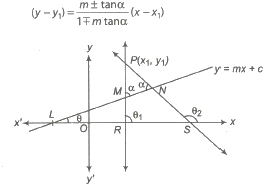
    18. The equation of the straight line which passes through a given point (x1, y1) and makes an angle α with the given straight line y = mx + c are

    CBSE Class 11 Maths Notes Rectangular Axis and Straight Lines

    19. The equation of the family of lines passing through the intersection of the lines a1x + b1y+ c1 = 0 and a2x + b2y + c2 = 0 is

    (a1x + b1y+ c1) + l(a2x + b2y + c2) = 0

    where, λ is any real number.

    20. Line ax + by + c = 0 divides the line joining the points (x1, y1) and (x2, y2) in the ratio λ : 1, then λ = – (a1x + b1y+ c / a2x + b2y + c).

    If λ is positive it divides internally and if λ. is negative, then it divides externally.

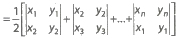
    21. Area of a polygon of n-sides with vertices A1(x1, y1), A2 (x2, y2) ,… ,An(xn, yn)

    CBSE Class 11 Maths Notes Rectangular Axis and Straight Lines

    22. Equation of the pair of lines through (α, β) and perpendicular to the pair of lines ax2 + 2hxy + by2 = 0 is b (x – α}2 – 2h (x – α)(y – β) + a (y – β)2= 0.

  • Solutions of Triangles, Heights & Distances Notes Class 11th Maths

    Basic Rules of Triangle

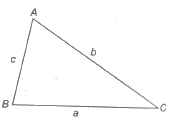
    CBSE Class 11 Maths Notes Solution of Triangles, Heights and Distances

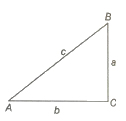
    In ΔABC, the angles are denoted by capital letters A, Band C and the lengths of the sides opposite to these angles are denoted by small letters a, b and c, respectively. Semi-perimeter of the triangle is written as

    s= a + b + c / 2

    and area denoted by Δ.

    (i) Sine Rule sin A / a = sin B / b = sin C / c = 1 / 2R, where R is the radius of the circumstances of the ΔABC.

    (ii) Cosine Rule

    cos A = b2 + c2 – a2 / 2bc

    cos B = a2 + c2 – b2 / 2ac

    cos C = a2 + b2 – c2 / 2ab

    (iii) Projection Rule a = b cos C + c cos B,

    b = c cos A + a cos C and c = a cos B + b cos A

    (iV) Napier’s Analogy tan B – C / 2 = b – c / b + c cot A / 2,

    tan C – A / 2 = c – a / c + a cot B / 2 and tan A – B / 2 = a – b / a + b cot C / 2

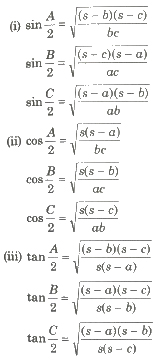
    Trigonometrical Ratios of Half of the Angles

    CBSE Class 11 Maths Notes Solution of Triangles, Heights and Distances

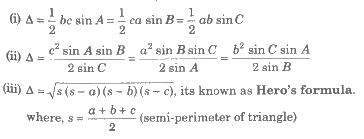
    Area of Triangles

    Consider a triangle of side a, b and c.

    CBSE Class 11 Maths Notes Solution of Triangles, Heights and Distances

    (iv) Δ = abc / 4R = rs

    where, R and r are the radii of the circumcircle and the incircle of the ΔABC, respectively.

    Solution of Triangles

    Elements of a Triangle

    There are six elements of a triangle, in which three are its sides and other three are its angle.

    If three elements of a triangle are given, atleast one of which is its side; then other elements can be uniquely calculated. This is called solving the triangle.

    1. Solutions of a Right Angled Triangle

    Let ΔABC be a given triangle with right angle at C, then

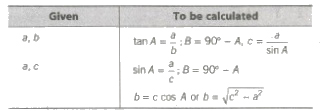
    (i) solution when two sides are given

    CBSE Class 11 Maths Notes Solution of Triangles, Heights and Distances

    CBSE Class 11 Maths Notes Solution of Triangles, Heights and Distances

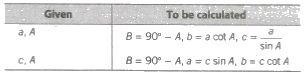
    (ii) solution when one side and one a cute angle are given

    CBSE Class 11 Maths Notes Solution of Triangles, Heights and Distances

    2. Solutions of a Triangle in General

    (i) Solution when three sides a, band c are given, then

    sin A = 2Δ / bc, sin B = 2Δ / ac, sin C = 2Δ / ab

    where, Δ = √s(s – a)(s – b)(s – c) and s = a + b + c / 2

    and A + B + C = 180°

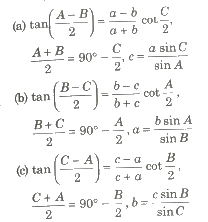
    (ii) Solution when two sides and the included angle are given, then

    CBSE Class 11 Maths Notes Solution of Triangles, Heights and Distances

    This is called as Napier’s analogy.

    (iii) Solution when one side a and two angles A and B are given, then

    C = 180° – (A + B)

    b = c sin B / sin C and C = sin C / sin A

    (iv) Solution when two sides a, b and the opposite ∠A is given, then

    sin B = b / a sin A, C = 180° – (A + B), c = a sin C / sin A

    Now, different cases arises here.

    (a) If A is an acute angle and a < b sin A, then sin B = b / a sin A gives sin B > 1, which is not possible, so no such triangle is possible.

    (b) When A is an acute angle and a = b sin A In this case, only one triangle is possible, which is right angled at B.

    (c) If A is an acute angle and a > b sin A In this case, there are two values of B given by

    sin B = b sin A / a, say B1 and B2 such that B1 + B2 = 180°,

    side c can be calculated from

    c = a sin C / sin A

    Circles Connected with Triangle

    1. Circumcircle

    CBSE Class 11 Maths Notes Solution of Triangles, Heights and Distances

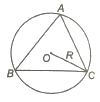
    The circle passing through the vertices of the ΔABC is called the circumcircle. Its radius R is called the circumradius.

    R = a / 2 sin A = b / 2 sin B = c / 2 sin C = abc / 4 Δ

    2.Incircle

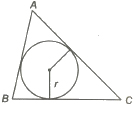
    The circle touches the three sides of the A triangle internally is called the inscribed or the incircle of the triangle. Its radius r is called inradius of the circle.

    CBSE Class 11 Maths Notes Solution of Triangles, Heights and Distances

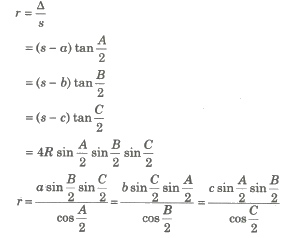
    CBSE Class 11 Maths Notes Solution of Triangles, Heights and Distances

    3. Escribed Circle

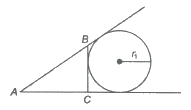
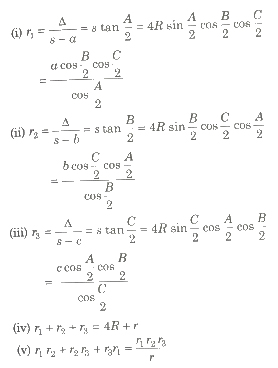
    The circle touches BC and the two sides AB and AC produced of ΔABC externally is called the escribed circle opposite A. Its radius is denoted by rl.

    CBSE Class 11 Maths Notes Solution of Triangles, Heights and Distances

    similarly, r2 and r3 denote the radii of the escribed circles opposite angles Band C, respectively. Hence, rl, r2 and r3 are called the exradius of &DeltaABC. Here,

    CBSE Class 11 Maths Notes Solution of Triangles, Heights and Distances

    4. Orthocentre and Pedal Triangle

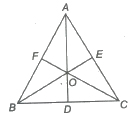
    The point of intersection of perpendicular drawn from the vertices on the opposite sides of a triangle is called orthocentre.

    CBSE Class 11 Maths Notes Solution of Triangles, Heights and Distances

    The ΔDEF formed by joining the feet of the altitudes is called the pedal triangle.

    (i) Distance of the orthocentre of the triangle from the angular points are 2R cos A, 2R co~ B, 2R cos C and its distances from the sides are 2 R cos B cos C, 2 R cos C cos A, 2 R cos A cos B.

    (ii) The length of medians AD, BE and CF of a Δ ABC are

    AD = 1 / 2 √2b2 + 2c2 – a2

    BE 1 / 2 √2c2 + 2a2 – b2

    CF = 1 / 2 √2a2 + 2b2 – c2

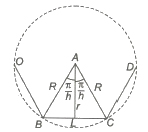
    Radii of the Inscribed and Circumscribed Circles of Regular Polygon

    CBSE Class 11 Maths Notes Solution of Triangles, Heights and Distances

    (i) R = a / 2 cosec π / n

    (ii) r = a / 2 cot π / n, where a is the length of a side of polygon.

    (iii) The area of the polygon = n (Area of AABC)

    = 1 / 4na2 cot (π / n)

    = nr2 tan π / n = n / 2 R2 sin (2π / n)

    Some Properties of Triangle

    (i) The mid-point of the hypotenuse of a right angled triangle is equidistant from the three vertices of the triangle.

    (ii) The mid-point of the hypotenuse of a right angled triangle is the circumcentre of the triangle.

    (iii) If any triangle, the exterior angle is equal to the sum of interior opposite angles.

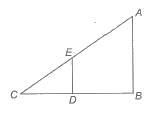
    (iv) In a Δ ABC, if DE||AB, then

    CBSE Class 11 Maths Notes Solution of Triangles, Heights and Distances

    AB / DE = BC / DC = AC / EC

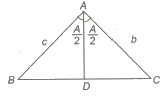
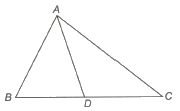
    (v) In any Δ ABC, if AD is the angle bisector of ∠ BAC, then

    CBSE Class 11 Maths Notes Solution of Triangles, Heights and Distances

    BD / DC = AB / AC = c / b

    (vi) Appollonius Theorem If AD is median of the &dELTA; ABC, then

    CBSE Class 11 Maths Notes Solution of Triangles, Heights and Distances

    AB2 + AC2 = 2 (AD2 + BD2)

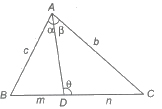
    (vii) m-n Theorem In a ΔABC, D is a A point on the line BC such that BD : DC= m: n and ∠ADC = θ, ∠BAD = α, ∠DAC = β, then

    CBSE Class 11 Maths Notes Solution of Triangles, Heights and Distances

    (a) (m + n) cot θ = m cot α – n cot β

    (b) (m + n) cot θ = n cot B – m cot C

    (viii) In an isosceles triangle, the median is perpendicular to the base.

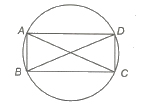
    (ix) ptolemy’s Theorem In a cyclic quadrilateral ABCD

    AB x CD + AD x BC = AC x BD

    CBSE Class 11 Maths Notes Solution of Triangles, Heights and Distances

    Heights and Distances

    Angle of Elevation

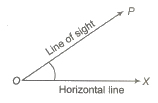
    If O be the observer’s eye and OX be the p horizontal line through O. If the object P is at higher level than eye, then ∠POX is called the angle of elevation.

    CBSE Class 11 Maths Notes Solution of Triangles, Heights and Distances

    Angle of Depression

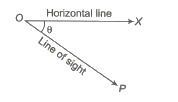
    If the object P is a lower level than O, then ∠POX is called the angle of depression.

    CBSE Class 11 Maths Notes Solution of Triangles, Heights and Distances

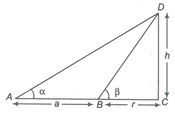
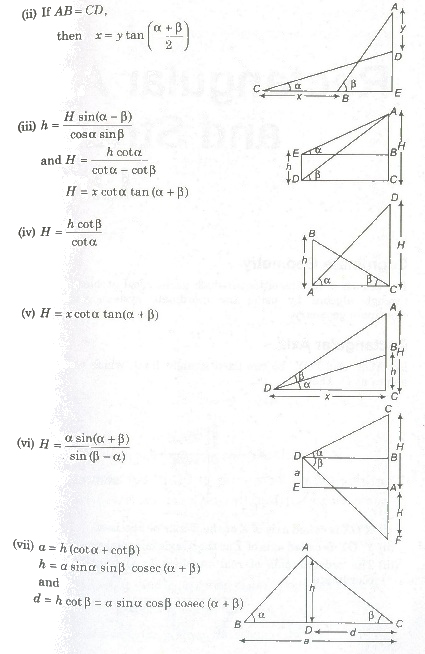
    Important Results on Height and Distance

    (i) a = h (cot α – cot β)

    CBSE Class 11 Maths Notes Solution of Triangles, Heights and Distances

    CBSE Class 11 Maths Notes Solution of Triangles, Heights and Distances

  • Inverse T Functions & T-Equations Notes Class 11th Maths

    Inverse Function

    If y = f(x) and x = g(y) are two functions such that f (g(y)) = y and g (f(y)) = x, then f and y are said to be inverse of each other

    i.e., g = f-1

    IF y = f(x), then x = f-1(y)

    Inverse Trigonometric Functions

    If y = sin X-1, then x = sin-1 y, similarly for other trigonometric functions.

    This is called inverse trigonometric function .

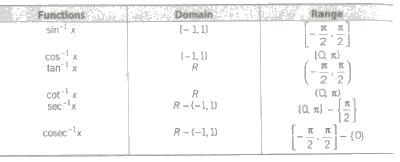
    Now, y = sin-1(x), y ∈ [π / 2 , π / 2] and x ∈ [-1,1].

    (i) Thus, sin-1x has infinitely many values for given x ∈ [-1, 1].

    (ii) There is only one value among these values which lies in the interval [π / 2 , π / 2]. This value is called the principal value.

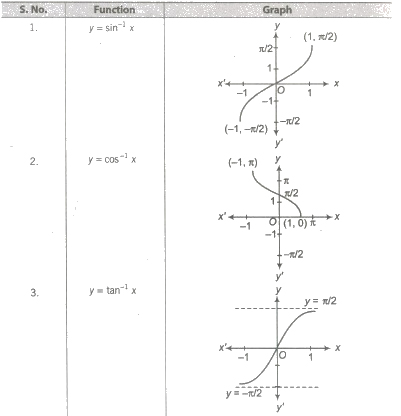
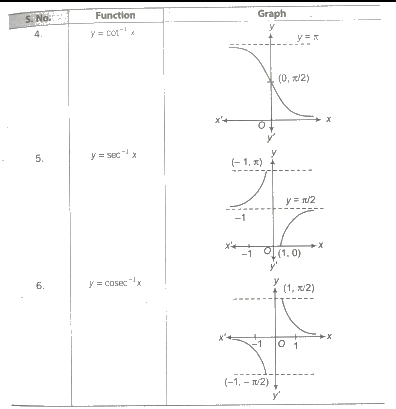
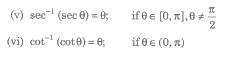
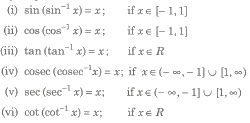
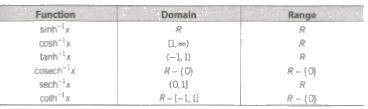
    Domain and Range of Inverse Trigonometric FunctionsGraphs of Inverse Trigonometric Functions

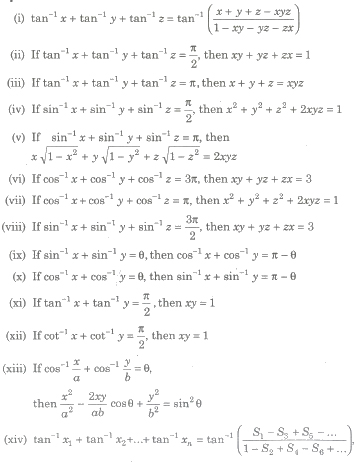
    CBSE Class 11 and 12 Maths Notes Inverse T - Functions and T - EquationsCBSE Class 11 and 12 Maths Notes Inverse T - Functions and T - Equations

    CBSE Class 11 and 12 Maths Notes Inverse T - Functions and T - Equations

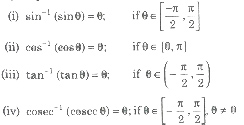
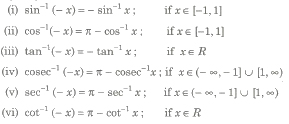
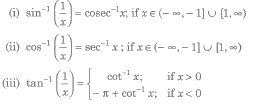
    Properties of Inverse Trigonometric Functions

    Property I

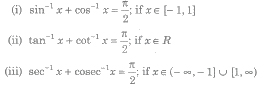
    CBSE Class 11 and 12 Maths Notes Inverse T - Functions and T - Equations

    CBSE Class 11 and 12 Maths Notes Inverse T - Functions and T - Equations

    Property II

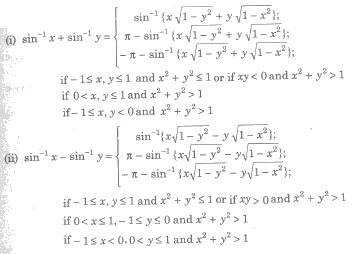
    CBSE Class 11 and 12 Maths Notes Inverse T - Functions and T - Equations

    Property III

    CBSE Class 11 and 12 Maths Notes Inverse T - Functions and T - Equations

    Property IV

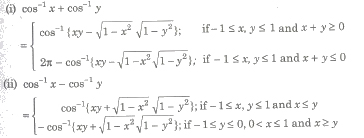
    CBSE Class 11 and 12 Maths Notes Inverse T - Functions and T - Equations

    Property V

    CBSE Class 11 and 12 Maths Notes Inverse T - Functions and T - Equations

    Property VI

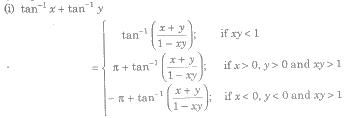
    CBSE Class 11 and 12 Maths Notes Inverse T - Functions and T - Equations

    Property VII

    CBSE Class 11 and 12 Maths Notes Inverse T - Functions and T - Equations

    Property VIII

    CBSE Class 11 and 12 Maths Notes Inverse T - Functions and T - Equations

    CBSE Class 11 and 12 Maths Notes Inverse T - Functions and T - Equations

    Property IX

    CBSE Class 11 and 12 Maths Notes Inverse T - Functions and T - Equations

    Property X

    CBSE Class 11 and 12 Maths Notes Inverse T - Functions and T - Equations

    CBSE Class 11 and 12 Maths Notes Inverse T - Functions and T - Equations

    Property XI

    CBSE Class 11 and 12 Maths Notes Inverse T - Functions and T - Equations

    Property XII

    CBSE Class 11 and 12 Maths Notes Inverse T - Functions and T - Equations

    CBSE Class 11 and 12 Maths Notes Inverse T - Functions and T - Equations

    Important Results

    CBSE Class 11 and 12 Maths Notes Inverse T - Functions and T - Equations

    where Sk denotes the sum of the product of x1,x2,…xn takes k at a time.

    Inverse Hyperbolic Functions

    If sinh y = x, then y is called the inverse hyperbolic sine of x and it is written as y = sinh-1x.

    Similarly, cosh-1 x, tan h-1 x etc., can be defined,

    Domain and Range of Inverse Hyperbolic Functions

    CBSE Class 11 and 12 Maths Notes Inverse T - Functions and T - Equations

    Relation between Inverse Circular Functions and Inverse Hyperbolic Functions

    (i) sinh-1x = – i sin-1(ix)

    (ii) cosh-1x = – i cos-1 x .

    (iii) tanh--1x = – i tan-1(ix)

    Important Results

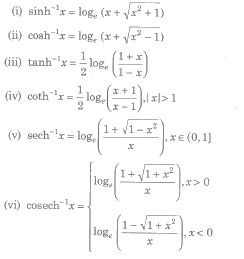
    CBSE Class 11 and 12 Maths Notes Inverse T - Functions and T - Equations

    Trigonometric Equation

    An equation involving one or more trigonometrical ratios of unknown angle is called a trigonometric equation .

    Solution/Roots of a Trigonometric Equation

    A value of the unknown angle which satisfies the given equation, is called a solution or root of the equation.

    The trigonometric equation may have infinite number of solutions.

    (i) Principal Solution – The least value of unknown angle which satisfies the given equation, is called a principal solution of trigonometric equation.

    (ii) General Solution – We know that, trigonometric function are periodic and solution of trigonometric equations can be generalised with the help of the periodicity of the trigonometric functions. The solution consisting of all possible solutions of a trigonometric equation is called its general solution.

    Important Results

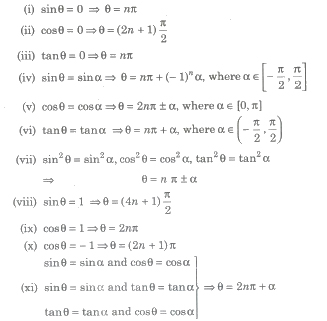
    CBSE Class 11 and 12 Maths Notes Inverse T - Functions and T - Equations

    CBSE Class 11 and 12 Maths Notes Inverse T - Functions and T - Equations

    Important Points to be Remembered

    (i) While solving an equation, we have to square it, sometimes the resulting roots does not satisfy the original equation.

    (ii) Do not cancel common factors involving the unknown angle on LHS and RHS.Because it may be the solution of given equation.

    (iii) (a) Equation involving sec θ or tan θ can never be a solution of the form (2n + 1) π / 2.

    (b) Equation involving coseca or cote can never be a solution of the form θ = nπ.
    For Class 11

  • Trigonometric Ratios and Identities Notes Class 11th Maths

    Angle

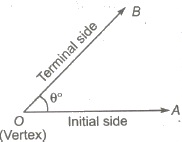
    When a ray OA starting from its initial position OA rotates about its end point 0 and takes the final position OB, we say that angle
    AOB (written as ∠ AOB) has been formed. The amount of rotation from the initial side to the terminal side is Called the measure of
    the angle.

    CBSE Class 11 Maths Notes Trigonometric Ratios and Identities

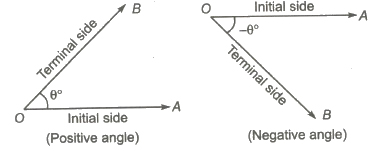
    Positive and Negative Angles

    An angle formed by a rotating ray is said to be positive or negative depending on whether it moves in an anti-clockwise or a clockwise direction, respectively.

    CBSE Class 11 Maths Notes Trigonometric Ratios and Identities

    Measurement of Angles

    There are three system for measuring angles,

    1. Sexagesimal System/Degree Measure (English System)

    In this system, a right angle is divided into 90 equal parts, called degrees. The symbol 1° is used to denote one degree. Each degree is divided into 60 equal parts, called minutes and one minute is divided into 60 equal parts, called seconds. Symbols 1′ and 1″ are used to denote one minute and one second, respectively.

    i.e., 1 right angle = 90°
    1° = 60′
    1′ = 60″

    2. Centesimal System (French System)

    In this system, a right angle is divided into 100 equal parts, called ‘grades’. Each grade is subdivided into 100 min and each minute is divided into 100 s.

    i.e., 1 right angle = 100 grades = 100g
    1g = 100′
    1′ = 100″

    3. Circular System (Radian System)

    In this system, angle is measured in radian.

    A radian is the angle subtended at the centre of a circle by an arc, whose length is equal to the radius of the circle.

    The number of radians in an angle subtended by an arc of circle at the centre is equal to arc/radius.

    Relationships

    (i) π radian = 180°
    or 1 radian (180°/π)= 57°16’22”
    where, π = 22/7 = 3.14159

    (ii) 1° = (π/180) rad = 0.01746 rad

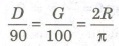
    (iii) If D is the number of degrees, R is the number of radians and G is the number of grades in an angle θ, then
    CBSE Class 11 Maths Notes Trigonometric Ratios and Identities

    (iv) θ = l/r where θ = angle subtended by arc of length / at the centre of the circle, r = radius of the circle.

    Trigonometric Ratios

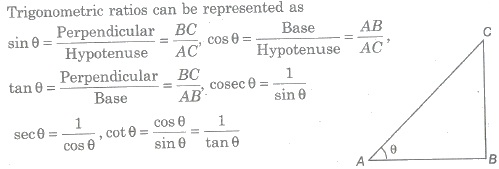
    Relation between different sides and angles of a right angled triangle are called trigonometric ratios or T-ratios

    CBSE Class 11 Maths Notes Trigonometric Ratios and Identities

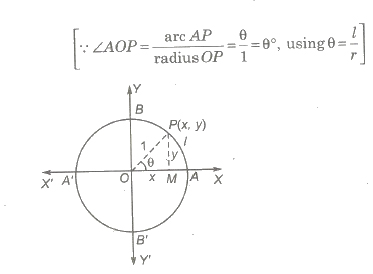
    Trigonometric (or Circular) Functions

    Let X’OX and YOY’ be the coordinate axes. Taking 0 as the centre and a unit radius, draw a circle, cutting the coordinate axes at A,B, A’ and B’, as shown in the figure.
    CBSE Class 11 Maths Notes Trigonometric Ratios and Identities

    Now, the six circular functions may be defined as under
    (i) cos θ = x
    (ii) sin θ = y
    (iii) sec θ = 1/x, x ≠ 0
    (iv) cosec θ = 1/y, y ≠ 0
    (v) tan θ = y/x, x ≠ 0
    (vi) cot θ = x/y, y ≠ 0

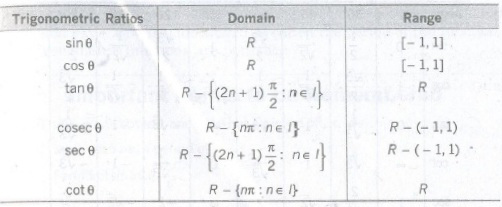
    Domain and Range

    CBSE Class 11 Maths Notes Trigonometric Ratios and Identities

    Range of Modulus Functions

    |sin θ|≤ 1, |cos θ| ≤ 1, |sec θ| ≥ 1, |Cosec θ| ≥ 1 for all values of 0, for which the functions are defined.

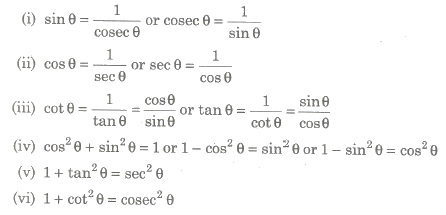
    Trigonometric Identities

    An equation involving trigonometric functions which is true for all those angles for which the functions are defined is called trigonometrical identity. Some identities are
    CBSE Class 11 Maths Notes Trigonometric Ratios and Identities

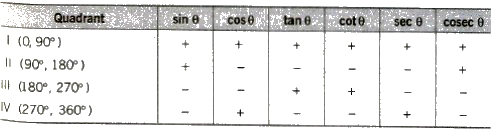
    Sign of Trigonometric Ratios

    CBSE Class 11 Maths Notes Trigonometric Ratios and Identities

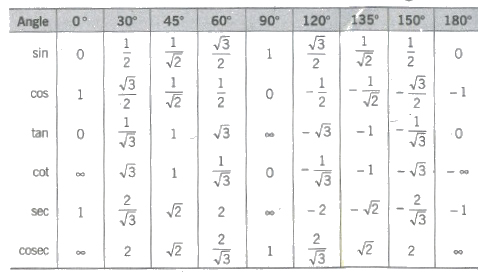
    Trigonometric Ratios of Some Standard Angles
    CBSE Class 11 Maths Notes Trigonometric Ratios and Identities

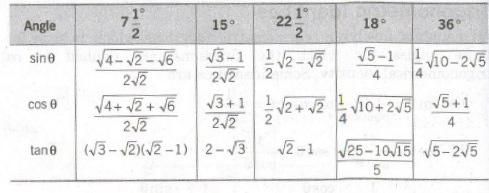
    Trigonometric Ratios of Some Special Angles

    CBSE Class 11 Maths Notes Trigonometric Ratios and Identities

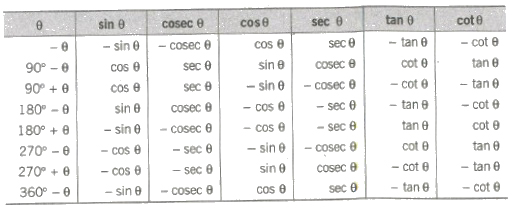
    Trigonometric Ratios of Allied Angles

    Two angles are said to be allied when their sum or difference is either zero or a multiple of 90°. The angles — θ, 90° ± θ, 180° ± θ, 270° + θ, 360° —θ etc., are angles allied to the angle θ, if θ is measured in degrees.
    CBSE Class 11 Maths Notes Trigonometric Ratios and Identities

    Trigonometric Periodic Functions

    A function f(x) is said to be periodic, if there exists a real number T> 0 such that f(x + T)= f(x) for all x. T is called the period of the function, all trigonometric functions are periodic.

    CBSE Class 11 Maths Notes Trigonometric Ratios and Identities

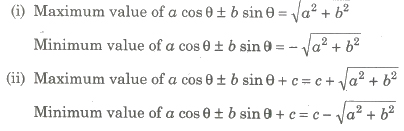
    Maximum and Minimum Values of Trigonometric Expressions

    CBSE Class 11 Maths Notes Trigonometric Ratios and Identities

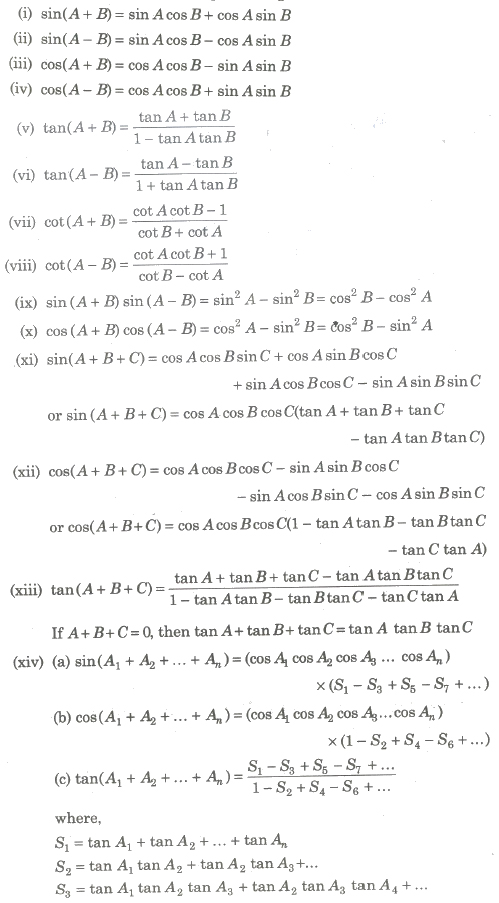
    Trigonometric Ratios of Compound Angles

    The algebraic sum of two or more angles are generally called compound angles and the angles are known as the constituent angle. Some standard formulas of compound angles have been given below.

    CBSE Class 11 Maths Notes Trigonometric Ratios and Identities
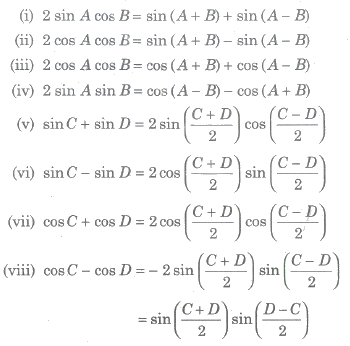
    Transformation Formulae
    CBSE Class 11 Maths Notes Trigonometric Ratios and Identities

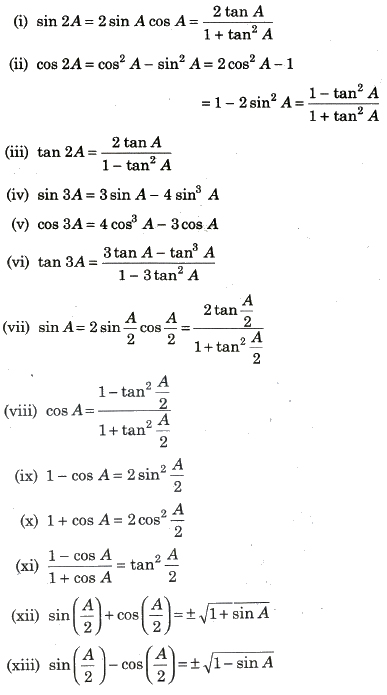
    Trigonometric Ratios of Multiple Angles

    CBSE Class 11 Maths Notes Trigonometric Ratios and Identities

    Trigonometric Ratios of Some Useful Angles

    CBSE Class 11 Maths Notes Trigonometric Ratios and Identities
    CBSE Class 11 Maths Notes Trigonometric Ratios and Identities

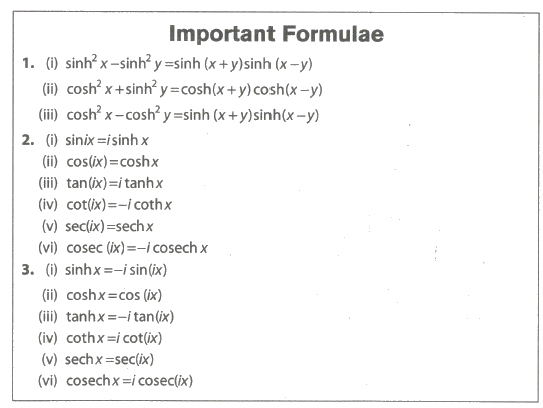
    Hyperbolic Functions

    The hyperbolic functions sinh , cosh z, tanh z, cosech z, sec h z , coth z are angles of the circular functions, defined by removing is appearing in the complex exponentials.

    CBSE Class 11 Maths Notes Trigonometric Ratios and Identities
    Domain and Range of Hyperbolic Function

    CBSE Class 11 Maths Notes Trigonometric Ratios and Identities

    identities

    (i) cosh2x – sinh2x = 1
    (ii) sech2x + tanh2x =1
    (iii) coth2x – cosech2x = 1
    (iv) cosh2x + sinh2x = cosh2x

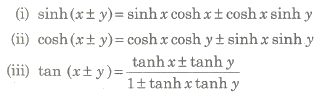
    Formulae for the Sum and Difference

    CBSE Class 11 Maths Notes Trigonometric Ratios and Identities
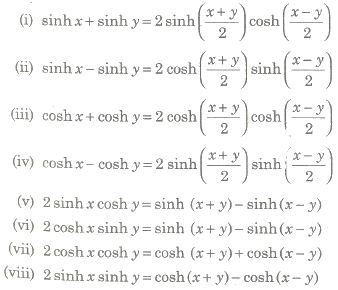
    Formulae to Transform the Product into Sum or Difference
    CBSE Class 11 Maths Notes Trigonometric Ratios and Identities
    Formulae for Multiples of x
    CBSE Class 11 Maths Notes Trigonometric Ratios and Identities
    CBSE Class 11 Maths Notes Trigonometric Ratios and Identities

  • Binomial Theorem and Mathematical Induction Notes Class 11th Maths

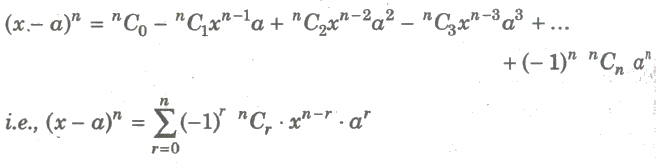
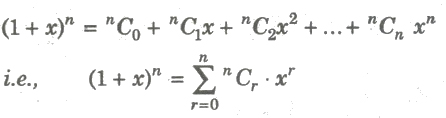
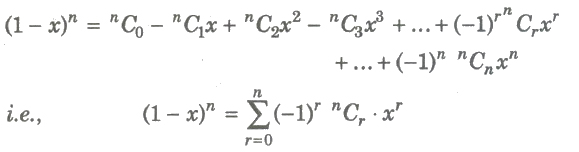
    Binomial Theorem for Positive Integer

    If n is any positive integer, then

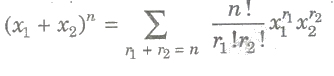
    CBSE Class 11 Maths Notes Binomial Theorem and Mathematical Induction

    This is called binomial theorem.

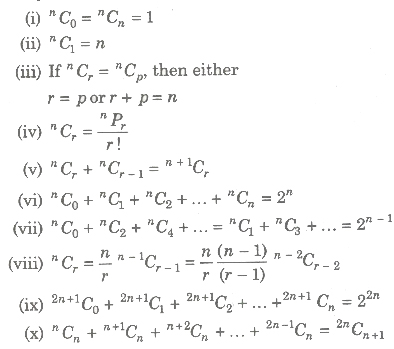
    Here, nC0nC1nC2, … , nno are called binomial coefficients and

    nCr = n! / r!(n – r)! for 0 ≤ r ≤ n.

    Properties of Binomial Theorem for Positive Integer

    (i) Total number of terms in the expansion of (x + a)n is (n + 1).

    (ii) The sum of the indices of x and a in each term is n.

    (iii) The above expansion is also true when x and a are complex numbers.

    (iv) The coefficient of terms equidistant from the beginning and the end are equal. These coefficients are known as the binomial coefficients and

    nCr = nCn – r, r = 0,1,2,…,n.

    (v) General term in the expansion of (x + c)n is given by

    Tr + 1 = nCrxn – r ar.

    (vi) The values of the binomial coefficients steadily increase to maximum and then steadily decrease .

    (vii)CBSE Class 11 Maths Notes Binomial Theorem and Mathematical Induction

    (viii)CBSE Class 11 Maths Notes Binomial Theorem and Mathematical Induction

    (ix) The coefficient of xr in the expansion of (1+ x)n is nCr.

    (x)

    (xi) (a)CBSE Class 11 Maths Notes Binomial Theorem and Mathematical Induction

    (b)CBSE Class 11 Maths Notes Binomial Theorem and Mathematical Induction

    (xii) (a) If n is odd, then (x + a)n + (x – a)n and (x + a)n – (x – a)n both have the same number of terms equal to (n +1 / 2).

    (b) If n is even, then (x + a)n + (x – a)n has (n +1 / 2) terms. and (x + a)n – (x – a)n has (n / 2) terms.

    (xiii) In the binomial expansion of (x + a)n, the r th term from the end is (n – r + 2)th term fromCBSE Class 11 Maths Notes Binomial Theorem and Mathematical Inductionthe beginning.

    (xiv) If n is a positive integer, then number of terms in (x + y + z)n is (n + l)(n + 2) / 2.

    Middle term in the Expansion of (1 + x)n

    (i) It n is even, then in the expansion of (x + a)n, the middle term is (n/2 + 1)th terms.

    (ii) If n is odd, then in the expansion of (x + a)n, the middle terms are (n + 1) / 2 th term and (n + 3) / 2 th term.

    Greatest Coefficient

    (i) If n is even, then in (x + a)n, the greatest coefficient is nCn / 2

    (ii) Ifn is odd, then in (x + a)n, the greatest coefficient is nCn – 1 / 2 or nCn + 1 / 2 both being equal.

    Greatest Term

    In the expansion of (x + a)n

    (i) If n + 1 / x/a + 1 is an integer = p (say), then greatest term is Tp == Tp + 1.

    (ii) If n + 1 / x/a + 1 is not an integer with m as integral part of n + 1 / x/a + 1, then Tm + 1. is the greatest term.

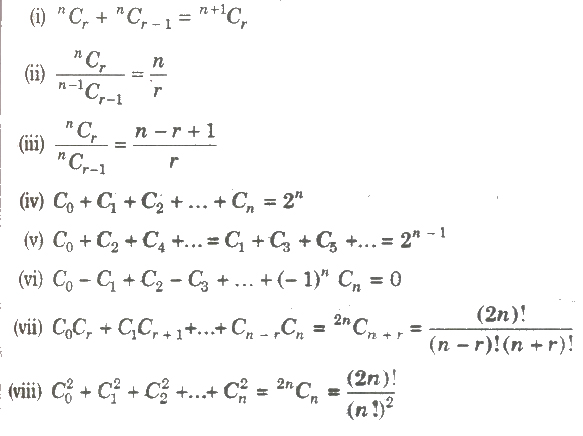
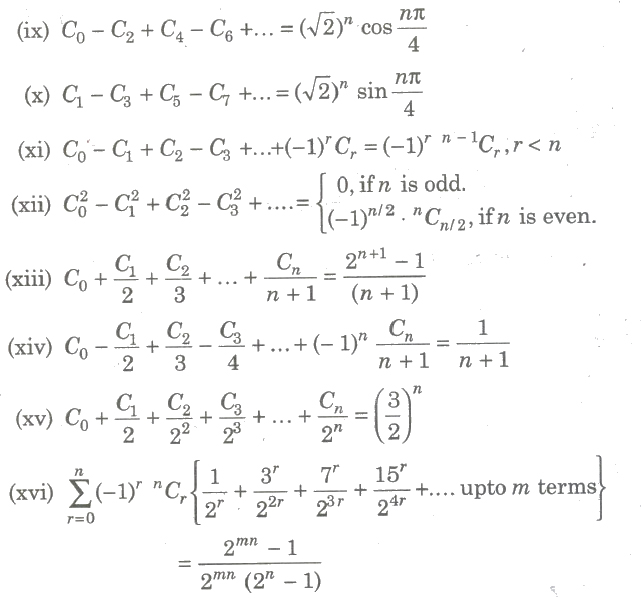
    Important Results on Binomial Coefficients

    CBSE Class 11 Maths Notes Binomial Theorem and Mathematical Induction
    CBSE Class 11 Maths Notes Binomial Theorem and Mathematical Induction

    Divisibility Problems

    From the expansion, (1+ x)n = 1+ nC1x + nC1x2+ … +nCnxn

    We can conclude that,

    (i) (1+ x)n – 1 = nC1x + nC1x2+ … +nCnxn is divisible by x i.e., it is multiple of x.

    (1+ x)n – 1 = M(x)

    (ii)CBSE Class 11 Maths Notes Binomial Theorem and Mathematical Induction

    (iii)CBSE Class 11 Maths Notes Binomial Theorem and Mathematical Induction

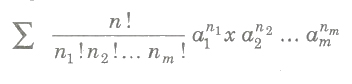
    Multinomial theorem

    For any n ∈ N,

    (i)CBSE Class 11 Maths Notes Binomial Theorem and Mathematical Induction

    (ii)CBSE Class 11 Maths Notes Binomial Theorem and Mathematical Induction

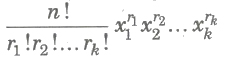
    (iii) The general term in the above expansion is

    CBSE Class 11 Maths Notes Binomial Theorem and Mathematical Induction

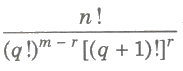
    (iv)The greatest coefficient in the expansion of (x1 + x2 + … + xm)n isCBSE Class 11 Maths Notes Binomial Theorem and Mathematical Inductionwhere q and r are the quotient and remainder respectively, when n is divided by m.

    (v) Number of non-negative integral solutions of x1 + x2 + … + xn = n is n + r – 1Cr – 1

    R-f Factor Relations

    Here, we are going to discuss problem involving (√A + B)sup>n = I + f, Where I and n are positive integers.

    0 le; f le; 1, |A – B2| = k and |√A – B| < 1

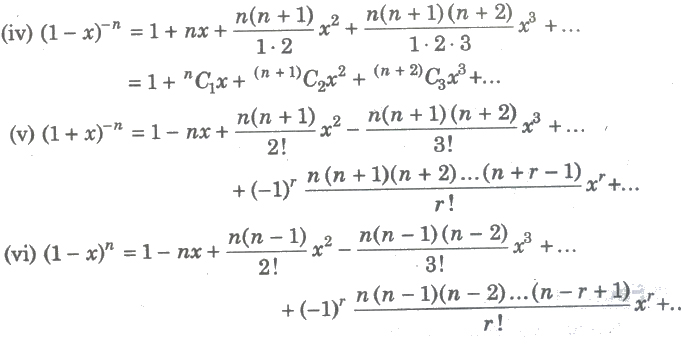
    Binomial Theorem for any Index

    If n is any rational number, then

    CBSE Class 11 Maths Notes Binomial Theorem and Mathematical Induction

    (i) If in the above expansion, n is any positive integer, then the series in RHS is finite otherwise infinite.

    (ii) General term in the expansion of (1 + x)n is Tr + 1 = n(n – 1)(n – 2)… [n – (r – 1)] / r! * xr

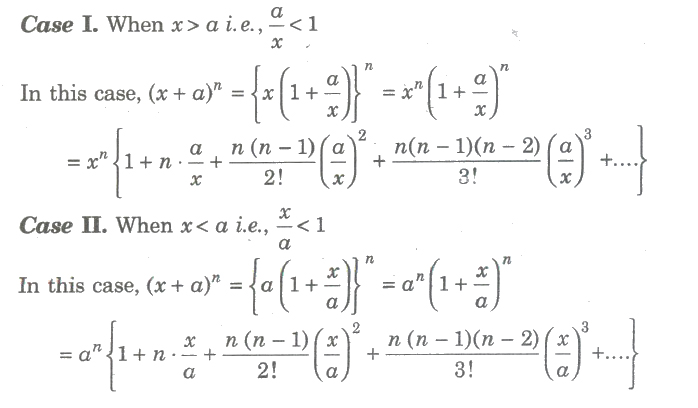
    (iii) Expansion of (x + a)n for any rational index

    CBSE Class 11 Maths Notes Binomial Theorem and Mathematical Induction

    CBSE Class 11 Maths Notes Binomial Theorem and Mathematical Induction

    (vii) (1 + x)– 1 = 1 – x + x2 – x3 + …∞

    (viii) (1 – x)– 1 = 1 + x + x2 + x3 + …∞

    (ix) (1 + x)– 2 = 1 – 2x + 3x2 – 4x3 + …∞

    (x) (1 – x)– 2 = 1 + 2x + 3x2 – 4x3 + …∞

    (xi) (1 + x)– 3 = 1 – 3x + 6x2 – …∞

    (xii) (1 – x)– 3 = 1 + 3x + 6x2 – …∞

    (xiii) (1 + x)n = 1 + nx, if x2, x3,… are all very small as compared to x.

    Important Results

    (i) Coefficient of xm in the expansion of (axp + b / xq)n is the coefficient of Tr + l where r = np – m / p + q

    (ii) The term independent of x in the expansion of axp + b / xq)n is the coefficient of Tr + lwhere r = np / p + q

    (iii) If the coefficient of rth, (r + l)th and (r + 2)th term of (1 + x)n are in AP, then n2 – (4r+1) n + 4r2 = 2

    (iv) In the expansion of (x + a)n

    Tr + 1 / Tr = n – r + 1 / r * a / x

    (v) (a) The coefficient of xn – 1 in the expansion of

    (x – l)(x – 2) ….(x – n) = – n (n + l) / 2

    (b) The coefficient of xn – 1 in the expansion of

    (x + l)(x + 2) ….(x + n) = n (n + l) / 2

    (vi) If the coefficient of pth and qth terms in the expansion of (1 + x)n are equal, then p + q = n + 2

    (vii) If the coefficients of xr and xr + 1 in the expansion of a + x / b)n are equal, then

    n = (r + 1)(ab + 1) – 1

    (viii) The number of term in the expansion of (x1 + x2 + … + xr)n is n + r – 1C r – 1.

    (ix) If n is a positive integer and a1, a2, … , am ∈ C, then the coefficient of xr in the expansion of (a1 + a2x + a3x2 +… + amxm – 1)n is

    CBSE Class 11 Maths Notes Binomial Theorem and Mathematical Induction

    (x) For |x| < 1,

    (a) 1 + x + x2 + x3+ … + ∞ = 1 / 1 – x

    (b) 1 + 2x + 3x2 + … + ∞ = 1 / (1 – x)2

    (xi) Total number of terms in the expansion of (a + b + c + d)n is (n + l)(n + 2)(n + 3) / 6.

    Important Points to be Remembered

    (i) If n is a positive integer, then (1 + x)n contains (n +1) terms i.e., a finite number of terms. When n is general exponent, then the expansion of (1 + x)n contains infinitely many terms.

    (ii) When n is a positive integer, the expansion of (l + x)n is valid for all values of x. If n is general exponent, the expansion of (i + x)n is valid for the values of x satisfying the condition |x| < 1.

  • Permutations & Combinations Notes Class 11th Maths

    Fundamental Principles of Counting

    1. Multiplication Principle

    If first operation can be performed in m ways and then a second operation can be performed in n ways. Then, the two operations taken together can be performed in mn ways. This can be extended to any finite number of operations.

    2. Addition Principle

    If first operation can be performed in m ways and another operation, which is independent of the first, can be performed in n ways. Then, either of the two operations can be performed in m + n ways. This can be extended to any finite number of exclusive events.

    Factorial

    For any natural number n, we define factorial as n ! or n = n(n – 1)(n – 2) … 3 x 2 x 1 and 0!= 1!= 1

    Permutation

    Each of the different arrangement which can be made by taking some or all of a number of things is called a permutation.

    Mathematically  The number of ways of arranging n distinct objects in a row taking r (0 ≤ r ≤ n) at a time is denoted by P(n ,r) or npr

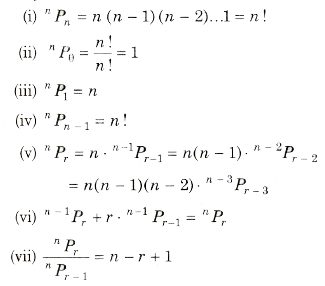
    Properties of Permutation

    CBSE Class 11 Maths Notes Permutations and Combinations

    Important Results on’Permutation

    1. The number of permutations of n different things taken r at a time, allowing repetitions is nr.
    2.  The number of permutations of n different things taken all at a time is nPn= n! .
    3. The number of permutations of n things taken all at a time, in which p are alike of one kind, q are alike of second kind and r are alike of third kind and rest are different is n!/(p!q!r!)
    4. The number of permutations of n things of which p1 are alike of one kind p2 are alike of second kind, p3 are alike of third kind,…, Pr are alike of rth kind such that p1 + p2 + p3 +…+pr = n is n!/P1!P2!P3!….Pr!
    5. Number of permutations of n different things taken r at a time,
      when a particular thing is to be included in each arrangement is r.n – 1Pr – 1.
      when a particular thing is always excluded, then number of arrangements = n – 1Pr
    6. Number of permutations of n different things taken all at a time, when m specified things always come together is m!(n – m + 1)!.
    7. Number of permutations of n different things taken all at a time, when m specified things never come together is n! – m! x (n – m + 1)!.

    Division into Groups

    (i) The number of ways in which (m + n) different things can be divided into two groups which contain m and n things respectively [(m + n)!/m ! n !].

    This can be extended to (m + n + p) different things divided into three groups of m, n, p things respectively [(m + n + p)!/m!n! p!].

    (ii) The number of ways of dividing 2n different elements into two groups of n objects each is [(2n)!/(n!)2] , when the distinction can be made between the groups, i.e., if the order of group is important. This can be extended to 3n different elements into 3 groups is [(3n)!/((n!)3].

    (iii) The number of ways of dividing 2n different elements into two groups of n object when no distinction can be made between the groups i.e., order of the group is not important is

    [(2n)!/2!(n!)2].

    This can be extended to 3n different elements into 3 groups is

    [(3n)!/3!(n!)3].

    The number of ways in which mn different things can be divided equally it into m groups, if order of the group is not important is

    [(mn)!/(n!)m!].

    (v) If the order of the group is important, then number of ways of dividing mn different things equally into m distinct groups is mn

    [(mn)!/(n!)m]

    (vi) The number of ways of dividing n different things into r groups is

    [rn — rC1(r — 1)n + rC2(r — 2)n — rC3(r – 3)n + …].

    (vii) The number of ways of dividing n different things into r groups taking into account the order of the groups and also the order of things in each group is

    n+r-1Pn = r(r + l)(r + 2) … (r + n – 1).

    (viii) The number of ways of dividing n identical things among r persons such that each gets 1, 2, 3, … or k things is the coefficient of xn – r in the expansion of (1 + x + x2 + … + Xk-1)r.

    Circular Permutation

    In a circular permutation, firstly we fix the position of one of the objects and then arrange the other objects in all possible ways.

    (i) Number of circular permutations at a time is (n -1)!. If clockwise taken as different. of n and different things taken anti-clockwise orders all are
    (ii) Number of circular permutations of n different things taken all at a time, when clockwise or anti-clockwise order is not different 1/2(n – 1)!.
    (iii) Number of circular permutations of n different things taken r at a time, when clockwise or anti-clockwise orders are take as different is

    nPr/r.

    (iv) Number of circular permutations of n different things taken r at a time, when clockwise or anti-clockwise orders are not different is

    nPr/2r.

    (v) If we mark numbers 1 to n on chairs in a round table, then n persons sitting around table is n!.

    Combination

    Each of the different groups or selections which can be made by some or all of a number of given things without reference to the order of the
    things in each group is called a combination.

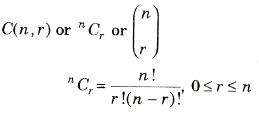
    Mathematically The number of combinations of n different things taken r at a time is

    CBSE Class 11 Maths Notes Permutations and Combinations

    Properties of Combination

    CBSE Class 11 Maths Notes Permutations and Combinations

    Important Results on Combination

    • The number of combinations of n different things taken r at a time allowing repetitions is n + r – 1Cr
    • The number of ways of dividing n identical things among r persons such that each one gets at least one is n – 1Cr – 1.
    • The total number of combinations of n different objects taken r at a time in which
      (a) m particular objects are excluded = n – mCr
      (b) m particular objects are included = n – mCr – 1
    • The total number of ways of dividing n identical items among r persons, each one of whom can receive 0, 1, 2 or more items (≤ n) is n + r – 1Cr – 1
    • The number of ways in which n identical items can be divided into r groups so that no group contains less than in items and more than k(m < k) is coefficient of xn in the expansion of (xm + xm + 1 +….+ xk)r.
    • The total number of ways of selection of some or all of n things at a time is nC1 + nC2 +….+ nn1 = 2n — 1.
    • The number of selections of r objects out of n identical objects is 1.
    • Total number of selections of zero or more objects from n identical objects is n + 1.

    Important Points to be Remembered

    1. Function

    (i) If a set A has m elements and set B has n elements, then

    (a) number of functions from A to B is nm
    (b) number of one-one function from A to B is nPm, m ≤ n.
    (c) number of onto functions from A to B is nm — nC1(n — 1)m + nC2(n — 2)m…..; m ≤ n.
    (d) number of increasing (decreasing) functions from A to B is nCm, m ≤ n.
    (e) number of non-increasing (non-decreasing) functions from A to B is m + n – 1Cm .
    (f) number of bijective (one-one onto) functions from A to B is n !, if m = n.

    (ii) Number of permutations of n different objects taken r at a time in which m particular objects are always

    (a) excluded = n – mPr
    (b) included = n – mPr – m x r!

    2. Geometry

    1. Given, n distinct points in the plane, no three of which are collinear, then the number of line segments formed = nC2.
    2. Given. ii distinct paints in the p)ane. in which m are collinear (m ≥ 3), then the number of line segments is (nC2 – mC2) + 1.
    3. Given, n distinct points in the plane, no three of which are collinear, then the number of triangle formed = nC3
    4. Given, n distinct points in a plane, in which m are collinear (m ≥ 3), then the number of triangle formed = nC3 — mC3
    5. The number of diagonals in a n-sided closed polygon = nC2 — n.
    6. Given, n points on the circumference of a circle, then
      (a) number of straight lines = nC2
      (b) number of triangles = nC3
      (c) number of quadrilaterals = nC4
    7. Number of rectangles of any size in a square of n x n isCBSE Class 11 Maths Notes Permutations and Combinationsand number of square of any size isCBSE Class 11 Maths Notes Permutations and Combinations.
    8. In a rectangle of n x p (n < p), numbers of rectangles of any size is np/4 (n + 1) (p + 1) and number of squares of any size is
      CBSE Class 11 Maths Notes Permutations and Combinations
    9. Suppose n straight lines are drawn in the plane such that no two lines are parallel and no three lines are concurrent, then number of parts which these divides the plane is equal to 1 +∑ n.

    3. Prime Factors

    Any natural number > 1, can be expressed as product of primes.

    • Let n = p1α1 p2α2 p3α3 …. prαr, where
    • pi, i = 1, 2, 3, … , r, are prime numbers.
    • αi, i = 1, 2, 3, … , r, are positive integers.
    1. Number of distinct positive integral divisors of n is (α1 + 1)(α2 + 1)(α3 + 1) … (αr + 1).
    2. Sum of distinct positive integral divisors of n is
      CBSE Class 11 Maths Notes Permutations and Combinations
    3. Total number of divisors of n (excluding 1 and n), is (α1 + 1)(α2 + 1)(α3 + 1) … (αr + 1) – 2.
    4. Total number of divisors of n (excluding 1 or n), is (α1 + 1)(α2 + 1)(α3 + 1) … (αr + 1) – 1.
    5. The number of ways in which n can be resolved as a product of two factors is
      (a) 1/2(α1 + 1)(α2 + 1)(α3 + 1) … (αr + 1) if n is not a perfect square.
      (b) 1/2[(α1 + 1)(α2 + 1)(α3 + 1) … (αr + 1) + 1], if n is a perfect square.
    6. The number of ways in which n can be resolved into two factors which are prime to each other is 2r – 1, where r is the number of different factors in n.
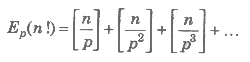
    7. If p is prime and pr divides n!, then
      CBSE Class 11 Maths Notes Permutations and Combinations

    4. Integral Solutions

    1. The number of integral solutions of x1+ x2 +….+ xr = n, where x1, x2, … xr ≥ 0 is n + r – 1Cr – 1.
    2. Number of integral solutions of x1+ x2 +….+ xr = n, where x1, x2, … xr ≥ 1 is n – 1Cr – 1

    5. Sum of Digits

    1. Sum of the numbers formed by taking all the given n digits = (Sum of all the n digits) x (n — 1)! x (111… 1)n times.
    2. The sum of all digits in the unit place of all numbers formed with the help of ai , a2, , an all at a time is (n — 1)!(a1 + a1 + …. + an).
    3. The sum of all digits of numbers that can be formed by using the digits a1, a2,… , an(repetition of digits is not allowed (n — 1)! (a1 + a1 + … + an)((10n – 1)/9)

    6. Arrangements

    1. The number of ways in which m (one type of different things) and n (another type of different things) can be arranged in a row so that all the second type of things come together is n !(m + 1)!.
    2. The number of ways in which m (one type of different things) and n (another type of different things) can be arranged in row so that no two things of the same type come together is 2 x m! n!
    3. The number of ways in which m (one type of different things) and n (another type of different things) (m ≥ n), can be arranged in a circle so that no two things of second type come together (m – 1)! mPn and when things of second type come together = m! n!
    4. The number of ways in which m things of one type and n things of another type (all different) can be arranged in the form of a garland so that all the second type of things come together, is m! n!/2 and if no things of second type come together is, [((m – 1)!mPn)/2]

    7. Dearrangements

    If n distinct objects are arranged in a row, then the number of ways in which they can be rearranged so that no one of them occupies the place assigned to it is

    CBSE Class 11 Maths Notes Permutations and Combinations

    8. Selection

    1. The total number of ways in which it is possible to make a selection by taking some or all the given n different objects is
      nC1 + nC2 + …. + nCn = 2n – 1
    2. If there are m items of one kind, n items of another kind and so on. Then, the number of ways of choosing r items out of these items = coefficient of xr in
      (1 + x + x2 + …. + xm)(1 + x + x2 + …. + xn)
    3. If there are m items of one kind, n items of another kind and so on. Then, the number of ways of choosing r items out of these items such that at least one item of each kind is included in every selection = coefficient of xr in
      (x + x2 + …. + xm)(x + x2 + …. + xn)….
    4. The number of ways of selecting r items from a group of n items in which p are identical, is
      n – PCr + n – PCr – 1n – PCr – 2 + … + n – PC0, if r ≤ P and n – PCr + n – PCr – 1n – PCr – 2 + … + n – PCr – p, if r > P
    5. The number of ways in which n identical things can be distributed into r different groups is n + r – lCr – 1, or n – 1Cr – 1 according as blanks groups are or are not admissible.
    6. The number of ways of answering one or more of n questions is 2n – 1.
    7. The number of ways of answering one or more n questions when each question has an alternative = 2n
    8. n! + 1 is not divisible by any natural number between 2 and n.
    9. If there are 1 objects of one kind, m objects of second kind, n objects of third kind and so on. Then, the number of possible arrangements of r objects out of these objects = Coefficient of xr in the expansion of

    CBSE Class 11 Maths Notes Permutations and Combinations

  • Sequences and Series Notes Class 11th Maths

    1. Sequence: Sequence is a function whose domain is a subset of natural numbers. It represents the images of 1, 2, 3,… ,n, as f1, f2, f3, …., fn , where fn = f(n).

    2. Real Sequence: A sequence whose range is a subset of R is called a real sequence.

    3. Series: If a1, a2, a3 , … , an is a sequence, then the expression a1 + a2 + a3 + … + an is a series.

    4. Progression: A sequence whose terms follow certain rule is called a progression.

    5. Finite Series: A series having finite number of terms is called finite series.

    6. Infinite Series: A series having infinite number of terms is called infinite series.

    Arithmetic Progression (AP)

    A sequence in which the difference of two consecutive terms is constant, is called Arithmetic Progression (AP).

    Properties of Arithmetic Progression

    (i) If a sequence is an AP, then its nth term is a linear expression in n, i.e., its nth term is given by An + B, where A and B are constants and A = common difference.

    (ii) nth Term of an AP If a is the first term, d is the common difference and / is the last term of an AP, then

    (a) nth term is given by 1= an = a + (n – 1)d

    (b) nth term of an AP from the last term is a’n = l – (n – 1)d

    (c) an + a’n = a + 1
    i.e., nth term from the start + nth term from the end
    = constant
    = first term + last term

    (d) Common difference of an AP
    d = Tn – Tn-1, ∀ n > 1

    (e) Tn = 1/2[Tn-k + Tn+k], k < n

    (iii) If a constant is added or subtracted from each term of an AP, then the resulting sequence is an AP with same common difference.

    (iv) If each term of an AP is multiplied or divided by a non-zero constant k, then the resulting sequence is also an AP, with common difference kd or d/k where d = common difference.

    (v) If an, an+1 and an+2 are three consecutive terms of an AP, then 2an+1 = an + an+2.

    (vi) (a) Any three terms of an AP can be taken as a – d, a, a + d.

    (b) Any four terms of an AP can be taken as a-3d,a- d, a + d, a + 3d.

    (c) Any five terms of an AP can be taken as a-2d,a – d, a, a + d, a + 2d.

    (vii) Sum of n Terms of an AP

    (a) Sum of n terms of AP, is given by Sn = n/2[2a + (n – 1)d] = n/2[a + l]

    (b) A sequence is an AP, iff the sum of n terms is of the form An2 + Bn, where A and B are constants. Common difference in such case will be 2A.

    (c) Tn = Sn – Sn-1

    (viii) a2, b2 and c2 are in AP.

    CBSE Class 11 Maths Notes Sequences and Series

    (ix) If a1, a2,…, an are the non-zero terms of an AP, then
    CBSE Class 11 Maths Notes Sequences and Series

    (x) Arithmetic Mean

    (a) If a, A and b are in AP, then A= (a + b)/2 is called the 2 arithmetic mean of a and b.

    (b) If a1, a2, a3 , an are n numbers, then their AM is given by,
    CBSE Class 11 Maths Notes Sequences and Series

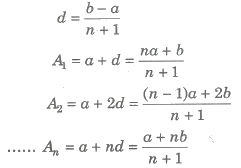
    (c) If a, A1 , A2 , A3 ,…,An, b are in AP, then A1, A2, A3,…, An are n arithmetic mean between a and b, where
    CBSE Class 11 Maths Notes Sequences and Series

    (d) Sum of n AM’s between a and b is nA
    i.e., A1 + A2 + A3 + + = nA
    CBSE Class 11 Maths Notes Sequences and Series
    Geometric Progression (GP)

    A sequence in which the ratio of two consecutive terms is constant is called GP. The constant ratio is called common ratio (r).
    i.e., an+1/an = r, ∀ n ≥ 1

    Properties of Geometric Progression (GP)

    (i) nth Term of a GP If a is the first term and r is the common ratio

    (a) nth term of a GP from the beginning is an = arn-1
    (b) nth term of a GP from the end is a’n = l/rn-1, l = last term
    (c) If a is the first term and r is the common ratio of a GP, then the GP can be written as a, ar, ar2,… , arn-1, …
    (d) The nth term from the end of a finite GP consisting of m terms is arm-n, where a is the first term and r is the common ratio of the GP.
    (e) ana’n = al i.e., nth term from the beginning x nth term from the end = constant = first term x last term.

    (ii) If all the terms of GP be multiplied or divided by same non-zero constant, then the resulting sequence is a GP with the same common ratio.

    (iii) The reciprocal terms of a given GP form a GP.

    (iv) If each term of a GP be raised to same power, the resulting sequence also forms a GP.

    (v) If the terms of a GP are chosen at regular intervals, then the resulting sequence is also a GP.

    (vi) If a1, a2, a3, … , an are non-zero, non-negative term of a GP, then

    (a) GM = (a1a2a3… an )1/n
    (b) log a1, log a2, log a3,…, log an are in an AP and vice-versa.

    (vii) If a, b and c are three consecutive terms of a GP, then b2 = ac

    (viii) (a) Three terms of a GP can be taken as a/r, a and ar.
    (b) Four terms of a GP can be taken as a/r3, a/r, ar and ar3.
    (c) Five terms of a GP can be taken as a/r2, a/r, ar and ar2.

    (ix) Sum of n Terms of a GP

    (a) Sum of n terms of a GP is given by
    CBSE Class 11 Maths Notes Sequences and Series

    (x) Geometric Mean (GM)

    (a) If a, G, b are in GP, then G is called the geometric mean of a and b and is given by G = √ab
    (b) If a, G1, G2, G3, , Gn, b are in GP, then G1, G2, G3,… , Gn, are in GM’s between a and b, where
    CBSE Class 11 Maths Notes Sequences and Series

    (c) Product of n GM’s, G1 X G2 X G3 X … X Gn = Gn
    CBSE Class 11 Maths Notes Sequences and Series

    Harmonic Progression (HP)

    A sequence a1, a2, a3 ,…, an of non-zero numbers is called a Harmonic Progression (HP), if the sequence 1/a1, 1/a2, 1/a3, …, 1/an is an AP.

    Properties of Harmonic Progression (HP)

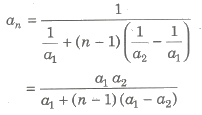
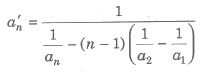
    (i) nth term of HP, if a1, a2, a3 ,…, an are in HP, then
    (a) nth term of the HP from the beginning
    CBSE Class 11 Maths Notes Sequences and Series

    (b) nth term of the HP from the end

    CBSE Class 11 Maths Notes Sequences and Series

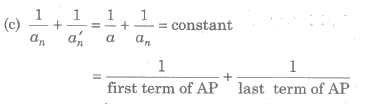
    CBSE Class 11 Maths Notes Sequences and Series

    (d) an = 1/a+(n-1)d are the first term and common difference of the corresponding AP.
    (ii) Sum of harmonic progression does not exist.

    Harmonic Mean

    (i) If a, H,b are in HP, then H is called the harmonic mean of a and b i.e., H= 2ab/(a + b)

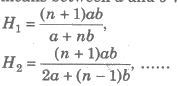
    (ii) If a, H1, H2, H3, …, Hn, b are in HP, then
    H1, H2, H3, …, Hn

    are n harmonic means between a and b where
    CBSE Class 11 Maths Notes Sequences and Series

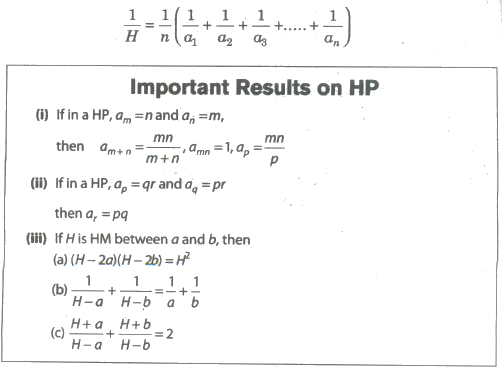
    (iii) Harmonic Mean (HM) between a1, a2, a3, …, an is given by
    CBSE Class 11 Maths Notes Sequences and Series
    Properties of AM, GM and HM between Two Numbers

    If A, G and H are arithmetic, geometric and harmonic means of two positive numbers a and b, then
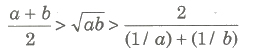
    (i) A=(a+b)/2, G=√ab, H=(2ab)/(a+b)
    (ii) A≥G≥H
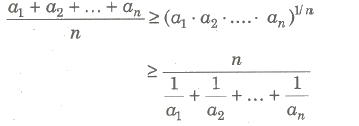
    (iii) A, G, H are in GP and G2 = AH
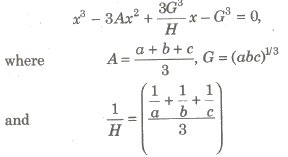
    (iv) If A,G,H are AM, GM and HM between three given numbers a, b and c, then the equation on having a, b and c as its root is
    CBSE Class 11 Maths Notes Sequences and Series

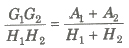
    (v) If A1,A2 be two AM’s, G1, G2 be two GM’s and H1, H2 be two HM’s between two numbers a and b, then
    CBSE Class 11 Maths Notes Sequences and Series

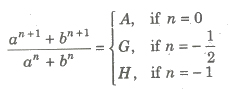
    (vi) If A,G and H be AM, GM and HM between two numbers a and b, then
    CBSE Class 11 Maths Notes Sequences and Series

    Arithmetico-Geometric Progression

    A sequence in which every term is a product of a term of AP and GP is known as arithmetico-geometric progression.

    The series may be written as

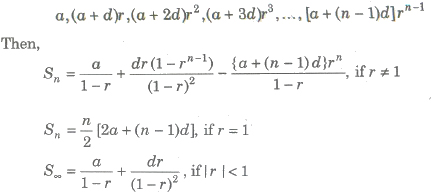
    CBSE Class 11 Maths Notes Sequences and Series

    Sum of Arithmetico-Geometric Series

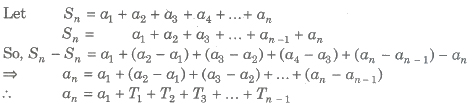
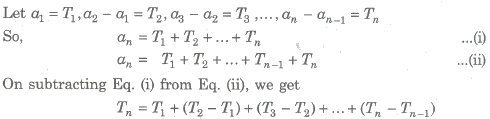
    Type 1 Let al + a2 + a3 + … be a given series. If a2 – al, a3 – a2, … are in AP or GP, then an and Sn can be found by the method of difference.
    CBSE Class 11 Maths Notes Sequences and Series
    where T1, T2, T3 ,… are terms of new series and Sn = Σan

    Type 2 It is not always necessary that the series of first order of differences i.e., a2 – a1, a3 – a2, …, an – an-1 is always either in AP or in GP in such case.
    CBSE Class 11 Maths Notes Sequences and Series

    Now, the series (T2 — T1) + (T3 — T2) + …+ (Tn – Tn-1) is series of second order of differences and when it is either in AP or in GP, then an = a1 + ΣTr

    Otherwise, in the similar way, we find series of higher order of differences and the nth term of the series.

    Exponential Series

    The sum of the series is denoted by theCBSE Class 11 Maths Notes Sequences and Seriesnumber e.
    CBSE Class 11 Maths Notes Sequences and Series

    (i) e lies between 2 and 3.
    (ii) e is an irrational number.
    CBSE Class 11 Maths Notes Sequences and Series

    Exponential Theorem

    Let a>0, then for all real value of x,
    CBSE Class 11 Maths Notes Sequences and Series
    Logarithmic Series
    CBSE Class 11 Maths Notes Sequences and Series

    Important Result and Useful Series
    CBSE Class 11 Maths Notes Sequences and Series
    24. If number of terms in AP/GP/HP are odd, then AM/GM/HM of first and last term in middle term of progression.

    25. If pth, qth and rth term of geometric progression are also in geometric progression.

    26. If a,b and c are in AP and also in GP, then a=b=c

    27. If a, b and c are in AP, then xa, xb and xc are in geometric progression.

  • Quadratic Equations and Inequalities Notes Class 11th Maths

    1. Real Polynomial: Let a0, a1, a2, … , an be real numbers and x is a real variable. Then, f(x) = a0 + a1x + a2x2 + … + anxn is called a real polynomial of real variable x with real coefficients.

    2. Complex Polynomial: If a0, a1, a2, … , an be complex numbers and x is a varying complex number, then f(x) = a0 + a1x + a2x2 + … + an – 1xn – 1 + anxn is called a complex polynomial or a polynomial of complex variable with complex coefficients.

    3. Degree of a Polynomial: A polynomial f(x) = a0 + a1x + a2x2 + a3x3 + … + anxn , real or complex is a polynomial of degree n , if an ≠ 0.

    4. Polynomial Equation: If f(x) is a polynomial, real or complex, then f(x) = 0 is called a polynomial equation. If f(x) is a polynomial of second degree, then f(x) = 0 is called a quadratic equation .

    Quadratic Equation: A polynomial of second degree is called a quadratic polynomial. Polynomials of degree three and four are known as cubic and biquadratic polynomials respectively. A quadratic polynomial f(x) when equated to zero is called quadratic equation. i.e., ax2 + bx + c = 0 where a ≠ 0.

    Roots of a Quadratic Equation: The values of variable x .which satisfy the quadratic equation is called roots of quadratic equation.

    Important Points to be Remembered

    • An equation of degree n has n roots, real or imaginary .
    • Surd and imaginary roots always occur in pairs of a polynomial equation with real coefficients i.e., if (√2 + √3i) is a root of an equation, then’ (√2 – √3i) is also its root. .
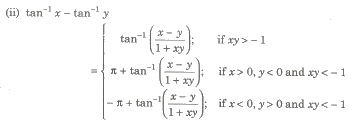
    • An odd degree equation has at least one real root whose sign is opposite to that of its last’ term (constant term), provided that the coefficient of highest degree term is positive.
    • Every equation of an even degree whose constant term is negative and the coefficient of highest degree term is positive has at least two real roots, one positive and one negative.
    • If an equation has only one change of sign it has one positive root.
    • If all the terms of an equation are positive and the equation involves odd powers of x, then all its roots are complex.

    Solution of Quadratic Equation

    1.Factorization Method: Let ax2 + bx + c = α(x – α) (x – β) = O. Then, x = α and x = β will satisfy the given equation.

    2. Direct Formula: Quadratic equation ax2 + bx + c = 0 (a ≠ 0) has two roots, given by

    CBSE Class 11 Maths Notes Quadratic Equations and Inequalities

    where D = Δ = b2 – 4ac is called discriminant of the equation .
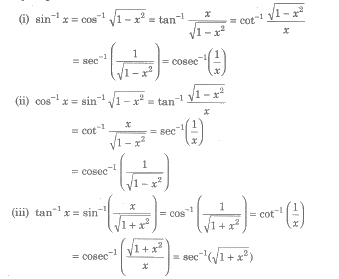
    Above formulas also known as Sridharacharya formula.
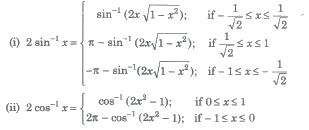
    Nature of Roots

    Let quadratic equation be ax2 + bx + c = 0, whose discriminant is D.

    (i) For ax2 + bx + c = 0; a, b , C ∈ R and a ≠ 0, if

    (a) D < => Complex roots

    (b) D > 0 => Real and distinct roots

    (c) D = 0 => Real and equal roots as α = β = – b/2a

    (ii) If a, b, C ∈ Q, a ≠ 0, then

    (a) If D > 0 and D is a perfect square => Roots are unequal and rational.

    (b) If D > 0, a = 1; b, c ∈ I and D is a perfect square. => Roots are integral. .
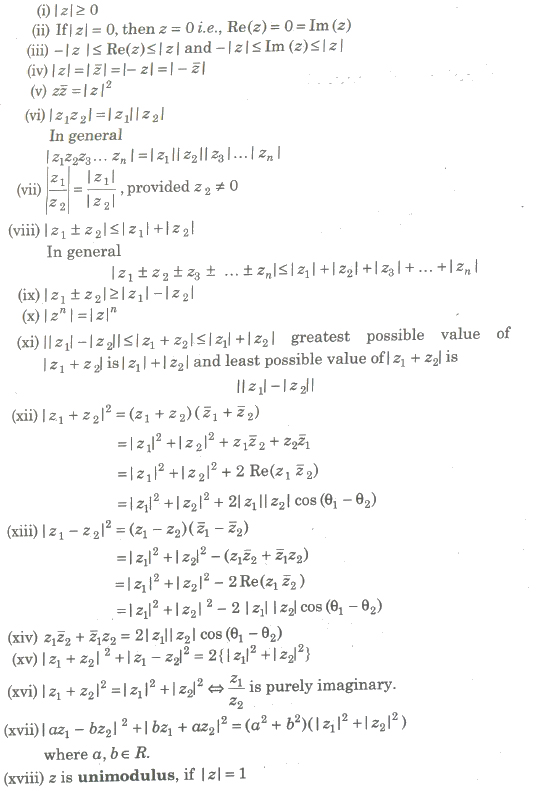
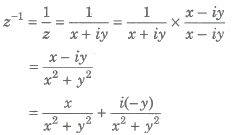
    (c) If D > and D is not a perfect square. => Roots are irrational and unequal.

    (iii) Conjugate Roots The irrational and complex roots of a quadratic equation always occur in pairs. Therefore,

    (a) If one root be α + iβ, then other root will be α – iβ.

    (b) If one root be α + √β, then other root will be α – √β.

    (iv) If D, and D2 be the discriminants of two quadratic equations, then

    (a) If D1 + D2 ≥ 0, then At least one of D1 and D2 ≥ 0 If D1 < 0, then D2 > 0 ,

    (b) If D1 + D2 < 0, then At least one of D1 and D2 < 0 If D1 > 0, then D2 < 0

    Roots Under Particular Conditions

    For the quadratic equation ax2 + bx + e = 0.

    (i) If b = 0 => Roots are real/complex as (c < 0/c > 0) and equal in magnitude but of opposite sign.

    (ii) If c = 0 => One roots is zero, other is – b / a.

    (iii) If b = C = 0 => Both roots are zero.

    (iv) If a = c => Roots are reciprocal to each other.

    (v) If a > 0, c < 0, a < 0, c > 0} => Roots are of opposite sign.

    (vi) If a > 0, b > 0, c > 0, a < 0, b < 0, c < 0} => Both roots are negative, provided D ≥ 0

    (vii) If a > 0, b < 0, c > 0, a < 0, b > 0, c < 0} => Both roots are positive, provided D ≥ 0

    (viii) If sign of a = sign of b ≠ sign of c => Greater root in magnitude is negative.

    (ix) If sign of b = sign of c ≠. sign of a => Greater root in magnitude is positive.

    (x) If a + b + c = 0 => One root is 1 and second root is c/a.

    Relation between Roots and Coefficients

    1. Quadratic Equation: If roots of quadratic equation ax2 + bx + c = 0 (a ≠ 0) are α and β, then Sum of roost = S = α + β = -b/a = – coefficient of x / coefficient of x2 Product of roots = P = α * β = c/a = constant term / coefficient of x2

    2. Cubic Equation: If α, β and γ are the roots of cubic equation ax3 + bx2 + cx + d = 0.

    Then,

    CBSE Class 11 Maths Notes Quadratic Equations and Inequalities

    3. Biquadratic Equation: If α, β, γ and δ are the roots of the biquadratic equation ax4 + bx3 + cx2 + dx + e = 0, then

    CBSE Class 11 Maths Notes Quadratic Equations and Inequalities

    CBSE Class 11 Maths Notes Quadratic Equations and Inequalities

    Symmetric Roots: If roots of quadratic equation ax2 + bx + c = 0 (a ≠ 0) are α and β, then

    CBSE Class 11 Maths Notes Quadratic Equations and Inequalities

    Formation of Polynomial Equation from Given Roots

    If a1, a2 a3,…, an are the roots of an nth degree equation, then the equation is xn – S1Xn – 1+ S2Xn – 2 – S3Xn – 3 +…+( _l)n Sn = 0 where Sn denotes the sum of the products of roots taken n at a time.

    1. Quadratic Equation

    If α and β are the roots of ‘a quadratic equation, then the equation is x2 – S1X + S2 = 0

    i.e., x2 – (α + β) x + αβ = 0

    2. Cubic Equation

    If α, β and γ are the roots of cubic equation, then the equation is

    CBSE Class 11 Maths Notes Quadratic Equations and Inequalities

    3. Biquadratic Equation

    If α, β, γ and δ are the roots of a biquadratic equation, then the equation is

    CBSE Class 11 Maths Notes Quadratic Equations and Inequalities

    Equation In Terms of the Roots of another Equation

    If α, β are roots of the equation ax2 + bx + c = 0, then the equation whose roots are.

    CBSE Class 11 Maths Notes Quadratic Equations and Inequalities

    The quadratic function f(x) = ax2 + 2hxy + by2 + 2gx + 2fy + c is always resolvable into linear factor, iff

    abc + 2fgh – af2 – bg2 – ch2 = 0

    CBSE Class 11 Maths Notes Quadratic Equations and Inequalities

    Condition for Common Roots in a Quadratic Equation

    1. Only One Root is Common

    If α be the common root of quadratic equations

    a1x2 + b1x + C1 = 0,

    and a2x2 + b2x + C2 = 0,

    then a1a2 + b1α + C1 = 0,

    and a2a2 + b2α + C2 = 0,

    By Cramer’s Rule

    CBSE Class 11 Maths Notes Quadratic Equations and Inequalities

    Hence, the condition for only one root common is

    (c1a2 – c2a1)2 = (b1c2 – b2c1)(a1b2 – a2b1)

    2. Both Roots are Common

    The required condition is

    a1 / a2 = b1 / b2 = c1 / c2

    (i) To find the common root of two equations, make the coefficient of second degree term in the two equations equal and subtract. The value of x obtained is the required common root.

    (ii) Two different quadratic equations with rational coefficient can not have single common root which is complex or irrational as imaginary and surd roots always occur in pair.

    Properties of Quadratic Equation

    (i) f(a) . f(b) < 0, then at least one or in general odd number of roots of the equation f(x) = 0 lies between a and b.

    CBSE Class 11 Maths Notes Quadratic Equations and Inequalities

    CBSE Class 11 Maths Notes Quadratic Equations and Inequalities

    (ii) f( a) . f( b) > 0, then in general even number of roots of the equation f(x) = 0 lies between a and b or no root exist f(a) = f(b), then there exists a point c between a and b such that f'(c) = 0, a < c < b.

    (iii) If the roots of the quadratic equation a1x2 + b1x + c1 = 0, a2x2 + b2x + c2 = 0 are in the ratio (i.e., &alpha1;/β1 = &alpha2;/β2), then

    b12 / b22 = a1c1 / a2c2.

    (iv) If one root is k times the other root of the quadratic equation ax2 + bx + c = 0 ,then

    (k + 1)2 / k = b2 / ac

    Quadratic Expression

    An expression of the form ax2 + bx + c, where a, b, c ∈ R and a ≠ 0 is called a quadratic expression in x .

    1. Graph of a Quadratic Expression

    We have

    y = ax2 + bx + c = f(x)

    CBSE Class 11 Maths Notes Quadratic Equations and Inequalities

    Let y + D/4a = Y and x + D / 2a = X

    Y = a * X2 => X2 = Y / a

    (i) The graph of the curve y = f(x) is parabolic.
    (ii) The axis of parabola is X = 0 or x + b / 2a = 0 i.e., (parallel to Y-axis). •
    (iii) If a > 0, then the parabola opens upward.
    If a < 0, then the parabola opens downward.

    CBSE Class 11 Maths Notes Quadratic Equations and Inequalities

    2. Position of y = ax2 +bx + c with Respect to Axes.

    (i) For D > 0, parabola cuts X-axis in two real and distinct points
    i.e, x = -b ± √D / 2a

    CBSE Class 11 Maths Notes Quadratic Equations and Inequalities

    (ii) For D = 0, parabola touch X-axis in one point, x = – b/2a.

    CBSE Class 11 Maths Notes Quadratic Equations and Inequalities

    (iii) For D < O,parabola does not cut X-axis (i.e., imaginary value of x).

    CBSE Class 11 Maths Notes Quadratic Equations and Inequalities

    3. Maximum and Minimum Values of Quadratic Expression

    (i) If a > 0, quadratic expression has least value at x = b / 2a. This least value is given by 4ac – b2 / 4a = – D/4a. But their is no greatest
    value.

    (ii) If a < 0, quadratic expression has greatest value at x = – b/2a . This greatest value is given by 4ac – b2 / 4a = – D/4a. But their is no least value.

    4. Sign of Quadratic Expression

    (i) a > 0 and D < 0, so f(x) > 0 for all x ∈ R i.e., f(x) is positive for all real values of x.

    (ii) a < 0 and D < 0, so f(x) < 0 for all x ∈ R i.e., f(x) is negative for all real values of x.

    (iii) a > 0 and D = 0, so f(x) ≥ 0 for all x ∈ R i.e., f(x) is positive for all real values of x except at vertex, where f(x) = 0.

    (iv) a < 0 and D = 0, so f(x) ≤ 0 for all x ∈ R i.e., f(x) is negative for all real values of x except at vertex, where f(x) = 0.

    (v) a > 0 and D > 0
    Let f(x) = o have two real roots α and β (α < β), then f(x) > 0 for x ∈ (- ∞, α) ∪ (β,∞) and f (x) < 0 for all x ∈ (α, β).

    (vi) a < 0 and D > 0
    Let f(x) = 0 have two real roots α and β (α < β). Then, f(x) < 0 for all x ∈ (- ∞, α) ∪ (β,∞) and f(x) > 0 for all
    x ∈ (α, β). ,

    5. Intervals of Roots

    In some problems, we want the roots of the equation ax2 + bx + c = 0 to lie in a given interval. For this we impose conditions on a, b and c.
    Since, a ≠ 0, we can take f(x) = x2 + b/a x + c/a.

    (i) Both the roots are positive i.e., they lie in (0,∞), if and only if roots are real, the sum of the roots as well as the product of the roots is positive.

    α + β = -b/a > 0 and αβ = c/a > 0 with b2 – 4ac ≥ 0

    Similarly, both the roots are negative i.e., they lie in (- ∞,0) ifF roots are real, the sum of the roots is negative and the product of the roots is positive.

    i.e., α + β = -b/a < 0 and αβ = c/a > 0 with b2 – 4ac ≥ 0

    (ii) Both the roots are greater than a given number k, iFf the following conditions are satisfied

    D ≥ 0, -b/2a > k and f(k) > 0

    CBSE Class 11 Maths Notes : Quadratic Equations and Inequalities

    (iii) Both .the roots are less than a given number k, iff the following conditions are satisfied

    D ≥ 0, -b/2a > k and f(k) > 0

    (iv) Both the roots lie in a’ given interval (k1, k2), iff the following conditions are satisfied

    D ≥ 0,k1 < -b/2a < k2 and f(k1) > 0, f(k2) > 0

    CBSE Class 11 Maths Notes : Quadratic Equations and Inequalities

    (v) Exactly one of the roots lie in a given interval (k1, k2), iff

    f(k1) f(k2) < 0

    CBSE Class 11 Maths Notes : Quadratic Equations and Inequalities

    (vi) A given number k lies between the roots iff f(k) < O. In particular, the roots of the equation will be of opposite sign, iff 0 lies between the roots.

    ⇒ f(0) < 0

    CBSE Class 11 Maths Notes : Quadratic Equations and Inequalities

    Wavy Curve Method

    Let f(x) = (x – a1)k1 (x – a2)k2(x — a3)k3 … (x – an – 1)kn – 1 (x – an)kn

    where k1, k2, k3,…, kn ∈ N and a1, a2, a3,…, an are fixed natural numbers satisfying the condition.

    a1 < a2 < a3 < … < an – 1 < an..

    First we mark the numbers a1, a2, a3,…, an on the real axis and the plus sign in the interval of the right of the largest of these numbers, i.e., on the right of an. If kn is even, we put plus sign on the left of an and if kn is odd, then we put minus sign on the left of an In the next interval we put a sign according to the following rule.

    When passing through the point an – 1 the polynomial f(x) changes sign . if kn – 1 is an odd number and the polynomial f(x) has same sign if kn – 1 is an even number. Then, we consider the next interval and put a sign in it using the same rule.

    Thus, we consider all the intervals. The solution of f(x) > 0 is the union of all interval in which we have put the plus sign and the solution of f(x) < 0 is the union of all intervals in which we have put the minus Sign.

    Descarte’s Rule of Signs

    The maximum number of positive real roots of a polynomial equation f(x) = 0 is the number of changes of sign from positive to negative and negative to positive in f(x) .

    The maximum number of negative real roots of a polynomial equation f(x) = 0 is the number of changes of sign from positive to negative and negative to positive in f(x).

    Rational Algebraic In equations

    (i) Values of Rational Expression P(x)/Q(x) for Real Values of x, where P(x) and Q(x) are Quadratic Expressions To find the values attained by rational expression of the form a1x2 + b1x + c1 / a2x2 + b2x + c2

    for real values of x.

    (a) Equate the given rational expression to y.
    (b) Obtain a quadratic equation in x by simplifying the expression,
    (c) Obtain the discriminant of the quadratic equation.
    (d) Put discriminant ≥ 0 and solve the in equation for y. The values of y so obtained determines the set of values attained by the given rational expression.

    (ii) Solution of Rational Algebraic In equation If P(x) and Q(x) are polynomial in x, then the in equation P(x) / Q(x) > 0,
    P(x) / Q(x) < 0, P(x) / Q(x) ≥ 0 and P(x) / Q(x) ≤ 0 are known as rational algebraic in equations.

    To solve these in equations we use the sign method as

    (a) Obtain P(x) and Q(x).
    (b) Factorize P(x) and Q(x) into linear factors.
    (c) Make the coefficient of x positive in all factors.
    (d) Obtain critical points by equating all factors to zero.
    (e) Plot the critical points on the number line. If these are n critical points, they divide the number line into (n + 1) regions.
    (f) In the right most region the expression P(x) / Q(x) bears positive sign and in other region the expression bears positive and negative signs depending on the exponents of the factors .

    Lagrange’s identity

    If a1, a2, a3, b1, b2, b3 ≠ R, then

    (a12 + a22 + a32) (b12 + b22 + b32) – (a1b1 + a2b2 + a3b3)2

    = (a1b2 – a2b1)2 + (a2b3 – a3b2 )2 + (a3b1 – a1b3)2

    Algebraic Interpretation of Rolle’s Theorem

    Let f (x) be a polynomial having α and β as its roots such that α < β, f(α) = f(β) = 0.Also, a polynomial function is everywhere continuous and differentiable, then there exist θ ∈ (α, β) such that f'(θ) = 0. Algebraically, we can say between any two zeros of a polynomial f(x) there is always a derivative f’ (x) = 0.

    Equation and In equation Containing Absolute Value

    1. Equation Containing Absolute Value

    By definition, |x| = x, if x ≥ 0 OR -x, if x < 0

    If |f(x) + g(x)| = |f(x)| + g(x)|, then it is equivalent to the system f(x) . g(x) ≥ 0.

    If |f(x) – g(x)| = |f(x)| – g(x)|, then it is equivalent to the system f(x) . g(x) ≤ 0.

    2.In equation Containing Absolute Value

    (i) |x| < a ⇒ – a < x < a (a > 0)
    (ii) |x| ≤ a ⇒ – a ≤ x ≤ a
    (iii) |x| > a ⇒ x < – a or x > a
    (iv) |x| ≥ a ⇒ x le; – a or x ≥ a

    3. Absolute Value of Real Number

    |x| = -x, x < 0 OR +x, x ≥ 0

    (i) |xy| = |x||y|
    (ii) |x / y| = |x| / |y|
    (iii) |x|2 = x2
    (iv) |x| ≥ x
    (v) |x + y| ≤ |x| + |y|
    Equality hold when x and y same sign.
    (vi) |x – y| ≥ ||x| – |y||

    Inequalities

    Let a and b be real numbers. If a – b is negative, we say that a is less than b (a < b) and if a – b is positive, then a is greater than b (a > b).

    Important Points to be Remembered

    (i) If a > b and b > c, then a > c. Generally, if a1 > a2, a2 > a3,…., an – 1 > an, then a1 > an.

    CBSE Class 11 Maths Notes : Quadratic Equations and Inequalities

    (vii) If a < x < b and a, b are positive real numbers then a2 < x2 < b2

    CBSE Class 11 Maths Notes : Quadratic Equations and Inequalities

    Important Inequality

    1. Arithmetico-Geometric and Harmonic Mean Inequality

    (i) If a, b > 0 and a ≠ b, then

    CBSE Class 11 Maths Notes : Quadratic Equations and Inequalities

    (ii) if ai > 0, where i = 1,2,3,…,n, then

    CBSE Class 11 Maths Notes : Quadratic Equations and Inequalities

    (iii) If a1, a2,…, an are n positive real numbers and m1, m2,…,mn are n positive rational numbers, then

    CBSE Class 11 Maths Notes : Quadratic Equations and Inequalities

    i.e., Weighted AM > Weighted GM

    (iv) If a1, a2,…, an are n positive distinct real numbers, then

    (a)CBSE Class 11 Maths Notes : Quadratic Equations and Inequalities

    (b)CBSE Class 11 Maths Notes : Quadratic Equations and Inequalities

    (c) If a1, a2,…, an and b1, b2,…, bn are rational numbers and M is a rational number, then

    CBSE Class 11 Maths Notes : Quadratic Equations and Inequalities

    (d)CBSE Class 11 Maths Notes : Quadratic Equations and Inequalities

    (v) If a1, a2, a3,…, an are distinct positive real numbers and p, ,q, r are natural numbers, then

    CBSE Class 11 Maths Notes : Quadratic Equations and Inequalities

    2. Cauchy – Schwartz’s inequality

    If a1, a2,…, an and b1, b2,…, bn are real numbers, such that

    (a1b1 + a2b2 + …+ anbn)2 ≤ (a12 + a22 + …, an2) * (b12 + b22 + …, bn2)

    Equality holds, iff a1 / b1 = a2 / b2 = an / bn

    3. Tchebychef’s Inequality

    Let a1, a2,…, an and b1, b2,…, bn are real numbers, such that

    (i) If a1 ≤ a2 ≤ a3 ≤… ≤ an and b1 ≤ b2 ≤ b3 ≤… ≤ bn, then

    n(a1b1 + a2b2 + a3b3 + …+ anbn) ≥ (a1 + a2 + …+ an) (b1 + b2 + …+ bn)

    (ii) If If a1 ≥ a2 ≥ a3 ≥… ≥ an and b1 ≥ b2 ≥ b3 ≥… ≥ bn, then

    n(a1b1 + a2b2 + a3b3 + …+ anbn) ≤ (a1 + a2 + …+ an) (b1 + b2 + …+ bn)

    4. Weierstrass Inequality

    (i) If a1, a2,…, an are real positive numbers, then for n ≥ 2

    (1 + a1)(1 + a2) … (1 + an) > 1 + a1 + a2 + … + an

    (ii) If a1, a2,…, an are real positive numbers, then

    (1 – a1)(1 – a2) … (1 – an) > 1 – a1 – a2 – … – an

    5. Logarithm Inequality

    (i) (a) When y > 1 and logy x > z ⇒ x > yz

    (b) When y > 1 and logy x < z ⇒ 0 < x < yz

    (ii) (a) When 0 < y < 1 and logy x > z ⇒ 0 < x < yz

    (b) hen 0 < y < 1 and logy x < z ⇒ x > yz

    Application of Inequalities to Find the Greatest and Least Values

    (i) If xl,x2,…,xn are n positive variables such that xl + x2 +…+ xn = c (constant), then the product xl * x2 *….* xn is greatest when x1 = x2 =… =xn = c/n and the greatest value is (c/n)n.

    (ii) If xl,x2,…,xn are positive variables such that xl,x2,…,xn = c (constant), then the sum xl+ x2 +….+ xn is least when x1 = x2 =… =xn = c1/n and the least value of the sum is n (c1/n).

    (iii) If xl,x2,…,xn are variables and ml,m2,…,mn are positive real number such that xl + x2 +….+ xn = c (constant), then xlml * x2m2 *… * xnmn is greatest, when

    xl / ml = x2 / m2 =…= xn / mn

    = xl + x2 +….+ xn / ml + m2 +….+ mn

  • Complex Number Notes Class 11th Maths

    Imaginary Quantity

    The square root of a negative real number is called an imaginary quantity or imaginary number. e.g., √-3, √-7/2

    The quantity √-1 is an imaginary number, denoted by ‘i’, called iota.

    Integral Powers of Iota  (i)

    i=√-1, i2 = -1, i3 = -i, i4=1

    So, i4n+1= i, i4n+2 = -1, i4n+3 = -i, i4n+4 = i4n = 1

    In other words,

    in = (-1)n/2, if n is an even integer
    in = (-1)(n-1)/2.i, if is an odd integer

    Complex Number

    A number of the form z = x + iy, where x, y ∈ R, is called a complex number

    The numbers x and y are called respectively real and imaginary parts of complex number z.

    i.e.,   x = Re (z) and y = Im (z)

    Purely Real and Purely Imaginary Complex Number

    A complex number z is a purely real if its imaginary part is 0.

    i.e., Im (z) = 0. And purely imaginary if its real part is 0 i.e., Re (z)= 0.

    Equality of Complex Numbers

    Two complex numbers z1 = a1 + ib1 and z2 = a2 + ib2 are equal, if a2= a2 and b1 = b2 i.e., Re (z1) = Re (z2) and Im (z1) = Im (z2).

    Algebra of Complex Numbers

    1. Addition of Complex Numbers

    Let z1 = (x1 + iyi) and z2 = (x2 + iy2) be any two complex numbers, then their sum defined as

    z1 + z2 = (x1 + iy1) + (x2 + iy2) = (x1 + x2) + i(y1 + y2)

    Properties of Addition

    (i) Commutative z1 + z2 = z2 + z1

    (ii) Associative (z1 + z2) + z3 = + (z2 + z3)

    (iii) Additive Identity z + 0 = z = 0 + z

    Here, 0 is additive identity.

    2. Subtraction of Complex Numbers

    Let z1 = (x1 + iy1) and z2 = (x2 + iy2) be any two complex numbers, then their difference is defined as

    z1 – z2 = (x1 + iy1) – (x2 + iy2)
    = (x1 – x2) + i(y1 – y2)

    3. Multiplication of Complex Numbers

    Let z1 = (x1 + iyi) and z2 = (x2 + iy2) be any two complex numbers, then their multiplication is defined as

    z1z2 = (x1 + iy1)(x2 + iy2) = (x1x2 – y1y2) + i(x1y2 + x2y1)

    Properties of Multiplication

    (i)  Commutative z1z2 = z2z1

    (ii) Associative (z1 z2) z3 = z1(z2 z3)

    (iii) Multiplicative Identity z • 1 = z = 1 • z

    Here, 1 is multiplicative identity of an element z.

    (iv) Multiplicative Inverse Every non-zero complex number z there exists a complex number z1 such that z.z1    = 1 = z1 • z

    (v)  Distributive Law

    (a)  z1(z2 + z3) = z1z2 + z1z3  (left distribution)

    (b) (z2 + z3)z1 = z2z1 + z3z1 (right distribution)

    4. Division of Complex Numbers

    Let z1 = x1 + iy1 and z2 = x2 + iy2 be any two complex numbers, then their division is defined as

    CBSE Class 11 Maths Notes Complex Number

    where z2 # 0.

    Conjugate of a Complex Number

    If z = x + iy is a complex number, then conjugate of z is denoted by z

    i.e., z = x – iy

    Properties of Conjugate

    CBSE Class 11 Maths Notes Complex Number

    Modulus of a Complex Number

    If z = x + iy, , then modulus or magnitude of z is denoted by |z| and is given by

    |z| = x2 + y2.

    It represents a distance of z from origin.

    In the set of complex number C, the order relation is not defined i.e., z1> z2 or zi <z2 has no meaning but |z1|>|z2| or |z1|< | z2 | has got its meaning, since |z| and |z2| are real numbers.

    Properties of Modulus

    CBSE Class 11 Maths Notes Complex Number

    Reciprocal/Multiplicative Inverse of a Complex Number

    Let z = x + iy be a non-zero complex number, then

    CBSE Class 11 Maths Notes Complex Number

    Here, z-1 is called multiplicative inverse of z.

    Argument of a Complex Number

    Any complex number z=x+iy can be represented geometrically by a point (x, y) in a plane, called Argand plane or Gaussian plane. The angle made by the line joining point z to the origin, with the x-axis is called argument of that complex number. It is denoted by the symbol arg (z) or amp (z).

    CBSE Class 11 Maths Notes Complex Number

    Argument (z) = θ = tan-1(y/x)

    Argument of z is not unique, general value of the argument of z is 2nπ + θ. But arg (0) is not defined.

    A purely real number is represented by a point on x-axis.

    A purely imaginary number is represented by a point on y-axis.

    There exists a one-one correspondence between the points of the plane and the members of the set C of all complex numbers.

    The length of the line segment OP is called the modulus of z and is denoted by |z|.

    i.e., length of OP = √x2 + y2.

    Principal Value of Argument

    The value of the argument which lies in the interval (- π, π] is called principal value of argument.

    (i) If x> 0 and y > 0, then arg (z) = 0
    (ii) If x < 0 and y> 0, then arg (z) = π -0
    (iii) If x < 0 and y < 0, then arg (z) = – (π – θ)
    (iv) If x> 0 and y < 0, then arg (z) = -θ

    Properties of Argument

    CBSE Class 11 Maths Notes Complex Number

    Square Root of a Complex Number

    If z = x + iy, then

    CBSE Class 11 Maths Notes Complex Number

    Polar Form

    If z = x + iy is a complex number, then z can be written as

    z = |z| (cos θ + i sin θ) where, θ = arg (z)

    this is called polar form.

    If the general value of the argument is 0, then the polar form of z is

    z = |z| [cos (2nπ + θ) + i sin (2nπ + θ)], where n is an integer.

    Eulerian Form of a Complex Number

    If z = x + iy is a complex number, then it can be written as

    z = rei0, where

    r = |z| and θ = arg (z)

    This is called Eulerian form and ei0= cosθ + i sinθ and e-i0 = cosθ — i sinθ.

    De-Moivre’s Theorem

    A simplest formula for calculating powers of complex number known as De-Moivre’s theorem.

    If n ∈ I (set of integers), then (cosθ + i sinθ)n = cos nθ + i sin nθ and if n ∈ Q (set of rational numbers), then cos nθ + i sin nθ is one of the values of (cos θ + i sin θ)n.

    CBSE Class 11 Maths Notes Complex Number

    The nth Roots of Unity

    The nth roots of unity, it means any complex number z, which satisfies the equation zn = 1 or z = (1)1/n

    or z = cos(2kπ/n) + isin(2kπ/n) , where k = 0, 1, 2, … , (n — 1)

    Properties of nth Roots of Unity

    1. nth roots of unity form a GP with common ratio e(i2π/n) .
    2. Sum of nth roots of unity is always 0.
    3. Sum of nth powers of nth roots of unity is zero, if p is a multiple of n
    4. Sum of pth powers of nth roots of unity is zero, if p is not a multiple of n.
    5. Sum of pth powers of nth roots of unity is n, ifp is a multiple of n.
    6. Product of nth roots of unity is (-1)(n – 1).
    7. The nth roots of unity lie on the unit circle |z| = 1 and divide its circumference into n equal parts.

    The Cube Roots of Unity

    Cube roots of unity are 1, ω, ω2,

    where ω = -1/2 + i√3/2 = e(i2π/3) and ω2 = (-1 – i√3)/2

    ω3r + 1 = ω, ω3r + 2 = ω2

    Properties of Cube Roots of Unity

    (i) 1 + ω + ω2r =
    0, if r is not a multiple of 3.
    3, if r is,a multiple of 3.

    (ii) ω3 = ω3r = 1

    (iii) ω3r + 1 = ω, ω3r + 2 = ω2

    (iv) Cube roots of unity lie on the unit circle |z| = 1 and divide its circumference into 3 equal parts.

    (v) It always forms an equilateral triangle.

    (vi) Cube roots of – 1 are -1, – ω, – ω2.

    CBSE Class 11 Maths Notes Complex Number

    Geometrical Representations of Complex Numbers

    1. Geometrical Representation of Addition

    If two points P and Q represent complex numbers z1 and zrespectively, in the Argand plane, then the sum z1 + z2 is represented

    by the extremity R of the diagonal OR of parallelogram OPRQ having OP and OQ as two adjacent sides.

    CBSE Class 11 Maths Notes Complex Number

    2. Geometrical Representation of Subtraction

    Let z1 = a1 + ib1 and z2 = a2 + ia2 be two complex numbers represented by points P (a1, b1) and Q(a2, b2) in the Argand plane. Q’ represents the complex number (—z2). Complete the parallelogram OPRQ’ by taking OP and OQ’ as two adjacent sides.

    CBSE Class 11 Maths Notes Complex Number

    The sum of z1 and —z2 is represented by the extremity R of the diagonal OR of parallelogram OPRQ’. R represents the complex number z1 — z2.

    3. Geometrical Representation of Multiplication of Complex Numbers

    CBSE Class 11 Maths Notes Complex Number

    R has the polar coordinates (r1r2, θ1 + θ2) and it represents the complex numbers z1z2.

    4. Geometrical Representation of the Division of Complex Numbers

    CBSE Class 11 Maths Notes Complex Number

    R has the polar coordinates  (r1/r2, θ1 – θ2) and it represents the complex number z1/z2.
    |z|=|z| and arg (z) = – arg (z). The general value of arg (z) is 2nπ – arg (z).

    If a point P represents a complex number z, then its conjugate i is represented by the image of P in the real axis.

    CBSE Class 11 Maths Notes Complex Number

    Concept of Rotation

    Let z1, z2 and z3 be the vertices of a ΔABC described in anti-clockwise sense. Draw OP and OQ parallel and equal to AB and AC, respectively. Then, point P is z2 – z1 and Q is z3 – z1. If OP is rotated through angle a in anti-clockwise, sense it coincides with OQ.

    CBSE Class 11 Maths Notes Complex Number

    Important Points to be Remembered

    CBSE Class 11 Maths Notes Complex Number

    (a) ze a is the complex number whose modulus is r and argument θ + α.
    (b) Multiplication by e-iα to z rotates the vector OP in clockwise sense through an angle α.

    (ii) If z1, z2, z3 and z4 are the affixes of the points A, B,C and D, respectively in the Argand plane.

    (a) AB is inclined to CD at the angle arg [(z2 – z1)/(z4 – z3)].

    (b) If CD is inclines at 90° to AB, then arg [(z2 – z1)/(z4 – z3)] = ±(π/2).

    (c) If z1 and z2 are fixed complex numbers, then the locus of a point z satisfying arg [([(z – z1)/(z – z2)] = ±(π/2).

    Logarithm of a Complex Number

    Let z = x + iy be a complex number and in polar form of z is re , then

    log(x + iy) = log (re) = log (r) + iθ

    log(√x2 + y2) + itan-1 (y/x)

    or log(z) = log (|z|)+ iamp (z),

    In general,

    z = rei(θ + 2nπ)

    log z = log|z| + iarg z + 2nπi

    Applications of Complex Numbers in Coordinate Geometry

    Distance between complex Points

    (i) Distance between A(z1) and B(1) is given by

    AB = |z2 — z1| = √(x2 + x1)2 + (y2 + y1)2

    where z1 = x1 + iy1 and z2 = x2 + iy2

    (ii) The point P (z) which divides the join of segment AB in the ratio m : n is given by

    z = (mz2 + nz1)/(m + n)

    If P divides the line externally in the ratio m : n, then

    z = (mz2 – nz1)/(m – n)

    Triangle in Complex Plane

    (i) Let ABC be a triangle with vertices A (z1), B(z2) and C(z3 ) then

    (a) Centroid of the ΔABC is given by

    z = 1/3(z1 + z2 + z3)

    (b) Incentre of the AABC is given by

    z = (az1 + bz2 + cz3)/(a + b + c)

    (ii) Area of the triangle with vertices A(z1), B(z2) and C(z3) is given by

    CBSE Class 11 Maths Notes Complex Number

    For an equilateral triangle,

    z12 + z22 + z32 = z2z3 + z3z1 + z1z2

    (iii) The triangle whose vertices are the points represented by complex numbers z1, z2 and z3 is equilateral, if

    CBSE Class 11 Maths Notes Complex Number

    Straight Line in Complex Plane

    (i) The general equation of a straight line is az + az + b = 0, where a is a complex number and b is a real number.

    (ii) The complex and real slopes of the line az + az are -a/a and – i[(a + a)/(a – a)].

    (iii) The equation of straight line through z1 and z2 is z = tz1 + (1 — t)z2, where t is real.

    (iv) If z1 and z2 are two fixed points, then |z — z1| = z — z2| represents perpendicular bisector of the line segment joining z1 and z2.

    (v) Three points z1, z2 and z3 are collinear, if

    CBSE Class 11 Maths Notes Complex Number

    This is also, the equation of the line passing through 1, z2 and z3 and slope is defined to be (z1 – z2)/z1 – z2

    (vi) Length of Perpendicular The length of perpendicular from a point z1 to az + az + b = 0 is given by |az1 + az1 + b|/2|a|

    (vii) arg (z – z1)/(z – z2) = β

    Locus is the arc of a circle which the segment joining z1 and z2 as a chord.

    (viii) The equation of a line parallel to the line az + az + b = 0 is az + az + λ = 0, where λ ∈ R.

    (ix) The equation of a line parallel to the line az + az + b = 0 is az + az + iλ = 0, where λ ∈ R.

    (x) If z1 and z2 are two fixed points, then I z — z11 =I z z21 represents perpendicular bisector of the segment joining A(z1) and B(z2).

    (xi) The equation of a line perpendicular to the plane z(z1 – z2) + z(z1 – z2) = |z1|2 – |z2|2.

    (xii) If z1, z2 and z3 are the affixes of the points A, B and C in the Argand plane, then

    (a) ∠BAC = arg[(z3 – z1/z2 – z1)]

    (b) [(z3 – z1)/(z2 – z1)] = |z3 – z1|/|z2 – z1| (cos α + isin α), where α = ∠BAC.

    (xiii) If z is a variable point in the argand plane such that arg (z) = θ, then locus of z is a straight line through the origin inclined at an angle θ with X-axis.

    (xiv) If z is a variable point and z1 is fixed point in the argand plane such that (z — z1)= θ, then locus of z is a straight line passing through the point z1 and inclined at an angle θ with the X-axis.

    (xv) If z is a variable point and z1, z2 are two fixed points in the Argand plane, then

    (a) |z – z1| + |z – z2| = |z1– z2|

    Locus of z is the line segment joining z1 and z2.

    (b) |z – z1| – |z – z2| = |z1– z2|

    Locus of z is a straight line joining z1 and z2 but z does not lie between z1 and z2.

    (c) arg[(z – z1)/(z – z2)] = 0 or &pi;

    Locus z is a straight line passing through z1 and z2.

    (d) |z – z1|2 + |z – z2|2 = |z1 – z2|2

    Locus of z is a circle with z1 and z2 as the extremities of diameter.

    Circle in Complete Plane

    (i) An equation of the circle with centre at z0 and radius r is

    |z – z0| = r

    or zz – z0z – z0z + z0

    • |z — z0| < r, represents interior of the circle.
    • |z — z0| > r, represents exterior of the circle.
    • |z — z0| ≤ r is the set of points lying inside and on the circle |z — z0| = r. Similarly, |z — z0| ≥ r is the set of points lying outside and on the circle |z — z0| = r.
    • General equation of a circle is 

    zz – az – az + b = 0

    where a is a complex number and b is a real number. Centre of the circle = – a

    Radius of the circle = √aa – b or √|a|2 – b

    (a) Four points z1, z2, z3 and z4 are concyclic, if

    [(z4 — z1)(z2 — z3)]/[(z4 – z3)(z2 – z1)] is purely real.

    (ii) |z — z1|/|z – z2| = k ⇒ Circle, if k ≠ 1 or Perpendicular bisector, if k = 1

    (iii) The equation of a circle described on the line segment joining z1 and 1 as diameter is (z – z1) (z – z2) + (z – z2) (z — z1) = 0

    (iv) If z1, and z2 are the fixed complex numbers, then the locus of a point z satisfying arg [(z – z1)/(z – z2)] = ± π / 2 is a circle having z1 and zat the end points of a diameter.

    Conic in Complex plane

    (i) Let z1 and z2 be two fixed points, and k be a positive real number.

    If k >|z1– z2|, then |z – z1| + |z – z2| = k represents an ellipse with foci at A(z1) and B(z2) and length of the major axis is k.

    (ii) Let z1 and z2 be two fixed points and k be a positive real number.

    If k ≠ |z1– z2| , then |z – z1| – |z – z2| = k represents hyperbola with foci at A(z1) and B(z2).

    Important Points to be Remembered

    • √-a x √-b ≠ √ab

    √a x √b = √ab is possible only, if  both a and b are non-negative.

    So, i2 = √-1 x √-1 ≠ √1

    • is neither positive, zero nor negative.
    • Argument of 0 is not defined.
    • Argument of purely imaginary number is π/2
    • Argument of purely real number is 0 or π.
    • If |z + 1/z| = a then the greatest value of |z| = a + √a2 + 4/2 and the least value of |z| = -a + √a2 + 4/2
    • The value of ii = e-π2
    • The complex number do not possess the property of order, i.e., x + iy < (or) > c + id is not defined.
    • The area of the triangle on the Argand plane formed by the complex numbers z, iz and z + iz is 1/2|z|2.
    • (x) If ω1 and ω2 are the complex slope of two lines on the Argand plane, then the lines are

    (a) perpendicular, if ω+ ω2 = 0.
    (b) parallel, if  ω= ω2.