Number System NCERT extra questions for class 9 maths










What is the difference between PDS and TPDS? Ans. Difference between PDS and TPDS :
The food procured by the FCI is distributed through fair price shops among the poor.
This is called public distribution system. There was no discrimination between the poor and non poor under PDS. Under the TPDS, the government has announced separate issue prices for people below poverty line (BPL) and for above poverty line (APL) families. In December 2000, two special schemes were launched to make the TPDS more focussed and targeted towards the poor. These were Antyodayo Anna Yojana (AAY) and the Annapurna Scheme (APS). The two schemes were linked with TPDS.
Under the AAY, poor families were identified by the respective state rural development boards. Twenty-five kilograms of foodgrains were made available to each eligible family at highly subsidised rate of Rs 2 per kg for wheat and Rs 3 per kg for rice. This quantity has been raised from 25 to 35 kg with effect from April 2002.
Discuss the role of government in the stabilisation of food grain prices. Ans. Government’s Measures to Stabilise foodgrain prices.
Our government has adopted the following measures to stabilise food grain prices.
importof foodgrains whenever it became necessary. For example, it entered into the PL 480 agreement with
USAin 1956 to import food grain to face food crisis in the
sellthem when prices tend to rise in times of shortage. Had the government not purchased the food grains, their prices might have fallen due to increased supply in the market. Similarly, in the times of shortage, when these foodgrains are supplied to the consumers at subsidised prices, their prices do not rise
Explain briefly the measures undertaken by the government to increase the production and supply of foodgrains.
Ans. Government’s measures to increase the production and supply of foodgrains
Main steps undertaken by the government in this regard are as follows :
Explain the paradox of excess stocks of food grains and starvation. Ans. Paradox of Excess Stocks and Starvation.
India has experienced a paradoxical situation in recent years. While the granaries of the government are overflowing with excess foodgrain stock, we also find people without food. We, in India, find widespread hunger even when we have excess stock of foodgrains. The main reason for this unfortunate situation is that many poor families do not have enough purchasing power (i.e. money income) to buy food. Over one-fifth of the country’s population suffers from chronic hunger. They have to go to their beds with empty stomach. A good food security network, therefore, should not only ensure adequate physical availability of food but also increase the capabilities of the poor to buy food.
To tackle this unfortunate situation, our government has launched several special poverty alleviation programmes. These programmes aim at increasing income of the poor so as to enable them to buy food.
System :
The major flaws/drawbacks of food security system in India are as follows :
Thepoor has not benefited much from the PDS. They have depended to a great extent on the open market for most of the commodities. Ration cards are issued only to those households who have proper residential addresses. Hence, a large number of homeless poor could not be covered under the PDS.
hasreduced its quantity available in the open market. This has also put an upward pressure on the market prices of food
functions :-
mantainthe buffer
are :-
are4.6 lakh ration shops all over the country. Ration shops
also knownas fair price shops who keep the stock of foodgrains, sugar and cooking kerosene oil. These items are sold to people at a price lower than the market price.
Any family with a ration card can buy a stipulated amount of these items (e.g. 35 kg of grains, 5 litres of kerosene, 5 kgs of sugar etc.) every month from the ration shop. PDS keeps on revising the prices in favour of urban poors.
What are the problems of the functioning of the ration shops? Describe any four of them.
[2011 (T-2)]
Ans. The problems of the functioning of the ration shops are :-
pilesup at ration shops become a big problem for
Describe in four points your awareness about National Food for Work Programme.
[2011 (T-2)]
Ans. (i) National Food for Work Programme was launched on November 14, 2004 in 150 most backward districts of the country.
year2004-05, Rs 2020 crores have been allocated for the programme in addition to 20 lakh tonnes of food
Explain how Green Revolution helped India to be self-sufficient in food grain production.
[2011 (T-2)]
Ans. Green Revolution was a policy adopted by Indian policy makers for the growth in production of wheat and rice. HYV seeds were introduced and there was massive increase in production of wheat and rice. The increase in foodgrains was, however, disproportionate. The highest rate of growth was achieved in Punjab and Haryana, where foodgrain production jumped from 7.23
million tonnes in 1964-65 to reach an all-time high of 30.33 million tonnes in 1995-96. Production of rice was recorded to rise significantly in Tamil Nadu and Andhra Pradesh.

(Production of foodgrains in India) (Source : Economic Survey 2004-05)
Write a note on the role of cooperatives in providing food and related items.
[2011 (T-2)]
Ans. The cooperatives also play an important role in food security in India, especially in southern and western parts of the country.
acknolwledgedas a successful and
innonativefood security
Questions Within The Lesson
Ans. (a) Agriculture is a seasonal occupation because farmars remain out of work for 4 to 5 months in a year.
(b) How does the yellow card help Ahmed run his family even with small earnings from rickshaw-pulling?
Ans. (a) No, Ahmed’s earning from rickshaw-pulling fluctuates every day.
(b) With his yellow card, Ahmed gets sufficient quantity of wheat, rice, sugar and kerosene oil for his daily requirements. He gets these essential items at half of the market price. In this way, Ahmed is able to manage his family even with small earnings.
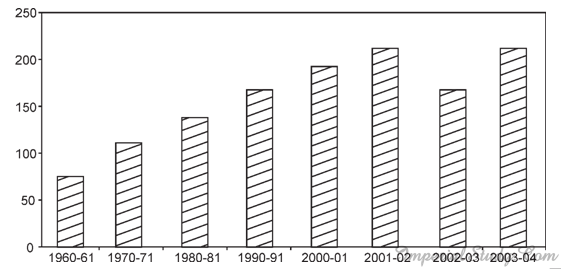
Source : Economic Survey 2004-05.
Ans. (a) In 2001-02 (212.9 million tonnes) in 20.3-04 (213.5 million tonnes)
(b) During 1980-81 to 1990-91
(c) No.
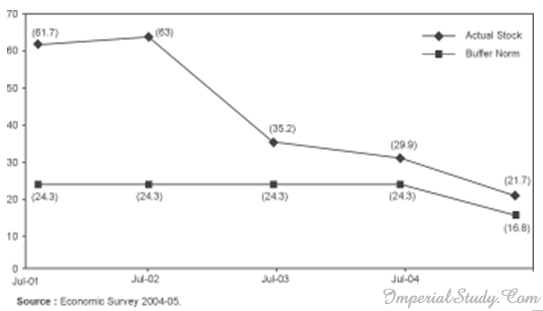
Study the Graph 4.2 and answer the following questions :
QUESTIONS IN THE EXERCISE
Ans. Food security is ensured under the following conditions :
The states of Uttar Pradesh, Bihar, Jharkhand, Orissa, West Bengal, Chhattisgarh, parts of Madhya Pradesh and Maharashtra are more food-insecure in India.
the Green Revolution. Green Revolution took place especially in the production of wheat and rice. The core of this new strategy was the use of HYV seeds along with chemical fertilizer and assured water supplies. As a result, total production of foodgrains increased from 50.8 million tonnes in 1950-51 to 212.0 million tonnes in 2003-04. The largest contribution came from wheat, whose production rose from 6.4 million tonnes to 72.1 million tonnes.
Ans. Despite large increase in foodgrain production we find people without food in India. Poor people suffer from chronic hunger. They find themselves unable to buy food. Over one-fifth of the country’s population still suffers from chronic hunger.
Ans. The supply of food is adversely affected during a natural calamity or disaster. Due to a natural calamity, say drought, the production of food grains is less and hence supply decreases.
not able to buy food. On the other hand, chronic hunger exists among people who are not able to buy food because of their very low income. For example land less labourers earn very less to earn enough for food.
Ans. Our government has undertaken a number of measures to provide food security for the poor.
A brief account of these measures is given below :
In 2000, two special schemes were launched. One, Antyodaya Anna Yojana and second, the Annapurna Schemes. The former relate to the poorest of the poor, while the latter targets indigent senior citizens. The functioning of these two schemes was linked with the PDS. Under AAY scheme, thirty-five kilograms of foodgrains are made available to each eligible family at a rate of Rs 2 per kg for wheat and Rs 3 per kg for rice.
Under APS, 10 kilograms of food grains is made available to eligible persons free of cost.
minimum price for their crops. This price is called ‘minimum support price’.
The interests of the consumers are protected when the procured food is made available to the consumers at subsidised rates. This task is done through fair price shops.
With a view to provide incentives to the farmers for raising the production of their crops, the government announces price of some crops before the sowing season. The government remains ready to purchase their crops at these pre-announced prices. This price is called minimum support price (MSP).
The purchased foodgrains are stored in granaries. This is done to distribute foodgrains among the poorer section of the society. The government makes foodgrains available to the poor at a price much lower than the market price. This is known as issue price.
The food procured by the government is distributed among the poor. This task is done through government regulated shops which are known as fair price shops.
[Important]
Ans. Role of Cooperatives in providing food and related items is as follows:-
The cooperatives are playing an important role in food security in India, especially in the southern and western parts of the country. The cooperative societies set up shops to sell goods to the poor people at lower prices. For example, out of all fair price shops operating in Tamil Nadu, nearly 94 percent are being run by the cooperatives. In Delhi, Mother Dairy is providing milk and vegetables to the consumers at controlled prices which are decided by the Delhi Government. Amul is another example in this regard. It has brought about the White Revolution in the country. There are many more cooperatives and NGOs also working intensively towards this direction.