Blog

  • Multiple Choice Questions of The Seven Ages Class 9th

    MULTIPLE CHOICE QUESTIONS

    Read the following extracts and choose from the options given below :

    1.    Then a soldier

    Full of strange oaths, and bearded like the pard, Jealous in honour, sudden quick in quarrel,
    Seeking the bubble reputation Even in the cannon’s mouth.

    (a)    The pard is a symbol of:

    (i)    humility    (ii) fierceness

    (iii)    jealousy    (iv) love

    (b)    The    poetic device used    in the second line    is a :

    (i)    metaphor    (ii) simile

    (iii)    alliteration    (iv) irony

    (c)    The    soldier seeks    his    moment of glory    :

    (i)    through death on the battlefield

    (ii)    through his acts of chivalry

    (iii)    by rescuing a maiden in distress

    (iv)    making great promises of valour

    Ans : (a) (ii)    (b) (ii)    (c)    (i)

    2.    And then the justice,

    In fair round belly with good capon lined,

    With eyes severe and beard of formal cut,

    Full of wise saws and modern instances And so he plays his part.

    (a)    Which stage is being referred to here?

    (i) Sixth    (ii)    Third

    (iii) Fifth    (iv) Seventh

    (b)    “good capon lined” means :

    (i) riches    (ii)    filled with big, fat, male chicken

    (iii)    round belly (iv)    some gown

    (c)    How does he show his wisdom?

    (i)    By physical appearance

    (ii)    Keeping severe expression

    (iii)    By quoting wise sayings

    (iv)    By showing off

    Ans : (a) (iii) (b) (ii)    (c)    (iii)

    3.    Into the lean and slippered pantaloons with spectacles on nose and pouch on side,

    His youthful hose, well saved, a world too wide For his shrunk shank; and his big manly voice Turning again toward childish treble, pipes And whistles in his sound.

    (a)    Which stage of man is referred to here?

    (i)    Fifth    (ii)    Third

    (iii)    Seventh    (iv)    Sixth

    (b)    ‘Shrunk shank’ means

    (i)    socks    (ii)    thin legs

    (iii)    wrinkled    face    (iv)    twisted neck

    (c)    Why does his    voice    again    become childish?

    (i)    Suffers from sore throat

    (ii)    Remains unwell
    (iii)    Is like a child’s voice again

    (iv)    His old age weakens his voice

    Ans : (a) (iv)    (b)    (ii)    (c)    (iv)

    4.    Last scene of all

    That ends this strange eventful history,

    Is second childishness and mere oblivion,

    Sans teeth, sans eyes, sans taste, sans everything.

    (a)    Why is this last stage called, ‘second childishness’?

    (i)    Behaves like a child

    (ii)    Is without teeth, taste like a child

    (iii)    Pretends to be a child

    (iv)    Has no hair

    (b)    ‘mere oblivion’ means :

    (i) illness    (ii) weakness

    (iii) forgetfulness    (iv) no financial security

    (c)    Why is man’s life called ‘strange eventful history ’ ?

    (i)    due to uncertainty

    (ii)    due to lot of variety

    (iii)    due to strange happenings

    (iv)    like a story

    Ans : (a) (ii)    (b)    (iii) (c) (iii)

    5.    In fair round belly with capon lined With eye severe and beard of formal cut Full of wise saws and modern stances And so he plays his part.

    (a)    Which stage of man is the poet referring to in the above lines?

    (i)    Infancy    (ii)    Youth

    (iii)    Middle age    (iv)    Old age

    (b)    The round belly is suggestive of :

    (i)    A wise person (ii)    A fat person

    (iii)    A generous person

    (iv)    A person of importance

    (c)    By ‘wise saws’ the poet means :

    (i)    Words of wisdom

    (ii)    Shrewd behaviour

    (iii)    Pretence    (iv)    Words of    love

    Ans : (a) (iii)    (b)    (iv)    (c)    (i)

    Content’s

  • Textbook Question of The Seven Ages Class 9th

    Page No: 81

    1. On the basis of your understanding of the poem, answer the following questions by ticking the correct choice 

    (a) All the world is a stage is an extended metaphor for-
    (i)The life shown in well known plays
    (ii) Seeing the well known plays
    (iii) Life of well known plays
    (iv) Life of man that comes to an end

    Answer

    (iv) Life of man that comes to an end

    (b) All ‘have their exits and their entrances’ Exits and entrances refer to __________.
    (i) Birth and death
    (ii) Beginning and end of play
    (iii) Coming and going of actors
    (iv) The end of the Shakespearean era

    Answer

    (i) Birth and death

    Page No: 82

    (c) The seven roles that a man plays correspond to his___________.
    (i) chronological age in life
    (ii) desires
    (iii) mental age in life
    (iv) idea of a perfect life

    Answer

    (i) chronological age in life

    1. Having read this extract, identify the stages of a person’s life as Shakespeare has done. Write down these stages in your note book, and sum up the characteristics of each stage in two or three words. e.g.

    Stage Characteristic feature

    Infancy crying
    Answer
     

    Stage  Characteristic feature
    Infancy Crying, helpless
    Childhood Whining, bright, alert, active
    Lover sentimental, unhappy, poetic,
    tense
    Soldier quarrelsome, short tempered,
    foolishly looking for glory and
    fame in the jaws of death
    Justice Wise, mature, authoritative, responsible
    Old age getting weak and lean due to
    failing health, loss of manly
    voice
    Extreme Old Age Clueless ,dependent
    1. Explain the meaning of the following

    (a) __________ all the men and women merely players
    They have their exits and their entrances __________.

    Answer

    The quoted lines are from the poem “The Seven Ages” by William Shakespeare. The poet has compared the world to a stage and men and women with actors.All men and women appear on the stage of the world to play various roles. They are just stage artists. Their birth marks their appearance on the stage and death

    denotes their departure.

    (b) And then the lover
    Sighing like furnace__________.

    Answer

    The lines are taken from the poem “The Seven Ages” by William Shakespeare. With the help of a simile, the poet explains that on attaining adolescence, men fall in love. The passion of love becomes active like heat generated in a furnace. However, this surging passion also declines after crossing a certain point of time. In this line, the poet hints at momentary nature of human affairs.

    (c) a soldier,__________Seeking the bubble reputation
    Even in the cannon’s mouth.

    Answer

    The quoted lines are from the poem “The Seven Ages” by William Shakespeare.

    The poet has compared a young man to a soldier who takes his responsibilities very seriously and strives relentlessly when dedicated to a cause. In his youth, man seeks instant fame and is ready to take risks. However, when one seeks instant fame, there is a big risk of their reputation getting tainted, just like a bubble that rises and bursts instantly.

    7. Read the poem again and note down the metaphors and similes. Copy and complete the following chart.

    Item Metaphor Simile
    World All the world’s a stage
    Men, women
    school-boy
    lover
    soldier
    reputation
    voice

    Which comparison(s) do you find most interesting? Why?

    Answer 

    Item Metaphor Simile
    World All the world’s a stage
    Men, women men and women merely players
    school-boy Creeping like snail
    lover sighing like a furnace
    soldier bearded like the pard
    reputation bubble reputation
    voice big manly voice

    According to me school boy comparison is really interesting one. Here, poet shows a boy carrying a schoolbag but at the same time walking slowly towards school. He doesn’t want to go to school. This phase common in these days.

    Content’s

  • Word Meanings of The Seven Ages Class 9th

    Word-Meaning
    •    Players – actors • Time – lifetime • Parts – roles •    Ages – stages • Whining – grumbling • Sighing – drawing deep breath • Ballad – song • Jealous in honour – keen to guard his reputation • Bubble reputation – short-lived glory • Justice – judge •    Lined – filled with
    • Merely – just
    • Mewling – crying
    • Puking – vomiting
    • Satchel – a small bag for carrying school books.
    • Woeful – very sad
    • Pard – leopard
    • Cannon – a big gun that fired cannon-balls made of iron.
    • Capon – very big and fat
    • Oaths – solemn promises
    • Justice – judge
    • Slippered – wearing indoor shoes
    • Pantaloon – a funny old man on whom other people play tricks.
    • Pouch – a soft fold of loose skin that hangs down as a result of illness or old age.
    • Hose – tight-fitting leg coverings
    • Shank – legs from the knee to the ankle.
    • Treble – a high voice
    • Oblivion – forgetting everything and being forgotten by everybody. Sans – without (a french word).

    Content’s

  • Summary of The Seven Ages Class 9th

    Summary

    Through Jacques, Shakespeare puts forth the view that the world is a stage in which human beings play their part.
    There are seven Acts like seven stages in a man’s life. A person performs multifarious roles in a single life-time. In the beginning, he is a baby crying in the arms of the nurse.
    Infancy is followed by a school-going stage, when he is bright-eyed, trudging unwillingly to school. In the third stage, he grows into a lover, writing poems in praise of his beloved and sighing like a furnace. Then he plays the role of a soldier, who is rash, and who willingly sacrifices his life for honour. In the next role, he is a Judge, well-fed, prosperous, fat and fierce-eyed. He is always in a mood of impressing others and is full of wise maxims.
    The next stage depicts man to be weak, thin, wearing spectacles and slippers. His clothes are loose, and legs are thin, and his voice is shrill like that of a child. At the end comes the last stage when he loses his memory, teeth, eyes, taste, in fact everything. It is like a second childhood as he has to depend on others for everything. Thus ends the drama of his eventful life.

    Content’s

  • Long Answer Questions of Lord Ullin’s Daughter Class 9th.

    LONG ANSWER QUESTIONS

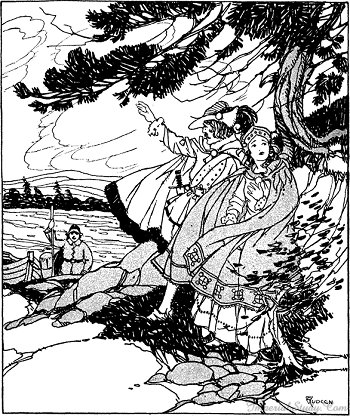
    1.    Describe the chase of the chief of Ulva’s Isle and his beloved by Lord Ullin’s men.

    Ans. The chief of Ulva’s Isle and Lord Ullins daughter elope and are pursued by Lord Ullin and his men. There is no where, they can take refuge, no way of getting any reprieve, For three days consecutively they had been chased relentlessly. Their only hope of escape was to cross the Lochgyle but the raging storm proved fatal. They perish in the stormy waters and leave Lord Ullin lamenting for his daughter.

    2.    How does the poet build the atmosphere of menace, danger and doom that awaits the lovers?

    Ans. Look at these lines and what they signify?

    •    This dark and stormy night — danger

    •    Three days we’ve fled together — chase

    •    For should he find us in the glen

    My blood would stain the heather — revenge

    •    Who will cheer my bonny bride

    When they have slain her lover — tragedy

    •    The water-wraith was shrieking — supernatural

    •    And in the scowl of heaven each face

    Grew dark as they were speaking— frightening

    •    Adown the glen rode armed men

    Their trampling sounded nearer — impending

    disaster
    •    Oh haste thee, haste! the lady cries

    •    Though tempest round us gather

    I’ll meet the raging of the skies — No escape But not an angry father

    *    These lines have drawn a picture of danger, chase, revenge, tragedy, supernatural, frightening situation impending disaster — Fatal — no escape.

    3.    The poem ‘Lord Ullin’s Daughter’ depicts the clash between the impetuous nature of youth and the tyrannical authority of parents. Discuss by giving examples from the poem.

    Ans. “O haste thee, haste ! the lady cries, though tempests round us gather I’ll meet the raging of the skies But not an angry father”. These lines clearly depict the impetuous nature of youth. The tyrannical authority of parents is evident from the lines – “And as the night grew drearer. Adown the glen rode armed men, their trampling sounded nearer.” These lines also show the reckless side of youth and cruel authority of parents – “Three days we have fled together, should he find us in the glen, My blood would stain the heather his horsemen (Lord Ullin’s) behind us ride “Then who will cheer my bonny bride when they have slain her lover?”

    4.    Imagine you are Lord Ullin. You have reached the fatal shore in time and are able to convince your daughter to come back home with her lover. Write a letter to your friend Robert upon the satisfaction which you got after you forgave them. And that you are happyat your timely decision which helped you to get back your daughter.    [CBSE    2010 (Term II)]

    Ans.

    Dear Robert

    You will be glad to know that I have forgiven my daughter. As I chased her and the chief of Ulva’s Isle I was able to reach the shore as they were about to board the boat to cross the glen in the raging storm. I prevented them from boarding the boat and convinced my daughter that I would not harm her Chieftain. I would accept him. The young people were so surprised that they could not believe their ears. I hugged them and embraced them and blessed them. Now I not only have my daughter safe and sound but also a brave fearless son-in-law.

    I am so glad I have a family to live with and to leave behind to carry my name after my death well so long.

    Yours sincerely,

    Ullin

    5.    Discuss ‘Lord Ullin’s Daughter’ as a ballad.

    Ans. ‘Lord Ullin’s Daughter is a ballad of the folk tradition. It describes a story in the narrative style, dealing with the tragedy of Lord Ullin’s daughter, who is unlucky in love. As is typical of a ballad, the poem begins midway, when the lovers have already eloped and the chase of Lord Ullin’s men is on the way. The poem begins abruptly with the dialogue between Chieftain and the boatman. The poem contains lots of dialogues which are typical of a ballad. There is fast paced action, which culminates in tragedy for the lovers, who are drowned in the stormy sea. The language is very simple. But it is the rhythm and the
    music which characterise the poem as a true ballad. The rhyme scheme throughout is ‘ab ab’ which adds to the music of the poem.

    6.    You are Lord Ullin. You are greatly grieved by the loss of your daughter and wonder what it would have been if you had not been rigid about following the traditions of your clan. Write a letter to your friend on how you were the cause of this tragedy.

    [CBSE 2010 (Term I)]

    Dear friend,

    I am writing this letter to you to share my feelings about the irreparable loss that I faced today. Now there is nothing left for me to live for my dear daughter, my only child is gone – gone forever – she would never come back and all because of my inhuman cruelty, my unforgiving nature, my dictatorial ways and my in keeping tradition of the clan. If I had not been so cruelly dictatorial she would be alive now, full of laughter and full of life. Not only my daughter but I would also have got a son — the chieftain of Ulva’s Isle — so brave, so fearless, so loving and devoted to my daughter. Oh God! why could I not foresee the consequences of my harshness. But nothing can be done now. She will never come back again. I will never see her, never hear her voice. Now there is nothing left but a lifelong regret and heartache.

    Your friend

    Ullin

    Content’s

  • Short Answer Questions of Lord Ullin’s Daughter Class 9th.

    SHORT ANSWER QUESTIONS

    1.    Lord Ullin is revengeful, having a dictatorial nature, but is soft at heart. Discuss.

    Ans. Lord Ullin’s daughter wanted to marry the chieftain of Ulva’s Island. He did not approve of it. The lovers elope. Lord Ullin is furious. Along with his boatmen he goes after them. This picture of a stern father is one side of facts. The other is that he loved his daughter as is evident from the lines his wrath was changed to wailing “Come back! come back! he cried in grief’ And I’ll forgive your highland chief, “My daughter! my daughter!” he cried in grief. His anger cools down as he sees his daughter in danger. He is ready to forgive her and her lover.

    2.    Why do you think the boatman was ready to risk his life, knowing fully well that there was a storm in the sea?    (CBSE    2010)

    Ans. The boatman was fearless and faithful. He agrees to take them across the lake not for the sake of the silver pound but for the sake of the lovely bride and her chieftain-lover. He shows no fear in the face of the raging waters. The spirit of the water shrieked fury as the boatman took out the boat — a bad omen but the boatmen remained undisturbed and brave.

    3.    Discuss the dramatic importance of the role played by the boatman. Do you think he was responsible for the tragic death of the lovers ?

    Ans. No, the boatman was not responsible for the tragic death of the lovers. He lost his life as well. In fact he took a brave and bold decison to help the young lovers. In any case they had no option for they were not ready to face Lord Uillin and his men. May be if Lord Ullin had caught them he would have slain the Chieftain and the
    young bride would have been left lamenting.

    4.Why    was Lord Ullin left lamenting in the end?

    (CBSE 2010)

    OR

    Why was Lord Ullin in despair at the end of the poem ?    [CBSE    2010 (Term I)]

    Ans. When Lord Ullin saw his only child perishing in the stormy waters of the lake he was devastated with grief and guilt. He felt if he had not been so strict may be his daughter would have lived. The loss of his daughter was a tragedy he was not able to face. When he saw her drowing, he wanted to save her but the stormy waves rose so high that neither he could give them any help nor they could of their own will come back to the safety of the shore, so there was nothing left for him but to lament.

    5.    Why was the Chieftain of Ulva in a hurry? Who tried to help him ?    [CBSE 2010 (Term I)]

    Ans. Chieftain of Ulva married Lord Ullin’s daughter against her father’s wishes. So they ran away to escape his wrath. Being chased by Lord Ullin and his men, both the lovers reach the shore of a river. They request the boatman to row them to the other shore. The river was furious with storm. At first the boatman refused but seeing the helplessness of the two lovers he agreed to help them.

    6.    What did the Chief of Ulva offer the ferryman to row them across ?    [CBSE    2010    (Term    I)]

    Ans. The chief of Ulva and her bonny bride were being chased by Lord Ullin and his men. They reached the shore of a tempestuous river and requested the boatman to row them across the river. When the boatman showed his reluctance, the chieftain offered him a silver coin to row them across.

    7.    What was the dilemma of the lady in the poem

    ‘Lord Ullin’s Daughter’ ? What choice does she finally make?    [CBSE    2010 (Term I)]

    Ans. The dilemma that Lord Ullin’s daughter faces is which was the lesser evil — the storming waters or the raging Lord Ullin and his men. Whom to face? Who would give them reprieve? Who would give them a chance to survive? Would the storm be kind to them and let them reach the other shore safely or will Lord Ullin be kind and forgive her and give her lover and herself a reprieve. She chooses the raging sea instead of facing a raging father.

    8.    What did the Chief of Ulva fear would happen if they did not cross the Lochgyle ?

    [CBSE 2010 (Term I)]

    Ans. After marrying Lord Ullin’s daughter, the chief of Ulva had invited his wrath. They tried to run away from there by crossing river Lochgyle. Lord Ullin and his men were chasing them. The chief of Ulva thought that if they were unable to cross the river, Lord Ulva and his men would kill the chieftain and there would be no one to take
    care of his bonny bride.

    9.    I’ll meet the raging of the skies;

    But not an angry father.

    Mention the reasons for the speaker’s unwillingness to meet an angry father.    [CBSE 2010 (Term I)]

    Lord Ullin’s daughter is a determined lady who loves the chieftain, despite many odds. She knew her father’s nature well that he would never accept the chieftain as her groom and would never bless her alliance with him. When she elopes with her lover, she is well prepared to face dangers that would result. They have been fleeing for three days. There is no place, where they can escape the wrath of her father, unless they cross the Lochgyle. The tempest, the menacing waves, the mighty wind, the dark raging skies do not deter her. She and her lover try to cross the sea. Even when she is in the grip of death, her one arm is around her lover. This was more than she could have bargained for. It was better than being alive and be separated from her lover. At least they were united in death.

    Content’s

  • Non-Multiple Choice Questions of Lord Ullin’s Daughter Class 9th.

    NON-MULTIPLE CHOICE QUESTIONS

    Read the following extracts and answer the questions given thereafter :

    1.    “And by my word! the bonny bride In danger shall not tarry;

    So, though the waves are raging white I’ll row you o’er the ferry. ”

    (a)    Who speaks the above lines and to whom?

    Ans. These lines have been spoken by the boatman to the chieftain.

    (b)    Who is the ‘bonny bride’?

    Ans. She is Lord Ullin’s daughter who has married the chieftain.

    (c)    What is the reason for the chief and his beloved to hurry across the ferry?

    Ans. They had married each other without the consent of Lord Ullin. So he and his men have been chasing them to separate them.

    2.    By this the storm grew loud apace,

    The water-wraith was shrieking;

    And in the scowl of heaven each face Grew dark as they were speaking,

    (a)    What change takes place while they were talking?

    Ans. The storm has turned furious.

    (b)    The word ‘water-wraith’ means :

    Ans. It means the spirit or the ghost of sea.

    (c)    What does the darkness of the sky symbolise?

    Ans. The darkness of the sea symbolises the approaching danger.

    3.    But still as wilder blew the wind,

    And as the night grew drearer,

    Adown the glen rode armed men,

    Their trampling sounded nearer.

    (a)    How does the situation become more risky for the lovers?
    Ans. The situation becomes more risky for them because Lord Ullin and his men were approaching nearer and nearer.

    (b)    ‘Trampling’ suggests :

    Ans. It suggests the sound of horses’ hoofs.

    (c)    Words like ‘Adown, ‘rode’ are :

    Ans. These words are extremely old fashioned (archaic).

    4.    Lord Ullin reached that fatal shore,

    His wrath had changed to wailing.

    (a)    The adjective ‘fatal’ has been used to describe the shore because :

    Ans. It was from that shore that Lord Ullin saw the waves engulfing his daughter.

    (b)    ‘His wrath had changed into wailing’, means : Ans. Forgetting his anger, Lord Ullin started crying over the possibility of his daughter meeting the watery grave.

    (c)    The reason why Lord Ullin came to the shore was to :

    Ans. To stop his daughter from eloping with Chieftain.

    5.    ‘Now who be ye, would cross Lochgyle,

    This dark and stormy weather?’

    O,    I am the chief of Ulva’s Isle,

    And this, Lord Ullin’s daughter.

    (a)    The person who is uttering the first two lines is :

    Ans. The person who is speaking first two lines is the boatman.

    (b)    The boatman is a little hesistant at the request because :

    Ans. It is a dark and stormy night.

    (c)    The Chieftain and the Lord’s daughter are in a hurry as :

    Ans. Lord Ullin and his men are close on their heels and, if caught, the chieftain will surely be killed.

    6.    “His horsemen hard behind us ride;

    Should they our steps discover,

    Then who shall cheer my bonny bride When they have slain her lover?”

    (a) The poetic device used in the first line is :

    Ans. The poetic device used in ‘alliteration’.

    (b)    ‘They’ refers to :

    Ans. ‘They’ here refers to Lord Ullin’s men.

    (c)    The word ‘bonny’ describes the bride as :

    Ans. It describes the bride as ‘lovely’.
    7.    A Chieftain, to the highland bound Cries, “Boatman, do not tarry!

    And I’ll give thee a silver pound To row us o’er the ferry!”

    (a)    Who is the Chieftain and why is he going towards the highlands?

    Ans. He is the Chief of Ulva’s Island and he is eloping with Lord Uillin’s daughter.

    (b)    Why is the Chieftain in a hurry?

    Ans. He is in a hurry as Lord Ullin and his men are pursuing the young couple.

    (c)    Why did the boatman tarry?

    Ans. The boatman hesitated because of the raging storm but finally relented, much impressed by the Cheftain’s young bride.

    Content’s

  • Multiple Choice Questions of Lord Ullin’s Daughter Class 9th.

    MULTIPLE CHOICE QUESTIONS

    Read the following extracts and choose the best option :    (CBSE 2010)

    1.    And still they row’d amidst the roar Of waters fast prevailing Lord Ullin reached that fatal shore;

    His wrath was changed to wailing

    (a)    The waters ‘fast prevailing ’ means :

    (i)    Quickly racing    (ii) Quickly overpowering

    (iii)    Settling down    (iv) Roaring sound

    (b)    The shore turns ‘fatal ’ because :

    (i)    The lovers drown by the time Lord Ullin and his men reach the shore

    (ii)    They left the shore

    (iii)    The lovers jumped into the stormy sea

    (iv)    The lovers were attacked.
    (c)    Synonym for ‘wrath ’ is :

    (i)    Sympathy    (ii)    Rage

    (iii)    Help    (iv)    Helplessness

    Ans : (a) (ii)    (b) (i)    (c)    (ii)

    2.    Out spoke the handy Highland wight,

    “I’ll go, my chief – I’m ready :

    It is not for your silver bright But for your winsome lady. ”

    [CBSE 2010 (Term I)]

    (a)    Who is the ‘highland wight’?

    (i)    The boatman    (ii)    Scottish Chieftain

    (iii)    Lord Ullin’s man

    (iv)    None of the above

    (b)    Why was the boatman ready to take them across the raging sea?(i)    Because of silver coin

    (ii)    Because he is helpful

    (iii)    Because of the beautiful lady

    (iv)    Because he is poor

    (c)    List two features of the speaker’s personality.

    (i) Helpful    (ii) Brave

    (iii) Greedy    (iv) Both (i) and (ii)

    Ans. (a) (i)    (b)    (ii)    (c)    (iv)

    3.    And still they row’d amidst the roar Of water fast prevailing:

    Lord Ullin reach’d that fatal shore, -His wrath was changed to wailing.

    [CBSE 2010 (Term I)]

    (a)    In spite of bad weather ‘they’ are continuing to row

    as :

    (i)    They have paid the ferryman

    (ii)    They are being chased by the horsemen

    (iii)    They are not afraid of the storm

    (iv)    They have decided to cross the river

    (b)    The shore has been referred as ‘fatal’ meaning deadly because :

    (i)    Lord Ullin reached there ready to kill

    (ii)    Storm would kill the two lovers

    (iii)    Lord Ullin was crying loudly

    (iv)    The river was furious with them

    (c)    Lord Ullin’s wrath changed to wailing when he :

    (i)    Saw his daughter caught in the storm

    (ii)    Discovered that she was half way across the

    river

    (iii)    Found her along with her lover

    (iv)    Realised that they had taken his boat

    Ans. (a) (ii)    (b)    (ii) (c) (i)

    4.    “Come back! Come back!” he cried in grief “Across this stormy water:

    And I’ll forgive your highland chief,

    [CBSE 2010 (Term I)]

    (a)    The speaker is grieved because :

    (i)    his daughter’s life is in danger

    (ii)    he has hurt himself fatally

    (iii)    his horsemen have left him alone

    (iv)    he has lost the battle

    (b)    The Highland Chief has invited the wrath of the speaker by :

    (i)    Conquering a part of his Estate

    (ii)    Eloping with his daughter

    (iii)    Insulting the speaker
    (iv)    Daring to cross the stormy water

    (c)    The speaker’s appeal couldn’t be heard as :

    (i)    His daughter had moved away

    (ii)    His voice was drowned in the sound of the waves

    (iii)    His child was caught in the stormy waters

    (iv)    The furious sea engulfed his daughter

    Ans. (a) (i)    (b)    (ii) (c) (ii)

    5.    “And fast before, her father’s men Three days we’ve fled together,

    For should he find us in the glen,

    My blood would stain the heather”

    [CBSE 2010 (Term I)]

    (a)    ‘We ’ in the second line refers to :

    (i)    Lord Ullin and his armed men

    (ii)    Daughter of Lord Ullin and her lover.

    (iii)    The boatman and his friend

    (iv)    The horsemen

    (b)    Word ‘heather ’ means :

    (i)    A cloth    (ii)    A kind of plant

    (iii)    A bush    (iv)    A weapon

    (c)    ‘Glen ’ here refers to :

    (i)    River    (ii)    Mountain

    (iii)    Valley    (iv)    Sea

    Ans. (a) (ii) (b) (ii) (c) (i)

    6.    “O haste thee haste! ” the lady cries Though tempests round us gather;

    I’ll meet the raging of the skies,

    But not an angry father. ”

    [CBSE 2010 (Term I)]

    (a)    “The lady” in the first line is_.

    (i)    The boatman’s wife

    (ii)    Lord Ullin’s wife

    (iii)    The boatman’s daughter

    (iv)    Lord Ullin’s daughter

    (b)    The word ‘tempest ’ in the second line means :

    (i)    Thunder    (ii)    Rain

    (iii)    Storm    (iv)    Earthquake

    (c)    ‘I ll meet the raging of the skies, but not an angry

    father ’ shows that she is_.

    (i)    scared of him    (ii)    guilty of eloping

    (iii)    upset with him

    (iv)    afraid he would separate her from her beloved

    Ans. (a) (iv) (b) (iii) (c) (iv)

    7.    “Out spoke the hardy highland wight I’ll go, my chief – I’m ready:It is not for your silver bright,

    But for your winsome lady. ”

    (a)    the hardy highland wight” in the first line refers

    to :

    (i) Lord Ullin    (ii) the Chieftain

    (iii)    the boatman    (iv) Lord Ullin’s daughter

    (b)    the hardy highland wight” promised to help the chieftain because :
    (i)    he was greedy    (ii)    he respected    his chief

    (iii)    he was impressed by    the beautiful    beloved

    of the chieftain

    (iv)    he was very cooperative

    (c)    The    speaker of the    above    stanza is :

    (i)    the boatman    (ii)    the chieftain

    (iii)    Lord Ullin    (iv)    Lord Ullin’s    daughter

    Ans. (a) (iii)    (b)    (iii)    (c)    (i)

    Content’s