Blog

  • Chapter 9 What Happened to the Reptiles NCERT Class VI English

    NCERT Class VI English Chapter 9 What Happened to the Reptiles

    • Pambupatti is a peaceful village, inhabited by a variety of people.
    • Prem, the narrator of the story, flees his village under unfortunate conditions to reach Pambupatti by chance.
    • An old resident of the village looks after him and tells him an interesting story.

    YOU may not believe this story. But I can tell you it is true, because I have been to Pambupatti, a village on the edge of the jungle. It is on a cliff, and the vast forest stretches below like a mossy green carpet. There are many kinds of people in the village — dark, fair, tall, short. They speak many languages. Some eat meat, some don’t. Some pray in a small temple at the edge of the forest. Others pray in a mosque some miles away.

    My name is Prem and I live many hundred miles away from Pambupatti. I had heard about the village, but I’d never been there. Then last year, something terrible happened. The people of my own village went mad. Far, far away in a place they have never even been to, a temple or mosque had been burnt down, and they went mad. They started fighting with one another. Some had to run away in the middle of the night. And at three in the morning, as I lay in my house, half awake to the sounds of hate and violence, there was a fire. Many houses were burnt down in the fire. One of them was mine.

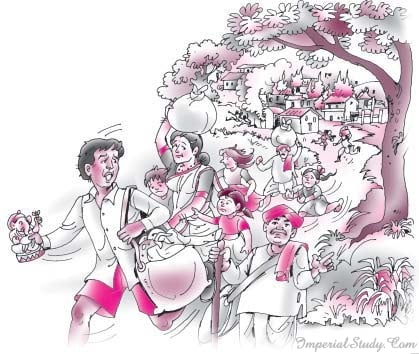
    I managed to grab a few clothes, some coins, my little Ganesh statue, and I ran! I ran for a day and a night, resting whenever my legs would not carry me any further. I jumped on to a train, then on a bus. No tickets. Never mind, everyone
    Chapter 9 What Happened to the Reptiles
    seemed to be running. Finally, I found myself in Pambupatti, and I saw some villagers gathered near a well. I ran to them, and before I could say a thing, I fainted.

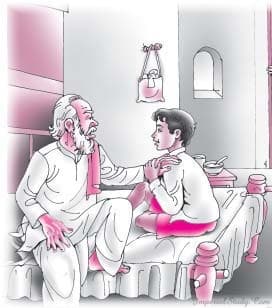
    When I opened my eyes, I saw an old man with white hair, white beard and shining black eyes bending over me. For the next few days, he looked after me, putting food in my mouth and bringing me sweet, cool water from the stream. He rubbed my feet gently and made the pain go away. Neighbours, strangers — everyone came to visit me.

    “Tell me, Grandfather,” I said to him one day. “I have never seen people like the villagers here! In my village, people fight with those who pray to another god. But here … this seems a very strange place!”

    “Prem,” replied the old man, “I will tell you the story of Pambupatti. You can take this story back to your village. Maybe it will heal some of its wounds, and dry some of its sores.”

    “Oh, Grandfather,” I said anxiously, “don’t say that. What I have seen in my village makes me burn with shame. I never, never want to go back there.”

    “But that’s exactly why you must go back,” he said, in a soft voice. I kept quiet. I didn’t want to argue with him, and I wanted to hear his story.

    • Very, very long ago, there were no animals in Pambupatti, only reptiles.
    • They had a meeting every month. Their leader, Makara, would chair the meeting.
    • Misusing his power, Makara ordered the tortoises and snakes to leave the forest.

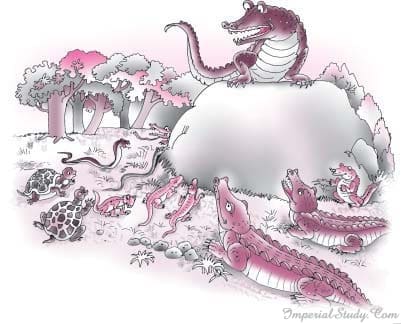
    It happened a long, long time ago, he began. So long ago that there were no schools and no teachers.Chapter 9 What Happened to the Reptiles Children lived in caves with their parents and helped them to collect fruit and berries from the forest. At that time, there were no tigers or panthers or elephants in Pambupatti forest. There were only reptiles, many kinds of reptiles. Now you know what reptiles are. Snakes, crocodiles, turtles, lizards. And you know that a reptile has scales on its body and it lays eggs. Every month, the reptiles of Pambupatti had a big meeting. Everyone came — the pretty excited snakes, the slow thoughtful tortoises, the clever quick lizards,


    Chapter 9 What Happened to the Reptiles
    and the moody crocodiles, grumpy because they were out of  water. The president of these meetings was Makara, the biggest crocodile of the forest. Chapter 9 What Happened to the Reptiles All the animals thought he was very important. When someone is strong and powerful, you know, it is difficult not to go along with what he says or does.

    Now, one day, a strange thing happened. It was a week before one of the monthly meetings. Makara sent a letter to the tortoises, asking them not to come to the meeting. Ahistay,
    the big old star tortoise with black and yellow pictures on his shell, was very angry.

    “What does this mean?” he shouted. “How dare they!” But not one of the tortoises had the courage to attend the meeting— they were so few, the others so many!

    Before the meeting, the giant Makara polished his teeth with the red flowers of the tree by the river till they sparkled. Everyone was waiting for him at the meeting place.

    “Brothers and sisters,” he began. All the reptiles, even the beautiful king cobras, stopped talking. Makara continued his speech. “I have decided that we don’t need the tortoises! I have told them not to come today. Brothers and sisters, can you tell me why we don’t like the tortoises?”

    The reptiles looked this way and that. They felt very uncomfortable. The snakes hissed anxiously, the lizards wriggled their tails, the crocodiles opened their jaws even wider.

    “But…” said one little lizard.

    “No BUTS!” shouted Makara. There was silence.

    “I think …” said a baby crocodile.

    “No I THINKS!” screamed Makara, so loudly that the fruit in the tree above him rained down. After that, no one had the courage to speak.

    Makara cleared his throat and showed a few more teeth. “Well,” he said, “I will tell you why we don’t like the tortoises. They are so slow! So stupid! They even carry their houses on their backs. Whoever heard of such a stupid thing? Now you lizards, you live in trees. Would you ever carry a TREE on your back? Would you?”

    Small, frightened voices answered together, “No, we wouldn’t. But…”

    “No BUTS! Now, listen. I have told the tortoises that they will have to move out of Pambupatti. When they go, we will have more of everything. More food, more water, more space. I want them out by tomorrow. But because they are such slowcoaches, I have given them one week. By next Tuesday we won’t have a single tortoise left in this jungle!”

    And by the following Tuesday, they were all gone. At first the animals were sad, but then they realised that what Makara had said was true. There was more food, more water, and more space for them! But soon, a strange smell began to fill the forest. It was the smell of rot — rotting fruit on the ground, rotting animals in the river. This was what the tortoises used to eat. And even Makara had to go about holding his nose with his big claws.

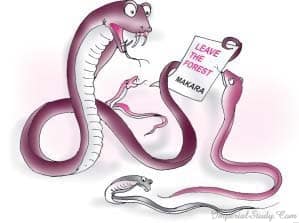
    A month passed by, and then the same thing happened all over again. But this time, it was the snakes. Makara wrote them one of his letters. They were to leave the forest and, since they could move fast, they had to go in a day!

    Naga, the head of the snakes, pleaded for more time, but Makara would not give in. At the meeting, he silenced the others — the lizards and crocodiles — with even louder shouts Chapter 9 What Happened to the Reptiles and threats. “Snakes are slimy,” he said, “and they make funny noises. Who wants such weird creatures around?” Again, no one dared to disagree with Makara, and so the snakes left.
    For a while, the animals of the forest were happy because they had been a little afraid of the snakes. You never knew when one of them might lose his temper and spit some venom at you! And it took only a little poison to kill you, after all.


    • The lizards were also ordered to leave, and the whole forest now belonged to Makara and his group.
    • The crocodiles faced unforeseen problems in the absence of their fellow reptiles.
    • They soon realised that their happiness lay in their fellow creatures’ happiness and homecoming.
    Chapter 9 What Happened to the Reptiles
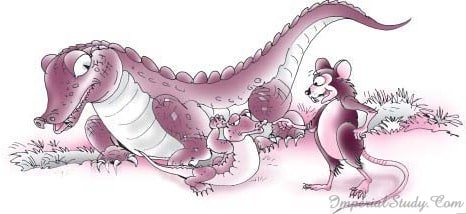
    A few weeks passed and the animals of the forest looked tired and fed up. The RATS! Now that there were no snakes to eat them, the rats had taken over the forest. And they were having a wonderful time. They were everywhere, on the trees, in the grass, in the bushes, on the ground. They ate up the eggs of the lizards and crocodiles. There would be no babies that year. Makara’s own nest of eggs had been chewed up.

    Then Makara had a great idea. He called a meeting of the crocodiles and said, “Wouldn’t it be wonderful if we, the
    Chapter 9 What Happened to the Reptiles
    crocodiles, could have the WHOLE jungle for ourselves? No one but us? These lizards, now, just look at them! They have the strangest habits, and some of them even change colour! How can we trust someone who is green one minute, red the next? Let’s get rid of them.”

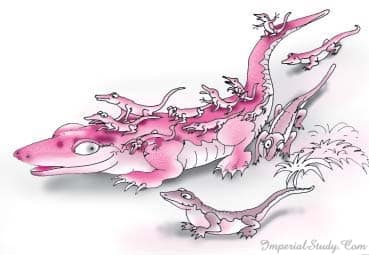
    By now, the crocodiles were really scared of Makara. So they clapped and cheered. Makara was pleased. The lizards left the forest, some with their babies on their backs.

    But now, when life should have been wonderful for the crocodiles of Pambupatti, all kinds of awful things began to happen. To begin with, the rats grew bolder by the day. They became so fearless that they jumped and turned somersaults on the crocodiles’ backs! And there were too many frogs. They seemed to be growing larger, and there was no one to eat them but the crocodiles. These huge frogs began to eat the baby crocodiles. And the insects! Now that the lizards were gone, there were millions of them, growing bigger and nastier by the day.

    It was a terrible time for the crocodiles. They couldn’t understand what had happened to their happy forest home. Then one day, a squeaky little voice piped up at one of their meetings, “We know why the forest has gone crazy, don’t we?”

    Suddenly everyone was silent. They looked at Makara fearfully, but to their surprise, he looked nervous. He shook a rat off his tail and asked the small crocodile. “Why, little fellow?”

    “It all began with the tort—”

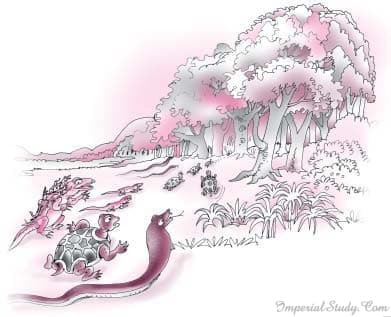
    “Okay, okay”, said Makara. “There’s no need to talk so much.” Makara didn’t want to admit he was wrong, but it didn’t matter. All the crocodiles knew now that he was not all that strong or powerful. Or always right. They sent urgent messages all over the place for the tortoises, snakes and lizards to come back to Pambupatti. And what a great day it was when these creatures came back, family after family, with their little ones on their backs or straggling behind, shouting at their parents to wait for them!
    Chapter 9 What Happened to the Reptiles
    In two months, the forest was back to normal. The rats disappeared, and the insects, and the smell, and the world finally went back to its familiar old self.

    “Well, Prem,” said the old man, “have you fallen asleep? Did my story send you off to dreamland?”

    I shook my head. “No, Grandfather, I was just thinking. Maybe it’s time I went back to my own village, because I have a story to tell them. But what if they don’t listen to me?”

    “We can only keep at it, my son — tell these stories again and again, to more and more people. Some of them may laugh at you or say your stories are not true. But they may remember them one day, and understand that each of us has a place in this strange, funny world of ours.”

    ZAI WHITAKER

    Questions

    1. In what way is Pambupatti different from any other village?
    2. Why is Prem determined not to return to his village?
    3. Why did Makara dislike tortoises, snakes and lizards? Write a line about each.
    4. What went wrong when the tortoises, snakes and lizards left the forest?
    5. Why do you think Prem wants to tell the story of the reptiles to the people of his village?
    6. Do you agree that it is difficult not to go along with someone who is very strong and powerful? Express your views frankly and clearly.
    7. If you were a baby crocodile, would you tell Makara that he was wrong? What would you say to convince him?
  • Chapter 8 A Pact with the Sun NCERT Class VI English

    NCERT Class VI English Chapter 8 A Pact with the Sun

    • Saeeda’s mother has not received proper medical treatment for her complaints.
    • She is denied healthy food, sunshine and fresh air.
    • At last, she consults a good physician who gives her effective medicine and sound advice.

    SAEEDA’S mother had been ailing for a long time—fever, cough, body-ache, painful joints and what not. Treated by a variety of physicians for weeks, she often showed signs of improvement but soon relapsed into her old, sick self, one complaint substituted by another. Though weak and colourless, she was forbidden normal food and was under strict orders to remain perpetually confined to her small, dingy room with doors and windows fastened, deprived of sunshine and fresh air.

    Chapter 8 A Pact with the Sun

    When she became critical, her relatives and neighbours persuaded her to consult a specialist even though his fee was likely to be high. Life is more precious than money, they said. Saeeda’s mother was poor but she heeded their advice and sold a few trinkets to pay the doctor’s fee and the cost of medicine.

    The doctor came in a few days and examined her and prescribed effective but costly medicine. To the question as to what she should eat he said, “Anything you wish to eat — chapati, vegetables, milk, fruits, etc. In addition to all this,” he added emphatically, “leave this dark hovel and occupy a bigger room with doors and windows open. Sit in the sun every morning from eight to nine. Sunshine and fresh air,” he concluded, “are more important than medicine.”

    The doctor and his advice became a subject of noisy commentary among all present. Some favoured while others opposed it. Exposure to sun and air for someone afflicted with chronic cough was dangerous, an experienced lady declared. A younger neighbour nearly quarrelled with her over this. Too exhausted to participate in the debate, Saeeda’s mother remained quiet but determined to follow the doctor’s advice.

    “Forget the consequences,” she said at last. “I’ll carry out his instructions to the letter. Move my bed into the next room and let me sit in the sun on my charpoy for an hour daily.”

    • The sky remains overcast with clouds for a few days.
    • Saeeda makes a special request to the sunrays to help her mother get well.
    • The sunrays keep their word, come down in large numbers and give new life to Saeeda’s mother.

    It so happened that the sky remained overcast next morning. The same was the case the following day. Saeeda’s mother was dejected. She muttered, “O Lord of mine, why have you ordered the sun to remain hidden? How will I ever be cured?”

    Saeeda was playing with her doll nearby and she heard her mother’s lament but kept calm. Later in the afternoon, when she stumbled on a spot of pale sunshine in the courtyard, she ran to her mother to say the sun was there. “No, no”, said everybody present. “It’s too late and chilly. Your mother can’t sit out there.” Disheartened, Saeeda returned to her doll. There was no sun really except for its last remnant entangled in the top branches of the family mango tree.

    Now, children have at their command a secret language, foreign to grown-ups altogether, in which they fluently communicate with trees, flowers, animals, the sun and the moon, perhaps even with the Almighty. Using that special language, Saeeda addressed her remark to the last departing ray of the sun. “Dearest sister, do come tomorrow with lots of warmth and brightness. You see, my mother is ill and needs your help.”

    Chapter 8 A Pact with the Sun“Surely,” answered the light, “don’t look unhappy. We’ll be here at the fixed hour.”
    Next day, early in the morning, when the sprightly sunrays embellished themselves for their journey down to earth, the sun said, “It’s our day off again. We’re staying up here. The road to earth is blocked by an army of thick, mucky clouds.” The little rays so much wanted to go down for a lark but they remained quiet. One of them, though, who had made a pact with little Saeeda said, “Sir, I can’t stay back. I’ve given my word to Saeeda whose mother is ill and needs our help. I’ll pierce through the clouds to reach Saeeda’s courtyard. How else will her mother be cured?” Hearing this, all the rays nearly staged a revolt against their father, the sun. “Fancy staying back again,” they said in a single voice. “What will the people of the earth say about us? That we of the heavens have turned liars?”

    The sun relented. “Please yourselves,” he said. “Mind your clothes, though. The clouds are mucky.”

    “Never mind our clothes. We can always change. But go we must.” And the rays rushed towards the earth. The clouds stood guard between them and Saeeda’s courtyard. The little rays focussed their heat — and they had enough of it — on a battalion of clouds, which had to flee from its post. The rays got through, shooting past the bewildered clouds. They were already late.
    Chapter 8 A Pact with the Sun
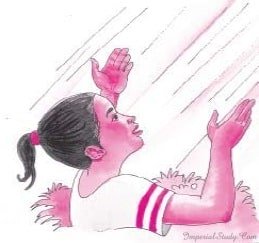
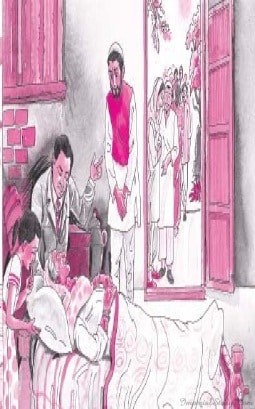
    Saeeda saw the whole host of them approaching and her heart leapt with joy. She shouted, “Amma, Amma! The sun is here. Come out.” The old lady’s eyes welled up with tears of gratitude. Her charpoy was placed in the courtyard and she sat on it for an hour reclining against bolsters. It had been months since she had felt the sun on her hands and face and breathed in fresh air. She thought she was in a new world. Though pale, her face glowed and her eyes shone bright. She saw her child too bathed in sunlight and kissed her. The morning air brought in a new fragrance from nearby flowers. The birds chanted a new tune. Saeeda’s mother felt better already.

    She is fully recovered now, but she still follows the doctor’s advice — an hour of sunlight and lungfuls of fresh air every day.

    ZAKIR HUSAIN
    [translated from the Urdu and
    slightly modified]

    Questions

    1. What did the physicians ask Saeeda’s mother to do to get well? Did their advice help her? If not, why not?
    2. What did the specialist prescribe in addition to medicine?
    3. What did Saeeda tell the sunrays to do?
    4. Why were the sunrays keen to go down to the earth the next day?

    What is your own formula for keeping good health?

    Who would you recommend to a patient in your neighbourhood — the physicians contacted first or the specialist contacted next? Give reasons for your choice. When would you make a pact with the sun? When you are going on a picnic, or when you are playing a cricket match? Think of other occasions.

  • Chapter 7 The Wonder Called Sleep NCERT Class VI English

    NCERT Class VI English Chapter 7 The Wonder Called Sleep

    • Our body and brain recover from fatigue after a good sleep.
    •  We dream while sleeping, but we do not always remember our dreams.
    • During sleep, our heartbeat becomes slower and our temperature and blood pressure go down.

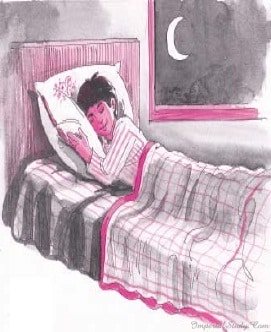
    WE know enough about what sleep is, though we don’t know what exactly causes sleep. Sleep is a state of rest — an unconscious rest. When we sleep, our body recovers from fatigue caused by the day’s activities. After a good sleep and the rest that it gives, we NCERT Class VI English Chapter 7 The Wonder Called Sleep. become alert and active again, ready for the normal activities of the day.
    When we wake up in the morning, it is not always possible for us to remember what happened when we were asleep. We may remember a dream but the rest of
    our sleep was a kind of darkness in which nothing seems to have taken place.

    Several things happen to our body while we are sleeping. As we sink deeper into sleep, our muscles relax more and more. Our heartbeat becomes slower. Our temperature and blood pressure go down. The ever-active brain also slows down so that we can’t think or act consciously. But we dream.

    When we wake up, our temperature and blood pressure rise to normal. Our heartbeat and breathing also become normal and we are fully awake, and have forgotten most, if not all, the dreams that we had while sleeping.


    • A dream is an activity of the mind when we are asleep.
    • Dreams help us sleep through noise and other disturbances.
    • Dreams may reveal something about one’s problems, but they cannot tell the future.

    What is a dream? It is an activity of the mind that takes place when we are asleep. Some dreams are probable while others are not. That only means that many of the things that happen in dreams could happen when we are awake. Others could not. Dreams seem to be important for several reasons. One is that a dream can help us to sleep through noise or other disturbances. For example, the alarm clock rings, but our mind causes us to dream that the telephone or doorbell is ringing, and that we are awake and answering it.

    Certain doctors have found that one’s dreams often reveal a great deal about one’s problems and that, if understood correctly, they can provide a key to the solution of those problems. But we must remember one thing. Dreams cannot be used as a way to tell the future. They simply can never tell the future.

    Sleep is the most common experience, but how many of us really think about the wonder and power of sleep? Many poets have written beautiful poems about sleep. Here is one in which the poet is describing the experience of falling asleep. Read it aloud.

    Lights Out

    I have come to the borders of sleep,
    The unfathomable deep
    Forest where all must lose
    Their way, however straight,
    Or winding, soon or late;
    They cannot choose.
    There is not any book
    Or face of dearest look
    That I would not turn from now
    To go into the unknown
    I must enter and leave alone
    I know not how.

    EDWARD THOMAS

    Questions

    1. What is the most obvious advantage of sleep?
    2. What happens to our body when we sleep?
    3. Define a dream in your own words.
    4. Why are dreams important? Mention two reasons.
    5. Why has sleep been called a wonder?
    6. Describe briefly to the class an improbable dream you have had.

    Grandmothers and mothers sing nice little songs while rocking little ones to sleep. Such a song is called a ‘lullaby’. Do you remember a lullaby in your own language? Tell the class in English what the lullaby says.

  • Chapter 6 The Monkey and the Crocodile NCERT Class VI English

    NCERT Class VI English Chapter 6 The Monkey and the Crocodile

    • A monkey lived in a fruit tree on the bank of a river.
    • He made friends with a crocodile, gave him delicious fruits to eat and sent some for his wife.
    • They met regularly and talked — the monkey in the tree and the crocodile on the ground.

    ONCE, on the bank of a river, a monkey made a home for himself in a tree laden with fruit. He lived in it happily eating to his heart’s content the fruit of his choice.

    The monkey was happy but lonely and wanted a companion to talk to and share the fruits with. But there was no one around, not even another monkey, till one day a crocodile appeared on the riverside.

    “Hello, there,” said the monkey. “Do you live in this river? Would you like to eat some fruit?”

    “Good morning,” replied the crocodile politely. “I did come here in search of food for myself and my wife. Nice of you to offer me fruit.”
    The monkey plucked some from the nearest branch and threw them down. The crocodile found them delicious.

    “Thanks,” he said. “May I have some on my next visit?”

    “Certainly, as many as you like and some for your wife too,” said the monkey. “Do come again. I’m rather lonely here.”

    The crocodile visited the monkey regularly and ate the fruits which his host threw down. He took some home for his wife. The monkey and the crocodile were now the best of friends. They talked and were never tired of talking. They talked about birds and animals, about the villages nearby and the difficulties villagers faced in raising good crops for lack of rain.

    • The crocodile’s wife was annoyed because her husband came home late.
    • She didn’t like his friendship with the monkey.
    • The crocodile couldn’t altogether ignore his wife’s wishes.

    One day, the crocodile stayed with the monkey longer than usual. His wife was annoyed waiting and waiting managing the little crocodiles that had just been hatched. She said, “Who is this friend of yours you are so fond of?”

    “Oh, he is a very nice monkey,” he replied. “He lives on a fruit-tree. He sends fruits for you everyday. You don’t expect me to climb trees, do you?”

    “A nice monkey, I’m sure,” replied the wife with obvious sarcasm. “If you ask me, this monkey should be my food. I want to eat his heart so much.”

    “What a foolish thing to say!” shouted the crocodile. “I can’t kill a friend, though I won’t mind a monkey occasionally for a change of taste.”

    “You bring him here,” ordered the wife. “I want to see him.”

    “So you can eat him. Never!” declared her husband.

    Chapter 6 The Monkey and the Crocodile
    His wife was furious and she dived in to hide herself at the bottom of the river leaving the little ones to pester their father. The crocodile was in a serious dilemma. He loved his wife and was very fond of his friend too. Finally, he decided to be on the side of his wife. She was his life-partner after all. ‘I know it’s a sin to betray a friend, but I have no choice,’ he said to himself. ‘I’ll invite the monkey home and hope for the best.’

    “My wife wants you over for a meal, dear friend,” said the crocodile when he visited the monkey next. “You must come home with me today.”

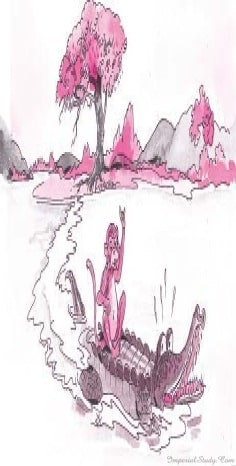
    “With pleasure,” said the monkey. “I’m no swimmer, but can ride on your back.” And they set out.

    In the middle of the river, where the current was the strongest, the crocodile could no longer hide his intention. “Sorry, my friend,” he said hesitatingly, “but I have to go under water now. I’ve brought you here to kill you. My wife cannot survive without eating your heart. Good bye.”

    • The monkey was thunderstruck. He knew his life was in danger.
    • He kept his cool and persuaded the crocodile on a pretext to swim back to the tree.
    • He decided then to discontinue his friendship with the crocodile.

    The monkey was scared and distressed. But he was sensible and clever like all monkeys. He kept a cool head. Calmly he said, “I’d do anything for you and your family. You are my only friend. After all, what is a monkey’s heart compared with the life of a crocodile’s wife? But how foolish could you be? Why didn’t you tell me before? I’d have brought my heart along.”

    “But where is your heart?” asked the crocodile innocently.

    “I thought you carried it all the time.”

    “Of course not. It’s there on the tree. Let’s swim back at once and get it. Your wife must be waiting,” replied the monkey gaining confidence.

    “Oh dear! What a mistake!” hissed the crocodile. They laughed loudly as the crocodile took a full turn to reach the tree.
    Chapter 6 The Monkey and the Crocodile
    Chapter 6 The Monkey and the CrocodileOn the river-bank, the monkey jumped on to the tree and heaved a deep sigh of relief. He plucked a fruit or two from the nearest branch and throwing them down said, “Let your
    wife have some fruit rather than my heart. Fresh fruits are good for mind and body. Good bye, friend, and if you don’t mind, we won’t meet again.” The crocodile, sadder and wiser, shed
    a few tears which were genuine and turned back to go home. He was in a hurry to tell his wife a thing or two.

    (a story from The Panchatantra)


    Questions

    1. The monkey was happy living in the fruit tree, but his happiness was not complete. What did he miss?
    2. What did the two friends generally talk about?
    3. Why was the crocodile’s wife annoyed with her husband one day?
    4. Why was the crocodile unwilling to invite his friend home?
    5. What did the crocodile tell the monkey midstream?
    6. How did the monkey save himself?
    7. What does the last sentence of the story suggest? What would the crocodile tell his wife?

  • Chapter 5 Tansen NCERT Class VI English

    NCERT Class VI English Chapter 5 Tansen

    • Tansen was the only child of his parents.
    • Naughty but talented, he imitated the calls of birds and animals perfectly.
    • Once he tried to frighten a group of travelers by roaring like a tiger.

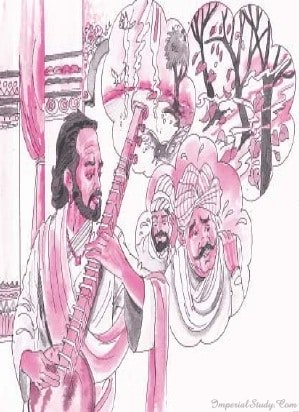
    YOU may have heard the name of Tansen — the greatest musician our country has produced.

    A singer called Mukandan Misra and his wife lived in Behat near Gwalior. Tansen was their only child. It is said that he was a naughty child. Often, he ran away to play in the forest and soon learned to imitate perfectly the calls of birds and animals.

    Chapter 5 Tansen
    A famous singer named Swami Haridas was once traveling through the forest with his disciples. Tired, the group settled down to rest in a shady grove. Tansen saw them.

    ‘Strangers in the forest!’ he said to himself. ‘It will be fun to frighten them’. He hid behind a tree and roared like a tiger. The little group of travelers scattered in fear but Swami Haridas called them together. “Don’t be afraid,” he said. “Tigers are not always dangerous. Let us look for this one.”

    Suddenly, one of his men saw a small boy hiding behind a tree. “There are no tigers here, master,” he said. “Only this naughty boy.”

    • Tansen learnt music from Swami Haridas for eleven years.
    • He stayed with a holy man called Mohammad Ghaus.
    • He married Hussaini, one of the ladies in the court of Rani Mrignaini.

    Swami Haridas did not punish him. He went to Tansen’s father and said, “Your son is very naughty. He is also very talented. I think I can make him a good singer.”

    Tansen was ten years old when he went away with Swami Haridas. He lived with him for eleven years, learning music, and became a great singer. At about this time, his parents died. Mukandan Misra’s dying wish was that Tansen should visit Mohammad Ghaus of Gwalior. Mohammad Ghaus was a holy man. Mukandan Misra had long been devoted to him, and often visited him. While living in Gwalior with Mohammed Ghaus, Tansen was often taken to the court of Rani Mrignaini, who was a great musician herself. There he met and married one of the ladies of the court. Her name was Hussaini.

    Hussaini also became Swami Haridas’s disciple. Tansen and Hussaini had five children who were all very musical. Tansen had, by this time, become very famous. Sometimes he sang before Emperor Akbar, who was so impressed by him that he insisted Tansen should join his court.

    • Tansen became a favourite in Akbar’s court.
    • Once he was asked to sing Raga Deepak.
    • Tansen asked his daughter and her friend to sing Raga Megh after Raga Deepak to counteract the effect of the latter.

    Tansen went to Akbar’s court in 1556, and soon became a great favourite of the Emperor. Akbar would call upon Tansen to sing at any time during the day or night. Quite often he would just walk into Tansen’s house to hear him practise. He also gave him many presents. Some of the courtiers became jealous of Tansen. “We shall never be able to rest till Tansen is ruined,” they declared. One of the courtiers, Shaukat Mian, had a bright idea.

    “Let us make him sing Raga Deepak,” he said.

    “How will that help us?” asked another man.

    “If Raga Deepak is properly sung, it makes the air so hot that the singer is burnt to ashes. Tansen is a very good singer. If he sings Raga Deepak, he will die, and we will be rid of him.”

    Shaukat Mian went to Akbar and said, “We don’t think Tansen is a great singer. Let us test him. Tell him to sing Raga Deepak. Only the greatest singers can sing it properly.”

    “Of course he can sing it. Tansen can sing anything.” Akbar said. Tansen was afraid, but could not disobey the king. “Very well, my lord,” he said, “but give me time to prepare myself.” Tansen went home. He had never been more downcast and unhappy. “I can sing the Raga,” he told his wife, “but the heat it gives off will not only set the lamps alight, it will also burn me to ashes.”

    Then he had an idea. “If someone sings Raga Megh at the same time, and sings it properly, it will bring rain. Perhaps our daughter, Saraswati, and her friend, Rupvati, could do it,” he said.

    He taught the two girls to sing Raga Megh. They practised night and day for two weeks. Tansen told them, “You must wait till the lamps start burning, and then you start singing.”

    • Both Ragas were sung according to plan.
    • Akbar punished Tansen’s enemies.
    • Tansen died in 1585.

    The legend goes that on the appointed day the whole town assembled to hear Tansen sing Raga Deepak. When he began to sing, the air became warm. Soon people in the audience were bathed in perspiration. The leaves on the trees dried up and fell to the ground. As the music continued, birds fell dead because of the heat and the water in the rivers began

    Chapter 5 Tansen
    to boil. People cried out in terror as flames shot up out of nowhere and lighted the lamps.

    At once Saraswati and Rupvati began to sing Raga Megh. The sky clouded over and the rain came down. Tansen was saved. The story goes that he was very ill after this, and Akbar was sorry that he had caused him so much suffering. He punished Tansen’s enemies. When Tansen got well, the entire city rejoiced. Tansen remained Akbar’s court singer till 1585 when he died. He composed several new ragas.

    Tansen’s tomb is in Gwalior. It is a place of pilgrimage for musicians.

    Questions

    1. Why did Swami Haridas say Tansen was ‘talented’?
    2. Why did Akbar ask Tansen to join his court?
    3. How do we know that Akbar was fond of Tansen? Give two reasons.
    4. What did the other courtiers feel about Tansen?
    5. (i) What happens if Raga Deepak is sung properly?
    (ii) Why did Tansen’s enemies want him to sing the Raga?
    6. Why did Tansen agree to sing Raga Deepak?
    7. (i) What steps did he take to save himself?
    (ii) Did his plan work? How?

    Are you interested in music? Do you like classical music?

    Name a few distinguished Indian musicians.

  • Chapter 4 The Old-Clock Shop NCERT Class VI English

    NCERT Class VI English Chapter 4 The Old-Clock Shop

    • It’s Christmas Eve, and closing time for shops.
    • Ray’s old-clock shop is still open.
    • Two shoppers call at this late hour.

    CHRISTMAS Eve had arrived. As last-minute shoppers were going home, a thick, white sheet of snow lay over Salt Lake City, USA. Yet the lights were still burning in the old-clock shop, as Ray, its old, deaf owner, worked on a clock he had sold that day.

    Chapter 4 The Old-Clock Shop
    Having finished his work, Ray stood up and was on his way to the back room when a cold rush of air from the front door hit the back of his neck.

    He turned to meet a last-minute shopper, but his old, wise eyes told him that this was not a shopper. He saw two men, one in his twenties, the other closer to fifty. The younger man remained at the door. The older man approached the counter with no sign of friendliness in his eyes. Ray was able to hide his growing fear as he slowly pushed a notepad and a pencil across the counter.

    He smiled at the unfriendly face, then pointed to his ears and shook his head from side to side. A quick look of surprise changed the man’s face as he studied the notepad, then turned and said something to his friend.

    Ray used the chance to look closely at the man, paying attention to the shape of a gun and a restless hand in the man’s right coat-pocket. Anger boiled within him, but it was kept down by an inner voice that said, “Be still.” He wrote on the notepad, “May I help you?” For the first time the older man looked directly at Ray and smiled. A cruel, mocking smile. They both understood why he was there, why his friend remained at the door. They looked like men who were down on their luck, and were now ready to try something they would later be sorry about.

    • Ray knows that his visitors are in need.
    • He accepts an old watch in exchange for a good sum of money.
    • The message of peace and goodwill spreads everywhere as the old clocks chime Merry Christmas.

    The clocks ticked on. Ray calmly wrote another message. “Have you come to pick up a clock or watch?” Then he pointed to the ‘loan’ board filled with hanging clocks and pocket watches. He was not a pawnbroker, but at the same time couldn’t say ‘No’ to the needy people who placed their old watches or clocks before him for anything they could get. He loaned more than he should. They would be there when the owners wanted them back … at the same price he had paid, with no interest.

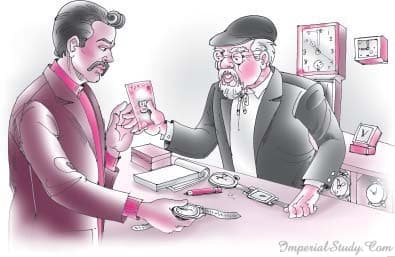
    Then the older man seemed to feel a little easier, took out his hand from his pocket and quickly looked at the watch on his wrist. “How much will you give me for this?” the man wrote.

    Ray noticed a little shame in the grey eyes looking at him. The watch was nothing special and yet had great powers. It was something to exchange, a way out of a bad situation. Knowing that great need had brought the man to his shop in the first place, Ray asked, “How much do you need for it?” The reply came back on the notepad: “Whatever it’s worth.”

    Ray reached into his cash-box, pulled out a fifty-dollar note and passed it into the man’s hand. As they shook hands, Ray looked into the man’s eyes; they seemed to say, “Thank
    Chapter 4 The Old-Clock Shop
    you!” They both knew the watch wasn’t worth that much. Before turning to leave, the man wrote, “I will be back to pick it up as soon as I can. Merry Christmas!”

    The little story ended on the half hour with the clocks striking altogether. The timepieces, which had been looking on silently all the while, rang out the time with such feeling that even Ray thought he could hear them. Their sweet, musical message was filled with hope. The timeless message of ‘Peace on earth, goodwill towards all’ was felt by the three men who stood in the old clock shop.

    Questions

    1. What made Ray think the visitor was not really a shopper?
    2. Why do you think he had come to the shop?
    3. How did Ray communicate with him?
    4. What do you think the man said to his friend who waited at the door?
    5. Ray was not a pawnbroker. Why then did he lend money to people in exchange for their old watches and clocks?
    6. “The watch was nothing special and yet had great powers.” In what sense did it have ‘great powers’?
    7. Do you think the man would ever come back to pick up the watch?
    8. When did “the unfriendly face” of the visitor turn truly friendly?

  • Chapter 3 The Shepherd’s Treasure NCERT Class VI English

    NCERT Class VI English Chapter 3 The Shepherd’s Treasure

    • A poor shepherd once lived in Iran.
    • Though uneducated, he was very wise and helpful.
    • The king decided to meet him in disguise.

    IN a village in Iran there once lived a shepherd. He was very poor. He did not have even a small cottage of his own. He had never been to school or learned to read and write, for there were very few schools in those days.

    Though poor and uneducated, this shepherd was very wise. He understood people’s sorrows and troubles and helped them face their problemsChapter 3 – The Shepherd’s Treasure
    with courage and common sense. Many people came to him for
    advice. Soon he became famous for his wisdom and friendly nature. The king of
    that country heard about him, and thought of meeting him.

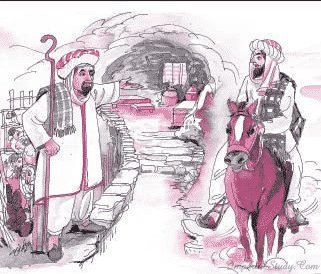
    Disguised as a shepherd and riding on a mule, one day the king came to the cave where the wise shepherd lived. As soon as the shepherd saw the traveller coming towards the cave, he rose to welcome him. He took the tired traveller inside the cave, gave him water to drink and a share of his own meagre meal. The king rested for the night in the cave and was greatly impressed by the shepherd’s hospitality and wise conversation.

    • The shepherd was able to make out that his visitor was none other than the king.
    • The king made the wise shepherd governor of a small district.
    • Other governors became jealous of the new governor and called him dishonest.

    Though still tired, the king decided to depart the next morning. He said, “Many thanks for your kindness to a poor traveller. I have a long way to go. Permit me to leave.”

    Looking straight into the eyes of his guest, the shepherd replied, “Thank you, Your Majesty, for paying me the compliment of a visit.”

    The king was astonished as well as pleased. ‘He is indeed very wise,’ he thought to himself. ‘I need people like him to work for me.’ And the king appointed this humble shepherd the governor of a small district.

    Although he rose to power and dignity, the shepherd remained as humble as ever. People loved and honored him for his wisdom, sympathy and goodness. He was kind and just to one and all. His fame as a fair and wise governor soon spread throughout the country.

    Now the governors of other provinces grew terribly jealous of him and began to talk to the king against him. They said, “He is very dishonest, and keeps for himself part of the money that he collects as tax from the people.” Why did he always carry with him, they added, an iron chest? Perhaps he carried in it the treasure that he had secretly collected. After all, they said mockingly, he was an ordinary shepherd and could behave no better.

    • The new governor was called to the palace.
    • He was ordered to explain why he always carried an iron chest.
    • The chest contained no gold or silver.

    At first the king did not pay attention to these reports, but how long could he ignore these governors and their endless stories about the shepherd? One thing was certain, the king discovered. The new governor did carry an iron chest with him all the time.

    So, one day, the new governor was summoned to the palace. He came riding on his camel, and to everyone’s delight, the famous iron chest was there fastened securely behind him on the camel’s back.

    Now the king was angry. He thundered, “Why do you always carry that iron chest with you? What does it contain?”

    The governor smiled. He asked his servant to bringChapter 3 – The Shepherd’s Treasure in the chest. How
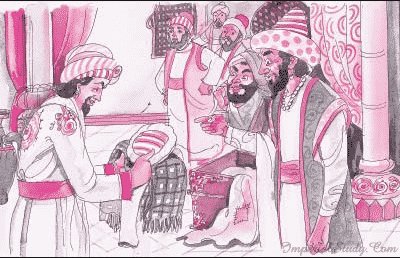
    Eagerly the people standing around waiting for the shepherd to be found out! But how great was their astonishment, and even of the king himself, when the chest was opened! No gold or silver or jewels but an old blanket was all that came out. Holding it up proudly, the shepherd said, “This, my dear master, is my only treasure. I always carry it with me.”

    “But why do you carry such an ordinary blanket with you? Surely, you are the governor of a district?” the king asked. To which the shepherd replied with quiet dignity, “This blanket is my oldest friend. It will still protect me if, at any time, Your Majesty should wish to take away my new cloaks.”

    How pleased the king was, and how embarrassed the jealous governors became to hear the wise man’s reply! Now they knew that the shepherd was indeed the humblest and the wisest man in the land. The king made him the governor of a much bigger district that very day.

    (an Iranian folktale)

    Questions

    1. The shepherd hadn’t been to school because
    (i) he was very poor.
    (ii) there were very few schools in those days.
    (iii) he wasn’t interested in studies.
    Choose the right answer.
    2. Who visited the Shepherd one day, and why?
    3. Why did the other governors grow jealous of the shepherd?
    4. Why was the new governor called to the palace?
    5. Why was everyone delighted to see the iron chest on the camel’s back?
    6. (i) What did the iron chest contain?
    (ii) Why did the shepherd always carry it?
    (iii) Is it an example of the shepherd’s humility or wisdom or both?
    7. How did the king reward the new governor?

  • The Friendly Mongoose Class VI English Chapter 2 NCERT Text Book

    Class VI NCERT Mathematics Text Book Chapter 2 The Friendly Mongoose is given below.

    NCERT Class VI English Chapter 2 The Friendly Mongoose

    • A farmer, his wife and their small child lived in a village.
    • There was also a baby mongoose in the house, who they believed would be their son’s companion and friend in future.
    • One day the farmer and his wife went out leaving the child alone with the mongoose.

    ONCE a farmer and his wife lived in a village with their small son. They loved him very much. “We must have a pet,” the farmer said to his wife one day. “When our son grows up, he will need a companion. This pet will be our son’s companion.” His wife liked the idea.

    One evening, the farmer brought with him a tiny mongoose. “It’s a baby mongoose,” said his wife, “but will soon be fully grown. He will be a friend to our son.”
    The Friendly Mongoose
    Both the baby and the mongoose grew. In five or six months the mongoose had grown to its full size — a lovely animal with two shining black eyes and a bushy tail. The farmer’s son was still a baby in the cradle, sleeping and crying alternately.

    One day, the farmer’s wife wanted to go to the market. She fed the baby and rocked him to sleep in his little cradle. Picking up the basket, she said to her husband, “I’m off to the bazar. The baby is sleeping. Keep an eye on him. Frankly, I don’t like to leave the child alone with the mongoose.”

    “You needn’t be afraid,” said the farmer. “The mongoose is a friendly animal. It’s as sweet as our baby and they are the best of friends, you know.”

    The wife went away, and the farmer, having nothing to do in the house, decided to go out and take a look at his fields not far away. He ran into some friends on the way back and didn’t return for quite some time.

    • The farmer’s wife returned home from the market carrying a heavy basket.
    • She found the mongoose at the entrance of the house with blood on his face and paws.
    • She jumped to the conclusion that it was her son’s blood, and the mongoose was the guilty one.

    The farmer’s wife finished her shopping and came back home with a basketful of groceries. She saw the mongoose sitting outside as if waiting for her. On seeing her he ran to welcome her, as was customary. The farmer’s wife took one look at the mongoose and screamed. “Blood!” she cried. The face and paws of the mongoose were smeared with blood.

    “You wicked animal! You have killed my baby,” she screamed hysterically. She was blind with rage and with all her The Friendly Mongoosestrength brought down the heavy basket full of groceries on the blood-smeared mongoose and ran inside to the child’s cradle.
    The baby was fast asleep. But on the floor lay a black snake torn and bleeding. In a flash she realised what had happened. She ran out
    looking for the mongoose.

    “Oh! You saved my child! You killed the snake! What have I done?” she cried touching the mongoose, who lay dead and still, unaware of  her sobbing. The farmer’s wife, who had acted hastily and rashly, stared long at the dead mongoose. Then she heard the baby crying. Wiping her tears, she went in to feed him.

    (a story from The Panchatantra)


    Questions

    1. Why did the farmer bring a baby mongoose into the house?
    2. Why didn’t the farmer’s wife want to leave the baby alone with the mongoose?
    3. What was the farmer’s comment on his wife’s fears?
    4. Why did the farmer’s wife strike the mongoose with her basket?
    5. Did she repent her hasty action? How does she show her repentance?

    Do you have a pet — a cat or a dog? If not, would you like one? How would you look after it? Are you for or against keeping birds in a cage as pets?

  • A Tale of Two Birds NCERT Class VI English Chapter 1 TEXT Book

    Class VI NCERT Mathematics Text Book Chapter 1 A Tale of Two Birds is given below. Collected From Open Sources

    • A mother bird and her two young ones lived in a forest.
    • The mother was killed in a storm and the young birds were separated from each other.
    • Each found a different home.

    THERE once lived a bird and her two new-born babies in a forest. They had a nest in a tall, shady tree and there the mother bird took care of her little ones day and night.

    One day, there was a big storm. There was thunder, lightning and rain, anChapter 1 – A Tale of Two Birdsd the wind blew down many trees. The tall tree in which the birds lived also came down. A big, heavy branch hit the nest and killed the bird. Fortunately for the baby birds, the strong wind blew them away to the other side of the forest. One of them came down near a cave where a gang of robbers lived. The other landed outside a rishi’s ashram a little distance away.
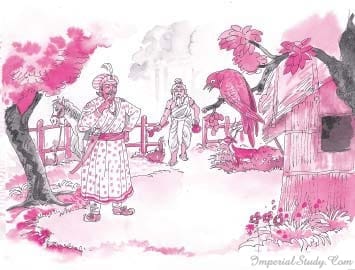
    Days passed and the baby birds became big birds. One day, the king of the country came to the forest to hunt. He saw a deer and rode after it. It ran deep into the forest followed by the king. Soon the king lost his way and didn’t know where he was.

    He rode on for a long time till he came to the other side of the forest. Very tired by now, he got off his horse and sat down under a tree that stood near a cave. Suddenly he heard a voice cry out, “Quick! Hurry up! There’s someone under the tree. Come and take his jewels and his horse. Hurry, or else he’ll slip away.” The king was amazed. He looked up and saw a big, brown bird on the tree under which he was sitting. He also heard faint noises issuing from the cave. He quickly got on to his horse and rode away as fast as he could.

    • The king was amazed to hear a similar voice again.
    • He came to know the birds’ true story.
    • He met the rishi who explained the behaviour of each bird.

    Soon, he came to a clearing which looked like an ashram. It was the rishi’s ashram. The king tied his horse to a tree and sat down in its shade. Suddenly he heard a gentle voice announce, “Welcome to the ashram, Sir. Please go inside and rest. The rishi will be back soon. There’s some cold water in the pot. Please make yourself comfortable.” The king looked up and saw a big, brown bird in the tree. He was amazed. ‘This one looks like the other bird outside the cave,’ he said to himself aloud.

    “You are right, Sir,” answered the bird. “He is my brother but he has made friends with robbers. He now talks as they do. He doesn’t talk to me any more.” Just then the rishi entered the ashram.

    “Welcome, Sir,” he said Chapter 1 – A Tale of Two Birds to the king. “Please come inside and make yourself at home. You look tired. Rest for a while. Then you can share my food.”

    The king told the rishi the story of the two birds and how each had behaved
    so differently though they looked so alike. “The forest is full of surprises,” he said.

    The holy man smiled and said, “After all, one is known by the company one keeps. That bird has always heard the talk of robbers. He imitates them and talks about robbing people. This one has repeated what he has always heard. He welcomes people to the ashram. Now, come inside and rest. I’ll tell you more about this place and these birds.”


    Questions

    1. How did the two baby birds get separated?
    2. Where did each of them find a home?
    3. What did the first bird say to the stranger?
    4. What did the second bird say to him?
    5. How did the rishi explain the different ways in which the birds behaved?
    6. Which one of the following sums up the story best?
    (i) A bird in hand is worth two in the bush.
    (ii) One is known by the company one keeps.
    (iii) A friend in need is a friend indeed.