Tag: Class 9th

  • Notes of The Story of India – Size and Location Class 9th Social Science Geography

    Topics in the chapter:

    • India’s Location
    • Its Size
    • India and the World
    • Its neighbours

    Introduction: India is one of the oldest civilisations and have a remarkable history. After Independence from British rule, it achieved multi-faceted socio-economic progress. Also made a remarkable progress in the field of agriculture, industry, technology and overall economic development.

    India’s Location

    • Lies entirely in Northern hemisphere between latitudes 8°4′ N and 37°6′ N and longitudes 68°7′ E and 97°25′ E.

    • Divided by Tropic of cancer (23°30′ N) in almost two equal parts.

    • In Southeast, Andaman and Nicobar islands lie in Bay of Bengal.

    • In Southwest, Lakshadweep islands lie in Arabian Sea.

    Its Size

    • Total Area of India is 3.28 million square km which is 2.4 percent of the total area of the world.

    • It is seventh largest country in the world in terms of landmass.

    • It has land boundary of about 15,200 km and the total length of the coast line of the mainland
    including Andaman and Nicobar and Lakshadweep islands is 7,516.6 km.

    • In the northwest, north and north east of India, young folds mountains bounds it.

    • South of about 22° north latitude, India narrows and finally extends towards the Indian Ocean. It also divides it into two seas, the Arabian Sea on the west and the Bay of Bengal on its east.

    • The latitudinal and longitudinal extent of the mainland is about 30°.

    • India’s east-west extent appears to be smaller than the north-south extent.

    • The time along the Standard Meridian (82°30′ E) passing through Mirzapur in UP is taken as the Indian Standard Time for whole country.

    • The time gap between Arunachal Pradesh present in the east and Gujarat present in the west is about 2 hours. The latitudinal extent influences the duration of day and night, as one moves from south to north.

    India and the World

    • India is located in the centre of the World between East and the West Asia.

    • The routes across the Indian ocean which connect the countries of Europe in the West and the countries of East Asia provide a strategic central location to India.

    • The Deccan Peninsula* helps India to establish close contact with West Asia, Africa and Europe from the western coast and with Southeast and East Asia from the eastern coast.

    • The Ocean which is south of India given name Indian Ocean as no other country has a long coastline on the Indian Ocean as India has.

    • The land routes of India are much older than sea route. Various passes across mountains in the north have provided passages to the ancient travellers as ocean limited such interaction for a long time.

    • The land routes helped India in the exchange of ideas and commodities since ancient times.

    • India have propagated the ideas of the Upanishads and the Ramayana, the stories of Panchtantra, the Indian numerals and the decimal system as well as given spices, muslin and other merchandise to different countries.

    • Also, the influence of Greek sculpture, and the architectural styles of dome and minarets from West Asia can be seen in different parts of India.

    Its neighbours

    • India is comprised of 29 states and 7 union territories and shares its land boundary with:
    → Northwest: Pakistan and Afghanistan
    → North: China, Nepal, Bhutan
    → East: Myanmar and Bangladesh
    → South: Sri Lanka and Maldives

    • Sri Lanka is separated from India by a narrow channel of sea formed by the Palk Strait and the Gulf of Mannar

    • Maldives Islands are situated to the south of the Lakshadweep Islands.

    * A peninsula is a piece of land that is bordered by water on three sides but connected to mainland on one side.

    Do You Know from Chapter

    • The southernmost point of the Indian Union– ‘Indira Point’ got submerged under the sea water in 2004 during the Tsunami.

    • Since the opening of the Suez Canal in 1869, India’s distance from Europe has been reduced by 7,000 km.

    • Before 1947, there were two types of states in India – the provinces and the Princely states.
    → Provinces were ruled directly by British officials who were appointed by the Viceroy.
    → Princely states were ruled by local, hereditary rulers, who acknowledged sovereignity in return for local autonomy.

    Important Map

    India - Size and Location Important map
  • Class 9th Science | Nots, NCERT Solution, Extra Questions..


    • Chapter 1- Matter in Our Surroundings Class 9th Science
    • Chapter 2- Is Matter Around Us Pure Class 9th Science
    • Chapter 3- Atoms and Molecules Class 9th Science
    • Chapter 4- Structure of the Atom Class 9th Science
    • Chapter 5- The Fundamental Unit of Life Class 9th Science
    • Chapter 6- Tissues Class 9th Science
    • Chapter 7- Diversity in Living Organisms Class 9th Science
    • Chapter 8- Motion Class 9th Science
    • Chapter 9- Force and Laws of Motion Class 9th Science
    • Chapter 10- Gravitation Class 9th Science
    • Chapter 11- Work and Energy Class 9th Science
    • Chapter 12- Sound Class 9th Science
    • Chapter 13- Why Do We Fall Ill Class 9th Science
    • Chapter 14- Natural Resources Class 9th Science
    • Chapter 15- Improvement in Food Resources Class 9th Science


  • Mrs Packletide’s Tiger Class 10th | English Chapter 2 Summary, Study Material

    Chapter-2 Mrs. Packletide’s Tiger

    Content’s

    Introduction

    Saki, the story writer, was born in 1870 and passed away in 1916. His real name was Hector Munro, a British author. He is known for his witty and satirical stories, most of which have surprise endings.

    ‘Mrs. Packletide’s Tiger’ is a satire on the vanity of women who go to extremes to show their superiority over their rivals. Mrs. Packletide wanted to shoot a tiger only to prove that she was no less that Loona Bimberton who had carried eleven miles in an airplane and continued to boast about it. Though she ‘killedi a tiger yet she had to pay the heavy price to satisfy her vanity.

  • Matter in our Surroundings Notes of Science Class 9th | PDF Download

    Science for class-  IX (NCERT)

    Chapter-1 –Matter in our surroundings

    1.1-Introduction

    You all know about matter from our previous classes. In this chapter, you will study more deeply about the characteristics of different forms of matter and their properties.

    1.2-What is matter?

    Matter is anything that hassome massand occupies some space. A book, a table, a river, a fountain of steam , huge rocky  mountains and even a small iron nail; all these look so different are all different forms of matter.

    The ancient Indian scientists classified matter into five elements – air, water, earth, fire, and sky. But the modern scientists classify it on the basis of their physical and chemical structure. Matter has different forms and different forms of matter have different characteristics and different properties.

    1.3-Different forms of matter.

    Matter is present in three forms-

    1.3.1-Solids

    Solids are mostly hard and rigid. Their molecules have very little space or no space between them. They have fixed shape and fixed volume. This means that they are unable to change their shapes and they even break if extreme force is applied on them.They are least compressible.

    But, what about a sponge? You can easily determine that a sponge is a solid, but you can easily change its shape. Then how is sponge a solid? Also, think of a rubber band which also comes in the categories of solid. You can stretch it easily according to your need, then how is a rubber called a solid?

    • A sponge is obviously a solid but has tiny pours between its molecules which allow the passage of air through them. This creates space between the molecules of sponge and that’s why you can change its shape.
    • A rubber band again is a solid, but its molecules are This allows the rubber band to be stretched according to your needs. However, the rubber band breaks if you try to stretch it over limit, so this proves that rubber band is a solid.

    1.3.2-Liquids

    Liquids are not rigid like solids but are fluid, which means they can flow. They have more molecular space than solids. They actually don’t possess any definite shape, but they do have a definite volume. They take the shape of the container in which they are kept. For example:- when you take a glass of water, the water inside the glass is in the shape of the glass. If you pour the water in a bowl, it changes shape to that of bowl. Liquids are more compressible than solids.

    1.3.3-Gases

    Gases have the least molecular space. They neither have any fixed shape, nor have any fixed volume. Some examples of gases are oxygen, hydrogen, nitrogen, etc. The molecules of gases keep moving. Because of the least molecular space, most gases are not visible. But they are present in all our surroundings. Even an empty jar container too has gas in it.

    The molecules of gases in a container keep moving at high speed in random directions. Due to this random movement, they hit the walls of the container too. This way, they exert  pressure on the walls of container in which they are kept.Gases are highly compressible and are available in compressed forms of Liquefied Petroleum Gas (LPG)

    andCompressed Natural Gas (CNG), etc.

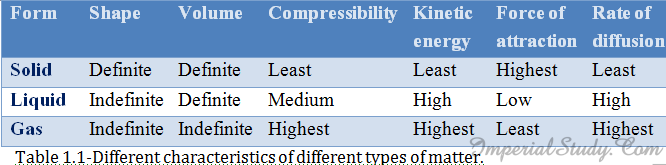
    Below is the table of characteristics of different forms of matter:-

    Matter in our Surroundings Notes of Science Class 9th | PDF Download

    Table 1.1-Different characteristics of different types of matter.

  • Class 9th | NCERT Solutions, Notes, Study Material, Sample Papers & QnA

    Here students can find best NCERT solutions for various subjects of their IX standard, for instance, Hindi, English, Maths, Science and Social Science. We provide you with the best study material that students typically look over the internet and what they typically need.

    Sample Papers are necessary elements for students to build up their examination skills and for practicing before they really face their examinations. They truly enhance the grades you get because they give you much experience for your examination.

    Best and easiest chapter notes so that you have all your concepts and doubts cleared in each subject and each chapter and you give your best in tests and examinations.

    Extra questions that help you to go into the depths of everything that you have learned and different types of questions will help you to build your confidence about each concept.

    MCQs in various subjects that are really necessary in order to stand for your examinations and are in fact an easier way to understand short answer type or one-word answer type questions.

    NCERT solutions that help you in case you are not able to find the correct answers for the questions asked in your textbooks and need to clear your doubts over these questions.

    Quizzes and Tests that not only develop your knowledge but are also fun enough that you would want to try all of them and thus by playing small quizzes you would have learned a lot about your chapters.


    Class 9th English Contents

      • Class 9th English Main Course Book
      • Class 9th English Workbook


    • Sample Paper’s

    Class 9th Mathematics

    Class 9th Science

    Class 9th Social Studies [Social Science]

    Class 9th Hindi

    • Class 9th Hindi Kritika                                                       Notes | Solutions
    • Class 9th Hindi Kshitiz                                                       Notes | Solutions
    • Class 9th Hindi Sparsh                                                      Notes | Solutions
    • Class 9th Hindi Sanchayan                                               Notes | Solutions
    • Class 9th Hindi Extra QnA
    • Sample Paper’s

    Class 9th Computer Science [IT]

    • Class 9th Computer NCERT Solution’s
    • Sample Paper’s

    Class 9th Sanskrit

    • Class 9th Sanskrit NCERT Solution Manika I
    • Class 9th Sanskrit NCERT Solution Manika I (Work Book)
    • Sample Paper’s

    We Hope Our Class 9th Study Materials Help You! Don’t Forget To Share With Your Friends

    If You Found Any Mistake In Notes, Solutions Or Any Topic We left. Please Send Info At ‘Contact Us’ Or Email Us At [email protected] !